EP4461702A1 - Verfahren zum sicheren betreiben eines reformers mit verschiedenen kohlenwasserstoffgemischen - Google Patents
Verfahren zum sicheren betreiben eines reformers mit verschiedenen kohlenwasserstoffgemischen Download PDFInfo
- Publication number
- EP4461702A1 EP4461702A1 EP24162785.0A EP24162785A EP4461702A1 EP 4461702 A1 EP4461702 A1 EP 4461702A1 EP 24162785 A EP24162785 A EP 24162785A EP 4461702 A1 EP4461702 A1 EP 4461702A1
- Authority
- EP
- European Patent Office
- Prior art keywords
- reformer
- molar concentration
- factor
- gas
- gas stream
- Prior art date
- Legal status (The legal status is an assumption and is not a legal conclusion. Google has not performed a legal analysis and makes no representation as to the accuracy of the status listed.)
- Pending
Links
Images
Classifications
-
- C—CHEMISTRY; METALLURGY
- C01—INORGANIC CHEMISTRY
- C01B—NON-METALLIC ELEMENTS; COMPOUNDS THEREOF; METALLOIDS OR COMPOUNDS THEREOF NOT COVERED BY SUBCLASS C01C
- C01B3/00—Hydrogen; Gaseous mixtures containing hydrogen; Separation of hydrogen from mixtures containing it; Purification of hydrogen; Reversible storage of hydrogen
- C01B3/02—Production of hydrogen; Production of gaseous mixtures containing hydrogen
- C01B3/32—Production of hydrogen; Production of gaseous mixtures containing hydrogen by reaction of gaseous or liquid organic compounds with gasifying agents, e.g. water, carbon dioxide or air
- C01B3/34—Production of hydrogen; Production of gaseous mixtures containing hydrogen by reaction of gaseous or liquid organic compounds with gasifying agents, e.g. water, carbon dioxide or air by reaction of hydrocarbons with gasifying agents
- C01B3/38—Production of hydrogen; Production of gaseous mixtures containing hydrogen by reaction of gaseous or liquid organic compounds with gasifying agents, e.g. water, carbon dioxide or air by reaction of hydrocarbons with gasifying agents using catalysts
- C01B3/382—Processes with two or more reaction steps, of which at least one is catalytic, e.g. steam reforming and partial oxidation
-
- C—CHEMISTRY; METALLURGY
- C01—INORGANIC CHEMISTRY
- C01B—NON-METALLIC ELEMENTS; COMPOUNDS THEREOF; METALLOIDS OR COMPOUNDS THEREOF NOT COVERED BY SUBCLASS C01C
- C01B3/00—Hydrogen; Gaseous mixtures containing hydrogen; Separation of hydrogen from mixtures containing it; Purification of hydrogen; Reversible storage of hydrogen
- C01B3/02—Production of hydrogen; Production of gaseous mixtures containing hydrogen
- C01B3/32—Production of hydrogen; Production of gaseous mixtures containing hydrogen by reaction of gaseous or liquid organic compounds with gasifying agents, e.g. water, carbon dioxide or air
- C01B3/34—Production of hydrogen; Production of gaseous mixtures containing hydrogen by reaction of gaseous or liquid organic compounds with gasifying agents, e.g. water, carbon dioxide or air by reaction of hydrocarbons with gasifying agents
-
- C—CHEMISTRY; METALLURGY
- C01—INORGANIC CHEMISTRY
- C01B—NON-METALLIC ELEMENTS; COMPOUNDS THEREOF; METALLOIDS OR COMPOUNDS THEREOF NOT COVERED BY SUBCLASS C01C
- C01B2203/00—Integrated processes for the production of hydrogen or synthesis gas
- C01B2203/02—Processes for making hydrogen or synthesis gas
- C01B2203/0205—Processes for making hydrogen or synthesis gas containing a reforming step
- C01B2203/0211—Processes for making hydrogen or synthesis gas containing a reforming step containing a non-catalytic reforming step
- C01B2203/0216—Processes for making hydrogen or synthesis gas containing a reforming step containing a non-catalytic reforming step containing a non-catalytic steam reforming step
-
- C—CHEMISTRY; METALLURGY
- C01—INORGANIC CHEMISTRY
- C01B—NON-METALLIC ELEMENTS; COMPOUNDS THEREOF; METALLOIDS OR COMPOUNDS THEREOF NOT COVERED BY SUBCLASS C01C
- C01B2203/00—Integrated processes for the production of hydrogen or synthesis gas
- C01B2203/02—Processes for making hydrogen or synthesis gas
- C01B2203/0205—Processes for making hydrogen or synthesis gas containing a reforming step
- C01B2203/0227—Processes for making hydrogen or synthesis gas containing a reforming step containing a catalytic reforming step
- C01B2203/0244—Processes for making hydrogen or synthesis gas containing a reforming step containing a catalytic reforming step the reforming step being an autothermal reforming step, e.g. secondary reforming processes
-
- C—CHEMISTRY; METALLURGY
- C01—INORGANIC CHEMISTRY
- C01B—NON-METALLIC ELEMENTS; COMPOUNDS THEREOF; METALLOIDS OR COMPOUNDS THEREOF NOT COVERED BY SUBCLASS C01C
- C01B2203/00—Integrated processes for the production of hydrogen or synthesis gas
- C01B2203/12—Feeding the process for making hydrogen or synthesis gas
- C01B2203/1205—Composition of the feed
- C01B2203/1211—Organic compounds or organic mixtures used in the process for making hydrogen or synthesis gas
- C01B2203/1235—Hydrocarbons
-
- C—CHEMISTRY; METALLURGY
- C01—INORGANIC CHEMISTRY
- C01B—NON-METALLIC ELEMENTS; COMPOUNDS THEREOF; METALLOIDS OR COMPOUNDS THEREOF NOT COVERED BY SUBCLASS C01C
- C01B2203/00—Integrated processes for the production of hydrogen or synthesis gas
- C01B2203/12—Feeding the process for making hydrogen or synthesis gas
- C01B2203/1205—Composition of the feed
- C01B2203/1211—Organic compounds or organic mixtures used in the process for making hydrogen or synthesis gas
- C01B2203/1235—Hydrocarbons
- C01B2203/1241—Natural gas or methane
-
- C—CHEMISTRY; METALLURGY
- C01—INORGANIC CHEMISTRY
- C01B—NON-METALLIC ELEMENTS; COMPOUNDS THEREOF; METALLOIDS OR COMPOUNDS THEREOF NOT COVERED BY SUBCLASS C01C
- C01B2203/00—Integrated processes for the production of hydrogen or synthesis gas
- C01B2203/12—Feeding the process for making hydrogen or synthesis gas
- C01B2203/1205—Composition of the feed
- C01B2203/1211—Organic compounds or organic mixtures used in the process for making hydrogen or synthesis gas
- C01B2203/1235—Hydrocarbons
- C01B2203/1247—Higher hydrocarbons
-
- C—CHEMISTRY; METALLURGY
- C01—INORGANIC CHEMISTRY
- C01B—NON-METALLIC ELEMENTS; COMPOUNDS THEREOF; METALLOIDS OR COMPOUNDS THEREOF NOT COVERED BY SUBCLASS C01C
- C01B2203/00—Integrated processes for the production of hydrogen or synthesis gas
- C01B2203/14—Details of the flowsheet
- C01B2203/142—At least two reforming, decomposition or partial oxidation steps in series
-
- C—CHEMISTRY; METALLURGY
- C01—INORGANIC CHEMISTRY
- C01B—NON-METALLIC ELEMENTS; COMPOUNDS THEREOF; METALLOIDS OR COMPOUNDS THEREOF NOT COVERED BY SUBCLASS C01C
- C01B2203/00—Integrated processes for the production of hydrogen or synthesis gas
- C01B2203/16—Controlling the process
-
- C—CHEMISTRY; METALLURGY
- C01—INORGANIC CHEMISTRY
- C01B—NON-METALLIC ELEMENTS; COMPOUNDS THEREOF; METALLOIDS OR COMPOUNDS THEREOF NOT COVERED BY SUBCLASS C01C
- C01B2203/00—Integrated processes for the production of hydrogen or synthesis gas
- C01B2203/16—Controlling the process
- C01B2203/1642—Controlling the product
- C01B2203/1647—Controlling the amount of the product
- C01B2203/1652—Measuring the amount of product
- C01B2203/1657—Measuring the amount of product the product being hydrogen
-
- C—CHEMISTRY; METALLURGY
- C01—INORGANIC CHEMISTRY
- C01B—NON-METALLIC ELEMENTS; COMPOUNDS THEREOF; METALLOIDS OR COMPOUNDS THEREOF NOT COVERED BY SUBCLASS C01C
- C01B2203/00—Integrated processes for the production of hydrogen or synthesis gas
- C01B2203/16—Controlling the process
- C01B2203/1642—Controlling the product
- C01B2203/1671—Controlling the composition of the product
- C01B2203/168—Adjusting the composition of the product
Definitions
- the invention relates to a method for operating a reformer, in particular a secondary reformer, autothermal reformer or POX reformer, which is operated in particular with different natural gas compositions.
- a reformer consisting of a primary reformer and a secondary reformer is used to produce hydrogen, for example from natural gas.
- steam reforming takes place in the primary reformer, followed by a second step with partial oxidation in the secondary reformer.
- the secondary reformer is usually an autothermal reformer.
- a so-called pre-reformer can also be used as the primary reformer, or the primary reformer can consist of a pre-reformer and a steam reformer. This is particularly common for subsequent ammonia synthesis.
- the natural gas is first thermally treated in a primary reformer. Air is usually fed in before a secondary reformer.
- this introduces oxygen for the combustion of natural gas and thus for the provision of heat, and on the other hand, nitrogen, which is required as a second reactant for the ammonia synthesis.
- the reformer is followed by a CO conversion and a carbon dioxide separation, so that ideally a gas mixture of hydrogen and nitrogen in a ratio (hereinafter referred to as H:N ratio) of ⁇ 3:1 is then present.
- the gas-air ratio (amount of natural gas fed to the primary reformer to the amount of air fed to the secondary reformer) is relevant and is usually used for control. This ratio is usually varied during operation, for example when the natural gas composition changes. This usually involves compensation for pressure and temperature, since volume flows are usually measured and controlled, not material flows. If too much air is fed in, this causes an incorrect H:N ratio in the subsequent synthesis gas, which may be unsuitable or significantly can be used less efficiently. Furthermore, the temperature in the secondary reformer increases, which leads to damage to the system. Since the temperature can become critical, a limit value for the gas-air ratio is defined in the system. If the temperature falls below this limit, the system is automatically shut down to protect the device from damage.
- a system is usually designed for a specific natural gas composition. If a system is fed from a neighboring natural gas source, a relatively constant composition can be assumed. However, there are also cases in which natural gas from different sources and therefore with different compositions is used. For example, and in particular, the carbon dioxide content can fluctuate, which has a particularly strong effect. This means that the air requirement sometimes differs significantly. If a system is designed for this type of operation, a problem arises. The gas-air ratio must now be selected so that the system can be operated with the different compositions. However, this means that when operating with a natural gas that requires a higher gas-air ratio, the distance to the set limit is very large, which in turn increases the risk of overheating. On the other hand, operation becomes more difficult for a natural gas that requires a low gas-air ratio, since the scope is severely restricted by the limit.
- the object of the invention is to provide a method that enables safe operation regardless of the composition of the natural gas used.
- the method according to the invention is used to operate a reformer, in particular a reformer of a plant for producing ammonia.
- the reformer is operated with at least a first hydrocarbon mixture and a second hydrocarbon mixture.
- the hydrocarbon mixtures are natural gases of different compositions, or a hydrocarbon mixture with a fluctuating composition.
- the hydrocarbon mixtures can also contain other components in addition to hydrocarbons. These hydrocarbon mixtures usually also contain carbon monoxide, carbon dioxide, hydrogen and/or nitrogen.
- the reformer has a primary reformer, to which a first gas stream is fed.
- the reformer also has a secondary reformer. The semi-product gas stream from the primary reformer and an air stream are fed to the secondary reformer.
- the quotient of the first gas stream divided by the air stream is formed from the first gas stream and the air stream.
- a threshold value is specified.
- the threshold value is set according to the state of the art for the quotient of the first gas flow divided by the air flow and is compared with this. If the threshold value is not reached, the reformer is switched off to avoid damage due to overheating.
- the first gas flow and the air flow are recorded and calculated as material flows in mol/s. These can also be recorded in other ways. It is important that they are always recorded and calculated in the same way.
- the threshold value is compared with the product of the quotient of the first gas flow divided by the air flow multiplied by a factor H, whereby the factor is specified depending on the chemical composition of the first gas flow.
- the threshold value is relatively deeply integrated into the plant's safety system and can therefore only be changed with great effort in order to ensure the plant's safety.
- factor H enables adjustment during ongoing operation, which can be determined using a verified natural gas composition.
- the two factors H can be specified during the design so that the system can be switched from one operating state with the first hydrocarbon mixture to another operating state with the second hydrocarbon mixture during operation.
- the factor H(1) is specified for the first hydrocarbon mixture and the factor H(2) for the second hydrocarbon mixture.
- the factor H(3) for the third hydrocarbon mixture can also be determined for this third hydrocarbon mixture.
- the secondary reformer is an autothermal reformer.
- the primary reformer is a pre-reformer or has a pre-reformer.
- the factor H is specified according to the molar concentration of methane, ethane, propane and butane.
- methane is usually the main component.
- longer-chain hydrocarbons are also found. This includes butane, n-butane and 2-methylpropane. Molar concentration is given in mol/mol.
- the factor H is specified according to the molar concentration of methane, ethane, propane, butane, pentane and hexane. This means that even small amounts of the actually liquid hydrocarbons are taken into account.
- pentane and hexane each include all isomers.
- the factor H is specified according to the molar concentration of methane, ethane, propane, butane, pentane, hexane, carbon monoxide, hydrogen and nitrogen. In this way, other components contained in the hydrocarbon mixture can also be taken into account.
- F(current) is an F value of the current gas composition
- F(0) is the F value of the gas composition for which the reformer is designed and for which the threshold value is specified.
- N(C1) is the molar concentration of CH 4
- N(C2) is the molar concentration of C 2 H 6
- N(C3) is the molar concentration of C 3 H 8
- N(C4) is the molar concentration of C 4 H 10
- N(C5) is the molar concentration of C 5 H 12
- N(C6) is the molar concentration of C 6 H 14
- N(CO) is the molar concentration of carbon monoxide
- N(H) is the molar concentration of hydrogen
- N(N) is the molar concentration of nitrogen.
- the gas composition is recorded. This can preferably be done online. Alternatively, this can also be done by taking samples and analyzing them in the laboratory. This enables a particularly variable use of any source of hydrocarbon mixtures, especially natural gases. This also ensures increased safety, since incorrect specification of the hydrocarbon mixture is eliminated as a source of error.
- the factor H is used for the targeted adjustment of the air flow in the event of load changes and/or changes in the composition of the first gas flow.
- the first gas flow is thus actively changed as the factor H changes, so that the amount of gas and in particular oxygen supplied is directly adapted to the changed composition of the hydrocarbon mixture.
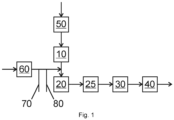
- Fig. 1 device for carrying out the method
- a device for carrying out the method according to the invention is shown.
- the hydrocarbon mixture in particular a natural gas, is first passed past a gas sensor 50 into the primary reformer 10.
- the first gas flow is measured in terms of quantity.
- a partial conversion with water vapor to hydrogen and carbon monoxide takes place (steam reforming).
- the half-product gas flow coming from the primary reformer 10 is mixed with an air flow combined and fed to the secondary reformer 20.
- the air flow is generated via an air compressor 60 and pressure and temperature are recorded with a pressure sensor 70 and a temperature sensor 80 in order to be able to convert the volume flow of the compressor into a mass-quantity air flow.
- the gas is cooled, passed through a CO conversion to increase the hydrogen yield and then the carbon dioxide and other components undesirable in the synthesis of a process gas purification 30 are separated from the gas flow and thus a mixture of hydrogen and nitrogen is introduced into the converter circuit 40 for ammonia synthesis.
Landscapes
- Chemical & Material Sciences (AREA)
- Chemical Kinetics & Catalysis (AREA)
- Organic Chemistry (AREA)
- Health & Medical Sciences (AREA)
- General Health & Medical Sciences (AREA)
- Engineering & Computer Science (AREA)
- Combustion & Propulsion (AREA)
- Inorganic Chemistry (AREA)
- Hydrogen, Water And Hydrids (AREA)
- Organic Low-Molecular-Weight Compounds And Preparation Thereof (AREA)
Abstract
Description
- Die Erfindung betrifft ein Verfahren zum Betreiben eines Reformers, insbesondere eines Sekundärreformers, autothermer Reformers oder POX Reformers, welcher insbesondere mit sich unterscheidenden Erdgaszusammensetzungen betrieben wird.
- Ein Reformer, bestehend aus einem Primärreformer und einem Sekundärreformer, dient zur Herstellung von Wasserstoff, beispielsweise aus Erdgas. In einem ersten Schritt erfolgt im Primärreformer eine Dampfreformierung, an den sich ein zweiter Schritt mit einer partiellen Oxidation im Sekundärreformer anschließt. Der Sekundärreformer ist zumeist ein autothermer Reformer. Als Primärreformer kann auch ein sogenannter Pre-Reformer verwendet werden oder der Primärreformer kann aus einem Pre-Reformer und einem Dampfreformer bestehen. Dieses ist besonders üblich für eine anschließende Ammoniaksynthese. Hierzu wird zunächst in einem Primärreformer das Erdgas zunächst thermisch behandelt. Vor einem Sekundärreformer wird üblicherweise Luft zugeführt. Zum einen wird damit Sauerstoff für eine Verbrennung von Erdgas und damit für die Bereitstellung von Wärme eingebracht, zum anderen Stickstoff, welcher als zweites Edukt für die Ammoniaksynthese benötigt wird. Im Idealfall schließt sich an den Reformer eine CO Konvertierung und eine Kohlendioxidabtrennung an, sodass danach im Idealfall ein Gasgemisch Wasserstoff und Stickstoff im Verhältnis (im weiteren Verlauf als H:N Verhältnis bezeichnet) ~ 3:1 vorliegt.
- Daher ist das Gas-Luft-Verhältnis (Menge an dem Primärreformer zugeführtem Erdgas zu Menge an dem Sekundärreformer zugeführter Luft) relevant und wird üblicherweise zur Regelung verwendet. Dieses Verhältnis wird während des Betriebes üblicherweise variiert, beispielsweise bei geänderter Erdgaszusammensetzung. Hierbei erfolgt üblicherweise eine Kompensation für Druck und Temperatur da üblicherweise Volumenströme gemessen und geregelt werden und nicht Stoffströme. Wird zu viel Luft zugeführt, so verursacht dies ein falsches H:N Verhältnis im späteren Synthesegas, was gegebenenfalls ungeeignet oder deutlich weniger effizient verwendet werden kann. Weiterhin tritt vor allem eine Erhöhung der Temperatur im Sekundärreformer auf, welches zu Beschädigungen in der Anlage führt. Da die Temperatur kritisch werden kann, wird anlagentechnisch ein Grenzwert für das Gas-Luftverhältnis definiert, bei dessen Unterschreiten ein automatisches Abschalten erfolgt, um die Vorrichtung vor Schäden zu schützen.
- Aus der
DE 10 2022 200 572 ist eine beispielhafte Ammoniakanlage gezeigt. - Hierbei wird eine Anlage üblicherweise auf eine bestimmte Erdgaszusammensetzung ausgelegt. Wird eine Anlage aus einer benachbarten Erdgasquelle gespeist, so kann von einer vergleichsweise konstanten Zusammensetzung ausgegangen werden. Es gibt jedoch auch Fälle, in denen Erdgas aus unterschiedlichen Quellen und damit mit unterschiedlichen Zusammensetzungen Verwendung findet. Hierbei kann beispielsweise und insbesondere auch der Kohlendioxidgehalt schwanken, was einen besonders starken Effekt erzeugt. Dadurch unterscheidet sich aber der Luftbedarf teilweise deutlich. Wird eine Anlage somit auf solch einen Betrieb ausgelegt ergibt sich ein Problem. Das Gas-Luft-Verhältnis muss nun so gewählt werden, dass die Anlage mit den verschiedenen Zusammensetzungen betrieben werden kann. Dieses führt aber dazu, dass während des Betriebs mit einem Erdgas, welches ein höheres Gas-Luft-Verhältnis benötigt, der Abstand zu dem gesetzten Grenzwert sehr groß, was wiederum das Risiko einer Überhitzung erhöht. Auf der anderen Seite wird der Betrieb für ein Erdgas, welches ein geringes Gas-Luft-Verhältnis benötigt schwieriger, da der Spielraum durch den Grenzwert stark eingeschränkt wird.
- Aufgabe der Erfindung ist es, ein Verfahren bereit zu stellen, dass den sicheren Betrieb unabhängig von der Zusammensetzung des verwendeten Erdgases ermöglicht.
- Gelöst wird diese Aufgabe durch das Verfahren mit den in Anspruch 1 angegebenen Merkmalen. Vorteilhafte Weiterbildungen ergeben sich aus den Unteransprüchen, der nachfolgenden Beschreibung sowie der Zeichnung.
- Das erfindungsgemäße Verfahren dient zum Betreiben eines Reformers, insbesondere eines Reformers einer Anlage zur Herstellung von Ammoniak. Der Reformer wird wenigstens mit einem ersten Kohlenwasserstoffgemisch und einem zweiten Kohlenwasserstoffgemisch betrieben. Insbesondere handelt es sich bei den Kohlenwasserstoffgemischen um Erdgase unterschiedlicher Zusammensetzung, beziehungsweise um ein Kohlenwasserstoffgemisch mit schwankender Zusammensetzung. Die Kohlenwasserstoffgemische können neben Kohlenwasserstoffen auch andere Bestandteile ausweisen. Üblicherweise weisen diese Kohlenwasserstoffgemische zusätzlich Kohlenmonoxid, Kohlendioxid, Wasserstoff und/oder Sticksoff auf. Der Reformer weist einen Primärreformer auf, dem Primärreformer wird ein erster Gasstrom zugeführt. Der Reformer weist weiter einen Sekundärreformer auf. Dem Sekundärreformer wird der Halbproduktgasstrom aus dem Primärreformer und ein Luftstrom zugeführt. Aus dem ersten Gasstrom und dem Luftstrom wird der Quotient aus erster Gasstrom dividiert durch Luftstrom gebildet. Es wird ein Schwellwert vorgegeben. Üblicherweise wird der Schwellwert nach dem Stand der Technik für den Quotienten aus erstem Gasstrom dividiert durch den Luftstrom vorgegeben und mit diesem verglichen. Bei einem Unterschreiten des Schwellwertes wird der Reformer abgeschaltet, um eine Beschädigung durch Überhitzung zu vermeiden.
- Bevorzugt werden der erste Gasstrom und der Luftstrom als Stoffströme in mol/s erfasst und berechnet. Diese können auch anders erfasst werden. Wesentlich ist, dass diese immer in gleicher Weise erfasst und berechnet werden.
- Erfindungsgemäß wird der Schwellwert verglichen mit dem Produkt aus dem Quotient aus erster Gasstrom durch Luftstrom multipliziert mit einem Faktor H, wobei der Faktor vorgegeben wird in Abhängigkeit von der chemischen Zusammensetzung des ersten Gasstromes. Der Schwellwert ist vergleichsweise tief in dem Sicherheitssystem der Anlage integriert und kann daher selber nur aufwändig geändert werden, um die Sicherheit der Anlage zu gewährleisten. Die Verwendung des Faktor H ermöglicht eine Anpassung im laufenden Betrieb, der anhand einer verifizierten Erdgaszusammensetzung ermittelt werden kann.
- Werden in einer Anlage beispielsweise genau zwei und in der jeweiligen Zusammensetzung bekannte Kohlenwasserstoffgemische eingesetzt, so können die beiden Faktoren H bei der Auslegung vorgegeben werden, sodass die Anlage im laufenden Betrieb quasi von einem Betriebszustand mit dem ersten Kohlenwasserstoffgemisch auf einen anderen Betriebszustand mit dem zweiten Kohlenwasserstoffgemisch umgeschaltet werden kann. Für das erste Kohlenwasserstoffgemisch wird beispielsweise der Faktor H(1) vorgegeben und für das zweite Kohlenwasserstoffgemisch der Faktor H(2). Sollte später auch ein drittes Kohlenwasserstoffgemisch verwendet werden, so kann für dieses dritte Kohlenwasserstoffgemisch ebenfalls der Faktor H(3) für das dritte Kohlenwasserstoffgemisch ermittelt werden.
- In einer weiteren Ausführungsform der Erfindung ist der Sekundärreformer ein autothermer Reformer.
- In einerweiteren Ausführungsform der Erfindung ist der Primärreformer ein Pre-Reformer oder weist einen Pre-Reformer auf.
- In einer weiteren Ausführungsform der Erfindung wird der Faktor H entsprechend der Stoffmengenkonzentration von Methan, Ethan, Propan und Butan vorgegeben. In Erdgas ist Methan üblicherweise die Hauptkomponente. Ja nach Ursprung des Erdgases finden sich aber auch längerkettige Kohlenwasserstoffe. Hierbei umfasst Butan, n-Butan und 2-Methylpropan. Stoffmengenkonzentration wird in mol/mol angegeben.
- In einer weiteren Ausführungsform der Erfindung wird der Faktor H entsprechend der Stoffmengenkonzentration von Methan, Ethan, Propan, Butan, Pentan und Hexan vorgegeben. Somit werden auch geringe Mengen der eigentlich flüssigen Kohlenwasserstoffe berücksichtigt. Auch hier umfassen Pentan und Hexan jeweils alle Isomere.
- In einer weiteren Ausführungsform der Erfindung wird der Faktor H entsprechend der Stoffmengenkonzentration von Methan, Ethan, Propan, Butan, Pentan, Hexan, Kohlenmonoxid, Wasserstoff und Stickstoff vorgegeben. Somit können auch im Kohlenwasserstoffgemisch enthaltene weitere Komponenten berücksichtigt werden.
- In einer weiteren Ausführungsform der Erfindung wird der Faktor H vorgegeben wird als:

- Hierbei ist F(aktuell) ein F Wert der aktuellen Gaszusammensetzung und F(0) ist der F-Wert der Gaszusammensetzung, für die der Reformer ausgelegt und für die der Schwellwert vorgegeben ist.
- Der F-Wert sich nach der Formel berechnet:

- Hierbei sind N(C1) die Stoffmengenkonzentration an CH4, N(C2) die Stoffmengenkonzentration an C2H6, N(C3) die Stoffmengenkonzentration C3H8, wobei N(C4) die Stoffmengenkonzentration C4H10, N(C5) die Stoffmengenkonzentration C5H12, N(C6) die Stoffmengenkonzentration C6H14, N(CO) die Stoffmengenkonzentration an Kohlenmonoxid, N(H) die Stoffmengenkonzentration an Wasserstoff und N(N) die Stoffmengenkonzentration an Stickstoff.
- Der besondere ist, dass durch diesen spezifischen Faktor H eine sehr gute Temperaturstabilität bei gleichzeitig extrem konstantem Verhältnis von Wasserstoff zu Stickstoff erreicht wird.
- In einer weiteren Ausführungsform der Erfindung wird die Gaszusammensetzung erfasst. Dieses kann bevorzugt online erfolgen. Alternativ kann dieses auch durch Probennahme und Analyse im Labor erfolgen. Dieses möglich eine besonders variable Verwendung von beliebigen Quellen von Kohlenwasserstoffgemischen, insbesondere Erdgasen. Auch wird hierdurch eine Erhöhung der Sicherheit gewährleistet, da eine falsche Vorgabe des Kohlenwasserstoffgemisches als Fehlerquelle ausscheidet.
- In einer weiteren Ausführungsform der Erfindung wird der Faktor H zur gezielten Einstellung des Luftstromes bei Laständerungen und/oder Änderungen der Zusammensetzung des ersten Gasstroms verwendet. Es wird somit der erste Gasstrom aktiv so verändert, wie sich der Faktor H ändert, sodass die zugeführte Gas- und insbesondere Sauerstoffmenge direkt an die geänderte Zusammensetzung des Kohlenwasserstoffgemisches angepasst wird.
- Nachfolgend ist das erfindungsgemäße Verfahren anhand eines in der Zeichnung dargestellten Ausführungsbeispiels näher erläutert.
-
Fig. 1 Vorrichtung zur Durchführung des Verfahrens - In
Fig. 1 ist eine Vorrichtung zur Durchführung des erfindungsgemäßen Verfahrens gezeigt. Das Kohlenwasserstoffgemisch, insbesondere ein Erdgas wird zunächst an einem Gassensor 50 vorbei in den Primärreformer 10 geführt. Dabei wird der erste Gasstrom mengenmäßig erfasst. Im Primärreformer 10 erfolgt eine partielle Umsetzung mit Wasserdampf zu Wasserstoff und Kohlenmonoxid (Dampfreformierung). Der aus dem Primärreformer 10 kommende Halbproduktgasstrom wird mit einem Luftstrom vereint und dem Sekundärreformer 20 zugeführt. Der Luftstrom wird über einen Luftverdichter 60 erzeugt und mit einem Drucksensor 70 und einem Temperatursensor 80 werden Druck und Temperatur erfasst, um so den Volumenstrom des Verdichters in einen stoffmengenmäßigen Luftstrom umrechnen zu können. Nach dem Sekundärreformer 20 wird das Gas gekühlt, durch eine CO Konvertierung zur Steigerung der Wasserstoffausbeute geleitet und dann wird aus dem Gasstrom das Kohlendioxid sowie andere in der Synthese unerwünschte Komponenten einer Prozessgasaufreinigung 30 abgetrennt und somit ein Gemisch aus Wasserstoff und Stickstoff in den Konverterkreislauf 40 zu Ammoniaksynthese eingebracht. -
- 10
- Primärreformer
- 20
- Sekundärreformer
- 25
- CO Konvertierung
- 30
- Prozessgasaufreinigung
- 40
- Konverterkreislauf
- 50
- Gassensor
- 60
- Luftverdichter
- 70
- Drucksensor
- 80
- Temperatursensor
Claims (8)
- Verfahren zum Betreiben eines Reformers, wobei der Reformer wenigstens mit einem ersten Kohlenwasserstoffgemisch und einem zweiten Kohlenwasserstoffgemisch betrieben wird, wobei der Reformer einen Primärreformer (10) aufweist, wobei dem Primärreformer (10) ein erster Gasstrom zugeführt wird, wobei der Reformer einen Sekundärreformer (20) aufweist, wobei dem Sekundärreformer (20) der Halbproduktgasstrom aus dem Primärreformer (10) und ein Luftstrom zugeführt wird, wobei aus dem ersten Gasstrom und dem Luftstrom der Quotient aus erster Gasstrom durch Luftstrom gebildet wird, wobei ein Schwellwert vorgegeben wird, wobei bei einem Unterschreiten des Schwellwertes der Reformer abgeschaltet wird, dadurch gekennzeichnet, dass der Schwellwert verglichen wird mit dem Produkt aus dem Quotient aus erster Gasstrom durch Luftstrom multipliziert mit einem Faktor H, wobei der Faktor vorgegeben wird in Abhängigkeit von der chemischen Zusammensetzung des Gasstromes.
- Verfahren nach Anspruch 1 oder 2, dadurch gekennzeichnet, dass der Sekundärreformer (20) ein autothermer Reformer ist.
- Verfahren nach einem der vorstehenden Ansprüche, dadurch gekennzeichnet, dass der Faktor H entsprechend der Stoffmengenkonzentration von Methan, Ethan, Propan und Butan vorgegeben wird.
- Verfahren nach Anspruch 3, dadurch gekennzeichnet, dass der Faktor H entsprechend der Stoffmengenkonzentration von Methan, Ethan, Propan, Butan, Pentan und Hexan vorgegeben wird.
- Verfahren nach Anspruch 4, dadurch gekennzeichnet, dass der Faktor H entsprechend der Stoffmengenkonzentration von Methan, Ethan, Propan, Butan, Pentan, Hexan, Kohlenmonoxid, Wasserstoff und Stickstoff vorgegeben wird.
- Verfahren nach Anspruch 5, dadurch gekennzeichnet, dass der Faktor H vorgegeben wird als:


- Verfahren nach einem der vorstehenden Ansprüche, dadurch gekennzeichnet, dass die Gaszusammensetzung erfasst wird.
- Verfahren nach einem der vorstehenden Ansprüche, dadurch gekennzeichnet, dass der Faktor H zur gezielten Einstellung des Luftstromes bei Laständerungen und/oder Änderungen der Zusammensetzung des ersten Gasstroms verwendet wird.
Applications Claiming Priority (2)
| Application Number | Priority Date | Filing Date | Title |
|---|---|---|---|
| DE102023106377.4A DE102023106377A1 (de) | 2023-03-14 | 2023-03-14 | Verfahren zum sicheren Betreiben eines Reformers mit verschiedenen Kohlenwasserstoffgemischen |
| LU103087A LU103087B1 (de) | 2023-03-14 | 2023-03-14 | Verfahren zum sicheren Betreiben eines Reformers mit verschiedenen Kohlenwasserstoffgemischen |
Publications (1)
| Publication Number | Publication Date |
|---|---|
| EP4461702A1 true EP4461702A1 (de) | 2024-11-13 |
Family
ID=90361357
Family Applications (1)
| Application Number | Title | Priority Date | Filing Date |
|---|---|---|---|
| EP24162785.0A Pending EP4461702A1 (de) | 2023-03-14 | 2024-03-11 | Verfahren zum sicheren betreiben eines reformers mit verschiedenen kohlenwasserstoffgemischen |
Country Status (2)
| Country | Link |
|---|---|
| US (1) | US20240308845A1 (de) |
| EP (1) | EP4461702A1 (de) |
Citations (4)
| Publication number | Priority date | Publication date | Assignee | Title |
|---|---|---|---|---|
| US20020172630A1 (en) * | 2001-03-23 | 2002-11-21 | Shabbir Ahmed | Fuel processor and method for generating hydrogen for fuel cells |
| US20150086888A1 (en) * | 2012-03-19 | 2015-03-26 | Jx Nippon Oil & Energy Corporation | Method for determining composition of gas fuel, device for determining composition of gas fuel, fuel supply system, and fuel cell system |
| US20230002225A1 (en) * | 2019-12-03 | 2023-01-05 | Synhelion Sa | Process for the production of syngas |
| DE102022200572A1 (de) | 2022-01-19 | 2023-07-20 | Thyssenkrupp Ag | Ammoniaksynthese und Harnstoffsynthese mit reduziertem CO2-Fußabdruck |
-
2024
- 2024-03-11 EP EP24162785.0A patent/EP4461702A1/de active Pending
- 2024-03-13 US US18/604,261 patent/US20240308845A1/en active Pending
Patent Citations (4)
| Publication number | Priority date | Publication date | Assignee | Title |
|---|---|---|---|---|
| US20020172630A1 (en) * | 2001-03-23 | 2002-11-21 | Shabbir Ahmed | Fuel processor and method for generating hydrogen for fuel cells |
| US20150086888A1 (en) * | 2012-03-19 | 2015-03-26 | Jx Nippon Oil & Energy Corporation | Method for determining composition of gas fuel, device for determining composition of gas fuel, fuel supply system, and fuel cell system |
| US20230002225A1 (en) * | 2019-12-03 | 2023-01-05 | Synhelion Sa | Process for the production of syngas |
| DE102022200572A1 (de) | 2022-01-19 | 2023-07-20 | Thyssenkrupp Ag | Ammoniaksynthese und Harnstoffsynthese mit reduziertem CO2-Fußabdruck |
Non-Patent Citations (1)
| Title |
|---|
| CHAN S.H. ET AL: "Effect of natural gas composition on autothermal fuel reforming products", vol. 64, no. 1-3, 1 May 2000 (2000-05-01), NL, pages 221 - 239, XP093083684, ISSN: 0378-3820, Retrieved from the Internet <URL:https://pdf.sciencedirectassets.com/271404/1-s2.0-S0378382000X00513/1-s2.0-S0378382000000655/main.pdf?X-Amz-Security-Token=IQoJb3JpZ2luX2VjEOj//////////wEaCXVzLWVhc3QtMSJIMEYCIQCsRLcBa7mkh7rM+1x0LbYvgCFTFUx5G2GqtzGrX3M2BwIhAKgeTWX7JzrGGO4RYLWIBNGa9rWrUs/HIyx8wozUewDNKrsFCND//////////wEQBRoMMDU5MDAzN> DOI: 10.1016/S0378-3820(00)00065-5 * |
Also Published As
| Publication number | Publication date |
|---|---|
| US20240308845A1 (en) | 2024-09-19 |
Similar Documents
| Publication | Publication Date | Title |
|---|---|---|
| EP1525172B1 (de) | Verfahren zum sicheren betreiben einer kontinuierlichen heterogen katalysierten gasphasen-partialoxidation wenigstens einer organischen verbindung | |
| EP3083493B1 (de) | Verfahren zur herstellung von synthesegas | |
| DE602004004871T2 (de) | Verfahren und anordnung zur gleichzeitigen evaluierung mehrerer katalysatoren | |
| EP2720788B1 (de) | Verfahren zur modifizierung eines methanhaltigen gasvolumenstroms | |
| EP2021274A1 (de) | Verfahren und anlage zur herstellung von synthesegas | |
| EP3205622A1 (de) | Verfahren zur synthese von methanol | |
| EP2625156B1 (de) | Verfahren und vorrichtung zur erzeugung eines methanreichen gases aus synthesegas | |
| DE1645826B1 (de) | Verfahren zur Umwandlung eines Kohlenwasserstoffeinsatzmaterials | |
| DE102009059310A1 (de) | Hocheffizientes Verfahren zur katalytischen Methanisierung von Kohlendioxid und Wasserstoff enthaltenden Gasgemischen | |
| LU103087B1 (de) | Verfahren zum sicheren Betreiben eines Reformers mit verschiedenen Kohlenwasserstoffgemischen | |
| EP3219697B1 (de) | Methanolsynthese aus synthesegasen mit wasserstoffmangel | |
| DE102023106377A1 (de) | Verfahren zum sicheren Betreiben eines Reformers mit verschiedenen Kohlenwasserstoffgemischen | |
| DE69927976T2 (de) | Verfahren zur dampfreformierung eines kohlenwasserstoffs | |
| EP3020696A1 (de) | Verfahren und anlage zur herstellung eines oder mehrerer oxygenate | |
| DE3521304A1 (de) | Verfahren zur erzeugung eines synthesegases | |
| DE2314804A1 (de) | Verfahren zur erzeugung methanhaltiger gase aus kohlenwasserstoffen | |
| WO2016198245A1 (de) | Festlegung von druck, temperatur und s/c-verhältnis für einen russfreien atr-betrieb | |
| DE3803080A1 (de) | Verfahren zur erzeugung von synthesegasen aus kohlenwasserstoffhaltigen einsatzstoffen | |
| Bautista et al. | Influence of Ni Cu alloying on Sepiolite-supported nickel catalysts in the liquid-phase selective hydrogenation of fatty acid ethyl esters | |
| EP3816145A1 (de) | Verfahren und anlage zur herstellung von methanol aus wasserstoffreichem synthesegas | |
| DE3803082A1 (de) | Mehrstufiges verfahren zur erzeugung von h(pfeil abwaerts)2(pfeil abwaerts)- und co-haltigen synthesegasen | |
| EP3037503B1 (de) | Verfahren zur herstellung und nutzung eines kohlenwasserstoffgemisches | |
| DE102005026881A1 (de) | Hochtemperaturreformierung | |
| EP0726929A1 (de) | Katalytisches reformierungsverfahren und reaktor | |
| EP3702016A1 (de) | Verfahren und anlage zur gewinnung eines propylenprodukts |
Legal Events
| Date | Code | Title | Description |
|---|---|---|---|
| PUAI | Public reference made under article 153(3) epc to a published international application that has entered the european phase |
Free format text: ORIGINAL CODE: 0009012 |
|
| STAA | Information on the status of an ep patent application or granted ep patent |
Free format text: STATUS: THE APPLICATION HAS BEEN PUBLISHED |
|
| AK | Designated contracting states |
Kind code of ref document: A1 Designated state(s): AL AT BE BG CH CY CZ DE DK EE ES FI FR GB GR HR HU IE IS IT LI LT LU LV MC ME MK MT NL NO PL PT RO RS SE SI SK SM TR |
|
| STAA | Information on the status of an ep patent application or granted ep patent |
Free format text: STATUS: REQUEST FOR EXAMINATION WAS MADE |
|
| 17P | Request for examination filed |
Effective date: 20250513 |
|
| GRAP | Despatch of communication of intention to grant a patent |
Free format text: ORIGINAL CODE: EPIDOSNIGR1 |
|
| STAA | Information on the status of an ep patent application or granted ep patent |
Free format text: STATUS: GRANT OF PATENT IS INTENDED |
|
| RIC1 | Information provided on ipc code assigned before grant |
Ipc: C01B 3/38 20060101AFI20251006BHEP |
|
| INTG | Intention to grant announced |
Effective date: 20251028 |
|
| GRAJ | Information related to disapproval of communication of intention to grant by the applicant or resumption of examination proceedings by the epo deleted |
Free format text: ORIGINAL CODE: EPIDOSDIGR1 |
|
| STAA | Information on the status of an ep patent application or granted ep patent |
Free format text: STATUS: REQUEST FOR EXAMINATION WAS MADE |
|
| GRAP | Despatch of communication of intention to grant a patent |
Free format text: ORIGINAL CODE: EPIDOSNIGR1 |
|
| STAA | Information on the status of an ep patent application or granted ep patent |
Free format text: STATUS: GRANT OF PATENT IS INTENDED |
|
| INTC | Intention to grant announced (deleted) | ||
| INTG | Intention to grant announced |
Effective date: 20260121 |
|
| GRAS | Grant fee paid |
Free format text: ORIGINAL CODE: EPIDOSNIGR3 |
|
| GRAA | (expected) grant |
Free format text: ORIGINAL CODE: 0009210 |
|
| STAA | Information on the status of an ep patent application or granted ep patent |
Free format text: STATUS: THE PATENT HAS BEEN GRANTED |