EP4459903A1 - Verfahren zur datenübertragung und kommunikationsvorrichtung - Google Patents
Verfahren zur datenübertragung und kommunikationsvorrichtung Download PDFInfo
- Publication number
- EP4459903A1 EP4459903A1 EP21969295.1A EP21969295A EP4459903A1 EP 4459903 A1 EP4459903 A1 EP 4459903A1 EP 21969295 A EP21969295 A EP 21969295A EP 4459903 A1 EP4459903 A1 EP 4459903A1
- Authority
- EP
- European Patent Office
- Prior art keywords
- group
- block size
- mapping relationship
- data block
- coding mode
- Prior art date
- Legal status (The legal status is an assumption and is not a legal conclusion. Google has not performed a legal analysis and makes no representation as to the accuracy of the status listed.)
- Pending
Links
Images




Classifications
-
- H—ELECTRICITY
- H04—ELECTRIC COMMUNICATION TECHNIQUE
- H04W—WIRELESS COMMUNICATION NETWORKS
- H04W28/00—Network traffic management; Network resource management
- H04W28/16—Central resource management; Negotiation of resources or communication parameters, e.g. negotiating bandwidth or QoS [Quality of Service]
-
- H—ELECTRICITY
- H04—ELECTRIC COMMUNICATION TECHNIQUE
- H04L—TRANSMISSION OF DIGITAL INFORMATION, e.g. TELEGRAPHIC COMMUNICATION
- H04L1/00—Arrangements for detecting or preventing errors in the information received
- H04L1/0001—Systems modifying transmission characteristics according to link quality, e.g. power backoff
- H04L1/0009—Systems modifying transmission characteristics according to link quality, e.g. power backoff by adapting the channel coding
-
- H—ELECTRICITY
- H04—ELECTRIC COMMUNICATION TECHNIQUE
- H04L—TRANSMISSION OF DIGITAL INFORMATION, e.g. TELEGRAPHIC COMMUNICATION
- H04L1/00—Arrangements for detecting or preventing errors in the information received
- H04L1/0001—Systems modifying transmission characteristics according to link quality, e.g. power backoff
- H04L1/0002—Systems modifying transmission characteristics according to link quality, e.g. power backoff by adapting the transmission rate
-
- H—ELECTRICITY
- H04—ELECTRIC COMMUNICATION TECHNIQUE
- H04L—TRANSMISSION OF DIGITAL INFORMATION, e.g. TELEGRAPHIC COMMUNICATION
- H04L1/00—Arrangements for detecting or preventing errors in the information received
- H04L1/0001—Systems modifying transmission characteristics according to link quality, e.g. power backoff
- H04L1/0009—Systems modifying transmission characteristics according to link quality, e.g. power backoff by adapting the channel coding
- H04L1/0013—Rate matching, e.g. puncturing or repetition of code symbols
-
- H—ELECTRICITY
- H04—ELECTRIC COMMUNICATION TECHNIQUE
- H04L—TRANSMISSION OF DIGITAL INFORMATION, e.g. TELEGRAPHIC COMMUNICATION
- H04L1/00—Arrangements for detecting or preventing errors in the information received
- H04L1/004—Arrangements for detecting or preventing errors in the information received by using forward error control
- H04L1/0056—Systems characterized by the type of code used
- H04L1/0057—Block codes
-
- H—ELECTRICITY
- H04—ELECTRIC COMMUNICATION TECHNIQUE
- H04L—TRANSMISSION OF DIGITAL INFORMATION, e.g. TELEGRAPHIC COMMUNICATION
- H04L25/00—Baseband systems
- H04L25/38—Synchronous or start-stop systems, e.g. for Baudot code
- H04L25/40—Transmitting circuits; Receiving circuits
- H04L25/49—Transmitting circuits; Receiving circuits using code conversion at the transmitter; using predistortion; using insertion of idle bits for obtaining a desired frequency spectrum; using three or more amplitude levels ; Baseband coding techniques specific to data transmission systems
- H04L25/4906—Transmitting circuits; Receiving circuits using code conversion at the transmitter; using predistortion; using insertion of idle bits for obtaining a desired frequency spectrum; using three or more amplitude levels ; Baseband coding techniques specific to data transmission systems using binary codes
-
- H—ELECTRICITY
- H04—ELECTRIC COMMUNICATION TECHNIQUE
- H04L—TRANSMISSION OF DIGITAL INFORMATION, e.g. TELEGRAPHIC COMMUNICATION
- H04L5/00—Arrangements affording multiple use of the transmission path
- H04L5/003—Arrangements for allocating sub-channels of the transmission path
- H04L5/0058—Allocation criteria
- H04L5/0064—Rate requirement of the data, e.g. scalable bandwidth, data priority
-
- H—ELECTRICITY
- H04—ELECTRIC COMMUNICATION TECHNIQUE
- H04W—WIRELESS COMMUNICATION NETWORKS
- H04W72/00—Local resource management
- H04W72/04—Wireless resource allocation
- H04W72/044—Wireless resource allocation based on the type of the allocated resource
- H04W72/0457—Variable allocation of band or rate
-
- H—ELECTRICITY
- H04—ELECTRIC COMMUNICATION TECHNIQUE
- H04B—TRANSMISSION
- H04B7/00—Radio transmission systems, i.e. using radiation field
- H04B7/24—Radio transmission systems, i.e. using radiation field for communication between two or more posts
- H04B7/26—Radio transmission systems, i.e. using radiation field for communication between two or more posts at least one of which is mobile
-
- H—ELECTRICITY
- H04—ELECTRIC COMMUNICATION TECHNIQUE
- H04L—TRANSMISSION OF DIGITAL INFORMATION, e.g. TELEGRAPHIC COMMUNICATION
- H04L1/00—Arrangements for detecting or preventing errors in the information received
- H04L1/0001—Systems modifying transmission characteristics according to link quality, e.g. power backoff
- H04L1/0006—Systems modifying transmission characteristics according to link quality, e.g. power backoff by adapting the transmission format
- H04L1/0007—Systems modifying transmission characteristics according to link quality, e.g. power backoff by adapting the transmission format by modifying the frame length
Definitions
- the present disclosure relates to the technical field of communications, and more particularly to a method for data transmission and a communication device.
- the application of battery-free and low-cost passive Internet of Things (IoT) devices has become the key technology of cellular IoT, which can enrich the types and number of terminals in the network to truly realize the Internet of Everything.
- the passive IoT devices can be zero-power terminals based on Radio Frequency Identification (RFID), and can be extended on this basis to be suitable for cellular IoT.
- RFID Radio Frequency Identification
- Embodiments of the present disclosure provide a method for data transmission and a communication device, so that the cellular IoT is compatible with zero-power terminals, which can not only enrich the types and number of linked terminals in the network to truly realize the Internet of Everything, but also improve the data transmission performance and the integrity of data transmission.
- a method for data transmission which includes following operation.
- a first code unit length used for first data and/or a first coding mode used for the first data are determined based on first information.
- the first information includes at least one of a first data block size used for the first data, a first code rate used for the first data, or a first bit number corresponding to a first data stream obtained by encoding the first data.
- the present disclosure provides a communication device for performing the method in the first aspect or various implementations thereof.
- the communication device includes functional modules for performing the method in the first aspect or various implementations thereof.
- the communication device may include a processing unit configured to perform functions related to information processing.
- the processing unit may be a processor.
- the communication device may include a sending unit and/or a receiving unit.
- the sending unit is configured to perform functions related to sending
- the receiving unit is configured to perform functions related to receiving.
- the sending unit may be a transmitter or an emitter and the receiving unit may be a receiver or a receptor.
- the communication device is a communication chip, the sending unit can be an input circuit or an interface of the communication chip, and the sending unit can be an output circuit or an interface of the communication chip.
- the communication device is a terminal device or a network device.
- the present disclosure provides a communication device including a processor and a memory.
- the memory is used for storing a computer program
- the processor is configured to invoke and run the computer program stored in the memory to perform the method in the first aspect or various implementations thereof.
- the number of the processor may be one or more and the number of the memory may be one or more.
- the memory may be integrated with the processor, or the memory may be disposed separately from the processor.
- the communication device further includes a transmitter (emitter) and a receiver (receptor).
- the communication device is a terminal device or a network device.
- the present disclosure provides a chip for implementing the method in the first aspect or various implementations thereof.
- the chip includes a processor configured to invoke and run a computer program from a memory to cause a device installed with the chip to perform the method in the first aspect or various implementations thereof.
- the present disclosure provides a computer-readable storage medium for storing a computer program that causes a computer to perform the method in the first aspect or various implementations thereof.
- the present disclosure provides a computer program product including computer program instructions that cause a computer to perform the method in the first aspect or various implementations thereof.
- the present disclosure provides a computer program that, when run on a computer, causes the computer to perform the method in the first aspect or various implementations thereof.
- the communication device determines, based on first information, a first code unit length used for first data and/or a first coding mode used for the first data, and the first information is designed to include at least one of a first data block size used for the first data, a first code rate used for the first data, or a first bit number corresponding to a first data stream obtained by encoding the first data, which is equivalent that the cellular IoT is enabled to be compatible with the communication mode of the zero-power terminal. That is, the cellular IoT is enabled to be compatible with the zero-power terminal, which can enrich the type and number of linked terminals in the network, so as to truly realize the Internet of Everything.
- the communication device determines, based on first information, a first code unit length used for first data and/or a first coding mode used for the first data, which is equivalent that the first coding mode and/or the first code unit length are associated with the first information.
- the first code rates or the first bit numbers are different, the first code unit lengths and/or the first coding modes determined by the communication device based on the first data block sizes, the first code rates or the first bit numbers may be different.
- the communication device can adaptively adjust the first code unit length and/or the first coding mode based on the first information, which facilitates improvement of the reliability of data transmission or data transmission rate and facilitates the interference deletion processing at a receiving end, thereby improving the data transmission performance and the integrity of data transmission.
- indication herein may be a direct indication, an indirect indication, or an indication indicates that there is an association.
- “A indicates B” means that A directly indicates B.
- B can be obtained through A.
- “A indicates B” can also mean that A indirectly indicates B.
- a indicates C and B can be obtained by C.
- “A indicates B” can also indicate that there is an association between A and B.
- pre-configuration herein may be achieved by pre-storing corresponding codes, tables, or other means that may be used to indicate related information in a device (e.g., including a terminal device and a network device), the specific implementation of which is not limited in the present disclosure.
- pre-configuration can refer to being defined in the protocol.
- the "protocol” may refer to standard protocols in the communication field, such as LTE protocols, NR protocols, and related protocols applied in future communication systems, which are not limited in the present disclosure.
- GSM Global System of Mobile communication
- CDMA Code Division Multiple Access
- WCDMA Wideband Code Division Multiple Access
- GPRS General Packet Radio Service
- LTE Long Term Evolution
- LTE-A Advanced long term evolution
- NR New Radio
- NR-U Universal Mobile Telecommunication Systems
- UMTS Universal Mobile Telecommunication Systems
- WLAN Wireless Local Area Networks
- WiFi Wireless Fidelity
- the cellular Internet of Things is the development product of the combination of cellular mobile communication network and Internet of Things.
- the cellular passive Internet of Things is also called passive cellular Internet of Things, which is a combination of a network device and passive terminals.
- a passive terminal can communicate with other passive terminals through the network device, or the passive terminals can communicate in a Device to Device (D2D) communication mode, while the network device only needs to send carrier signals, that is, power supply signals, to supply power to the passive terminals.
- D2D Device to Device
- the communication system in the embodiments of the present disclosure can be applied to a Carrier Aggregation (CA) scenario, a Dual Connectivity (DC) scenario, and a Standalone (SA) network distribution scenario.
- CA Carrier Aggregation
- DC Dual Connectivity
- SA Standalone
- the applied spectrum is not limited by the embodiments of the present disclosure.
- the embodiments of the present disclosure may be applied to a licensed spectrum or an unlicensed spectrum.
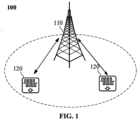
- the communication system 100 may include a network device 110, which may be a device that communicates with a terminal device 120 (or referred to as a communication terminal or terminal).
- the network device 110 may provide communication coverage for a particular geographic area and may communicate with terminal devices located within the coverage area.
- FIG. 1 exemplarily illustrates one network device and two terminal devices.
- the communication system 100 may include multiple network devices and other numbers of terminal devices may be included within the coverage area of each network device, which is not limited by the embodiments of the present disclosure.
- the communication system 100 may further include other network entities, such as a network controller, a mobility management entity and the like, which are not limited by the embodiments of the present disclosure.
- network entities such as a network controller, a mobility management entity and the like, which are not limited by the embodiments of the present disclosure.
- a device having a communication function in a network/system in the embodiments of the present disclosure may be referred to as a communication device.
- the communication device may include a network device 110 and terminal devices 120 that have a communication function, and the network device 110 and the terminal devices 120 may be specific devices described above and will not be described here.
- the communication device may further include other devices in the communication system 100, such as a network controller, a mobility management entity and other network entities, which are not limited in the embodiments of the present disclosure.
- the embodiments of the present disclosure describe various embodiments in connection with the terminal device and the network device.
- the network device may be a device for communicating with a mobile device, the network device may be an Access Point (AP) in a WLAN, a Base Transceiver Station (BTS) in a GSM or in a CDMA, a base station (NodeB, NB) in a WCDMA system, an Evolutional Node B (eNB or eNodeB) in a LTE, or a relay station or an Access Point, or a network device (gNB) in a vehicle-mounted device, a wearable device and an NR network or a network device in a future evolved Public Land Mobile Network (PLMN), etc.
- AP Access Point
- BTS Base Transceiver Station
- NodeB, NB base station
- eNB Evolutional Node B
- gNB network device
- PLMN future evolved Public Land Mobile Network
- the network device provides services for a cell
- the terminal device communicates with the network device through transmission resources (e.g., frequency domain resources, or spectrum resources) used by the cell.
- the cell may be a cell corresponding to the network device (e.g., base station), and the cell may belong to a macro base station or a base station corresponding to a Small cell.
- the Small cell may include a Metro cell, a Micro cell, a Pico cell, a Femto cell, etc. These Small cells have the characteristics of small coverage and low transmission power, and are suitable for providing high-speed data transmission services.
- a terminal device may also be referred to as a User Equipment, an access terminal, a subscriber unit, a subscriber station, a mobile station, a mobile platform, a remote terminal, a mobile device, a user terminal, a terminal, a wireless communication device, a user agent or a user apparatus, etc.
- the terminal device may be a STAION (ST) in a WLAN, a cellular telephone, a cordless telephone, a Session Initiation Protocol (SIP) telephone, a Wireless Local Loop (WLL) station, a Personal Digital Assistant (PDA) device, a handheld device having a wireless communication function, a computing device or other processing devices connected to a wireless modem, a vehicle-mounted device, a wearable device, and a next generation communication system, such as a terminal device in an NR network or a terminal device in a future evolved PLMN, or a zero-power device.
- ST STAION
- WLAN Wireless Local Loop
- PDA Personal Digital Assistant
- the terminal device may also be a wearable device.
- the wearable device can also be called a wearable intelligent device, which is a general name of wearable devices (such as glasses, gloves, watches, clothing and shoes) developed by intelligently designing daily wear by applying wearable technologies.
- the wearable device is a portable device that is worn directly on the body or integrated into the user's clothes or accessories.
- the wearable device is not only a kind of hardware device, but also realizes powerful functions through software support, data interaction and cloud interaction.
- the generalized wearable smart device includes devices that have full functions and a large size, which can realize complete or partial functions without relying on smart phones, such as smart watches or smart glasses.
- the generalized wearable smart device further includes devices that only focus on a certain kind of application function, which need to be used in conjunction with other devices, such as smart phones, such as various smart bracelets and smart jewelry for monitoring physical signs.
- a zero-power device can be understood as a device whose power consumption is lower than preset power consumption.
- the zero-power device includes passive terminals and even includes semi-passive terminals.
- the zero-power device is a Radio Frequency Identification (RFID) tag, which is a technology for realizing contactless automatic transmission and identification of tag information by means of spatial coupling of radio frequency signals.
- RFID tag is also called “radio frequency tag” or “electronic tag”.
- the electronic tag can be divided into different types, which may be an active electronic tag, a passive electronic tag and a semi-passive electronic tag.
- the active electronic tag also known as initiative electronic tag, means that the working power of the electronic tag is provided by battery, and the battery, memory and antenna together form the active electronic tag. Different from the passive radio frequency activation mode, the active electronic tag sends information through set frequency band before battery replacement.
- the passive electronic tag also known as inactive electronic tag, does not support a built-in battery.
- the tag When the passive electronic tag approaches a reader, the tag is in the near field range formed by the radiation of an antenna of the reader.
- An antenna of the electronic tag generates an induced current through electromagnetic induction, and the induced current drives a chip circuit of the electronic tag.
- the chip circuit sends the identification information stored in the tag to the reader through the antenna of the electronic tag.
- the semi-passive electronic tag also known as semi-initiative electronic tag, inherits the advantages of small size, light weight, low price and long service life of the passive electronic tag.
- the semi-passive electronic tag only provides power for a few circuits in the chip through its built-in battery when it is not accessed by the reader, and only when it is accessed by the reader, the RFID chip is powered by the built-in battery, so as to increase the reading and writing distance of the tag and thus improve the reliability of communication.
- An RFID system is a wireless communication system.
- the RFID system is composed of two parts: an electronic tag and a Reader/Writer.
- the electronic tag includes coupling components and chips. Every electronic tag has a unique electronic code, which is placed on the measured target to mark the target object.
- the reader/writer cannot only read the information on the electronic tag, but also write the information on the electronic tag, and at the same time provide the power needed for communication for the electronic tag.
- Zero-power communication adopts technologies of power harvesting and back scattering communication. In order to understand the technical solutions of the embodiments of the present disclosure, the related zero-power technology is explained.
- FIG. 2 is a schematic diagram of a zero-power communication system according to the present disclosure.
- the zero-power communication system consists of a network device and a zero-power terminal.
- the network device is used to send wireless power supply signals and downlink communication signals to the zero-power terminal and receive back scattering signals from the zero-power terminal.
- a basic zero-power terminal includes a power harvesting module, a back scattering communication module and a low power computing module.
- the zero-power terminal can further have a memory or a sensor for storing some basic information (such as, article identification, etc.) or obtaining sensing data, such as ambient temperature and ambient humidity.
- the zero-power communication can also be called zero-power terminal-based communication.
- the key technologies of the zero-power communication mainly include Radio Frequency (RF) power harvesting and back scattering communication.
- RF Radio Frequency
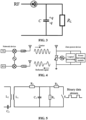
- FIG. 3 is a principle diagram of power harvesting according to an embodiment of the present disclosure.
- the power harvesting module can include a capacitor C and a resistor R L .
- the power harvesting module harvests spatial electromagnetic wave power based on the principle of electromagnetic induction, and then obtains the power required to drive the zero-power terminal to work, such as driving the low-power demodulation and modulation module, sensors and memory reading. Therefore, the zero-power terminal does not need a conventional battery.
- the principle of electromagnetic induction means that as long as the magnetic flux passing through the closed circuit changes, the induced current will be generated in the closed circuit.
- the capacitor C and the resistor R L can be used to form a closed circuit.
- the radio frequency power harvesting module can generate an induced current and store the generated induced current in the capacitor C to realize the harvesting of spatial electromagnetic wave power.
- FIG. 4 is a principle diagram of back scattering communication according to the present disclosure.
- a network device acts as a sending end (TX)
- the network device sends a carrier to a zero-power device through an amplifier (AMP).
- the zero-power device uses the power harvested by the power harvesting module to drive a logic processing module and a modulation module to process and modulate the carrier, and loads, through a variable resistor, the information needed to be sent and radiates the modulated reflected signal from the antenna.
- This information transmission process is called back scattering communication.
- the network device acts as a receiving end (RX)
- the reflected signal sent by the zero-power device can be received by a low noise amplifier (LNA).
- the AMP and the LNA may each be connected with a voltage display lamp, and an emergency lamp may be provided between the voltage display lamps respectively connected to the AMP and LNA.
- the functions of back scattering communication and load modulation are inseparable.
- the load modulation adjusts and controls the circuit parameters of the oscillation loop of the zero-power terminal according to the clock of the data stream, so that the size and the phase of impedance of the zero-power device are changed accordingly, and thus the modulation process is completed.
- the technology of the load modulation mainly includes two methods: resistance-based load modulation and capacitance-based load modulation.
- FIG. 5 is a circuit diagram of resistance-based load modulation according to an embodiment of the present disclosure.
- the resistor R L is connected in parallel with a resistor R 3 .
- the resistor R L can be called a load modulation resistor.
- the resistor R L is switched on or switched off based on the control of binary data stream. The switching on and off of the resistor R L will lead to the change of circuit voltage.
- the resistor R L can be connected in parallel with an inductor L 1 through a resistor R 2 , and the inductor L 1 is used to form a resonant circuit with an inductor L 2 .
- the switching on and off of the load modulation resistor will lead to the change of circuit voltage, which will lead to the change of resonant frequency of the resonant circuit, and finally realize amplitude keying (ASK) modulation. That is, signal modulation and transmission are realized by adjusting the amplitude of back scattering signal of the zero-power terminal.
- the inductor L 2 can also be connected to a capacitor C 2 , which can be used to convert a change in the resonant frequency of the resonant circuit into a signal for transmission by the antenna.
- the change of the resonant frequency of the resonant circuit can be realized by switching on and off the capacitor C1 in order to realize frequency keying (FSK) modulation. That is, the signal modulation and transmission are realized by adjusting the working frequency of the back scattering signal of the zero-power terminal.
- FSK frequency keying
- the zero-power terminal modulates incoming signals by means of load modulation and performs the back scattering communication process, the zero-power terminal has following significant advantages.
- the terminal device may be a zero-power device (such as a passive terminal, or even a semi-passive terminal), or even the terminal device may be a non-zero-power device, such as an ordinary terminal, but the ordinary terminal may perform back scattering communication in some cases.
- a zero-power device such as a passive terminal, or even a semi-passive terminal
- the terminal device may be a non-zero-power device, such as an ordinary terminal, but the ordinary terminal may perform back scattering communication in some cases.
- the data transmitted by the terminal device can use different forms of codes to represent binary "1" and "0".
- Radio frequency identification systems generally use one of the following coding modes: reverse non-return-to-zero (NRZ) coding, Manchester coding, Unipolar RZ coding, differential bi-phase (DBP) coding, Miller coding and differential coding.
- NRZ reverse non-return-to-zero
- Manchester coding Manchester coding
- Unipolar RZ coding Unipolar RZ coding
- DBP differential bi-phase
- Miller coding Miller coding
- 0 and 1 are represented by use of different pulse signals.
- the zero-power terminal may be divided into the following types based on the power source and usage mode of the zero-power terminal.
- the zero-power terminal does not need a built-in battery.
- the zero-power terminal approaches the network device (such as the reader of the RFID system)
- the zero-power terminal is in the near-field range formed by the radiation of the antenna of the network device. Therefore, an antenna of the zero-power terminal generates an induced current through electromagnetic induction, and the induced current drives the low power chip circuit of the zero-power terminal, so that demodulation of signals in the forward link and modulation of signals in the backward link are realized.
- the zero-power terminal uses the back scattering implementation for signal transmission.
- the passive zero-power terminal does not need the built-in battery to drive either the forward link or the backward link, so it is a true zero-power terminal.
- the passive zero-power terminal does not need the battery, and the RF circuit and the baseband circuit of the passive zero-power terminal are very simple.
- a Low Noise Amplifier (LNA), a Power Amplifier (PA), a crystal oscillator, an Analog to Digital Converter (ADC) and the like are not required by the passive zero-power terminal, and thus the passive zero-power terminal has many advantages, such as small size, light weight, very cheap price and long service life.
- LNA Low Noise Amplifier
- PA Power Amplifier
- ADC Analog to Digital Converter
- the semi-passive zero-power terminal itself is not installed with conventional batteries, but it can harvest radio wave power using an RF power harvesting module and store the harvested power in a power storage unit (such as, a capacitor). After obtaining energy, the power storage unit may drive the low power chip circuit of the zero-power terminal, so that demodulation of signals in the forward link signal and modulation of signals in the backward link signal are realized.
- the zero-power terminal uses the back scattering implementation for signal transmission.
- the semi-passive zero-power terminal does not need the built-in battery to drive either the forward link or the backward link.
- the power stored by capacitors is used in the work, the power comes from the radio power harvested by the power harvesting module, so it is also a true zero-power terminal.
- the semi-passive zero-power terminal inherits many advantages of the passive zero-power terminal, so it has many advantages such as small size, light weight, very cheap price and long service life.
- the zero-power terminal used can also be an active zero-power terminal, which can have the built-in battery.
- the battery is used to drive a low power chip circuit of the zero-power terminal, so that demodulation of signals in the forward link and modulation of signals in the backward link are realized.
- the zero-power terminal uses the back scattering implementation for signal transmission. Therefore, the zero-power of this kind of terminal is mainly reflected in the fact that the signal transmission on the backward link does not need the power of the terminal itself, but uses the way of back scattering. That is to say, the active zero-power terminal supplies power to the RFID chip through the built-in battery, so as to increase the reading and writing distance of the zero-power terminal and improve the reliability of communication. Therefore, the active zero-power terminal can be applied in some scenarios with relatively high requirements on communication distance and reading delay.
- the zero-power terminal may perform power harvesting based on the power supply signal.
- the power supply signal can be a base station, a smart phone, an intelligent gateway, a charging station, a micro base station, etc.
- the power supply signal can be a low frequency signal, an intermediate frequency signal, a high frequency signal, etc.
- the power supply signal may be a sine wave, a square wave, a triangular wave, a pulse, a rectangular wave, etc.
- the power supply signal may be a continuous wave or a discontinuous wave (i.e., a certain time interruption is allowed).
- the power supply signal can be a signal specified in the 3GPP standard.
- the power supply signal can be a Sounding Reference Signal (SRS), a Physical Uplink Shared Channel (PUSCH), a Physical Random Access Channel (PRACH), a Physical Uplink Control Channel (PUCCH), a Physical Downlink Control Channel (PDCCH), a Physical Downlink Shared Channel (PDSCH), a Physical Broadcast Channel (PBCH), etc.
- SRS Sounding Reference Signal
- PUSCH Physical Uplink Shared Channel
- PRACH Physical Random Access Channel
- PUCCH Physical Uplink Control Channel
- PDCCH Physical Downlink Control Channel
- PDSCH Physical Downlink Shared Channel
- PBCH Physical Broadcast Channel
- the carrier signal sent by the network device can also be used to provide power to the zero-power device, the carrier signal can also be called power supply signal.
- the zero-power terminal may perform back scattering communication based on the received trigger signal.
- the trigger signal may be used to schedule or trigger the zero-power terminal to perform the back scattering communication.
- the trigger signal carries the scheduling information of the network device, or the trigger signal is scheduling signaling or a scheduling signal sent by the network device.
- the trigger signal can be a base station, a smart phone, an intelligent gateway, etc.
- the trigger signal can be a low frequency signal, an intermediate frequency signal, a high frequency signal, etc.
- the trigger signal may be a sine wave, a square wave, a triangular wave, a pulse, a rectangular wave, etc.
- the trigger signal may be a continuous wave or a discontinuous wave (i.e., a certain time interruption is allowed).
- the trigger signal may be a signal specified in the 3GPP standard. Such as, an SRS, a PUSCH, a PRACH, a PUCCH, a PDCCH, a PDSCH, a PBCH and so on.
- the trigger signal may also be a new signal.
- the power supply signal and the trigger signal can be one signal or two independent signals, which are not specifically limited in the present disclosure.
- the signal for power supply i.e., power supply signal
- the signal for information transmission i.e., trigger signal
- the power supply signal and the trigger signal may be one signal
- the power supply signal and the trigger signal may be two independent signals. These two signals may not be sent in the same frequency band.
- the network device continuously or intermittently sends power supply signals in a certain frequency band, and the zero-power device harvests power. After the zero-power device obtains power, the zero-power device can carry out corresponding communication processes, such as measurement, channel/signal reception, channel/signal transmission and so on.
- the zero-power device can send the signal on preset resources. For example, different resources may be adopted for different user Identifications (IDs) or different user types.
- the zero-power device can also send the signal based on the scheduling of the network device. That is, the zero-power device can receive a trigger signal and perform signal transmission based on the scheduling of the trigger signal.
- FIG. 6 is a schematic diagram of a subcarrier modulation scheme according to an embodiment of the present disclosure. As illustrated in FIG. 6 , for the subcarrier modulation scheme, the zero-power device first generates a low-frequency subcarrier, and then modulates the coded baseband coded data stream on the low-frequency subcarrier to obtain a modulated subcarrier. After that, the modulated subcarrier is modulated on the high frequency carrier by means of load modulation to obtain the modulated high frequency subcarrier.
- OLK On-Off Keying
- the zero-power device modulates the coded baseband coded data stream on the signal received by the zero-power device to obtain a reflected signal, and transmits the transmitted signal to the network device.
- the signal received by the zero-power device can be the high-frequency signal or a specific carrier signal.
- the application of battery-free and low-cost passive Internet of Things (IoT) devices has become the key technology of cellular IoT, which can enrich the types and number of terminals in the network to truly realize the Internet of Everything.
- the passive IoT devices can be existing zero-power terminals based on the Radio Frequency Identification (RFID) technology for example, and can be extended on this basis to be suitable for cellular IoT.
- RFID Radio Frequency Identification
- the zero-power terminal In actual network deployment, a technical bottleneck faced by the technology of the passive zero-power communication is the limited coverage distance of the forward link, which is mainly due to the fact that the communication distance of the forward link is limited by the signal strength of wireless signals reaching the zero-power terminal.
- the zero-power terminal Based on the above implementation technology, the zero-power terminal generally needs to consume 10 microwatts (uw) of power to drive a low power circuit. This means that the signal power reaching the zero-power terminal needs to be at least -20 dBm.
- the transmission power of the network device is generally not too large. For example, in an Industrial Scientific Medical (ISM) band where RFID works, the maximum transmission power is 30 dBm. Therefore, considering the radio propagation loss in space, the transmission distance of the passive zero-power terminal is generally in the range of 10 m to tens of meters.
- ISM Industrial Scientific Medical
- the semi-passive zero-power terminal has the potential to significantly expand the communication distance, because the semi-passive zero-power terminal can use the RF power harvesting module to harvest radio waves, so the semi-passive zero-power terminal can continuously acquire radio power and store the acquired radio power in the power storage unit. After obtaining enough power, the power storage unit can drive the low-power circuit to work, so as to realize signal demodulation of the forward link and signal modulation of the backward link. Therefore, in this case, the semi-passive zero-power terminal is equivalent to an active terminal, and downlink coverage of the active terminal depends on the receiver sensitivity of the downlink signal (usually far below the RF power harvesting threshold).
- the power harvesting module can harvest power and input electric power to the power storage unit when the received radio signal strength is not lower than -30dBm. Therefore, the coverage of the forward link of the semi-passive zero-power terminal depends on the RF power harvesting threshold (e.g.,-30dBm). Compared with the passive zero-power terminal, the received radio signal strength is relaxed from -20dBm to -30dBm, so that a link budget gain of 10dB can be obtained, and therefore the downlink coverage can be improved by more than 3 times.
- semi-passive zero-power terminals also face the problem of decreasing charging efficiency. With the decrease of the received signal strength, the power that can be harvested and stored by the power harvesting module is greatly reduced. For example, when the received signal strength is -30dBm, that is, 1 microwatt, the power that can be harvested and stored is far less than 1 microwatt (the power harvesting efficiency is greatly reduced).
- the low power circuit of the zero-power terminal may need to consume an average power of microwatts (uw).
- the terminal device needs to perform power harvesting, and when the distance between the terminal device and the network device is large, the speed of obtaining and storing power through power harvesting is very slow.
- the terminal device close to the network device even if the terminal device performs back scattering communication at a higher rate, the data transmission performance can be guaranteed.
- the terminal device far away from the network device performs back scattering communication at a higher rate, the block error rate (BLER) will be too large, so that the transmission times of Hybrid Automatic Repeat Request (HARQ) is increased, and thus the performance of data transmission is reduced.
- BLER block error rate
- the embodiments of the present disclosure provide a method for data transmission and a communication device, which can not only apply the zero-power terminal to the cellular Internet of Things to enrich the types and number of linked terminals in the network to truly realize the Internet of Everything, but also facilitate improvement of the data transmission performance.
- solutions according to the present disclosure are not only applicable to zero-power scenarios, but also are applicable to non-zero-power scenarios, that is, applicable to the data transmission process between the terminal device and the network device, such as the process of sending data by the terminal device or the process of receiving data by the network device.
- the solutions according to the present disclosure are also applicable to the initial access process, such as the process of sending data by the terminal device or the process of receiving data by the network device, which is not specifically limited in the present disclosure.
- FIG. 8 is a schematic flowchart of a method 200 for data transmission according to an embodiment of the present disclosure.
- the method 200 may be performed by a communication device.
- the communication device may be a terminal device or a network device.
- the communication device may be the terminal device 120 or the network device 110 as illustrated in FIG. 1 .
- the communication device may be a zero-power terminal or a network device.
- the method may include the following operation.
- the communication device determines, based on first information, a first code unit length used for first data and/or a first coding mode used for the first data.
- the first information includes at least one of: a first data block size used for the first data, a first code rate used for the first data, or a first bit number corresponding to a first data stream obtained by encoding the first data.
- the communication device determines, based on first information, a first code unit length used by first data and/or a first coding mode used by the first data, and the first information is designed to include at least one of a first data block size used for the first data, a first code rate used for the first data, or a first bit number corresponding to a first data stream obtained by encoding the first data, which is equivalent that the cellular IoT is enabled to be compatible with the communication mode of the zero-power terminal. That is, the cellular IoT is enabled to be compatible with the zero-power terminal, which can enrich the type and number of linked terminals in the network, so as to truly realize the Internet of Everything.
- the communication device determines, based on first information, a first code unit length used for first data and/or a first coding mode used for the first data, which is equivalent that the first coding mode and/or the first code unit length are associated with the first information.
- the first code rates or the first bit numbers are different, the first code unit lengths and/or the first coding modes determined by the communication device based on the first data block sizes, the first code rates or the first bit numbers may be different.
- the communication device can adaptively adjust the first code unit length and/or the first coding mode based on the first information, which facilitates improvement of the reliability of data transmission or data transmission rate and facilitates the interference deletion processing at a receiving end, thereby improving the data transmission performance and the integrity of data transmission.
- the first code rate is small, the first data block size is small or the first bit number is small, the first code unit length is adaptively adjusted to a larger code unit length based on the first information and/or the first coding mode is adaptively adjusted to a coding mode with higher reliability based on the first information, so as to improve the reliability of data transmission.
- the first code rate is large, the first data block size is large or the first bit number is large, the first code unit length is adaptively adjusted to a smaller code unit length based on the first information and/or the first coding mode is adaptively adjusted to a coding mode with a higher transmission rate based on the first information, so as to improve the data transmission rate.
- the communication device adaptively adjusts the first code unit length and/or the first coding mode based on the first information, the reliability of data transmission or data transmission rate is adaptively improved and the interference deletion processing at a receiving end is facilitated, thereby improving the data transmission performance and the integrity of data transmission.
- the first code unit length is adaptively adjusted to a larger code unit length based on the first information and/or the first coding mode is adaptively adjusted to a coding mode with a higher transmission rate based on the first information, so as to further improve the data transmission rate.
- the first code rate is large, the first data block size is large or the first bit number is large, the first code unit length is adaptively adjusted to a larger code unit length based on the first information and/or the first coding mode is adaptively adjusted to a coding mode with higher reliability based on the first information, so as to further improve the reliability of data transmission.
- the communication device adaptively adjusts the first code unit length and/or the first coding mode based on the first information, the reliability of data transmission or data transmission rate is adaptively improved and the interference deletion processing at a receiving end is facilitated, thereby improving the data transmission performance and the integrity of data transmission.
- the communication device can support multiple code unit lengths and/or multiple coding modes.
- the multiple code unit lengths include the first code unit length, and the multiple coding modes include the first coding mode.
- first coding mode and the first code unit length are not specifically limited in the present disclosure.
- the first coding mode includes, but is not limited to, several commonly used coding algorithms described above.
- the NRZ coding the unipolar return-to-zero coding, the Manchester coding, the Miller coding, the DBP coding, the differential coding, the Pulse Interval Encoding (PIE) coding and so on.
- PIE Pulse Interval Encoding
- the first code unit length may be a time length corresponding to one code unit.
- a length corresponding to one code unit may refer to a length of one code unit used to carry one bit of information.
- the length of one code unit may refer to a time length of one bit of information on a baseband coded data stream, a time length, corresponding to one bit of information, on the modulated subcarrier, or a time length, corresponding to one bit of information, on the modulated high frequency carrier.
- the length of one code unit may refer to a time length of one bit of information on a baseband coded data stream or a time length, corresponding to one bit of information, on the reflected signal.
- one code unit can be used to carry one bit of information.
- the number of code units used for different bit information is different, that is, there is a situation that multiple code units carry one bit of information. That is, for the PIE coding, the speed of back scattering signals is low.
- the code unit may also be referred to as a code chip, a symbol or a frame, or the code unit length may also be referred to as a code unit time length or the like, which is not specifically limited in the present disclosure.
- the implementation of the first data block size and the first data stream is not specifically limited in the present disclosure.
- the first data block size may be a size of a data block to be transmitted or a size of a bit stream before encoding.
- the first data block size may be the bit number of a bit stream before encoding.
- the first data block size may be the bit number of the first data before encoding.
- the unit of the first data block size may be bit, kilobit, etc.
- the first data block size may also be referred to as the first transport block size or the first code block size.
- the first data stream may be an actually sent bit stream or an encoded bit stream, i.e., the first bit number may be the number of bits in the encoded bit stream, or the first data stream may be a bit stream after rate matching.
- the first bit number may be the number of bits in a bit stream obtained by encoding the first data.
- the first bit number may be the numbler of bits to be sent when no rate matching is performed on the first data.
- the first bit number may be the number of encoded bits or the number of encoded bits after rate matching, which is not specifically limited in the present disclosure.
- the unit of the first bit number may be bit, kilobit, etc.
- the first data stream may also be referred to as a baseband coded data stream
- the first bit number may also be referred to as the number of bits in the baseband coded data stream
- the first data stream may be the baseband coded data stream illustrated in FIG. 6 or FIG. 7
- the first bit number may be the number of bits in the baseband coded data stream illustrated in FIG. 6 or FIG. 7 .
- the first data is not specifically limited in the present disclosure.
- the first data may be data to be sent by the terminal device, and the first data may be data before encoding.
- the first data may also be referred to as a first data package, e.g., the first data may be a Media Access Control (MAC) Control Element (CE) Protocol Data Unit (PDU).
- MAC Media Access Control
- CE Control Element
- PDU Protocol Data Unit
- the S210 may include the following operation.
- a first data block size group to which the first data block size belongs is determined.
- a code unit length corresponding to the first data block size group is determined as the first code unit length based on a first mapping relationship, and/or a coding mode corresponding to the first data block size is determined as the first coding mode based on the first mapping relationship.
- the first mapping relationship includes a corresponding relationship between each of at least one data block size group and a respective code unit length and/or a respective coding mode, and the at least one data block size group includes the first data block size group.
- the communication device can adaptively adjust the first code unit length and/or the first coding mode based on the first data block size, and then adaptively improve the reliability of data transmission or data transmission rate based on the first data block size, which facilitates improvement of the data transmission performance.
- the first code unit length is adaptively adjusted to a larger code unit length based on the first data block size, and/or the first coding mode is adaptively adjusted to a coding mode with higher reliability based on the first data block size, so as to improve the reliability of data transmission.
- the first code unit length is adaptively adjusted to a smaller code unit length based on the first data block size, and/or the first coding mode is adaptively adjusted to a coding mode with a higher transmission rate based on the first data block size, so as to improve the data transmission rate.
- the communication device adaptively adjusts the first code unit length and/or the first coding mode based on the first data block size, the reliability of data transmission or data transmission rate is adaptively improved and the interference deletion processing at a receiving end is facilitated, thereby improving the data transmission performance and the integrity of data transmission.
- the first code unit length is adaptively adjusted to a larger code unit length and/or the first coding mode is adaptively adjusted to a coding mode with a higher transmission rate based on the first data block size, so as to further improve the data transmission rate.
- the first code unit length is adaptively adjusted to a larger code unit length based on the first data block size and/or the first coding mode is adaptively adjusted to a coding mode with higher reliability based on the first data block size, so as to further improve the reliability of data transmission.
- the communication device adaptively adjusts the first code unit length and/or the first coding mode based on the first data block size, the reliability of data transmission or data transmission rate is adaptively improved and the interference deletion processing at a receiving end is facilitated, thereby improving the data transmission performance and the integrity of data transmission.
- the terminal device can determine the first data block size according to parameters scheduled by the network device, and determine, based on the first mapping relationship, a code unit length corresponding to the first data block size group to which the first data block size belongs as the first code unit length, and/or determine, based on the first mapping relationship, a coding mode corresponding to the first data block size group as the first coding mode.
- the understanding of the first data block size by the network device can be consistent with the understanding of the first data block size by the terminal device.
- the network device can also determine, based on the first mapping relationship, the code unit length corresponding to the first data block size group to which the first data block size belongs as the first code unit length, and/or determine, based on the first mapping relationship, the coding mode corresponding to the first data block size group as the first coding mode.
- the first data block size may also be a scheduling-free parameter.
- the first data block size may be pre-configured, i.e., the terminal device or the network device may determine, based on the first mapping relationship, the code unit length corresponding to the first data block size group to which the first data block size belongs as the first code unit length, and/or determine, based on the first mapping relationship, the coding mode corresponding to the first data block size group as the first coding mode.
- the parameters scheduled by the network device may be, for example, index information of a Modulation and Coding Scheme (MCS).
- MCS Modulation and Coding Scheme
- the at least one data block size group includes at least one group obtained based on multiple bit number thresholds.
- the at least one data block size group includes k groups obtained based on k bit number thresholds, and each of the k groups corresponds to a respective coding mode and/or a respective code unit length.
- X k represents the k-th threshold
- a value range of the bit number corresponding to the first group among the k groups is [1, X 1 ]
- a value range of the bit number corresponding to the second group among the k groups is [X 1 , X 2 ]
- a value range of the bit number corresponding to the k-th group among the k groups is [X k-1 , X k ].
- the at least one data block size group includes at least one group obtained by dividing at least one bit number.
- a bit number closest to the first data block size is determined among the at least one bit number, and a group to which the bit number which is closest to the first data block size belongs is determined as the first data block size group.
- a group to which a bit number being larger than the first data block size and closest to the first data block size belongs may be determined as the first data block size group.
- a group to which a bit number being smaller than the first data block size and closest to the first data block size belongs may be determined as the first data block size group.
- the at least one bit number includes X 1 , X 2 , X 3 , X 4 and X 5 in order from small to large
- two groups are obtained by dividing X 1 , X 2 , X 3 , X 4 and X 5 , and the bit number in the first group among the two groups includes X 1 , X 2 and X 3 , and the bit number in the second group among the two groups includes X 4 and X 5 .
- the second group to which X 4 being larger than X t and closest to X t belongs may be determined as the first bit number group, or the first group to which X 3 being smaller than X t and closest to X t belongs may be determined as the first bit number group.
- the at least one bit number may be another number of bit numbers, or 3 length groups or 4 data block size groups and the like may be obtained by dividing X1, X2, X3, X4 and X5, which are not specifically limited in the present disclosure.
- different data block size groups correspond to different coding modes and/or different code unit lengths in the first mapping relationship, or multiple data block size groups correspond to a same coding mode and/or a same code unit length in the first mapping relationship.
- the data block size groups and the coding modes in the first mapping relationship may be in a one-to-one correspondence, in a one-to-multiple correspondence or in a multiple-to-one correspondence.
- the data block size groups and the code unit lengths in the first mapping relationship may be in a one-to-one correspondence, in a one-to-multiple correspondence or in a multiple-to-one correspondence.
- the first mapping relationship is determined by the communication device from multiple mapping relationships.
- the multiple mapping relationships may be pre-configured, configured by a network device or determined by a terminal device.
- the multiple mapping relationships may be determined by the terminal device, and further, the terminal device may send information indicating the multiple mapping relationships to the network device.
- each of the multiple mapping relationships can be used to define a respective code unit length and/or a respective coding mode corresponding to each of the at least one data block size group, but the corresponding relationships between the data block size groups and the code unit lengths in different mapping relationships are different and/or the corresponding relationships between the data block size groups and the coding modes in different mapping relationships are different.
- the mapping relationship may also be referred to as a mapping pattern.
- the first mapping relationship is determined from the multiple mapping relationships based on related information of a terminal device, and/or the first mapping relationship is determined from the multiple mapping relationships based on information indicated by a network device.
- the first mapping relationship is determined from the multiple mapping relationships by a terminal device or a network device based on related information of the terminal device. Further, the terminal device can report the related information of the terminal device to the network device.
- the related information of the terminal device includes, but is not limited to, an identification of the terminal device and/or a cell identification of the terminal device.
- the first mapping relationship may be obtained by the communication device processing the related information of the terminal device according to a preset rule.
- the first mapping relationship can be obtained by the communication device by calculating, according to a preset calculation method, the related information of the terminal device according to the preset rule.
- the first mapping relationship may be obtained by the communication device performing modulo operation on the related information or a part of the related information of the terminal device based on the number of the multiple mapping relationships.
- the first mapping relationship is a mapping relationship indicated by a network device.
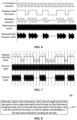
- FIG. 9 and FIG. 10 are schematic diagrams of OOK modulation based on different coding modes according to the embodiments of the present disclosure.
- a coding mode 1 illustrated in FIG. 9 is a coding mode determined by the communication device based on L 1
- a coding mode 2 illustrated in FIG. 10 is a coding mode determined by the communication device based on L 2 .
- the communication device when the first data block size is L 1 , the communication device can adaptively adjust the first coding mode to the coding mode 1 based on the first data block size; and when the first data block size is L 2 , the communication device can adaptively adjust the first coding mode to the coding mode 2 based on the first data block size. That is, the communication device can adaptively adjust the first coding mode based on the first data block size. Further, in the examples illustrated in FIG. 9 and FIG.
- the first coding mode may be adjusted adaptively to a coding mode having a higher transmission rate based on the first data block size when the first data block size is large; and the first coding mode may be adjusted adaptively to a coding mode with higher reliability based on the first data block size when the first data block size is small.
- the reliability of data transmission or data transmission rate is adaptively improved and the interference deletion processing at a receiving end is facilitated, thereby facilitating improving the data transmission performance and the integrity of data transmission.
- FIG. 9 and FIG. 10 are only examples of the present disclosure and should not be construed as limitation of the present disclosure.
- mapping relationships may be used, and different coding modes may be determined based on the first data block size, which is not specifically limited in the present disclosure.
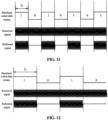
- FIG. 11 and FIG. 12 are schematic diagrams of OOK modulation based on different code unit lengths according to embodiments of the present disclosure.
- a code unit length illustrated in FIG. 11 is T 1 and a code unit length illustrated in FIG. 12 is T 2 .
- the communication device when the first data block size is L 1 , the communication device can adaptively adjust the first code unit length to T 1 based on the first data block size; and when the first data block size is L 2 , the communication device can adaptively adjust the first code unit length to T 2 based on the first data block size. Furthermore, in the examples illustrated in FIG. 11 and FIG.
- the first code unit length can be adaptively adjusted to a smaller code unit length based on the first data block size when the first data block size is large, which facilitates improvement of the data transmission rate; and the first code unit length can be adaptively adjusted to a larger code unit length based on the first data block size when the first data block size is large, which facilitates improvement of the reliability of data transmission.
- the reliability of data transmission or data transmission rate is adaptively improved and the interference deletion processing at a receiving end is facilitated, thereby improving the data transmission performance and the integrity of the data transmission.
- FIG. 11 and FIG. 12 are only examples of the present disclosure and should not be construed as limiting the present disclosure.
- mapping relationships may be used, and different code unit lengths may be determined based on the first data block size, which is not specifically limited in the present disclosure.
- the S210 may include the following operation.
- a first code rate group to which the first code rate belongs is determined.
- a code unit length corresponding to the first code rate group is determined as the first code unit length based on a second mapping relationship, and/or a coding mode corresponding to the first code rate group is determined as the first coding mode based on the second mapping relationship.
- the second mapping relation includes a corresponding relationship between each of at least one code rate group and a respective code unit length and/or a respective coding mode, and the at least one code rate group includes the first code rate group.
- the communication device can adaptively adjust the first code unit length and/or the first coding mode based on the first code rate, and then adaptively improve the reliability of data transmission or data transmission rate based on the first code rate, which facilitates improvement of the data transmission performance.
- the first code unit length is adaptively adjusted to a larger code unit length based on the first code rate, and/or the first coding mode is adaptively adjusted to a coding mode with higher reliability based on the first code rate, so as to improve the reliability of data transmission.
- the first code unit length is adaptively adjusted to a smaller code unit length based on the first code rate, and/or the first coding mode is adaptively adjusted to a coding mode with a higher transmission rate based on the first code rate, so as to improve the data transmission rate.
- the communication device adaptively adjusts, the first code unit length and/or the first coding mode based on the first code rate, the reliability of data transmission or data transmission rate is adaptively improved and the interference deletion processing at a receiving end is facilitated, thereby improving the data transmission performance and the integrity of data transmission.
- the first code unit length is adaptively adjusted to a larger code unit length based on the first code rate, and/or the first coding mode is adaptively adjusted to a coding mode with a higher transmission rate based on the first code rate, so as to further improve the data transmission rate.
- the first code unit length is adaptively adjusted to a larger code unit length based on the first code rate, and/or the first coding mode is adaptively adjusted to a coding mode with higher reliability based on the first code rate, so as to further improve the reliability of data transmission.
- the communication device adaptively adjusts the first code unit length and/or the first coding mode based on the first code rate, the reliability of data transmission or data transmission rate is adaptively improved and the interference deletion processing at a receiving end is facilitated, thereby improving the data transmission performance and the integrity of data transmission.
- the terminal device can determine the first code rate according to parameters scheduled by the network device, and determine, based on the second mapping relationship, a code unit length corresponding to the first code rate group to which the first code rate belongs as the first code unit length, and/or determine, based on the second mapping relationship, a coding mode corresponding to the first code rate group as the first coding mode.
- the understanding of the first code rate by the network device can be consistent with the understanding of the first code rate by the terminal device.
- the network device can also determine, based on the second mapping relationship, the code unit length corresponding to the first code rate group to which the first code rate belongs as the first code unit length, and/or determine, based on the second mapping relationship, the coding mode corresponding to the first code rate group as the first coding mode.
- the first code rate may also be a scheduling-free parameter.
- the first code rate may be pre-configured, i.e., the terminal device or the network device may determine, based on the second mapping relationship, the code unit length corresponding to the first code rate group to which the first code rate belongs as the first code unit length, and/or determine, based on the second mapping relationship, the coding mode corresponding to the first code rate as the first coding mode.
- the parameters scheduled by the network device may be, for example, index information of an MCS.
- the at least one code rate group includes at least one group obtained based on multiple code rate thresholds.
- the at least one rate group includes r groups obtained based on r code rate thresholds, and each of the r groups corresponds to a respective coding mode and/or a respective code unit length.
- R r represents the r-th threshold
- a value range of the code rate corresponding to the first group among the r groups is [1, R 1 ]
- a value range of the code rate corresponding to the second group among the r groups is [R 1 , R 2 ]
- a value range of the code rate corresponding to the r-th group among the r groups is [R r-1 , R r ].
- the at least one code rate group includes at least one group obtained by dividing at least one code rate.
- a code rate closest to the first code rate is determined among the at least one code rate, and a group to which the code rate closest to the first code rate belongs is determined as the first code rate group. For example, a group to which a code rate being greater than the first code rate and closest to the first code rate belongs may be determined as the first code rate group. For another example, a group to which a code rate being smaller than the first code rate and closest to the first code rate belongs may be determined as the first code rate group.
- the at least one code rate includes R 1 , R 2 , R 3 , R 4 and R 5 in order from small to large
- two groups are obtained by dividing R 1 , R 2 , R 3 , R 4 and R 5 .
- the code rate in the first group among the two groups includes R 1 , R 2 , and R 3
- the code rate in the second group among the two groups include R 4 and R 5 .
- the second group to which R 4 being greater than R t and closest to R t belongs can be determined as the first code rate group, or the first group to which R 3 being smaller than R t and closest to R t belongs may be determined as the first code rate group.
- the at least one code rate may be another number of code rates, or 3 length groups or 4 code rate groups and the like may be obtained by dividing R 1 , R 2 , R 3 , R 4 and R 5 , which are not specifically limited in the present disclosure.
- different code rate groups correspond to different coding modes and/or different code unit lengths in the second mapping relationship, or multiple code rate groups correspond to a same coding mode and/or a same code unit length in the second mapping relationship.
- the rate groups and the coding modes in the second mapping relationship may be in a one-to-one correspondence, in a one-to-multiple correspondence or in a multiple-to-one correspondence.
- the rate groups and the code unit lengths in the second mapping relationship may be in a one-to-one correspondence, in a one-to-multiple correspondence or in a multiple-to-one correspondence.
- the second mapping relationship is determined from multiple mapping relationships by the communication device.
- the multiple mapping relationships may be pre-configured, configured by a network device or determined by a terminal device.
- the multiple mapping relationships may be determined by the terminal device, and further, the terminal device may send information indicating the multiple mapping relationships to the network device.
- each of the multiple mapping relationships can be used to define a respective code unit length and/or a respective coding mode corresponding to each of the at least one code rate group, but the corresponding relationships between the code rate groups and the code unit lengths in different mapping relationships are different and/or the corresponding relationships between the code rate groups and the coding modes in different mapping relationships are different.
- the mapping relationship may also be referred to as a mapping pattern.
- the second mapping relationship is determined from the multiple mapping relationships based on related information of a terminal device, and/or the second mapping relationship is determined from the multiple mapping relationships based on information indicated by a network device.
- the second mapping relationship is determined from the multiple mapping relationships by the terminal device or the network device based on related information of the terminal device. Further, the terminal device can report the related information of the terminal device to the network device.
- the related information of the terminal device includes, but is not limited to, an identification of the terminal device and/or a cell identification of the terminal device.
- the second mapping relationship may be obtained by the communication device processing the related information of the terminal device according to a preset rule.
- the second mapping relationship can be obtained by the communication device by calculating, according to a preset calculation method, the related information of the terminal device according to the preset rule.
- the second mapping relationship may be obtained by the communication device performing modulo operation on the related information or a part of the related information of the terminal device based on the number of the multiple mapping relationships.
- the second mapping relationship is a mapping relationship indicated by a network device.
- the communication device when the first code rate is R 1 , the communication device can adaptively adjust the first coding mode to the coding mode 1 based on the first code rate; and when the first code rate is R 2 , the communication device can adaptively adjust the first coding mode to the coding mode 2 based on the first code rate. That is, the communication device can adaptively adjust the first coding mode based on the first code rate. Further, in the examples illustrated in FIG. 9 and FIG.
- the communication device can adaptively adjust the first coding mode to a coding mode having a higher transmission rate based on the first code rate when the first code rate is relatively large; and the communication device can adaptively adjust the first coding mode to a coding mode with higher reliability based on the first code rate when the first code rate is relatively small.
- the reliability of data transmission or data transmission rate is adaptively improved and the interference deletion processing at a receiving end is facilitated, thereby improving the data transmission performance and the integrity of data transmission.
- the communication device when the first code rate is R 1 , the communication device can adaptively adjust the first code unit length to T 1 based on the first code rate; and when the first code rate is R 2 , the communication device can adaptively adjust the first code unit length to T 2 based on the first code rate. Furthermore, in the examples illustrated in FIG. 11 and FIG. 12 , when the first code rate is R 1 , the communication device can adaptively adjust the first code unit length to T 1 based on the first code rate; and when the first code rate is R 2 , the communication device can adaptively adjust the first code unit length to T 2 based on the first code rate. Furthermore, in the examples illustrated in FIG. 11 and FIG.
- the communication device can adaptively adjust the first code unit length to a smaller code unit length based on the first code rate when the first code rate is large, which facilitates improvement of the data transmission rate; and the communication device can adaptively adjust the first code unit length to a larger code unit length based on the first code rate when the first code rate is relatively large, which facilitates improvement of the reliability of data transmission.
- the reliability of data transmission or data transmission rate is adaptively improved and the interference deletion processing at a receiving end is facilitated, thereby improving the data transmission performance and the integrity of data transmission.
- the S210 may include the following operations.
- the first information includes the first data block size and the first code rate
- a first group to which the first data block size and the first code rate belong is determined.
- a code unit length corresponding to the first group is determined as the first code unit length based on a third mapping relationship, and/or a coding mode corresponding to the first group is determined as the first coding mode based on the third mapping relationship.
- the third mapping relationship includes a corresponding relationship between each of at least one group and a respective code unit length and/or a respective coding mode, and the at least one group includes the first group.
- the communication device can adaptively adjust the first code unit length and/or the first coding mode based on the first data block size and the first code rate, and then adaptively improve the reliability of data transmission or data transmission rate based on the first data block size and the first code rate, which facilitates improvement of the data transmission performance.
- the first code unit length is adaptively adjusted to a larger code unit length based on the first data block size, and/or the first coding mode is adaptively adjusted to a coding mode with higher reliability based on the first data block size, so as to improve the reliability of data transmission.
- the channel condition is good
- the first data block size is large or the first code rate is large
- the first code unit length is adaptively adjusted to a smaller code unit length based on the first data block size and/or the first coding mode is adaptively adjusted to a coding mode with a higher transmission rate based on the first data block size, so as to improve the data transmission rate.
- the communication device adaptively adjusts the first code unit length and/or the first coding mode based on the first data block size, the reliability of data transmission or data transmission rate is adaptively improved and the interference deletion processing at a receiving end is facilitated, thereby improving the data transmission performance and the integrity of data transmission.
- the first data block size is small or the first code rate is small
- the first code unit length is adaptively adjusted to a larger code unit length based on the first data block size
- the first coding mode is adaptively adjusted to a coding mode with a higher transmission rate based on the first data block size, so as to further improve the data transmission rate.
- the channel condition is good
- the first data block size is large or the first code rate is large
- the first code unit length is adaptively adjusted to a larger code unit length based on the first data block size
- the first coding mode is adaptively adjusted to a coding mode with higher reliability based on the first data block size, so as to further improve the reliability of data transmission.
- the communication device adaptively adjusts the first code unit length and/or the first coding mode based on the first data block size, the reliability of data transmission or data transmission rate is adaptively improved and the interference deletion processing at a receiving end is facilitated, thereby improving the data transmission performance and the integrity of data transmission.
- the terminal device can determine the first data block size and/or the first code rate according to parameters scheduled by the network device, and determine, based on the third mapping relationship, a code unit length corresponding to the first group to which the first data block size and the first code rate belong as the first code unit length, and/or determine, based on the third mapping relationship, a coding mode corresponding to the first group as the first coding mode.
- the understanding of the first data block size and the first code rate by the network device can be consistent with the understanding of the first data block size and the first code rate by the terminal device.
- the network device can also determine, based on the third mapping relationship, the code unit length corresponding to the first group to which the first data block size and the first code rate belong as the first code unit length, and/or determine, based on the third mapping relationship, the coding mode corresponding to the first group as the first coding mode.
- the first transport block size and the first code rate may also be scheduling-free parameters.
- the first transport block size and the first code rate may be pre-configured, i.e., the terminal device or the network device may determine, based on the third mapping relationship, the code unit length corresponding to the first group to which the first data block size and the first code rate belong as the first code unit length and/or determine, based on the third mapping relationship, the coding mode corresponding to the first group as the first coding mode.
- the parameters of the network device scheduling may be, for example, index information of an MCS.
- the first group is determined based on the first data block size group to which the first data block size belongs and the first code rate group to which the first code rate belongs.
- first data block size group and the first code rate group can be referred to above and will not be repeated herein to avoid repetition.
- the first group is an intersection of a first data block size group to which the first data block size belongs and a first code rate group to which the first code rate belongs, or the first group is a union of the first data block size group to which the first data block size belongs and the first code rate group to which the first code rate belongs.
- the first group when the first group is located in an intermediate position of the at least one group, the first group is the intersection of the first data block size group to which the first data block size belongs and the first code rate group to which the first code rate belongs.
- the first group when the first group is not located in an intermediate position of the at least one group, the first group is the union of the first data block size group to which the first data block size belongs and the first code rate group to which the first code rate belongs.
- the at least one group includes 3 groups.
- a data block size(s) in a first group among the three groups is less than X 1 , or a code rate(s) in the first group is less than R 1 , X 1 > 0, R 1 > 0;
- a data block size(s) in a second group among the three groups is greater than or equal to X 1 and less than X 2 , and a code rate(s) in the second group is greater than or equal to R 1 and less than R 2 , X 2 > X 1 , R 2 > R 1 ;
- a data block size(s) in a third group among the three groups is greater than or equal to X 2 , or a code rate(s) in the third group is greater than or equal to R 2 .
- FIG. 13 to FIG. 15 are schematic diagrams of the third mapping relationship according to embodiments of the present disclosure.
- the first group corresponds to a coding mode 1
- the second group corresponds to a coding mode 2
- the third group corresponds to a coding mode 3.
- the first group corresponds to a code unit length 1
- the second group corresponds to a code unit length 2
- the third group corresponds to a code unit length 3.
- the first group corresponds to the coding mode 1 and the code unit length 1
- the second group corresponds to the coding mode 2 and the code unit length 2
- the third group corresponds to the coding mode 3 and the code unit length 3.
- the coding mode 1, the coding mode 2, and the coding mode 3 may be completely different coding modes, or there may be the same coding mode among the coding mode 1, the coding mode 2, and the coding mode 3.
- the code unit length 1, the code unit length 2, and the code unit length 3 may be completely different code unit lengths, or there may be the same code unit length among the code unit length 1, the code unit length 2, and the code unit length 3.
- both the code unit lengths and coding modes may be different in different groups, or only the code unit lengths or the coding modes may be the same.
- different groups correspond to different coding modes and/or different code unit lengths in the third mapping relationship, or different groups correspond to a same coding mode and/or a same code unit length in the third mapping relationship.
- the groups and the coding modes in the third mapping relationship may be in a one-to-one correspondence, in a one-to-multiple correspondence or in a multiple-to-one correspondence.
- the groups and the code unit lengths in the third mapping relationship may be in a one-to-one correspondence, in a one-to-multiple correspondence or in a multiple-to-one correspondence.
- the third mapping relationship is determined from multiple mapping relationships by the communication device.
- the multiple mapping relationships may be pre-configured, configured by a network device or determined by a terminal device.
- the multiple mapping relationships may be determined by the terminal device, and further, the terminal device may send information indicating the multiple mapping relationships to the network device.
- each of the multiple mapping relationships can be used to define a respective code unit length and/or a respective coding mode corresponding to each of the at least one group, but the corresponding relationships between the groups and the code unit lengths in different mapping relationships are different and/or the corresponding relationships between the groups and the coding modes in different mapping relationships are different.
- the mapping relationship may also be referred to as a mapping pattern.
- the third mapping relationship is determined from the multiple mapping relationships based on related information of a terminal device, and/or the third mapping relationship is determined in the multiple mapping relationships based on information indicated by a network device.
- the third mapping relationship is determined from the multiple mapping relationships by a terminal device or a network device based on related information of the terminal device. Further, the terminal device can report the related information of the terminal device to the network device.
- the related information of the terminal device includes, but is not limited to, an identification of the terminal device and/or a cell identification of the terminal device.
- the third mapping relationship may be obtained by the communication device processing the related information of the terminal device according to a preset rule.
- the third mapping relationship can be obtained by the communication device by calculating, according to a preset calculation method, the related information of the terminal device according to the preset rule.
- the third mapping relationship may be obtained by the communication device performing modulo operation on the related information or a part of the related information of the terminal device based on the number of the multiple mapping relationships.
- the third mapping relationship is a mapping relationship indicated by a network device.
- the communication device can adaptively adjust the first coding mode to the coding mode 1 based on the first group to which the first data block size and the first code rate belong.
- the communication device can adaptively adjust the first coding mode to the coding mode 2 based on the first group to which the first data block size and the first code rate belong. That is, the communication device can adaptively adjust the first coding mode based on the first data block size and the first code rate.
- the communication device can adaptively adjust the first coding mode to a coding mode with a higher transmission rate based on the first data block size and the first code rate when the first data block size is large or the first code rate is large; and the communication device can adaptively adjust the first coding mode to a coding mode with higher reliability based on the first data block size and the first code rate when the first data block size is small or the first code rate is small.
- the reliability of data transmission or data transmission rate is adaptively improved and the interference deletion processing at a receiving end is facilitated, thereby improving the data transmission performance and the integrity of data transmission.
- the communication device can adaptively adjust the first code unit length to T 1 based on the first group to which the first data block size and the first code rate belong.
- the communication device can adaptively adjust the first code unit length to T 2 based on the first group to which the first data block size and the first code rate belong. That is, the communication device can adaptively adjust the first code unit length based on the first data block size and the first code rate.
- the communication device can adaptively adjust the first code unit length to a code unit length with a higher transmission rate based on the first data block size and the first code rate when the first data block size is large or the first code rate is large; and the communication device can adaptively adjust the first code unit length to a code unit length with higher reliability based on the first data block size and the first code rate when the first data block size is small or the first code rate is small.
- the reliability of data transmission or data transmission rate is adaptively improved and the interference deletion processing at a receiving end is facilitated, thereby improving the data transmission performance and the integrity of data transmission.
- the S210 may include the following operations.
- a first bit number group to which the first bit number belongs is determined.
- a code unit length corresponding to the first bit number group is determined as the first code unit length based on a fourth mapping relationship, and/or a coding mode corresponding to the first bit number group is determined as the first coding mode based on the fourth mapping relationship.
- the fourth mapping relationship includes a corresponding relationship between each of at least one bit number group and a respective code unit length and/or a respective coding mode, and the at least one bit number group includes the first bit number group.
- the communication device can adaptively adjust the first code unit length and/or the first coding mode based on the first bit number, and then adaptively improve the reliability of data transmission or data transmission rate based on the first bit number, which facilitates improvement of the data transmission performance.
- the first code unit length is adaptively adjusted to a larger code unit length based on the first bit number, and/or the first coding mode is adaptively adjusted to a coding mode with higher reliability based on the first bit number, so as to improve the reliability of data transmission.
- the first code unit length is adaptively adjusted to a smaller code unit length based on the first bit number, and/or the first coding mode is adaptively adjusted to a coding mode with a higher transmission rate based on the first bit number, so as to improve the data transmission rate.
- the communication device adaptively adjusts the first code unit length and/or the first coding mode based on the first bit number, the reliability of data transmission or data transmission rate is adaptively improved and the interference deletion processing at a receiving end is facilitated, thereby improving the data transmission performance and the integrity of data transmission.
- the first code unit length is adaptively adjusted to a larger code unit length based on the first bit number, and/or the first coding mode is adaptively adjusted to a coding mode with a higher transmission rate based on the first bit number, so as to further improve the data transmission rate.
- the first code unit length is adaptively adjusted to a larger code unit length based on the first bit number, and/or the first coding mode is adaptively adjusted to a coding mode with higher reliability based on the first bit number, so as to further improve the reliability of data transmission.
- the communication device adaptively adjusts the first code unit length and/or the first coding mode based on the first bit number, the reliability of data transmission or data transmission rate is adaptively improved and the interference deletion processing at a receiving end is facilitated, thereby improving the data transmission performance and the integrity of data transmission.
- the terminal device can determine the first bit number according to parameters scheduled by the network device, and determine, based on the fourth mapping relationship, a code unit length corresponding to the first bit number group to which the first bit number belongs as the first code unit length, and/or determine, based on the fourth mapping relationship, a coding mode corresponding to the first bit number group as the first coding mode.
- the understanding of the first bit number by the network device can be consistent with the understanding of the first bit number by the terminal device.
- the network device can also determine, based on the fourth mapping relationship, the code unit length corresponding to the first bit number group to which the first bit number belongs as the first code unit length, and/or determine, based on the fourth mapping relationship, the coding mode corresponding to the first bit number group as the first coding mode.
- the first bit number may also be a scheduling-free parameter.
- the first bit number may be pre-configured, i.e., the terminal device or the network device may determine, based on the fourth mapping relationship, the code unit length corresponding to the first bit number group to which the first bit number belongs as the first code unit length, and/or determine, based on the fourth mapping relationship, the coding mode corresponding to the first bit number group as the first coding mode.
- the parameters scheduled by the network device may be, for example, index information of an MCS.
- the at least one bit number group includes b groups obtained based on b bit number thresholds, and each of the b groups corresponds to a respective coding mode and/or a respective code unit length.
- B b represents the b-th threshold
- a value range of the bit number corresponding to the first group among the b groups is [1, B 1 ]
- a value range of the bit number corresponding to the second group among the b groups is [B 1 , B 2 ]
- a value range of the bit number corresponding to the b-th group among the b groups is [B b-1 , B b ].
- the at least one bit number group includes at least one group obtained by dividing at least one bit number.
- a bit number closest to the first bit number is determined among the at least one bit number, and a group to which the bit number closest to the first bit number belongs is determined as the first bit number group. For example, a group to which a bit number being greater than the first bit number and closest to the first bit number belongs may be determined as the first bit number group. For another example, a group to which a bit number being smaller than and closest to the first bit number belongs may be determined as the first bit number group.
- the at least one bit number includes B 1 , B 2 , B 3 , B 4 and B 5 in order from small to large
- two groups are obtained by dividing B 1 , B 2 , B 3 , B 4 and B 5
- the bit number in the first group among the two groups includes B 1 , B 2 and B 3
- the bit number in the second group among the two groups includes B 4 and B 5 .
- the second group to which B 4 being larger than B t and closest to B t belongs may be determined as the first bit number group, or the first group to which B 3 being smaller than B t and closest to B t belongs may be determined as the first bit number group.
- the at least one bit number may be another number of bit numbers, or 3 length groups or 4 bit number groups and the like may be obtained by dividing B 1 , B 2 , B 3 , B 4 and B 5 , which are not specifically limited in the present disclosure.
- different bit number groups correspond to different coding modes and/or different code unit lengths in the fourth mapping relationship, or multiple bit number groups correspond to a same coding mode and/or a same code unit length in the fourth mapping relationship.
- bit number groups and coding modes in the fourth mapping relationship may be in a one-to-one correspondence, in a one-to-multiple correspondence or in a multiple-to-one correspondence.
- bit number groups and the code unit lengths in the fourth mapping relationship may be in a one-to-one correspondence, in a one-to-multiple correspondence or in a multiple-to-one correspondence.
- the fourth mapping relationship is determined from multiple mapping relationships by the communication device.
- the multiple mapping relationships may be pre-configured, configured by a network device or determined by a terminal device.
- the multiple mapping relationships may be determined by the terminal device, and further, the terminal device may send information indicating the multiple mapping relationships to the network device.
- each of the multiple mapping relationships can be used to define a respective code unit length and/or a respective coding mode corresponding to each of the at least one bit number group, but the corresponding relationship between the bit number group and the code unit length in different mapping relationships is different and/or the corresponding relationship between the bit number group and the coding mode in different mapping relationships is different.
- the mapping relationship may also be referred to as a mapping pattern.
- the fourth mapping relationship is determined from the multiple mapping relationships based on related information of a terminal device, and/or the fourth mapping relationship is determined in the multiple mapping relationships based on information indicated by a network device.
- the fourth mapping relationship is determined from the multiple mapping relationships by a terminal device or a network device based on related information of the terminal device. Further, the terminal device can report the related information of the terminal device to the network device.
- the related information of the terminal device includes, but is not limited to, an identification of the terminal device and/or a cell identification of the terminal device.
- the fourth mapping relationship may be obtained by the communication device processing the related information of the terminal device according to a preset rule.
- the fourth mapping relationship can be obtained by the communication device by calculating, according to a preset calculation method, the related information of the terminal device according to the preset rule.
- the fourth mapping relationship may be obtained by the communication device performing modulo operation on the related information or a part of the related information of the terminal device based on the number of the multiple mapping relationships.
- the fourth mapping relationship is a mapping relationship indicated by a network device.
- the communication device when the first bit number is B 1 , the communication device can adaptively adjust the first coding mode to the coding mode 1 based on the first bit number; and when the first bit number is B 2 , the communication device can adaptively adjust the first coding mode to the coding mode 2 based on the first bit number. That is, the communication device can adaptively adjust the first coding mode based on the first bit number. Further, in the examples illustrated in FIG. 9 and FIG.
- the communication device can adaptively adjust the first coding mode to a coding mode with a higher transmission rate based on the first bit number when the first bit number is large; and the communication device can adaptively adjust the first coding mode to a coding mode with higher reliability based on the first bit number when the first bit number is small. Therefore, the reliability of data transmission or data transmission rate is adaptively improved and the interference deletion processing at a receiving end is facilitated, thereby improving the data transmission performance and the integrity of data transmission.
- the communication device when the first bit number is B 1 , the communication device can adaptively adjust the first code unit length to T 1 based on the first bit number; and when the first bit number is B 2 , the communication device can adaptively adjust the first code unit length to T 2 based on the first bit number. Furthermore, in the examples illustrated in FIG. 11 and FIG. 12 , when the first bit number is B 1 , the communication device can adaptively adjust the first code unit length to T 1 based on the first bit number; and when the first bit number is B 2 , the communication device can adaptively adjust the first code unit length to T 2 based on the first bit number. Furthermore, in the examples illustrated in FIG. 11 and FIG.
- the communication device can adaptively adjust the first code unit length to a smaller code unit length based on the first bit number when the first bit number is large, which facilitates improvement of the data transmission rate; and the communication device can adaptively adjust the first code unit length to a larger code unit length based on the first bit number when the first bit number is large, which facilitates improvement of the reliability of data transmission. Therefore, the reliability of data transmission or data transmission rate is adaptively improved and the interference deletion processing at a receiving end is facilitated, thereby improving the data transmission performance and the integrity of data transmission.
- the communication device is a terminal device, and the method 200 may further include the following operations.
- the first data is encoded by using the first code unit length and/or the first coding mode to obtain the first data stream.
- the first data stream is sent to a network device.
- the terminal device determines the first code unit length based on the first information
- the terminal device encodes the first data by using the first code unit length to obtain the first data stream; and then sends the first data stream to the network device.
- the method 200 may further include the following operation.
- Scheduling information sent by the network device is received.
- the scheduling information is used for indicating the first data block size and/or the first code rate.
- the terminal device receives the scheduling information sent by the terminal device.
- the communication device is a network device, and the method 200 may further include the following operations.
- the first data stream sent by the terminal device is received.
- the first data stream is decoded by using the first code unit length and/or the first coding mode to obtain the first data.
- the network device determines the first code unit length and/or the first coding mode, and decodes the first data stream based on the determined first code unit length and/or the first coding mode to obtain the first data.
- the method 200 may further include the following operation.
- Scheduling information is sent to the terminal device.
- the scheduling information is used for the terminal device to determine the first data block size and/or the first code rate.
- the network device before receiving the first data stream, the network device sends the scheduling information to the terminal device.
- the method 200 may further include the following operation.
- the first bit number is determined according to a number of resources used for the first data stream and a modulation order corresponding to the first data stream.
- the network device determines the first bit number according to the number of resources used for the first data stream and the modulation order corresponding to the first data stream, and determines the first code unit length and/or the first coding mode based on the determined first bit number.
- the network device may also decode, by using multiple code unit lengths and/or multiple coding modes, the first data stream in a blind detection manner to obtain the first data.
- the network device may also decode, by using multiple code unit lengths and/or multiple coding modes, the first data stream in a traversal manner, and use the verified decoded data as the decoded first data.
- the multiple code unit lengths are determined according to pre-configured information, and/or the multiple coding modes are determined according to the pre-configured information.
- the size of the sequence number of the above-mentioned processes does not mean the order of execution, and the execution order of the processes should be determined by their functions and inherent logic, and should not be defined in any way by the implementation process of the embodiments of the present disclosure.
- FIG. 16 is a schematic block diagram of a communication device 300 according to an embodiment of the present disclosure.
- the communication device 300 may include a determining unit 310.
- the determining unit 310 is configured to determine, based on first information, a first code unit length used for first data and/or a first coding mode used for the first data.
- the first information includes at least one of: a first data block size used for the first data, a first code rate used for the first data, or a first bit number corresponding to a first data stream obtained by encoding the first data.
- the determining unit 310 may specifically be configured to: when the first information includes the first data block size, determine a first data block size group to which the first data block size belongs; and determine, based on a first mapping relationship, a code unit length corresponding to the first data block size group as the first code unit length, and/or determine, based on the first mapping relationship, a coding mode corresponding to the first data block size as the first coding mode.
- the first mapping relationship includes a corresponding relationship between each of at least one data block size group and a respective code unit length and/or a respective coding mode, and the at least one data block size group includes the first data block size group.
- different data block size groups correspond to different coding modes and/or different code unit lengths in the first mapping relationship, or multiple data block size groups correspond to a same coding mode and/or a same code unit length in the first mapping relationship.
- the first mapping relationship is determined from multiple mapping relationships by the communication device.
- the first mapping relationship is determined from the multiple mapping relationships based on related information of a terminal device, and/or the first mapping relationship is determined in the multiple mapping relationships based on information indicated by a network device.
- the determining unit 310 may specifically be configured to: when the first information includes the first code rate, determine a first code rate group to which the first code rate belongs; and determine, based on a second mapping relationship, a code unit length corresponding to the first code rate group as the first code unit length, and/or determine, based on the second mapping relationship, a coding mode corresponding to the first code rate group as the first coding mode.
- the second mapping relation includes a corresponding relationship between each of at least one code rate group and a respective code unit length and/or a respective coding mode, and the at least one code rate group includes the first code rate group.
- different code rate groups correspond to different coding modes and/or different code unit lengths in the second mapping relationship, or multiple code rate groups correspond to a same coding mode and/or a same code unit length in the second mapping relationship.
- the second mapping relationship is determined from multiple mapping relationships by the communication device.
- the second mapping relationship is determined from the multiple mapping relationships based on related information of a terminal device, and/or the second mapping relationship is determined in the multiple mapping relationships based on information indicated by a network device.
- the determining unit 310 may specifically be configured to: when the first information includes the first data block size and the first code rate, determine a first group to which the first data block size and the first code rate belong; and determine, based on a third mapping relationship, a code unit length corresponding to the first group as the first code unit length, and/or determine, based on the third mapping relationship, a coding mode corresponding to the first group as the first coding mode.
- the third mapping relationship includes a corresponding relationship between each of at least one group and a respective code unit length and/or a respective coding mode, and the at least one group includes the first group.
- the first group is determined based on a first data block size group to which the first data block size belongs and a first code rate group to which the first code rate belongs.
- the first group is an intersection of a first data block size group to which the first data block size belongs and a first code rate group to which the first code rate belongs, or the first group is a union of the first data block size group to which the first data block size belongs and the first code rate group to which the first code rate belongs.
- the at least one group includes three groups.
- a data block size(s) in a first group among the three groups is less than X 1 , or a code rate(s) in the first group is less than R 1 X 1 > 0, R 1 > 0;
- a data block size(s) in a second group among the three groups is greater than or equal to X 1 and less than X 2 , and a code rate(s) in the second group is greater than or equal to R 1 and less than R 2 , X 2 > X 1 , R 2 > R 1 ;
- a data block size(s) in a third group among the three groups is greater than or equal to X 2 , or a code rate(s) in the third group is greater than or equal to R 2 .
- different groups correspond to different coding modes and/or different code unit lengths in the third mapping relationship, or different groups correspond to a same coding mode and/or a same code unit length in the third mapping relationship.
- the third mapping relationship is determined from multiple mapping relationships by the communication device.
- the third mapping relationship is determined from the multiple mapping relationships based on related information of a terminal device, and/or the third mapping relationship is determined in the multiple mapping relationships based on information indicated by a network device.
- the determining unit 310 may specifically be configured to: when the first information includes the first bit number, determine a first bit number group to which the first bit number belongs; and determine, based on a fourth mapping relationship, a code unit length corresponding to the first bit number group as the first code unit length, and/or determine, based on the fourth mapping relationship, a coding mode corresponding to the first bit number group as the first coding mode.
- the fourth mapping relationship includes a corresponding relationship between each of at least one bit number group and a respective code unit length and/or a respective coding mode, and the at least one bit number group includes the first bit number group.
- different bit number groups correspond to different coding modes and/or different code unit lengths in the fourth mapping relationship, or multiple bit number groups correspond to a same coding mode and/or a same code unit length in the fourth mapping relationship.
- the fourth mapping relationship is determined from multiple mapping relationships by the communication device.
- the fourth mapping relationship is determined from the multiple mapping relationships based on related information of a terminal device, and/or the fourth mapping relationship is determined in the multiple mapping relationships based on information indicated by a network device.
- the first data stream is a bit stream after rate matching.
- the communication device 300 is the terminal device, and the determining unit 310 may further be configured to: encode, by using the first code unit length and/or the first coding mode, the first data to obtain the first data stream; and send the first data stream to a network device.
- the determining unit 310 may further be configured to receive scheduling information sent by the network device.
- the scheduling information is used for indicating the first data block size and/or the first code rate.
- the communication device 300 is a network device
- the determining unit 310 may further be configured to: receive the first data stream sent by a terminal device; and decode, by using the first code unit length and/or the first coding mode, the first data stream to obtain the first data.
- the determining unit 310 may further be configured to: send scheduling information to the terminal device.
- the scheduling information is used for the terminal device to determine the first data block size and/or the first code rate.
- the determining unit 310 may further be configured to: determine the first bit number according to a number of resources used for the first data stream and a modulation order corresponding to the first data stream.
- the apparatus embodiments and the method embodiments may correspond to each other, and reference to similar descriptions of the apparatus embodiments may be made to the method embodiments.
- the communication device 300 illustrated in FIG. 16 may correspond to a respective body in the method 200 of the embodiment of the present disclosure, and the foregoing and other operations and/or functions of various units in the communication device 300 are respectively used to implement corresponding flows in various methods provided in the embodiments of the present disclosure, and will not be repeated here for the sake of brevity,.
- each operation of the method embodiments in the embodiments of the present disclosure can be completed by the integrated logic circuit of the hardware in the processor and/or the instruction in the form of software, and the operations of the method disclosed in combination with the embodiments of the present disclosure can be directly embodied as being executed and completed by a hardware decoding processor or can be executed and completed by a combination of the hardware and software modules in the decoding processor.
- the software module may be located in a Random Access Memory (RAM), a flash memory, a Read-Only Memory (ROM), a programmable read-only memory, an electrically erasable programmable memory, a register or other storage media mature in the art.
- RAM Random Access Memory
- ROM Read-Only Memory
- the storage medium is located in the memory, and the processor reads the information in the memory and completes the operations in the method embodiments in combination with its hardware.
- the determining unit 310 referred to above may be implemented by processors respectively.
- FIG. 17 is a schematic diagram of a structure of a communication device 400 according to an embodiment of the present disclosure.
- the communication device 400 may include a processor 410.
- the processor 410 may invoke and run a computer program from a memory to implement the method in the embodiments of the present disclosure.
- the communication device 400 may further include a memory 420.
- the memory 420 may be used for storing indication information and may also be used for storing codes, instructions and the like executed by the processor 410.
- the processor 410 may invoke and run a computer program from the memory 420 to implement the method in the embodiments of the present disclosure.
- the memory 420 may be a separate device independent of the processor 410 or may be integrated within the processor 410.
- the communication device 400 may further include a transceiver 430.
- the processor 410 may control the transceiver 430 to communicate with other devices, and in particular may send information or data to other devices or receive information or data sent by other devices.
- the transceiver 430 may include a transmitter and a receiver.
- the transceiver 430 may further include antennas, the number of which may be one or more.
- the bus system includes a power bus, a control bus and a state signal bus, in addition to a data bus.
- the communication device 400 may implement the corresponding flows implemented by the communication device in the various methods of the embodiments of the present disclosure. That is, the communication device 400 of the embodiments of the present disclosure may correspond to the communication device 300 of the embodiments of the present disclosure and may correspond to a respective body for performing the method 200 according to the embodiments of the present disclosure, which will not be repeated here for the sake of brevity.
- the embodiment of the present disclosure further provides a chip.
- the chip may be an integrated circuit chip having signal processing capabilities that can implement or perform the methods, operations and logic diagrams disclosed in the embodiments of the present disclosure.
- the chip may also be referred to as a system-level chip, a system chip, a chip system or a chip-on system chip, etc.
- the chip can be applied to various communication devices, so that the communication device mounted with the chip can perform the methods, operations and logic block diagrams disclosed in the embodiments of the present disclosure.
- FIG. 18 is a schematic diagram of a structure of a chip 500 according to an embodiment of the present disclosure.
- the chip 500 includes a processor 510.
- the processor 510 may invoke and run a computer program from a memory to implement the method in the embodiments of the present disclosure.
- the chip 500 may further include a memory 520.
- the processor 510 may invoke and run a computer program from the memory 520 to implement the method in the embodiments of the present disclosure.
- the memory 520 may be used to store indication information and may also be used to store codes, instructions and the like executed by the processor 510.
- the memory 520 may be a separate device independent of the processor 510 or may be integrated within the processor 510.
- the chip 500 may further include an input interface 530.
- the processor 510 may control the input interface 530 to communicate with other devices or chips, and in particular may obtain information or data sent by other devices or chips.
- the chip 500 may further include an output interface 540.
- the processor 510 may control the output interface 540 to communicate with other devices or chips, and in particular may output information or data to other devices or chips.
- the chip 500 may be applied to the communication device in the embodiments of the present disclosure, and the chip may implement the corresponding flows implemented by the communication device in various methods of the embodiments of the present disclosure, that is, may implement the corresponding flows implemented by the terminal device or the network device in the various methods of the embodiments of the present disclosure, which will not be repeated here for the sake of brevity.
- the bus system includes a power bus, a control bus and a state signal bus, in addition to a data bus.
- the processor referred to above may include, but is not limited to, the followings:
- DSP Digital Signal Processor
- ASIC Application Specific Integrated Circuit
- FPGA Field Programmable Gate Array
- the processor may be used to implement or perform the methods, operations, and logic diagrams disclosed in the embodiments of the present disclosure.
- the operations of the method disclosed in combination with the embodiments of the present disclosure can be directly embodied as being executed and completed by a hardware decoding processor or can be executed and completed by a combination of the hardware and software modules in the decoding processor.
- the software module may be located in a random access memory, a flash memory, a read only memory, a programmable read-only memory, an erasable programmable memory, a register and other storage media mature in the art.
- the storage medium is located in the memory, and the processor reads the information in the memory and completes the operations of the method in combination with its hardware.
- the memory referred to above includes, but is not limited to, a volatile memory and/or a nonvolatile memory.
- the nonvolatile memory may be an ROM, a Programmable ROM (PROM), an Erasable PROM (EPROM), an Electrically Erasable EPROM (EEPROM), or a flash memory.
- the volatile memory may be an RAM which serves as an external cache.
- SRAM static RAM
- DRAM dynamic RAM
- SDRAM synchronous DRAM
- DDR SDRAM double data rate SDRAM
- ESDRAM Enhanced SDRAM
- SLDRAM synch link DRAM
- DR RAM direct Rambus RAM
- An embodiment of the present disclosure further provides a computer-readable storage medium for storing a computer program.
- the computer-readable storage medium stores one or more programs including instructions that, when executed by a portable electronic device including multiple application programs, cause the portable electronic device to perform the method for data transmission according to the present disclosure.
- the computer-readable storage medium can be applied to the communication device in the embodiments of the present disclosure, and the computer program causes the computer to perform corresponding flows implemented by the communication device in various methods of the embodiments of the present disclosure, which will not be repeated here for the sake of brevity.
- An embodiment of the present disclosure further provides a computer program product, which includes a computer program.
- the computer program product may be applied to the communication device in the embodiments of the present disclosure, and the computer program causes the computer to perform corresponding flows implemented by the communication device in various methods of the embodiments of the present disclosure, which will not be repeated here for the sake of brevity.
- An embodiment of the present disclosure further provides a computer program.
- the computer program When the computer program is executed by a computer, the computer is caused to perform the method for data transmission according to the present disclosure.
- the computer program can be applied to the communication device in the embodiments of the present disclosure, and when the computer program is run on the computer, the computer is caused to perform corresponding flows implemented by the communication device in various methods of the embodiments of the present disclosure, which will not be repeated here for the sake of brevity.
- An embodiment of the present disclosure further provides a communication system.
- the communication system may include the above-mentioned terminal device and the network device to form the communication system as illustrated in FIG. 1 which will not be repeated here for the sake of brevity.
- system in the present disclosure can also be referred to as “network management architecture” or “network system”.
- the technical solution of the disclosure or the part that contributes to the related art or the part of the technical solution may be embodied in the form of a software product essentially, and the computer software product is stored in a storage medium including several indications to make a computer device (which may be a personal computer, a server or a network device, etc.) execute all or part of the operations of the methods described in the each embodiment of the disclosure.
- the aforementioned storage medium includes: U disks, mobile hard disks, ROMs, RAMs, magnetic disks or optical disks and other media that can store program codes.
- the units/modules/components described above as separation/display means may or may not be physically separated, i.e., may be located in one place, or may be distributed over multiple network elements. Some or all of the units/modules/components may be selected according to actual needs to achieve the object of the embodiments of the present disclosure.
- the coupling, or direct coupling or communication connection between each other illustrated or discussed above may be indirect coupling or communication connection through some interfaces, apparatuses or units, and may be electrical, mechanical or other form.
Landscapes
- Engineering & Computer Science (AREA)
- Signal Processing (AREA)
- Computer Networks & Wireless Communication (AREA)
- Quality & Reliability (AREA)
- Physics & Mathematics (AREA)
- Spectroscopy & Molecular Physics (AREA)
- Mobile Radio Communication Systems (AREA)
- Compression, Expansion, Code Conversion, And Decoders (AREA)
- Communication Control (AREA)
- Detection And Prevention Of Errors In Transmission (AREA)
Applications Claiming Priority (1)
| Application Number | Priority Date | Filing Date | Title |
|---|---|---|---|
| PCT/CN2021/141776 WO2023122909A1 (zh) | 2021-12-27 | 2021-12-27 | 用于数据传输的方法和通信设备 |
Publications (2)
| Publication Number | Publication Date |
|---|---|
| EP4459903A1 true EP4459903A1 (de) | 2024-11-06 |
| EP4459903A4 EP4459903A4 (de) | 2025-11-05 |
Family
ID=86996837
Family Applications (1)
| Application Number | Title | Priority Date | Filing Date |
|---|---|---|---|
| EP21969295.1A Pending EP4459903A4 (de) | 2021-12-27 | 2021-12-27 | Verfahren zur datenübertragung und kommunikationsvorrichtung |
Country Status (4)
| Country | Link |
|---|---|
| US (1) | US20240349123A1 (de) |
| EP (1) | EP4459903A4 (de) |
| CN (1) | CN118541938A (de) |
| WO (1) | WO2023122909A1 (de) |
Families Citing this family (2)
| Publication number | Priority date | Publication date | Assignee | Title |
|---|---|---|---|---|
| CN119628783A (zh) * | 2023-09-14 | 2025-03-14 | 中兴通讯股份有限公司 | 信息传输方法、装置及存储介质 |
| WO2025091299A1 (zh) * | 2023-10-31 | 2025-05-08 | Oppo广东移动通信有限公司 | 比特序列的预处理方法、ook符号的生成方法及装置 |
Family Cites Families (7)
| Publication number | Priority date | Publication date | Assignee | Title |
|---|---|---|---|---|
| JP4412005B2 (ja) * | 2004-03-05 | 2010-02-10 | 株式会社日立製作所 | 適応変調方法並びにデータレート制御方法 |
| JP4700106B2 (ja) * | 2006-04-27 | 2011-06-15 | 三菱電機株式会社 | 適応変調方法および通信装置 |
| CN1976535A (zh) * | 2006-12-12 | 2007-06-06 | 华为技术有限公司 | 信道自适应装置与信道自适应方法 |
| US10367602B2 (en) * | 2015-07-14 | 2019-07-30 | Universitat Politecnica De Catalunya | Data modulation method for IEEE 802.11 devices to generate low frequency signals |
| ITUB20152257A1 (it) * | 2015-07-17 | 2017-01-17 | Inst Rundfunktechnik Gmbh | Trasmettitore per l’invio di un segnale di trasmissione dati e ricevitore per la ricezione del segnale di trasmissione dati |
| CN119212104A (zh) * | 2017-06-16 | 2024-12-27 | 华为技术有限公司 | 确定传输块大小的方法及装置 |
| JPWO2019064378A1 (ja) * | 2017-09-27 | 2020-09-03 | 富士通株式会社 | 無線通信方法、無線通信システム、無線端末、及び基地局 |
-
2021
- 2021-12-27 WO PCT/CN2021/141776 patent/WO2023122909A1/zh not_active Ceased
- 2021-12-27 EP EP21969295.1A patent/EP4459903A4/de active Pending
- 2021-12-27 CN CN202180105181.2A patent/CN118541938A/zh active Pending
-
2024
- 2024-06-26 US US18/754,519 patent/US20240349123A1/en active Pending
Also Published As
| Publication number | Publication date |
|---|---|
| CN118541938A (zh) | 2024-08-23 |
| US20240349123A1 (en) | 2024-10-17 |
| EP4459903A4 (de) | 2025-11-05 |
| WO2023122909A1 (zh) | 2023-07-06 |
Similar Documents
| Publication | Publication Date | Title |
|---|---|---|
| US20240160866A1 (en) | Wireless communication method, terminal device and network device | |
| WO2023004748A1 (zh) | 无线通信方法、终端设备和网络设备 | |
| WO2023000209A1 (zh) | 无线通信方法、终端设备和网络设备 | |
| US20240349123A1 (en) | Method for data transmission and communication device | |
| WO2023010321A1 (zh) | 一种无线通信方法及装置、通信设备 | |
| US20240373375A1 (en) | Wireless communication method, terminal device, and energy supply node | |
| US20250247837A1 (en) | Wireless communication method and device | |
| WO2023283757A1 (zh) | 无线通信方法、终端设备和通信设备 | |
| US20240430729A1 (en) | Uci reporting method, terminal device, and network device | |
| CN117480823A (zh) | 无线通信方法及设备 | |
| CN117178614A (zh) | 无线通信方法、终端设备和网络设备 | |
| EP4580260A1 (de) | Verfahren und vorrichtung zur drahtlosen kommunikation | |
| US20240349257A1 (en) | Method for data transmission and communication device | |
| WO2023000175A1 (zh) | 无线通信方法、第一设备和第二设备 | |
| US20240235257A1 (en) | Wireless communication method, and terminal device | |
| CN117561667A (zh) | 无线通信方法及设备 | |
| CN117204115A (zh) | 无线通信方法、终端设备和网络设备 | |
| WO2023168698A1 (zh) | 信息传输方法、终端设备和网络设备 | |
| WO2023236144A1 (zh) | 无线通信的方法和设备 | |
| WO2023283758A1 (zh) | 无线通信方法、终端设备和通信设备 | |
| US20250351087A1 (en) | Wireless communication methods, network devices and terminal devices | |
| KR20250145649A (ko) | 무선 통신 방법, 네트워크 장치 및 앰비언트 파워 인에이블(amp) 장치 | |
| WO2024250212A9 (zh) | 无线通信方法、第一设备和第二设备 | |
| WO2023010341A1 (zh) | 无线通信方法、终端设备和网络设备 | |
| CN117203899A (zh) | 无线通信方法及设备 |
Legal Events
| Date | Code | Title | Description |
|---|---|---|---|
| STAA | Information on the status of an ep patent application or granted ep patent |
Free format text: STATUS: THE INTERNATIONAL PUBLICATION HAS BEEN MADE |
|
| PUAI | Public reference made under article 153(3) epc to a published international application that has entered the european phase |
Free format text: ORIGINAL CODE: 0009012 |
|
| STAA | Information on the status of an ep patent application or granted ep patent |
Free format text: STATUS: REQUEST FOR EXAMINATION WAS MADE |
|
| 17P | Request for examination filed |
Effective date: 20240726 |
|
| AK | Designated contracting states |
Kind code of ref document: A1 Designated state(s): AL AT BE BG CH CY CZ DE DK EE ES FI FR GB GR HR HU IE IS IT LI LT LU LV MC MK MT NL NO PL PT RO RS SE SI SK SM TR |
|
| DAV | Request for validation of the european patent (deleted) | ||
| DAX | Request for extension of the european patent (deleted) | ||
| A4 | Supplementary search report drawn up and despatched |
Effective date: 20251007 |
|
| RIC1 | Information provided on ipc code assigned before grant |
Ipc: H04L 1/00 20060101AFI20250930BHEP Ipc: H04L 25/49 20060101ALI20250930BHEP Ipc: H04B 7/26 20060101ALI20250930BHEP Ipc: H04W 72/12 20230101ALI20250930BHEP |