EP4459865A1 - Montageelement - Google Patents
Montageelement Download PDFInfo
- Publication number
- EP4459865A1 EP4459865A1 EP22913317.8A EP22913317A EP4459865A1 EP 4459865 A1 EP4459865 A1 EP 4459865A1 EP 22913317 A EP22913317 A EP 22913317A EP 4459865 A1 EP4459865 A1 EP 4459865A1
- Authority
- EP
- European Patent Office
- Prior art keywords
- installation member
- support beam
- member according
- section
- abutting portion
- Prior art date
- Legal status (The legal status is an assumption and is not a legal conclusion. Google has not performed a legal analysis and makes no representation as to the accuracy of the status listed.)
- Pending
Links
Images





Classifications
-
- H—ELECTRICITY
- H02—GENERATION; CONVERSION OR DISTRIBUTION OF ELECTRIC POWER
- H02S—GENERATION OF ELECTRIC POWER BY CONVERSION OF INFRARED RADIATION, VISIBLE LIGHT OR ULTRAVIOLET LIGHT, e.g. USING PHOTOVOLTAIC [PV] MODULES
- H02S30/00—Structural details of PV modules other than those related to light conversion
- H02S30/10—Frame structures
-
- F—MECHANICAL ENGINEERING; LIGHTING; HEATING; WEAPONS; BLASTING
- F16—ENGINEERING ELEMENTS AND UNITS; GENERAL MEASURES FOR PRODUCING AND MAINTAINING EFFECTIVE FUNCTIONING OF MACHINES OR INSTALLATIONS; THERMAL INSULATION IN GENERAL
- F16B—DEVICES FOR FASTENING OR SECURING CONSTRUCTIONAL ELEMENTS OR MACHINE PARTS TOGETHER, e.g. NAILS, BOLTS, CIRCLIPS, CLAMPS, CLIPS OR WEDGES; JOINTS OR JOINTING
- F16B2/00—Friction-grip releasable fastenings
- F16B2/20—Clips, i.e. with gripping action effected solely by the inherent resistance to deformation of the material of the fastening
- F16B2/22—Clips, i.e. with gripping action effected solely by the inherent resistance to deformation of the material of the fastening of resilient material, e.g. rubbery material
- F16B2/24—Clips, i.e. with gripping action effected solely by the inherent resistance to deformation of the material of the fastening of resilient material, e.g. rubbery material of metal
- F16B2/241—Clips, i.e. with gripping action effected solely by the inherent resistance to deformation of the material of the fastening of resilient material, e.g. rubbery material of metal of sheet metal
- F16B2/245—Clips, i.e. with gripping action effected solely by the inherent resistance to deformation of the material of the fastening of resilient material, e.g. rubbery material of metal of sheet metal external, i.e. with contracting action
-
- F—MECHANICAL ENGINEERING; LIGHTING; HEATING; WEAPONS; BLASTING
- F16—ENGINEERING ELEMENTS AND UNITS; GENERAL MEASURES FOR PRODUCING AND MAINTAINING EFFECTIVE FUNCTIONING OF MACHINES OR INSTALLATIONS; THERMAL INSULATION IN GENERAL
- F16B—DEVICES FOR FASTENING OR SECURING CONSTRUCTIONAL ELEMENTS OR MACHINE PARTS TOGETHER, e.g. NAILS, BOLTS, CIRCLIPS, CLAMPS, CLIPS OR WEDGES; JOINTS OR JOINTING
- F16B37/00—Nuts or like thread-engaging members
- F16B37/04—Devices for fastening nuts to surfaces, e.g. sheets, plates
- F16B37/041—Releasable devices
-
- F—MECHANICAL ENGINEERING; LIGHTING; HEATING; WEAPONS; BLASTING
- F16—ENGINEERING ELEMENTS AND UNITS; GENERAL MEASURES FOR PRODUCING AND MAINTAINING EFFECTIVE FUNCTIONING OF MACHINES OR INSTALLATIONS; THERMAL INSULATION IN GENERAL
- F16B—DEVICES FOR FASTENING OR SECURING CONSTRUCTIONAL ELEMENTS OR MACHINE PARTS TOGETHER, e.g. NAILS, BOLTS, CIRCLIPS, CLAMPS, CLIPS OR WEDGES; JOINTS OR JOINTING
- F16B7/00—Connections of rods or tubes, e.g. of non-circular section, mutually, including resilient connections
- F16B7/04—Clamping or clipping connections
- F16B7/044—Clamping or clipping connections for rods or tubes being in angled relationship
- F16B7/048—Clamping or clipping connections for rods or tubes being in angled relationship for rods or for tubes without using the innerside thereof
- F16B7/0493—Clamping or clipping connections for rods or tubes being in angled relationship for rods or for tubes without using the innerside thereof forming a crossed-over connection
-
- H—ELECTRICITY
- H02—GENERATION; CONVERSION OR DISTRIBUTION OF ELECTRIC POWER
- H02S—GENERATION OF ELECTRIC POWER BY CONVERSION OF INFRARED RADIATION, VISIBLE LIGHT OR ULTRAVIOLET LIGHT, e.g. USING PHOTOVOLTAIC [PV] MODULES
- H02S20/00—Supporting structures for PV modules
-
- H—ELECTRICITY
- H02—GENERATION; CONVERSION OR DISTRIBUTION OF ELECTRIC POWER
- H02S—GENERATION OF ELECTRIC POWER BY CONVERSION OF INFRARED RADIATION, VISIBLE LIGHT OR ULTRAVIOLET LIGHT, e.g. USING PHOTOVOLTAIC [PV] MODULES
- H02S20/00—Supporting structures for PV modules
- H02S20/20—Supporting structures directly fixed to an immovable object
- H02S20/22—Supporting structures directly fixed to an immovable object specially adapted for buildings
- H02S20/23—Supporting structures directly fixed to an immovable object specially adapted for buildings specially adapted for roof structures
-
- F—MECHANICAL ENGINEERING; LIGHTING; HEATING; WEAPONS; BLASTING
- F16—ENGINEERING ELEMENTS AND UNITS; GENERAL MEASURES FOR PRODUCING AND MAINTAINING EFFECTIVE FUNCTIONING OF MACHINES OR INSTALLATIONS; THERMAL INSULATION IN GENERAL
- F16B—DEVICES FOR FASTENING OR SECURING CONSTRUCTIONAL ELEMENTS OR MACHINE PARTS TOGETHER, e.g. NAILS, BOLTS, CIRCLIPS, CLAMPS, CLIPS OR WEDGES; JOINTS OR JOINTING
- F16B2/00—Friction-grip releasable fastenings
- F16B2/005—Means to increase the friction-coefficient
-
- Y—GENERAL TAGGING OF NEW TECHNOLOGICAL DEVELOPMENTS; GENERAL TAGGING OF CROSS-SECTIONAL TECHNOLOGIES SPANNING OVER SEVERAL SECTIONS OF THE IPC; TECHNICAL SUBJECTS COVERED BY FORMER USPC CROSS-REFERENCE ART COLLECTIONS [XRACs] AND DIGESTS
- Y02—TECHNOLOGIES OR APPLICATIONS FOR MITIGATION OR ADAPTATION AGAINST CLIMATE CHANGE
- Y02E—REDUCTION OF GREENHOUSE GAS [GHG] EMISSIONS, RELATED TO ENERGY GENERATION, TRANSMISSION OR DISTRIBUTION
- Y02E10/00—Energy generation through renewable energy sources
- Y02E10/50—Photovoltaic [PV] energy
Definitions
- the present disclosure generally relates to the technical field of installation members, and more particularly, to installation members for photovoltaic panels.
- a frame of a photovoltaic panel is generally fixed to a support beam through bolts and nuts, especially fixed to a support beam in the form of C-shaped profile.
- Patent documents CN208806776U , CN214480441U , CN207782737U , CN209120116U , and CN207782738U have disclosed some common bolt fastening schemes in this field. All these schemes require bolt holes to be drilled in the support beam, so that the photovoltaic panels can be subsequently installed onto the support beam through bolts. However, drilling bolt holes in the support beam not only increases the manufacturing procedures and costs of the support beam, but also weakens the strength of the support beam itself.
- the present disclosure provides an installation member for installing a photovoltaic panel frame to a support beam.
- the installation member is formed by stamping a metal sheet and includes a top wall and a side wall extending from the top wall.
- the side wall includes a receiving slot for receiving at least part of the support beam to allow the installation member to be installed to the support beam.
- the top wall includes a fastening hole through which a fastener passes through for fastening the photovoltaic panel frame to the support beam.
- the installation member avoids weakening the strength of the support beam itself, and also allows flexible adjustment of the position of the installation member according to the position of the photovoltaic module or the accumulated installation tolerance, so that there is no need to drill new fastening hole on site, and the successful installation of dozens or even hundreds of photovoltaic modules can be ensured.
- the installation member formed by stamping a metal sheet has better flexibility, which allows the installation member to better absorb external resistance and avoids damage of the installation member caused by stress concentration.
- the present disclosure may further include one or more of the following optional forms.
- the installation member is configured to install the photovoltaic panel frame to the support beam comprising a base and a leg extending from the base, and the receiving slot is configured to receive the leg of the support beam.
- the receiving slot is adapted to be engaged with the leg when the fastener is fastened in place such that the installation member is at least partially located inside the support beam and is fastened to the support beam.
- the receiving slot includes a first section having an inlet end and a second section adjoining the first section and forming an angle with the first section, where the leg of the support beam comprises a leg body extending from the base and a flange bent from the leg body, and the first section and the second section are configured to respectively receive the leg body and the flange of the support beam.
- a width of the first section of the receiving slot is such set to prevent the flange of the support beam from entering the second section in a translational manner from the inlet end.
- Such design prevents the leg of the support beam from being directly inserted into place (that is, the flange and the leg body of the support beam respectively inserted into the second section and the first section of the receiving slot) in a translational manner, and from another perspective, it also prevents the leg that has been inserted into place from escaping from the receiving slot.
- the width of the first section of the receiving slot is smaller than a width of the flange.
- the top wall extends in a first direction, and the first section of the receiving slot extends substantially in parallel with the first direction.
- the installation member includes a first part and a second part which are respectively located on opposite sides of the first section, and the first part includes the top wall;
- the support beam comprises two legs respectively arranged on opposite sides of the base, and an opening is defined between the flanges of the two legs; and a dimension of the second part in the first direction is greater than a width of the opening.
- a dimension of the first part in the first direction is greater than the width of the opening.
- an abutting tab is provided on the side wall, and the abutting tab is arranged on a side, away from the top wall, of the first section so as to abut against an inner side of the leg body of the support beam when the photovoltaic panel frame is fastened to the support beam.
- the abutting tab extends from the side wall toward an exterior of the installation member.
- the outwardly protruding abutting tab helps to prevent the installation member from falling off the support beam during the installation process, which will be easily understood through the explanation hereinafter.
- a reinforcing rib is provided at a junction between the side wall and the abutting tab.
- a barb is provided on the side wall, and the barb is arranged on a side, close to the top wall, of the first section so as to hook an outer side of the leg body of the support beam when the installation member is installed to the support beam.
- the side wall is provided with a stiffener around the receiving slot.
- the stiffener includes a first stiffener arranged on the side wall along an edge of the receiving slot and surrounding at least an end, away from the first section, of the second section.
- the stiffener includes a second stiffener arranged on the side wall and surrounding at least part of the first stiffener.
- the stiffener includes a third stiffener, and the third stiffener is arranged on the side wall and is close to a junction between the first section and the second section.
- the installation member includes two side walls provided symmetrically, and the two side walls are respectively located on opposite sides of the top wall in a second direction substantially perpendicular to the first direction.
- the installation member includes two bottom walls extending from the two side walls respectively and extending toward each other.
- the installation member includes a limiting structure arranged on at least one of the two bottom walls and configured to prevent the two bottom walls from being misaligned with each other and/or separated from each other.
- one of the two bottom walls comprises a first abutting portion
- the other of the two bottom walls comprises a second abutting portion
- the first abutting portion and the second abutting portion are configured to abut against each other.
- the first abutting portion is in the form of a tab and the second abutting portion is in the form of a recess; or each of the first abutting portion and the second abutting portion is in the form of a folded rim.
- each of the first abutting portion and the second abutting portion is in the form of a folded rim
- the installation member includes a limiting structure arranged on at least one of the first abutting portion and the second abutting portion and configured to prevent the first abutting portion and the second abutting portion from being misaligned with each other and/or separated from each other.
- a folded rim is provided at a lateral edge of the side wall and/or a lateral edge of the bottom wall.
- the installation member includes a stiffener structure, and the stiffener structure includes multiple intersecting stiffeners and extends from the side wall to the corresponding bottom wall.
- a rolled rim is provided at a lateral edge of the side wall and curved toward an the interior of the installation member.
- the top wall is provided with an anti-loosening tab extending toward an exterior of the installation member and having a sharp free end.
- the top wall comprises two anti-loosening tabs arranged in a centrosymmetric manner around the fastening hole, and the free end of each anti-loosening tab points in a direction opposite to an unscrewing direction of the fastener.
- the top wall is integrally formed with a fastening nut defining the fastening hole.
- the installation member according to the present disclosure can avoid drilling holes in the support beam and thus avoid weakening the support beam, and the position of the installation member can also be flexibly adjusted. Further, the installation member has many designs to prevent itself from falling off the support beam during the installation process, which facilitates the successful installation of photovoltaic modules (especially a large number of photovoltaic modules).
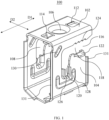
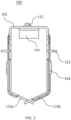
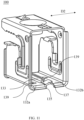
- FIGS. 1 and 2 show an installation member 100, according to a first exemplary embodiment of the present disclosure, for installing a photovoltaic module to a support beam.
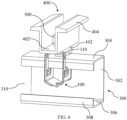
- FIGS. 3A to 8B show the process of installing the photovoltaic module 200 to the support beam 300 with the installation member 100, according to the first exemplary embodiment of the present disclosure.
- the photovoltaic module 200 may include a photovoltaic panel 202 and a photovoltaic panel frame 204 attached to the photovoltaic panel 202.
- the support beam 300 may be fixed to a roof of a building, a support leg connected to the ground, a mountain, or a pile foundation or floating foundation in a mountain, lake or ocean.
- the installation member 100 may include a top wall 102 and side wall(s) 104 extending from the top wall 102.
- the side wall 104 includes a receiving slot 108 for receiving at least part of the support beam 300 to allow the installation member 100 to be installed to the support beam 300.
- the top wall 102 includes a first fastening hole 106 for a fastener 500 to pass through to fasten the photovoltaic panel frame 204 to the support beam 300.
- the photovoltaic panel frame 204 of the photovoltaic module 200 can be installed to the support beam 300 with the installation member 100 and a clamping block 400. Only a portion of the photovoltaic module 200 and the support beam 300 are shown in the figures.
- the support beam 300 may have a base 302 and leg(s) 304 extending from the base 302.
- the support beam 300 may be in the form of an elongated C-shaped profile.
- the support beam 300 may have two legs 304 symmetrically provided on opposite sides of the base 302.
- Each leg 304 may include a leg body 306 extending from the base 302 and a flange 308 bent from/relative to the leg body 306.
- the flanges 308 of the two legs 304 may be opposite to each other and define an opening 310 therebetween.
- the leg body 306 may be substantially perpendicular to the base 302 and the flanges 308.
- the support beam 300 may be made of aluminum or steel by stamping or rolling.
- the clamping block 400 may have a fastening portion 402 and clamping arm(s) 404 extending from the fastening portion 402.
- a second fastening hole (not shown) is defined in the fastening portion 402.
- the fastener 500 may at least partially pass through the first fastening hole 106 of the installation member 100 and the second fastening hole of the clamping block 400, thereby fastening the photovoltaic panel frame 204 between the leg body 306 of the support beam 300 and the clamping arm(s) 404 of the clamping block 400.
- a second fastening hole may be provided in the photovoltaic panel frame 204, and the photovoltaic panel frame 204 may be fastened to the support beam 300 with the installation member 100 and the fastener 500.
- providing the fastening hole in the installation member 100 avoids weakening the strength of the support beam 300 itself, and allows flexible adjustment of the position of the installation member 100 according to the position of the photovoltaic module 200 or the accumulated installation tolerance, so that there is no need to drill new fastening hole on site, and the successful installation of a large number of photovoltaic modules 200 can be ensured.
- the installation member 100 may be formed by stamping a metal sheet. Compared to forming by casting, the installation member formed by stamping a metal sheet has better flexibility, which allows the installation member to better absorb external resistance and avoids damage of the installation member caused by stress concentration.
- the top wall 102 of the installation member 100 may extend in a first direction D1.
- the top wall 102 is substantially rectangular. It is conceivable that the top wall 102 may also have other suitable shapes.
- the top wall 102 may be integrally formed with a fastening nut 110 in which the first fastening hole 106 is defined.
- the first fastening hole 106 may have internal threads to be threadedly engaged with the fastener 500 with external threads.
- the fastener 500 may be, for example, a bolt or stud.
- the fastening nut 110 protrudes towards an interior of the installation member 100.
- a fastening hole in the form of an opening may be provided on the top wall 102, and consequently an additional fastening nut may be used to achieve the fastening of the photovoltaic panel frame 204.
- Anti-loosening tab(s) 112 may be provided on the top wall 102.
- the anti-loosening tab 112 may extend toward an exterior of the installation member 100 and have a sharp free end 114.
- the top wall 102 may have two anti-loosening tabs 112 arranged in a centrosymmetric manner around the first fastening hole 106.
- the free end 114 of each anti-loosening tab 112 may point in a direction opposite to an unscrewing direction of the fastener 500 to prevent the fastener 500 from loosening.
- the two anti-loosening tabs 112 respectively point towards two sides of the installation member 100.
- the installation member 100 includes two side walls 104 provided symmetrically.
- the two side walls 104 are respectively located on opposite sides of the top wall 102 in a second direction D2 substantially perpendicular to the first direction D1.
- Each side wall 104 is provided with one receiving slot 108.
- the receiving slot 108 may be in the form of a cut.
- the receiving slot 108 may receive the leg 304 of the support beam 300, and includes a first section 118 having an inlet end 116 and a second section 120 adjoining the first section 118 and forming an angle with the first section 118.
- the first section 118 and the second section 120 are configured to respectively receive the leg body 306 and the flange 308 of the support beam 300.
- the first section 118 of the receiving slot 108 may extend substantially in parallel with the first direction D1 and be closer to the top wall 102 than the second section 120.
- the first section 118 may be substantially perpendicular to the second section 120 (that is, the receiving slot 108 is substantially L-shaped), so that the first section 118 and the second section 120 can respectively receive the leg body 306 and the flange 308, that are substantially perpendicular to each other, of the support beam 300.
- the side wall 104 may be provided with an abutting tab 122.
- the abutting tab 122 is located on a side, away from the top wall 102, of the first section 118 so as to abut against an inner side of the leg body 306 of the support beam 300 when the photovoltaic panel frame 204 is fastened to the support beam 300.
- the abutting tab 122 may extend from the side wall 104 toward the exterior of the installation member 100.
- each of the two side walls 104 of the installation member 100 is provided with one abutting tab 122.
- a barb 124 may be provided on the side wall 104, and be arranged on a side, close to the top wall 102, of the first section 118 so as to hook an outer side of the leg body 306 of the support beam 300 when the installation member 100 is installed to the support beam 300.
- the barb 124 may be in the form of sawteeth. The functions of the abutting tab 122 and the barb 124 will be further explained in the following.
- the side wall 104 is provided with stiffener(s) and/or folded rim(s).
- the side wall 104 is provided with stiffeners around the receiving slot 108.
- a first stiffener 126 is provided on the side wall 104 along an edge of the receiving slot 108.
- the first stiffener 126 surrounds an end, away from the first section 118, of the second section 120 of the receiving slot 108.
- the first stiffener 126 may be in the form of a folded rim and be U-shaped.
- a second stiffener 128 is provided on the side wall 104 and surrounds the first stiffener 126.
- the second stiffener 128 may be formed by, for example, stamping. In the illustrated embodiment, the second stiffener 128 may also be U-shaped. The first stiffener 126 and the second stiffener 128 may form a double U-shaped structure surrounding the end of the second section 120 of the receiving slot 108, significantly enhancing the stiffness of the side wall 104 of the installation member 100.
- a third stiffener 130 is provided on the side wall 104 and is close to a junction between the first section 118 and the second section 120. In the illustrated embodiment, the third stiffener 130 is substantially strip-shaped.
- the first stiffener 126, the second stiffener 128, and the third stiffener 130 may prevent deformation of the side wall 104 of the installation member 100 (especially deformation near the receiving slot 108).
- the installation member 100 may further include two bottom walls 132a and 132b.
- the two bottom walls 132a and 132b extend from the ends of the two side walls 104 respectively and extend toward each other, and the bottom walls 132a and 132b interlace with one another and abut against each other.
- the bottom wall 132a has a first abutting portion 133
- the bottom wall 132b has a second abutting portion 135.
- the first abutting portion 133 and the second abutting portion 135 can abut against each other to provide support for the side walls 104 of the installation member 100 when the side walls 104 are subjected to pressing force along the second direction D2, thereby preventing deformation of the installation member 100.
- the first abutting portion 133 is in the form of a tab
- the second abutting portion 135 is in the form of a recess.
- folded rims 131 are provided at lateral edges of the side walls 104 and lateral edges of the bottom walls 132a and 132b (as shown in FIG. 1 ), so as to improve the stiffness of the installation member 100.
- the photovoltaic module 200 may be applied to various scenarios such as building, mountain, lake, ocean, etc. If the installation member 100 falls off from the support beam 300 during the installation process, it may be difficult to find the installation member 100 or pose a threat to the surrounding people or environment.
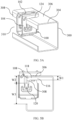
- FIGS. 3A to 5B show an exemplary process of installing the installation member 100 to the support beam 300.
- the installation member 100 is placed relative to the support beam 300 in a first orientation as shown in FIGS. 3A and 3B .
- the side walls 104 of the installation member 100 in the first orientation are substantially parallel to the leg body 306 of the support beam 300.
- part of the installation member 100 is placed into the support beam 300 through the opening 310 of the support beam 300, so that the bottom walls 132 of the installation member 100 are located inside the support beam 300, and the top wall 102 of the installation member 100 is located outside the support beam 300.
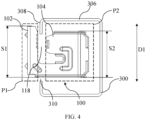
- the installation member 100 is rotated from the first orientation to a second orientation as shown in FIG. 4 , so that the flange 308 of the support beam 300 is inserted into the first sections 118 of the receiving slots 108 of the installation member 100.
- the top wall 102 and the side walls 104 of the installation member 100 in the second orientation are substantially perpendicular to the leg body 306 of the support beam 300.
- the installation member 100 is rotated from the second orientation to a third orientation as shown in FIGS. 5A and 5B , so that the leg body 306 and the flange 308 of the support beam 300 are respectively inserted into the first sections 118 and the second sections 120 of the receiving slots 108 of the installation member 100.
- the side walls 104 of the installation member 100 are substantially perpendicular to the leg body 306 of the support beam 300, and the top wall 102 of the installation member 100 is substantially parallel to the leg body 306 of the support beam 300.
- the installation member 100 is installed at the leg 304 of the support beam 300.
- a width of the first section 118 of the receiving slot 108 is such set to prevent the flange 308 of the support beam 300 from entering the second section 120 in a translational manner through the inlet end 116.
- the width W1 of the first section 118 of the receiving slot 108 may be set to be smaller than the width W2 of the flange 308.
- the leg 304 of the support beam 300 cannot be directly inserted into the receiving slot 108 from the inlet end 116 of the receiving slot 108 along a horizontal direction (in terms of the orientation in FIG. 5B ), and consequently the leg body 306 and the flange 308 cannot be respectively received in the first section 118 and the second section 120 by inserting the leg 304 of the support beam 300 along the horizontal direction.
- the leg 304 of the support beam 300 that has been already in position in the receiving slot 108 cannot be moved out of the receiving slot 108 through translation, so that it will be difficult for the installation member 100 that has been already installed in position to fall off the support beam 300.
- the installation member 100 when installing the installation member 100 to the support beam 300, as shown in FIGS. 4 to 5B , the installation member 100 is partially placed into the support beam 300 in the second orientation, with the first section 118 of the receiving slot 108 of the installation member 100 being aligned with the flange 308 of the support beam 300, and the installation member 100 is then rotated to the third orientation to complete the installation of the installation member 100.
- the size of the installation member 100 may be such set to prevent the installation member 100 in the second orientation from translating into the support beam 300 directly through the opening 310.
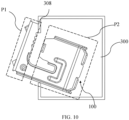
- the installation member 100 may include or be divided into a first part P1 and a second part P2 which are respectively located on opposite sides of the first section 118 of the receiving slot 108.
- the first part P1 includes the top wall 102.
- the dimension S2 of the second part P2 in the first direction D1 may be greater than the width W3 of the opening 310, so that it is difficult for the installation member 100 oriented in the second orientation to translate into the support beam 300 directly through the opening 310, and it is also difficult for the installation member 100 that has already entered the support beam 300 to translate out of the support beam 300.
- the installation member 100 should be first moved into the support beam 300 via the opening 310 in the first orientation and then rotated to the second orientation, such that the first section 118 of the receiving slot 108 of the installation member 100 is aligned with the flange 308 of the support beam 300.
- the dimension S1 of the first part P1 in the first direction D1 may also be greater than the width W3 of the opening 310 to prevent the installation member 100 in the second orientation from completely entering the support beam 300.
- the width of the first section 118 of the receiving slot 108 is such set to prevent the flange 308 of the support beam 300 from entering the second section 120 in a translational manner through the inlet end 116, and the dimension S2 of the second part P2 in the first direction D1 is set to be greater than the width W3 of the opening 310.
- the design of the installation member 100 of the present disclosure may also prevent the installation member 100 from falling off.
- FIGS. 3A and 3B if the installation is suspended after the first stage of installation is completed, in terms of the orientation of FIG. 3B , in the absence of external force, the lower side wall 104 of the installation member 100 would abut against the lower leg 304 of the support beam 300, and the abutting tab 122 extending outwardly of the installation member 100 would abut against the flange 308 of the support beam 300, preventing the installation member 100 from falling off the support beam 300.
- the installation member 100 would tilt in a manner as shown in FIG. 10 , and the first part P1 of the installation member 100 hooks the flange 308 of the support beam 300, thereby retaining part of the installation member 100 inside the support beam 300.
- the barb 124 of the installation member 100 would hook the outer side of the leg body 306 of the support beam 300, to prevent the installation member 100 from falling off the support beam 300.
- the clamping block 400 may be placed on the top wall 102 of the installation member 100, and the second fastening hole in the clamping block 400 may be aligned with the first fastening hole 106 of the fastening nut 110 on the installation member 100, and then the fastener 500 is pre-screwed into the fastening nut 110 of the installation member 100 through the second fastening hole.
- the photovoltaic panel frame 204 may be placed between the clamping arm 404 of the clamping block 400 and the leg body 306 of the support beam 300, by, for example, moving the installation member 100 and the clamping block 400.
- the fastener 500 is not screwed tight, and the side, close to the top wall 102, of the first section 118 of the receiving slot 108 contacts the outer side of the leg body 306 of the support beam 300.
- the fastener 500 may be further screwed tight, and the installation member 100 may be moved towards the clamping block 400 along the axis direction of the fastener 500 until the receiving slot 108 of the installation member 100 engages the leg 304 of the support beam 300 and the abutting tab 122 abuts against the inner side of the leg body 306.
- the installation member 100 is at least partially located inside the support beam 300 and is fastened to the support beam 300, and the photovoltaic panel frame 204 is clamped between the clamping arm 404 of the clamping block 400 and the leg body 306 of the support beam 300, such that the photovoltaic panel frame 204 is fastened to the support beam 300.
- the ability of the installation member 100 to resist the external force along the second direction D2 may be effectively improved through the abutment between the abutting tab 122 and the support beam 300.
- the sharp free ends 114 of the anti-loosening tabs 112 of the installation member 100 pierce into the clamping block 400. This may prevent the installation member 100 from being rotated relative to the clamping block 400 due to the external force and prevent the consequent loosening of the fastener 500. Even if the fastener 500 is slightly loose and a small clearance is thereby generated between the installation member 100 and the clamping block 400, the anti-loosening tabs 112 having elasticity may deflect upwards by means of their own elasticity, to compensate for the small clearance, thereby avoiding further loosening of the fastener 500 caused by the small clearance.
- the above steps of fastening the photovoltaic module 200 to the support beam 300 with the installation member 100 and the clamping block 400 are only exemplary. It is conceivable that the installation member 100 and the clamping block 400 may be first pre-fixed via the fastener 500; then the installation member 100 and the clamping block 400 may be installed to the support beam 300; and finally the photovoltaic panel frame 204 may be placed between the clamping arm 404 of the clamping block 400 and the leg body 306 of the support beam 300, by, for example, moving the installation member 100 and the clamping block 400, and the fastener 500 may be screwed tight, to complete the fastening operation.
- FIG. 9 to FIG. 10 show an installation member 100 according to a second exemplary embodiment of the present disclosure.
- the installation member according to the second exemplary embodiment of the present disclosure is similar to the installation member according to the first exemplary embodiment of the present disclosure, and the main difference lies in the following aspects.
- the first stiffener 126 of the installation member 100 according to the second exemplary embodiment of the present disclosure is longer.
- the first stiffener 126 extends around the end, away from the first section 118, of the second section 120 of the receiving slot 108 and extends to the junction between the first section 118 and the second section 120.
- the third stiffener 130 is substantially circular.
- FIG. 11 shows an installation member 100 according to a third exemplary embodiment of the present disclosure.
- the installation member according to the third exemplary embodiment of the present disclosure is similar to the installation member according to the second exemplary embodiment of the present disclosure, and the main difference lies in the following aspects.
- the first abutting portion 133 of the bottom wall 132a and the second abutting portion 135 of the bottom wall 132b of the installation member 100 according to the third exemplary embodiment of the present disclosure are each in the form of a folded rim.
- the first abutting portion 133 and the second abutting portion 135 can abut against each other, to prevent deformation of the installation member 100 especially when subjected to an external force along the second direction D2.
- the bottom wall 132a has a lug 137 protruding towards the bottom wall 132b, to abut against the bottom wall 132b when the installation member is subjected to an external force, especially at an angle to the second direction D2, to further prevent deformation of the installation member 100.
- the bottom walls 132a and 132b are each provided with a substantially circular fourth stiffener 139, to increase the stiffness of the bottom walls 132a and 132b.
- FIG. 12 shows an installation member 100 according to a fourth exemplary embodiment of the present disclosure.
- the installation member according to the fourth exemplary embodiment of the present disclosure is similar to the installation member according to the second exemplary embodiment of the present disclosure, and the main difference lies in the following aspects.
- the obtuse angle between each bottom wall 132a /132b and the corresponding side wall 104 is greater.
- the installation member 100 has strip-shaped fifth stiffeners 141 that extend from the side walls 104 respectively to the bottom walls 132a and 132b, to increase the stiffness of the installation member 100.
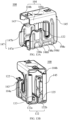
- FIG. 13A to FIG. 14B show an installation member 100 according to a fifth exemplary embodiment of the present disclosure.
- the installation member according to the fifth exemplary embodiment of the present disclosure is similar to the installation member according to the third exemplary embodiment of the present disclosure, and the main difference therebetween lies in the following aspects.
- the installation member 100 includes side walls 104a, 104b (may be collectively referred to as side walls 104 hereinafter) and bottom walls 132a, 132b (may be collectively referred to as bottom walls 132 hereinafter).
- the side walls 104a and 104b are symmetrically provided with respect to each other.
- the bottom wall 132a extends from the bottom of the side wall 104a
- the bottom wall 132b extends from the bottom of the side wall 104b
- the bottom wall 132a and the bottom wall 132b extend towards each other.
- a reinforcing rib 143 is provided at the junction between each side wall 104 and the corresponding abutting tab 122.
- a triangular support is formed between the side wall 104 and the abutting tab 122 by providing the reinforcing rib 143, to further improve the stiffness of the abutting tab 122.
- the reinforcing rib 143 may be formed by, for example, stamping.
- a rolled rim 145 is formed at a lateral edge of the side wall 104 of the installation member 100 and curved toward the interior of the installation member 100.
- Each side wall 104 of the installation member 100 may have a rolled rim 145, and the rolled rim 145 may have a substantially circular cross-section. Providing the rolled rim 145 may effectively increase the stiffness of the side wall 104.
- the installation member 100 further includes stiffener structures 147a and 147b (collectively referred to as stiffener structures 147 hereinafter).
- the stiffener structure 147a extends from the side wall 104a to the corresponding bottom wall 132a
- the stiffener structure 147b extends from the side wall 104b to the corresponding bottom wall 132b.
- Each stiffener structure 147 may include multiple stiffeners 148a, 148b, 148c, 148d, and 148e. These stiffeners intersect vertically and horizontally, so that the stiffener structure is substantially grid-like.
- the stiffener structure extends from the side wall to the bottom wall, the overall stiffness of the installation member is increased, which may reduce the respective deformation of the side wall and the bottom wall and also the relative deformation of the side wall and the bottom wall (the relative deformation may be, for example, a change in the included angle between the side wall and the bottom wall).
- the first abutting portion 133 of the bottom wall 132a and the second abutting portion 135 of the bottom wall 132b of the installation member 100 are each in the form of a folded rim.
- the first abutting portion 133 and the second abutting portion 135 may both extend substantially in parallel with the side wall 104 towards the interior of the installation member 100.
- the installation member 100 includes a limiting structure arranged on at least one of the first abutting portion 133 and the second abutting portion 135 and configured to prevent the first abutting portion and the second abutting portion from being misaligned with and/or separated from each other.
- the limiting structure includes a first limiting hole 149a and a first limiting protrusion 151a provided on the first abutting portion 133, and also includes a second limiting hole 149b and a second limiting protrusion 151b provided on the second abutting portion 135.
- the first limiting hole 149a and the second limiting hole 149b respectively are through holes that run through the first abutting portion 133 and the second abutting portion 135.
- the first limiting protrusion 151a and the second limiting protrusion 151b protrude substantially perpendicular to the first abutting portion 133 and the second abutting portion 135, respectively.
- the first limiting protrusion 151a is inserted into and passed through the second limiting hole 149b, and the second limiting protrusion 151b is inserted into and passed through the first limiting hole 149a, so as to prevent the first abutting portion 133 and the second abutting portion 135 from being misaligned with and/or separated from each other when the installation member 100 is subjected to an external force (the photovoltaic panel installed via the installation member 100 exerts an external force onto the installation member 100 when subjected to, for example, a wind force), especially when subjected to an external force at an angle to the second direction D2.
- an external force the photovoltaic panel installed via the installation member 100 exerts an external force onto the installation member 100 when subjected to, for example, a wind force
- first limiting hole 149a and the second limiting hole 149b may not be through holes but only recessed relative to the corresponding first abutting portion 133 and second abutting portion 135. It is also conceivable that in some other embodiments, one or more limiting holes may be provided only on one of the first abutting portion 133 and the second abutting portion 135, and one or more limiting protrusions may be correspondingly provided on the other of the first abutting portion 133 and the second abutting portion 135.
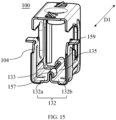
- FIG. 15 shows an installation member 100 according to a sixth exemplary embodiment of the present disclosure.
- the installation member according to the sixth exemplary embodiment of the present disclosure is similar to the installation member according to the fifth exemplary embodiment of the present disclosure, and the main difference therebetween lies in the following aspects.
- the first abutting portion 133 of the bottom wall 132a and the second abutting portion 135 of the bottom wall 132b of the installation member 100 are each in the form of a folded rim.
- the first abutting portion 133 and the second abutting portion 135 may both extend substantially in parallel with the side wall 104 towards the interior of the installation member 100.
- the installation member 100 includes a limiting structure arranged on at least one of the first abutting portion 133 and the second abutting portion 135 and configured to prevent the first abutting portion 133 and the second abutting portion 135 from being misaligned with and/or separated from each other.
- the limiting structure includes a first limiting hook 157 provided on the first abutting portion 133 and a second limiting hook 159 provided on the second abutting portion 135.
- the first limiting hook 157 hooks the second abutting portion 135, and the second limiting hook 159 hooks the first abutting portion 133, thereby preventing the first abutting portion 133 and the second abutting portion 135 from being misaligned with and/or separated from each other when the installation member 100 is subjected to an external force.
- first abutting portion 133 and the second abutting portion 135 both extend substantially along the first direction D1 of the installation member 100, and have a substantially same width (that is, the dimension in the first direction D1).
- the first limiting hook 157 and the second limiting hook 159 are spaced apart along the first direction D1 of the installation member 100.
- the width of the first limiting hook 157 and second limiting hook 159 may be adjusted according to actual needs.
- the sum of the width of the first limiting hook 157 and the width of the second limiting hook 159 (that is, the dimensions in the first direction D1) is approximately equal to the width of the first abutting portion 133/second abutting portion 135, to more effectively prevent the first abutting portion 133 and the second abutting portion 135 from being misaligned with and/or separated from each other.
- the width of the first limiting hook 157 and the width the second limiting hook 159 are each approximately equal to half of the width of the first abutting portion 133/second abutting portion 135.
- first abutting portion 133 and the second abutting portion 135 may be provided with limiting hook(s).
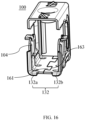
- FIG. 16 shows an installation member 100 according to a seventh exemplary embodiment of the present disclosure.
- the installation member according to the seventh exemplary embodiment of the present disclosure is similar to the installation member according to the fifth exemplary embodiment of the present disclosure, and the main difference therebetween lies in the following aspects.
- the bottom walls 132a and 132b of the installation member 100 extend substantially along the same plane towards each other.
- the bottom walls 132a and 132b are both substantially perpendicular to the side walls 104.
- the installation member 100 includes a limiting structure arranged on at least one of the bottom walls 132a and 132b and configured to prevent the two bottom walls 132a and 132b from being misaligned with and/or separated from each other.
- the limiting structure includes limiting tabs 161 provided on the bottom wall 132a and limiting notchs 163 provided on the bottom wall 132b.
- the limiting notch 163 may be in the form of a dovetail slot.
- the limiting notch 163 may be formed by, for example, punching.
- the limiting tab 161 may be in an interference fit with the limiting notch 163, thereby preventing the bottom wall 132a and the bottom wall 132b from being misaligned with and/or separated from each other when the installation member 100 is subjected to an external force.
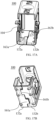
- FIG. 17A and FIG. 17B show an installation member 100 according to an eighth exemplary embodiment of the present disclosure.
- the installation member according to the eighth exemplary embodiment of the present disclosure is similar to the installation member according to the seventh exemplary embodiment of the present disclosure, and the main difference therebetween lies in the following aspects.
- the bottom walls 132a and 132b of the installation member 100 extend substantially along the same plane towards each other.
- the bottom walls 132a and 132b are both substantially perpendicular to the side walls 104.
- the installation member 100 includes a limiting structure arranged on at least one of the bottom walls 132a and 132b and configured to prevent the two bottom walls 132a and 132b from being misaligned with and/or separated from each other.
- the limiting structure includes a first limiting tab 161a and first limiting notch 163a provided on the bottom wall 132a, and also includes a second limiting tab 161b and second limiting notch 163b provided on the bottom wall 132b.
- the first limiting notch 163a and the second limiting notch 163b are recessed towards the interior of the installation member 100 respectively from the bottom wall 132a and the bottom wall 132b.
- the first limiting tab 161a is received in the second limiting notch 163b, and the second limiting tab 161b is received in the first limiting notch 163a, thereby preventing the bottom wall 132a and the bottom wall 132b from being misaligned with and/or separated from each other when the installation member 100 is subjected to an external force.
- limiting tabs and limiting notches are not limited thereto.
- one limiting notch may be recessed towards the interior of the installation member from the bottom wall, while the other limiting notch may be recessed towards the exterior of the installation member from the bottom wall.
- FIGS. 1 to 17B only illustrate the shape, size and arrangement of each optional component of the installation member according to the present disclosure. However, these embodiments are merely intended to illustrate rather than limit. Other shapes, sizes and arrangements may be adopted without departing from the idea and scope of the present disclosure.
Landscapes
- Engineering & Computer Science (AREA)
- General Engineering & Computer Science (AREA)
- Mechanical Engineering (AREA)
- Architecture (AREA)
- Civil Engineering (AREA)
- Structural Engineering (AREA)
- Roof Covering Using Slabs Or Stiff Sheets (AREA)
- Photovoltaic Devices (AREA)
- Mutual Connection Of Rods And Tubes (AREA)
Applications Claiming Priority (2)
| Application Number | Priority Date | Filing Date | Title |
|---|---|---|---|
| CN202111666027.0A CN114142800A (zh) | 2021-12-31 | 2021-12-31 | 安装件 |
| PCT/CN2022/106788 WO2023124028A1 (zh) | 2021-12-31 | 2022-07-20 | 安装件 |
Publications (2)
| Publication Number | Publication Date |
|---|---|
| EP4459865A1 true EP4459865A1 (de) | 2024-11-06 |
| EP4459865A4 EP4459865A4 (de) | 2025-12-24 |
Family
ID=80384142
Family Applications (1)
| Application Number | Title | Priority Date | Filing Date |
|---|---|---|---|
| EP22913317.8A Pending EP4459865A4 (de) | 2021-12-31 | 2022-07-20 | Montageelement |
Country Status (5)
| Country | Link |
|---|---|
| EP (1) | EP4459865A4 (de) |
| JP (1) | JP2024547173A (de) |
| CN (1) | CN114142800A (de) |
| AU (1) | AU2022428543B2 (de) |
| WO (1) | WO2023124028A1 (de) |
Families Citing this family (1)
| Publication number | Priority date | Publication date | Assignee | Title |
|---|---|---|---|---|
| CN114142800A (zh) * | 2021-12-31 | 2022-03-04 | A.雷蒙德公司 | 安装件 |
Family Cites Families (15)
| Publication number | Priority date | Publication date | Assignee | Title |
|---|---|---|---|---|
| DE102010022556B3 (de) * | 2010-06-02 | 2011-06-30 | A. Raymond Et Cie S.C.S. | Vorrichtung zum Befestigen eines Solarmoduls |
| US20140000085A1 (en) * | 2012-07-02 | 2014-01-02 | A. Raymond Et Cie | Removal tool and method for photovoltaic fastener |
| CN203367303U (zh) * | 2013-05-31 | 2013-12-25 | 阿雷蒙紧固件(镇江)有限公司 | 一种光伏板边框紧固件 |
| FR3054862B3 (fr) * | 2016-08-04 | 2018-08-31 | A Raymond Et Cie | Agrafe de maintien de deux elements plans |
| CN206977347U (zh) * | 2017-07-20 | 2018-02-06 | 浙江双宇电子科技有限公司 | 一种光伏组件安装型材 |
| CN207766211U (zh) * | 2018-01-06 | 2018-08-24 | 海宁川达科技有限公司 | 一种太阳能光伏板连接装置 |
| CN207782737U (zh) | 2018-01-24 | 2018-08-28 | 河南厚德电力科技有限公司 | 太阳能光伏组件固定结构 |
| CN207782738U (zh) | 2018-01-24 | 2018-08-28 | 河南厚德电力科技有限公司 | 太阳能光伏电池组件固定结构 |
| FR3079890B1 (fr) * | 2018-04-04 | 2020-04-03 | A. Raymond Et Cie | Agrafe de fixation pour chassis photovoltaique a montage par insertion puis coulissement dans une fente d’une paroi de support |
| CN208806776U (zh) | 2018-09-13 | 2019-04-30 | 泰州中来光电科技有限公司 | 一种光伏组件的安装结构 |
| CN209120116U (zh) | 2018-12-24 | 2019-07-16 | 江苏日托光伏科技股份有限公司 | 一种双玻组件侧面挂钩式安装件 |
| CN213043614U (zh) * | 2020-09-07 | 2021-04-23 | 合肥阳光新能源科技有限公司 | 转接件及光伏系统 |
| CN214480441U (zh) | 2021-04-29 | 2021-10-22 | 浙江正泰新能源开发有限公司 | 光伏组件边框结构及光伏组件系统 |
| CN114142800A (zh) * | 2021-12-31 | 2022-03-04 | A.雷蒙德公司 | 安装件 |
| CN217183240U (zh) * | 2021-12-31 | 2022-08-12 | A.雷蒙德公司 | 安装件 |
-
2021
- 2021-12-31 CN CN202111666027.0A patent/CN114142800A/zh active Pending
-
2022
- 2022-07-20 EP EP22913317.8A patent/EP4459865A4/de active Pending
- 2022-07-20 WO PCT/CN2022/106788 patent/WO2023124028A1/zh not_active Ceased
- 2022-07-20 AU AU2022428543A patent/AU2022428543B2/en active Active
- 2022-07-20 JP JP2024539693A patent/JP2024547173A/ja active Pending
Also Published As
| Publication number | Publication date |
|---|---|
| AU2022428543A1 (en) | 2024-06-27 |
| JP2024547173A (ja) | 2024-12-26 |
| WO2023124028A1 (zh) | 2023-07-06 |
| AU2022428543B2 (en) | 2025-11-27 |
| EP4459865A4 (de) | 2025-12-24 |
| CN114142800A (zh) | 2022-03-04 |
Similar Documents
| Publication | Publication Date | Title |
|---|---|---|
| JP4108724B1 (ja) | 構造物設置架台 | |
| EP3128098B1 (de) | Solarzellenvorrichtung | |
| US20120312356A1 (en) | Solar cell module | |
| EP2535948A1 (de) | Strukturunterstützende struktur, rahmen für die struktur, verfahren zur konstruktion der struktur mit diesem rahmen und solarstromerzeugungssystem | |
| TWI550241B (zh) | 用以支撐太陽能模組的支架 | |
| EA022863B1 (ru) | Предотвращающий боковое смещение элемент для наружной стеновой панели и наружная стеновая установочная конструкция, в которой он используется | |
| US20210194410A1 (en) | Assembly apparatus for truss structure | |
| EP4459865A1 (de) | Montageelement | |
| US11060295B2 (en) | Snow fence for a structure having varying roof types | |
| JP7609426B2 (ja) | 折板屋根における太陽電池モジュールの支持装置 | |
| US10601205B2 (en) | Connection arrangement for the connection of two switchgear cabinet frameworks | |
| JP3240780U (ja) | 太陽電池アセンブリ取り付け構造及び該構造を用いるカラースチールタイル、太陽光発電システム | |
| CN217183240U (zh) | 安装件 | |
| KR102031421B1 (ko) | 프로파일유닛 및 프로파일 구조체 | |
| JP7664077B2 (ja) | 取付装置及びアンカー補助具 | |
| KR102209590B1 (ko) | 지지철물 | |
| KR20190024125A (ko) | 이탈 방지 흙막이 패널 및 흙막이 구조물 | |
| JP7058079B2 (ja) | 外壁改修構造 | |
| US12523243B2 (en) | Overhead rail attachment | |
| JP6935305B2 (ja) | 補強金具及び太陽電池モジュール用架台キット | |
| AU2014100758A4 (en) | External gutter system | |
| GB2626843A (en) | Overhead rail attachment | |
| KR20190019276A (ko) | 지붕 고정장치 | |
| RU97154U1 (ru) | Кронштейн навесной фасадной системы с воздушным зазором | |
| JPH0860770A (ja) | カーテンウォール構法における壁パネル取り付け用定規部材の取り付け構造 |
Legal Events
| Date | Code | Title | Description |
|---|---|---|---|
| STAA | Information on the status of an ep patent application or granted ep patent |
Free format text: STATUS: THE INTERNATIONAL PUBLICATION HAS BEEN MADE |
|
| PUAI | Public reference made under article 153(3) epc to a published international application that has entered the european phase |
Free format text: ORIGINAL CODE: 0009012 |
|
| STAA | Information on the status of an ep patent application or granted ep patent |
Free format text: STATUS: REQUEST FOR EXAMINATION WAS MADE |
|
| 17P | Request for examination filed |
Effective date: 20240729 |
|
| AK | Designated contracting states |
Kind code of ref document: A1 Designated state(s): AL AT BE BG CH CY CZ DE DK EE ES FI FR GB GR HR HU IE IS IT LI LT LU LV MC MK MT NL NO PL PT RO RS SE SI SK SM TR |
|
| DAV | Request for validation of the european patent (deleted) | ||
| DAX | Request for extension of the european patent (deleted) | ||
| A4 | Supplementary search report drawn up and despatched |
Effective date: 20251120 |
|
| RIC1 | Information provided on ipc code assigned before grant |
Ipc: H02S 30/10 20140101AFI20251114BHEP |