EP4459738A1 - Verfahren zum laden einer sekundärbatterie - Google Patents
Verfahren zum laden einer sekundärbatterie Download PDFInfo
- Publication number
- EP4459738A1 EP4459738A1 EP22915266.5A EP22915266A EP4459738A1 EP 4459738 A1 EP4459738 A1 EP 4459738A1 EP 22915266 A EP22915266 A EP 22915266A EP 4459738 A1 EP4459738 A1 EP 4459738A1
- Authority
- EP
- European Patent Office
- Prior art keywords
- charging
- secondary battery
- negative electrode
- current density
- charging step
- Prior art date
- Legal status (The legal status is an assumption and is not a legal conclusion. Google has not performed a legal analysis and makes no representation as to the accuracy of the status listed.)
- Pending
Links
Images
Classifications
-
- H—ELECTRICITY
- H01—ELECTRIC ELEMENTS
- H01M—PROCESSES OR MEANS, e.g. BATTERIES, FOR THE DIRECT CONVERSION OF CHEMICAL ENERGY INTO ELECTRICAL ENERGY
- H01M10/00—Secondary cells; Manufacture thereof
- H01M10/05—Accumulators with non-aqueous electrolyte
- H01M10/052—Li-accumulators
-
- H—ELECTRICITY
- H01—ELECTRIC ELEMENTS
- H01M—PROCESSES OR MEANS, e.g. BATTERIES, FOR THE DIRECT CONVERSION OF CHEMICAL ENERGY INTO ELECTRICAL ENERGY
- H01M10/00—Secondary cells; Manufacture thereof
- H01M10/05—Accumulators with non-aqueous electrolyte
- H01M10/052—Li-accumulators
- H01M10/0525—Rocking-chair batteries, i.e. batteries with lithium insertion or intercalation in both electrodes; Lithium-ion batteries
-
- H—ELECTRICITY
- H01—ELECTRIC ELEMENTS
- H01M—PROCESSES OR MEANS, e.g. BATTERIES, FOR THE DIRECT CONVERSION OF CHEMICAL ENERGY INTO ELECTRICAL ENERGY
- H01M10/00—Secondary cells; Manufacture thereof
- H01M10/05—Accumulators with non-aqueous electrolyte
- H01M10/056—Accumulators with non-aqueous electrolyte characterised by the materials used as electrolytes, e.g. mixed inorganic/organic electrolytes
- H01M10/0561—Accumulators with non-aqueous electrolyte characterised by the materials used as electrolytes, e.g. mixed inorganic/organic electrolytes the electrolyte being constituted of inorganic materials only
- H01M10/0562—Solid materials
-
- H—ELECTRICITY
- H01—ELECTRIC ELEMENTS
- H01M—PROCESSES OR MEANS, e.g. BATTERIES, FOR THE DIRECT CONVERSION OF CHEMICAL ENERGY INTO ELECTRICAL ENERGY
- H01M10/00—Secondary cells; Manufacture thereof
- H01M10/05—Accumulators with non-aqueous electrolyte
- H01M10/058—Construction or manufacture
- H01M10/0585—Construction or manufacture of accumulators having only flat construction elements, i.e. flat positive electrodes, flat negative electrodes and flat separators
-
- H—ELECTRICITY
- H01—ELECTRIC ELEMENTS
- H01M—PROCESSES OR MEANS, e.g. BATTERIES, FOR THE DIRECT CONVERSION OF CHEMICAL ENERGY INTO ELECTRICAL ENERGY
- H01M10/00—Secondary cells; Manufacture thereof
- H01M10/42—Methods or arrangements for servicing or maintenance of secondary cells or secondary half-cells
- H01M10/44—Methods for charging or discharging
-
- H—ELECTRICITY
- H01—ELECTRIC ELEMENTS
- H01M—PROCESSES OR MEANS, e.g. BATTERIES, FOR THE DIRECT CONVERSION OF CHEMICAL ENERGY INTO ELECTRICAL ENERGY
- H01M10/00—Secondary cells; Manufacture thereof
- H01M10/42—Methods or arrangements for servicing or maintenance of secondary cells or secondary half-cells
- H01M10/44—Methods for charging or discharging
- H01M10/446—Initial charging measures
-
- H—ELECTRICITY
- H01—ELECTRIC ELEMENTS
- H01M—PROCESSES OR MEANS, e.g. BATTERIES, FOR THE DIRECT CONVERSION OF CHEMICAL ENERGY INTO ELECTRICAL ENERGY
- H01M10/00—Secondary cells; Manufacture thereof
- H01M10/42—Methods or arrangements for servicing or maintenance of secondary cells or secondary half-cells
- H01M10/48—Accumulators combined with arrangements for measuring, testing or indicating the condition of cells, e.g. the level or density of the electrolyte
-
- H—ELECTRICITY
- H01—ELECTRIC ELEMENTS
- H01M—PROCESSES OR MEANS, e.g. BATTERIES, FOR THE DIRECT CONVERSION OF CHEMICAL ENERGY INTO ELECTRICAL ENERGY
- H01M4/00—Electrodes
- H01M4/02—Electrodes composed of, or comprising, active material
- H01M4/04—Processes of manufacture in general
- H01M4/0402—Methods of deposition of the material
- H01M4/0407—Methods of deposition of the material by coating on an electrolyte layer
-
- H—ELECTRICITY
- H01—ELECTRIC ELEMENTS
- H01M—PROCESSES OR MEANS, e.g. BATTERIES, FOR THE DIRECT CONVERSION OF CHEMICAL ENERGY INTO ELECTRICAL ENERGY
- H01M4/00—Electrodes
- H01M4/02—Electrodes composed of, or comprising, active material
- H01M4/13—Electrodes for accumulators with non-aqueous electrolyte, e.g. for lithium-accumulators; Processes of manufacture thereof
- H01M4/134—Electrodes based on metals, Si or alloys
-
- H—ELECTRICITY
- H01—ELECTRIC ELEMENTS
- H01M—PROCESSES OR MEANS, e.g. BATTERIES, FOR THE DIRECT CONVERSION OF CHEMICAL ENERGY INTO ELECTRICAL ENERGY
- H01M4/00—Electrodes
- H01M4/02—Electrodes composed of, or comprising, active material
- H01M4/13—Electrodes for accumulators with non-aqueous electrolyte, e.g. for lithium-accumulators; Processes of manufacture thereof
- H01M4/139—Processes of manufacture
- H01M4/1395—Processes of manufacture of electrodes based on metals, Si or alloys
-
- H—ELECTRICITY
- H01—ELECTRIC ELEMENTS
- H01M—PROCESSES OR MEANS, e.g. BATTERIES, FOR THE DIRECT CONVERSION OF CHEMICAL ENERGY INTO ELECTRICAL ENERGY
- H01M4/00—Electrodes
- H01M4/02—Electrodes composed of, or comprising, active material
- H01M4/36—Selection of substances as active materials, active masses, active liquids
- H01M4/38—Selection of substances as active materials, active masses, active liquids of elements or alloys
- H01M4/381—Alkaline or alkaline earth metals elements
- H01M4/382—Lithium
-
- H—ELECTRICITY
- H01—ELECTRIC ELEMENTS
- H01M—PROCESSES OR MEANS, e.g. BATTERIES, FOR THE DIRECT CONVERSION OF CHEMICAL ENERGY INTO ELECTRICAL ENERGY
- H01M10/00—Secondary cells; Manufacture thereof
- H01M10/42—Methods or arrangements for servicing or maintenance of secondary cells or secondary half-cells
- H01M10/44—Methods for charging or discharging
- H01M10/448—End of discharge regulating measures
-
- H—ELECTRICITY
- H01—ELECTRIC ELEMENTS
- H01M—PROCESSES OR MEANS, e.g. BATTERIES, FOR THE DIRECT CONVERSION OF CHEMICAL ENERGY INTO ELECTRICAL ENERGY
- H01M4/00—Electrodes
- H01M4/02—Electrodes composed of, or comprising, active material
- H01M2004/026—Electrodes composed of, or comprising, active material characterised by the polarity
- H01M2004/027—Negative electrodes
-
- Y—GENERAL TAGGING OF NEW TECHNOLOGICAL DEVELOPMENTS; GENERAL TAGGING OF CROSS-SECTIONAL TECHNOLOGIES SPANNING OVER SEVERAL SECTIONS OF THE IPC; TECHNICAL SUBJECTS COVERED BY FORMER USPC CROSS-REFERENCE ART COLLECTIONS [XRACs] AND DIGESTS
- Y02—TECHNOLOGIES OR APPLICATIONS FOR MITIGATION OR ADAPTATION AGAINST CLIMATE CHANGE
- Y02E—REDUCTION OF GREENHOUSE GAS [GHG] EMISSIONS, RELATED TO ENERGY GENERATION, TRANSMISSION OR DISTRIBUTION
- Y02E60/00—Enabling technologies; Technologies with a potential or indirect contribution to GHG emissions mitigation
- Y02E60/10—Energy storage using batteries
Definitions
- the present invention relates to a method for charging secondary battery.
- a secondary battery for motor driving is required to have extremely high output characteristics and high energy as compared with a lithium secondary battery for consumer use used in a mobile phone, a notebook computer, and the like. Therefore, a lithium secondary battery having the highest theoretical energy among all practical batteries has attracted attention, and is currently being rapidly developed.
- lithium secondary batteries that are currently widespread use a combustible organic electrolyte solution as an electrolyte.
- safety measures against liquid leakage, short circuit, overcharge, and the like are more strictly required than other batteries.
- the solid electrolyte is a material mainly made of an ion conductor capable of ion conduction in a solid. Therefore, in the all-solid-state lithium secondary battery, in principle, various problems caused by the combustible organic electrolyte solution do not occur unlike the conventional liquid lithium secondary battery. Further, in general, when a positive electrode material having a high potential and a large capacity and a negative electrode material having a large capacity are used, the power density and the energy density of the battery can be significantly improved. An all-solid-state lithium secondary battery using a sulfide-based material as a positive electrode active material and using metallic lithium or a lithium-containing alloy as a negative electrode active material is a promising candidate.
- the negative electrode potential decreases with the progress of charging.
- the negative electrode potential decreases to be lower than 0 V (vs. Li/Li+)
- metal lithium is precipitated at the negative electrode, and dendrite (tree-like) crystals are precipitated (this phenomenon is also referred to as "electrodeposition of metal lithium”).
- electrodeposition of metallic lithium occurs, there is a problem that a deposited dendrite penetrates the solid electrolyte layer to cause an internal short circuit in the battery.
- JP 2020-009724 A discloses a charging method in a secondary battery utilizing a deposition-dissolution reaction of metallic lithium as a reaction of a negative electrode for the purpose of achieving both suppression of a short circuit in the battery and shortening of a charging time.
- the charging method includes a first charging step in which the secondary battery is charged at a first current density I1, and a second charging step in which the secondary battery is charged at a second current density I2 greater than the first current density I1 after the first charging step.
- the first charging step is characterized in that when the roughness height on the surface on the negative electrode current collector foil side of the solid electrolyte layer is represented by Y (um) and the thickness of the roughness coating layer is represented by X (um), the secondary battery is charged at the first current density I1 until X/Y becomes 0.5 or more.
- an object of the present invention is to provide a means for more effectively suppressing a short circuit in a secondary battery.
- an uncharged state is defined as an SOC of 0%
- a state in which a current value becomes 20% or less of a constant current value by charging at a constant current and charging at a constant voltage after 4.2 V is reached is defined as an SOC of 100%.
- An embodiment of the present invention relates to a method for charging a secondary battery including a positive electrode current collector, a positive electrode active material layer, a solid electrolyte layer, and a negative electrode current collector in this order, and utilizing a deposition-dissolution reaction of metallic lithium as the reaction of the negative electrode.
- the charging method includes a multi-stage charging step including at least a first charging step and a second charging step.
- the first charging step the secondary battery is charged at a first current density I1 to deposit metallic lithium on a surface on the solid electrolyte layer side of the negative electrode current collector to form a deposited Li layer that is a part of a negative electrode active material layer and that contains the metallic lithium.
- the secondary battery is charged at a second current density I2 greater than the first current density I1 to increase the thickness of the deposited Li layer.
- the first charging step is characterized in that it includes performing pausing at least once or discharging at least once, and is characterized in that the secondary battery is charged at the first current density I1 so that the SOC does not exceed 4.5%.
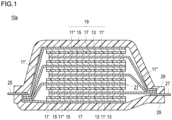
- Fig. 1 is a cross-sectional view schematically illustrating a flat laminate type all-solid-state lithium secondary battery according to an embodiment of the present invention.
- An embodiment of the present invention relates to a method for charging a secondary battery including a positive electrode current collector, a positive electrode active material layer, a solid electrolyte layer, and a negative electrode current collector in this order, and utilizing a deposition-dissolution reaction of metallic lithium as the reaction of the negative electrode.
- the charging method includes a multi-stage charging step including at least a first charging step and a second charging step.
- the first charging step the secondary battery is charged at a first current density I1 to deposit metallic lithium on a surface on the solid electrolyte layer side of the negative electrode current collector to form a deposited Li layer that is a part of a negative electrode active material layer and that contains the metallic lithium.
- the secondary battery is charged at a second current density I2 greater than the first current density I1 to increase the thickness of the deposited Li layer.
- the first charging step is characterized in that it includes performing pausing at least once or discharging at least once, and is characterized in that the secondary battery is charged at the first current density I1 so that the SOC does not exceed 4.5%. According to the charging method according to the present embodiment, a short circuit in the secondary battery can be more effectively suppressed.
- Fig. 1 is a cross-sectional view schematically illustrating a flat laminate type all-solid-state lithium secondary battery according to an embodiment of the present invention.
- a flat laminate type non-bipolar lithium secondary battery hereinafter also simply referred to as a "laminate type secondary battery" illustrated in Fig. 1 will be described in detail as an example.
- the present invention can be applied to both a non-bipolar type (internal parallel connection type) battery and a bipolar type (internal series connection type) battery.
- a laminate type secondary battery 10a of the present embodiment has a structure in which a power generating element 21, which has a flat and substantially rectangular shape, and in which a charge-discharge reaction actually proceeds, is sealed inside a laminate film 29 which is a battery outer casing material.
- the power generating element 21 has a configuration in which a positive electrode, a solid electrolyte layer 17, and a negative electrode are laminated.
- the positive electrode has a structure in which a positive electrode active material layer 13 containing a positive electrode active material (here, an NMC composite oxide (LiNi 0.8 Mn 0.1 Co 0.1 O 2 )) is disposed on both surfaces of a positive electrode current collector 11'.
- the negative electrode has a structure in which a negative electrode active material layer 15 containing a negative electrode active material (a deposited Li layer made of metallic lithium as a negative electrode active material) is disposed on both surfaces of a negative electrode current collector 11".
- a negative electrode active material layer 15 containing a negative electrode active material a deposited Li layer made of metallic lithium as a negative electrode active material
- the positive electrode, the solid electrolyte layer, and the negative electrode are laminated in this order such that one positive electrode active material layer 13 and the negative electrode active material layer 15 adjacent thereto face each other via the solid electrolyte layer 17.
- the adjacent positive electrode, solid electrolyte layer, and negative electrode constitute one single battery layer 19. Therefore, it can also be said that the laminate type secondary battery 10a shown in Fig. 1 has a configuration in which a plurality of single battery layers 19 are laminated to be electrically connected in parallel.
- the positive electrode active material layer 13 is disposed on only one surface of each of outermost positive electrode current collectors located in both outermost layers of the power-generating element 21, the active material layer may be provided on both surfaces.
- a current collector instead of using a current collector exclusively for an outermost layer provided with the active material layer only on one surface thereof, a current collector provided with the active material layer on both surfaces thereof may be used as it is as an outermost current collector.
- the positive electrode current collector 11' and the negative electrode current collector 11" have a structure in which a positive electrode current collecting plate (tab) 25 and a negative electrode current collecting plate (tab) 27 which are electrically connected to the respective electrodes (the positive electrode and the negative electrode) are attached respectively, and led out to the outside of the laminate film 29 which is a battery outer casing material so as to be sandwiched between end portions of the laminate film 29.
- the positive electrode current collecting plate 25 and the negative electrode current collecting plate 27 may be attached to the positive electrode current collector 11' and the negative electrode current collector 11" of the respective electrodes via a positive electrode lead and a negative electrode lead (not illustrated), respectively, by ultrasonic welding, resistance welding, or the like as necessary.
- a restraint pressure is applied to the laminate type secondary battery 10a in the lamination direction of the power generating elements 21 by a pressure member (not illustrated). Therefore, the volume of the power generating element 21 is kept constant.
- the positive electrode current collector is a conductive member that functions as a flow path for electrons emitted from the positive electrode toward an external load or flowing from a power supply toward the positive electrode with the progress of a battery reaction (charge-discharge reaction).
- the material constituting the positive electrode current collector is not particularly limited.
- a constituent material of the positive electrode current collector for example, a metal or a resin having an electrical conduction property can be adopted.
- the metal examples include aluminum, nickel, iron, stainless steel, titanium, copper, and the like.
- a clad material of nickel and aluminum, a clad material of copper and aluminum, or the like may be used.
- a foil in which a metal surface is coated with aluminum may be used.
- aluminum, stainless steel, copper, and nickel are preferable from the viewpoint of an electron conduction property, a battery operating potential, and the like.
- the latter resin having an electrical conduction property examples include a resin obtained by adding a conductive filler to a nonconductive polymer material.
- the current collector may have a single-layer structure made of a single material, or may have a laminated structure in which layers made of these materials are appropriately combined. From the viewpoint of weight reduction of the current collector, it is preferable that the current collector includes at least a conductive resin layer made of a resin having conductivity. From the viewpoint of blocking the movement of lithium ions between single battery layers, a metal layer may be provided in a part of the current collector.
- the thickness of the positive electrode current collector is not particularly limited, and is, for example, 10 to 100 ⁇ m.
- the positive electrode active material layer contains a positive electrode active material.
- the type of the positive electrode active material is not particularly limited, and examples thereof include layered rock salt-type active materials such as LiCoO 2 , LiMnO 2 , LiNiO 2 , LiVO 2 , and Li(Ni-Mn-Co)O 2 , spinel-type active materials such as LiMn 2 O 4 and LiNi 0.5 Mn 1.5 O 4 , olivine-type active materials such as LiFePO 4 and LiMnPO 4 , Si-containing active materials such as Li 2 FeSiO 4 and Li 2 MnSiO 4 , and the like. Further, examples of the oxide active material other than those described above include Li 4 Ti 5 O 12 .
- a composite oxide containing lithium and nickel is preferably used, and Li(Ni-Mn-Co)O 2 and a composite oxide in which some transition metals thereof are substituted with other elements (hereinafter, also simply referred to as "NMC composite oxide”) are more preferably used.
- the NMC composite oxide has a layered crystal structure in which a lithium atomic layer and a transition metal (Mn, Ni, and Co are orderly arranged) atomic layer are alternately stacked via an oxygen atomic layer, one Li atom is contained per atom of the transition metal M, the amount of Li that can be taken out is twice that of the spinel type lithium-manganese oxide, that is, the supply capacity is twice that of the spinel type lithium-manganese oxide, and the NMC composite oxide can have a high capacity.
- a lithium atomic layer and a transition metal (Mn, Ni, and Co are orderly arranged) atomic layer are alternately stacked via an oxygen atomic layer, one Li atom is contained per atom of the transition metal M, the amount of Li that can be taken out is twice that of the spinel type lithium-manganese oxide, that is, the supply capacity is twice that of the spinel type lithium-manganese oxide, and the NMC composite oxide can have a high capacity.
- the NMC composite oxide also includes a composite oxide in which some transition metal elements are substituted with other metal elements.
- other elements include Ti, Zr, Nb, W, P, Al, Mg, V, Ca, Sr, Cr, Fe, B, Ga, In, Si, Mo, Y, Sn, V, Cu, Ag, Zn, and the like, and other elements are preferably Ti, Zr, Nb, W, P, Al, Mg, V, Ca, Sr, and Cr, more preferably Ti, Zr, P, Al, Mg, and Cr, and still more preferably Ti, Zr, Al, Mg, and Cr from the viewpoint of improving cycle characteristics.
- a sulfur-based positive electrode active material is used.
- the sulfur-based positive electrode active material include a particle or a thin film of an organic sulfur compound or an inorganic sulfur compound, and any material may be used as long as it can release lithium ions during charging and occlude lithium ions during discharging by utilizing an oxidation-reduction reaction of sulfur.
- the organic sulfur compound include a disulfide compound, a sulfur-modified polyacrylonitrile represented by a compound described in WO 2010/044437 A , a sulfur-modified polyisoprene, rubeanic acid (dithiooxamide), polysulfide carbon, and the like.
- a disulfide compound, a sulfur-modified polyacrylonitrile, and rubeanic acid are preferable, and sulfur-modified polyacrylonitrile is particularly preferable.
- the disulfide compound one having a dithiobiurea derivative, a thiourea group, a thioisocyanate, or a thioamide group is more preferable.
- the sulfur-modified polyacrylonitrile is a modified polyacrylonitrile containing a sulfur atom obtained by mixing a sulfur powder and polyacrylonitrile followed by heating in an inert gas or under reduced pressure.
- the putative structure thereof is a structure in which polyacrylonitrile is cyclized to be polycyclic, and at least some S is bonded to C as shown in, for example, Chem. Mater. 2011, 23, 5024-5028 .
- the compound described in this document has strong peak signals at around 1330 cm -1 and 1560 cm -1 in the Raman spectrum, and further has peaks at around 307 cm -1 , 379 cm -1 , 472 cm -1 , and 929 cm -1 .
- the inorganic sulfur compound is preferable because it is excellent in stability, and specific examples thereof include sulfur (S), a S-carbon composite, TiS 2 , TiS 3 , TiS 4 , NiS, NiS 2 , CuS, FeS 2 , Li 2 S, MoS 2 , MoS 3 , and the like.
- S sulfur
- a S-carbon composite, TiS 2 , TiS 3 , TiS 4 , FeS 2 , and MoS 2 are preferable, and a S-carbon composite, TiS 2 , and FeS 2 are more preferable.
- the S-carbon composite is one that contains a sulfur powder and a carbon material, and is in a state of being composited by subjecting these to a heat treatment or mechanical mixing.
- the S-carbon composite is in a state in which sulfur is distributed on the surface or in pores of the carbon material, a state in which sulfur and the carbon material are uniformly dispersed at a nano-level and are aggregated into a particle, a state in which the carbon material is distributed on the surface or inside of a fine sulfur powder, or a state in which a plurality of these states are combined.
- positive electrode active materials may be used in combination. It is needless to say that a positive electrode active material other than those described above may be used.
- the content of the positive electrode active material in the positive electrode active material layer is not particularly limited, but is, for example, preferably in the range of 35 to 99% by mass, and more preferably in the range of 40 to 90% by mass.
- the positive electrode active material layer preferably further contains a solid electrolyte.
- a solid electrolyte When the positive electrode active material layer contains a solid electrolyte, the ion conduction property of the positive electrode active material layer can be improved.
- the solid electrolyte include a sulfide solid electrolyte and an oxide solid electrolyte, but it is preferable to contain a sulfide solid electrolyte from the viewpoint of high ion conductivity.
- Examples of the sulfide solid electrolyte include LiI-Li 2 S-SiS 2 , LiI-Li 2 S-P 2 O 5 , LiI-Li 3 PO 4 -P 2 S 5 , Li 2 S-P 2 S 5 , LiI-Li 3 PS 4 , LiI-LiBr-Li 3 PS 4 , Li 3 PS 4 , Li 2 S-P 2 S 5 -LiI, Li 2 S-P 2 S 5 -Li 2 O, Li 2 S-P 2 S 5 -Li 2 O-LiI, Li 2 S-SiS 2 , Li 2 S-SiS 2 -LiI, Li 2 S-SiS 2 -LiBr, Li 2 S-SiS 2 -LiCl, Li 2 S-SiS 2 -B 2 S 3 -LiI, Li 2 S-SiS 2 -P 2 S 5 -LiI, Li 2 S-B 2 S 3 , Li 2 S
- the sulfide solid electrolyte may have, for example, a Li 3 PS 4 skeleton, a Li 4 P 2 S 7 skeleton, or a Li 4 P 2 S 6 skeleton.
- Examples of the sulfide solid electrolyte having a Li 3 PS 4 skeleton include LiI-Li 3 PS 4 , LiI-LiBr-Li 3 PS 4 , and Li 3 PS 4 .
- Examples of the sulfide solid electrolyte having a Li 4 P 2 S 7 skeleton include a Li-P-S-based solid electrolyte called LPS (e.g., Li 7 P 3 S 11 ).
- the sulfide solid electrolyte for example, LGPS expressed by Li (4-x) Ge (1-x) P x S 4 (x satisfies 0 ⁇ x ⁇ 1) or the like may be used.
- the sulfide solid electrolyte is preferably a sulfide solid electrolyte containing a P element, and the sulfide solid electrolyte is more preferably a material containing Li 2 S-P 2 S 5 as a main component.
- the sulfide solid electrolyte may contain halogen (F, Cl, Br, I).
- the sulfide solid electrolyte may be sulfide glass, may be crystallized sulfide glass, or may be a crystalline material obtained by a solid phase method.
- the sulfide glass can be obtained, for example, by performing mechanical milling (ball milling or the like) on a raw material composition.
- the crystallized sulfide glass can be obtained, for example, by heat-treating sulfide glass at a temperature equal to or higher than a crystallization temperature.
- ion conductivity (e.g., Li ion conductivity) of the sulfide solid electrolyte at a normal temperature (25°C) is, for example, preferably 1 ⁇ 10 -5 S/cm or more, and more preferably 1 ⁇ 10 -4 S/cm or more.
- a value of the ion conductivity of the solid electrolyte can be measured by an AC impedance method.
- Examples of the oxide solid electrolyte include a compound having a NASICON-type structure, and the like.
- Examples of the compound having a NASICON-type structure include a compound (LAGP) expressed by general formula: Li 1+x Al x Ge 2-x (PO 4 ) 3 (0 ⁇ x ⁇ 2), a compound (LATP) expressed by general formula: Li 1+x Al x Ti 2-x (PO 4 ) 3 (0 ⁇ x ⁇ 2), and the like.
- oxide solid electrolyte examples include LiLaTiO (e.g., Li 0.34 La 0.51 TiO 3 ), LiPON (e.g., Li 2.9 PO 3.3 N 0.46 ), LiLaZrO (e.g., Li 7 La 3 Zr 2 O 12 ), and the like.
- LiLaTiO e.g., Li 0.34 La 0.51 TiO 3
- LiPON e.g., Li 2.9 PO 3.3 N 0.46
- LiLaZrO e.g., Li 7 La 3 Zr 2 O 12
- the shape of the solid electrolyte examples include particle shapes such as a perfectly spherical shape and an elliptically spherical shape, a thin film shape, and the like.
- the average particle diameter (D 50 ) is not particularly limited, but is preferably 40 um or less, more preferably 20 um or less, and still more preferably 10 um or less. Meanwhile, the average particle diameter (D 50 ) is preferably 0.01 um or more, and more preferably 0.1 um or more.
- the content of the solid electrolyte in the positive electrode active material layer is, for example, preferably in the range of 1 to 60% by mass, and more preferably in the range of 10 to 50% by mass.
- the positive electrode active material layer may further contain at least one of a conductive aid and a binder in addition to the positive electrode active material and the solid electrolyte described above.
- the conductive aid examples include metals such as aluminum, stainless steel (SUS), silver, gold, copper, and titanium, alloys or metal oxides containing these metals; and carbon such as carbon fibers (specifically, vapor grown carbon fibers (VGCFs), polyacrylonitrile-based carbon fibers, pitch-based carbon fibers, rayon-based carbon fibers, activated carbon fibers, and the like), carbon nanotubes (CNTs), carbon black (specifically, acetylene black, Ketjen black (registered trademark), furnace black, channel black, thermal lamp black, and the like), but are not limited thereto.
- metals such as aluminum, stainless steel (SUS), silver, gold, copper, and titanium, alloys or metal oxides containing these metals
- carbon such as carbon fibers (specifically, vapor grown carbon fibers (VGCFs), polyacrylonitrile-based carbon fibers, pitch-based carbon fibers, rayon-based carbon fibers, activated carbon fibers, and the like), carbon nanotubes (CNTs), carbon black (
- a material obtained by coating a periphery of a particulate ceramic material or resin material with the metal material by plating or the like can also be used as the conductive aid.
- these conductive aids from the viewpoint of electrical stability, it is preferable to contain at least one selected from the group consisting of aluminum, stainless steel, silver, gold, copper, titanium, and carbon, it is more preferable to contain at least one selected from the group consisting of aluminum, stainless steel, silver, gold, and carbon, and it is still more preferable to contain at least one type of carbon.
- only one type may be used alone or two or more types may be used in combination.
- the shape of the conductive aid is preferably particulate or fibrous.
- the shape of the particle is not particularly limited, and may be any shape of a powder shape, a spherical shape, a rod shape, a needle shape, a plate shape, a columnar shape, an irregular shape, a scaly shape, a spindle shape, and the like.
- the average particle diameter (primary particle diameter) when the conductive aid is particulate is not particularly limited, but is preferably 0.01 to 10 um from the viewpoint of electrical characteristics of the battery.
- the "particle diameter of the conductive aid” means the maximum distance L among the distances between any two points on the contour line of the conductive aid.
- the value of the "average particle diameter of the conductive aid” a value calculated as an average value of particle diameters of particles observed in several to several tens of fields of view using an observation means such as a scanning electron microscope (SEM) or a transmission electron microscope (TEM) is adopted.
- the content of the conductive aid in the positive electrode active material layer is not particularly limited, but is preferably 0 to 10% by mass, more preferably 2 to 8% by mass, and still more preferably 4 to 7% by mass with respect to the total mass of the positive electrode active material layer. Within such a range, a stronger electron conduction path can be formed in the positive electrode active material layer, and this can effectively contribute to improvement of battery characteristics.
- the binder is not particularly limited, and examples thereof include the following materials.
- the thickness of the positive electrode active material layer varies depending on the configuration of the intended all-solid-state battery, but is, for example, preferably in the range of 0.1 to 1000 um, more preferably 40 to 100 ⁇ m.
- the solid electrolyte layer is a layer containing a solid electrolyte as a main component and is interposed between the negative electrode active material layer and the positive electrode active material layer. Since the specific form of the solid electrolyte contained in the solid electrolyte layer is the same as that described above, the detailed description thereof is omitted here.
- the content of the solid electrolyte in the solid electrolyte layer is, for example, preferably in the range of 10 to 100% by mass, more preferably in the range of 50 to 100% by mass, and still more preferably in the range of 90 to 100% by mass.
- the solid electrolyte layer may further contain a binder in addition to the solid electrolyte described above. Since the specific form of the binder that can be contained in the solid electrolyte layer is the same as that described above, the detailed description thereof is omitted here.
- the thickness of the solid electrolyte layer varies depending on the configuration of the intended all-solid-state battery, but is preferably 600 um or less, more preferably 500 um or less, and still more preferably 400 um or less from the viewpoint that the volume energy density of the battery can be improved. Meanwhile, the lower limit value of the thickness of the solid electrolyte layer is not particularly limited, but is preferably 1 um or more, more preferably 5 um or more, and still more preferably 10 um or more.
- the negative electrode current collector is a conductive member that functions as a flow path for electrons emitted from the negative electrode toward the power supply or flowing from an external load toward the negative electrode with the progress of a battery reaction (charge-discharge reaction).
- the material constituting the negative electrode current collector is not particularly limited.
- a metal or a resin having an electrical conduction property can be adopted similarly to the positive electrode current collector.
- the thickness of the negative electrode current collector is not particularly limited, and is, for example, 10 to 100 ⁇ m.
- the all-solid-state battery according to the present embodiment is of a so-called lithium-deposition type in which lithium metal is deposited on a negative electrode current collector in a charging process.
- the layer made of lithium metal (deposited Li layer) deposited on the negative electrode current collector in this charging process is the negative electrode active material layer of the lithium secondary battery according to the present embodiment. Therefore, the thickness of the negative electrode active material layer increases with the progress of the charging process, and the thickness of the negative electrode active material layer decreases with the progress of the discharging process.
- the thickness of the negative electrode active material layer (lithium metal layer) at full charge is not particularly limited, but is usually 0.1 to 1000 ⁇ m.
- the current collector and the current collecting plate may be electrically connected with a positive electrode lead or a negative electrode lead interposed therebetween.
- a material constituting the positive electrode lead and the negative electrode lead a material used in a known lithium secondary battery can be similarly adopted.
- the portion taken out from an outer casing is preferably covered with a heat resistant and insulating heat shrinkable tube or the like so as not to affect a product (e.g., an automotive component, particularly an electronic device, or the like) due to electric leakage caused by contact with peripheral devices, wiring lines, or the like.
- the battery outer casing material As the battery outer casing material, a known metal can case can be used, and a bag-shaped case using the aluminum-containing laminate film 29, which can cover a power-generating element can be used.
- the laminate film for example, a laminate film or the like having a three-layer structure formed by laminating PP, aluminum, and nylon can be used, but the laminate film is not limited thereto.
- the laminate film is desirable from the viewpoint of high output and excellent cooling performance, and suitable application for batteries for large devices for EV and HEV. Further, from the perspective of easy adjustment of a group pressure applied to the power-generating element from an outside, the outer casing body is more preferably a laminate film containing aluminum.
- the laminate type secondary battery according to the present embodiment has a configuration in which a plurality of single battery layers are connected in parallel, and thus has a high capacity and excellent cycle durability. Therefore, the laminate type secondary battery according to the present embodiment is suitably used as a power supply for driving an EV and an HEV.
- the method for charging a secondary battery according to the present embodiment has a multi-stage charging step, and includes at least a first charging step in which the secondary battery is charged at a first current density I1 to deposit metallic lithium on a surface on the solid electrolyte layer side of the negative electrode current collector to form a deposited Li layer that is a part of a negative electrode active material layer and that contains the metallic lithium, and a second charging step in which the secondary battery is charged at a second current density I2 greater than the first current density I1 after the first charging step to increase a thickness of the deposited Li layer, wherein the first charging step is characterized in that it includes performing pausing at least once or discharging at least once, in which the secondary battery is charged at the first current density I1 so that the SOC does not exceed 4.5%.
- the solid electrolyte layer and the negative electrode current collector of the all-solid-state lithium secondary battery according to the present embodiment are both a solid and have some irregularities on the surface, and therefore are in contact with each other in a point contact state before the initial charging.
- the initial charging is started, lithium is deposited in a space portion between the solid electrolyte layer and the negative electrode active material layer with a contact point at which the solid electrolyte layer and the negative electrode current collector are in contact as a starting point.
- the charging method according to the present embodiment in the first charging step, charging is performed at a relatively small current density I1 until the SOC does not exceed 4.5%, so that it is possible to prevent rapid growth of a dendrite starting from the contact point.
- the charge concentration can be alleviated by performing pausing. Alternatively, by performing discharging instead of or in addition to the pausing, the grown dendrite can be dissolved and a dendrite path can be cut.
- the number of fine dendrites on the surface on the solid electrolyte layer side of the deposited Li layer formed in the first charging step can be reduced (the surface on the solid electrolyte layer side of the deposited Li layer can be formed smoother). Therefore, it is possible to significantly suppress a short circuit as compared with the conventional technique described in JP 2020-009724 A .
- the secondary battery is charged at a first current density I1 to deposit metallic lithium on a surface on the solid electrolyte layer side of the negative electrode current collector to form a deposited Li layer that is a part of the negative electrode active material layer and that contains the metallic lithium.
- the first charging step is characterized in that it includes performing pausing at least once or discharging at least once, and is characterized in that the secondary battery is charged at the first current density I1 so that the SOC does not exceed 4.5%.
- the first current density I1 is not particularly limited as long as it is smaller than the second current density I2 in the second charging step described later, but is preferably less than 0.22 (mA/cm 2 ), more preferably 0.01 (mA/cm 2 ) or more and 0.21 (mA/cm 2 ) or less, and still more preferably 0.02 (mA/cm 2 ) or more and 0.10 (mA/cm 2 ) or less.
- the first current density I1 is less than 0.22 (mA/cm 2 )
- deposition and growth of a dendrite are less likely to occur, and the effect of suppressing a short circuit in the secondary battery is further enhanced.
- the first current density I1 is 0.01 (mA/cm 2 ) or more, the charging time can be shortened.
- the charging rate (C) in the first charging step is preferably less than 0.05 (C), more preferably 0.0023 (C) or more and 0.048 (C) or less, and still more preferably 0.0045 (C) or more and 0.023 (C) or less.
- the charging rate (C) is less than 0.05 (C)
- deposition and growth of a dendrite are less likely to occur, and the effect of suppressing a short circuit in the secondary battery is further enhanced.
- the charging rate (C) is 0.0023 (C) or more, the charging time can be shortened.
- 1 C is a current value at which the battery has just reached a fully charged (100% charged) state when charging is performed at the current value for 1 hour.
- the first charging step includes performing pausing at least once or discharging at least once.
- the "pausing” refers to a state in which charging and discharging are not performed.
- the pausing time per pausing when pausing is performed is not particularly limited, but is preferably 0.005 hours (18 seconds) or more, more preferably 0.01 hours (36 seconds) or more, and still more preferably 0.02 hours (72 seconds) or more.
- the pausing time is 0.01 hours (36 seconds) or more, the concentration of charges is further alleviated, and the effect of suppressing a short circuit in the secondary battery is further enhanced.
- the upper limit value of the pausing time is not particularly limited, but is usually 3 hours or less, preferably 2 hours or less, and more preferably 1.5 hours or less.
- the number of pausing times is also not particularly limited, but is usually 1 to 10 and preferably 3 to 5. When the number of pausing times is 3 to 5, the concentration of charges is further alleviated, and the effect of suppressing a short circuit in the secondary battery is further enhanced.
- the discharging it is preferable to perform pausing after discharging in addition to pausing during or after charging or instead of pausing during or after charging.
- the number of pausing times in the case of performing pausing after discharging in addition to pausing during or after charging is usually 1 to 20, and preferably 6 to 10.
- the discharge lower limit voltage (cutoff voltage or end-of-discharge voltage) is not particularly limited, but is preferably 0 to 2.5 V, more preferably 2.0 to 2.5 V, and still more preferably 2.3 to 2.5 V.
- the discharge lower limit voltage is 2.5 V or less, a dendrite path can be sufficiently cut, so that the effect of suppressing a short circuit in the secondary battery is further enhanced.
- the deposited Li layer slightly remains between the solid electrolyte layer and the negative electrode current collector.
- This remaining deposited Li layer is due to the suppression of the formation of fine dendrites by discharging, and therefore even when charging is performed at a relatively large charging density I2 in the subsequent second charging step, a short circuit in the secondary battery is less likely to occur as compared with the conventional technique described in JP 2020-009724 A .
- the current density and the discharging rate during discharging are also not particularly limited, and may be comparable to the first current density and the charging rate in the first charging step. That is, the current density during discharging is preferably less than 0.22 (mA/cm 2 ), more preferably 0.01 (mA/cm 2 ) or more and 0.21 (mA/cm 2 ) or less, and still more preferably 0.02 (mA/cm 2 ) or more and 0.10 (mA/cm 2 ) or less.
- the discharging rate (C) during discharging is preferably less than 0.05 (C), more preferably 0.0023 (C) or more and 0.048 (C) or less, and still more preferably 0.0045 (C) or more and 0.023 (C) or less.
- the number of discharging times is also not particularly limited, but is usually 1 to 10 and preferably 3 to 5. When the number of discharging times is 3 to 5, the concentration of charges is further alleviated, and the effect of suppressing a short circuit in the secondary battery is further enhanced.
- the first charging step it is essential to perform pausing at least once or discharging at least once, but from the viewpoint of more effectively suppressing formation of fine dendrites, it is preferable to perform discharging at least once, more preferable to perform pausing at least once and discharging at least once.
- both pausing and discharging it is preferable to perform pausing between charging and discharging.
- a cycle that "charging is performed, and then pausing and/or discharging is performed" may be repeated.
- respective charging conditions, pausing conditions, and/or discharging conditions may be the same or different, but in consideration of convenience of operation, respective charging conditions, pausing conditions, and/or discharging conditions are preferably the same.
- the last operation in the first charging step may be any of charging, pausing, and discharging.
- the present embodiment is also characterized in that the secondary battery is charged at the first current density I1 so that the SOC does not exceed 4.5% in the first charging step.
- the first charging step when charging is performed a plurality of times, charging is performed so that the SOC does not exceed 4.5% in each charging (that is, the SOC does not exceed 4.5% in the first charging step.).
- the SOC at the end of the first charging step is 4.5% or less, but the SOC is preferably 0.5 to 3.0% and more preferably 1.0 to 2.0%.
- the secondary battery is charged at a second current density I2 greater than the first current density I1 to increase the thickness of the deposited Li layer.
- the second current density I2 is not particularly limited as long as it is greater than the first current density I1 (when there are a plurality of first current densities I1, the largest one among them) in the first charging step, but is preferably 0.22 (mA/cm 2 ) or more, and more preferably 0.22 to 1.00 (mA/cm 2 ).
- the second current density I2 is 0.22 (mA/cm 2 ) or more, the charging time can be shortened.
- the second current density I2 is 1.00 (mA/cm 2 ) or less, deposition and growth of a dendrite are less likely to occur, and the effect of suppressing a short circuit in the secondary battery is further enhanced.
- the charging rate (C) in the second charging step is preferably 0.05 (C) or more, and more preferably 0.05 to 0.23 (C).
- the charging rate (C) is 0.05 (C) or more, the charging time can be shortened.
- the charging rate (C) is 0.23 (C) or less, deposition and growth of a dendrite are less likely to occur, and the effect of suppressing a short circuit in the secondary battery is further enhanced.
- the method for charging a secondary battery according to the present embodiment is preferably performed at the time of initial charging, and may be performed at the time of second or later charging as necessary.
- an NMC composite oxide LiNi 0.8 Mn 0.1 Co 0.1 O 2
- an argyrodite type solid electrolyte Li 6 PS 5 Cl, average particle diameter (D50): 0.8 ⁇ m
- acetylene black which is a conductive aid
- SBR styrene-butadiene rubber
- the NMC composite oxide, the solid electrolyte, and acetylene black were weighed at a mass ratio of 83.8 : 10.8 : 5.4, mixed in an agate mortar, and then further mixed and stirred in a planetary ball mill.
- a planetary ball mill To 100 parts by mass of the resulting mixed powder, 2.7 parts by mass of styrene-butadiene rubber (SBR) was added, and xylene as a solvent was added thereto to prepare a positive electrode active material slurry.
- SBR styrene-butadiene rubber
- the positive electrode active material slurry prepared above was applied to one surface of an aluminum foil (thickness: 20 um) as a positive electrode current collector and dried to form a positive electrode active material layer (basis weight: 25.0 mg/cm 2 ) to produce a positive electrode.
- An argyrodite type solid electrolyte (Li 6 PS 5 Cl, average particle diameter (D50): 3 ⁇ m) which is a halogen-containing sulfide solid electrolyte having a lithium ion conduction property and SBR which is a binder were mixed at a mass ratio of 95 : 5, an appropriate amount of xylene as a solvent was added thereto, followed by mixing to prepare solid electrolyte slurry.
- the solid electrolyte slurry prepared above was applied to one surface of a stainless steel (SUS 430LX) foil (thickness: 10 um) as a negative electrode current collector and dried to form a solid electrolyte layer (basis weight: 3.7 mg/cm 2 , thickness after pressing: 20 um) .
- the solid electrolyte layer produced above was transferred by cold isostatic pressing (CIP) to the exposed surface of the positive electrode produced above.
- CIP cold isostatic pressing
- a positive electrode tab made of aluminum and a negative electrode tab made of nickel were joined to an aluminum foil which is a positive electrode current collector and a stainless steel foil which is a negative electrode current collector, respectively, by an ultrasonic welding machine, and the obtained laminate was placed in an aluminum laminate film and vacuum-sealed to produce a test cell.
- the test cell was allowed to stand in a thermostatic chamber at 60°C for 5 hours, and the temperature of the cell was set to 60°C. Subsequently, charging of the cell was started at a constant current with a current density of 0.04 mA/cm 2 (corresponding to 0.01 C) as the first current density I1, charging was stopped when the SOC reached 4.5%, and pausing was performed for 0.02 h. Thereafter, discharging of the cell was started at a constant current with a current density of 0.04 mA/cm 2 (corresponding to 0.01 C), and when the voltage reached 2.5 V, discharging was stopped, and pausing was performed for 0.5 h. As a result, a deposited Li layer made of metallic lithium was formed on the surface on the solid electrolyte layer side of the negative electrode current collector.
- a charge-discharge test was performed in the same manner as in Example 1 except that the above (first charging step) was performed by the following method.
- the test cell was allowed to stand in a thermostatic chamber at 60°C for 5 hours, and the temperature of the cell was set to 60°C. Subsequently, charging of the cell was started at a constant current with a current density of 0.04 mA/cm 2 (corresponding to 0.01 C) as the first current density I1, charging was stopped when the SOC reached 3.0%, and pausing was performed for 0.02 h. Thereafter, discharging of the cell was started at a constant current with a current density of 0.04 mA/cm 2 (corresponding to 0.01 C), and when the voltage reached 2.5 V, discharging was stopped, and pausing was performed for 0.5 h. As a result, a deposited Li layer made of metallic lithium was formed on the surface on the solid electrolyte layer side of the negative electrode current collector.
- a charge-discharge test was performed in the same manner as in Example 1 except that the above (first charging step) was performed by the following method.
- the test cell was allowed to stand in a thermostatic chamber at 60°C for 5 hours, and the temperature of the cell was set to 60°C. Subsequently, charging of the cell was started at a constant current with a current density of 0.04 mA/cm 2 (corresponding to 0.01 C) as the first current density I1, charging was stopped when the SOC reached 1.5%, and pausing was performed for 0.02 h. Thereafter, discharging of the cell was started at a constant current with a current density of 0.04 mA/cm 2 (corresponding to 0.01 C), and when the voltage reached 2.5 V, discharging was stopped, and pausing was performed for 0.5 h. As a result, a deposited Li layer made of metallic lithium was formed on the surface on the solid electrolyte layer side of the negative electrode current collector.
- a charge-discharge test was performed in the same manner as in Example 1 except that the above (first charging step) was performed by the following method.
- the test cell was allowed to stand in a thermostatic chamber at 60°C for 5 hours, and the temperature of the cell was set to 60°C. Subsequently, charging of the cell was started at a constant current with a current density of 0.04 mA/cm 2 (corresponding to 0.01 C) as the first current density I1, charging was stopped when the SOC reached 1.5%, and pausing was performed for 0.02 h. Thereafter, discharging of the cell was started at a constant current with a current density of 0.04 mA/cm 2 (corresponding to 0.01 C), and when the voltage reached 2.5 V, discharging was stopped, and pausing was performed for 0.5 h. This cycle was repeated 5 times. As a result, a deposited Li layer made of metallic lithium was formed on the surface on the solid electrolyte layer side of the negative electrode current collector.
- a charge-discharge test was performed in the same manner as in Example 1 except that the above (first charging step) was performed by the following method.
- the test cell was allowed to stand in a thermostatic chamber at 60°C for 5 hours, and the temperature of the cell was set to 60°C. Subsequently, charging of the cell was started at a constant current with a current density of 0.04 mA/cm 2 (corresponding to 0.01 C) as the first current density I1, charging was stopped when the SOC reached 1.5%, and pausing was performed for 0.02 h. Thereafter, discharging of the cell was started at a constant current with a current density of 0.04 mA/cm 2 (corresponding to 0.01 C), and when the voltage reached 0 V, discharging was stopped, and pausing was performed for 0.5 h. This cycle was repeated 5 times. As a result, a deposited Li layer made of metallic lithium was formed on the surface on the solid electrolyte layer side of the negative electrode current collector.
- a charge-discharge test was performed in the same manner as in Example 1 except that the above (first charging step) was performed by the following method.
- the test cell was allowed to stand in a thermostatic chamber at 60°C for 5 hours, and the temperature of the cell was set to 60°C. Subsequently, charging of the cell was started at a constant current with a current density of 0.04 mA/cm 2 (corresponding to 0.01 C) as the first current density I1, charging was stopped when the SOC reached 1.5%, and pausing was performed for 1.5 h. Thereafter, discharging of the cell was started at a constant current with a current density of 0.04 mA/cm 2 (corresponding to 0.01 C), and when the voltage reached 2.5 V, discharging was stopped, and pausing was performed for 0.5 h. This cycle was repeated 5 times. As a result, a deposited Li layer made of metallic lithium was formed on the surface on the solid electrolyte layer side of the negative electrode current collector.
- a charge-discharge test was performed in the same manner as in Example 1 except that the above (first charging step) was performed by the following method.
- the test cell was allowed to stand in a thermostatic chamber at 60°C for 5 hours, and the temperature of the cell was set to 60°C. Subsequently, charging of the cell was started at a constant current with a current density of 0.04 mA/cm 2 (corresponding to 0.01 C) as the first current density I1, charging was stopped when the SOC reached 1.5%, and pausing was performed for 0.02 h. Thereafter, discharging of the cell was started at a constant current with a current density of 0.04 mA/cm 2 (corresponding to 0.01 C), and when the voltage reached 2.5 V, discharging was stopped, and pausing was performed for 0.5 h. This cycle was repeated 10 times. As a result, a deposited Li layer made of metallic lithium was formed on the surface on the solid electrolyte layer side of the negative electrode current collector.
- a charge-discharge test was performed in the same manner as in Example 1 except that the above (first charging step) was performed by the following method.
- the test cell was allowed to stand in a thermostatic chamber at 60°C for 5 hours, and the temperature of the cell was set to 60°C. Subsequently, charging of the cell was started at a constant current with a current density of 0.04 mA/cm 2 (corresponding to 0.01 C) as the first current density I1, charging was stopped when the SOC reached 1.5%, and pausing was performed for 0.02 h. As a result, a deposited Li layer made of metallic lithium was formed on the surface on the solid electrolyte layer side of the negative electrode current collector.
- a charge-discharge test was performed in the same manner as in Example 1 except that the above (first charging step) was performed by the following method.
- the test cell was allowed to stand in a thermostatic chamber at 60°C for 5 hours, and the temperature of the cell was set to 60°C. Subsequently, charging of the cell was started at a constant current with a current density of 0.04 mA/cm 2 (corresponding to 0.01 C) as the first current density I1, charging was stopped when a predetermined time (0.296 h) elapsed (the SOC increased by 0.3%), and pausing was performed for 0.02 h. This charging and pausing operation was repeated 5 times (the SOC reached 1.5% by the fifth charging, and then pausing was performed for 0.02 h). As a result, a deposited Li layer made of metallic lithium was formed on the surface on the solid electrolyte layer side of the negative electrode current collector.
- a charge-discharge test was performed in the same manner as in Example 1 except that the above (first charging step) and (second charging step) were performed by the following method.
- the test cell was allowed to stand in a thermostatic chamber at 60°C for 5 hours, and the temperature of the cell was set to 60°C. Subsequently, charging of the cell was started at a constant current with a current density of 0.21 mA/cm 2 (corresponding to 0.048 C) as the first current density I1, charging was stopped when the SOC reached 1.5%, and pausing was performed for 0.02 h. As a result, a deposited Li layer made of metallic lithium was formed on the surface on the solid electrolyte layer side of the negative electrode current collector.
- a charge-discharge test was performed in the same manner as in Example 1 except that the above (first charging step) was performed by the following method.
- the test cell was allowed to stand in a thermostatic chamber at 60°C for 5 hours, and the temperature of the cell was set to 60°C. Subsequently, charging of the cell was started at a constant current with a current density of 0.87 mA/cm 2 (corresponding to 0.20 C) as the first current density I1, and charging was stopped when the SOC reached 1.5%. As a result, a deposited Li layer made of metallic lithium was formed on the surface on the solid electrolyte layer side of the negative electrode current collector.
- a charge-discharge test was performed in the same manner as in Example 1 except that the above (first charging step) was performed by the following method.
- the test cell was allowed to stand in a thermostatic chamber at 60°C for 5 hours, and the temperature of the cell was set to 60°C. Subsequently, charging of the cell was started at a constant current with a current density of 4.37 mA/cm 2 (corresponding to 1.00 C) as the first current density I1, and charging was stopped when the SOC reached 1.5%. As a result, a deposited Li layer made of metallic lithium was formed on the surface on the solid electrolyte layer side of the negative electrode current collector.
- a charge-discharge test was performed in the same manner as in Example 1 except that the above (first charging step) was performed by the following method.
- the test cell was allowed to stand in a thermostatic chamber at 60°C for 5 hours, and the temperature of the cell was set to 60°C. Subsequently, charging of the cell was started at a constant current with a current density of 0.43 mA/cm 2 (corresponding to 0.10 C) as the first current density I1, charging was stopped when the SOC reached 1.5%, and pausing was performed for 0.02 h. As a result, a deposited Li layer made of metallic lithium was formed on the surface on the solid electrolyte layer side of the negative electrode current collector.
- a charge-discharge test was performed in the same manner as in Example 1 except that the above (first charging step) was performed by the following method.
- the test cell was allowed to stand in a thermostatic chamber at 60°C for 5 hours, and the temperature of the cell was set to 60°C. Subsequently, charging of the cell was started at a constant current with a current density of 0.22 mA/cm 2 (corresponding to 0.05 C) as the first current density I1, charging was stopped when the SOC reached 1.5%, and pausing was performed for 0.02 h. As a result, a deposited Li layer made of metallic lithium was formed on the surface on the solid electrolyte layer side of the negative electrode current collector.
- a charge-discharge test was performed in the same manner as in Example 1 except that the above (first charging step) was performed by the following method.
- the test cell was allowed to stand in a thermostatic chamber at 60°C for 5 hours, and the temperature of the cell was set to 60°C. Subsequently, charging of the cell was started at a constant current with a current density of 0.87 mA/cm 2 (corresponding to 0.20 C) as a first current density I1, charging was stopped when the SOC reached 30%, and pausing was performed for 0.02 h. As a result, a deposited Li layer made of metallic lithium was formed on the surface on the solid electrolyte layer side of the negative electrode current collector.
- Second charging step Average charge-discharge efficiency (%) Current density I1 (mA/cm 2 ) Crate (C) Charging time (h) SOC (%) Number of pausing times (times) Pausing time (h) Number of discharging times (times) Discharge lower limit voltage (V) Current density I2 (mA/cm 2 ) Crate (C) Charging time (h) Between charging and discharging or between charging and subsequent charging Between discharging and charging Example 1 0.04 0.01 4.45 4.5 2 0.02 0.5 1 2.5 0.22 0.05 200 82 Example 2 0.04 0.01 2.97 3.0 2 0.02 0.5 1 2.5 0.22 0.05 200 84 Example 3 0.04 0.01 1.48 1.5 2 0.02 0.5 1 2.5 0.22 0.05 200 85 Example 4 0.04 0.01 1.48 1.5 10 0.02 0.5 5 2.5 0.22 0.05 200 88 Example 5 0.04 0.01 1.48 1.5 10 0.02 0.5 5 0 0.22 0.05 200 82 Example 6 0.04 0.01 1.48 1.5 10 1.5 0.5 5 2.5 0.
Landscapes
- Chemical & Material Sciences (AREA)
- Engineering & Computer Science (AREA)
- Electrochemistry (AREA)
- General Chemical & Material Sciences (AREA)
- Chemical Kinetics & Catalysis (AREA)
- Manufacturing & Machinery (AREA)
- Materials Engineering (AREA)
- Physics & Mathematics (AREA)
- Condensed Matter Physics & Semiconductors (AREA)
- General Physics & Mathematics (AREA)
- Inorganic Chemistry (AREA)
- Secondary Cells (AREA)
- Battery Electrode And Active Subsutance (AREA)
Applications Claiming Priority (2)
| Application Number | Priority Date | Filing Date | Title |
|---|---|---|---|
| JP2021212284 | 2021-12-27 | ||
| PCT/IB2022/000724 WO2023126674A1 (ja) | 2021-12-27 | 2022-12-16 | 二次電池の充電方法 |
Publications (2)
| Publication Number | Publication Date |
|---|---|
| EP4459738A1 true EP4459738A1 (de) | 2024-11-06 |
| EP4459738A4 EP4459738A4 (de) | 2025-08-27 |
Family
ID=86998249
Family Applications (1)
| Application Number | Title | Priority Date | Filing Date |
|---|---|---|---|
| EP22915266.5A Pending EP4459738A4 (de) | 2021-12-27 | 2022-12-16 | Verfahren zum laden einer sekundärbatterie |
Country Status (5)
| Country | Link |
|---|---|
| US (1) | US20250070285A1 (de) |
| EP (1) | EP4459738A4 (de) |
| JP (1) | JP7663135B2 (de) |
| CN (1) | CN118435424A (de) |
| WO (1) | WO2023126674A1 (de) |
Family Cites Families (9)
| Publication number | Priority date | Publication date | Assignee | Title |
|---|---|---|---|---|
| WO2000042673A1 (fr) * | 1999-01-14 | 2000-07-20 | Fujitsu Limited | Procede de charge d'une cellule secondaire et chargeur |
| EP1170816A2 (de) * | 2000-07-06 | 2002-01-09 | Japan Storage Battery Company Limited | Sekundärbatterie mit nichtwässrigem Elektrolyten und Verfahren zur Herstellung |
| JP2003109672A (ja) | 2001-09-28 | 2003-04-11 | Sony Corp | 非水電解質電池の充電方法 |
| JP5534227B2 (ja) | 2008-10-17 | 2014-06-25 | 独立行政法人産業技術総合研究所 | 硫黄変性ポリアクリロニトリル、その製造方法、及びその用途 |
| JP6172083B2 (ja) * | 2014-08-04 | 2017-08-02 | トヨタ自動車株式会社 | リチウム固体二次電池およびその製造方法 |
| JP6965839B2 (ja) * | 2018-07-12 | 2021-11-10 | トヨタ自動車株式会社 | 二次電池の充電方法 |
| CN112640185B (zh) * | 2020-08-04 | 2022-04-26 | 宁德新能源科技有限公司 | 电子装置、用于电化学装置的充电方法、终端和存储介质 |
| CN116235313A (zh) | 2020-09-28 | 2023-06-06 | 松下知识产权经营株式会社 | 二次电池的充电方法及充电系统 |
| CN116830356A (zh) | 2021-01-29 | 2023-09-29 | 松下知识产权经营株式会社 | 二次电池的充电方法及充电系统 |
-
2022
- 2022-12-16 EP EP22915266.5A patent/EP4459738A4/de active Pending
- 2022-12-16 CN CN202280084109.0A patent/CN118435424A/zh active Pending
- 2022-12-16 WO PCT/IB2022/000724 patent/WO2023126674A1/ja not_active Ceased
- 2022-12-16 JP JP2023570473A patent/JP7663135B2/ja active Active
- 2022-12-16 US US18/724,119 patent/US20250070285A1/en active Pending
Also Published As
| Publication number | Publication date |
|---|---|
| US20250070285A1 (en) | 2025-02-27 |
| WO2023126674A1 (ja) | 2023-07-06 |
| JPWO2023126674A1 (de) | 2023-07-06 |
| EP4459738A4 (de) | 2025-08-27 |
| JP7663135B2 (ja) | 2025-04-16 |
| WO2023126674A8 (ja) | 2023-11-23 |
| CN118435424A (zh) | 2024-08-02 |
Similar Documents
| Publication | Publication Date | Title |
|---|---|---|
| KR20220037675A (ko) | 음극 및 이를 포함하는 이차전지 | |
| JP2021099958A (ja) | 全固体リチウムイオン二次電池 | |
| EP4235856A1 (de) | Positivelektrodenmaterial für elektrische vorrichtungen, positivelektrode für elektrische vorrichtungen damit und elektrische vorrichtung | |
| EP4528838A1 (de) | Sekundärbatterie | |
| EP4459738A1 (de) | Verfahren zum laden einer sekundärbatterie | |
| EP4160736A1 (de) | Positive elektrode für sekundärbatterie | |
| JP2023119150A (ja) | 全固体電池およびアクティベーション済全固体電池の製造方法 | |
| JP7780932B2 (ja) | 全固体リチウム二次電池の製造方法 | |
| EP4439706A2 (de) | Festkörperbatterie und herstellungsverfahren für festkörperbatterie | |
| JP2021131966A (ja) | 全固体リチウムイオン二次電池 | |
| JP7756257B2 (ja) | リチウム二次電池の製造方法 | |
| US20250364561A1 (en) | All-Solid State Battery | |
| EP4503183A1 (de) | Positivelektrodenmaterial und sekundärbatterie damit | |
| JP7311027B2 (ja) | 蓄電デバイス用電極およびリチウムイオン二次電池 | |
| US20250323314A1 (en) | Cathode layer and solid-state battery | |
| WO2025141311A1 (ja) | リチウム二次電池 | |
| WO2025046872A1 (ja) | 全固体電池の製造方法 | |
| EP3547410A1 (de) | Negativelektrode für elektrische vorrichtungen und elektrische vorrichtung mit verwendung davon | |
| WO2025141312A1 (ja) | リチウム二次電池 | |
| WO2025142350A1 (ja) | リチウム二次電池 | |
| EP4224571A1 (de) | Sekundärbatterie | |
| WO2025027762A1 (ja) | 全固体電池 | |
| WO2025099468A1 (ja) | リチウム二次電池 | |
| WO2025141751A1 (ja) | リチウム二次電池 | |
| WO2024089460A1 (ja) | 全固体電池 |
Legal Events
| Date | Code | Title | Description |
|---|---|---|---|
| STAA | Information on the status of an ep patent application or granted ep patent |
Free format text: STATUS: THE INTERNATIONAL PUBLICATION HAS BEEN MADE |
|
| PUAI | Public reference made under article 153(3) epc to a published international application that has entered the european phase |
Free format text: ORIGINAL CODE: 0009012 |
|
| STAA | Information on the status of an ep patent application or granted ep patent |
Free format text: STATUS: REQUEST FOR EXAMINATION WAS MADE |
|
| 17P | Request for examination filed |
Effective date: 20240618 |
|
| AK | Designated contracting states |
Kind code of ref document: A1 Designated state(s): AL AT BE BG CH CY CZ DE DK EE ES FI FR GB GR HR HU IE IS IT LI LT LU LV MC ME MK MT NL NO PL PT RO RS SE SI SK SM TR |
|
| DAV | Request for validation of the european patent (deleted) | ||
| DAX | Request for extension of the european patent (deleted) | ||
| A4 | Supplementary search report drawn up and despatched |
Effective date: 20250724 |
|
| RIC1 | Information provided on ipc code assigned before grant |
Ipc: H01M 10/44 20060101AFI20250718BHEP Ipc: H01M 10/052 20100101ALI20250718BHEP Ipc: H01M 10/0562 20100101ALI20250718BHEP Ipc: H01M 10/0585 20100101ALI20250718BHEP Ipc: H01M 10/48 20060101ALI20250718BHEP |
|
| RIC1 | Information provided on ipc code assigned before grant |
Ipc: H01M 10/44 20060101AFI20251023BHEP Ipc: H01M 10/48 20060101ALI20251023BHEP Ipc: H01M 10/0585 20100101ALI20251023BHEP Ipc: H01M 10/0562 20100101ALI20251023BHEP Ipc: H01M 10/0525 20100101ALI20251023BHEP Ipc: H01M 10/052 20100101ALI20251023BHEP Ipc: H01M 4/38 20060101ALI20251023BHEP Ipc: H01M 4/1395 20100101ALI20251023BHEP Ipc: H01M 4/134 20100101ALI20251023BHEP |