EP4459716A1 - Zusammengesetztes lithiumkompensationsadditiv, herstellungsverfahren und verwendung - Google Patents
Zusammengesetztes lithiumkompensationsadditiv, herstellungsverfahren und verwendung Download PDFInfo
- Publication number
- EP4459716A1 EP4459716A1 EP22914245.0A EP22914245A EP4459716A1 EP 4459716 A1 EP4459716 A1 EP 4459716A1 EP 22914245 A EP22914245 A EP 22914245A EP 4459716 A1 EP4459716 A1 EP 4459716A1
- Authority
- EP
- European Patent Office
- Prior art keywords
- lithium
- additive
- supplementing
- composite
- amorphous
- Prior art date
- Legal status (The legal status is an assumption and is not a legal conclusion. Google has not performed a legal analysis and makes no representation as to the accuracy of the status listed.)
- Pending
Links
Images
Classifications
-
- H—ELECTRICITY
- H01—ELECTRIC ELEMENTS
- H01M—PROCESSES OR MEANS, e.g. BATTERIES, FOR THE DIRECT CONVERSION OF CHEMICAL ENERGY INTO ELECTRICAL ENERGY
- H01M4/00—Electrodes
- H01M4/02—Electrodes composed of, or comprising, active material
- H01M4/36—Selection of substances as active materials, active masses, active liquids
- H01M4/58—Selection of substances as active materials, active masses, active liquids of inorganic compounds other than oxides or hydroxides, e.g. sulfides, selenides, tellurides, halogenides or LiCoFy; of polyanionic structures, e.g. phosphates, silicates or borates
-
- H—ELECTRICITY
- H01—ELECTRIC ELEMENTS
- H01M—PROCESSES OR MEANS, e.g. BATTERIES, FOR THE DIRECT CONVERSION OF CHEMICAL ENERGY INTO ELECTRICAL ENERGY
- H01M4/00—Electrodes
- H01M4/02—Electrodes composed of, or comprising, active material
- H01M4/36—Selection of substances as active materials, active masses, active liquids
- H01M4/58—Selection of substances as active materials, active masses, active liquids of inorganic compounds other than oxides or hydroxides, e.g. sulfides, selenides, tellurides, halogenides or LiCoFy; of polyanionic structures, e.g. phosphates, silicates or borates
- H01M4/581—Chalcogenides or intercalation compounds thereof
- H01M4/5815—Sulfides
-
- C—CHEMISTRY; METALLURGY
- C01—INORGANIC CHEMISTRY
- C01D—COMPOUNDS OF ALKALI METALS, i.e. LITHIUM, SODIUM, POTASSIUM, RUBIDIUM, CAESIUM, OR FRANCIUM
- C01D15/00—Lithium compounds
-
- H—ELECTRICITY
- H01—ELECTRIC ELEMENTS
- H01M—PROCESSES OR MEANS, e.g. BATTERIES, FOR THE DIRECT CONVERSION OF CHEMICAL ENERGY INTO ELECTRICAL ENERGY
- H01M10/00—Secondary cells; Manufacture thereof
- H01M10/05—Accumulators with non-aqueous electrolyte
- H01M10/052—Li-accumulators
-
- H—ELECTRICITY
- H01—ELECTRIC ELEMENTS
- H01M—PROCESSES OR MEANS, e.g. BATTERIES, FOR THE DIRECT CONVERSION OF CHEMICAL ENERGY INTO ELECTRICAL ENERGY
- H01M10/00—Secondary cells; Manufacture thereof
- H01M10/05—Accumulators with non-aqueous electrolyte
- H01M10/052—Li-accumulators
- H01M10/0525—Rocking-chair batteries, i.e. batteries with lithium insertion or intercalation in both electrodes; Lithium-ion batteries
-
- H—ELECTRICITY
- H01—ELECTRIC ELEMENTS
- H01M—PROCESSES OR MEANS, e.g. BATTERIES, FOR THE DIRECT CONVERSION OF CHEMICAL ENERGY INTO ELECTRICAL ENERGY
- H01M4/00—Electrodes
- H01M4/02—Electrodes composed of, or comprising, active material
- H01M4/13—Electrodes for accumulators with non-aqueous electrolyte, e.g. for lithium-accumulators; Processes of manufacture thereof
- H01M4/134—Electrodes based on metals, Si or alloys
-
- H—ELECTRICITY
- H01—ELECTRIC ELEMENTS
- H01M—PROCESSES OR MEANS, e.g. BATTERIES, FOR THE DIRECT CONVERSION OF CHEMICAL ENERGY INTO ELECTRICAL ENERGY
- H01M4/00—Electrodes
- H01M4/02—Electrodes composed of, or comprising, active material
- H01M4/13—Electrodes for accumulators with non-aqueous electrolyte, e.g. for lithium-accumulators; Processes of manufacture thereof
- H01M4/136—Electrodes based on inorganic compounds other than oxides or hydroxides, e.g. sulfides, selenides, tellurides, halogenides or LiCoFy
-
- H—ELECTRICITY
- H01—ELECTRIC ELEMENTS
- H01M—PROCESSES OR MEANS, e.g. BATTERIES, FOR THE DIRECT CONVERSION OF CHEMICAL ENERGY INTO ELECTRICAL ENERGY
- H01M4/00—Electrodes
- H01M4/02—Electrodes composed of, or comprising, active material
- H01M4/13—Electrodes for accumulators with non-aqueous electrolyte, e.g. for lithium-accumulators; Processes of manufacture thereof
- H01M4/139—Processes of manufacture
- H01M4/1397—Processes of manufacture of electrodes based on inorganic compounds other than oxides or hydroxides, e.g. sulfides, selenides, tellurides, halogenides or LiCoFy
-
- H—ELECTRICITY
- H01—ELECTRIC ELEMENTS
- H01M—PROCESSES OR MEANS, e.g. BATTERIES, FOR THE DIRECT CONVERSION OF CHEMICAL ENERGY INTO ELECTRICAL ENERGY
- H01M4/00—Electrodes
- H01M4/02—Electrodes composed of, or comprising, active material
- H01M4/36—Selection of substances as active materials, active masses, active liquids
-
- H—ELECTRICITY
- H01—ELECTRIC ELEMENTS
- H01M—PROCESSES OR MEANS, e.g. BATTERIES, FOR THE DIRECT CONVERSION OF CHEMICAL ENERGY INTO ELECTRICAL ENERGY
- H01M4/00—Electrodes
- H01M4/02—Electrodes composed of, or comprising, active material
- H01M4/36—Selection of substances as active materials, active masses, active liquids
- H01M4/362—Composites
-
- H—ELECTRICITY
- H01—ELECTRIC ELEMENTS
- H01M—PROCESSES OR MEANS, e.g. BATTERIES, FOR THE DIRECT CONVERSION OF CHEMICAL ENERGY INTO ELECTRICAL ENERGY
- H01M4/00—Electrodes
- H01M4/02—Electrodes composed of, or comprising, active material
- H01M4/36—Selection of substances as active materials, active masses, active liquids
- H01M4/362—Composites
- H01M4/366—Composites as layered products
-
- H—ELECTRICITY
- H01—ELECTRIC ELEMENTS
- H01M—PROCESSES OR MEANS, e.g. BATTERIES, FOR THE DIRECT CONVERSION OF CHEMICAL ENERGY INTO ELECTRICAL ENERGY
- H01M4/00—Electrodes
- H01M4/02—Electrodes composed of, or comprising, active material
- H01M4/36—Selection of substances as active materials, active masses, active liquids
- H01M4/38—Selection of substances as active materials, active masses, active liquids of elements or alloys
-
- H—ELECTRICITY
- H01—ELECTRIC ELEMENTS
- H01M—PROCESSES OR MEANS, e.g. BATTERIES, FOR THE DIRECT CONVERSION OF CHEMICAL ENERGY INTO ELECTRICAL ENERGY
- H01M4/00—Electrodes
- H01M4/02—Electrodes composed of, or comprising, active material
- H01M4/62—Selection of inactive substances as ingredients for active masses, e.g. binders, fillers
-
- H—ELECTRICITY
- H01—ELECTRIC ELEMENTS
- H01M—PROCESSES OR MEANS, e.g. BATTERIES, FOR THE DIRECT CONVERSION OF CHEMICAL ENERGY INTO ELECTRICAL ENERGY
- H01M4/00—Electrodes
- H01M4/02—Electrodes composed of, or comprising, active material
- H01M4/62—Selection of inactive substances as ingredients for active masses, e.g. binders, fillers
- H01M4/628—Inhibitors, e.g. gassing inhibitors, corrosion inhibitors
-
- H—ELECTRICITY
- H01—ELECTRIC ELEMENTS
- H01M—PROCESSES OR MEANS, e.g. BATTERIES, FOR THE DIRECT CONVERSION OF CHEMICAL ENERGY INTO ELECTRICAL ENERGY
- H01M4/00—Electrodes
- H01M4/02—Electrodes composed of, or comprising, active material
- H01M2004/026—Electrodes composed of, or comprising, active material characterised by the polarity
- H01M2004/028—Positive electrodes
-
- Y—GENERAL TAGGING OF NEW TECHNOLOGICAL DEVELOPMENTS; GENERAL TAGGING OF CROSS-SECTIONAL TECHNOLOGIES SPANNING OVER SEVERAL SECTIONS OF THE IPC; TECHNICAL SUBJECTS COVERED BY FORMER USPC CROSS-REFERENCE ART COLLECTIONS [XRACs] AND DIGESTS
- Y02—TECHNOLOGIES OR APPLICATIONS FOR MITIGATION OR ADAPTATION AGAINST CLIMATE CHANGE
- Y02E—REDUCTION OF GREENHOUSE GAS [GHG] EMISSIONS, RELATED TO ENERGY GENERATION, TRANSMISSION OR DISTRIBUTION
- Y02E60/00—Enabling technologies; Technologies with a potential or indirect contribution to GHG emissions mitigation
- Y02E60/10—Energy storage using batteries
Definitions
- the present application relates to the technical field of battery materials, in particular, to a composite lithium-supplementing additive, a preparation method therefor and application thereof.
- an SEI film will be formed at the interface of the anode material.
- the formation of SEI is an irreversible process.
- the Li + consumed to form the SEI can no longer be intercalated in the cathode material during the discharge process, which will cause the loss of battery capacity.
- Studies have found that the formation of the SEI film will consume a portion of the Li + in the cathode material, which will lead to irreversible capacity loss of the electrode material. Therefore, this capacity loss can be compensated by pre-supplement of lithium.
- pre-supplement of lithium There are two main types of pre-supplement of lithium, one is the anode material lithium-supplement technology, which has high requirements for the operating environment.
- the lithium-supplement agent is generally metal lithium foil and inert lithium powder; the other is the cathode material lithium-supplement technology, which has relatively low requirements and a simple method.
- Li 2 S and other lithium-supplementing additives have a high theoretical specific capacity of up to 1166 mAh/g, and do not produce gas after lithium deintercalation, which are promising cathode lithium-supplementing additives.
- crystalline lithium-supplementing additives such as Li 2 S have poor electronic and ionic conductivity, and the particle size of Li 2 S on the market is generally at a micro-level, which has a large activation barrier during the first charge process, making it difficult for lithium ions to escape, resulting in a low actual specific capacity.
- a common solution is the nanominiaturization of the crystalline lithium-supplementing additives such as Li 2 S, which can reduce the activation barrier to a certain extent, making it easier for lithium ions to escape and increasing the specific capacity of crystalline lithium-supplementing additives such as Li 2 S.
- this solution cannot completely eliminate this activation barrier.
- An objective of the embodiments of the present application is to provide a composite lithium-supplementing additive and a preparation method and application thereof to at least solve the problem that the existing crystalline lithium-supplementing additives have a high activation barrier during the first charging process which make the lithium ions difficult to deintercalate.
- the present application provides a composite lithium-supplementing additive
- the composite lithium-supplementing additive comprises a core containing an amorphous lithium-supplementing additive and an encapsulation layer coated on an outer surface of the core.
- a preparation method for a composite lithium-supplementing additive comprising the following steps:
- a cathode material comprising a cathode active material and the above-mentioned composite lithium-supplementing additive.
- a cathode plate comprises the above-mentioned cathode material.
- a secondary battery comprises the above-mentioned cathode plate.
- the advantageous effects of the composite lithium-supplementing additive provided by the embodiment of the present application are that it includes a core containing an amorphous lithium-supplementing additive and a carbon encapsulation layer coated on the outer surface of the core.
- the amorphous lithium-supplementing additive in the core has a lower polarity so that the voltage platform is lower during charging, which can effectively reduce the activation barrier of the lithium-supplementing additive and significantly improve the deintercalation efficiency of lithium ions, thereby achieving a higher lithium-supplementing specific capacity of the additive.
- the encapsulation layer can not only improve the stability of the lithium-supplementing additive, but also effectively improve the electronic and ionic conductivity of the lithium-supplementing material in the core, enhance the deintercalation of lithium during the charging process, and also play a role in isolating water and oxygen, thereby improving the stability of the lithium-supplementing additive and achieving stable lithium-supplementing effects.
- the advantageous effects of the preparation method for a composite lithium-supplementing additive provided in the embodiment of the present application are that: preparing a core containing an amorphous lithium-supplementing additive, so that the composite lithium-supplementing additive has a high lithium ion deintercalation efficiency; and then preparing an encapsulation layer on the outer surface of the core to obtain the composite lithium-supplementing additive.
- the preparation method of a composite lithium-supplementing additive provided in the present application is simple and efficient, and is suitable for industrial-scale production and application.
- the prepared composite lithium-supplementing additive has a low activation barrier and is able to basically release all lithium ions at a lower voltage, thereby achieving a higher lithium-supplementing specific capacity.
- the cathode material includes a cathode active material and the above-mentioned composite lithium-supplementing additive, the additive has a low activation barrier and is able to basically release all lithium ions at a relatively low voltage and achieve a relatively high lithium-supplementing specific capacity, and thus has a relatively good lithium-supplementing effect in the cathode material.
- the cathode material can compensate for the active lithium ions consumed by the formation of the SEI film during the first charge of the battery, thereby effectively maintaining the specific capacity of the cathode plate and improving the capacity retention rate of the cathode plate.
- the advantageous effects of the cathode plate provided by the embodiment of the present application are that: it contains the above-mentioned composite lithium-supplementing additive, the activation barrier of the additive is low, and lithium ions can be basically released at a lower voltage, and a higher lithium-supplementing specific capacity can be achieved. Therefore, it can play a better lithium-supplementing effect in the cathode plate, and compensate for the active lithium ions consumed by the formation of the SEI film during the first charge of the battery, thereby effectively maintaining the specific capacity of the cathode plate and improving the capacity retention rate of the cathode plate.
- the advantageous effects of the secondary battery provided by the embodiment of the present application are that: since the above-mentioned cathode plate is included, and the cathode plate includes the above-mentioned composite lithium-supplementing additive, which can effectively compensate for the active lithium ions consumed by the formation of the SEI film during the first charge of the battery, effectively maintain the specific capacity of the cathode plate, and improve the capacity retention rate of the cathode plate. Therefore, the secondary battery provided by the present application has high energy density and good capacity retention rate.
- the term "and/or” refers to the association relationship of associated objects, indicating that there may be three relationships.
- a and/or B may refer to: A exists alone, A and B exist at the same time, and B exists alone.
- a and B may be singular or plural.
- the character "/" generally indicates that the associated objects are in an "or” relationship.
- At least one means one or more, and "a plurality of” means two or more.
- At least one of the following” or similar expressions refers to any combination of these items, including any combination of single items or plural items.
- at least one of a, b or c or “at least one of a, b and c” can both mean: a, b, c, a-b (namely a and b), a-c, b-c, or a-b-c, where a, b, c may be singular or plural.
- the size of the serial numbers of the above-mentioned processes does not indicate the order of execution, some or all of the steps can be executed in parallel or sequentially, and the execution order of each process should be determined by its function and internal logic, and should not constitute any limitation on the implementation process of the embodiments of the present application.
- a first aspect of the embodiments of the present application provides a composite lithium-supplementing additive, which includes a core containing an amorphous lithium-supplementing additive and an encapsulation layer coated on an outer surface of the core.
- the composite lithium-supplementing additive provided in the first aspect of the embodiments of the present application includes a core containing an amorphous lithium-supplementing additive and a carbon encapsulation layer covering the outer surface of the core.
- the amorphous lithium-supplementing additive in the core has a lower polarity so that the voltage platform is lower during charging, which can effectively reduce the activation barrier of the lithium-supplementing additive and significantly improve the deintercalation efficiency of lithium ions, thereby achieving a higher lithium-supplementing specific capacity of the additive.
- the encapsulation layer can not only improve the stability of the lithium-supplementing additive, but also effectively improve the electronic and ionic conductivity of the lithium-supplementing material in the core, enhance the deintercalation of lithium during the charging process, and also play a role in isolating water and oxygen, thereby improving the stability of the lithium-supplementing additive and achieving stable lithium-supplementing effects.
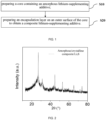
- At least one characteristic peak with 2 ⁇ between 20° and 30° and at least one characteristic peak having a peak width of 2° to 8° is observed in the X-ray diffraction pattern of the amorphous lithium-supplementing additive.
- the characteristic peaks of amorphous lithium sulfide are broader.
- the amorphous lithium-supplementing additive is at least one selected from: amorphous lithium sulfide (Li 2 S), lithium nitride (Li 3 N), lithium oxide (Li 2 O), lithium fluoride (LiF), and lithium phosphide (LisP).
- amorphous lithium-supplementing additives not only have good lithium-supplementing effect, but also have small polarization and low activation barrier, which can significantly improve the deintercalation efficiency of lithium ions.
- the encapsulation layer includes at least one of an isolating encapsulation layer, an ionic conductor encapsulation layer, and an electronic conductor encapsulation layer.
- These encapsulation layers can effectively improve the electronic and ionic conductivity of the lithium-supplementing material in the core, and improve the deintercalation of lithium during the charging process; they can also play a role in isolating moisture, thereby improving the stability of the cathode lithium-supplementing additive and achieving a stable lithium-supplementing effect.
- the stability, uniformity of dispersion, and good processibility of the cathode lithium-supplementing additive in the electrode active slurry and active layer can also be ensured.
- the content of the amorphous lithium-supplementing additive in the core is no less than 20%, or no less than 30%, or no less than 50%, or no less than 80%, and so on.
- the mass ratio of the amorphous lithium-supplementing additive to the crystalline lithium-supplementing additive in the core is (20-60):(40-80), or (40-60):(40-60), or (50-60):(40-50).
- the content of the amorphous lithium-supplementing additive in the core of the embodiment of the present application effectively reduces the activation barrier of the composite lithium-supplementing additive and improves the deintercalation efficiency of lithium ions in the additive, thereby achieving a higher lithium-supplementing specific capacity of the additive.
- the particle size D50 of the core is 40-60 nm, and the thickness of the encapsulation layer is 5-15 nm.
- the thickness of the encapsulation layer ensures both the specific capacity and electron conductive environment of the composite lithium-supplementing additive. If the encapsulation layer is too thick, the overall specific capacity of the additive will be reduced because the encapsulation layer does not contribute lithium ions; if the encapsulation layer is too thin, the encapsulation layer will not completely cover the core, which is not conducive to a good electronic conductive environment.
- the particle size D50 of the core is 40-60 nm, and the core with a small particle size has a larger active specific surface area, which is conducive to the intercalation and deintercalation of lithium ions. If the particle size of the core is too small, the particle agglomeration will be more severe; if the particle size of the core is too large, the specific surface area will be reduced, which will reduce the intercalation and deintercalation efficiency of lithium ions, resulting in poor lithium-supplementing effect of the additive.
- the thickness of the encapsulation layer may be 5-8 nm, 8-10 nm, 10-13 nm, 13-15 nm, etc.
- the particle size D50 of the core may be 40-45 nm, 45-50 nm, 50-55 nm, 55-60 nm, etc.
- the above-mentioned lithium-supplementing additive of the present application has excellent storage and processability and stable electrochemical performance.
- the attenuation rate of the capacity after being stored for 20 hours at an ambient humidity of 25% is no more than 30%, or no more than 14.5% with respect to the capacity stored for 0.5 hour
- the attenuation rate of the capacity after being stored for 20 hours at an ambient humidity of 20% is no more than 25%, or no more than 12.2% with respect to the capacity stored for 0.5 hour
- the attenuation rate of the capacity after being stored for 20 hours at an ambient humidity of 10% is no more than 20%, or no more than 8.8% with respect to the capacity stored for 0.5 hour.
- the lithium-supplementing additive in the embodiment of the present application has excellent storage stability and high lithium-supplementing effect and lithium-supplementing stability.
- the above lithium-supplementing additive of the present application is stored in a favorable environment that is dry and oxygen-free, such as a vacuum environment, to achieve the maximum performance of the electrochemical performance of the above lithium-supplementing additive of the present application.
- a second aspect of the embodiments of the present application provides a preparation method for a composite lithium-supplementing additive, comprising the following steps S10 to S20.
- step S10 a core containing an amorphous lithium-supplementing additive is prepared; and in step S20, an encapsulation layer is prepared on an outer surface of the core to obtain a composite lithium-supplementing additive.
- the preparation method for the composite lithium-supplementing additive provided in the second aspect of the embodiments of the present application prepares a core containing an amorphous lithium-supplementing additive, allow a high lithium-ion deintercalation efficiency of the composite lithium-supplementing additive; and then prepares an encapsulation layer on the outer surface of the core to obtain the composite lithium-supplementing additive.
- the preparation method for the composite lithium-supplementing additive provided in the embodiment of the present application is simple and highly efficient and is suitable for industrial large-scale production and application.
- the prepared composite lithium-supplementing additive has a low activation barrier and can basically release all lithium ions at a lower voltage, thereby achieving a higher lithium-supplementing specific capacity.
- a preparation method for a core containing an amorphous lithium-supplementing additive may employ atomic layer deposition.
- the core contains at least one amorphous lithium-supplementing additive selected from the group consisting of amorphous lithium sulfide, amorphous lithium nitride, amorphous lithium oxide, amorphous lithium fluoride, and amorphous lithium phosphide.
- amorphous lithium-supplementing additives not only have good lithium-supplementing effect, but also have low polarization and low activation barrier, which can significantly improve the deintercalation efficiency of lithium ions.
- the step of preparing amorphous lithium sulfide includes the following steps S11 to S12.
- step S11 elemental sulfur is dissolved in an organic solvent to obtain a first reaction solution, the terminal group of the organic solvent is an amino group; and in step S12, the first reaction solution is, under a condensation reflux condition, mixed with elemental lithium to react, and the mixture is separated to obtain amorphous lithium sulfide.
- the preparation method for amorphous lithium sulfide provided in the embodiment of the present application dissolves sulfur in an organic solvent having an amino terminal group, and generates amino polysulfide, i.e., the first reaction solution, by a ring-opening reaction between the terminal amino group in the organic solvent and the S8 molecule; then, the amino polysulfide is mixed with elemental lithium to produce amorphous lithium sulfide. Since the reaction process generates a large amount of heat, the reaction process is carried out under condensation reflux conditions to avoid the evaporation of the solution that affects the generation of amorphous lithium sulfide.
- the organic solvent is at least one selected from propylene diamine and ethylene diamine.
- the terminal group of the organic solvent used in the embodiment of the present application is an amino group. If the organic solvent is a linear molecule, both ends are amino groups, including but not limited to propylene diamine, ethylene diamine, and the like.
- the amino groups at the head and tail ends of the organic solvent react with the S8 molecules to generate amino polysulfides, which then react with elemental lithium to generate amorphous lithium sulfide.
- the organic solvent can be adsorbed on the surface of the newly formed lithium sulfide through the terminal amino group to prevent the growth of lithium sulfide, thereby preventing lithium sulfide from forming a crystalline state.
- the ratio of the elemental sulfur to the organic solvent is (1-2) g:(50-80) mL. This ratio fully ensures the reaction between elemental sulfur and the organic solvent, and the proportion of the organic solvent is also conducive to the in-situ conversion into a carbon encapsulation layer.
- the ratio of elemental sulfur to the organic solvent includes but is not limited to 1 g:(50-60) mL, 1 g:(60-70) mL, 1 g:(70-80) mL, 2 g:(50-60) mL, 2 g:(60-70) mL, 2 g:(70-80) mL, and so on.
- the step of mixing the first reaction solution with elemental lithium to react includes: mixing the first reaction solution with the elemental lithium by dropwise addition to react. Since the reaction between amino polysulfide and elemental lithium is very rapid and a large amount of heat is generated during the reaction, in order to ensure a stable, complete and sufficient reaction, the first reaction solution is mixed with the elemental lithium by adding in a dropwise manner and reacted under condensation reflux condition.
- the mass ratio of elemental lithium to elemental sulfur is 1 :(2-4). This ratio fully ensures the production efficiency of amorphous lithium sulfide. If the amount of elemental lithium is too much or the amount of elemental sulfur is too much, by-products will increase and thus the purity of the product will be reduced.
- the reaction solution is filtered to obtain a solid precipitate, which is then vacuum dried at 40-60°C for 10-24 hrs to obtain amorphous lithium sulfide.
- the step of preparing an encapsulation layer on the outer surface of the core includes: forming at least one of an isolating encapsulation layer, an ionic conductor encapsulation layer, and an electronic conductor encapsulation layer on the outer surface of the core.
- the material used to prepare the isolating encapsulation layer on the outer surface of the core containing the amorphous lithium-supplementing additive includes at least one of ceramic, high-molecular polymer or carbon material.
- the ceramic isolating encapsulation layer may be deposited by, but not limited to, sputtering a ceramic target on the surface of the core containing the amorphous lithium-supplementing additive by magnetron sputtering, the conditions of magnetron sputtering are adjusted according to the specific properties of the target material.
- the step of forming the high-molecular polymer isolating encapsulation layer may be: dispersing the core material in a solution containing the high-molecular polymer, and then vacuum drying to form a dense polymer isolating encapsulation layer on the surface of the core.
- the solvent of the solution is a solvent that can evenly disperse or dissolve the polymer, such as one or more of N-methylpyrrolidone, methanol, ethanol, isopropanol, acetone, tetrahydrofuran and diethyl ether.
- the method for forming the carbon material isolating encapsulation layer includes the following steps: dispersing the core material in a solution containing a carbon source, drying followed by a carbonization treatment, and forming a dense carbon isolating encapsulation layer on the surface of the core.
- the carbon source may be, but not limited to, PEO, and may also be other carbon sources. Any carbon source that can form a carbon coating layer on the surface of the core is suitable for the present application.
- the core material and PEO are mixed evenly, PEO reaches the melting point at 300°C, and is evenly coated on the surface of the core.
- the coated material is sintered in an inert atmosphere at 600 degrees Celsius for 16 hours, and a dense carbon layer is formed after sintering.
- the material for preparing the electronic conductor encapsulation layer includes at least one of a carbon material, a conductive polymer, or a conductive oxide; the carbon material, the conductive polymer, and the conductive oxide are all materials of the electronic conductor encapsulation layer contained in the lithium-supplementing additive as described above.
- the method and conditions for forming the electronic conductor encapsulation layer of the carbon material, the conductive polymer, and the conductive oxide are specifically according to the method for forming the carbon material, the conductive polymer, or the conductive oxide.
- the method for forming the electronic conductor encapsulation layer can form an isolating conductive encapsulation layer by chemical deposition, magnetron sputtering, or atomic layer deposition.
- the material for preparing the ionic conductor encapsulation layer includes at least one of a perovskite-type, NASICON-type, garnet-type or polymer-type solid electrolyte.
- the method and conditions for forming the ionic conductor encapsulation layer are specifically according to the method for forming a perovskite-type, NASICON-type, garnet-type or polymer-type solid electrolyte.
- the step of preparing a carbon material encapsulation layer on the outer surface of the core containing an amorphous lithium sulfide additive comprises steps S11 to S21.
- step S11 the elemental sulfur is dissolved in an organic solvent having an amino terminal group such as propylene diamine or ethylene diamine to obtain a first reaction solution; in step S12, the first reaction solution is mixed and reacts with elemental lithium under a condensation reflux condition and is separated to obtain amorphous lithium sulfide; and in step S21, a carbon coating is applied on the amorphous lithium sulfide by calcination to obtain a composite lithium-supplementing additive.
- an organic solvent having an amino terminal group such as propylene diamine or ethylene diamine
- the composite lithium-supplementing additive prepared in the embodiment of the present application includes a core containing amorphous lithium sulfide.
- the binding force between Li + and S 2- is much weaker in the amorphous state than in the crystalline state.
- the polarization of lithium sulfide is smaller.
- the voltage platform is lower, which can effectively reduce the activation barrier of lithium sulfide and significantly improve the deintercalation efficiency of lithium ions, thereby achieving a higher lithium-supplementing specific capacity of the additive.
- the carbon encapsulation layer can effectively increase the conductivity of the additive, thereby reducing the polarization of the additive, which is beneficial to the deintercalation of lithium ions from lithium sulfide during charging, thereby increasing the specific capacity.
- the step of applying a carbon coating on amorphous lithium sulfide by calcination treatment includes: keeping the amorphous lithium sulfide warm for 1-3 hours at an inert atmosphere of 400°C to 500°C to obtain a composite lithium-supplementing additive.
- the amorphous lithium sulfide since there is residual organic solvent in the amorphous lithium sulfide, it can be converted into amorphous carbon in situ by sintering in an inert atmosphere and coated on the surface of the lithium sulfide to form a carbon encapsulation layer. If the temperature is too low, the carbonization is incomplete and the conductivity of the carbon layer is low.
- the sintering temperature of 400°C to 500°C can reduce the proportion of amorphous lithium sulfide converted into lithium sulfide crystals.
- the mass fraction of the encapsulation layer is 20%-40%; the mass fraction of the core is 60%-80%.
- the mass ratio of the encapsulation layer and the core simultaneously ensures the specific capacity and electronic conductive environment of the additive. If the content of the encapsulation layer is too high, the overall specific capacity of the additive will be reduced because the encapsulation material does not contribute lithium ions. If the content of the encapsulation layer is too low, a complete and uniformly coated encapsulation layer cannot be formed on the outer surface of the core, and the coating is incomplete, which is not conducive to establishing a good electronic conductive environment.
- the mass fraction of the encapsulation layer may be 20%, and the mass fraction of the core is 80%, or the mass fraction of the encapsulation layer may be 30%, and the mass fraction of the core is 70%, or the mass fraction of the encapsulation layer may be 40%, and the mass fraction of the core is 60%, and so on.
- the thickness of the encapsulation layer is 5-15 nm, and the particle size D50 of the core is 40-60 nm.
- the amorphous lithium-supplementing additive In the core of the composite lithium-supplementing additive of the embodiment of the present application, compared with crystalline lithium sulfide, the amorphous lithium-supplementing additive has low polarization, a lower voltage platform during charging, and can release more lithium ions under the same voltage window, so that the specific capacity is higher. In addition, it basically does not produce gas and has good chemical stability. Therefore, the higher the content of the amorphous lithium-supplementing additive in the core of the composite lithium-supplementing additive, the more conducive it is to lithium-ion deintercalation, so that the additive has higher electrochemical properties such as specific capacity.
- the mass percentage of the amorphous lithium-supplementing additive is no less than 20%, which effectively improves the deintercalation of the lithium ion in the additive, increases the specific capacity of the additive, and thus improves the lithium-supplementing effect of the additive in the cathode.
- the mass percentage of amorphous lithium sulfide is 20%-60%, and the mass percentage of crystalline lithium sulfide is 40%-80%, or the ratio of amorphous lithium sulfide to crystalline lithium sulfide is (40-60):(40-60), or the ratio of amorphous lithium sulfide to crystalline lithium sulfide is (50-60):(40-50).
- an embodiment of the present application further provides a cathode material.
- the cathode material of the embodiment of the present application includes a cathode active material and a cathode lithium-supplementing additive of the above embodiment of the present application.
- the cathode material of the embodiment of the present application has excellent lithium replenishing performance and good processibility and so that the quality of the cathode active material layer is improved, thereby improving the quality of the cathode active material layer and the electrochemical performance of the corresponding cathode plate.
- the content of the above cathode lithium-supplementing additive in the cathode material of the embodiment of the present application can be controlled.
- the mass content of the cathode material in the cathode active layer of the embodiment of the present application may be 1.5%-5.5%, or may be 2.0%.
- the mass percentage of the composite lithium-supplementing additive in the cathode material is 0.1%-4%, and this proportion can just compensate for the loss of active lithium in the battery during the first charging process. If the amount of the composite lithium-supplementing additive added to the cathode plate is too low, the loss of active lithium in the cathode material cannot be fully replenished, which is not conducive to improving the energy density and capacity retention rate of the battery. If the amount of the composite lithium-supplementing additive added to the cathode material is too high, lithium precipitation on the anode may become serious and increase the cost. In some specific embodiments, in the cathode material, the mass percentage of the composite lithium-supplementing additive may be 0.1%, 0.3%, 0.5%, 0.8%, 1%, 2%, 3%, 4%, and the like.
- the cathode active material contained in the cathode material of the embodiment of the present application may be a phosphate cathode active material and a ternary cathode active material.
- this includes one or more of lithium cobalt oxide, lithium manganese oxide, lithium iron phosphate, lithium manganese iron phosphate, lithium vanadium phosphate, lithium vanadium oxyphosphate, lithium vanadium fluorophosphate, lithium titanate, lithium nickel cobalt manganese oxide, and lithium nickel cobalt aluminum oxide.
- a fourth aspect of the embodiments of the present application provides a cathode plate, which includes the composite lithium-supplementing additive prepared by the above method, or the above composite lithium-supplementing additive.
- the cathode plate provided in the fourth aspect of the embodiments of the present application includes the above-mentioned composite lithium-supplementing additive.
- the additive has a low activation barrier and can release basically all lithium ions at a lower voltage, thereby achieving a higher lithium-supplementing specific capacity. Therefore, it shows a better lithium-supplementing effect in the cathode plate, compensating for the active lithium ions consumed by the formation of the SEI film during the first charging process of the battery, thereby effectively maintaining the specific capacity of the cathode plate and improving the capacity retention rate of the cathode plate.
- the cathode plate includes a current collector and an active material layer that are laminated and bonded, and the mass percentage of the composite lithium-supplementing additive in the active material layer is 0.1%-4%, which can just compensate for the loss of active lithium in the battery during the first charging process. If the amount of the composite lithium-supplementing additive added to the cathode plate is too low, the loss of active lithium in the cathode material cannot be fully replenished, which is not conducive to improving the energy density and capacity retention rate of the battery. If the amount of the composite lithium-supplementing additive added to the cathode plate is too high, lithium precipitation on the anode may become serious and increase the cost.
- the mass percentage of the composite lithium-supplementing additive in the active material layer of the cathode plate may be 0.1 %, 0.3%, 0.5%, 0.8%, 1%, 2%, 3%, 4%, and the like.
- the cathode active material in the cathode plate includes but is not limited to at least one of lithium iron phosphate, lithium cobalt oxide, lithium manganese iron phosphate, lithium manganese oxide, lithium nickel cobalt manganese oxide, and lithium nickel manganese oxide. These cathode materials have high specific capacity, which is beneficial to improving the energy density of the battery.
- the cathode plate also includes a cathode current collector
- the cathode active layer also includes components such as a conductive agent and a binder.
- the embodiments of the present application do not specifically limit these materials, and appropriate materials can be selected according to actual application requirements.
- the cathode current collector includes but is not limited to any one of copper foil and aluminum foil.
- the content of the binder in the cathode active layer is 2 wt%-4 wt%.
- the content of the binder may be a typical but non-limiting content such as 2 wt%, 3 wt%, 4 wt% and the like.
- the binder includes one or more of polyvinylidene chloride, soluble polytetrafluoroethylene, styrene-butadiene rubber, hydroxypropyl methylcellulose, methylcellulose, carboxymethyl cellulose, polyvinyl alcohol, acrylonitrile copolymer, sodium alginate, chitosan and chitosan derivatives.
- the content of the conductive agent in the cathode active layer is 3 wt%-5 wt%.
- the content of the conductive agent may be a typical but non-limiting content such as 3 wt%, 4 wt%, 5 wt% and the like.
- the conductive agent includes one or more of graphite, carbon black, acetylene black, graphene, carbon fiber, C60 and carbon nanotubes.
- the preparation process of the cathode plate is as follows: mixing the cathode active material, the composite lithium-supplementing additive, the conductive agent and the binder to obtain an electrode slurry, coating the electrode slurry on the current collector, and preparing the cathode plate through steps such as drying, rolling, and die cutting.
- a fifth aspect of embodiments of the present application provides a secondary battery, which includes the above-mentioned cathode plate.
- the secondary battery provided in the fifth aspect of the embodiments of the present application includes the above-mentioned cathode plate, and the cathode plate is added with the above-mentioned composite lithium-supplementing additive, which can effectively compensate for the active lithium ions consumed by the formation of the SEI film during the first charging cycle of the battery, effectively maintain the specific capacity of the cathode plate, and improve the capacity retention rate of the cathode plate. Therefore, the secondary battery provided in the embodiment of the present application has high energy density and good capacity retention rate.
- the secondary battery in the embodiment of the present application may be a lithium-ion battery or a lithium-metal battery.
- the anode plate, electrolyte, separator, and the like of the secondary battery in the embodiment of the present application are not specifically limited and can be applied to any battery system.
- a composite Li 2 S lithium-supplementing additive the preparation of which includes the following steps: 1 g of sulfur was dissolved in 50 mL of propylene diamine, after being completely dissolved, the solution was slowly added dropwise into a flask containing about 0.5 g of lithium bars under condensation and reflux conditions to avoid solvent loss, until all lithium was consumed. the reaction solution was filtered to obtain amorphous lithium sulfide, which was then vacuum dried for 12 hrs. The dried precipitate was placed in a corundum boat. A tube furnace was passed with argon, heated to 400°C and kept for 2 hrs to obtain a carbon-coated composite lithium-supplementing additive, which was recorded as H-Li 2 S@C-1.
- a lithium-ion battery the preparation of which includes the following steps:
- a composite Li 2 S lithium-supplementing additive which differs from Example 1 in that the organic solvent was replaced by ethylenediamine, and the product was marked as H-Li 2 S@C-2.
- a lithium-ion battery which differs from Example 1 in that the lithium-supplementing additive in the cathode plate adopted the composite lithium-supplementing additive prepared in Example 2.
- a composite Li 2 S lithium-supplementing additive which differs from Example 1 in that the obtained carbon-coated Li 2 S composite lithium-supplementing additive was subjected to secondary carbon coating by means of a solvothermal method to achieve a higher coverage coating, and the product was marked as H-Li 2 S@C-3.
- a lithium-ion battery which differs from Example 1 in that the lithium-supplementing additive in the cathode plate adopted the composite lithium-supplementing additive prepared in Example 3.
- a composite Li 2 S lithium-supplementing additive which differs from Example 1 in that the heat treatment temperature of the dried precipitate was reduced from 400°C to 300°C, and the amorphous part of the obtained composite lithium-supplementing additive accounted for a higher proportion.
- the product was marked as H-Li 2 S@C-4.
- a lithium-ion battery which differs from Example 1 in that the lithium-supplementing additive in the cathode plate adopted the composite lithium-supplementing additive prepared in Example 4.
- a composite LiF lithium-supplementing additive which was produced as follows: a LiF film was grown on a silicon wafer by radio frequency sputtering (radio frequency power: 30 W, with pure argon flow, and the ambient pressure was maintained at 10 -2 mbar). The obtained material was a crystalline/amorphous composite lithium-supplementing additive. The obtained film was ball milled followed by sieving, and carbon-coated by a solvothermal method to obtain H-LiF@C.
- a composite Li 3 N lithium-supplementing additive purchased Li 3 N powder (Aladdin, L303263 lithium nitride, 99.9%) was placed in a tantalum boat and evaporated by resistance heating, the total evaporation pressure in the vacuum chamber remained unchanged, the boat temperature was adjusted to 550°C-800°C at 50 mPa, and crystalline/amorphous composite Li 3 N was deposited on a substrate, ball milled and crushed, and carbon-coated by a solvothermal method after sieving, and the obtained sample was recorded as H-LisN@C.
- crystalline Li 2 S (Aladdin, L166537, 99.98%) was purchased, mixed with PVP and heat treated at 700°C to obtain a crystalline Li 2 S@C-1 composite material.
- Li 2 SO 4 and PVP were ball-milled and mixed, and then heat-treated at 800°C in an inert atmosphere to obtain a crystalline Li 2 S@C-2 composite material.
- lithium metal and CoF 3 powder were mixed in a molar ratio of 3:1 and heated to 240°C.
- the lithium became a molten state and the mixture was mechanically stirred to react and generate a crystalline Co/LiF composite material.
- a certain amount of lithium foil was placed in a tubular furnace, with the continuous introduction of 100 sccm of nitrogen, heated to 300°C and kept for 24 hrs to obtain crystalline Li 3 N, which was then ball-milled and carbon-coated through a solvothermal method to obtain crystalline Li 3 N@C.
- the above-mentioned composite lithium-supplementing additive, conductive agent and binder were mixes to prepare the electrode (without adding a cathode active material), and the specific steps are as follows: the lithium-supplementing material from each Example or Comparative Example was each mixed with SP and PVDF in a mass ratio of 80:8:12 and stirred by ball milling for 60 min; the speed was set to 30 Hz; homogenization-coating-drying-cutting operations were performed, and cathode plates were prepared respectively. The cathode plates were baked in a vacuum oven at 100°C to remove trace water. Except for the cathode, the rest of the battery components are consistent with those mentioned above and unchanged.
- Example 1 is taken as an example and Comparative Example 1 is taken as a reference to test the specific capacity of the electrode of Example 1 under varying humidity conditions (25%, 20%, and 10%) placed for different periods of time.
- Tables 2, 3, and 4 below: Table 2 Example Humidity 25%, placed for different durations (h) Specific capacity (mAh/g) Example 1 0.5 658.9 1 633.1 2 614.2 5 595.4 10 579.3 20 562.9 Comparative Example 1 0.5 430.6 Table 3
- Example Humidity 20% placed for different durations (h) Specific capacity (mAh/g)
- Table 4 Example Humidity 10%, placed for different durations (h) Specific capacity (mAh/g)
- Example 1 0.5 669.6 1 654.3 2 641.7 5 629.4 10 619.1 20 610.3
- the cathode plate (without cathode active material) prepared by the cathode composite lithium-supplementing additive in Example 1 of the present application was stored at varying humidities, and the specific capacity of the battery did not change significantly. Under the humidity of 25%, 20%, and 10%, the attenuation rate of the specific capacity after 20 hours relative to that after 0.5 hours is 14.5%, 12.2%, and 8.8%, respectively. The lower the humidity, the smaller the change in specific capacity. It can be seen that the composite lithium-supplementing additive in the embodiments of the present application not only shows a good lithium-supplementing effect in the cathode plate, but also has good stability and provides stable lithium supplementation.
- the composite lithium-supplementing additives prepared in Examples 1 to 6 and Comparative Examples 1 to 4 were assembled into the same lithium-ion button cells (with the composite lithium-supplementing additive as a variable) under the same conditions, and the performance was tested according to the following methods: the button cells were charged to 4.3 V under a constant current and constant voltage at a rate of 0.05 C, the cut-off current was 0.01 C, left for 5 min, and discharged to 3.0 V at a rate of 0.05 C.
- the relevant performance test results are shown in Table 1 below.
- the lithium-ion batteries with the composite Li 2 S lithium-supplementing additive prepared in Examples 1-4 of the present application exhibits a better first charge specific capacity, and the specific capacity increment is higher, indicating that lithium ions are more easily extracted from the amorphous Li 2 S and the lithium-ion deintercalation efficiency is high, thereby achieving a higher lithium-supplementing specific capacity of the additive.
- Example 5 Compared with Comparative Example 3, and by comparing Example 6 with Comparative Example 4, it can also be seen that similar patterns are observed in LiF and Li 3 N lithium-supplementing additives.
- the above results show the advantages of amorphous/crystalline composite structure lithium-supplementing additives in terms of lithium deintercalation and performances.
Landscapes
- Chemical & Material Sciences (AREA)
- Chemical Kinetics & Catalysis (AREA)
- Electrochemistry (AREA)
- General Chemical & Material Sciences (AREA)
- Engineering & Computer Science (AREA)
- Materials Engineering (AREA)
- Inorganic Chemistry (AREA)
- Composite Materials (AREA)
- Manufacturing & Machinery (AREA)
- Organic Chemistry (AREA)
- Battery Electrode And Active Subsutance (AREA)
- Secondary Cells (AREA)
Applications Claiming Priority (2)
| Application Number | Priority Date | Filing Date | Title |
|---|---|---|---|
| CN202111662402.4A CN115312760B (zh) | 2021-12-30 | 2021-12-30 | 复合补锂添加剂及制备方法和应用 |
| PCT/CN2022/138813 WO2023124990A1 (zh) | 2021-12-30 | 2022-12-13 | 复合补锂添加剂及制备方法和应用 |
Publications (2)
| Publication Number | Publication Date |
|---|---|
| EP4459716A1 true EP4459716A1 (de) | 2024-11-06 |
| EP4459716A4 EP4459716A4 (de) | 2025-07-16 |
Family
ID=83853692
Family Applications (1)
| Application Number | Title | Priority Date | Filing Date |
|---|---|---|---|
| EP22914245.0A Pending EP4459716A4 (de) | 2021-12-30 | 2022-12-13 | Zusammengesetztes lithiumkompensationsadditiv, herstellungsverfahren und verwendung |
Country Status (4)
| Country | Link |
|---|---|
| US (1) | US20250070161A1 (de) |
| EP (1) | EP4459716A4 (de) |
| CN (1) | CN115312760B (de) |
| WO (1) | WO2023124990A1 (de) |
Cited By (1)
| Publication number | Priority date | Publication date | Assignee | Title |
|---|---|---|---|---|
| EP4492502A4 (de) * | 2022-03-10 | 2026-03-04 | Shenzhen Innovazone Tech Co Ltd | Lithiumergänzungsadditiv, herstellungsverfahren dafür und anwendung davon |
Families Citing this family (6)
| Publication number | Priority date | Publication date | Assignee | Title |
|---|---|---|---|---|
| CN115312760B (zh) * | 2021-12-30 | 2026-04-17 | 深圳市德方创域新能源科技有限公司 | 复合补锂添加剂及制备方法和应用 |
| CN116504932A (zh) * | 2022-12-12 | 2023-07-28 | 深圳市德方创域新能源科技有限公司 | 补锂材料及其制备方法、正极片和二次电池 |
| CN116598438A (zh) * | 2022-12-19 | 2023-08-15 | 深圳市德方创域新能源科技有限公司 | 一种正极补锂添加剂及其制备方法和应用 |
| CN116722142A (zh) * | 2023-06-29 | 2023-09-08 | 深圳市研一新材料有限责任公司 | 一种湿法球磨制备碳包覆补锂材料的方法和应用 |
| CN119920820A (zh) * | 2023-10-31 | 2025-05-02 | 比亚迪股份有限公司 | 正极、锂电池和装置 |
| CN117559013A (zh) * | 2023-11-22 | 2024-02-13 | 高能时代(珠海)新能源科技有限公司 | 一种补锂剂复合材料及其制备方法与应用 |
Family Cites Families (12)
| Publication number | Priority date | Publication date | Assignee | Title |
|---|---|---|---|---|
| JP4693371B2 (ja) * | 2004-07-16 | 2011-06-01 | 三洋電機株式会社 | 非水電解質二次電池 |
| CN107808978B (zh) * | 2016-09-08 | 2020-07-28 | 中国科学院物理研究所 | 一种液态活性锂补充剂、其制备方法及其用途 |
| CN108358175B (zh) * | 2018-04-25 | 2020-02-07 | 北京卫蓝新能源科技有限公司 | 一种硫化锂的制备方法 |
| JP7215004B2 (ja) * | 2018-07-20 | 2023-01-31 | 住友金属鉱山株式会社 | リチウムイオン二次電池用正極活物質とその製造方法、リチウムイオン二次電池用正極合剤ペースト、及び、リチウムイオン二次電池 |
| KR102743515B1 (ko) * | 2018-11-22 | 2024-12-16 | 이데미쓰 고산 가부시키가이샤 | 고체 전해질의 제조 방법 및 전해질 전구체 |
| CN111384428B (zh) * | 2018-12-29 | 2021-09-17 | 宁德时代新能源科技股份有限公司 | 一种补锂剂、正极极片、隔离膜及锂离子电池 |
| CN113471413A (zh) * | 2020-03-31 | 2021-10-01 | 北京卫蓝新能源科技有限公司 | 一种复合补锂浆料、制备方法及应用 |
| CN113471412A (zh) * | 2020-03-31 | 2021-10-01 | 北京卫蓝新能源科技有限公司 | 一种复合导电浆料及制备方法、正极极片及锂离子电池 |
| CN113036106A (zh) * | 2021-03-09 | 2021-06-25 | 昆山宝创新能源科技有限公司 | 一种复合补锂添加剂及其制备方法和应用 |
| CN113314703B (zh) * | 2021-05-28 | 2022-05-17 | 蜂巢能源科技有限公司 | 一种负极材料及其制备方法与用途 |
| CN113793983A (zh) * | 2021-08-09 | 2021-12-14 | 恒大新能源技术(深圳)有限公司 | 补锂添加剂及其制备方法与应用 |
| CN115312760B (zh) * | 2021-12-30 | 2026-04-17 | 深圳市德方创域新能源科技有限公司 | 复合补锂添加剂及制备方法和应用 |
-
2021
- 2021-12-30 CN CN202111662402.4A patent/CN115312760B/zh active Active
-
2022
- 2022-12-13 EP EP22914245.0A patent/EP4459716A4/de active Pending
- 2022-12-13 US US18/723,716 patent/US20250070161A1/en active Pending
- 2022-12-13 WO PCT/CN2022/138813 patent/WO2023124990A1/zh not_active Ceased
Cited By (1)
| Publication number | Priority date | Publication date | Assignee | Title |
|---|---|---|---|---|
| EP4492502A4 (de) * | 2022-03-10 | 2026-03-04 | Shenzhen Innovazone Tech Co Ltd | Lithiumergänzungsadditiv, herstellungsverfahren dafür und anwendung davon |
Also Published As
| Publication number | Publication date |
|---|---|
| CN115312760A (zh) | 2022-11-08 |
| EP4459716A4 (de) | 2025-07-16 |
| US20250070161A1 (en) | 2025-02-27 |
| CN115312760B (zh) | 2026-04-17 |
| WO2023124990A1 (zh) | 2023-07-06 |
Similar Documents
| Publication | Publication Date | Title |
|---|---|---|
| EP4459716A1 (de) | Zusammengesetztes lithiumkompensationsadditiv, herstellungsverfahren und verwendung | |
| US20220216507A1 (en) | Solid electrolyte material for lithium secondary battery, electrode, and battery | |
| EP1711971B1 (de) | Mit elektroleitfähigem material beschichtete elektrodenzusatzstoffe und lithium-sekundärelement damit | |
| JP7523591B2 (ja) | 負極活物質としてシリコン(Si)を含む全固体電池 | |
| US9843045B2 (en) | Negative electrode active material and method for producing the same | |
| US20120301780A1 (en) | Positive electrode active material for lithium ion battery, method for producing the same, positive electrode for lithium ion battery, and lithium ion battery | |
| TWI431841B (zh) | 具高容量之電極活性材料 | |
| EP4044279B1 (de) | Aktives anodenmaterial, verfahren zum herstellen eines aktiven anodenmaterials, anode damit und lithium-sekundärbatterie | |
| KR102468500B1 (ko) | 황-탄소 복합체, 이를 포함하는 리튬-황 전지용 양극 및 리튬-황 전지 | |
| CN116014220B (zh) | 正极补锂添加剂及其制备方法、正极片、二次电池 | |
| CN113243060B (zh) | 锂二次电池用隔膜和包含所述隔膜的锂二次电池 | |
| JP7771198B2 (ja) | 負極活物質、これを含む負極、これを含む二次電池、および負極活物質の製造方法 | |
| KR20210058715A (ko) | 리튬 이차전지용 양극 활물질 및 상기 양극 활물질의 제조 방법 | |
| EP4131552B1 (de) | Elektrolyt für lithium-schwefel-batterie und lithium-schwefel-batterie damit | |
| KR20140126586A (ko) | 양극 활물질 및 이의 제조 방법, 그리고 상기 양극 활물질을 포함하는 리튬 이차 전지 | |
| KR102724217B1 (ko) | 리튬 이차전지, 전지 팩 및 이를 포함하는 전자 기기 | |
| KR20190091001A (ko) | 리튬 이차전지용 음극 활물질, 이를 포함하는 음극 및 상기 음극을 포함하는 리튬 이온 이차 전지 | |
| KR102817533B1 (ko) | 리튬 이차전지용 실리콘계 음극, 이의 제조방법 및 이를 포함하는 리튬 이차전지 | |
| JP7721676B2 (ja) | リチウム二次電池用正極添加剤を含む正極 | |
| KR102917427B1 (ko) | 리튬-황 전지용 전해액 및 이를 포함하는 리튬-황 전지 | |
| KR102906200B1 (ko) | 실리콘계 세라믹체를 포함하는 이차전지용 음극 활물질과 세라믹체의 제조방법 | |
| KR20230025318A (ko) | 음극 활물질, 이를 포함하는 음극, 이를 포함하는 이차전지 및 음극 활물질의 제조방법 | |
| EP4261948B1 (de) | Positivelektrode mit schwefel-kohlenstoff-verbundstoff und lithium-ionen-sekundärbatterie damit | |
| KR102694221B1 (ko) | 음극 활물질, 그의 제조방법 및 이를 포함하는 리튬 이차전지 | |
| US20230197966A1 (en) | Lithium-ion battery anode material and methods of making the same |
Legal Events
| Date | Code | Title | Description |
|---|---|---|---|
| STAA | Information on the status of an ep patent application or granted ep patent |
Free format text: STATUS: THE INTERNATIONAL PUBLICATION HAS BEEN MADE |
|
| PUAI | Public reference made under article 153(3) epc to a published international application that has entered the european phase |
Free format text: ORIGINAL CODE: 0009012 |
|
| STAA | Information on the status of an ep patent application or granted ep patent |
Free format text: STATUS: REQUEST FOR EXAMINATION WAS MADE |
|
| 17P | Request for examination filed |
Effective date: 20240628 |
|
| AK | Designated contracting states |
Kind code of ref document: A1 Designated state(s): AL AT BE BG CH CY CZ DE DK EE ES FI FR GB GR HR HU IE IS IT LI LT LU LV MC ME MK MT NL NO PL PT RO RS SE SI SK SM TR |
|
| DAV | Request for validation of the european patent (deleted) | ||
| DAX | Request for extension of the european patent (deleted) | ||
| A4 | Supplementary search report drawn up and despatched |
Effective date: 20250617 |
|
| RIC1 | Information provided on ipc code assigned before grant |
Ipc: H01M 4/58 20100101AFI20250611BHEP Ipc: H01M 10/0525 20100101ALI20250611BHEP Ipc: H01M 4/134 20100101ALI20250611BHEP Ipc: H01M 4/136 20100101ALI20250611BHEP Ipc: H01M 4/1397 20100101ALI20250611BHEP Ipc: H01M 4/36 20060101ALI20250611BHEP Ipc: H01M 4/38 20060101ALI20250611BHEP Ipc: H01M 4/62 20060101ALI20250611BHEP Ipc: H01M 10/052 20100101ALI20250611BHEP |