EP4459561A1 - Verfahren und vorrichtung zur anzeige von spezialeffekten, vorrichtung, speichermedium und programmprodukt - Google Patents
Verfahren und vorrichtung zur anzeige von spezialeffekten, vorrichtung, speichermedium und programmprodukt Download PDFInfo
- Publication number
- EP4459561A1 EP4459561A1 EP23745999.5A EP23745999A EP4459561A1 EP 4459561 A1 EP4459561 A1 EP 4459561A1 EP 23745999 A EP23745999 A EP 23745999A EP 4459561 A1 EP4459561 A1 EP 4459561A1
- Authority
- EP
- European Patent Office
- Prior art keywords
- target
- effect object
- effect
- map
- floating force
- Prior art date
- Legal status (The legal status is an assumption and is not a legal conclusion. Google has not performed a legal analysis and makes no representation as to the accuracy of the status listed.)
- Pending
Links
Images


Classifications
-
- G—PHYSICS
- G06—COMPUTING OR CALCULATING; COUNTING
- G06T—IMAGE DATA PROCESSING OR GENERATION, IN GENERAL
- G06T19/00—Manipulating three-dimensional [3D] models or images for computer graphics
- G06T19/006—Mixed reality
-
- G—PHYSICS
- G06—COMPUTING OR CALCULATING; COUNTING
- G06F—ELECTRIC DIGITAL DATA PROCESSING
- G06F3/00—Input arrangements for transferring data to be processed into a form capable of being handled by the computer; Output arrangements for transferring data from processing unit to output unit, e.g. interface arrangements
- G06F3/01—Input arrangements or combined input and output arrangements for interaction between user and computer
- G06F3/011—Arrangements for interaction with the human body, e.g. for user immersion in virtual reality
-
- G—PHYSICS
- G06—COMPUTING OR CALCULATING; COUNTING
- G06F—ELECTRIC DIGITAL DATA PROCESSING
- G06F3/00—Input arrangements for transferring data to be processed into a form capable of being handled by the computer; Output arrangements for transferring data from processing unit to output unit, e.g. interface arrangements
- G06F3/01—Input arrangements or combined input and output arrangements for interaction between user and computer
- G06F3/011—Arrangements for interaction with the human body, e.g. for user immersion in virtual reality
- G06F3/012—Head tracking input arrangements
-
- G—PHYSICS
- G06—COMPUTING OR CALCULATING; COUNTING
- G06F—ELECTRIC DIGITAL DATA PROCESSING
- G06F3/00—Input arrangements for transferring data to be processed into a form capable of being handled by the computer; Output arrangements for transferring data from processing unit to output unit, e.g. interface arrangements
- G06F3/01—Input arrangements or combined input and output arrangements for interaction between user and computer
- G06F3/017—Gesture based interaction, e.g. based on a set of recognized hand gestures
-
- G—PHYSICS
- G06—COMPUTING OR CALCULATING; COUNTING
- G06F—ELECTRIC DIGITAL DATA PROCESSING
- G06F3/00—Input arrangements for transferring data to be processed into a form capable of being handled by the computer; Output arrangements for transferring data from processing unit to output unit, e.g. interface arrangements
- G06F3/01—Input arrangements or combined input and output arrangements for interaction between user and computer
- G06F3/048—Interaction techniques based on graphical user interfaces [GUI]
- G06F3/0481—Interaction techniques based on graphical user interfaces [GUI] based on specific properties of the displayed interaction object or a metaphor-based environment, e.g. interaction with desktop elements like windows or icons, or assisted by a cursor's changing behaviour or appearance
-
- G—PHYSICS
- G06—COMPUTING OR CALCULATING; COUNTING
- G06T—IMAGE DATA PROCESSING OR GENERATION, IN GENERAL
- G06T13/00—Animation
- G06T13/20—Three-dimensional [3D] animation
- G06T13/40—Three-dimensional [3D] animation of characters, e.g. humans, animals or virtual beings
-
- G—PHYSICS
- G06—COMPUTING OR CALCULATING; COUNTING
- G06T—IMAGE DATA PROCESSING OR GENERATION, IN GENERAL
- G06T15/00—Three-dimensional [3D] image rendering
- G06T15/005—General purpose rendering architectures
-
- G—PHYSICS
- G06—COMPUTING OR CALCULATING; COUNTING
- G06T—IMAGE DATA PROCESSING OR GENERATION, IN GENERAL
- G06T19/00—Manipulating three-dimensional [3D] models or images for computer graphics
- G06T19/20—Editing of three-dimensional [3D] images, e.g. changing shapes or colours, aligning objects or positioning parts
-
- G—PHYSICS
- G06—COMPUTING OR CALCULATING; COUNTING
- G06T—IMAGE DATA PROCESSING OR GENERATION, IN GENERAL
- G06T2215/00—Indexing scheme for image rendering
- G06T2215/16—Using real world measurements to influence rendering
Definitions
- the present disclosure relates to the field of computer technology, in particular to an effect display method and apparatus, a device, a storage medium, and a program product.
- an effect display method comprising:
- an effect display apparatus comprising:
- an electronic device comprising:
- a computer-readable storage medium in which a computer program is stored, wherein the program, when executed by a processor, cause the processor to implement the effect display method as described in any of the aforementioned embodiments.
- a computer program product comprising a computer program or instruction that, when executed by a processor, cause the processor to implement the effect display method as described in any of the aforementioned embodiments.
- a computer program comprising instructions that, when executed by a processor, cause the processor to implement the effect display method as described in any of the aforementioned embodiments.
- the inventors have found that currently, most operations on effect objects lack integration into reality, and an experience of a user is not real.
- the embodiments of the present disclosure provide an effect display method that by controlling a target effect object to move from an initial position to a target position, allows the target effect object to be displayed in a floating animation effect to achieve a floating effect of the target effect object and simulate an effect of a balloon movement, thereby enhancing an integration into reality and improving a real experience of a user.
- the effect display method proposed in the embodiments of the present disclosure is elaborated below in conjunction with the accompanying drawings.
- Fig. 1 is a flowchart of an effect display method provided in some embodiments of the present disclosure, which is applicable to the case of adding effect props to an instant video.
- the method can be executed by an effect display apparatus which can be realized by using software and/or hardware and can be configured in an electronic device.
- the electronic device can be a mobile terminal, a fixed terminal or a portable terminal, such as a mobile phone, a site, an unit, a deceive, a multimedia computer, a multimedia tablet, an Internet node, a communicator, a desktop computer, a laptop computer, a notebook computer, a netbook computer, a tablet computer, a Personal Communication System (PCS) deceive, a personal navigation deceive, a Personal Digital Assistant (PDA), an audio/video player, a digital camera/camera, a positioning deceive, a television receiver, a radio broadcast receiver, an e-book deceive, a game deceive or any combination thereof, comprising accessories and peripherals of these deceives or any combination thereof.
- PCS Personal Communication System
- PDA Personal Digital Assistant
- the electronic device can be a server, wherein the server can be either a physical server or a cloud server, and the server can be a server, or a server cluster.
- the effect display method provided in some embodiments of the present disclosure mainly comprises the following steps S101 to S104.
- step S101 a physical property of a target effect object is set, wherein the physical property comprises a gravity parameter of the target effect object.
- the effect object can also be called an effect prop, which can be understood as a real operation object in a display scene corresponding to the real operation object.
- the effect object can be a sugar figurine, which in some embodiments is a three-dimensional sugar figurine.
- the styles of the sugar figurines may be various, such as a rabbit style, a tiger style, a peacock style, a font style, a human style, etc.
- the styles of the three-dimensional sugar figurines are not limited.
- a tiger-style sugar figurine is taken as an example for explanation in below.
- the target effect object is referred to an effect object in a target state.
- an effect object can be adjusted and changed according to a duration of completing a specified action by a user, and the target effect object is the effect object in a final state after adjustment.
- the effect object mentioned above is a sugar figurine
- the sugar figurine when a user makes duck face, blowing the sugar figurine is triggered, and as a time of making duck face by the user is increasing, the sugar figurine continues to grow.
- the sugar figurine reaches a maximum state, the sugar figurine is determined to be in the target state, and the sugar figurine in the target state is determined as the target sugar figurine, namely the target effect object.
- the physical property can be understood as a property parameter that is required to be set for the target effect object to simulate a real environment.
- the above gravity parameter can be selected to be 0.
- the physical property may also comprise: linear damping and angular damping, wherein the linear damping and the angular damping can be set based on an existence state of the effect object in the real environment, and will not be specifically limited in the present embodiment.
- step S102 a current position and a target position of the target effect object are determined.
- the current position can be understood as a position of the target effect object in a current video frame obtained.
- the target position can be understood as a position that the target effect object will reach by floating, that is, after floating to the target position, the target effect object gradually becomes stationary.
- the current position is determined by at least one of the following parameters: a floating force applied to the target effect object in a previous video frame; a first collision force generated by a face collision in the previous video frame; or a second collision force generated by an effect border collision in the previous video frame.
- the current position is determined based on aerodynamics by one or more parameters of the floating force applied to the target effect object in the previous video frame, the first collision force generated by the face collision in the previous video frame, and the second collision force generated by the effect border collision in the previous video frame.
- a specific determining method will not be limited in the present embodiment.
- the determining a target position of the target effect object comprises: determining a mouth position in an acquired facial image as an initial position of the target effect object; and determining the target position of the target effect object based on the initial position and a preset offset.
- the initial position of the target effect object can be the mouth position in the facial image on a terminal screen.
- a facial image of a user is obtained, a feature extraction is performed to the facial image, and based on a result of feature extraction, a mouth image is determined from the facial image and the mouth image is determined on the terminal screen to determine the initial position of the target effect object.
- depth information of the facial image is obtained, based on which a 3D head model is established, a gravity center position and an offset of a mouth of the 3D head model is obtained (the offset between the gravity center position and the mouth of the 3D head model is known) to determine the position of the mouth of the user, and then to determine the initial position of the target effect object.
- the preset offset can be designed according to an actual situation, and the above preset offset can be a vector with direction and length.
- the above initial position can be represented by coordinates.
- the target position is a position where the effect object gradually approaches and eventually stops and stays.
- the target position is located near the face, but does not coincide with the 3D head model, to avoid blocking the face by the effect object.
- the method further comprises: generating the target effect object.
- a process of generating the target effect object mainly comprises: detecting whether a mouth of a target user has completed a specified action based on an acquired facial image; displaying an effect object in an initial state in response to the mouth of the target user completing the specified action; obtaining a keeping duration of completing the specified action by the mouth; adjusting a display state of the effect object based on the keeping duration; and generating the target effect object in response to the keeping duration reaching a preset duration.
- the facial image of the user is obtained by a camera of terminal equipment.
- the camera can be an external camera connected to the terminal equipment, or a built-in camera of the terminal equipment.
- the above connection can be wired or wireless, and is not limited in the present embodiment.
- the above built-in camera of the terminal equipment can be a front camera or a rear camera.
- the above camera is the front camera of the terminal equipment. In this way, the user can view a dynamic effect of the effect object through a display screen of the terminal equipment, enhancing the user's experience.
- the above specified action can be understood as making duck face, and a specific method for detecting the action of making duck face will not be elaborated anymore in the present embodiment.
- the detecting the facial image after obtaining the facial image, by detecting the facial image, whether the mouth of the user has completed the specified action is judged, that is, whether the user has completed making duck face is judged. Specifically, the detecting the facial image is also used to detect the position of the mouth of the user on the terminal screen.
- the first one is to perform a feature extraction from the above facial image, and based on a result of feature extraction, to determine an image of the mouth in the facial image and to determine the image of the mouth on the terminal screen.
- the second one is to obtain depth information of the facial image, based on which a 3D head model is established, and to obtain a gravity center position and an offset of the mouth of the 3D head model (the offset between the gravity center position and the mouth of the 3D head model is known) to determine the position of the mouth of the user.
- the above initial state can be understood as a state of the effect object when the user just makes duck face.
- a display state of the effect object is constantly changing.
- the effect object can be divided into multiple stages, with different display states designed for the multiple stages to simulate a real changing process of the effect object in a real environment.
- different display states designed for the multiple stages to simulate a real changing process of the effect object in a real environment.
- the display state of the effect object is determined based on the keeping duration of the specified action (i.e., making duck face) by the mouth. For example, an entire changing process of the effect object is designed to be 10 seconds, and a duration for each display state is designed based on a number of divided stages and a real changing process of the effect object. In addition, the above real changing process is presented at a speed of being first fast and then slow to restore a true rhythm.
- the specified action i.e., making duck face
- stage 1 an effect object in an initial state is displayed when a user has made duck face for less than 1 second; in stage 2: the effect object in a first state is displayed when the user has made duck face for 1 to 2 seconds; in stage 3: the effect object in a second state is displayed when the user has made duck face for 2 to 4 seconds; in stage 4: the effect object in a third state is displayed when the user has made duck face for 4 to 8 seconds; in stage 5: the effect object in a fourth state is displayed when the user has made duck face for 8 to 9 seconds; stage 6: the effects object in a target state is displayed when the user has made duck face for 9 to 10 seconds. After 10 seconds, the effect object leaves a position of a mouth and floats around a face.
- the effect object being a tiger-style sugar figurine is taken as an example for explanation.
- the process of blowing a tiger-style sugar figurine is divided into 6 stages to simulate a real process of blowing the tiger-style sugar figurine.
- a realism of blowing the tiger-style sugar figurine is increased and a fun of user interaction is improved.
- stage 1 a tiger tail appears
- stage 2 a tiger head appears slightly
- stage 3 a shape of the tiger tail completely appears, and the tiger head becomes larger
- stage 4 a tiger body appears
- stage 5 an overall outline appears
- stage 6 details such as tiger ears and limbs appear.
- appearance time points of the tiger-style sugar figurine in each stage are allocated and keyframes are assigned by a timeline of blend shape to improve a fluency of blowing the tiger-style sugar figurine and restore a true rhythm.
- an effect border is displayed on a terminal screen to optimize a display effect of an effect.
- prompt information is also displayed on a terminal screen for reminding a target user to complete a specified action.
- the prompt information is "blow".
- a progress bar may also be displayed on the terminal screen for prompting the user for a duration of completing the specified action. The progress bar is displayed above a facial image, and the above prompt information is displayed above the progress bar and at a starting position of the progress bar.
- the above prompt information constantly changes its position according to an actual progress of the progress bar. Specifically, as a keeping duration of making duck face by the target user keeps increasing, the progress bar slides continuously to the right, and a small bubble of "blow” follows vertices of the progress bar to move, meanwhile the sugar figurine starts to appear at a mouth of the target user.
- a display state of the sugar figurine is presented in stages according to the description in the above embodiments.
- the effect object in a current state is displayed in response to the keeping duration not reaching the preset duration and the mouth of the target user not completing the specified action; the prompt information is displayed, wherein the prompt information is configured to prompt the target user to continue completing the specified action.
- the current state of the effect object is determined, in which the effect object is displayed at the mouth of the target user.
- the progress bar pauses, and the small bubble of "blow” changes to "continue to blow", accompanied by a zoom breathing animation.
- the facial image of the target user is detected in real-time to judge whether the action of making duck face is completed again. After completing the action of making duck face, the effect object continues to change from the current display state according to preset changing stages.
- the effect border plays an expansion effect once with starlight twinkling.
- the effect object floats away from the mouth to an edge of the face, and a boom balloon sound effect is played.
- step S103 the floating force parameter is determined based on the current position and the target position.
- the floating force parameter comprises floating force direction and floating force magnitude.
- the floating force parameter is referred to the floating force direction and the floating force magnitude that need to be applied on each video frame.
- the floating force direction is obtained by the difference between the current position and the target position, and the floating force magnitude is preset.
- a vector difference of the initial position and the target position is calculated, and a direction of the vector difference is determined as the floating force direction.
- the floating force magnitude is preset.
- each video frame is obtained in real-time and is configured as the current video frame to determine the current position of the target effect object in the current video frame.
- the floating force direction is determined based on the direction of the vector difference between the current position and the target position, and the floating force magnitude is determined by a preset force magnitude.
- step S103 the target effect object is controlled to float to display a floating animation effect of the target effect object, based on the physical property and the floating force parameter and according to a kinematic model, wherein the kinematic model is configured to analyze a motion state of an object with the physical property under a floating force indicated by the floating force parameter.
- the physical property is set on the target effect object and the floating force is applied towards the target position, causing the target effect object to float from the initial position to the target position, so as to display a floating animation effect on a terminal screen.
- An effect achieved in a way is that the farther away the target position is, the greater an external force is, and the easier it is to push the target effect object to the target position; the closer the target position is, the smaller the external force is.
- a new target position is determined based on the target position and a preset offset after the target effect object moves to the target position.
- the floating force parameter is calculated based on the current position and the new target position in the current video frame to control the target effect object to float from the current position to the target position, so that the target effect object is displayed in a floating animation effect.
- the new target position is located near the original target position. Namely, if the target position is slightly moved, the target effect object will oscillate back and forth near the target position until it comes to rest.
- a dynamic effect that the target effect object floats at the target position is related to values of the linear damping parameter of the target effect object. The smaller the linear damping is, the easier it is to oscillate back and forth, while the larger the linear damping is, the easier it is to stop, simulating air resistance.
- Some embodiments of the present disclosure provide an effect display method and apparatus, a deceive, a storage medium, and a program product.
- the method comprises: obtaining an initial position of a target effect object, wherein the target effect object is referred to an effect object in a target state; determining a target position based on the initial position and a preset offset; controlling the target effect object to move from the initial position to the target position to display the target effect object in a floating animation effect.
- the embodiments of the present disclosure by controlling the target effect object to move from the initial position to the target position so that the target effect object is displayed in the floating animation effect, to achieve a floating effect of the target effect object and simulate an effect of balloon movement, thereby enhancing the integration into reality and improving a real experience of the user.
- the method further comprises: controlling the target effect object to rotate at an angular velocity, when controlling the target effect object to float, based on the physical property and the floating force parameter and according to the kinematic model.
- a process of determining the angular velocity comprises: obtaining a current angle of the target effect object in the current video frame; taking a difference of the current angle and a preset angle as an angle difference; and determining the angular velocity based on the angle difference and a preset velocity value.
- a force for restoring the default angle is required to be applied to the target effect object.
- a velocity is used to simulate, that is, a velocity to rotate towards a specified angle is given to the target effect object.
- an angle difference dg between the current angle g0 of a model and a preset angle g1 is calculated and dg is multiplied by an appropriate preset velocity value as an angular velocity of the target effect object. In this way, a goal that the target effect object is continuously rotating towards a default direction is achieved.
- the controlling the target effect object to float to display the floating animation effect of the target effect object, based on the physical property and the floating force parameter and according to the kinematic model comprises: detecting in real-time whether a head of a target user moves; and controlling the target effect object to follow the head of the target user to float, in response to detecting a head movement of the target user, based on the physical property and a new floating force parameter and according to the kinematic model, wherein the new floating force parameter is determined by a disturbance force parameter generated by the head movement of the target user.
- the target effect object follows the face to move, resulting in realistic physical collision and air resistance effects.
- the new floating force parameter is determined by using the following method: determining a new target position based on the current position, a preset offset, and the disturbance force parameter; and determining the new floating force parameter based on the current position and the new drift point.
- air surrounding a rapidly moving object follows the Bernoulli's principle, where a pressure decreases in an area with a faster air velocity, and an object will receive a force in a direction of a lower pressure.
- a following phenomenon demonstrates this principle: when a train runs quickly, a person near it will be drawn closer to the train by the air. When this principle is applied to a prop, the target effect object will approach to an area with a fast air velocity.
- the original target position is p1
- the initial position is p
- the method for determining the new floating force parameter based on the current position and the new drift point is same as the method for determining the floating force parameter in the above embodiments. Please refer to the description in the above embodiments for details, and the method will not be elaborated anymore in the present embodiment.
- the disturbance force parameter generated by the head movement of the target user is determined by using the following method: obtaining a first head position of the target user in a current video frame and second head positions of the target user in N video frames before the current video frame, wherein N is a positive integer; determining differences of the first head position and the second head positions as a position difference vector; determining a numerical value corresponding to the position difference vector as a magnitude of the disturbance force; and determining a direction of the position difference vector as a direction of the disturbance force.
- position information of the head of the target user is recorded frame by frame, and a difference between a first head position p3 of the target user in the current video frame and a second head position p4 of the target user in a video frame which is located 10 frames ahead of the current video frame is made to obtain a vector u1, which is determined as a direction and a magnitude of a wind generated for simulating a rapid head movement.
- the method further comprises, before the detecting in real-time whether the head of the target user moves: determining a number of the target effect object; and in response to the number of the target effect object reaching a preset number, detecting in real-time whether the face of the target user moves.
- the preset number can be designed according to an actual situation. In some embodiments, the above preset number is 4.
- the number of the target effect object reaches 4, whether the face of the target user moves is detected. If the face of the target user moves, the 4 target effect objects are controlled to follow the face of the target user to move simultaneously. In this way, it can avoid having too few effect objects that affect a display effect, and also avoid too many effect objects blocking the face of the target user.
- an expansion effect is displayed once on an effect border along with effects of starlight twinkling and ribbons falling off, the last sugar figurine leaves the mouth and floats to an edge of the face, and a boom balloon sound effect is played.
- the embodiments of the present disclosure can also provide a method for generating a material of an effect object.
- the method for generating the material of the effect object mainly comprises: blending a pre-acquired MatCap (Material Capture) map and a pre-acquired PBR (Physically-Based Rendering) material map to obtain a final blended map; and adding a transparency effect and a lighting effect to the final blended map to obtain the effect object.
- MatCap Magnetic Capture
- PBR Physical-Based Rendering
- the MatCap map comprises: a MatCap candy map, a MatCap detail map, and a MatCap highlight map;
- the blending the pre-acquired MatCap map and the pre-acquired PBR material map to obtain the final blended map comprises: blending the PBR material map with the MatCap detail map to obtain a first blended map; blending the first blended map with the MatCap highlight map to obtain a second blended map; and blending the second blended map with the MatCap candy map to obtain the final blended map.
- different color values are set for different channels in a color model to obtain the MatCap candy map, the MatCap detail map, and the MatCap highlight map.
- weight values can be assigned to the PBR material map, the MatCap candy map, the MatCap detail map, and the MatCap highlight map to make a blended effect object more realistic, wherein the weight values are obtained by input of designers.
- the present disclosure provides a method for displaying a tiger-style sugar figurine.
- a target user makes duck face
- blowing the sugar figurine is triggered, indicating that the sugar figurine begins to appear.
- a vertex animation is played, and the sugar figurine continues to grow until it reaches a target state.
- the sugar figurine automatically leaves the mouth and floats to a preset position near the face, and then follows the face to move with air resistance and dynamic effects.
- the sugar figurine will remain in a current state, and a prompt will appear at a progress bar to prompt the user to continue blowing and won't disappear until the target user makes duck face again, and the sugar figurine will continue to grow till it changes to the target state.
- the sugar figurine automatically leaves the mouth, and floats to the preset position near the face, and follows the face to move with air resistance and dynamic effects. Then, whether the target user makes duck face is detected, upon detecting that the target user makes duck face, blowing next sugar figurine is triggered.
- Fig. 4 is a schematic diagram of the structure of an effect display apparatus provided in some embodiments of the present disclosure.
- the present embodiment can be applicable to the case of adding an effect prop to an instant video.
- the effect display apparatus can be realized by using software and/or hardware, and can be configured in an electronic device.
- the effect display apparatus 40 provided in the present embodiment of the disclosure mainly comprises: an initial position obtaining module 41, a target position determining module 42, and a target effect object moving module 43.
- the physical property setting module 41 is configured to set a physical property of a target effect object, wherein the physical property comprises a gravity parameter of the target effect object.
- the physical property further comprises: linear damping and angular damping.
- the position determining module 42 comprises:
- the floating force parameter comprises a floating force direction and a floating force magnitude
- the floating force direction is obtained by a difference between the current position and the target position
- the floating force magnitude is preset
- the current position is the position of the target effect object in a current video frame.
- the current position is determined by at least one of the following parameters:
- the effect display apparatus further comprises: a rotation control module, configured to control the target effect object to rotate at an angular velocity, when controlling the target effect object to move from the initial position to the target position.
- a process of determining the angular velocity comprises: obtaining a current angle of the target effect object in the current video frame; taking a difference of the current angle and a preset angle as an angle difference; and determining the angular velocity based on the angle difference and a preset velocity value.
- the floating control module 44 comprises: a head movement detecting unit configured to detect in real-time whether a head of a target user moves after the target effect object is controlled to move from the initial position to the target position; a floating control unit configured to control the target effect object to follow the head of the target user to move when the head movement of the target user is detected. Specifically, when a head movement of the target user is detected, the target effect object is controlled to follow the head of the target user to float based on the physical property and a new floating force parameter and according to the kinematic model, wherein the new floating force parameter is determined by a disturbance force parameter generated by the head movement of the target user.
- the new floating force parameter is determined by using the following method: determining a new target position based on the current position, a preset offset, and the disturbance force parameter; and determining the new floating force parameter based on the current position and the new drift point.
- the disturbance force parameter generated by the head movement of the target user is determined by using the following method: obtaining a first head position of the target user in a current video frame and second head positions of the target user in N video frames before the current video frame, wherein N is a positive integer; determining differences of the first head position and the second head positions as a position difference vector; determining a numerical value corresponding to the position difference vector as a magnitude of the disturbance force; and determining a direction of the position difference vector as a direction of the disturbance force.
- the effect display apparatus further comprises: a quantity determining module configured to determine a number of the target effect object before the detecting in real-time whether the head of the target user moves; a head movement detecting module configured to detect in real-time whether the face of the target user moves, in response to the number of the target effect object reaching a preset number.
- the effect display apparatus further comprises:
- the effect display apparatus further comprises: a current state display module configured to display the effect object in a current state in response to the keeping duration not reaching the preset duration and the mouth of the target user has not completed the specified action; and a prompt information display module configured to display prompt information, wherein the prompt information is configured to prompt the target user to continue completing the specified action.
- the effect display apparatus further comprises: a map blending module configured to blend a pre-acquired MatCap map and a pre-acquired PBR material map to obtain a final blended map; an effect object generating module configured to add a transparency effect and a lighting effect to the final blended map to obtain the effect object.
- the MatCap map comprises a MatCap candy map, a MatCap detail map, and a MatCap highlight map.
- the map blending module comprises: a first blending unit configured to blend the PBR material map with the MatCap detail map to obtain a first blended map; a second blending unit configured to blend the first blended map with the MatCap highlight map to obtain a second blended map; and a final blending unit configured to blend the second blended map with the MatCap candy map to obtain the final blended map.
- the effect display apparatus provided in the present embodiment of the disclosure can execute the steps executed in the effect display method provided in the embodiments of the method of the present disclosure.
- the specific executing steps and beneficial effects will not be elaborated herein.
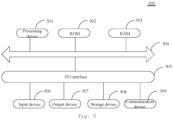
- Fig. 5 is a schematic diagram of the structure of an electronic device provided in the embodiments of the present disclosure.
- Fig. 5 which illustrates a schematic diagram of the structure suitable for realizing the electronic device 500 in the present embodiment of the disclosure.
- the electronic device 500 in the present embodiment may comprise, but not limited to, mobile terminals such as mobile phone, laptop, digital broadcast receiver, PDA (personal digital assistant), PAD (tablet), PMP (portable multimedia player), car-mounted terminal (such as car-mounted navigation terminal), wearable terminal device, etc., and fixed terminals such as digital TV, desktop computer, smart home device, etc.
- PDA personal digital assistant
- PAD tablet
- PMP portable multimedia player
- car-mounted terminal such as car-mounted navigation terminal
- wearable terminal device etc.
- fixed terminals such as digital TV, desktop computer, smart home device, etc.
- the electronic device shown in Fig. 5 is only an example and should not impose any limitations on the scope of use and the functions of the embodiments of the present disclosure.
- the electronic device 500 may comprise a processing device (such as Central Processing Unit, graphics processor, etc.) 501, which may execute various appropriate actions and processes based on a program stored in Read-Only Memory (ROM) 502 or a program loaded from a storage device 508 into Random Access Memory (RAM) 503 so as to implement the image rendering method according to the embodiments of the present disclosure.
- ROM Read-Only Memory
- RAM Random Access Memory
- various programs and data required for operations of the terminal equipment 500 are also stored.
- the processing device 501, ROM 502, and RAM 503 are connected to each other through a bus 504.
- Input/output (I/O) interface 505 is also connected to the bus 504
- the following devices can be connected to the I/O interface 505: an input device 506 comprising, for example, touch screen, touchpad, keyboard, mouse, camera, microphone, accelerometer, gyroscope, etc.; an output device 507 comprising, for example, liquid crystal display (LCD), speaker, vibrator, etc.; a storage device 508 comprising, for example, magnetic tape, hard disk, etc.; and a communication device 509.
- the communication device 509 can allow the terminal equipment 500 to communicate wirelessly or wiredly with other equipment to exchange data.
- Fig. 5 illustrates terminal equipment 500 with various devices, it should be understood that it is not required to implement or have all the shown devices. As an alternative, more or fewer devices can be implemented or equipped.
- the process described above with reference to the flowchart can be realized as a computer software program.
- the embodiments of the present disclosure comprise a computer program product, comprising a computer program carried on a non-transient computer-readable medium, wherein the computer program comprises program codes for executing the method shown in the flowchart, thereby implementing the page redirection method as described above.
- the computer program can be downloaded and installed from the network through the communication device 509, or be installed from the storage device 508, or be installed from ROM 502.
- the processing device 501 the above functions defined in the methods of the embodiments of the present disclosure are executed.
- the above computer-readable medium in the present disclosure can be a computer-readable signal medium, a computer-readable storage medium, or any combination of both.
- the computer-readable storage medium may be, but not limited to, an electrical, magnetic, optical, electromagnetic, infrared, or semiconductor system, device, or component, or any combination thereof. More specific examples of the computer-readable storage medium may comprise, but not limited to: electrical connection with one or more wires, portable computer disk, hard disk, Random Access Memory (RAM), Read-Only Memory (ROM), Erasable Programmable Read-Only Memory (EPROM or flash), fiber optic, Portable Compact Disk Read-Only Memory (CD-ROM), optical storage device, magnetic storage device, or any suitable combination thereof.
- the computer-readable storage medium may be any tangible medium containing or storing a program, which may be used by or in combination with an instruction execution system, device, or component.
- the computer-readable signal medium may comprise a data signal propagated in baseband or as a part of carrier wave, in which computer-readable program codes are carried. This type of propagated data signal can take various forms, comprising but not limited to electromagnetic signal, optical signal, or any suitable combination thereof.
- the computer-readable signal medium can also be any computer-readable medium other than the computer-readable storage medium, wherein the computer-readable signal medium can send, propagate, or transmit a program used by, or in combination with an instruction execution system, device, or component.
- the program codes contained in the computer-readable media can be transmitted using any appropriate medium, comprising but not limited to: wire, optical cable, RF (Radio Frequency), etc., or any suitable combination thereof.
- clients and servers can communicate using any currently known or future developed network protocol, such as HTTP (HyperText Transfer Protocol), and can interconnect with any form or medium of digital data communication (such as communication network).
- HTTP HyperText Transfer Protocol
- Examples of the communication network comprise Local Area Network ("LAN”), Wide Area Network ("WAN"), internet (for example, the Internet), and end-to-end network (for example, ad hoc end-to-end network), as well as any currently known or future developed network.
- LAN Local Area Network
- WAN Wide Area Network
- internet for example, the Internet
- end-to-end network for example, ad hoc end-to-end network
- the above computer-readable media may be comprised in the electronic device mentioned above; or exist separately without being assembled into the electronic device.
- the above computer-readable media carry one or more programs, and when the above one or more programs are executed by terminal equipment, cause the terminal equipment to set a physical property of a target effect object, wherein the physical property comprises a gravity parameter of the target effect object; determine a current position and a target position of the target effect object; determine a floating force parameter based on the current position and the target position; control the target effect object to float to display a floating animation effect of the target effect object, based on the physical property and the floating force parameter and according to a kinematic model, wherein the kinematic model is configured to analyze a motion state of an object with the physical property under a floating force indicated by the floating force parameter.
- the physical property comprises a gravity parameter of the target effect object
- determine a current position and a target position of the target effect object determine a floating force parameter based on the current position and the target position
- control the target effect object to float to display a floating animation effect of the target effect object, based on the physical property and the floating force parameter and according
- the terminal equipment when the above one or more programs are executed by the terminal equipment, the terminal equipment may also execute other steps as described in the above embodiments.
- Computer program codes for executing operations of the present disclosure may be written in one or more programming languages or combinations thereof, comprising but not limited to object-oriented programming languages such as Java, Smalltalk, C++, and conventional procedural programming languages such as C or similar programming languages.
- Program codes can be completely executed on a user computer, partially executed on a user computer, executed as an independent software package, partially executed on a user computer and partially executed on a remote computer, or completely executed on a remote computer or server.
- the remote computer can connect to a user computer through any type of network, comprising Local Area Network (LAN) or Wide Area Network (WAN), or can connect to an external computer (such as using Internet service providers to connect via the Internet).
- LAN Local Area Network
- WAN Wide Area Network
- each box in the flowchart or block diagram can represent a module, a program segment, or a part of codes that contains one or more executable instructions for implementing a specified logical function.
- the functions indicated in the boxes can also occur in an order different from those indicated in the accompanying drawings. For example, two consecutive boxes can in fact be executed in parallel substantially, and sometimes they can also be executed in opposite order, depending on the functionality involved.
- each box in the block diagram and/or flowchart, as well as the combination of boxes in the block diagram and/or flowchart, can be implemented using a dedicated hardware-based system that performs specified functions or operations, or can be implemented using a combination of dedicated hardware and computer instructions.
- the involved units described in the embodiments of the present disclosure can be realized in a form of software or in a form of hardware, wherein, name of the unit does not constitute a limitation on the unit itself in some situation.
- exemplary types of usable hardware logic components comprise: Field Programmable Gate Array (FPGA), Application Specific Integrated Circuit (ASIC), Application Specific Standard Product (ASSP), System on Chip (SOC), Complex Programmable Logic Device (CPLD), and so on.
- FPGA Field Programmable Gate Array
- ASIC Application Specific Integrated Circuit
- ASSP Application Specific Standard Product
- SOC System on Chip
- CPLD Complex Programmable Logic Device
- a machine readable medium may be a tangible medium that may contain or store a program to be used by or in combination with an instruction execution system, device, or equipment.
- the machine readable medium can be a machine readable signal medium or a machine readable storage medium.
- the machine readable medium may comprise but not limited to an electronic, magnetic, optical, electromagnetic, infrared, or semiconductor system, device, or equipment, or any suitable combination thereof.
- machine readable storage medium may comprise electrical connection based on one or more lines, portable computer disk, hard disk, Random Access Memory (RAM), Read-Only Memory (ROM), Erasable Programmable Read-Only Memory (EPROM or flash memory), optical fiber, Compact Disc Read-Only Memory (CD-ROM), optical storage device, magnetic storage device, or any suitable combination thereof.
- RAM Random Access Memory
- ROM Read-Only Memory
- EPROM Erasable Programmable Read-Only Memory
- CD-ROM Compact Disc Read-Only Memory
- magnetic storage device or any suitable combination thereof.
- an effect display method comprising: setting a physical property of a target effect object, wherein the physical property comprises a gravity parameter of the target effect object; determining a current position and a target position of the target effect object; determining a floating force parameter based on the current position and the target position; and controlling the target effect object to float to display a floating animation effect of the target effect object, based on the physical property and the floating force parameter and according to a kinematic model, wherein the kinematic model is configured to analyze a motion state of an object with the physical property under a floating force indicated by the floating force parameter.
- the physical property further comprises: linear damping and angular damping.
- the determining a target position of the target effect object comprises: determining a mouth position in an acquired facial image as an initial position of the target effect object; and determining the target position of the target effect object based on the initial position and a preset offset.
- the floating force parameter comprises a floating force direction and a floating force magnitude
- the floating force direction is obtained by a difference between the current position and the target position
- the floating force magnitude is preset
- the current position is the position of the target effect object in a current video frame.
- the current position is determined by at least one of the following parameters: a floating force applied to the target effect object in a previous video frame; a first collision force generated by a face collision in the previous video frame; or a second collision force generated by an effect border collision in the previous video frame.
- the method further comprises: controlling the target effect object to rotate at an angular velocity, when controlling the target effect object to float, based on the physical property and the floating force parameter and according to the kinematic model.
- a process of determining the angular velocity comprises: obtaining a current angle of the target effect object in the current video frame; taking a difference of the current angle and a preset angle as an angle difference; and determining the angular velocity based on the angle difference and a preset velocity value.
- the controlling the target effect object to float to display the floating animation effect of the target effect object, based on the physical property and the floating force parameter and according to the kinematic model comprises: detecting in real-time whether a head of a target user moves; and controlling the target effect object to follow the head of the target user to float, in response to detecting a head movement of the target user, based on the physical property and a new floating force parameter and according to the kinematic model, wherein the new floating force parameter is determined by a disturbance force parameter generated by the head movement of the target user.
- the new floating force parameter is determined by using the following method: determining a new target position based on the current position, a preset offset, and the disturbance force parameter; and determining the new floating force parameter based on the current position and the new drift point.
- the disturbance force parameter generated by the head movement of the target user is determined by using the following method: obtaining a first head position of the target user in a current video frame and second head positions of the target user in N video frames before the current video frame, wherein N is a positive integer; determining differences of the first head position and the second head positions as a position difference vector; determining a numerical value corresponding to the position difference vector as a magnitude of the disturbance force; and determining a direction of the position difference vector as a direction of the disturbance force.
- the method further comprises, before the detecting in real-time whether the head of the target user moves: determining a number of the target effect object; and in response to the number of the target effect object reaching a preset number, detecting in real-time whether the face of the target user moves.
- the method further comprises: detecting whether a mouth of a target user has completed a specified action based on an acquired facial image; displaying an effect object in an initial state in response to the mouth of the target user completing the specified action; obtaining a keeping duration of completing the specified action by the mouth; adjusting a display state of the effect object based on the keeping duration; and generating the target effect object in response to the keeping duration reaching a preset duration.
- the method further comprises: displaying the effect object in a current state in response to the keeping duration not reaching the preset duration and the mouth of the target user has not completed the specified action; and displaying prompt information, wherein the prompt information is configured to prompt the target user to continue completing the specified action.
- the method further comprises: blending a pre-acquired MatCap map and a pre-acquired PBR material map to obtain a final blended map; and adding a transparency effect and a lighting effect to the final blended map to obtain the effect object.
- the MatCap map comprises a MatCap candy map, a MatCap detail map, and a MatCap highlight map and the blending the pre-acquired MatCap map and the pre-acquired PBR material map to obtain the final blended map comprises: blending the PBR material map with the MatCap detail map to obtain a first blended map; blending the first blended map with the MatCap highlight map to obtain a second blended map; and blending the second blended map with the MatCap candy map to obtain the final blended map.
- an effect display apparatus comprising: a physical property setting module configured to set a physical property of a target effect object, wherein the physical property comprises a gravity parameter of the target effect object; a position determining module configured to determine a current position and a target position of the target effect object; a floating force parameter determining module configured to determine a floating force parameter based on the current position and the target position; a floating control module configured to control the target effect object to float to display a floating animation effect of the target effect object, based on the physical property and the floating force parameter and according to a kinematic model, wherein the kinematic model is configured to analyze a motion state of an object with the physical property under a floating force indicated by the floating force parameter.
- the physical property further comprise linear damping and angular damping.
- the position determining module comprises: an initial position determining unit configured to determine a mouth position in an acquired facial image as an initial position of the target effect object; and a target position determining unit configured to determine the target position of the target effect object based on the initial position and a preset offset.
- the floating force parameter comprises a floating force direction and a floating force magnitude
- the floating force direction is obtained by a difference between the current position and the target position
- the floating force magnitude is preset
- the current position is the position of the target effect object in a current video frame.
- the current position is determined by at least one of the following parameters: a floating force applied to the target effect object in a previous video frame; a first collision force generated by a face collision in the previous video frame; or a second collision force generated by an effect border collision in the previous video frame.
- the effect display apparatus further comprises: a rotation control module, configured to control the target effect object to rotate at an angular velocity, when controlling the target effect object to move from the initial position to the target position
- a process of determining the angular velocity comprises: obtaining a current angle of the target effect object in the current video frame; taking a difference of the current angle and a preset angle as an angle difference; and determining the angular velocity based on the angle difference and a preset velocity value.
- the floating control module comprises: a head movement detecting unit configured to detect in real-time whether a head of a target user moves after the target effect object is controlled to move from the initial position to the target position; a floating control unit configured to control the target effect object to follow the head of the target user to move when the head movement of the target user is detected.
- the new floating force parameter is determined by using the following method: determining a new target position based on the current position, a preset offset, and the disturbance force parameter; and determining the new floating force parameter based on the current position and the new drift point.
- the disturbance force parameter generated by the head movement of the target user is determined by using the following method: obtaining a first head position of the target user in a current video frame and second head positions of the target user in N video frames before the current video frame, wherein N is a positive integer; determining differences of the first head position and the second head positions as a position difference vector; determining a numerical value corresponding to the position difference vector as a magnitude of the disturbance force; and determining a direction of the position difference vector as a direction of the disturbance force.
- the effect display apparatus further comprises: a quantity determining module configured to determine a number of the target effect object before the detecting in real-time whether the head of the target user moves; a head movement detecting module configured to detect in real-time whether the face of the target user moves, in response to the number of the target effect object reaching a preset number.
- the effect display apparatus further comprises: an action completion judging module configured to detect whether a mouth of a target user has completed a specified action based on an acquired facial image; an initial state display module configured to display an effect object in an initial state in response to the mouth of the target user completing the specified action; a keeping duration obtaining unit configured to obtain a keeping duration of completing the specified action by the mouth; a display state adjusting module configured to adjust a display state of the effect object based on the keeping duration; and a target effect object generating unit configured to generate the target effect object in response to the keeping duration reaching a preset duration.
- an action completion judging module configured to detect whether a mouth of a target user has completed a specified action based on an acquired facial image
- an initial state display module configured to display an effect object in an initial state in response to the mouth of the target user completing the specified action
- a keeping duration obtaining unit configured to obtain a keeping duration of completing the specified action by the mouth
- a display state adjusting module configured to adjust a display state of the
- the effect display apparatus further comprises: a current state display module configured to display the effect object in a current state in response to the keeping duration not reaching the preset duration and the mouth of the target user has not completed the specified action; and a prompt information display module configured to display prompt information, wherein the prompt information is configured to prompt the target user to continue completing the specified action.
- the effect display apparatus further comprises: a map blending module configured to blend a pre-acquired MatCap map and a pre-acquired PBR material map to obtain a final blended map; an effect object generating module configured to add a transparency effect and a lighting effect to the final blended map to obtain the effect object.
- the MatCap map comprises: a MatCap candy map, a MatCap detail map, and a MatCap highlight map.
- the map blending module comprises: a first blending unit configured to blend the PBR material map with the MatCap detail map to obtain a first blended map; a second blending unit configured to blend the first blended map with the MatCap highlight map to obtain a second blended map; and a final blending unit configured to blend the second blended map with the MatCap candy map to obtain the final blended map.
- an electronic device comprising:
- a computer-readable storage medium in which a computer program is stored, wherein the program, when executed by a processor, cause the processer to implement the effect display method as provided in any of the aforementioned embodiments.
- a computer program product comprising a computer program or instruction, wherein the computer program or instruction, when executed by a processor, cause the processer to implement the effect display method as described in any of the aforementioned embodiments.
- a computer program comprising: instructions, wherein the instructions, when executed by a processor, cause the processer to implement the effect display method as described in any of the aforementioned embodiments.
Landscapes
- Engineering & Computer Science (AREA)
- Theoretical Computer Science (AREA)
- General Engineering & Computer Science (AREA)
- Physics & Mathematics (AREA)
- General Physics & Mathematics (AREA)
- Human Computer Interaction (AREA)
- Computer Graphics (AREA)
- Computer Hardware Design (AREA)
- Software Systems (AREA)
- Architecture (AREA)
- Processing Or Creating Images (AREA)
Applications Claiming Priority (2)
| Application Number | Priority Date | Filing Date | Title |
|---|---|---|---|
| CN202210088012.9A CN114494658B (zh) | 2022-01-25 | 2022-01-25 | 特效展示方法、装置、设备和存储介质 |
| PCT/CN2023/072052 WO2023143116A1 (zh) | 2022-01-25 | 2023-01-13 | 特效展示方法、装置、设备、存储介质和程序产品 |
Publications (2)
| Publication Number | Publication Date |
|---|---|
| EP4459561A1 true EP4459561A1 (de) | 2024-11-06 |
| EP4459561A4 EP4459561A4 (de) | 2025-04-09 |
Family
ID=81474166
Family Applications (1)
| Application Number | Title | Priority Date | Filing Date |
|---|---|---|---|
| EP23745999.5A Pending EP4459561A4 (de) | 2022-01-25 | 2023-01-13 | Verfahren und vorrichtung zur anzeige von spezialeffekten, vorrichtung, speichermedium und programmprodukt |
Country Status (5)
| Country | Link |
|---|---|
| US (1) | US12429943B2 (de) |
| EP (1) | EP4459561A4 (de) |
| JP (1) | JP7796888B2 (de) |
| CN (1) | CN114494658B (de) |
| WO (1) | WO2023143116A1 (de) |
Families Citing this family (2)
| Publication number | Priority date | Publication date | Assignee | Title |
|---|---|---|---|---|
| CN114494658B (zh) * | 2022-01-25 | 2023-10-31 | 北京字跳网络技术有限公司 | 特效展示方法、装置、设备和存储介质 |
| CN117695651B (zh) * | 2023-07-12 | 2024-09-06 | 苏州幻塔网络科技有限公司 | 虚拟角色的运动控制方法及装置、存储介质、计算机设备 |
Family Cites Families (17)
| Publication number | Priority date | Publication date | Assignee | Title |
|---|---|---|---|---|
| JP5022605B2 (ja) * | 2006-01-31 | 2012-09-12 | 任天堂株式会社 | プログラム、コンピュータシステムおよび情報処理方法 |
| KR20140068410A (ko) * | 2012-11-28 | 2014-06-09 | 삼성전자주식회사 | 물리 엔진 기반의 사용자 인터페이스를 제공하는 방법 및 그 전자 장치 |
| US10137363B2 (en) * | 2013-06-20 | 2018-11-27 | Uday Parshionikar | Gesture based user interfaces, apparatuses and control systems |
| US20160096612A1 (en) * | 2014-10-02 | 2016-04-07 | Aether Industries, LLC. | Super-pressure balloon |
| US9478109B2 (en) * | 2014-12-29 | 2016-10-25 | Immersion Corporation | Virtual sensor in a virtual environment |
| CN106303491A (zh) * | 2015-05-27 | 2017-01-04 | 深圳超多维光电子有限公司 | 图像处理方法及装置 |
| CN105824426A (zh) * | 2016-03-31 | 2016-08-03 | 联想(北京)有限公司 | 一种信息处理方法、电子设备及电子装置 |
| US10528133B2 (en) * | 2018-03-13 | 2020-01-07 | Facebook Technologies, Llc | Bracelet in a distributed artificial reality system |
| CN112041891A (zh) * | 2018-04-18 | 2020-12-04 | 斯纳普公司 | 增强表情系统 |
| WO2020115452A1 (en) * | 2018-12-03 | 2020-06-11 | Square Enix Ltd. | Airborne lifting device within a video game |
| US20220266160A1 (en) | 2019-06-20 | 2022-08-25 | Sung Ho Wang | Levitation object capable of adjusting levitating height |
| CN112887631B (zh) | 2019-11-29 | 2022-08-12 | 北京字节跳动网络技术有限公司 | 在视频中显示对象的方法、装置、电子设备及计算机可读存储介质 |
| CN111240482B (zh) | 2020-01-10 | 2023-06-30 | 北京字节跳动网络技术有限公司 | 一种特效展示方法及装置 |
| CN111340211B (zh) * | 2020-02-19 | 2020-11-24 | 腾讯科技(深圳)有限公司 | 一种动作控制模型的训练方法、相关装置及存储介质 |
| CN111760265B (zh) * | 2020-06-24 | 2024-03-22 | 抖音视界有限公司 | 一种操作控制的方法及装置 |
| US11899204B2 (en) * | 2021-06-09 | 2024-02-13 | Snap Inc. | Soft follow and pitch angle effects for VR/AR interface |
| CN114494658B (zh) * | 2022-01-25 | 2023-10-31 | 北京字跳网络技术有限公司 | 特效展示方法、装置、设备和存储介质 |
-
2022
- 2022-01-25 CN CN202210088012.9A patent/CN114494658B/zh active Active
-
2023
- 2023-01-13 WO PCT/CN2023/072052 patent/WO2023143116A1/zh not_active Ceased
- 2023-01-13 JP JP2024544387A patent/JP7796888B2/ja active Active
- 2023-01-13 EP EP23745999.5A patent/EP4459561A4/de active Pending
-
2024
- 2024-07-25 US US18/783,864 patent/US12429943B2/en active Active
Also Published As
| Publication number | Publication date |
|---|---|
| CN114494658A (zh) | 2022-05-13 |
| JP7796888B2 (ja) | 2026-01-09 |
| US12429943B2 (en) | 2025-09-30 |
| US20240377880A1 (en) | 2024-11-14 |
| CN114494658B (zh) | 2023-10-31 |
| JP2025503169A (ja) | 2025-01-30 |
| WO2023143116A1 (zh) | 2023-08-03 |
| EP4459561A4 (de) | 2025-04-09 |
Similar Documents
| Publication | Publication Date | Title |
|---|---|---|
| US11393154B2 (en) | Hair rendering method, device, electronic apparatus, and storage medium | |
| US12429943B2 (en) | Effect display method and apparatus, device, storage medium, and program product | |
| KR102590102B1 (ko) | 증강 현실 기반 디스플레이 방법, 장치 및 저장 매체 | |
| JP2020537200A (ja) | 画像に挿入される画像コンテンツについての影生成 | |
| WO2022170958A1 (zh) | 基于增强现实的显示方法、设备、存储介质及程序产品 | |
| CN116016986A (zh) | 虚拟人互动视频的渲染方法和装置 | |
| JP2023100732A (ja) | コンピュータプログラム、サーバ装置、端末装置、及び方法 | |
| KR20210124306A (ko) | 인터랙티브 대상의 구동 방법, 장치, 디바이스 및 기록 매체 | |
| US12417574B2 (en) | Animation processing method and apparatus, electronic device and storage medium | |
| EP4071725B1 (de) | Augmented-reality-basiertes anzeigeverfahren und -vorrichtung, speichermedium und programmprodukt | |
| JP2022184702A (ja) | コンテンツ配信システム、コンテンツ配信方法、及びコンテンツ配信プログラム | |
| JP7625039B2 (ja) | プログラム | |
| HK40030754A (en) | Cross-terminal interaction method and apparatus, electronic device and storage medium | |
| CN116206090A (zh) | 基于虚拟现实空间的拍摄方法、装置、设备及介质 | |
| TW201727351A (zh) | 用以瀏覽全景相片之裝置及其方法 | |
| CN118349105A (zh) | 虚拟对象的呈现方法、装置、设备及介质 | |
| WO2024162216A1 (ja) | プログラム | |
| CN116204169A (zh) | 一种可视化编程方法及装置和电子设备 | |
| CN118349146A (zh) | 虚拟对象引导交互方法、装置、设备及介质 |
Legal Events
| Date | Code | Title | Description |
|---|---|---|---|
| STAA | Information on the status of an ep patent application or granted ep patent |
Free format text: STATUS: THE INTERNATIONAL PUBLICATION HAS BEEN MADE |
|
| PUAI | Public reference made under article 153(3) epc to a published international application that has entered the european phase |
Free format text: ORIGINAL CODE: 0009012 |
|
| STAA | Information on the status of an ep patent application or granted ep patent |
Free format text: STATUS: REQUEST FOR EXAMINATION WAS MADE |
|
| 17P | Request for examination filed |
Effective date: 20240729 |
|
| AK | Designated contracting states |
Kind code of ref document: A1 Designated state(s): AL AT BE BG CH CY CZ DE DK EE ES FI FR GB GR HR HU IE IS IT LI LT LU LV MC ME MK MT NL NO PL PT RO RS SE SI SK SM TR |
|
| REG | Reference to a national code |
Ref country code: DE Ref legal event code: R079 Free format text: PREVIOUS MAIN CLASS: G06T0019000000 Ipc: G06F0003048100 |
|
| A4 | Supplementary search report drawn up and despatched |
Effective date: 20250306 |
|
| RIC1 | Information provided on ipc code assigned before grant |
Ipc: G06F 3/01 20060101ALI20250228BHEP Ipc: G06T 13/40 20110101ALI20250228BHEP Ipc: G06F 3/0481 20220101AFI20250228BHEP |
|
| DAV | Request for validation of the european patent (deleted) | ||
| DAX | Request for extension of the european patent (deleted) |