EP4456312A2 - Lithium-ionen-akkumulator - Google Patents
Lithium-ionen-akkumulator Download PDFInfo
- Publication number
- EP4456312A2 EP4456312A2 EP24169999.0A EP24169999A EP4456312A2 EP 4456312 A2 EP4456312 A2 EP 4456312A2 EP 24169999 A EP24169999 A EP 24169999A EP 4456312 A2 EP4456312 A2 EP 4456312A2
- Authority
- EP
- European Patent Office
- Prior art keywords
- cell
- sheet
- electrode
- lithium
- accumulator
- Prior art date
- Legal status (The legal status is an assumption and is not a legal conclusion. Google has not performed a legal analysis and makes no representation as to the accuracy of the status listed.)
- Withdrawn
Links
Images

Classifications
-
- H—ELECTRICITY
- H01—ELECTRIC ELEMENTS
- H01M—PROCESSES OR MEANS, e.g. BATTERIES, FOR THE DIRECT CONVERSION OF CHEMICAL ENERGY INTO ELECTRICAL ENERGY
- H01M50/00—Constructional details or processes of manufacture of the non-active parts of electrochemical cells other than fuel cells, e.g. hybrid cells
- H01M50/50—Current conducting connections for cells or batteries
- H01M50/531—Electrode connections inside a battery casing
- H01M50/54—Connection of several leads or tabs of plate-like electrode stacks, e.g. electrode pole straps or bridges
-
- H—ELECTRICITY
- H01—ELECTRIC ELEMENTS
- H01M—PROCESSES OR MEANS, e.g. BATTERIES, FOR THE DIRECT CONVERSION OF CHEMICAL ENERGY INTO ELECTRICAL ENERGY
- H01M4/00—Electrodes
- H01M4/02—Electrodes composed of, or comprising, active material
- H01M4/64—Carriers or collectors
- H01M4/66—Selection of materials
- H01M4/661—Metal or alloys, e.g. alloy coatings
-
- H—ELECTRICITY
- H01—ELECTRIC ELEMENTS
- H01M—PROCESSES OR MEANS, e.g. BATTERIES, FOR THE DIRECT CONVERSION OF CHEMICAL ENERGY INTO ELECTRICAL ENERGY
- H01M10/00—Secondary cells; Manufacture thereof
- H01M10/04—Construction or manufacture in general
- H01M10/0413—Large-sized flat cells or batteries for motive or stationary systems with plate-like electrodes
-
- H—ELECTRICITY
- H01—ELECTRIC ELEMENTS
- H01M—PROCESSES OR MEANS, e.g. BATTERIES, FOR THE DIRECT CONVERSION OF CHEMICAL ENERGY INTO ELECTRICAL ENERGY
- H01M10/00—Secondary cells; Manufacture thereof
- H01M10/05—Accumulators with non-aqueous electrolyte
- H01M10/052—Li-accumulators
- H01M10/0525—Rocking-chair batteries, i.e. batteries with lithium insertion or intercalation in both electrodes; Lithium-ion batteries
-
- H—ELECTRICITY
- H01—ELECTRIC ELEMENTS
- H01M—PROCESSES OR MEANS, e.g. BATTERIES, FOR THE DIRECT CONVERSION OF CHEMICAL ENERGY INTO ELECTRICAL ENERGY
- H01M10/00—Secondary cells; Manufacture thereof
- H01M10/05—Accumulators with non-aqueous electrolyte
- H01M10/058—Construction or manufacture
- H01M10/0585—Construction or manufacture of accumulators having only flat construction elements, i.e. flat positive electrodes, flat negative electrodes and flat separators
-
- H—ELECTRICITY
- H01—ELECTRIC ELEMENTS
- H01M—PROCESSES OR MEANS, e.g. BATTERIES, FOR THE DIRECT CONVERSION OF CHEMICAL ENERGY INTO ELECTRICAL ENERGY
- H01M4/00—Electrodes
- H01M4/02—Electrodes composed of, or comprising, active material
- H01M4/64—Carriers or collectors
- H01M4/66—Selection of materials
- H01M4/661—Metal or alloys, e.g. alloy coatings
- H01M4/662—Alloys
-
- H—ELECTRICITY
- H01—ELECTRIC ELEMENTS
- H01M—PROCESSES OR MEANS, e.g. BATTERIES, FOR THE DIRECT CONVERSION OF CHEMICAL ENERGY INTO ELECTRICAL ENERGY
- H01M4/00—Electrodes
- H01M4/02—Electrodes composed of, or comprising, active material
- H01M4/64—Carriers or collectors
- H01M4/70—Carriers or collectors characterised by shape or form
-
- H—ELECTRICITY
- H01—ELECTRIC ELEMENTS
- H01M—PROCESSES OR MEANS, e.g. BATTERIES, FOR THE DIRECT CONVERSION OF CHEMICAL ENERGY INTO ELECTRICAL ENERGY
- H01M50/00—Constructional details or processes of manufacture of the non-active parts of electrochemical cells other than fuel cells, e.g. hybrid cells
- H01M50/10—Primary casings; Jackets or wrappings
- H01M50/102—Primary casings; Jackets or wrappings characterised by their shape or physical structure
- H01M50/105—Pouches or flexible bags
-
- H—ELECTRICITY
- H01—ELECTRIC ELEMENTS
- H01M—PROCESSES OR MEANS, e.g. BATTERIES, FOR THE DIRECT CONVERSION OF CHEMICAL ENERGY INTO ELECTRICAL ENERGY
- H01M50/00—Constructional details or processes of manufacture of the non-active parts of electrochemical cells other than fuel cells, e.g. hybrid cells
- H01M50/10—Primary casings; Jackets or wrappings
- H01M50/172—Arrangements of electric connectors penetrating the casing
- H01M50/174—Arrangements of electric connectors penetrating the casing adapted for the shape of the cells
- H01M50/176—Arrangements of electric connectors penetrating the casing adapted for the shape of the cells for prismatic or rectangular cells
-
- H—ELECTRICITY
- H01—ELECTRIC ELEMENTS
- H01M—PROCESSES OR MEANS, e.g. BATTERIES, FOR THE DIRECT CONVERSION OF CHEMICAL ENERGY INTO ELECTRICAL ENERGY
- H01M50/00—Constructional details or processes of manufacture of the non-active parts of electrochemical cells other than fuel cells, e.g. hybrid cells
- H01M50/10—Primary casings; Jackets or wrappings
- H01M50/172—Arrangements of electric connectors penetrating the casing
- H01M50/174—Arrangements of electric connectors penetrating the casing adapted for the shape of the cells
- H01M50/178—Arrangements of electric connectors penetrating the casing adapted for the shape of the cells for pouch or flexible bag cells
-
- H—ELECTRICITY
- H01—ELECTRIC ELEMENTS
- H01M—PROCESSES OR MEANS, e.g. BATTERIES, FOR THE DIRECT CONVERSION OF CHEMICAL ENERGY INTO ELECTRICAL ENERGY
- H01M50/00—Constructional details or processes of manufacture of the non-active parts of electrochemical cells other than fuel cells, e.g. hybrid cells
- H01M50/40—Separators; Membranes; Diaphragms; Spacing elements inside cells
- H01M50/463—Separators, membranes or diaphragms characterised by their shape
- H01M50/466—U-shaped, bag-shaped or folded
-
- Y—GENERAL TAGGING OF NEW TECHNOLOGICAL DEVELOPMENTS; GENERAL TAGGING OF CROSS-SECTIONAL TECHNOLOGIES SPANNING OVER SEVERAL SECTIONS OF THE IPC; TECHNICAL SUBJECTS COVERED BY FORMER USPC CROSS-REFERENCE ART COLLECTIONS [XRACs] AND DIGESTS
- Y02—TECHNOLOGIES OR APPLICATIONS FOR MITIGATION OR ADAPTATION AGAINST CLIMATE CHANGE
- Y02E—REDUCTION OF GREENHOUSE GAS [GHG] EMISSIONS, RELATED TO ENERGY GENERATION, TRANSMISSION OR DISTRIBUTION
- Y02E60/00—Enabling technologies; Technologies with a potential or indirect contribution to GHG emissions mitigation
- Y02E60/10—Energy storage using batteries
Definitions
- the invention relates to a lithium-ion accumulator which has at least one accumulator cell.
- Lithium-ion batteries are widely used as storage devices for electrical energy. They are also used in the automotive sector, where they are used in particular as so-called drive or traction batteries for driving hybrid or electric vehicles.
- the main components of a lithium-ion battery are a positive electrode, a negative electrode and an electrolyte.
- the lithium-ion battery contains free and therefore mobile lithium ions, i.e. lithium ions that can freely move back and forth through the electrolyte between the negative electrode and the positive electrode.
- the invention is based on the object of specifying an advantageously designed lithium-ion accumulator.
- the lithium-ion battery according to the invention also referred to as battery for short, has at least one battery cell.
- typical designs are in which the accumulator has several accumulator cells.
- the accumulator cells are usually designed in the same way.
- the at least one accumulator cell has at least one electrode sheet.
- This electrode sheet forms an electrode, i.e. a positive electrode or a negative electrode.
- the positive electrode acts as an anode when charging the accumulator. Therefore, an electrode sheet that forms a positive electrode is hereinafter referred to as an anode sheet.
- the negative electrode acts as a cathode when discharging the accumulator. Therefore, an electrode sheet that forms a positive electrode is hereinafter referred to as a cathode sheet.
- the at least one electrode sheet is further extended in a longitudinal direction and in particular elongated.
- the at least one electrode sheet thus has a length L.
- the at least one electrode sheet is typically extended in a transverse direction and in a stacking direction.
- the at least one electrode sheet then also has a width B and a thickness D.
- the strength or thickness D is typically smaller than the width B and also smaller than the length L.
- D is less than 0.01 L.
- D is also less than 0.01 B.
- the at least one electrode sheet is also formed by a coated film.
- Electrode sheets formed by coated films are known in principle and their production is outlined, for example, in "Heimes, Heiner Hans; Kampker, Achim; Lienemann, Christoph; Locke, Marc; Offermanns, Christian; Michaelis, Sarah; Rahimzei, Ehsan (2016): Production process of a lithium-ion battery cell, Frankfurt am Main, PEM of RWTH Aachen and VDMA Eigendruck".
- the at least one electrode sheet has a conductor, namely an electrode conductor.
- the conductor is typically formed by a foil, in particular a metal foil.
- the electrode conductor forms two contact tabs, namely a first contact tab and a second contact tab.
- the electrode conductor thus forms not just one contact tab, as is the case with electrode sheets according to the prior art, but two contact tabs.
- This design is based on the consideration that the internal resistance of lithium-ion batteries increases when the dimensions of the electrode sheets increase, for example with ever longer electrode blades. However, the internal resistance can be reduced with the help of the additional second contact lug. In this way, high energy densities can be achieved without having to accept major compromises in terms of fast charging capability.
- the electrode conductor is extended in the longitudinal direction, if it has two opposite ends when viewed in the longitudinal direction and if each of the two ends forms one of the two contact lugs. In this way, a relatively large spatial separation between the two contact lugs is achieved.
- the at least one electrode sheet is extended in the longitudinal direction over a length of greater than or equal to 300 mm, preferably greater than or equal to 500 mm and in particular greater than or equal to 700 mm.
- the electrode conductor of the at least one electrode sheet is extended in the longitudinal direction over a length of greater than or equal to 300 mm, preferably greater than or equal to 500 mm and in particular greater than or equal to 700 mm, depending on the application.
- the electrode conductor is typically formed by a foil, in particular a metal foil.
- the foil usually has an outer edge that is formed by a closed curve, which lies in particular in a plane that is spanned by the longitudinal direction and the transverse direction.
- the area delimited by the closed curve is preferably covered by the metal foil to at least 80%, more preferably to at least 90% and in particular to at least 95%.
- the metal foil is preferably not perforated, has no slits and also no other openings.
- the at least one electrode sheet is formed by a coated film, in particular a film of the type described above, to which a coating is applied.
- the corresponding coating is applied to one side of the film or to two opposite sides of the film, in particular applied over a large area.
- It expediently has a so-called active material, namely an anode active material if the at least one electrode sheet is designed as an anode sheet, or a cathode active material if the at least one electrode sheet is designed as a cathode sheet.
- active material namely an anode active material if the at least one electrode sheet is designed as an anode sheet, or a cathode active material if the at least one electrode sheet is designed as a cathode sheet.
- Corresponding active materials are known in principle.
- a further useful embodiment of the accumulator is one in which the at least one accumulator cell has at least one base element.
- the base element has two electrode sheets, i.e. in particular two electrode sheets of the type described above, with one of the electrode sheets forming an anode sheet and the other a cathode sheet.
- the anode sheet also forms two contact lugs, namely two primary contact lugs
- the cathode sheet also forms two contact lugs, namely two secondary contact lugs.
- the at least one base element also has a separator sheet or an electrolyte sheet as an additional sheet.
- a separator sheet or an electrolyte sheet for each additional sheet, it is also typically extended in the longitudinal direction and in particular elongated. It therefore has a length L.
- it is typically extended in the transverse direction and in the stacking direction. It therefore also has a width B and a thickness D.
- the strength or thickness D is typically smaller than the width B and also smaller than the length L.
- D is less than 0.01 L.
- D is also less than 0.01 B.
- a corresponding separator sheet is expediently made from a separator material and forms a separator. Suitable separator materials are known per se.
- a corresponding electrolyte sheet in turn, preferably has a solid-state electrolyte.
- the further sheet is then expediently arranged between the anode sheet and the cathode sheet of the at least one base element.
- the at least one base element has two separator sheets as additional sheets. These preferably form a pocket in which one of the two electrode sheets of the base element lies.
- the accumulator cell has a housing and at least two base elements arranged in the housing, namely a first base element and a second base element.
- Each of the two base elements has two primary contact lugs, namely a first primary contact lug and a second primary contact lug.
- the accumulator cell has two primary cell conductors, which are each led through the housing, namely a first primary cell arrester and a second primary cell arrester. The first primary contact lugs are then connected to the first primary cell arrester within the housing and the second primary contact lugs are connected to the second primary cell arrester within the housing.
- the two base elements arranged in the housing each have two secondary contact lugs, namely a first secondary contact lug and a second secondary contact lug.
- the first secondary contact lugs are then connected to the first secondary cell arrester within the housing and the second secondary contact lugs are connected to the second secondary cell arrester within the housing.
- a lithium-ion battery 2 described below as an example is in Fig. 1 shown schematically. It has several similarly designed battery cells 4, which are arranged in a housing 6 of the lithium-ion battery 2.
- accumulator cells 4 is in Fig. 2 in a sectional view. It is preferably designed as a so-called pouch cell and has a housing 8. In the housing 8, several similarly designed base elements 10 are stacked on top of each other in a stacking direction 12. In addition, the housing 8 is filled with an electrolyte (not shown in detail), for example LiPF 6 .
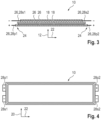
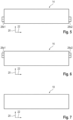
- One of the base elements 10 is in Fig. 3 in a sectional view and in Fig. 4 shown in a top view. It has four leaves, namely a Fig. 5 separately shown cathode sheet 14, a Fig. 6 separately shown anode sheet 16 and two separator sheets 18.
- its thickness is significantly smaller than its width and length. This means that its extension in the stacking direction 12 is smaller than its extension in the transverse direction 20 and also smaller than its extension in the longitudinal direction 22.
- the separator blades 18 are further made of a separator material, for example a polyolefin.
- a separator material for example a polyolefin.
- One of the separator blades 18 is in Fig. 7 shown as an example.
- the cathode sheet 14 and the anode sheet 16 are each formed by a coated metal foil.
- the cathode sheet 14 is formed, for example, by a coated copper foil and the anode sheet 16 by a coated aluminum foil.
- the coatings each have an active material.
- graphite as the cathode active material in the case of the cathode sheet 14 and, for example, LiCoO 2 as the anode active material in the case of the anode sheet 16.
- the coatings are also applied to both sides of the metal foils, i.e. on two opposite sides of each metal foil as seen in the stacking direction 12.
- the two separator sheets 18 of a base element 10 also form a pocket in the exemplary embodiment.
- the two separator sheets 18 are connected to one another along two edges 24.
- the two edges 24 each extend along the transverse direction 20 and delimit the pocket on two opposite sides in the longitudinal direction 22.
- the anode sheet 16 of the base element 10 is also located in the pocket.
- the two separator sheets 18 enclose the anode sheet 16 in the manner of a banderole. This is evident from Fig. 3 visible.
- the two electrode sheets 14, 16, i.e. the cathode sheet 14 and the anode sheet 16 are each formed by a coated metal foil in the exemplary embodiment.
- the metal foil forms an electrode conductor 26.
- the copper foil forms the electrode conductor 26 of the cathode sheet 14 and the aluminum foil forms the electrode conductor 26 of the anode sheet 16.
- each electrode conductor 26 forms two contact lugs 28, namely at two opposite ends of the corresponding electrode conductor 26 as seen in the longitudinal direction 22.
- the metal foil of the anode sheet 16 forms a first primary contact lug 28p1 and a second primary contact lug 28p2 and the metal foil of the cathode sheet 14 forms a first secondary contact lug 28s1 and a second secondary contact lug 28s2.
- Each battery cell 4 also has four separate cell conductors 30, namely a first primary cell conductor 30p1, a second primary cell conductor 30p2, a first secondary cell conductor 30s1 and a second secondary cell conductor 30s2. These four cell conductors 30 are each led through the housing 8. They thus penetrate the housing 8. This is due to Fig. 2 visible.
- all first primary contact lugs 28p1 of the accumulator cell 4 are connected to the first primary cell conductor 30p1
- all second primary contact lugs 28p2 of the accumulator cell 4 are connected to the second primary cell conductor 30p2
- all first secondary contact lugs 28s1 of the accumulator cell 4 are connected to the first secondary cell conductor 30s1
- all second secondary contact lugs 28s1 of the accumulator cell 4 are connected to the second secondary cell conductor 30s2.
- the connections are each formed by welded connections.
Landscapes
- Chemical & Material Sciences (AREA)
- Chemical Kinetics & Catalysis (AREA)
- Electrochemistry (AREA)
- General Chemical & Material Sciences (AREA)
- Engineering & Computer Science (AREA)
- Manufacturing & Machinery (AREA)
- Materials Engineering (AREA)
- Secondary Cells (AREA)
- Connection Of Batteries Or Terminals (AREA)
Abstract
Description
- Die Erfindung betrifft einen Lithium-Ionen-Akkumulator, welcher zumindest eine Akkumulatorzelle aufweist.
- Lithium-Ionen-Akkumulatoren sind als Speicher für elektrische Energie weit verbreitet. Sie werden unter anderem auch im Kraftfahrzeugbereich eingesetzt und dienen hier insbesondere als sogenannte Antriebs- oder Traktionsbatterien zum Antrieb von Hybrid- oder Elektrofahrzeugen.
- Ein Lithium-Ionen-Akkumulator weist als wesentliche Komponenten eine positive Elektrode, eine negative Elektrode und ein Elektrolyt auf. Hinsichtlich des genauen Aufbaus ist hierbei eine Vielzahl von Ausführungen bekannt. Allen Ausführungen gemein ist aber, dass im Lithium-Ionen-Akkumulator freie und somit mobile Lithium-Ionen vorliegen, also Lithium-Ionen, die frei durch den Elektrolyten zwischen der negativen Elektrode und der positiven Elektrode hin- und herwandern können.
- Ein mögliches Verfahren zur Herstellung von Lithium-Ionen-Akkumulatoren ist zum Beispiel in "Heimes, Heiner Hans; Kampker, Achim; Lienemann, Christoph; Locke, Marc; Offermanns, Christian; Michaelis, Sarah; Rahimzei, Ehsan (2018): Produktionsprozess einer Lithium-Ionen-Batteriezelle, Frankfurt am Main, PEM der RWTH Aachen und VDMA Eigendruck" skizziert.
- Der Erfindung liegt die Aufgabe zugrunde, einen vorteilhaft ausgebildeten Lithium-Ionen-Akkumulator anzugeben.
- Diese Aufgabe wird durch einen Lithium-Ionen-Akkumulator mit den Merkmalen des Patentanspruchs 1 gelöst. Vorteilhafte Ausgestaltungen mit zweckmäßigen Weiterbildungen der Erfindung sind in den abhängigen Patentansprüchen angegeben.
- Der erfindungsgemäße Lithium-Ionen-Akkumulator, nachfolgend auch kurz Akkumulator genannt, weist dabei zumindest eine Akkumulatorzelle auf. Typisch sind jedoch Ausführungen, bei denen der Akkumulator mehrere Akkumulatorzellen aufweist. Hierbei sind die Akkumulatorzellen dann üblicherweise gleichartig ausgestaltet.
- Weiter weist die zumindest eine Akkumulatorzelle zumindest ein Elektrodenblatt auf. Jenes Elektrodenblatt bildet dabei eine Elektrode aus, also eine positive Elektrode oder eine negative Elektrode. Die positive Elektrode wirkt beim Laden des Akkumulators als Anode. Daher wird ein Elektrodenblatt, welches eine positive Elektrode ausbildet, nachfolgend als Anodenblatt bezeichnet. Die negative Elektrode wiederum wirkt beim Entladen des Akkumulators als Kathode. Daher wird ein Elektrodenblatt, welches eine positive Elektrode ausbildet, nachfolgend als Kathodenblatt bezeichnet.
- Das zumindest eine Elektrodenblatt ist weiter in einer Längsrichtung ausgedehnt und insbesondere langgestreckt. Somit weist das zumindest eine Elektrodenblatt eine Länge L auf. Außerdem ist das zumindest eine Elektrodenblatt typischerweise in einer Querrichtung sowie in einer Stapelrichtung ausgedehnt. Somit weist dann das zumindest eine Elektrodenblatt außerdem eine Breite B sowie eine Dicke D auf. Hierbei ist die Stärke oder Dicke D typischerweise kleiner als die Breite B und auch kleiner als die Läge L. Typischerweise gilt dabei D kleiner 0,01 L. Üblicherweise gilt außerdem D kleiner 0,01 B.
- Bevorzugt ist das zumindest eine Elektrodenblatt zudem durch eine beschichtete Folie ausgebildet. Durch beschichtete Folien ausgebildete Elektrodenblätter sind hierbei prinzipiell bekannt und deren Herstellung ist beispielsweise in "Heimes, Heiner Hans; Kampker, Achim; Lienemann, Christoph; Locke, Marc; Offermanns, Christian; Michaelis, Sarah; Rahimzei, Ehsan (2018): Produktionsprozess einer Lithium-Ionen-Batteriezelle, Frankfurt am Main, PEM der RWTH Aachen und VDMA Eigendruck" skizziert.
- Weiter weist das zumindest eine Elektrodenblatt einen Ableiter auf, nämlich einen Elektroden-Ableiter. Der Ableiter ist dabei typischerweise durch eine Folie ausgebildet, insbesondere eine Metallfolie. Hierbei bildet der Elektroden-Ableiter zwei Kontaktfahnen oder Tabs aus, nämlich eine erste Kontaktfahne und eine zweite Kontaktfahne. Der Elektroden-Ableiter bildet somit nicht nur eine Kontaktfahne aus, wie dies bei Elektrodenblättern nach dem Stand der Technik der Fall ist, sondern zwei Kontaktfahnen.
- Dieser Ausgestaltung liegt die Überlegung zugrunde, dass bei Lithium-Ionen-Akkumulatoren der Innenwiderstand steigt, wenn die Abmessungen der Elektrodenblätter steigen, also zum Beispiel bei immer länger werdenden Elektrodenblättern. Mit Hilfe der zusätzlichen zweiten Kontaktfahne lässt sich der Innenwiderstand jedoch reduzieren. Auf diese Weise lassen sich hohe Energiedichten erreichen, ohne dass größere Abstriche im Hinblick auf die Schnellladefähigkeit in Kauf genommen werden müssen.
- Zweckdienlich ist es weiter, wenn der Elektroden-Ableiter in der Längsrichtung ausgedehnt ist, wenn dieser in der Längsrichtung gesehen zwei einander gegenüberliegende Enden aufweist und wenn jedes der zwei Enden eine der zwei Kontaktfahnen ausbildet. Auf diese Weise ist eine relative große räumliche Trennung zwischen den zwei Kontaktfahnen realisiert.
- Weiterhin ist das zumindest eine Elektrodenblatt je nach Anwendungsfall in der Längsrichtung über eine Länge größer gleich 300 mm, bevorzugt größer gleich 500 mm und insbesondere größer gleich 700 mm ausgedehnt. Insbesondere ist der Elektroden-Ableiter des zumindest einen Elektrodenblatt je nach Anwendungsfall in der Längsrichtung über eine Länge größer gleich 300 mm, bevorzugt größer gleich 500 mm und insbesondere größer gleich 700 mm ausgedehnt.
- Wie zuvor bereits erwähnt ist der Elektroden-Ableiter typischerweise durch eine Folie ausgebildet, insbesondere eine Metallfolie. Die Folie weist dabei üblicherweise eine äußere Berandung auf, die durch eine geschlossene Kurve ausgebildet ist, welche insbesondere in einer Ebene liegt, die durch die Längsrichtung und die Querrichtung aufgespannt wird. Die von der geschlossenen Kurve begrenzte Fläche ist dabei bevorzugt zu zumindest 80 %, weiter bevorzugt zu zumindest 90 % und insbesondere zu zumindest 95% durch die Metallfolie abgedeckt. D. h., dass die Metallfolie vorzugsweise nicht perforiert ist, keine Schlitze aufweist und auch sonst keine Durchbrüche.
- In vorteilhafter Weiterbildung ist das zumindest eine Elektrodenblatt durch eine beschichtete Folie ausgebildet, also insbesondere eine Folie der zuvor beschriebenen Art, auf die eine Beschichtung aufgebracht ist. Die entsprechende Beschichtung ist dabei je nach Anwendungsfall auf eine Seite der Folie oder auf zwei einander gegenüberliegenden Seiten der Folie aufgebracht, insbesondere flächig aufgebracht. Sie weist zweckdienlicherweise ein sogenanntes Aktivmaterial auf, nämlich ein Anoden-Aktivmaterial, wenn das zumindest eine Elektrodenblatt als Anodenblatt ausgebildet ist, oder ein Kathoden-Aktivmaterial, wenn das zumindest eine Elektrodenblatt als Kathodenblatt ausgebildet ist. Entsprechende Aktivmaterialien sind dabei prinzipiell bekannt.
- Zweckdienlich ist weiter eine Ausgestaltung des Akkumulators, bei der die zumindest eine Ackumulatorzelle zumindest ein Basiselement aufweist. Dabei weist das Basiselement zwei Elektrodenblätter auf, also insbesondere zwei Elektrodenblätter der zuvor beschriebenen Art, wobei eines der Elektrodenblätter ein Anodenblatt ausbildet und das andere ein Kathodenblatt. Hierbei bildet weiterhin das Anodenblatt zwei Kontaktfahnen aus, nämlich zwei primäre Kontaktfahnen, und zudem bildet auch das Kathodenblatt zwei Kontaktfahnen ausbildet, nämlich zwei sekundäre Kontaktfahnen.
- Je nach Ausführungsvariante weist das zumindest eine Basiselement zudem ein Separatorblatt oder ein Elektrolytblatt als ein weiteres Blatt auf. Auch für jedes weitere Blatt gilt typischerweise, dass dieses in der Längsrichtung ausgedehnt und insbesondere langgestreckt ist. Somit weist es eine Länge L auf. Außerdem ist es typischerweise in der Querrichtung sowie in der Stapelrichtung ausgedehnt. Somit weist es außerdem eine Breite B sowie eine Dicke D auf. Hierbei ist die Stärke oder Dicke D typischerweise kleiner als die Breite B und auch kleiner als die Läge L. Typischerweise gilt dabei D kleiner 0,01 L. Üblicherweise gilt außerdem D kleiner 0,01 B.
- Davon unabhängig ist ein entsprechendes Separatorblatt zweckdienlicherweise aus einem Separatormaterial gefertigt und bildet einen Separator aus. Geeignete Separatormaterialien sind dabei an sich bekannt. Ein entsprechendes Elektrolytblatt wiederum weist bevorzugt einen Festkörperelektrolyten auf. Je nach Anwendungsfall kommt dabei zum Beispiel eines der Sulfide Li2S-P2S5, Li2S-SiS2 oder Li2S-GeS2 als Festkörperelektrolyt zum Einsatz, eines der Oxide Li7La3Zr2O12 (LLZO) oder Li3xLa2/3-3xTiO3 (LLTO) oder eines der Li-Argyrodite LisPSsx (mit X=Cl, Br oder I), Li7PS6 oder Li7PSe6.
- Das weitere Blatt ist dann zweckdienlicherweise zwischen dem Anodenblatt und dem Kathodenblatt des zumindest einen Basiselements angeordnet.
- Einer weiteren Ausführungsvariante entsprechend weist das zumindest eine Basiselement zwei Separatorblätter als weitere Blätter auf. Diese bilden dabei bevorzugt eine Tasche aus, in der eines der zwei Elektrodenblätter des Basiselements einliegt.
- Von Vorteil ist außerdem eine Ausführung des Akkumulators, bei der die Akkumulatorzelle eine Einhausung aufweist sowie zumindest zwei in der Einhausung angeordnete Basiselemente, nämlich ein erstes Basiselement und ein zweites Basiselement. Dabei weist jedes der zwei Basiselemente zwei primäre Kontaktfahnen auf, nämlich eine erste primäre Kontaktfahne und eine zweite primäre Kontaktfahne. Zudem weist die Akkumulatorzelle zwei primäre Zell-Ableiter auf, die jeweils durch die Einhausung hindurchgeführt sind, nämlich einen ersten primären Zell-Ableiter und einen zweiten primären Zell-Ableiter. Hierbei sind dann die ersten primären Kontaktfahnen innerhalb der Einhausung an den ersten primären Zell-Ableiter angebunden sind und die zweiten primären Kontaktfahnen sind innerhalb der Einhausung an den zweiten primären Zell-Ableiter angebunden.
- Alternativ oder zusätzlich zu den zwei primären Kontaktfahnen weisen die zwei in der Einhausung angeordneten Basiselemente jeweils zwei sekundäre Kontaktfahnen auf, nämlich eine erste sekundäre Kontaktfahne und eine zweite sekundäre Kontaktfahne. Hierbei sind dann die ersten sekundären Kontaktfahnen innerhalb der Einhausung an den ersten sekundären Zell-Ableiter angebunden und die zweiten sekundären Kontaktfahnen sind innerhalb der Einhausung an den zweiten sekundäre Zell-Ableiter angebunden.
- Weitere Vorteile, Merkmale und Einzelheiten der Erfindung ergeben sich aus den Ansprüchen, der nachfolgenden Beschreibung bevorzugter Ausführungsformen sowie anhand der schematischen Zeichnungen. Darin zeigen:
- Fig. 1
- in einer Seitenansicht ein Akkumulator aufweisend mehrere Akkumulatorzellen,
- Fig. 2
- in einer Seitenansicht ein Zellstapel aus einer der Akkumulatorzellen,
- Fig. 3
- in einer Seitenansicht eine Basiseinheit des Zellstapels,
- Fig. 4
- in einer Draufsicht die Basiseinheit des Zellstapels,
- Fig. 5
- in einer Draufsicht ein Kathodenblatt der Basiseinheit,
- Fig. 6
- in einer Draufsicht ein Anodenblatt der Basiseinheit, und
- Fig. 7
- in einer Draufsicht ein Separatorblatt der Basiseinheit.
- Einander entsprechende Teile sind in allen Figuren mit den gleichen Bezugszeichen versehen.
- Ein nachfolgend exemplarisch beschriebener Lithium-Ionen-Akkumulator 2 ist in
Fig. 1 schematisch dargestellt. Er weist mehrere gleichartig ausgestaltete Akkumulatorzellen 4 auf, die in einem Gehäuse 6 des Lithium-Ionen-Akkumulators 2 angeordnet sind. - Eine dieser Akkumulatorzellen 4 ist in
Fig. 2 in einer Schnittdarstellung skizziert. Sie ist bevorzugt als sogenannte Pouch-Zelle ausgestaltet und weist eine Einhausung 8 auf. In der Einhausung 8 sind mehrere gleichartig ausgestaltete Basiselemente 10 in einer Stapelrichtung 12 übereinander gestapelt. Zudem ist die Einhausung 8 mit einem nicht näher dargestellten Elektrolyten befüllt, zum Beispiel LiPF6. - Eines der Basiselemente 10 ist in
Fig. 3 in einer Schnittdarstellung und inFig. 4 in einer Draufsicht gezeigt. Es weist vier Blätter auf, nämlich ein inFig. 5 separat dargestelltes Kathodenblatt 14, ein inFig. 6 separat dargestelltes Anodenblatt 16 und zwei Separatorblätter 18. Für jedes der Blätter gilt dabei, dass dessen Dicke wesentlich kleiner ist als dessen Breite und dessen Länge. D. h., dass dessen Ausdehnung in Stapelrichtung 12 kleiner ist als dessen Ausdehnung in Querrichtung 20 und auch kleiner als dessen Ausdehnung in Längsrichtung 22. - Die Separatorblätter 18 sind weiter aus einem Separatormaterial gefertigt, also beispielsweise einem Polyolefin. Eines der Separatorblätter 18 ist in
Fig. 7 exemplarisch abgebildet. - Das Kathodenblatt 14 und das Anodenblatt 16 sind im Ausführungsbeispiel jeweils durch eine beschichtete Metallfolie ausgebildet. Dabei ist das Kathodenblatt 14 beispielsweise durch eine beschichtete Kupferfolie ausgebildet und das Anodenblatt 16 durch eine beschichtete Aluminiumfolie. Die Beschichtungen weisen jeweils ein Aktivmaterial auf. Also zum Beispiel Graphit als Kathoden-Aktivmaterial im Falle des Kathodenblatts 14 und beispielsweise LiCoO2 als Anoden-Aktivmaterial im Falle des Anodenblatts 16. Im Ausführungsbeispiel sind die Beschichtungen zudem beidseitig auf die Metallfolien aufgebracht, also auf zwei in Stapelrichtung 12 gesehen gegenüberliegenden Seiten einer jeden Metallfolie.
- Die zwei Separatorblätter 18 eines Basiselements 10 bilden im Ausführungsbeispiel außerdem eine Tasche aus. Hierzu sind die zwei Separatorblätter 18 entlang zweier Ränder 24 miteinander verbunden. Die zwei Ränder 24 erstrecken sich im Ausführungsbeispiel jeweils entlang der Querrichtung 20 und begrenzen die Tasche auf zwei in Längsrichtung 22 gegenüberliegenden Seiten. In der Tasche liegt weiterhin das Anodenblatt 16 des Basiselements 10 ein. Als Folge umschließen die zwei Separatorblätter 18 das Anodenblatt 16 nach Art einer Banderole. Dies ist aus
Fig. 3 ersichtlich. - Wie zuvor bereits dargelegt sind die beiden Elektrodenblätter 14,16, also das Kathodenblatt 14 und das Anodenblatt 16, im Ausführungsbeispiel jeweils durch eine beschichtete Metallfolie ausgebildet. In beiden Fällen bildet die Metallfolie dabei einen Elektroden-Ableiter 26 aus. Im zuvor genannten Ausführungsbeispiel bildet also die Kupferfolie den Elektroden-Ableiter 26 des Kathodenblatts 14 und die Aluminiumfolie den Elektroden-Ableiter 26 des Anodenblatts 16 aus.
- Weiter bildet jeder Elektroden-Ableiter 26 zwei Kontaktfahnen 28 aus und zwar an zwei in Längsrichtung 22 gesehen einander gegenüberliegenden Enden des entsprechenden Elektroden-Ableiters 26. Hierbei bildet die Metallfolie des Anodenblatt 16 eine erste primären Kontaktfahne 28p1 sowie eine zweite primäre Kontaktfahne 28p2 aus und die Metallfolie des Kathodenblatts 14 bildet eine erste sekundäre Kontaktfahne 28s1 sowie eine zweite sekundäre Kontaktfahne 28s2 aus.
- Jede Akkumulatorzelle 4 weit außerdem vier separate Zell-Ableiter 30 auf, nämlich einen ersten primären Zell-Ableiter 30p1, einen zweiten primären Zell-Ableiter 30p2, einen ersten sekundären Zell-Ableiter 30s1 und einen zweiten sekundären Zell-Ableiter 30s2. Diese vier Zell-Ableiter 30 sind jeweils durch die Einhausung 8 hindurchgeführt. Sie durchsetzen somit also die Einhausung 8. Dies ist aus
Fig. 2 ersichtlich. - Innerhalb der Einhausung 8 einer jeden Akkumulatorzelle 4 sind alle ersten primären Kontaktfahnen 28p1 der Akkumulatorzelle 4 an den ersten primären Zell-Ableiter 30p1 angebunden, alle zweiten primären Kontaktfahnen 28p2 der Akkumulatorzelle 4 sind an den zweiten primären Zell-Ableiter 30p2 angebunden, alle ersten sekundären Kontaktfahnen 28s1 der Akkumulatorzelle 4 sind an den ersten sekundären Zell-Ableiter 30s1 angebunden und alle zweiten sekundären Kontaktfahnen 28s1 der Akkumulatorzelle 4 sind an den zweiten sekundären Zell-Ableiter 30s2 angebunden. Die Anbindungen sind im Ausführungsbeispiel dabei jeweils durch Schweißverbindungen ausgebildet.
-
- 2
- Lithium-Ionen-Akkumulator
- 4
- Akkumulatorzelle
- 6
- Gehäuse
- 8
- Einhausung
- 10
- Basiselement
- 12
- Stapelrichtung
- 14
- Kathodenblatt
- 16
- Anodenblatt
- 18
- Separatorblatt
- 20
- Querrichtung
- 22
- Längsrichtung
- 24
- Rand
- 26
- Elektroden-Ableiter
- 28
- Kontaktfahne
- 28p1
- erste primäre Kontaktfahne
- 28p2
- zweite primäre Kontaktfahne
- 28s1
- erste sekundäre Kontaktfahne
- 28s1
- zweite sekundäre Kontaktfahne
- 30
- Zell-Ableiter
- 30p1
- erster primärer Zell-Ableiter
- 30p2
- zweiter primärer Zell-Ableiter
- 30s1
- erster sekundärer Zell-Ableiter
- 30s2
- zweiter sekundärer Zell-Ableiter
Claims (10)
- Lithium-Ionen-Akkumulator (2) aufweisend zumindest eine Akkumulatorzelle (4), wobei- die Akkumulatorzelle (4) zumindest ein Elektrodenblatt (14,16) aufweist,- das zumindest eine Elektrodenblatt (14,16) in einer Längsrichtung (22) ausgedehnt ist,- das zumindest eine Elektrodenblatt (14,16) einen Elektroden-Ableiter (26) aufweist und- der Elektroden-Ableiter (26) zwei Kontaktfahnen (28) ausbildet, nämlich eine erste Kontaktfahne (28p1,28s1) und eine zweite Kontaktfahne (28p2,28s2).
- Lithium-Ionen-Akkumulator (2) nach Anspruch 1,
wobei der Elektroden-Ableiter (26) in der Längsrichtung (22) ausgedehnt ist, wobei der Elektroden-Ableiter (26) in der Längsrichtung gesehen zwei einander gegenüberliegende Enden aufweist und wobei jedes der zwei Enden eine der zwei Kontaktfahnen (28) ausbildet. - Lithium-Ionen-Akkumulator (2) nach Anspruch 1 oder 2,
wobei das zumindest eine Elektrodenblatt (14,16) in der Längsrichtung (22) über eine Länge größer gleich 500 mm ausgedehnt ist. - Lithium-Ionen-Akkumulator (2) nach einem der Ansprüche 1 bis 3,
wobei der Elektroden-Ableiter (26) durch eine Folie ausgebildet ist. - Lithium-Ionen-Akkumulator (2) nach einem der Ansprüche 1 bis 4,
wobei- die Akkumulatorzelle (4) zumindest ein Basiselement (10) aufweist,- das Basiselement (10) zwei Elektrodenblätter (14,16) aufweist, nämlich ein Anodenblatt (16) und ein Kathodenblatt (14),- das Anodenblatt (16) zwei Kontaktfahnen (28p1,28p2) ausbildet, nämlich zwei primäre Kontaktfahnen (28p1,28p2), und- das Kathodenblatt zwei Kontaktfahnen (28s1,28s2) ausbildet, nämlich zwei sekundäre Kontaktfahnen (28s1,28s2). - Lithium-Ionen-Akkumulator (2) nach Anspruch 5,
wobei zwischen dem Anodenblatt (16) und dem Kathodenblatt (14) des Basiselements (10) ein Separatorblatt (18) oder ein Elektrolytblatt des Basiselements (10) angeordnet ist. - Lithium-Ionen-Akkumulator (2) nach Anspruch 5,
wobei eines der zwei Elektrodenblätter (16) des Basiselements (10) zwischen zwei Separatorblättern (18) des Basiselements (10) einliegt. - Lithium-Ionen-Akkumulator (2) nach Anspruch 7,
wobei die zwei Separatorblätter (18) des Basiselements (10) eine Tasche ausbilden, in der das eine der zwei Elektrodenblätter (16) einliegt. - Lithium-Ionen-Akkumulator (2) nach einem der Ansprüche 5 bis 8,
wobei- die Akkumulatorzelle (4) eine Einhausung (8) aufweist sowie zwei in der Einhausung (8) angeordnete Basiselemente (10), nämlich ein erstes Basiselement (10) und ein zweites Basiselement (10),- jedes der zwei Basiselemente (10) zwei primäre Kontaktfahnen (28p1,28p2) aufweist, nämlich eine erste primäre Kontaktfahne (28p1) und eine zweite primäre Kontaktfahne (28p2),- die Akkumulatorzelle (4) zwei primäre Zell-Ableiter (30p1,30p2) aufweist, die jeweils durch die Einhausung (8) hindurchgeführt sind, nämlich einen ersten primären Zell-Ableiter (30p1) und einen zweiten primären Zell-Ableiter (30p2),- die ersten primären Kontaktfahnen (28p1) innerhalb der Einhausung (8) an den ersten primären Zell-Ableiter (30p1) angebunden sind und- die zweiten primären Kontaktfahnen (28p2) innerhalb der Einhausung (8) an den zweiten primären Zell-Ableiter (30p2) angebunden sind. - Lithium-Ionen-Akkumulator (2) nach einem der Ansprüche 5 bis 9,
wobei- die Akkumulatorzelle (2) eine Einhausung (8) aufweist sowie zwei in der Einhausung angeordnete Basiselemente (10), nämlich ein erstes Basiselement (10) und ein zweites Basiselement (10),- jedes der zwei Basiselemente (10) zwei sekundäre Kontaktfahnen (28s1,28s2) aufweist, nämlich eine erste sekundäre Kontaktfahne (28s1) und eine zweite sekundäre Kontaktfahne (28s2),- die Akkumulatorzelle (4) zwei sekundäre Zell-Ableiter (30s1,30s2) aufweist, die jeweils durch die Einhausung (8) hindurchgeführt sind, nämlich einen ersten sekundären Zell-Ableiter (30s1) und einen zweiten sekundären Zell-Ableiter (30s2),- die ersten sekundären Kontaktfahnen (28s1) innerhalb der Einhausung (8) an den ersten sekundären Zell-Ableiter (30s1) angebunden sind und- die zweiten sekundären Kontaktfahnen (28s2) innerhalb der Einhausung (8) an den zweiten sekundäre Zell-Ableiter (30s2) angebunden sind.
Applications Claiming Priority (1)
| Application Number | Priority Date | Filing Date | Title |
|---|---|---|---|
| DE102023203849 | 2023-04-26 |
Publications (2)
| Publication Number | Publication Date |
|---|---|
| EP4456312A2 true EP4456312A2 (de) | 2024-10-30 |
| EP4456312A3 EP4456312A3 (de) | 2024-11-06 |
Family
ID=90730240
Family Applications (1)
| Application Number | Title | Priority Date | Filing Date |
|---|---|---|---|
| EP24169999.0A Withdrawn EP4456312A3 (de) | 2023-04-26 | 2024-04-12 | Lithium-ionen-akkumulator |
Country Status (3)
| Country | Link |
|---|---|
| US (1) | US20240363981A1 (de) |
| EP (1) | EP4456312A3 (de) |
| CN (1) | CN118867256A (de) |
Family Cites Families (6)
| Publication number | Priority date | Publication date | Assignee | Title |
|---|---|---|---|---|
| CN103560275A (zh) * | 2013-10-11 | 2014-02-05 | 河南超威电源有限公司 | 双极电池 |
| CN204905369U (zh) * | 2015-08-10 | 2015-12-23 | 东莞市致格电池科技有限公司 | 一种叠片电芯 |
| KR102872284B1 (ko) * | 2019-11-26 | 2025-10-16 | 주식회사 엘지에너지솔루션 | 전극조립체 및 그 제조방법 |
| CN112582668A (zh) * | 2021-02-25 | 2021-03-30 | 潍坊聚能电池有限公司 | 一种多极柱锂离子动力电池及其制造方法 |
| DE102021109074A1 (de) * | 2021-04-12 | 2022-10-13 | Volkswagen Aktiengesellschaft | Batteriezelle und Verfahren zu deren Herstellung sowie Kraftfahrzeug |
| CN113782838B (zh) * | 2021-11-11 | 2022-03-15 | 深圳市兴禾自动化股份有限公司 | 一种电芯热复合制成工艺 |
-
2024
- 2024-04-12 EP EP24169999.0A patent/EP4456312A3/de not_active Withdrawn
- 2024-04-25 US US18/646,686 patent/US20240363981A1/en active Pending
- 2024-04-25 CN CN202410502742.8A patent/CN118867256A/zh active Pending
Also Published As
| Publication number | Publication date |
|---|---|
| CN118867256A (zh) | 2024-10-29 |
| US20240363981A1 (en) | 2024-10-31 |
| EP4456312A3 (de) | 2024-11-06 |
Similar Documents
| Publication | Publication Date | Title |
|---|---|---|
| DE60313313T2 (de) | Elektrochemisches bündel | |
| EP2596540B1 (de) | Batterie mit quaderförmigen zellen welche eine bipolare elektrode enthalten | |
| DE102016204372A1 (de) | Energiespeichereinrichtung | |
| DE102011075063A1 (de) | Verfahren und Vorrichtung zur Herstellung von Elektrodenwickeln | |
| DE102016218495A1 (de) | Verfahren zur Herstellung eines Elektrodenstapels für eine Batteriezelle und Batteriezelle | |
| DE102019207895A1 (de) | Stapelbatterie | |
| DE102016217369A1 (de) | Elektrode mit erhöhtem Aktivmaterialanteil | |
| DE212024000134U1 (de) | Batteriezelle und Batteriepack | |
| WO2016120060A1 (de) | Design für feststoffzellen | |
| WO2016116317A1 (de) | Elektrodenwickel für ein galvanisches element und verfahren zu dessen herstellung | |
| DE102014222332A1 (de) | Schichtaufbau für ein galvanisches Element | |
| DE102013224088A1 (de) | Verfahren zur Herstellung einer metallischen Elektrode sowie Verfahren zur Herstellung eines Zellstapels bzw. eines Zellwickels | |
| EP3526843B1 (de) | Verfahren zum herstellen einer galvanischen lithium-ionen-zelle und galvanische lithium-ionen-zelle | |
| DE102013209067A1 (de) | Batteriezelle mit einem Elektrodenensemble sowie eine Batterie und ein Kraftfahrzeug mit der Batteriezelle | |
| DE102017207169A1 (de) | Zellenstapel | |
| DE102020111242A1 (de) | Lithiumionenbatterie | |
| DE102021109074A1 (de) | Batteriezelle und Verfahren zu deren Herstellung sowie Kraftfahrzeug | |
| DE102022105602B4 (de) | Batterie mit Wärmeleiter | |
| DE112011105553T5 (de) | Elektrische Speichervorrichtung und Herstellungsverfahren einer elektrischen Speichervorrichtung | |
| WO2019145542A1 (de) | Batteriezelle | |
| WO2016066388A1 (de) | Stromsammler für eine elektrochemische energiespeichervorrichtung | |
| DE102017207770A1 (de) | Verfahren zur Herstellung eines Elektrodenstapels für eine Batteriezelle und Batteriezelle | |
| DE102021111379A1 (de) | Elektrodenstapel für eine Batteriezelle, Batteriezelle und Verfahren zur Herstellung | |
| DE102025134428A1 (de) | Elektrochemische Zelle | |
| DE102024208666A1 (de) | Natrium-Ionen-Akkumulator und Verfahren zur Fertigung eines Natrium-Ionen-Akkumulators |
Legal Events
| Date | Code | Title | Description |
|---|---|---|---|
| PUAI | Public reference made under article 153(3) epc to a published international application that has entered the european phase |
Free format text: ORIGINAL CODE: 0009012 |
|
| STAA | Information on the status of an ep patent application or granted ep patent |
Free format text: STATUS: THE APPLICATION HAS BEEN PUBLISHED |
|
| PUAL | Search report despatched |
Free format text: ORIGINAL CODE: 0009013 |
|
| AK | Designated contracting states |
Kind code of ref document: A2 Designated state(s): AL AT BE BG CH CY CZ DE DK EE ES FI FR GB GR HR HU IE IS IT LI LT LU LV MC ME MK MT NL NO PL PT RO RS SE SI SK SM TR |
|
| AK | Designated contracting states |
Kind code of ref document: A3 Designated state(s): AL AT BE BG CH CY CZ DE DK EE ES FI FR GB GR HR HU IE IS IT LI LT LU LV MC ME MK MT NL NO PL PT RO RS SE SI SK SM TR |
|
| RIC1 | Information provided on ipc code assigned before grant |
Ipc: H01M 50/178 20210101ALI20241002BHEP Ipc: H01M 50/176 20210101ALI20241002BHEP Ipc: H01M 10/0525 20100101ALI20241002BHEP Ipc: H01M 10/04 20060101ALI20241002BHEP Ipc: H01M 4/66 20060101ALI20241002BHEP Ipc: H01M 50/54 20210101ALI20241002BHEP Ipc: H01M 10/0585 20100101ALI20241002BHEP Ipc: H01M 50/466 20210101ALI20241002BHEP Ipc: H01M 50/172 20210101ALI20241002BHEP Ipc: H01M 50/533 20210101AFI20241002BHEP |
|
| STAA | Information on the status of an ep patent application or granted ep patent |
Free format text: STATUS: THE APPLICATION IS DEEMED TO BE WITHDRAWN |
|
| 18D | Application deemed to be withdrawn |
Effective date: 20250507 |