EP4455120A1 - Verfahren zur alkoxycarbonylierung von olefinen unter einsatz von synthesegas - Google Patents
Verfahren zur alkoxycarbonylierung von olefinen unter einsatz von synthesegas Download PDFInfo
- Publication number
- EP4455120A1 EP4455120A1 EP23170052.7A EP23170052A EP4455120A1 EP 4455120 A1 EP4455120 A1 EP 4455120A1 EP 23170052 A EP23170052 A EP 23170052A EP 4455120 A1 EP4455120 A1 EP 4455120A1
- Authority
- EP
- European Patent Office
- Prior art keywords
- bar
- mpa
- supplied
- palladium
- range
- Prior art date
- Legal status (The legal status is an assumption and is not a legal conclusion. Google has not performed a legal analysis and makes no representation as to the accuracy of the status listed.)
- Pending
Links
- 238000000034 method Methods 0.000 title claims abstract description 59
- 150000001336 alkenes Chemical class 0.000 title claims abstract description 11
- 238000007083 alkoxycarbonylation reaction Methods 0.000 title abstract description 7
- 230000015572 biosynthetic process Effects 0.000 title abstract description 7
- 238000003786 synthesis reaction Methods 0.000 title abstract description 7
- KDLHZDBZIXYQEI-UHFFFAOYSA-N palladium Substances [Pd] KDLHZDBZIXYQEI-UHFFFAOYSA-N 0.000 claims description 13
- LFQSCWFLJHTTHZ-UHFFFAOYSA-N Ethanol Chemical compound CCO LFQSCWFLJHTTHZ-UHFFFAOYSA-N 0.000 claims description 12
- OKKJLVBELUTLKV-UHFFFAOYSA-N Methanol Chemical compound OC OKKJLVBELUTLKV-UHFFFAOYSA-N 0.000 claims description 12
- 150000001875 compounds Chemical class 0.000 claims description 8
- 239000003446 ligand Substances 0.000 claims description 8
- 229910002091 carbon monoxide Inorganic materials 0.000 claims description 7
- KFZMGEQAYNKOFK-UHFFFAOYSA-N Isopropanol Chemical compound CC(C)O KFZMGEQAYNKOFK-UHFFFAOYSA-N 0.000 claims description 6
- LRHPLDYGYMQRHN-UHFFFAOYSA-N N-Butanol Chemical compound CCCCO LRHPLDYGYMQRHN-UHFFFAOYSA-N 0.000 claims description 6
- 150000002148 esters Chemical class 0.000 claims description 6
- JRZJOMJEPLMPRA-UHFFFAOYSA-N olefin Natural products CCCCCCCC=C JRZJOMJEPLMPRA-UHFFFAOYSA-N 0.000 claims description 6
- JKDRQYIYVJVOPF-FDGPNNRMSA-L palladium(ii) acetylacetonate Chemical compound [Pd+2].C\C([O-])=C\C(C)=O.C\C([O-])=C\C(C)=O JKDRQYIYVJVOPF-FDGPNNRMSA-L 0.000 claims description 6
- BDERNNFJNOPAEC-UHFFFAOYSA-N propan-1-ol Chemical compound CCCO BDERNNFJNOPAEC-UHFFFAOYSA-N 0.000 claims description 6
- 229910052763 palladium Inorganic materials 0.000 claims description 5
- AFVFQIVMOAPDHO-UHFFFAOYSA-N Methanesulfonic acid Chemical compound CS(O)(=O)=O AFVFQIVMOAPDHO-UHFFFAOYSA-N 0.000 claims description 4
- AMQJEAYHLZJPGS-UHFFFAOYSA-N N-Pentanol Chemical compound CCCCCO AMQJEAYHLZJPGS-UHFFFAOYSA-N 0.000 claims description 4
- DKGAVHZHDRPRBM-UHFFFAOYSA-N Tert-Butanol Chemical compound CC(C)(C)O DKGAVHZHDRPRBM-UHFFFAOYSA-N 0.000 claims description 4
- 239000002253 acid Substances 0.000 claims description 4
- FKOASGGZYSYPBI-UHFFFAOYSA-K bis(trifluoromethylsulfonyloxy)alumanyl trifluoromethanesulfonate Chemical compound [Al+3].[O-]S(=O)(=O)C(F)(F)F.[O-]S(=O)(=O)C(F)(F)F.[O-]S(=O)(=O)C(F)(F)F FKOASGGZYSYPBI-UHFFFAOYSA-K 0.000 claims description 4
- ZSIAUFGUXNUGDI-UHFFFAOYSA-N hexan-1-ol Chemical compound CCCCCCO ZSIAUFGUXNUGDI-UHFFFAOYSA-N 0.000 claims description 4
- 239000000203 mixture Substances 0.000 claims description 4
- AQIXEPGDORPWBJ-UHFFFAOYSA-N pentan-3-ol Chemical compound CCC(O)CC AQIXEPGDORPWBJ-UHFFFAOYSA-N 0.000 claims description 4
- JOXIMZWYDAKGHI-UHFFFAOYSA-N toluene-4-sulfonic acid Chemical compound CC1=CC=C(S(O)(=O)=O)C=C1 JOXIMZWYDAKGHI-UHFFFAOYSA-N 0.000 claims description 4
- 125000002541 furyl group Chemical group 0.000 claims description 3
- 125000004076 pyridyl group Chemical group 0.000 claims description 3
- 239000011541 reaction mixture Substances 0.000 claims description 3
- UKSZBOKPHAQOMP-SVLSSHOZSA-N (1e,4e)-1,5-diphenylpenta-1,4-dien-3-one;palladium Chemical compound [Pd].C=1C=CC=CC=1\C=C\C(=O)\C=C\C1=CC=CC=C1.C=1C=CC=CC=1\C=C\C(=O)\C=C\C1=CC=CC=C1 UKSZBOKPHAQOMP-SVLSSHOZSA-N 0.000 claims description 2
- RRHPTXZOMDSKRS-PHFPKPIQSA-L (1z,5z)-cycloocta-1,5-diene;dichloropalladium Chemical compound Cl[Pd]Cl.C\1C\C=C/CC\C=C/1 RRHPTXZOMDSKRS-PHFPKPIQSA-L 0.000 claims description 2
- ISWSIDIOOBJBQZ-UHFFFAOYSA-N Phenol Chemical compound OC1=CC=CC=C1 ISWSIDIOOBJBQZ-UHFFFAOYSA-N 0.000 claims description 2
- QAOWNCQODCNURD-UHFFFAOYSA-N Sulfuric acid Chemical compound OS(O)(=O)=O QAOWNCQODCNURD-UHFFFAOYSA-N 0.000 claims description 2
- RBYGDVHOECIAFC-UHFFFAOYSA-L acetonitrile;palladium(2+);dichloride Chemical compound [Cl-].[Cl-].[Pd+2].CC#N.CC#N RBYGDVHOECIAFC-UHFFFAOYSA-L 0.000 claims description 2
- 125000003785 benzimidazolyl group Chemical group N1=C(NC2=C1C=CC=C2)* 0.000 claims description 2
- 125000000499 benzofuranyl group Chemical group O1C(=CC2=C1C=CC=C2)* 0.000 claims description 2
- HPXRVTGHNJAIIH-UHFFFAOYSA-N cyclohexanol Chemical compound OC1CCCCC1 HPXRVTGHNJAIIH-UHFFFAOYSA-N 0.000 claims description 2
- 125000003838 furazanyl group Chemical group 0.000 claims description 2
- 238000010438 heat treatment Methods 0.000 claims description 2
- 125000002883 imidazolyl group Chemical group 0.000 claims description 2
- 125000001041 indolyl group Chemical group 0.000 claims description 2
- 125000000904 isoindolyl group Chemical group C=1(NC=C2C=CC=CC12)* 0.000 claims description 2
- 125000005956 isoquinolyl group Chemical group 0.000 claims description 2
- 125000001786 isothiazolyl group Chemical group 0.000 claims description 2
- 125000000842 isoxazolyl group Chemical group 0.000 claims description 2
- 125000002971 oxazolyl group Chemical group 0.000 claims description 2
- LXNAVEXFUKBNMK-UHFFFAOYSA-N palladium(II) acetate Substances [Pd].CC(O)=O.CC(O)=O LXNAVEXFUKBNMK-UHFFFAOYSA-N 0.000 claims description 2
- PIBWKRNGBLPSSY-UHFFFAOYSA-L palladium(II) chloride Chemical compound Cl[Pd]Cl PIBWKRNGBLPSSY-UHFFFAOYSA-L 0.000 claims description 2
- YJVFFLUZDVXJQI-UHFFFAOYSA-L palladium(ii) acetate Chemical compound [Pd+2].CC([O-])=O.CC([O-])=O YJVFFLUZDVXJQI-UHFFFAOYSA-L 0.000 claims description 2
- 125000003373 pyrazinyl group Chemical group 0.000 claims description 2
- 125000003226 pyrazolyl group Chemical group 0.000 claims description 2
- 125000002098 pyridazinyl group Chemical group 0.000 claims description 2
- 125000000714 pyrimidinyl group Chemical group 0.000 claims description 2
- 125000000168 pyrrolyl group Chemical group 0.000 claims description 2
- 125000005493 quinolyl group Chemical group 0.000 claims description 2
- 235000011149 sulphuric acid Nutrition 0.000 claims description 2
- 239000001117 sulphuric acid Substances 0.000 claims description 2
- 125000003831 tetrazolyl group Chemical group 0.000 claims description 2
- 125000000335 thiazolyl group Chemical group 0.000 claims description 2
- 125000001544 thienyl group Chemical group 0.000 claims description 2
- 238000002474 experimental method Methods 0.000 description 7
- 125000004432 carbon atom Chemical group C* 0.000 description 3
- 238000006243 chemical reaction Methods 0.000 description 3
- 125000005842 heteroatom Chemical group 0.000 description 2
- 125000004400 (C1-C12) alkyl group Chemical group 0.000 description 1
- 125000004178 (C1-C4) alkyl group Chemical group 0.000 description 1
- 125000004169 (C1-C6) alkyl group Chemical group 0.000 description 1
- 125000004209 (C1-C8) alkyl group Chemical group 0.000 description 1
- FGUUSXIOTUKUDN-IBGZPJMESA-N C1(=CC=CC=C1)N1C2=C(NC([C@H](C1)NC=1OC(=NN=1)C1=CC=CC=C1)=O)C=CC=C2 Chemical compound C1(=CC=CC=C1)N1C2=C(NC([C@H](C1)NC=1OC(=NN=1)C1=CC=CC=C1)=O)C=CC=C2 FGUUSXIOTUKUDN-IBGZPJMESA-N 0.000 description 1
- UGFAIRIUMAVXCW-UHFFFAOYSA-N Carbon monoxide Chemical compound [O+]#[C-] UGFAIRIUMAVXCW-UHFFFAOYSA-N 0.000 description 1
- 150000001298 alcohols Chemical class 0.000 description 1
- 125000000217 alkyl group Chemical group 0.000 description 1
- 229910052799 carbon Inorganic materials 0.000 description 1
- 238000007037 hydroformylation reaction Methods 0.000 description 1
- 229910052751 metal Inorganic materials 0.000 description 1
- 239000002184 metal Substances 0.000 description 1
- 125000002950 monocyclic group Chemical group 0.000 description 1
- 229910052760 oxygen Inorganic materials 0.000 description 1
- -1 polycyclic aromatic hydrocarbon radicals Chemical class 0.000 description 1
- 125000006413 ring segment Chemical group 0.000 description 1
- 238000007086 side reaction Methods 0.000 description 1
- 229910052717 sulfur Inorganic materials 0.000 description 1
Classifications
-
- C—CHEMISTRY; METALLURGY
- C07—ORGANIC CHEMISTRY
- C07C—ACYCLIC OR CARBOCYCLIC COMPOUNDS
- C07C67/00—Preparation of carboxylic acid esters
- C07C67/36—Preparation of carboxylic acid esters by reaction with carbon monoxide or formates
- C07C67/38—Preparation of carboxylic acid esters by reaction with carbon monoxide or formates by addition to an unsaturated carbon-to-carbon bond
-
- B—PERFORMING OPERATIONS; TRANSPORTING
- B01—PHYSICAL OR CHEMICAL PROCESSES OR APPARATUS IN GENERAL
- B01J—CHEMICAL OR PHYSICAL PROCESSES, e.g. CATALYSIS OR COLLOID CHEMISTRY; THEIR RELEVANT APPARATUS
- B01J31/00—Catalysts comprising hydrides, coordination complexes or organic compounds
- B01J31/16—Catalysts comprising hydrides, coordination complexes or organic compounds containing coordination complexes
- B01J31/22—Organic complexes
- B01J31/2204—Organic complexes the ligands containing oxygen or sulfur as complexing atoms
- B01J31/2208—Oxygen, e.g. acetylacetonates
- B01J31/2226—Anionic ligands, i.e. the overall ligand carries at least one formal negative charge
- B01J31/223—At least two oxygen atoms present in one at least bidentate or bridging ligand
- B01J31/2234—Beta-dicarbonyl ligands, e.g. acetylacetonates
-
- B—PERFORMING OPERATIONS; TRANSPORTING
- B01—PHYSICAL OR CHEMICAL PROCESSES OR APPARATUS IN GENERAL
- B01J—CHEMICAL OR PHYSICAL PROCESSES, e.g. CATALYSIS OR COLLOID CHEMISTRY; THEIR RELEVANT APPARATUS
- B01J31/00—Catalysts comprising hydrides, coordination complexes or organic compounds
- B01J31/16—Catalysts comprising hydrides, coordination complexes or organic compounds containing coordination complexes
- B01J31/24—Phosphines, i.e. phosphorus bonded to only carbon atoms, or to both carbon and hydrogen atoms, including e.g. sp2-hybridised phosphorus compounds such as phosphabenzene, phosphole or anionic phospholide ligands
-
- B—PERFORMING OPERATIONS; TRANSPORTING
- B01—PHYSICAL OR CHEMICAL PROCESSES OR APPARATUS IN GENERAL
- B01J—CHEMICAL OR PHYSICAL PROCESSES, e.g. CATALYSIS OR COLLOID CHEMISTRY; THEIR RELEVANT APPARATUS
- B01J31/00—Catalysts comprising hydrides, coordination complexes or organic compounds
- B01J31/16—Catalysts comprising hydrides, coordination complexes or organic compounds containing coordination complexes
- B01J31/24—Phosphines, i.e. phosphorus bonded to only carbon atoms, or to both carbon and hydrogen atoms, including e.g. sp2-hybridised phosphorus compounds such as phosphabenzene, phosphole or anionic phospholide ligands
- B01J31/2404—Cyclic ligands, including e.g. non-condensed polycyclic ligands, the phosphine-P atom being a ring member or a substituent on the ring
- B01J31/2409—Cyclic ligands, including e.g. non-condensed polycyclic ligands, the phosphine-P atom being a ring member or a substituent on the ring with more than one complexing phosphine-P atom
-
- C—CHEMISTRY; METALLURGY
- C07—ORGANIC CHEMISTRY
- C07C—ACYCLIC OR CARBOCYCLIC COMPOUNDS
- C07C69/00—Esters of carboxylic acids; Esters of carbonic or haloformic acids
- C07C69/02—Esters of acyclic saturated monocarboxylic acids having the carboxyl group bound to an acyclic carbon atom or to hydrogen
- C07C69/22—Esters of acyclic saturated monocarboxylic acids having the carboxyl group bound to an acyclic carbon atom or to hydrogen having three or more carbon atoms in the acid moiety
- C07C69/24—Esters of acyclic saturated monocarboxylic acids having the carboxyl group bound to an acyclic carbon atom or to hydrogen having three or more carbon atoms in the acid moiety esterified with monohydroxylic compounds
-
- B—PERFORMING OPERATIONS; TRANSPORTING
- B01—PHYSICAL OR CHEMICAL PROCESSES OR APPARATUS IN GENERAL
- B01J—CHEMICAL OR PHYSICAL PROCESSES, e.g. CATALYSIS OR COLLOID CHEMISTRY; THEIR RELEVANT APPARATUS
- B01J2231/00—Catalytic reactions performed with catalysts classified in B01J31/00
- B01J2231/30—Addition reactions at carbon centres, i.e. to either C-C or C-X multiple bonds
- B01J2231/32—Addition reactions to C=C or C-C triple bonds
- B01J2231/321—Hydroformylation, metalformylation, carbonylation or hydroaminomethylation
-
- B—PERFORMING OPERATIONS; TRANSPORTING
- B01—PHYSICAL OR CHEMICAL PROCESSES OR APPARATUS IN GENERAL
- B01J—CHEMICAL OR PHYSICAL PROCESSES, e.g. CATALYSIS OR COLLOID CHEMISTRY; THEIR RELEVANT APPARATUS
- B01J2531/00—Additional information regarding catalytic systems classified in B01J31/00
- B01J2531/001—General concepts, e.g. reviews, relating to catalyst systems and methods of making them, the concept being defined by a common material or method/theory
- B01J2531/002—Materials
- B01J2531/004—Ligands
-
- B—PERFORMING OPERATIONS; TRANSPORTING
- B01—PHYSICAL OR CHEMICAL PROCESSES OR APPARATUS IN GENERAL
- B01J—CHEMICAL OR PHYSICAL PROCESSES, e.g. CATALYSIS OR COLLOID CHEMISTRY; THEIR RELEVANT APPARATUS
- B01J2531/00—Additional information regarding catalytic systems classified in B01J31/00
- B01J2531/80—Complexes comprising metals of Group VIII as the central metal
- B01J2531/82—Metals of the platinum group
- B01J2531/824—Palladium
Definitions
- Alkoxycarbonylation is the reaction of ethylenically unsaturated compounds (olefins) with carbon monoxide and alcohols in the presence of a metal-ligand complex to form the corresponding esters. Palladium is usually used as the metal.
- the following scheme shows the general reaction equation for an alkoxycarbonylation:
- the technical object of the invention is to provide a new process which provides an increased yield.
- the object is achieved by a method according to claim 1.
- (C 1 -C 12 )-alkyl includes straight-chain and branched alkyl groups having 1 to 12 carbon atoms. These are preferably (C 1 -C 8 )-alkyl groups, particularly preferably (C 1 -C 6 )-alkyl, most preferably (C 1 -C 4 )-alkyl.
- (C 3 -C 20 )-heteroaryl includes mono- or polycyclic aromatic hydrocarbon radicals having 3 to 20 carbon atoms, where one or more of the carbon atoms are replaced by heteroatoms. Preferred heteroatoms are N, O and S.
- the (C 3 -C 20 )-heteroaryl groups have 3 to 20, preferably 6 to 14, particularly preferably 6 to 10 ring atoms.
- pyridyl is a C 6 -heteroaryl radical in the context of this invention
- furyl is a C 5 -heteroaryl radical.
- CO is supplied at a pressure in the range of 1 MPa (10 bar) to 3 MPa (30 bar).
- CO is supplied at a pressure in the range of 1.5 MPa (15 bar) to 2.5 MPa (25 bar).
- CO is supplied at a pressure of 2 MPa (20 bar).
- H 2 is supplied at a pressure in the range of 0.6 MPa (6 bar) to 2.9 MPa (29 bar).
- H 2 is supplied at a pressure in the range of 0.9 MPa (9 bar) to 2.1 MPa (21 bar).
- H 2 is supplied at a pressure in the range of 1 MPa (10 bar) to 2 MPa (20 bar).
- the ratio of the pressures at which CO and H 2 are supplied is in the range of 1:0.3 to 1:1.4.
- R 1 , R 3 are each selected from furyl, thienyl, pyrrolyl, oxazolyl, isoxazolyl, thiazolyl, isothiazolyl, imidazolyl, pyrazolyl, furazanyl, tetrazolyl, pyridyl, pyridazinyl, pyrimidyl, pyrazinyl, benzofuranyl, indolyl, isoindolyl, Benzimidazolyl, quinolyl, isoquinolyl.
- R 2 and R 4 stand for ter Bu.
- the ligand in process step b) has the formula (1):
- the compound in process step c) which comprises Pd is selected from palladium dichloride, palladium(II) acetylacetonate, palladium(II) acetate, dichloro(1,5-cyclooctadiene)palladium(II), bis(dibenzylideneacetone)palladium, bis(acetonitrile)dichloropalladium(II), palladium(cinnamyl)dichloride.
- the compound in process step c) which comprises Pd is Pd(acac) 2 .
- the alcohol in process step d) is selected from methanol, ethanol, 1-propanol, 1-butanol, 1-pentanol, 1-hexanol, 2-propanol, tert -butanol, 3-pentanol, cyclohexanol, phenol, or mixtures thereof.
- the alcohol in process step d) is methanol.
- the method comprises the additional method step d ⁇ ) comprising: d') Addition of an acid selected from: aluminium triflate, sulphuric acid, methylsulphonic acid (MSA), para-toluenesulphonic acid (p-TSA).
- an acid selected from: aluminium triflate, sulphuric acid, methylsulphonic acid (MSA), para-toluenesulphonic acid (p-TSA).
- aluminium triflate is added in process step d').
- the acid:ligand ratio is in the range of 1 mol:1 mol to 15 mol:1 mol.
- the ratio of aluminium triflate to ligand is in the range of 1 mol: 1 mol to 15 mol: 1 mol.
- the reaction mixture is preferably heated to a temperature in the range from 30 °C to 150 °C, preferably from 40 °C to 140 °C, particularly preferably from 50 °C to 120 °C, in order to convert the olefin into an ester.
- the experiment was carried out once with synthesis gas and as a comparison experiment with pure CO.
- the synthesis gas was a mixture of CO and H 2 .
- CO was supplied at a pressure of 20 bar.
- H 2 was also supplied at 20 bar, resulting in a total pressure of 40 bar.
- the test series was carried out with a constant CO pressure of 20 bar.
- the H 2 pressure was varied according to the following table. p(H 2 ) [bar] yield [%] 0 47 5 44 10 63 20 67 30 41 40 41
- the yield could be increased by using synthesis gas.
Landscapes
- Chemical & Material Sciences (AREA)
- Organic Chemistry (AREA)
- Chemical Kinetics & Catalysis (AREA)
- Inorganic Chemistry (AREA)
- Engineering & Computer Science (AREA)
- Materials Engineering (AREA)
- Organic Low-Molecular-Weight Compounds And Preparation Thereof (AREA)
- Low-Molecular Organic Synthesis Reactions Using Catalysts (AREA)
- Catalysts (AREA)
Abstract
Description
- Die Erfindung betrifft ein Verfahren zur Alkoxycarbonylierung von Olefinen unter Einsatz von Synthesegas (= Gemisch aus CO und H2).
- Die Alkoxycarbonylierung ethylenisch ungesättigter Verbindungen ist ein Prozess mit steigender Bedeutung. Unter einer Alkoxycarbonylierung versteht man die Umsetzung ethylenisch ungesättigter Verbindungen (Olefinen) mit Kohlenmonoxid und Alkoholen in Gegenwart eines Metall-Ligand-Komplexes zu den entsprechenden Estern. Üblicherweise wird als Metall Palladium eingesetzt. Das folgende Schema zeigt die allgemeine Reaktionsgleichung einer Alkoxycarbonylierung:

- Klassischer Weise wird ein Alkoxycarbonylierungsverfahren unter Einsatz von CO betrieben. Ein solches ist in
EP 4 001 256 A1 beschrieben. Die Zufuhr von H2 wurde bisher absichtlich vermieden da man davon ausgegangen ist, dass diese Nebenreaktion, wie beispielsweise eine Hydroformylierung, fördern würde, und somit der Umsatz zum gewünschten Zielprodukt rückläufig wäre. - Die technische Aufgabe der Erfindung ist die Bereitstellung eines neuen Verfahrens, welches eine gesteigerte Ausbeute liefert.
- Die Aufgabe wird gelöst durch ein Verfahren nach Anspruch 1.
- Verfahren umfassend die Verfahrensschritte:
- a) Vorlegen eines Olefins;
- b) Zugabe eines Liganden gemäß Formel (I):
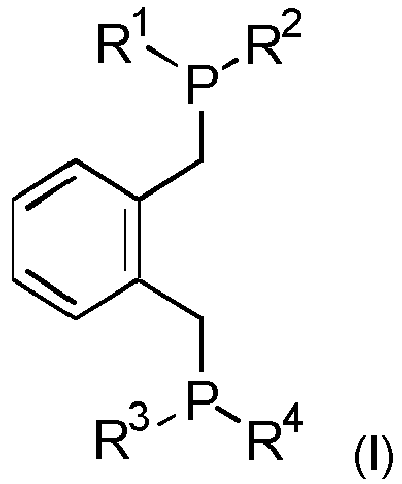
- R1 und R3 jeweils für einen -(C3-C20)-Heteroarylrest stehen,
- R2 und R4 jeweils für -(C1-C12)-Alkyl stehen;
- c) Zugabe einer Verbindung, welche Pd umfasst;
- d) Zugabe eines Alkohols;
- e) Zuführen von CO und H2, wobei der Druck, mit welchem H2 zugeführt wird mindestens 0,6 MPa (6 bar) beträgt;
- f) Erwärmen des Reaktionsgemisches aus a) bis e), wobei das Olefin zu einem Ester umgesetzt wird.
- Der Begriff (C1-C12)-Alkyl umfasst geradkettige und verzweigte Alkylgruppen mit 1 bis 12 Kohlenstoffatomen. Vorzugsweise handelt es sich dabei um (C1-C8)-Alkylgruppen, besonders bevorzugt (C1-C6)-Alkyl, am meisten bevorzugt (C1-C4)-Alkyl.
- Der Begriff (C3-C20)-Heteroaryl umfasst mono- oder polycyclische aromatische Kohlenwasserstoffreste mit 3 bis 20 Kohlenstoffatomen, wobei eins oder mehrere der Kohlenstoffatome durch Heteroatome ersetzt sind. Bevorzugte Heteroatome sind N, O und S. Die (C3-C20)-Heteroarylgruppen weisen 3 bis 20, bevorzugt 6 bis 14, besonders bevorzugt 6 bis 10 Ringatome auf. Somit ist beispielsweise Pyridyl im Rahmen dieser Erfindung ein C6-Heteroarylrest, Furyl ist ein C5-Heteroarylrest.
- In einer Variante des Verfahrens wird CO mit einem Druck im Bereich von 1 MPa (10 bar) bis 3 MPa (30 bar) zugeführt.
- In einer Variante des Verfahrens wird CO mit einem Druck im Bereich von 1,5 MPa (15 bar) bis 2,5 MPa (25 bar) zugeführt.
- In einer Variante des Verfahrens wird CO mit einem Druck von 2 MPa (20 bar) zugeführt.
- In einer Variante des Verfahrens wird H2 mit einem Druck im Bereich von 0,6 MPa (6 bar) bis 2,9 MPa (29 bar) zugeführt.
- In einer Variante des Verfahrens wird H2 mit einem Druck im Bereich von 0,9 MPa (9 bar) bis 2,1 MPa (21 bar) zugeführt.
- In einer Variante des Verfahrens wird H2 mit einem Druck im Bereich von 1 MPa (10 bar) bis 2 MPa (20 bar) zugeführt.
- In einer Variante des Verfahrens liegt das Verhältnis der Drücke, mit welchem CO und H2 zugeführt werden, im Bereich von 1:0,3 bis 1:1,4.
- In einer Variante des Verfahrens sind R1, R3 jeweils ausgewählt aus Furyl, Thienyl, Pyrrolyl, Oxazolyl, Isoxazolyl, Thiazolyl, Isothiazolyl, Imidazolyl, Pyrazolyl, Furazanyl, Tetrazolyl, Pyridyl, Pyridazinyl, Pyrimidyl, Pyrazinyl, Benzofuranyl, Indolyl, Isoindolyl, Benzimidazolyl, Chinolyl, Isochinolyl.
- In einer Variante des Verfahrens stehen R2 und R4 für ter Bu.
- In einer Variante des Verfahrens weist der Ligand in Verfahrensschritt b) die Formel (1) auf:

- In einer Variante des Verfahrens ist die Verbindung in Verfahrensschritt c), welche Pd umfasst, ausgewählt aus Palladiumdichlorid, Palladium(II)-acetylacetonat, Palladium(II)-acetat, Dichloro(1,5-cyclooctadiene)palladium(II), Bis(dibenzylideneaceton)palladium, Bis(acetonitrile)dichloropalladium(ll), Palladium(cinnamyl)dichlorid.
- In einer Variante des Verfahrens ist die Verbindung in Verfahrensschritt c), welche Pd umfasst, Pd(acac)2.
- In einer Variante des Verfahrens ist der Alkohol in Verfahrensschritt d) ausgewählt aus Methanol, Ethanol, 1-Propanol, 1-Butanol, 1-Pentanol, 1-Hexanol, 2-Propanol, tert-Butanol, 3-Pentanol, Cyclohexanol, Phenol, oder Mischungen davon.
- In einer Variante des Verfahrens ist der Alkohol in Verfahrensschritt d) Methanol.
- In einer Variante des Verfahrens umfasst das Verfahren den zusätzlichen Verfahrensschritt d`) umfasst:
d') Zugabe einer Säure, welche ausgewählt ist aus: Aluminiumtriflat, Schwefelsäure, Methylsulfonsäure (MSA), para-Toluolsulfonsäure (p-TSA). - In einer Variante des Verfahrens wird in Verfahrensschritt d') Aluminiumtriflat zugegeben.
- In einer Variante des Verfahrens liegt das Verhältnis Säure : Ligand im Bereich von 1 mol : 1 mol bis 15 mol : 1 mol.
- In einer Variante des Verfahrens liegt das Verhältnis Aluminiumtriflat : Ligand im Bereich von 1 mol: 1 mol bis 15 mol: 1 mol.
- Die Reaktionsmischung wird in Verfahrensschritt f) des erfindungsgemäßen Verfahrens vorzugsweise auf eine Temperatur im Bereich von 30 °C bis 150 °C, bevorzugt von 40 °C bis 140 °C, besonders bevorzugt von 50 °C bis 120 °C erwärmt, um das Olefin zu einem Ester umzusetzen.
- Im Folgenden soll die Erfindung anhand eines Ausführungsbeispiels näher erläutert werden.
-

- Pd (acac)2: 0.04 mol%
- (1): 0,12 mol%
- Al(OTf)3: 0,6 mol%
- Der Versuch wurde einmal mit Synthesegas und als Vergleichsversuch mit reinem CO durchgeführt. Das Synthesegas war hierbei ein Gemisch aus CO und H2. CO wurde in beiden Versuchen mit einem Druck von 20 bar zugeführt. Bei dem Versuch mit Synthesegas wurde das H2 ebenfalls mit 20 bar zugeführt, womit sich ein Gesamtdruck von 40 bar eingestellt hat.
-
- CO: 47 %
- CO + H2: 67 %
-

- Pd (acac)2: 0.04 mol%
- (1): 0,12 mol%
- Al(OTf)3: 0,6 mol%
- Die Versuchsreihe wurde mit einem konstanten CO-Druck von 20 bar durchgeführt. Der H2-Druck wurde entsprechend der nachfolgenden Tabelle variiert.
p(H2) [bar] Ausbeute [%] 0 47 5 44 10 63 20 67 30 41 40 41 - Wie die durchgeführten Versuche zweigen, konnte die Ausbeute durch den Einsatz von Synthesegas gesteigert werden.
Claims (15)
- Verfahren umfassend die Verfahrensschritte:a) Vorlegen eines Olefins;b) Zugabe eines Liganden gemäß Formel (I):
 R1 und R3 jeweils für einen -(C3-C20)-Heteroarylrest stehen,R2 und R4 jeweils für -(C1-C12)-Alkyl stehen;c) Zugabe einer Verbindung, welche Pd umfasst;d) Zugabe eines Alkohols;e) Zuführen von CO und H2, wobei der Druck, mit welchem H2 zugeführt wird mindestens 0,6 MPa (6 bar) beträgt;f) Erwärmen des Reaktionsgemisches aus a) bis e), wobei das Olefin zu einem Ester umgesetzt wird.
 - Verfahren nach Anspruch 1,
wobei CO mit einem Druck im Bereich von 1 MPa (10 bar) bis 3 MPa (30 bar) zugeführt wird. - Verfahren nach einem der Ansprüche 1 oder 2,
wobei CO mit einem Druck im Bereich von 1,5 MPa (15 bar) bis 2,5 MPa (25 bar) zugeführt wird. - Verfahren nach einem der Ansprüche 1 bis 3,
wobei H2 mit einem Druck im Bereich von 0,6 MPa (6 bar) bis 2,9 MPa (29 bar) zugeführt wird. - Verfahren nach einem der Ansprüche 1 bis 4,
wobei H2 mit einem Druck im Bereich von 0,9 MPa (9 bar) bis 2,1 MPa (21 bar) zugeführt wird. - Verfahren nach einem der Ansprüche 1 bis 5,
wobei das Verhältnis der Drücke, mit welchem CO und H2 zugeführt werden, im Bereich von 1:0,3 bis 1:1,4 liegt. - Verfahren nach einem der Ansprüche 1 bis 6,
wobei R1, R3 jeweils ausgewählt sind aus Furyl, Thienyl, Pyrrolyl, Oxazolyl, Isoxazolyl, Thiazolyl, Isothiazolyl, Imidazolyl, Pyrazolyl, Furazanyl, Tetrazolyl, Pyridyl, Pyridazinyl, Pyrimidyl, Pyrazinyl, Benzofuranyl, Indolyl, Isoindolyl, Benzimidazolyl, Chinolyl, Isochinolyl. - Verfahren nach einem der Ansprüche 1 bis 7,
wobei R2 und R4 für ter Bu stehen. - Verfahren nach einem der Ansprüche 1 bis 8,
wobei der Ligand in Verfahrensschritt b) die Formel (1) aufweist:
- Verfahren nach einem der Ansprüche 1 bis 9,
wobei die Verbindung in Verfahrensschritt c), welche Pd umfasst, ausgewählt ist aus Palladiumdichlorid, Palladium(II)-acetylacetonat, Palladium(II)-acetat, Dichloro(1,5-cyclooctadiene)palladium(ll), Bis(dibenzylideneaceton)palladium, Bis(acetonitrile)dichloropalladium(ll), Palladium(cinnamyl)dichlorid - Verfahren nach einem der Ansprüche 1 bis 10,
wobei die Verbindung in Verfahrensschritt c), welche Pd umfasst, Pd(acac)2 ist. - Verfahren nach einem der Ansprüche 1 bis 11,
wobei der Alkohol in Verfahrensschritt d) ausgewählt ist aus Methanol, Ethanol, 1-Propanol, 1-Butanol, 1-Pentanol, 1-Hexanol, 2-Propanol, tert-Butanol, 3-Pentanol, Cyclohexanol, Phenol, oder Mischungen davon. - Verfahren nach einem der Ansprüche 1 bis 12,
wobei der Alkohol in Verfahrensschritt d) Methanol ist. - Verfahren nach einem der Ansprüche 1 bis 13,
wobei das Verfahren den zusätzlichen Verfahrensschritt d`) umfasst:
d`) Zugabe einer Säure, welche ausgewählt ist aus: Aluminiumtriflat, Schwefelsäure, Methylsulfonsäure (MSA), para-Toluolsulfonsäure (p-TSA). - Verfahren nach Anspruch 14,
wobei das Verhältnis Säure : Ligand im Bereich von 1 mol : 1 mol bis 15 mol : 1 mol liegt.
Priority Applications (6)
| Application Number | Priority Date | Filing Date | Title |
|---|---|---|---|
| EP23170052.7A EP4455120A1 (de) | 2023-04-26 | 2023-04-26 | Verfahren zur alkoxycarbonylierung von olefinen unter einsatz von synthesegas |
| JP2024064684A JP7730395B2 (ja) | 2023-04-26 | 2024-04-12 | 合成ガスを用いたオレフィンのアルコキシカルボニル化方法 |
| US18/638,013 US20240360066A1 (en) | 2023-04-26 | 2024-04-17 | Process for alkoxycarbonylation of olefins using synthesis gas |
| TW113115021A TWI914781B (zh) | 2023-04-26 | 2024-04-23 | 使用合成氣之烯烴的烷氧基羰基化方法 |
| KR1020240053824A KR20240158160A (ko) | 2023-04-26 | 2024-04-23 | 합성 가스를 사용한 올레핀의 알콕시카르보닐화 방법 |
| CN202410497816.3A CN118851907A (zh) | 2023-04-26 | 2024-04-24 | 使用合成气使烯烃进行烷氧羰基化的方法 |
Applications Claiming Priority (1)
| Application Number | Priority Date | Filing Date | Title |
|---|---|---|---|
| EP23170052.7A EP4455120A1 (de) | 2023-04-26 | 2023-04-26 | Verfahren zur alkoxycarbonylierung von olefinen unter einsatz von synthesegas |
Publications (1)
| Publication Number | Publication Date |
|---|---|
| EP4455120A1 true EP4455120A1 (de) | 2024-10-30 |
Family
ID=86227024
Family Applications (1)
| Application Number | Title | Priority Date | Filing Date |
|---|---|---|---|
| EP23170052.7A Pending EP4455120A1 (de) | 2023-04-26 | 2023-04-26 | Verfahren zur alkoxycarbonylierung von olefinen unter einsatz von synthesegas |
Country Status (6)
| Country | Link |
|---|---|
| US (1) | US20240360066A1 (de) |
| EP (1) | EP4455120A1 (de) |
| JP (1) | JP7730395B2 (de) |
| KR (1) | KR20240158160A (de) |
| CN (1) | CN118851907A (de) |
| TW (1) | TWI914781B (de) |
Families Citing this family (1)
| Publication number | Priority date | Publication date | Assignee | Title |
|---|---|---|---|---|
| WO2025237424A1 (zh) * | 2024-05-17 | 2025-11-20 | 中国科学院上海有机化学研究所 | 一种长碳烯烃氢酯化合成长碳脂肪酸酯的方法 |
Citations (2)
| Publication number | Priority date | Publication date | Assignee | Title |
|---|---|---|---|---|
| EP3121184A2 (de) * | 2015-07-23 | 2017-01-25 | Evonik Degussa GmbH | Benzolbasierte diphosphinliganden für die alkoxycarbonylierung |
| EP4001256A1 (de) | 2020-11-24 | 2022-05-25 | Evonik Operations GmbH | Verfahren zur alkoxycarbonylierung von ethylenisch ungesättigter verbindungen unter einsatz von benzolbasierte diphosphinliganden und aluminiumtriflat |
Family Cites Families (5)
| Publication number | Priority date | Publication date | Assignee | Title |
|---|---|---|---|---|
| JPS4948924B1 (de) * | 1970-05-19 | 1974-12-24 | Mitsubishi Chem Ind | |
| JPS5146170B2 (de) | 1972-09-14 | 1976-12-07 | ||
| JPS603373B2 (ja) * | 1982-03-29 | 1985-01-28 | 工業技術院長 | 光学活性エステルの製法 |
| EP4001253A1 (de) | 2020-11-12 | 2022-05-25 | Evonik Operations GmbH | Doppelte alkoxycarbonylierung von dienen als eintopfsynthese |
| EP4001252A1 (de) | 2020-11-12 | 2022-05-25 | Evonik Operations GmbH | Doppelte alkoxycarbonylierung von dienen |
-
2023
- 2023-04-26 EP EP23170052.7A patent/EP4455120A1/de active Pending
-
2024
- 2024-04-12 JP JP2024064684A patent/JP7730395B2/ja active Active
- 2024-04-17 US US18/638,013 patent/US20240360066A1/en active Pending
- 2024-04-23 TW TW113115021A patent/TWI914781B/zh active
- 2024-04-23 KR KR1020240053824A patent/KR20240158160A/ko active Pending
- 2024-04-24 CN CN202410497816.3A patent/CN118851907A/zh active Pending
Patent Citations (2)
| Publication number | Priority date | Publication date | Assignee | Title |
|---|---|---|---|---|
| EP3121184A2 (de) * | 2015-07-23 | 2017-01-25 | Evonik Degussa GmbH | Benzolbasierte diphosphinliganden für die alkoxycarbonylierung |
| EP4001256A1 (de) | 2020-11-24 | 2022-05-25 | Evonik Operations GmbH | Verfahren zur alkoxycarbonylierung von ethylenisch ungesättigter verbindungen unter einsatz von benzolbasierte diphosphinliganden und aluminiumtriflat |
Also Published As
| Publication number | Publication date |
|---|---|
| CN118851907A (zh) | 2024-10-29 |
| JP7730395B2 (ja) | 2025-08-27 |
| JP2024159562A (ja) | 2024-11-08 |
| TWI914781B (zh) | 2026-02-11 |
| KR20240158160A (ko) | 2024-11-04 |
| US20240360066A1 (en) | 2024-10-31 |
| TW202502715A (zh) | 2025-01-16 |
Similar Documents
| Publication | Publication Date | Title |
|---|---|---|
| EP3889161B1 (de) | Platin-komplexe mit benzylbasierten diphosphinliganden für die katalyse der alkoxycarbonylierung ethylenisch ungesättigter verbindungen | |
| EP4103571B1 (de) | Niederdruckhydroformylierung von diisobuten | |
| EP4001256A1 (de) | Verfahren zur alkoxycarbonylierung von ethylenisch ungesättigter verbindungen unter einsatz von benzolbasierte diphosphinliganden und aluminiumtriflat | |
| EP4011895A1 (de) | Platin-komplexe mit 1,2-substituierten benzylbasierten diphosphinliganden für die katalyse der alkoxycarbonylierung ethylenisch ungesättigter verbindungen | |
| DE2462444B2 (de) | Verfahren zur Herstellung von Monocarbonsäureester« | |
| EP3889163A1 (de) | Platin-komplexe mit ferrocen-liganden für die katalyse der alkoxycarbonylierung ethylenisch ungesättigter verbindungen | |
| DE3633033A1 (de) | Verfahren und katalysatorsystem zur trimerisierung von acetylen und acetylenverbindungen | |
| EP4001253A1 (de) | Doppelte alkoxycarbonylierung von dienen als eintopfsynthese | |
| DE2124718C3 (de) | Verfahren zur Herstellung einer Carbonsäure oder eines Carbonsäureesters | |
| DE102011089008B4 (de) | Verfahren zur Herstellung von Estern aus Formiaten und olefinisch ungesättigten Verbindungen | |
| EP4011894B1 (de) | Platin-komplexe mit binaphthyl-diphosphin-liganden für die katalyse der hydroxycarbonylierung ethylenisch ungesättigter verbindungen | |
| EP3030544A1 (de) | Verfahren zur synthese von gesättigten carbonsäureestern | |
| EP0170964B1 (de) | Verfahren zur Herstellung von Essigsäureanhydrid und ggf. Essigsäure | |
| DE69102182T2 (de) | Katalysator und Verfahren zur Synthese von gesättigten Carbonsäureestern. | |
| EP4001252A1 (de) | Doppelte alkoxycarbonylierung von dienen | |
| DE2128965A1 (de) | Verfahren zur Herstellung von Olefinoxyden | |
| DE68907863T2 (de) | Verfahren zur herstellung von alkoholen und aldehyden aus alkenen und synthesegasen. | |
| EP4612158A1 (de) | Methoxypyridylliganden und deren einsatz in der alkoxycarbonylierung | |
| EP3272731A1 (de) | Verfahren zur herstellung von di- oder tricarbonsäureestern durch alkoxycarbonylierung von dienen mit konjugierten doppelbindungen | |
| EP4612159A1 (de) | Picolylliganden und deren einsatz in der alkoxycarbonylierung | |
| EP4567021B1 (de) | Verfahren zur alkoxycarbonylierung von ethylenisch ungesättigten verbindungen unter einsatz von co2 und einer zinkverbindung | |
| DE3034019C2 (de) | Verfahren zur gleichzeitigen Herstellung von Estern von Alkanolen und vicinalen Glykolen | |
| DE3509912A1 (de) | Verfahren zur herstellung von acetylverbindungen | |
| DE102017206200A1 (de) | Verfahren zur Hydroformylierung von Pentensäureestern | |
| EP0190424A2 (de) | Verfahren zur Herstellung reiner Dialkylsuccinate |
Legal Events
| Date | Code | Title | Description |
|---|---|---|---|
| PUAI | Public reference made under article 153(3) epc to a published international application that has entered the european phase |
Free format text: ORIGINAL CODE: 0009012 |
|
| STAA | Information on the status of an ep patent application or granted ep patent |
Free format text: STATUS: THE APPLICATION HAS BEEN PUBLISHED |
|
| AK | Designated contracting states |
Kind code of ref document: A1 Designated state(s): AL AT BE BG CH CY CZ DE DK EE ES FI FR GB GR HR HU IE IS IT LI LT LU LV MC ME MK MT NL NO PL PT RO RS SE SI SK SM TR |
|
| STAA | Information on the status of an ep patent application or granted ep patent |
Free format text: STATUS: REQUEST FOR EXAMINATION WAS MADE |
|
| 17P | Request for examination filed |
Effective date: 20241120 |
|
| RBV | Designated contracting states (corrected) |
Designated state(s): AL AT BE BG CH CY CZ DE DK EE ES FI FR GB GR HR HU IE IS IT LI LT LU LV MC ME MK MT NL NO PL PT RO RS SE SI SK SM TR |