EP4455084A1 - Graphitierungsofen mit querschnittserweiterung - Google Patents
Graphitierungsofen mit querschnittserweiterung Download PDFInfo
- Publication number
- EP4455084A1 EP4455084A1 EP23170107.9A EP23170107A EP4455084A1 EP 4455084 A1 EP4455084 A1 EP 4455084A1 EP 23170107 A EP23170107 A EP 23170107A EP 4455084 A1 EP4455084 A1 EP 4455084A1
- Authority
- EP
- European Patent Office
- Prior art keywords
- graphitization furnace
- channel
- cross
- section
- sectional area
- Prior art date
- Legal status (The legal status is an assumption and is not a legal conclusion. Google has not performed a legal analysis and makes no representation as to the accuracy of the status listed.)
- Withdrawn
Links
Images

Classifications
-
- F—MECHANICAL ENGINEERING; LIGHTING; HEATING; WEAPONS; BLASTING
- F27—FURNACES; KILNS; OVENS; RETORTS
- F27B—FURNACES, KILNS, OVENS OR RETORTS IN GENERAL; OPEN SINTERING OR LIKE APPARATUS
- F27B9/00—Furnaces through which the charge is moved mechanically, e.g. of tunnel type; Similar furnaces in which the charge moves by gravity
- F27B9/28—Furnaces through which the charge is moved mechanically, e.g. of tunnel type; Similar furnaces in which the charge moves by gravity for treating continuous lengths of work
-
- C—CHEMISTRY; METALLURGY
- C01—INORGANIC CHEMISTRY
- C01B—NON-METALLIC ELEMENTS; COMPOUNDS THEREOF; METALLOIDS OR COMPOUNDS THEREOF NOT COVERED BY SUBCLASS C01C
- C01B32/00—Carbon; Compounds thereof
- C01B32/05—Preparation or purification of carbon not covered by groups C01B32/15, C01B32/20, C01B32/25, C01B32/30
-
- C—CHEMISTRY; METALLURGY
- C01—INORGANIC CHEMISTRY
- C01B—NON-METALLIC ELEMENTS; COMPOUNDS THEREOF; METALLOIDS OR COMPOUNDS THEREOF NOT COVERED BY SUBCLASS C01C
- C01B32/00—Carbon; Compounds thereof
- C01B32/20—Graphite
- C01B32/205—Preparation
-
- F—MECHANICAL ENGINEERING; LIGHTING; HEATING; WEAPONS; BLASTING
- F27—FURNACES; KILNS; OVENS; RETORTS
- F27B—FURNACES, KILNS, OVENS OR RETORTS IN GENERAL; OPEN SINTERING OR LIKE APPARATUS
- F27B15/00—Fluidised-bed furnaces; Other furnaces using or treating finely-divided materials in dispersion
- F27B15/006—Equipment for treating dispersed material falling under gravity with ascending gases
-
- F—MECHANICAL ENGINEERING; LIGHTING; HEATING; WEAPONS; BLASTING
- F27—FURNACES; KILNS; OVENS; RETORTS
- F27B—FURNACES, KILNS, OVENS OR RETORTS IN GENERAL; OPEN SINTERING OR LIKE APPARATUS
- F27B9/00—Furnaces through which the charge is moved mechanically, e.g. of tunnel type; Similar furnaces in which the charge moves by gravity
- F27B9/30—Details, accessories or equipment specially adapted for furnaces of these types
- F27B9/32—Casings
Definitions
- the present invention relates to the field of graphitization furnaces. More specifically, the present invention relates to graphitization furnaces comprising a widening cross-section.
- the most common commercially used anode material in lithium-ion batteries is graphite.
- the graphite can be lithiated to the state of LiC 6 , which correlates to a theoretical maximal capacity of 372 mAh/g.
- Artificial graphite may be produced by heating carbonaceous starting materials, such as coke and/or pitch, to temperatures of about 3000 °C under exclusion of oxygen.
- the heating may be performed in batch or continuous furnaces.
- carbonaceous material is typically conveyed along a heated channel, transitioning to graphite while being conveyed.
- the process of continuous graphitization may be advantageous because it may produce graphite more efficiently than a batch process and may allow for industrial scale production.
- some carbonaceous materials in particular carbonaceous material in the form of powder, may have a tendency to cake in continuous furnaces.
- the caking may lead to an inhomogeneous temperature distribution, which in turn may result in a reduced product quality and consistency. It also may result in reduced process efficiency and higher production costs due to interruptions in the continuous process while resolving caking-induced channel blockage, as well as the need to re-process some products that have not been fully graphitized due to the caking.
- the present disclosure relates to a graphitization furnace comprising a raw material inlet and a product outlet.
- the graphitization furnace comprises a channel connecting the raw material inlet and the product outlet, wherein the channel comprises an upstream and a downstream section.
- the upstream section has a first cross-sectional area closer to the raw material inlet and second cross-sectional area closer to the product outlet and the downstream section has a third cross-sectional area closer to the raw material inlet and fourth cross-sectional area closer to the product outlet.
- the second cross-sectional area section is larger than the first cross-sectional area and the fourth cross-sectional area is larger than the second and third cross-sectional area.
- the upstream section and the downstream section may be spaced apart or adjoining.
- an edge-like or arched transition feature may be disposed between the upstream section and the downstream section.
- the graphitization furnace may be a vertical graphitization furnace.
- the graphitization furnace may be a vertical graphitization furnace and the downstream section may be provided in the lower third, the lower fourth, the lower fifth or the lower sixth of the channel, more specifically the lower fifth or lower sixth of the channel, and in particular in the lower fifth of the channel, wherein lower means closer to the gravitational center of the earth.
- the upstream section may be provided in the lower half, the lower third, the lower fourth or the lower fifth of the channel, more specifically the lower fifth or lower sixth of the channel, and in particular in the lower fifth of the channel, wherein lower means closer to the gravitational center of the earth.
- the graphitization furnace may be a vertical graphitization furnace and the downstream section may be provided in the lower third, the lower fourth, the lower fifth or the lower sixth of the channel, more specifically the lower fifth or lower sixth of the channel, and in particular in the lower fifth of the channel; and the upstream section may be provided in the lower half, the lower third, the lower fourth or the lower fifth of the channel, more specifically the lower fifth or lower sixth of the channel, and in particular in the lower fifth of the channel, wherein lower means closer to the gravitational center of the earth.
- channel may comprise a heating zone, a high temperature reaction zone and a cooling zone.
- downstream section may be disposed in the high temperature reaction zone and/or the cooling zone, in particular in the cooling zone.
- the upstream section may have a first length L1 and the downstream section may have a second length L2, more specifically the upstream section and the downstream section may be adjoining and the upstream section and downstream section may have a combined length L3, wherein the ratio L2/L3 may be smaller than 0.5, more specifically smaller than 0.3 and in particular smaller than 0.2.
- the ratio of L2/L3 may be between about 0.03 to about 0.5, more specifically 0.05 to about 0.3 and in particular between about 0.1 to about 0.2.
- the channel may have a first inner diameter D1, a second inner diameter D2, a third inner diameter D3 and a fourth inner diameter D4 in the plane of the first, second, third and fourth cross-sectional area respectively, and the inner diameters meet the requirement D 2 ⁇ D 1 L 1 ⁇ D 4 ⁇ D 3 L 2 .
- the first angle ⁇ 1 may be less than 45°, 35°, 30°, 20°, 15°, 10°, 9°, 8°, 7°, 6°, 5°, 4°, 3°, 2° or 1°.
- the first angle ⁇ 1 may be between about 0.1 to about 45°, more specifically between about 0.2°and 20° and in particular between about 0.3° to about 10°.
- the first angle ⁇ 1 may be less than 20°, 15°, 10°, 9°, 8°, 7°, 6°, 5°, 4°, 3°, 2° or 1°, in particular the first angle ⁇ 1 may be between about 0.1 to about 20°, more specifically between about 0.2° and 10° and in particular between about 0.3° to about 5°.
- the first angle ⁇ 1 may be between about 0.1° to about 5°, more specifically between about 0.1° to about 2°, and in particular between about 0.1° to about 1.5°.
- the first angle ⁇ 1 may be between about 0.1° to about 5°, more specifically between about 0.2° to about 2° and in particular between about 0.3° to about 1.5°.
- the second angle ⁇ 2 may be less than 45°, 35°, 30°, 20°, 15°, 10°, 9°, 8°, 7°, 6°, 5°, 4°, 3°, 2° or 1°.
- the second angle ⁇ 2 may be between about 0.1 to about 45°, more specifically between about 0.2°and 20° and in particular between about 0.3 to about 10°.
- the second angle ⁇ 2 may be less than 20°, 15°, 10°, 9°, 8°, 7°, 6°, 5°, 4°, 3°, 2° or 1°, in particular the second angle ⁇ 2 may be between about 0.1 to about 20°, more specifically between about 0.2°and 10° and in particular between about 0.3 to about 5°.
- the second angle ⁇ 2 may be between about 0.1° to about 5°, more specifically between about 0.1° to about 2° and in particular between about 0.1° to about 1.5°.
- the second angle ⁇ 2 may be between about 0.1° to about 5°, more specifically between about 0.2° to about 2° and in particular between about 0.3° to about 1.5°.
- the first angle ⁇ 1 may be less than 45°, 35°, 30°, 20°, 15°, 10°, 9°, 8°, 7°, 6°, 5°, 4°, 3°, 2° or 1°; and the second angle ⁇ 2 may be less than 45°, 35°, 30°, 20°, 15°, 10°, 9°, 8°, 7°, 6°, 5°, 4°, 3°, 2° or 1°.
- the first angle ⁇ 1 may be between about 0.1° to about 45° more specifically between about 0.2°and 20° and in particular between about 0.3° to about 10°; and the second angle ⁇ 2 may be between about 0.1° to about 45°, more specifically between about 0.2° and in particular between about 0.3° to about 10°.
- the first angle ⁇ 1 may be less 20°, 15°, 10°, 9°, 8°, 7°, 6°, 5°, 4°, 3°, 2° or 1°, in particular the first angle ⁇ 1 may be between about 0.1° to about 20°, more specifically between about 0.2°and 10° and in particular between about 0.3° to about 5°; and the second angle ⁇ 2 may be less than 20°, 15°, 10°, 9°, 8°, 7°, 6°, 5°, 4°, 3°, 2° or 1°, in particular the second angle ⁇ 2 may be between about 0.1° to about 20°, more specifically between about 0.2°and 10° and in particular between about 0.3° to about 5°.
- the first angle ⁇ 1 may be between about 0.1° to about 5°, more specifically between about 0.1° to about 2° and in particular between about 0.1° to about 1.5°; and the second angle ⁇ 2 may be between about 0.1° to about 5°, more specifically between about 0.1° to about 2° and in particular between about 0.1° to about 1.5°.
- the first angle ⁇ 1 may be between about 0.1° to about 5°, more specifically between about 0.2° to about 2° and in particular between about 0.3° to about 1.5°; and the second angle ⁇ 2 may be between about 0.1° to about 5°, more specifically between about 0.2° to about 2° and in particular between about 0.3° to about 1.5°.
- the first angle ⁇ 1 may be between about 0.1° to about 5°, more specifically between about 0.2° to about 2° and in particular between about 0.3° to about 1.5°; and the second angle ⁇ 2 may be between about 0.1° to about 5°, more specifically between about 0.2° to about 2° and in particular between about 0.3° to about 1.5°.
- the second cross-sectional area is the third cross-sectional area.
- the graphitization furnace may be a continuous graphitization furnace or a semi-batch graphitization furnace, and in particular a continuous graphitization furnace.
- the graphitization furnace may be configured such that material flow in the graphitization furnace is gravity assisted.
- the upstream section and/or downstream section may comprise or consist of graphite.
- a cross-section, (perpendicular to a central-channel-axis) of the upstream section or downstream section may be circular, elliptical or polygonal, more specifically octagonal, hexagonal, rectangular, square, or elliptical, and in particular rectangular or elliptical.
- the corners of the polygon are rounded.
- the graphitization furnace may comprise a stirrer, wherein the stirrer extends at least partially into the channel, more specifically into the downstream section.
- the present disclosure relates to a method of using a graphitization furnace according to any preceding claim for preparing graphite from carbonaceous material.
- artificial graphite may be produced by heating carbonaceous starting materials, such as coke and/or pitch, to temperatures of about 3000 °C under exclusion of oxygen.
- the starting material typically comprises non-crystalline carbon, which is transformed to graphite, due to the heat.
- An important property of graphite is its degree of crystallinity. A higher crystallinity may result for example in a higher maximal specific capacity when used in a battery.
- graphite is well known and attributed its common meaning in the art. More specifically, the term “graphite” may refer to a material comprising crystalline carbon in a hexagonal structure. Alternatively or additionally, the term “graphite” may refer to a material comprising at least about 60 %, more specifically at least about 80 % and in particular at least about 83 % crystalline carbon in a hexagonal structure. Alternatively or additionally, the term “graphite” may refer to a material with a graphitization degree of at least about 46 %, more specifically 69 %, even more specifically at least about 80 % and in particular at least about 83 %.
- the crystallinity of a graphite may be described via its graphitization degree which may be measured by X-ray diffraction (XRD).
- XRD X-ray diffraction
- the crystalline carbon in the graphite forms a plurality of honeycomb lattices.
- the distance between the plurality of honeycomb lattices is described by the parameter "interplane distance d 002 .
- XRD may be used to measure the interplane distance d 001 between the plurality of lattices.
- An interplane distance d 002 of 0.3440 nm corresponds to the interplane distance of turbostratic graphite and an interplane distance of 0.3354 nm corresponds to the interplane distance in a perfect graphite crystal.
- a higher graphitization degree may correspond to a higher maximum discharge capacity.
- Heat treatment of the carbonaceous material may be performed in a continuous furnace, i.e. a furnace which is configured for a continuous or semi-continuous production of graphite.
- carbonaceous raw material may be conveyed along a channel 100 between a raw material inlet and a product outlet, while being heated.
- the carbonaceous raw material may be in any form, for instance in powder form or granulated, more specifically in powder form.
- the carbonaceous material may cake in sections of the channel 100.
- the caking may occur in sections closer to the product outlet.
- the channel 100 may be arranged vertically between a material inlet at the top and an outlet at the bottom.
- the carbonaceous material may form a material column, wherein the carbonaceous material at the bottom of the material column, e.g. close to the product outlet, is compressed by the carbonaceous material disposed above it. The compression may significantly increase the material's propensity for caking.
- This caking may also result in a reduced flowability of the carbonaceous material which may result in an impaired material flow.
- the reduced flowability may result in an impeded discharge of the carbonaceous material from the product outlet.
- the caking and/or reduced flowability may lead to inhomogeneities in the conveyed carbonaceous material.
- the caking and/or reduced flowability may lead to an inhomogeneous temperature distribution in the carbonaceous material disposed in the graphitization furnace.
- These inhomogeneities may, in turn, result in a reduced product quality, e.g. a reduced degree of graphitization or inhomogeneous degree of graphitization.
- the caking may also lead to the product discharged from the graphitization furnace to comprise agglomerates, which may reduce the product quality or require post-processing to break-up the agglomerates.
- the present disclosure relates to a graphitization furnace comprising a raw material inlet and a product outlet.
- the graphitization furnace comprises a channel 100 connecting the raw material inlet and the product outlet, wherein the channel 100 comprises an upstream section 110 and a downstream section 120.
- the upstream section 110 has a first cross-sectional area closer to the raw material inlet and second cross-sectional area closer to the product outlet and the downstream section 120 has a third cross-sectional area closer to the raw material inlet and fourth cross-sectional area closer to the product outlet.
- the second cross-sectional area section is larger than the first cross-sectional area and the fourth cross-sectional area is larger than the second and third cross-sectional area.
- upstream and downstream as used herein have their typical meaning in the art, wherein upstream refers to a section closer to the raw material inlet and downstream referring to a section closer to the product outlet.
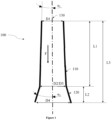
- Figure 1 shows an example of a channel 100 comprising a central-channel-axis 130.
- the central-channel-axis 130 may correspond to the material flow direction F.
- the upstream section 110 may have a first length L1 parallel to the central-channel-axis 130.
- the first length L1 may be the length between the first cross-sectional area and the second cross-sectional area parallel to the central-channel-axis 130.
- the downstream section 120 may have a second length L2 parallel to the central-channel-axis 130.
- the length L2 may be measured between the third cross-sectional area and the fourth cross-sectional area.
- the upstream section 110 and the downstream section 120 may have an aggregate third length L3 parallel to the central-channel-axis 130.
- the length L3 may be the length between the first cross-sectional area and the fourth cross-sectional area parallel to the central-channel-axis 130.
- the method of measuring L1, L2 and L3 is not particularly limited.
- the first length may be determined by measuring the length of the central-channel-axis 130 between the first cross-sectional area and the second cross-sectional area.
- the first length L1 may be determined by measuring the distance between the geometric center of the first cross-sectional area and the second cross-sectional area.
- the second length L2 may be determined by measuring the distance between the geometric center of the third cross-sectional area and the fourth cross-sectional area and the third length L3 by measuring the distance between the geometric center of the first cross-sectional area and the fourth cross-sectional area.
- L1 and L2 may be determined on basis of a cross-section of the channel.
- the distance from the intersections of the central-channel-axis 130 with the third and fourth cross-sectional area represents L2 and the distance of the intersections of the central-channel-axis 130 with the first and second cross-sectional area represents L1.
- the third length L3 may be the distance from the intersections of the central-channel-axis 130 with the first and fourth cross-sectional area.
- the central-channel-axis 130 is not necessarily straight.
- the central-channel-axis 130 may also be curved.
- L1 and L2 may be measured by determining the geometric centers of a plurality of cross-sectional areas along the channel 100 and summing up the individual distances between the geometric centers being disposed within the upstream and downstream section, respectively.
- the channel 100 may have a first inner diameter D1 in the plane of the first-cross-sectional area. Accordingly, and as depicted in Figure 1 , the channel 100 may have a second D2, third D3 and fourth D4 inner diameter in the plane of the second, third and fourth cross-sectional area respectively.
- the cross-section (perpendicular to the central-channel-axis 130) of the upstream section 110 or downstream section 120 may be elliptical or polygonal, more specifically octagonal, hexagonal, rectangular, square, or elliptical, and in particular rectangular or elliptical.
- the diameters D1 to D4 are the respective inner diameters in the corresponding plane of the first to fourth cross-sectional area.
- the skilled person knows how to determine a diameter, but in case of doubt, the diameter should refer to the maximum diameter in a plane.
- the diagonal length in the cross-sectional area's plane may be regarded as the respective diameter of the square.
- the corners of the polygon are rounded.
- the channel 100 may comprise two wall sections which are aligned parallel to the central-channel-axis 130 and two wall sections disposed at an angle relative to the central-channel-axis 130.
- wall section refers to a part of channel's 100 wall, more specifically to a part of the wall with a length of at least 5 cm, more specifically at least 10 cm.
- wall section may refer to a part of wall with a length of at least 5 cm, in particular at least 10 cm, and a width of at least 10 cm. The width and length may also be measured along a curved wall segment, along the curved surface. For example, within a channel 100 with a square cross-section, a wall section may be one side of the downstream section 120.
- the graphitization furnace may be a vertical graphitization furnace, wherein the carbonaceous material forms a material column.
- the carbonaceous material's temperature may be the lowest and the compressive force of the material column may be the highest.
- a conveying means may be disposed close to the product outlet which may introduce further forces to the carbonaceous material, which may further increase the risk of caking.
- the downstream section 120 may be disposed at a greater angle (or greater radially outward inclination) relative to the central-channel-axis 130 compared to the upstream section 110. Accordingly, in some embodiments, D 4 ⁇ D 3 L 2 may be greater than D 2 ⁇ D 1 L 1 .
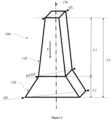
- the first angle ⁇ 1 and the second angle ⁇ 2 are depicted Figure 1 and Figure 2 .
- the first angle ⁇ 1 may be less than 45°, 35°, 30°, 20°, 15°, 10°, 9°, 8°, 7°, 6°, 5°, 4°, 3°, 2° or 1°.
- the first angle ⁇ 1 may be between about 0.1 to about 45°, more specifically between about 0.2°and 20° and in particular between about 0.3 to about 10°.
- the first angle ⁇ 1 may be less than 20°, 15°, 10°, 9°, 8°, 7°, 6°, 5°, 4°, 3°, 2° or 1°, in particular the first angle ⁇ 1 may be between about 0.1 to about 20°, more specifically between about 0.2°and 10° and in particular between about 0.3 to about 5°.
- the first angle ⁇ 1 may be between about 0.1° to about 5°, more specifically between about 0.1° to about 2° and in particular between about 0.1° to about 1.5°.
- the first angle ⁇ 1 may be between about 0.1° to about 5°, more specifically between about 0.2° to about 2° and in particular between about 0.3° to about 1.5°.
- the second angle ⁇ 2 may be less than 45°, 35°, 30°, 20°, 15°, 10°, 9°, 8°, 7°, 6°, 5°, 4°, 3°, 2° or 1°.
- the second angle ⁇ 2 may be between about 0.1 to about 45°, more specifically between about 0.2°and 20° and in particular between about 0.3 to about 10°.
- the second angle ⁇ 2 may be less than 20°, 15°, 10°, 9°, 8°, 7°, 6°, 5°, 4°, 3°, 2° or 1°, in particular the second angle ⁇ 2 may be between about 0.1 to about 20°, more specifically between about 0.2°and 10° and in particular between about 0.3 to about 5°.
- the second angle ⁇ 2 may be between about 0.1° to about 5°, more specifically between about 0.1° to about 2° and in particular between about 0.1° to about 1.5°.
- the second angle ⁇ 2 may be between about 0.1° to about 5°, more specifically between about 0.2° to about 2° and in particular between about 0.3° to about 1.5°.
- the first angle ⁇ 1 may be less than 45°, 35°, 30°, 20°, 15°, 10°, 9°, 8°, 7°, 6°, 5°, 4°, 3°, 2° or 1°; and the second angle ⁇ 2 may be less than 45°, 35°, 30°, 20°, 15°, 10°, 9°, 8°, 7°, 6°, 5°, 4°, 3°, 2° or 1°.
- the first angle ⁇ 1 may be between about 0.1 to about 45°, more specifically between about 0.2°and 20° and in particular between about 0.3 to about 10°; and the second angle ⁇ 2 may be between about 0.1 to about 45°, more specifically between about 0.2°and 20° and in particular between about 0.3 to about 10°.
- the first angle ⁇ 1 may be less than 20°, 15°, 10°, 9°, 8°, 7°, 6°, 5°, 4°, 3°, 2° or 1°, in particular the first angle ⁇ 1 may be between about 0.1 to about 20°, more specifically between about 0.2°and 10° and in particular between about 0.3 to about 5°; and the second angle ⁇ 2 may be less than 20°, 15°, 10°, 9°, 8°, 7°, 6°, 5°, 4°, 3°, 2° or 1°, in particular the second angle ⁇ 2 may be between about 0.1 to about 20°, more specifically between about 0.2°and 10° and in particular between about 0.3 to about 5°.
- the transport of carbonaceous material prone to caking may be improved by providing a channel section with a diameter increasing in the material transport direction and an additional channel section wherein the diameter increases even further.
- the increase in diameter also results in an increased space requirement for the graphitization furnace.
- the first angle ⁇ 1 may be between about 0.1° to about 5°, more specifically between about 0.1° to about 2° and in particular between about 0.1° to about 1.5°; and the second angle ⁇ 2 may be between about 0.1° to about 5°, more specifically between about 0.1° to about 2° and in particular between about 0.1° to about 1.5°.
- the first angle ⁇ 1 may be between about 0.1° to about 5°, more specifically between about 0.2° to about 2° and in particular between about 0.3° to about 1.5°; and the second angle ⁇ 2 may be between about 0.1° to about 5°, more specifically between about 0.2° to about 2° and in particular between about 0.3° to about 1.5°.
- the first angle ⁇ 1 may be between about 0.1° to about 5°, more specifically between about 0.2° to about 2° and in particular between about 0.3° to about 1.5°; and the second angle ⁇ 2 may be between about 0.1° to about 5°, more specifically between about 0.2° to about 2° and in particular between about 0.3° to about 1.5°.
- the channel 100 may comprise a heating zone, a high temperature reaction zone and a cooling zone.
- the heating zone may be characterized by the temperature of the carbonaceous material increasing in flow direction when the graphitization furnace is used.
- the high temperature reaction zone may be characterized by the carbonaceous material having a temperature of at least 80% of the maximum temperature achieved in the graphitization furnace.
- the cooling zone may be characterized by the temperature of the carbonaceous material decreasing in flow direction when the graphitization furnace is used.
- the downstream section 120 may be disposed in the high temperature reaction zone and/or the cooling zone, in particular the cooling zone.
- the carbonaceous material may be in particular prone to caking where the pressure on the carbonaceous material is the highest.
- the cooling zone is typically arranged the lowest in a vertical graphitization oven increasing the diameter of the downstream section 120 may be in particular expedient in the cooling zone to prevent caking.
- the graphitization furnace may be a vertical graphitization furnace.
- the graphitization furnace may be a vertical graphitization furnace and the downstream section may be provided in the lower third, the lower fourth, the lower fifth or the lower sixth of the channel, more specifically the lower fifth or lower sixth of the channel, and in particular in the lower fifth of the channel, wherein lower means closer to the gravitational center of the earth.
- the upstream section may be provided in the lower half, the lower third, the lower fourth or the lower fifth of the channel, more specifically the lower fifth or lower sixth of the channel, and in particular in the lower fifth of the channel, wherein lower means closer to the gravitational center of the earth.
- the graphitization furnace may be a vertical graphitization furnace and the downstream section may be provided in the lower third, the lower fourth, the lower fifth or the lower sixth of the channel, more specifically the lower fifth or lower sixth of the channel, and in particular in the lower fifth of the channel; and the upstream section may be provided in the lower half, the lower third, the lower fourth or the lower fifth of the channel, more specifically the lower fifth or lower sixth of the channel, and in particular in the lower fifth of the channel, wherein lower means closer to the gravitational center of the earth. Therefore, the widening of the channel 100 may be limited to its lower end.
- the ratio of L2/L3 may be smaller than 0.5, more specifically smaller than 0.3 and in particular smaller than 0.2. Additionally or alternatively, the ratio of L2/L3 may be between about 0.03 to about 0.5, more specifically 0.05 to about 0.3 and in particular between about 0.1 to about 0. 2. Hence, the length of the downstream section 120 may be significantly shorter compared to that of the upstream section 110. While the significant widening of the downstream section 120 may improve the flowability, the increased diameter may result in an increased space requirement of the graphitization furnace in general for a downstream section 120 of high length.
- a cross-section (in plane with the central-channel-axis 130) of a wall section of the upstream section 110 and/or a wall section of the downstream section 120 may be straight or curved, in particular straight.
- the upstream section 110 is depicted as comprising two straight wall sections and the downstream section 120 as comprising two curved cross-sections.
- the two curved cross-section shown in Figure 2 are concave, but these may also be convex or show an irregular curvature.
- the upstream section and the downstream section are spaced apart or adjoining, in particular adjoining.
- the second cross-sectional area is the third cross-sectional area. Hence the downstream section 120 and the upstream section 110 may be directly connected.
- an edge-like or arched transition feature may be disposed between the upstream section 110 and the downstream section 120 .
- Such transition features may be an (abrupt or gradual) change in the cross-sectional diameters of the upstream section 110 to the downstream 120 and can be provided for a variety of purposes, such as constructive needs or reducing the chance of material agglomerating at the junction of the upstream section 110 and the downstream section 120.
- the structure of the transition features is not particularly limited and it can be as simple as an edge or a curved widening of the channel.
- the extent of the cross-sectional area may not decline between the first cross-sectional area and the second cross-sectional area and/or between the third cross-sectional area and the fourth cross-sectional area. Accordingly, the upstream section and/or downstream section may not be tubular and not be tapered in the material flow direction F. In some embodiments, the cross-sectional area may continuously increase between the first cross-sectional area and the second cross-sectional area and/or between the third cross-sectional area and the fourth cross-sectional area.
- the graphitization furnace may be a continuous graphitization furnace or a semi-batch graphitization furnace, and in particular continuous graphitization furnace.
- the material flow in the graphitization furnace, in particular the vertical graphitization furnace may be gravity assisted. While the material flow may be gravity assisted, the graphitization furnace, in particular the channel 100, may include conveying means, for example to control the rate of material flow and/or discharge from the product outlet.
- the graphitization furnace is configured to withstand temperatures inside at least in parts of the channel of at least 3000 °C. More specifically, the graphitization furnace may be configured to withstand temperatures inside at least in parts of the channel of up to 3500 °C.
- the upstream section 110 and/or downstream section 120 may comprise or consist of graphite.
- Graphite may endure temperatures greater than 3000 °C and may exhibit good mechanical properties. Further, graphite may exhibit a high thermal conductivity, accordingly a channel 100 comprising or consisting of graphite may exhibit a high thermal conductivity.
- the channel 100 may be heated by an external heating element and conduct the heat to the carbonaceous material disposed within it.
- the heating element may be disposed around or adjacent to the channel's 100 outer perimeter. In particular, the heating element may be disposed around or adjacent to the heating zone and/or high temperature reaction zone.
- graphite may be used as a heating element.
- a current may be applied to a section of the channel 100 comprising or consisting of graphite.
- the current, or electrical energy, may then be converted to thermal energy.
- the channel 100 itself may therefore heat the carbonaceous material disposed therein.
- graphite may be used as an electrode to apply a current to the carbonaceous material.
- at least a portion of the channel 100 comprising or consisting of graphite may be a heating element or electrode.
- the channel 100 may comprise carbon fiber reinforced carbon, CFRC, more specifically the channel 100 may comprise at least about 90 wt.-% CFRC and in particular the carbonaceous substrate may comprise at least about 95 wt.-% CFRC, relative to the total weight of the channel 100.
- CFRC may exhibit improved mechanical properties compared to other carbonaceous materials. Further, CRFC is also resistant to high temperatures.
- CFRC is well known and attributed its common meaning in the art. More specifically, the term “CFRC” may refer to a composite material comprising carbon fibers in a matrix of carbon. In particular, the term “CFRC” may refer to a composite material consisting of carbon fibers in a matrix of carbon. CFRC may also be used as a heating element, or as an electrode to apply current to the carbonaceous material. Accordingly, in some embodiments, at least a portion of the channel 100 comprising or consisting of CFRC may be a heating element or electrode.
- the graphitization furnace may comprise a stirrer, wherein the stirrer extends at least partially into the channel 100, more specifically into the downstream section 120.
- the stirrer may aid in preventing caking of the carbonaceous carbon and/or aid in discharging material from the product outlet.
- the stirrer may comprise a plurality of mixing paddles.
- the stirrer may comprise a first mixing paddle disposed in the downstream section and a second mixing paddle disposed within the upstream section, wherein a first diameter of the first mixing paddle is greater compared to a second diameter of a second mixing paddle.
- the present disclosure relates to a method of using a graphitization furnace according to any preceding embodiment for preparing graphite from a carbonaceous raw material.
- the method may yield graphite having a graphitization degree of at least about 46 %, more specifically 69 %, even more specifically at least about 80 % and in particular at least about 83 %.
- the method may yield graphite, which is suitable for use as anode material, in particular anode material for lithium batteries.
- the method further comprises the step of manufacturing an anode for lithium batteries using the graphite yielded from (continuously) operating the graphitization furnace.
Landscapes
- Engineering & Computer Science (AREA)
- Chemical & Material Sciences (AREA)
- Organic Chemistry (AREA)
- Mechanical Engineering (AREA)
- General Engineering & Computer Science (AREA)
- Inorganic Chemistry (AREA)
- Dispersion Chemistry (AREA)
- Life Sciences & Earth Sciences (AREA)
- General Life Sciences & Earth Sciences (AREA)
- Geology (AREA)
- Carbon And Carbon Compounds (AREA)
- Vertical, Hearth, Or Arc Furnaces (AREA)
Priority Applications (6)
| Application Number | Priority Date | Filing Date | Title |
|---|---|---|---|
| EP23170107.9A EP4455084A1 (de) | 2023-04-26 | 2023-04-26 | Graphitierungsofen mit querschnittserweiterung |
| EP24723065.9A EP4701986A1 (de) | 2023-04-26 | 2024-04-26 | Graphitisierungsofen mit sich verbreiterndem querschnitt |
| PCT/EP2024/061663 WO2024223895A1 (en) | 2023-04-26 | 2024-04-26 | Graphitization furnace comprising widening cross-section |
| CN202480027034.1A CN121057709A (zh) | 2023-04-26 | 2024-04-26 | 包括加宽截面的石墨炉 |
| KR1020257039128A KR20260003063A (ko) | 2023-04-26 | 2024-04-26 | 확장 단면을 포함하는 흑연화로 |
| JP2025562534A JP2026514496A (ja) | 2023-04-26 | 2024-04-26 | 拡幅した断面を含む黒鉛化炉 |
Applications Claiming Priority (1)
| Application Number | Priority Date | Filing Date | Title |
|---|---|---|---|
| EP23170107.9A EP4455084A1 (de) | 2023-04-26 | 2023-04-26 | Graphitierungsofen mit querschnittserweiterung |
Publications (1)
| Publication Number | Publication Date |
|---|---|
| EP4455084A1 true EP4455084A1 (de) | 2024-10-30 |
Family
ID=86226422
Family Applications (2)
| Application Number | Title | Priority Date | Filing Date |
|---|---|---|---|
| EP23170107.9A Withdrawn EP4455084A1 (de) | 2023-04-26 | 2023-04-26 | Graphitierungsofen mit querschnittserweiterung |
| EP24723065.9A Pending EP4701986A1 (de) | 2023-04-26 | 2024-04-26 | Graphitisierungsofen mit sich verbreiterndem querschnitt |
Family Applications After (1)
| Application Number | Title | Priority Date | Filing Date |
|---|---|---|---|
| EP24723065.9A Pending EP4701986A1 (de) | 2023-04-26 | 2024-04-26 | Graphitisierungsofen mit sich verbreiterndem querschnitt |
Country Status (5)
| Country | Link |
|---|---|
| EP (2) | EP4455084A1 (de) |
| JP (1) | JP2026514496A (de) |
| KR (1) | KR20260003063A (de) |
| CN (1) | CN121057709A (de) |
| WO (1) | WO2024223895A1 (de) |
Citations (3)
| Publication number | Priority date | Publication date | Assignee | Title |
|---|---|---|---|---|
| GB725906A (en) * | 1952-09-17 | 1955-03-09 | Duisburger Kupferhuette | Improved roasting furnace |
| US3630508A (en) * | 1969-09-05 | 1971-12-28 | Torrax Systems | Vertical shaft furnace system |
| US20220371898A1 (en) * | 2019-09-30 | 2022-11-24 | Onejoon Gmbh | Process for producing graphite and vertical graphitization furnace |
-
2023
- 2023-04-26 EP EP23170107.9A patent/EP4455084A1/de not_active Withdrawn
-
2024
- 2024-04-26 CN CN202480027034.1A patent/CN121057709A/zh active Pending
- 2024-04-26 JP JP2025562534A patent/JP2026514496A/ja active Pending
- 2024-04-26 WO PCT/EP2024/061663 patent/WO2024223895A1/en not_active Ceased
- 2024-04-26 KR KR1020257039128A patent/KR20260003063A/ko active Pending
- 2024-04-26 EP EP24723065.9A patent/EP4701986A1/de active Pending
Patent Citations (3)
| Publication number | Priority date | Publication date | Assignee | Title |
|---|---|---|---|---|
| GB725906A (en) * | 1952-09-17 | 1955-03-09 | Duisburger Kupferhuette | Improved roasting furnace |
| US3630508A (en) * | 1969-09-05 | 1971-12-28 | Torrax Systems | Vertical shaft furnace system |
| US20220371898A1 (en) * | 2019-09-30 | 2022-11-24 | Onejoon Gmbh | Process for producing graphite and vertical graphitization furnace |
Also Published As
| Publication number | Publication date |
|---|---|
| WO2024223895A1 (en) | 2024-10-31 |
| KR20260003063A (ko) | 2026-01-06 |
| CN121057709A (zh) | 2025-12-02 |
| EP4701986A1 (de) | 2026-03-04 |
| JP2026514496A (ja) | 2026-05-11 |
Similar Documents
| Publication | Publication Date | Title |
|---|---|---|
| JP5964917B2 (ja) | 非水電解質二次電池用負極活物質の製造方法 | |
| CN101370576B (zh) | 连续式粉粒体高温气体处理装置和处理方法 | |
| ES2978980T3 (es) | Aditivos de acción catalítica para coques procedentes de petróleo o procedentes de carbón | |
| CN211425033U (zh) | 一种立式连续锂电池负极材料生产用炉窑 | |
| KR20250058723A (ko) | 리튬 이차전지용 전극 건식코팅재의 제조시스템 및 이를 이용한 전극 건식코팅재의 제조방법 | |
| EP4701986A1 (de) | Graphitisierungsofen mit sich verbreiterndem querschnitt | |
| CN101417797A (zh) | 单桥串接石墨化炉 | |
| CN113948734A (zh) | 燃料电池电堆 | |
| EP4455085A1 (de) | Graphitierungsofen mit einem kanal mit plattenförmigen wandsegmenten | |
| CN114426309A (zh) | 一种制备四氯化锆的沸腾加热方法及沸腾加热炉 | |
| CN207294206U (zh) | 一种用于生产氧氯化锆的氯化炉 | |
| EP4455082A1 (de) | Graphitierungsofen mit rührwerk | |
| CN2766951Y (zh) | 一种管式反应器 | |
| EP4455083A1 (de) | Graphitierungsofen mit einem kanal mit plattenförmigen wandsegmenten | |
| CN108423674B (zh) | 一种低能耗锂电池石墨负极材料提纯工艺 | |
| EP4431853A1 (de) | Kaskaden-graphitisierungofen | |
| CN208279565U (zh) | 一种新型快速热解反应器 | |
| CN110371966A (zh) | 一种炭素原料连续石墨化炉构造及石墨化方法 | |
| CN216687526U (zh) | 一种制备四氯化锆的沸腾加热炉 | |
| JP2026515498A (ja) | 撹拌機を含む黒鉛化炉 | |
| CN117287970B (zh) | 一种超大型黄磷电炉 | |
| CN108439392A (zh) | 一种低能耗锂电池石墨负极材料提纯装置及其制作工艺 | |
| CN107936993A (zh) | 一种高压均热快速热解器 | |
| CN210741098U (zh) | 一种复合式炉盖 | |
| CN105019021A (zh) | 一种多晶硅铸锭热场结构 |
Legal Events
| Date | Code | Title | Description |
|---|---|---|---|
| PUAI | Public reference made under article 153(3) epc to a published international application that has entered the european phase |
Free format text: ORIGINAL CODE: 0009012 |
|
| STAA | Information on the status of an ep patent application or granted ep patent |
Free format text: STATUS: THE APPLICATION HAS BEEN PUBLISHED |
|
| AK | Designated contracting states |
Kind code of ref document: A1 Designated state(s): AL AT BE BG CH CY CZ DE DK EE ES FI FR GB GR HR HU IE IS IT LI LT LU LV MC ME MK MT NL NO PL PT RO RS SE SI SK SM TR |
|
| STAA | Information on the status of an ep patent application or granted ep patent |
Free format text: STATUS: THE APPLICATION IS DEEMED TO BE WITHDRAWN |
|
| 18D | Application deemed to be withdrawn |
Effective date: 20250501 |