EP4454941A1 - Rückprallsperre für stützbein - Google Patents
Rückprallsperre für stützbein Download PDFInfo
- Publication number
- EP4454941A1 EP4454941A1 EP23170704.3A EP23170704A EP4454941A1 EP 4454941 A1 EP4454941 A1 EP 4454941A1 EP 23170704 A EP23170704 A EP 23170704A EP 4454941 A1 EP4454941 A1 EP 4454941A1
- Authority
- EP
- European Patent Office
- Prior art keywords
- seat
- child safety
- safety seat
- pawl
- support leg
- Prior art date
- Legal status (The legal status is an assumption and is not a legal conclusion. Google has not performed a legal analysis and makes no representation as to the accuracy of the status listed.)
- Pending
Links
Images





Classifications
-
- B—PERFORMING OPERATIONS; TRANSPORTING
- B60—VEHICLES IN GENERAL
- B60N—SEATS SPECIALLY ADAPTED FOR VEHICLES; VEHICLE PASSENGER ACCOMMODATION NOT OTHERWISE PROVIDED FOR
- B60N2/00—Seats specially adapted for vehicles; Arrangement or mounting of seats in vehicles
- B60N2/24—Seats specially adapted for vehicles; Arrangement or mounting of seats in vehicles for particular purposes or particular vehicles
- B60N2/42—Seats specially adapted for vehicles; Arrangement or mounting of seats in vehicles for particular purposes or particular vehicles the seat constructed to protect the occupant from the effect of abnormal g-forces, e.g. crash or safety seats
- B60N2/4207—Seats specially adapted for vehicles; Arrangement or mounting of seats in vehicles for particular purposes or particular vehicles the seat constructed to protect the occupant from the effect of abnormal g-forces, e.g. crash or safety seats characterised by the direction of the g-forces
- B60N2/4214—Seats specially adapted for vehicles; Arrangement or mounting of seats in vehicles for particular purposes or particular vehicles the seat constructed to protect the occupant from the effect of abnormal g-forces, e.g. crash or safety seats characterised by the direction of the g-forces longitudinal
- B60N2/4221—Seats specially adapted for vehicles; Arrangement or mounting of seats in vehicles for particular purposes or particular vehicles the seat constructed to protect the occupant from the effect of abnormal g-forces, e.g. crash or safety seats characterised by the direction of the g-forces longitudinal due to impact coming from the front
-
- B—PERFORMING OPERATIONS; TRANSPORTING
- B60—VEHICLES IN GENERAL
- B60N—SEATS SPECIALLY ADAPTED FOR VEHICLES; VEHICLE PASSENGER ACCOMMODATION NOT OTHERWISE PROVIDED FOR
- B60N2/00—Seats specially adapted for vehicles; Arrangement or mounting of seats in vehicles
- B60N2/24—Seats specially adapted for vehicles; Arrangement or mounting of seats in vehicles for particular purposes or particular vehicles
- B60N2/26—Seats specially adapted for vehicles; Arrangement or mounting of seats in vehicles for particular purposes or particular vehicles for children
- B60N2/28—Seats readily mountable on, and dismountable from, existing seats or other parts of the vehicle
- B60N2/2821—Seats readily mountable on, and dismountable from, existing seats or other parts of the vehicle having a seat and a base part
- B60N2/2824—Seats readily mountable on, and dismountable from, existing seats or other parts of the vehicle having a seat and a base part part of the base being supported by the vehicle frame
-
- B—PERFORMING OPERATIONS; TRANSPORTING
- B60—VEHICLES IN GENERAL
- B60N—SEATS SPECIALLY ADAPTED FOR VEHICLES; VEHICLE PASSENGER ACCOMMODATION NOT OTHERWISE PROVIDED FOR
- B60N2/00—Seats specially adapted for vehicles; Arrangement or mounting of seats in vehicles
- B60N2/24—Seats specially adapted for vehicles; Arrangement or mounting of seats in vehicles for particular purposes or particular vehicles
- B60N2/26—Seats specially adapted for vehicles; Arrangement or mounting of seats in vehicles for particular purposes or particular vehicles for children
- B60N2/28—Seats readily mountable on, and dismountable from, existing seats or other parts of the vehicle
- B60N2/2884—Seats readily mountable on, and dismountable from, existing seats or other parts of the vehicle with protection systems against abnormal g-forces
-
- B—PERFORMING OPERATIONS; TRANSPORTING
- B60—VEHICLES IN GENERAL
- B60N—SEATS SPECIALLY ADAPTED FOR VEHICLES; VEHICLE PASSENGER ACCOMMODATION NOT OTHERWISE PROVIDED FOR
- B60N2/00—Seats specially adapted for vehicles; Arrangement or mounting of seats in vehicles
- B60N2/24—Seats specially adapted for vehicles; Arrangement or mounting of seats in vehicles for particular purposes or particular vehicles
- B60N2/26—Seats specially adapted for vehicles; Arrangement or mounting of seats in vehicles for particular purposes or particular vehicles for children
- B60N2/28—Seats readily mountable on, and dismountable from, existing seats or other parts of the vehicle
- B60N2/2887—Fixation to a transversal anchorage bar, e.g. isofix
-
- B—PERFORMING OPERATIONS; TRANSPORTING
- B60—VEHICLES IN GENERAL
- B60N—SEATS SPECIALLY ADAPTED FOR VEHICLES; VEHICLE PASSENGER ACCOMMODATION NOT OTHERWISE PROVIDED FOR
- B60N2/00—Seats specially adapted for vehicles; Arrangement or mounting of seats in vehicles
- B60N2/24—Seats specially adapted for vehicles; Arrangement or mounting of seats in vehicles for particular purposes or particular vehicles
- B60N2/42—Seats specially adapted for vehicles; Arrangement or mounting of seats in vehicles for particular purposes or particular vehicles the seat constructed to protect the occupant from the effect of abnormal g-forces, e.g. crash or safety seats
- B60N2/4207—Seats specially adapted for vehicles; Arrangement or mounting of seats in vehicles for particular purposes or particular vehicles the seat constructed to protect the occupant from the effect of abnormal g-forces, e.g. crash or safety seats characterised by the direction of the g-forces
- B60N2/4214—Seats specially adapted for vehicles; Arrangement or mounting of seats in vehicles for particular purposes or particular vehicles the seat constructed to protect the occupant from the effect of abnormal g-forces, e.g. crash or safety seats characterised by the direction of the g-forces longitudinal
- B60N2/4228—Seats specially adapted for vehicles; Arrangement or mounting of seats in vehicles for particular purposes or particular vehicles the seat constructed to protect the occupant from the effect of abnormal g-forces, e.g. crash or safety seats characterised by the direction of the g-forces longitudinal due to impact coming from the rear
-
- B—PERFORMING OPERATIONS; TRANSPORTING
- B60—VEHICLES IN GENERAL
- B60N—SEATS SPECIALLY ADAPTED FOR VEHICLES; VEHICLE PASSENGER ACCOMMODATION NOT OTHERWISE PROVIDED FOR
- B60N2/00—Seats specially adapted for vehicles; Arrangement or mounting of seats in vehicles
- B60N2/24—Seats specially adapted for vehicles; Arrangement or mounting of seats in vehicles for particular purposes or particular vehicles
- B60N2/42—Seats specially adapted for vehicles; Arrangement or mounting of seats in vehicles for particular purposes or particular vehicles the seat constructed to protect the occupant from the effect of abnormal g-forces, e.g. crash or safety seats
- B60N2/43—Safety locks
Definitions
- the present disclosure relates to a foot prop for a child safety seat, a child safety seat, a seat base comprising such a foot prop and a child safety seat comprising such a foot prop or such a seat base.
- the disclosure relates to a foot prop and its use with a seat base of a child safety seat or with a child safety seat.
- Child safety seats must be used for safely transporting children in a vehicle. Smaller children, such as babies or toddlers, are held firmly in their safety seat mounted on a passenger seat of a vehicle with a special child restraint system, such as an integral harness system.
- a safety seat with a 3-point or 5-point harness using a harness buckle as a coupling device is the safest way to travel.
- the 3-point or 5-point harness of the safety seat firmly secures shoulders and hips of the child in the seat.
- child safety seats are mounted on a seat of the vehicle.
- the child safety seats are either secured by using the vehicle's seat belt, or by anchoring the child safety seat on the vehicle seat by using a particular anchoring mechanism, such as an Isofix system.
- the child safety seat When using anchoring mechanisms, such as Isofix or LATCH (Lower Anchors and Tethers for Children), the child safety seat is attached by means of rigid links or latches to respective anchorage units of the vehicle seats, such as loop mountings fixed in the vehicle.
- anchoring mechanisms generally employ two anchorage units.
- the anchorage units thus, define a lateral axis of the vehicle.
- a child safety seat mounted by means of such an anchoring mechanism e.g., an Isofix system, tends to rotate about said lateral axis.
- the rotation of the child safety seat about the above-mentioned lateral axis might provide a severe danger and risk of injuries for the child being secured in the child safety seat in the event of both a frontal collision or a rear-end collision.
- a rear-end collision typically causes the child safety seat to first rise from the vehicle seat and then to bounce back to its original position (rebound phase).
- the child is affected by high accelerations both in the rise from as well as in the fall back to the vehicle seat.
- the child safety seat is also forced to rotate about the lateral axis, thereby being pressed downwards in the vehicle seat.
- top tether This mechanism comprises a tether and a rigid point in the vehicle body.
- the tether connects the rigid point to the top of the child safety seat, thereby preventing forward movement of the child safety seat relative to the vehicle seat in the case of a collision.
- Isofix Pivoting Link Another mechanism for dealing with the rotation is the so-called "Isofix Pivoting Link", to which European patent no. 1 090 804 is directed.
- the mechanism using the Isofix pivoting link operates to control the movement of the child safety seat so that forward and rotational movement thereof is translated at least in part into (translatory) downward movement of the child safety seat into the vehicle seat.
- this mechanism reduces the overall tilting angle of the child in a frontal impact.
- a third mechanism for suppressing the rotation of the child safety seat about the lateral axis is given by a support leg, or foot prop as it is otherwise known.
- a support leg or foot prop for a child safety seat is a means to prevent the rotation of the child safety seat about the lateral axis in case of an impact.
- the support leg is attached to the front end of a seat base for a child safety seat.
- the seat base may be attached by Isofix links at its rear end to the corresponding anchorage units of the vehicle.
- the front end of the seat base with the attached foot prop may extend off the vehicle seat.
- the support supports the seat base against being pressed downward into the vehicle seat in the case of a frontal accident.
- the seat pivots upwards and it is known for a support leg to pivot or fold back inwards towards the lower base. After the seat has rotated to its maximum height, it falls back down onto the seat during the rebound phase and finally lands on the support leg. In this rebound phase, the support leg is completely uncontrolled and free to pivot while not in contact with the vehicle floor, meaning the point at which it reconnects with the floor is uncontrolled, and may be unfavorable to the child occupant of the seat.
- a child safety seat for use with a vehicle seat, the child safety seat comprising a support leg pivotally connected with respect to a forward facing portion of the child safety seat so as to swing inward toward the seat and outward away from the seat, and a locking means activated by a forward acceleration of the seat to impose a limit to an extent of outward swing of the leg.
- the locking means is releasable.
- the locking means allows inward pivoting of the support leg during an impact but then imposes a limit to an extent of outward swing of the leg during a rebound phase.
- the support leg cannot return to its initial position and ends up at an angle defined by the locking means.
- the locking means secures the leg at this outward limit.
- the locking means is positioned adjacent to a pivot point for the support leg.
- the locking means comprises a detent mechanism.
- the locking means comprises an engaging member for engagement with the support leg.
- the engaging member is movable between an engaged position and a disengaged position with respect to the support leg.
- the locking means comprises a housing.
- the engaging member comprises a pawl.
- this pawl pivots about a pivot point.
- the pawl comprises a generally elongate body portion and a head portion that projects to one side the body portion.
- the head portion of the pawl comprises an upward projecting ramp.
- the ramp comprises an upper face which inclines away from an inside edge of the head portion.
- the ramp comprises an upper face which inclines away from an inside corner of the head portion.
- the engaging member comprises a pin.
- this pin acts linearly.
- the locking means comprises a biasing member acting against the engaging member.
- the biasing member biases the engaging member towards its disengaged position.
- the locking means is configured so that it never locks the support leg inadvertently in daily use.
- the support leg is pivotally connected with respect to a base of the child seat.
- the base is integral with a body of the seat.
- a body of the seat is separable from the base.
- the child safety seat comprises a link projecting from the child seat body, and a releasable connector provided on the link for engagement with an anchorage unit associated with the vehicle seat.
- a child safety seat for use with a vehicle seat, the child safety seat comprising a support leg pivotally connected with respect to a forward facing portion of the child safety seat so as to swing inward toward the seat and outward away from the seat, and a releasable locking means, wherein in use, the releasable locking means allows inward pivoting of the support leg but imposes a limit to an extent of outward swing of the leg.
- a base for a child safety seat comprising a support leg pivotally connected with respect to a forward facing portion of the base so as to swing inward toward the seat and outward away from the seat, and a releasable locking means activated by a forward acceleration of the seat to impose a limit to an extent of outward swing of the leg.
- a locking mechanism configured for securement with respect to a child safety seat.
- the locking mechanism comprises an engaging member for engagement with the support leg, and a biasing member to bias the engaging member towards its disengaged position.
- the locking mechanism further comprises a housing with respect to which both the engaging member and the biasing member are secured.
- the locking mechanism is configured for retrofit with respect to a child safety seat.
- the locking means further comprises a pawl non-return means configured to permit the pawl to move from its disengaged position to its engaged position but prevent the pawl from returning to its retracted position.
- the non-return means comprises an obstructing member movable between an unobstructive position and an obstructive position with respect to the pawl.
- the pawl comprises a recess configured to receive the obstructing member and release the obstructive member as the pawl moves from its disengaged position to its engaged position.
- the obstructing member comprises a nut.
- the obstructing member comprises a ball bearing.
- the obstructing member comprises a pin.
- the obstructing member is biased into its obstructive position.
- a child seat embodying the present features is described below in its usual is use position as shown in the accompanying drawings and terms such as front, rear, upper, lower, horizontal, longitudinal etc., may be used with reference to this usual position.
- the child seat assembly may be manufactured, transported, sold, or used in orientations other than that described and shown here.
- FIG. 1 there is shown a child safety seat 1 for use with a vehicle seat.
- the child safety seat 1 comprises a seat base 10 comprising an anti-rebound bar 11.
- a child seat body 20 is releasably secured with respect to the seat base 10, although in an alternative the base could be integral with (i.e. not separable from) the body of the seat.
- the seat base 10 is releasably secured to the vehicle seat by means of connectors, such as, but not limited to, Isofix connectors. The connectors engage with respective anchorage units of the vehicle seat 1.
- the child seat body 20 is commonly securable in either rearward or forward facing configurations within the vehicle, depending on the size and age of the child.
- the child occupant is secured in the child seat body 20.
- the present disclosure has particular benefit for the case of a rearward facing occupant secured in a seat fitted in a vehicle involved in rear end collision. It may also offer some advantage for a forward facing occupant.
- a support leg 40 (otherwise known as a foot prop) is pivotally connected with respect to a forward facing portion of the seat base 10 of the child safety seat 1 at a pivot point PP, so as to swing inward toward the seat 1 (rearward in the vehicle) and outward away from the seat 1 (forward in the vehicle).
- This pivoting connection allows the leg 40 to be folded toward the seat 1 into a retracted and stowed position within an underside of the base 10, for compactness and ease of storage.
- the leg 40 can be extended and its length locked in an installed or in-use position in which a foot 42 of the leg 40 contacts a cabin floor of the vehicle.
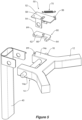
- the seat base 10 comprises a supporting frame 12 comprising a mount 14 for the support leg 40.
- the support leg 40 is positioned between a pair of spaced apart mount portions 14a and a pivot pin 16 passes through the support leg 40 and the mount portions to create the pivot point P.
- a metal frame 12 is preferably provided, at least at the front of the child safety seat 1 for the support leg 40, which conveniently is formed of metal. Nevertheless, other possibilities such as a polymer support leg 40 and a polymer supporting structure for it can be envisaged.
- a locking means 50 is positioned adjacent to a pivot P for the support leg 40.
- the locking means 50 comprises a housing 52 that is secured with respect to the supporting frame 12 at a position near to the pivot point P for the support leg 40.
- the housing 52 is secured with respect to one of the mount portions 14a of the frame 12, and comprises tabs 54 which locate over the pivot pin 16.
- the housing 52 houses a pawl 60 that can rotate freely around a pivot point PP which secures the pawl 60 with respect to the housing 52.
- the pawl 60 comprises a generally elongate body portion 62 and a head portion 64 that projects to one side the body portion 62.
- the pivot point PP and the head portion 64 are at distal ends of the body portion 62.
- the head portion 64 curves in an arc about the pivot point PP as it extends outwardly.
- Both the pawl 60 and housing 52 illustrated are formed from a sheet of rigid material, but could be moulded from plastic. Both the pawl 60 and the housing 52 are laid flat atop an upwardly facing surface of one of the mount portions 14a, with the housing 52 uppermost, and oriented with pivot point PP being positioned forward on the seat 1 and the head portion 64 of the pawl 60 being rearward on the seat 1.
- the housing 52 can be secured to the frame without any addition fasteners, such as by clipping to it, or by using existing features, such as the pivot pin 16 via locating tab 54, to effect its retention.
- the housing 52 and the pawl 60 could be made from a sheet of polymer of low sliding coefficient, which comes as a flat 2D design which has to be folded to form the housing 52. These parts could also be 3D printed or moulded.
- the pawl 60 can pivot between a retracted position in which it is nearly entirely housed within the housing 52, and an extended position in which the head portion 64 of the pawl 60 projects from the housing 52.
- a sliding surface between the housing 52 and pawl 60 might comprise ribs to assure sliding without any sticking.
- the locking means 50 could be provided as an assembly that can be retrofit to a seat 1.
- a biasing member in the form of a spring 70 extends between an attachment point 56 on the housing 52, and an attachment point 66 on the pawl 60.
- the spring 70 biases the pawl 60 toward its retracted position in order to exclude unintentional deflection of the pawl 60 that would undesirably lock the support leg 40 in ordinary use.
- the attachment point 66 comprises a pin that extends through a slot 58 provided in the housing 52.
- a centre of mass of the pawl 60 is positioned as far from the pivot point PP as possible so that the pawl 60 wants to pivot into its extended position in the case of an effective forward acceleration in +X (such as in the case of a rebound phase of a rear impact).
- this extension of the pawl 60 is prevented at the beginning because a lateral wall of the support leg 40 joint obstructs it, as illustrated in Figures 4 and 6 .
- this lateral wall of the support leg 40 moves upwards, and as soon as sufficient space is available, the pawl 60 shears out into the free space.
- the pawl 60 Due to the continuous acceleration and inertia, the pawl 60 remains extended during the rebound phase. As soon as the support leg 40 rotates back, the joint hits the top of the pawl 60, which blocks the support leg 40 from returning to its initial position. As a result, the support leg 40 can no longer return to its initial position and ends up at an angle defined by the pawl 60.
- the position of the pivot point PP and the outer shape of the pawl 60 are such that the pawl 60 can shear out of its housing 52 as far as practicable.
- the force that might arise in a rear impact causes the child safety seat to rotate about the lateral axis defined by the connection point of the connectors of the rigid links and the anchorage units. This causes the front part of the seat base 1 to rise with regard to the vehicle seat. Therefore, the position and orientation of the child safety seat drastically differ from the as fitted position.
- the locking means 50 allows inward pivoting of the support leg 40 during the crash but then prevents full outward pivoting in the rebound phase.
- the angle of the support leg 40 when landing again on the vehicle floor has been found to be most disadvantageous when the support leg 40 is pivoted outwards to a maximum extent, as this causes the seat 1 to fall and rotate further, causing the occupant's head to hit the headrest with greater speed.
- the angle of the support leg 40 when landing again on the vehicle floor has been found to be advantageous when the seat 1 is stopped from rotating sooner, at a slightly higher position, because the head of the occupant gets caught by the headrest earlier and thus more softly.
- the locking means 50 limits an extent of outward swing of the leg 40 to at or near vertical.
- a locking means 50 could conceivably reduce the instance of head and neck injuries to very small children secured in a seat in a vehicle involved in a rear end collision.
- a locking means 50 could conceivably reduce the size of a rebound bar required for a given seat. This might reduce the complexity and the cost of producing a seat.
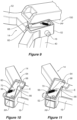
- FIG. 9 through 11 where there is illustrated a locking means 150 according to a further form.
- Those parts of the locking means 150 which are identical (or near- identical) to corresponding parts shown in locking means 50 of Figures 1 through 8 , will be denoted by the same reference numerals and will not be described again in detail.
- the head portion 64 of the pawl 60 of locking means 150 comprises an upward projecting ramp 68.
- This ramp 68 comprises an upper face which inclines rearwardly from an inside edge E of the head portion 64.
- the thickness of the head portion 64 increases as it extends rearwardly from the inside edge E, adding weight to the head portion 64 that aids pawl 60 operation.
- locking means 150 when it is compared with locking means 50 is the position of the attachment point 56 for the spring 70 on the housing 52.
- the attachment point 56 for the spring 70 on the housing 52 is positioned toward the same end of the pawl 60 as the pivot point PP of the pawl 60. This changes the line of action of the spring 70 with the intent of ensuring that the spring 70 does not unduly impair operation of the pawl 60 in the event of an effective forward acceleration in +X (such as in the case of a rebound phase of a rear impact).
- the upward projecting ramp 68 is intended to aid the earliest possible extension of the head portion 64 of the pawl 60 in the case of an effective forward acceleration in +X (such as in the case of a rebound phase of a rear impact) by reducing surface pressure in its engagement with the support leg 40. Moreover, the upward projecting ramp 68 stops rotation of the support leg sooner than a flat pawl 60 would, the advantage of which is discussed above.
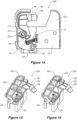
- FIG. 12 through 16 where there is illustrated a locking means 200 according to a further form.
- Those parts of the locking means 200 which are identical (or near- identical) to corresponding parts shown in locking means 50 of Figures 1 through 8 , will be denoted by the same reference numerals and will not be described again in detail.
- the housing 52 and the pawl 60 are moulded from an engineering plastic material.
- the housing includes an integrally formed cover 52c which can be folded between an open position and a closed position in which is covers the pawl 60.
- the body portion 62 of the pawl 60 comprises a recess 72 for receiving at least a portion of the spring 70. This gives the spring 70 a direct line of action against the pawl 60 and improves packaging of the parts within the housing 52 for compactness.
- locking means 200 further comprises a pawl non-return means 210.
- the pawl non-return means 210 permits the pawl 60 to move from its disengaged (or retracted) position to its engaged (or extended) position, but prevents the pawl 60 from returning to its disengaged (retracted) position.
- the non-return means 210 comprises an obstructing member 220 movable between an unobstructive position and an obstructive position with respect to the pawl 60.
- the obstructing member 220 comprises a nut
- the pawl 60 comprises a recess 212 for receiving the nut 220 within the plane of the pawl 60.
- the recess 212 comprises a slot of a width matching a dimension of the nut 220 across opposing flats.
- a blind end of the slot 212 is shaped to match an edge profile of the nut 220 so that the nut 220 is nested in the blind end of the slot 212.
- the nut 220 is in its unobstructive position.
- the slot 212 is inclined forwardly to an opening which breaks through an outer side edge of the pawl 60, so that the slot 212 forms a chute for the nut 220.
- the non-return means 200 acts as an additional safety stage for preventing the pawl 60 from being ineffective.
- the non-returns means 200 might comprise a ball detent or a spring loaded pin which is biased to extend into the cavity vacated by the locking pawl 60 but otherwise occupied by the pawl 60 when it is stored in its retracted position.
- a single embodiment may, for succinctness and/or to assist in understanding the scope of the disclosure, combine multiple features. It is to be understood that in such a case, these multiple features may be provided separately (in separate embodiments), or in any other suitable combination. Alternatively, where separate features are described in separate embodiments, these separate features may be combined into a single embodiment unless otherwise stated or implied. This also applies to the claims which can be recombined in any combination. That is a claim may be amended to include a feature defined in any other claim. Further a phrase referring to "at least one of' a list of items refers to any combination of those items, including single members. As an example, "at least one of: a, b, or c" is intended to cover: a, b, c, a-b, a-c, b-c, and a-b-c.
Landscapes
- Engineering & Computer Science (AREA)
- Aviation & Aerospace Engineering (AREA)
- Transportation (AREA)
- Mechanical Engineering (AREA)
- Health & Medical Sciences (AREA)
- Child & Adolescent Psychology (AREA)
- General Health & Medical Sciences (AREA)
- Seats For Vehicles (AREA)
Priority Applications (6)
| Application Number | Priority Date | Filing Date | Title |
|---|---|---|---|
| EP23170704.3A EP4454941A1 (de) | 2023-04-28 | 2023-04-28 | Rückprallsperre für stützbein |
| AU2024202540A AU2024202540A1 (en) | 2023-04-28 | 2024-04-17 | Support leg rebound lock |
| US18/645,080 US12485803B2 (en) | 2023-04-28 | 2024-04-24 | Support leg rebound lock |
| CN202423073166.4U CN223355431U (zh) | 2023-04-28 | 2024-04-26 | 用于儿童安全座椅的底座 |
| CN202420894627.5U CN222329520U (zh) | 2023-04-28 | 2024-04-26 | 儿童安全座椅以及用于其的底座和锁定机构 |
| CN202410512358.6A CN118849905A (zh) | 2023-04-28 | 2024-04-26 | 支撑腿回弹锁 |
Applications Claiming Priority (1)
| Application Number | Priority Date | Filing Date | Title |
|---|---|---|---|
| EP23170704.3A EP4454941A1 (de) | 2023-04-28 | 2023-04-28 | Rückprallsperre für stützbein |
Publications (1)
| Publication Number | Publication Date |
|---|---|
| EP4454941A1 true EP4454941A1 (de) | 2024-10-30 |
Family
ID=86282351
Family Applications (1)
| Application Number | Title | Priority Date | Filing Date |
|---|---|---|---|
| EP23170704.3A Pending EP4454941A1 (de) | 2023-04-28 | 2023-04-28 | Rückprallsperre für stützbein |
Country Status (4)
| Country | Link |
|---|---|
| US (1) | US12485803B2 (de) |
| EP (1) | EP4454941A1 (de) |
| CN (3) | CN118849905A (de) |
| AU (1) | AU2024202540A1 (de) |
Citations (3)
| Publication number | Priority date | Publication date | Assignee | Title |
|---|---|---|---|---|
| EP1090804A2 (de) | 1999-10-09 | 2001-04-11 | BRITAX RÖMER Kindersicherheit GmbH | Kindersicherheitssitz |
| US20030006642A1 (en) * | 2000-12-22 | 2003-01-09 | Keiper Gmbh & Co | Activation device for a vehicle seat adjuster |
| JP2003094994A (ja) * | 2001-09-25 | 2003-04-03 | Combi Corp | チャイルドシートのサポートレッグ装置 |
Family Cites Families (8)
| Publication number | Priority date | Publication date | Assignee | Title |
|---|---|---|---|---|
| GB9024434D0 (en) | 1990-11-09 | 1991-01-02 | Britax Excelsior | Child safety seat |
| ATE276897T1 (de) | 2001-07-26 | 2004-10-15 | Graco Childrens Prod Inc | Sitzuntergestell mit lastfussstruktur |
| CN103507675B (zh) * | 2012-06-28 | 2016-01-13 | 宝钜儿童用品香港股份有限公司 | 儿童汽车椅支撑装置及儿童汽车安全椅 |
| US9242584B2 (en) * | 2013-01-18 | 2016-01-26 | Wonderland Nurserygoods Company Limited | Child safety seat assembly |
| DE202015104792U1 (de) * | 2015-09-09 | 2015-12-01 | Cybex Gmbh | Kindersitz zur Anbringung auf einem Kraftfahrzeugsitz |
| ES2806278T3 (es) | 2017-09-14 | 2021-02-17 | Britax Roemer Kindersicherheit Gmbh | Pata de apoyo para un asiento de seguridad para niños |
| US11383623B2 (en) * | 2018-07-27 | 2022-07-12 | Safest Seats Llc | Support platform with load leg for child car seat |
| EP3895935A1 (de) | 2020-04-14 | 2021-10-20 | Wonderland Switzerland AG | Autokindersitz und stabilitätsbein und auslöseaktuator |
-
2023
- 2023-04-28 EP EP23170704.3A patent/EP4454941A1/de active Pending
-
2024
- 2024-04-17 AU AU2024202540A patent/AU2024202540A1/en active Pending
- 2024-04-24 US US18/645,080 patent/US12485803B2/en active Active
- 2024-04-26 CN CN202410512358.6A patent/CN118849905A/zh active Pending
- 2024-04-26 CN CN202420894627.5U patent/CN222329520U/zh active Active
- 2024-04-26 CN CN202423073166.4U patent/CN223355431U/zh active Active
Patent Citations (3)
| Publication number | Priority date | Publication date | Assignee | Title |
|---|---|---|---|---|
| EP1090804A2 (de) | 1999-10-09 | 2001-04-11 | BRITAX RÖMER Kindersicherheit GmbH | Kindersicherheitssitz |
| US20030006642A1 (en) * | 2000-12-22 | 2003-01-09 | Keiper Gmbh & Co | Activation device for a vehicle seat adjuster |
| JP2003094994A (ja) * | 2001-09-25 | 2003-04-03 | Combi Corp | チャイルドシートのサポートレッグ装置 |
Also Published As
| Publication number | Publication date |
|---|---|
| US12485803B2 (en) | 2025-12-02 |
| CN222329520U (zh) | 2025-01-10 |
| AU2024202540A1 (en) | 2024-11-14 |
| US20240359601A1 (en) | 2024-10-31 |
| CN118849905A (zh) | 2024-10-29 |
| CN223355431U (zh) | 2025-09-19 |
Similar Documents
| Publication | Publication Date | Title |
|---|---|---|
| KR100707772B1 (ko) | 어린이 카시트 | |
| KR101770307B1 (ko) | 아동용 안전 시트 | |
| US8424964B2 (en) | Child safety seat | |
| EP0901935B1 (de) | Verankerung für Kindersitze | |
| US8100472B2 (en) | Vehicle active head restraint system with a locking linkage | |
| US10011199B2 (en) | Rear facing ride down safety seat | |
| EP3680127A2 (de) | Kinderrückhaltesystem | |
| EP1787855B1 (de) | Fahrzeug Kindersitzanordnung | |
| US5294175A (en) | Vehicle seat assembly with a front panel | |
| CN109843644B (zh) | 儿童座椅 | |
| US12485803B2 (en) | Support leg rebound lock | |
| US7862114B2 (en) | Seat restraining device | |
| US6193311B1 (en) | Infant vehicle seat | |
| AU2024266801A1 (en) | Child safety seat with belted pivot link | |
| EP2746096B1 (de) | Dynamische Kinderrückhalteeinrichtung | |
| EP2772389B1 (de) | Kindersicherheitssitz | |
| JPH07323770A (ja) | 幼児用拘束保護シート用取付構造 | |
| CN119975130A (zh) | 靠背复位机构及座椅 | |
| CN114683976A (zh) | 儿童安全座椅 | |
| JP2002046511A (ja) | チャイルドシート |
Legal Events
| Date | Code | Title | Description |
|---|---|---|---|
| PUAI | Public reference made under article 153(3) epc to a published international application that has entered the european phase |
Free format text: ORIGINAL CODE: 0009012 |
|
| STAA | Information on the status of an ep patent application or granted ep patent |
Free format text: STATUS: THE APPLICATION HAS BEEN PUBLISHED |
|
| AK | Designated contracting states |
Kind code of ref document: A1 Designated state(s): AL AT BE BG CH CY CZ DE DK EE ES FI FR GB GR HR HU IE IS IT LI LT LU LV MC ME MK MT NL NO PL PT RO RS SE SI SK SM TR |
|
| STAA | Information on the status of an ep patent application or granted ep patent |
Free format text: STATUS: REQUEST FOR EXAMINATION WAS MADE |
|
| 17P | Request for examination filed |
Effective date: 20250408 |