EP4454847A1 - Lederartiges biologisches verbundmaterial, herstellungsverfahren dafür und verwendung davon - Google Patents
Lederartiges biologisches verbundmaterial, herstellungsverfahren dafür und verwendung davon Download PDFInfo
- Publication number
- EP4454847A1 EP4454847A1 EP22909877.7A EP22909877A EP4454847A1 EP 4454847 A1 EP4454847 A1 EP 4454847A1 EP 22909877 A EP22909877 A EP 22909877A EP 4454847 A1 EP4454847 A1 EP 4454847A1
- Authority
- EP
- European Patent Office
- Prior art keywords
- strain
- culture
- mycelium
- culturing
- membrane
- Prior art date
- Legal status (The legal status is an assumption and is not a legal conclusion. Google has not performed a legal analysis and makes no representation as to the accuracy of the status listed.)
- Pending
Links
Images





Classifications
-
- D—TEXTILES; PAPER
- D03—WEAVING
- D03D—WOVEN FABRICS; METHODS OF WEAVING; LOOMS
- D03D15/00—Woven fabrics characterised by the material, structure or properties of the fibres, filaments, yarns, threads or other warp or weft elements used
- D03D15/20—Woven fabrics characterised by the material, structure or properties of the fibres, filaments, yarns, threads or other warp or weft elements used characterised by the material of the fibres or filaments constituting the yarns or threads
- D03D15/208—Woven fabrics characterised by the material, structure or properties of the fibres, filaments, yarns, threads or other warp or weft elements used characterised by the material of the fibres or filaments constituting the yarns or threads cellulose-based
- D03D15/217—Woven fabrics characterised by the material, structure or properties of the fibres, filaments, yarns, threads or other warp or weft elements used characterised by the material of the fibres or filaments constituting the yarns or threads cellulose-based natural from plants, e.g. cotton
-
- D—TEXTILES; PAPER
- D06—TREATMENT OF TEXTILES OR THE LIKE; LAUNDERING; FLEXIBLE MATERIALS NOT OTHERWISE PROVIDED FOR
- D06N—WALL, FLOOR, OR LIKE COVERING MATERIALS, e.g. LINOLEUM, OILCLOTH, ARTIFICIAL LEATHER, ROOFING FELT, CONSISTING OF A FIBROUS WEB COATED WITH A LAYER OF MACROMOLECULAR MATERIAL; FLEXIBLE SHEET MATERIAL NOT OTHERWISE PROVIDED FOR
- D06N3/00—Artificial leather, oilcloth or other material obtained by covering fibrous webs with macromolecular material, e.g. resins, rubber or derivatives thereof
- D06N3/0043—Artificial leather, oilcloth or other material obtained by covering fibrous webs with macromolecular material, e.g. resins, rubber or derivatives thereof characterised by their foraminous structure; Characteristics of the foamed layer or of cellular layers
-
- B—PERFORMING OPERATIONS; TRANSPORTING
- B27—WORKING OR PRESERVING WOOD OR SIMILAR MATERIAL; NAILING OR STAPLING MACHINES IN GENERAL
- B27N—MANUFACTURE BY DRY PROCESSES OF ARTICLES, WITH OR WITHOUT ORGANIC BINDING AGENTS, MADE FROM PARTICLES OR FIBRES CONSISTING OF WOOD OR OTHER LIGNOCELLULOSIC OR LIKE ORGANIC MATERIAL
- B27N1/00—Pretreatment of moulding material
-
- B—PERFORMING OPERATIONS; TRANSPORTING
- B27—WORKING OR PRESERVING WOOD OR SIMILAR MATERIAL; NAILING OR STAPLING MACHINES IN GENERAL
- B27N—MANUFACTURE BY DRY PROCESSES OF ARTICLES, WITH OR WITHOUT ORGANIC BINDING AGENTS, MADE FROM PARTICLES OR FIBRES CONSISTING OF WOOD OR OTHER LIGNOCELLULOSIC OR LIKE ORGANIC MATERIAL
- B27N3/00—Manufacture of substantially flat articles, e.g. boards, from particles or fibres
- B27N3/02—Manufacture of substantially flat articles, e.g. boards, from particles or fibres from particles
-
- B—PERFORMING OPERATIONS; TRANSPORTING
- B27—WORKING OR PRESERVING WOOD OR SIMILAR MATERIAL; NAILING OR STAPLING MACHINES IN GENERAL
- B27N—MANUFACTURE BY DRY PROCESSES OF ARTICLES, WITH OR WITHOUT ORGANIC BINDING AGENTS, MADE FROM PARTICLES OR FIBRES CONSISTING OF WOOD OR OTHER LIGNOCELLULOSIC OR LIKE ORGANIC MATERIAL
- B27N3/00—Manufacture of substantially flat articles, e.g. boards, from particles or fibres
- B27N3/08—Moulding or pressing
- B27N3/18—Auxiliary operations, e.g. preheating, humidifying, cutting-off
-
- B—PERFORMING OPERATIONS; TRANSPORTING
- B32—LAYERED PRODUCTS
- B32B—LAYERED PRODUCTS, i.e. PRODUCTS BUILT-UP OF STRATA OF FLAT OR NON-FLAT, e.g. CELLULAR OR HONEYCOMB, FORM
- B32B37/00—Methods or apparatus for laminating, e.g. by curing or by ultrasonic bonding
-
- B—PERFORMING OPERATIONS; TRANSPORTING
- B32—LAYERED PRODUCTS
- B32B—LAYERED PRODUCTS, i.e. PRODUCTS BUILT-UP OF STRATA OF FLAT OR NON-FLAT, e.g. CELLULAR OR HONEYCOMB, FORM
- B32B5/00—Layered products characterised by the non- homogeneity or physical structure, i.e. comprising a fibrous, filamentary, particulate or foam layer; Layered products characterised by having a layer differing constitutionally or physically in different parts
- B32B5/02—Layered products characterised by the non- homogeneity or physical structure, i.e. comprising a fibrous, filamentary, particulate or foam layer; Layered products characterised by having a layer differing constitutionally or physically in different parts characterised by structural features of a fibrous or filamentary layer
- B32B5/08—Layered products characterised by the non- homogeneity or physical structure, i.e. comprising a fibrous, filamentary, particulate or foam layer; Layered products characterised by having a layer differing constitutionally or physically in different parts characterised by structural features of a fibrous or filamentary layer the fibres or filaments of a layer being of different substances, e.g. conjugate fibres, mixture of different fibres
-
- B—PERFORMING OPERATIONS; TRANSPORTING
- B32—LAYERED PRODUCTS
- B32B—LAYERED PRODUCTS, i.e. PRODUCTS BUILT-UP OF STRATA OF FLAT OR NON-FLAT, e.g. CELLULAR OR HONEYCOMB, FORM
- B32B5/00—Layered products characterised by the non- homogeneity or physical structure, i.e. comprising a fibrous, filamentary, particulate or foam layer; Layered products characterised by having a layer differing constitutionally or physically in different parts
- B32B5/22—Layered products characterised by the non- homogeneity or physical structure, i.e. comprising a fibrous, filamentary, particulate or foam layer; Layered products characterised by having a layer differing constitutionally or physically in different parts characterised by the presence of two or more layers which are next to each other and are fibrous, filamentary, formed of particles or foamed
- B32B5/24—Layered products characterised by the non- homogeneity or physical structure, i.e. comprising a fibrous, filamentary, particulate or foam layer; Layered products characterised by having a layer differing constitutionally or physically in different parts characterised by the presence of two or more layers which are next to each other and are fibrous, filamentary, formed of particles or foamed one layer being a fibrous or filamentary layer
- B32B5/26—Layered products characterised by the non- homogeneity or physical structure, i.e. comprising a fibrous, filamentary, particulate or foam layer; Layered products characterised by having a layer differing constitutionally or physically in different parts characterised by the presence of two or more layers which are next to each other and are fibrous, filamentary, formed of particles or foamed one layer being a fibrous or filamentary layer another layer next to it also being fibrous or filamentary
-
- C—CHEMISTRY; METALLURGY
- C12—BIOCHEMISTRY; BEER; SPIRITS; WINE; VINEGAR; MICROBIOLOGY; ENZYMOLOGY; MUTATION OR GENETIC ENGINEERING
- C12N—MICROORGANISMS OR ENZYMES; COMPOSITIONS THEREOF; PROPAGATING, PRESERVING, OR MAINTAINING MICROORGANISMS; MUTATION OR GENETIC ENGINEERING; CULTURE MEDIA
- C12N1/00—Microorganisms; Compositions thereof; Processes of propagating, maintaining or preserving microorganisms or compositions thereof; Processes of preparing or isolating a composition containing a microorganism; Culture media therefor
- C12N1/14—Fungi; Culture media therefor
-
- D—TEXTILES; PAPER
- D03—WEAVING
- D03D—WOVEN FABRICS; METHODS OF WEAVING; LOOMS
- D03D15/00—Woven fabrics characterised by the material, structure or properties of the fibres, filaments, yarns, threads or other warp or weft elements used
- D03D15/20—Woven fabrics characterised by the material, structure or properties of the fibres, filaments, yarns, threads or other warp or weft elements used characterised by the material of the fibres or filaments constituting the yarns or threads
- D03D15/283—Woven fabrics characterised by the material, structure or properties of the fibres, filaments, yarns, threads or other warp or weft elements used characterised by the material of the fibres or filaments constituting the yarns or threads synthetic polymer-based, e.g. polyamide or polyester fibres
-
- D—TEXTILES; PAPER
- D04—BRAIDING; LACE-MAKING; KNITTING; TRIMMINGS; NON-WOVEN FABRICS
- D04B—KNITTING
- D04B1/00—Weft knitting processes for the production of fabrics or articles not dependent on the use of particular machines; Fabrics or articles defined by such processes
- D04B1/14—Other fabrics or articles characterised primarily by the use of particular thread materials
-
- D—TEXTILES; PAPER
- D04—BRAIDING; LACE-MAKING; KNITTING; TRIMMINGS; NON-WOVEN FABRICS
- D04B—KNITTING
- D04B1/00—Weft knitting processes for the production of fabrics or articles not dependent on the use of particular machines; Fabrics or articles defined by such processes
- D04B1/14—Other fabrics or articles characterised primarily by the use of particular thread materials
- D04B1/16—Other fabrics or articles characterised primarily by the use of particular thread materials synthetic threads
-
- D—TEXTILES; PAPER
- D04—BRAIDING; LACE-MAKING; KNITTING; TRIMMINGS; NON-WOVEN FABRICS
- D04B—KNITTING
- D04B21/00—Warp knitting processes for the production of fabrics or articles not dependent on the use of particular machines; Fabrics or articles defined by such processes
-
- D—TEXTILES; PAPER
- D06—TREATMENT OF TEXTILES OR THE LIKE; LAUNDERING; FLEXIBLE MATERIALS NOT OTHERWISE PROVIDED FOR
- D06N—WALL, FLOOR, OR LIKE COVERING MATERIALS, e.g. LINOLEUM, OILCLOTH, ARTIFICIAL LEATHER, ROOFING FELT, CONSISTING OF A FIBROUS WEB COATED WITH A LAYER OF MACROMOLECULAR MATERIAL; FLEXIBLE SHEET MATERIAL NOT OTHERWISE PROVIDED FOR
- D06N3/00—Artificial leather, oilcloth or other material obtained by covering fibrous webs with macromolecular material, e.g. resins, rubber or derivatives thereof
-
- B—PERFORMING OPERATIONS; TRANSPORTING
- B32—LAYERED PRODUCTS
- B32B—LAYERED PRODUCTS, i.e. PRODUCTS BUILT-UP OF STRATA OF FLAT OR NON-FLAT, e.g. CELLULAR OR HONEYCOMB, FORM
- B32B2262/00—Composition or structural features of fibres which form a fibrous or filamentary layer or are present as additives
- B32B2262/06—Vegetal fibres
- B32B2262/062—Cellulose fibres, e.g. cotton
-
- B—PERFORMING OPERATIONS; TRANSPORTING
- B32—LAYERED PRODUCTS
- B32B—LAYERED PRODUCTS, i.e. PRODUCTS BUILT-UP OF STRATA OF FLAT OR NON-FLAT, e.g. CELLULAR OR HONEYCOMB, FORM
- B32B2262/00—Composition or structural features of fibres which form a fibrous or filamentary layer or are present as additives
- B32B2262/14—Mixture of at least two fibres made of different materials
-
- B—PERFORMING OPERATIONS; TRANSPORTING
- B32—LAYERED PRODUCTS
- B32B—LAYERED PRODUCTS, i.e. PRODUCTS BUILT-UP OF STRATA OF FLAT OR NON-FLAT, e.g. CELLULAR OR HONEYCOMB, FORM
- B32B2307/00—Properties of the layers or laminate
- B32B2307/70—Other properties
- B32B2307/716—Degradable
- B32B2307/7163—Biodegradable
-
- B—PERFORMING OPERATIONS; TRANSPORTING
- B32—LAYERED PRODUCTS
- B32B—LAYERED PRODUCTS, i.e. PRODUCTS BUILT-UP OF STRATA OF FLAT OR NON-FLAT, e.g. CELLULAR OR HONEYCOMB, FORM
- B32B9/00—Layered products comprising a layer of a particular substance not covered by groups B32B11/00 - B32B29/00
- B32B9/02—Layered products comprising a layer of a particular substance not covered by groups B32B11/00 - B32B29/00 comprising animal or vegetable substances, e.g. cork, bamboo, starch
-
- C—CHEMISTRY; METALLURGY
- C12—BIOCHEMISTRY; BEER; SPIRITS; WINE; VINEGAR; MICROBIOLOGY; ENZYMOLOGY; MUTATION OR GENETIC ENGINEERING
- C12R—INDEXING SCHEME ASSOCIATED WITH SUBCLASSES C12C - C12Q, RELATING TO MICROORGANISMS
- C12R2001/00—Microorganisms ; Processes using microorganisms
- C12R2001/645—Fungi ; Processes using fungi
-
- D—TEXTILES; PAPER
- D06—TREATMENT OF TEXTILES OR THE LIKE; LAUNDERING; FLEXIBLE MATERIALS NOT OTHERWISE PROVIDED FOR
- D06N—WALL, FLOOR, OR LIKE COVERING MATERIALS, e.g. LINOLEUM, OILCLOTH, ARTIFICIAL LEATHER, ROOFING FELT, CONSISTING OF A FIBROUS WEB COATED WITH A LAYER OF MACROMOLECULAR MATERIAL; FLEXIBLE SHEET MATERIAL NOT OTHERWISE PROVIDED FOR
- D06N2209/00—Properties of the materials
- D06N2209/10—Properties of the materials having mechanical properties
- D06N2209/103—Resistant to mechanical forces, e.g. shock, impact, puncture, flexion, shear, compression, tear
-
- D—TEXTILES; PAPER
- D06—TREATMENT OF TEXTILES OR THE LIKE; LAUNDERING; FLEXIBLE MATERIALS NOT OTHERWISE PROVIDED FOR
- D06N—WALL, FLOOR, OR LIKE COVERING MATERIALS, e.g. LINOLEUM, OILCLOTH, ARTIFICIAL LEATHER, ROOFING FELT, CONSISTING OF A FIBROUS WEB COATED WITH A LAYER OF MACROMOLECULAR MATERIAL; FLEXIBLE SHEET MATERIAL NOT OTHERWISE PROVIDED FOR
- D06N2211/00—Specially adapted uses
- D06N2211/12—Decorative or sun protection articles
- D06N2211/28—Artificial leather
Definitions
- the present invention relates to a leather-like biocomposite, preparation method therefor and use thereof. Particularly, the present invention relates to a method for preparing a leather-like biocomposite made from a fungal mycelium, a leather-like biocomposite prepared by the method, and use of the leather-like biological composite for preparing a textile product.
- Synthetic materials are often derived from non-renewable resources or limited natural resources, which is not sustainable and even generates significant waste discharges.
- the leather waste after use is often harmful to the environment and nature. Therefore, it has been in the spotlight to produce a new green, sustainable, naturally degradable, and non-polluting material without being limited by time and space constraints.
- Mycelium one of the best decomposers in nature, exists in part of the life cycle of certain fungi. It is capable of attaching to culture media based on biowaste and agricultural waste, digesting them for promoting mycelium growth, and self-assembling into an intricate mycelium network. In contrast to livestock raising, mycelium can grow in a few days. In addition, unlike leather made from synthetic fibers, the material is made from mycelium, which does not need to be extracted from petroleum, making it environment-friendly. At the same time, it can meet more aesthetic and functional needs of consumers. Therefore, it is an ethically and environmentally responsible biomaterial.
- One of the technical problems to be solved by the present invention is to provide a leather-like biocomposite that can replace animal leather.
- One of the technical problems to be solved by the present invention is to improve the hand feel, texture and appearance of the resulting leather-like biocomposite.
- One of the technical problems to be solved by the present invention is to improve the mechanical properties of the resulting leather-like biocomposite, including elongation at break, breaking strength, and tear strength.
- One of the technical problems to be solved by the present invention is to provide a method for preparing the leather-like biocomposite with the above improvements.
- the present invention provides a method for preparing a leather-like biocomposite, comprising the following steps:
- the present invention provides a leather-like biocomposite prepared by the method of the present invention.
- the present invention provides use of the leather-like biocomposite of the invention for preparing a textile product.
- the method for preparing the leather-like biocomposite of the present invention does not need to use a material derived from animals or chemical processes, so it is economical and environment-friendly, and has wide applications in various industrial and living scenarios. More importantly, taking advantage of the capability of the fungal mycelium to self-assemble into intricate mycelium networks, the method of the present invention is used to prepare biodegradable biomaterials with excellent mechanical properties.
- the leather-like biocomposite obtained by the preparation method of the present invention exhibits a uniform texture, a soft and fine hand feel, and high strength mechanical properties.
- the present invention provides a method for preparing a leather-like biocomposite.
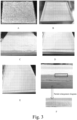
- FIG. 1A shows a schematic flowchart of the method for preparing a leather-like biocomposite of the present invention.
- the method for preparing a leather-like biocomposite comprises: placing a suitable amount of culture mixture comprising a fungal strain and a nutrient substrate in a culture device and culturing it until the mycelium on the surface of the nutrient substrate grows to a height of 0.5-1 cm and distributes evenly (step D); flat pressing a plate against the upper surface of the mycelium in one direction and culturing until the mycelium attaching to the plate grows to a thickness of 0.1-5 mm and the formed mycelium completely covers the entire nutrient substrate, forming a mycelial membrane structure on the surface thereof (step E); removing the plate, closely attaching a lattice-like membrane on the upper surface of the mycelium and continuing culturing until the mycelium completely penetrates the lattice-like membrane and grows to a height of 0.5-1 cm and distributes evenly, without forming a mycelial membrane structure (step F); flat pressing a plate against the upper surface of
- the present invention provides a method for preparing a leather-like biocomposite, comprising the following steps:
- the fungal strain in step i) can be cultured through the following steps, including: placing a certain amount of a culture mixture comprising the fungal strain and a nutrient substrate in a culture device, with a volume ratio of the mixture in the culture device not exceeding 60%, compacting and flat pressing the mixture in the culture device, and kept the mixture standstill for culturing in darkness at a temperature of 25-35 °C, a concentration of carbon dioxide of 3-7%, an oxygen concentration ⁇ 20% and a relative humidity ⁇ 40% for 3-7 days, e.g., 3 days, 4 days, 5 days, 6 days or 7 days.
- the fungal strain in step i), is cultured under the following conditions, until the mycelium of the fungal strain grows and fills the entire nutrient substrate.
- the nutrient substrate is a nutrient substrate comprising lignin or a derivative thereof.
- the volume ratio of the culturing mixture in the culture device is up to 60%.
- the culture duration is 3-7 days.
- the temperature is 25-35°C.
- the culture mixture is kept standstill in darkness.
- the concentration of carbon dioxide is 3-7%; the concentration of oxygen is ⁇ 20%; and a relative humidity is ⁇ 40%.
- the nutrient substrate is selected from one or more of the following substances: straw, rice hulls, fuelwood, bark, peanut hulls, corn cobs, twig firewood, wrapper, wood chips and a mixture thereof.
- the mycelium in step i), grows to a height selected from 0.5 cm, 0.6 cm, 0.7 cm, 0.8 cm, 0.9 cm, 1.0 cm and a range consisting of any two of the preceding values. In one embodiment, in step i), the mycelium grows to a height of 0.5 cm, 0.6 cm, or 0.7 cm.
- Controlling the growth of the mycelium in steps ii)-iv), such as the growth height and the densification state allows the mycelium to self-assemble into an intricate mycelium network and completely cover and twist with the lattice-like membrane to form a robust, biodegradable material.
- the lattice-like membrane in the mycelium-membrane complex can provide the necessary structural support for the complex, further enhancing the mechanical properties such as breaking strength of the complex.
- step ii) of the method of the present invention the mycelium is allowed to grow for a period of time while being flat pressed by an unperforated plate until the mycelium attaching to the plate grows to a thickness of 0.1-5 mm and the formed mycelium completely covers the entire nutrient substrate, forming a mycelial membrane structure on the surface.
- an unperforated plate was flat pressed on the upper surface of the mycelium in one direction and the culture continued until the mycelium attaching to the plate grew to a thickness of 0.1-5 mm and the formed mycelium completely covered the entire nutrient substrate, forming a mycelial membrane structure on the surface thereof.
- This layer of mycelial membrane facilitates the separation of the lower nutrient substrate from the upper mycelium composite in subsequent steps.
- the composite growing on this layer of mycelial membrane structure can have a uniformly fine and smooth surface at both sides, which allows for subsequent industrialization of the material without the need for further treatment/processing.
- the mycelium grows to a thickness selected from a group consisting of: 0.1 mm, 0.2 mm, 0.3 mm, 0.4 mm, 0.5 mm, 0.6 mm, 0.7 mm, 0.8 mm, 0.9 mm, 1 mm, 1.1 mm, 1.2 mm, 1.3 mm, 1.4 mm, 1.5 mm, 1.6 mm, 1.7 mm, 1.8 mm, 1.9 mm, 2 mm, 2.1 mm, 2.2 mm, 2.3 mm, 2.4 mm, 2.5 mm, 2.6 mm, 2.7 mm, 2.8 mm, 2.9 mm, 3 mm, 3.1 mm, 3.2 mm, 3.3 mm, 3.4 mm, 3.5 mm, 3.6 mm, 3.7 mm, 3.8 mm, 3.9 mm, 4 mm, 4.1 mm, 4.2 mm, 4.3 mm, 4.4 mm, 4.5 mm,
- the mycelium grows to a thickness from 1 mm to 2 mm. In one embodiment, in step ii) of the method of the present invention, the mycelium grows to a thickness of 1 mm, 1.1 mm, 1.2 mm, 1.3 mm, 1.4 mm, 1.5 mm, 1.6 mm, 1.7 mm, 1.8 mm, 1.9 mm, or 2 mm.
- step iii) of the method of the present invention the mycelium growth needs to be controlled to completely penetrate the lattice-like membrane and grow to a height of 0.5-1 cm and distributes evenly, where the upright or branched mycelium is in a growing state in which the interstices are not connected in appearance.
- the unperforated plate is removed, a lattice-like membrane is closely attached onto the upper surface of the mycelium and the culture is continued until the mycelium completely penetrates the lattice-like membrane and grows uniformly distributed to a height of 0.5-1 cm and distributes evenly, where the upright or branched mycelium is in a growing state in which the interstices are not connected in appearance, without forming a mycelial membrane structure.
- the height of the mycelial growth is selected from 0.5 cm, 0.6 cm, 0.7 cm, 0.8 cm, 0.9 cm, 1 cm and a range consisting of any two of the preceding values.
- the mycelium growth needs to be controlled to a height of 0.5 cm to 0.8 cm.
- the mycelium growth needs to be controlled to a height of 0.5 cm, 0.6 cm, 0.7 cm to 0.8 cm.
- step iv) of the method of the present invention the mycelium is again allowed to grow for a period of time while being flat pressed by an unperforated plate until the mycelium grows to a thickness of 1-5 mm and reaches a state where the mycelium completely covers the lattice-like membrane without visible interstices or uneven distribution, and forms an overall fine and smooth surface.
- an unperforated plate is flat pressed against the upper surface of the mycelium in one direction and the culture is continued until the mycelium grows to a thickness of 1-5 mm and reaches a growing state where the mycelium completely covers the lattice-like membrane without visible interstices or uneven distribution, and forms an overall fine and smooth surface, forming a mycelial membrane structure again on the surface.
- the formation of the mycelial membrane structure again increases the mechanical strength of the mycelium-membrane complex, and enhances the flatness and smooth hand feel.
- the mycelium grew to a thickness selected from the group consisting of: 1 mm, 1.1 mm, 1.2 mm, 1.3 mm, 1.4 mm, 1.5 mm, 1.6 mm, 1.7 mm, 1.8 mm, 1.9 mm, 2 mm, 2.1 mm, 2.2 mm, 2.3 mm, 2.4 mm, 2.5 mm, 2.6 mm, 2.7 mm, 2.8 mm, 2.9 mm, 3 mm, 3.1 mm, 3.2 mm, 3.3 mm, 3.4 mm, 3.5 mm, 3.6 mm, 3.7 mm, 3.8 mm, 3.9 mm, 4 mm, 4.1 mm, 4.2 mm, 4.3 mm, 4.4 mm, 4.5 mm, 4.6 mm, 4.7 mm, 4.8 mm, 4.9 mm, 5mm, and a range between any two of the preceding numbers.
- the mycelium grows to a thickness from 1 mm to 2 mm. In one embodiment, in step iv) of the method of the present invention, the mycelium grows to a thickness of 1 mm, 1.1 mm, 1.2 mm, 1.3 mm, 1.4 mm, 1.5 mm, 1.6 mm, 1.7 mm, 1.8 mm, 1.9 mm, or 2 mm.
- mycelial membrane structure means that the mycelium has an integral and intact a membrane-like structure and a smooth and flat upper surface. On contrary, if the mycelium is dispersed or intensively arranged without an integral structure, exhibiting a fluffy appearance, then the mycelium in this state is referred to as a non-membranous mycelial structure. See FIG. 4 for a physical diagram of the mycelial membrane structure.
- the operation of flat plate pressing allows the final monolayer mycelium-membrane complex to have excellent texture, hand feel, appearance, and mechanical properties, as compared to rolling, an easy-to-operate method.
- the inventor believes that employing the flat-platen pressing operation during the mycelium growth can control the mycelium growth on one plane, regardless of differences in growth direction and status of each hypha, which is critical for the formation of the mycelial membrane structure.
- the flat-platen pressing operation can significantly increase the mycelium density in the mycelium-membrane complex and the thickness of the entire mycelium-membrane complex, with a finer mycelial membrane structure formed on the surface, enabling the final monolayer mycelium-membrane complex to have excellent mechanical properties.
- the unperforated plate in steps ii) and iv), may be flat pressed in a randomized direction against the upper surface of the mycelium. In one embodiment, in steps ii) and iv), the unperforated plate may be flat pressed against the upper surface of the mycelium in such a direction that the mycelium does not cross with each other after being pressed down.
- the flat pressing method of the present invention can control the mycelium to grow on one plane and twist into a uniform state, regardless of differences in growth direction and status of each hypha.
- the unperforated plate in steps ii) and iv), is flat pressed against the upper surface of the mycelium in the same direction.
- the resulting mycelium-membrane complex exhibits excellent mechanical properties, such as excellent elongation at break, breaking strength, and tear strength, as compared to the mycelium-membrane complex obtained by changing the orientation of the plate during flat pressing.
- the inventors believe that the way of flat pressing the unperforated plate against the upper surface of the mycelium in the same direction ensures that the mycelium has the same orientation, and the resulting mycelium-membrane complex exhibits a uniform texture, a soft and fine hand feel, and high strength mechanical properties in the same orientation as that of the mycelium.
- the culture conditions for fungal strains in steps ii)-iv) may be the same or different.
- an unperforated plate in step ii), is flat pressed against the upper surface of the mycelium and kept standstill for continuous culturing in darkness for 3-7 days at a temperature of 25-35 °C, a carbon dioxide concentration of 3-7%, an oxygen concentration ⁇ 20%, and a relative humidity ⁇ 40%.
- the lattice-like membrane in step iii), is closely attached to the upper surface of the mycelium and kept standstill for continuous culturing in darkness for 3-7 days at a temperature of 25-35 °C, a carbon dioxide concentration of 3-7%, an oxygen concentration ⁇ 20%, and a relative humidity ⁇ 40%.
- an unperforated plate in step iv), is flat pressed against the upper surface of the mycelium and kept standstill for continuous culturing in darkness for 3-7 days at a temperature of 25-35 °C, a carbon dioxide concentration of 3-7%, an oxygen concentration ⁇ 20%, and a relative humidity ⁇ 40%.
- the unperforated plate may be selected as a material that is not easily adhered to and digested by the fungal hyphae.
- the unperforated plate is a plastic plate.
- the unperforated plate is a glass plate.
- the lattice-like membrane may be selected from materials having a certain pore size and a certain thickness.
- the lattice-like membrane has a thickness of 0.1 mm - 5 mm, preferably 0.5 mm - 4 mm, more preferably 0.5 mm - 3 mm, more preferably 0.5 mm - 2 mm, more preferably 0.5 mm - 1 mm, and more preferably 0.5 mm.
- the lattice-like membrane has an average pore size of 1 ⁇ m - 5 mm, preferably 10 ⁇ m - 5 mm, more preferably 100 ⁇ m - 5 mm.
- the lattice-like membrane may be selected from biodegradable materials, such as fiber materials.
- the lattice-like membrane is a fiber material.
- the lattice-like membrane is selected from one or more of: gauze, nylon fabric, and natural fiber fabric. The fiber material is partially consumed or biodegraded by the mycelium, and the mycelium-secreted substances twist the fibers and the hyphae together to form a composite with better physical properties, thereby improving the mechanical strength of the mycelium-membrane complex.
- the material that can be used as the nutrient substrate is a nutrient substrate comprising lignin or a derivative thereof.
- the nutrient substrate is selected from one or more of the following substances: straw, rice hulls, fuelwood, bark, peanut hulls, corn cobs, twig firewood, wrapper, wood chips and a mixture thereof.
- steps iii) and iv) of the present invention are repeated at least once to ensure that the mycelium-membrane complex contains at least one layer of a lattice-like membrane after final separation of the mycelium-membrane complex from the nutrient substrate.
- the method of the present invention further comprises: in step v), repeating the preceding steps iii) and iv) several times until a complex containing a multilayer structure is formed.
- a lattice-like membrane made from different materials may be used in each repetition of steps iii) and iv).
- steps ii)-v) are repeated 1-5 times, for example, 1 time, 2 times, 3 times, 4 times or 5 times.
- steps ii)-v) are repeated 1 time or 2 times.
- the step of separating the complex from the nutrient substrate in step vi) can be carried out by separating a second layer of lattice-like membrane upwards from the nutrient substrate from its underlying mycelium (retaining the second layer of lattice-like membrane as well as the mycelium that covers around the membrane and is partially or mostly located thereon), thereby separating the mycelium-membrane complex from the nutrient substrate and obtaining a mycelium-membrane complex containing one layer of lattice-like membrane.
- a first (i.e., the bottom) layer of lattice-like membrane is wrapped in the removed nutrient substrate.
- the obtained mycelium-membrane complex containing the second layer of lattice-like membrane has a flatter surface, and exhibits a fine overall appearance and a uniform and smooth mycelium arrangement since it has the mycelium that completely covers the lattice-like membrane, thereby ensuring that the leather-like biocomposite prepared by the mycelium-membrane complex has a soft and fine look and hand feel.
- steps ii)-v) are repeated once, resulting in a mycelium-membrane complex comprising two layers of lattice-like membranes prior to the separation step.
- the lattice-like membrane covered in the mycelium-membrane complex can improve the mechanical properties of the complex.
- steps ii)-v) can be repeated multiple times to prepare a mycelium-membrane complex comprising multiple layers of lattice-like membranes, which can further improve the mechanical strength of the mycelium-membrane complex.
- mycelium-membrane complexes with different appearances and mechanical properties can be produced by using lattice membranes made of different materials and by stacking mycelium layers for different times. This further enriches the application range of the leather-like biocomposite prepared by the method of the present invention.
- the method of the present invention further comprises placing the nutrient substrate separated in step vi) in a culture device again for culturing, and subsequently repeating the steps ii)-v). Since the separated nutrient substrate has been infiltrated by fungi and their mycelium during the preceding culturing processes, it can be placed directly in the culture device again for culturing without the need to supplement the fungal strains again or it only needs to supplement a small amount of the fungal strains. As a result, the method of the present invention greatly saves raw materials and allows for recycling of the preparation of leather-like biocomposites in an environmentally friendly manner.
- FIG. 1B shows another schematic flowchart of the method for preparing a leather-like biocomposite of the present invention.
- the same reference numerals as in FIG. 1A represent the same meaning, which will not be described again.
- the method for preparing a leather-like biocomposite of the present invention further comprises the step of preparing a fungal strain for use in step D.
- the method for preparing a leather-like biocomposite of the present invention further comprises: preparing a mother fungal strain (step A), preparing the mother fungal strain into a secondary strain (a secondary liquid strain, corresponding to step B1; or a secondary solid strain, corresponding to step B2), and then preparing the secondary strain into a culture strain (step C).
- the culture strain may be subject to further enlarged culture to prepare a culture-enlarged strain (step C1).
- a certain volume of culture strains or culture-enlarged strains together with part of the nutrient substrate they carry can be placed in a culture device as a culture mixture for culturing until the mycelia of the strains grow to fill the entire nutrient substrate (step D).
- secondary liquid strains can be added directly to a culture device pre-filled with nutrient substrate at an inoculum concentration of 1-10% for culturing (a process shown by dashed line in FIG. 1B ).
- the culture mixture cultured in step i) of the present invention can be obtained by a method selected from the following:
- the solid medium is a medium comprising lignin or a derivative thereof as a nutrient substrate.
- the nutrient substrate is selected from one or more of the following substances: straw, rice hulls, fuelwood, bark, peanut hulls, corn cobs, twig firewood, wrapper, wood chips and a mixture thereof.
- the nutrient substrate consists of 40 wt% straw, 5 wt% rice hulls, 5 wt% wood chips, and 50 wt% water.
- the nutrient substrate consists of 45 wt% corn cobs, 5 wt% straw, and 50 wt% water.
- the nutrient substrate consists of 45 wt% straw, 5 wt% wood chips, and 50 wt% water.
- the mother strain is obtained by culturing in a PDA slant medium at a temperature of 25-35°C for 5-10 days;
- the secondary liquid strain is obtained by culturing in a PDA liquid medium in a shaking flask rotating at a speed of 100-200 rpm at a temperature of 25-35°C for 5-10 days; and the secondary liquid strain is transferred to a new solid medium at an inoculum concentration of 1-10% for continued culture to prepare a liquid culture strain.
- the mother strain is obtained by culturing in a PDA slant medium at a temperature of 25-35°C for 5-10 days;
- the secondary solid strain is obtained by culturing in a solid medium comprising lignin or a derivative thereof as a nutrient substrate at a temperature of 25-35°C for 10-20 days; and the secondary liquid strain is transferred to a new solid medium at an inoculum concentration of 1-10% for continued culture to prepare a solid culture strain.
- the mother strain is obtained by culturing in a PDA slant medium at a temperature of 25-35°C for 5-10 days;
- the secondary liquid strain is obtained by culturing in a PDA liquid medium in a shaking flask rotating at a speed of 100-200 rpm at a temperature of 25-35°C for 5-10 days; and the secondary liquid strain is transferred to a new solid medium at an inoculum concentration of 1-10% for continued culture to prepare a liquid culture strain;
- the liquid culture-enlarged strain is obtained by re-transferring the liquid culture strain to a new solid medium at an inoculum concentration of 1-10% for continued culture at 25-35°C for 5-10 days.
- the mother strain is obtained by culturing in a PDA slant medium at a temperature of 25-35°C for 5-10 days;
- the secondary solid strain is obtained by culturing in a solid medium comprising lignin or a derivative thereof as a nutrient substrate at a temperature of 25-35°C for 10-20 days; and the secondary solid strain is transferred to a new solid medium at an inoculum concentration of 1-10% for continued culture to prepare a solid culture-enlarged strain;
- the solid culture-enlarged strain is obtained by re-transferring the solid culture strain to a new solid medium at an inoculum concentration of 1-10% for continuing culture at 25-35°C for 5-10 days.
- the culture device in step i) has a solid medium comprising lignin or a derivative thereof as a nutrient substrate;
- the mother strain is obtained by culturing in a PDA slant medium at a temperature of 25-35°C for 5-10 days;
- the secondary liquid strain is obtained by culturing in a PDA liquid medium in a shaking flask rotating at a speed of 100-200 rpm at a temperature of 25-35°C for 5-10 days, the secondary liquid strain serves as the fungal strain cultured in step i) at an inoculum concentration of 1-10%.
- the solid medium is a medium comprising lignin or a derivative thereof as a nutrient substrate.
- the nutrient substrate is selected from one or more of the following substances: straw, rice hulls, fuelwood, bark, peanut hulls, corn cobs, twig firewood, wrapper, wood chips and a mixture thereof.
- culture strains that have been pre-cultured for culturing has the advantages that the culture strains are rapidly and sufficiently activated, whether in the preparation of liquid strains or the preparation of solid strains, which ensures the high activity of their growth in the nutrient substrate, greatly shortening the growth cycle of the leather-like biocomposite in the later period and facilitating industrialization of the method of the present invention.
- the sufficiently activated culture strains are evenly and appropriately distributed in the nutrient substrate, which facilitates uniform growth of mycelium during the formation of the complex, which to a certain extent allows the resulting the leather-like biocomposite prepared by the method of the present invention to have a uniform texture, a soft and fine hand feel, and excellent mechanical properties.
- the present invention further comprises the step of post-treating the mycelium-membrane complex obtained after separation.
- the post-treating involves treating the complex with organic or inorganic reagents, followed by drying it.
- the post-treating comprises removing surface proteins of the complex by ethanol and moisturizing the complex by glycerol, and the drying is heat drying, freeze drying or natural air drying.
- the post-treating comprises immersing the complex in a mixed solution of ethanol (50%-70%): glycerol of 15-20:1 (v/v) for 8-24 hours, followed by heat treatment at a temperature of 50-80°C for 10-60 minutes.
- the fungal strains that can be used in the method of the present invention are selected as fungi whose vegetative part is mycelium, preferably fungi that grow vigorously and whose vegetative part is mycelium, and even more preferably fungi from the class Basidiomycetes.
- the fungal strain of the present invention is a fungus whose vegetative part is mycelium.
- the fungal strain of the present invention is a lower filamentous fungus with mycelium serving as the vegetative part, a common edible fungus with mycelium serving as the vegetative part, or a higher fungus with mycelium serving as the vegetative part.
- the fungal strain of the present invention is a fungus from the class Basidiomycetes.
- the fungal strain of the present invention is one or more selected from the group consisting of: Agaricus bisporus, Pleurotus ostreatus, Lentinula edodes, Hericium erinaceus, Pleurotus ferulae Lanzi, Flammulina velutipes, Auriclaria polytricha, Ganoderma lucidum, Trametes versicolor, and Maitake mushroom.
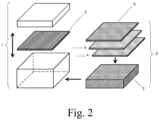
- FIG. 2 shows a schematic view of a culture apparatus used for the preparation method of the present invention.
- the culture device 1 of the present invention comprises a receiving portion and a cover capable of sealing the receiving portion.
- the culture device 1 further comprises a movable plate 2 that is closely fit to the four sides of the receiving portion of the culture device 1, thereby separating the space of the receiving portion into upper and lower portions.
- the culture device 1 further comprises a nutrient substrate 3 and a lattice-like membrane 4.
- the culture device may be a plastic box.
- the volume of the culture device may be dependent on the desired size of the biocomposite to be produced.
- the culture device has a volume of (1-5) meters ⁇ (1-5) meters ⁇ (0.05-0.1) meters, preferably (1-2.5) meters ⁇ (1-2.5) meters ⁇ (0.05-0.08) meters.
- the culture device is 0.05-0.1 meters, preferably 0.05-0.08 meters in depth.
- the plate 2 needs to be selected as an unperforated plate and needs to be made of a material that is not easily adhered to and digested by the fungal hyphae.
- the unperforated plate is a plastic plate.
- the unperforated plate is a glass plate.
- the plate 2 in the culture device 1 needs to have a certain weight.
- a plate with a sufficient weight can provide a better flattening effect, and underweight or overweight of the plate may fail to produce to a densely flattened mycelium.
- An underweight plate may result in insufficiently dense and compacted mycelium, while an overweight plate may impose increased load on growth of mycelium, thereby decreasing its thickness, even blocking the growth of mycelium to some extent, which can lead to insufficient mycelium per unit area, thus failing to form a dense mycelium that meets the subsequent processing requirements.
- Selecting the weight of the plate suitable for mycelium growth can be accomplished by the method of the prior art.
- the pressure generated by the plate on the mixed culture is 10-20 Pa, preferably 10-15 Pa, the flattening/compacting effect for the mycelium and the effect of maintaining mycelium growth can be balanced.
- the pressure generated by the plate on the mixed culture is 10-20 Pa, preferably 10-15 Pa.
- the pressure generated by the plate on the mixed culture is 10 Pa, 11 Pa, 12 Pa, 13 Pa, 14 Pa, or 15 Pa.
- a culture mixture comprising a fungal strain and a nutrient substrate 3 is placed in a culture device 1 for culturing the fungal strain until the mycelial of the fungal strain grows and fills the entire nutrient substrate. Subsequently, a plate 2 is flat pressed against the upper surface of the mycelium in one direction and the culture is continued until the mycelium attaching to the side of the plate grows to a thickness of 0.1-5 mm and the formed mycelium completely covers the whole nutrient substrate, forming a mycelial membrane structure on the surface.
- the plate 2 is removed; a layer of lattice-like membrane 4 is closely attached to the upper surface of the mycelium; and the culture is continued until the mycelium completely penetrates the lattice-like membrane 4 and grows to a height of 0.5-1 cm and distributes evenly, without forming a membrane structure.
- the plate 2 is flat pressed against the upper surface of the mycelium in one direction and the culture is continued until the mycelium grows to a thickness of 1-5 mm and a mycelium-membrane complex is formed where the mycelium completely covers the lattice-like membrane 4, forming a mycelial membrane structure on the surface thereof.
- the foregoing steps are repeated at least once, e.g., three times, to obtain a mycelium-membrane complex 5 carrying its underlying nutrient substrate 3 and completely covering three layers of lattice-like membranes 4.
- the lattice membrane 4b is separated from its underlying mycelium (retaining the second layer of lattice-like membrane as well as the mycelium that covers the membrane and is partially or mostly located thereon) from the lattice-like membrane as shown by "b" in FIG. 2 ("a” represents the first layer of lattice-like membrane; and "b” represents the second layer of lattice-like membrane), thereby separating the mycelium-membrane complex from its underlying nutrient substrate.
- the separation step it is sufficient to ensure in the separation step that the mycelium-membrane complex is not separated from its underlying nutrient substrate from the first layer of lattice-like membrane.
- the foregoing steps are repeated four times, in the case of obtaining a mycelium-membrane complex carrying its underlying nutrient substrate and completely covering four layers of lattice-like membranes 4, it is also possible to optionally discard the bottom two layers of lattice-like membranes and separate the mycelium-membrane complex from its underlying nutrient substrate from the third layer of lattice-like membrane.
- the mycelium-membrane complex when the foregoing steps are repeated three times, the mycelium-membrane complex is separated from its underlying nutrient substrate from the second layer of lattice-like membrane. In one embodiment, when the foregoing steps are repeated four times, the mycelium-membrane complex is separated from its underlying nutrient substrate from the second or third layer of lattice-like membrane.
- the separated lower layer of nutrient substrate comprising the first lattice-like membrane can also be placed again in the culture device for culturing, thereby self-circulating the method of the present invention by repeating it, which greatly reduces the cost of the method of the present invention and is environmentally friendly.
- the present invention provides a leather-like biocomposite prepared by the method of the present invention.
- the leather-like biocomposite prepared by the method of the present invention has excellent appearances including a uniform mycelium arrangement and a soft and fine hand feel, as well as excellent mechanical properties including excellent elongation at break, tear strength, and the like.
- the elongation at break and breaking strength of the leather-like biocomposite prepared by the method of the present invention can be tested by Standard Test Method for Breaking Strength and Elongation of Textile Fabrics (ASTM D5034-09 (2017)).
- the tear strength of the leather-like biocomposite prepared by the method of the present invention can be tested by the Test Method for Tearing Strength of Fabrics (BS EN ISO 13937-2:2000).
- the leather-like biocomposite prepared by the method of the present invention has an elongation at break of 20-40 (%), preferably 25-35 (%). In one embodiment, the leather-like biocomposite prepared by the method of the present invention has a breaking strength of 45-60 (lb), preferably 50-57 (lb). In one embodiment, the leather-like biocomposite prepared by the method of the present invention has a tearing strength of 6-25 (N), preferably 9-20 (N).
- the present invention provides use of the leather-like biocomposite of the invention for preparing a textile product.
- the leather-like biocomposite of the present invention is similar to leather materials in appearance, hand feel, texture and mechanical properties, it can be used in the field of textile products as a biocomposite.
- the textile product is selected from one or more in the group consisting of: hats, shoes, clothes, and bags.
- the textile product is a leather-like substitute.
- Trametes versicolor strains used in this example were commercially available Trametes versicolor slant strains purchased from Shenzhen wholesale market for agricultural products. The strain was identified and assessed by referring to [1] TIE Weifang, JIA Junzhong, ZHANG Ye. Cultivation and identification of Pleurotus eryngii strain [J]. China Food Safety Magazine, 2017(27):83-84. DOI:10.16043/j.cnki.cfs.2017.27.065 . After the strain was obtained, its genomic DNA was extracted, and then the 18s rDNA fragment was PCR amplified, which was sequenced and identified as Trametes versicolor by GeneBank comparison.
- the leather-like biocomposite was prepared by following steps.
- Pleurotus ostreatus strains used in this example were commercially available Pleurotus ostreatus slant strains purchased from Shenzhen wholesale markets for agricultural products. The strain was identified and assessed by using the same method as that in Example 1. After the strain was obtained, its genomic DNA was extracted, and then its 18s rDNA fragment was PCR amplified, which was sequenced and identified as Pleurotus ostreatus by GeneBank comparison.
- the leather-like biocomposite was prepared by the following steps.
- Lentinula edodes strains used in this example were commercially available Lentinula edodes slant strains purchased from Shenzhen wholesale markets for agricultural products. The strain was identified and assessed by using the same method as that in Example 1. After the strain was obtained, its genomic DNA was extracted, then its 18s rDNA fragment was PCR amplified, which was sequenced and identified as Lentinula edodes by GeneBank comparison.
- the leather-like biocomposite was prepared by the following steps.
- a monolayer mycelium-membrane complex was prepared using the method described in Example 1, except that only half of the mycelium was flat pressed by the unperforated plate during its growth, while the other half did not undergo such operation.
- FIG. 4 shows physical comparison of the mycelial membrane structure obtained by this example with a non-mycelial membrane structure.
- FIG. 4 since the mycelium in the lower part of FIG. 4 has been treated by the method of the present invention during culturing (by flat pressing using an unperforated plate), this part of mycelium has good integrity with a flat structure and a smooth, leather-like hand feel, forming a mycelial membrane structure (see the partial enlargement diagram in the lower right of FIG. 4 ).
- the mycelium in the upper part of FIG. 4 did not undergo the operation of flat pressing using an unperforated plate during culturing.
- Example 5 Comparison of the structures of mycelium layers obtained by plate pressing of the present invention and by rolling as a control
- Example 1 of the present invention The strains and method of Example 1 of the present invention were used for the present experiment, except that a plate was not used in steps 6 and 8 to apply pressure to the upper surface of the mycelium. Instead, a roller with a smooth surface was used to apply pressure to the upper surface of the mycelium by means of rolling.
- the experiments were carried out in parallel in three groups and the pressure applied was adjusted with reference to the plate pressing. The group 1 was applied a single light rolling; the group 2 was applied two times of moderate rolling; and the group 3 applied multiple times of heavy rolling. In addition, the experiment of Example 1 was repeated as a control, which was numbered as group 4.
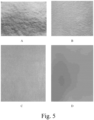
- FIG. 5 shows physical diagrams of the mycelium layer structures obtained from group 1 ( FIG. 5A ), group 2 ( FIG. 5B ), group 3 ( FIG. 5C ) and group 4 ( FIG. 5D ).
- the final mycelial membrane was less likely to form a uniform plane, exhibiting apparently uneven undulations.
- the mycelium layer still exhibited apparent unevenness.
- FIG. 5C after multiple times of heavy rolling, the mycelium layer was able to be flat pressed but with irregular hyphae, showing a fluffing and pilling appearance.
- FIG. 5D after plate pressing of the present invention and pressing the plate along the same direction twice, the final mycelium layer resulted in a glossy, dense and flawless plane, with a mycelial membrane structure formed on the surface.
- Example 6 Performance testing of the mycelium-membrane complex covering a monolayer lattice-like membrane of the present invention
- the monolayer mycelium-membrane complex prepared using the method described in Example 1 was tested for mechanical properties including elongation at break, breaking strength, and tear strength.
- FIG. 6 shows a physical diagram of a leather-like biocomposite obtained by the method of examples of the present invention after post-treating, which was sent to CTI for testing mechanical properties.
- the elongation at break and breaking strength of the leather-like biocomposite prepared by Example 1 can be tested by Standard Test Method for Breaking Strength and Elongation of Textile Fabrics (ASTM D5034-09 (2017)).
- the tear strength of the leather-like biocomposite prepared by Example 1 can be tested by the Test Method for Tearing Strength of Fabrics (BS EN ISO 13937-2:2000).
- testing results of breaking strength are shown in table 1 below.
- Testing item Testing result Standard requirements 001 Length direction 19.6N* -- Width direction 9.6N -- Note: * The tearing direction is vertical to the sample cut.
- test results of elongation at break are shown in table 3 below. Testing item Testing result Standard requirements 001 Length direction 26.6% -- Width direction 35.2% --
- the complex obtained by using the method of the present invention in particular the operation of flat pressing by an unperforated plate in a random direction, shows good mechanical properties in different directions and excellent overall mechanical properties.
- Example 7 Comparison of mechanical properties of composites obtained by plate pressing of the present invention and by rolling as a control
- the mechanical properties of the monolayer mycelium-membrane complexes obtained by the methods of group 3 and group 4 in Example 5 were tested using the test method in Example 6.
- the tested indicators include breaking strength and tear strength.
- the obtained mycelium-membrane complex was post-treated by using the test method of Example 1. Specifically, the complex was immersed in a mixed solution of ethanol (70%): glycerol of 15:1 (v/v) for 24 hours, followed by heat treatment at 60 °C for 15 minutes to obtain a leather-like biocomposite.
- FIG. 7 shows a physical diagram of a leather-like biocomposite obtained by the method of Example 1 of the present invention after post-treating, and a hat made therefrom.
- the composite prepared by the method of the present invention has a flat appearance, dense structure, good integrity, and a fine and smooth hand feel, which can completely replace the animal-derived leather to produce textile products.
Landscapes
- Life Sciences & Earth Sciences (AREA)
- Engineering & Computer Science (AREA)
- Health & Medical Sciences (AREA)
- Chemical & Material Sciences (AREA)
- Wood Science & Technology (AREA)
- Textile Engineering (AREA)
- Genetics & Genomics (AREA)
- Organic Chemistry (AREA)
- Zoology (AREA)
- Biotechnology (AREA)
- Bioinformatics & Cheminformatics (AREA)
- Botany (AREA)
- Mycology (AREA)
- Microbiology (AREA)
- Biomedical Technology (AREA)
- Tropical Medicine & Parasitology (AREA)
- Biochemistry (AREA)
- General Engineering & Computer Science (AREA)
- General Health & Medical Sciences (AREA)
- Medicinal Chemistry (AREA)
- Virology (AREA)
- Manufacturing & Machinery (AREA)
- Forests & Forestry (AREA)
- Micro-Organisms Or Cultivation Processes Thereof (AREA)
Applications Claiming Priority (2)
| Application Number | Priority Date | Filing Date | Title |
|---|---|---|---|
| CN202111570984 | 2021-12-21 | ||
| PCT/CN2022/139524 WO2023116563A1 (zh) | 2021-12-21 | 2022-12-16 | 皮革样生物复合材料、其制备方法和其用途 |
Publications (2)
| Publication Number | Publication Date |
|---|---|
| EP4454847A1 true EP4454847A1 (de) | 2024-10-30 |
| EP4454847A4 EP4454847A4 (de) | 2026-03-04 |
Family
ID=86785772
Family Applications (1)
| Application Number | Title | Priority Date | Filing Date |
|---|---|---|---|
| EP22909877.7A Pending EP4454847A4 (de) | 2021-12-21 | 2022-12-16 | Lederartiges biologisches verbundmaterial, herstellungsverfahren dafür und verwendung davon |
Country Status (4)
| Country | Link |
|---|---|
| US (1) | US20250179727A1 (de) |
| EP (1) | EP4454847A4 (de) |
| CN (2) | CN118434545B (de) |
| WO (1) | WO2023116563A1 (de) |
Cited By (1)
| Publication number | Priority date | Publication date | Assignee | Title |
|---|---|---|---|---|
| WO2025125493A1 (en) * | 2023-12-12 | 2025-06-19 | Naturpladen Aps | A method of producing a composite material |
Families Citing this family (10)
| Publication number | Priority date | Publication date | Assignee | Title |
|---|---|---|---|---|
| CN118434545B (zh) * | 2021-12-21 | 2026-02-24 | 深圳先进技术研究院 | 皮革样生物复合材料、其制备方法和其用途 |
| US20240075706A1 (en) * | 2022-09-01 | 2024-03-07 | Mycoworks, Inc. | Durable Mycelium Bonding |
| WO2024148085A2 (en) * | 2023-01-03 | 2024-07-11 | The Fynder Group, Inc. | Fungal/mesh composite materials and methods for making the same |
| CN117188042B (zh) * | 2023-08-28 | 2025-09-23 | 江南大学 | 一种固态发酵制备纯菌丝皮革的方法 |
| CN117587640B (zh) * | 2023-11-21 | 2026-01-30 | 江南大学 | 一种基于菌丝体纤维的高强度可降解皮革及其制备方法 |
| CN117918187A (zh) * | 2024-03-05 | 2024-04-26 | 天津农学院 | 一种食用菌皮革及培育方法 |
| KR102891135B1 (ko) * | 2024-04-03 | 2025-11-25 | 류충현 | 압축롤러를 이용한 버섯 균사체 함유 대체가죽 소재의 대량생산 방법 |
| CN118909783B (zh) * | 2024-06-26 | 2025-05-09 | 无锡君臻生物科技有限公司 | 一种菌丝体皮革的制备方法 |
| CN118404868B (zh) * | 2024-07-01 | 2024-11-15 | 吉林农业大学 | 一种冻融菌丝发酵液制备的菌丝皮革及其制备方法 |
| CN119790897A (zh) * | 2025-03-12 | 2025-04-11 | 天津农学院 | 一种基于压力调控培育食用菌皮革的方法 |
Family Cites Families (17)
| Publication number | Priority date | Publication date | Assignee | Title |
|---|---|---|---|---|
| CN1322108C (zh) * | 2002-06-20 | 2007-06-20 | 北京锦绣大地农业股份有限公司 | 香菇液体菌种的深层发酵培养方法及其培养基 |
| WO2012122092A2 (en) * | 2011-03-07 | 2012-09-13 | Ecovative Design Llc | Method of producing a chitinous polymer derived from fungal mycelium |
| WO2016168563A1 (en) * | 2015-04-15 | 2016-10-20 | Ecovative Design Llc | Process for production of mycelial composite surfaces in a roll-to-roll format |
| CN106148199B (zh) * | 2016-07-05 | 2019-10-18 | 江西理工大学 | 一种利用大型真菌菌丝体制备可降解缓冲材料的方法 |
| US10687482B2 (en) * | 2016-07-14 | 2020-06-23 | Mycoworks, Inc. | Method of producing fungal materials and objects made therefrom |
| CN107189948A (zh) * | 2017-06-07 | 2017-09-22 | 河南省农业科学院植物营养与资源环境研究所 | 一种促进平菇液体菌丝快速生长的培养基及培养方法 |
| US11678617B2 (en) * | 2018-10-18 | 2023-06-20 | Mycoworks, Inc. | Mycelium growth bed with perforation layer and related method for creating a uniform sheet of mycelium from a solid-state medium |
| US11032982B2 (en) * | 2018-10-18 | 2021-06-15 | Mycoworks, Inc. | Mycelium growth bed |
| WO2020086907A1 (en) * | 2018-10-24 | 2020-04-30 | Mycoworks, Inc. | Monokaryon mycelial material and related method of production |
| US20220007777A1 (en) * | 2018-11-14 | 2022-01-13 | Bolt Threads, Inc. | Methods of generating mycelium materials with improved properties |
| CN109601254B (zh) * | 2018-12-01 | 2022-02-25 | 广东茂丰源农业科技有限公司 | 一种培养产物与基质完全分离的牛樟芝培养方法 |
| CN109624017A (zh) * | 2018-12-13 | 2019-04-16 | 北京服装学院 | 一种基于真菌的纤维板及其制备方法 |
| CN109588208B (zh) * | 2018-12-22 | 2021-09-03 | 甘肃省科学院生物研究所 | 一种生物多孔材料及制备方法 |
| WO2020136448A1 (en) * | 2018-12-26 | 2020-07-02 | Mycotech Pte. Ltd. | Mycelium material, its method to produce and usage as leather substitute |
| EP4077635A4 (de) * | 2019-12-20 | 2024-07-17 | Bolt Threads, Inc. | Myzelmaterialien und herstellungsverfahren dafür |
| CN113692913A (zh) * | 2021-09-15 | 2021-11-26 | 吉林大学 | 一种利用平菇菌丝制备生物纤维缓冲包装材料的方法 |
| CN118434545B (zh) * | 2021-12-21 | 2026-02-24 | 深圳先进技术研究院 | 皮革样生物复合材料、其制备方法和其用途 |
-
2022
- 2022-12-16 CN CN202280086257.6A patent/CN118434545B/zh active Active
- 2022-12-16 CN CN202211622081.XA patent/CN116286385A/zh active Pending
- 2022-12-16 US US18/722,586 patent/US20250179727A1/en active Pending
- 2022-12-16 WO PCT/CN2022/139524 patent/WO2023116563A1/zh not_active Ceased
- 2022-12-16 EP EP22909877.7A patent/EP4454847A4/de active Pending
Cited By (1)
| Publication number | Priority date | Publication date | Assignee | Title |
|---|---|---|---|---|
| WO2025125493A1 (en) * | 2023-12-12 | 2025-06-19 | Naturpladen Aps | A method of producing a composite material |
Also Published As
| Publication number | Publication date |
|---|---|
| CN118434545A (zh) | 2024-08-02 |
| CN116286385A (zh) | 2023-06-23 |
| WO2023116563A1 (zh) | 2023-06-29 |
| US20250179727A1 (en) | 2025-06-05 |
| EP4454847A4 (de) | 2026-03-04 |
| CN118434545B (zh) | 2026-02-24 |
Similar Documents
| Publication | Publication Date | Title |
|---|---|---|
| EP4454847A1 (de) | Lederartiges biologisches verbundmaterial, herstellungsverfahren dafür und verwendung davon | |
| US11793124B2 (en) | System for growing fungal materials | |
| US20220290199A1 (en) | Mycological biopolymers grown in void space tooling | |
| US12286617B2 (en) | Method of producing fungal mats and materials made therefrom | |
| US10947496B2 (en) | Molding system for fungal structures | |
| US8001719B2 (en) | Method for producing rapidly renewable chitinous material using fungal fruiting bodies and product made thereby | |
| Gaitán-Hernández et al. | Obtaining and characterizing Pleurotus ostreatus strains for commercial cultivation under warm environmental conditions | |
| CN103749151B (zh) | 一种皱盖假芝的人工栽培方法 | |
| CN109220542B (zh) | 一种红托竹荪地毯式菌床的制作方法 | |
| CN109795794B (zh) | 一种制备可降解材料的方法 | |
| KR102862954B1 (ko) | 버섯 균사체를 이용한 친환경 포장용 대체소재 제조방법 및 그의 용도 | |
| KR102706339B1 (ko) | Pla함유 시트를 이용한 하이브리드 버섯균사체 가죽 제조방법 및 이에 의해 제조된 버섯균사체 가죽 | |
| CN113875496A (zh) | 一种蛹虫草菌株的复壮方法 | |
| Badalyan et al. | Morphological and growth characteristics of mycelial collections of medicinal xylotrophic mushrooms (Agaricomycetes) distributed in forests of Northern Iran | |
| CN102511309A (zh) | 一种全生料食用菌菌砖生产工艺及其培养料 | |
| JP3704818B2 (ja) | ブクリョウの人工栽培方法 | |
| CN106962018B (zh) | 牛蒡固体发酵栽培杏鲍菇的方法 | |
| KR102938371B1 (ko) | 기계적 강도 및 유연성이 우수한 가죽대체소재 및 이의 제조방법 | |
| CN116649156A (zh) | 一种段木银耳的接种方法 | |
| KR20240083068A (ko) | 친환경 복합재료 및 이의 제조방법 | |
| CN120966265A (zh) | 一种油茶果壳菌丝体复合材料及其应用 | |
| CN121647924A (zh) | 蜜环菌丝体材料可生物降解的宠物殡葬器具及制备方法 | |
| KR20250170241A (ko) | 대형 버섯 균사체 매트 생산의 표준화 및 이를 통해 생산된 버섯 균사체 매트 | |
| CN104557325A (zh) | 一种灰树花栽培料的制作方法 |
Legal Events
| Date | Code | Title | Description |
|---|---|---|---|
| STAA | Information on the status of an ep patent application or granted ep patent |
Free format text: STATUS: THE INTERNATIONAL PUBLICATION HAS BEEN MADE |
|
| PUAI | Public reference made under article 153(3) epc to a published international application that has entered the european phase |
Free format text: ORIGINAL CODE: 0009012 |
|
| STAA | Information on the status of an ep patent application or granted ep patent |
Free format text: STATUS: REQUEST FOR EXAMINATION WAS MADE |
|
| 17P | Request for examination filed |
Effective date: 20240625 |
|
| AK | Designated contracting states |
Kind code of ref document: A1 Designated state(s): AL AT BE BG CH CY CZ DE DK EE ES FI FR GB GR HR HU IE IS IT LI LT LU LV MC ME MK MT NL NO PL PT RO RS SE SI SK SM TR |
|
| DAV | Request for validation of the european patent (deleted) | ||
| DAX | Request for extension of the european patent (deleted) | ||
| REG | Reference to a national code |
Ref country code: DE Ref legal event code: R079 Free format text: PREVIOUS MAIN CLASS: B27N0003040000 Ipc: C12N0001140000 |
|
| A4 | Supplementary search report drawn up and despatched |
Effective date: 20260130 |
|
| RIC1 | Information provided on ipc code assigned before grant |
Ipc: C12N 1/14 20060101AFI20260126BHEP Ipc: B27N 1/00 20060101ALI20260126BHEP Ipc: B27N 3/04 20060101ALI20260126BHEP Ipc: B27N 3/02 20060101ALI20260126BHEP Ipc: B27N 3/18 20060101ALI20260126BHEP Ipc: B32B 9/02 20060101ALI20260126BHEP Ipc: D06N 3/00 20060101ALI20260126BHEP |