EP4454641A1 - Verfahren zur herstellung einer oralen verbundtablette mit protonenpumpenhemmer und antazid und damit hergestellte orale verbundtablette - Google Patents
Verfahren zur herstellung einer oralen verbundtablette mit protonenpumpenhemmer und antazid und damit hergestellte orale verbundtablette Download PDFInfo
- Publication number
- EP4454641A1 EP4454641A1 EP22911687.6A EP22911687A EP4454641A1 EP 4454641 A1 EP4454641 A1 EP 4454641A1 EP 22911687 A EP22911687 A EP 22911687A EP 4454641 A1 EP4454641 A1 EP 4454641A1
- Authority
- EP
- European Patent Office
- Prior art keywords
- oral composite
- composite tablet
- preparing
- proton pump
- antacid
- Prior art date
- Legal status (The legal status is an assumption and is not a legal conclusion. Google has not performed a legal analysis and makes no representation as to the accuracy of the status listed.)
- Pending
Links
Images




Classifications
-
- A—HUMAN NECESSITIES
- A61—MEDICAL OR VETERINARY SCIENCE; HYGIENE
- A61K—PREPARATIONS FOR MEDICAL, DENTAL OR TOILETRY PURPOSES
- A61K9/00—Medicinal preparations characterised by special physical form
- A61K9/20—Pills, tablets, discs, rods
- A61K9/2095—Tabletting processes
-
- A—HUMAN NECESSITIES
- A61—MEDICAL OR VETERINARY SCIENCE; HYGIENE
- A61K—PREPARATIONS FOR MEDICAL, DENTAL OR TOILETRY PURPOSES
- A61K31/00—Medicinal preparations containing organic active ingredients
- A61K31/33—Heterocyclic compounds
- A61K31/395—Heterocyclic compounds having nitrogen as a ring hetero atom, e.g. guanethidine or rifamycins
- A61K31/435—Heterocyclic compounds having nitrogen as a ring hetero atom, e.g. guanethidine or rifamycins having six-membered rings with one nitrogen as the only ring hetero atom
- A61K31/44—Non condensed pyridines; Hydrogenated derivatives thereof
- A61K31/4427—Non condensed pyridines; Hydrogenated derivatives thereof containing further heterocyclic ring systems
- A61K31/4439—Non condensed pyridines; Hydrogenated derivatives thereof containing further heterocyclic ring systems containing a five-membered ring with nitrogen as a ring hetero atom, e.g. omeprazole
-
- A—HUMAN NECESSITIES
- A61—MEDICAL OR VETERINARY SCIENCE; HYGIENE
- A61K—PREPARATIONS FOR MEDICAL, DENTAL OR TOILETRY PURPOSES
- A61K33/00—Medicinal preparations containing inorganic active ingredients
-
- A—HUMAN NECESSITIES
- A61—MEDICAL OR VETERINARY SCIENCE; HYGIENE
- A61K—PREPARATIONS FOR MEDICAL, DENTAL OR TOILETRY PURPOSES
- A61K33/00—Medicinal preparations containing inorganic active ingredients
- A61K33/06—Aluminium, calcium or magnesium; Compounds thereof, e.g. clay
- A61K33/08—Oxides; Hydroxides
-
- A—HUMAN NECESSITIES
- A61—MEDICAL OR VETERINARY SCIENCE; HYGIENE
- A61K—PREPARATIONS FOR MEDICAL, DENTAL OR TOILETRY PURPOSES
- A61K33/00—Medicinal preparations containing inorganic active ingredients
- A61K33/06—Aluminium, calcium or magnesium; Compounds thereof, e.g. clay
- A61K33/10—Carbonates; Bicarbonates
-
- A—HUMAN NECESSITIES
- A61—MEDICAL OR VETERINARY SCIENCE; HYGIENE
- A61K—PREPARATIONS FOR MEDICAL, DENTAL OR TOILETRY PURPOSES
- A61K9/00—Medicinal preparations characterised by special physical form
- A61K9/0012—Galenical forms characterised by the site of application
- A61K9/0053—Mouth and digestive tract, i.e. intraoral and peroral administration
-
- A—HUMAN NECESSITIES
- A61—MEDICAL OR VETERINARY SCIENCE; HYGIENE
- A61K—PREPARATIONS FOR MEDICAL, DENTAL OR TOILETRY PURPOSES
- A61K9/00—Medicinal preparations characterised by special physical form
- A61K9/20—Pills, tablets, discs, rods
- A61K9/2072—Pills, tablets, discs, rods characterised by shape, structure or size; Tablets with holes, special break lines or identification marks; Partially coated tablets; Disintegrating flat shaped forms
- A61K9/2086—Layered tablets, e.g. bilayer tablets; Tablets of the type inert core-active coat
- A61K9/209—Layered tablets, e.g. bilayer tablets; Tablets of the type inert core-active coat containing drug in at least two layers or in the core and in at least one outer layer
-
- A—HUMAN NECESSITIES
- A61—MEDICAL OR VETERINARY SCIENCE; HYGIENE
- A61P—SPECIFIC THERAPEUTIC ACTIVITY OF CHEMICAL COMPOUNDS OR MEDICINAL PREPARATIONS
- A61P1/00—Drugs for disorders of the alimentary tract or the digestive system
- A61P1/04—Drugs for disorders of the alimentary tract or the digestive system for ulcers, gastritis or reflux esophagitis, e.g. antacids, inhibitors of acid secretion, mucosal protectants
-
- A—HUMAN NECESSITIES
- A61—MEDICAL OR VETERINARY SCIENCE; HYGIENE
- A61K—PREPARATIONS FOR MEDICAL, DENTAL OR TOILETRY PURPOSES
- A61K2300/00—Mixtures or combinations of active ingredients, wherein at least one active ingredient is fully defined in groups A61K31/00 - A61K41/00
Definitions
- the present invention relates to a method for preparing an oral composite tablet containing a proton pump inhibitor and an antacid and an oral composite tablet prepared thereby, and more specifically, to a method for preparing an oral composite tablet with excellent appearance stability and high productivity.
- Digestive tract diseases such as peptic ulcer and gastroesophageal reflux disease occur when factors that attack the mucous membranes of the esophagus, stomach, and duodenum become more dominant than factors that protect them, and rapid gastric acid suppression is required to protect digestive tract diseases from gastric acid attack.
- a proton pump inhibitor is a drug that inhibits the proton pump (H+/K+-ATPase) of parietal cells, suppressing the production of hydrochloric acid and weakening the strength of acidity in the digestive tract. It is effective in treating indigestion, gastric/esophageal reflux disease, pharyngeal/laryngeal reflux disease, or peptic ulcer disease.
- benzimidazole-based compounds or their salts are used as treatments for peptic ulcers with proton pump inhibitory action, examples of which include omeprazole, lansoprazole, rabeprazole, pantoprazole, and esomeprazole.
- proton pump inhibitors have the problem of being easily decomposed or deformed under acidic conditions.
- esomeprazole is susceptible to acid decomposition and is also affected by moisture, heat, organic solvents, and light, and thus the formulation stability and dissolution rate are likely to decrease. Therefore, in order to secure the acid resistance of these proton pump inhibitors, methods of stabilizing them by coating them with enteric polymers or using them in combination with antacid are being considered.
- a proton pump inhibitor is manufactured in a single tablet form by simply mixing it with an antacid, the drug is denatured by the acid as the proton pump inhibitor is directly exposed to an acidic environment.
- proton pump inhibitors coated with enteric polymers generally have weak buffering properties and are very vulnerable to shock, so they not only easily collapse during the manufacturing process, but also are easily exposed to acidic environments when the coating layer is lost, making it impossible to prevent decomposition and exert drug efficacy.
- a composite preparation with a double-layer tablet structure in which the proton pump inhibitor and antacid are separated into different layers is being considered.
- the properties of the excipients used in each upper and lower layer are different, the properties of the excipients used in each upper and lower layer are different, so it is important to secure the appearance stability of the double-layer tablet composite formulation.
- the present invention provides a method for preparing an oral composite tablet, which comprises the following steps of:
- the present invention provides an oral composite tablet prepared according to the method for preparing an oral composite tablet of the present invention, which comprises: an upper layer containing a proton pump inhibitor or a pharmaceutically acceptable salt thereof as an active ingredient; and a lower layer containing an antacid as an active ingredient.
- the method for preparing an oral composite tablet of the present invention is to manufacture a double-layer tablet comprising an upper layer containing a proton pump inhibitor and a lower layer containing an antacid, by applying tableting pressure appropriate to the physicochemical properties of the excipient contained in each of the upper and lower layers. Therefore, it is possible to secure appearance stability and manufacture double-layer tablets with excellent productivity without tableting failure or poor friability.
- the present invention relates to a method for manufacturing an oral composite tablet containing a proton pump inhibitor and an antacid, and specifically includes the steps of:
- the oral composite tablet according to the present invention has the property of preventing decomposition of the proton pump inhibitor contained in the upper layer (referred to as the first layer in the present invention) by disintegrating the lower layer (referred to as the second layer in the present invention) containing the antacid and adjusting the pH state. Therefore, the physicochemical properties of the excipients used in the upper layer and lower layer are completely different. Accordingly, the first and second granules used in each layer have different degrees of compression against the same external pressure, that is, different compressibility, so the appearance stability of the final manufactured double-layer tablet can vary greatly.
- the oral composite tablet according to the present invention in the form of a double-layer tablet is prone to tableting problems such as capping, laminating, cracks, and friability defects.
- capping is a phenomenon in which the top of the composite tablet peels off into a hat shape when the composite tablet is ejected from the punch
- laminating is a phenomenon in which capping becomes severe and the composite tablet peels off in layers on the side instead of the top.
- the tableting pressure during tableting of each layer was set to a specific range, which is suitable for the physicochemical properties of the excipients included in each of the upper and lower layers, so that an oral composite tablet with a double-layer tablet structure having appropriate hardness can be manufactured without tableting problems or abrasion defects.
- the manufacturing method according to the present invention not only does not affect the pharmacological effect of the active ingredient, but also has an excellent effect in improving appearance stability, and can secure high productivity as the actual process is easy to introduce.
- step (1) is a step of preparing the first granule by dry granulating a mixture containing a proton pump inhibitor or a pharmaceutically acceptable salt thereof and excipient.
- the proton pump inhibitor refers to any drug that possesses pharmacological activity as an inhibitor of the proton pump (H + /K + -ATPase), and includes salts, esters, amides, enantiomers, isomers, tautomers, prodrugs, derivatives, etc. of known proton pump inhibitory drugs.
- the final stage of gastric acid secretion in the body is the release of the proton pump (H + /K + -ATPase) into the gastric lumen and the import of K ions into the gastric lumen.
- Proton pump inhibitors strongly inhibit gastric acid secretion by inhibiting this pump.
- the proton pump inhibitor may include one or more selected from the group consisting of esomeprazole, omeprazole, lansoprazole, rabeprazole, and pantoprazole. In one embodiment, the proton pump inhibitor may be esomeprazole.
- the esomeprazole((S)-5-methoxy-2-[(4-methoxy-3,5-dimethylpyridin-2-yl)methylsulfinyl]-3H-benzoimidazole) refers to the (S)-optical isomer, which is known to have excellent safety and efficacy among the two optical isomers of omeprazole.
- Lansoprazole (2- ⁇ [3-methyl-4-(2,2,2-trifluoroethoxy)pyridin-2-yl]methanesulfinyl ⁇ -1H-1,3-benzodiazole) is commercially available under the product name Lanstone.
- the pharmaceutically acceptable salt of the proton pump inhibitor is any pharmaceutically acceptable salt that can be commonly used in the art, and may be, for example, metal salts such as magnesium (Mg) salt, strontium (Sr) salt, lithium salt, sodium salt, potassium salt and calcium salt, or ammonium salt, but are not limited to these.
- the proton pump inhibitor or its pharmaceutically acceptable salt may be used in the form of an anhydride or hydrate, such as monohydrate, dihydrate, or trihydrate.
- the proton pump inhibitor or a pharmaceutically acceptable salt thereof may be esomeprazole magnesium salt or lansoprazole.
- the proton pump inhibitor may be esomeprazole magnesium trihydrate.
- the excipient may include one or more selected from the group consisting of a diluent, a disintegrant, a binder, and a lubricant.
- the diluent refers to a substance that serves to increase the volume of the preparation.
- the diluent may be one or more selected from the group consisting of dicalcium phosphate anhydrous, D-mannitol, starch, low-substituted hydroxypropyl cellulose (L-HPC), microcrystalline cellulose, sucrose, sorbitol, xylitol, and glucose, but is not limited thereto.
- the lubricant refers to a substance that facilitates extrusion and release of tablets by improving the fluidity of powder particles, increasing the filling ability into the die, which is the lower part of the tablet press, and reducing friction between the powder particles and between the powder particles and the punch-die, which is the upper part of the tablet press.
- the lubricant may be one or more selected from the group consisting of calcium stearate, colloidal silicon dioxide(fumed silica, Aerosil), glyceryl monostearate, glyceryl palmitostearate, magnesium stearate, sodium lauryl sulfate, sodium stearyl fumarate, zinc stearate, stearic acid, hydrogenated vegetable oil, polyethylene glycol, sodium benzoate, talc, corn starch and carnauba wax, but is not limited thereto.
- the disintegrant refers to a substance that absorbs moisture and promotes disintegration of the preparation, and can be used to improve the dissolution of the active ingredient.
- the disintegrant may be one or more selected from the group consisting of crospovidone, cross-linked carboxymethylcellulose sodium (Cross-linked CMC Na, C.CMC Na, or croscarmellose sodium), corn starch, carboxymethylcellulose calcium, sodium starch glycolate, low-substituted hydroxypropyl cellulose (L-HPC), polyvinylpyrrolidone, pregelatinized starch, alginic acid and sodium alginate, but is not limited thereto.
- the binder refers to a substance used to cause adhesion of powder particles in the preparation.
- the binder may be one or more selected from the group consisting of sodium carboxymethylcellulose, ethylcellulose, hydroxyethylcellulose, hydroxypropyl cellulose, hydroxypropylmethylcellulose, methylcellulose, polyvinylpyrrolidone, gelatin, pregelatinized starch and povidone, but is not limited thereto.
- the mixture in step (1) contains as an excipient at least one selected from the group consisting of dicalcium phosphate anhydrous, mannitol, hydroxypropyl cellulose, sodium stearyl fumarate, microcrystalline cellulose, starch, crospovidone, cross-linked sodium carboxymethyl cellulose and magnesium stearate.
- step (1) can be performed according to a conventional dry granulation method known in the art.
- the dry granulation is used to manufacture the first granule using a roller compactor with a mixture containing a binder, a lubricant, and a disintegrant as an excipient along with the proton pump inhibitor, which is the active ingredient.
- step (2) is a step of manufacturing the second granule by dry granulating a mixture containing an antacid and excipient.
- the antacid refers to a compound that can relieve the typical heartburn feeling (or pyrosis) caused by acid hypersecretion.
- the antacid refers to a drug that acts directly on both excess acid in the stomach and gastroesophageal reflux, that is, by buffering the pH of the gastric mucosa, or indirectly, for example, by suppressing acid secretion from the stomach.
- the antacid includes a substance that reduces all of the symptoms reported above either indirectly by inhibition of acid secretion at the gastric level or directly by virtue of their neutralizing effect on gastric acidity.
- the antacid may be one or more selected from the group consisting of magnesium hydroxide, magnesium oxide, sodium bicarbonate and potassium carbonate, and in one embodiment, the antacid may include one or more selected from the group consisting of magnesium hydroxide and magnesium oxide.
- the pharmaceutically acceptable salt of the antacid is any pharmaceutically acceptable salt that can be commonly used in the art.
- metal salts such as magnesium (Mg) salt, strontium (Sr) salt, lithium salt, sodium salt, potassium salt and calcium salt, or ammonium salt may be used, but are not limited thereto.
- the antacid or its pharmaceutically acceptable salt may be used in the form of an anhydride or hydrate, such as monohydrate, dihydrate, or trihydrate.
- the excipient may include one or more selected from the group consisting of a diluent, a disintegrant, a fluidizing agent, and a lubricant.
- the diluent may be one or more selected from the group consisting of calcium hydrogen phosphate, dicalcium phosphate anhydrous, calcium carbonate, D-mannitol, starch, low-substituted hydroxypropyl cellulose (L-HPC), microcrystalline cellulose, sucrose, sorbitol, xylitol and glucose, but is not limited thereto.
- the lubricant may be one or more selected from the group consisting of calcium stearate, colloidal silicon dioxide(fumed silica, Aerosil), glyceryl monostearate, glyceryl palmitostearate, magnesium stearate, sodium lauryl sulfate, sodium stearyl fumarate, zinc stearate, stearic acid, hydrogenated vegetable oil, polyethylene glycol, sodium benzoate, talc, corn starch and carnauba wax, but is not limited thereto.
- the disintegrant may be one or more selected from the group consisting of crospovidone, cross-linked carboxymethylcellulose sodium (Cross-linked CMC Na, C.CMC Na, or croscarmellose sodium), corn starch, carboxymethylcellulose calcium, sodium starch glycolate, low-substituted hydroxypropyl cellulose (L-HPC), polyvinylpyrrolidone, pregelatinized starch, alginic acid and sodium alginate, but is not limited thereto.
- crospovidone cross-linked carboxymethylcellulose sodium (Cross-linked CMC Na, C.CMC Na, or croscarmellose sodium)
- corn starch carboxymethylcellulose calcium, sodium starch glycolate, low-substituted hydroxypropyl cellulose (L-HPC), polyvinylpyrrolidone, pregelatinized starch, alginic acid and sodium alginate, but is not limited thereto.
- the fluidizing agent refers to an ingredient that improves the flow characteristics of an active ingredient, excipient, or the mixture thereof included in the mixture of step (2) above, and may be included to maximize the effect without affecting other ingredients.
- the fluidizing agent may be one or more selected from the group consisting of silicon dioxide, colloidal silicon dioxide, talc, and mixtures thereof, but is not limited thereto.
- the mixture in step (2) may include one or more excipients selected from the group consisting of dicalcium phosphate anhydrous, mannitol, hydroxypropyl cellulose, sodium stearyl fumarate, colloidal silicon dioxide, microcrystalline cellulose, pregelatinized starch, crospovidone, cross-linked sodium carboxymethyl cellulose and magnesium stearate.
- excipients selected from the group consisting of dicalcium phosphate anhydrous, mannitol, hydroxypropyl cellulose, sodium stearyl fumarate, colloidal silicon dioxide, microcrystalline cellulose, pregelatinized starch, crospovidone, cross-linked sodium carboxymethyl cellulose and magnesium stearate.
- step (2) The dry granulation in step (2) is the same as described in step (1).
- the dry granulation can produce the second granule using a roller compactor with a mixture containing antacid, the active ingredient, as well as a lubricant and a disintegrant as an excipient.
- step (3) is the step of filling the second granule into a container using a double-layer tablet press and then applying a pre-pressure of 1 kN or less to first tablet the lower layer (second layer).
- the lower layer needs to have sufficient hardness and rapid disintegration. Therefore, in the present invention, after filling the second granule in a container, a pre-pressure of 1 kN or less is applied and compressed into tablets, thereby forming a lower layer with appropriate hardness and rapid disintegration characteristics.
- the pre-pressure of step (3) may be 0.1 to 1 kN. If the pre-pressure in step (3) above is less than 0.1 kN, hardness is insufficient and air in the filled second granule cannot be sufficiently removed, which may cause capping. On the contrary, if the pre-pressure in step (3) above exceeds 1 kN, the interlayer bonding force of the upper and lower layers may decrease, causing cracks or layer separation.
- the tableting process may be performed based on a typical double-layer tablet oral composite tablet manufacturing process performed in the relevant technical field.
- step (4) is a step of filling the first granule on the lower layer and then performing secondary compression of the upper layer by applying main pressure of 25 to 35 kN.
- the first granule is filled on the lower layer and then compressed by applying main pressure in the range of 25 to 35 kN to improve appearance stability and productivity by improving tableting difficulties and friability defects of oral composite tablets in the form of double-layer tablets.
- the main pressure in step (4) may be 25 to 35 kN or 28 to 35 kN. If the main pressure in step (4) is less than 25 kN, there is a problem of severe edge wear due to the low hardness of the composite tablet. On the contrary, if the main pressure in step (4) above exceeds 35 kN, the interlayer bonding force may decrease, causing layer separation, and tableting failure may occur.
- step (4) above the tableting process can be performed based on the oral composite tablet manufacturing process having a typical double-layer tablet form performed in the relevant technical field.
- the method for preparing an oral composite tablet according to the present invention may further include the steps of coating, selecting, and packaging the oral composite tablet obtained through steps (1) to (4) above.
- the pre-pressure of the second granule when compressing the lower layer is set to 1 kN or less, and the main pressure of the first granule is set to 25 to 35 kN when compressing the upper layer.
- the oral composite tablet manufactured according to the manufacturing method of the present invention can be formed by tableting in the form of a double-layer tablet with the first granule containing the proton pump inhibitor as the upper layer (first layer) and the second granule containing the antacid as the lower layer (second layer), and as a double-layer tablet, both tablet stability and dissolution characteristics of each active ingredient can be secured.
- the oral composite tablet manufactured according to the manufacturing method of the present invention has the advantage of satisfying tablet stability because the active ingredients contained in the upper and lower layers exhibit the desired dissolution rate and have stable hardness as a double-layer tablet.
- these oral composite tablets in the form of double-layer tablets can be mass-produced, the productivity of double-layer tablets can be improved while satisfying both manufacturing reliability and product reliability.
- the present invention relates to an oral composite tablet containing a proton pump inhibitor and an antacid prepared from the above-described manufacturing method, and specifically, comprises:
- the oral composite tablet is manufactured by the above-described manufacturing method, and the description of the method for preparing an oral composite tablet according to the present invention can be applied as it is to the details of the upper layer and lower layer included in the oral composite tablet.
- any pharmaceutical additives commonly used in the art may be included in an appropriate amount.
- one or more additives selected from the group consisting of surfactants, antioxidants, preservatives, stabilizers, flavoring agents, colorants, solubilizers, pH adjusters, coating agents, and any combinations thereof may be additionally included, but are not limited thereto.
- the coating agent may be one or more selected from the group consisting of polyvinyl alcohol (PVA), hydroxypropylmethylcellulose (HPMC), and hydroxypropyl cellulose (HPC), but is not limited thereto.
- PVA polyvinyl alcohol
- HPMC hydroxypropylmethylcellulose
- HPC hydroxypropyl cellulose
- the oral composite tablet may be a multi-layer tablet such as a double-layer tablet or a triple-layer tablet.
- the oral composite tablet may be a double-layer tablet, and in this case, it may be composed of an upper layer (first layer) containing a proton pump inhibitor or a pharmaceutically acceptable salt thereof as the active ingredient and a disintegrant, and a lower layer (second layer) containing an antacid as the active ingredient and a disintegrant.
- the oral composite tablet of the present invention is manufactured as a double-layer tablet according to the above-described manufacturing method, so that the active ingredients contained in the upper and lower layers exhibit the desired dissolution rate and have stable hardness as a double-layer tablet.
- the oral composite tablet may have a hardness of 12.8 to 15.5 kp.
- the oral composite tablet of the present invention may be a multi-layer tablet, for example, a double-layer tablet, and the proton pump inhibitor and antacid present in different layers may exhibit temporal release for each layer.
- the antacid present in the lower layer is released first to increase the pH in the stomach, and then the proton pump inhibitor present in the upper layer is released to neutralize the acidic environment in the stomach and prevent the decomposition of the proton pump inhibitor by gastric acid.
- the oral composite tablet contains a proton pump inhibitor and an antacid as active ingredients, wherein, unlike commercial enteric preparations, the antacid quickly neutralizes gastric acid without enteric coating to prevent decomposition of the proton pump inhibitor, and the proton pump inhibitor is quickly dissolved and absorbed in the body, without delaying the onset of drug effect.
- the oral composite tablet prevents decomposition of the proton pump inhibitor in the stomach due to the time-dependent release of the proton pump inhibitor and antacid and improves stability, thereby providing a pharmaceutical composite preparation that exhibits an optimal drug release pattern.
- the total related substance content of the proton pump inhibitor or pharmaceutically acceptable salt thereof in the composite preparation is based on 2.0% by weight or less of the total weight of the proton pump inhibitor or pharmaceutically acceptable salt thereof.
- the total related substance content may be measured after 1 week, 2 weeks, and 4 weeks while stored in a chamber under stress stability conditions at 60°C.
- the oral composite tablet may have a proton pump inhibitor dissolution rate of 10% or more and 50% or less for 10 minutes and an antacid dissolution rate of 70% or more at the same time, when tested in a mixture of 75 ml of 0.1N HCl and 225 ml of purified water under conditions of a rotation speed of 75 rpm and 37 ⁇ 0.5 °C according to the paddle method, the second method of the United States Pharmacopoeia (USP) dissolution test.
- USP United States Pharmacopoeia
- An oral composite tablet containing a proton pump inhibitor in the upper layer (first layer) and an antacid in the lower layer (second layer) was manufactured according to the composition and content shown in Tables 1 and 2 below.
- esomeprazole magnesium trihydrate was mixed with microcrystalline cellulose, crospovidone, hydroxypropyl cellulose, and sodium stearyl fumarate for 30 minutes.
- the prepared mixture was made into flakes using a roller compactor under the conditions of a roller speed of 25 rpm, hydraulic pressure of 2 MPa, and roller gap of 2.5 mm, and then sieved through a sieve with an opening size of 1.0 mm to prepare dry granules.
- the first granule for forming the upper layer (first layer) was prepared by mixing sodium stearyl fumarate as a lubricant with the prepared dry granule for 5 minutes.
- Magnesium hydroxide was mixed with microcrystalline cellulose and crospovidone for 24 minutes.
- the prepared mixture was made into flakes using a roller compactor under the conditions of a roller speed of 25 rpm, hydraulic pressure of 2 MPa, and roller gap of 2.5 mm, and then sieved through a sieve with an opening size of 2.0 mm to prepare dry granules.
- colloidal silicon oxide was distributed into the prepared dry granules, sieved through a sieve with an opening size of 0.8 mm, mixed for 24 minutes, and mixed with sodium stearyl fumarate as a lubricant for 6 minutes to prepare second granules to form a lower layer (second layer).
- the lower layer was first tableted by applying the pre-pressure shown in Tables 1 and 2 below to the prepared second granules using a double-layer tablet press and then the upper layer was second tableted by applying the main pressure shown in Tables 1 and 2 below to the prepared first granules using a double-layer tablet press, and skin coating was performed.
- tableting was performed using a double-layer tablet press with a tableting speed of 10 rpm, lower layer supply speed of 100 rpm, and upper layer supply speed of 100 rpm, and coating was performed at a rotation speed of 2 rpm, a supply air temperature of 53°C, and an exhaust temperature of 40°C.
- Hardness was measured using a tablet hardness tester (ERWEKA GmBH Tablet hardness tester), and appearance defect measurement was performed by randomly selecting 20 tablets during the tableting and coating process.
- friability measurement based on the Korean Pharmacopoeia, it was measured at 25 rpm for 4 minutes and a total of 100 rotations were set to 1 time, and was calculated as the difference in mass before and after friability measurement.
- 1-time friability is used as an evaluation item to check tableting failure in the tableting process
- 4-time friability is used as an evaluation item to ensure tablet appearance stability within the coating machine.
- the evaluation standard for 1-time friability is within 0.5%
- the evaluation standard for 4-time friability is within 2.0%.
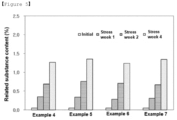
- the total content of related substances was measured for the oral composite tablets in Examples 4 to 7.
- the oral composite tablets prepared in Examples 4 to 7 were each packaged in HDPE bottles and stored in a chamber under severe stability conditions at 60°C.
- week 0 initial
- week 1, week 2, and week 4 the total content of related substances generated from each oral composite tablet was measured according to the analysis conditions below, and the results are shown in Figure 5 .
- the phosphate buffer solution (pH 7.6) in the Mobile phase A and Mobile phase B was made by mixing 5.2 ml of 1.0 mol/L sodium dihydrogen phosphate and 63.0 ml of 0.5 mol/L disodium hydrogen phosphate and adding water to make 1 L.
- the oral composite tablets manufactured in Examples 4 to 7 were found to have excellent stability, as the total content of related substance generated from each oral composite tablet satisfied the standard of 2.0% or less for up to Week 4 of stress.
- the solution mixed with 0.1 N HCl and purified water which is the dissolution medium, reenacts the gastric juice (0.1 N HCl) present in the stomach and the water (purified water) taken together when taking the medicine.
- This is to check the degree of decomposition of esomeprazole, a proton pump inhibitor that can be decomposed at low pH and the antacid power of antacid when taken by humans.
- magnesium hydroxide contained in the lower layer of the oral composite tablets manufactured in Examples 4 to 7 showed a dissolution rate of about 70% or more at 10 minutes.
Landscapes
- Health & Medical Sciences (AREA)
- Public Health (AREA)
- Chemical & Material Sciences (AREA)
- Veterinary Medicine (AREA)
- Medicinal Chemistry (AREA)
- Pharmacology & Pharmacy (AREA)
- Life Sciences & Earth Sciences (AREA)
- Animal Behavior & Ethology (AREA)
- General Health & Medical Sciences (AREA)
- Epidemiology (AREA)
- Engineering & Computer Science (AREA)
- Bioinformatics & Cheminformatics (AREA)
- Inorganic Chemistry (AREA)
- Chemical Kinetics & Catalysis (AREA)
- General Chemical & Material Sciences (AREA)
- Nuclear Medicine, Radiotherapy & Molecular Imaging (AREA)
- Organic Chemistry (AREA)
- Nutrition Science (AREA)
- Physiology (AREA)
- Medicinal Preparation (AREA)
Applications Claiming Priority (2)
| Application Number | Priority Date | Filing Date | Title |
|---|---|---|---|
| KR1020210186751A KR20230097346A (ko) | 2021-12-24 | 2021-12-24 | 프로톤 펌프 저해제 및 제산제를 포함하는 경구용 복합정제의 제조방법 및 이에 의해 제조된 경구용 복합정제 |
| PCT/KR2022/019656 WO2023121054A1 (ko) | 2021-12-24 | 2022-12-06 | 프로톤 펌프 저해제 및 제산제를 포함하는 경구용 복합정제의 제조방법 및 이에 의해 제조된 경구용 복합정제 |
Publications (2)
| Publication Number | Publication Date |
|---|---|
| EP4454641A1 true EP4454641A1 (de) | 2024-10-30 |
| EP4454641A4 EP4454641A4 (de) | 2025-10-22 |
Family
ID=86903016
Family Applications (1)
| Application Number | Title | Priority Date | Filing Date |
|---|---|---|---|
| EP22911687.6A Pending EP4454641A4 (de) | 2021-12-24 | 2022-12-06 | Verfahren zur herstellung einer oralen verbundtablette mit protonenpumpenhemmer und antazid und damit hergestellte orale verbundtablette |
Country Status (6)
| Country | Link |
|---|---|
| US (1) | US20250032420A1 (de) |
| EP (1) | EP4454641A4 (de) |
| KR (1) | KR20230097346A (de) |
| CN (1) | CN118302156A (de) |
| MX (1) | MX2024006979A (de) |
| WO (1) | WO2023121054A1 (de) |
Family Cites Families (8)
| Publication number | Priority date | Publication date | Assignee | Title |
|---|---|---|---|---|
| SE9600071D0 (sv) * | 1996-01-08 | 1996-01-08 | Astra Ab | New oral formulation of two active ingredients I |
| WO2004066924A2 (en) * | 2003-01-24 | 2004-08-12 | Andrx Labs Llc | Novel pharmaceutical formulation containing a proton pump inhibitor and an antacid |
| JP5118962B2 (ja) | 2005-04-28 | 2013-01-16 | エーザイ・アール・アンド・ディー・マネジメント株式会社 | 安定化組成物 |
| KR102034694B1 (ko) * | 2017-12-14 | 2019-10-22 | 한국유나이티드제약 주식회사 | 모사프리드와 라베프라졸을 함유하는 유핵정 복합제제 |
| US12251375B2 (en) * | 2018-08-23 | 2025-03-18 | Chong Kun Dang Pharmaceutical Corp. | Pharmaceutical preparation having excellent dissolution properties, containing esomeprazole and sodium bicarbonate |
| KR102494141B1 (ko) * | 2019-10-18 | 2023-02-01 | 주식회사 대웅테라퓨틱스 | 프로톤 펌프 저해제 및 탄산수소나트륨을 포함하는 안정한 약제학적 조성물 및 이의 제조방법 |
| EP4070789A4 (de) * | 2020-01-23 | 2024-01-24 | Hanmi Pharm. Co., Ltd. | Pharmazeutische verbundformulierung mit protonenpumpenhemmer und antazidum |
| KR102497608B1 (ko) * | 2020-04-27 | 2023-02-08 | 한국유나이티드제약 주식회사 | 모사프리드 및 프로톤펌프억제제를 함유하는 복합제제 |
-
2021
- 2021-12-24 KR KR1020210186751A patent/KR20230097346A/ko active Pending
-
2022
- 2022-12-06 WO PCT/KR2022/019656 patent/WO2023121054A1/ko not_active Ceased
- 2022-12-06 CN CN202280078535.3A patent/CN118302156A/zh active Pending
- 2022-12-06 EP EP22911687.6A patent/EP4454641A4/de active Pending
- 2022-12-06 MX MX2024006979A patent/MX2024006979A/es unknown
- 2022-12-06 US US18/714,147 patent/US20250032420A1/en active Pending
Also Published As
| Publication number | Publication date |
|---|---|
| CN118302156A (zh) | 2024-07-05 |
| KR20230097346A (ko) | 2023-07-03 |
| WO2023121054A1 (ko) | 2023-06-29 |
| MX2024006979A (es) | 2024-06-26 |
| US20250032420A1 (en) | 2025-01-30 |
| EP4454641A4 (de) | 2025-10-22 |
Similar Documents
| Publication | Publication Date | Title |
|---|---|---|
| KR102608890B1 (ko) | 프로톤 펌프 저해제 및 제산제를 포함하는 약학적 조성물 | |
| EP3646855B1 (de) | Orale feste zubereitungszusammensetzung mit protonenpumpenhemmer, orale feste zubereitung damit und herstellungsverfahren dafür | |
| EP3648745B1 (de) | Pharmazeutische zusammensetzung mit kugelförmiger tablette aus mehreren einheiten mit esomeprazol und kugelförmiges, pharmazeutisch verträgliches salz davon und verfahren zur herstellung der pharmazeutischen zusammensetzung | |
| KR101433428B1 (ko) | 안정성이 개선된 설글리코타이드 및 h2 수용체 길항제 함유 다층 정제 및 이의 제조방법 | |
| EP4454641A1 (de) | Verfahren zur herstellung einer oralen verbundtablette mit protonenpumpenhemmer und antazid und damit hergestellte orale verbundtablette | |
| KR102531045B1 (ko) | 프로톤 펌프 저해제 및 제산제를 포함하는 약제학적 복합제제 | |
| KR20220065997A (ko) | 라베프라졸 및 제산제를 포함하는 약제학적 복합제제 및 이의 제조방법 | |
| KR101567937B1 (ko) | 안정성이 개선된 다층 고형 제제 | |
| CN101756935A (zh) | 一种奥美拉唑胶囊及其制备方法 | |
| HK40106528A (zh) | 用於制备包含质子泵抑制剂和抗酸剂的经口复合片剂的方法及由其制备的经口复合片剂 | |
| KR102274147B1 (ko) | 텔미사르탄을 포함하는 단층정 복합 제제 | |
| US12582636B2 (en) | Pharmaceutical composite formulation comprising proton pump inhibitor and antacid | |
| US20240100087A1 (en) | Pharmaceutical composition comprising proton pump inhibitor and antacid | |
| KR102810679B1 (ko) | 제약 조성물 | |
| KR102608889B1 (ko) | 프로톤 펌프 저해제 및 제산제를 포함하는 약제학적 복합제제 및 그의 제조방법 | |
| RU2807610C1 (ru) | Фармацевтическая композиция, содержащая ингибитор протонного насоса и антацидное средство | |
| KR20220028789A (ko) | 에스오메프라졸 함유 다층 정제 | |
| HK40076442B (zh) | 包含质子泵抑制剂和抗酸剂的药物复合制剂 | |
| HK40076442A (en) | Pharmaceutical composite formulation comprising proton pump inhibitor and antacid | |
| HK40071295A (en) | Pharmaceutical composition comprising proton pump inhibitor and antacid | |
| KR101641319B1 (ko) | 안정성이 개선된 에카베트와 라니티딘의 복합 제제 | |
| US20120294937A1 (en) | New pharmaceutical dosage form for the treatment of gastric acid-related disorders | |
| KR102027912B1 (ko) | 경구투여용 탐술로신 또는 이의 약제학적으로 허용되는 염을 포함하는 서방성 삼중정제 | |
| KR20210132388A (ko) | 모사프리드 및 프로톤펌프억제제를 함유하는 복합제제 | |
| HK40083374A (en) | Pharmaceutical composite formulation comprising proton pump inhibitor and antacid, and method for preparing same |
Legal Events
| Date | Code | Title | Description |
|---|---|---|---|
| STAA | Information on the status of an ep patent application or granted ep patent |
Free format text: STATUS: THE INTERNATIONAL PUBLICATION HAS BEEN MADE |
|
| PUAI | Public reference made under article 153(3) epc to a published international application that has entered the european phase |
Free format text: ORIGINAL CODE: 0009012 |
|
| STAA | Information on the status of an ep patent application or granted ep patent |
Free format text: STATUS: REQUEST FOR EXAMINATION WAS MADE |
|
| 17P | Request for examination filed |
Effective date: 20240523 |
|
| AK | Designated contracting states |
Kind code of ref document: A1 Designated state(s): AL AT BE BG CH CY CZ DE DK EE ES FI FR GB GR HR HU IE IS IT LI LT LU LV MC ME MK MT NL NO PL PT RO RS SE SI SK SM TR |
|
| DAV | Request for validation of the european patent (deleted) | ||
| DAX | Request for extension of the european patent (deleted) | ||
| A4 | Supplementary search report drawn up and despatched |
Effective date: 20250919 |
|
| RIC1 | Information provided on ipc code assigned before grant |
Ipc: A61K 9/24 20060101AFI20250915BHEP Ipc: A61K 9/20 20060101ALI20250915BHEP Ipc: A61K 31/4439 20060101ALI20250915BHEP Ipc: A61K 33/00 20060101ALI20250915BHEP Ipc: A61K 33/08 20060101ALI20250915BHEP Ipc: A61P 1/04 20060101ALI20250915BHEP |