EP4454472A1 - Natürlicher käse und verfahren zur herstellung von natürlichem käse mit spezifischen strukturmerkmale - Google Patents
Natürlicher käse und verfahren zur herstellung von natürlichem käse mit spezifischen strukturmerkmale Download PDFInfo
- Publication number
- EP4454472A1 EP4454472A1 EP23214259.6A EP23214259A EP4454472A1 EP 4454472 A1 EP4454472 A1 EP 4454472A1 EP 23214259 A EP23214259 A EP 23214259A EP 4454472 A1 EP4454472 A1 EP 4454472A1
- Authority
- EP
- European Patent Office
- Prior art keywords
- stream
- milk
- streams
- vat
- volume
- Prior art date
- Legal status (The legal status is an assumption and is not a legal conclusion. Google has not performed a legal analysis and makes no representation as to the accuracy of the status listed.)
- Pending
Links
Images



Classifications
-
- A—HUMAN NECESSITIES
- A23—FOODS OR FOODSTUFFS; TREATMENT THEREOF, NOT COVERED BY OTHER CLASSES
- A23C—DAIRY PRODUCTS, e.g. MILK, BUTTER OR CHEESE; MILK OR CHEESE SUBSTITUTES; PREPARATION THEREOF
- A23C19/00—Cheese; Cheese preparations; Making thereof
- A23C19/02—Making cheese curd
-
- A—HUMAN NECESSITIES
- A23—FOODS OR FOODSTUFFS; TREATMENT THEREOF, NOT COVERED BY OTHER CLASSES
- A23C—DAIRY PRODUCTS, e.g. MILK, BUTTER OR CHEESE; MILK OR CHEESE SUBSTITUTES; PREPARATION THEREOF
- A23C13/00—Cream; Cream preparations; Making thereof
- A23C13/12—Cream preparations
- A23C13/14—Cream preparations containing milk products or non-fat milk components
-
- A—HUMAN NECESSITIES
- A23—FOODS OR FOODSTUFFS; TREATMENT THEREOF, NOT COVERED BY OTHER CLASSES
- A23C—DAIRY PRODUCTS, e.g. MILK, BUTTER OR CHEESE; MILK OR CHEESE SUBSTITUTES; PREPARATION THEREOF
- A23C19/00—Cheese; Cheese preparations; Making thereof
- A23C19/02—Making cheese curd
- A23C19/028—Making cheese curd without substantial whey separation from coagulated milk
-
- A—HUMAN NECESSITIES
- A23—FOODS OR FOODSTUFFS; TREATMENT THEREOF, NOT COVERED BY OTHER CLASSES
- A23C—DAIRY PRODUCTS, e.g. MILK, BUTTER OR CHEESE; MILK OR CHEESE SUBSTITUTES; PREPARATION THEREOF
- A23C19/00—Cheese; Cheese preparations; Making thereof
- A23C19/02—Making cheese curd
- A23C19/05—Treating milk before coagulation; Separating whey from curd
-
- A—HUMAN NECESSITIES
- A23—FOODS OR FOODSTUFFS; TREATMENT THEREOF, NOT COVERED BY OTHER CLASSES
- A23C—DAIRY PRODUCTS, e.g. MILK, BUTTER OR CHEESE; MILK OR CHEESE SUBSTITUTES; PREPARATION THEREOF
- A23C19/00—Cheese; Cheese preparations; Making thereof
- A23C19/06—Treating cheese curd after whey separation; Products obtained thereby
- A23C19/068—Particular types of cheese
Definitions
- the invention relates to the field of natural cheese and a method for making natural cheese with specific texture attributes.
- Typical natural cheeses have well known texture attributes.
- Processed cheese such as American cheese, is a food product made from natural cheese with the addition of other ingredients such as emulsifiers, sodium citrate, calcium phosphate, sorbic acid, enzymes, cheese culture, vitamin D3, milk fat, extra salt, saturated vegetable oils, whey and/or artificial food colorings.
- Processed cheese has several advantages over natural cheese including resistance to oiling offs when heated and a uniform look and physical behavior. Disadvantages include an elevated amount of sodium and artificial ingredients.
- the present invention includes a method for accumulating streams from which to make natural cheese including the steps of adding concentrated acidified milk, adding cream, adding homogenized cream, adding water and adding raw milk.
- the present invention includes a method for producing natural cheese including the steps of creating a first stream of raw milk, creating a second stream of concentrated acidified milk, creating a third stream of cream, creating a fourth stream of homogenized cream, creating a fifth stream of water, combining the five streams and making natural cheese from the combined streams.
- the present invention includes a method for producing natural cheese with specific texture and flavor attributes including the steps of creating a first stream of raw milk, creating a second stream of concentrated acidified milk by adding an acidulant to skim milk to reduce the pH to 5.5 - 6.5 and concentrating the acidified milk 3-4 fold, creating a third stream of cream having 35-45% milk fat, creating a fourth stream of homogenized cream having 20-25% milk fat, creating a fifth stream of water, combining the five streams and making natural cheese from the combined streams.
- the invention relates to natural cheese and the production of natural cheese with specific texture attributes.
- the invention utilizes processes within the boundaries of conventional cheese make technology which allow for the tuning of natural cheese texture while maintaining an ingredient statement as that of a Standard of Identity cheese.
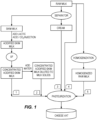
- FIG. 1 an embodiment of one method for making natural cheese with specific texture attributes is shown.
- the method is divided into split streams relating to calcium reduction for melt behavior for example and relating to controlled homogenization for restricted oiling off for example.
- a total of five streams are produced and recombined, however, other numbers of streams can also be utilized.
- raw milk is separated and an acidulant, such as lactic acid, is added to reduce the skim milk pH.
- acidulants such as using a CO 2 injection, can also be utilized.
- the pH is reduced to between 5.5 and 6.5, more particularly reduced to between 5.7 to 5.9 and, more particularly reduced to 5.9.
- the acidified skim milk is ultra-filtrated, as is known in the art, to concentrate the acidified skim milk to 3-5-fold, more particularly to 4-5 fold, and more particularly to 4.5.
- stream 2 a portion of the concentrated acidified milk is re-blended with water to produce a mineral reduced milk stream.
- the resultant stream will have reduced mineral contents such as calcium and phosphorus.
- the raw milk is separated to produce cream with greater than 25% milk fat, more particularly in the range of 25-42%, and more particularly 35%.
- Stream 4 includes raw milk.
- raw milk is standardized to between with between 3-12% milk fat, more particularly to between 3-8% milk fat, and more particularly to 4% milk fat.
- the stream is then homogenized, as is known in the art.
- the streams can be combined in equal or differing percentages to form a unified stream that enters the pasteurization step as will be set forth in more detail below.
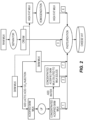
- FIG. 2 a second embodiment of a method for making natural cheese with specific texture attributes is shown.
- Streams 1, 2 and 3 are the same as described above with respect to FIG. 1 .
- Stream 7 is composed of skim milk.
- raw milk is standardized to between with between 12-18% milk fat, more particularly to between 13-16% milk fat, and more particularly to 15% milk fat.
- the stream is then homogenized, as is known in the art.
- the streams can be combined in the same or differing percentages to form a unified stream that enters a pasteurization step.
- Examples of various percentages for the seven streams described in FIGS. 1 and 2 is as follows: Table A. Cheese Milk Formulations (data given are parts per 100 m/m) CT5 CT7 CT4 CT3 V1 V2 V3 V4 V1 V2 V3 V4 V1 V2 V3 V4 V1 V2 V3 V4 V1 V2 V3 V4 Stream 8 0.9 0.9 0.9 Stream 7 47.2 47.2 46.8 46. 8 46. 8 46.8 51. 1 52. 6 48. 5 48. 4 Stream 4 19.7 5 19.7 5 0 19. 2 19. 2 19. 2 19. 2 19. 2 19. 2 Stream 5 39.7 39.7 0 40. 4 40. 3 40.
- the total amount demineralized protein prior to milk standardization is preferably in the range of 30-50%, and more particularly in the range of 45-47%, of total proteins in the vat.
- the total amount of homogenized fat is preferably in the range of 20-40%, and more particularly 35%, prior to milk standardization.
- the milk concentration factor is preferably approximately 1-1.5, and more particularly 1.15.
- the target protein: fat ratio in the final milk is preferably around 0.70-0.95, and more preferably 0.77-0.85. Preferably, these are the parameters that determine the ratios of each stream to the vat.
- Unacidified skim milk concentrates can also be utilized to satisfy the standardization requirements such as amount of demineralized proteins, protein: fat ratio, and milk concentration factor as can be seen in example CT 7 (stream 8).
- Lactose powder (Stream 10) is added to compensate the lactose removal as a result of ultrafiltration as well to aid in acid development during the cheesemaking (CT5 V1 to V3).
- Portion of cream is added with lipolytic enzyme prior to homogenization to generate lipolytic flavor in the final cheese (Stream 9 in CT4 V4).
- the cheese make process proceeds as is known in the art. Additional lactic acid can be added after pasteurization to bring the pH of cheese milk down in the range of 6.1-6.5, and more specifically around 6.2-6.3.
- the results of the method shown in FIGS. 1 and 2 include tailored texture attributes including controlled breakdown of the cheese structure and controlled melting and oiling off in particular. Further attributes include reduced stringiness, reduced oiling off, smooth melt, slightly adhesive, mild flavor, creamy, less acidic, and slightly lipolytic.
- the natural cheese produced from the method disclosed herein preferably has the following compositional characteristics: Moisture 42 - 47% Fat 24 - 35% FDB 41 - 61% Salt 1.5 - 2.7% pH 5.1-5.45 Calcium 350 to 550 mg/100 grams of cheese Lactose ⁇ 0.02%
- the cheese made according to FIGS. 1 and 2 can also be tuned to add flavors.
- a flavor can be added by blending a flavor ferment into the curd after salting and prior to pressing.
- the mineral composition of Stream 2 in the examples is given in Table 3.
- the reduction of calcium and phosphorus achieved by ultrafiltration at pH 5.9 and dilution to starting volume with water is approximately 39% and 46% compared to the starting skim milk.
- Table 3. Total and serum Ca and P contents [mg/100g] in skim milk and demineralized split stream UFpH5.9dl in CT1-4.
- Serum Ca and P is defined as the fraction recovered in the permeate after ultracentrifugation (100,000 x g, lh/5°C).
- Example CT1 the cheese make process was designed to achieve a composition and mimic processing for Monterey Jack type cheese as follows:
- Thickness oil layer [%] [% of initial diameter] [kPa] [-/-] oiling off oil- off stdev Melt area stdev fracture stress stdev frac strain stdev CT1 vat 1(REF) 10.8 2.3 201.0 1.1 57.2 9.9 0.94 0.04 vat 2(REF) 12.8 1.6 196.2 1.8 52.7 7.6 1.04 0.06 vat 3 12.3 2.1 177.7 2.3 70.6 12.1 1.14 0.05 vat 4 9.3 1.6 173.7 4.5 70.4 10.8 1.23 0.05 CT2 vat 1 18.3 1.6 186.0 2.6 103.7 10.1 0.83 0.07 vat 2 15.2 0.4 186.9 5.7 111.8 11.5 0.89 0.04 vat 3 4.2 1.1 180.4 3.8 59.3 7.4 1.17 0.07 vat 4 7.4 1.4 178.1 2.5 64.5 9.2 1.06 0.09 CT3 vat 1 9 2 155.6 3.0 110.8 5.5 0.98 0.04 vat 2 11 1 169.7 3.0 13
- the calcium content of the in the final cheese influences the hot functionality of the cheese such as melt behavior. Despite higher extent of demineralization, cheeses spread less upon melting than the reference cheeses with normal calcium and phosphate content at near identical moisture content.
- Partial homogenization is effective to reduce the extent of oiling-off, compared to the reference cheese and to other variants without homogenized cream. See for example the following:
- Vat 3 and vat 4 had 35% of fat homogenized, vat 1 and vat 2 non-homogenized.
- the upper picture shows shreds before heating, the lower pictures after heating. Oil exudation can be observed as dark zone around the melted cheese.
- melt area modified Schreiber test
- the natural cheeses produced had the following approximate composition: moisture content 41 - 42%, NaCl content 1.8 %, fat content 30% and pH - 5.30.
- the calcium and phosphorus content of these cheeses is reduced by approximately 30% and 40% respectively, compared to a reference cheese.
- the visco-elastic behavior upon heating to 80°C and cooling was markedly different from a standard natural cheese (Monterey Jack), and approached that of processed cheese.
- the Tan ⁇ max (heat) was highest in the natural cheese sample whereas, the Tan ⁇ max (heat) was comparatively low for the processed cheese sample.
- the Tan ⁇ max (heat) for all the test cheeses ranged from 1.65 to 2.01.
- CT5 cheeses are less fluid-like and assumingly more cohesive than the natural cheese.
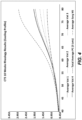
- the cross-over temperature was found to be typically higher for processed cheeses.
- the processed cheeses achieved liquid-like properties only at comparatively higher temperature, compared to the natural cheeses. See Figs. 4 and 5 .
- the rheological analysis indicates differences in molecular assembly of the fat-filled protein matrix of the processed cheese and that of the texture-tuned cheeses of CT6.
- the processed cheese attains fluid-like character at higher temperatures (T crossover heating 12°C higher) and maximum Tan ⁇ remains approx. 35% lower (indicating a higher cohesivity).
- the cheeses produced meets the desired chemical composition.
- Firmness and specific melting properties e.g., oiling-off, spread, low/no stringiness, homogeneous melt
- FIG. 6 there is shown a method for making natural cheese with specific texture and flavor attributes.
- the method uses five streams that are combined, however, other numbers of streams can also be utilized.
- Stream 1 is raw milk as is known in the art.
- Stream 2 is milk, such as skim milk, that has been separated from the raw milk, acidified, ultrafiltered and concentrated. More specifically, an acidulant, such as lactic acid, is added to reduce the pH. Other acidulants, such as a CO 2 injection, can also be utilized. The pH is reduced to between 5.5 and 6.5, and more particularly reduced to between 5.7 to 6.0. Following pH adjustment, the acidified skim milk is ultra-filtrated, as is known in the art, to concentrate the acidified skim milk to 3-5-fold, more particularly to 3-4 fold, and more particularly to 3 fold.
- an acidulant such as lactic acid
- Other acidulants such as a CO 2 injection
- Stream 3 is cream that has been separated from the raw milk.
- the fat content of the cream can be greater than 25%, however, other ranges can be utilized such as 20 - 50%, 35 - 45% and more particularly 40 - 45%.
- Stream 4 is a homogenized cream stream.
- the fat content ranges that can be utilized include 15 - 30%, 20 - 25% and more particularly approximately 25%.
- Stream 5 is water such as standard culinary type water.
- the five streams can be combined in equal or differing percentages by weight or by volume to form a unified stream for pasteurization.
- percentages by volume can be used: Table 9: Stream Combination Percentages STREAM PERCENTAGE BY VOLUME 1 20-30% 2 20-30% 3 3-10% 4 4 - 15% 5 20 - 40%
- the approximate percentages by volume are Stream 1 are 24-28%, Stream 2 are 27-28%, Stream 3 are 5 - 6%, Stream 4 are 7 - 9% and Stream 5 are 31-35%.
- the percentages by volume are approximately Stream 1 25%, Stream 2 25%, Stream 3 5%, Stream 4 10% and Stream 5 35%.
- the cheese make process proceeds as is known in the art. Additional lactic acid or CO2 can be added after pasteurization to bring the pH of cheese milk in the range of 5.8 - 6.35, and more specifically in the range of 5.95 - 6.10.
- the results of the method shown in FIG. 6 include tailored texture attributes such as increased plasticity, minimal free oil and more flowable body upon heating, and improved melt profile, and unique flavors such as savory, umami, and fresh dairy.
- the natural cheese produced from the method in FIG. 6 preferably has the following compositional characteristics: Table 10: Compositional Characteristics Moisture 47-53% Fat 20 - 30% FDB 38 - 62% Salt 1.3 - 2.7% pH 5.0 - 5.5 Calcium 350 to 550 mg/100 grams of cheese Lactose 0.01 - 0.10%
Landscapes
- Life Sciences & Earth Sciences (AREA)
- Chemical & Material Sciences (AREA)
- Engineering & Computer Science (AREA)
- Food Science & Technology (AREA)
- Polymers & Plastics (AREA)
- Dairy Products (AREA)
Applications Claiming Priority (1)
| Application Number | Priority Date | Filing Date | Title |
|---|---|---|---|
| US18/141,032 US20230329263A1 (en) | 2020-07-27 | 2023-04-28 | Natural Cheese and Method for Making Natural Cheese with Specific Texture Attributes |
Publications (1)
| Publication Number | Publication Date |
|---|---|
| EP4454472A1 true EP4454472A1 (de) | 2024-10-30 |
Family
ID=89119540
Family Applications (1)
| Application Number | Title | Priority Date | Filing Date |
|---|---|---|---|
| EP23214259.6A Pending EP4454472A1 (de) | 2023-04-28 | 2023-12-05 | Natürlicher käse und verfahren zur herstellung von natürlichem käse mit spezifischen strukturmerkmale |
Country Status (4)
| Country | Link |
|---|---|
| EP (1) | EP4454472A1 (de) |
| AU (1) | AU2023270283B2 (de) |
| CA (1) | CA3220040A1 (de) |
| MX (1) | MX2023013621A (de) |
Citations (1)
| Publication number | Priority date | Publication date | Assignee | Title |
|---|---|---|---|---|
| US20220022477A1 (en) * | 2020-07-27 | 2022-01-27 | Sargento Foods Inc. | Natural Cheese And Method For Making Natural Cheese With Specific Texture Attributes |
Family Cites Families (1)
| Publication number | Priority date | Publication date | Assignee | Title |
|---|---|---|---|---|
| NZ511003A (en) * | 2001-04-06 | 2003-06-30 | Fonterra Tech Ltd | preparing a fat containing stable dairy based food product such as cheese |
-
2023
- 2023-11-14 CA CA3220040A patent/CA3220040A1/en active Pending
- 2023-11-16 MX MX2023013621A patent/MX2023013621A/es unknown
- 2023-11-23 AU AU2023270283A patent/AU2023270283B2/en active Active
- 2023-12-05 EP EP23214259.6A patent/EP4454472A1/de active Pending
Patent Citations (1)
| Publication number | Priority date | Publication date | Assignee | Title |
|---|---|---|---|---|
| US20220022477A1 (en) * | 2020-07-27 | 2022-01-27 | Sargento Foods Inc. | Natural Cheese And Method For Making Natural Cheese With Specific Texture Attributes |
Non-Patent Citations (1)
| Title |
|---|
| OOMMEN B S ET AL: "EFFECT OF HOMOGENIZATION OF CREAM ON COMPOSITION, YIELD, AND FUNCTIONALITY OF CHEDDAR CHEESE MADE FROM MILK SUPPLEMENTED WITH ULTRAFILTERED MILK", DAIRY SCIENCE AND TECHNOLOGY (LE LAIT), EDP SCIENCES, PARIS, FR, vol. 80, no. 1, 1 January 2000 (2000-01-01), pages 77 - 91, XP008024260, ISSN: 0023-7302, DOI: 10.1051/LAIT:2000109 * |
Also Published As
| Publication number | Publication date |
|---|---|
| MX2023013621A (es) | 2024-02-21 |
| AU2023270283A1 (en) | 2024-11-14 |
| AU2023270283B2 (en) | 2025-11-20 |
| CA3220040A1 (en) | 2025-04-26 |
Similar Documents
| Publication | Publication Date | Title |
|---|---|---|
| EP2120591B1 (de) | Neuer trink-joghurt und verfahren zu seiner herstellung | |
| RU2658763C2 (ru) | Обогащенные минеральными веществами молока молочные продукты и способы их получения | |
| CA2207881C (en) | Melt-controlled cheese | |
| US6303160B1 (en) | High moisture cream cheese texture control | |
| EP1769683B1 (de) | Rahmkäse mit hohem Wasser- und niedrigem Fettgehalt und Verfahren zu seiner Herstellung | |
| EP3393264B1 (de) | Molkereiprodukt und molkereiverfahren | |
| US6475538B2 (en) | Process for mozzarella cheese | |
| EP2332422A1 (de) | Käsealternativprodukt und Verfahren zu dessen Herstellung | |
| US20240284928A1 (en) | Natural Cheese and Method for Making Natural Cheese with Specific Texture Attributes | |
| US8192779B2 (en) | Production of natural cheese product | |
| EP4454472A1 (de) | Natürlicher käse und verfahren zur herstellung von natürlichem käse mit spezifischen strukturmerkmale | |
| WO2009056680A1 (en) | Cheese and method for its manufacture | |
| MX2008007023A (es) | Suero de mantequilla y crema calentados para fabricar un producto de queso crama. | |
| US20230329263A1 (en) | Natural Cheese and Method for Making Natural Cheese with Specific Texture Attributes | |
| US20020122845A1 (en) | Cheese with characteristics of different natural cheeses | |
| JPH1052224A (ja) | 酸性高タンパク質成形食品の製造法 | |
| EP2813147A1 (de) | Frischkäseprodukt | |
| KR20260011346A (ko) | 치즈멜로우 및 그 제조방법 | |
| Bogsan et al. | Buffalo Mozzarella Cheese: Knowledge from the East and the West | |
| El-Tahra et al. | Effect of adding CaCl2 or whey protein to cow’s milk on Mozzarella cheese properties | |
| JP2021040526A (ja) | 低脂肪フレッシュチーズおよびその製造方法 | |
| Debnath et al. | Effect of processing parameters on quality attributes of cream cheese | |
| Guinee | 31 What effects has homogenisation of milk on the manufacture and quality of cheese? | |
| HK1262602B (en) | Dairy product and processes | |
| MXPA06011254A (en) | High moisture, low fat cream cheese with maintained product quality and method for making same |
Legal Events
| Date | Code | Title | Description |
|---|---|---|---|
| PUAI | Public reference made under article 153(3) epc to a published international application that has entered the european phase |
Free format text: ORIGINAL CODE: 0009012 |
|
| STAA | Information on the status of an ep patent application or granted ep patent |
Free format text: STATUS: THE APPLICATION HAS BEEN PUBLISHED |
|
| AK | Designated contracting states |
Kind code of ref document: A1 Designated state(s): AL AT BE BG CH CY CZ DE DK EE ES FI FR GB GR HR HU IE IS IT LI LT LU LV MC ME MK MT NL NO PL PT RO RS SE SI SK SM TR |
|
| STAA | Information on the status of an ep patent application or granted ep patent |
Free format text: STATUS: REQUEST FOR EXAMINATION WAS MADE |
|
| 17P | Request for examination filed |
Effective date: 20241212 |
|
| STAA | Information on the status of an ep patent application or granted ep patent |
Free format text: STATUS: EXAMINATION IS IN PROGRESS |
|
| 17Q | First examination report despatched |
Effective date: 20250325 |