EP4450463A1 - Positivelektrodenaktivmaterial, positivelektrodenplatte, sekundärbatterie mit wasserfreiem elektrolyt und verfahren zur herstellung eines positivelektrodenaktivmaterials - Google Patents
Positivelektrodenaktivmaterial, positivelektrodenplatte, sekundärbatterie mit wasserfreiem elektrolyt und verfahren zur herstellung eines positivelektrodenaktivmaterials Download PDFInfo
- Publication number
- EP4450463A1 EP4450463A1 EP24162312.3A EP24162312A EP4450463A1 EP 4450463 A1 EP4450463 A1 EP 4450463A1 EP 24162312 A EP24162312 A EP 24162312A EP 4450463 A1 EP4450463 A1 EP 4450463A1
- Authority
- EP
- European Patent Office
- Prior art keywords
- positive electrode
- lithium
- active material
- electrode active
- particles
- Prior art date
- Legal status (The legal status is an assumption and is not a legal conclusion. Google has not performed a legal analysis and makes no representation as to the accuracy of the status listed.)
- Pending
Links
Images

Classifications
-
- H—ELECTRICITY
- H01—ELECTRIC ELEMENTS
- H01M—PROCESSES OR MEANS, e.g. BATTERIES, FOR THE DIRECT CONVERSION OF CHEMICAL ENERGY INTO ELECTRICAL ENERGY
- H01M4/00—Electrodes
- H01M4/02—Electrodes composed of, or comprising, active material
- H01M4/36—Selection of substances as active materials, active masses, active liquids
- H01M4/48—Selection of substances as active materials, active masses, active liquids of inorganic oxides or hydroxides
- H01M4/50—Selection of substances as active materials, active masses, active liquids of inorganic oxides or hydroxides of manganese
- H01M4/505—Selection of substances as active materials, active masses, active liquids of inorganic oxides or hydroxides of manganese of mixed oxides or hydroxides containing manganese for inserting or intercalating light metals, e.g. LiMn2O4 or LiMn2OxFy
-
- C—CHEMISTRY; METALLURGY
- C01—INORGANIC CHEMISTRY
- C01G—COMPOUNDS CONTAINING METALS NOT COVERED BY SUBCLASSES C01D OR C01F
- C01G53/00—Compounds of nickel
- C01G53/40—Complex oxides containing nickel and at least one other metal element
- C01G53/42—Complex oxides containing nickel and at least one other metal element containing alkali metals, e.g. LiNiO2
- C01G53/44—Complex oxides containing nickel and at least one other metal element containing alkali metals, e.g. LiNiO2 containing manganese
- C01G53/50—Complex oxides containing nickel and at least one other metal element containing alkali metals, e.g. LiNiO2 containing manganese of the type (MnO2)n-, e.g. Li(NixMn1-x)O2 or Li(MyNixMn1-x-y)O2
-
- H—ELECTRICITY
- H01—ELECTRIC ELEMENTS
- H01M—PROCESSES OR MEANS, e.g. BATTERIES, FOR THE DIRECT CONVERSION OF CHEMICAL ENERGY INTO ELECTRICAL ENERGY
- H01M10/00—Secondary cells; Manufacture thereof
- H01M10/05—Accumulators with non-aqueous electrolyte
-
- H—ELECTRICITY
- H01—ELECTRIC ELEMENTS
- H01M—PROCESSES OR MEANS, e.g. BATTERIES, FOR THE DIRECT CONVERSION OF CHEMICAL ENERGY INTO ELECTRICAL ENERGY
- H01M10/00—Secondary cells; Manufacture thereof
- H01M10/05—Accumulators with non-aqueous electrolyte
- H01M10/052—Li-accumulators
- H01M10/0525—Rocking-chair batteries, i.e. batteries with lithium insertion or intercalation in both electrodes; Lithium-ion batteries
-
- H—ELECTRICITY
- H01—ELECTRIC ELEMENTS
- H01M—PROCESSES OR MEANS, e.g. BATTERIES, FOR THE DIRECT CONVERSION OF CHEMICAL ENERGY INTO ELECTRICAL ENERGY
- H01M4/00—Electrodes
- H01M4/02—Electrodes composed of, or comprising, active material
- H01M4/13—Electrodes for accumulators with non-aqueous electrolyte, e.g. for lithium-accumulators; Processes of manufacture thereof
- H01M4/131—Electrodes based on mixed oxides or hydroxides, or on mixtures of oxides or hydroxides, e.g. LiCoOx
-
- H—ELECTRICITY
- H01—ELECTRIC ELEMENTS
- H01M—PROCESSES OR MEANS, e.g. BATTERIES, FOR THE DIRECT CONVERSION OF CHEMICAL ENERGY INTO ELECTRICAL ENERGY
- H01M4/00—Electrodes
- H01M4/02—Electrodes composed of, or comprising, active material
- H01M4/36—Selection of substances as active materials, active masses, active liquids
- H01M4/362—Composites
- H01M4/366—Composites as layered products
-
- H—ELECTRICITY
- H01—ELECTRIC ELEMENTS
- H01M—PROCESSES OR MEANS, e.g. BATTERIES, FOR THE DIRECT CONVERSION OF CHEMICAL ENERGY INTO ELECTRICAL ENERGY
- H01M4/00—Electrodes
- H01M4/02—Electrodes composed of, or comprising, active material
- H01M4/36—Selection of substances as active materials, active masses, active liquids
- H01M4/48—Selection of substances as active materials, active masses, active liquids of inorganic oxides or hydroxides
- H01M4/52—Selection of substances as active materials, active masses, active liquids of inorganic oxides or hydroxides of nickel, cobalt or iron
- H01M4/525—Selection of substances as active materials, active masses, active liquids of inorganic oxides or hydroxides of nickel, cobalt or iron of mixed oxides or hydroxides containing iron, cobalt or nickel for inserting or intercalating light metals, e.g. LiNiO2, LiCoO2 or LiCoOxFy
-
- C—CHEMISTRY; METALLURGY
- C01—INORGANIC CHEMISTRY
- C01P—INDEXING SCHEME RELATING TO STRUCTURAL AND PHYSICAL ASPECTS OF SOLID INORGANIC COMPOUNDS
- C01P2002/00—Crystal-structural characteristics
- C01P2002/80—Crystal-structural characteristics defined by measured data other than those specified in group C01P2002/70
- C01P2002/88—Crystal-structural characteristics defined by measured data other than those specified in group C01P2002/70 by thermal analysis data, e.g. TGA, DTA, DSC
-
- C—CHEMISTRY; METALLURGY
- C01—INORGANIC CHEMISTRY
- C01P—INDEXING SCHEME RELATING TO STRUCTURAL AND PHYSICAL ASPECTS OF SOLID INORGANIC COMPOUNDS
- C01P2004/00—Particle morphology
- C01P2004/01—Particle morphology depicted by an image
- C01P2004/03—Particle morphology depicted by an image obtained by SEM
-
- C—CHEMISTRY; METALLURGY
- C01—INORGANIC CHEMISTRY
- C01P—INDEXING SCHEME RELATING TO STRUCTURAL AND PHYSICAL ASPECTS OF SOLID INORGANIC COMPOUNDS
- C01P2004/00—Particle morphology
- C01P2004/30—Particle morphology extending in three dimensions
- C01P2004/45—Aggregated particles or particles with an intergrown morphology
-
- C—CHEMISTRY; METALLURGY
- C01—INORGANIC CHEMISTRY
- C01P—INDEXING SCHEME RELATING TO STRUCTURAL AND PHYSICAL ASPECTS OF SOLID INORGANIC COMPOUNDS
- C01P2004/00—Particle morphology
- C01P2004/51—Particles with a specific particle size distribution
-
- C—CHEMISTRY; METALLURGY
- C01—INORGANIC CHEMISTRY
- C01P—INDEXING SCHEME RELATING TO STRUCTURAL AND PHYSICAL ASPECTS OF SOLID INORGANIC COMPOUNDS
- C01P2004/00—Particle morphology
- C01P2004/60—Particles characterised by their size
- C01P2004/61—Micrometer sized, i.e. from 1-100 micrometer
-
- C—CHEMISTRY; METALLURGY
- C01—INORGANIC CHEMISTRY
- C01P—INDEXING SCHEME RELATING TO STRUCTURAL AND PHYSICAL ASPECTS OF SOLID INORGANIC COMPOUNDS
- C01P2004/00—Particle morphology
- C01P2004/60—Particles characterised by their size
- C01P2004/62—Submicrometer sized, i.e. from 0.1-1 micrometer
-
- C—CHEMISTRY; METALLURGY
- C01—INORGANIC CHEMISTRY
- C01P—INDEXING SCHEME RELATING TO STRUCTURAL AND PHYSICAL ASPECTS OF SOLID INORGANIC COMPOUNDS
- C01P2004/00—Particle morphology
- C01P2004/60—Particles characterised by their size
- C01P2004/64—Nanometer sized, i.e. from 1-100 nanometer
-
- C—CHEMISTRY; METALLURGY
- C01—INORGANIC CHEMISTRY
- C01P—INDEXING SCHEME RELATING TO STRUCTURAL AND PHYSICAL ASPECTS OF SOLID INORGANIC COMPOUNDS
- C01P2004/00—Particle morphology
- C01P2004/80—Particles consisting of a mixture of two or more inorganic phases
-
- C—CHEMISTRY; METALLURGY
- C01—INORGANIC CHEMISTRY
- C01P—INDEXING SCHEME RELATING TO STRUCTURAL AND PHYSICAL ASPECTS OF SOLID INORGANIC COMPOUNDS
- C01P2006/00—Physical properties of inorganic compounds
- C01P2006/10—Solid density
-
- C—CHEMISTRY; METALLURGY
- C01—INORGANIC CHEMISTRY
- C01P—INDEXING SCHEME RELATING TO STRUCTURAL AND PHYSICAL ASPECTS OF SOLID INORGANIC COMPOUNDS
- C01P2006/00—Physical properties of inorganic compounds
- C01P2006/40—Electric properties
-
- Y—GENERAL TAGGING OF NEW TECHNOLOGICAL DEVELOPMENTS; GENERAL TAGGING OF CROSS-SECTIONAL TECHNOLOGIES SPANNING OVER SEVERAL SECTIONS OF THE IPC; TECHNICAL SUBJECTS COVERED BY FORMER USPC CROSS-REFERENCE ART COLLECTIONS [XRACs] AND DIGESTS
- Y02—TECHNOLOGIES OR APPLICATIONS FOR MITIGATION OR ADAPTATION AGAINST CLIMATE CHANGE
- Y02E—REDUCTION OF GREENHOUSE GAS [GHG] EMISSIONS, RELATED TO ENERGY GENERATION, TRANSMISSION OR DISTRIBUTION
- Y02E60/00—Enabling technologies; Technologies with a potential or indirect contribution to GHG emissions mitigation
- Y02E60/10—Energy storage using batteries
Definitions
- the present disclosure relates to a positive electrode active material, and it also relates to a positive electrode plate, a non-aqueous electrolyte secondary battery, and a method of producing a positive electrode active material.
- Japanese Patent Laying-Open No. 2020-87879 discloses a lithium-metal composite oxide that is formed of secondary particles each of which is an aggregate of primary particles as well as single particles which are present independently of the secondary particles, and it suggests blending the single particles with the secondary particles to achieve a bimodal distribution (a distribution with two peaks) of the circularity of the active material for enhancing packing density.
- a positive electrode plate that comprises, as a positive electrode active material, single particles and aggregate particles including a nickel-cobalt-manganese-based compound (hereinafter also called a Hi-Ni-based NCM compound) having a high nickel ratio is likely to experience breakage of the aggregate particles in a compression step during production, and the particle breakage can spread at the time of cycle testing.
- a nickel-cobalt-manganese-based compound hereinafter also called a Hi-Ni-based NCM compound
- An object of the present disclosure is to provide a positive electrode active material which comprises single particles and aggregate particles including a Hi-Ni-based NCM compound and which can achieve both energy density and cycling performance, a positive electrode plate and a non-aqueous electrolyte secondary battery including the same, as well as a method of producing the positive electrode active material.
- the present disclosure provides a positive electrode active material, a positive electrode plate, a non-aqueous electrolyte secondary battery, and a method of producing a positive electrode active material as described below.
- a particle may mean not only “one particle” but also “a group of particles (powder, particles)”.
- a positive electrode active material includes single particles and aggregate particles. With this configuration, the packing density of a positive electrode active material layer of a positive electrode plate can be easily enhanced.
- the positive electrode active material may consist essentially of single particles and aggregate particles.
- the positive electrode active material according to the present embodiment can be for a non-aqueous electrolyte secondary battery. Details of the non-aqueous electrolyte secondary battery will be described below.
- the size of the single particles and the aggregate particles is not particularly limited.
- the average particle size (D50) of the single particles may be from 1 ⁇ m to 20 ⁇ m, preferably from 1 ⁇ m to 10 ⁇ m, more preferably from 1 ⁇ m to 5 ⁇ m.
- the average particle size (D50, D70, D30) of the aggregate particles may be from 1 ⁇ m to 40 ⁇ m, preferably from 1 ⁇ m to 30 ⁇ m, more preferably from 1 ⁇ m to 20 ⁇ m.
- the average particle sizes D50, D70, and D30 refer to particle sizes in volume-based particle size distribution at which the cumulative particle volume accumulated from the side of small particle sizes reaches 50%, 70%, and 30%, respectively, of the total particle volume.
- the average particle size may be measured by laser diffraction and scattering.
- the aggregate particle may be an aggregate of primary particles.
- a primary particle refers to a particle whose grain boundary is not visually identified in an SEM image of the particle, and whose average primary particle size is less than 0.5 ⁇ m.
- the average primary particle size refers to the distance between two points located farthest apart from each other on the outline of the primary particle.
- the average primary particle size of the primary particles may be from 0.05 ⁇ m to 0.2 ⁇ m, or from 0.1 ⁇ m to 0.2 ⁇ m, for example.
- each of 10 or more primary particles randomly selected from an SEM image of one aggregated particle has an average primary particle size from 0.05 ⁇ m to 0.2 ⁇ m
- the average primary particle size of all the primary particles included in this aggregated particle is from 0.05 ⁇ m to 0.2 ⁇ m.
- the primary particles may have an average primary particle size from 0.1 ⁇ m to 0.2 ⁇ m, for example.
- the single particles and the aggregate particles (primary particles) include a nickel-cobalt-manganese-based compound (hereinafter also called an NCM compound).
- the NCM compound included in the single particles has a ratio of nickel of 70 mol% or more, preferably 73 mol% or more, more preferably 76 mol% or more.
- the NCM compound included in the aggregate particles (primary particles) has a ratio of nickel of 75 mol% or more, preferably 78 mol% or more, more preferably 81 mol% or more.
- the ratio of nickel refers to the ratio of nickel to metallic elements except lithium.
- the NCM compound includes a nickel-cobalt-manganese composite hydroxide, more preferably a lithium-nickel-cobalt-manganese composite oxide.
- the nickel-cobalt-manganese composite hydroxide may be obtained by coprecipitation and/or the like, for example.
- the molar ratio of lithium to nickel, cobalt, and manganese namely Li:(Ni+Co+Mn)
- the molar ratio of lithium to nickel, cobalt, and manganese can be (1.0 to 12):1.0, for example.
- the single particles may include one, two, or more types of a first layered metal oxide represented by the following formula (1): Li 1-a1 Ni x1 Me 1 1-x1 O 2 (1) [in the formula (1),
- the primary particles may include one, two, or more types of a second layered metal oxide represented by the following formula (2): Li 1-a2 Ni x2 Me 2 1-x2 O 2 (2) [in the formula (2),
- the single particles may include at least one selected from the group consisting of LiNi 0.7 Co 0.2 Mn 0.1 O 2 , LiNi 0.7 Co 0.1 Mn 0.2 O 2 O 2 , and LiNi 0.8 Co 0.1 Mn 0.1 O 2 .
- the primary particles may include at least one selected from the group consisting of LiNi 0.75 Co 0.15 Mn 0.1 O 2 , LiNi 0.75 Co 0.1 Mn 0.15 O 2 , and LiNi 0.8 Co 0.1 Mn 0.1 O 2 .
- both the single particles and the primary particles may consist essentially of LiNi 0.75 Co 0.15 Mn 0.1 O 2 .
- both the single particles and the primary particles may consist essentially of LiNi 0.75 Co 0.1 Mn 0.15 O 2 .
- both the single particles and the primary particles may consist essentially of LiNi 0.8 Co 0.1 Mn 0.1 O 2 .
- the single particles may consist essentially of LiNi 0.7 Co 0.2 Mn 0.1 O 2 and the primary particles may consist essentially of LiNi 0.75 Co 0.1 Mn 0.15 O 2 .
- the single particles may consist essentially of LiNi 0.7 Co 0.2 Mn 0.1 O 2 and the primary particles may consist essentially of LiNi 0.75 Co 0.15 Mn 0.1 O 2 .
- the single particles include a lithium-nickel-cobalt-manganese composite oxide
- the single particles can be obtained by mixing a lithium source such as, for example, lithium hydroxide with a nickel-cobalt-manganese composite hydroxide and calcining the resultant, followed by wet grinding in a ball mill and/or the like and drying.
- the single particles may have been surface-treated.
- the aggregate particles further include a phosphoric acid compound, as well as at least one selected from the group consisting of a lithium-containing metal oxide and lithium borate (Li 3 BO 3 ).
- a lithium-containing metal oxide and lithium borate Li 3 BO 3
- the extent of lithium extraction from inside the aggregate particles can be evaluated based on the DTG peak value of a TG curve obtainable by differential thermogravimetric (DTG) measurement described in the Examples section.
- the phosphoric acid compound can include lithium phosphate (Li 3 PO 4 ) and/or the like, for example.
- the lithium-containing metal oxide can include at least one selected from the group consisting of lithium tungstate (Li 2 WO 4 ), lithium zirconate (Li 2 ZrO 3 ), lithium titanate (Li 2 TiO 3 ), and lithium aluminate (LiAlO 2 ), for example.
- the aggregate particles preferably include lithium borate.
- the aggregate particles are a lithium-nickel-cobalt-manganese composite oxide
- the aggregate particles can be obtained by mixing a lithium source such as, for example, lithium hydroxide, with a nickel-cobalt-manganese composite hydroxide and calcining the resultant to obtain a lithium-nickel-cobalt-manganese composite oxide (hereinafter also called a lithium composite oxide) having an aggregated structure, followed by surface treatment of the resulting lithium composite oxide having an aggregated structure with a phosphoric acid compound, and then heat treatment with the use of at least one selected from the group consisting of a metal oxide and boric acid as well as a lithium salt.
- a lithium source such as, for example, lithium hydroxide
- a nickel-cobalt-manganese composite hydroxide nickel-cobalt-manganese composite hydroxide
- a lithium composite oxide having an aggregated structure
- the method for surface treatment of the lithium composite oxide having an aggregated structure with a phosphoric acid compound can be, for example, mechanochemical treatment and the like.
- mechanochemical treatment By performing mechanochemical treatment, it is possible to facilitate formation of a phosphoric acid compound layer on the surface of aggregate particles.
- the mechanochemical treatment can be a treatment that involves subjecting, in a dry mode for example, a base (particles made of the lithium composite oxide having an aggregated structure) and covering substance particles (lithium phosphate) to high-speed rotation together with a medium (zirconia beads) inside a vessel, to crush and bond the covering substance particles to the surface of the base to achieve covering.
- the molar ratio of the covering substance particles to the base may be from 0.01 mol% to 2.0 mol %, for example.
- the method for heat treatment of the lithium composite oxide having an aggregated structure surface-treated with the phosphoric acid compound (which is also called a surface-treated lithium composite oxide) with the use of at least one selected from the group consisting of a metal oxide and boric acid (H 3 BO 3 ) as well as a lithium salt can be, for example, a method that involves mixing the surface-treated lithium composite oxide with at least one selected from the group consisting of a metal oxide and boric acid as well as a lithium salt and heating the resultant at a temperature from 200°C to 400°C for a duration from 3 minutes to 120 minutes.
- the lithium salt include lithium carbonate and the like.
- the metal oxide examples include tungstic acid (H 3 BO 3 ), zirconic acid (H 4 O 4 Zr), titanic acid (H 4 TiO 4 ), aluminic acid (HAlO 2 ), and the like.
- the heat treatment time is preferably from 10 minutes to 60 minutes, from the viewpoints of energy density and cycling performance.
- the molar ratio of the total mass of the lithium-containing metal oxide and the lithium borate with respect to the phosphoric acid compound in the aggregate particles (hereinafter also called the covering ratio) is 5.0 or less.
- the lower limit to the covering ratio may be 0.5 or more, or 0.8 or more, or 1.0 or more, for example.
- the upper limit to the covering ratio may be 4.0 or less, or 3.0 or less, or 2.0 or less, or 1.8 or less, for example.
- the mass ratio between the single particles and the aggregate particles in the positive electrode active material may be, for example, from 20:80 to 50:50, preferably from 30:70 to 50:50. With the mass ratio between the single particles and the aggregate particles in the positive electrode active material being within the above-mentioned range, packing properties tend to be enhanced.
- the DTG peak value of the positive electrode active material may be, for example, less than 3.2%/min, preferably 3.0%/min or less, more preferably 2.0%/min or less, further preferably 1.5%/min or less.
- the DTG peak value of the positive electrode active material is measured by a method that is described below in the Examples section.
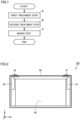
- the method of producing a positive electrode active material includes a first treatment step (A) that involves coating aggregate particles with a phosphoric acid compound by, for example, mechanochemical treatment and/or the like, a second treatment step (B) that involves performing heat treatment of the aggregate particles after the first treatment step with the use of at least one selected from the group consisting of a metal oxide and boric acid as well as a lithium salt, and a mixing step (C) that involves mixing the aggregate particles after the second treatment step with single particles.
- a first treatment step (A) that involves coating aggregate particles with a phosphoric acid compound by, for example, mechanochemical treatment and/or the like
- a second treatment step (B) that involves performing heat treatment of the aggregate particles after the first treatment step with the use of at least one selected from the group consisting of a metal oxide and boric acid as well as a lithium salt
- a mixing step (C) that involves mixing the aggregate particles after the second treatment step with single particles.
- Fig. 2 is a schematic view illustrating an example of a non-aqueous electrolyte secondary battery according to the present embodiment.
- a battery 100 illustrated in Fig. 2 may be, for example, a lithium-ion battery as a main electric power supply or a motive force assisting electric power supply of an electric vehicle.
- Battery 100 includes an exterior package 90. Exterior package 90 accommodates an electrode assembly 50 and an electrolyte (not illustrated). Electrode assembly 50 is connected to a positive electrode terminal 91 via a positive electrode current-collecting member 81. Electrode assembly 50 is connected to a negative electrode terminal 92 via a negative electrode current-collecting member 82.
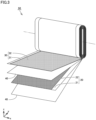
- Fig. 3 is a schematic view illustrating an example of an electrode assembly according to the present embodiment. Electrode assembly 50 is a wound-type one. Electrode assembly 50 includes a positive electrode plate 20, a separator 40, and a negative electrode plate 30. That is, battery 100 includes positive electrode plate 20. Positive electrode plate 20 includes a positive electrode active material layer 22 and a positive electrode base material 21. Negative electrode plate 30 includes a negative electrode active material layer 32 and a negative electrode base material 31.
- positive electrode active material layer 22 may be formed directly or indirectly on one side or both sides of positive electrode base material 21.
- Positive electrode base material 21 may be a conductive sheet made of Al alloy foil, pure Al foil, and/or the like, for example.
- Positive electrode active material layer 22 includes a positive electrode active material including single particles 11 and aggregate particles 12.
- Positive electrode active material layer 22 includes the above-described positive electrode active material.
- Positive electrode active material layer 22 may further include a conductive material, a binder, and the like.
- Positive electrode active material layer 22 may have a thickness from 10 ⁇ m to 200 ⁇ m, for example. Positive electrode active material layer 22 may have a high density. The density of positive electrode active material layer 22 may be 3.65 g/cm 3 or more, or 3.7 g/cm 3 or more, or 3.8 g/cm 3 or more, for example. The density of positive electrode active material layer 22 may be 4.0 g/cm 3 or less, for example.
- the method of producing positive electrode plate 20 includes preparation of a positive electrode slurry (A), application (B), and rolling (C).
- a positive electrode slurry including the above-described positive electrode active material is prepared.
- the positive electrode slurry is prepared by dispersing the positive electrode active material in a dispersion medium.
- the dispersion medium may be an organic solvent, and the examples thereof include N-methyl-2-pyrrolidone (NMP), tetrahydrofuran (THF), dimethylformamide (DMF), methyl ethyl ketone (MEK), dimethyl sulfoxide (DMSO), and the like.
- the positive electrode slurry can include a conductive material and a binder.
- the conductive material include carbon nanotubes, carbon black such as acetylene black (AB), other carbon materials (such as graphite, for example), and the like.
- the binder include polyvinylidene difluoride (PVdF), polytetrafluoroethylene (PTFE), polyimide (PI), polyamide (PA), polyamide-imide (PAI), butadiene rubber (BR), styrenebutadiene rubber (SBR), nitrile-butadiene rubber (NBR), styrene-ethylene-butylene-styrene block copolymer (SEBS), carboxymethyl cellulose (CMC), a combination of these, and the like.
- the slurry may have a solid concentration from 40% to 80%, for example.
- any stirring apparatus, any mixing apparatus, and/or any dispersing apparatus may be used.
- the positive electrode slurry is applied to the surface of positive electrode base material 21 to form positive electrode active material layer 22.
- positive electrode active material layer 22 and positive electrode base material 21 are rolled together to produce positive electrode plate 20.
- a raw sheet of positive electrode plate 20 is produced. The raw sheet may be cut into a certain planar size, depending on the specifications of battery 100.
- a nickel-cobalt-manganese composite hydroxide obtained by coprecipitation having a composition of Ni 0.78 Co 0.11 Mn 0.11 (OH) 2 was calcined at 500°C to obtain a nickel-cobalt-manganese composite oxide (Z1).
- lithium hydroxide and the nickel-cobalt-manganese composite oxide (Z1) were mixed together so as to achieve a molar ratio of Li to the total amount of Ni, Co, and Mn of 1.05:1, and the resulting mixture was calcined in an oxygen atmosphere at 900°C for 72 hours and then wet ground in a ball mill and dried to form a single particle structure, followed by another heat treatment in an oxygen atmosphere at 750°C for 10 hours to obtain a lithium composite oxide having a single particle structure (a composite oxide A).
- Measurement of particle size distribution of the composite oxide A revealed that the value of particle size (D50) was 3.6 ⁇ m, and SEM structure examination revealed that the composite oxide A was particles having substantially a single particle structure and having a particle size from 2.5 to 3.8 ⁇ m.
- a nickel-cobalt-manganese composite hydroxide obtained by coprecipitation having a composition of Ni 0.83 Co 0.05 Mn 0.12 (OH) 2 was calcined together with lithium hydroxide at a temperature of 800°C for 10 hours in an oxygen atmosphere, followed by disintegration, and thereby a lithium composite oxide was obtained.
- Lithium phosphate in an amount of 0.2 mol % was added to the resultant, which was subjected to mechanochemical treatment together with ⁇ -2mm zirconia balls in a P5 planetary mill manufactured by FRITSCH for a certain period of time to obtain a lithium composite oxide having an aggregated structure and covered with lithium phosphate (a composite oxide B1) (a first treatment step).
- D50 was 12 ⁇ m
- D70 was 14 ⁇ m
- D30 was 10 ⁇ m.
- the average primary particle size of the composite oxide B was 0.13 ⁇ m.
- the composite oxide A and the composite oxide B were mixed together in a mass ratio of 1:1 (a mixing step) to obtain a positive electrode active material of Example 1.
- Positive electrode active materials were produced in the same manner as in Example 1 except that the added compound and the surface-covering compound specified in Table 1 were used in such amounts for achieving the covering ratio as specified in Table 1, and also the treatment time in the second treatment step was changed to those specified in Table 1.
- a positive electrode active material was produced in the same manner as in Example 1 except that the aggregate particles were produced by the procedure described below.
- a nickel-cobalt-manganese composite hydroxide obtained by coprecipitation having a composition of Ni 0.83 Co 0.05 Mn 0.12 (OH) 2 was calcined together with lithium hydroxide at 800°C for 10 hours in an oxygen atmosphere, followed by disintegration, and thereby a lithium composite oxide was obtained.
- a lithium composite oxide covered with lithium phosphate as well as 0.6 wt% boric acid and the same molar amount of lithium carbonate were added, and heat treatment was carried out at a temperature of 300°C for 5 minutes to obtain a lithium composite oxide covered with lithium borate (Li 3 PO 4 ).
- the heat treatment time is shown in Table 1.
- the positive electrode active material obtained in Examples and Comparative Example, acetylene black, and polyvinylidene difluoride (PVdF) were further mixed in a solid mass ratio of 96.3:2.5:1.2, and a proper amount of N-methyl-2-pyrrolidone (NMP) was added, followed by mixing and kneading to prepare a positive electrode composite material slurry.
- NMP N-methyl-2-pyrrolidone
Landscapes
- Chemical & Material Sciences (AREA)
- Chemical Kinetics & Catalysis (AREA)
- Electrochemistry (AREA)
- General Chemical & Material Sciences (AREA)
- Inorganic Chemistry (AREA)
- Organic Chemistry (AREA)
- Engineering & Computer Science (AREA)
- Manufacturing & Machinery (AREA)
- Materials Engineering (AREA)
- Composite Materials (AREA)
- Battery Electrode And Active Subsutance (AREA)
Applications Claiming Priority (1)
| Application Number | Priority Date | Filing Date | Title |
|---|---|---|---|
| JP2023067147A JP7756678B2 (ja) | 2023-04-17 | 2023-04-17 | 正極活物質、正極板、非水電解質二次電池および正極活物質の製造方法 |
Publications (1)
| Publication Number | Publication Date |
|---|---|
| EP4450463A1 true EP4450463A1 (de) | 2024-10-23 |
Family
ID=90363457
Family Applications (1)
| Application Number | Title | Priority Date | Filing Date |
|---|---|---|---|
| EP24162312.3A Pending EP4450463A1 (de) | 2023-04-17 | 2024-03-08 | Positivelektrodenaktivmaterial, positivelektrodenplatte, sekundärbatterie mit wasserfreiem elektrolyt und verfahren zur herstellung eines positivelektrodenaktivmaterials |
Country Status (4)
| Country | Link |
|---|---|
| US (1) | US20240343605A1 (de) |
| EP (1) | EP4450463A1 (de) |
| JP (1) | JP7756678B2 (de) |
| CN (1) | CN118825252A (de) |
Citations (7)
| Publication number | Priority date | Publication date | Assignee | Title |
|---|---|---|---|---|
| EP3575269A1 (de) * | 2018-05-15 | 2019-12-04 | Samsung SDI Co., Ltd. | Kathodenaktivmaterial für eine lithiumsekundärbatterie und lithiumsekundärbatterie mit kathode mit kathodenaktivmaterial |
| JP2020087879A (ja) | 2018-11-30 | 2020-06-04 | 住友化学株式会社 | リチウム金属複合酸化物粉末、リチウム二次電池用正極活物質、正極、及びリチウム二次電池 |
| US20200358094A1 (en) * | 2017-08-25 | 2020-11-12 | Sumitomo Metal Mining Co., Ltd. | Positive electrode active material for non-aqueous electrolyte secondary battery and method for producing the same, positive electrode mixture paste for non-aqueous electrolyte secondary battery, and non-aqueous electrolyte secondary battery |
| US20210074998A1 (en) * | 2017-12-04 | 2021-03-11 | Samsung Sdi Co., Ltd. | Positive active material for rechargeable lithium battery, preparing method thereof and rechargeable lithium battery comprising positive electrode including positive active material |
| KR20220059931A (ko) * | 2020-11-03 | 2022-05-10 | 주식회사 엘지에너지솔루션 | 리튬 이차 전지용 양극 활물질, 그 제조방법 및 이를 포함하는 리튬 이차 전지 |
| EP4086984A1 (de) * | 2020-10-12 | 2022-11-09 | Btr Nano Tech Co., Ltd | Positivelektrodenmaterial, verfahren zu seiner herstellung sowie lithium-ionen-sekundärbatterie |
| CN115504519A (zh) * | 2022-09-23 | 2022-12-23 | 深圳市贝特瑞纳米科技有限公司 | 前体及其制备方法、正极材料及其制备方法、锂离子电池 |
Family Cites Families (4)
| Publication number | Priority date | Publication date | Assignee | Title |
|---|---|---|---|---|
| US10529978B2 (en) * | 2015-03-30 | 2020-01-07 | Sanyo Electric Co., Ltd. | Nonaqueous electrolyte secondary battery |
| JP7028073B2 (ja) * | 2018-05-31 | 2022-03-02 | 住友金属鉱山株式会社 | 非水系電解質二次電池用正極活物質、非水系電解質二次電池 |
| JP7412264B2 (ja) * | 2019-10-11 | 2024-01-12 | 住友金属鉱山株式会社 | リチウムイオン二次電池用正極活物質およびその製造方法 |
| JP7273869B2 (ja) * | 2021-01-21 | 2023-05-15 | プライムプラネットエナジー&ソリューションズ株式会社 | 非水電解質二次電池 |
-
2023
- 2023-04-17 JP JP2023067147A patent/JP7756678B2/ja active Active
-
2024
- 2024-03-08 EP EP24162312.3A patent/EP4450463A1/de active Pending
- 2024-04-11 US US18/632,289 patent/US20240343605A1/en active Pending
- 2024-04-15 CN CN202410444473.4A patent/CN118825252A/zh active Pending
Patent Citations (8)
| Publication number | Priority date | Publication date | Assignee | Title |
|---|---|---|---|---|
| US20200358094A1 (en) * | 2017-08-25 | 2020-11-12 | Sumitomo Metal Mining Co., Ltd. | Positive electrode active material for non-aqueous electrolyte secondary battery and method for producing the same, positive electrode mixture paste for non-aqueous electrolyte secondary battery, and non-aqueous electrolyte secondary battery |
| US20210074998A1 (en) * | 2017-12-04 | 2021-03-11 | Samsung Sdi Co., Ltd. | Positive active material for rechargeable lithium battery, preparing method thereof and rechargeable lithium battery comprising positive electrode including positive active material |
| EP3575269A1 (de) * | 2018-05-15 | 2019-12-04 | Samsung SDI Co., Ltd. | Kathodenaktivmaterial für eine lithiumsekundärbatterie und lithiumsekundärbatterie mit kathode mit kathodenaktivmaterial |
| JP2020087879A (ja) | 2018-11-30 | 2020-06-04 | 住友化学株式会社 | リチウム金属複合酸化物粉末、リチウム二次電池用正極活物質、正極、及びリチウム二次電池 |
| EP3889112A1 (de) * | 2018-11-30 | 2021-10-06 | Sumitomo Chemical Company Limited | Lithium-metall-verbundoxid, positivelektrodenaktivmaterial für lithiumsekundärbatterien, positivelektrode und lithiumsekundärbatterie |
| EP4086984A1 (de) * | 2020-10-12 | 2022-11-09 | Btr Nano Tech Co., Ltd | Positivelektrodenmaterial, verfahren zu seiner herstellung sowie lithium-ionen-sekundärbatterie |
| KR20220059931A (ko) * | 2020-11-03 | 2022-05-10 | 주식회사 엘지에너지솔루션 | 리튬 이차 전지용 양극 활물질, 그 제조방법 및 이를 포함하는 리튬 이차 전지 |
| CN115504519A (zh) * | 2022-09-23 | 2022-12-23 | 深圳市贝特瑞纳米科技有限公司 | 前体及其制备方法、正极材料及其制备方法、锂离子电池 |
Also Published As
| Publication number | Publication date |
|---|---|
| CN118825252A (zh) | 2024-10-22 |
| JP2024153329A (ja) | 2024-10-29 |
| US20240343605A1 (en) | 2024-10-17 |
| JP7756678B2 (ja) | 2025-10-20 |
Similar Documents
| Publication | Publication Date | Title |
|---|---|---|
| US20240021816A1 (en) | Positive electrode active material for nonaqueous electrolyte secondary battery | |
| US11380892B2 (en) | Positive electrode active material for nonaqueous electrolyte secondary battery | |
| EP2590246B1 (de) | Aktives Elektrodenmaterial, Herstellungsverfahren dafür und Elektrode und Lithiumbatterie damit | |
| US9406928B2 (en) | Positive electrode active material for nonaqueous electrolyte secondary batteries, method for manufacturing the same, and nonaqueous electrolyte secondary battery using said positive electrode active material | |
| EP2634847B1 (de) | Mehrschichtiges strukturiertes kohlenstoffmaterial für eine negativelektrode einer sekundärbatterie mit nichtwässrigem elektrolyt, negativelektrode für eine nichtwässrige sekundärbatterie, lithiumionensekundärbatterie und verfahren zur herstellung des mehrschichtigen strukturierten kohlenstoffmaterials für die negativelektrode einer sekundärbatterie mit nichtwässrigem elektrolyt | |
| EP2639865B1 (de) | Positives Aktivmaterial, Verfahren zu seiner Herstellung und Lithiumsekundärbatterie damit | |
| EP2675002A1 (de) | Positives Aktivmaterial, Verfahren zu seiner Herstellung und Lithium-Sekundärbatterie mit dem positiven Aktivmaterial | |
| JP2024500898A (ja) | リチウム二次電池用正極活物質、その製造方法およびこれを含むリチウム二次電池 | |
| KR20100093034A (ko) | 비수전해액 이차 전지용 Li-Ni계 복합 산화물 입자 분말 및 그의 제조 방법, 및 비수전해질 이차 전지 | |
| JP7392464B2 (ja) | 全固体型リチウムイオン二次電池用正極活物質とその製造方法、および全固体型リチウムイオン二次電池 | |
| EP4105179A1 (de) | Beschichtete positivelektroden-aktivsubstanz, positivelektrodenmaterial, batterie und verfahren zur herstellung einer beschichteten positivelektroden-aktivsubstanz | |
| EP4134350A1 (de) | Positivelektrodenmaterial und batterie | |
| JP7354611B2 (ja) | リチウムイオン二次電池用正極活物質とその製造方法、及び、リチウムイオン二次電池 | |
| KR20140025160A (ko) | 복합 음극 활물질, 그 제조방법, 및 이를 포함하는 리튬 전지 | |
| KR102697188B1 (ko) | 리튬 이차전지의 제조 방법 및 이에 의하여 제조된 리튬 이차전지 | |
| JP2020021684A5 (de) | ||
| EP4450463A1 (de) | Positivelektrodenaktivmaterial, positivelektrodenplatte, sekundärbatterie mit wasserfreiem elektrolyt und verfahren zur herstellung eines positivelektrodenaktivmaterials | |
| EP4261951A1 (de) | Positivelektrodenaktivmaterial, positivelektrode und lithium-ionen-batterie | |
| KR101708361B1 (ko) | 복합 음극 활물질, 그 제조방법, 및 이를 포함하는 리튬 전지 | |
| EP4450462A1 (de) | Verfahren zur herstellung eines positivelektrodenaktivmaterials, positivelektrodenaktivmaterial, positivelektrodenplatte und sekundärbatterie mit wasserfreiem elektrolyt | |
| KR101470089B1 (ko) | 리튬이차전지용 양극 활물질, 이의 제조방법 및 이를 이용한 리튬이차전지 | |
| US20240101443A1 (en) | Positive electrode active material precursor for lithium secondary battery and method for manufacturing same | |
| KR101785269B1 (ko) | 복합 음극 활물질, 그 제조방법, 및 이를 포함하는 리튬 전지 | |
| US20230290932A1 (en) | Positive Electrode Active Material, Positive Electrode and Method of Producing The Same, and Lithium-Ion Battery | |
| EP4647403A1 (de) | Aktives material für positive elektroden auf nickel-kobalt-mangan-basis, positive elektrodenplatte und sekundärbatterie mit wasserfreiem elektrolyt |
Legal Events
| Date | Code | Title | Description |
|---|---|---|---|
| PUAI | Public reference made under article 153(3) epc to a published international application that has entered the european phase |
Free format text: ORIGINAL CODE: 0009012 |
|
| STAA | Information on the status of an ep patent application or granted ep patent |
Free format text: STATUS: REQUEST FOR EXAMINATION WAS MADE |
|
| 17P | Request for examination filed |
Effective date: 20240308 |
|
| AK | Designated contracting states |
Kind code of ref document: A1 Designated state(s): AL AT BE BG CH CY CZ DE DK EE ES FI FR GB GR HR HU IE IS IT LI LT LU LV MC ME MK MT NL NO PL PT RO RS SE SI SK SM TR |