EP4450271A2 - Elektrisch schweissbares nahtmaterial - Google Patents
Elektrisch schweissbares nahtmaterial Download PDFInfo
- Publication number
- EP4450271A2 EP4450271A2 EP24198746.0A EP24198746A EP4450271A2 EP 4450271 A2 EP4450271 A2 EP 4450271A2 EP 24198746 A EP24198746 A EP 24198746A EP 4450271 A2 EP4450271 A2 EP 4450271A2
- Authority
- EP
- European Patent Office
- Prior art keywords
- suture
- tissue
- arm
- end effector
- needle
- Prior art date
- Legal status (The legal status is an assumption and is not a legal conclusion. Google has not performed a legal analysis and makes no representation as to the accuracy of the status listed.)
- Pending
Links
Images







Classifications
-
- A—HUMAN NECESSITIES
- A61—MEDICAL OR VETERINARY SCIENCE; HYGIENE
- A61B—DIAGNOSIS; SURGERY; IDENTIFICATION
- A61B17/00—Surgical instruments, devices or methods
- A61B17/04—Surgical instruments, devices or methods for suturing wounds; Holders or packages for needles or suture materials
- A61B17/0483—Hand-held instruments for holding sutures
-
- A—HUMAN NECESSITIES
- A61—MEDICAL OR VETERINARY SCIENCE; HYGIENE
- A61L—METHODS OR APPARATUS FOR STERILISING MATERIALS OR OBJECTS IN GENERAL; DISINFECTION, STERILISATION OR DEODORISATION OF AIR; CHEMICAL ASPECTS OF BANDAGES, DRESSINGS, ABSORBENT PADS OR SURGICAL ARTICLES; MATERIALS FOR BANDAGES, DRESSINGS, ABSORBENT PADS OR SURGICAL ARTICLES
- A61L17/00—Materials for surgical sutures or for ligaturing blood vessels ; Materials for prostheses or catheters
- A61L17/06—At least partially resorbable materials
- A61L17/10—At least partially resorbable materials containing macromolecular materials
- A61L17/12—Homopolymers or copolymers of glycolic acid or lactic acid
-
- A—HUMAN NECESSITIES
- A61—MEDICAL OR VETERINARY SCIENCE; HYGIENE
- A61B—DIAGNOSIS; SURGERY; IDENTIFICATION
- A61B17/00—Surgical instruments, devices or methods
- A61B17/04—Surgical instruments, devices or methods for suturing wounds; Holders or packages for needles or suture materials
- A61B17/0469—Suturing instruments for use in minimally invasive surgery, e.g. endoscopic surgery
-
- A—HUMAN NECESSITIES
- A61—MEDICAL OR VETERINARY SCIENCE; HYGIENE
- A61B—DIAGNOSIS; SURGERY; IDENTIFICATION
- A61B17/00—Surgical instruments, devices or methods
- A61B17/04—Surgical instruments, devices or methods for suturing wounds; Holders or packages for needles or suture materials
- A61B17/0487—Suture clamps, clips or locks, e.g. for replacing suture knots; Instruments for applying or removing suture clamps, clips or locks
-
- A—HUMAN NECESSITIES
- A61—MEDICAL OR VETERINARY SCIENCE; HYGIENE
- A61B—DIAGNOSIS; SURGERY; IDENTIFICATION
- A61B17/00—Surgical instruments, devices or methods
- A61B17/04—Surgical instruments, devices or methods for suturing wounds; Holders or packages for needles or suture materials
- A61B17/06—Needles ; Sutures; Needle-suture combinations; Holders or packages for needles or suture materials
- A61B17/06066—Needles, e.g. needle tip configurations
-
- A—HUMAN NECESSITIES
- A61—MEDICAL OR VETERINARY SCIENCE; HYGIENE
- A61B—DIAGNOSIS; SURGERY; IDENTIFICATION
- A61B17/00—Surgical instruments, devices or methods
- A61B17/04—Surgical instruments, devices or methods for suturing wounds; Holders or packages for needles or suture materials
- A61B17/06—Needles ; Sutures; Needle-suture combinations; Holders or packages for needles or suture materials
- A61B17/06166—Sutures
-
- A—HUMAN NECESSITIES
- A61—MEDICAL OR VETERINARY SCIENCE; HYGIENE
- A61B—DIAGNOSIS; SURGERY; IDENTIFICATION
- A61B17/00—Surgical instruments, devices or methods
- A61B17/064—Surgical staples, i.e. penetrating the tissue
- A61B17/0643—Surgical staples, i.e. penetrating the tissue with separate closing member, e.g. for interlocking with staple
-
- A—HUMAN NECESSITIES
- A61—MEDICAL OR VETERINARY SCIENCE; HYGIENE
- A61B—DIAGNOSIS; SURGERY; IDENTIFICATION
- A61B17/00—Surgical instruments, devices or methods
- A61B17/12—Surgical instruments, devices or methods for ligaturing or otherwise compressing tubular parts of the body, e.g. blood vessels or umbilical cord
- A61B17/122—Clamps or clips, e.g. for the umbilical cord
-
- A—HUMAN NECESSITIES
- A61—MEDICAL OR VETERINARY SCIENCE; HYGIENE
- A61L—METHODS OR APPARATUS FOR STERILISING MATERIALS OR OBJECTS IN GENERAL; DISINFECTION, STERILISATION OR DEODORISATION OF AIR; CHEMICAL ASPECTS OF BANDAGES, DRESSINGS, ABSORBENT PADS OR SURGICAL ARTICLES; MATERIALS FOR BANDAGES, DRESSINGS, ABSORBENT PADS OR SURGICAL ARTICLES
- A61L17/00—Materials for surgical sutures or for ligaturing blood vessels ; Materials for prostheses or catheters
-
- A—HUMAN NECESSITIES
- A61—MEDICAL OR VETERINARY SCIENCE; HYGIENE
- A61L—METHODS OR APPARATUS FOR STERILISING MATERIALS OR OBJECTS IN GENERAL; DISINFECTION, STERILISATION OR DEODORISATION OF AIR; CHEMICAL ASPECTS OF BANDAGES, DRESSINGS, ABSORBENT PADS OR SURGICAL ARTICLES; MATERIALS FOR BANDAGES, DRESSINGS, ABSORBENT PADS OR SURGICAL ARTICLES
- A61L17/00—Materials for surgical sutures or for ligaturing blood vessels ; Materials for prostheses or catheters
- A61L17/005—Materials for surgical sutures or for ligaturing blood vessels ; Materials for prostheses or catheters containing a biologically active substance, e.g. a medicament or a biocide
-
- A—HUMAN NECESSITIES
- A61—MEDICAL OR VETERINARY SCIENCE; HYGIENE
- A61L—METHODS OR APPARATUS FOR STERILISING MATERIALS OR OBJECTS IN GENERAL; DISINFECTION, STERILISATION OR DEODORISATION OF AIR; CHEMICAL ASPECTS OF BANDAGES, DRESSINGS, ABSORBENT PADS OR SURGICAL ARTICLES; MATERIALS FOR BANDAGES, DRESSINGS, ABSORBENT PADS OR SURGICAL ARTICLES
- A61L17/00—Materials for surgical sutures or for ligaturing blood vessels ; Materials for prostheses or catheters
- A61L17/06—At least partially resorbable materials
-
- A—HUMAN NECESSITIES
- A61—MEDICAL OR VETERINARY SCIENCE; HYGIENE
- A61L—METHODS OR APPARATUS FOR STERILISING MATERIALS OR OBJECTS IN GENERAL; DISINFECTION, STERILISATION OR DEODORISATION OF AIR; CHEMICAL ASPECTS OF BANDAGES, DRESSINGS, ABSORBENT PADS OR SURGICAL ARTICLES; MATERIALS FOR BANDAGES, DRESSINGS, ABSORBENT PADS OR SURGICAL ARTICLES
- A61L17/00—Materials for surgical sutures or for ligaturing blood vessels ; Materials for prostheses or catheters
- A61L17/06—At least partially resorbable materials
- A61L17/10—At least partially resorbable materials containing macromolecular materials
- A61L17/105—Polyesters not covered by A61L17/12
-
- A—HUMAN NECESSITIES
- A61—MEDICAL OR VETERINARY SCIENCE; HYGIENE
- A61L—METHODS OR APPARATUS FOR STERILISING MATERIALS OR OBJECTS IN GENERAL; DISINFECTION, STERILISATION OR DEODORISATION OF AIR; CHEMICAL ASPECTS OF BANDAGES, DRESSINGS, ABSORBENT PADS OR SURGICAL ARTICLES; MATERIALS FOR BANDAGES, DRESSINGS, ABSORBENT PADS OR SURGICAL ARTICLES
- A61L17/00—Materials for surgical sutures or for ligaturing blood vessels ; Materials for prostheses or catheters
- A61L17/14—Post-treatment to improve physical properties
-
- B—PERFORMING OPERATIONS; TRANSPORTING
- B29—WORKING OF PLASTICS; WORKING OF SUBSTANCES IN A PLASTIC STATE IN GENERAL
- B29C—SHAPING OR JOINING OF PLASTICS; SHAPING OF MATERIAL IN A PLASTIC STATE, NOT OTHERWISE PROVIDED FOR; AFTER-TREATMENT OF THE SHAPED PRODUCTS, e.g. REPAIRING
- B29C65/00—Joining or sealing of preformed parts, e.g. welding of plastics materials; Apparatus therefor
- B29C65/02—Joining or sealing of preformed parts, e.g. welding of plastics materials; Apparatus therefor by heating, with or without pressure
- B29C65/04—Dielectric heating, e.g. high-frequency welding, i.e. radio frequency welding of plastic materials having dielectric properties, e.g. PVC
-
- B—PERFORMING OPERATIONS; TRANSPORTING
- B29—WORKING OF PLASTICS; WORKING OF SUBSTANCES IN A PLASTIC STATE IN GENERAL
- B29C—SHAPING OR JOINING OF PLASTICS; SHAPING OF MATERIAL IN A PLASTIC STATE, NOT OTHERWISE PROVIDED FOR; AFTER-TREATMENT OF THE SHAPED PRODUCTS, e.g. REPAIRING
- B29C65/00—Joining or sealing of preformed parts, e.g. welding of plastics materials; Apparatus therefor
- B29C65/02—Joining or sealing of preformed parts, e.g. welding of plastics materials; Apparatus therefor by heating, with or without pressure
- B29C65/34—Joining or sealing of preformed parts, e.g. welding of plastics materials; Apparatus therefor by heating, with or without pressure using heated elements which remain in the joint, e.g. "verlorenes Schweisselement"
- B29C65/3404—Joining or sealing of preformed parts, e.g. welding of plastics materials; Apparatus therefor by heating, with or without pressure using heated elements which remain in the joint, e.g. "verlorenes Schweisselement" characterised by the type of heated elements which remain in the joint
- B29C65/3408—Joining or sealing of preformed parts, e.g. welding of plastics materials; Apparatus therefor by heating, with or without pressure using heated elements which remain in the joint, e.g. "verlorenes Schweisselement" characterised by the type of heated elements which remain in the joint comprising single particles, e.g. fillers or discontinuous fibre-reinforcements
- B29C65/3412—Joining or sealing of preformed parts, e.g. welding of plastics materials; Apparatus therefor by heating, with or without pressure using heated elements which remain in the joint, e.g. "verlorenes Schweisselement" characterised by the type of heated elements which remain in the joint comprising single particles, e.g. fillers or discontinuous fibre-reinforcements comprising fillers
-
- B—PERFORMING OPERATIONS; TRANSPORTING
- B29—WORKING OF PLASTICS; WORKING OF SUBSTANCES IN A PLASTIC STATE IN GENERAL
- B29C—SHAPING OR JOINING OF PLASTICS; SHAPING OF MATERIAL IN A PLASTIC STATE, NOT OTHERWISE PROVIDED FOR; AFTER-TREATMENT OF THE SHAPED PRODUCTS, e.g. REPAIRING
- B29C65/00—Joining or sealing of preformed parts, e.g. welding of plastics materials; Apparatus therefor
- B29C65/02—Joining or sealing of preformed parts, e.g. welding of plastics materials; Apparatus therefor by heating, with or without pressure
- B29C65/34—Joining or sealing of preformed parts, e.g. welding of plastics materials; Apparatus therefor by heating, with or without pressure using heated elements which remain in the joint, e.g. "verlorenes Schweisselement"
- B29C65/3404—Joining or sealing of preformed parts, e.g. welding of plastics materials; Apparatus therefor by heating, with or without pressure using heated elements which remain in the joint, e.g. "verlorenes Schweisselement" characterised by the type of heated elements which remain in the joint
- B29C65/3408—Joining or sealing of preformed parts, e.g. welding of plastics materials; Apparatus therefor by heating, with or without pressure using heated elements which remain in the joint, e.g. "verlorenes Schweisselement" characterised by the type of heated elements which remain in the joint comprising single particles, e.g. fillers or discontinuous fibre-reinforcements
- B29C65/3416—Joining or sealing of preformed parts, e.g. welding of plastics materials; Apparatus therefor by heating, with or without pressure using heated elements which remain in the joint, e.g. "verlorenes Schweisselement" characterised by the type of heated elements which remain in the joint comprising single particles, e.g. fillers or discontinuous fibre-reinforcements comprising discontinuous fibre-reinforcements
-
- B—PERFORMING OPERATIONS; TRANSPORTING
- B29—WORKING OF PLASTICS; WORKING OF SUBSTANCES IN A PLASTIC STATE IN GENERAL
- B29C—SHAPING OR JOINING OF PLASTICS; SHAPING OF MATERIAL IN A PLASTIC STATE, NOT OTHERWISE PROVIDED FOR; AFTER-TREATMENT OF THE SHAPED PRODUCTS, e.g. REPAIRING
- B29C65/00—Joining or sealing of preformed parts, e.g. welding of plastics materials; Apparatus therefor
- B29C65/02—Joining or sealing of preformed parts, e.g. welding of plastics materials; Apparatus therefor by heating, with or without pressure
- B29C65/34—Joining or sealing of preformed parts, e.g. welding of plastics materials; Apparatus therefor by heating, with or without pressure using heated elements which remain in the joint, e.g. "verlorenes Schweisselement"
- B29C65/3468—Joining or sealing of preformed parts, e.g. welding of plastics materials; Apparatus therefor by heating, with or without pressure using heated elements which remain in the joint, e.g. "verlorenes Schweisselement" characterised by the means for supplying heat to said heated elements which remain in the join, e.g. special electrical connectors of windings
-
- B—PERFORMING OPERATIONS; TRANSPORTING
- B29—WORKING OF PLASTICS; WORKING OF SUBSTANCES IN A PLASTIC STATE IN GENERAL
- B29C—SHAPING OR JOINING OF PLASTICS; SHAPING OF MATERIAL IN A PLASTIC STATE, NOT OTHERWISE PROVIDED FOR; AFTER-TREATMENT OF THE SHAPED PRODUCTS, e.g. REPAIRING
- B29C65/00—Joining or sealing of preformed parts, e.g. welding of plastics materials; Apparatus therefor
- B29C65/74—Joining or sealing of preformed parts, e.g. welding of plastics materials; Apparatus therefor by welding and severing, or by joining and severing, the severing being performed in the area to be joined, next to the area to be joined, in the joint area or next to the joint area
- B29C65/745—Joining or sealing of preformed parts, e.g. welding of plastics materials; Apparatus therefor by welding and severing, or by joining and severing, the severing being performed in the area to be joined, next to the area to be joined, in the joint area or next to the joint area using a single unit having both a severing tool and a welding tool
- B29C65/7451—Joining or sealing of preformed parts, e.g. welding of plastics materials; Apparatus therefor by welding and severing, or by joining and severing, the severing being performed in the area to be joined, next to the area to be joined, in the joint area or next to the joint area using a single unit having both a severing tool and a welding tool the severing tool and the welding tool being movable with respect to one-another
-
- B—PERFORMING OPERATIONS; TRANSPORTING
- B29—WORKING OF PLASTICS; WORKING OF SUBSTANCES IN A PLASTIC STATE IN GENERAL
- B29C—SHAPING OR JOINING OF PLASTICS; SHAPING OF MATERIAL IN A PLASTIC STATE, NOT OTHERWISE PROVIDED FOR; AFTER-TREATMENT OF THE SHAPED PRODUCTS, e.g. REPAIRING
- B29C66/00—General aspects of processes or apparatus for joining preformed parts
- B29C66/01—General aspects dealing with the joint area or with the area to be joined
- B29C66/05—Particular design of joint configurations
- B29C66/10—Particular design of joint configurations particular design of the joint cross-sections
- B29C66/11—Joint cross-sections comprising a single joint-segment, i.e. one of the parts to be joined comprising a single joint-segment in the joint cross-section
- B29C66/112—Single lapped joints
-
- B—PERFORMING OPERATIONS; TRANSPORTING
- B29—WORKING OF PLASTICS; WORKING OF SUBSTANCES IN A PLASTIC STATE IN GENERAL
- B29C—SHAPING OR JOINING OF PLASTICS; SHAPING OF MATERIAL IN A PLASTIC STATE, NOT OTHERWISE PROVIDED FOR; AFTER-TREATMENT OF THE SHAPED PRODUCTS, e.g. REPAIRING
- B29C66/00—General aspects of processes or apparatus for joining preformed parts
- B29C66/01—General aspects dealing with the joint area or with the area to be joined
- B29C66/05—Particular design of joint configurations
- B29C66/10—Particular design of joint configurations particular design of the joint cross-sections
- B29C66/11—Joint cross-sections comprising a single joint-segment, i.e. one of the parts to be joined comprising a single joint-segment in the joint cross-section
- B29C66/112—Single lapped joints
- B29C66/1122—Single lap to lap joints, i.e. overlap joints
-
- B—PERFORMING OPERATIONS; TRANSPORTING
- B29—WORKING OF PLASTICS; WORKING OF SUBSTANCES IN A PLASTIC STATE IN GENERAL
- B29C—SHAPING OR JOINING OF PLASTICS; SHAPING OF MATERIAL IN A PLASTIC STATE, NOT OTHERWISE PROVIDED FOR; AFTER-TREATMENT OF THE SHAPED PRODUCTS, e.g. REPAIRING
- B29C66/00—General aspects of processes or apparatus for joining preformed parts
- B29C66/01—General aspects dealing with the joint area or with the area to be joined
- B29C66/05—Particular design of joint configurations
- B29C66/10—Particular design of joint configurations particular design of the joint cross-sections
- B29C66/11—Joint cross-sections comprising a single joint-segment, i.e. one of the parts to be joined comprising a single joint-segment in the joint cross-section
- B29C66/114—Single butt joints
-
- B—PERFORMING OPERATIONS; TRANSPORTING
- B29—WORKING OF PLASTICS; WORKING OF SUBSTANCES IN A PLASTIC STATE IN GENERAL
- B29C—SHAPING OR JOINING OF PLASTICS; SHAPING OF MATERIAL IN A PLASTIC STATE, NOT OTHERWISE PROVIDED FOR; AFTER-TREATMENT OF THE SHAPED PRODUCTS, e.g. REPAIRING
- B29C66/00—General aspects of processes or apparatus for joining preformed parts
- B29C66/01—General aspects dealing with the joint area or with the area to be joined
- B29C66/05—Particular design of joint configurations
- B29C66/302—Particular design of joint configurations the area to be joined comprising melt initiators
- B29C66/3022—Particular design of joint configurations the area to be joined comprising melt initiators said melt initiators being integral with at least one of the parts to be joined
- B29C66/30221—Particular design of joint configurations the area to be joined comprising melt initiators said melt initiators being integral with at least one of the parts to be joined said melt initiators being point-like
-
- B—PERFORMING OPERATIONS; TRANSPORTING
- B29—WORKING OF PLASTICS; WORKING OF SUBSTANCES IN A PLASTIC STATE IN GENERAL
- B29C—SHAPING OR JOINING OF PLASTICS; SHAPING OF MATERIAL IN A PLASTIC STATE, NOT OTHERWISE PROVIDED FOR; AFTER-TREATMENT OF THE SHAPED PRODUCTS, e.g. REPAIRING
- B29C66/00—General aspects of processes or apparatus for joining preformed parts
- B29C66/50—General aspects of joining tubular articles; General aspects of joining long products, i.e. bars or profiled elements; General aspects of joining single elements to tubular articles, hollow articles or bars; General aspects of joining several hollow-preforms to form hollow or tubular articles
-
- B—PERFORMING OPERATIONS; TRANSPORTING
- B29—WORKING OF PLASTICS; WORKING OF SUBSTANCES IN A PLASTIC STATE IN GENERAL
- B29C—SHAPING OR JOINING OF PLASTICS; SHAPING OF MATERIAL IN A PLASTIC STATE, NOT OTHERWISE PROVIDED FOR; AFTER-TREATMENT OF THE SHAPED PRODUCTS, e.g. REPAIRING
- B29C66/00—General aspects of processes or apparatus for joining preformed parts
- B29C66/50—General aspects of joining tubular articles; General aspects of joining long products, i.e. bars or profiled elements; General aspects of joining single elements to tubular articles, hollow articles or bars; General aspects of joining several hollow-preforms to form hollow or tubular articles
- B29C66/51—Joining tubular articles, profiled elements or bars; Joining single elements to tubular articles, hollow articles or bars; Joining several hollow-preforms to form hollow or tubular articles
- B29C66/53—Joining single elements to tubular articles, hollow articles or bars
- B29C66/534—Joining single elements to open ends of tubular or hollow articles or to the ends of bars
- B29C66/5346—Joining single elements to open ends of tubular or hollow articles or to the ends of bars said single elements being substantially flat
-
- B—PERFORMING OPERATIONS; TRANSPORTING
- B29—WORKING OF PLASTICS; WORKING OF SUBSTANCES IN A PLASTIC STATE IN GENERAL
- B29C—SHAPING OR JOINING OF PLASTICS; SHAPING OF MATERIAL IN A PLASTIC STATE, NOT OTHERWISE PROVIDED FOR; AFTER-TREATMENT OF THE SHAPED PRODUCTS, e.g. REPAIRING
- B29C66/00—General aspects of processes or apparatus for joining preformed parts
- B29C66/69—General aspects of joining filaments
-
- B—PERFORMING OPERATIONS; TRANSPORTING
- B29—WORKING OF PLASTICS; WORKING OF SUBSTANCES IN A PLASTIC STATE IN GENERAL
- B29C—SHAPING OR JOINING OF PLASTICS; SHAPING OF MATERIAL IN A PLASTIC STATE, NOT OTHERWISE PROVIDED FOR; AFTER-TREATMENT OF THE SHAPED PRODUCTS, e.g. REPAIRING
- B29C66/00—General aspects of processes or apparatus for joining preformed parts
- B29C66/70—General aspects of processes or apparatus for joining preformed parts characterised by the composition, physical properties or the structure of the material of the parts to be joined; Joining with non-plastics material
- B29C66/73—General aspects of processes or apparatus for joining preformed parts characterised by the composition, physical properties or the structure of the material of the parts to be joined; Joining with non-plastics material characterised by the intensive physical properties of the material of the parts to be joined, by the optical properties of the material of the parts to be joined, by the extensive physical properties of the parts to be joined, by the state of the material of the parts to be joined or by the material of the parts to be joined being a thermoplastic or a thermoset
- B29C66/731—General aspects of processes or apparatus for joining preformed parts characterised by the composition, physical properties or the structure of the material of the parts to be joined; Joining with non-plastics material characterised by the intensive physical properties of the material of the parts to be joined, by the optical properties of the material of the parts to be joined, by the extensive physical properties of the parts to be joined, by the state of the material of the parts to be joined or by the material of the parts to be joined being a thermoplastic or a thermoset characterised by the intensive physical properties of the material of the parts to be joined
- B29C66/7314—Electrical and dielectric properties
- B29C66/73141—Electrical conductivity
-
- B—PERFORMING OPERATIONS; TRANSPORTING
- B29—WORKING OF PLASTICS; WORKING OF SUBSTANCES IN A PLASTIC STATE IN GENERAL
- B29C—SHAPING OR JOINING OF PLASTICS; SHAPING OF MATERIAL IN A PLASTIC STATE, NOT OTHERWISE PROVIDED FOR; AFTER-TREATMENT OF THE SHAPED PRODUCTS, e.g. REPAIRING
- B29C66/00—General aspects of processes or apparatus for joining preformed parts
- B29C66/70—General aspects of processes or apparatus for joining preformed parts characterised by the composition, physical properties or the structure of the material of the parts to be joined; Joining with non-plastics material
- B29C66/73—General aspects of processes or apparatus for joining preformed parts characterised by the composition, physical properties or the structure of the material of the parts to be joined; Joining with non-plastics material characterised by the intensive physical properties of the material of the parts to be joined, by the optical properties of the material of the parts to be joined, by the extensive physical properties of the parts to be joined, by the state of the material of the parts to be joined or by the material of the parts to be joined being a thermoplastic or a thermoset
- B29C66/739—General aspects of processes or apparatus for joining preformed parts characterised by the composition, physical properties or the structure of the material of the parts to be joined; Joining with non-plastics material characterised by the intensive physical properties of the material of the parts to be joined, by the optical properties of the material of the parts to be joined, by the extensive physical properties of the parts to be joined, by the state of the material of the parts to be joined or by the material of the parts to be joined being a thermoplastic or a thermoset characterised by the material of the parts to be joined being a thermoplastic or a thermoset
- B29C66/7392—General aspects of processes or apparatus for joining preformed parts characterised by the composition, physical properties or the structure of the material of the parts to be joined; Joining with non-plastics material characterised by the intensive physical properties of the material of the parts to be joined, by the optical properties of the material of the parts to be joined, by the extensive physical properties of the parts to be joined, by the state of the material of the parts to be joined or by the material of the parts to be joined being a thermoplastic or a thermoset characterised by the material of the parts to be joined being a thermoplastic or a thermoset characterised by the material of at least one of the parts being a thermoplastic
- B29C66/73921—General aspects of processes or apparatus for joining preformed parts characterised by the composition, physical properties or the structure of the material of the parts to be joined; Joining with non-plastics material characterised by the intensive physical properties of the material of the parts to be joined, by the optical properties of the material of the parts to be joined, by the extensive physical properties of the parts to be joined, by the state of the material of the parts to be joined or by the material of the parts to be joined being a thermoplastic or a thermoset characterised by the material of the parts to be joined being a thermoplastic or a thermoset characterised by the material of at least one of the parts being a thermoplastic characterised by the materials of both parts being thermoplastics
-
- B—PERFORMING OPERATIONS; TRANSPORTING
- B29—WORKING OF PLASTICS; WORKING OF SUBSTANCES IN A PLASTIC STATE IN GENERAL
- B29C—SHAPING OR JOINING OF PLASTICS; SHAPING OF MATERIAL IN A PLASTIC STATE, NOT OTHERWISE PROVIDED FOR; AFTER-TREATMENT OF THE SHAPED PRODUCTS, e.g. REPAIRING
- B29C66/00—General aspects of processes or apparatus for joining preformed parts
- B29C66/80—General aspects of machine operations or constructions and parts thereof
- B29C66/81—General aspects of the pressing elements, i.e. the elements applying pressure on the parts to be joined in the area to be joined, e.g. the welding jaws or clamps
- B29C66/816—General aspects of the pressing elements, i.e. the elements applying pressure on the parts to be joined in the area to be joined, e.g. the welding jaws or clamps characterised by the mounting of the pressing elements, e.g. of the welding jaws or clamps
- B29C66/8161—General aspects of the pressing elements, i.e. the elements applying pressure on the parts to be joined in the area to be joined, e.g. the welding jaws or clamps characterised by the mounting of the pressing elements, e.g. of the welding jaws or clamps said pressing elements being supported or backed-up by springs or by resilient material
-
- B—PERFORMING OPERATIONS; TRANSPORTING
- B29—WORKING OF PLASTICS; WORKING OF SUBSTANCES IN A PLASTIC STATE IN GENERAL
- B29C—SHAPING OR JOINING OF PLASTICS; SHAPING OF MATERIAL IN A PLASTIC STATE, NOT OTHERWISE PROVIDED FOR; AFTER-TREATMENT OF THE SHAPED PRODUCTS, e.g. REPAIRING
- B29C66/00—General aspects of processes or apparatus for joining preformed parts
- B29C66/80—General aspects of machine operations or constructions and parts thereof
- B29C66/83—General aspects of machine operations or constructions and parts thereof characterised by the movement of the joining or pressing tools
- B29C66/832—Reciprocating joining or pressing tools
-
- B—PERFORMING OPERATIONS; TRANSPORTING
- B29—WORKING OF PLASTICS; WORKING OF SUBSTANCES IN A PLASTIC STATE IN GENERAL
- B29C—SHAPING OR JOINING OF PLASTICS; SHAPING OF MATERIAL IN A PLASTIC STATE, NOT OTHERWISE PROVIDED FOR; AFTER-TREATMENT OF THE SHAPED PRODUCTS, e.g. REPAIRING
- B29C66/00—General aspects of processes or apparatus for joining preformed parts
- B29C66/80—General aspects of machine operations or constructions and parts thereof
- B29C66/84—Specific machine types or machines suitable for specific applications
- B29C66/861—Hand-held tools
- B29C66/8618—Hand-held tools being battery operated
-
- B—PERFORMING OPERATIONS; TRANSPORTING
- B29—WORKING OF PLASTICS; WORKING OF SUBSTANCES IN A PLASTIC STATE IN GENERAL
- B29C—SHAPING OR JOINING OF PLASTICS; SHAPING OF MATERIAL IN A PLASTIC STATE, NOT OTHERWISE PROVIDED FOR; AFTER-TREATMENT OF THE SHAPED PRODUCTS, e.g. REPAIRING
- B29C66/00—General aspects of processes or apparatus for joining preformed parts
- B29C66/80—General aspects of machine operations or constructions and parts thereof
- B29C66/84—Specific machine types or machines suitable for specific applications
- B29C66/863—Robotised, e.g. mounted on a robot arm
-
- A—HUMAN NECESSITIES
- A61—MEDICAL OR VETERINARY SCIENCE; HYGIENE
- A61B—DIAGNOSIS; SURGERY; IDENTIFICATION
- A61B17/00—Surgical instruments, devices or methods
- A61B2017/00831—Material properties
- A61B2017/00955—Material properties thermoplastic
-
- A—HUMAN NECESSITIES
- A61—MEDICAL OR VETERINARY SCIENCE; HYGIENE
- A61B—DIAGNOSIS; SURGERY; IDENTIFICATION
- A61B17/00—Surgical instruments, devices or methods
- A61B17/04—Surgical instruments, devices or methods for suturing wounds; Holders or packages for needles or suture materials
- A61B17/0401—Suture anchors, buttons or pledgets, i.e. means for attaching sutures to bone, cartilage or soft tissue; Instruments for applying or removing suture anchors
- A61B2017/0409—Instruments for applying suture anchors
-
- A—HUMAN NECESSITIES
- A61—MEDICAL OR VETERINARY SCIENCE; HYGIENE
- A61B—DIAGNOSIS; SURGERY; IDENTIFICATION
- A61B17/00—Surgical instruments, devices or methods
- A61B17/04—Surgical instruments, devices or methods for suturing wounds; Holders or packages for needles or suture materials
- A61B17/06—Needles ; Sutures; Needle-suture combinations; Holders or packages for needles or suture materials
- A61B17/06066—Needles, e.g. needle tip configurations
- A61B2017/0608—J-shaped
-
- A—HUMAN NECESSITIES
- A61—MEDICAL OR VETERINARY SCIENCE; HYGIENE
- A61B—DIAGNOSIS; SURGERY; IDENTIFICATION
- A61B17/00—Surgical instruments, devices or methods
- A61B17/04—Surgical instruments, devices or methods for suturing wounds; Holders or packages for needles or suture materials
- A61B17/06—Needles ; Sutures; Needle-suture combinations; Holders or packages for needles or suture materials
- A61B17/06166—Sutures
- A61B2017/0619—Sutures thermoplastic, e.g. for bonding, welding, fusing or cutting the suture by melting it
-
- A—HUMAN NECESSITIES
- A61—MEDICAL OR VETERINARY SCIENCE; HYGIENE
- A61B—DIAGNOSIS; SURGERY; IDENTIFICATION
- A61B34/00—Computer-aided surgery; Manipulators or robots specially adapted for use in surgery
-
- B—PERFORMING OPERATIONS; TRANSPORTING
- B29—WORKING OF PLASTICS; WORKING OF SUBSTANCES IN A PLASTIC STATE IN GENERAL
- B29C—SHAPING OR JOINING OF PLASTICS; SHAPING OF MATERIAL IN A PLASTIC STATE, NOT OTHERWISE PROVIDED FOR; AFTER-TREATMENT OF THE SHAPED PRODUCTS, e.g. REPAIRING
- B29C65/00—Joining or sealing of preformed parts, e.g. welding of plastics materials; Apparatus therefor
- B29C65/02—Joining or sealing of preformed parts, e.g. welding of plastics materials; Apparatus therefor by heating, with or without pressure
- B29C65/34—Joining or sealing of preformed parts, e.g. welding of plastics materials; Apparatus therefor by heating, with or without pressure using heated elements which remain in the joint, e.g. "verlorenes Schweisselement"
- B29C65/3472—Joining or sealing of preformed parts, e.g. welding of plastics materials; Apparatus therefor by heating, with or without pressure using heated elements which remain in the joint, e.g. "verlorenes Schweisselement" characterised by the composition of the heated elements which remain in the joint
- B29C65/3476—Joining or sealing of preformed parts, e.g. welding of plastics materials; Apparatus therefor by heating, with or without pressure using heated elements which remain in the joint, e.g. "verlorenes Schweisselement" characterised by the composition of the heated elements which remain in the joint being metallic
-
- B—PERFORMING OPERATIONS; TRANSPORTING
- B29—WORKING OF PLASTICS; WORKING OF SUBSTANCES IN A PLASTIC STATE IN GENERAL
- B29C—SHAPING OR JOINING OF PLASTICS; SHAPING OF MATERIAL IN A PLASTIC STATE, NOT OTHERWISE PROVIDED FOR; AFTER-TREATMENT OF THE SHAPED PRODUCTS, e.g. REPAIRING
- B29C65/00—Joining or sealing of preformed parts, e.g. welding of plastics materials; Apparatus therefor
- B29C65/02—Joining or sealing of preformed parts, e.g. welding of plastics materials; Apparatus therefor by heating, with or without pressure
- B29C65/34—Joining or sealing of preformed parts, e.g. welding of plastics materials; Apparatus therefor by heating, with or without pressure using heated elements which remain in the joint, e.g. "verlorenes Schweisselement"
- B29C65/3472—Joining or sealing of preformed parts, e.g. welding of plastics materials; Apparatus therefor by heating, with or without pressure using heated elements which remain in the joint, e.g. "verlorenes Schweisselement" characterised by the composition of the heated elements which remain in the joint
- B29C65/3484—Joining or sealing of preformed parts, e.g. welding of plastics materials; Apparatus therefor by heating, with or without pressure using heated elements which remain in the joint, e.g. "verlorenes Schweisselement" characterised by the composition of the heated elements which remain in the joint being non-metallic
- B29C65/3492—Joining or sealing of preformed parts, e.g. welding of plastics materials; Apparatus therefor by heating, with or without pressure using heated elements which remain in the joint, e.g. "verlorenes Schweisselement" characterised by the composition of the heated elements which remain in the joint being non-metallic being carbon
-
- B—PERFORMING OPERATIONS; TRANSPORTING
- B29—WORKING OF PLASTICS; WORKING OF SUBSTANCES IN A PLASTIC STATE IN GENERAL
- B29C—SHAPING OR JOINING OF PLASTICS; SHAPING OF MATERIAL IN A PLASTIC STATE, NOT OTHERWISE PROVIDED FOR; AFTER-TREATMENT OF THE SHAPED PRODUCTS, e.g. REPAIRING
- B29C66/00—General aspects of processes or apparatus for joining preformed parts
- B29C66/70—General aspects of processes or apparatus for joining preformed parts characterised by the composition, physical properties or the structure of the material of the parts to be joined; Joining with non-plastics material
- B29C66/71—General aspects of processes or apparatus for joining preformed parts characterised by the composition, physical properties or the structure of the material of the parts to be joined; Joining with non-plastics material characterised by the composition of the plastics material of the parts to be joined
-
- B—PERFORMING OPERATIONS; TRANSPORTING
- B29—WORKING OF PLASTICS; WORKING OF SUBSTANCES IN A PLASTIC STATE IN GENERAL
- B29C—SHAPING OR JOINING OF PLASTICS; SHAPING OF MATERIAL IN A PLASTIC STATE, NOT OTHERWISE PROVIDED FOR; AFTER-TREATMENT OF THE SHAPED PRODUCTS, e.g. REPAIRING
- B29C66/00—General aspects of processes or apparatus for joining preformed parts
- B29C66/70—General aspects of processes or apparatus for joining preformed parts characterised by the composition, physical properties or the structure of the material of the parts to be joined; Joining with non-plastics material
- B29C66/72—General aspects of processes or apparatus for joining preformed parts characterised by the composition, physical properties or the structure of the material of the parts to be joined; Joining with non-plastics material characterised by the structure of the material of the parts to be joined
- B29C66/721—Fibre-reinforced materials
- B29C66/7212—Fibre-reinforced materials characterised by the composition of the fibres
-
- B—PERFORMING OPERATIONS; TRANSPORTING
- B29—WORKING OF PLASTICS; WORKING OF SUBSTANCES IN A PLASTIC STATE IN GENERAL
- B29C—SHAPING OR JOINING OF PLASTICS; SHAPING OF MATERIAL IN A PLASTIC STATE, NOT OTHERWISE PROVIDED FOR; AFTER-TREATMENT OF THE SHAPED PRODUCTS, e.g. REPAIRING
- B29C66/00—General aspects of processes or apparatus for joining preformed parts
- B29C66/70—General aspects of processes or apparatus for joining preformed parts characterised by the composition, physical properties or the structure of the material of the parts to be joined; Joining with non-plastics material
- B29C66/72—General aspects of processes or apparatus for joining preformed parts characterised by the composition, physical properties or the structure of the material of the parts to be joined; Joining with non-plastics material characterised by the structure of the material of the parts to be joined
- B29C66/721—Fibre-reinforced materials
- B29C66/7214—Fibre-reinforced materials characterised by the length of the fibres
- B29C66/72143—Fibres of discontinuous lengths
-
- B—PERFORMING OPERATIONS; TRANSPORTING
- B29—WORKING OF PLASTICS; WORKING OF SUBSTANCES IN A PLASTIC STATE IN GENERAL
- B29K—INDEXING SCHEME ASSOCIATED WITH SUBCLASSES B29B, B29C OR B29D, RELATING TO MOULDING MATERIALS OR TO MATERIALS FOR MOULDS, REINFORCEMENTS, FILLERS OR PREFORMED PARTS, e.g. INSERTS
- B29K2105/00—Condition, form or state of moulded material or of the material to be shaped
- B29K2105/06—Condition, form or state of moulded material or of the material to be shaped containing reinforcements, fillers or inserts
- B29K2105/16—Fillers
- B29K2105/162—Nanoparticles
-
- B—PERFORMING OPERATIONS; TRANSPORTING
- B29—WORKING OF PLASTICS; WORKING OF SUBSTANCES IN A PLASTIC STATE IN GENERAL
- B29K—INDEXING SCHEME ASSOCIATED WITH SUBCLASSES B29B, B29C OR B29D, RELATING TO MOULDING MATERIALS OR TO MATERIALS FOR MOULDS, REINFORCEMENTS, FILLERS OR PREFORMED PARTS, e.g. INSERTS
- B29K2505/00—Use of metals, their alloys or their compounds, as filler
-
- B—PERFORMING OPERATIONS; TRANSPORTING
- B29—WORKING OF PLASTICS; WORKING OF SUBSTANCES IN A PLASTIC STATE IN GENERAL
- B29K—INDEXING SCHEME ASSOCIATED WITH SUBCLASSES B29B, B29C OR B29D, RELATING TO MOULDING MATERIALS OR TO MATERIALS FOR MOULDS, REINFORCEMENTS, FILLERS OR PREFORMED PARTS, e.g. INSERTS
- B29K2507/00—Use of elements other than metals as filler
- B29K2507/04—Carbon
-
- B—PERFORMING OPERATIONS; TRANSPORTING
- B29—WORKING OF PLASTICS; WORKING OF SUBSTANCES IN A PLASTIC STATE IN GENERAL
- B29K—INDEXING SCHEME ASSOCIATED WITH SUBCLASSES B29B, B29C OR B29D, RELATING TO MOULDING MATERIALS OR TO MATERIALS FOR MOULDS, REINFORCEMENTS, FILLERS OR PREFORMED PARTS, e.g. INSERTS
- B29K2995/00—Properties of moulding materials, reinforcements, fillers, preformed parts or moulds
- B29K2995/0037—Other properties
- B29K2995/0056—Biocompatible, e.g. biopolymers or bioelastomers
-
- B—PERFORMING OPERATIONS; TRANSPORTING
- B29—WORKING OF PLASTICS; WORKING OF SUBSTANCES IN A PLASTIC STATE IN GENERAL
- B29L—INDEXING SCHEME ASSOCIATED WITH SUBCLASS B29C, RELATING TO PARTICULAR ARTICLES
- B29L2031/00—Other particular articles
- B29L2031/709—Articles shaped in a closed loop, e.g. conveyor belts
-
- B—PERFORMING OPERATIONS; TRANSPORTING
- B29—WORKING OF PLASTICS; WORKING OF SUBSTANCES IN A PLASTIC STATE IN GENERAL
- B29L—INDEXING SCHEME ASSOCIATED WITH SUBCLASS B29C, RELATING TO PARTICULAR ARTICLES
- B29L2031/00—Other particular articles
- B29L2031/753—Medical equipment; Accessories therefor
Definitions
- This invention relates to the use of electrical energy to fuse polymer materials into useful shapes, and more particularly to the use of electrical energy to fuse polymer materials into useful shapes in the body of an animal (which term is intended to include humans and other mammals), and even more particularly to the use of electrical energy to fuse polymer sutures and other structures for the surgical joining of tissues in a body such as for surgical suturing and vessel or organ closure.
- a suture In surgical procedures, a suture is typically used to secure the edges of tissue together so as to maintain those tissue edges in proximity to one another until healing is substantially completed.
- the suture is generally directed through the portions of the tissue to be joined and formed into a single loop or stitch, which is then knotted or otherwise secured (e.g., with a crimped fastener) so as to maintain the edges of the tissue in the appropriate relationship to each other for healing to occur.
- each individual stitch requires an individual knot (or some other stitch-closing device, e.g., a crimped fastener) for securing the stitch in place about the wound.
- loop-closing devices e.g., crimped fasteners
- a fused loop of suture can be used to maintain the wound edges in sufficient proximity for a sufficient period of time to allow healing to occur.
- Polymer sutures are particularly amenable to various fusing or joining processes, such as, for example, by welding, where sections of the sutures can be fused together upon application of sufficient heat to the sections to cause partial melting and fusion of the sections of the sutures.
- ultrasonic energy may be effectively applied to sections of suture material to induce frictional heating of the sections in order to fuse or weld the sections of the suture together. While such ultrasonic welding of sutures can be an important improvement over direct thermal welding of sutures (i.e., ultrasonic welding melts only the parts of the suture that touch each other and not the whole cross-section of the suture), thereby preserving the strength of the suture, ultrasonic welding suffers from two significant disadvantages of its own. First, ultrasonic welding requires bulky, expensive equipment.
- ultrasonic welding requires straight line access between the energy source and the weld site, so that it is incompatible with curved or flexible instruments.
- the present invention comprises the provision and use of a new and improved approach for forming connections (which may also be referred to as joinders or welds) within the body which does not suffer from the problems associated with the prior art.
- the present invention comprises the provision and use of a new and improved method and apparatus for producing suture welds of sufficient strength and reliability to replace suture knots or other loop-closure devices.
- One important aspect of the present invention comprises the provision and use of a new kind of polymer biomaterial that is strong, biologically compatible, and weldable with electrical energy (i.e., "an electrically weldable polymer").
- Another important aspect of the present invention is the provision and use of a method for joining polymer devices in a body to make medically useful structures.
- Another important aspect of the present invention is the provision and use of apparatus for delivering and joining medically useful structures in a body.
- Still another important aspect of the present invention is the provision and use of novel medically useful structures, including, but not limited to, (i) a fused loop of electrically weldable polymer; (ii) a welded hemostasis clip of electrically weldable polymer; and (iii) a continuously deliverable, staple-like chain of electrically weldable polymer fasteners.
- a device for positioning in the body of an animal comprising a first portion and a second portion that may be positioned in contact with one other, said first portion and said second portion each comprising a biocompatible conductive thermoplastic material, such that when the device is positioned in the body of an animal and electric current flows from said first portion to said second portion, heat is generated by electrical resistance at the point of contact between said first portion and said second portion so as to melt regions of said first portion and said second portion, and when the electric current is thereafter terminated, the melted regions of said first portion and said second portion re-solidify so that a weld is formed between said first portion and said second portion.
- apparatus for forming a weld between a first portion of a biocompatible conductive thermoplastic material and a second portion of a biocompatible conductive thermoplastic material comprising:
- a method for forming a weld between two portions of a biocompatible conductive thermoplastic material in the body of an animal comprising:
- an end effector for a suturing device comprising:
- the present invention comprises the provision and use of a new and improved method and apparatus for producing suture welds of sufficient strength and reliability to replace, or enhance the strength of, suture knots or other loop closure devices.
- This disclosure describes an invention that joins sutures by welding (instead of, for example, tying or knotting). This saves time and can be done in extremely confined spaces.
- the present invention can deliver suture welds through a serpentine path, such as through a curved catheter, using low-cost welding apparatus.
- Aspects of the disclosed invention can be particularly beneficial to manufacturers of robotic surgical systems. For example, a fully automated suturing device accessory can be utilized in surgical robotic systems.
- MIS Minimally invasive surgery
- robotic surgery place demands on the surgeon's skill due to the need to tie suture knots in regions of the body which are inaccessible to the surgeon's hands.
- Many surgical instruments have been developed that assist the surgeon in knot tying or provide a knot substitute. Such instruments have been invented by the present inventor and others.
- One known instrument comprises a tool for the formation of welded loops of suture, and another considers the welded loop of suture itself as a surgical fastener.
- the present invention seeks to improve upon these earlier inventions through the use of a novel suture material and novel welding apparatus that does not require bulky, costly ultrasonic equipment and can be delivered through a slender and/or curved shaft.
- Novel aspects of the disclosed invention include, among other things:
- the suture material aspect of the present invention is made of a filament of biocompatible material, of a diameter, strength and flexibility consistent with surgical suture, and electrically conductive with a predictable resistance value.
- Some versions of the apparatus further include a mechanism for clamping the suture to maintain suture tension during the welding process; a mechanism for trimming suture tails extending past the suture loop; a handle with controls for allowing a user (e.g., a surgeon) to maneuver the apparatus and initiate the welding process; and an elongated straight, curved, articulating, flexible and/or steerable shaft connecting the distal welding apparatus to the proximal handle, allowing the user to maneuver the welding apparatus into regions of the body with difficult access (such as in MIS procedures).
- a mechanism for clamping the suture to maintain suture tension during the welding process a mechanism for trimming suture tails extending past the suture loop
- a handle with controls for allowing a user (e.g., a surgeon) to maneuver the apparatus and initiate the welding process
- an elongated straight, curved, articulating, flexible and/or steerable shaft connecting the distal welding apparatus to the proximal handle, allowing the user to maneuver the welding apparatus into regions of the body
- the welding process aspect of the present invention shares many characteristics in common with resistance or spot welding of metals, with several important novel distinctions, including but not limited to: low voltage and special electrical isolation necessary for medical devices; the ability to work with non-metallic conductive materials; and means for controlling the localization and depth of material melt so as to preserve the high strength of the highly linearized molecular chains of the conductive polymer or the composite materials being welded.
- the thermoplastic polymer is a bio-absorbable material currently approved for use as a suture or implant material (e.g., Polylactic Acid (PLA), Polyglycolide (PGA), Polydioxanone (PDS), a thermoplastic linear polyester such as that sold under the tradename TephaFLEX TM , etc.).
- the thermoplastic polymer is a non-absorbable material (e.g., Nylon, Polypropylene, Polycarbonate, etc.).
- the conductive additive is an inert and/or non-toxic material such as carbon black, carbon fiber, iron oxide (Fe203 and others) or metallic powders or nanoparticles.
- high strength, high-melt-temperature polymer filaments are provided in a low-melt temperature metallic matrix such that when applying electric current through adjacent portions of the polymer filament/metal matrix, the metal fuses but leaves the high strength filaments undamaged.
- metallic suture or wire is used, however, pure metal is generally less desirable than conductive thermoplastic because high melt temperatures of metals and high thermal conductivity in metals risk damage to surrounding tissue, and melt spread in metals is more difficult to control than melt spread in polymers.
- power source 60 comprises a DC battery, but in other versions, power source 60 may comprise an exterior AC power source with an isolation transformer and a rectifier, or a low- or high-frequency AC power source.
- first and second electrodes 40, 45 are configured such that as melting spreads, electrodes 40, 45 move toward each other as the melted material is displaced, and electrodes 40, 45 contact each other when the optimum amount of material has melted.
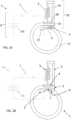
- Fig. 3 shows a tissue fastening device or construct 100 having a length of electrically conductive thermoplastic material formed into a continuous loop in situ, and joined by a partial depth penetration weld.
- regions of virgin monofilament 105 with high tensile strength resulting from highly linearized molecular chains notionally represented by lines roughly parallel to the suture axis, surrounding a weld region 110 with amorphous molecular orientation, notionally represented by random, disorganized lines.
- the tensile strength of the virgin monofilament is significantly stronger than that of the re-melt region.
- the top and bottom portions of the overlapping loop ends load the weld region in shear, and since the area of the weld region is greater than the cross-section of the suture, the stress in this region is reduced as long as there is virgin high strength suture material on both sides of the weld region to distribute the load.
- Electrodes (not shown) applied to facing surfaces of first end 155 and second end 165 on clip 150 initiate a weld melt region 180 and bond first end 155 and second end 165 to one another so that clip 150 occludes blood vessel 175.
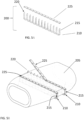
- Figs. 5A and 5B show another illustrative device 200 made of molded conductive thermoplastic material that is electrically welded in situ to occlude a section of a hollow organ 205, such as a stomach, to allow the organ to be surgically divided.
- Device 200 comprises (i) a first strip 210 having a row of conductive thermoplastic needles 215 terminating in needle tips 220, and (ii) a second strip 225 having counterpart recesses (not shown) for receiving needle tips 220.
- an apparatus (not shown) delivers first strip 210 of conductive thermoplastic needles 215 through two layers of the organ (i.e., through the two side walls of the hollow organ) and second strip 225 is welded to the needle tips 220 of first strip 210 after needle tips 220 have penetrated and emerged from the organ.
- the depth of melting of needles 215 the distance between the top portion (i.e., second strip 225) and bottom portion (i.e., first strip 210) of device 200 can be controlled, thereby controlling the degree of "squeeze" applied to the organ and accommodating organs with variable thickness.
- welded surgical fasteners functionally similar to a row of stitches or surgical staples may be delivered in a continuous linear process.
- Fig. 6 shows a suturing instrument 300 for surgery comprising a distal end 305 and a proximal end 310 connected by a shaft 315.
- Distal end 305 is an end effector and includes mechanical and electrical means for manipulating tissue and suture material for the formation of surgical stitches.
- Proximal end 310 contains actuating means for driving and operating the stitch-forming means at distal end 305 through wires and linkages (not shown in Fig. 6 ) passing through shaft 315.
- Shaft 315 has sufficient length to reach anatomical structures within the interior of a body, with proximal end 310 of the instrument remaining outside of a body, distal end 305 reaching target tissue at a surgical site, and shaft 315 passing through intervening tissue and spaces, e.g., by passing through a small incision in a body wall such as the abdominal wall.
- proximal end 310 of instrument 300 includes a handle adapted to be held by a human hand and the actuating means on proximal end 310 includes various buttons, triggers, levers, etc. for controlling the stitch-forming means at distal end 305, and a battery for supplying power to weld the suture.
- the handle contains motors, linear actuators, pneumatic or hydraulic cylinders, or other actuation means to drive the stitch-formation means, a microprocessor-controlled circuit to sequence the stitch formation and welding, a trigger or button to initiate the stitch formation process, and a battery to power the actuators and circuit.
- a handle and external power means such as a power cord or pneumatic or hydraulic hoses.
- proximal end 310 includes electrical and/or mechanical interfaces 320 for connection to a surgical robot.
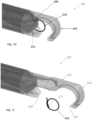
- Fig. 7A shows a version of a distal end effector 305 for surgical stitching instrument 300 (or other surgical stitching instrument).
- Distal end effector 305 comprises a slidable grasper 325 for grasping a piece of tissue and means for passing and welding a loop of suture about the grasped tissue, as will be discussed in further detail below.
- Slidable grasper 325 includes a passage 330 for passing a length of conductive thermoplastic polymer monofilament suture 335 (having a distal end 337) therethrough, a hook feature 340 with a groove 345 opening on the inside of hook feature 340, and a needle hole 350 aligning with groove 345 of hook feature 340.
- Slidable grasper 325 also comprises a bore 352 for passing a needle 355 therethrough.
- hook feature 340 of slidable grasper 325 is moved proximally (i.e., in the direction of arrow 357) so as to pinch the tissue to be sutured (not shown) between a first textured grasping surface 360 and a second textured grasping surface 365.
- needle 355 comprises a groove 370 so that after needle 355 has been advanced through the tissue (not shown) which is pinched between grasping surfaces 360, 365 and needle 355 is disposed in needle hole 350 of hook feature 340, groove 370 in needle 355 is aligned with groove 345 in hook feature 340, whereby to form a continuous circular path (i.e., by means of groove 345 of hook feature 340 and groove 370 in needle 355).
- suture 335 may be advanced through the continuous circular path formed by groove 370 of needle 355 and groove 345 of hook feature 340 until distal end 337 of suture 335 passes back over a portion of suture 335 proximal to distal end 337, whereby to form a loop of suture passing through the tissue captured in distal end effector 305, with distal end 337 of suture 335 contacting the proximal portion of suture 335 at overlapping region 375.
- Suture 335 is advanced by motor-driven rollers in shaft 315 and/or proximal end 310 of instrument 300 which engage and push suture 335 through the circular path, or by other driving means in shaft 315 and/or proximal end 310 of instrument 300 (not shown) known to those skilled in the art.
- an articulating gripping mechanism 400 may be used to firmly grasp distal end 337 of suture 335 adjacent the proximal portion of suture 335 at overlapping region 375, leaving proximal portion of suture 335 free to slide axially for tensioning.
- articulating gripping mechanism 400 comprises a first lever 405 and a second lever 410 which pivot about pins 415 and 420, respectively.
- levers 405, 410 are held apart, creating a gap in line with groove 370 in needle 355 and circular groove 345 of hook feature 340, thereby allowing distal end 337 of suture 335 to pass through the gap in order to form the loop of suture.
- levers 405, 410 are closed on distal end 337 of suture 335, grasping distal end 337 and holding it firmly in place in overlapping region 375.
- Levers 405, 410 are made of a non-electrically-conductive material except for a first electrode 425 disposed where levers 405, 410 grip distal end 337 of suture 335. Electrode 425 only makes electrical contact with distal end 337 of suture 335.
- a second electrode 430 is advanced to contact the portion of suture that overlaps with distal end 337 of suture 335 (i.e., portion 440 of Fig. 7G ) in overlapping region 375.
- Voltage potential is applied across first electrode 425 and second electrode 430 and current flows across the overlapping suture region 375, thereby causing heating, melting and the formation of a weld in accordance with the method described above in relation to Fig. 2A .
- a knife blade 500 is advanced to cut the suture supply proximal to the weld so as to separate the welded loop from instrument 300 (Fig. Fig. 7H ).
- Hook feature 340 of slidable grasper 325 is then moved distally so as to re-open slidable grasper 325, thereby releasing the pinched tissue.
- First lever 405 and second lever 410 are also separated to release the welded loop stitch 445 surrounding the tissue ( Fig. 7I ).
- the actuators at proximal end 310 of instrument 300 then return distal end effector 305 to the position of Fig. 7A and instrument 300 is ready to form another stitch.
- Fig. 8A shows a version of the present invention incorporated into a highly articulated end effector 801 for robotic surgery.
- This embodiment includes a four degree of freedom (DoF) slave-robot end effector controlled remotely by a surgeon stationed at a master-robot control console.
- the principal degrees of freedom include: an instrument shaft 802 rolling about axis R, a mid-section "knuckle" 803 articulating in pitch about axis P, and first (804) and second (805) independently rotating tool elements disposed in opposition to each other, each rotating about yaw axis Y.
- Other robotic end effectors employ articulating segments or other means to achieve four or five DoF motion, and the present invention applies to these devices also.
- the end effector described thus far in this paragraph is known to the art and is in common usage in robotic surgery. We will now describe novel aspects unique to the present invention.
- Fig. 8B shows an embodiment of the present invention that forms a suture stitch in the same manner as the invention described in Figs. 7A through 7I , but differs through the addition of a highly articulated end effector (e.g., the end effector of Fig. 8A ).
- first articulating opposed tool element 804 is a semi-circular shaped rigid body with an inward facing groove 810 terminating in a needle hole 811 at its distal end.
- Second tool element 805 is a semi-circular shaped needle with an inward facing suture groove 812 and a sharp tissue penetrating point 813 on its distal end.
- the distal portion of the needle 805 (i.e., second tool element 805) has a radius 814 to align with needle-receiving hole 811 in tool element 804.
- first and second tool elements 804 and 805 are closed in opposition (as shown in Fig. 8A )
- inward facing grooves 810 and 812 form a continuous groove through which suture may be advanced.
- Fig. 8C shows a partial section view of an embodiment of the present invention schematically displaying the means for forming a suture stitch with the end effector.
- a flexible suture delivery tube 820 aligns with grooves 810 and 812 in opposing tool elements 804 and 805 when tool elements 804 and 805 are closed in opposition.
- the distal end 821 of the suture delivery tube 820 is fixed relative to first tool element 804 (in other embodiments the mechanism may be reversed and delivery tube 820 may be fixed to second tool element 805).
- the flexibility of the suture delivery tube 820 allows the suture delivery tube to maintain its alignment with first tool element 804 throughout the full range of motion of the articulating end effector.
- the flexible suture delivery tube 820 serves the same purpose as the suture passage 202 described in Fig. 7A , with the difference of being flexible and allowing articulation of the end effector.
- Figs. 8D, 8E and 8F show detail views of suture grippers 825 and 826.
- Suture grippers 825 and 826 provide multiple functions in the suture formation process. In an embodiment they are arranged on a ramped guide surface provided on the end effector (not shown in Figs. 8D, 8E and 8F , but of the sort well known to those skilled in the art of gripping mechanisms) such that they separate as grippers 825 and 826 move distally and come together as they move proximally. Their movement is controlled by flexible gripper actuation linkage 827 which has sufficient flexibility to actuate the grippers throughout the full range of motion of the end effector.
- the grippers 825 and 826 move into three distinct positions: feed position ( Fig.
- Fig. 8C also shows weld electrode 830 actuated distally and proximally by flexible electrode linkage 831 which has sufficient flexibility to control movement of the weld electrode throughout the full range of motion of the end effector.
- the suture grippers 825 and 826 are electrically insulated except for the distal surfaces of the grippers contacting the distal side of the overlapping conductive suture segments held in the clamped position.
- the electrode 830 is electrically insulated except for a portion of the distal surface which can be brought into contact with the proximal side of the overlapping conductive suture segments held in the clamped position.
- either or both flexible actuation linkages 827 (of grippers 825 and 826) and 831 (of electrode 830) are insulated, and conductive and arranged to deliver electrical energy to either the grippers or the electrode or both.
- separate flexible insulated wires deliver electrical energy to either or both grippers 825 and 826 and/or electrode 830.
- the other element i.e., the electrode 830, or the grippers 825 and 826) may be connected to ground through the instrument shaft and connected components.
- Figs. 9A through 9E illustrate an embodiment of the present invention in a body as it might be viewed by a surgeon at a robotic control console.
- Fig. 9A shows an opening 900 in tissue 901 that the surgeon would like to close with a stitch.
- the surgeon's hand and wrist movements at the master-robot on the control console are replicated by the instrument end effector 801 in the body.
- the surgeon's thumb and forefinger movements are replicated by the tool element 804 and the needle 805.
- the surgeon positions the tool element 804 and needle 805 astride the tissue opening to be stitched.
- Fig. 9B shows the tool element 804 and needle 805 closed in opposition in response to the surgeon bringing their thumb and forefinger together.
- the needle 805 has penetrated through both sides of the tissue opening, completing a continuous circular groove (i.e., the conjoined circular grooves 812 and 810) from the needle 805 to the tool element 804. If they are happy with the stitch location defined by the needle placement, the surgeon initiates the stitch process by depressing a footswitch, or a voice-activated command, or other means available to initiate action.
- the stitch process is a fully automated sequence. In other embodiments some steps are automatically initiated in sequence and others are initiated by the surgeon.
- the first step in this sequence is activation of a suture advancing mechanism connected to the flexible suture delivery tube 820, which advances a fixed length of conductive suture equal to the circumference of the continuous inward facing groove of the tool element 804 and needle 805 (i.e., the conjoined circular grooves 810 and 812), plus additional material to form an overlapping region for the suture loop.
- the next step in the sequence is activation of an actuating mechanism connected to the flexible gripper actuation linkage 827 and the suture grippers 825 and 826 to move the grippers from the feed position ( Fig. 8D ) to the clamp/weld position ( Fig. 8E ), thereby gripping the distal end of the advanced suture in the overlap region.
- Fig. 9C shows the tool element 804 and needle 805 opened and released from the tissue leaving conductive suture 905 threaded through both sides of the tissue opening.
- this motion is controlled by the surgeon at the control console by separation of their thumb and forefinger.
- the separation of the tool element 804 and needle 805 is automatically initiated by the robot as part of the automated stitching process.
- Fig. 9D shows the suture loop tensioned by reversal of the suture advancing mechanism.
- tensioning is initiated automatically and suture is pulled to a predetermined or programmed tension value.
- the surgeon controls the tensioning process through a control means such as a trigger, slide mechanism, foot switch or similar means.
- the control means includes tactile haptic feedback such that the surgeon has the sensation of pulling on the suture to achieve the desired tension of the stitch.
- the separation of the tool element 804 and the needle 805 is performed automatically by the robot, the surgeon controls and feels tension through haptic feedback by separation of their thumb and forefinger which is temporarily disengaged from controlling the motion of the tool element 804 and needle 805.
- the weld process is initiated by initiation of an actuator connected to the flexible electrode linkage 831.
- the electrode 830 is brought into contact with the proximal side of the overlapping region of the conductive suture loop with a predetermined contacting force.
- Electrical current is then passed through the overlapping region (i.e., by passing an electrical current between electrode 830 and grippers 825 and 826), causing the interface between the suture segments in the overlapping region to locally melt and fuse into a weld.
- Fig. 9E shows the final step of the stitching sequence where the tensioned, welded loop 906 has been cut free from the suture supply exiting the suture delivery tube 820 and released from the end effector by actuation and movement of the suture grippers 825 and 826 from the clamp/weld position ( Fig. 8E ) to the cut/release position ( Fig. 8F ).
- Fig. 10A shows an embodiment with integrated tissue grasping and manipulation capability.
- This embodiment of an end effector has a first tool element 804, a needle 805, and a second opposing hollow tool element 1000.
- Hollow tool element 1000 includes an opening 1001 which is sufficiently large for needle 805 to rotate through, and a blunt or textured, non-tissue-penetrating end 1002 that directly opposes and aligns with a matching blunt or textured non-tissue-penetrating end 1003 on tool element 804.
- Figs. 10B through 10e show an embodiment of end effector with tissue grasping and manipulation capability (i.e., the end effector of Fig. 10A ) as it might be viewed in a body by a surgeon at a robot control console.
- Fig. 10B shows first and second opposing tool elements 804 and 1000 separated in preparation for grasping tissue. Needle 805 is outside hollow tool element 1000 and needle point 813 (not shown in Fig. 10B ) protected in hollow opening 1001. The motion of the opposing tool elements is controlled by the movement of the surgeon's thumb and forefinger, and needle 804 moves with, and maintains its protected orientation with hollow tool element 1000, while the surgeon grasps and manipulates tissue as one might do with surgical forceps.
- Fig. 10C shows the opposing tool elements 804 and 1000 grasping tissue at a location where the surgeon would like to place a stitch.
- the non-tissue-penetrating ends of the opposing tool elements 804 and 1000 pinch the tissue at the exact spot where the needle 805 will penetrate, thereby facilitating easy entry and penetration by the needle 805.
- the surgeon initiates the stitching process by depressing a foot switch, using a voice command or other means to initiate the automated sequence.
- the first step in the sequence is activation of an actuator that "fires" the needle 805 through the tissue.
- Fig. 10D shows needle point 813 penetrating the tissue and seated in needle hole 811 in tool element 804, and establishing (in conjunction with tool element 804) an uninterrupted suture groove (i.e., the conjoined circular grooves 810 and 812) through the tissue.
- an uninterrupted suture groove i.e., the conjoined circular grooves 810 and 812
- Fig. 10E shows hollow tool element 1000 retracted from the tissue, either by action on the part of the surgeon or automatically as part of the automated stitch sequence, leaving needle 805 in place (i.e., passed through the tissue and seated in needle hole 811 in tool element 804).
- the remainder of the stitch sequence is the same as that described in Figs. 9B through 9E .
Landscapes
- Health & Medical Sciences (AREA)
- Engineering & Computer Science (AREA)
- Life Sciences & Earth Sciences (AREA)
- Surgery (AREA)
- Mechanical Engineering (AREA)
- Animal Behavior & Ethology (AREA)
- Veterinary Medicine (AREA)
- Public Health (AREA)
- General Health & Medical Sciences (AREA)
- Biomedical Technology (AREA)
- Molecular Biology (AREA)
- Medical Informatics (AREA)
- Heart & Thoracic Surgery (AREA)
- Nuclear Medicine, Radiotherapy & Molecular Imaging (AREA)
- Vascular Medicine (AREA)
- Chemical & Material Sciences (AREA)
- Materials Engineering (AREA)
- Epidemiology (AREA)
- Reproductive Health (AREA)
- Robotics (AREA)
- Materials For Medical Uses (AREA)
- Surgical Instruments (AREA)
Applications Claiming Priority (3)
| Application Number | Priority Date | Filing Date | Title |
|---|---|---|---|
| US201762586108P | 2017-11-14 | 2017-11-14 | |
| EP18879322.8A EP3709931B1 (de) | 2017-11-14 | 2018-11-14 | Elektrisch schweissbares nahtmaterial |
| PCT/US2018/061043 WO2019099512A1 (en) | 2017-11-14 | 2018-11-14 | Electrically weldable suture material, and apparatus and method for forming welded suture loops and other welded structures |
Related Parent Applications (2)
| Application Number | Title | Priority Date | Filing Date |
|---|---|---|---|
| EP18879322.8A Division EP3709931B1 (de) | 2017-11-14 | 2018-11-14 | Elektrisch schweissbares nahtmaterial |
| EP18879322.8A Division-Into EP3709931B1 (de) | 2017-11-14 | 2018-11-14 | Elektrisch schweissbares nahtmaterial |
Publications (2)
| Publication Number | Publication Date |
|---|---|
| EP4450271A2 true EP4450271A2 (de) | 2024-10-23 |
| EP4450271A3 EP4450271A3 (de) | 2025-01-01 |
Family
ID=66431601
Family Applications (2)
| Application Number | Title | Priority Date | Filing Date |
|---|---|---|---|
| EP24198746.0A Pending EP4450271A3 (de) | 2017-11-14 | 2018-11-14 | Elektrisch schweissbares nahtmaterial |
| EP18879322.8A Active EP3709931B1 (de) | 2017-11-14 | 2018-11-14 | Elektrisch schweissbares nahtmaterial |
Family Applications After (1)
| Application Number | Title | Priority Date | Filing Date |
|---|---|---|---|
| EP18879322.8A Active EP3709931B1 (de) | 2017-11-14 | 2018-11-14 | Elektrisch schweissbares nahtmaterial |
Country Status (6)
| Country | Link |
|---|---|
| US (2) | US11446021B2 (de) |
| EP (2) | EP4450271A3 (de) |
| JP (3) | JP2021502875A (de) |
| KR (2) | KR102797427B1 (de) |
| CN (2) | CN118680614A (de) |
| WO (1) | WO2019099512A1 (de) |
Families Citing this family (7)
| Publication number | Priority date | Publication date | Assignee | Title |
|---|---|---|---|---|
| US12114853B2 (en) | 2017-11-14 | 2024-10-15 | Intuitive Surgical Operations, Inc. | Electrically weldable suture material, and apparatus and method for forming welded suture loops and other welded structures |
| JP2021502875A (ja) | 2017-11-14 | 2021-02-04 | イーガン・デザイン・エルエルシー | 電気的に溶接可能な縫合糸材料、ならびに、溶接された縫合糸ループおよび他の溶接された構造体を形成するための装置および方法 |
| US12213662B2 (en) | 2017-11-14 | 2025-02-04 | Intuitive Surgical Operations, Inc. | Electrically weldable suture material, and apparatus and method for forming welded suture loops and other welded structures |
| CN119318518A (zh) * | 2019-02-07 | 2025-01-17 | 直观外科手术操作公司 | 可电焊接缝合线材料以及用于形成焊接缝合线环和其它焊接结构的设备和方法 |
| US11246672B2 (en) * | 2019-08-15 | 2022-02-15 | Auris Health, Inc. | Axial motion drive devices, systems, and methods for a robotic medical system |
| US12137905B2 (en) * | 2022-05-16 | 2024-11-12 | Covidien Lp | Gas-powered continuous feed surgical fastening device |
| TWI886884B (zh) * | 2023-06-08 | 2025-06-11 | 艾斯創生醫股份有限公司 | 手術用具 |
Citations (1)
| Publication number | Priority date | Publication date | Assignee | Title |
|---|---|---|---|---|
| US5417700A (en) | 1992-03-30 | 1995-05-23 | Thomas D. Egan | Automatic suturing and ligating device |
Family Cites Families (61)
| Publication number | Priority date | Publication date | Assignee | Title |
|---|---|---|---|---|
| US3657056A (en) * | 1967-12-11 | 1972-04-18 | Ultrasonic Systems | Ultrasonic suturing apparatus |
| US5133727A (en) | 1990-05-10 | 1992-07-28 | Symbiosis Corporation | Radial jaw biopsy forceps |
| US4662068A (en) * | 1985-11-14 | 1987-05-05 | Eli Polonsky | Suture fusing and cutting apparatus |
| US5059201A (en) | 1989-11-03 | 1991-10-22 | Asnis Stanley E | Suture threading, stitching and wrapping device for use in open and closed surgical procedures |
| US5618290A (en) | 1993-10-19 | 1997-04-08 | W.L. Gore & Associates, Inc. | Endoscopic suture passer and method |
| US5968076A (en) * | 1995-03-03 | 1999-10-19 | United States Surgical Corporation | Channel-bodied surgical needle and method of manufacture |
| US5925064A (en) * | 1996-07-01 | 1999-07-20 | University Of Massachusetts | Fingertip-mounted minimally invasive surgical instruments and methods of use |
| US5766186A (en) | 1996-12-03 | 1998-06-16 | Simon Fraser University | Suturing device |
| US20020011508A1 (en) | 1997-08-28 | 2002-01-31 | Egan Thomas D. | Fused constructs of filamentous material for surgical applications |
| US6286746B1 (en) | 1997-08-28 | 2001-09-11 | Axya Medical, Inc. | Fused loop of filamentous material and apparatus for making same |
| US5893880A (en) * | 1997-08-28 | 1999-04-13 | Axya Medical Inc. | Fused loop filamentous material |
| AT408832B (de) | 1997-09-09 | 2002-03-25 | Werner Ing Fuchs | Chirurgische nahtzange |
| US7169141B2 (en) | 1998-02-24 | 2007-01-30 | Hansen Medical, Inc. | Surgical instrument |
| US6077277A (en) | 1999-04-05 | 2000-06-20 | Starion Instruments, Inc. | Suture welding device |
| US6669705B2 (en) | 2000-05-17 | 2003-12-30 | Axya Medical, Inc. | Apparatus and method for welding sutures |
| US6896686B2 (en) * | 2001-03-23 | 2005-05-24 | Arthrex, Inc. | Arthroscopic suture passing instrument |
| EP1270485A1 (de) | 2001-06-28 | 2003-01-02 | Edward S. Bittar | Handschweissgerät für Angelschnüre |
| US6599310B2 (en) * | 2001-06-29 | 2003-07-29 | Quill Medical, Inc. | Suture method |
| US7582097B2 (en) * | 2001-12-18 | 2009-09-01 | Ethicon, Inc. | Suture welding system and method |
| GB0130608D0 (en) * | 2001-12-21 | 2002-02-06 | Psimedica Ltd | Medical fibres and fabrics |
| US20040073256A1 (en) | 2002-08-09 | 2004-04-15 | Kevin Marchitto | Activated surgical fasteners, devices therefor and uses thereof |
| US7338502B2 (en) | 2002-12-18 | 2008-03-04 | Rosenblatt Associates, Llc | Systems and methods for soft tissue reconstruction |
| US7240677B2 (en) * | 2003-02-03 | 2007-07-10 | Biomedical Enterprises, Inc. | System and method for force, displacement, and rate control of shaped memory material implants |
| US20070134292A1 (en) * | 2003-07-17 | 2007-06-14 | Esa Suokas | Synthetic, bioabsorbable polymer materials and implants |
| WO2005087113A1 (en) | 2004-03-08 | 2005-09-22 | Boston Scientific Limited | Fused suture knot |
| US7862583B2 (en) * | 2004-05-27 | 2011-01-04 | Ethicon Endo-Surgery, Inc. | Fusible suture and method for suturing therewith |
| US7645286B2 (en) * | 2005-05-20 | 2010-01-12 | Neotract, Inc. | Devices, systems and methods for retracting, lifting, compressing, supporting or repositioning tissues or anatomical structures |
| US7967820B2 (en) * | 2006-02-07 | 2011-06-28 | P Tech, Llc. | Methods and devices for trauma welding |
| US7947053B2 (en) * | 2006-10-10 | 2011-05-24 | Mckay Raymond G | Suturing device and technique |
| US20090012538A1 (en) | 2007-07-03 | 2009-01-08 | Justin Saliman | Methods and devices for continuous suture passing |
| EP2162072B1 (de) * | 2007-07-03 | 2013-06-19 | Synergy Biosurgical AG | Medizinisches implantat |
| US20090131979A1 (en) * | 2007-07-17 | 2009-05-21 | Thompson G Alan | Wound closure method apparatus and system |
| US20090259251A1 (en) | 2008-04-11 | 2009-10-15 | Cohen Matthew D | Loop suture |
| US8403017B2 (en) | 2008-10-27 | 2013-03-26 | Covidien Lp | System, method and apparatus for making tapered looped suture |
| US20100113873A1 (en) | 2008-11-06 | 2010-05-06 | Takayuki Suzuki | Suturing device and suturing system |
| KR20110113176A (ko) | 2009-01-26 | 2011-10-14 | 신세스 게엠바하 | 양방향 봉합사 통과기 |
| US9168037B2 (en) * | 2010-06-17 | 2015-10-27 | Ethicon Endo-Surgery, Inc. | Laparoscopic suture device with asynchronous in-line needle movement |
| WO2012006491A1 (en) | 2010-07-09 | 2012-01-12 | The Regents Of The University Of Michigan | Suturing system |
| EP2590580B1 (de) * | 2010-07-11 | 2019-05-08 | Mininvasive Ltd. | Kreisförmige knochentunellierungsvorrichtung |
| US8540735B2 (en) | 2010-12-16 | 2013-09-24 | Apollo Endosurgery, Inc. | Endoscopic suture cinch system |
| US8931679B2 (en) | 2011-10-17 | 2015-01-13 | Covidien Lp | Surgical stapling apparatus |
| US8864753B2 (en) | 2011-12-13 | 2014-10-21 | Covidien Lp | Surgical Forceps Connected to Treatment Light Source |
| US9017346B2 (en) | 2011-12-14 | 2015-04-28 | Msk, Llc | Automated suture device |
| US9138214B2 (en) | 2012-03-02 | 2015-09-22 | Abbott Cardiovascular Systems, Inc. | Suture securing systems, devices and methods |
| US8855822B2 (en) * | 2012-03-23 | 2014-10-07 | Innovative Surgical Solutions, Llc | Robotic surgical system with mechanomyography feedback |
| WO2013163503A1 (en) * | 2012-04-27 | 2013-10-31 | The General Hospital Corporation | Implantable electrode system |
| WO2014047223A2 (en) | 2012-09-18 | 2014-03-27 | Oc10, Llc | Materials, methods and devices for joining lines |
| US20160345563A1 (en) | 2012-09-18 | 2016-12-01 | Oc10, Llc | Method and apparatus for joining lines |
| US20140276778A1 (en) * | 2013-03-14 | 2014-09-18 | Tyler Evans McLawhorn | Flexible mesh ablation device |
| CA2924605A1 (en) | 2013-09-26 | 2015-04-02 | Surgimatix, Inc. | Laparoscopic suture device with autoloading and suture capture |
| US10245023B2 (en) | 2013-10-02 | 2019-04-02 | Michael Amirfarzad Kia | Suture device |
| JP6353051B2 (ja) | 2013-12-09 | 2018-07-04 | テレフレックス メディカル インコーポレイテッド | 滑動式縫合糸把持器 |
| WO2015134758A1 (en) | 2014-03-05 | 2015-09-11 | Coaxis Medical, Inc. | Suture anchoring system and delivery method |
| US10058325B2 (en) | 2015-05-19 | 2018-08-28 | Arthrex, Inc. | Suture passer and method of tissue repair |
| WO2017027726A1 (en) | 2015-08-11 | 2017-02-16 | Beacon Surgical Instruments, Llc | Suturing device and method of use |
| CN107920816B (zh) * | 2015-09-04 | 2022-04-15 | 伊西康公司 | 用于伤口闭合装置的改进的端部执行器 |
| US10820898B2 (en) | 2017-10-05 | 2020-11-03 | Ethicon Llc | Surgical tools with occluded blade |
| JP2021502875A (ja) | 2017-11-14 | 2021-02-04 | イーガン・デザイン・エルエルシー | 電気的に溶接可能な縫合糸材料、ならびに、溶接された縫合糸ループおよび他の溶接された構造体を形成するための装置および方法 |
| US12213662B2 (en) | 2017-11-14 | 2025-02-04 | Intuitive Surgical Operations, Inc. | Electrically weldable suture material, and apparatus and method for forming welded suture loops and other welded structures |
| US12114853B2 (en) | 2017-11-14 | 2024-10-15 | Intuitive Surgical Operations, Inc. | Electrically weldable suture material, and apparatus and method for forming welded suture loops and other welded structures |
| US11399822B2 (en) | 2020-01-03 | 2022-08-02 | Maruho Medical, Inc. | Method and apparatus for passing suture |
-
2018
- 2018-11-14 JP JP2020544390A patent/JP2021502875A/ja active Pending
- 2018-11-14 CN CN202410685119.0A patent/CN118680614A/zh active Pending
- 2018-11-14 EP EP24198746.0A patent/EP4450271A3/de active Pending
- 2018-11-14 KR KR1020207014114A patent/KR102797427B1/ko active Active
- 2018-11-14 KR KR1020257012169A patent/KR20250053994A/ko active Pending
- 2018-11-14 US US16/190,915 patent/US11446021B2/en active Active
- 2018-11-14 CN CN201880073783.2A patent/CN111683622B/zh active Active
- 2018-11-14 WO PCT/US2018/061043 patent/WO2019099512A1/en not_active Ceased
- 2018-11-14 EP EP18879322.8A patent/EP3709931B1/de active Active
-
2022
- 2022-08-19 US US17/891,487 patent/US12539114B2/en active Active
-
2023
- 2023-09-15 JP JP2023149957A patent/JP2023166567A/ja active Pending
-
2025
- 2025-06-03 JP JP2025092263A patent/JP2025124807A/ja active Pending
Patent Citations (1)
| Publication number | Priority date | Publication date | Assignee | Title |
|---|---|---|---|---|
| US5417700A (en) | 1992-03-30 | 1995-05-23 | Thomas D. Egan | Automatic suturing and ligating device |
Also Published As
| Publication number | Publication date |
|---|---|
| CN111683622B (zh) | 2024-06-18 |
| EP3709931A1 (de) | 2020-09-23 |
| US20230050983A1 (en) | 2023-02-16 |
| CN118680614A (zh) | 2024-09-24 |
| WO2019099512A1 (en) | 2019-05-23 |
| US12539114B2 (en) | 2026-02-03 |
| EP4450271A3 (de) | 2025-01-01 |
| JP2025124807A (ja) | 2025-08-26 |
| EP3709931B1 (de) | 2024-10-16 |
| US11446021B2 (en) | 2022-09-20 |
| KR20200088329A (ko) | 2020-07-22 |
| JP2023166567A (ja) | 2023-11-21 |
| KR102797427B1 (ko) | 2025-04-22 |
| US20190142419A1 (en) | 2019-05-16 |
| KR20250053994A (ko) | 2025-04-22 |
| EP3709931A4 (de) | 2021-08-18 |
| CN111683622A (zh) | 2020-09-18 |
| JP2021502875A (ja) | 2021-02-04 |
Similar Documents
| Publication | Publication Date | Title |
|---|---|---|
| US12114853B2 (en) | Electrically weldable suture material, and apparatus and method for forming welded suture loops and other welded structures | |
| US12539114B2 (en) | Electrically weldable suture material, and apparatus and method for forming welded suture loops and other welded structures | |
| EP1168966B1 (de) | Vorrichtung zum verschweissen eines nähfadens | |
| US20250221701A1 (en) | Electrically weldable suture material, and apparatus and method for forming welded suture loops and other welded structures | |
| CA2212325C (en) | Automatic suturing and ligating device | |
| WO2008045483A2 (en) | Suturing devices and technique | |
| JP2002520081A (ja) | 結節部なしに縫合部及び結紮部を保持するための用具及び方法 | |
| US12213662B2 (en) | Electrically weldable suture material, and apparatus and method for forming welded suture loops and other welded structures | |
| US20250040926A1 (en) | Electrically weldable suture material, and apparatus and method for forming welded suture loops and other welded structures | |
| AU694766C (en) | Automatic suturing and ligating device |
Legal Events
| Date | Code | Title | Description |
|---|---|---|---|
| PUAI | Public reference made under article 153(3) epc to a published international application that has entered the european phase |
Free format text: ORIGINAL CODE: 0009012 |
|
| STAA | Information on the status of an ep patent application or granted ep patent |
Free format text: STATUS: THE APPLICATION HAS BEEN PUBLISHED |
|
| AC | Divisional application: reference to earlier application |
Ref document number: 3709931 Country of ref document: EP Kind code of ref document: P |
|
| AK | Designated contracting states |
Kind code of ref document: A2 Designated state(s): AL AT BE BG CH CY CZ DE DK EE ES FI FR GB GR HR HU IE IS IT LI LT LU LV MC MK MT NL NO PL PT RO RS SE SI SK SM TR |
|
| REG | Reference to a national code |
Ref country code: DE Ref legal event code: R079 Free format text: PREVIOUS MAIN CLASS: B29K0507040000 Ipc: A61B0017040000 |
|
| PUAL | Search report despatched |
Free format text: ORIGINAL CODE: 0009013 |
|
| AK | Designated contracting states |
Kind code of ref document: A3 Designated state(s): AL AT BE BG CH CY CZ DE DK EE ES FI FR GB GR HR HU IE IS IT LI LT LU LV MC MK MT NL NO PL PT RO RS SE SI SK SM TR |
|
| RIC1 | Information provided on ipc code assigned before grant |
Ipc: B29K 505/00 20060101ALI20241126BHEP Ipc: B29L 31/00 20060101ALI20241126BHEP Ipc: B29K 105/16 20060101ALI20241126BHEP Ipc: A61B 17/064 20060101ALI20241126BHEP Ipc: B29C 65/00 20060101ALI20241126BHEP Ipc: B29C 65/74 20060101ALI20241126BHEP Ipc: B29C 65/34 20060101ALI20241126BHEP Ipc: A61L 17/06 20060101ALI20241126BHEP Ipc: A61L 17/00 20060101ALI20241126BHEP Ipc: A61L 17/14 20060101ALI20241126BHEP Ipc: B29K 507/04 20060101ALI20241126BHEP Ipc: A61B 17/122 20060101ALI20241126BHEP Ipc: A61B 17/06 20060101ALI20241126BHEP Ipc: A61B 17/04 20060101AFI20241126BHEP |
|
| STAA | Information on the status of an ep patent application or granted ep patent |
Free format text: STATUS: REQUEST FOR EXAMINATION WAS MADE |
|
| 17P | Request for examination filed |
Effective date: 20250630 |