EP4446199A1 - Einstellbares gurtzeugsystem - Google Patents
Einstellbares gurtzeugsystem Download PDFInfo
- Publication number
- EP4446199A1 EP4446199A1 EP24167415.9A EP24167415A EP4446199A1 EP 4446199 A1 EP4446199 A1 EP 4446199A1 EP 24167415 A EP24167415 A EP 24167415A EP 4446199 A1 EP4446199 A1 EP 4446199A1
- Authority
- EP
- European Patent Office
- Prior art keywords
- strap
- stroller
- protrusions
- slide
- harness system
- Prior art date
- Legal status (The legal status is an assumption and is not a legal conclusion. Google has not performed a legal analysis and makes no representation as to the accuracy of the status listed.)
- Pending
Links
Images


Classifications
-
- B—PERFORMING OPERATIONS; TRANSPORTING
- B62—LAND VEHICLES FOR TRAVELLING OTHERWISE THAN ON RAILS
- B62B—HAND-PROPELLED VEHICLES, e.g. HAND CARTS OR PERAMBULATORS; SLEDGES
- B62B9/00—Accessories or details specially adapted for children's carriages or perambulators
- B62B9/24—Safety guards for children, e.g. harness
-
- B—PERFORMING OPERATIONS; TRANSPORTING
- B60—VEHICLES IN GENERAL
- B60N—SEATS SPECIALLY ADAPTED FOR VEHICLES; VEHICLE PASSENGER ACCOMMODATION NOT OTHERWISE PROVIDED FOR
- B60N2/00—Seats specially adapted for vehicles; Arrangement or mounting of seats in vehicles
- B60N2/24—Seats specially adapted for vehicles; Arrangement or mounting of seats in vehicles for particular purposes or particular vehicles
- B60N2/26—Seats specially adapted for vehicles; Arrangement or mounting of seats in vehicles for particular purposes or particular vehicles for children
- B60N2/28—Seats readily mountable on, and dismountable from, existing seats or other parts of the vehicle
- B60N2/2803—Adaptations for seat belts
- B60N2/2812—Adaptations for seat belts for securing the child to the child seat
Definitions
- the present disclosure is generally in the field of harness systems, and more particularly related to harness systems for strollers.
- Strollers often include a harness that is used to secure a child within a seat of the stroller.
- Conventional harnesses may include multiple straps that are affixed to the stroller seat. A child may be provided in the seat, the straps may be provided around the child, and the straps may be inserted into a buckle to secure the child within the seat.
- the harness may also include a slide that is configured to slide along the strap to adjust the tightness of the harness to further secure the child.
- the thickness of a strap is typically less than the thickness of the apertures in the slides through which the strap is inserted. This results in limited resistance being provided to the slide by the strap as a user moves the slide up and down the strap, which allows for the child to easily move the slide downwards and adjust the tightness of the harness.
- the present disclosure describes harness system for a stroller, the harness system.
- the harness system comprises a first strap affixed to the stroller, the first strap comprising one or more protrusions.
- the harness system also comprises a slide provided on the first strap, wherein the one or more protrusions provide a resistance against movement of the slide across the one or more protrusions.
- the present disclosure describes a stroller.
- the stroller comprises a harness system.
- the harness system comprises a first strap affixed to the stroller, the first strap comprising one or more protrusions.
- the harness system also comprises a slide provided on the first strap, wherein the one or more protrusions provide a resistance against movement of the slide across the one or more protrusions.
- the present disclosure describes A strap for a harness system of a stroller.
- the strap comprises one or more protrusions provided along the strap at designed intervals, wherein the strap is affixed to the stroller, wherein the one or more protrusions provide a resistance against movement of a slide of the harness system across the one or more protrusions, wherein the strap is provided through the slide.
- Strollers may include a harness system (which may also be referred to simply as a "harness” herein as well) that may be used to secure a child within a seat of the stroller.
- the harness system may include multiple straps that are provided around the arms and/or shoulders of the child.
- the straps may include an adjustable mechanism, such as a slide attached to each individual strap. The slide may be moved up or down the strap to adjust the tightness of the straps (and the harness) against the child.
- the straps are configured such that the slide that is used to adjust the tightness of the harness may easily be moved up and down the strap without significant resistance.
- the child may be able to move the slide to loosen the straps. This may result in the child being less secure within the stroller.
- the present disclosure describes an adjustable harness system for a stroller.
- the harness described herein includes one or more protrusions provided at various intervals on the straps (e.g., raised portions of the surface of the straps).
- the one or more protrusions provide resistance against the movement of the slide at the locations of the protrusions. In this manner, the slide may be moved up and down with little resistance along the portions of the strap between the protrusions. However, additional force may be required to move the slide across a protrusion.
- the protrusions serve to limit the ability of the child to loosen or otherwise adjust the tightness of the harness after the child has been secured within the stroller.
- the straps may comprise a webbing material and the protrusions may be formed as a part of the webbing.
- additional material may be provided in the webbing at the intervals associated with the protrusions such that the webbing is raised at those intervals.
- the protrusions may alternatively include elements that are added to the webbing.
- a material may be stitched to the exterior of the webbing forming the straps.
- a material may also be permanently or removably adhered to the straps in any other suitable manner as well.
- the straps may also comprise any other type of flexible or deformable material as well.
- the intervals at which the protrusions are provided on the straps may be pre-determined based on standard height locations associated with stroller harness systems. That is, different geographical regions may be associated with standard harness height positions. The location of the protrusions may be selected according to these height positions to provide a visual indication to a user as to where the standard height positions are located. The location of the protrusions may vary depending on the region. For example, the location of the protrusions on a harness used within the United States may differ than the location of the protrusions on a harness used within Europe. In embodiments, a harness may also include multiple different sets of protrusions that may correspond to standard heights for different geographical regions. The protrusions associated with the different regions may be indicated in any number of suitable manners.
- the protrusions associated with one region may be provided in one color and the protrusions associated with another region may be provided in another color.
- the locations of the protrusions along the strap may not necessarily correspond to standard heights, but may also be provided at any other intervals along the strap as well.
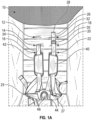
- FIGS. 1A is a front view of a stroller 10 including an adjustable harness system. Particularly, the figure shows a comparison between a strap 24 that may be used with a conventional harness system of a stroller 10 and a strap 26 that may instead be used with the harness system described herein. The comparison illustrates differences between the strap 24 associated with the conventional harness system and the strap 26 associated with the harness system described herein.
- a complete harness system may include multiple straps similar to the strap 26 rather than including strap 24 and strap 26 as shown in the figure.
- a conventional harness system includes one or more straps, such as strap 24 for example.
- a conventional harness system may also include a second strap similar to strap 24 in place of the strap 26 shown in the figure (reference hereinafter to strap 24 may also refer to a second type of similar strap).
- the strap 24 may be placed around the shoulders and/or arms of a child provided in the stroller 10.
- the strap 24 may also include an adjustable pad 42 that provides a cushion between the strap 24 and the child to provide additional comfort to the child when the strap 24 is secured against the child.
- the strap 24 may be secured to the stroller 10 as well. Additional straps, such as straps 25 and 27 may be provided over the hips and/or legs of the child to further secure the child within the stroller 10.
- any of the straps 24, 25, and 27 may be inserted into a buckle 44, such that the straps 24, 25, and 27 may form the completed harness system and the child may be secured within the stroller 10.
- the buckle 44 may include a button 46 that may be pressed to allow the straps 24, 25, and 27 to be disengaged from the buckle 44 to allow the child to be removed from the stroller 10.
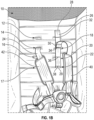
- the strap 26 is affixed to the stroller 10 (shown in further detail in FIG. 1B and 3A ).
- the strap 26 may be affixed to the stroller 10 at a first end 28 and a second end 29.
- the strap 26 may be affixed to the stroller 10 in any suitable manner.
- the first end 28 and the second end 29 may be stitched into the material of the stroller 10.
- a slide 30 is provided on the strap 26 that is configured to be moved up and down the strap 26 by a user (for example, a parent securing a child within the stroller 10). That is, the strap 26 may be fed through one or more apertures of the slide (as shown in FIG. 3A ). Also provided within the slide 30 (for example, one of the apertures of the slid 30) is a separate harness strap 33. While the strap 26 is affixed to the stroller 10, the harness strap 33 is configured to be provided within the buckle 44 to complete the harness system to secure a child within the stroller 10. Thus, the harness strap 33 is removably secured at one end within the buckle 44 and at another end through the slide 30 that is also attached to the strap 26 (which is affixed to the stroller 10).
- the strap 26 also includes one or more protrusions.
- FIG. 1A shows a first protrusion 32 provided on the strap 26. Any other number of protrusions may also exist on the strap 26 at various intervals.
- FIG. 1B shows four protrusions provided on the strap 26 (first protrusion 32, second protrusion 34, third protrusion 36, and fourth protrusion 38) at various intervals along the strap 26.
- the protrusions 32, 34, 36, and 38 comprise raised portions of the strap 26.
- the strap 26 may be a webbing material and the protrusions 32, 34, 36, and 38 may be additional material provided at the locations of the protrusions 32, 34, 36, and 38 that form raised portions of the surface of the strap 26 at those locations.
- the strap 26 and/or protrusions 32, 34, 36, and 38 may also comprise any other material.
- the protrusions 32, 34, 36, and 38 may also be provided in any other size and/or shape, and may extend outwards from either side of the strap 26 (as shown in FIG. 3A ) by any distance.
- the protrusions 32, 34, 36, and 38 provide resistance against the movement of the slide 30 at the locations of the protrusions 32, 34, 36, and 38. Given that the protrusions 32, 34, 36, and 38 are raised from the surface of the strap 26, a user may be required to provide additional force to continue to move the slide 30 across the protrusions 32, 34, 36, and 38 than may be required to move the slide within the portions of the strap 26 in between the various protrusions 32, 34, 36, and 38. Providing this additional resistance at various intervals along the strap 26 may mitigate the likelihood that a child that is secured within the stroller using the harness is able to freely move the slide 26 to significantly adjust the tightness of the harness.
- the protrusions 32, 34, 36, and 38 are illustrated as being stitching formed on the strap 26. However, the protrusions may also be formed in any other manner. For example, the protrusions 32, 34, 36, and 38 may be formed by providing additional material on the straps 26 at the various intervals. The protrusions 32, 34, 36, and 38 may also be formed by removably or permanently affixing a separate element onto the strap 26. For example, a material may be adhered to the strap 26 at the various intervals at which it is desired for the protrusions 32, 34, 36, and 38 to exist.
- the protrusions 32, 34, 36, and 38 are provided at various intervals along the strap 26.
- the location of the protrusions 32, 34, 36, and 38 may correspond to standard height locations for the harness. In this manner, the intervals at which the protrusions 32, 34, 36, 38 are provided on the straps may provide height indicators.
- the distances between the protrusions 32, 34, 36, and 38 may be equivalent. However, in other instances, some or all of the distances between the protrusions 32, 34, 36, 38 may be different. That is, different geographical regions may be associated with standard harness height positions.
- the location of the protrusions 32, 34, 36, 38 may provide an indication of locations of standard height locations associated with a harness of a stroller 10 for the particular geographical region.
- the location of the protrusions 32, 34, 36, 38 may vary depending on the region.
- FIG. 1A shows that the protrusions 32, 34, 36, 38 are located at heights of button holes 18, 20, 22, 23 etc.
- the button holes 18, 20, 22, 23 etc. may not necessarily be included on the stroller 10 (the same applies to any button holes shown in any of the figures).
- the protrusions 32, 34, 36, and 38 may also be provided in a color that allows for the protrusions 32, 34, 36, and 38 to be easily identified and distinguished from the remainder of the material comprising the strap 26.
- the strap 26 may be a black color and the protrusions 32, 34, 36, and 38 may be provided in an orange color (however, any other colors may also be used). This allows for a user to more easily identify the standard height locations that the protrusions 32, 34, 36, and 38 indicate along the strap 26.
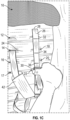
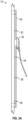
- FIG. 2 is a partial view of a portion of a strap 26 of the adjustable harness system of FIGS. 1A-1C . Particularly, FIG. 2 shows that the second end 29 of the strap 26 is affixed to the stroller 10. FIG. 2 also shows one of the protrusions 38.
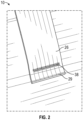
- FIG. 3A is a side view of a strap 26 of the adjustable harness system of FIGS. 1A-1C .
- FIG. 3B is a front view of a strap 26 of the adjustable harness system of FIGS. 1A-1C .
- the strap 26 is shown as being affixed to the stroller 10 at the first end 28 and the second end 29.
- the strap 26 may comprise a webbing material and the webbing may be affixed to a front and/or back surface of the stroller at the first end 28 and the second end 29.
- the strap 26 may also be removably affixed to the stroller 10 as well through any suitable mechanism.
- the strap 26 is shown as being provided through apertures (for example, apertures 46 and 48) in the slide 30. Also provided through one of the apertures in the slide 30 is a harness strap 33. While the strap 26 is affixed to the stroller 30, the harness strap 33 is a portion of the harness that is connected to the buckle 44 as shown in FIG. 1A . As the slide 30 is moved up the strap 26, the tightness of the harness strap 33 is increased as an end 31 of the harness strap 33 moves further away from the buckle.
- apertures for example, apertures 46 and 48
- the side view also shows the protrusions 32, 34, 36, and 38.
- the protrusions 32, 34, 36, and 38 are shown as extending outwards from the front side 50 and the back side 52 of the strap 26. Extending the protrusions 32, 34, 36, and 38 outwards from both sides of the strap 26 provides further resistance to the movement of the slide 30 across the protrusions 32, 34, 36, and 38. As the slide moves across a given protrusion, the additional material that the protrusion provides on top of the strap 26 may also need to travel through the an aperture 46 or 48 of the slide 30.
- the protrusions 32, 34, 36, and 38 may be sized such that the combination of the strap 26 and a protrusion is equal to or greater than the size of the apertures 46 and 48.
- the protrusions 32, 34, 36, and 38 may comprise a flexible or deformable material. Thus, a user may need to apply further force to allow the protrusion 32, 34, 36, and 38 to fit through the aperture 46 or 48.
- the protrusions 32, 34, 36, and 38 may also only be provided on the front side 50 or the back side 52 of the strap 26 as well.
- the distance to which the protrusions 32, 34, 36, and 38 extend outwards from the strap 26 may vary depending on the amount of resistance against the movement of the slide 30 that is desired. For example, extending the protrusions 32, 34, 36, and 38 outwards a greater distance from the strap 26 may provide additional resistance.
- FIG. 2 illustrates that the protrusions 32, 34, 36, and 38 all extend from the strap 26 equal distances, some of the protrusions 32, 34, 36, and 38 may extend outwards from the strap 26 to different distances as well.
- FIG. 3C is a side view of another strap 26 of the adjustable harness system of FIGS. 1A-1C .
- FIGS. 3D-3E show a front view of another strap 26 of the adjustable harness system of FIGS. 1A-1C .
- FIGS. 3C-3E illustrate another mechanism by which the strap 26 may be secured to the stroller 10.
- an aperture 50 may be provided through a surface of the stroller 10 and the strap 26 may be provided through the aperture 50.
- the strap 26 may be secured to the stroller 10 by providing an anchoring element 52 behind the surface of the stroller 10 on which the aperture 50 is provided.
- the anchoring element 52 is sized such that the anchoring element 52 may not fit through the aperture 50 or may not easily fit through the aperture 50.
- FIG. 3D shows the strap 26 with the anchoring element 52 provided in the aperture 50 and secured within the stroller 10.
- FIG. 3E shows the strap 26 with the anchoring element 52 removed from the aperture 50.
- FIGS. 3C-3E merely provide one additional example of a manner by which the strap 26 may be secured to the stroller 10. The strap 26 may also be secured to the stroller 10 in any other suitable manner.
- conditional language such as, among others, “can,” “could,” “might,” or “may,” unless specifically stated otherwise, or otherwise understood within the context as used, is generally intended to convey that certain implementations could include, while other implementations do not include, certain features, elements, and/or operations. Thus, such conditional language generally is not intended to imply that features, elements, and/or operations are in any way required for one or more implementations or that one or more implementations necessarily include logic for deciding, with or without user input or prompting, whether these features, elements, and/or operations are included or are to be performed in any particular implementation.
Landscapes
- Engineering & Computer Science (AREA)
- Health & Medical Sciences (AREA)
- Transportation (AREA)
- Mechanical Engineering (AREA)
- Public Health (AREA)
- Chemical & Material Sciences (AREA)
- Combustion & Propulsion (AREA)
- Child & Adolescent Psychology (AREA)
- General Health & Medical Sciences (AREA)
- Aviation & Aerospace Engineering (AREA)
- Carriages For Children, Sleds, And Other Hand-Operated Vehicles (AREA)
- Seats For Vehicles (AREA)
Applications Claiming Priority (1)
| Application Number | Priority Date | Filing Date | Title |
|---|---|---|---|
| US202363494327P | 2023-04-05 | 2023-04-05 |
Publications (1)
| Publication Number | Publication Date |
|---|---|
| EP4446199A1 true EP4446199A1 (de) | 2024-10-16 |
Family
ID=90717616
Family Applications (1)
| Application Number | Title | Priority Date | Filing Date |
|---|---|---|---|
| EP24167415.9A Pending EP4446199A1 (de) | 2023-04-05 | 2024-03-28 | Einstellbares gurtzeugsystem |
Country Status (3)
| Country | Link |
|---|---|
| US (1) | US20240336292A1 (de) |
| EP (1) | EP4446199A1 (de) |
| CN (1) | CN118770344A (de) |
Citations (4)
| Publication number | Priority date | Publication date | Assignee | Title |
|---|---|---|---|---|
| US4223917A (en) * | 1978-02-09 | 1980-09-23 | Toyota Jidosha Kogyo Kabushiki Kaisha | Seatbelt system |
| DE10337018A1 (de) * | 2003-08-12 | 2005-03-10 | Volkswagen Ag | Sicherheitsgurteinrichtung für ein Fahrzeug, insbesondere für ein Kraftfahrzeug |
| DE102007058278A1 (de) * | 2007-12-04 | 2009-06-10 | Trw Automotive Gmbh | Sicherheitsgurtsystem |
| EP2634038A1 (de) * | 2012-03-01 | 2013-09-04 | Britax Römer Kindersicherheit GmbH | Einstellbares Beckengurtsystem |
Family Cites Families (9)
| Publication number | Priority date | Publication date | Assignee | Title |
|---|---|---|---|---|
| US6237999B1 (en) * | 1999-08-24 | 2001-05-29 | Donald A. Hobson | Child car seat |
| NO316064B1 (no) * | 2002-07-04 | 2003-12-08 | Torgersen Hans & Soenn | Anordning for stramming av sikkerhetsbelte |
| US8622478B2 (en) * | 2011-01-05 | 2014-01-07 | Graco Children's Products Inc. | Child car seat with adjustable harness system |
| CN204580651U (zh) * | 2012-06-07 | 2015-08-26 | 菲尔和特德设计有限公司 | 将儿童固定到座椅的安全带、车辆车厢、车辆座椅及推车 |
| CN214524029U (zh) * | 2021-01-07 | 2021-10-29 | 明门瑞士股份有限公司 | 肩带组件以及婴儿车 |
| CN214823556U (zh) * | 2021-02-18 | 2021-11-23 | 明门瑞士股份有限公司 | 幼儿载具 |
| US11498460B1 (en) * | 2021-05-06 | 2022-11-15 | E.V.S Ltd. | Child carrier restraint |
| CN120792939A (zh) * | 2021-10-22 | 2025-10-17 | 明门瑞士股份有限公司 | 护头装置及幼儿载具 |
| TW202426289A (zh) * | 2022-12-27 | 2024-07-01 | 瑞士商明門瑞士股份有限公司 | 護頭裝置和載具 |
-
2024
- 2024-03-28 EP EP24167415.9A patent/EP4446199A1/de active Pending
- 2024-03-29 US US18/621,748 patent/US20240336292A1/en active Pending
- 2024-04-03 CN CN202410402614.6A patent/CN118770344A/zh active Pending
Patent Citations (4)
| Publication number | Priority date | Publication date | Assignee | Title |
|---|---|---|---|---|
| US4223917A (en) * | 1978-02-09 | 1980-09-23 | Toyota Jidosha Kogyo Kabushiki Kaisha | Seatbelt system |
| DE10337018A1 (de) * | 2003-08-12 | 2005-03-10 | Volkswagen Ag | Sicherheitsgurteinrichtung für ein Fahrzeug, insbesondere für ein Kraftfahrzeug |
| DE102007058278A1 (de) * | 2007-12-04 | 2009-06-10 | Trw Automotive Gmbh | Sicherheitsgurtsystem |
| EP2634038A1 (de) * | 2012-03-01 | 2013-09-04 | Britax Römer Kindersicherheit GmbH | Einstellbares Beckengurtsystem |
Also Published As
| Publication number | Publication date |
|---|---|
| US20240336292A1 (en) | 2024-10-10 |
| CN118770344A (zh) | 2024-10-15 |
Similar Documents
| Publication | Publication Date | Title |
|---|---|---|
| EP2328440B1 (de) | Kleinkindertragevorrichtung | |
| USD611751S1 (en) | Temporary car seat cover for a bench seat | |
| US20040239163A1 (en) | Child seat cover | |
| TWI531493B (zh) | Children with seats | |
| US9010856B2 (en) | Automobile bench seat cover | |
| US20190313724A1 (en) | Head support system | |
| US20140070579A1 (en) | Fastening tape for seat pad and seat pad having the sam | |
| US20110314588A1 (en) | Horseback Riding Training Glove | |
| US20180000258A1 (en) | Child Carrier Having Adjustable Seat Coupling | |
| US9049946B1 (en) | Infant covering blanket adapted for use with infant supporting apparatuses | |
| KR20130002781U (ko) | 고글의 렌즈 탈,부착장치 | |
| US7862116B2 (en) | Cushion for aircraft ejection seat | |
| US20110291451A1 (en) | Safety belt buckle and assembly for a vehicle child seat | |
| EP4446199A1 (de) | Einstellbares gurtzeugsystem | |
| CN104379412B (zh) | 具有安全带带扣的车辆座椅 | |
| CN108372808B (zh) | 具有耐磨滑动罩的车辆座椅总成 | |
| US10596929B2 (en) | Child restraint system including harness and adjustment mechanism | |
| US7726736B1 (en) | Car seat reminder system | |
| US20120284972A1 (en) | Belt Buckle Accessory | |
| US10668890B2 (en) | Automobile seat restraint system and method | |
| US10772439B2 (en) | Safety harness with adjustable separation mechanism | |
| EP3235405A1 (de) | Sitz | |
| US9095225B2 (en) | Infant changing board | |
| CA3195369A1 (en) | Flotation vest with repositionable collar member | |
| EP3294055A1 (de) | Verschlusssystem für den frontbereich einer pferdedecke |
Legal Events
| Date | Code | Title | Description |
|---|---|---|---|
| PUAI | Public reference made under article 153(3) epc to a published international application that has entered the european phase |
Free format text: ORIGINAL CODE: 0009012 |
|
| STAA | Information on the status of an ep patent application or granted ep patent |
Free format text: STATUS: THE APPLICATION HAS BEEN PUBLISHED |
|
| AK | Designated contracting states |
Kind code of ref document: A1 Designated state(s): AL AT BE BG CH CY CZ DE DK EE ES FI FR GB GR HR HU IE IS IT LI LT LU LV MC ME MK MT NL NO PL PT RO RS SE SI SK SM TR |
|
| STAA | Information on the status of an ep patent application or granted ep patent |
Free format text: STATUS: REQUEST FOR EXAMINATION WAS MADE |
|
| 17P | Request for examination filed |
Effective date: 20250415 |
|
| GRAP | Despatch of communication of intention to grant a patent |
Free format text: ORIGINAL CODE: EPIDOSNIGR1 |
|
| STAA | Information on the status of an ep patent application or granted ep patent |
Free format text: STATUS: GRANT OF PATENT IS INTENDED |
|
| INTG | Intention to grant announced |
Effective date: 20260306 |