EP4445754A1 - Inspektionsvorrichtung und inspektionsverfahren für filterstab - Google Patents
Inspektionsvorrichtung und inspektionsverfahren für filterstab Download PDFInfo
- Publication number
- EP4445754A1 EP4445754A1 EP21967183.1A EP21967183A EP4445754A1 EP 4445754 A1 EP4445754 A1 EP 4445754A1 EP 21967183 A EP21967183 A EP 21967183A EP 4445754 A1 EP4445754 A1 EP 4445754A1
- Authority
- EP
- European Patent Office
- Prior art keywords
- filter rod
- inspection
- shading
- end portion
- image
- Prior art date
- Legal status (The legal status is an assumption and is not a legal conclusion. Google has not performed a legal analysis and makes no representation as to the accuracy of the status listed.)
- Pending
Links
Images


Classifications
-
- A—HUMAN NECESSITIES
- A24—TOBACCO; CIGARS; CIGARETTES; SIMULATED SMOKING DEVICES; SMOKERS' REQUISITES
- A24D—CIGARS; CIGARETTES; TOBACCO SMOKE FILTERS; MOUTHPIECES OF CIGARS OR CIGARETTES; MANUFACTURE OF TOBACCO SMOKE FILTERS OR MOUTHPIECES
- A24D3/00—Tobacco smoke filters, e.g. filter tips or filtering inserts; Filters specially adapted for simulated smoking devices; Mouthpieces of cigars or cigarettes
- A24D3/02—Manufacture of tobacco smoke filters
-
- A—HUMAN NECESSITIES
- A24—TOBACCO; CIGARS; CIGARETTES; SIMULATED SMOKING DEVICES; SMOKERS' REQUISITES
- A24C—MACHINES FOR MAKING CIGARS OR CIGARETTES
- A24C5/00—Making cigarettes; Making tipping materials for, or attaching filters or mouthpieces to, cigars or cigarettes
- A24C5/32—Separating, ordering, counting or examining cigarettes; Regulating the feeding of tobacco according to rod or cigarette condition
- A24C5/34—Examining cigarettes or the rod, e.g. for regulating the feeding of tobacco; Removing defective cigarettes
-
- A—HUMAN NECESSITIES
- A24—TOBACCO; CIGARS; CIGARETTES; SIMULATED SMOKING DEVICES; SMOKERS' REQUISITES
- A24C—MACHINES FOR MAKING CIGARS OR CIGARETTES
- A24C5/00—Making cigarettes; Making tipping materials for, or attaching filters or mouthpieces to, cigars or cigarettes
- A24C5/32—Separating, ordering, counting or examining cigarettes; Regulating the feeding of tobacco according to rod or cigarette condition
- A24C5/34—Examining cigarettes or the rod, e.g. for regulating the feeding of tobacco; Removing defective cigarettes
- A24C5/3412—Examining cigarettes or the rod, e.g. for regulating the feeding of tobacco; Removing defective cigarettes by means of light, radiation or electrostatic fields
-
- A—HUMAN NECESSITIES
- A24—TOBACCO; CIGARS; CIGARETTES; SIMULATED SMOKING DEVICES; SMOKERS' REQUISITES
- A24D—CIGARS; CIGARETTES; TOBACCO SMOKE FILTERS; MOUTHPIECES OF CIGARS OR CIGARETTES; MANUFACTURE OF TOBACCO SMOKE FILTERS OR MOUTHPIECES
- A24D3/00—Tobacco smoke filters, e.g. filter tips or filtering inserts; Filters specially adapted for simulated smoking devices; Mouthpieces of cigars or cigarettes
- A24D3/02—Manufacture of tobacco smoke filters
- A24D3/0295—Process control means
Definitions
- the present invention relates to an inspection apparatus and an inspection method for a filter rod, and, specifically, relates to an inspection apparatus and an inspection method, which, in a conveyance process, inspect a filter rod that becomes a filter element of a flavor inhalation article.
- the inspection apparatus includes a plurality of light sources that emit light beams of different wavelength distributions, an adjusting unit that forms inspection light from the light beams emitted from the respective light sources, an illuminating unit that illuminates the filter rod with the inspection light formed by the adjusting unit, a photodetector that receives measurement light obtained as a result of the inspection light applied from the illuminating unit acting upon the filter rod, and a determination unit that determines the quality of the filter rod based on the measurement light received by the photodetector.
- the adjusting unit adjusts the color of the inspection light by mixing the light beams emitted from the respective light sources.
- PTL 1 also discloses a filter rod manufacturing machine including the inspection apparatus above.
- the manufacturing machine includes a conveyance drum that conveys the filter rod, and the conveyance drum includes a cylindrical core in whose interior a suction source and the illuminating unit are disposed, and a drum shell that covers the cylindrical core and that is rotatably disposed with respect to the cylindrical core.
- the cylindrical core has a communication port that causes the suction source and the drum shell to communicate with each other in a peripheral direction thereof and a first illumination port at which the illuminating unit is positioned.
- the drum shell has a plurality of holding grooves that are arranged with an interval therebetween in a peripheral direction thereof and that each hold a filter rod, a suction hole that communicates with the communication port as the drum shell rotates, and a second illumination port that opens into a bottom wall of each holding groove.
- the suction hole of the manufacturing machine is used as a second illumination port of the inspection apparatus, and the second illumination port is formed into a long hole whose length is greater than or equal to the length of each filter rod.
- a filter rod is obtained by, for example, after forming a raw-material rod by rolling up a filter fiber bundle, such as acetate tow, into a rod shape, wrapping the raw-material rod with an inner plug wrapper and cutting the raw-material rod.
- glue used to wrap the filter rod adheres to a conveyance path and the glue accumulates and hardens, as a result of which the glue may grow into a needle-shaped glue residue.
- the needle-shaped glue residue may get stuck into or adhere to an end surface of the filter rod that is oriented in a conveyance direction.
- the filter rod becomes a defective product, and thus a filter element used in a flavor inhalation article (may not contain a tobacco raw material) becomes a defective product. Since the defective product needs to be eliminated in the next step and subsequent steps, when the filter element and thus the flavor inhalation article have their productivity reduced, and become products without being eliminated, the quality of the flavor inhalation article is reduced and a user may no longer have confidence in the products.
- the second illumination port is formed into a long hole whose length is greater than or equal to the length of the filter rod, since the suction hole opens into the bottom wall of each holding groove that holds a corresponding filter rod, the width of the suction hole, that is, the width of the second illumination port is smaller than the diameter of the filter rod. Since the inspection light that is applied from the illuminating unit illuminates the filter rod by passing through the second illumination port, a radial-direction part of the filter rod protruding from the width of the second illumination port and the end portion of the filter rod are positioned in blind spots of an inspection region, and cannot be inspected.
- the glue residue gets stuck into or adheres to the end surface of the filter rod, such a foreign substance cannot be detected, and the filter rod is not eliminated as a defective product.
- capturing an image of the end surface of the filter rod from a forward side and inspecting the end surface of the filter rod may be considered.
- the needle-shaped glue residue may be image-recognized only as almost a point, and thus is difficult to be identified as a glue residue.
- the color of the end surface of the filter rod and the color of the glue residue are colors that are substantially close to white, even if, as with the adjusting unit of the inspection apparatus of PTL 1, the color of the inspection light is adjusted by mixing the colors of the light beams emitted from the respective light sources, the glue residue is difficult to identify. Therefore, there is a demand for efficiently detecting a defective product by inspection at the stage of the filter rod to eliminate the filter rod, the defective product being damaged by a foreign substance, such as a glue residue, getting stuck into or adhering to the end surface of the filter rod, or the end surface of the filter rod coming into contact with a foreign substance, such as a glue residue.
- a foreign substance such as a glue residue
- the present invention has been made in view of such problems, and it is an object of the present invention to provide an inspection apparatus and an inspection method for a filter rod, which are capable of efficiently inspecting the filter rod and improving the quality of the filter rod.
- an inspection apparatus for a filter rod is an inspection apparatus that inspects at a conveyance section the filter rod that becomes a filter element of a flavor inhalation article, and that includes a camera that captures an image of an end portion of the filter rod from a radial direction orthogonal to an axial direction of the filter rod, an illuminating device that illuminates the end portion in an illumination direction that faces an imaging direction of the camera across the end portion, an image processing unit that processes the image captured by the camera so as to detect shading of the end portion, and a determination unit that determines a quality of the filter rod based on the shading detected by the image processing unit.
- An inspection method for a filter rod is an inspection method of inspecting at a conveyance section the filter rod that becomes a filter element of a flavor inhalation article, and the inspection method includes an imaging step of capturing an image of an end portion of the filter rod from a radial direction orthogonal to an axial direction of the filter rod; an illumination step of illuminating the end portion in an illumination direction that faces an imaging direction in the imaging step across the end portion; an image processing step of processing the image captured in the imaging step so as to detect shading of the end portion; and a determination step of determining a quality of the filter rod based on the shading detected in the image processing step.
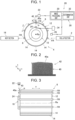
- Fig. 1 is a schematic view of a filter rod manufacturing machine.
- the filter rod manufacturing machine includes a roll-up section 2 and a conveyance section 4.
- a filter material formed from a filter fiber bundle such as acetate tow
- a raw-material rod is wrapped with an inner plug wrapper to form a continuous raw-material rod, and the raw-material rod is cut to manufacture filter rods FR.
- the raw-material rod may be formed by embedding a capsule into the filter material, adding activated carbon particles to the filter material, or adding particles of a hydrotalcite compound to the filter material.
- the filter material may be a filler in which a nonwoven fabric is folded, or a filler in which a paper web is gathered.
- Each filter rod FR manufactured by the roll-up section 2 is conveyed to the conveyance section 4.
- a drum row in which a plurality of rotatable conveyance drums are arranged in a row is disposed.
- Fig. 1 shows only one conveyance drum 6 in the drum row.
- the conveyance drum 6 includes a cylindrical core 10 in whose interior a suction source 8 is disposed, and a drum shell 12 that covers the cylindrical core 10.
- the drum shell 12 rotates around a rotational axis Ra as a center with respect to the cylindrical core 10.
- a plurality of holding grooves 14 that hold the filter rods FR are formed in an outer peripheral surface of the drum shell 12 along a peripheral direction Z.
- a suction pressure from the suction source 8 is applied to each holding groove 14.
- the filter rods FR are held by the holding grooves 14 in the outer peripheral surface of the drum shell 12 by the suction pressure of the suction source 8. Therefore, each filter rod FR is conveyed along the peripheral direction Z of the conveyance drum 6 as the drum shell 12 rotates.
- the filter rods FR on the conveyance drum 6 are conveyed while successively being transferred onto an adjacent conveyance drum on a downstream side in the drum row, and then are supplied to a next section 16.
- the filter rods FR are processed in a next step.
- the filter rods FR are canned in the next section 16 and conveyed to an apparatus of the next step, or are subjected to filter attachment processing in the next section 16.
- the filter attachment processing after the filter rods FR are connected to rods, which become flavor elements or tubular elements, through tipping paper, they are cut and become filter elements that constitute a flavor inhalation article.
- the inspection apparatus 20 for the filter rods FR is disposed at the conveyance section 4.
- the inspection apparatus 20 includes a camera 22, an illuminating device 24, a sensor 26, and a control unit 28.
- the control unit 28 includes an image processing unit 30 and a determination unit 32.
- the camera 22 and the sensor 26 are electrically connected to the control unit 28.
- the illuminating device 24 is, for example, an LED illuminating device of white light, and electrical power is supplied thereto by a power source 34.
- the camera 22 captures an image of an end portion 40 of a filter rod FR from a radial direction X orthogonal to the axial direction Y of the filter rod FR.
- An end surface 40a of the end portion 40 is shown on a near side in Fig. 1 .
- the sensor 26 detects a sending of the filter rod FR into the conveyance section 4, and outputs an imaging start signal to the control unit 28.
- the camera 22 receives the imaging start signal and captures the image of the end portion 40 at a timing in which the filter rod FR to be inspected that has been sent into the conveyance section 4 is conveyed to an imaging position P.
- the illuminating device 24 illuminates the end portion 40 in an illumination direction (shown by an alternate long and two short dash line) that faces the imaging direction (shown by an alternate long and short dash line) of the camera 22 across the end portion 40.
- the illuminating device 24 may be electrically connected to the control unit 28, or may be provided with a display unit (not shown) that displays the captured image captured by the camera 22.
- Fig. 2 shows an actual captured image captured by the camera 22.
- the image processing unit 30 processes the captured image and detects shading 42 of the end portion 40.
- portions corresponding to the end portion 40 and the end surface 40a in the shading 42 are indicated by the same reference numerals. This also applies to subsequent figures of captured images.
- the end portion 40 When a filter rod FR is normal, as shown in Fig. 2 , in a monochromatic image captured by the camera 22, the end portion 40 is detected as the shading 42 that is black and rectangular in an orientation in which an up-down direction is the axial direction Y of the end portion 40 and a left-right direction is the radial direction X of the end portion 40.
- the end surface 40a of the end portion 40 appears as a substantially straight boundary in an upper end of the shading 42.
- Fig. 3 is a side view of a conveyance drum 6.
- each filter rod FR protruding to an outer side of the drum shell 12 in the direction of the rotational axis Ra, each filter rod FR is held by the corresponding holding groove 14 of the drum shell 12. That is, the length of each filter rod FR in the axial direction Y is larger than the length of the drum shell 12 in the direction of the rotational axis Ra.
- the illuminating device 24 is fixed to an outer peripheral surface of the cylindrical core 10 that is positioned across the end portion 40.
- the camera 22 is fixed directly above the imaging position P that is situated above the illuminating device 24. Therefore, the camera 22 is capable of capturing an image of the end portion 40 from the radial direction X and the shading 42 appears in the captured image.
- the determination unit 32 determines the quality of a filter rod FR based on the shading 42 detected by the image processing unit 30.
- Fig. 4 is an inspection flowchart of an inspection by the inspection apparatus 20.
- the sensor 26 detects a sending of the filter rod FR into the conveyance section 4, and outputs an imaging start signal to the control unit 28 (filter rod detection step S1).
- the camera 22 receives the imaging start signal through the control unit 28, and, at a timing in which the filter rod FR to be inspected that has been sent into the conveyance section 4 is conveyed to the imaging position P, captures an image of the end portion 40 of the filter rod FR in the radial direction Y, and transmits captured image data to the image processing unit 30 (imaging step S2).
- the illuminating device 24 illuminates the end portion 40 in the illumination direction that faces the imaging direction of the camera 22 across the end portion 40 (illumination step S3).
- the image processing unit 30 processes the captured image transmitted from the camera 22 and detects the shading 42 of the end portion 40 (image processing step S4).
- the determination unit 32 determines the quality of the filter rod FR based on the shading 42 detected by the image processing unit 30 (determination step S5).
- Fig. 5 is a diagram for describing steps S41 to S45 and steps S51 to S54 of the inspection flowchart.
- step S41 an area S of the shading 42 is calculated and the process proceeds to step S51.
- step S51 it is determined whether or not the area S of the shading 42 is greater than or equal to a predetermined first threshold value T1.
- a predetermined first threshold value T1 When the determination result is Yes and S ⁇ T1 holds, it is determined that the filter rod FR properly exists at the imaging position P and that the filter rod FR can be inspected, and the process proceeds to step S42.
- the determination result in step S51 is No and S ⁇ T1 does not hold, that is, when the area S of the shading 42 becomes less than the first threshold value T1, there may be a problem in the capturing of the image of the end portion 40.
- the filter rod FR that is held by the drum shell 12 may be inclined, or the imaging timing of the camera 22 may be deviated and the image of the end portion 40 may not be properly captured. In this case, the process proceeds to step S52 and an output is made that the filter rod FR cannot be properly inspected and the inspection of the filter rod FR ends.
- step S42 two first edges E1 that are positioned on respective sides of the shading 42 in the radial direction X are detected.
- step S43 a first inspection region A1 that is defined by a region extending from inner sides of the two respective first edges E1 in the radial direction X of the shading 42 to the center of the shading 42 and including an upper end of the shading 42 in the axial direction Y is set.
- step S44 in the first inspection regionAl, a plurality of second edges E2 that are positioned on the upper end of the shading 42 in the axial direction Y are detected with a predetermined interval d existing in the radial direction X.
- step S45 an imaginary straight line L obtained by subjecting each second edge E2 to approximation linear processing is formed, and the process proceeds to step S53.
- step S53 the quality of the filter rod FR is determined based on the imaginary straight line L. Specifically, it is determined whether or not a standard deviation SD of a displacement amount w between the imaginary straight line L and each second edge E2 in the axial direction Y exceeds a predetermined second threshold value T2.
- a portion indicated by reference numeral 44; this also applies below
- a foreign substance such as a glue residue
- step S58 an output is made that the filter rod FR is defective, and the inspection ends.
- the defective filter rod FR is eliminated from a conveyance path of the conveyance section 4. This also applies in the description below.
- the detection result of step S53 is No and SD > T2 does not hold, that is, when the standard deviation SD of the displacement amount w between the imaginary straight line L and each second edge E2 in the axial direction Y becomes less than the second threshold value T2, the process proceeds to step S54.
- Fig. 6 is a diagram for describing steps S46 and S47 and step S55 of the inspection flowchart.
- a second inspection region A2 that is defined by a region extending to outer sides of the two respective first edges E1 in the radial direction X of the shading 42 and situated on an upper side of the imaginary straight line L in the axial direction Y is set.
- the imaginary straight line L extends in the radial direction X, and coincides with a lower end frame of the second inspection region A2.
- step S5 the quality of the filter rod FR is determined based on the second inspection region A2. Specifically, after setting the second inspection region A2 in step S46, the process proceeds to step S47, and, in step S47, the second inspection region A2 is subjected to binary black-and-white reversal processing.
- Fig. 7 shows a captured image after the binary black-and-white reversal processing when the end portion 40 is normal.
- step S55 it is determined whether or not one or more white regions AW formed in the second inspection region A2 by the binary black-and-white reversal processing exist and whether or not an area Sw of the white region AW is greater than or equal to a predetermined fourth threshold value T4.
- Fig. 8 shows a captured image after the binary black-and-white reversal processing when the foreign substance 44, such as a glue residue, is stuck in the end surface 40a. In the captured image, the foreign substance 44 appears clearly as the white region AW.
- step S48 upon terminating the binary black-and-white reversal processing performed in step S47 and restoring the second inspection region A2 to the original state, the second inspection region A2 is divided into a plurality of division regions AD, and the density of the color of each division region AD, in other words, the shade of black or gray is detected.
- step S56 it is determined whether a change rate Rv of the density of the color of each division region AD is greater than or equal to a predetermined fifth threshold value T5. Specifically, the change rate Rv of a particular division region AD is compared with the change rates Rv of the densities of the colors of three adjacent division regions AD in the radial direction X, the axial direction Y, or an oblique direction of the particular division region AD.
- the determination result is Yes and Rv ⁇ T5 holds, since it is supposed that the foreign substance 44, such as a glue residue, exists in the end surface 40a, the process proceeds to step S58 and an output is made that the filter rod FR is defective, and the inspection ends.
- the inspection apparatus 20 of the embodiment inspects the filter rod FR that becomes a filter element of a flavor inhalation article during a conveyance process at the conveyance section 4.
- the illuminating device 24 illuminates the end portion 40 in the illumination direction that faces the imaging direction of the camera 22 across the end portion 40, as a result of which it is possible to easily and reliably detect by the shading 42 of the end portion 40 that the foreign substance 44, such as a glue residue, is stuck in or adheres to the end surface 40a of the filter rod FR.
- the camera 22 receives an imaging start signal output from the sensor 26, the camera 22 captures an image of the end portion 40 at a timing in which the filter rod FR to be inspected that has been sent into the conveyance section 4 is conveyed to the imaging position P. Therefore, it is possible to reliably inspect filter rods FR that are successively sent to the conveyance section 4 without omitting any filter rod FR.
- each filter rod FR With the end portion 40 of each filter rod FR protruding to the outer side of the drum shell 12 in the direction of the rotational axis Ra, each filter rod FR is held by the outer peripheral surface of the drum shell 12, and the illuminating device 24 is fixed to the outer peripheral surface of the cylindrical core 10 across the end portion 40. Therefore, in the conveyance drum 6 that is disposed at the conveyance section 4, it is possible to reliably inspect the end surface 40a of each end portion 40 without producing blind spots of inspection at the end portion 40 of each filter rod FR that is being conveyed.
- the determination unit 32 determines that the filter rod FR properly exists at the imaging position P and that the filter rod FR can be inspected. Therefore, a case in which the inspection cannot be properly performed due to inclination of the filter rod FR at the time of the inspection or occurrence of a deviation in the imaging timing is previously eliminated. Consequently, it is possible to further improve inspection precision and inspection efficiency of the filter rod FR.
- the image processing unit 30 detects two first edges E1 of a captured image, sets the first inspection regionAl, and forms the imaginary straight line L. Further, in the determination step S5, the determination unit 32 determines the quality of a filter rod FR based on the imaginary straight line L.
- the filter rod FR is obtained by, after forming a raw-material rod by rolling up a filter fiber bundle into a rod shape, wrapping the raw-material rod with an inner plug wrapper and cutting the raw-material rod.
- a cut end of the inner plug wrapper protrudes slightly from the end surface 40a of the filter rod FR.
- the first inspection region A1 it is possible to prevent the cut end of the inner plug wrapper from being erroneously recognized as the foreign substance 44 existing in the end surface 40a. Therefore, it is possible to further improve inspection precision and inspection efficiency of the filter rod FR.
- the determination unit 32 determines that the filter rod FR is defective. Therefore, even when a plurality of foreign substances 44 intermittently exist in the end surface 40a, since it is possible to detect unacceptably large foreign substances 44, it is possible to further improve inspection precision and inspection efficiency of the filter rod FR.
- the determination unit 32 determines that the filter rod FR is defective. Therefore, even when a plurality of foreign substances 44 intermittently exist in the end surface 40a, it is possible to detect unacceptably large foreign substances 44 with even higher precision.
- the image processing unit 30 sets the second inspection region A2 in a captured image. Further, in the determination step S5, the determination unit 32 determines the quality of the filter rod FR based on the second inspection region A2. Therefore, it is possible to efficiently detect a foreign substance 44 that protrudes toward the region extending to the outer sides of the two respective first edges E1 in the radial direction X of the shading 42 and including the upper side of the imaginary straight line L in the axial direction Y, that is, the region existing on an outer side and an upper side of the first inspection region A 1 from the end surface 40a.
- the image processing unit 30 performs binary black-and-white reversal processing on the second inspection region A2. Further, in the determination step S5, when one or more white regions AW formed in the second inspection region A2 by the binary black-and-white reversal processing exist and the area Sw of the white region AW becomes greater than or equal to the fourth threshold value T4, the determination unit 32 determines that the filter rod FR is defective. Since the foreign substance 44 appears clearly as the white region AW, it is possible to further improve inspection precision and inspection efficiency of the filter rod FR.
- the image processing unit 30 divides the second inspection region A2 into a plurality of division regions AD and detects the density of the color of each division region AD. Further, in the determination step S5, when the change rate Rv of the density of the color of each division region AD becomes greater than or equal to the fifth threshold value T5, the determination unit 32 determines that the filter rod FR is defective. Therefore, even if the foreign substance 44 is one that protrudes in a posture or orientation in which the shading 42 is unlikely to occur from the end surface 40a or the shade of the shading 42 is light, it is possible to detect the difference between the densities of the colors. Thus, it is possible to further improve inspection precision and inspection efficiency of the filter rod FR.
- each step that constitutes the image processing step S4 and each step that constitutes the determination step S5 need not be necessarily performed in the order described in the embodiment.
- each step has the operational effect described above, not all of the steps need to be performed.
- the determination of step S56 may be performed before the determination of step S55, or only one of steps S55 and S56 may be performed.
- step S54 may be performed before the determination of step S53, or only one of the steps S53 and S54 may be performed.
Landscapes
- Health & Medical Sciences (AREA)
- General Health & Medical Sciences (AREA)
- Toxicology (AREA)
- Investigating Materials By The Use Of Optical Means Adapted For Particular Applications (AREA)
Applications Claiming Priority (1)
| Application Number | Priority Date | Filing Date | Title |
|---|---|---|---|
| PCT/JP2021/045135 WO2023105684A1 (ja) | 2021-12-08 | 2021-12-08 | フィルタロッドの検査装置及び検査方法 |
Publications (2)
| Publication Number | Publication Date |
|---|---|
| EP4445754A1 true EP4445754A1 (de) | 2024-10-16 |
| EP4445754A4 EP4445754A4 (de) | 2025-11-05 |
Family
ID=86729967
Family Applications (1)
| Application Number | Title | Priority Date | Filing Date |
|---|---|---|---|
| EP21967183.1A Pending EP4445754A4 (de) | 2021-12-08 | 2021-12-08 | Inspektionsvorrichtung und inspektionsverfahren für filterstab |
Country Status (2)
| Country | Link |
|---|---|
| EP (1) | EP4445754A4 (de) |
| WO (1) | WO2023105684A1 (de) |
Family Cites Families (5)
| Publication number | Priority date | Publication date | Assignee | Title |
|---|---|---|---|---|
| US6169600B1 (en) * | 1998-11-20 | 2001-01-02 | Acuity Imaging, Llc | Cylindrical object surface inspection system |
| JP2002014050A (ja) * | 2000-06-30 | 2002-01-18 | Japan Tobacco Inc | シガレット検査装置 |
| JP2004101339A (ja) * | 2002-09-09 | 2004-04-02 | Japan Tobacco Inc | 丸棒体の外観検査装置 |
| WO2019077665A1 (ja) | 2017-10-16 | 2019-04-25 | 日本たばこ産業株式会社 | 喫煙用ロッド状物品の検査装置、喫煙用ロッド状物品の製造機、及び喫煙用ロッド状物品の検査方法 |
| IT201800010374A1 (it) * | 2018-11-15 | 2020-05-15 | Xepics Sa | Metodo e sistema automatico di misura per la misurazione di parametri fisici e dimensionali di articoli combinati. |
-
2021
- 2021-12-08 WO PCT/JP2021/045135 patent/WO2023105684A1/ja not_active Ceased
- 2021-12-08 EP EP21967183.1A patent/EP4445754A4/de active Pending
Also Published As
| Publication number | Publication date |
|---|---|
| EP4445754A4 (de) | 2025-11-05 |
| WO2023105684A1 (ja) | 2023-06-15 |
Similar Documents
| Publication | Publication Date | Title |
|---|---|---|
| JP5453350B2 (ja) | 包装体の検査装置 | |
| US5392359A (en) | Apparatus for inspecting appearance of cylindrical objects | |
| CN111492230A (zh) | 香烟过滤嘴的检查方法、香烟过滤嘴的检查装置及香烟过滤嘴的检查程序 | |
| US6578583B2 (en) | Apparatus for making and inspecting multi-component wrapped article | |
| KR20190088966A (ko) | 검사 장치 및 ptp 포장기 | |
| HUE032476T2 (en) | Control system | |
| KR102337014B1 (ko) | 신장된 요소를 검사하는 방법 | |
| JP2001292757A (ja) | シガレット検査装置 | |
| EP4445754A1 (de) | Inspektionsvorrichtung und inspektionsverfahren für filterstab | |
| JP2002148205A (ja) | 棒状体の表面検査装置 | |
| KR20150063435A (ko) | 사조의 검사 방법, 사조의 검사 장치, 사조의 제조 방법, 사조 패키지 및 사조 모듈 | |
| JP6785634B2 (ja) | 不織布の検査装置 | |
| JP2009128158A (ja) | パターン検査装置 | |
| JP5112742B2 (ja) | 捲縮繊維束の幅異常検出方法及び装置 | |
| CN110833208A (zh) | 卷烟机和水松纸输送检测方法 | |
| WO2013046401A1 (ja) | たばこフィルタの検査システム及びその検査方法 | |
| JP6612100B2 (ja) | 物品検査装置 | |
| WO2019077665A1 (ja) | 喫煙用ロッド状物品の検査装置、喫煙用ロッド状物品の製造機、及び喫煙用ロッド状物品の検査方法 | |
| JP2004271205A (ja) | 容器口部の欠陥検査装置 | |
| WO2018198403A1 (ja) | 検査装置、ptp包装機及びptpシートの製造方法 | |
| JP4549838B2 (ja) | 光沢度測定方法および装置 | |
| KR102234309B1 (ko) | 신장된 요소의 검사 그룹 | |
| JPH11287763A (ja) | 卵の自動検査方法およびこの方法に好適な卵の搬送制御装置および卵の自動検査装置 | |
| JP3494561B2 (ja) | 錠剤の外観検査方法と錠剤の外観検査装置 | |
| JP3140125B2 (ja) | 紙巻たばこの搬送装置 |
Legal Events
| Date | Code | Title | Description |
|---|---|---|---|
| STAA | Information on the status of an ep patent application or granted ep patent |
Free format text: STATUS: THE INTERNATIONAL PUBLICATION HAS BEEN MADE |
|
| PUAI | Public reference made under article 153(3) epc to a published international application that has entered the european phase |
Free format text: ORIGINAL CODE: 0009012 |
|
| STAA | Information on the status of an ep patent application or granted ep patent |
Free format text: STATUS: REQUEST FOR EXAMINATION WAS MADE |
|
| 17P | Request for examination filed |
Effective date: 20240528 |
|
| AK | Designated contracting states |
Kind code of ref document: A1 Designated state(s): AL AT BE BG CH CY CZ DE DK EE ES FI FR GB GR HR HU IE IS IT LI LT LU LV MC MK MT NL NO PL PT RO RS SE SI SK SM TR |
|
| DAV | Request for validation of the european patent (deleted) | ||
| DAX | Request for extension of the european patent (deleted) | ||
| A4 | Supplementary search report drawn up and despatched |
Effective date: 20251009 |
|
| RIC1 | Information provided on ipc code assigned before grant |
Ipc: A24C 5/34 20060101AFI20251002BHEP Ipc: A24D 3/02 20060101ALI20251002BHEP |