EP4444004A1 - Uplink-übertragungsverfahren und -vorrichtung, netzwerkknoten und speichermedium - Google Patents
Uplink-übertragungsverfahren und -vorrichtung, netzwerkknoten und speichermedium Download PDFInfo
- Publication number
- EP4444004A1 EP4444004A1 EP22906643.6A EP22906643A EP4444004A1 EP 4444004 A1 EP4444004 A1 EP 4444004A1 EP 22906643 A EP22906643 A EP 22906643A EP 4444004 A1 EP4444004 A1 EP 4444004A1
- Authority
- EP
- European Patent Office
- Prior art keywords
- transmission
- symbol
- slot
- pusch
- repetition transmission
- Prior art date
- Legal status (The legal status is an assumption and is not a legal conclusion. Google has not performed a legal analysis and makes no representation as to the accuracy of the status listed.)
- Pending
Links
Images

Classifications
-
- H—ELECTRICITY
- H04—ELECTRIC COMMUNICATION TECHNIQUE
- H04L—TRANSMISSION OF DIGITAL INFORMATION, e.g. TELEGRAPHIC COMMUNICATION
- H04L5/00—Arrangements affording multiple use of the transmission path
-
- H—ELECTRICITY
- H04—ELECTRIC COMMUNICATION TECHNIQUE
- H04L—TRANSMISSION OF DIGITAL INFORMATION, e.g. TELEGRAPHIC COMMUNICATION
- H04L5/00—Arrangements affording multiple use of the transmission path
- H04L5/003—Arrangements for allocating sub-channels of the transmission path
- H04L5/0044—Allocation of payload; Allocation of data channels, e.g. PDSCH or PUSCH
-
- H—ELECTRICITY
- H04—ELECTRIC COMMUNICATION TECHNIQUE
- H04L—TRANSMISSION OF DIGITAL INFORMATION, e.g. TELEGRAPHIC COMMUNICATION
- H04L5/00—Arrangements affording multiple use of the transmission path
- H04L5/003—Arrangements for allocating sub-channels of the transmission path
- H04L5/0048—Allocation of pilot signals, i.e. of signals known to the receiver
-
- H—ELECTRICITY
- H04—ELECTRIC COMMUNICATION TECHNIQUE
- H04L—TRANSMISSION OF DIGITAL INFORMATION, e.g. TELEGRAPHIC COMMUNICATION
- H04L5/00—Arrangements affording multiple use of the transmission path
- H04L5/003—Arrangements for allocating sub-channels of the transmission path
- H04L5/0053—Allocation of signalling, i.e. of overhead other than pilot signals
-
- H—ELECTRICITY
- H04—ELECTRIC COMMUNICATION TECHNIQUE
- H04L—TRANSMISSION OF DIGITAL INFORMATION, e.g. TELEGRAPHIC COMMUNICATION
- H04L5/00—Arrangements affording multiple use of the transmission path
- H04L5/0091—Signalling for the administration of the divided path, e.g. signalling of configuration information
- H04L5/0094—Indication of how sub-channels of the path are allocated
-
- H—ELECTRICITY
- H04—ELECTRIC COMMUNICATION TECHNIQUE
- H04L—TRANSMISSION OF DIGITAL INFORMATION, e.g. TELEGRAPHIC COMMUNICATION
- H04L5/00—Arrangements affording multiple use of the transmission path
- H04L5/14—Two-way operation using the same type of signal, i.e. duplex
- H04L5/1469—Two-way operation using the same type of signal, i.e. duplex using time-sharing
-
- H—ELECTRICITY
- H04—ELECTRIC COMMUNICATION TECHNIQUE
- H04W—WIRELESS COMMUNICATION NETWORKS
- H04W72/00—Local resource management
- H04W72/04—Wireless resource allocation
-
- H—ELECTRICITY
- H04—ELECTRIC COMMUNICATION TECHNIQUE
- H04W—WIRELESS COMMUNICATION NETWORKS
- H04W72/00—Local resource management
- H04W72/04—Wireless resource allocation
- H04W72/044—Wireless resource allocation based on the type of the allocated resource
- H04W72/0446—Resources in time domain, e.g. slots or frames
-
- H—ELECTRICITY
- H04—ELECTRIC COMMUNICATION TECHNIQUE
- H04W—WIRELESS COMMUNICATION NETWORKS
- H04W72/00—Local resource management
- H04W72/12—Wireless traffic scheduling
- H04W72/1263—Mapping of traffic onto schedule, e.g. scheduled allocation or multiplexing of flows
- H04W72/1268—Mapping of traffic onto schedule, e.g. scheduled allocation or multiplexing of flows of uplink data flows
-
- H—ELECTRICITY
- H04—ELECTRIC COMMUNICATION TECHNIQUE
- H04W—WIRELESS COMMUNICATION NETWORKS
- H04W72/00—Local resource management
- H04W72/20—Control channels or signalling for resource management
-
- H—ELECTRICITY
- H04—ELECTRIC COMMUNICATION TECHNIQUE
- H04W—WIRELESS COMMUNICATION NETWORKS
- H04W72/00—Local resource management
- H04W72/20—Control channels or signalling for resource management
- H04W72/23—Control channels or signalling for resource management in the downlink direction of a wireless link, i.e. towards a terminal
Definitions
- the disclosure relates to the field of wireless technologies, and in particular to a method, an apparatus and a network node for uplink transmission and a storage medium.
- type A of Physical Uplink Shared Channel (PUSCH) repetition transmission type A adopts a consecutive slot-based manner. That is, a terminal is configured to perform K times of retransmissions on K consecutive slots. This manner will cause that the number of actual repetition transmissions is far less than the number of repetition transmissions configured by a network side, and the efficiency of uplink transmission is poor.
- PUSCH Physical Uplink Shared Channel
- embodiments of the disclosure provide a method, an apparatus and a network node for uplink transmission and a storage medium.
- An embodiment of the disclosure provides a method for uplink transmission, which is applied to a first terminal and includes the following operation.
- First slot(s) is determined.
- Each first slot represents an available slot for PUSCH transmission or PUSCH repetition transmission, and the number of available symbol(s) of the first slot is greater than or equal to the number of symbol(s) indicated for each transmission or each repetition transmission.
- An embodiment of the disclosure further provides an apparatus for uplink transmission, which includes a first determination unit.
- the first determination unit is configured to determine first slot(s).
- Each first slot represents an available slot for PUSCH transmission or PUSCH repetition transmission, and the number of available symbol(s) of the first slot is greater than or equal to the number of symbol(s) indicated for each PUSCH transmission or each PUSCH repetition transmission.
- An embodiment of the disclosure further provides a first terminal, which includes a first processor and a first communication interface.
- the first processor is configured to determine first slot(s).
- Each first slot represents an available slot for PUSCH transmission or PUSCH repetition transmission, and the number of available symbol(s) of the first slot is greater than or equal to the number of symbol(s) indicated for each PUSCH transmission or each PUSCH repetition transmission.
- An embodiment of the disclosure further provides a first terminal, which includes a first processor and a first memory for storing a computer program capable of running on a processor.
- the first processor is configured to perform operations of any method mentioned above when running the computer program.
- An embodiment of the disclosure provides a storage medium storing a computer program.
- the computer program is executed by a processor, operations of any method mentioned above are implemented.
- the PUSCH transmission or the PUSCH repetition transmission is configured by using the available slot, and the first terminal determines a slot in which the number of available symbol(s) is greater than or equal to the number of symbol(s) indicated for each transmission, or a slot in which the number of available symbol(s) is greater than or equal to the number of symbol(s) indicated for each repetition transmission, as the first slot available for the PUSCH transmission or the PUSCH repetition transmission. Based on this, the PUSCH transmission or the PUSCH repetition transmission is performed, which avoids the case in which the number of actual transmissions or actual repetition transmissions is far less than the number of transmissions or repetition transmissions configured by the network side, thereby improving the efficiency of uplink transmission.
- PUSCH repetition type A adopts a consecutive slot-based manner. That is, a terminal is configured to perform K times of retransmissions on K consecutive slots. Specifically, the number of retransmissions is configured as 16, for a frame structure of Time Division Duplexing (TDD) (for example, 7D1S2U), e.g., a frame structure that each frame is configured with 7 downlink sub-frames, 1 special sub-frame and 2 uplink sub-frames, 16 times of retransmissions cover one subframe and six slots.
- TDD Time Division Duplexing
- 7D1S2U Time Division Duplexing
- FIG. 1 when one sub-frame and six slots both contain two uplink slots respectively, the number of retransmissions that can actually be performed is 4.
- the number of retransmissions that can actually be performed is 8. That is, the consecutive slot-based manner will cause that the number of actual retransmissions is far less than the number of retransmissions configured by a network side, and the efficiency of uplink transmission is poor.
- an available slot manner is used, and a first terminal determines a slot in which the number of available symbol(s) is greater than or equal to the number of symbol(s) indicated for each transmission, or a slot in which the number of available symbol(s) is greater than or equal to the number of symbol(s) indicated for each repetition transmission, as the first slot available for the transmission or the repetition transmission of PUSCH.
- the transmission or the repetition transmission of the PUSCH is performed, which avoids the case in which the number of actual transmissions or actual repetition transmissions is far less than the number of transmissions or repetition transmissions configured by the network side, thereby improving the efficiency of uplink transmission.
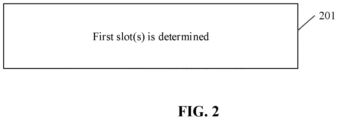
- An embodiment of the disclosure provides a method for uplink transmission, as illustrated in FIG. 2 .
- the method includes the following operation.
- first slot(s) is determined.
- Each first slot represents an available slot for PUSCH transmission or PUSCH repetition transmission.
- the number of available symbol(s) of the first slot is greater than or equal to the number of symbol(s) indicated for each transmission or each repetition transmission.
- the available slot there is a lack of relevant definitions and processing methods for the available slot.
- the following considerations need to be made in principle: whether to consider including a flexible slot, and whether to consider the change of the flexible slot, more specifically, whether to consider RRC configuration information (for example, uplink slot configuration information and downlink slot configuration information), whether to consider a Slot Format Indication (SFI) and the like.
- RRC configuration information for example, uplink slot configuration information and downlink slot configuration information
- SFI Slot Format Indication
- the number of available symbol(s) being greater than or equal to the number of symbol(s) indicated for each transmission or each repetition transmission is used as a basic criterion for determining the available slot(s), thereby ensuring that available resource of the determined available slot(s) may meet the transmission or the repetition transmission of the PUSCH.
- the first terminal determines the first slot(s) based on configuration information of the TDD.
- the configuration information of the TDD includes, but is not limited to, tdd-UL-DL-ConfigurationCommon and/or tdd-UL-DL-ConfigurationDedicated.
- the first terminal does not consider the following symbols as the available resource of the available slot(s). That is, the available symbol(s) do not include: a symbol carrying a type 0-Physical Downlink Control Channel (PDCCH) Common Search Space (type 0-PDCCH CSS), and/or a flexible symbol carrying a Synchronization Signal Block (SSB).
- PDCH Physical Downlink Control Channel
- SSB Synchronization Signal Block
- determining the first slot(s) based on the configuration information of the TDD includes the following two cases:
- Case 1 the first slot(s) and the available resource of the first slot(s) are determined based on uplink slot(s) and uplink symbol(s) indicated in the configuration information of the TDD.
- Case 2 the first slot(s) and the available resource on the first slot(s) are determined based on uplink slot(s), uplink symbol(s), flexible slot(s) and flexible symbol(s) indicated by the configuration information of the TDD.
- the SFI is considered when determining the available slot(s).
- the indication of the SFI may also be considered in two cases: one is that the indication of the SFI is not considered when determining the available slot(s), and the influence of the SFI is considered when processing conflicts with other configuration information subsequently; the other is that the indication of the SFI is considered when determining the available slot(s).
- the SFI may be a slot format indication based on Downlink Control Information (DCI) format 2_0.
- DCI Downlink Control Information
- the corresponding slot is the first slot based on the uplink slot(s), the uplink symbol(s), the flexible slot(s) and the flexible symbol(s) indicated in the configuration information of the TDD.
- the number of available symbol(s) in the corresponding slot is greater than or equal to the number of symbol(s) indicated for each PUSCH transmission or each PUSCH repetition transmission, that is, all of the symbol(s) indicated for each PUSCH transmission or each PUSCH repetition transmission are the uplink symbol(s) or the flexible symbol(s), and the symbol(s) indicated for each PUSCH transmission or each PUSCH repetition transmission are not occupied by other channels or signals and can be used for PUSCH transmission or PUSCH repetition transmission
- this slot is determined as an available slot (i.e., the first slot), and the corresponding symbol(s) indicated for each PUSCH transmission or each PUSCH repetition transmission are determined as the available resource on the first slot.
- the first terminal may perform the following operations:
- the first SFI indicates flexible symbol(s) are updated to downlink symbol(s) and if uplink symbol(s) after updating and/or flexible symbol(s) after updating cannot meet PUSCH transmission or PUSCH repetition transmission, one repetition transmission is counted in for the corresponding first slot, and the PUSCH transmission or the PUSCH repetition transmission is not performed on the corresponding first slot;
- the PUSCH transmission or the PUSCH repetition transmission is performed only on a part of resource.
- the PUSCH transmission or the PUSCH repetition transmission cannot be met, which means that corresponding physical resources cannot meet the number of physical resources or the positions of physical resources indicated for the PUSCH transmission or PUSCH repetition transmission.
- the transmission is performed on a part of resource, which means that the transmission is performed on resource that does not overlap or is not conflict with other transmissions, or that is not occupied by the other transmissions.
- the first terminal determines that the SFI indicated by a base station does not change the first terminal's judgment on the available slot(s) and the available resource of the available slot(s), or the first terminal does not expect the SFI indicated by the base station to change the first terminal's judgment on the available slot(s) and available resource of the available slot(s).
- the first terminal still determines the corresponding slot as the first slot.
- the first terminal still determines the corresponding slot as the first slot, but does not perform the PUSCH transmission or the PUSCH repetition transmission on the first slot, but still counts in one repetition transmission for the first slot (i.e., adds 1 to the recorded number of repetition transmissions); or the first terminal performs the PUSCH transmission or the PUSCH repetition transmission on available symbol(s) of the first slot.
- determining first slot(s) includes the following operations.
- the first slot(s) and available resource of the first slot(s) are determined based on uplink slot(s) and uplink symbol(s) indicated by the configuration information of TDD and a second SFI; or the first slot(s) and available resource of the first slot(s) are determined based on uplink slot(s), uplink symbol(s), flexible slot(s) and flexible symbol(s) indicated by the configuration information of TDD and a second SFI.
- the second SFI represents a last SFI received by the first terminal before receiving first Downlink Control Information (DCI).
- DCI Downlink Control Information
- the first DCI is used for indicating PUSCH transmission or PUSCH repetition transmission.
- whether a corresponding slot is the first slot is determined based on the uplink slot(s) and the uplink symbol(s) indicated in the configuration information of the TDD and the uplink symbol(s) indicated by the second SFI.
- the number of available symbol(s) in the corresponding slot is greater than or equal to the number of symbol(s) indicated for each PUSCH transmission or each PUSCH repetition transmission(i.e., all of the available uplink symbol(s) in the corresponding slot can be used for PUSCH transmission or PUSCH repetition transmission)
- the slot is determined as the available slot (i.e., the first slot), and the corresponding available uplink symbol(s) are determined as the available resource on the first slot.
- the first terminal may perform the following operations: assuming that the third SFI does not change the determination of the first slot(s) by the first terminal; and/or not expecting that the third SFI changes the determination of the first slot(s) by the first terminal.
- the uplink symbol(s) indicated by the second SFI, including flexible symbol(s), indicated by the second SFI, to be updated as the uplink symbol(s), would not be updated as flexible symbol(s) or downlink symbol(s).
- the first terminal receives a third SFI after receiving the second SFI
- the third SFI indicates that uplink symbol(s) indicated by the second SFI is updated to flexible symbol(s) or downlink symbol(s)
- the PUSCH transmission or the PUSCH repetition transmission is not performed on the corresponding first slot and one repetition transmission is counted in for the corresponding first slot; or the PUSCH transmission or the PUSCH repetition transmission is performed only on a part of resource.
- the PUSCH transmission or the PUSCH repetition transmission of the cannot be met, which means that corresponding physical resources cannot meet the number of physical resources or the positions of physical resources indicated for the PUSCH transmission or PUSCH repetition transmission.
- the transmission is performed on a part of resource, which means that the transmission is performed on resource that does not overlap or is not conflict with other transmissions, or that is not occupied by the other transmissions.
- the third SFI indicates that the uplink symbol(s) indicated by the second SFI are updated to flexible symbol(s) or downlink symbol(s)
- the number of flexible symbol(s) available for uplink transmission is reduced. If the uplink symbol(s) after updating and the flexible symbol(s) after updating cannot meet the PUSCH transmission or the PUSCH repetition transmission, then the first terminal still determines the corresponding slot as the first slot, but does not perform the PUSCH transmission or the PUSCH repetition transmission on the first slot, but still counts in one repetition transmission for the first slot (i.e., adds 1 to the recorded number of repetition transmissions); or the first terminal performs the PUSCH transmission or the PUSCH repetition transmission on available symbol(s) of the first slot.
- the flexible slot(s) and flexible symbol(s) indicated in the configuration information of the TDD are also considered.
- whether a corresponding slot is the first slot is determined based on the uplink slot(s), the uplink symbol(s), the flexible slot(s) and the flexible symbol(s) indicated in the configuration information of the TDD and the uplink symbol(s) indicated by the second SFI.
- the slot is determined as the available slot (i.e., the first slot), and the corresponding available uplink symbol(s) and the flexible symbol(s) are determined as available resource of the first slot.
- the first terminal may perform the following operations: assuming that the third SFI does not change the determination of the first slot(s) by the first terminal; and/or not expecting that the third SFI changes the determination of the first slot(s) by the first terminal.
- the first terminal receives a third SFI after receiving the second SFI
- the third SFI indicates that uplink symbol(s) indicated by the second SFI is updated to flexible symbol(s) or downlink symbol(s)
- the PUSCH transmission or the PUSCH repetition transmission is not performed on the corresponding first slot and one repetition transmission is counted in for the corresponding first slot.
- the PUSCH transmission or the PUSCH repetition transmission of the cannot be met, which means that corresponding physical resources cannot meet the number of physical resources or the positions of physical resources indicated for the PUSCH transmission or PUSCH repetition transmission. That is, since the third SFI updates the states of the symbol(s), the number of flexible symbol(s) available for uplink transmission is reduced, and the uplink symbol(s) after updating and flexible symbol(s) after updating cannot meet the indicated PUSCH transmission or the indicated PUSCH repetition transmission, then the first terminal still determines the corresponding slot as the first slot, but does not perform the PUSCH transmission or the PUSCH repetition transmission on the first slot, but still counts in one repetition transmission for the first slot (i.e., adds 1 to the recorded number of repetition transmissions); or the first terminal performs the PUSCH transmission or the PUSCH repetition transmission on the remained available resource.
- an indication of a Cancellation Indication can only be used for type B of repetition transmission (i.e., repetition type B), and the repetition type A cannot be cancelled by the indication of the CI.
- a condition for the CI to be valid is that the CI is to be sent before the corresponding PUSCH or the PDCCH scheduled for Sounding Reference Signal (SRS) transmission.
- SRS Sounding Reference Signal
- the corresponding PUSCH transmission or the corresponding PUSCH repetition transmission may span a long time by using the method based on available slot(s).
- the transmission PUSCH or the PUSCH repetition transmission may span 80 slots, and the corresponding scheduled or indicated PDCCH has been sent long ago. At this time, if the indication of the CI is still required to be transmitted before indication of the corresponding transmission, it is difficult to achieve.
- the method further includes the following operations.
- the corresponding PUSCH transmission or the corresponding PUSCH repetition transmission is cancelled and one repetition transmission is counted in for the corresponding PUSCH transmission or the corresponding PUSCH repetition transmission, or the PUSCH transmission or the PUSCH repetition transmission is performed only on a part of resource.
- Cancelled resource indicated by the first CI overlaps with the PUSCH transmission or the PUSCH repetition transmission or overlaps with slot(s) of the corresponding PUSCH transmission or the corresponding PUSCH repetition transmission.
- the transmission being performed on a part of resource means that the transmission is performed on resource that does not overlap or is not conflict with other transmissions, or that is not occupied by other transmissions.
- the terminal when the terminal performs the PUSCH transmission or the PUSCH repetition transmission based on available slot(s), if the received CI indicates that the cancelled resource, including symbol(s) of time domain or Physical Resource Block(s) (PRB(s)) of frequency domain, overlaps with the corresponding PUSCH transmission or corresponding PUSCH repetition transmission, or overlaps with the slot(s) of the corresponding PUSCH transmission or corresponding PUSCH repetition transmission, then the corresponding PUSCH transmission or corresponding PUSCH repetition transmission is cancelled, but one repetition transmission is still counted in for the first slot (i.e., adds 1 to the recorded number of repetition transmissions), or the first terminal performs the corresponding PUSCH transmission or the corresponding PUSCH repetition transmission on the remained resource without overlapping.
- PRB(s) Physical Resource Block
- cancelled symbols indicated by the first CI include a first symbol, a second symbol and symbol(s) between the first symbol and the second symbol.
- the first symbol represents a last symbol of received PDCCH carrying the first CI.
- the second symbol represents a first symbol after elapsing a processing time delay and a time offset.
- the first CI indicates the cancelled symbol(s), which starts from the last symbol of received PDCCH indication carrying the first CI, and ends at the first symbol after elapsing the processing delay and the time offset.
- an inconsistency of understanding between the base station and the terminal which affects transmission efficiency, can be avoided by agreeing on symbol(s) indicated by the CI.
- PDCCH carrying the first CI indication does not need to be sent or received by the first terminal before first DCI.
- the first DCI is used for indicating the PUSCH transmission or the PUSCH repetition transmission.
- an uplink downlink transmission manner or a downlink transmission manner of flexible slots is updated by the SFI, so it is necessary to further consider the impact of the update on the definition of the available slots, as well as the indication of the CI and the transmission relationship between the SRS and the available slots.
- the SRS may be transmitted in a special slot and the SRS occupies the last several symbols of the special slot. Therefore, it is also necessary to consider how to deal with the transmission relationship between the SRS and the special slot.
- a priority of the PUSCH transmission or the PUSCH repetition transmission is a high priority, and the method includes the following operations.
- a third symbol, a fourth symbol and/or a fifth symbol are determined as available symbols when determining the first slot.
- the third symbol represents a symbol in which a Sounding Reference Signal (SRS) can be configured or is configured.
- the fourth symbol represents a symbol indicated for the PUSCH transmission or the PUSCH repetition transmission, and a network side triggers the first terminal to send an aperiodic SRS on the fourth symbol.
- the fifth symbol represents a symbol indicated for the PUSCH transmission or the PUSCH repetition transmission, and a transmission of a periodic SRS and/or a semi-persistent SRS on the fifth symbol overlaps with the corresponding PUSCH transmission or corresponding PUSCH repetition transmission.
- the priority of the PUSCH transmission or the PUSCH repetition transmission is the high priority (for example, the priority of the PUSCH transmission or the PUSCH repetition transmission is indicated as 1 (i.e., priority index 1)), or when the PUSCH transmission or the PUSCH repetition transmission is a service of higher priority (for example, a URLLC service), all potential symbols in which the SRS can be configured or is configured are considered to be capable of being used for the PUSCH transmission or PUSCH repetition transmission, and thus, when determining the available slot(s), the positions of SRS symbols are not considered, and it is determined that the PUSCH transmission or the PUSCH repetition transmission may be performed on the corresponding symbols.
- the first terminal is triggered by the base station to send the aperiodic SRS on the symbol indicated for the PUSCH transmission or PUSCH repetition transmission, then the PUSCH transmission or the PUSCH repetition transmission is still performed on the corresponding symbol, and the first terminal does not send the aperiodic SRS on the corresponding symbol. If the transmission of the periodic SRS and/or semi-persistent SRS overlaps with the PUSCH transmission or the PUSCH repetition transmission, then the PUSCH transmission or the PUSCH repetition transmission is still performed on the corresponding resource.
- a priority of the PUSCH transmission or the PUSCH repetition transmission is a low priority, and the method includes the following operations.
- a network side triggers the first terminal to send an aperiodic SRS
- a symbol for sending the aperiodic SRS overlaps with a symbol indicated for the PUSCH transmission or the PUSCH repetition transmission
- the corresponding PUSCH transmission or the corresponding PUSCH repetition transmission is cancelled and one repetition transmission is counted in for the corresponding PUSCH transmission or the corresponding PUSCH repetition transmission, or the PUSCH transmission or PUSCH repetition transmission is performed only on a part of resource.
- the corresponding PUSCH transmission or the corresponding PUSCH repetition transmission is performed.
- the transmission being performed on a part of resource means that the transmission is performed on resource that does not overlap or is not conflict with other transmissions, or that is not occupied by other transmissions.
- the priority of the PUSCH transmission or the PUSCH repetition transmission is the low priority (for example, the priority of the PUSCH transmission or the PUSCH repetition transmission is indicated as 0 (i.e., priority index 0)), or when the PUSCH transmission or the PUSCH repetition transmission is a service of lower priority (for example, an Enhanced Mobile Broadband (eMBB) service), in a first case, the first terminal considers that none of the symbols configured with the SRS are used for the PUSCH transmission or the PUSCH repetition transmission; in a second case, the first terminal does not consider that the SRS will affect the definition of the available slot(s), that is, all uplink symbols are available symbols even if SRS transmission is configured.
- eMBB Enhanced Mobile Broadband
- the network side configures or indicates the PUSCH transmission or the PUSCH repetition transmission, and symbols indicated for the PUSCH transmission or PUSCH repetition transmission overlaps with symbols on which the first terminal, triggered by the network side, sends the aperiodic SRSs.
- the PUSCH transmission or the PUSCH repetition transmission is not performed on the corresponding symbols, but one repetition transmission is still counted in for the symbols (i.e., adds 1 to the recorded number of repetition transmissions); or the first terminal performs the PUSCH transmission or the PUSCH repetition transmission on the resource without overlapping.
- the PUSCH transmission or the PUSCH repetition transmission overlaps with the transmission of the periodic SRS, the PUSCH transmission or the PUSCH repetition transmission is performed preferentially, that is, the periodic SRS is not sent.
- the base station can trigger sending of an aperiodic SRS to obtain the channel state.
- a priority of the PUSCH transmission or the PUSCH repetition transmission is lower than a preset priority, and the method further the following operations.
- a sixth symbol is determined as an available symbol when determining the first slot(s).
- the sixth symbol represents a symbol in which a semi-persistent SRS is configured and is not activated.
- the symbol configured with the semi-persistent SRS
- the symbol is considered to be an available symbol for the PUSCH transmission or the PUSCH repetition transmission. If the corresponding semi-persistent SRS is activated, the symbol is not considered to be an available symbol for the PUSCH transmission or the PUSCH repetition transmission.
- the method further includes the following operations.
- the semi-persistent SRS is activated when the PUSCH transmission or the PUSCH repetition transmission is performed on the sixth symbol, the PUSCH transmission or the PUSCH repetition transmission corresponding to the first slot is cancelled and one repetition transmission is counted in for the corresponding PUSCH transmission or PUSCH repetition transmission; or the PUSCH transmission or the PUSCH repetition transmission of the is performed on only a part of resource.
- the transmission being performed on a part of resource means that the transmission is performed on resource that does not overlap or is not conflict with other transmissions, or that is not occupied by other transmissions.
- the available slot(s) determined by the first terminal are not affected when activating the semi-persistent SRS.
- the PUSCH transmission or the PUSCH repetition transmission is performed based on available slot(s), which avoids the case in which the number of actual transmissions or actual repetition transmissions is far less than the number of transmissions or repetition transmissions configured by the network side, for example, when 16 or 32 times of retransmissions are configured, 16 or 32 retransmission opportunities will actually be obtained, which greatly improves the efficiency of uplink transmission.
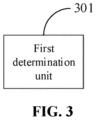
- an embodiment of the disclosure further provides an apparatus for uplink transmission, which is arranged in the first terminal, as illustrated in FIG. 3 , the apparatus includes a first determination unit 301.
- the first determination unit 301 is configured to determine first slot(s).
- Each first slot represents an available slot for PUSCH transmission or PUSCH repetition transmission, and a number of available symbol(s) of the first slot is greater than or equal to a number of symbol(s) indicated for each transmission or each repetition transmission.
- the available symbol(s) of the first slot exclude: a symbol carrying a type 0-PDCCH CSS and/or a flexible symbol carrying a SSB.
- the first determination unit 301 is configured to determine the first slot(s) and available resource of the first slot(s) based on uplink slot(s) and uplink symbol(s) indicated by configuration information of TDD.
- the first determination unit 301 is configured to determine the first slot(s) and available resource of the first slot(s) based on uplink slot(s), uplink symbol(s), flexible slot(s) and flexible symbol(s) indicated by configuration information of TDD.
- the apparatus further includes a conflict processing unit.
- the conflict processing unit configured to: when receiving a first SFI, assume that the first SFI does not affect the determination of the first slot(s) by the first terminal; and/or not expect that the first SFI changes the determination of the first slot(s) by the first terminal; and/or in a case that the first SFI indicates flexible symbol(s) are updated to downlink symbol(s) and if uplink symbol(s) after updating and/or flexible symbol(s) after updating cannot meet PUSCH transmission or PUSCH repetition transmission, count in one repetition transmission for the corresponding first slot, and not perform the PUSCH transmission or the PUSCH repetition transmission on the corresponding first slot; and/or in a case that the first SFI indicates flexible symbol(s) are updated to the downlink symbol(s) and if the uplink symbol(s) after updating and/or the flexible symbol(s) after updating cannot meet the PUSCH transmission or the PUSCH repetition transmission, perform the PUSCH transmission or the PUSCH repetition transmission only on a part of resource.
- the first determination unit 301 is configured to: determine the first slot(s) and available resource of the first slot(s) based on uplink slot(s) and uplink symbol(s) indicated by configuration information of TDD and a second SFI; or determine the first slot(s) and available resource of the first slot(s) based on uplink slot(s), uplink symbol(s), flexible slot(s) and flexible symbol(s) indicated by configuration information of TDD and a second SFI.
- the second SFI represents a last SFI received by the first terminal before receiving first DCI.
- the first DCI is used for indicating PUSCH transmission or PUSCH repetition transmission.
- the conflict processing unit is further configured to: in a case that the first terminal receives a third SFI after receiving the second SFI: assume that the third SFI does not change the determination of the first slot(s) by the first terminal; and/or not expect that the third SFI changes the determination of the first slot(s) by the first terminal.
- the conflict processing unit is further configured to: in a case that the first slot(s) and the available resource of the first slot(s) are determined based on the uplink slot(s) and the uplink symbol(s) in the uplink slot(s) indicated in the configuration information of the TDD and the second SFI: not update uplink symbol(s) indicated by the second SFI to flexible symbol(s) or downlink symbol(s).
- the conflict processing unit is further configured to: in a case that a third SFI indicates that uplink symbol(s) indicated by the second SFI is updated to flexible symbol(s) or downlink symbol(s), and if the uplink symbol(s) after updating and/or the flexible symbol(s) after updating cannot meet the PUSCH transmission or the PUSCH repetition transmission: not perform the PUSCH transmission or the PUSCH repetition transmission on the corresponding first slot, and count in one repetition transmission for the corresponding first slot; or perform the PUSCH transmission or the PUSCH repetition transmission only on a part of resource.
- the conflict processing unit is further configured to: in a case that a first cancellation indication (CI) is received when performing the PUSCH transmission or the PUSCH repetition transmission based on the determined first slot(s): cancel the corresponding PUSCH transmission or the corresponding PUSCH repetition transmission and count in one repetition transmission for the corresponding PUSCH transmission or the corresponding PUSCH repetition transmission; or perform the PUSCH transmission or the PUSCH repetition transmission only on a part of resource.
- CI cancellation indication
- Cancelled resource indicated by the first CI overlaps with the corresponding PUSCH transmission or the corresponding PUSCH repetition transmission, or overlaps with slot(s) of the corresponding PUSCH transmission or the corresponding PUSCH repetition transmission.
- cancelled symbols indicated by the first CI comprises a first symbol, a second symbol and symbol(s) between the first symbol and the second symbol.
- the first symbol represents a last symbol of received PDCCH carrying the first CI
- the second symbol represents a first symbol after elapsing a processing delay and a time offset.
- PDCCH carrying the first CI does not need to be sent before first Downlink Control Information (DCI) or PDCCH carrying the first CI does not need to be or received by the first terminal before first DCI.
- the first DCI is used for indicating the PUSCH transmission or the PUSCH repetition transmission.
- a priority of the PUSCH transmission or the PUSCH repetition transmission is a high priority
- the first determination unit 301 is further configured to determine a third symbol, a fourth symbol and/or a fifth symbol as available symbol(s) when the first slot(s) is determined.
- the third symbol represents a symbol in which a Sounding Reference Signal (SRS) can be configured or is configured.
- the fourth symbol represents a symbol indicated for the PUSCH transmission or the PUSCH repetition transmission and a network side triggers the first terminal to send an aperiodic SRS on the fourth symbol.
- the fifth symbol represents a symbol indicated for the PUSCH transmission or the PUSCH repetition transmission and a transmission of a periodic and/or a semi-persistent SRS on the fifth symbol overlaps with the corresponding PUSCH transmission or corresponding PUSCH repetition transmission.
- a priority of the PUSCH transmission or the PUSCH repetition transmission is a low priority
- the first determination unit 301 is further configured to:
- the first determination unit 301 is further configured to: when a transmission of a periodic SRS overlaps with corresponding PUSCH transmission or corresponding PUSCH repetition transmission, perform corresponding PUSCH transmission or corresponding PUSCH repetition transmission.
- a priority of the PUSCH transmission or the PUSCH repetition transmission is a low priority; and the first determination unit 301 is configured to determine a sixth symbol as an available symbol.
- the sixth symbol represents a symbol in which a semi-persistent SRS is configured and is not activated.
- the conflict processing unit is further configured to: in a case that the semi-persistent SRS is activated when the PUSCH transmission or the PUSCH repetition transmission is performed on the sixth symbol: cancel the corresponding PUSCH transmission or the corresponding PUSCH repetition transmission and count in one repetition transmission for the corresponding PUSCH transmission or the corresponding PUSCH repetition transmission; or perform the PUSCH transmission or the PUSCH repetition transmission of the only on a part of resource.
- the first determination unit 301 and the conflict processing unit may be implemented by processors in apparatus for uplink transmission.
- the apparatus for uplink transmission provided in the above embodiments only provide examples of the division of program modules during uplink transmission.
- the above processing may be assigned and completed by different program modules as needed. That is, the internal structure of the apparatus is divided into different program modules to complete all or part of the processing described above.
- the apparatuses and the methods for uplink transmission provided by the above embodiments belong to the same concept, and the specific implementation process of the apparatuses is detailed in the method embodiments, which will not be repeated here.
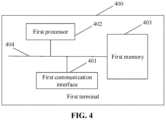
- the first terminal 400 includes a first communication interface 401, a first processor 402, a first memory 403 and a bus system 404.
- the first communication interface 401 is capable of interacting information with other network nodes.
- the first processor 402 is connected is connected with the first communication interface 401 to realize information interaction with other network nodes, and is configured to perform the methods provided by one or more technical solutions at the first terminal side described above when running a computer program.
- the computer program is stored on the first memory 403.
- the first processor 402 is configured to determine first slot(s).
- Each first slot represents an available slot for PUSCH transmission or PUSCH repetition transmission, and the number of available symbol(s) of the first slot is greater than or equal to the number of symbol(s) indicated for each transmission or each repetition transmission of the.
- the available symbol(s) of the first slot exclude: a symbol carrying a type 0-PDCCH CSS and/or a flexible symbol carrying a SSB.
- the first processor 402 is configured to determine the first slot(s) and available resource of the first slot(s) based on uplink slot(s) and uplink symbol(s) indicated by configuration information of TDD.
- the first processor 402 is configured to determine the first slot(s) and n available resource of the first slot(s) based on uplink slot(s), uplink symbol(s), flexible slot(s) and flexible symbol(s) indicated by configuration information of TDD.
- the first processor 402 is further configured to: when receiving a first SFI, assume that the first SFI does not affect the determination of the first slot(s) by the first terminal; and/or not expect that the first SFI changes the determination of the first slot(s) by the first terminal; and/or in a case that the first SFI indicates flexible symbol(s) are updated to downlink symbol(s) and if uplink symbol(s) after updating and/or flexible symbol(s) after updating cannot meet the PUSCH transmission or the PUSCH repetition transmission of the, count in one repetition transmission for the corresponding first slot, and not perform the PUSCH transmission or the PUSCH repetition transmission on the corresponding first slot; and/or in a case that the first SFI indicates flexible symbol(s) are updated to downlink symbol(s) and if the uplink symbol(s) after updating and/or the flexible symbol(s) after updating cannot meet the PUSCH transmission or the PUSCH repetition transmission, perform the PUSCH transmission or the PUSCH repetition transmission only on a part of resource.
- the first processor 402 is configured to: determine the first slot(s) and available resource of the first slot(s) based on uplink slot(s) and uplink symbol(s) indicated by configuration information of TDD and a second SFI; or determine the first slot(s) and available resource of the first slot(s) based on uplink slot(s), uplink symbol(s), flexible slot(s) and flexible symbol(s) indicated by configuration information of TDD and a second SFI.
- the second SFI represents a last SFI received by the first terminal before receiving first DCI.
- the first DCI is used for indicating the PUSCH transmission or the PUSCH repetition transmission.
- the first processor 402 is further configured to: in a case that the first terminal receives a third SFI after receiving the second SFI: assume that the third SFI does not change the determination of the first slot(s) by the first terminal; and/or not expect that the third SFI changes the determination of the first slot(s) by the first terminal.
- the first processor 402 is further configured to: in a case that the first slot(s) and the available resource of the first slot(s) are determined based on the uplink slot(s) and the uplink symbol(s) in the uplink slot(s) indicated in the configuration information of the TDD and the second SFI: not update uplink symbol(s) indicated by the second SFI to flexible symbol(s) or downlink symbol(s).
- the first processor 402 is further configured to: in a case that a third SFI indicates that uplink symbol(s) indicated by the second SFI is updated to flexible symbol(s) or downlink symbol(s), and the uplink symbol(s) after updating and/or the flexible symbol(s) after updating cannot meet the PUSCH transmission or the PUSCH repetition transmission: not perform the PUSCH transmission or the PUSCH repetition transmission of on the corresponding first slot, and count in one repetition transmission for the corresponding first slot ; or perform the PUSCH transmission or the PUSCH repetition transmission only on a part of resource.
- the first processor 402 is further configured to: in a case that a first cancellation indication (CI) is received when performing the PUSCH transmission or the PUSCH repetition transmission based on the determined first slot(s), cancel the corresponding PUSCH transmission or the corresponding PUSCH repetition transmission and count in one repetition transmission for the corresponding PUSCH transmission or the corresponding PUSCH repetition transmission; or perform the PUSCH transmission or the PUSCH repetition transmission only on a part of resource.
- CI first cancellation indication
- Cancelled resource indicated by the first CI overlaps with the corresponding PUSCH transmission or the corresponding PUSCH repetition transmission, or overlaps with slots of the corresponding PUSCH transmission or the corresponding PUSCH repetition transmission.
- cancelled symbols indicated by the first CI comprises a first symbol, a second symbol and symbol(s) between the first symbol and the second symbol.
- the first symbol represents a last symbol of received PDCCH carrying the first CI
- the second symbol represents a first symbol after elapsing a processing delay and a time offset.
- PDCCH carrying the first CI does not need to be sent before first Downlink Control Information (DCI) or PDCCH carrying the first CI does not need to be or received by the first terminal before first DCI.
- the first DCI is used for indicating the PUSCH transmission or the PUSCH repetition transmission.
- a priority of the PUSCH transmission or the PUSCH repetition transmission is a high priority
- the first processor 402 is configured to: determine a third symbol, a fourth symbol and/or a fifth symbol as available symbol(s) when the first slot(s) is determined.
- the third symbol represents a symbol in which a Sounding Reference Signal (SRS) can be configured or is configured.
- the fourth symbol represents a symbol indicated for the PUSCH transmission or the PUSCH repetition transmission, and a network side triggers the first terminal to send an aperiodic SRS on the fourth symbol.
- the fifth symbol represents a symbol indicated for the PUSCH transmission or the PUSCH repetition transmission, and a transmission of a periodic and/or a semi-persistent SRS on the fifth symbol overlaps with the corresponding PUSCH transmission or corresponding PUSCH repetition transmission.
- a priority of the PUSCH transmission or the PUSCH repetition transmission is a low priority
- the first processor 402 is further configured to: when a network side triggers the first terminal to send an aperiodic Sounding Reference Signal (SRS), and a symbol for sending the aperiodic SRS overlaps with a symbol indicated for the PUSCH transmission or the PUSCH repetition transmission: cancel the corresponding PUSCH transmission or the corresponding PUSCH repetition transmission and count in one repetition transmission for the corresponding PUSCH transmission or the corresponding PUSCH repetition transmission; or perform the PUSCH transmission or the PUSCH repetition transmission only on a part of resource.
- SRS Sounding Reference Signal
- the first processor 402 is further configured to: when a transmission of a periodic SRS overlaps with the corresponding PUSCH transmission or the corresponding PUSCH repetition transmission, perform the corresponding PUSCH transmission or the corresponding PUSCH repetition transmission.
- a priority of the PUSCH transmission or the PUSCH repetition transmission is a low priority; and the first processor 402 is configured to: determine a sixth symbol as an available symbol.
- the sixth symbol represents a symbol in which a semi-persistent SRS is configured and is not activated.
- the first processor 402 is further configured to: in a case that the semi-persistent SRS is activated when the PUSCH transmission or the PUSCH repetition transmission is performed on the sixth symbol: cancel the corresponding PUSCH transmission or the corresponding PUSCH repetition transmission and count in one repetition transmission for the corresponding PUSCH transmission or the corresponding PUSCH repetition transmission; or perform the PUSCH transmission or the PUSCH repetition transmission of the only on a part of resource.
- the various components in the first terminal 400 are coupled together through the bus system 404.
- the bus system 404 is configured to implement connection communication between these components.
- the bus system 404 includes a power bus, a control bus and a status signal bus in addition to a data bus.
- the various buses are labeled as the bus system 404 in FIG. 4 for clarity.
- the first memory 403 in the embodiments of the disclosure is configured to store various types of data to support the operation of the first terminal 400. Examples of these data include any computer program for operating on the first terminal 400.
- the methods disclosed in the above embodiments of the disclosure may be applied to the first processor 402, or implemented by the first processor 402.
- the first processor 402 may be an integrated circuit chip with a signal processing capability. The operations of the above methods may be accomplished by an integrated logic circuit in the form of hardware in the first processor 402 or instructions in the form of software during the implementation.
- the first processor 402 described above may be a general processor, a Digital Signal Processor (DSP), or other programmable logic devices, a discrete gate or transistor logic device, a discrete hardware component, or the like.
- DSP Digital Signal Processor
- the first processor 402 may implement or perform the various methods, operations and logic blocks disclosed in the embodiments of the disclosure.
- the general processor may be a microprocessor or any conventional processor or the like.
- the operations of the methods disclosed in the embodiments of the disclosure may be directly executed and completed by a decoding processor in the form of hardware or by a combination of the hardware in the decoding processor and software modules.
- the software modules may be located in a storage medium in the first memory 403, and the first processor 402 reads information in the first memory 403 and completes the operations of the above methods in combination with hardware thereof.
- the first terminal 400 may be implemented by one or more Application Specific Integrated Circuits (ASICs), DSPs, Programmable Logic Devices (PLDs), Complex Programmable Logic Devices (CPLDs), Field-Programmable Gate Arrays (FPGAs), general processors, controllers, Micro Controller Units (MCUs), microprocessors, or other electronic elements, to perform the above methods.
- ASICs Application Specific Integrated Circuits
- DSPs Digital Signals
- PLDs Programmable Logic Devices
- CPLDs Complex Programmable Logic Devices
- FPGAs Field-Programmable Gate Arrays
- general processors controllers
- controllers Micro Controller Units (MCUs)
- MCUs Micro Controller Units
- microprocessors or other electronic elements
- the first memory 403 in embodiments of the disclosure may be a volatile memory, a non-volatile memory, or include both the volatile memory and the non-volatile memory.
- the non-volatile memory may be a Read-Only Memory (ROM), a Programmable ROM (PROM), an Erasable PROM (EPROM), an Electrically EPROM (EEPROM), a Ferromagnetic Random Access Memory (FRAM), a flash memory, a magnetic surface memory, an optical disc, or a Compact Disc ROM (CD-ROM).
- the magnetic surface memory may be a magnetic disk memory or a magnetic tape memory.
- the volatile memory may be a Random Access Memory (RAM), which serves as an external cache.
- RAMs such as a Static RAM (SRAM), a Synchronous SRAM (SSRAM), a Dynamic RAM (DRAM), a Synchronous DRAM (SDRAM), a Double Data Rate SDRAM (DDRSDRAM), an Enhanced SDRAM (ESDRAM), a SyncLink DRAM (SLDRAM), a Direct Rambus RAM (DRRAM).
- SRAM Static RAM
- SSRAM Synchronous SRAM
- DRAM Dynamic RAM
- SDRAM Synchronous DRAM
- DDRSDRAM Double Data Rate SDRAM
- ESDRAM Enhanced SDRAM
- SLDRAM SyncLink DRAM
- DRRAM Direct Rambus RAM
- an embodiment of the disclosure further provides a storage medium, i.e., a computer storage medium, specifically a computer-readable storage medium, including, for example, the first memory 403 for storing a computer program.
- the computer program may be executed by the first processor 402 in the first terminal 400 to complete the operations of methods at the first terminal side described above.
- the computer-readable storage medium may be a memory, such as a FRAM, a ROM, a PROM, an EPROM, an EEPROM, a flash memory, a magnetic surface memory, an optical disk, or a CD-ROM, etc.
- the term "and/or" is only an association relationship that describes associated objects and represents that three relationships may exist.
- a and/or B may represent three conditions: independent existence of A, existence of both A and B and independent existence of B.
- the term "at least one" used herein usually represents any one of multiple, or any combination of at least two of multiple.
- including at least one of A, B and C may represent including any one or more elements selected from a set consisting of A, B and C.
Landscapes
- Engineering & Computer Science (AREA)
- Signal Processing (AREA)
- Computer Networks & Wireless Communication (AREA)
- Mobile Radio Communication Systems (AREA)
- Small-Scale Networks (AREA)
Applications Claiming Priority (2)
| Application Number | Priority Date | Filing Date | Title |
|---|---|---|---|
| CN202111535363.1A CN116266950B (zh) | 2021-12-15 | 2021-12-15 | 上行传输方法、装置、网络节点及存储介质 |
| PCT/CN2022/139275 WO2023109898A1 (zh) | 2021-12-15 | 2022-12-15 | 上行传输方法、装置、网络节点及存储介质 |
Publications (2)
| Publication Number | Publication Date |
|---|---|
| EP4444004A1 true EP4444004A1 (de) | 2024-10-09 |
| EP4444004A4 EP4444004A4 (de) | 2025-04-02 |
Family
ID=86742929
Family Applications (1)
| Application Number | Title | Priority Date | Filing Date |
|---|---|---|---|
| EP22906643.6A Pending EP4444004A4 (de) | 2021-12-15 | 2022-12-15 | Uplink-übertragungsverfahren und -vorrichtung, netzwerkknoten und speichermedium |
Country Status (7)
| Country | Link |
|---|---|
| EP (1) | EP4444004A4 (de) |
| JP (1) | JP7778933B2 (de) |
| CN (1) | CN116266950B (de) |
| AU (1) | AU2022416255B2 (de) |
| CA (1) | CA3240733A1 (de) |
| MX (1) | MX2024007501A (de) |
| WO (1) | WO2023109898A1 (de) |
Families Citing this family (1)
| Publication number | Priority date | Publication date | Assignee | Title |
|---|---|---|---|---|
| US10716125B2 (en) * | 2016-04-01 | 2020-07-14 | Qualcomm Incorporated | Sounding reference signal triggering for enhanced carrier aggregation |
Family Cites Families (9)
| Publication number | Priority date | Publication date | Assignee | Title |
|---|---|---|---|---|
| AU2017410371B2 (en) * | 2017-04-20 | 2022-09-15 | Guangdong Oppo Mobile Telecommunications Corp., Ltd. | Method, apparatus and system for transmitting periodic uplink information/signals |
| EP3637889B1 (de) * | 2017-06-07 | 2023-05-10 | Guangdong Oppo Mobile Telecommunications Corp., Ltd. | Drahtloskommunikationsverfahren und -vorrichtung |
| CN110034862B (zh) * | 2018-01-12 | 2021-05-28 | 维沃移动通信有限公司 | 一种下行反馈方法、移动通信终端及网络侧设备 |
| CN113519138B (zh) | 2019-02-13 | 2024-08-02 | 交互数字专利控股公司 | 物理上行链路共享信道传输 |
| US11641249B2 (en) * | 2019-03-25 | 2023-05-02 | Lenovo (Singapore) Pte. Ltd. | Method and apparatus for determining a duration of a repetition of a transport block |
| CN111435907B (zh) * | 2019-03-28 | 2023-02-24 | 维沃移动通信有限公司 | 传输处理方法、装置、终端和介质 |
| WO2021097590A1 (en) | 2019-11-18 | 2021-05-27 | Zte Corporation | Systems and methods for determining information indicative of cancelation |
| CN113260053B (zh) * | 2020-02-12 | 2023-03-24 | 中国信息通信研究院 | 一种传输时隙结构指示方法和设备 |
| US20240381345A1 (en) * | 2021-05-26 | 2024-11-14 | Beijing Xiaomi Mobile Software Co., Ltd. | Method and apparatus for determining blind retransmission slot resource, and communication device |
-
2021
- 2021-12-15 CN CN202111535363.1A patent/CN116266950B/zh active Active
-
2022
- 2022-12-15 AU AU2022416255A patent/AU2022416255B2/en active Active
- 2022-12-15 CA CA3240733A patent/CA3240733A1/en active Pending
- 2022-12-15 EP EP22906643.6A patent/EP4444004A4/de active Pending
- 2022-12-15 JP JP2024535808A patent/JP7778933B2/ja active Active
- 2022-12-15 MX MX2024007501A patent/MX2024007501A/es unknown
- 2022-12-15 WO PCT/CN2022/139275 patent/WO2023109898A1/zh not_active Ceased
Also Published As
| Publication number | Publication date |
|---|---|
| CN116266950A (zh) | 2023-06-20 |
| CN116266950B (zh) | 2026-01-20 |
| JP7778933B2 (ja) | 2025-12-02 |
| AU2022416255B2 (en) | 2025-05-29 |
| EP4444004A4 (de) | 2025-04-02 |
| AU2022416255A1 (en) | 2024-07-04 |
| WO2023109898A1 (zh) | 2023-06-22 |
| JP2024542893A (ja) | 2024-11-18 |
| CA3240733A1 (en) | 2023-06-22 |
| MX2024007501A (es) | 2024-07-10 |
Similar Documents
| Publication | Publication Date | Title |
|---|---|---|
| JP7031017B2 (ja) | アップリンク伝送方法及び装置 | |
| KR102949238B1 (ko) | 채널 충돌 처리 방법, 장치, 설비 및 저장 매체 | |
| AU2019264697B2 (en) | Processing method and apparatus based on uplink signal, related device, and storage medium | |
| CN112491514B (zh) | 侧行链路反馈信息传输的方法和通信装置 | |
| WO2018059160A1 (zh) | 一种数据传输方法及装置 | |
| JP2020537364A (ja) | 時間領域リソース確定方法、装置、記憶媒体及びシステム | |
| WO2024067571A1 (zh) | 灵活双工sbfd信息指示方法、终端及网络侧设备 | |
| JP2022519555A (ja) | ランダムアクセスメッセージの伝送方法及び機器 | |
| CN114375008A (zh) | 配置授权的重复传输方法、装置、设备及可读存储介质 | |
| KR20170118183A (ko) | 정보 송신 방법과, 사용자 장비 및 기지국 | |
| CN112291852B (zh) | 一种uci传输、接收方法、装置、系统、设备及介质 | |
| EP4444004A1 (de) | Uplink-übertragungsverfahren und -vorrichtung, netzwerkknoten und speichermedium | |
| JP2023545795A (ja) | フィードバック情報伝送方法、端末、ネットワーク機器および可読記憶媒体 | |
| CN113938259B (zh) | Harq-ack的反馈方法和设备 | |
| JP2025511023A (ja) | 物理層操作の処理方法、装置及び端末 | |
| WO2023125906A1 (zh) | 资源传输方向确定方法、装置及终端 | |
| HK40114152A (en) | Uplink transmission method and apparatus, network node and storage medium | |
| WO2018054115A1 (zh) | 一种数据传输指示、处理方法及装置 | |
| JP2026503010A (ja) | マルチセルpucch構成、装置、コンピュータ読み取り可能な記憶媒体、およびソフトウェア製品 | |
| CN110166202B (zh) | 处理rrc配置的半静态ul传输的方法及装置和用户终端 | |
| CN111600689B (zh) | Srs传输方法和设备 | |
| WO2024235067A1 (zh) | 灵活双工的实现方法、装置、终端、网络侧设备及介质 | |
| CN117939651A (zh) | 传输信息量的确定方法、装置、设备及存储介质 | |
| CN118555042A (zh) | 一种传输指示方法、装置、通信设备和存储介质 | |
| WO2019191986A1 (zh) | 发送信道的方法、接收信道的方法、终端设备和网络设备 |
Legal Events
| Date | Code | Title | Description |
|---|---|---|---|
| STAA | Information on the status of an ep patent application or granted ep patent |
Free format text: STATUS: THE INTERNATIONAL PUBLICATION HAS BEEN MADE |
|
| PUAI | Public reference made under article 153(3) epc to a published international application that has entered the european phase |
Free format text: ORIGINAL CODE: 0009012 |
|
| STAA | Information on the status of an ep patent application or granted ep patent |
Free format text: STATUS: REQUEST FOR EXAMINATION WAS MADE |
|
| 17P | Request for examination filed |
Effective date: 20240702 |
|
| AK | Designated contracting states |
Kind code of ref document: A1 Designated state(s): AL AT BE BG CH CY CZ DE DK EE ES FI FR GB GR HR HU IE IS IT LI LT LU LV MC ME MK MT NL NO PL PT RO RS SE SI SK SM TR |
|
| REG | Reference to a national code |
Ref country code: HK Ref legal event code: DE Ref document number: 40114152 Country of ref document: HK |
|
| DAV | Request for validation of the european patent (deleted) | ||
| DAX | Request for extension of the european patent (deleted) | ||
| A4 | Supplementary search report drawn up and despatched |
Effective date: 20250305 |
|
| RIC1 | Information provided on ipc code assigned before grant |
Ipc: H04W 72/04 20230101AFI20250227BHEP |
|
| STAA | Information on the status of an ep patent application or granted ep patent |
Free format text: STATUS: EXAMINATION IS IN PROGRESS |
|
| 17Q | First examination report despatched |
Effective date: 20251216 |