EP4442902A1 - Grundgewebe für papiermacherfilz, papiermacherfilz und verfahren zur herstellung eines papiermacherfilzes - Google Patents
Grundgewebe für papiermacherfilz, papiermacherfilz und verfahren zur herstellung eines papiermacherfilzes Download PDFInfo
- Publication number
- EP4442902A1 EP4442902A1 EP24168485.1A EP24168485A EP4442902A1 EP 4442902 A1 EP4442902 A1 EP 4442902A1 EP 24168485 A EP24168485 A EP 24168485A EP 4442902 A1 EP4442902 A1 EP 4442902A1
- Authority
- EP
- European Patent Office
- Prior art keywords
- yarn
- base fabric
- structural unit
- papermaking felt
- yarns
- Prior art date
- Legal status (The legal status is an assumption and is not a legal conclusion. Google has not performed a legal analysis and makes no representation as to the accuracy of the status listed.)
- Pending
Links
Images

Classifications
-
- D—TEXTILES; PAPER
- D21—PAPER-MAKING; PRODUCTION OF CELLULOSE
- D21F—PAPER-MAKING MACHINES; METHODS OF PRODUCING PAPER THEREON
- D21F7/00—Other details of machines for making continuous webs of paper
- D21F7/08—Felts
- D21F7/10—Seams thereof
-
- D—TEXTILES; PAPER
- D21—PAPER-MAKING; PRODUCTION OF CELLULOSE
- D21F—PAPER-MAKING MACHINES; METHODS OF PRODUCING PAPER THEREON
- D21F7/00—Other details of machines for making continuous webs of paper
- D21F7/08—Felts
-
- D—TEXTILES; PAPER
- D21—PAPER-MAKING; PRODUCTION OF CELLULOSE
- D21F—PAPER-MAKING MACHINES; METHODS OF PRODUCING PAPER THEREON
- D21F7/00—Other details of machines for making continuous webs of paper
- D21F7/08—Felts
- D21F7/083—Multi-layer felts
-
- D—TEXTILES; PAPER
- D03—WEAVING
- D03D—WOVEN FABRICS; METHODS OF WEAVING; LOOMS
- D03D1/00—Woven fabrics designed to make specified articles
-
- D—TEXTILES; PAPER
- D03—WEAVING
- D03D—WOVEN FABRICS; METHODS OF WEAVING; LOOMS
- D03D1/00—Woven fabrics designed to make specified articles
- D03D1/0094—Belts
-
- D—TEXTILES; PAPER
- D03—WEAVING
- D03D—WOVEN FABRICS; METHODS OF WEAVING; LOOMS
- D03D11/00—Double or multi-ply fabrics not otherwise provided for
-
- D—TEXTILES; PAPER
- D03—WEAVING
- D03D—WOVEN FABRICS; METHODS OF WEAVING; LOOMS
- D03D13/00—Woven fabrics characterised by the special disposition of the warp or weft threads, e.g. with curved weft threads, with discontinuous warp threads, with diagonal warp or weft
-
- D—TEXTILES; PAPER
- D03—WEAVING
- D03D—WOVEN FABRICS; METHODS OF WEAVING; LOOMS
- D03D13/00—Woven fabrics characterised by the special disposition of the warp or weft threads, e.g. with curved weft threads, with discontinuous warp threads, with diagonal warp or weft
- D03D13/008—Woven fabrics characterised by the special disposition of the warp or weft threads, e.g. with curved weft threads, with discontinuous warp threads, with diagonal warp or weft characterised by weave density or surface weight
-
- D—TEXTILES; PAPER
- D03—WEAVING
- D03D—WOVEN FABRICS; METHODS OF WEAVING; LOOMS
- D03D15/00—Woven fabrics characterised by the material, structure or properties of the fibres, filaments, yarns, threads or other warp or weft elements used
- D03D15/20—Woven fabrics characterised by the material, structure or properties of the fibres, filaments, yarns, threads or other warp or weft elements used characterised by the material of the fibres or filaments constituting the yarns or threads
- D03D15/283—Woven fabrics characterised by the material, structure or properties of the fibres, filaments, yarns, threads or other warp or weft elements used characterised by the material of the fibres or filaments constituting the yarns or threads synthetic polymer-based, e.g. polyamide or polyester fibres
-
- D—TEXTILES; PAPER
- D03—WEAVING
- D03D—WOVEN FABRICS; METHODS OF WEAVING; LOOMS
- D03D15/00—Woven fabrics characterised by the material, structure or properties of the fibres, filaments, yarns, threads or other warp or weft elements used
- D03D15/30—Woven fabrics characterised by the material, structure or properties of the fibres, filaments, yarns, threads or other warp or weft elements used characterised by the structure of the fibres or filaments
-
- D—TEXTILES; PAPER
- D03—WEAVING
- D03D—WOVEN FABRICS; METHODS OF WEAVING; LOOMS
- D03D15/00—Woven fabrics characterised by the material, structure or properties of the fibres, filaments, yarns, threads or other warp or weft elements used
- D03D15/40—Woven fabrics characterised by the material, structure or properties of the fibres, filaments, yarns, threads or other warp or weft elements used characterised by the structure of the yarns or threads
- D03D15/47—Woven fabrics characterised by the material, structure or properties of the fibres, filaments, yarns, threads or other warp or weft elements used characterised by the structure of the yarns or threads multicomponent, e.g. blended yarns or threads
-
- D—TEXTILES; PAPER
- D03—WEAVING
- D03D—WOVEN FABRICS; METHODS OF WEAVING; LOOMS
- D03D3/00—Woven fabrics characterised by their shape
- D03D3/02—Tubular fabrics
-
- D—TEXTILES; PAPER
- D21—PAPER-MAKING; PRODUCTION OF CELLULOSE
- D21F—PAPER-MAKING MACHINES; METHODS OF PRODUCING PAPER THEREON
- D21F1/00—Wet end of machines for making continuous webs of paper
- D21F1/0027—Screen-cloths
- D21F1/0036—Multi-layer screen-cloths
-
- D—TEXTILES; PAPER
- D10—INDEXING SCHEME ASSOCIATED WITH SUBLASSES OF SECTION D, RELATING TO TEXTILES
- D10B—INDEXING SCHEME ASSOCIATED WITH SUBLASSES OF SECTION D, RELATING TO TEXTILES
- D10B2331/00—Fibres made from polymers obtained otherwise than by reactions only involving carbon-to-carbon unsaturated bonds, e.g. polycondensation products
- D10B2331/02—Fibres made from polymers obtained otherwise than by reactions only involving carbon-to-carbon unsaturated bonds, e.g. polycondensation products polyamides
-
- D—TEXTILES; PAPER
- D10—INDEXING SCHEME ASSOCIATED WITH SUBLASSES OF SECTION D, RELATING TO TEXTILES
- D10B—INDEXING SCHEME ASSOCIATED WITH SUBLASSES OF SECTION D, RELATING TO TEXTILES
- D10B2401/00—Physical properties
- D10B2401/06—Load-responsive characteristics
- D10B2401/063—Load-responsive characteristics high strength
-
- D—TEXTILES; PAPER
- D10—INDEXING SCHEME ASSOCIATED WITH SUBLASSES OF SECTION D, RELATING TO TEXTILES
- D10B—INDEXING SCHEME ASSOCIATED WITH SUBLASSES OF SECTION D, RELATING TO TEXTILES
- D10B2505/00—Industrial
Definitions
- a papermaking machine for dewatering paper materials generally includes a wire part, a press part, and a dryer part.
- the wire part, the press part, and the dryer part are arranged in this order along a transfer direction of wet paper.
- the wet paper is moved in a papermaking machine in a belt shape with a constant width in a felt cross direction (cross machine direction (CD direction)) perpendicular to a felt running direction (machine direction (MD direction)) in the papermaking machine, and is dewatered while being transferred one after another by papermaking tools attached to each of the wire part, the press part, and the dryer part, and is finally dried in the dryer part.
- CD direction cross machine direction
- MD direction machine direction
- a press device arranged in the press part includes a plurality of press devices arranged in series along the transfer direction of the wet paper.
- Each press device includes an endless felt or an open-ended felt that has been formed into an endless felt by connecting it in the papermaking machine, and a pair of rolls (that is, a roll press) arranged vertically to face each other such that a part of each felt is sandwiched therebetween or a cylindrical belt (that is, a shoe press) containing a roll and a shoe.
- the wet paper transferred by the felt that travels in the same direction at substantially the same speed is pressed and pressurized together with the felt by the roll and roll or by the cylindrical belt containing the roll and the shoe, thereby continuously dewatering the wet paper.
- a base fabric for a papermaking felt is required to be lighter in weight because the product price increases as the basis weight increases.
- a seam felt has an effect of reducing a load when hanging.
- a mark (seam mark) is likely to occur due to a difference in thickness between a seam region and a base region of the seam felt. Therefore, it is desired to prevent the occurrence of the seam mark while ensuring the strength of the seam region.
- JP 2007-277783 A discloses a shoe press device that provides excellent water squeezing properties and paper quality in the production of thin paper by adjusting a relation of void volumes between a papermaking felt and a papermaking belt.
- JP S63-126991 A discloses a papermaking felt having a smooth press surface with an increased contact area with paper and a roll side surface having abrasion resistance by tightly binding a top layer of the fabric and a bottom layer of the fabric in a longitudinal direction.
- JP 2004-36021 A discloses a papermaking felt that includes a base fabric in which a base region is formed by a double woven structure obtained by entangling wefts with both of a pair of warps that form a connection loop, and brings about an effect of reducing vibration and abnormal noise generated during running in a papermaking machine without extremely increasing a basis weight of the base fabric by including a single-cloth overlapping region having single-cloth fabric layers overlapped each other in the vicinity of the connection loop.
- JP 2006-9207 A discloses a papermaking felt that is made of a woven fabric in which both MD direction yarns and CD direction yarns are made of only a single yarn, has excellent dimensional stability and resistance to fiber loss by applying a crimp to the MD direction yarns by heat-setting a base material, and brings about an effect of preventing an icicle phenomenon (the MD direction yarns jump out in a loop shape on a felt surface during use in the papermaking machine).
- the papermaking felts disclosed in the above patent literatures can achieve any of a plurality of required important properties, but cannot be said to simultaneously achieve a plurality of the properties.
- the plurality of required properties cannot be achieved simultaneously by simply combining the property of the papermaking felt disclosed in each of the above patent literatures.
- an object of the present invention is to provide a base fabric for a papermaking felt from which a papermaking felt which is lightweight, has excellent water squeezing properties, prevents an icicle phenomenon, and prevents occurrence of seam mark is obtained.
- the present inventors have found that the above object can be achieved by using a specific structure of the base fabric for a papermaking felt, and the present invention was completed.
- the present invention relates to the followings.
- a base fabric for a papermaking felt from which a papermaking felt which is lightweight, has excellent water squeezing properties, prevents an icicle phenomenon, and prevent occurrence of seam mark is obtained.
- Ato B indicating a numerical range means a range including A and B and indicates "A or more and B or less”.
- the base fabric for a papermaking felt in the present disclosure forms a warp-weft double woven structure and has a wet paper side surface and a roll side surface.
- the base fabric is made of an MD yarn in a felt running direction (MD direction) and a CD yarn in a felt cross direction (CD direction).
- the base fabric comprises a weave repeat.
- the CD yarn includes an upper CD yarn located on the wet paper side surface and a lower CD yarn located on the roll side surface, and the MD yarn is woven into both the upper CD yarn and the lower CD yarn.
- the MD yarn includes at least one combination of a first MD yarn and a second MD yarn adjacent to the first MD yarn in the CD direction.
- the weave repeat includes a first structural unit, a second structural unit, a third structural unit, and a fourth structural unit.
- the first structural unit represents a 1/1 plain weave structure formed by the upper CD yarn and the first MD yarn.
- the second structural unit represents a 1/1 plain weave structure formed by the lower CD yarn and the second MD yarn.
- the third structural unit represents a structural unit in which the first MD yarn alternately comes into contact with a wet paper side surface of the upper CD yarn, a roll side surface of the lower CD yarn, and a wet paper side surface of the upper CD yarn.
- the fourth structural unit represents a structural unit in which the second MD yarn alternately comes into contact with a roll side surface of the lower CD yarn, a wet paper side surface of the upper CD yarn, and a roll side surface of the lower CD yarn.
- the weave repeat includes a location at which the first structural unit and the second structural unit are formed in pairs on both surfaces of the base fabric.
- the base fabric for a papermaking felt in the present disclosure is made of the MD yarn in the felt running direction (MD direction) and the CD yarn in the felt cross direction (CD direction).
- the CD yarn includes the upper CD yarn located on the wet paper side surface and the lower CD yarn located on the roll side surface.
- the MD yarn is woven into both the upper CD yarn and the lower CD yarn, and includes at least one combination of the first MD yarn and the second MD yarn adjacent to the first MD yarn in the CD direction. That is, the base fabric for a papermaking felt in the present disclosure forms a warp-weft double woven structure.
- the MD yarns being adjacent in the CD direction means that two of the MD yarns are in the closest positional relationship in the CD direction. There are usually two MD yarns adjacent to the first MD yarn in the CD direction, and either MD yarn may be used as the second MD yarn. However, the MD yarn contained in the combination of the first MD yarn and the second MD yarn is not redundantly contained in the other combination of the first MD yarn and the second MD yarn.
- the first MD yarn and the second MD yarn may be woven back and connected at an end portion when a base fabric is woven by a weaving machine, or may be independent yarns that are not connected to each other.
- the number of CD yarns is not particularly limited, but is preferably 140 Numbers/5 cm or less, more preferably 90 Numbers/5 cm or less, still more preferably 60 Numbers/5 cm or less, and particularly preferably 45 Numbers/5 cm or less.
- the lower limit of the number of CD yarns of the base fabric for a papermaking felt is not particularly limited, but the number of CD yarns may be 10 Numbers/5 cm or more, 20 Numbers/5 cm or more, 25 Numbers/5 cm or more.
- the base fabric for a papermaking felt When the number of CD yarns of the base fabric for a papermaking felt is 140/5 cm or less, the base fabric for a papermaking felt and the papermaking felt are further reduced in weight, which is preferable.
- the CD yarn may be a single yarn or a twisted yarn, and is preferably a twisted yarn.
- the CD yarn is preferably a twisted yarn because it is less likely to be fibrillated.
- the CD yarn may be a twisted yarn formed by twisting one yarn or a twisted yarn formed by twisting two or more yarns.
- the CD yarn is preferably a twisted yarn formed by twisting two or more yarns because fiber loss of a nonwoven fabric is reduced.
- the number of yarns to be twisted is preferably 2 to 50, more preferably 2 to 20, and still more preferably 2 to 4.
- a material of fibers constituting the MD yarn or the CD yarn in the base fabric for a papermaking felt in the present disclosure is preferably a thermoplastic resin.
- a thermoplastic resin for example, a polyethylene resin, a polypropylene resin, a polyvinyl chloride resin, a polystyrene resin, a polyvinyl acetate resin, a polyurethane resin, a Teflon (registered trademark) resin, an ABS resin, an AS resin, an acrylic resin, a polyethylene terephthalate resin, a polyamide resin, a polyacetal resin, a polycarbonate resin, a polyester resin, a polyphenylene sulfide (PPS) resin, a polytetrafluoroethylene (PTFE) resin, a polyether ether ketone (PEEK) resin, or the like can be used, and among these, a polyamide resin is preferred.
- the materials of the MD yarn and the CD yarn may be the same or different from each other.
- a form of the fibers constituting the MD yarn and the CD yarn may be a monofilament, a multifilament, a spun yarn, a processed yarn such as a textured yarn subjected to crimp processing or bulky processing, a bulky yarn, and a stretch yarn, or a twisted yarn formed by twisting these yarns.
- a cross-sectional shape of the fiber may be circular, substantially elliptical, polygonal, substantially star-shaped, substantially rectangular, or the like.
- Fineness of the fibers constituting the MD yarn and the CD yarn is not particularly limited, but may be preferably 89 dtex to 3220 dtex (0.10 mm to 0.60 mm), and more preferably 200 dtex to 2000 dtex (0.15 mm to 0.47 mm).
- the CD yarn includes the upper CD yarn located on the wet paper side surface.
- the upper CD yarn forms a 1/1 plain weave structure with the first MD yarn.
- the CD yarn includes the lower CD yarn located on the roll side surface.
- the lower CD yarn forms a 1/1 plain weave structure with the second MD yarn.
- a positional relationship between the upper CD yarn and the lower CD yarn is not particularly limited, but it is preferable that the lower CD yarn is located on a straight line vertically drawn from the upper CD yarn to the roll side surface of the base fabric from the viewpoint of improving the water-squeezing properties (compression property and recovery property) and preventing occurrence of a seam mark.
- the weave repeat of the base fabric for a papermaking felt in the present disclosure includes the first structural unit, the second structural unit, the third structural unit, and the fourth structural unit.
- the weave repeat preferably consists of the first structural unit, the second structural unit, the third structural unit, and the fourth structural unit. Further, the weave repeat may include a plurality of combinations of the first structural unit, the second structural unit, the third structural unit, and the fourth structural unit, or may be made of a plurality of combinations of the first structural unit, the second structural unit, the third structural unit, and the fourth structural unit.
- the first structural unit represents the 1/1 plain weave structure formed by the upper CD yarn and the first MD yarn.
- the second structural unit represents the 1/1 plain weave structure formed by the lower CD yarn and the second MD yarn.
- the weave repeat of the base fabric for a papermaking felt in the present disclosure includes a location at which the first structural unit and the second structural unit are formed in pairs on both surfaces of the base fabric. Accordingly, the weight of the base fabric can be reduced. As long as the location at which the first structural unit and the second structural unit are formed in pairs on both surfaces of the base fabric for a papermaking felt is included, other locations at which the first structural unit and the second structural unit are not formed in pairs on both surfaces of the base fabric may be included.
- the first structural unit and the second structural unit being formed in pairs on both surfaces of the base fabric means a state in which there is a point at which the second MD yarn included in the second structural unit is closest to or is most spaced from the roll side surface of the base fabric on an MD cross-section of the base fabric that passes through a point at which the first MD yarn included in the first structural unit is closest to the wet paper side surface of the base fabric.
- the MD cross-section of the base fabric is a cross-section obtained by cutting the base fabric and means a cross-section parallel to the CD direction of the base fabric and perpendicular to the MD direction of the base fabric.
- all the first structural units and the second structural units included in the base fabric for a papermaking felt in the present disclosure are formed in pairs on both surfaces of the base fabric.
- the weave repeat of the base fabric for a papermaking felt in the present disclosure includes the first structural unit and the second structural unit, and accordingly, the number of locations at which the MD yarn passes between the upper CD yarn and the lower CD yarn is reduced.
- the basis weight of the base fabric increases.
- the base fabric for a papermaking felt in the present disclosure can ensure an appropriate void volume without increasing the basis weight. Accordingly, the base fabric can be reduced in weight and exhibit excellent water-squeezing properties.
- the third structural unit represents a structural unit in which the first MD yarn alternately comes into contact with a surface of the upper CD yarn on a wet paper side, a surface of the lower CD yarn on a roll side, and the surface of the upper CD yarn on the wet paper side.
- the fourth structural unit represents a structural unit in which the second MD yarn alternately comes into contact with the surface of the lower CD yarn on the roll side, the surface of the upper CD yarn on the wet paper side, and the surface of the lower CD yarn on the roll side.
- the weave repeat of the base fabric for a papermaking felt in the present disclosure includes the third structural unit and the fourth structural unit, and accordingly, the base fabric is not completely crushed during use of the papermaking felt, and an appropriate void volume can be ensured.
- a seam felt in which a papermaking felt is connected by interlocking seam loops to be described later and inserting a core wire the thickness of the base region with respect to the seam region under pressure during use does not become small, and unevenness in thickness of the base fabric can be reduced. Accordingly, even when the base fabric for a papermaking felt is reduced in weight, the base fabric exhibits excellent water-squeezing properties, and occurrence of the seam mark due to the unevenness in thickness of the base fabric is prevented. In addition, since the unevenness in thickness of the base fabric for a papermaking felt is small, vibration and abnormal noise are also prevented, and wear of the nonwoven fabric entangled to the base fabric is also reduced.
- the weave repeat of the base fabric for a papermaking felt in the present disclosure includes the third structural unit and the fourth structural unit, and accordingly, the first MD yarn passes a position of the lower CD yarn, and similarly, the second MD yarn passes a position of the upper CD yarn.
- Each of the first MD yarn and the second MD yarn is in contact with the upper CD yarn and the lower CD yarn, and therefore a frictional force is generated at each contact point. The frictional force prevents the MD yarn from jumping out to a felt front surface or a felt rear surface, which prevents the icicle phenomenon.
- a positional relationship between the third structural unit and the fourth structural unit is not particularly limited, but it is preferable that the third structural unit and the fourth structural unit are formed in pairs on both surfaces of the base fabric because the water-squeezing properties (compression property and recovery property) are improved and the occurrence of the seam mark is prevented.
- the third structural unit and the fourth structural unit being formed in pairs on both surfaces of the base fabric means a state in which there is a point at which the second MD yarn included in the fourth structural unit is closest to the wet paper side surface of the base fabric on an MD cross-section of the base fabric that passes through a point at which the first MD yarn included in the third structural unit is closest to the roll side surface of the base fabric.
- the weave repeat of the base fabric for a papermaking felt in the present disclosure it is preferable that at least one of the combinations of the third structural unit and the fourth structural unit is formed in pairs on both surfaces of the base fabric, and it is more preferable that all of the combinations of the third structural unit and the fourth structural unit are formed in pairs on both surfaces of the base fabric.
- the lower CD yarn included in the third structural unit and the upper CD yarn included in the fourth structural unit are not adjacent in the MD direction from a viewpoint of maintaining a shape of the base fabric, reducing the unevenness in thickness of the base fabric, and further preventing the occurrence of the seam mark.
- the upper CD yarn and the lower CD yarn being not adjacent in the MD direction means a state in which, in the third structural unit and the fourth structural unit which are not formed in pairs on both surfaces of the base fabric, there is another CD yarn in a substantially rectangular plane surrounded by a straight line passing through the point at which the first MD yarn included in the third structural unit is closest to the roll side surface of the base fabric and extending perpendicularly to the wet paper side surface and roll side surface of the base fabric, a straight line passing through the point at which the second MD yarn included in the fourth structural unit is closest to the wet paper side surface of the base fabric and extending perpendicularly to the wet paper side surface and roll side surface of the base fabric, the roll side surface of the base fabric, and the wet paper side surface of the base fabric.
- the upper CD yarn and the lower CD yarn of the third structural unit and the fourth structural unit formed in pairs on both surfaces of the base fabric are not adjacent in the MD direction.
- each of the third structural unit and the fourth structural unit is not a twill weaving pattern, which is preferable because occurrence of sea disclosure m marks in the base region is prevented.
- each of the third structural unit and the fourth structural unit being not a twill weaving pattern means a state in which the first MD yarn in the weave repeat and the other plurality of first MD yarns shifted in the CD direction with respect to the first MD yarn are woven into the CD yarn with the same weaving pattern, but the positional relationship in the MD direction is not regular (not in a row).
- the basis weight of the base fabric for a papermaking felt in the present disclosure is not particularly limited, but is preferably 850 g/m 2 or less, more preferably 700 g/m 2 or less, still more preferably 600 g/m 2 or less, particularly preferably 500 g/m 2 or less, and most preferably 450 g/m 2 or less.
- the lower limit of the basis weight of the base fabric for a papermaking felt is not particularly limited, but the basis weight may be 200 g/m 2 or more, 250 g/m 2 or more, or 300 g/m 2 or more.
- the basis weight of the base fabric is 850 g/m 2 or less is preferable because the base fabric and the papermaking felt to be described below is reduced in weight.
- the base fabric for a papermaking felt in the present disclosure includes the weave repeat described above.
- the base fabric may consist of the weave repeat or may include the weave repeat.
- Examples of a base fabric including the weave repeat include a base fabric constituted by the weave repeat and a part of the weave repeat.
- FIG. 1 shows a base fabric B for a papermaking felt in which the CD yarns included in each of the third structural unit and the fourth structural unit are not adjacent, the third structural unit and the fourth structural unit are located in pairs, and further, a temporary core wire 7 at the time of production is provided.
- FIG. 2 shows a base fabric B for a papermaking felt in which the CD yarns included in each of the third structural unit and the fourth structural unit are adjacent and the third structural unit and the fourth structural unit are located in pairs.
- FIG. 3 shows a base fabric B for a papermaking felt in which the CD yarns included in each of the third structural unit and the fourth structural unit are not adjacent and the third structural unit and the fourth structural unit are not located in pairs.
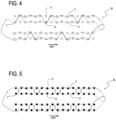
- FIG. 4 shows a base fabric B for a papermaking felt in which the CD yarns included in each of the third structural unit and the fourth structural unit are adjacent and the third structural unit and the fourth structural unit are not located in pairs.
- FIG. 5 shows a base fabric B for a papermaking felt in which an upper CD yarn (twisted yarn) 3 and a lower CD yarn (twisted yarn) 4 in FIG. 1 are replaced with an upper CD yarn (single yarn) 5 and a lower CD yarn (single yarn) 6, respectively.
- the base fabric for a papermaking felt in the present disclosure is not used in the form of a folded or overlapped base fabric having the MD yarns sewn or welded.
- the present disclosure also relates to a papermaking felt (hereinafter, also simply referred to as a "felt”) including the base fabric for a papermaking felt described above.
- a papermaking felt hereinafter, also simply referred to as a "felt”
- the papermaking felt in the present disclosure may include the base fabric for a papermaking felt described above and an additional layer.
- the additional layer include any layer selected from woven fabrics, nonwoven fabrics, strands of yarn, grid-shaped materials, films, sheets, and foams.
- Examples of a method for providing the additional layer on the base fabric include entangling, adhesion, welding, bonding, welding by ultrasonic waves, and laying by 3D printing.
- the papermaking felt can be formed by entangling nonwoven fabrics to both the wet paper side surface of the base fabric for a papermaking felt and the roll side surface of the base fabric for a papermaking felt, which is preferable because the roll side surface of the base fabric is not damaged.
- a basis weight of the papermaking felt in the present disclosure is not particularly limited, and is preferably 1700 g/m 2 or less, more preferably 1500 g/m 2 or less, still more preferably 1300 g/m 2 or less, particularly preferably 1100 g/m 2 or less, and most preferably 900 g/m 2 or less.
- the lower limit of the basis weight of the papermaking felt is not particularly limited, and the basis weight of the papermaking felt may be, for example, equal to or greater than the basis weight of the base fabric for a papermaking felt.
- a weight of the base fabric with respect to a weight of the entire papermaking felt in the present disclosure is not particularly limited, and is preferably 11/20 or less, more preferably 9/20 or less, and still more preferably 2/5 or less.
- the lower limit of the weight of the base fabric with respect to the weight of the entire papermaking felt is not particularly limited, and the weight of the base fabric with respect to the weight of the entire papermaking felt may be 1/20 or more, 1/10 or more, 3/20 or more, or the like.
- weight of the base fabric with respect to the weight of the entire papermaking felt is 11/20 or less is preferable because the felt is flexible and the workability of installation of the felt in the papermaking machine is improved.
- the papermaking felt in the present disclosure may include seam loop portions at both ends.
- a seam loop of the papermaking felt may be fitted to another seam loop to engage these seam loops, and a core wire may be inserted into a tunnel-shaped space formed by the engaged seam loops to connect the felts. By repeating this operation one or more times, an endless papermaking felt can be formed on the papermaking machine.
- papermaking felt in the present disclosure can also be formed as an endless felt having no seam loop portions at both ends.
- the present disclosure also relates to a method including, in any order, a step of weaving the first MD yarn with the upper CD yarn in a 1/1 plain weave structure and weaving the first MD yarn with one of the lower CD yarns and two of the upper CD yarns, the lower CD yarns having another two lower CD yarns each being adjacent to the one lower CD yarn, the another two lower CD yarns being adjacent to the two upper CD yarns on a wet paper side, respectively, such that the first MD yarn is alternately in contact with a wet paper side surface of one of the two upper CD yarns, a roll side surface of the one lower CD yarn, and a wet paper side surface of the other of the two upper CD yarns (hereinafter, also referred to as a "step 1"), and a step of weaving the second MD yarn with the lower CD yarn in a 1/1 plain weave structure and weaving the second MD yarn with one of the upper CD yarns and two of the lower CD yarns, the upper CD yarns having another two upper CD yarn
- the step 1 is a step of forming the first structural unit and the third structural unit in the base fabric for a papermaking felt in the present disclosure.
- the step 2 is a step of forming the second structural unit and the fourth structural unit in the base fabric for a papermaking felt in the present disclosure.
- the papermaking felt in the present disclosure can be produced by performing the step 1 and the step 2 in any order and performing a step of providing the additional layer as necessary. For example, after performing the method including the step 1 and the step 2 in any order, a step of entangling the nonwoven fabrics to both the wet paper side surface and the roll side surface of the obtained base fabric for a papermaking felt may be performed, a step of forming seam loop portions at both ends of the obtained base fabric for a papermaking felt may be performed, any other step may be performed, and a plurality of these steps may be performed.
- the MD yarn (picking yarn) and the CD yarn (warp yarn) were used with the numbers of yarns being 110 Numbers/5 cm and 40 Numbers/5 cm, respectively, and a 1/1 warp-weft double woven base fabric was produced by a weaving machine to obtain a base fabric for a papermaking felt in Example 1.
- a basis weight of the base fabric for a papermaking felt in Example 1 obtained by the above method was 410 g/m 2 .
- the base fabric for a papermaking felt in Example 1 has the structure schematically shown in FIG. 1 (a structure including the temporary core wire 7 is shown only in FIG. 1 to describe producing steps to be described below). That is, in the base fabric for a papermaking felt in Example 1, the CD yarns included in the third structural unit and the fourth structural unit were in a non-adjacent positional relationship. The third structural unit and the fourth structural unit had a pairwise positional relationship.
- each of the third structural unit and the fourth structural unit is not a twill weaving pattern.
- the temporary core wire 7 for needling was inserted into an MD yarn folded portion (right end portion in FIG. 1 ) on a weaving machine, a nonwoven fabric was stacked, entangled, and integrated, the temporary core wire 7 was pulled out, and the fiber layer above the loop was cut and separated, thereby obtaining the papermaking felt in Example 1.
- the basis weight of the papermaking felt in Example 1 obtained by the above method was 850 g/m 2 .
- Example 2 The papermaking felts in Example 1, and those in Examples 2 to 8 and Comparative Examples 1 to 4 to be described below were evaluated as follows. Results are shown in Table 2.
- the papermaking felt was punched into a circular shape having a diameter of 117 mm and immersed in water for 1 hour or more to obtain a sample for evaluation.
- the sample for evaluation was set in a pressure tester, and an initial load thickness (mm) when pressure was applied with a surface pressure of 0.3 kg/cm 2 , a load thickness (mm) when pressure was applied with a surface pressure of 30 kg/cm 2 , and a pressure removal thickness (mm) when the load was removed were measured.
- the pressure was applied with a time from an initial load to the load removal being set to 1 second.
- compression rate % initial load thickness ⁇ load thickness / initial load thickness ⁇ 100
- Recovery rate % pressure removal thickness ⁇ load thickness / load thickness ⁇ 100
- the pressure tester used for measuring the compression rate and the recovery rate was as follows.
- the papermaking felt was punched into a rectangular shape having a size of 300 mm in the MD direction and a size of 30 mm in the CD direction.
- the nonwoven fabrics at portions of 75 mm from both ends in the MD direction and a portion of 10 mm around the center in the MD direction portions of 5 mm from the center in the MD direction toward both MD directions) were removed, and the CD yarn of the exposed base fabric was removed.
- MD yarns other than those in the portions of 5 mm from both ends in the CD direction were cut.
- the obtained papermaking felt was immersed in water for 3 hours to obtain the sample for evaluation.
- One end of a portion of the sample for evaluation in the MD direction at which the nonwoven fabric was not removed was gripped by one chuck of a tensile tester, and one first MD yarns located at a center in the CD direction was gripped by the other chuck among the first MD yarns exposed at the other end of the sample for evaluation, followed by having been pulled in the MD direction at a pulling speed of 100 mm/min to measure the pullout strength of the first MD yarn.
- a tensile strength of the second MD yarn was measured in the same method as in the measurement of the tensile strength of the first MD yarn except that one of the second MD yarns located at the center in the CD direction was gripped by the other chuck instead of gripping one of the first MD yarns located at the center in the CD direction by the other chuck.
- the tensile tester used for measuring the pullout strength is as follows. ⁇ Precision Universal Tester Autograph AG-X (manufactured by Shimadzu Corporation) (Seam Mark)
- the papermaking felt was punched into a circular shape having a diameter of 70 mm such that the seam loop portion was located at the center, and immersed in water for 1 hour or more to adjust a water content to about 30%.
- Leaf bleached kraft PULP (LBKP) was beaten to have a beating degree of 300 C.S.F. to 500 C.S.F. (Canadian Standard Freeness: an index of fineness of paper raw material), followed by being used to prepare a wet paper with a sheet former to have a basis weight of 220 g/m 2 .
- the obtained wet paper was punched into a circular shape having a diameter of 60 mm, and the water content was adjusted to about 80%.
- the felt having the water content adjusted to about 30% and the wet paper having the water content adjusted to about 80% were overlapped and placed, and a press plate was freely dropped at a surface pressure of 50 kg/cm 2 to collect the seam mark of the wet paper and then dried to obtain the sample for evaluation.
- the seam mark was visually evaluated as follows.
- a base fabric for a papermaking felt was produced in the same manner as in Example 1 except for the contents shown in Table 1. Except for not performing disposing and pulling out of temporary core wire and not performing cutting of fiber layer above the loop and separating, nonwoven fabrics were stacked, entangled, and integrated by the same method as in Example 1 to obtain a papermaking felt in Example 2.
- the base fabric for a papermaking felt in Example 2 has a structure schematically shown in FIG. 1 except for having an endless form.
- each of the third structural unit and the fourth structural unit is not a twill weaving pattern.
- a base fabric for a papermaking felt and a papermaking felt were produced in the same manner as in Example 1 except for the contents shown in Table 1.
- the base fabrics for a papermaking felt in Examples 3 and 4 have structures schematically shown in FIGS. 2 and 3 , respectively, and the base fabrics for a papermaking felt in Examples 5 and 6 have the structure schematically shown in FIG. 1 .
- each of the third structural unit and the fourth structural unit is not a twill weaving pattern.
- each of the third structural unit and the fourth structural unit is a twill weaving pattern.
- a base fabric for a papermaking felt and a papermaking felt were produced in the same manner as in Example 1 except for the contents shown in Table 1.
- the base fabric for a papermaking felt in Example 7 has the structure schematically shown in FIG. 5 .
- each of the third structural unit and the fourth structural unit is not a twill weaving pattern.
- the CD yarn used in Example 7 was the same single yarn as the MD yarn used in Example 1.
- a base fabric for a papermaking felt and a papermaking felt were produced in the same manner as in Example 1 except for the contents shown in Table 1.
- the base fabric for a papermaking felt in Example 8 has the structure schematically shown in FIG. 1 .
- each of the third structural unit and the fourth structural unit is not a twill weaving pattern.
- the CD yarn used in Example 8 is a twisted yarn of 1500 dtex obtained by twisting two nylon 6 yarns having a fineness of 750 dtex.
- a base fabric for a papermaking felt and a papermaking felt were produced in the same manner as in Example 1 except for the contents shown in Table 1.
- Table 1 Base fabric for a papermaking felt Papermaking felt MD yarn CD yarn Structure Basis weight (g/m 2 ) Positional relationship of CD yarns (*1) Positional relationship of structural units (*2) Not twill weaving pattern (*3) Form Basis weight (g/m 2 ) Form The number of yarns (per Number/5 cm) Form The number of twisted yarns The number of yarns (per Number/5 cm)
- Example 2 Single yarn 110 Twisted yarn 4 40 1/1 Warp-weft double 410 Not adjacent Pairwise Not twill Endless 850
- Example 3 Single yarn 110 Twisted yarn 4 40 1/1 Warp-weft double 410 Adjacent Pairwise Not twill Seam 850
- Example 4 Single yarn 110 Twisted yarn 4 40 1/1 Warp-we
- the base fabric for a papermaking felt in the present disclosure can provide a papermaking felt which is lightweight, has excellent water-squeezing properties, prevents icicle phenomenon, and prevent occurrence of seam mark, and therefore can be used to produce various papers such as newspaper, high-quality paper, paperboard, and household paper.
Landscapes
- Engineering & Computer Science (AREA)
- Textile Engineering (AREA)
- Paper (AREA)
Applications Claiming Priority (1)
| Application Number | Priority Date | Filing Date | Title |
|---|---|---|---|
| JP2023062931A JP2024149199A (ja) | 2023-04-07 | 2023-04-07 | 抄紙用フェルト用基布、抄紙用フェルト及び抄紙用フェルトの製造方法 |
Publications (1)
| Publication Number | Publication Date |
|---|---|
| EP4442902A1 true EP4442902A1 (de) | 2024-10-09 |
Family
ID=90718190
Family Applications (1)
| Application Number | Title | Priority Date | Filing Date |
|---|---|---|---|
| EP24168485.1A Pending EP4442902A1 (de) | 2023-04-07 | 2024-04-04 | Grundgewebe für papiermacherfilz, papiermacherfilz und verfahren zur herstellung eines papiermacherfilzes |
Country Status (4)
| Country | Link |
|---|---|
| US (1) | US20240337068A1 (de) |
| EP (1) | EP4442902A1 (de) |
| JP (1) | JP2024149199A (de) |
| CN (1) | CN118773792A (de) |
Citations (7)
| Publication number | Priority date | Publication date | Assignee | Title |
|---|---|---|---|---|
| JPS63126991A (ja) | 1986-11-06 | 1988-05-30 | アステン グループ インコーポレイティド | 抄紙機用多層ウェットプレスフェルト |
| JP2004036021A (ja) | 2002-07-02 | 2004-02-05 | Nippon Felt Co Ltd | 製紙用シーム付きフェルト |
| WO2004059076A2 (en) * | 2002-12-24 | 2004-07-15 | Voith Fabrics Patent Gmbh | Fabrics with paired, interchanging yarns having discontinuous weave pattern |
| JP2006009207A (ja) | 2004-06-28 | 2006-01-12 | Ichikawa Co Ltd | 抄紙用フェルト及びその製造方法 |
| WO2007075372A1 (en) * | 2005-12-29 | 2007-07-05 | Albany International Corp. | Multi-layer fabric with paired binder yarns having different contour patterns |
| JP2007277783A (ja) | 2006-04-11 | 2007-10-25 | Ichikawa Co Ltd | 抄紙用プレス装置 |
| DE602004012179T2 (de) * | 2003-03-27 | 2009-05-28 | Voith Patent Gmbh | Pressfilz |
Family Cites Families (1)
| Publication number | Priority date | Publication date | Assignee | Title |
|---|---|---|---|---|
| JP4883629B2 (ja) * | 2007-03-13 | 2012-02-22 | イチカワ株式会社 | 湿紙搬送用ベルト |
-
2023
- 2023-04-07 JP JP2023062931A patent/JP2024149199A/ja active Pending
-
2024
- 2024-04-03 CN CN202410399387.6A patent/CN118773792A/zh active Pending
- 2024-04-04 EP EP24168485.1A patent/EP4442902A1/de active Pending
- 2024-04-05 US US18/627,471 patent/US20240337068A1/en active Pending
Patent Citations (7)
| Publication number | Priority date | Publication date | Assignee | Title |
|---|---|---|---|---|
| JPS63126991A (ja) | 1986-11-06 | 1988-05-30 | アステン グループ インコーポレイティド | 抄紙機用多層ウェットプレスフェルト |
| JP2004036021A (ja) | 2002-07-02 | 2004-02-05 | Nippon Felt Co Ltd | 製紙用シーム付きフェルト |
| WO2004059076A2 (en) * | 2002-12-24 | 2004-07-15 | Voith Fabrics Patent Gmbh | Fabrics with paired, interchanging yarns having discontinuous weave pattern |
| DE602004012179T2 (de) * | 2003-03-27 | 2009-05-28 | Voith Patent Gmbh | Pressfilz |
| JP2006009207A (ja) | 2004-06-28 | 2006-01-12 | Ichikawa Co Ltd | 抄紙用フェルト及びその製造方法 |
| WO2007075372A1 (en) * | 2005-12-29 | 2007-07-05 | Albany International Corp. | Multi-layer fabric with paired binder yarns having different contour patterns |
| JP2007277783A (ja) | 2006-04-11 | 2007-10-25 | Ichikawa Co Ltd | 抄紙用プレス装置 |
Also Published As
| Publication number | Publication date |
|---|---|
| US20240337068A1 (en) | 2024-10-10 |
| JP2024149199A (ja) | 2024-10-18 |
| CN118773792A (zh) | 2024-10-15 |
Similar Documents
| Publication | Publication Date | Title |
|---|---|---|
| EP1254284B1 (de) | Papiermacher formiergewebe mit zusatzfäden | |
| CN101952496B (zh) | 具有高中心平面抗性的工业过滤织物 | |
| US20130327490A1 (en) | Paper machine fabric | |
| US7980275B2 (en) | Papermaker's press felt with long machine direction floats in base fabric | |
| CN114108357B (zh) | 抄纸用毛毡及其制造方法 | |
| TW593816B (en) | Enhancements for seams in on-machine-seamable papermaker's fabrics | |
| JP2001040595A (ja) | 成型糸を有している多軸プレス布 | |
| JP4869767B2 (ja) | 繊維により高度に支持された安定な形成布 | |
| JP2003166189A (ja) | 継ぎ合せ抄紙機の布における継目の増強法 | |
| EP1693506B1 (de) | Papiermacher-Formiergewebe mit Maschinenrichtungsnähfäden | |
| US9260819B2 (en) | Press felt for papermaking | |
| CN107304527B (zh) | 抄纸用毛毡 | |
| EP4442902A1 (de) | Grundgewebe für papiermacherfilz, papiermacherfilz und verfahren zur herstellung eines papiermacherfilzes | |
| EP3124694A1 (de) | Filz zur papierherstellung | |
| JP5115557B2 (ja) | 乾燥機ファブリック | |
| EP2305883B1 (de) | Papiermaschinenpressfilz mit langen Längsflottierungen im Grundgewebe | |
| CN116685731A (zh) | 造纸机的环形织造干燥机织物 | |
| BR102024006648A2 (pt) | Tecido de base para um feltro para fabricação de papel, feltro para fabricação de papel, e, método para produzir o feltro para fabricação de papel | |
| US20250146220A1 (en) | Papermaking felt base member and papermaking felt | |
| JP6891015B2 (ja) | 抄紙用フェルト |
Legal Events
| Date | Code | Title | Description |
|---|---|---|---|
| PUAI | Public reference made under article 153(3) epc to a published international application that has entered the european phase |
Free format text: ORIGINAL CODE: 0009012 |
|
| STAA | Information on the status of an ep patent application or granted ep patent |
Free format text: STATUS: THE APPLICATION HAS BEEN PUBLISHED |
|
| AK | Designated contracting states |
Kind code of ref document: A1 Designated state(s): AL AT BE BG CH CY CZ DE DK EE ES FI FR GB GR HR HU IE IS IT LI LT LU LV MC ME MK MT NL NO PL PT RO RS SE SI SK SM TR |
|
| STAA | Information on the status of an ep patent application or granted ep patent |
Free format text: STATUS: REQUEST FOR EXAMINATION WAS MADE |
|
| 17P | Request for examination filed |
Effective date: 20250409 |