EP4439735A2 - Lithiumbatterie mit modifiziertem polyolefinbindemittel - Google Patents
Lithiumbatterie mit modifiziertem polyolefinbindemittel Download PDFInfo
- Publication number
- EP4439735A2 EP4439735A2 EP24166303.8A EP24166303A EP4439735A2 EP 4439735 A2 EP4439735 A2 EP 4439735A2 EP 24166303 A EP24166303 A EP 24166303A EP 4439735 A2 EP4439735 A2 EP 4439735A2
- Authority
- EP
- European Patent Office
- Prior art keywords
- lithium battery
- anode
- group
- modified polyolefin
- adhesive
- Prior art date
- Legal status (The legal status is an assumption and is not a legal conclusion. Google has not performed a legal analysis and makes no representation as to the accuracy of the status listed.)
- Pending
Links
Images

Classifications
-
- H—ELECTRICITY
- H01—ELECTRIC ELEMENTS
- H01M—PROCESSES OR MEANS, e.g. BATTERIES, FOR THE DIRECT CONVERSION OF CHEMICAL ENERGY INTO ELECTRICAL ENERGY
- H01M4/00—Electrodes
- H01M4/02—Electrodes composed of, or comprising, active material
- H01M4/62—Selection of inactive substances as ingredients for active masses, e.g. binders, fillers
- H01M4/621—Binders
- H01M4/622—Binders being polymers
-
- H—ELECTRICITY
- H01—ELECTRIC ELEMENTS
- H01M—PROCESSES OR MEANS, e.g. BATTERIES, FOR THE DIRECT CONVERSION OF CHEMICAL ENERGY INTO ELECTRICAL ENERGY
- H01M10/00—Secondary cells; Manufacture thereof
- H01M10/05—Accumulators with non-aqueous electrolyte
- H01M10/052—Li-accumulators
-
- H—ELECTRICITY
- H01—ELECTRIC ELEMENTS
- H01M—PROCESSES OR MEANS, e.g. BATTERIES, FOR THE DIRECT CONVERSION OF CHEMICAL ENERGY INTO ELECTRICAL ENERGY
- H01M10/00—Secondary cells; Manufacture thereof
- H01M10/05—Accumulators with non-aqueous electrolyte
- H01M10/058—Construction or manufacture
- H01M10/0585—Construction or manufacture of accumulators having only flat construction elements, i.e. flat positive electrodes, flat negative electrodes and flat separators
-
- H—ELECTRICITY
- H01—ELECTRIC ELEMENTS
- H01M—PROCESSES OR MEANS, e.g. BATTERIES, FOR THE DIRECT CONVERSION OF CHEMICAL ENERGY INTO ELECTRICAL ENERGY
- H01M50/00—Constructional details or processes of manufacture of the non-active parts of electrochemical cells other than fuel cells, e.g. hybrid cells
- H01M50/10—Primary casings; Jackets or wrappings
- H01M50/183—Sealing members
- H01M50/19—Sealing members characterised by the material
- H01M50/193—Organic material
-
- H—ELECTRICITY
- H01—ELECTRIC ELEMENTS
- H01M—PROCESSES OR MEANS, e.g. BATTERIES, FOR THE DIRECT CONVERSION OF CHEMICAL ENERGY INTO ELECTRICAL ENERGY
- H01M50/00—Constructional details or processes of manufacture of the non-active parts of electrochemical cells other than fuel cells, e.g. hybrid cells
- H01M50/10—Primary casings; Jackets or wrappings
- H01M50/102—Primary casings; Jackets or wrappings characterised by their shape or physical structure
- H01M50/105—Pouches or flexible bags
-
- Y—GENERAL TAGGING OF NEW TECHNOLOGICAL DEVELOPMENTS; GENERAL TAGGING OF CROSS-SECTIONAL TECHNOLOGIES SPANNING OVER SEVERAL SECTIONS OF THE IPC; TECHNICAL SUBJECTS COVERED BY FORMER USPC CROSS-REFERENCE ART COLLECTIONS [XRACs] AND DIGESTS
- Y02—TECHNOLOGIES OR APPLICATIONS FOR MITIGATION OR ADAPTATION AGAINST CLIMATE CHANGE
- Y02E—REDUCTION OF GREENHOUSE GAS [GHG] EMISSIONS, RELATED TO ENERGY GENERATION, TRANSMISSION OR DISTRIBUTION
- Y02E60/00—Enabling technologies; Technologies with a potential or indirect contribution to GHG emissions mitigation
- Y02E60/10—Energy storage using batteries
-
- Y—GENERAL TAGGING OF NEW TECHNOLOGICAL DEVELOPMENTS; GENERAL TAGGING OF CROSS-SECTIONAL TECHNOLOGIES SPANNING OVER SEVERAL SECTIONS OF THE IPC; TECHNICAL SUBJECTS COVERED BY FORMER USPC CROSS-REFERENCE ART COLLECTIONS [XRACs] AND DIGESTS
- Y02—TECHNOLOGIES OR APPLICATIONS FOR MITIGATION OR ADAPTATION AGAINST CLIMATE CHANGE
- Y02P—CLIMATE CHANGE MITIGATION TECHNOLOGIES IN THE PRODUCTION OR PROCESSING OF GOODS
- Y02P70/00—Climate change mitigation technologies in the production process for final industrial or consumer products
- Y02P70/50—Manufacturing or production processes characterised by the final manufactured product
Definitions
- Embodiments relate to a lithium battery including a modified polyolefin binder.
- a secondary battery may be generally configured by accommodating an electrode assembly and an electrolyte in a battery case, and installing a cap plate on the battery case. Electrode tabs, cathode terminals, and the like, may be connected to the electrode assembly, and these components may be exposed or protruded to the outside through the cap plate.
- An electrode assembly of a secondary battery may be configured as a jelly-roll type by winding a laminate of a cathode plate, an anode plate, and a separator, or may be configured as a stack-type by stacking a plurality of cathode plates, anode plates, and separators.
- a lithium battery including an electrode assembly including a cathode, an anode, and a separator between the cathode and the anode; a battery case surrounding the electrode assembly; and an adhesive layer between the electrode assembly and the battery case, the adhesive layer attaching the electrode assembly and the battery case to each other, wherein the adhesive layer includes an adhesive including a maleimide-modified polyolefin containing two or more acid functional groups.
- An electrolyte absorption amount of the adhesive may be 30 wt% or less.
- the maleimide-modified polyolefin containing two or more acid functional groups may have a weight average molecular weight (Mw) of 10,000 g/mol or more.
- the maleimide-modified polyolefin containing two or more acid functional groups may have a melting point (T m ) of 130 °C or less.
- the maleimide-modified polyolefin containing two or more acid functional groups may be a reaction product between an amine compound containing two or more acid functional groups and an ⁇ , ⁇ -unsaturated dicarboxylic acid anhydride-modified polyolefin.
- a maleimide in the maleimide-modified polyolefin containing two or more acid functional groups may be a product of a dehydration reaction between an amine compound containing two or more acid functional groups and an (e.g., ⁇ , ⁇ -unsaturated) dicarboxylic acid anhydride-modified polyolefin.
- An ( ⁇ , ⁇ -unsaturated) dicarboxylic acid in the (e.g., ⁇ , ⁇ -unsaturated) dicarboxylic acid anhydride-modified polyolefin may include anhydrous maleic acid.
- a modified polyolefin in the (e.g., ⁇ , ⁇ -unsaturated) dicarboxylic acid anhydride-modified polyolefin may include a polyethylene or a polypropylene.
- a content of polyolefin in the (e.g., ⁇ , ⁇ -unsaturated) dicarboxylic acid anhydride-modified polyolefin may be 50 mol% or more.
- a content of (e.g., ⁇ , ⁇ -unsaturated) dicarboxylic acid anhydride in the (e.g., ⁇ , ⁇ -unsaturated) dicarboxylic acid anhydride-modified polyolefin may be 50 mol% or less.
- L 1 may be a C 1 -C 20 alkylene group, a C 2 -C 20 alkeynylene group, a C 2 -C 20 alkynylene group, a C 3 -C 10 cycloalkylene group, a C 3 -C 10 cycloalkenylene group, or a C 6 -C 30 arylene group
- a 1 may be a carboxylic acid group, a sulfonic acid group, or a phosphorus acid group
- a1 may be an integer of 2 to 5.
- the amine compound containing two or more acid functional groups may be represented by one of Formulae 1-1 to 1-6: in Formulae 1-1 to 1-6, L 1 may be a C 1 -C 20 alkylene group, a C 2 -C 20 alkeynylene group, a C 2 -C 20 alkynylene group, a C 3 -C 10 cycloalkylene group, a C 3 -C 10 cycloalkenylene group, or a C 6 -C 30 arylene group, and A 11 to A 15 may be each independently a carboxylic acid group, a sulfonic acid group, or a phosphorus acid group.
- the amine compound containing two or more acid functional groups may be represented by one of Formulae 1-1 to 1-4.
- the adhesive layer may be on at least one surface of an upper surface and a lower surface of the electrode assembly.
- the adhesive layer may be on an entire outer surface of the electrode assembly.
- An area on which the adhesive layer is disposed may be 6 % or more with respect to a total area of an outer surface of the electrode assembly.
- the adhesive layer may have a thickness of about 1 ⁇ m to about 10 ⁇ m.
- the adhesive layer is on an outer surface of the electrode assembly in the form of a polygonal shape, a circular shape, an oval shape a straight-line, a diagonal curve a zig-zag line; or a combination thereof.
- the lithium battery may further include an electrolyte inside the battery case.
- the electrolyte may include a liquid electrolyte, a solid electrolyte, or a gel electrolyte.
- An adhesive layer between an electrode assembly and a battery case may include an adhesive including a maleimide-modified polyolefin containing two or more acid functional groups, and adhesive strength between the electrode assembly and the battery case and high-temperature stability may improve.
- a lithium battery comprising an adhesive including the maleimide-modified polyolefin containing two or more acid functional groups may have improved impact strength and high-temperature stability.
- particle diameter of a particle refers to an average particle diameter if the particle is spherical, and for a particle that is non-spherical, said term refers to an average major axis length of the particle.
- the particle diameter of particles may be measured using a particle size analyzer (PSA).
- PSD particle size analyzer
- the term "particle diameter" of particles may refer to an average diameter of the particles, for example.
- the average particle diameter may be, for example, a median particle diameter D50.
- the median particle diameter D50 refers to a particle size corresponding to a cumulative volume of 50 vol% as counted from the smallest particle size in a particle size distribution measured by a laser diffraction method.
- substituted with a halogen means that any hydrogen in a polymer is replaced with a halogen or an alkyl group having 1 to 5 carbon atoms substituted with a halogen.
- halogen refers to fluorine, chlorine, bromine, or iodine.
- metal refers to both metals and metalloids such as silicon and germanium, in an elemental or ionic state.
- alloy means a mixture of two or more metals.
- cathode active material refers to a cathode material capable of undergoing lithiation and delithiation.
- anode active material refers to an anode material capable of undergoing lithiation and delithiation.
- lithiumation and “to lithiate” refer to a process of adding lithium to a cathode active material or an anode active material.
- the terms “delithiation” and “to delithiate” refer to a process of removing lithium from a cathode active material or an anode active material.
- the terms “charging” and “to charge” refer to a process of providing electrochemical energy to a battery.
- the terms “discharging” and “to discharge” refer to a process of removing electrochemical energy from a battery.
- positive electrode and “cathode” refer to an electrode at which electrochemical reduction and lithiation take place during a discharging process.
- negative electrode and “anode” refer to an electrode at which electrochemical oxidation and delithiation take place during a discharging process.
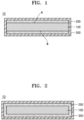
- FIG. 1 is a cross-sectional view of a lithium battery according to embodiments.
- FIG. 2 is a cross-sectional view of a lithium battery according to other embodiments.
- a lithium battery 10 includes an electrode assembly 100 including a cathode, an anode, and a separator between the cathode and the anode; a battery case 300 housing the electrode assembly 100; and an adhesive layer 200 between the electrode assembly 100 and the battery case 300 and attaching the electrode assembly 100 and the battery case 300 to each other.
- the adhesive layer 200 includes an adhesive including a maleimide-modified polyolefin containing two or more acid functional groups.
- the adhesive layer 200 includes an adhesive including a maleimide-modified polyolefin containing two or more acid functional groups and, due to excellent adhesive properties and high-temperature stability of the maleimide-modified polyolefin containing two or more acid functional groups, a lithium battery 10 including the same may have improved impact strength and high-temperature stability.
- Adhesive strength may improve by virtue of two or more acid functional groups included in the maleimide-modified polyolefin.
- the polyolefin may be modified by maleimide, and high-temperature stability may improve.
- An adhesive including a maleimide-modified polyolefin containing two or more acid functional groups may have improved adhesive properties and high-temperature stability.
- An electrolyte absorption amount of the adhesive containing maleimide-modified polyolefin containing two or more acid functional groups may be 30 wt% or less with respect to the total weight of the adhesive.
- the electrolyte absorption amount of the adhesive may be 25 wt% or less, 20 wt% or less, or 15 wt% or less, with respect to the total weight of the adhesive.
- Electrolyte absorption amount refers to the amount of an electrolyte absorbed after an adhesive is completely immersed in the electrolyte and preserved for 1 hour at 80 °C, and is calculated by the Equation below.
- Electrolyte absorption amount (wt%) (Weight of adhesive after immersion in electrolyte - Weight of adhesive before immersion in electrolyte) / (Weight of adhesive before immersion in electrolyte) * 100
- the maleimide-modified polyolefin containing two or more acid functional groups may have a weight average molecular weight (Mw) of, e.g., 10,000 g/mol or more.
- the weight average molecular weight (Mw) may be measured by gel permeation chromatography (GPC) or size-exclusion chromatography (SEC).
- the maleimide-modified polyolefin containing two or more acid functional groups may have a weight average molecular weight (Mw) of, e.g., about 10,000 g/mol to about 1,000,000 g/mol.
- the maleimide-modified polyolefin containing two or more acid functional groups may have a melting point (Tm) of, e.g., 130 °C or less.
- the melting point (Tm) of the maleimide-modified polyolefin containing two or more acid functional groups may be 100 °C or less, about 40 °C to about 130 °C, or about 40 °C to about 100 °C.
- the material of a separator may be polyethylene, and the processing temperature may not exceed the melting point of polyethylene (134 °C). If the melting point were to be less than 40 °C, as softening properties deteriorate, the effect of pushing the electrolyte out from between an adhesive and a metal foil may decrease, giving rise to insufficient adhesive strength and causing heat resistance to decrease.
- the maleimide-modified polyolefin containing two or more acid functional groups may be a product of reaction between an amine compound containing two or more acid functional groups and an ⁇ , ⁇ -unsaturated dicarboxylic acid anhydride-modified polyolefin.
- a maleimide unit in the maleimide-modified polyolefin containing two or more acid functional groups may be a product of a dehydration reaction between an amine compound containing two or more acid functional groups and an ⁇ , ⁇ -unsaturated dicarboxylic acid anhydride-modified polyolefin.
- a maleimide unit in the maleimide-modified polyolefin containing two or more acid functional groups may be a product of reaction as shown in Reaction 1 between an amine compound containing two or more acid functional groups (see definition of the amine compound below) and a (e.g., ⁇ , ⁇ -unsaturated) dicarboxylic acid anhydride-modified polyolefin.
- a maleimide in maleimide-modified polyolefin containing two or more acid functional groups may be prepared by a dehydration reaction of an amine group in an amine compound containing two or more acid functional groups with (e.g., ⁇ , ⁇ -unsaturated) dicarboxylic acid anhydride in a (e.g., ⁇ , ⁇ -unsaturated) dicarboxylic acid anhydride-modified polyolefin.
- the ⁇ , ⁇ -unsaturated dicarboxylic acid anhydride-modified polyolefin may be produced by grafting polyolefin with a monomer having an ⁇ , ⁇ -unsaturated dicarboxylic acid anhydride structure.
- the monomer of ⁇ , ⁇ -unsaturated dicarboxylic acid anhydride structure may utilize an ⁇ , ⁇ -unsaturated dicarboxylic acid, an ⁇ , ⁇ -unsaturated dicarboxylic acid anhydride, an ⁇ , ⁇ -unsaturated dicarboxylic acid ester, an ⁇ , ⁇ -unsaturated dicarboxylic acid diester, an ⁇ , ⁇ -unsaturated dicarboxylic acid derivative with a functional group bound to ⁇ , ⁇ -unsaturated dicarboxylic acid, an ⁇ , ⁇ -unsaturated dicarboxylic acid salt, or a mixture thereof.
- the monomer of ⁇ , ⁇ -unsaturated dicarboxylic acid anhydride structure may be a monomer of maleic acid anhydride structure, and maleic acid, a maleic acid anhydride, a maleic acid ester, a maleic acid diester, a maleic acid derivative with a functional group bound to maleic acid, a maleic acid salt, or a mixture thereof may be used as the monomer of maleic acid anhydride structure.
- Examples of a maleic acid anhydride derivative with a functional group bound to maleic acid anhydride may include 2,3-dimethylmaleic anhydride, phenylmaleic anhydride, and the like.
- the ⁇ , ⁇ -unsaturated dicarboxylic acid anhydride-modified polyolefin may be prepared by grafting a polyolefin with an ⁇ , ⁇ -unsaturated dicarboxylic acid anhydride.
- An ⁇ , ⁇ -unsaturated dicarboxylic acid, an ⁇ , ⁇ -unsaturated dicarboxylic acid anhydride, an ⁇ , ⁇ -unsaturated dicarboxylic acid ester, an ⁇ , ⁇ -unsaturated dicarboxylic acid diester, an ⁇ , ⁇ -unsaturated dicarboxylic acid derivative with a functional group bound to ⁇ , ⁇ -unsaturated dicarboxylic acid, or an ⁇ , ⁇ -unsaturated dicarboxylic acid salt may be used, and the prepared modified polyolefin may be dehydrated by a high-temperature treatment to thereby prepare an ⁇ , ⁇ -unsaturated dicarboxylic acid anhydride-modified polyolefin.
- the ⁇ , ⁇ -unsaturated dicarboxylic acid anhydride in the ⁇ , ⁇ -unsaturated dicarboxylic acid anhydride-modified polyolefin may include anhydrous maleic acid.
- the modified polyolefin in the ⁇ , ⁇ -unsaturated dicarboxylic acid anhydride-modified polyolefin may include a polyethylene or a polypropylene.
- the type of the ⁇ , ⁇ -unsaturated dicarboxylic acid anhydride-modified polyolefin may be a random co-polymer or a graft co-polymer, and may be hyper branched or a dendrimer.
- the content of polyolefin in the ⁇ , ⁇ -unsaturated dicarboxylic acid anhydride-modified polyolefin may be 50 mol% or more.
- the content of polyolefin in the ⁇ , ⁇ -unsaturated dicarboxylic acid anhydride-modified polyolefin may be 75 mol% or more, or 90 mol% or more.
- the content of ⁇ , ⁇ -unsaturated dicarboxylic acid (e.g. anhydrous maleic acid) in the ⁇ , ⁇ -unsaturated dicarboxylic acid anhydride-modified polyolefin may be 50 mol% or less.
- the content of ⁇ , ⁇ -unsaturated dicarboxylic acid (e.g. anhydrous maleic acid) in the ⁇ , ⁇ -unsaturated dicarboxylic acid anhydride-modified polyolefin may be 25 mol% or less, 15 mol% or less, or about 5 mol% to about 15 mol%.
- anhydrous maleic acid may be calculated using 1 H-NMR, from a ratio of an area corresponding to ⁇ , ⁇ -unsaturated dicarboxylic acid (e.g. anhydrous maleic acid) in the total area of 1 H-NMR peaks.
- the ⁇ , ⁇ -unsaturated dicarboxylic acid modified polyolefin may be prepared by copolymerization of polyolefin with a metal adhesive co-monomer or other co-monomers, along with a monomer having ⁇ , ⁇ -unsaturated dicarboxylic acid structure.
- a metal adhesive co-monomer may include acrylic acid, an acrylic acid derivative, e.g., methacrylic acid, vinyl alcohol, an acrylic acid ester derivative containing a hydroxy alkyl group, an acrylic acid ester derivative containing a carboxy alkyl group, or a mixture thereof.
- examples of the metal adhesive co-monomer may include a polymerizable compound including a carboxyl group (including anhydride structures) or a hydroxy group having metal adhesive properties, an acid component (sulfonic acid, phosphonic acid, etc.), or a functional group (e.g., trimethoxysilyl group) giving rise to a reaction with a metal surface, e.g., silane coupling reaction, or a mixture of such compounds.
- Other co-monomers may include ethylene, styrene, or a mixture thereof. The other comonomers may be included, and the adhesive resin may have a decreased melting point and improved fluidity.
- An acid functional group in the amine compound containing two or more acid functional groups may include carboxylic acid, sulfonic acid, or phosphorus acid.
- the acid functional group may include carboxylic acid.
- the amine compound containing two or more acidic functional groups may be represented by Formula 1.
- L 1 is a C 1 -C 20 alkylene group, a C 2 -C 20 alkeynylene group, a C 2 -C 20 alkynylene group, a C 3 -C 10 cycloalkylene group, a C 3 -C 10 cycloalkenylene group, or a C 6 -C 30 arylene group.
- a 1 is a carboxylic acid group, a sulfonic acid group, or a phosphorus acid group.
- a1 is an integer of 2 to 5.
- a 1 may be a carboxylic acid group.
- a1 may be an integer of 2 to 4, in particular a1 may be 2.
- Amine compound containing two or more acid functional groups may be represented by one of Formulae 1-1 to 1-6.
- L 1 is a C 1 -C 20 alkylene group, a C 2 -C 20 alkeynylene group, a C 2 -C 20 alkynylene group, a C 3 -C 10 cycloalkylene group, a C 3 -C 10 cycloalkenylene group, or a C 6 -C 30 arylene group.
- a 11 to A 15 are each independently a carboxylic acid group, a sulfonic acid group, or a phosphorus acid group.
- An to A 15 each independently may be a carboxylic acid group.
- the amine compound containing two or more acid functional groups may be represented by one of Formulae 1-1 to 1-4.
- the adhesive layer 200 may be on at least one surface of an upper surface and a lower surface of the electrode assembly 100.
- the adhesive layer 200 may be on an entire upper surface or lower surface of the electrode assembly 100.
- the adhesive layer 200 may be on an entire upper surface and an entire lower surface of the electrode assembly 100.
- the adhesive layer 200 may be on an entire outer surface of the electrode assembly 100, e.g., may completely surround the electrode assembly 100.
- a disposition area of the adhesive layer 200 may be 6% or more with respect to a total area of the outer surface of the electrode assembly 100.
- the disposition area of the adhesive layer 200 may be, e.g., 10 % or more, 20 % or more, 30 % or more, 40 % or more, 50 % or more, about 10 % to about 90 %, about 10 % to about 80 %, or about 10 % to about 70 %, with respect to the total area of the outer surface of the electrode assembly 100.
- the adhesive layer 200 may have a thickness of about 1 ⁇ m to about 10 ⁇ m.
- the thickness of the adhesive layer 200 may be, e.g., about 2 ⁇ m to about 10 ⁇ m, about 3 ⁇ m to about 10 ⁇ m, about 4 ⁇ m to about 10 ⁇ m, or about 5 ⁇ m to about 10 ⁇ m.
- the adhesive layer 200 may be on an outer surface of the electrode assembly in the form of a polygonal shape, a circular shape, an oval shape a straight-line, a diagonal curve a zig-zag line; or a combination thereof.
- the adhesive layer 200 may further include a tackifier or an additive in addition to the adhesive described above.
- the tackifier may include a rosin tackifier.
- the additive may include cross-linking agents, metal surface modifiers (silane coupling agents, acid derivatives such as phosphoric acid compounds (zirconium phosphate, titanium phosphate), and derivatives of metal oxide compounds such as titanic acid and chromic acid derivatives).
- the above additive may be a single type or may be used as a mixture of two or more types.
- the electrode assembly 100 includes an electrode assembly including a cathode, an anode, and a separator between the cathode and the anode.
- a separator may be disposed between the cathode and the anode to prepare an electrode assembly.
- the anode may include an anode current collector; and an anode active material layer on the anode current collector.
- the anode active material layer may include an anode active material, a binder, and a conductive material.
- An anode for a lithium battery according to embodiments may include an anode current collector; and an electrodeposing induction layer on one side of the anode current collector.
- An anode for a lithium battery according to embodiments may include an anode current collector; an electrodeposing induction layer on the anode current collector; and an anode active material layer on the electrodeposing induction layer.
- Materials constituting the anode current collector may include a suitable conductive material that does not react with lithium, e.g., a conductive material that does not form an alloy or a compound with lithium.
- the anode current collector may include, e.g., a metal or an alloy.
- the anode current collector may be formed of, e.g., indium (In), copper (Cu), magnesium (Mg), stainless steel (SUS), titanium (Ti), iron (Fe), cobalt (Co), nickel (Ni), zinc (Zn), aluminum (Al), germanium (Ge), lithium (Li), or an alloy thereof.
- the anode current collector may include, e.g., a first metal substrate.
- the first metal substrate may include a first metal as a main component or may be made of a first metal.
- the first metal substrate may include a first metal as a main component or may be made of a first metal.
- the content of the first metal included in the first metal substrate may be, e.g., 90 wt% or more, 95 wt% or more, 99 wt% or more, or 99.9 wt% or more with respect to a total weight of the first metal substrate.
- the first metal substrate may be composed of a material that does not react with lithium, e.g., a material that does not form an alloy and/or a compound with lithium.
- the first metal may be, e.g., copper (Cu), nickel (Ni), stainless steel (SUS), iron (Fe), cobalt (Co), or another suitable material for a current collector.
- the first metal substrate may be made of, e.g., a single type of the aforementioned metals, or an alloy of two or more metals thereof.
- the first metal substrate may be, e.g., a sheet type or a foil type.
- the thickness of the anode current collector 21 may be, e.g., about 5 ⁇ m to about 50 ⁇ m, about 10 ⁇ m to about 50 ⁇ m, about 10 ⁇ m to about 40 ⁇ m, about 10 ⁇ m to about 30 ⁇ m, or may be selected depending on a feature of a lithium battery.
- the anode current collector may further include a coating layer containing a second metal on the first metal substrate.
- the anode current collector may include, e.g., a first metal substrate; and a coating layer on the first metal substrate and containing a second metal.
- the second metal may have a higher Mohs hardness compared to the first metal.
- the coating layer containing the second metal may be harder than the substrate containing the first metal, and deterioration of the first metal substrate may be prevented.
- the Mohs hardness of a material constituting the first metal substrate may be, e.g., 6.0 or less.
- the Mohs hardness of the first metal may be, e.g., 5.5 or less, 5.0 or less, 4.5 or less, 4.0 or less, 3.5 or less, or 3.0 or less.
- the Mohs hardness of the first metal may be, e.g., about 2.0 to about 6.0.
- the coating layer may include a second metal.
- the coating layer may include a second metal as a main component, or may be formed of a second metal.
- the content of the second metal included in the coating layer may be, e.g., 90 wt% or more, 95 wt% or more, 99 wt% or more, or 99.9 wt% or more, with respect to the total weight of the coating layer.
- the coating layer may be composed of a material that does not react with lithium, for example, a material that does not form an alloy and/or a compound with lithium.
- the Mohs hardness of a material constituting the coating layer may be, e.g., 6.0 or more.
- the Mohs hardness of the second metal may be 6.0 or more, 6.5 or more, 7.0 or more, 7.5 or more, 8.0 or more, 8.5 or more, or 9.0 or more.
- the Mohs hardness of the second metal may be, e.g., about 6.0 to about 12. If the Mohs hardness of the second metal were to be too low, it could be difficult to suppress deterioration of the anode current collector. If the Mohs hardness of the second metal were to be too high, processing may be not easy.
- the second metal may be, e.g., titanium (Ti), manganese (Mn), niobium (Nb), tantalum (Ta), iridium (Ir), vanadium (V), rhenium (Re), osmium (Os), tungsten (W), chromium (Cr), boron (B), ruthenium (Ru), or rhodium (Rh).
- the coating layer may be made of, e.g., a single type of the aforementioned metals, or an alloy of two or more metals thereof.
- the difference in Mohs hardness between the first metal included in the first metal substrate and the second metal included in the coating layer may be, e.g., 2 or more, 2.5 or more, 3 or more, 3.5 or more, or 4 or more.
- the difference in Mohs hardness between the first metal and the second metal may be within the above ranges, and deterioration of the anode current collector may be more effectively suppressed.
- the coating layer may have a single-layer structure or a multi-layer structure having two or more layers.
- the coating layer may have a two-layer structure including a first coating layer and a second coating layer.
- the coating layer may have a three-layer structure having a first coating layer, a second coating layer, and a third coating layer.
- the thickness of the coating layer may be, e.g., about 10 nm to about 1 ⁇ m, about 50 nm to about 500 nm, about 50 nm to about 200 nm, or about 50 nm to about 150 nm. If the thickness of the coating layer were to be too thin, it could be difficult to suppress uneven growth of a lithium-containing metal layer. As the thickness of the coating layer increases, the cycling performance of the lithium battery may improve. If the thickness of the coating layer were to be excessively large, the energy density of the lithium battery could deteriorate, and formation of the coating layer could be difficult.
- the coating layer may be formed on the first metal substrate by a method such as a vacuum deposition method, a sputtering method, or a plating method. A suitable method that is capable of providing a coating layer may be used.
- the anode current collector may have a reduced thickness relative to other anode current collectors included in electrodes.
- the anode disclosed herein, by including a thin-film current collector e.g., may be distinguished from another electrode that includes a thick-film current collector.
- As an electrode according to one or more embodiments may employ a thin-film current collector having a reduced thickness, the thickness of a lithium electrodeposed layer in the anode including the thin-film current collector may relatively increase. As a result, a lithium battery employing the electrode may have increased energy density.
- the anode current collector 21 may have a thickness of 15 ⁇ m or less, 14.5 ⁇ m or less, or 14 ⁇ m or less.
- the thickness of the anode current collector may be about 0.1 ⁇ m to about 15 ⁇ m, about 1 ⁇ m to about 14.5 ⁇ m, about 2 ⁇ m to about 14 ⁇ m, about 3 ⁇ m to about 14 ⁇ m, about 5 ⁇ m to about 14 ⁇ m, or about 10 ⁇ m to about 14 ⁇ m.
- the anode current collector may have a form of a sheet, a foil, a film, a plate, a porous structure, a mesoporous structure, a through-hole containing structure, a polygonal ring, a mesh, a foam, a nonwoven structure, or may have another suitable form.
- the anode current collector may include a base film and a metal substrate layer on one side or both sides of the base film.
- the anode current collector may include a substrate, and the substrate may have, e.g., a structure including a base film and a metal substrate layer on one side or both sides of the base film.
- an interlayer may be further disposed on the metal substrate layer.
- the base film may include, e.g., a polymer.
- the polymer may be a thermoplastic polymer.
- the polymer may include polyethylene terephthalate (PET), polyethylene (PE), polypropylene (PP), polybutylene terephthalate (PBT), polyimide (PI), or a combination thereof.
- PET polyethylene terephthalate
- PE polyethylene
- PP polypropylene
- PBT polybutylene terephthalate
- PI polyimide
- the base film may include a thermoplastic polymer, and the base film may get liquefied in the event of a short circuit, thereby preventing a rapid increase in electric current.
- the base film may be an insulator.
- the metal substrate layer may include copper (Cu), stainless steel, titanium (Ti), iron (Fe), cobalt (Co), nickel (Ni), or an alloy thereof.
- the metal substrate layer may be disconnected, thus acting as an electrochemical fuse to provide protection against short circuits.
- a limiting current and a maximum current may be controlled through controlling a thickness of the metal substrate layer.
- the metal substrate layer may be plated or deposited on the base film. As the thickness of the metal substrate layer decreases, the limiting current and/or maximum current of the anode current collector decrease, which may lead to an improved stability of a lithium battery in case of a short circuit.
- a lead-tab may be added on the metal substrate layer for connection to the outside. The lead-tab may be welded to the metal substrate layer or a metal substrate layer/base film laminate by ultrasonic welding, laser welding, spot welding, or the like.
- the metal substrate layer may be electrically connected to the lead-tab.
- a metal chip may be added between the metal substrate layer and the lead-tab.
- the metal chip may be a flake of the same material as the metal of the metal substrate layer.
- the metal chip may be a metal foil, a metal mesh, or the like.
- the metal chip may be an aluminum foil, a copper foil, an SUS foil, or the like.
- the metal layer or the metal layer/metal chip laminate may be electrically connected to the lead-tab.
- a metal chip and/or a lead-tab may be further added on a part of the metal substrate layer.
- the base film may have a thickness of about 1 ⁇ m to about 50 ⁇ m, about 1.5 ⁇ m to about 50 ⁇ m, about 1.5 ⁇ m to about 40 ⁇ m, or about 1 ⁇ m to about 30 ⁇ m. With the base film having a thickness within the above ranges, the weight of an anode assembly may be more effectively reduced.
- the base film may have a melting point of about 100 °C to about 300 °C, about 100 °C to about 250 °C or less, or about 100 °C to about 200 °C. Within the above ranges, the base film may easily melt and be bonded to the lead-tab while welding the lead-tab. To help improve adhesion between the base film and the metal substrate layer, a surface treatment such as corona treatment may be performed on the base film.
- the metal substrate layer may have a thickness of about 0.01 ⁇ m to about 3 ⁇ m, about 0.1 ⁇ m to about 3 ⁇ m, about 0.1 ⁇ m to about 2 ⁇ m, or about 0.1 ⁇ m to about 1 ⁇ m.
- the anode may provide stability while maintaining conductivity.
- the metal chip may have a thickness of about 2 ⁇ m to about 10 ⁇ m, about 2 ⁇ m to about 7 ⁇ m, or about 4 ⁇ m to about 6 ⁇ m.
- the metal layer and the lead-tab may be more easily connected.
- the weight of the electrode may be reduced and as a result, improve in energy density.
- the anode may include an anode active material layer on the anode current collector, and the anode active material layer may include an anode active material, a conductive material, and a binder.
- the anode active material layer may be prepared using an anode active material composition obtained by mixing an anode active material, a conductor, a binder, and a solvent, and the anode active material composition may be directly coated on an anode current collector to thereby prepare an anode plate.
- the prepared anode active material composition may be cast on a separate support, and an anode active material film exfoliated from the support may be laminated on an anode current collector to thereby prepare an anode plate.
- the anode active material may include a suitable material for an anode active material in a lithium battery.
- the anode active material may include lithium metal, a metal alloyable with lithium, a transition metal oxide, a non-transition metal oxide, or a carbonaceous material.
- Examples of the metal alloyable with lithium may include Si, Sn, Al, Ge, Pb, Bi, Sb, a Si-Y alloy (wherein Y is an alkali metal, an alkaline earth metal, an element of Group 13, an element of Group 14, a transition metal, a rare earth metal, or a combination thereof, but not Si), a Sn-Y alloy (wherein Y is an alkali metal, an alkaline earth metal, an element of Group 13, an element of Group 14, a transition metal, a rare earth metal, or a combination thereof, but not Sn) and the like.
- Si-Y alloy wherein Y is an alkali metal, an alkaline earth metal, an element of Group 13, an element of Group 14, a transition metal, a rare earth metal, or a combination thereof, but not Si
- Sn-Y alloy wherein Y is an alkali metal, an alkaline earth metal, an element of Group 13, an element of Group 14, a transition metal, a rare earth metal, or a combination thereof, but not S
- Y may be Mg, Ca, Sr, Ba, Ra, Sc, Y, Ti, Zr, Hf, Rf, V, Nb, Ta, Db, Cr, Mo, W, Sg, Tc, Re, Bh, Fe, Pb, Ru, Os, Hs, Rh, Ir, Pd, Pt, Cu, Ag, Au, Zn, Cd, B, Al, Ga, Sn, In, Tl, Ge, P, As, Sb, Bi, S, Se, Te, Po, or a combination thereof.
- the transition metal oxide may be, for example, a lithium titanium oxide, a vanadium oxide, a lithium vanadium oxide, or the like.
- the non-transition metal oxide may be, for example, SnO 2 , SiO x (0 ⁇ x ⁇ 2), or the like.
- the carbonaceous material may be, for example, a crystalline carbon, an amorphous carbon, or a mixture thereof.
- the crystalline carbon may include graphite, such as artificial graphite or natural graphite in shapeless, plate, flake, spherical or fiber form.
- the amorphous carbon may include soft carbon (low-temperature calcined carbon) or hard carbon, mesophase pitch carbides, calcined cokes, and the like.
- the amounts of the anode active material, the conductor, the binder, and the solvent may be at a level suitably used in lithium batteries. Depending on the use and configuration of the lithium battery, one or more of the conductive material, the binder, and the solvent may be omitted.
- An anode may include an electrodeposing induction layer on an anode current collector.
- the electrodeposing induction layer may include a lithiophilic metal and a carbonaceous material.
- the lithiophilic metal may include silver (Ag) or gold (Au).
- the carbonaceous material may include Denka Black and the like.
- lithium metal may be plated on the electrodeposing induction layer.
- the electrodeposing induction layer may have a thickness of about 1 ⁇ m to about 10 ⁇ m.
- the thickness of the electrodeposing induction layer may be, for example, about 1 ⁇ m to about 8 ⁇ m, about 1 ⁇ m to about 6 ⁇ m, about 1 ⁇ m to about 5 ⁇ m, about 1.5 ⁇ m to about 10 ⁇ m, about 2 ⁇ m to about 10 ⁇ m, or about 2 ⁇ m to about 5 ⁇ m.
- the cycling performance of a lithium battery including the electrodeposing induction layer may further improve. If the thickness of the electrodeposing induction layer excessively increases, the internal resistance of a lithium battery may increase. If the thickness of the electrodeposing induction layer is excessively decreased, the electrodeposing induction effect of the electrodeposing induction layer may be insignificant.
- the electrodeposing induction layer may further include a binder.
- the binder may be a non-conductive binder or a conductive binder.
- the conductive binder may be, for example, an ionically conductive binder, an electronically conductive binder, or a combination thereof.
- binders other than the above-described binders may include, e.g., polystyrene sulfonate (PSS), a polyvinylidene fluoride-hexafluoropropylene copolymer (PVDF-HFP), polyvinylidene fluoride-hexafluoropropylene), polyvinyl fluoride (PVF), polyvinylidene fluoride (PVDF), poly(meth)acrylic acid, poly(meth)acrylate, poly(methylmethacrylate) (PMMA), polyethylene oxide (PEO), polyethylene glycol (PEG), polyacrylonitrile (PAN), an acrylonitrile-styrene-butadiene copolymer, polytetrafluoroethylene (PTFE), polyethylene dioxythiophene (PEDOT), polypyrrole (PPY), polyaniline, polyacetylene, polytetrafluoroethylene (PTFE), styrene-buty
- the ionically conductive binder may include polar functional groups.
- the ionically conductive binder containing polar functional groups may include Nafion TM , Aquivion ® , Flemion ® , Gore TM , Aciplex TM , Morgane ® ADP, sulfonated poly(ether ether ketone) (SPEEK), sulfonated poly(arylene ether ketone ketone sulfone) (SPAEKKS), sulfonated poly(aryl ether ketone) (SPAEK), poly[bis(benzimidazobenzisoquinolinones)] (SPBIBI), poly(styrene sulfonate) (PSS), lithium 9,10-diphenylanthracene-2-sulfonate (DPASLi+), and the like.
- SPBIBI styrene sulfonate
- DPASLi+ lithium 9,10-diphenylan
- the binder other than the binder described above may be, for example, an acryl-based binder or a fluorine-based binder.
- the fluorine-based binder included in the electrodeposing induction layer may be, for example, polyvinylidene fluoride (PVDF), polytetrafluoroethylene (PTFE), and polyvinylidene fluoride-hexafluoropropylene copolymer (PVDF-HFP), fluoride-hexafluoropropylene, or the like.
- the acryl-based binder including the electrodeposing induction layer may be poly(meth)acrylic acid, poly(meth)acrylate, polymethyl(meth)acrylate, polyacrylonitrile, an acrylonitrile-styrene-butadiene copolymer, or the like.
- the content of the binder may be, for example, about 3 wt% to about 20 wt%, about 3 wt% to about 15 wt%, about 3 wt% to about 10 wt%, about 3 wt% to about 7 wt%, or about 4 wt% to about 7 wt% with respect to a total weight of the electrodeposing induction layer.
- the electrodeposing induction layer may further include a conductive material.
- the conductive material may include carbon black, acetylene black, Ketchen black, carbon nanotubes, carbon nanofibers, carbon nanobelts, graphene, graphene oxide, fullerene, activated carbon, carbon fibers, or a combination thereof.
- the electrodeposing induction layer may be prepared by curing an electrodeposing induction layer-providing composition containing the lithiophilic metal and the carbonaceous material.
- the electrodeposing induction layer-providing composition may further include the binder described above or the conductive agent described above.
- the electrodeposing induction layer may be provided, for example, by having the electrodeposing induction layer-providing composition applied on an anode current collector, and then cured at a temperature of 100 °C or more.
- the electrodeposing induction layer may be provided, for example, by having the electrodeposing induction layer-providing composition applied on an anode current collector, and then thermally treated at a temperature of 100 °C or more, for about 1 hour to about 10 hours.
- An electrodeposing induction layer may be provided, for example, by having the electrodeposing induction layer-providing composition applied on an anode current collector, and then thermally treated at a temperature of 160 °C or more, for about 1 hour to about 10 hours.
- the anode may include an anode current collector; the electrodeposing induction layer disposed on the anode current collector; and a lithium electrodeposed layer disposed on the electrodeposing induction layer, wherein the lithium electrodeposed layer may include lithium metal or a lithium alloy.
- the lithium electrodeposed layer may be formed by lithium metal is plated on the electrodeposing induction layer upon charging after the anode is introduced, along with a cathode and an electrolyte, into a lithium battery.
- the lithium electrodeposed layer may include, for example, lithium metal or a lithium alloy.
- the lithium alloy may be an alloy of lithium with another metal alloyable with lithium, and may include, for example, a lithium-silver alloy, a lithium-zinc alloy, a lithium-magnesium alloy, a lithium-tin alloy, and the like.
- the lithium electrodeposed layer may include a spherical lithium metal or a spherical lithium alloy.
- the average particle diameter (D50) of the spherical lithium metal or lithium alloy may be about 0.1 ⁇ m to about 15 ⁇ m, about 0.1 ⁇ m to about 12 ⁇ m, about 0.1 ⁇ m to about 10 ⁇ m, about 1 ⁇ m to about 15 ⁇ m, about 2 ⁇ m to about 15 ⁇ m, about 3 ⁇ m to about 15 ⁇ m, or about 3 ⁇ m to about 10 ⁇ m.
- the thickness of the lithium electrodeposed layer may be, for example, 50 ⁇ m or less, 40 ⁇ m or less, 35 ⁇ m or less, 30 ⁇ m or less, about 1 ⁇ m to about 50 ⁇ m, about 1 ⁇ m to about 40 ⁇ m, about 5 ⁇ m to about 40 ⁇ m, about 1 ⁇ m to about 35 ⁇ m, or about 10 ⁇ m to about 35 ⁇ m.
- the energy density of a lithium battery may further improve.
- the thickness of the lithium electrodeposed layer if fully charged may be 35 ⁇ m or less, 30 ⁇ m or less, 28 ⁇ m or less, about 10 ⁇ m to about 35 ⁇ m, about 10 ⁇ m to about 30 ⁇ m, and about 10 ⁇ m to about 28 ⁇ m.
- the anode may optionally further include an anode interlayer disposed between the anode current collector and the electrodeposing induction layer.
- the anode may further include an anode interlayer, and the formation and/or growth of lithium dendrites at the anode may be more effectively suppressed.
- the anode interlayer may be omitted.
- the anode interlayer may include, for example, an anode active material and a binder.
- the anode active material may be an anode material that can be lithiated and delithiated.
- the anode active material included in the anode interlayer may have, for example, a particle form.
- the anode active material having a particle form may have an average particle diameter of about 10 nm to about 4 ⁇ m, about 10 nm to about 1 ⁇ m, about 10 nm to about 500 nm, about 10 nm to about 100 nm, or about 20 nm to about 80 nm. Within the above ranges, reversible plating and/or dissolution of lithium during charging/discharging may be further facilitated.
- the average particle diameter of the anode active material may be, for example, a median particle diameter (D50) as measured by a laser-type particle size distribution analyzer.
- the anode active material included in the anode interlayer may include, for example, one or more selected from among a carbonaceous anode active material and a metal or metalloid anode active material.
- the carbonaceous anode active material may be amorphous carbon, for example.
- Examples of the carbonaceous anode active material may include carbon black (CB), acetylene black (AB), furnace black (FB), Ketjen black (KB), graphene, or the like; or other suitable material categorized as amorphous carbon.
- Amorphous carbon is carbon with no crystalline structure or an extremely low degree of crystallinity and as such, may be distinguished from crystalline carbon or graphitic carbon.
- the metal or metalloid anode active material may include at least one selected from gold (Au), platinum (Pt), palladium (Pd), silicon (Si), silver (Ag), aluminum (Al), bismuth (Bi), tin (Sn), and zinc (Zn).
- the metal or metalloid anode active material may be a suitable metal anode active material or metalloid anode active material that can form an alloy or a compound with lithium.
- nickel (Ni) does not form an alloy with lithium, nickel is not regarded as a metal anode active material herein.
- the anode interlayer may include a single anode active material or may include a mixture of multiple different anode active materials.
- the anode interlayer may include a mixture of amorphous carbon with at least one metal selected from gold (Au), platinum (Pt), palladium (Pd), silicon (Si), silver (Ag), aluminum (Al), bismuth (Bi), tin (Sn), and zinc (Zn).
- the mixing ratio of amorphous carbon and at least one metal in the mixture may be in weight ratio, for example, about 10:1 to about 1:2, about 10:1 to about 1:1, about 7:1 to about 1:1, about 5:1 to about 1:1, or about 4:1 to about 2:1.
- the anode active material included in the anode interlayer may include, for example, a mixture of first particles composed of amorphous carbon, and second particles composed of a metal or a metalloid.
- Examples of the metal may include gold (Au), platinum (Pt), palladium (Pd), silicon (Si), silver (Ag), aluminum (Al), bismuth (Bi), tin (Sn), zinc (Zn), and the like.
- the content of the second particles may be about 8 wt% to about 60 wt%, about 10 wt% to about 50 wt%, about 15 wt% to about 40 wt%, or about 20 wt% to about 30 wt%, with respect to the total weight of the mixture. As the second particles are included in an amount in the above ranges, for example, cycling performance of the lithium battery may be further improved.
- binder included in the anode interlayer may include styrene butadiene rubber (SBR), polytetrafluoroethylene, polyvinylidene fluoride, polyethylene, a vinylidene fluoride/hexafluoropropylene copolymer, polyacrylonitrile, polymethylmethacrylate, or the like; or other suitable binder.
- SBR styrene butadiene rubber
- the binder may be composed of a single type of binder, or multiple binders of different types. If the anode interlayer does not include binders, the anode interlayer may be easily separated from the anode current collector.
- the amount of the binder included in the anode interlayer may be, for example, about 1 wt% to about 20 wt% with respect to the total weight of the anode interlayer.
- a thickness of the anode interlayer may be, for example, about 1 ⁇ m to about 20 ⁇ m, about 1 ⁇ m to about 15 ⁇ m, about 2 ⁇ m to about 10 ⁇ m, or about 3 ⁇ m to about 7 ⁇ m.
- a thickness of the anode interlayer may be, for example, about 1 % to about 50 %, about 1 % to about 30 %, about 1 % to about 10 %, or about 1 % to about 5 %, with respect to a thickness of the anode active material layer.
- the thickness of the anode interlayer is excessively thin, lithium dendrites formed between the anode interlayer and the anode current collector may cause the anode interlayer to collapse, making it difficult to improve cycling performance of the lithium battery. If the thickness of the anode interlayer is excessively increased, the lithium battery employing the anode may have a decreased energy density, and the cycling performance may be difficult to improve. If the thickness of the anode interlayer decreases, for example, charge capacity of the anode interlayer may also decrease.
- the charge capacity of the anode interlayer may be, for example, about 0.1 % to about 50 %, about 1 % to about 30 %, about 1 % to about 10 %, about 1 % to about 5 %, or about 1 % to about 2 % with respect to a charge capacity. If the charge capacity of the anode interlayer is excessively small, lithium dendrites formed between the anode interlayer and the anode current collector may cause the anode interlayer to collapse, making it difficult to improve cycling performance of the lithium battery. If the charge capacity of the anode interlayer is excessively increased, the energy density of a lithium battery employing the anode may deteriorate and improvement of cycling performance may become difficult.
- Charge capacity of a cathode active material layer may be obtained by multiplying the charge capacity density (mAh/g) of a cathode active material by the mass of the cathode active material in the cathode active material layer. If multiple types of cathode active materials are used, the product of charge capacity density ⁇ mass may be calculated for each cathode active material, and the sum of these products may be defined as the charge capacity of the cathode active material layer. Charge capacity of an anode interlayer may be obtained in the same manner described with respect to the cathode active material layer above.
- Charge capacity of an anode interlayer may be then obtained by multiplying the charge capacity density (mAh/g) of an anode active material by the mass of the anode interlayer in the anode active material layer. If multiple types of anode active materials are used, the product of charge capacity density ⁇ mass may be calculated for each anode active material, and the sum of these products may be defined as charge capacity of the anode interlayer.
- the charge specific density of the cathode active material and the anode active material are capacities estimated using an all-solid half cell that uses lithium metal as counter electrode. By charge capacity measurement using a solid-state half cell, charge capacities of the cathode active material layer and the anode interlayer may be directly measured. Charge specific density may be obtained by dividing the measured charge capacity by the mass of each active material. In some embodiments, charge capacities of the cathode active material layer and the anode interlayer may be an initial charge capacity measured during charging in the first cycle.
- the anode may further include a lithium metal layer containing lithium metal or a lithium alloy, disposed between the anode current collector and the electrodeposing induction layer.
- the lithium metal layer may include, for example, a lithium foil, lithium powder, plated lithium, or a combination thereof.
- the anode active material layer including a lithium foil may be, for example, a lithium metal layer.
- An anode active material layer containing lithium powder may be introduced by coating a slurry containing lithium powder, a binder, etc. onto an anode current collector.
- the binder may be, for example, a fluorine-based binder such as polyvinylidene fluoride (PVDF).
- PVDF polyvinylidene fluoride
- the anode active material layer may be free of carbon-based anode active materials.
- the cathode may include a cathode active material, a conductive material, and a binder.
- a cathode active material, a conductive material, a binder, and a solvent may be mixed together to prepare a cathode active material composition, and a cathode may be prepared by directly coating and drying the prepared cathode active material composition on an aluminum current collector.
- a film obtained by casting the cathode active material composition on a separate support and then separating the composition from the support may be laminated on the aluminum current collector to form a cathode plate provided with a cathode active material layer.
- the cathode active material may be a lithium-containing metal oxide, and may utilize a suitable lithium-containing metal oxide.
- a suitable lithium-containing metal oxide For example, at least one of the composite oxides of lithium and a metal selected from cobalt, manganese, nickel, and a combination thereof may be utilized as the lithium-containing metal oxide.
- the lithium-containing metal oxide may be represented by any one of the following formulae: Li a A 1-b B b D 2 (in the formula, 0.90 ⁇ a ⁇ 1 and 0 ⁇ b ⁇ 0.5); Li a E 1-b B b O 2-c D c (in the formula, 0.90 ⁇ a ⁇ 1, 0 ⁇ b ⁇ 0.5, and 0 ⁇ c ⁇ 0.05); LiE 2-b B b O 4-c D c (in the formula, 0 ⁇ b ⁇ 0.5 and 0 ⁇ c ⁇ 0.05); Li a Ni 1-b-c Co b B c D ⁇ (in the formula, 0.90 ⁇ a ⁇ 1, 0 ⁇ b ⁇ 0.5, 0 ⁇ c ⁇ 0.05, and 0 ⁇ ⁇ ⁇ 2); Li a Ni 1-b-c Co b B c O 2- ⁇ F ⁇ (in the formula, 0.90 ⁇ a ⁇ 1, 0 ⁇ b 0.5);
- A may be nickel (Ni), cobalt (Co), manganese (Mn), or a combination thereof;
- B may be aluminum (Al), Ni, Co, Mn, chromium (Cr), iron (Fe), magnesium (Mg), strontium (Sr), vanadium (V), a rare earth element, or a combination thereof;
- D may be oxygen (O), fluorine (F), sulfur (S), phosphorus (P), or a combination thereof;
- E may be Co, Mn, or a combination thereof;
- F may be F, S, P, or a combination thereof;
- G may be Al, Cr, Mn, Fe, Mg, lanthanum (La), cerium (Ce), Sr, V, or a combination thereof;
- Q may be titanium (Ti), molybdenum (Mo), Mn, or a combination thereof;
- a compound having a coating layer added on a surface of the above compound may also be used. Furthermore, a mixture of the above compound with a compound having a coating layer added thereon may also be used.
- the coating layer added on the surface of the above-described compound may include, for example, compounds of a coating element, such as oxides and hydroxides of the coating element, oxyhydroxides of the coating element, oxycarbonates of the coating element, and hydroxycarbonates of the coating element.
- a compound providing the above coating layer may be amorphous or crystalline.
- the coating element included in the coating layer may be Mg, Al, Co, K, Na, Ca, Si, Ti, V, Sn, Ge, Ga, B, As, Zr, or a mixture thereof.
- the method of providing the coating layer may be selected within a range that does not adversely affect physical properties of a cathode active material. Examples of coating method may include spray coating, dip coating, and the like.
- the conductive material carbon black, graphite fine particles, natural graphite, artificial graphite, acetylene black, Ketjen black, carbon fiber; carbon nanotubes; metal powder, metal fiber or metal tube (such as copper, nickel, aluminum, and silver); or conductive polymers (such as polyphenylene derivatives) may be utilized. Any conductive material available in the art may be utilized. In some embodiments, the cathode may not contain any conductive material, for example.
- a vinylidene fluoride/hexafluoropropylene copolymer a vinylidene fluoride/hexafluoropropylene copolymer, polyvinylidene fluoride, polyacrylonitrile, polymethyl methacrylate, polytetrafluoroethylene (PTFE), a mixture of the above-described polymers, and/or a styrene butadiene rubber polymer may be utilized. Any suitable binder in the art may be utilized.
- NMP N-methylpyrrolidone
- acetone water, or other suitable solvent may be utilized.
- pores in the electrode plate by further adding a plasticizer or a pore former to the cathode active material composition.
- the amount of each of the cathode active material, the conductive material, the binder, and the solvent used in the cathode may be at a level commonly used in a lithium battery. Depending on the use and configuration of the lithium battery, one or more of the conductive material, the binder, and the solvent may be omitted.
- the amount of the binder included in the cathode may be about 0.1 wt% to about 10 wt%, or about 0.1 wt% to about 5 wt%, relative to the total weight of the cathode active material layer.
- the amount of the cathode active material included in the cathode may be about 80 wt% to about 99 wt%, about 90 wt% to about 99 wt%, or about 95 wt% to about 99 wt%, with respect to the total weight of the cathode active material layer.
- a separator may be between the cathode and the anode.
- the separator may be a suitable separator used in lithium batteries.
- the separator may be a separator capable of retaining a large quantity of electrolyte solution, while exhibiting low resistance to ion migration in electrolyte.
- the separator may be formed of a material selected from among glass fiber, polyester, Teflon, polyethylene, polypropylene, polytetrafluoroethylene (PTFE), or a combination thereof that is in the form of non-woven fabric or woven fabric.
- a lithium ion battery may utilize, for example, a rollable separator formed of polyethylene, polypropylene, or the like.
- a lithium-ion polymer battery may utilize, for example, a separator capable of retaining a large quantity of organic electrolyte.
- the separator may be prepared by the method described below as an example. However, the method by which to prepare the separator may be adjusted according to conditions required.
- a separator composition may be prepared by mixing a polymer resin, a filler, and a solvent.
- the separator composition may be directly coated and dried on an electrode to thereby form a separator.
- the separator may be formed by casting and drying the separator composition on a support, and then laminating a separator film exfoliated from the support onto an electrode.
- the polymer used in the preparation of the separator may utilize a suitable polymer available for use in a binder of an electrode plate.
- the polymer may utilize a vinylidene fluoride/hexafluoropropylene copolymer, polyvinylidene fluoride (PVDF), polyacrylonitrile, polymethyl methacrylate, or a mixture thereof.
- PVDF polyvinylidene fluoride
- the electrode assembly 100 may be inside a battery case 300. According to embodiments, the adhesive described above applied onto an outer surface of the electrode assembly 100 before being positioned inside the battery case 300.
- the battery case 300 may be a pouch type, a prismatic type, or a cylindrical type.
- the battery case 300 may include a polyolefin resin or a metal.
- the polyolefin resin may include a polypropylene resin or a polyethylene resin.
- the metal may include aluminum or an aluminum alloy.
- the lithium battery 10 may further include an electrolyte injected into the battery case 300.
- the electrolyte may be, e.g., a liquid electrolyte, a solid electrolyte, a gel electrolyte, or a combination thereof.
- the electrolyte may be, e.g., an organic electrolyte.
- the organic electrolyte may be prepared, e.g., by dissolving a lithium salt in an organic solvent.
- a suitable organic solvent may be used.
- the organic solvent may include propylene carbonate, ethylene carbonate, fluoroethylene carbonate, butylene carbonate, dimethyl carbonate, diethyl carbonate, methyl ethyl carbonate, methyl propyl carbonate, ethyl propyl carbonate, methyl isopropyl carbonate, dipropyl carbonate, dibutyl carbonate, benzonitrile, acetonitrile, tetrahydrofuran, 2-methyltetrahydrofuran, ⁇ -butyrolactone, dioxolane, 4-methyldioxolane, N,N-dimethylformamide, dimethylacetamide, dimethyl sulfoxide, dioxane, 1,2-dimethoxyethane, sulfolane, dichloroethane, chlorobenzene, nitrobenzene, diethylene glycol, dimethyl ether, and mixtures thereof.
- a suitable lithium salt may be used.
- the lithium salt may include LiPF 6 , LiBF 4 , LiSbF 6 , LiAsF 6 , LiClO 4 , LiCF 3 SO 3 , Li(CF 3 SO 2 ) 2 N, LiC 4 F 9 SO 3 , LiAlO 2 , LiAlCl 4 , LiN(C x F 2x+1 SO 2 )(C y F 2y+1 SO 2 ) (1 ⁇ x ⁇ 20 and 1 ⁇ y ⁇ 20), LiCl, LiI, or a mixture thereof.
- the concentration of the lithium salt may be, e.g., about 0.1 M to about 5.0 M.
- solid electrolyte may include an oxide solid electrolyte, a sulfide solid electrolyte, a polymer solid electrolyte, or a combination thereof.
- the solid electrolyte may be, e.g., an oxide solid electrolyte.
- the oxide solid electrolyte may include Li 1+x+y Al x Ti 2-x Si y P 3-y O 12 (0 ⁇ x ⁇ 2 and 0 ⁇ y ⁇ 3), BaTiO 3 , Pb(Zr,Ti)O 3 (PZT), Pb 1-x La x Zr 1-y Ti y O 3 (PLZT) (0 ⁇ x ⁇ 1 and 0 ⁇ y ⁇ 1), PB(Mg 3 Nb 2/3 )O 3 -PbTiO 3 (PMN-PT), HfO 2 , SrTiO 3 , SnO 2 , CeO 2 , Na 2 O, MgO, NiO, CaO, BaO, ZnO, ZrO 2 , Y 2 O 3 , Al 2 O 3 , TiO 2 , SiO 2 , Li 3 PO 4 , Li x Ti y (PO 4 ) 3 (0 ⁇ x ⁇ 2 and 0 ⁇
- the solid electrolyte may be prepared by a sintering method or the like.
- Examples of the sulfide solid electrolyte may include lithium sulfide, silicon sulfide, phosphorus sulfide, boron sulfide, or a combination thereof.
- Sulfide solid electrolyte particles may include Li 2 S, P 2 S 5 , SiS 2 , GeS 2 , B 2 S 3 , or a combination thereof.
- the sulfide solid electrolyte particles may be Li 2 S or P 2 S 5 .
- the sulfide solid electrolyte particles may have a higher lithium ion conductivity than that of other inorganic compounds.
- the sulfide solid electrolyte may include Li 2 S and P 2 S 5 .
- sulfide solid electrolyte materials constituting the sulfide-based solid electrolyte include Li 2 S-P 2 S 5
- a mixing molar ratio of Li 2 S and P 2 S 5 may be, e.g., in a range of about 50:50 to about 90:10.
- LISICON Li 2+2x Zn 1-x GeO 4
- Li 3+y PO 4-x N x Li 3.25 Ge 0.25 P 0.75 S 4
- Thio-LISICON Li 2 O-Al 2 O 3
- the sulfide solid electrolyte material may be prepared by subjecting a starting material (e.g., Li 2 S, P 2 S 5 , etc.) of the sulfide solid electrolyte material to a treatment such as a melt quenching method, a mechanical milling method, and the like. A calcination process may be performed following the above treatment.
- the sulfide solid electrolyte may be amorphous or crystalline, or may be in a mixed state thereof.
- the polymer solid electrolyte may be an electrolyte that includes a mixture of a lithium salt and a polymer, or includes a polymer having an ion-conducting functional group.
- the polymer solid electrolyte may be a polymer electrolyte not containing liquid electrolyte.
- a polymer included in the polymer solid electrolyte may be polyethylene oxide (PEO), polyvinylidene fluoride (PVDF), vinylidene fluoride-hexafluoropropylene (PVDF-HFP), polyethylene oxide (PEO), a poly(styrene-b-ethylene oxide) block copolymer (PS-PEO), poly(styrene-butadiene), poly(styrene-isoprene-styrene), a poly(styrene-b-divinylbenzene) block copolymer, a poly(styrene-ethylene oxide-styrene) block copolymer, polystyrene sulfonate (PSS), polyvinyl fluoride (PVF), poly(methylmethacrylate) (PMMA), polyethylene glycol (PEG), polyacrylonitrile (PAN), polytetrafluoroethylene (PTFE), polyethylenedioxythiophen
- the lithium salt may be a suitable lithium salt, e.g., LiPF 6 , LiBF 4 , LiSbF 6 , LiAsF 6 , LiClO 4 , LiCF 3 SO 3 , Li(CF 3 SO 2 ) 2 N, LiC 4 F 9 SO 3 , LiAlO 2 , LiAlCl 4 , LiN(C x F 2x+1 SO 2 )(C y F 2y+1 SO 2 ) (x and y are each an integer of 1 to 20), LiCl, LiI, or a mixture thereof.
- a suitable lithium salt e.g., LiPF 6 , LiBF 4 , LiSbF 6 , LiAsF 6 , LiClO 4 , LiCF 3 SO 3 , Li(CF 3 SO 2 ) 2 N, LiC 4 F 9 SO 3 , LiAlO 2 , LiAlCl 4 , LiN(C x F 2x+1 SO 2 )(C y F 2y+1 SO 2
- the gel electrolyte may be a gel polymer electrolyte.
- the polymer gel electrolyte may be an electrolyte that includes a liquid electrolyte and a polymer, or includes an organic solvent and a polymer having an ion-conducting functional group.
- the liquid electrolyte may be, for example, an ionic liquid, a mixture of a lithium salt and an organic solvent, a mixture of an ionic liquid and an organic solvent, or a mixture of lithium salt, an ionic liquid, and an organic solvent.
- the polymer may be selected from polymers used in solid polymer electrolytes.
- the organic solvent may be selected from organic solvents used in liquid electrolytes.
- the lithium salt may be selected from lithium salts used in solid polymer electrolytes.
- the ionic liquid may refer to a room-temperature molten salt or a salt that is in a liquid state at room temperature, which consists of ions alone and has a melting point of room temperature or less.
- the ionic liquid may be at least one selected from compounds containing: a) at least one cation selected from ammonium, pyrrolidinium, pyridinium, pyrimidinium, imidazolium, piperidinium, pyrazolium, oxazolium, pyridazinium, phosphonium, sulfonium, triazolium, and a mixture thereof; and b) at least one anion selected from BF 4 - , PF 6 - , AsF 6 - , SbF 6 - , AlCl 4 - , HSO 4 - , ClO 4 - , CH 3 SO 3 - , CF 3 CO2 - , Cl - , Br - , I - ,
- the lithium battery may be a lithium primary battery, a lithium secondary battery, a lithium-sulfur battery, a lithium-air battery, or other suitable lithium battery.
- the lithium battery may be prepared by the method described below as an example; or may be adjusted according to conditions required.
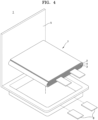
- a lithium battery 1 may include a cathode 3, the above-described anode 2, and a separator 4.
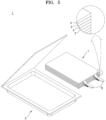
- the cathode 3, the anode 2, and the separator 4 may be wound or folded to form an electrode structure 7 (see FIGS. 4 and 5 ).
- the electrode structure 7 may be accommodated in the battery case 5.
- the battery case 5 may be injected with an organic electrolyte and sealed by a cap assembly 6, thereby completing the preparation of the lithium battery 1.
- the battery case 5 may be a cylindrical type, or may be a prismatic type, a thin-film type, or the like.
- the adhesive described above may be applied onto the electrode assembly 7 to form an adhesive layer, and then inserted into the battery case 5. Then, the battery case 5 may be injected with an electrolyte and sealed by a cap assembly 6, thereby completing the preparation of the lithium battery 1.
- a lithium battery 1 may include a cathode 3, the above-described anode 2, and a separator 4.
- the separator 4 may be between the cathode 3 and the anode 2, and the cathode 3, the anode 2, and the separator 4 may be wound to form a electrode assembly 7.
- the electrode assembly 7 may be accommodated in the battery case 5.
- An electrode tab 8, acting as an electrical path for guiding an electrical current generated in the electrode assembly 7 to the outside, may be included.
- the battery case 5 may be injected with an electrolyte and sealed to thereby complete the preparation of the lithium battery 1.
- the battery case 5 may be a prismatic type, or may also be, for example, a cylindrical type, a thin-film type, or the like.
- the adhesive described above may be applied onto the electrode assembly 7 to form an adhesive layer, and then inserted into the battery case 5. Then, the battery case 5 may be injected with an organic electrolyte and sealed to thereby complete the preparation of the lithium battery 1.
- a lithium battery 1 may include a cathode 3, the above-described anode 2, and a separator 4.
- the separator 4 may be between the cathode 3 and the anode 2 to form an electrode assembly.
- the electrode assembly 7 may be stacked in a bi-cell structure and then accommodated into the battery case 5.
- An electrode tab 8, acting as an electrical path for guiding an electrical current generated in the electrode assembly 7 to the outside, may be included.
- the battery case 5 may be injected with an electrolyte and sealed to thereby complete the preparation of the lithium battery 1.
- the battery case 5 may have a polyhedronal shape, or may also have a cylindrical shape, a thin-film shape, or the like.
- the adhesive described above may be applied onto the electrode assembly 7 to form an adhesive layer, and then inserted into the battery case 5. Then, the battery case 5 may be injected with an organic electrolyte and sealed to thereby complete the preparation of the lithium battery 1.
- a pouch-type lithium battery corresponds to the lithium battery shown in FIGS. 4 and 5 that uses a pouch as a battery case.
- the pouch-type lithium battery may include one or more electrode assemblies.
- the electrode assembly may be formed by disposing a separator between a cathode and an anode.
- the electrode assemblies may be stacked in a bi-cell structure, and immersed in an organic electrolyte, and then accommodated and sealed in a pouch, thereby completing the preparation of a pouch-type lithium battery.
- the cathode, the anode, and the separator described above may be simply stacked in the form of an electrode assembly and then accommodated in a pouch, or may be wound or folded into a jelly roll-type electrode assembly and then accommodated in a pouch. Subsequently, the pouch may be injected with an organic electrolyte and then sealed, thereby completing the preparation of a lithium battery.
- the lithium battery due to having excellent lifespan characteristics and high-rate capability, may be used in, e.g., an electric vehicle (EV).
- EV electric vehicle
- the lithium battery may be used in a hybrid vehicle, such as a plug-in hybrid electric vehicle (PHEV) and the like.
- PHEV plug-in hybrid electric vehicle
- the lithium battery may be used in a field that requires a large amount of energy storage.
- the lithium battery may be used in an electric bicycle, a power tool, and the like.
- the battery module may include, e.g., a plurality of batteries and a frame holding the batteries.
- the battery pack may include, e.g., a plurality of battery modules and a bus bar connecting these battery modules.
- the battery module or the battery pack may further include a cooling device.
- a plurality of battery packs may be controlled by a battery management system.
- the battery management system may include a battery pack, and a battery control device connected to the battery pack.
- Anhydrous maleic acid-modified polypropylene containing maleic acid anhydride i.e. a maleic anhydride grafted polypropylene obtained by grafting maleic anhydride onto a polyolefin backbone
- a maleic anhydride grafted polypropylene obtained by grafting maleic anhydride onto a polyolefin backbone was purchased as a commercially available resin (Mitsui Chemicals).
- maleic acid structures formed anhydrous maleic acid structures by a heat treatment at 120 °C for 24 hours, to prepare a modified polypropylene containing 5 mol% of anhydrous maleic acid.
- the content of anhydrous maleic acid included in the modified polypropylene containing anhydrous maleic acid was calculated from a peak at 0.7-0.8 ppm and a peak at 2.3-2.7 ppm on a spectrum obtained for 1 H-NMR measurement.
- the peak at 0.7-0.8 ppm corresponds to methyl groups (-CH 3 ) in polypropylene
- the peak at 2.3-2.7 ppm corresponds to methylene groups (-CH 2 -) derived from anhydrous maleic acid structures graft-polymerized on PP.
- the area of methyl groups is A
- the area of methylene groups is B
- the content of anhydrous maleic acid in molar ratio (mol%) was calculated from 2B/3A*100
- the anhydrous maleic acid content of the modified polypropylene containing anhydrous maleic acid was 5 mol%.
- An adhesive was prepared following the same process as in Preparation Example 1, except that unlike in Preparation Example 1, the anhydrous maleic acid-modified polypropylene containing 3 mol% of anhydrous maleic acid, obtained through heat-treating 1 mol% anhydrous maleic acid until the content of anhydrous maleic acid became 3 mol%, was used.
- the content of anhydrous maleic acid in the anhydrous maleic acid-containing modified polypropylene was 3 mol% calculated using peak area ratios on 1 H-NMR spectrum.
- An adhesive was prepared following the same process as in Preparation Example 1, except that unlike in Preparation Example 1, the anhydrous maleic acid-modified polypropylene containing 2 mol% of anhydrous maleic acid, obtained through heat-treating 1 mol% anhydrous maleic acid until the content of anhydrous maleic acid became 2 mol%, was used.
- the content of anhydrous maleic acid in the anhydrous maleic acid-containing modified polypropylene was 2 mol% calculated using peak area ratios on 1 H-NMR spectrum.
- An adhesive was prepared following the same process as in Preparation Example 1, except that unlike in Preparation Example 1, the anhydrous maleic acid-modified polypropylene containing 9 mol% of anhydrous maleic acid, obtained through heat-treating 1 mol% anhydrous maleic acid until the content of anhydrous maleic acid became 9 mol%, was used.
- the content of anhydrous maleic acid in the anhydrous maleic acid-containing modified polypropylene was 9 mol% calculated using peak area ratios on 1 H-NMR spectrum.
- An adhesive was prepared following the same process as in Preparation Example 1, except that 4-aminoisophthalic acid was used instead of 5-aminoisophthalic acid as in Preparation Example 1.
- An adhesive was prepared following the same process as in Preparation Example 1, except that 5-(4-aminophenoxy)-isophthalic acid was used instead of 5-aminoisophthalic acid as in Preparation Example 1.
- An adhesive was prepared following the same process as in Preparation Example 1, except that 5-amino-1,3-phenylenediacetic acid was used instead of 5-aminoisophthalic acid as in Preparation Example 1.
- An adhesive was prepared following the same process as in Preparation Example 1, except that 5-(4-aminophenoxy)-1,3-phenylenedisulfonic acid was used instead of 5-aminoisophthalic acid as in Preparation Example 1.
- An adhesive was prepared following the same process as in Preparation Example 1, except that 5-amino-m-xylylenediphosphonic acid was used instead of 5-aminoisophthalic acid as in Preparation Example 1.
- Polypropylene by Prime Polymer Co., Ltd. was prepared as an adhesive.
- a polypropylene modified by anhydrous maleic acid was prepared as an adhesive.
- the content of anhydrous maleic acid was 5 mol% calculated using peak area ratios on 1 H-NMR spectrum.
- the melting points of the resins according to Preparation Examples 1 to 9 and Comparative Preparation Examples 1 and 2 were measured using differential scanning calorimetry (DSC).
- the temperature was raised at a rate of 10 °C/min in a nitrogen atmosphere, and cooled, and then raised again at a rate of 10 °C/min. Endothermic peak values during the second temperature elevation were measured as melting points and are shown in Table 1 below.
- Example 1 Adhesive according to Preparation Example 1
- a cathode composition was obtained by mixing LiNi 0.6 Co 0.2 Al 0.2 O 2 , a conductive material (Super-P; Timcal Ltd.), a binder (PVdF; Solvay), and N-methylpyrrolidone.
- the cathode composition was coated on top of an aluminum foil (thickness: about 10 ⁇ m) and dried at 50 °C, and then, the dried product was dried in a vacuum at about 120 °C to prepare a cathode.
- An electrode assembly was prepared by placing a polypropylene separator (Celgard 3510, 20 ⁇ m) between the cathode obtained above and a 10 ⁇ m-thick copper (Cu) current collector.
- the adhesive according to Preparation Example 1 was applied to an outer surface of the electrode assembly to form a 10 ⁇ m-thick adhesive layer.
- the adhesive-coated electrode assembly was inserted into an aluminum battery case and injected with an electrolyte, to prepare a lithium battery.
- Lithium batteries were prepared following the same process as Example 1, except that the types of adhesives and additives included in the adhesive layers were changed as shown in Table 2 below.
- Table 2 Item Adhesive Tackifier Additive Example 1 Preparation Example 1 - - Example 2 Preparation Example 2 - - Example 3 Preparation Example 3 - - Example 4 Preparation Example 4 - - Example 5 Preparation Example 5 - - Example 6 Preparation Example 6 - - Example 7 Preparation Example 7 - - Example 8 Preparation Example 8 - - Example 9 Preparation Example 9 - - Example 10 Preparation Example 1 Rosin Tackifier - Example 11 Preparation Example 1 - Silane coupling agent Example 12 Preparation Example 1 Rosin Tackifier Silane coupling agent Example 13 Preparation Example 1 - Titanium phosphate Comparative Example 1 Comparative Preparation Example 1 - - Comparative Example 2 Comparative Preparation Example 2 - - -
- the adhesive strength of the adhesive layers according to Examples 1 to 13 and Comparative Examples 1 and 2 was measured according to ISO 527-3 standard testing method.
- a sample which was stacked such that the thickness of the adhesive layer between the electrode assembly and the battery case is 10 ⁇ m, was prepared to have a width of 15 mm.
- a tension test was carried out at a rate of 300 mm/min while keeping the distance between chucking jigs at 50 mm.
- Adhesive strength was calculated from an average value of tensile strength of sections with the adhesives, and is shown in Table 3.
- the lithium batteries prepared in Examples 1 to 13 and Comparative Examples 1 and 2 were each charged at a constant current of 0.1 C rate at 45 °C until the battery voltage reached 4.3 V (vs. Li), and while maintaining 4.3 V, charged under a constant voltage until the current reached 0.05 C.
- the lithium battery upon completion of charging was preserved for 30 days at 60 °C and relative humidity 90 %.
- the lithium batteries according to Examples 1 to 13 due to containing the adhesives according to Preparation Examples 1 to 9, show improved initial adhesion and adhesive strength after high-temperature preservation. Further, the lithium batteries according to Examples 1 to 13 show improved impact stability.
- the movement of electrode assemblies may be minimized and the electrode assemblies may be prevented from colliding inside a battery case, and a technology to integrate such electrode assemblies with the exterior material by applying an adhesive resin or a tape to the surface of a jelly-roll or a stack may be considered.
- the adhesion between a battery case and an electrode assembly may be carried out in the presence of an electrolyte, the adhesion between objects to be attached may be carried out with the adhesive having an organic solvent absorbed therein, and thus the adhesive material may have low electrolyte absorption properties and high adhesive properties.
- An adhesive material may have excellent adhesion-holding power at high temperatures, as well as excellent initial adhesion, which may allow battery stability to be maintained even after exposure to high-temperature environments.
- an adhesive including a maleimide-modified polyolefin containing two or more acid functional groups may help improve high-temperature stability, and thus, a lithium battery including the adhesive may have improved high-temperature stability between an electrode assembly and a battery case.
- the lithium battery may have improved impact strength and high-temperature stability.
- One or more embodiments may provide a lithium battery including a modified polyolefin having excellent impact strength and high-temperature stability.
Landscapes
- Chemical & Material Sciences (AREA)
- Chemical Kinetics & Catalysis (AREA)
- Electrochemistry (AREA)
- General Chemical & Material Sciences (AREA)
- Engineering & Computer Science (AREA)
- Manufacturing & Machinery (AREA)
- Secondary Cells (AREA)
- Adhesives Or Adhesive Processes (AREA)
- Cell Separators (AREA)
Applications Claiming Priority (2)
| Application Number | Priority Date | Filing Date | Title |
|---|---|---|---|
| KR20230039383 | 2023-03-26 | ||
| KR1020230113191A KR20240144846A (ko) | 2023-03-26 | 2023-08-28 | 변성 폴리올레핀 바인더를 포함하는 리튬전지 |
Publications (2)
| Publication Number | Publication Date |
|---|---|
| EP4439735A2 true EP4439735A2 (de) | 2024-10-02 |
| EP4439735A3 EP4439735A3 (de) | 2025-02-19 |
Family
ID=90481937
Family Applications (1)
| Application Number | Title | Priority Date | Filing Date |
|---|---|---|---|
| EP24166303.8A Pending EP4439735A3 (de) | 2023-03-26 | 2024-03-26 | Lithiumbatterie mit modifiziertem polyolefinbindemittel |
Country Status (2)
| Country | Link |
|---|---|
| US (1) | US20240322315A1 (de) |
| EP (1) | EP4439735A3 (de) |
Family Cites Families (4)
| Publication number | Priority date | Publication date | Assignee | Title |
|---|---|---|---|---|
| JP3831939B2 (ja) * | 2001-11-12 | 2006-10-11 | ソニー株式会社 | 電池 |
| JP2014197541A (ja) * | 2013-03-05 | 2014-10-16 | ユニチカ株式会社 | リチウムイオン二次電池セパレータ用塗料およびリチウムイオン二次電池セパレータ、リチウムイオン二次電池 |
| WO2015048575A1 (en) * | 2013-09-26 | 2015-04-02 | Designer Molecules, Inc. | Low dielectric constant, low dielectric dissipation factor coatings, films and adhesives |
| KR102141110B1 (ko) * | 2018-07-05 | 2020-08-04 | 울산과학기술원 | 유기 발광 다이오드 화소 구획 층 포토레지스트 조성물 및 이를 이용하여 제조된 화소 구획 층 |
-
2024
- 2024-03-19 US US18/609,336 patent/US20240322315A1/en active Pending
- 2024-03-26 EP EP24166303.8A patent/EP4439735A3/de active Pending
Also Published As
| Publication number | Publication date |
|---|---|
| EP4439735A3 (de) | 2025-02-19 |
| US20240322315A1 (en) | 2024-09-26 |
Similar Documents
| Publication | Publication Date | Title |
|---|---|---|
| US11431019B2 (en) | Lithium secondary battery | |
| US10396398B2 (en) | Secondary battery | |
| CN106159313B (zh) | 锂金属电池 | |
| EP4310938A2 (de) | Anode für lithium-metall-batterie, lithium-metall-batterie mit anode und herstellungsverfahren für anode für lithium-metall-batterie | |
| KR101608631B1 (ko) | 우드메탈로 이루어진 전극 단자를 포함하는 리튬 이차전지 | |
| CN106058311A (zh) | 用于锂二次电池的电解质和包括所述电解质的锂二次电池 | |
| KR20180044746A (ko) | 금속이차전지용 양극 및 이를 포함하는 금속이차전지 | |
| KR102510888B1 (ko) | 리튬 이차전지용 양극, 이의 제조방법 및 이를 포함한 리튬 이차전지 | |
| KR20190130307A (ko) | 전극 보호층을 포함하는 음극 및 이를 적용한 리튬 이차전지 | |
| KR102510889B1 (ko) | 리튬 이차전지용 양극, 이의 제조방법 및 이를 포함한 리튬 이차전지 | |
| US20240322187A1 (en) | Anode and lithium battery including the same | |
| KR102857429B1 (ko) | 리튬금속전지용 음극, 이를 포함하는 리튬금속전지 및 리튬금속전지용 음극 제조방법 | |
| KR20240144846A (ko) | 변성 폴리올레핀 바인더를 포함하는 리튬전지 | |
| KR102195725B1 (ko) | 리튬 이차전지용 양극, 이의 제조방법 및 이를 포함한 리튬 이차전지 | |
| EP4439735A2 (de) | Lithiumbatterie mit modifiziertem polyolefinbindemittel | |
| KR20240144840A (ko) | 리튬전지 | |
| KR20240144820A (ko) | 리튬금속전지 및 그 제조방법 | |
| US20240322177A1 (en) | Electrode structure and lithium battery including the same | |
| US20250132335A1 (en) | Anode and lithium battery including the same | |
| KR102856257B1 (ko) | 리튬금속전지 및 그 제조방법 | |
| KR102903847B1 (ko) | 음극 및 이를 포함하는 리튬전지 | |
| US20240322169A1 (en) | Anode and lithium battery including the anode | |
| US20240322221A1 (en) | Electrode structure including polymer electrolyte, manufacturing method of the electrode structure, and lithium metal battery including the electrode structure | |
| CN118712506A (zh) | 包括改性聚烯烃粘合剂的锂电池 | |
| KR20240144826A (ko) | 바인더, 이를 포함하는 음극 및 리튬전지 |
Legal Events
| Date | Code | Title | Description |
|---|---|---|---|
| PUAI | Public reference made under article 153(3) epc to a published international application that has entered the european phase |
Free format text: ORIGINAL CODE: 0009012 |
|
| STAA | Information on the status of an ep patent application or granted ep patent |
Free format text: STATUS: REQUEST FOR EXAMINATION WAS MADE |
|
| 17P | Request for examination filed |
Effective date: 20240326 |
|
| AK | Designated contracting states |
Kind code of ref document: A2 Designated state(s): AL AT BE BG CH CY CZ DE DK EE ES FI FR GB GR HR HU IE IS IT LI LT LU LV MC ME MK MT NL NO PL PT RO RS SE SI SK SM TR |
|
| PUAL | Search report despatched |
Free format text: ORIGINAL CODE: 0009013 |
|
| AK | Designated contracting states |
Kind code of ref document: A3 Designated state(s): AL AT BE BG CH CY CZ DE DK EE ES FI FR GB GR HR HU IE IS IT LI LT LU LV MC ME MK MT NL NO PL PT RO RS SE SI SK SM TR |
|
| RIC1 | Information provided on ipc code assigned before grant |
Ipc: H01M 50/193 20210101ALI20250113BHEP Ipc: H01M 50/124 20210101ALI20250113BHEP Ipc: H01M 50/121 20210101ALI20250113BHEP Ipc: H01M 50/119 20210101ALI20250113BHEP Ipc: H01M 50/105 20210101ALI20250113BHEP Ipc: H01M 10/0585 20100101ALI20250113BHEP Ipc: H01M 10/0525 20100101ALI20250113BHEP Ipc: H01M 10/052 20100101ALI20250113BHEP Ipc: H01M 4/62 20060101AFI20250113BHEP |
|
| GRAP | Despatch of communication of intention to grant a patent |
Free format text: ORIGINAL CODE: EPIDOSNIGR1 |
|
| STAA | Information on the status of an ep patent application or granted ep patent |
Free format text: STATUS: GRANT OF PATENT IS INTENDED |
|
| RIC1 | Information provided on ipc code assigned before grant |
Ipc: H01M 4/62 20060101AFI20251031BHEP Ipc: H01M 10/052 20100101ALI20251031BHEP Ipc: H01M 10/0585 20100101ALI20251031BHEP Ipc: H01M 50/193 20210101ALI20251031BHEP Ipc: H01M 50/105 20210101ALN20251031BHEP |