EP4438666A2 - Stromkabel mit verbesserter wärmeleitfähigkeit - Google Patents
Stromkabel mit verbesserter wärmeleitfähigkeit Download PDFInfo
- Publication number
- EP4438666A2 EP4438666A2 EP24165308.8A EP24165308A EP4438666A2 EP 4438666 A2 EP4438666 A2 EP 4438666A2 EP 24165308 A EP24165308 A EP 24165308A EP 4438666 A2 EP4438666 A2 EP 4438666A2
- Authority
- EP
- European Patent Office
- Prior art keywords
- cable according
- copolymer
- polypropylene
- insulating layer
- electrically insulating
- Prior art date
- Legal status (The legal status is an assumption and is not a legal conclusion. Google has not performed a legal analysis and makes no representation as to the accuracy of the status listed.)
- Pending
Links
Images
Classifications
-
- H—ELECTRICITY
- H01—ELECTRIC ELEMENTS
- H01B—CABLES; CONDUCTORS; INSULATORS; SELECTION OF MATERIALS FOR THEIR CONDUCTIVE, INSULATING OR DIELECTRIC PROPERTIES
- H01B3/00—Insulators or insulating bodies characterised by the insulating materials; Selection of materials for their insulating or dielectric properties
- H01B3/18—Insulators or insulating bodies characterised by the insulating materials; Selection of materials for their insulating or dielectric properties mainly consisting of organic substances
- H01B3/30—Insulators or insulating bodies characterised by the insulating materials; Selection of materials for their insulating or dielectric properties mainly consisting of organic substances plastics; resins; waxes
- H01B3/44—Insulators or insulating bodies characterised by the insulating materials; Selection of materials for their insulating or dielectric properties mainly consisting of organic substances plastics; resins; waxes vinyl resins; acrylic resins
- H01B3/441—Insulators or insulating bodies characterised by the insulating materials; Selection of materials for their insulating or dielectric properties mainly consisting of organic substances plastics; resins; waxes vinyl resins; acrylic resins from alkenes
-
- B—PERFORMING OPERATIONS; TRANSPORTING
- B29—WORKING OF PLASTICS; WORKING OF SUBSTANCES IN A PLASTIC STATE IN GENERAL
- B29C—SHAPING OR JOINING OF PLASTICS; SHAPING OF MATERIAL IN A PLASTIC STATE, NOT OTHERWISE PROVIDED FOR; AFTER-TREATMENT OF THE SHAPED PRODUCTS, e.g. REPAIRING
- B29C48/00—Extrusion moulding, i.e. expressing the moulding material through a die or nozzle which imparts the desired form; Apparatus therefor
- B29C48/15—Extrusion moulding, i.e. expressing the moulding material through a die or nozzle which imparts the desired form; Apparatus therefor incorporating preformed parts or layers, e.g. extrusion moulding around inserts
- B29C48/154—Coating solid articles, i.e. non-hollow articles
-
- C—CHEMISTRY; METALLURGY
- C08—ORGANIC MACROMOLECULAR COMPOUNDS; THEIR PREPARATION OR CHEMICAL WORKING-UP; COMPOSITIONS BASED THEREON
- C08F—MACROMOLECULAR COMPOUNDS OBTAINED BY REACTIONS ONLY INVOLVING CARBON-TO-CARBON UNSATURATED BONDS
- C08F210/00—Copolymers of unsaturated aliphatic hydrocarbons having only one carbon-to-carbon double bond
- C08F210/04—Monomers containing three or four carbon atoms
- C08F210/06—Propene
-
- C—CHEMISTRY; METALLURGY
- C08—ORGANIC MACROMOLECULAR COMPOUNDS; THEIR PREPARATION OR CHEMICAL WORKING-UP; COMPOSITIONS BASED THEREON
- C08K—Use of inorganic or non-macromolecular organic substances as compounding ingredients
- C08K13/00—Use of mixtures of ingredients not covered by one single of the preceding main groups, each of these compounds being essential
- C08K13/02—Organic and inorganic ingredients
-
- C—CHEMISTRY; METALLURGY
- C08—ORGANIC MACROMOLECULAR COMPOUNDS; THEIR PREPARATION OR CHEMICAL WORKING-UP; COMPOSITIONS BASED THEREON
- C08K—Use of inorganic or non-macromolecular organic substances as compounding ingredients
- C08K3/00—Use of inorganic substances as compounding ingredients
- C08K3/01—Use of inorganic substances as compounding ingredients characterized by their specific function
- C08K3/013—Fillers, pigments or reinforcing additives
-
- C—CHEMISTRY; METALLURGY
- C08—ORGANIC MACROMOLECULAR COMPOUNDS; THEIR PREPARATION OR CHEMICAL WORKING-UP; COMPOSITIONS BASED THEREON
- C08K—Use of inorganic or non-macromolecular organic substances as compounding ingredients
- C08K3/00—Use of inorganic substances as compounding ingredients
- C08K3/18—Oxygen-containing compounds, e.g. metal carbonyls
- C08K3/24—Acids; Salts thereof
- C08K3/26—Carbonates; Bicarbonates
-
- C—CHEMISTRY; METALLURGY
- C08—ORGANIC MACROMOLECULAR COMPOUNDS; THEIR PREPARATION OR CHEMICAL WORKING-UP; COMPOSITIONS BASED THEREON
- C08K—Use of inorganic or non-macromolecular organic substances as compounding ingredients
- C08K3/00—Use of inorganic substances as compounding ingredients
- C08K3/34—Silicon-containing compounds
-
- C—CHEMISTRY; METALLURGY
- C08—ORGANIC MACROMOLECULAR COMPOUNDS; THEIR PREPARATION OR CHEMICAL WORKING-UP; COMPOSITIONS BASED THEREON
- C08K—Use of inorganic or non-macromolecular organic substances as compounding ingredients
- C08K3/00—Use of inorganic substances as compounding ingredients
- C08K3/34—Silicon-containing compounds
- C08K3/346—Clay
-
- C—CHEMISTRY; METALLURGY
- C08—ORGANIC MACROMOLECULAR COMPOUNDS; THEIR PREPARATION OR CHEMICAL WORKING-UP; COMPOSITIONS BASED THEREON
- C08K—Use of inorganic or non-macromolecular organic substances as compounding ingredients
- C08K3/00—Use of inorganic substances as compounding ingredients
- C08K3/38—Boron-containing compounds
-
- C—CHEMISTRY; METALLURGY
- C08—ORGANIC MACROMOLECULAR COMPOUNDS; THEIR PREPARATION OR CHEMICAL WORKING-UP; COMPOSITIONS BASED THEREON
- C08K—Use of inorganic or non-macromolecular organic substances as compounding ingredients
- C08K5/00—Use of organic ingredients
- C08K5/04—Oxygen-containing compounds
- C08K5/13—Phenols; Phenolates
- C08K5/132—Phenols containing keto groups, e.g. benzophenones
-
- C—CHEMISTRY; METALLURGY
- C08—ORGANIC MACROMOLECULAR COMPOUNDS; THEIR PREPARATION OR CHEMICAL WORKING-UP; COMPOSITIONS BASED THEREON
- C08L—COMPOSITIONS OF MACROMOLECULAR COMPOUNDS
- C08L23/00—Compositions of homopolymers or copolymers of unsaturated aliphatic hydrocarbons having only one carbon-to-carbon double bond; Compositions of derivatives of such polymers
- C08L23/02—Compositions of homopolymers or copolymers of unsaturated aliphatic hydrocarbons having only one carbon-to-carbon double bond; Compositions of derivatives of such polymers not modified by chemical after-treatment
- C08L23/10—Homopolymers or copolymers of propene
- C08L23/12—Polypropene
-
- C—CHEMISTRY; METALLURGY
- C08—ORGANIC MACROMOLECULAR COMPOUNDS; THEIR PREPARATION OR CHEMICAL WORKING-UP; COMPOSITIONS BASED THEREON
- C08L—COMPOSITIONS OF MACROMOLECULAR COMPOUNDS
- C08L23/00—Compositions of homopolymers or copolymers of unsaturated aliphatic hydrocarbons having only one carbon-to-carbon double bond; Compositions of derivatives of such polymers
- C08L23/02—Compositions of homopolymers or copolymers of unsaturated aliphatic hydrocarbons having only one carbon-to-carbon double bond; Compositions of derivatives of such polymers not modified by chemical after-treatment
- C08L23/10—Homopolymers or copolymers of propene
- C08L23/14—Copolymers of propene
-
- C—CHEMISTRY; METALLURGY
- C08—ORGANIC MACROMOLECULAR COMPOUNDS; THEIR PREPARATION OR CHEMICAL WORKING-UP; COMPOSITIONS BASED THEREON
- C08L—COMPOSITIONS OF MACROMOLECULAR COMPOUNDS
- C08L23/00—Compositions of homopolymers or copolymers of unsaturated aliphatic hydrocarbons having only one carbon-to-carbon double bond; Compositions of derivatives of such polymers
- C08L23/02—Compositions of homopolymers or copolymers of unsaturated aliphatic hydrocarbons having only one carbon-to-carbon double bond; Compositions of derivatives of such polymers not modified by chemical after-treatment
- C08L23/16—Ethene-propene or ethene-propene-diene copolymers
-
- H—ELECTRICITY
- H01—ELECTRIC ELEMENTS
- H01B—CABLES; CONDUCTORS; INSULATORS; SELECTION OF MATERIALS FOR THEIR CONDUCTIVE, INSULATING OR DIELECTRIC PROPERTIES
- H01B13/00—Apparatus or processes specially adapted for manufacturing conductors or cables
- H01B13/06—Insulating conductors or cables
- H01B13/14—Insulating conductors or cables by extrusion
- H01B13/148—Selection of the insulating material therefor
-
- H—ELECTRICITY
- H01—ELECTRIC ELEMENTS
- H01B—CABLES; CONDUCTORS; INSULATORS; SELECTION OF MATERIALS FOR THEIR CONDUCTIVE, INSULATING OR DIELECTRIC PROPERTIES
- H01B3/00—Insulators or insulating bodies characterised by the insulating materials; Selection of materials for their insulating or dielectric properties
- H01B3/002—Inhomogeneous material in general
- H01B3/004—Inhomogeneous material in general with conductive additives or conductive layers
-
- H—ELECTRICITY
- H01—ELECTRIC ELEMENTS
- H01B—CABLES; CONDUCTORS; INSULATORS; SELECTION OF MATERIALS FOR THEIR CONDUCTIVE, INSULATING OR DIELECTRIC PROPERTIES
- H01B3/00—Insulators or insulating bodies characterised by the insulating materials; Selection of materials for their insulating or dielectric properties
- H01B3/18—Insulators or insulating bodies characterised by the insulating materials; Selection of materials for their insulating or dielectric properties mainly consisting of organic substances
- H01B3/20—Insulators or insulating bodies characterised by the insulating materials; Selection of materials for their insulating or dielectric properties mainly consisting of organic substances liquids, e.g. oils
- H01B3/22—Insulators or insulating bodies characterised by the insulating materials; Selection of materials for their insulating or dielectric properties mainly consisting of organic substances liquids, e.g. oils hydrocarbons
-
- H—ELECTRICITY
- H01—ELECTRIC ELEMENTS
- H01B—CABLES; CONDUCTORS; INSULATORS; SELECTION OF MATERIALS FOR THEIR CONDUCTIVE, INSULATING OR DIELECTRIC PROPERTIES
- H01B7/00—Insulated conductors or cables characterised by their form
- H01B7/17—Protection against damage caused by external factors, e.g. sheaths or armouring
- H01B7/29—Protection against damage caused by extremes of temperature or by flame
- H01B7/292—Protection against damage caused by extremes of temperature or by flame using material resistant to heat
-
- H—ELECTRICITY
- H01—ELECTRIC ELEMENTS
- H01B—CABLES; CONDUCTORS; INSULATORS; SELECTION OF MATERIALS FOR THEIR CONDUCTIVE, INSULATING OR DIELECTRIC PROPERTIES
- H01B9/00—Power cables
-
- B—PERFORMING OPERATIONS; TRANSPORTING
- B29—WORKING OF PLASTICS; WORKING OF SUBSTANCES IN A PLASTIC STATE IN GENERAL
- B29K—INDEXING SCHEME ASSOCIATED WITH SUBCLASSES B29B, B29C OR B29D, RELATING TO MOULDING MATERIALS OR TO MATERIALS FOR MOULDS, REINFORCEMENTS, FILLERS OR PREFORMED PARTS, e.g. INSERTS
- B29K2995/00—Properties of moulding materials, reinforcements, fillers, preformed parts or moulds
- B29K2995/0003—Properties of moulding materials, reinforcements, fillers, preformed parts or moulds having particular electrical or magnetic properties, e.g. piezoelectric
- B29K2995/0005—Conductive
-
- B—PERFORMING OPERATIONS; TRANSPORTING
- B29—WORKING OF PLASTICS; WORKING OF SUBSTANCES IN A PLASTIC STATE IN GENERAL
- B29K—INDEXING SCHEME ASSOCIATED WITH SUBCLASSES B29B, B29C OR B29D, RELATING TO MOULDING MATERIALS OR TO MATERIALS FOR MOULDS, REINFORCEMENTS, FILLERS OR PREFORMED PARTS, e.g. INSERTS
- B29K2995/00—Properties of moulding materials, reinforcements, fillers, preformed parts or moulds
- B29K2995/0003—Properties of moulding materials, reinforcements, fillers, preformed parts or moulds having particular electrical or magnetic properties, e.g. piezoelectric
- B29K2995/0007—Insulating
-
- B—PERFORMING OPERATIONS; TRANSPORTING
- B29—WORKING OF PLASTICS; WORKING OF SUBSTANCES IN A PLASTIC STATE IN GENERAL
- B29L—INDEXING SCHEME ASSOCIATED WITH SUBCLASS B29C, RELATING TO PARTICULAR ARTICLES
- B29L2031/00—Other particular articles
- B29L2031/34—Electrical apparatus, e.g. sparking plugs or parts thereof
- B29L2031/3462—Cables
-
- C—CHEMISTRY; METALLURGY
- C08—ORGANIC MACROMOLECULAR COMPOUNDS; THEIR PREPARATION OR CHEMICAL WORKING-UP; COMPOSITIONS BASED THEREON
- C08F—MACROMOLECULAR COMPOUNDS OBTAINED BY REACTIONS ONLY INVOLVING CARBON-TO-CARBON UNSATURATED BONDS
- C08F2800/00—Copolymer characterised by the proportions of the comonomers expressed
- C08F2800/20—Copolymer characterised by the proportions of the comonomers expressed as weight or mass percentages
-
- C—CHEMISTRY; METALLURGY
- C08—ORGANIC MACROMOLECULAR COMPOUNDS; THEIR PREPARATION OR CHEMICAL WORKING-UP; COMPOSITIONS BASED THEREON
- C08K—Use of inorganic or non-macromolecular organic substances as compounding ingredients
- C08K3/00—Use of inorganic substances as compounding ingredients
- C08K3/18—Oxygen-containing compounds, e.g. metal carbonyls
- C08K3/24—Acids; Salts thereof
- C08K3/26—Carbonates; Bicarbonates
- C08K2003/265—Calcium, strontium or barium carbonate
-
- C—CHEMISTRY; METALLURGY
- C08—ORGANIC MACROMOLECULAR COMPOUNDS; THEIR PREPARATION OR CHEMICAL WORKING-UP; COMPOSITIONS BASED THEREON
- C08K—Use of inorganic or non-macromolecular organic substances as compounding ingredients
- C08K3/00—Use of inorganic substances as compounding ingredients
- C08K3/38—Boron-containing compounds
- C08K2003/382—Boron-containing compounds and nitrogen
- C08K2003/385—Binary compounds of nitrogen with boron
Definitions
- the invention relates to a cable comprising at least one electrically insulating layer obtained from a polymer composition comprising at least one thermoplastic polymer material based on polypropylene and at least one inorganic filler chosen from silicates, boron nitride, carbonates and a mixture thereof, and a method for preparing said cable.
- the invention typically but not exclusively applies to electric cables intended for the transport of energy, in particular to medium voltage energy cables (in particular from 6 to 45-60 kV) or high voltage (in particular greater than 60 kV, and up to 400 kV), whether they are in direct or alternating current, in the fields of aerial, submarine, terrestrial electricity transport, or even aeronautics.
- medium voltage energy cables in particular from 6 to 45-60 kV
- high voltage in particular greater than 60 kV, and up to 400 kV
- the invention applies in particular to electric cables having improved thermal conductivity.
- the electrically insulating layer may be a polymer layer based on a crosslinked polyolefin such as a crosslinked polyethylene (XLPE) or a crosslinked ethylene-propylene or ethylene-propylene-diene elastomer (EPDM).
- XLPE crosslinked polyethylene
- EPDM ethylene-propylene-diene elastomer
- the crosslinking is generally carried out during the step of extrusion of the polymer composition around the elongated electrically conductive element.
- a crosslinked polyolefin makes it possible to provide a layer having improved electrical and mechanical properties compared to non-crosslinked LDPE, in particular, cables comprising XLPE-based insulating layers can be used up to temperatures of 90°C while cables comprising an LDPE-based insulating layer can only be used at lower temperatures, not exceeding 70°C.
- XLPEs have a number of drawbacks. On the one hand, these polymers are not easily recyclable.
- the crosslinking (vulcanization) process to produce a homogeneous layer requires specific reaction conditions (e.g. in terms of duration and temperature) which reduce the manufacturing speed of the cable and increase its production cost.
- the polymer must be able to be brought to the temperature required to obtain its crosslinking for a sufficiently long time.
- the production speed of cables comprising an electrically insulating layer based on XLPE must be adjusted so that the time spent in the crosslinking tunnel is long enough to obtain a satisfactory crosslinking rate, which represents a significant limiting factor in terms of production capacity.
- crosslinking can sometimes start prematurely in the extruder (screw, collar) and/or the extruder head, inducing a formation of particles of degraded XLPE in the extruder (also called “scorch”), which can then migrate into the electrically insulating layer or into the semiconducting layer of the cable and create defects there.
- LDPE-based materials for electrically insulating layers of cables is therefore in principle an alternative to the use of XLPE-based materials.
- LDPE-based materials have the disadvantage that they cannot be used at temperatures above 70°C, which also has the consequence of reducing their energy transport capacity so as to avoid overheating of the electrically insulating layer at temperatures above 70°C.
- Polypropylene-based materials also have good dielectric properties, which are used, for example, in transformers and cables, particularly submarine cables with an electrically insulating layer made from polypropylene laminated on paper (PPLP cables, from the English term “ paper laminated polypropylene ”) .
- PPLP cables polypropylene laminated on paper
- Polypropylene is generally characterised by a lower density than polyethylene, this lower density being associated with slightly lower thermal conductivity properties than polyethylene. Therefore, this represents a disadvantage when the power cables are MV and HV cables as it reduces the evacuation of heat generated by the Joule effect, and thus the amount of energy transported, this being a function of the maximum acceptable temperature of the elongated electrically conductive element.
- compositions for an electrical cable having a thermal conductivity of at least about 0.30 W/mK comprising 100 parts by weight of a polyolefin (eg ethylene-butene copolymer), from 10 to 70 parts by weight of weight of a halogenated flame retardant (ethylene bistetrabromophthalimide), from 100 to 200 parts by weight of a non-halogenated flame retardant (metal oxide and/or hydroxide) and from 5 to 35 parts by weight of a synergistic flame retardant (antimony trioxide).
- a polyolefin eg ethylene-butene copolymer
- a halogenated flame retardant ethylene bistetrabromophthalimide
- metal oxide and/or hydroxide non-halogenated flame retardant
- synergistic flame retardant antimony trioxide
- the aim of the present invention is to overcome the drawbacks of the prior art and to provide an economical cable, in particular medium or high voltage, comprising recyclable materials, capable of operating at temperatures above 70°C, and having improved thermal conductivity, while guaranteeing good mechanical properties, in particular in terms of elongation and breaking strength.
- the first subject of the invention is an electric cable comprising at least one elongated electrically conductive element and at least one electrically insulating layer obtained from a polymer composition comprising at least one thermoplastic polymer material based on polypropylene and at least one inorganic filler, characterized in that the inorganic filler is chosen from silicates, boron nitride, carbonates, and one of their mixtures, and preferably from silicates, carbonates, and one of their mixtures.
- thermoplastic polymer material based on polypropylene with an inorganic filler selected from silicates, boron nitride and carbonates makes it possible to obtain an electrically insulating layer having improved thermal conductivity, while ensuring good mechanical properties, particularly in terms of elongation and breaking strength.
- silicates as inorganic filler, we can cite aluminum, calcium or magnesium silicates.
- Aluminum silicates are preferred.
- Aluminum silicates can be chosen from kaolins and any other mineral or clay comprising mainly kaolinite.
- any other mineral or clay comprising predominantly kaolinite means any other mineral or clay comprising at least approximately 50% by mass, preferably at least approximately 60% by mass, and more preferably at least approximately 70% by mass, of kaolinite, relative to the total mass of the mineral or clay.
- Kaolins especially calcined kaolin, are preferred.
- carbonates as inorganic filler we can cite chalk, calcium carbonate (e.g. aragonite, vaterite, calcite or a mixture of at least two of the aforementioned compounds), magnesium carbonate, limestone, or any other mineral comprising mainly calcium carbonate or magnesium carbonate.
- calcium carbonate e.g. aragonite, vaterite, calcite or a mixture of at least two of the aforementioned compounds
- magnesium carbonate e.g. aragonite, vaterite, calcite or a mixture of at least two of the aforementioned compounds
- limestone e.g. a mixture of at least two of the aforementioned compounds
- any other mineral comprising mainly calcium carbonate or magnesium carbonate.
- any other mineral comprising predominantly calcium carbonate or magnesium carbonate means any other mineral comprising at least approximately 50% by mass, preferably at least approximately 60% by mass, and more preferably at least approximately 70% by mass, of calcium carbonate or magnesium carbonate, relative to the total mass of the mineral.
- the inorganic filler is chosen from kaolins, chalk, and one of their mixtures.
- the inorganic filler is chalk.
- the inorganic filler preferably represents from 1% to 50% by mass approximately, more preferably from 2% to 40% by mass approximately, and more preferably from 5% to 30% by mass approximately, relative to the total mass of the polymer composition.
- the polypropylene-based thermoplastic polymer material may comprise a homopolymer or copolymer of propylene P 1 , and preferably a copolymer of propylene P 1 .
- Propylene homopolymer P 1 preferably has an elastic modulus ranging from approximately 1250 to 1600 MPa.
- the propylene homopolymer P 1 may represent at least 10% by mass, and preferably from 15 to 30% by mass, relative to the total mass of the polypropylene-based thermoplastic polymer material.
- propylene copolymers P 1 examples include copolymers of propylene and olefin, the olefin being chosen in particular from ethylene and an ⁇ 1 olefin other than propylene.
- the ethylene or ⁇ 1 -olefin other than propylene in the propylene-olefin copolymer preferably represents at most approximately 15 mol%, and more preferably at most approximately 10 mol%, relative to the total number of moles of propylene-olefin copolymer.
- Propylene and ethylene copolymers are preferred as propylene copolymer P 1 .
- the propylene copolymer P 1 may be a random propylene copolymer or a heterophase propylene copolymer, and preferably a heterophase propylene copolymer.
- the polypropylene-based thermoplastic polymer material may comprise several different propylene copolymers P 1 , in particular two different propylene copolymers P 1 , said propylene copolymers P 1 being as defined above.
- the polypropylene-based thermoplastic polymer material may comprise a random propylene copolymer (as a first propylene copolymer P 1 ) and a heterophase propylene copolymer (as a second propylene copolymer P 1 ).
- This combination of propylene copolymers P 1 makes it possible to improve the mechanical properties of the crosslinked layer.
- the propylene random copolymer P 1 preferably has an elastic modulus ranging from approximately 600 to 1200 MPa.
- the heterophase propylene copolymer P 1 preferably has an elastic modulus ranging from approximately 50 to 250 MPa.
- the heterophase copolymer may comprise a thermoplastic phase of propylene type and a thermoplastic elastomer phase of the copolymer type of ethylene and an ⁇ 2- olefin.
- the ⁇ 2- olefin of the thermoplastic elastomer phase of the heterophase copolymer may be propylene.
- thermoplastic elastomer phase of the heterophase copolymer may represent at least approximately 20% by mass, and preferably at least approximately 45% by mass, relative to the total mass of the heterophase copolymer.
- heterophase copolymer As an example of a heterophase copolymer, we can mention the heterophase copolymer marketed by the company Basell Polyolefins under the reference Adflex ® Q 200 F.
- the propylene homopolymer or copolymer P 1 may have a melting temperature greater than approximately 130°C, preferably greater than approximately 140°C, and more preferably ranging from approximately 140 to 170°C.
- Propylene homopolymer or copolymer P 1 can have a fusion enthalpy ranging from about 20 to 100 J/g.
- the propylene homopolymer P 1 has a fusion enthalpy ranging from about 80 to 90 J/g.
- the statistical copolymer of propylene P 1 can have a fusion enthalpy ranging from about 40 to 80 J/g.
- the heterophase propylene copolymer P 1 can have a fusion enthalpy ranging from about 20 to 50 J/g.
- Propylene homopolymer or copolymer P 1 can have a melt flow index ranging from 0.5 to 3 g/10 min, measured at approximately 230°C with a load of approximately 2.16 kg according to ASTM D1238-00.
- Propylene statistical copolymer P 1 can have a melt flow index ranging from 1.2 to 2.5 g/10 min, measured at approximately 230°C with a load of approximately 2.16 kg according to ASTM D1238-00.
- the heterophase propylene copolymer P 1 can have a melt flow index ranging from 0.5 to 1.5 g/10 min, measured at approximately 230°C with a load of approximately 2.16 kg according to ASTM D1238-00.
- the propylene copolymer P 1 or the propylene copolymers P 1 when there are several of them represent(s) at least approximately 50% by mass, preferably approximately 55 to 90% by mass, and more preferably approximately 60 to 90% by mass, relative to the total mass of the thermoplastic polymer material based on polypropylene.
- the propylene random copolymer may represent at least 20% by mass, and preferably from 30 to 70% by mass, relative to the total mass of the polypropylene-based thermoplastic polymer material.
- the heterophase propylene copolymer P 1 may represent at least 1% by mass, and preferably from 2 to 40% by mass, relative to the total mass of the polypropylene-based thermoplastic polymer material.
- the polypropylene-based thermoplastic polymer material may further comprise a homopolymer or a copolymer of olefin P 2 , the olefin being chosen in particular from ethylene and an olefin ⁇ 3 .
- thermoplastic polymer material with good mechanical properties, particularly in terms of elastic modulus, and electrical properties.
- the olefin ⁇ 3 propylene, 1-hexene or 1-octene is particularly preferred.
- the homopolymer or copolymer of olefin P 2 may be a polyethylene.
- the polyethylene may be a low density polyethylene, and preferably a linear low density polyethylene, in particular according to the ISO 1183A standard (at a temperature of 23°C).
- linear low density polyethylene means a linear polyethylene having a density ranging from about 0.91 to 0.925, said density being measured according to the ISO 1183A standard (at a temperature of 23°C).
- the olefin homopolymer or copolymer P 2 represents from 10 to 50% by mass approximately, and more preferably from 10 to 40% by mass approximately, relative to the total mass of the thermoplastic polymer material based on polypropylene.
- the polypropylene-based thermoplastic polymer material comprises two propylene copolymers P 1 such as a random propylene copolymer and a heterophase propylene copolymer, and an olefin homopolymer or copolymer P 2 such as a polyethylene.
- This combination of propylene copolymers P 1 and an olefin homopolymer or copolymer P 2 makes it possible to further improve the mechanical properties of the crosslinked layer, while ensuring good thermal conductivity.
- thermoplastic polymer material of the polymer composition of the electrically insulating layer of the cable of the invention is preferably heterophase (i.e. it comprises several phases).
- the presence of several phases generally comes from the mixture of two different polyolefins, such as a mixture of polypropylene and a copolymer of propylene or polyethylene.
- the polymer composition of the invention may further comprise a dielectric liquid, in particular forming an intimate mixture with the thermoplastic polymer material.
- dielectric liquids examples include mineral oils (e.g. naphthenic oils, paraffinic oils or aromatic oils), vegetable oils (e.g. soybean oil, linseed oil, rapeseed oil, corn oil or castor oil) or synthetic oils such as aromatic hydrocarbons (alkylbenzenes, alkylnaphthalenes, alkylbiphenyls, alkydiarylethylenes, etc.), silicone oils, ether oxides, organic esters or aliphatic hydrocarbons.
- mineral oils e.g. naphthenic oils, paraffinic oils or aromatic oils
- vegetable oils e.g. soybean oil, linseed oil, rapeseed oil, corn oil or castor oil
- synthetic oils such as aromatic hydrocarbons (alkylbenzenes, alkylnaphthalenes, alkylbiphenyls, alkydiarylethylenes, etc.), silicone oils, ether oxides, organic esters or aliphatic hydrocarbons.
- the dielectric liquid represents from 1% to 20% by mass approximately, preferably from 2 to 15% by mass approximately, and more preferably from 3 to 12% by mass approximately, relative to the total mass of the thermoplastic polymer material.
- the dielectric liquid may comprise a mineral oil and at least one polar compound of the benzophenone, acetophenone or one of their derivatives.
- the dielectric liquid may comprise at least about 70% by weight of mineral oil, and preferably at least about 80% by weight of mineral oil, relative to the total mass of the dielectric liquid.
- Mineral oil is generally liquid at around 20-25°C.
- Mineral oil can be chosen from naphthenic oils and paraffinic oils.
- Mineral oil is obtained from the refining of crude oil.
- the mineral oil comprises a paraffinic carbon (Cp) content ranging from approximately 45 to 65 atomic%, a naphthenic carbon (Cn) content ranging from approximately 35 to 55 atomic% and an aromatic carbon (Ca) content ranging from approximately 0.5 to 10 atomic%.
- Cp paraffinic carbon
- Cn naphthenic carbon
- Ca aromatic carbon
- the polar compound of the benzophenone, acetophenone or one of their derivatives represents at least approximately 2.5% by mass, preferably at least approximately 3.5% by mass, and even more preferably at least approximately 4% by mass, relative to the total mass of the dielectric liquid.
- the polar compound of the benzophenone, acetophenone or one of their derivatives is chosen from benzophenone, dibenzosuberone, fluorenone and anthrone.
- Benzophenone is particularly preferred.
- thermoplastic polymer material may further comprise one or more additives.
- the additives are well known to those skilled in the art and may be chosen from antioxidants, anti-UV agents, anti-copper agents, anti-water treeing agents, pigments, and a mixture thereof.
- the thermoplastic polymer material may typically comprise from about 0.01 to 5% by weight, and preferably from 0.1 to 2% by weight approximately of additives, relative to the total mass of the thermoplastic polymer material.
- antioxidants help protect the polymer composition from thermal stresses generated during the cable manufacturing or cable operation stages.
- the antioxidants are preferably selected from hindered phenols, thioesters, sulfur-based antioxidants, phosphorus-based antioxidants, amine-type antioxidants, and a mixture thereof.
- hindered phenols examples include Pentaerythritol tetrakis(3-(3,5-di-tert-butyl-4-hydroxyphenyl)propionate) (Irganox ® 1010), Octadecyl 3-(3,5-di-tert-butyl-4-hydroxyphenyl)propionate (Irganox ® 1076), 1,3,5-trimethyl-2,4,6-tris(3,5-di-tert-butyl-4-hydroxybenzyl)benzene (Irganox ® 1330), 4,6-bis(octylthiomethyl)-o-cresol (Irgastab ® KV10), 2,2'-thiobis(6-tert-butyl-4-methylphenol) (Irganox ® 1081), 2,2'-thiodiethylene bis[3-(3,5-di-tert-butyl-4-hydroxyphenyl) propionate] (Irganox
- thioesters examples include didodecyl-3,3'-thiodipropionate (Irganox ® PS800), distearyl thiodipropionate (Irganox ® PS802) or 4,6-bis(octylthiomethyl)-o-cresol (Irganox ® 1520).
- sulfur-based antioxidants examples include dioctadecyl-3,3'-thiodipropionate or didodecyl-3,3'-thiodipropionate.
- phosphorus-based antioxidants examples include tris(2,4-di-tert-butylphenyl)phosphite (Irgafos ® 168) or bis(2,4-di-tert-butylphenyl)pentaerythritol diphosphite (Ultranox ® 626).
- amine-type antioxidants examples include phenylene diamines (eg 1PPD or 6PPD), diphenylamine styrene, diphenylamines, mercaptobenzimidazoles and polymerized 2,2,4-trimethyl-1,2-dihydroquinoline (TMQ).
- phenylene diamines eg 1PPD or 6PPD
- diphenylamine styrene diphenylaminestyrene
- diphenylamines diphenylamines
- mercaptobenzimidazoles examples include polymerized 2,2,4-trimethyl-1,2-dihydroquinoline (TMQ).
- Irganox B 225 which comprises an equimolar mixture of Irgafos 168 and Irganox 1010 as described above.
- the polymer composition of the electrically insulating layer of the invention is a thermoplastic polymer composition. It is therefore not crosslinkable.
- the polymer composition does not comprise crosslinking agents, silane coupling agents, peroxides and/or additives that enable crosslinking. Indeed, such agents degrade the polypropylene-based thermoplastic polymer material.
- the polymer composition is preferably recyclable.
- the polymer composition may be prepared by mixing the polypropylene-based thermoplastic polymer material with at least one inorganic filler as defined in the invention, optionally a dielectric liquid and optionally one or more additives.
- the electrically insulating layer of the cable of the invention is a non-crosslinked layer or in other words a thermoplastic layer.
- non-crosslinked layer or "thermoplastic layer” means a layer whose gel rate according to the ASTM D2765-01 standard (xylene extraction) is at most 20%, preferably at most 10%, preferably at most 5%, and particularly preferably 0%.
- the electrically insulating layer preferably not crosslinked, has a thermal conductivity of at least 0.235 W/mK at 40°C, preferably at least 0.240 W/mK at 40°C, more preferably at least 0.250 W/mK at 40°C, more preferably at least 0.280 W/mK at 40°C, more preferably at least 0.300 W/mK at 40°C, and more preferably at least 0.320 W/mK at 40°C.
- Thermal conductivity is preferably measured using the method well known by the English term "Transient Plane Source or TPS".
- thermal conductivity is measured using a device marketed under the reference HOT DISK TPS 2500S by the company THERMOCONCEPT.
- the electrically insulating layer preferably not crosslinked, has a tensile strength (TS) of at least 8.5 MPa, in particular before or after aging (according to standard IEC 20-86).
- TS tensile strength
- the electrically insulating layer preferably not crosslinked, has an elongation at break (ER) of at least 350%, in particular before or after aging (according to standard IEC 20-86).
- ER elongation at break
- TS tensile strength
- ER elongation at break
- the electrically insulating layer of the cable of the invention is preferably a recyclable layer.
- the electrically insulating layer of the invention may be an extruded layer, in particular by methods well known to those skilled in the art.
- the electrically insulating layer has a variable thickness depending on the type of cable envisaged.
- the thickness of the insulating layer is typically approximately 4 to 5.5 mm, and more particularly approximately 4.5 mm.
- the thickness of the insulating layer typically varies from 17 to 18 mm (for voltages of the order of approximately 150 kV) and up to thicknesses ranging from 20 to 25 mm approximately for voltages greater than 150 kV (very high voltage cables). (high voltage).
- the above thicknesses depend on the size of the elongated electrically conductive element.
- the term "electrically insulating layer” means a layer whose electrical conductivity can be at most 1.10 -9 S/m, and preferably at most 1.10 -10 S/m (siemens per meter) (at approximately 25°C).
- the cable of the invention relates more particularly to the field of electric cables operating in direct current (DC) or alternating current (AC).
- the electrically insulating layer of the invention may surround the elongated electrically conductive element.
- the elongated electrically conductive element may be a single-body conductor such as, for example, a metal wire or a multi-body conductor such as a plurality of twisted or untwisted metal wires.
- the elongated electrically conductive member may be aluminum, aluminum alloy, copper, copper alloy, or a combination thereof.
- semiconductor layer means a layer whose electrical conductivity can be at least 1.10 -9 S/m (siemens per meter), preferably at least 1.10 -3 S/m, and preferably can be less than 1.10 3 S/m (at 25°C).
- the first semiconductor layer, the electrically insulating layer, and the second semiconductor layer constitute a three-layer insulation.
- the electrically insulating layer is in direct physical contact with the first semiconductor layer
- the second semiconductor layer is in direct physical contact with the electrically insulating layer.
- the first and second semiconductor layers are preferably made of a thermoplastic polymer material.
- the cable may further include an electrically insulating sheath surrounding the second semiconducting layer, and may be in direct physical contact therewith.
- the electrical cable may further comprise an electrical screen (e.g. metallic) surrounding the second semiconducting layer.
- an electrical screen e.g. metallic
- the electrically insulating sheath surrounds said electrical screen and the electrical screen is between the electrically insulating sheath and the second semiconducting layer.
- This metal screen may be a so-called "wire” screen composed of a set of copper or aluminum conductors arranged around and along the second semi-conductor layer, a so-called “ribboned” screen composed of one or more copper or aluminum conductive metal ribbons possibly laid in a helix around the second semi-conductor layer or a conductive aluminum metal ribbon laid longitudinally around the second semi-conductor layer and made waterproof using glue in the overlapping areas of parts of said ribbon, or a so-called “watertight" screen of the metal tube type possibly composed of lead or lead alloy and surrounding the second semi-conductor layer.
- This latter type of screen makes it possible in particular to act as a barrier to moisture that tends to penetrate the electric cable in a radial direction.
- the metal screen of the electric cable of the invention may comprise a so-called “wired” screen and a so-called “watertight” screen or a so-called “wired” screen and a so-called “ribbon” screen.
- All types of metal screens can act as earthing for the electrical cable and can thus carry fault currents, for example in the event of a short circuit in the network concerned.
- the second subject of the invention is an electric cable comprising at least one elongated electrically conductive element and at least one non-crosslinked electrically insulating layer obtained from a polymer composition comprising at least one thermoplastic polymer material based on polypropylene and at least one inorganic filler, characterized in that the non-crosslinked electrically insulating layer has a thermal conductivity of at least 0.235 W/m.K at 40°C, preferably at least 0.240 W/m.K at 40°C, more preferably at least 0.250 W/m.K at 40°C, more preferably at least 0.280 W/m.K at 40°C, more preferably at least 0.300 W/m.K at 40°C, and more preferably at least 0.320 W/m.K at 40°C.
- Thermal conductivity is preferably measured using the method well known by the English term "Transient Plane Source or TPS".
- thermal conductivity is measured using a device marketed under the reference HOT DISK TPS 2500S by the company THERMOCONCEPT.
- the elongated electrically conductive element, the non-crosslinked electrically insulating layer, the polymer composition, the polypropylene-based thermoplastic polymer material and the inorganic filler may be as defined in the first subject of the invention.
- the third subject of the invention is a method of manufacturing an electric cable in accordance with the first subject or second subject of the invention, characterized in that it comprises at least one step 1) of extruding the polymer composition as defined in the first subject of the invention around an elongated electrically conductive element, to obtain an electrically insulating layer (extruded) surrounding said elongated electrically conductive element.
- Step 1) can be carried out by techniques well known to those skilled in the art, for example using an extruder.
- step 1) the composition at the extruder outlet is said to be “non-crosslinked”, the temperature and the processing time within the extruder being optimized accordingly.
- the method preferably does not include a step of crosslinking the layer obtained in step 1).
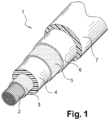
- FIG. 1 represents a schematic view of an electric cable according to a preferred embodiment in accordance with the invention.
- the medium or high voltage electric cable 1 according to the first object of the invention, illustrated in the figure 1 , comprises a central elongated electrically conductive element 2, in particular made of copper or aluminum.
- the electric cable 1 further comprises several layers arranged successively and coaxially around this central elongated electrically conductive element 2, namely: a first semi-conductive layer 3 called the “internal semi-conductive layer”, an electrically insulating layer 4, a second semi-conductive layer 5 called the “external semi-conductive layer”, a metal earthing and/or protective screen 6, and an external protective sheath 7.
- the electrically insulating layer 4 is a non-crosslinked extruded layer, obtained from the polymer composition as defined in the invention.
- Semiconductor layers 3 and 5 are thermoplastic extruded layers (i.e. not crosslinked).
- compositions I1, I2 and I3 in accordance with the invention i.e. comprising at least one polypropylene-based thermoplastic polymer material and at least chalk as an inorganic filler, were compared with comparative compositions C1 and C2 , composition C2 corresponding to a composition for forming an XLPE layer and composition C1 corresponding to a composition comprising a polypropylene-based thermoplastic polymer material identical to that used for compositions of the invention I1, I2 and I3 (C1 therefore did not comprise an inorganic filler as defined in the invention).
- compositions collected in Table 1 are implemented as follows.
- the dielectric liquid and the antioxidant were mixed with stirring at approximately 75°C, in order to form a dielectric liquid.
- the dielectric liquid was then mixed with the heterophase copolymer in a container, and the resulting mixture and the inorganic filler were mixed using a twin screw extruder ("Berstorff twin screw extruder") at a temperature of about 145 to 180°C and then melted at about 200°C (screw speed: 80 rpm).
- the resulting homogenized and melted mixture was then cooled and formed into pellets.
- the pellets were then hot-pressed to form layers in the form of plates.
- Each of the polymer compositions C1, C2, I1, I2 and I3 were thus prepared in the form of 1 mm thick layers for the evaluation of their mechanical properties and also in 8 mm thick layers for carrying out thermal conductivity measurements.
- compositions C1, C2, I1, I2 and I3 were then compared in terms of their mechanical properties (tensile strength/elongation at break before and after aging at 135°C for 240 hours) and their thermal conductivity.
- TS tensile strength
- ER elongation at break
- thermal conductivity results show that the presence of an inorganic filler as defined in the invention in a polypropylene matrix leads to an electrically insulating layer having a thermal conductivity higher than that of an electrically insulating layer in which there is no inorganic filler.
Landscapes
- Chemical & Material Sciences (AREA)
- Polymers & Plastics (AREA)
- Chemical Kinetics & Catalysis (AREA)
- Medicinal Chemistry (AREA)
- Organic Chemistry (AREA)
- Health & Medical Sciences (AREA)
- Spectroscopy & Molecular Physics (AREA)
- Physics & Mathematics (AREA)
- Engineering & Computer Science (AREA)
- Oil, Petroleum & Natural Gas (AREA)
- Manufacturing & Machinery (AREA)
- Dispersion Chemistry (AREA)
- Mechanical Engineering (AREA)
- Compositions Of Macromolecular Compounds (AREA)
- Organic Insulating Materials (AREA)
Applications Claiming Priority (3)
| Application Number | Priority Date | Filing Date | Title |
|---|---|---|---|
| FR1752201A FR3064106B1 (fr) | 2017-03-17 | 2017-03-17 | Cable electrique presentant une conductivite thermique amelioree |
| EP18715208.7A EP3596739B1 (de) | 2017-03-17 | 2018-03-16 | Elektrisches kabel mit verbesserter thermischer leitfähigkeit |
| PCT/FR2018/050648 WO2018167442A1 (fr) | 2017-03-17 | 2018-03-16 | Câble électrique présentant une conductivité thermique améliorée |
Related Parent Applications (2)
| Application Number | Title | Priority Date | Filing Date |
|---|---|---|---|
| EP18715208.7A Division EP3596739B1 (de) | 2017-03-17 | 2018-03-16 | Elektrisches kabel mit verbesserter thermischer leitfähigkeit |
| EP18715208.7A Division-Into EP3596739B1 (de) | 2017-03-17 | 2018-03-16 | Elektrisches kabel mit verbesserter thermischer leitfähigkeit |
Publications (2)
| Publication Number | Publication Date |
|---|---|
| EP4438666A2 true EP4438666A2 (de) | 2024-10-02 |
| EP4438666A3 EP4438666A3 (de) | 2025-01-01 |
Family
ID=59579677
Family Applications (2)
| Application Number | Title | Priority Date | Filing Date |
|---|---|---|---|
| EP18715208.7A Active EP3596739B1 (de) | 2017-03-17 | 2018-03-16 | Elektrisches kabel mit verbesserter thermischer leitfähigkeit |
| EP24165308.8A Pending EP4438666A3 (de) | 2017-03-17 | 2018-03-16 | Stromkabel mit verbesserter wärmeleitfähigkeit |
Family Applications Before (1)
| Application Number | Title | Priority Date | Filing Date |
|---|---|---|---|
| EP18715208.7A Active EP3596739B1 (de) | 2017-03-17 | 2018-03-16 | Elektrisches kabel mit verbesserter thermischer leitfähigkeit |
Country Status (6)
| Country | Link |
|---|---|
| US (1) | US11158437B2 (de) |
| EP (2) | EP3596739B1 (de) |
| KR (2) | KR102456565B1 (de) |
| CN (2) | CN110431641A (de) |
| FR (1) | FR3064106B1 (de) |
| WO (1) | WO2018167442A1 (de) |
Families Citing this family (9)
| Publication number | Priority date | Publication date | Assignee | Title |
|---|---|---|---|---|
| FR3090664B1 (fr) * | 2018-12-20 | 2021-12-17 | Nexans | Cable electrique comprenant autour d’un conducteur electrique allonge une couche polymere obtenue a partir d’une composition polymère comprenant au moins deux polymeres homophasiques |
| FR3099631B1 (fr) | 2019-07-30 | 2022-02-18 | Nexans | Câble électrique présentant une conductivité thermique améliorée |
| IL302317A (en) * | 2020-10-28 | 2023-06-01 | Dompe Farm Spa | Pharmaceutical packages comprising polypropylene containers and ngf aqueous formulations packaged therein |
| FR3118274B1 (fr) * | 2020-12-18 | 2024-02-09 | Nexans | Procédé de fabrication d’un câble électrique présentant une conductivité thermique améliorée |
| FR3119484A1 (fr) | 2021-02-03 | 2022-08-05 | Nexans | Câble électrique présentant une conductivité thermique améliorée |
| EP4202958A1 (de) * | 2021-12-21 | 2023-06-28 | Nexans | Elektrisches kabel oder elektrisches kabelzubehör |
| FR3131470A1 (fr) * | 2021-12-23 | 2023-06-30 | Nexans | Extrémité composite de câble de transport électrique à haute ou très haute tension et procédé de préparation d’une extrémité de câble |
| CN116444931B (zh) * | 2022-01-06 | 2025-12-09 | 中国石油化工股份有限公司 | 耐电树枝化热塑性绝缘材料及其制备方法和应用 |
| FR3144692A1 (fr) | 2022-12-30 | 2024-07-05 | Nexans | Câble comprenant une couche polymère recyclable |
Citations (1)
| Publication number | Priority date | Publication date | Assignee | Title |
|---|---|---|---|---|
| WO2015089179A1 (en) | 2013-12-10 | 2015-06-18 | General Cable Technologies Corporation | Thermally conductive compositions and cables thereof |
Family Cites Families (14)
| Publication number | Priority date | Publication date | Assignee | Title |
|---|---|---|---|---|
| US4153587A (en) * | 1971-07-06 | 1979-05-08 | Mitsubishi Petrochemical Co., Ltd. | High inorganic filler content composition |
| US4348459A (en) * | 1980-11-10 | 1982-09-07 | Uniroyal, Inc. | Thermoplastic elastomer and electrical article insulated therewith |
| JPS58213043A (ja) * | 1982-06-04 | 1983-12-10 | Mitsui Toatsu Chem Inc | ポリプロピレン樹脂組成物 |
| EP0110677A1 (de) * | 1982-11-26 | 1984-06-13 | Exxon Research And Engineering Company | Unvernetzte thermoplastische Elastomerzusammensetzungen für Niederspannungsisolierung |
| US4806424A (en) * | 1984-08-06 | 1989-02-21 | Camco, Incorporated | Electrical conductor insulated with insulating and jacketing material having improved resistance to hot fluids and gases |
| GB0229810D0 (en) * | 2002-12-20 | 2003-01-29 | Vantico Ag | Flame retardant polymer compositions |
| ES2389123T3 (es) * | 2004-03-31 | 2012-10-23 | Olex Australia Pty Limited | Composición formadora de materiales cerámicos para protección contra el fuego |
| US10811163B2 (en) * | 2010-01-29 | 2020-10-20 | Prysmian S.P.A. | Energy cable |
| US20130233604A1 (en) * | 2010-11-25 | 2013-09-12 | Gabriele Perego | Energy cable having a voltage stabilized thermoplastic electrically insulating layer |
| WO2014029447A1 (en) * | 2012-08-24 | 2014-02-27 | Abb Research Ltd | A high voltage direct current cable product |
| WO2015022004A1 (en) * | 2013-08-12 | 2015-02-19 | Abb Technology Ltd | Thermoplastic blend formulations for cable insulations |
| WO2015120259A1 (en) * | 2014-02-07 | 2015-08-13 | General Cable Technologies Corporation | Methods of forming cables with improved coverings |
| JP6376464B2 (ja) * | 2014-06-19 | 2018-08-22 | 日立金属株式会社 | 絶縁電線 |
| DK3695424T3 (da) * | 2017-10-12 | 2022-09-12 | Prysmian Spa | Elektrisk kabel med forbedret termoplastisk isoleringslag |
-
2017
- 2017-03-17 FR FR1752201A patent/FR3064106B1/fr active Active
-
2018
- 2018-03-16 CN CN201880018777.7A patent/CN110431641A/zh active Pending
- 2018-03-16 KR KR1020217022189A patent/KR102456565B1/ko active Active
- 2018-03-16 CN CN202211533024.4A patent/CN115732125A/zh not_active Withdrawn
- 2018-03-16 EP EP18715208.7A patent/EP3596739B1/de active Active
- 2018-03-16 US US16/493,529 patent/US11158437B2/en not_active Expired - Fee Related
- 2018-03-16 WO PCT/FR2018/050648 patent/WO2018167442A1/fr not_active Ceased
- 2018-03-16 EP EP24165308.8A patent/EP4438666A3/de active Pending
- 2018-03-16 KR KR1020197028190A patent/KR20190120797A/ko not_active Ceased
Patent Citations (1)
| Publication number | Priority date | Publication date | Assignee | Title |
|---|---|---|---|---|
| WO2015089179A1 (en) | 2013-12-10 | 2015-06-18 | General Cable Technologies Corporation | Thermally conductive compositions and cables thereof |
Also Published As
| Publication number | Publication date |
|---|---|
| WO2018167442A1 (fr) | 2018-09-20 |
| US11158437B2 (en) | 2021-10-26 |
| US20200005961A1 (en) | 2020-01-02 |
| KR20190120797A (ko) | 2019-10-24 |
| FR3064106A1 (fr) | 2018-09-21 |
| KR102456565B1 (ko) | 2022-10-19 |
| EP3596739B1 (de) | 2024-05-22 |
| EP4438666A3 (de) | 2025-01-01 |
| CN110431641A (zh) | 2019-11-08 |
| FR3064106B1 (fr) | 2021-07-30 |
| EP3596739C0 (de) | 2024-05-22 |
| CN115732125A (zh) | 2023-03-03 |
| KR20210091836A (ko) | 2021-07-22 |
| EP3596739A1 (de) | 2020-01-22 |
Similar Documents
| Publication | Publication Date | Title |
|---|---|---|
| EP3596739B1 (de) | Elektrisches kabel mit verbesserter thermischer leitfähigkeit | |
| EP3391387B1 (de) | Elektrische mittel- oder hochspannungsleitung | |
| EP3390528B1 (de) | Polymerzusammensetzung mit einer dielektrischen flüssigkeit mit verbesserter polarität | |
| EP3390529B1 (de) | Polymerzusammensetzung mit grösserer widerstandsfähigkeit gegen weissbruch | |
| EP3671769A1 (de) | Elektrisches kabel mit verbesserter temperaturalterungsbeständigkeit | |
| WO2023067263A1 (fr) | Procédé de fabrication d'un câble électrique par refroidissement contrôlé | |
| EP3671767A1 (de) | Elektrisches kabel, das beständig gegen wasserbäumchen ist | |
| EP3642275A1 (de) | Polymerzusammensetzung mit einer polaren dielektrischen flüssigkeit | |
| EP3772069B1 (de) | Elektrisches kabel mit verbesserter wärmeleitfähigkeit | |
| EP3670601A1 (de) | Kabel, das eine leicht abziehbare halbleiterschicht umfasst | |
| EP4288983A1 (de) | Elektrisches kabel mit verbesserter wärmeleitfähigkeit | |
| EP4394801A1 (de) | Kabel mit einer wiederverwertbaren polymerschicht | |
| EP4264644A1 (de) | Verfahren zur herstellung eines elektrischen kabels mit verbesserter wärmeleitfähigkeit | |
| WO2022129735A1 (fr) | Procédé de fabrication d'un câble électrique présentant une conductivité thermique améliorée |
Legal Events
| Date | Code | Title | Description |
|---|---|---|---|
| PUAI | Public reference made under article 153(3) epc to a published international application that has entered the european phase |
Free format text: ORIGINAL CODE: 0009012 |
|
| STAA | Information on the status of an ep patent application or granted ep patent |
Free format text: STATUS: THE APPLICATION HAS BEEN PUBLISHED |
|
| AC | Divisional application: reference to earlier application |
Ref document number: 3596739 Country of ref document: EP Kind code of ref document: P |
|
| AK | Designated contracting states |
Kind code of ref document: A2 Designated state(s): AL AT BE BG CH CY CZ DE DK EE ES FI FR GB GR HR HU IE IS IT LI LT LU LV MC MK MT NL NO PL PT RO RS SE SI SK SM TR |
|
| REG | Reference to a national code |
Ref country code: DE Ref legal event code: R079 Free format text: PREVIOUS MAIN CLASS: C08K0003260000 Ipc: H01B0003440000 |
|
| PUAL | Search report despatched |
Free format text: ORIGINAL CODE: 0009013 |
|
| AK | Designated contracting states |
Kind code of ref document: A3 Designated state(s): AL AT BE BG CH CY CZ DE DK EE ES FI FR GB GR HR HU IE IS IT LI LT LU LV MC MK MT NL NO PL PT RO RS SE SI SK SM TR |
|
| RIC1 | Information provided on ipc code assigned before grant |
Ipc: C08K 3/38 20060101ALI20241122BHEP Ipc: C08K 3/26 20060101ALI20241122BHEP Ipc: H01B 3/22 20060101ALI20241122BHEP Ipc: C08L 23/14 20060101ALI20241122BHEP Ipc: C08L 23/12 20060101ALI20241122BHEP Ipc: C08K 3/34 20060101ALI20241122BHEP Ipc: H01B 3/44 20060101AFI20241122BHEP |
|
| STAA | Information on the status of an ep patent application or granted ep patent |
Free format text: STATUS: REQUEST FOR EXAMINATION WAS MADE |
|
| 17P | Request for examination filed |
Effective date: 20250630 |