EP3772069B1 - Elektrisches kabel mit verbesserter wärmeleitfähigkeit - Google Patents
Elektrisches kabel mit verbesserter wärmeleitfähigkeit Download PDFInfo
- Publication number
- EP3772069B1 EP3772069B1 EP20188285.9A EP20188285A EP3772069B1 EP 3772069 B1 EP3772069 B1 EP 3772069B1 EP 20188285 A EP20188285 A EP 20188285A EP 3772069 B1 EP3772069 B1 EP 3772069B1
- Authority
- EP
- European Patent Office
- Prior art keywords
- electric cable
- approximately
- insulating layer
- electrically insulating
- inorganic filler
- Prior art date
- Legal status (The legal status is an assumption and is not a legal conclusion. Google has not performed a legal analysis and makes no representation as to the accuracy of the status listed.)
- Active
Links
Images
Classifications
-
- C—CHEMISTRY; METALLURGY
- C08—ORGANIC MACROMOLECULAR COMPOUNDS; THEIR PREPARATION OR CHEMICAL WORKING-UP; COMPOSITIONS BASED THEREON
- C08L—COMPOSITIONS OF MACROMOLECULAR COMPOUNDS
- C08L23/00—Compositions of homopolymers or copolymers of unsaturated aliphatic hydrocarbons having only one carbon-to-carbon double bond; Compositions of derivatives of such polymers
- C08L23/02—Compositions of homopolymers or copolymers of unsaturated aliphatic hydrocarbons having only one carbon-to-carbon double bond; Compositions of derivatives of such polymers not modified by chemical after-treatment
- C08L23/10—Homopolymers or copolymers of propene
- C08L23/14—Copolymers of propene
-
- C—CHEMISTRY; METALLURGY
- C08—ORGANIC MACROMOLECULAR COMPOUNDS; THEIR PREPARATION OR CHEMICAL WORKING-UP; COMPOSITIONS BASED THEREON
- C08K—Use of inorganic or non-macromolecular organic substances as compounding ingredients
- C08K3/00—Use of inorganic substances as compounding ingredients
- C08K3/18—Oxygen-containing compounds, e.g. metal carbonyls
- C08K3/20—Oxides; Hydroxides
- C08K3/22—Oxides; Hydroxides of metals
-
- H—ELECTRICITY
- H01—ELECTRIC ELEMENTS
- H01B—CABLES; CONDUCTORS; INSULATORS; SELECTION OF MATERIALS FOR THEIR CONDUCTIVE, INSULATING OR DIELECTRIC PROPERTIES
- H01B7/00—Insulated conductors or cables characterised by their form
- H01B7/42—Insulated conductors or cables characterised by their form with arrangements for heat dissipation or conduction
- H01B7/428—Heat conduction
-
- H—ELECTRICITY
- H01—ELECTRIC ELEMENTS
- H01B—CABLES; CONDUCTORS; INSULATORS; SELECTION OF MATERIALS FOR THEIR CONDUCTIVE, INSULATING OR DIELECTRIC PROPERTIES
- H01B13/00—Apparatus or processes specially adapted for manufacturing conductors or cables
- H01B13/06—Insulating conductors or cables
- H01B13/14—Insulating conductors or cables by extrusion
-
- H—ELECTRICITY
- H01—ELECTRIC ELEMENTS
- H01B—CABLES; CONDUCTORS; INSULATORS; SELECTION OF MATERIALS FOR THEIR CONDUCTIVE, INSULATING OR DIELECTRIC PROPERTIES
- H01B13/00—Apparatus or processes specially adapted for manufacturing conductors or cables
- H01B13/06—Insulating conductors or cables
- H01B13/14—Insulating conductors or cables by extrusion
- H01B13/148—Selection of the insulating material therefor
-
- H—ELECTRICITY
- H01—ELECTRIC ELEMENTS
- H01B—CABLES; CONDUCTORS; INSULATORS; SELECTION OF MATERIALS FOR THEIR CONDUCTIVE, INSULATING OR DIELECTRIC PROPERTIES
- H01B13/00—Apparatus or processes specially adapted for manufacturing conductors or cables
- H01B13/22—Sheathing; Armouring; Screening; Applying other protective layers
- H01B13/24—Sheathing; Armouring; Screening; Applying other protective layers by extrusion
-
- H—ELECTRICITY
- H01—ELECTRIC ELEMENTS
- H01B—CABLES; CONDUCTORS; INSULATORS; SELECTION OF MATERIALS FOR THEIR CONDUCTIVE, INSULATING OR DIELECTRIC PROPERTIES
- H01B3/00—Insulators or insulating bodies characterised by the insulating materials; Selection of materials for their insulating or dielectric properties
- H01B3/18—Insulators or insulating bodies characterised by the insulating materials; Selection of materials for their insulating or dielectric properties mainly consisting of organic substances
- H01B3/30—Insulators or insulating bodies characterised by the insulating materials; Selection of materials for their insulating or dielectric properties mainly consisting of organic substances plastics; resins; waxes
- H01B3/44—Insulators or insulating bodies characterised by the insulating materials; Selection of materials for their insulating or dielectric properties mainly consisting of organic substances plastics; resins; waxes vinyl resins; acrylic resins
- H01B3/441—Insulators or insulating bodies characterised by the insulating materials; Selection of materials for their insulating or dielectric properties mainly consisting of organic substances plastics; resins; waxes vinyl resins; acrylic resins from alkenes
-
- H—ELECTRICITY
- H01—ELECTRIC ELEMENTS
- H01B—CABLES; CONDUCTORS; INSULATORS; SELECTION OF MATERIALS FOR THEIR CONDUCTIVE, INSULATING OR DIELECTRIC PROPERTIES
- H01B7/00—Insulated conductors or cables characterised by their form
- H01B7/02—Disposition of insulation
-
- H—ELECTRICITY
- H01—ELECTRIC ELEMENTS
- H01B—CABLES; CONDUCTORS; INSULATORS; SELECTION OF MATERIALS FOR THEIR CONDUCTIVE, INSULATING OR DIELECTRIC PROPERTIES
- H01B7/00—Insulated conductors or cables characterised by their form
- H01B7/02—Disposition of insulation
- H01B7/0275—Disposition of insulation comprising one or more extruded layers of insulation
-
- H—ELECTRICITY
- H01—ELECTRIC ELEMENTS
- H01B—CABLES; CONDUCTORS; INSULATORS; SELECTION OF MATERIALS FOR THEIR CONDUCTIVE, INSULATING OR DIELECTRIC PROPERTIES
- H01B9/00—Power cables
-
- C—CHEMISTRY; METALLURGY
- C08—ORGANIC MACROMOLECULAR COMPOUNDS; THEIR PREPARATION OR CHEMICAL WORKING-UP; COMPOSITIONS BASED THEREON
- C08K—Use of inorganic or non-macromolecular organic substances as compounding ingredients
- C08K3/00—Use of inorganic substances as compounding ingredients
- C08K3/18—Oxygen-containing compounds, e.g. metal carbonyls
- C08K3/20—Oxides; Hydroxides
- C08K3/22—Oxides; Hydroxides of metals
- C08K2003/2227—Oxides; Hydroxides of metals of aluminium
-
- C—CHEMISTRY; METALLURGY
- C08—ORGANIC MACROMOLECULAR COMPOUNDS; THEIR PREPARATION OR CHEMICAL WORKING-UP; COMPOSITIONS BASED THEREON
- C08K—Use of inorganic or non-macromolecular organic substances as compounding ingredients
- C08K2201/00—Specific properties of additives
- C08K2201/001—Conductive additives
-
- C—CHEMISTRY; METALLURGY
- C08—ORGANIC MACROMOLECULAR COMPOUNDS; THEIR PREPARATION OR CHEMICAL WORKING-UP; COMPOSITIONS BASED THEREON
- C08K—Use of inorganic or non-macromolecular organic substances as compounding ingredients
- C08K2201/00—Specific properties of additives
- C08K2201/002—Physical properties
- C08K2201/005—Additives being defined by their particle size in general
-
- C—CHEMISTRY; METALLURGY
- C08—ORGANIC MACROMOLECULAR COMPOUNDS; THEIR PREPARATION OR CHEMICAL WORKING-UP; COMPOSITIONS BASED THEREON
- C08L—COMPOSITIONS OF MACROMOLECULAR COMPOUNDS
- C08L2203/00—Applications
- C08L2203/20—Applications use in electrical or conductive gadgets
- C08L2203/202—Applications use in electrical or conductive gadgets use in electrical wires or wirecoating
-
- C—CHEMISTRY; METALLURGY
- C08—ORGANIC MACROMOLECULAR COMPOUNDS; THEIR PREPARATION OR CHEMICAL WORKING-UP; COMPOSITIONS BASED THEREON
- C08L—COMPOSITIONS OF MACROMOLECULAR COMPOUNDS
- C08L2205/00—Polymer mixtures characterised by other features
- C08L2205/02—Polymer mixtures characterised by other features containing two or more polymers of the same C08L -group
-
- C—CHEMISTRY; METALLURGY
- C08—ORGANIC MACROMOLECULAR COMPOUNDS; THEIR PREPARATION OR CHEMICAL WORKING-UP; COMPOSITIONS BASED THEREON
- C08L—COMPOSITIONS OF MACROMOLECULAR COMPOUNDS
- C08L2205/00—Polymer mixtures characterised by other features
- C08L2205/02—Polymer mixtures characterised by other features containing two or more polymers of the same C08L -group
- C08L2205/025—Polymer mixtures characterised by other features containing two or more polymers of the same C08L -group containing two or more polymers of the same hierarchy C08L, and differing only in parameters such as density, comonomer content, molecular weight, structure
-
- C—CHEMISTRY; METALLURGY
- C08—ORGANIC MACROMOLECULAR COMPOUNDS; THEIR PREPARATION OR CHEMICAL WORKING-UP; COMPOSITIONS BASED THEREON
- C08L—COMPOSITIONS OF MACROMOLECULAR COMPOUNDS
- C08L2205/00—Polymer mixtures characterised by other features
- C08L2205/03—Polymer mixtures characterised by other features containing three or more polymers in a blend
-
- C—CHEMISTRY; METALLURGY
- C08—ORGANIC MACROMOLECULAR COMPOUNDS; THEIR PREPARATION OR CHEMICAL WORKING-UP; COMPOSITIONS BASED THEREON
- C08L—COMPOSITIONS OF MACROMOLECULAR COMPOUNDS
- C08L2207/00—Properties characterising the ingredient of the composition
- C08L2207/02—Heterophasic composition
Definitions
- the invention relates to a cable comprising at least one electrically insulating layer obtained from a polymer composition comprising at least one thermoplastic polymer material based on polypropylene and at least one inorganic filler chosen from aluminum oxide, an oxide hydrated aluminum, magnesium oxide, zinc oxide, and a mixture thereof, the inorganic filler represents at least 10% by weight, relative to the total weight of the polymer composition, the polymer composition further comprises a dielectric liquid; and a process for preparing said cable.
- a polymer composition comprising at least one thermoplastic polymer material based on polypropylene and at least one inorganic filler chosen from aluminum oxide, an oxide hydrated aluminum, magnesium oxide, zinc oxide, and a mixture thereof, the inorganic filler represents at least 10% by weight, relative to the total weight of the polymer composition, the polymer composition further comprises a dielectric liquid; and a process for preparing said cable.
- the invention applies typically but not exclusively to electric cables intended for the transport of energy, in particular to medium voltage (in particular from 6 to 45-60 kV) or high voltage (in particular greater than 60 kV, and up to 400 kV), whether in direct or alternating current, in the fields of air, submarine, land electricity transmission, or even aeronautics.
- medium voltage in particular from 6 to 45-60 kV
- high voltage in particular greater than 60 kV, and up to 400 kV
- the invention applies in particular to electric cables having improved thermal conductivity.
- the electrically insulating layer generally comprises at least one polyolefin such as an ethylene polymer (ie a homo- or copolymer of ethylene) crosslinked or non-crosslinked.
- ethylene polymer ie a homo- or copolymer of ethylene
- Non-crosslinked ethylene polymers eg non-crosslinked low density polyethylene or non-crosslinked LDPE
- non-crosslinked low density polyethylene or non-crosslinked LDPE generally cannot be used at temperatures above 70°C, and therefore reduce the ability of the cable to carry electrical energy so as to avoid any overheating of the electrically insulating layer at temperatures above 70°C.
- crosslinked ethylene polymers eg XLPE
- Propylene polymers generally have slightly lower thermal conductivity properties than ethylene polymers. Consequently, their use can lead to a reduction in the evacuation of the heat generated by the Joule effect, and thus in the quantity of energy transported, the latter being a function of the maximum acceptable temperature of the elongated electrically conductive element. .
- the international application WO2018167442A1 describes an electric cable comprising at least one elongated electrically conductive element and at least one electrically insulating layer obtained from a polymer composition comprising at least one thermoplastic polymer material based on polypropylene and at least one inorganic filler such as kaolin or the chalk.
- a polymer composition comprising at least one thermoplastic polymer material based on polypropylene and at least one inorganic filler such as kaolin or the chalk.
- the mechanical properties of the cable thus obtained are not optimized.
- Other relevant documents are: EP0893801A1 , WO2019/117055A1 , WO2011/125924A1 , WO2012/069864A1 , EP2528968A1 And US2013/008691A1 .
- the object of the present invention is therefore to overcome the drawbacks of the techniques of the prior art by proposing an electric cable, in particular at medium or high voltage, based on propylene polymer(s), said cable being able to operate at temperatures above 70°C, with improved mechanical properties, particularly in terms of elongation at break and tensile strength, while guaranteeing good thermal conductivity.
- the first subject of the invention is an electric cable according to independent claim 1.
- thermoplastic polymer material based on polypropylene with the inorganic filler as defined in the invention makes it possible to obtain an electrically insulating layer having improved mechanical properties, in particular in terms of elongation at break and resistance to traction, while guaranteeing good thermal conductivity, or even better thermal conductivity.
- a mixture of inorganic fillers is preferably a mixture of two or three of said inorganic fillers.
- aluminum oxide also well known by the name “alumina”, is a chemical compound of formula Al 2 O 3 .
- the hydrated aluminum oxide or hydrated alumina can be a monohydrated or polyhydrated aluminum oxide, and preferably monohydrated or trihydrated.
- boehmite which is the gamma polymorph of AlO(OH) or Al 2 O 3 .H 2 O; or the diaspore, which is the alpha polymorph of AIO(OH) or Al 2 O 3 .H 2 O.
- gibbsite or hydrargillite which is the polymorph gamma of Al(OH) 3 ; bayerite which is the alpha polymorph of Al(OH) 3 ; or nordstrandite, which is the beta polymorph of Al(OH) 3 .
- Hydrated aluminum oxide is also well known as “aluminum oxide hydroxide” or “alumina hydroxide”.
- Aluminum oxide is preferred as the inorganic filler.
- the aluminum oxide is in particular a calcined aluminum oxide (respectively a calcined magnesium oxide).
- the inorganic filler represents at least 10% by weight, relative to the total weight of the polymer composition.
- the inorganic filler can be in the form of particles with a size ranging from 0.01 to 6 ⁇ m approximately, preferably from 0.05 to 2 ⁇ m approximately, in a particularly preferred manner from 0.075 to 1.5 ⁇ m approximately, and more particularly preferred from 0.1 to 1.1 ⁇ m approximately.
- dimension means the average dimension in number of all the particles of a given population, this dimension being conventionally determined by methods well known to those skilled in the art. job.
- the dimension of the particle(s) according to the invention can for example be determined by microscopy, in particular by scanning electron microscope (SEM) or by transmission electron microscope (TEM).
- the inorganic filler may comprise a mixture of particles with a size ranging from 0.01 to 0.50 ⁇ m approximately, and preferably from 0.05 to 0.25 ⁇ m approximately; and of particles with a dimension ranging from 0.60 to 2 ⁇ m approximately, and preferably from 0.75 to 1.5 ⁇ m approximately.
- the inorganic filler can be "treated” or “untreated”, and preferably "treated".
- treated inorganic filler means an inorganic filler having undergone a surface treatment, or in other words, an inorganic filler treated on the surface. Said surface treatment makes it possible in particular to modify the surface properties of the inorganic filler, for example to improve the compatibility of the inorganic filler with the thermoplastic polymer material.
- the inorganic filler of the invention can be silanized, or in other words can be processed to obtain a silanized inorganic filler.
- the surface treatment used to obtain the silanized inorganic filler is in particular a surface treatment from at least one silane compound (with or without coupling agent), this type of surface treatment being well known to those skilled in the art. .
- the silanized inorganic filler of the invention may comprise siloxane and/or silane groups at its surface.
- Said groups can be of the vinylsilane, alkylsilane, epoxysilane, methacryloxysilane, acryloxysilane, aminosilane or mercaptosilane type.
- the inorganic filler may have a specific surface according to the BET method ranging from 1 to 20 g/cm 2 approximately, and preferably ranging from 7.5 to 17 g/cm 2 approximately.
- the specific surface area of the inorganic filler can be easily determined according to DIN 9277 (2010).
- the inorganic filler may comprise a mixture of particles with a specific surface area ranging from 2 to 9 g/cm 2 approximately, and particles with a specific surface area ranging from 10 to 17 g/cm 2 approximately .
- thermoplastic polymer material based on polypropylene can comprise a homopolymer or a copolymer of propylene P 1 , and preferably a copolymer of propylene P 1 .
- the propylene homopolymer P 1 preferably has an elastic modulus ranging from approximately 1250 to 1600 MPa.
- the propylene homopolymer P 1 can represent at least 10% by weight, and preferably from 15 to 30% by weight, relative to the total weight of the thermoplastic polymer material based on polypropylene.
- copolymers of propylene P 1 of copolymers of propylene and of olefin, the olefin being chosen in particular from ethylene and an olefin ⁇ 1 different from propylene.
- the ethylene or the olefin ⁇ 1 different from the propylene of the copolymer of propylene and olefin preferably represents at most 15% by mole approximately, and in a particularly preferred manner at most 10% by mole approximately, with respect to the number of moles total propylene olefin copolymer.
- Propylene and ethylene copolymers are preferred as propylene copolymer P 1 .
- the propylene copolymer P 1 can be a random propylene copolymer or a heterophase propylene copolymer, and preferably a heterophase propylene copolymer.
- the propylene random copolymer P 1 preferably has an elastic modulus ranging from approximately 600 to 1200 MPa.
- the heterophase propylene copolymer P 1 can comprise a thermoplastic phase of the propylene type and a thermoplastic elastomer phase of the copolymer type of ethylene and an ⁇ 2 olefin.
- the ⁇ 2 olefin of the thermoplastic elastomer phase of the heterophase propylene copolymer P 1 can be propylene.
- thermoplastic elastomer phase of the heterophase propylene copolymer P 1 can represent at least 20% by weight approximately, and preferably at least 45% by weight approximately, relative to the total weight of the heterophase propylene copolymer P 1 .
- the heterophase propylene copolymer P 1 preferably has an elastic modulus ranging from approximately 50 to 1200 MPa, and in a particularly preferred manner: either an elastic modulus ranging from approximately 50 to 550 MPa, and more particularly preferably ranging from 50 to 300 MPa approximately; i.e. an elastic modulus ranging from approximately 600 to 1200 MPa.
- heterophase propylene copolymer By way of example of a heterophase propylene copolymer, mention may be made of the heterophase propylene copolymer marketed by the company LyondellBasell under the reference Adflex ® Q 200 F, or the heterophase copolymer marketed by the company LyondellBasell under the reference EP ® 2967.
- the propylene homopolymer or copolymer P 1 may have a melting point above approximately 110° C., preferably above approximately 130° C., in a particularly preferred manner above approximately 140° C., and more particularly preferably ranging from 140 to 170°C approximately.
- the propylene homopolymer or copolymer P 1 can have an enthalpy of fusion ranging from approximately 20 to 100 J/g.
- the propylene homopolymer P 1 can have an enthalpy of fusion ranging from approximately 80 to 90 J/g.
- the random propylene copolymer P 1 may have an enthalpy of fusion ranging from approximately 40 to 80 J/g.
- the heterophase propylene copolymer P 1 can have an enthalpy of fusion ranging from approximately 20 to 50 J/g.
- the propylene homopolymer or copolymer P 1 can have a melt index ranging from 0.5 to 3 g/10 min, measured at approximately 230° C. with a load of approximately 2.16 kg according to standard ASTM D1238-00 .
- the random propylene copolymer P 1 can have a melt index ranging from 1.2 to 2.5 g/10 min, and preferably ranging from 1.5 to 2.5 g/10 min, measured at approximately 230° C. with a load of approximately 2.16 kg according to ASTM D1238-00.
- the heterophase propylene copolymer P 1 can have a melt index ranging from 0.5 to 1.5 g/10 min, and preferably ranging from 0.5 to 1.4 g/10 min approximately, measured at 230° C. approximately with a load of approximately 2.16 kg according to ASTM D1238-00.
- the polypropylene-based thermoplastic polymer material may comprise several different propylene copolymers P 1 , in particular two different propylene copolymers P 1 , said propylene copolymers P 1 being as defined above.
- the polypropylene-based thermoplastic polymer material may comprise a random copolymer of propylene (as first propylene copolymer P 1 ) and a heterophase propylene copolymer (as second propylene copolymer P 1 ), or two copolymers of different heterophase propylene.
- the polypropylene-based thermoplastic polymer material comprises a random propylene copolymer and a heterophase propylene copolymer
- said heterophase propylene copolymer preferably has an elastic modulus ranging from approximately 50 to 300 MPa.
- the two heterophase propylene copolymers have a different elastic modulus.
- the polypropylene-based thermoplastic polymer material comprises a first heterophase propylene copolymer having an elastic modulus ranging from approximately 50 to 550 MPa, and in a particularly preferred manner ranging from approximately 50 to 300 MPa; and a second heterophase propylene copolymer having an elastic modulus ranging from approximately 600 to 1200 MPa.
- the first and second heterophase propylene copolymers have a melt index as defined in the invention.
- combinations of propylene copolymers P 1 can advantageously make it possible to improve the mechanical properties of the polymer layer.
- the combination makes it possible to obtain optimized mechanical properties of the polymer layer, in particular in terms of elongation at break, and of flexibility; and/or makes it possible to form a more homogeneous polymer layer, in particular promotes the dispersion of the dielectric liquid in the thermoplastic polymer material based on polypropylene of said polymer layer.
- the propylene copolymer P 1 or the propylene copolymers P 1 when there are several represent(s) at least 50% by weight approximately, preferably from 55 to 90% by weight approximately, and particularly preferably from 60 to 90% by weight approximately, relative to the total weight of the thermoplastic polymer material based on polypropylene.
- the random propylene copolymer P 1 can represent at least 20% by weight, and preferably from 30 to 70% by weight, relative to the total weight of the thermoplastic polymer material based on polypropylene.
- the heterophase propylene copolymer P 1 or the heterophase propylene copolymers P 1 when there are several of them, can represent from 5 to 95% by weight approximately, preferably from 50 to 90% by weight approximately, and from particularly preferably from 60 to 80% by weight approximately, relative to the total weight of the thermoplastic polymer material based on polypropylene.
- the polypropylene-based thermoplastic polymer material may also comprise a P 2 olefin homopolymer or copolymer.
- Said homopolymer or copolymer of olefin P 2 is preferably different from said homopolymer or a copolymer of propylene P 1 .
- the ⁇ 3 olefin is preferably chosen from the following olefins: propylene, 1-butene, isobutylene, 1-pentene, 4-methyl-1-pentene, 1-hexene, 1-octene, 1-decene, 1-dodecene, and a mixture thereof.
- the ⁇ 3 olefin of propylene, 1-hexene or 1-octene type is particularly preferred.
- thermoplastic polymer material having good mechanical properties, in particular in terms of elastic modulus, and electrical properties.
- the olefin P 2 homopolymer or copolymer is preferably an ethylene polymer.
- the ethylene polymer is a low density polyethylene, a linear low density polyethylene, a medium density polyethylene, or a high density polyethylene, and preferably a high density polyethylene; in particular according to the ISO 1183A standard (at a temperature of 23°C).
- the ethylene polymer preferably has an elastic modulus of at least 400 MPa, and particularly preferably at least 500 MPa.
- the elastic modulus or Young's modulus of a polymer (known under the Anglicism " Tensile Modulus” ) is well known to those skilled in the art, and can be easily determined according to standard ISO 527-1 , -2 (2012).
- the ISO 527 standard presents a first part, denoted “ISO 527-1”, and a second part, denoted “ISO 527-2” specifying the test conditions relating to the general principles of the first part of the ISO 527 standard.
- the expression “low density” means having a density ranging from 0.91 to 0.925 g/cm 3 approximately, said density being measured according to the ISO 1183A standard (at a temperature of 23° C.).
- the expression “medium density” means having a density ranging from 0.926 to 0.940 g/cm 3 approximately, said density being measured according to the ISO 1183A standard (at a temperature of 23° C.).
- the expression “high density” means having a density ranging from 0.941 to 0.965 g/cm 3 , said density being measured according to the ISO 1183A standard (at a temperature of 23° C.).
- the olefin homopolymer or copolymer P 2 represents from 5 to 50% by weight approximately, and in a particularly preferred manner from 10 to 40% by weight approximately, relative to the total weight polypropylene-based thermoplastic polymer material.
- the polypropylene-based thermoplastic polymer material comprises two propylene copolymers P 1 such as a random propylene copolymer and a heterophase propylene copolymer or two different heterophase propylene copolymers; and an olefin P 2 homopolymer or copolymer such as an ethylene polymer.
- This combination of copolymers of propylene P 1 and of an olefin homopolymer or copolymer P 2 makes it possible to further improve the mechanical properties of the polymer layer, while guaranteeing good thermal conductivity.
- thermoplastic polymer material of the polymer composition of the electrically insulating layer of the cable of the invention is preferably heterophase (i.e. it comprises several phases).
- the presence of several phases generally results from the mixture of two different polyolefins, such as a mixture of different propylene polymers or a mixture of a propylene polymer and an ethylene polymer.
- the polymer composition of the invention further comprises a dielectric liquid, in particular forming an intimate mixture with the thermoplastic polymer material.
- the dielectric liquid improves the inorganic filler/polypropylene-based thermoplastic polymer material interface.
- the presence of the dielectric liquid thus makes it possible to obtain better dielectric properties (ie better electrical insulation), and in particular better dielectric rigidity of the layer obtained from the polymer composition. She can also make it possible to improve the mechanical properties and/or the resistance to aging of said layer.
- dielectric liquid examples include mineral oils (e.g. naphthenic oils, paraffinic oils or aromatic oils), vegetable oils (e.g. soybean oil, linseed oil, rapeseed oil, corn oil or castor oil) or synthetic oils such as aromatic hydrocarbons (alkylbenzenes, alkylnaphthalenes, alkylbiphenyls, alkydiarylethylenes, etc.), silicone oils, ether oxides, organic esters or aliphatic hydrocarbons, or one of their mixtures.
- mineral oils e.g. naphthenic oils, paraffinic oils or aromatic oils
- vegetable oils e.g. soybean oil, linseed oil, rapeseed oil, corn oil or castor oil
- synthetic oils such as aromatic hydrocarbons (alkylbenzenes, alkylnaphthalenes, alkylbiphenyls, alkydiarylethylenes, etc.), silicone oils, ether oxides, organic esters or alipha
- the dielectric liquid preferably comprises at least one mineral oil.
- the dielectric liquid represents from 1% to 20% by weight approximately, preferably from 2 to 15% by weight approximately, and in a particularly preferred manner from 3 to 12% by weight approximately, relative to the weight total of polypropylene-based thermoplastic polymer material.
- the dielectric liquid may comprise at least 70% by weight approximately mineral oil, and preferably at least 80% by weight approximately mineral oil, relative to the total weight of the dielectric liquid.
- Mineral oil is generally liquid at around 20-25°C.
- the mineral oil is preferably chosen from naphthenic oils and paraffinic oils.
- Mineral oil is obtained from the refining of crude oil.
- the mineral oil comprises a paraffinic carbon (Cp) content ranging from approximately 45 to 65 atomic %, a naphthenic carbon (Cn) content ranging from approximately 35 to 55 atomic and an aromatic carbon (Ca) content ranging from approximately 0.5 to 10 atomic %.
- Cp paraffinic carbon
- Cn naphthenic carbon
- Ca aromatic carbon
- the dielectric liquid advantageously comprises a mineral oil, in particular as defined in the invention, and at least one polar compound of the benzophenone or acetophenone type or one of their derivatives.
- the polar compound of benzophenone, acetophenone type or one of their derivatives represents at least 2.5% by weight approximately, preferably at least 3.5% by weight approximately, and in a particularly preferred manner at least 4% by weight approximately, relative to the total weight of the dielectric liquid.
- the dielectric liquid may comprise at most 30% by weight approximately, preferably at most 20% by weight approximately, and even more preferably at most 15% by weight approximately, of polar compound of the benzophenone or acetophenone type or one of their derivatives, for relative to the total weight of the dielectric liquid.
- This maximum quantity makes it possible to guarantee moderate or even low dielectric losses (eg less than approximately 10 ⁇ 3 ), and also to prevent migration of the dielectric liquid out of the electrically insulating layer.
- the polar compound of benzophenone or acetophenone type or one of their derivatives is chosen from benzophenone, dibenzosuberone, fluorenone and anthrone.
- Benzophenone is particularly preferred.
- the polypropylene-based thermoplastic polymer material may further comprise one or more additives.
- additives are well known to a person skilled in the art and can be chosen from agents promoting the implementation such as lubricants, compatibilizing agents, or coupling agents, antioxidants, anti-UV agents, anti- -copper, anti-water treeing agents, pigments, and a mixture thereof.
- thermoplastic polymer material based on polypropylene can typically comprise from 0.01 to 5% by weight approximately, and preferably from 0.1 to 2% by weight approximately, of additives, relative to the total weight of the thermoplastic polymer material based. of polypropylene.
- the antioxidants make it possible to protect the polymer composition from the thermal stresses generated during the stages of manufacture of the cable or of operation of the cable.
- the antioxidants are preferably selected from hindered phenols, thioesters, sulfur-based antioxidants, phosphorus-based antioxidants, amine-type antioxidants, and a mixture thereof.
- hindered phenols examples include 1,2-bis(3,5-di-tert-butyl-4-hydroxyhydrocinnamoyl) hydrazine (Irganox ® MD 1024), pentaerythritol tetrakis(3-(3, 5-di-tert-butyl-4-hydroxyphenyl)propionate) (Irganox ® 1010), octadecyl 3-(3,5-di-tert-butyl-4-hydroxyphenyl)propionate (Irganox ® 1076), the 1, 3,5-trimethyl-2,4,6-tris(3,5-di-tert-butyl-4-hydroxybenzyl)benzene (Irganox ® 1330), 4,6-bis (octylthiomethyl)-o-cresol (Irgastab ® KV10 or Irganox ® 1520), 2,2'-thiobis(6-tert-butyl-4-
- sulfur-based antioxidants include thioethers such as didodecyl-3,3'-thiodipropionate (Irganox ® PS800), distearyl thiodipropionate or dioctadecyl-3,3'-thiodipropionate (Irganox ® PS802), bis[2-methyl-4- ⁇ 3-n-alkyl ( C12 or C14 ) thiopropionyloxy ⁇ -5-tert- butylphenyl]sulfide, thiobis-[2- tert -butyl-5-methyl- 4,1-phenylene] bis [3-(dodecylthio)propionate], or 4,6-bis(octylthiomethyl)-o-cresol (Irganox ® 1520 or Irgastab ® KV10).
- thioethers such as didodecyl-3,3'-thiodipropionate (Irga
- phosphorus-based antioxidants examples include tris(2,4-di-tert-butyl-phenyl)phosphite (Irgafos ® 168) or bis(2,4-di-tert-butylphenyl )pentaerythritol diphosphite (Ultranox ® 626).
- amine-type antioxidants examples include phenylene diamines (e.g. paraphenylene diamines such as 1PPD or 6PPD), diphenylamine styrene, diphenylamines, 4-(1-methyl-1-phenylethyl)-N -[4-(1-methyl-1-phenylethyl)phenyl]aniline (Naugard 445), mercapto benzimidazoles, or polymerized 2,2,4-trimethyl-1,2 dihydroquinoline (TMQ).
- phenylene diamines e.g. paraphenylene diamines such as 1PPD or 6PPD
- diphenylamine styrene diphenylamines
- diphenylamines 4-(1-methyl-1-phenylethyl)-N -[4-(1-methyl-1-phenylethyl)phenyl]aniline (Naugard 445)
- mercapto benzimidazoles or poly
- Irganox B 225 which comprises an equimolar mixture of Irgafos 168 and Irganox 1010 as described above.
- the polymer composition of the electrically insulating layer of the invention is a thermoplastic polymer composition. It is therefore not crosslinkable.
- the polymer composition does not include crosslinking agents, silane-type coupling agents, peroxides and/or additives which allow crosslinking. Indeed, such agents degrade the thermoplastic polymer material based on polypropylene.
- the polymer composition is preferably recyclable.
- the polymer composition may also comprise at least one inorganic filler different from the inorganic filler chosen from aluminum oxide, a hydrated aluminum oxide, magnesium oxide, zinc oxide, and one of their mixtures, such as talc, aluminum trihydrate Al(OH) 3 , or magnesium dihydrate Mg(OH) 2 ; and/or at least one halogen-free mineral filler intended to improve the fire behavior of the polymer composition.
- the inorganic filler different from the inorganic filler chosen from aluminum oxide, a hydrated aluminum oxide, magnesium oxide, zinc oxide, and one of their mixtures, and/or the mineral filler without halogens may represent at most 30% by weight approximately, preferably at most 20% by weight approximately, particularly preferably at most 10% by weight approximately, and more particularly preferably at most 5% by weight approximately, relative to the total weight of the polymer composition.
- the cable of the invention preferably does not comprise halogenated compounds.
- halogenated compounds can be of any nature, such as for example fluorinated polymers or chlorinated polymers such as polyvinyl chloride (PVC), halogenated plasticizers, halogenated mineral fillers, etc.
- the polymer composition can be prepared by mixing the polypropylene-based thermoplastic polymer material with at least one inorganic filler selected from aluminum oxide, hydrated aluminum oxide, magnesium oxide, zinc oxide , and a mixture thereof, optionally a dielectric liquid and optionally one or more additives as defined in the invention.
- at least one inorganic filler selected from aluminum oxide, hydrated aluminum oxide, magnesium oxide, zinc oxide , and a mixture thereof, optionally a dielectric liquid and optionally one or more additives as defined in the invention.
- the electrically insulating layer of the cable of the invention is a non-crosslinked layer or in other words a thermoplastic layer.
- the expression "uncrosslinked layer” or "thermoplastic layer” means a layer whose gel content according to the ASTM D2765-01 standard (xylene extraction) is at most approximately 30%, preferably at most approximately 20%, particularly preferably at most approximately 10%, more particularly preferably at most 5%, and even more particularly preferably 0%.
- the electrically insulating layer preferably non-crosslinked, has a thermal conductivity of at least 0.30 W/m.K at 40° C., preferably of at least 0.31 W/ m.K at 40°C, particularly preferably at least 0.32 W/m.K at 40°C, more particularly preferably at least 0.33 W/m.K at 40°C, even more particularly preferably at least 0.34 W/m.K at 40°C, and even more preferably at least 0.35 W/m.K at 40°C.
- the thermal conductivity is preferably measured according to the method well known under the anglicism “Transient Plane Source or TPS”.
- the thermal conductivity is measured using a device marketed under the reference HOT DISK TPS 2500S by the company THERMOCONCEPT.
- the electrically insulating layer preferably non-crosslinked, has a tensile strength (RT) of at least 8.5 MPa, preferably of at least approximately 10 MPa, and particularly preferably of at least approximately 15 MPa, before aging (according to standard CEI 20-86).
- RT tensile strength
- the electrically insulating layer preferably non-crosslinked, has an elongation at break (ER) of at least approximately 250%, preferably of at least approximately 300%, and particularly preferably of at least approximately 350%, before aging (according to standard CEI 20-86).
- ER elongation at break
- the electrically insulating layer preferably non-crosslinked, has a tensile strength (RT) of at least 8.5 MPa, preferably of at least approximately 10 MPa, and particularly preferably of at least approximately 15 MPa, after aging (according to standard CEI 20-86).
- RT tensile strength
- the electrically insulating layer preferably non-crosslinked, has an elongation at break (ER) of at least approximately 250%, preferably of at least approximately 300%, and particularly preferably of at least approximately 350%, after aging (according to standard CEI 20-86).
- ER elongation at break
- RT tensile strength
- ER elongation at break
- Aging is generally carried out at 135°C for 240 hours (or 10 days).
- the electrically insulating layer of the cable of the invention is preferably a recyclable layer.
- the electrically insulating layer of the invention may be an extruded layer, in particular by methods well known to those skilled in the art.
- the electrically insulating layer has a variable thickness depending on the type of cable envisaged.
- the thickness of the electrically insulating layer is typically from 4 to 5.5 mm approximately, and more particularly from 4.5 mm approximately.
- the thickness of the electrically insulating layer typically varies from 17 to 18 mm (for voltages of the order of approximately 150 kV) and to go up to thicknesses ranging approximately 20 to 25 mm for voltages above 150 kV (high voltage cables).
- the aforementioned thicknesses depend on the size of the elongated electrically conductive element.
- the term "electrically insulating layer” means a layer whose electrical conductivity can be at most 1.10 -8 S/m (siemens per meter), preferably at most 1.10 -9 S/m, and in a way particularly preferred of at most 1.10 ⁇ 10 S/m, measured at approximately 25° C. in direct current.
- the polymer composition may then comprise less than 6% by weight approximately of electrically conductive filler, preferably less than 1% by weight approximately of electrically conductive filler, and in a particularly preferred manner 0% by weight approximately of electrically conductive filler, relative to the total weight of the polymer composition.
- the electrically conductive filler can be chosen from carbon blacks, graphites, and one of their mixtures.
- the electrically insulating layer of the invention may comprise at least one thermoplastic polymer material based on polypropylene, at least one inorganic filler chosen from aluminum oxide, hydrated aluminum oxide, magnesium oxide, zinc oxide, and one of their mixtures, one or more additives, optionally at least one inorganic filler different from the inorganic filler chosen from aluminum oxide, hydrated aluminum oxide, magnesium oxide, zinc oxide, and one of their mixtures, and optionally at least one halogen-free mineral filler intended to improve the fire behavior of the polymer composition, the aforementioned ingredients being as defined in the invention.
- the proportions of the various ingredients in the electrically insulating layer may be identical to those as described in the invention for these same ingredients in the polymer composition.
- the cable of the invention relates more particularly to the field of electric cables operating in direct current (DC) or in alternating current (AC).
- the electrically insulating layer of the invention can surround the elongated electrically conductive element.
- the elongated electrically conductive element is preferably positioned at the center of the cable.
- the elongated electrically conductive element can be a single-body conductor such as for example a metal wire or a multi-body conductor such as a plurality of twisted or untwisted metal wires.
- the elongated electrically conductive member can be aluminum, aluminum alloy, copper, copper alloy, or a combination thereof.
- the electrically insulating layer more particularly has an electrical conductivity lower than that of the semi-conducting layer. More particularly, the electrical conductivity of the semiconductor layer can be at least 10 times greater than the electrical conductivity of the electrically insulating layer, preferably at least 100 times greater than the electrical conductivity of the electrically insulating layer, and in a particularly preferably at least 1000 times greater than the electrical conductivity of the electrically insulating layer.
- the semiconductor layer may surround the electrically insulating layer.
- the semiconductor layer can then be an outer semiconductor layer.
- the electrically insulating layer may surround the semiconductor layer.
- the semiconductor layer can then be an internal semiconductor layer.
- the semiconductor layer is preferably an inner semiconductor layer.
- the electrical cable of the invention may further comprise another semi-conductor layer.
- semiconductor layer means a layer whose electrical conductivity can be strictly greater than 1.10 -8 S/m (siemens per meter), preferably at least 1.10 -3 S/m, and preferably may be less than 1 ⁇ 10 3 S/m, measured at 25° C. in direct current.
- the first semiconductor layer, the electrically insulating layer and the second semiconductor layer constitute a three-layer insulation.
- the electrically insulating layer is in direct physical contact with the first semiconductor layer
- the second semiconductor layer is in direct physical contact with the electrically insulating layer.
- the first semiconductor layer (respectively the second semiconductor layer) is preferably obtained from a polymer composition comprising at least one thermoplastic polymer material based on polypropylene as defined in the invention, and optionally at least one electrically conductive load as defined in the invention.
- the electrically conductive filler preferably represents an amount sufficient for the layer to be semiconductive.
- the polymer composition may comprise at least 6% by weight approximately of electrically conductive filler, preferably at least 10% by weight approximately of electrically conductive filler, preferably at least 15% by weight approximately of electrically conductive filler, and even more preferably at least 25% by weight approximately of electrically conductive filler, relative to the total weight of the polymer composition.
- the polymer composition may comprise at most 45% by weight approximately of electrically conductive filler, and preferably at most 40% by weight approximately of electrically conductive filler, relative to the total weight of the polymer composition.
- the first semiconductor layer (respectively the second semiconductor layer) is preferably a thermoplastic layer or an uncrosslinked layer.
- the cable may further comprise an outer protective sheath surrounding the electrically insulating layer (or the second semi-conducting layer if it exists).
- the outer protective sheath may be in direct physical contact with the electrically insulating layer (or the second semi-conductor layer if it exists).
- the outer protective sheath may be an electrically insulating sheath.
- the electrical cable may further comprise an electrical screen (e.g. metal) surrounding the second semi-conducting layer.
- an electrical screen e.g. metal
- the electrically insulating sheath surrounds said electric screen and the electric screen is between the electrically insulating sheath and the second semi-conductor layer.
- This metallic screen can be a so-called "wired” screen composed of a set of copper or aluminum conductors arranged around and along the second semi-conducting layer, a so-called “ribboned” screen composed of one or more ribbons metal conductors in copper or aluminum possibly placed in a helix around the second semi-conductive layer or a metal conductive strip in aluminum placed longitudinally around the second semi-conductive layer and sealed with glue in the areas of overlapping portions of said tape, or of a so-called “sealed” screen of the metal tube type optionally composed of lead or lead alloy and surrounding the second semi-conducting layer.
- This last type of screen makes it possible in particular to act as a barrier to moisture tending to penetrate the electrical cable in the radial direction.
- the metal screen of the electric cable of the invention may comprise a so-called “wired” screen and a so-called “watertight” screen or a so-called “wired” screen and a so-called “taped” screen.
- All types of metal screens can play the role of earthing the electric cable and can thus carry fault currents, for example in the event of a short circuit in the network concerned.
- the second object of the invention is a process for manufacturing an electric cable in accordance with the first object of the invention, characterized in that it comprises at least one step 1) of extruding a polymer composition as defined in the first object of the invention around an elongated electrically conductive element, to obtain an electrically insulating (extruded) layer surrounding said elongated electrically conductive element.
- Step 1) is carried out by techniques well known to those skilled in the art, for example using an extruder.
- step 1) the composition leaving the extruder is said to be “uncrosslinked”, the temperature as well as the processing time within the extruder being optimized accordingly.
- the method preferably does not include a step for crosslinking the layer obtained in step 1).
- the electrically insulating layer and/or the semi-conductive layer(s) of the electric cable of the invention can be obtained by successive extrusion or by co-extrusion.
- each of these layers Prior to the extrusion of each of these layers around at least one elongated electrically conductive element, all of the constituents necessary for the formation of each of these layers can be metered and mixed in a continuous mixer of the BUSS co-kneader type, twin-screw extruder or another type of mixer suitable for polymer mixtures, in particular fillers.
- the mixture can then be extruded in the form of rods, then cooled and dried to be put in the form of granules, or else the mixture can be put directly in the form of granules, by techniques well known to those skilled in the art.
- These granules can then be introduced into a single-screw extruder in order to extrude and deposit the composition around the elongated electrically conductive element to form the layer in question.
- the different compositions can be extruded one after the other to successively surround the elongated electrically conductive element, and thus form the different layers of the electric cable of the invention.
- co-extrusion can alternatively be extruded concomitantly by co-extrusion using a single extruder head, co-extrusion being a process well known to those skilled in the art.
- the operating conditions are well known to those skilled in the art.
- the temperature within the mixing or extrusion device may be higher than the melting temperature of the predominant polymer or of the polymer having the highest melting temperature, among the polymers used in the composition to be used.
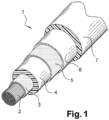
- FIG. 1 represents a schematic view of an electric cable according to a preferred embodiment in accordance with the invention.
- the medium or high voltage electric cable 1 in accordance with the first object of the invention, illustrated in the figure 1 comprises a central elongated electrically conductive element 2, in particular made of copper or aluminum.
- the electric cable 1 further comprises several layers arranged successively and coaxially around this electrically central elongated conductor 2, namely: a first semi-conducting layer 3 called “internal semi-conducting layer”, an electrically insulating layer 4, a second semi-conducting layer 5 called “external semi-conducting layer”, a metal screen 6 earthing and/or protection, and an outer protective sheath 7.
- the electrically insulating layer 4 is a non-crosslinked extruded layer, obtained from the polymer composition as defined in the invention.
- Semiconductor layers 3 and 5 are thermoplastic extruded layers (i.e. non-crosslinked).
- composition I1 in accordance with the invention ie comprising at least one thermoplastic polymer material based on polypropylene and at least aluminum oxide as inorganic filler, was compared with a comparative composition C1 , the composition C1 corresponding to a composition comprising a thermoplastic polymer material based on polypropylene identical to that used for the composition of the invention I1 but comprising instead of aluminum oxide, kaolin as an inorganic filler.
- Table 1 below collates polymer compositions, the amounts of the compounds of which are expressed as percentages by weight, relative to the total weight of the polymer composition.
- compositions collated in Table 1 are implemented as follows.
- the liquid mixture is then mixed with the following constituents: heterophase propylene copolymer, random propylene copolymer, high-density polyethylene of the compositions C1 and I1 referenced in Table 1, for each polymer layer to be considered, in a container. Then, the resulting mixture and the inorganic filler, for each polymer layer to be considered, is homogenized using a twin-screw extruder (“Berstorff twin screw extruder”) at a temperature of approximately 145 to 180° C., then melted at approximately 200°C (screw speed: 80 rpm).
- twin-screw extruder twin-screw extruder
- the homogenized and molten mixture is then put into the form of granules.
- the granules were then hot pressed to form layers in the form of plates.
- Each of the polymer compositions C1 and I1 was thus prepared in the form of layers 1 mm thick for the evaluation of their mechanical properties and also of layers 8 mm thick to perform the thermal conductivity measurements.
- compositions C1 and I1 were then compared from the point of view of their mechanical properties (tensile strength/elongation at break before and after aging at 135° C. for 240 hours) and of their thermal conductivity.
- RT tensile strength
- ER elongation at break
- thermal conductivity results show that the presence of an inorganic filler as defined in the invention in a polypropylene matrix results in an electrically insulating layer having a higher thermal conductivity than an electrically insulating layer in which the inorganic filler is chalk.
Landscapes
- Chemical & Material Sciences (AREA)
- Health & Medical Sciences (AREA)
- Chemical Kinetics & Catalysis (AREA)
- Medicinal Chemistry (AREA)
- Polymers & Plastics (AREA)
- Organic Chemistry (AREA)
- Physics & Mathematics (AREA)
- Spectroscopy & Molecular Physics (AREA)
- Engineering & Computer Science (AREA)
- Manufacturing & Machinery (AREA)
- Compositions Of Macromolecular Compounds (AREA)
- Organic Insulating Materials (AREA)
- Inorganic Insulating Materials (AREA)
Claims (13)
- Elektrisches Kabel, umfassend mindestens ein verlängertes elektrisch leitendes Element und mindestens eine elektrisch isolierende Schicht, erhalten aus einer Polymerzusammensetzung, umfassend mindestens ein thermoplastisches Polymermaterial auf der Grundlage von Polypropylen und mindestens einen anorganischen Füllstoff, wobei der anorganische Füllstoff ausgewählt ist aus Aluminiumoxid, Aluminiumoxydhydrat, Magnesiumoxyd, Zinkoxyd und eine ihrer Mischungen, wobei die Polymerzusammensetzung außerdem eine dielektrische Flüssigkeit umfasst, dadurch gekennzeichnet, dass der anorganische Füllstoff mindestens 10 Gew% mit Bezug auf das Gesamtgewicht der Zusammensetzung umfasst.
- Elektrisches Kabel (1) nach Anspruch 1, dadurch gekennzeichnet, dass der anorganische Füllstoff Aluminiumoxid ist.
- Elektrisches Kabel (1) nach einem der vorhergehenden Ansprüche, dadurch gekennzeichnet, dass der anorganische Füllstoff die Form von Partikeln mit einer Abmessung aufweist, die von 0,01 bis 6 µm reicht.
- Elektrisches Kabel (1) nach einem der vorhergehenden Ansprüche, dadurch gekennzeichnet, dass das thermoplastische Polymermaterial auf der Grundlage von Polypropylen ein Propylencopolymer P1 umfasst.
- Elektrisches Kabel (1) nach Anspruch 4, dadurch gekennzeichnet, dass das Propylencopolymer P1 ein statisches Propylencopolymer oder ein heterophasisches Propylencopolymer ist.
- Elektrisches Kabel (1) nach einem der vorhergehenden Ansprüche, dadurch gekennzeichnet, dass das thermoplastische Polymermaterial auf der Grundlage von Polypropylen ein statisches Propylencopolymer und ein hererophasisches Propylencopolymer oder zwei verschiedene heterophasische Propylencopolymere umfasst.
- Elektrisches Kabel (1) nach einem der Ansprüche 4 bis 6, dadurch gekennzeichnet, dass das thermoplastische Polymermaterial auf der Grundlage von Polypropylen außerdem ein Olefinhomopolymer oder -copolymer P2 umfasst.
- Elektrisches Kabel (1) nach einem der vorhergehenden Ansprüche, dadurch gekennzeichnet, dass die dielektrische Flüssigkeit mindestens ein mineralisches Öl umfasst.
- Elektrisches Kabel (1) nach einem der vorhergehenden Ansprüche, dadurch gekennzeichnet, dass die elektrisch isolierende Schicht eine nicht vernetzte Schicht ist.
- Elektrisches Kabel (1) nach einem der vorhergehenden Ansprüche, dadurch gekennzeichnet, dass die elektrisch isolierende Schicht eine Zugfestigkeit vor oder nach der Alterung von mindestens 8,5 MPa aufweist.
- Elektrisches Kabel (1) nach einem der vorhergehenden Ansprüche, dadurch gekennzeichnet, dass die elektrisch isolierende Schicht eine Reißdehnung vor oder nach der Alterung von mindestens 250 % aufweist.
- Elektrisches Kabel (1) nach einem der vorhergehenden Ansprüche, dadurch gekennzeichnet, dass es Folgendes umfasst:- mindestens eine halbleitende Schicht (3, 5), die das längliche elektrisch leitende Element (2) umgibt, und- mindestens eine elektrisch isolierende Schicht (4), die das längliche elektrisch leitende Element (2) umgibt,wobei die elektrisch isolierende Schicht wie in einem der vorhergehenden Ansprüche definiert ist.
- Verfahren zur Herstellung eines elektrischen Kabels, wie in einem der vorhergehenden Ansprüche definiert, dadurch gekennzeichnet, dass es mindestens einen Schritt 1) des Extrudierens der Polymerzusammensetzung um das längliche elektrisch leitende Element (2) umfasst, um eine elektrisch isolierende Schicht zu erhalten, die das längliche elektrisch leitende Element umgibt.
Applications Claiming Priority (1)
| Application Number | Priority Date | Filing Date | Title |
|---|---|---|---|
| FR1908652A FR3099631B1 (fr) | 2019-07-30 | 2019-07-30 | Câble électrique présentant une conductivité thermique améliorée |
Publications (3)
| Publication Number | Publication Date |
|---|---|
| EP3772069A1 EP3772069A1 (de) | 2021-02-03 |
| EP3772069B1 true EP3772069B1 (de) | 2023-06-07 |
| EP3772069C0 EP3772069C0 (de) | 2023-06-07 |
Family
ID=69104550
Family Applications (1)
| Application Number | Title | Priority Date | Filing Date |
|---|---|---|---|
| EP20188285.9A Active EP3772069B1 (de) | 2019-07-30 | 2020-07-29 | Elektrisches kabel mit verbesserter wärmeleitfähigkeit |
Country Status (5)
| Country | Link |
|---|---|
| US (1) | US12062470B2 (de) |
| EP (1) | EP3772069B1 (de) |
| KR (1) | KR20210016279A (de) |
| CN (1) | CN112300496A (de) |
| FR (1) | FR3099631B1 (de) |
Families Citing this family (1)
| Publication number | Priority date | Publication date | Assignee | Title |
|---|---|---|---|---|
| FR3119484A1 (fr) * | 2021-02-03 | 2022-08-05 | Nexans | Câble électrique présentant une conductivité thermique améliorée |
Citations (2)
| Publication number | Priority date | Publication date | Assignee | Title |
|---|---|---|---|---|
| EP2528968A1 (de) * | 2010-01-29 | 2012-12-05 | Prysmian S.p.A. | Stromkabel |
| US20130008691A1 (en) * | 2010-04-05 | 2013-01-10 | Autonetworks Technologies, Ltd. | Composition for wire coating, insulated, and wiring harness |
Family Cites Families (10)
| Publication number | Priority date | Publication date | Assignee | Title |
|---|---|---|---|---|
| US4221882A (en) * | 1979-01-31 | 1980-09-09 | Exxon Research & Engineering Co. | High impact melt-flowable dual continuum melt mixed polymer blends of polypropylene, polyethylene, and ethylene-propylene rubber |
| IT1293759B1 (it) * | 1997-07-23 | 1999-03-10 | Pirelli Cavi S P A Ora Pirelli | Cavi con rivestimento riciclabile a bassa deformazione residua |
| US20020143089A1 (en) * | 2001-01-23 | 2002-10-03 | Ettore Minghetti | Plastic sheets with improved wear resistance and methods of production |
| US20080271832A1 (en) * | 2007-05-04 | 2008-11-06 | Tyco Electronics Corporation | Thermo-conductive, heat-shrinkable, dual-wall tubing |
| KR20170139696A (ko) * | 2010-11-25 | 2017-12-19 | 프리즈미안 에스피에이 | 전압 안정화 열가소성 전기 절연층을 가진 에너지 케이블 |
| EP2879135A1 (de) * | 2013-11-28 | 2015-06-03 | Nexans | Feuerfeste Zusammensetzungen |
| JP2017506414A (ja) * | 2014-02-07 | 2017-03-02 | ジェネラル・ケーブル・テクノロジーズ・コーポレーション | 改善されたカバーを備えるケーブルを形成する方法 |
| FR3045920B1 (fr) * | 2015-12-18 | 2018-01-19 | Nexans | Cable electrique a moyenne ou haute tension |
| FR3064106B1 (fr) | 2017-03-17 | 2021-07-30 | Nexans | Cable electrique presentant une conductivite thermique amelioree |
| JP7272276B2 (ja) * | 2017-12-15 | 2023-05-12 | 住友電気工業株式会社 | 絶縁材用樹脂組成物、絶縁材、絶縁電線及びケーブル |
-
2019
- 2019-07-30 FR FR1908652A patent/FR3099631B1/fr not_active Expired - Fee Related
-
2020
- 2020-07-29 KR KR1020200094237A patent/KR20210016279A/ko not_active Withdrawn
- 2020-07-29 US US16/942,244 patent/US12062470B2/en active Active
- 2020-07-29 CN CN202010743991.8A patent/CN112300496A/zh active Pending
- 2020-07-29 EP EP20188285.9A patent/EP3772069B1/de active Active
Patent Citations (2)
| Publication number | Priority date | Publication date | Assignee | Title |
|---|---|---|---|---|
| EP2528968A1 (de) * | 2010-01-29 | 2012-12-05 | Prysmian S.p.A. | Stromkabel |
| US20130008691A1 (en) * | 2010-04-05 | 2013-01-10 | Autonetworks Technologies, Ltd. | Composition for wire coating, insulated, and wiring harness |
Non-Patent Citations (1)
| Title |
|---|
| XIAO MENG ET AL: "Review of high thermal conductivity polymer dielectrics for electrical insulation", HIGH VOLTAGE, THE INSTITUTION OF ENGINEERING AND TECHNOLOGY, MICHAEL FARADAY HOUSE, SIX HILLS WAY, STEVENAGE, HERTS. SG1 2AY, UK, vol. 1, no. 1, 1 April 2016 (2016-04-01), pages 34 - 42, XP006056333, DOI: 10.1049/HVE.2016.0008 * |
Also Published As
| Publication number | Publication date |
|---|---|
| CN112300496A (zh) | 2021-02-02 |
| US20210074451A1 (en) | 2021-03-11 |
| FR3099631B1 (fr) | 2022-02-18 |
| KR20210016279A (ko) | 2021-02-15 |
| EP3772069C0 (de) | 2023-06-07 |
| EP3772069A1 (de) | 2021-02-03 |
| US12062470B2 (en) | 2024-08-13 |
| FR3099631A1 (fr) | 2021-02-05 |
Similar Documents
| Publication | Publication Date | Title |
|---|---|---|
| EP3596739B1 (de) | Elektrisches kabel mit verbesserter thermischer leitfähigkeit | |
| CN108701507B (zh) | 中压或高压电缆 | |
| EP3671769A1 (de) | Elektrisches kabel mit verbesserter temperaturalterungsbeständigkeit | |
| EP3390529B1 (de) | Polymerzusammensetzung mit grösserer widerstandsfähigkeit gegen weissbruch | |
| US12073965B2 (en) | Water tree resistant electric cable | |
| EP3772069A1 (de) | Elektrisches kabel mit verbesserter wärmeleitfähigkeit | |
| EP3670602A1 (de) | Polymerzusammensetzung, die mindestens zwei homophasische polymere umfasst | |
| EP4405985A1 (de) | Elektrisches kabel mit einer halbleiterschicht mit glatter oberfläche | |
| FR3107985A1 (fr) | câble comprenant une couche semiconductrice présentant une surface lisse | |
| EP4288983A1 (de) | Elektrisches kabel mit verbesserter wärmeleitfähigkeit | |
| EP4264644A1 (de) | Verfahren zur herstellung eines elektrischen kabels mit verbesserter wärmeleitfähigkeit | |
| EP3670601A1 (de) | Kabel, das eine leicht abziehbare halbleiterschicht umfasst | |
| WO2022129735A1 (fr) | Procédé de fabrication d'un câble électrique présentant une conductivité thermique améliorée | |
| WO2016005791A1 (en) | Energy cable having a thermoplastic electrically insulating layer |
Legal Events
| Date | Code | Title | Description |
|---|---|---|---|
| PUAI | Public reference made under article 153(3) epc to a published international application that has entered the european phase |
Free format text: ORIGINAL CODE: 0009012 |
|
| STAA | Information on the status of an ep patent application or granted ep patent |
Free format text: STATUS: THE APPLICATION HAS BEEN PUBLISHED |
|
| AK | Designated contracting states |
Kind code of ref document: A1 Designated state(s): AL AT BE BG CH CY CZ DE DK EE ES FI FR GB GR HR HU IE IS IT LI LT LU LV MC MK MT NL NO PL PT RO RS SE SI SK SM TR |
|
| AX | Request for extension of the european patent |
Extension state: BA ME |
|
| TPAC | Observations filed by third parties |
Free format text: ORIGINAL CODE: EPIDOSNTIPA |
|
| TPAC | Observations filed by third parties |
Free format text: ORIGINAL CODE: EPIDOSNTIPA |
|
| STAA | Information on the status of an ep patent application or granted ep patent |
Free format text: STATUS: REQUEST FOR EXAMINATION WAS MADE |
|
| 17P | Request for examination filed |
Effective date: 20210803 |
|
| RBV | Designated contracting states (corrected) |
Designated state(s): AL AT BE BG CH CY CZ DE DK EE ES FI FR GB GR HR HU IE IS IT LI LT LU LV MC MK MT NL NO PL PT RO RS SE SI SK SM TR |
|
| STAA | Information on the status of an ep patent application or granted ep patent |
Free format text: STATUS: EXAMINATION IS IN PROGRESS |
|
| 17Q | First examination report despatched |
Effective date: 20211013 |
|
| GRAP | Despatch of communication of intention to grant a patent |
Free format text: ORIGINAL CODE: EPIDOSNIGR1 |
|
| STAA | Information on the status of an ep patent application or granted ep patent |
Free format text: STATUS: GRANT OF PATENT IS INTENDED |
|
| INTG | Intention to grant announced |
Effective date: 20221103 |
|
| GRAS | Grant fee paid |
Free format text: ORIGINAL CODE: EPIDOSNIGR3 |
|
| GRAA | (expected) grant |
Free format text: ORIGINAL CODE: 0009210 |
|
| STAA | Information on the status of an ep patent application or granted ep patent |
Free format text: STATUS: THE PATENT HAS BEEN GRANTED |
|
| AK | Designated contracting states |
Kind code of ref document: B1 Designated state(s): AL AT BE BG CH CY CZ DE DK EE ES FI FR GB GR HR HU IE IS IT LI LT LU LV MC MK MT NL NO PL PT RO RS SE SI SK SM TR |
|
| REG | Reference to a national code |
Ref country code: GB Ref legal event code: FG4D Free format text: NOT ENGLISH |
|
| REG | Reference to a national code |
Ref country code: CH Ref legal event code: EP Ref country code: AT Ref legal event code: REF Ref document number: 1577454 Country of ref document: AT Kind code of ref document: T Effective date: 20230615 Ref country code: DE Ref legal event code: R096 Ref document number: 602020011623 Country of ref document: DE |
|
| U01 | Request for unitary effect filed |
Effective date: 20230705 |
|
| U07 | Unitary effect registered |
Designated state(s): AT BE BG DE DK EE FI FR IT LT LU LV MT NL PT SE SI Effective date: 20230713 |
|
| REG | Reference to a national code |
Ref country code: NO Ref legal event code: T2 Effective date: 20230607 |
|
| REG | Reference to a national code |
Ref country code: LT Ref legal event code: MG9D |
|
| U20 | Renewal fee for the european patent with unitary effect paid |
Year of fee payment: 4 Effective date: 20230914 |
|
| PG25 | Lapsed in a contracting state [announced via postgrant information from national office to epo] |
Ref country code: ES Free format text: LAPSE BECAUSE OF FAILURE TO SUBMIT A TRANSLATION OF THE DESCRIPTION OR TO PAY THE FEE WITHIN THE PRESCRIBED TIME-LIMIT Effective date: 20230607 |
|
| PG25 | Lapsed in a contracting state [announced via postgrant information from national office to epo] |
Ref country code: RS Free format text: LAPSE BECAUSE OF FAILURE TO SUBMIT A TRANSLATION OF THE DESCRIPTION OR TO PAY THE FEE WITHIN THE PRESCRIBED TIME-LIMIT Effective date: 20230607 Ref country code: HR Free format text: LAPSE BECAUSE OF FAILURE TO SUBMIT A TRANSLATION OF THE DESCRIPTION OR TO PAY THE FEE WITHIN THE PRESCRIBED TIME-LIMIT Effective date: 20230607 Ref country code: GR Free format text: LAPSE BECAUSE OF FAILURE TO SUBMIT A TRANSLATION OF THE DESCRIPTION OR TO PAY THE FEE WITHIN THE PRESCRIBED TIME-LIMIT Effective date: 20230908 |
|
| PG25 | Lapsed in a contracting state [announced via postgrant information from national office to epo] |
Ref country code: SK Free format text: LAPSE BECAUSE OF FAILURE TO SUBMIT A TRANSLATION OF THE DESCRIPTION OR TO PAY THE FEE WITHIN THE PRESCRIBED TIME-LIMIT Effective date: 20230607 |
|
| PG25 | Lapsed in a contracting state [announced via postgrant information from national office to epo] |
Ref country code: IS Free format text: LAPSE BECAUSE OF FAILURE TO SUBMIT A TRANSLATION OF THE DESCRIPTION OR TO PAY THE FEE WITHIN THE PRESCRIBED TIME-LIMIT Effective date: 20231007 |
|
| PG25 | Lapsed in a contracting state [announced via postgrant information from national office to epo] |
Ref country code: SM Free format text: LAPSE BECAUSE OF FAILURE TO SUBMIT A TRANSLATION OF THE DESCRIPTION OR TO PAY THE FEE WITHIN THE PRESCRIBED TIME-LIMIT Effective date: 20230607 Ref country code: SK Free format text: LAPSE BECAUSE OF FAILURE TO SUBMIT A TRANSLATION OF THE DESCRIPTION OR TO PAY THE FEE WITHIN THE PRESCRIBED TIME-LIMIT Effective date: 20230607 Ref country code: RO Free format text: LAPSE BECAUSE OF FAILURE TO SUBMIT A TRANSLATION OF THE DESCRIPTION OR TO PAY THE FEE WITHIN THE PRESCRIBED TIME-LIMIT Effective date: 20230607 Ref country code: IS Free format text: LAPSE BECAUSE OF FAILURE TO SUBMIT A TRANSLATION OF THE DESCRIPTION OR TO PAY THE FEE WITHIN THE PRESCRIBED TIME-LIMIT Effective date: 20231007 Ref country code: CZ Free format text: LAPSE BECAUSE OF FAILURE TO SUBMIT A TRANSLATION OF THE DESCRIPTION OR TO PAY THE FEE WITHIN THE PRESCRIBED TIME-LIMIT Effective date: 20230607 |
|
| PG25 | Lapsed in a contracting state [announced via postgrant information from national office to epo] |
Ref country code: PL Free format text: LAPSE BECAUSE OF FAILURE TO SUBMIT A TRANSLATION OF THE DESCRIPTION OR TO PAY THE FEE WITHIN THE PRESCRIBED TIME-LIMIT Effective date: 20230607 |
|
| REG | Reference to a national code |
Ref country code: CH Ref legal event code: PL |
|
| REG | Reference to a national code |
Ref country code: DE Ref legal event code: R097 Ref document number: 602020011623 Country of ref document: DE |
|
| PG25 | Lapsed in a contracting state [announced via postgrant information from national office to epo] |
Ref country code: MC Free format text: LAPSE BECAUSE OF FAILURE TO SUBMIT A TRANSLATION OF THE DESCRIPTION OR TO PAY THE FEE WITHIN THE PRESCRIBED TIME-LIMIT Effective date: 20230607 |
|
| TPAC | Observations filed by third parties |
Free format text: ORIGINAL CODE: EPIDOSNTIPA |
|
| PG25 | Lapsed in a contracting state [announced via postgrant information from national office to epo] |
Ref country code: MC Free format text: LAPSE BECAUSE OF FAILURE TO SUBMIT A TRANSLATION OF THE DESCRIPTION OR TO PAY THE FEE WITHIN THE PRESCRIBED TIME-LIMIT Effective date: 20230607 |
|
| PLBE | No opposition filed within time limit |
Free format text: ORIGINAL CODE: 0009261 |
|
| STAA | Information on the status of an ep patent application or granted ep patent |
Free format text: STATUS: NO OPPOSITION FILED WITHIN TIME LIMIT |
|
| REG | Reference to a national code |
Ref country code: IE Ref legal event code: MM4A |
|
| PG25 | Lapsed in a contracting state [announced via postgrant information from national office to epo] |
Ref country code: CH Free format text: LAPSE BECAUSE OF NON-PAYMENT OF DUE FEES Effective date: 20230731 |
|
| 26N | No opposition filed |
Effective date: 20240308 |
|
| PG25 | Lapsed in a contracting state [announced via postgrant information from national office to epo] |
Ref country code: IE Free format text: LAPSE BECAUSE OF NON-PAYMENT OF DUE FEES Effective date: 20230729 |
|
| PG25 | Lapsed in a contracting state [announced via postgrant information from national office to epo] |
Ref country code: IE Free format text: LAPSE BECAUSE OF NON-PAYMENT OF DUE FEES Effective date: 20230729 |
|
| U20 | Renewal fee for the european patent with unitary effect paid |
Year of fee payment: 5 Effective date: 20240724 |
|
| GBPC | Gb: european patent ceased through non-payment of renewal fee |
Effective date: 20240729 |
|
| PG25 | Lapsed in a contracting state [announced via postgrant information from national office to epo] |
Ref country code: GB Free format text: LAPSE BECAUSE OF NON-PAYMENT OF DUE FEES Effective date: 20240729 |
|
| U1N | Appointed representative for the unitary patent procedure changed after the registration of the unitary effect |
Representative=s name: CABINET BOETTCHER; FR |
|
| PG25 | Lapsed in a contracting state [announced via postgrant information from national office to epo] |
Ref country code: CY Free format text: LAPSE BECAUSE OF FAILURE TO SUBMIT A TRANSLATION OF THE DESCRIPTION OR TO PAY THE FEE WITHIN THE PRESCRIBED TIME-LIMIT; INVALID AB INITIO Effective date: 20200729 |
|
| PG25 | Lapsed in a contracting state [announced via postgrant information from national office to epo] |
Ref country code: HU Free format text: LAPSE BECAUSE OF FAILURE TO SUBMIT A TRANSLATION OF THE DESCRIPTION OR TO PAY THE FEE WITHIN THE PRESCRIBED TIME-LIMIT; INVALID AB INITIO Effective date: 20200729 |
|
| U20 | Renewal fee for the european patent with unitary effect paid |
Year of fee payment: 6 Effective date: 20250728 |
|
| PGFP | Annual fee paid to national office [announced via postgrant information from national office to epo] |
Ref country code: NO Payment date: 20250725 Year of fee payment: 6 |
|
| PG25 | Lapsed in a contracting state [announced via postgrant information from national office to epo] |
Ref country code: TR Free format text: LAPSE BECAUSE OF FAILURE TO SUBMIT A TRANSLATION OF THE DESCRIPTION OR TO PAY THE FEE WITHIN THE PRESCRIBED TIME-LIMIT Effective date: 20230607 |