EP4435779B1 - Verbesserte block-basierte harmonische teilband-transposition - Google Patents
Verbesserte block-basierte harmonische teilband-transposition Download PDFInfo
- Publication number
- EP4435779B1 EP4435779B1 EP24193627.7A EP24193627A EP4435779B1 EP 4435779 B1 EP4435779 B1 EP 4435779B1 EP 24193627 A EP24193627 A EP 24193627A EP 4435779 B1 EP4435779 B1 EP 4435779B1
- Authority
- EP
- European Patent Office
- Prior art keywords
- subband
- samples
- analysis
- input
- signal
- Prior art date
- Legal status (The legal status is an assumption and is not a legal conclusion. Google has not performed a legal analysis and makes no representation as to the accuracy of the status listed.)
- Active
Links
Images

Classifications
-
- G—PHYSICS
- G10—MUSICAL INSTRUMENTS; ACOUSTICS
- G10L—SPEECH ANALYSIS TECHNIQUES OR SPEECH SYNTHESIS; SPEECH RECOGNITION; SPEECH OR VOICE PROCESSING TECHNIQUES; SPEECH OR AUDIO CODING OR DECODING
- G10L19/00—Speech or audio signals analysis-synthesis techniques for redundancy reduction, e.g. in vocoders; Coding or decoding of speech or audio signals, using source filter models or psychoacoustic analysis
- G10L19/02—Speech or audio signals analysis-synthesis techniques for redundancy reduction, e.g. in vocoders; Coding or decoding of speech or audio signals, using source filter models or psychoacoustic analysis using spectral analysis, e.g. transform vocoders or subband vocoders
- G10L19/0204—Speech or audio signals analysis-synthesis techniques for redundancy reduction, e.g. in vocoders; Coding or decoding of speech or audio signals, using source filter models or psychoacoustic analysis using spectral analysis, e.g. transform vocoders or subband vocoders using subband decomposition
-
- G—PHYSICS
- G10—MUSICAL INSTRUMENTS; ACOUSTICS
- G10L—SPEECH ANALYSIS TECHNIQUES OR SPEECH SYNTHESIS; SPEECH RECOGNITION; SPEECH OR VOICE PROCESSING TECHNIQUES; SPEECH OR AUDIO CODING OR DECODING
- G10L19/00—Speech or audio signals analysis-synthesis techniques for redundancy reduction, e.g. in vocoders; Coding or decoding of speech or audio signals, using source filter models or psychoacoustic analysis
- G10L19/02—Speech or audio signals analysis-synthesis techniques for redundancy reduction, e.g. in vocoders; Coding or decoding of speech or audio signals, using source filter models or psychoacoustic analysis using spectral analysis, e.g. transform vocoders or subband vocoders
- G10L19/022—Blocking, i.e. grouping of samples in time; Choice of analysis windows; Overlap factoring
-
- G—PHYSICS
- G10—MUSICAL INSTRUMENTS; ACOUSTICS
- G10L—SPEECH ANALYSIS TECHNIQUES OR SPEECH SYNTHESIS; SPEECH RECOGNITION; SPEECH OR VOICE PROCESSING TECHNIQUES; SPEECH OR AUDIO CODING OR DECODING
- G10L19/00—Speech or audio signals analysis-synthesis techniques for redundancy reduction, e.g. in vocoders; Coding or decoding of speech or audio signals, using source filter models or psychoacoustic analysis
- G10L19/02—Speech or audio signals analysis-synthesis techniques for redundancy reduction, e.g. in vocoders; Coding or decoding of speech or audio signals, using source filter models or psychoacoustic analysis using spectral analysis, e.g. transform vocoders or subband vocoders
- G10L19/032—Quantisation or dequantisation of spectral components
-
- G—PHYSICS
- G10—MUSICAL INSTRUMENTS; ACOUSTICS
- G10L—SPEECH ANALYSIS TECHNIQUES OR SPEECH SYNTHESIS; SPEECH RECOGNITION; SPEECH OR VOICE PROCESSING TECHNIQUES; SPEECH OR AUDIO CODING OR DECODING
- G10L21/00—Speech or voice signal processing techniques to produce another audible or non-audible signal, e.g. visual or tactile, in order to modify its quality or its intelligibility
- G10L21/02—Speech enhancement, e.g. noise reduction or echo cancellation
-
- G—PHYSICS
- G10—MUSICAL INSTRUMENTS; ACOUSTICS
- G10L—SPEECH ANALYSIS TECHNIQUES OR SPEECH SYNTHESIS; SPEECH RECOGNITION; SPEECH OR VOICE PROCESSING TECHNIQUES; SPEECH OR AUDIO CODING OR DECODING
- G10L21/00—Speech or voice signal processing techniques to produce another audible or non-audible signal, e.g. visual or tactile, in order to modify its quality or its intelligibility
- G10L21/02—Speech enhancement, e.g. noise reduction or echo cancellation
- G10L21/038—Speech enhancement, e.g. noise reduction or echo cancellation using band spreading techniques
-
- G—PHYSICS
- G10—MUSICAL INSTRUMENTS; ACOUSTICS
- G10L—SPEECH ANALYSIS TECHNIQUES OR SPEECH SYNTHESIS; SPEECH RECOGNITION; SPEECH OR VOICE PROCESSING TECHNIQUES; SPEECH OR AUDIO CODING OR DECODING
- G10L21/00—Speech or voice signal processing techniques to produce another audible or non-audible signal, e.g. visual or tactile, in order to modify its quality or its intelligibility
- G10L21/04—Time compression or expansion
-
- G—PHYSICS
- G10—MUSICAL INSTRUMENTS; ACOUSTICS
- G10L—SPEECH ANALYSIS TECHNIQUES OR SPEECH SYNTHESIS; SPEECH RECOGNITION; SPEECH OR VOICE PROCESSING TECHNIQUES; SPEECH OR AUDIO CODING OR DECODING
- G10L25/00—Speech or voice analysis techniques not restricted to a single one of groups G10L15/00 - G10L21/00
- G10L25/03—Speech or voice analysis techniques not restricted to a single one of groups G10L15/00 - G10L21/00 characterised by the type of extracted parameters
- G10L25/18—Speech or voice analysis techniques not restricted to a single one of groups G10L15/00 - G10L21/00 characterised by the type of extracted parameters the extracted parameters being spectral information of each sub-band
Definitions
- the present document relates to audio source coding systems which make use of a harmonic transposition method for high frequency reconstruction (HFR), as well as to digital effect processors, e.g. exciters, where generation of harmonic distortion add brightness to the processed signal, and to time stretchers where a signal duration is prolonged with maintained spectral content.
- HFR high frequency reconstruction
- digital effect processors e.g. exciters
- WO 98/57436 the concept of transposition was established as a method to recreate a high frequency band from a lower frequency band of an audio signal. A substantial saving in bitrate can be obtained by using this concept in audio coding.
- a low bandwidth signal is presented to a core waveform coder and the higher frequencies are regenerated using transposition and additional side information of very low bitrate describing the target spectral shape at the decoder side.
- the harmonic transposition defined in WO 98/57436 performs well for complex musical material in a situation with low cross over frequency.
- a harmonic transposition The principle of a harmonic transposition is that a sinusoid with frequency ⁇ is mapped to a sinusoid with frequency Q ⁇ ⁇ where Q ⁇ > 1 is an integer defining the order of the transposition.
- a single sideband modulation (SSB) based HFR maps a sinusoid with frequency ⁇ to a sinusoid with frequency ⁇ + ⁇ ⁇ where ⁇ ⁇ is a fixed frequency shift. Given a core signal with low bandwidth, a dissonant ringing artifact will typically result from the SSB transposition.
- SSB single sideband modulation
- harmonic transposition based HFR are generally preferred over SSB based HFR.
- high quality harmonic transposition based HFR methods typically employ complex modulated filterbanks with a fine frequency resolution and a high degree of oversampling in order to reach the required audio quality.
- the fine frequency resolution is usually employed to avoid unwanted intermodulation distortion arising from the nonlinear treatment or processing of the different subband signals which may be regarded as sums of a plurality of sinusoids.
- the high quality harmonic transposition based HFR methods aim at having at most one sinusoid in each subband. As a result, intermodulation distortion caused by the nonlinear processing may be avoided.
- a high degree of oversampling in time may be beneficial in order to avoid an alias type of distortion, which may be caused by the filterbanks and the nonlinear processing.
- a certain degree of oversampling in frequency may be necessary to avoid pre-echoes for transient signals caused by the nonlinear processing of the subband signals.
- harmonic transposition based HFR methods generally make use of two blocks of filterbank based processing.
- a first portion of the harmonic transposition based HFR typically employs an analysis/synthesis filterbank with a high frequency resolution and with time and/or frequency oversampling in order to generate a high frequency signal component from a low frequency signal component.
- a second portion of harmonic transposition based HFR typically employs a filterbank with a relatively coarse frequency resolution, e.g. a QMF filterbank, which is used to apply spectral side information or HFR information to the high frequency component, i.e. to perform the so-called HFR processing, in order to generate a high frequency component having the desired spectral shape.
- the second portion of filterbanks is also used to combine the low frequency signal component with the modified high frequency signal component in order to provide the decoded audio signal.
- harmonic transposition based HFR may be relatively high. Consequently, there is a need to provide harmonic transposition based HFR methods with reduced computational complexity, which at the same time provides good audio quality for various types of audio signals (e.g. transient and stationary audio signals).
- so-called subband block based harmonic transposition may be used to suppress intermodulation products caused by the nonlinear processing of the subband signals. I.e. by performing a block based nonlinear processing of the subband signals of a harmonic transposer, the intermodulation products within the subbands may be suppressed or reduced.
- harmonic transposition which makes use of an analysis/synthesis filterbank with a relatively coarse frequency resolution and/or a relatively low degree of oversampling may be applied.
- a QMF filterbank may be applied.
- the block based nonlinear processing of a subband block based harmonic transposition system comprises the processing of a time block of complex subband samples.
- the processing of a block of complex subband samples may comprise a common phase modification of the complex subband samples and the superposition of several modified samples to form an output subband sample.
- This block based processing has the net effect of suppressing or reducing intermodulation products which would otherwise occur for input subband signals comprising of several sinusoids.
- harmonic transposition based on block based subband processing may have reduced computational complexity compared with high quality harmonic transposers, i.e. harmonic transposers having a fine frequency resolution and using sample based processing.
- harmonic transposers having a fine frequency resolution and using sample based processing.
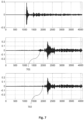
- the audio quality obtained for transient audio signals is generally reduced compared to the audio quality which may be achieved with high quality sample based harmonic transposers, i.e. harmonic transposers using a fine frequency resolution. It has been identified that the reduced quality for transient signals may be due to the time smearing caused by the block processing.
- each transposition order Q ⁇ of block based harmonic transposition requires a different analysis and synthesis filter bank framework.
- the quality improvement may be obtained by means of a fixed or signal adaptive modification of the nonlinear block processing.
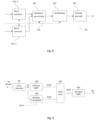
- the reduction of computational complexity may be achieved by efficiently implementing several orders of subband block based transposition in the framework of a single analysis and synthesis filterbank pair.
- one single analysis/synthesis filterbank e.g. a QMF filterbank, may be used for several orders of harmonic transposition Q ⁇ .
- the same analysis/synthesis filterbank pair may be applied for the harmonic transposition (i.e. the first portion of harmonic transposition based HFR) and the HFR processing (i.e. the second portion of harmonic transposition based HFR), such that the complete harmonic transposition based HFR may rely on one single analysis/synthesis filterbank.
- only one single analysis filterbank may be used at the input side to generate a plurality of analysis subband signals which are subsequently submitted to harmonic transposition processing and HFR processing.
- only one single synthesis filterbank may be used to generate the decoded signal at the output side.
- the system may comprise an analysis filterbank configured to provide an analysis subband signal from the input signal.
- the analysis subband may be associated with a frequency band of the input signal.
- the analysis subband signal may comprise a plurality of complex valued analysis samples, each having a phase and a magnitude.
- the analysis filterbank may be one of a quadrature mirror filterbank, a windowed discrete Fourier transform or a wavelet transform.
- the analysis filterbank may be a 64 point quadrature mirror filterbank. As such, the analysis filterbank may have a coarse frequency resolution.
- the system may comprise a subband processing unit configured to determine a synthesis subband signal from the analysis subband signal using a subband transposition factor Q and a subband stretch factor S . At least one of Q or S may be greater than one.
- the subband processing unit may comprise a block extractor configured to derive a frame of L input samples from the plurality of complex valued analysis samples.
- the frame length L may be greater than one, however, in certain embodiments the frame length L may be equal to one.
- the block extractor may be configured to apply a block hop size of p samples to the plurality of analysis samples, prior to deriving a next frame of L input samples. As a result of repeatedly applying the block hop size to the plurality of analysis samples, a suite of frames of input samples may be generated.
- the frame length L and/or the block hop size p may be arbitrary numbers and do not necessarily need to be integer values.
- the block extractor may be configured to interpolate two or more analysis samples to derive an input sample of a frame of L input samples.
- the block extractor may be configured to downsample the plurality of analysis samples in order to yield an input sample of a frame of L input samples.
- the block extractor may be configured to downsample the plurality of analysis samples by the subband transposition factor Q .
- the block extractor may contribute to the harmonic transposition and/or time stretch by performing a downsampling operation.
- the system may comprise a nonlinear frame processing unit configured to determine a frame of processed samples from a frame of input samples. The determination may be repeated for a suite of frames of input samples, thereby generating a suite of frames of processed samples. The determination may be performed by determining for each processed sample of the frame, the phase of the processed sample by offsetting the phase of the corresponding input sample.
- the nonlinear frame processing unit may be configured to determine the phase of the processed sample by offsetting the phase of the corresponding input sample by a phase offset value which is based on a predetermined input sample from the frame of input samples, the transposition factor Q and the subband stretch factor S .
- the phase offset value may be based on the predetermined input sample multiplied by ( QS - 1).
- the phase offset value may be given by the predetermined input sample multiplied by ( QS - 1) plus a phase correction parameter ⁇ .
- the phase correction parameter ⁇ may be determined experimentally for a plurality of input signals having particular acoustic properties.
- the predetermined input sample is the same for each processed sample of the frame.
- the predetermined input sample may be the center sample of the frame of input samples.
- the determination may be performed by determining for each processed sample of the frame, the magnitude of the processed sample based on the magnitude of the corresponding input sample and the magnitude of the predetermined input sample.
- the nonlinear frame processing unit may be configured to determine the magnitude of the processed sample as a mean value of the magnitude of the corresponding input sample and the magnitude of the predetermined input sample.
- the magnitude of the processed sample may be determined as the geometric mean value of the magnitude of the corresponding input sample and the magnitude of the predetermined input sample. More specifically, the geometric mean value may be determined as the magnitude of the corresponding input sample raised to the power of (1 - ⁇ ), multiplied by the magnitude of the predetermined input sample raised to the power of ⁇ .
- the geometrical magnitude weighting parameter is ⁇ ⁇ (0,1].
- the geometrical magnitude weighting parameter ⁇ may be a function of the subband transposition factor Q and the subband stretch factor S .
- the predetermined input sample used for the determination of the magnitude of the processed sample may be different from the predetermined input sample used for the determination of the phase of the processed sample.
- both predetermined input samples are the same.
- the nonlinear frame processing unit may be used to control the degree of harmonic transposition and/or time stretch of the system. It can be shown that as a result of the determination of the magnitude of the processed sample from the magnitude of the corresponding input sample and from the magnitude of a predetermined input sample, the performance of the system for transient and/or voiced input signals may be improved.
- the system in particular the subband processing unit, may comprise an overlap and add unit configured to determine the synthesis subband signal by overlapping and adding the samples of a suite of frames of processed samples.
- the overlap and add unit may apply a hop size to succeeding frames of processed samples. This hop size may be equal to the block hop size p multiplied by the subband stretch factor S .
- the overlap and add unit may be used to control the degree of time stretching and/or of harmonic transposition of the system.
- the system may comprise a windowing unit upstream of the overlap and add unit.
- the windowing unit may be configured to apply a window function to the frame of processed samples.
- the window function may be applied to a suite of frames of processed samples prior to the overlap and add operation.
- the window function may have a length which corresponds to the frame length L .
- the window function may be one of a Gaussian window, cosine window, raised cosine window, Hamming window, Hann window, rectangular window, Bartlett window, and/or Blackman window.
- the window function comprises a plurality of window samples and the overlapped and added window samples of a plurality of window functions shifted with a hop size of Sp may provide a suite of samples at a significantly constant value K .
- the system may comprise a synthesis filterbank configured to generate the time stretched and/or frequency transposed signal from the synthesis subband signal.
- the synthesis subband may be associated with a frequency band of the time stretched and/or frequency transposed signal.
- the synthesis filterbank may be a corresponding inverse filterbank or transform to the filterbank or transform of the analysis filterbank.
- the synthesis filterbank may be an inverse 64 point quadrature mirror filterbank.
- the analysis filterbank is configured to generate a plurality of analysis subband signals; the subband processing unit is configured to determine a plurality of synthesis subband signals from the plurality of analysis subband signals; and the synthesis filterbank is configured to generate the time stretched and/or frequency transposed signal from the plurality of synthesis subband signals.
- the system may be configured to generate a signal which is time stretched by a physical time stretch factor S ⁇ and/or frequency transposed by a physical frequency transposition factor Q ⁇ .
- the analysis subband index n associated with the analysis subband signal and the synthesis subband index m associated with the synthesis subband signal may be related by n ⁇ ⁇ f S ⁇ f A 1 Q ⁇ m .
- n may be selected as the nearest, i.e. the nearest smaller or larger, integer value to the term ⁇ f S ⁇ f A 1 Q ⁇ m .
- the system may comprise a control data reception unit configured to receive control data reflecting momentary acoustic properties of the input signal.
- momentary acoustic properties may e.g. be reflected by the classification of the input signal into different acoustic property classes.
- classes may comprise a transient property class for a transient signal and/or a stationary property class for a stationary signal.
- the system may comprise a signal classifier or may receive the control data from a signal classifier.
- the signal classifier may be configured to analyze the momentary acoustic properties of the input signal and/or configured to set the control data reflecting the momentary acoustic properties.
- the subband processing unit may be configured to determine the synthesis subband signal by taking into account the control data.
- the block extractor may be configured to set the frame length L according to the control data.
- a short frame length L is set if the control data reflects a transient signal; and/or a long frame length L is set if the control data reflects a stationary signal.
- the frame length L may be shortened for transient signal portions, compared to the frame length L used for stationary signal portions.
- the momentary acoustic properties of the input signal may be taken into account within the subband processing unit. As a result, the performance of the system for transient and/or voiced signals may be improved.
- the analysis filterbank is typically configured to provide a plurality of analysis subband signals.
- the analysis filterbank may be configured to provide a second analysis subband signal from the input signal.
- This second analysis subband signal is typically associated with a different frequency band of the input signal than the analysis subband signal.
- the second analysis subband signal may comprise a plurality of complex valued second analysis samples.
- the subband processing unit may comprise a second block extractor configured to derive a suite of second input samples by applying the block hop size p to the plurality of second analysis samples.
- each second input sample corresponds to a frame of input samples. This correspondence may refer to timing and/or sample aspects.
- a second input sample and the corresponding frame of input samples may relate to same time instances of the input signal.
- the subband processing unit may comprise a second nonlinear frame processing unit configured to determine a frame of second processed samples from a frame of input samples and from the corresponding second input sample.
- the determining of the frame of second processed samples may be performed by determining for each second processed sample of the frame, the phase of the second processed sample by offsetting the phase of the corresponding input sample by a phase offset value which is based on the corresponding second input sample, the transposition factor Q and the subband stretch factor S .
- the phase offset may be performed as outlined in the present document, wherein the second processed sample takes the place of the predetermined input sample.
- the determining of the frame of second processed samples may be performed by determining for each second processed sample of the frame the magnitude of the second processed sample based on the magnitude of the corresponding input sample and the magnitude of the corresponding second input sample.
- the magnitude may be determined as outlined in the present document, wherein the second processed sample takes the place of the predetermined input sample.
- the second nonlinear frame processing unit may be used to derive a frame or a suite of frames of processed samples from frames taken from two different analysis subband signals.
- a particular synthesis subband signal may be derived from two or more different analysis subband signals.
- this may be beneficial in the case where a single analysis and synthesis filterbank pair is used for a plurality of orders of harmonic transposition and/or degrees of time-stretch.
- the relation between the frequency resolution of the analysis and synthesis filterbank may be taken into account.
- the synthesis subband signal may be determined based on the frame of processed samples, i.e. the synthesis subband signal may be determined from a single analysis subband signal corresponding to the integer index n .
- the synthesis subband signal may be determined based on the frame of second processed samples, i.e. the synthesis subband signal may be determined from two analysis subband signals corresponding to the nearest integer index value n and a neighboring integer index value.
- the second analysis subband signal may be correspond to the analysis subband index n + 1 or n - 1.
- a system configured to generate a time stretched and/or frequency transposed signal from an input signal.
- This system is particularly adapted to generate the time stretched and/or frequency transposed signal under the influence of a control signal, and to thereby take into account the momentary acoustic properties of the input signal. This may be particularly relevant for improving the transient response of the system.
- the system may comprise a control data reception unit configured to receive control data reflecting momentary acoustic properties of the input signal.
- the system may comprise an analysis filterbank configured to provide an analysis subband signal from the input signal; wherein the analysis subband signal comprises a plurality of complex valued analysis samples, each having a phase and a magnitude.
- the system may comprise a subband processing unit configured to determine a synthesis subband signal from the analysis subband signal using a subband transposition factor Q , a subband stretch factor S and the control data. Typically, at least one of Q or S is greater than one.
- the subband processing unit may comprise a block extractor configured to derive a frame of L input samples from the plurality of complex valued analysis samples.
- the frame length L may be greater than one.
- the block extractor may be configured to set the frame length L according to the control data.
- the block extractor may also be configured to apply a block hop size of p samples to the plurality of analysis samples, prior to deriving a next frame of L input samples; thereby generating a suite of frames of input samples.
- the subband processing unit may comprise a nonlinear frame processing unit configured to determine a frame of processed samples from a frame of input samples. This may be performed by determining for each processed sample of the frame the phase of the processed sample by offsetting the phase of the corresponding input sample; and by determining for each processed sample of the frame the magnitude of the processed sample based on the magnitude of the corresponding input sample.
- the system may comprise an overlap and add unit configured to determine the synthesis subband signal by overlapping and adding the samples of a suite of frames of processed samples; and a synthesis filterbank configured to generate the time stretched and/or frequency transposed signal from the synthesis subband signal.
- a system configured to generate a time stretched and/or frequency transposed signal from an input signal.
- This system may be particularly well adapted for performing a plurality of time stretch and/or frequency transposition operations within a single analysis / synthesis filterbank pair.
- the system may comprise an analysis filterbank configured to provide a first and a second analysis subband signal from the input signal, wherein the first and the second analysis subband signal each comprise a plurality of complex valued analysis samples, referred to as the first and second analysis samples, respectively, each analysis sample having a phase and a magnitude.
- the first and the second analysis subband signal correspond to different frequency bands of the input signal.
- the system may further comprise a subband processing unit configured to determine a synthesis subband signal from the first and second analysis subband signal using a subband transposition factor Q and a subband stretch factor S .
- a subband processing unit may comprise a first block extractor configured to derive a frame of L first input samples from the plurality of first analysis samples; the frame length L being greater than one.
- the first block extractor may be configured to apply a block hop size of p samples to the plurality of first analysis samples, prior to deriving a next frame of L first input samples; thereby generating a suite of frames of first input samples.
- the subband processing unit may comprise a second block extractor configured to derive a suite of second input samples by applying the block hop size p to the plurality of second analysis samples; wherein each second input sample corresponds to a frame of first input samples.
- the first and second block extractor may have any of the features outlined in the present document.
- the subband processing unit may comprise a nonlinear frame processing unit configured to determine a frame of processed samples from a frame of first input samples and from the corresponding second input sample. This may be performed by determining for each processed sample of the frame the phase of the processed sample by offsetting the phase of the corresponding first input sample; and/or by determining for each processed sample of the frame the magnitude of the processed sample based on the magnitude of the corresponding first input sample and the magnitude of the corresponding second input sample.
- the nonlinear frame processing unit may be configured to determine the phase of the processed sample by offsetting the phase of the corresponding first input sample by a phase offset value which is based on the corresponding second input sample, the transposition factor Q and the subband stretch factor S .
- the subband processing unit may comprise an overlap and add unit configured to determine the synthesis subband signal by overlapping and adding the samples of a suite of frames of processed samples, wherein the overlap and add unit may apply a hop size to succeeding frames of processed samples.
- the hop size may be equal to the block hop size p multiplied by the subband stretch factor S .
- the system may comprise a synthesis filterbank configured to generate the time stretched and/or frequency transposed signal from the synthesis subband signal.
- the different components of the systems described in the present document may comprise any or all of the features outlined with regards to these components in the present document. This is in particular applicable to the analysis and synthesis filterbank, the subband processing unit, the nonlinear processing unit, the block extractors, the overlap and add unit, and/or the window unit described at different parts within this document.
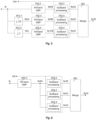
- the systems outlined in the present document may comprise a plurality of subband processing units. Each subband processing unit may be configured to determine an intermediate synthesis subband signal using a different subband transposition factor Q and/or a different subband stretch factor S .
- the systems may further comprise a merging unit downstream of the plurality of subband processing units and upstream of the synthesis filterbank configured to merge corresponding intermediate synthesis subband signals to the synthesis subband signal.
- the systems may be used to perform a plurality of time stretch and/or harmonic transposition operations while using only a single analysis / synthesis filterbank pair.
- the systems may comprise a core decoder upstream of the analysis filterbank configured to decode a bitstream into the input signal.
- the systems may also comprise an HFR processing unit downstream of the merging unit (if such a merging unit is present) and upstream of the synthesis filterbank.
- the HFR processing unit may be configured to apply spectral band information derived from the bitstream to the synthesis subband signal.
- a set-top box for decoding a received signal comprising at least a low frequency component of an audio signal.
- the set-top box may comprise a system according to any of the aspects and features outlined in the present document for generating a high frequency component of the audio signal from the low frequency component of the audio signal.
- a method for generating a time stretched and/or frequency transposed signal from an input signal is described.
- This method is particularly well adapted to enhance the transient response of a time stretch and/or frequency transposition operation.
- the method may comprise the step of providing an analysis subband signal from the input signal, wherein the analysis subband signal comprises a plurality of complex valued analysis samples, each having a phase and a magnitude.
- the method may comprise the step of determining a synthesis subband signal from the analysis subband signal using a subband transposition factor Q and a subband stretch factor S .
- Q or S is greater than one.
- the method may comprise the step of deriving a frame of L input samples from the plurality of complex valued analysis samples, wherein the frame length L is typically greater than one.
- a block hop size of p samples may be applied to the plurality of analysis samples, prior to deriving a next frame of L input samples; thereby generating a suite of frames of input samples.
- the method may comprise the step of determining a frame of processed samples from a frame of input samples.
- This may be performed by determining for each processed sample of the frame the phase of the processed sample by offsetting the phase of the corresponding input sample.
- the magnitude of the processed sample may be determined based on the magnitude of the corresponding input sample and the magnitude of a predetermined input sample.
- the method may further comprise the step of determining the synthesis subband signal by overlapping and adding the samples of a suite of frames of processed samples. Eventually the time stretched and/or frequency transposed signal may be generated from the synthesis subband signal.
- a synthesis subband signal may be determined from the analysis subband signal using a subband transposition factor Q , a subband stretch factor S and the control data.
- Q or S is greater than one.
- the method may comprise the step of deriving a frame of L input samples from the plurality of complex valued analysis samples, wherein the frame length L is typically greater than one and wherein the frame length L is set according to the control data.
- the method may comprise the step of applying a block hop size of p samples to the plurality of analysis samples, prior to deriving a next frame of L input samples, in order to thereby generate a suite of frames of input samples.
- a frame of processed samples may be determined from a frame of input samples, by determining for each processed sample of the frame the phase of the processed sample by offsetting the phase of the corresponding input sample, and the magnitude of the processed sample based on the magnitude of the corresponding input sample.
Landscapes
- Engineering & Computer Science (AREA)
- Physics & Mathematics (AREA)
- Acoustics & Sound (AREA)
- Multimedia (AREA)
- Signal Processing (AREA)
- Health & Medical Sciences (AREA)
- Audiology, Speech & Language Pathology (AREA)
- Human Computer Interaction (AREA)
- Computational Linguistics (AREA)
- Spectroscopy & Molecular Physics (AREA)
- Quality & Reliability (AREA)
- Compression, Expansion, Code Conversion, And Decoders (AREA)
- Vibration Dampers (AREA)
- Production Of Liquid Hydrocarbon Mixture For Refining Petroleum (AREA)
- Braking Arrangements (AREA)
- Superconductors And Manufacturing Methods Therefor (AREA)
- Superheterodyne Receivers (AREA)
Claims (5)
- Teilband-Verarbeitungseinheit (102), die konfiguriert ist zum:Empfangen eines ersten und eines zweiten Analyse-Teilbandsignals eines Audiosignals, wobei das erste und zweite Analyse-Teilbandsignal jeweils eine Vielzahl von komplex bewerteten Analyseproben zu verschiedenen Zeiten umfassen, wobei jede Analyseprobe eine Phase und eine Magnitude aufweist;Bestimmen eines Synthese-Teilbandsignals aus dem ersten und zweiten Analyse-Teilbandsignal unter Verwendung eines Teilband-Transpositionsfaktors Q und eines Teilband-Dehnungsfaktors S; wobei mindestens eines von Q oder S größer als eins ist; wobei die Teilband-Verarbeitungseinheit (102) umfassteinen ersten Blockextraktor (301-1), der konfiguriert ist zum wiederholtenAbleiten eines Frames von L ersten Eingangsproben aus der Vielzahl von komplex bewerteten Analyseproben des ersten Analyse-Teilbandsignals; wobei die Framelänge L größer als eins ist; undAnwenden einer Eingangsblocksprunggröße auf die Vielzahl von komplex bewerteten Analyseproben des ersten Analyse-Teilbandsignals vor Ableiten eines nächsten Frames von L ersten Eingangsproben, wobei die Eingangsblocksprunggröße gleich einer Probe ist;wodurch eine Folge von Frames von L ersten Eingangsproben erzeugt wird; wobei, wenn Q größer als 1 ist, der erste Blockextraktor (301-1) konfiguriert ist, die Abtastrate bei der Vielzahl von komplex bewerteten Analyseproben um den Teilband-Transpositionsfaktor Q zu verringern;einen zweiten Blockextraktor (301-2), der konfiguriert ist, für jeden Frame von L ersten Eingangsproben eine entsprechende zweite Eingangsprobe aus der Vielzahl von komplex bewerteten Analyseproben des zweiten Analyse-Teilbandsignals abzuleiten, und die Eingangsblocksprunggröße auf die Vielzahl von komplex bewerteten Analyseproben des zweiten Analyse-Teilbandsignals vor Ableiten einer nächsten entsprechenden zweiten Eingangsprobe anzuwenden;eine nichtlineare Frame-Verarbeitungseinheit (302), die konfiguriert ist, einen Frame von verarbeiteten Proben aus einem Frame von L ersten Eingangsproben und aus der entsprechenden zweiten Eingangsprobe zu bestimmen, durch Bestimmen für jede verarbeitete Probe des Frames:der Phase der verarbeiteten Probe durch Verschieben der Phase der entsprechenden ersten Eingangsprobe; undder Magnitude der verarbeiteten Probe basierend auf der Magnitude der entsprechenden ersten Eingangsprobe und der Magnitude der entsprechenden zweiten Eingangsprobe; undeine Überlagerungs- und Addierungseinheit (204), die konfiguriert ist, das Synthese-Teilbandsignal durch Überlagern und Addieren der Proben einer Folge von Frames von verarbeiteten Proben zu bestimmen; wobei die Überlagerungs- und Addierungseinheit (204) eine Ausgangsblocksprunggröße auf aufeinanderfolgende Frames verarbeiteter Proben anwendet, wobei die Ausgangsblocksprunggröße gleich der Eingangsblocksprunggröße multipliziert mit dem Teilband-Dehnungsfaktor S ist; undAusgeben des bestimmten Synthese-Teilbandsignals.
- Teilband-Verarbeitungseinheit nach Anspruch 1, weiter umfassend eine Fensterungseinheit (203) stromaufwärts der Überlagerungs- und Addierungseinheit (204) und die konfiguriert ist, eine Fensterungsfunktion auf den Frame von verarbeiteten Proben anzuwenden.
- Teilband-Verarbeitungseinheit nach Anspruch 1 oder Anspruch 2, wobei die Teilband-Verarbeitungseinheit konfiguriert ist, eine Vielzahl von Synthese-Teilbandsignalen aus einer Vielzahl von Analyse-Teilbandsignalen zu bestimmen.
- Verfahren zum Bestimmen eines Synthese-Teilbandsignals, wobei das Verfahren umfasst:Empfangen eines ersten und eines zweiten Analyse-Teilbandsignals eines Audiosignals; wobei das erste und das zweite Analyse-Teilbandsignal jeweils eine Vielzahl von komplex bewerteten Analyseproben zu verschiedenen Zeiten umfassen, wobei jede Analyseprobe eine Phase und eine Magnitude aufweist;Ableiten eines Frames von L ersten Eingangsproben aus der Vielzahl von komplex bewerteten Analyseproben des ersten Analyse-Teilbandsignals; wobei die Framelänge L größer als eins ist;Anwenden einer Eingangsblocksprunggröße auf die Vielzahl von komplex bewerteten Analyse-Teilbandsignalen des ersten Analyse-Teilbandsignals vor Ableiten eines nächsten Frames von L ersten Eingangsproben; wodurch eine Folge von Frames von L ersten Eingangsproben erzeugt wird, wobei die Eingangsblocksprunggröße gleich einer Probe ist;Ableiten, für jeden Frame von L ersten Eingangsproben, einer entsprechenden zweiten Eingangsprobe aus der Vielzahl von komplex bewerteten Analyseproben des zweiten Analyse-Teilbandsignals, und Anwenden der Eingangsblocksprunggröße auf die Vielzahl von komplex bewerteten Analyseproben des zweiten Analyse-Teilbandsignals vor Ableiten einer nächsten entsprechenden zweiten Eingangsprobe;Bestimmen eines Frames von verarbeiteten Proben aus einem Frame von L ersten Eingangsproben und aus der entsprechenden zweiten Eingangsprobe durch Bestimmen für jede verarbeitete Probe des Frames:der Phase der verarbeiteten Probe durch Verschieben der Phase der entsprechenden ersten Eingangsprobe; undder Magnitude der verarbeiteten Probe basierend auf der Magnitude der entsprechenden ersten Eingangsprobe und der Magnitude der entsprechenden zweiten Eingangsprobe;Bestimmen des Synthese-Teilbandsignals durch Überlagern und Addieren der Proben einer Folge von Frames von verarbeiteten Proben.
- Computerprogramm mit Anweisungen, die, wenn sie von einer Rechenvorrichtung oder einem System ausgeführt werden, bewirken, dass die Rechenvorrichtung oder das System das Verfahren nach Anspruch 4 durchführt.
Applications Claiming Priority (8)
| Application Number | Priority Date | Filing Date | Title |
|---|---|---|---|
| US29624110P | 2010-01-19 | 2010-01-19 | |
| US33154510P | 2010-05-05 | 2010-05-05 | |
| EP19175682.4A EP3564955B1 (de) | 2010-01-19 | 2011-01-05 | Verbesserte block-basierte harmonische teilband-transposition |
| EP23190357.6A EP4250290B1 (de) | 2010-01-19 | 2011-01-05 | Verbesserte block-basierte harmonische teilband-transposition |
| EP20206463.0A EP3806096B1 (de) | 2010-01-19 | 2011-01-05 | Verbesserte block-basierte harmonische teilband-transposition |
| PCT/EP2011/050114 WO2011089029A1 (en) | 2010-01-19 | 2011-01-05 | Improved subband block based harmonic transposition |
| EP11700033.1A EP2526550B1 (de) | 2010-01-19 | 2011-01-05 | Verbesserte block-basierte harmonische teilband-transposition |
| EP22189432.2A EP4120263B1 (de) | 2010-01-19 | 2011-01-05 | Verbesserte block-basierte harmonische teilband-transposition |
Related Parent Applications (5)
| Application Number | Title | Priority Date | Filing Date |
|---|---|---|---|
| EP20206463.0A Division EP3806096B1 (de) | 2010-01-19 | 2011-01-05 | Verbesserte block-basierte harmonische teilband-transposition |
| EP23190357.6A Division EP4250290B1 (de) | 2010-01-19 | 2011-01-05 | Verbesserte block-basierte harmonische teilband-transposition |
| EP22189432.2A Division EP4120263B1 (de) | 2010-01-19 | 2011-01-05 | Verbesserte block-basierte harmonische teilband-transposition |
| EP19175682.4A Division EP3564955B1 (de) | 2010-01-19 | 2011-01-05 | Verbesserte block-basierte harmonische teilband-transposition |
| EP11700033.1A Division EP2526550B1 (de) | 2010-01-19 | 2011-01-05 | Verbesserte block-basierte harmonische teilband-transposition |
Publications (5)
| Publication Number | Publication Date |
|---|---|
| EP4435779A2 EP4435779A2 (de) | 2024-09-25 |
| EP4435779A3 EP4435779A3 (de) | 2024-10-09 |
| EP4435779C0 EP4435779C0 (de) | 2025-04-02 |
| EP4435779B1 true EP4435779B1 (de) | 2025-04-02 |
| EP4435779B9 EP4435779B9 (de) | 2025-07-09 |
Family
ID=43531026
Family Applications (12)
| Application Number | Title | Priority Date | Filing Date |
|---|---|---|---|
| EP11700033.1A Active EP2526550B1 (de) | 2010-01-19 | 2011-01-05 | Verbesserte block-basierte harmonische teilband-transposition |
| EP19175681.6A Active EP3564954B1 (de) | 2010-01-19 | 2011-01-05 | Verbesserte subbandblockbasierte harmonische transposition |
| EP20206463.0A Active EP3806096B1 (de) | 2010-01-19 | 2011-01-05 | Verbesserte block-basierte harmonische teilband-transposition |
| EP25184152.4A Pending EP4597493A1 (de) | 2010-01-19 | 2011-01-05 | Verbesserte blockbasierte harmonische teilbandtransposition |
| EP23190357.6A Active EP4250290B1 (de) | 2010-01-19 | 2011-01-05 | Verbesserte block-basierte harmonische teilband-transposition |
| EP19175682.4A Active EP3564955B1 (de) | 2010-01-19 | 2011-01-05 | Verbesserte block-basierte harmonische teilband-transposition |
| EP22189432.2A Active EP4120263B1 (de) | 2010-01-19 | 2011-01-05 | Verbesserte block-basierte harmonische teilband-transposition |
| EP25157475.2A Active EP4531041B1 (de) | 2010-01-19 | 2011-01-05 | Verbesserte blockbasierte harmonische teilbandtransposition |
| EP22189443.9A Active EP4120264B1 (de) | 2010-01-19 | 2011-01-05 | Verbesserte block-basierte harmonische teilband-transposition |
| EP25169133.3A Active EP4557284B1 (de) | 2010-01-19 | 2011-01-05 | Verbesserte blockbasierte harmonische teilbandtransposition |
| EP24193627.7A Active EP4435779B9 (de) | 2010-01-19 | 2011-01-05 | Verbesserte block-basierte harmonische teilband-transposition |
| EP24193623.6A Active EP4435778B1 (de) | 2010-01-19 | 2011-01-05 | Verbesserte blockbasierte harmonische teilbandtransposition |
Family Applications Before (10)
| Application Number | Title | Priority Date | Filing Date |
|---|---|---|---|
| EP11700033.1A Active EP2526550B1 (de) | 2010-01-19 | 2011-01-05 | Verbesserte block-basierte harmonische teilband-transposition |
| EP19175681.6A Active EP3564954B1 (de) | 2010-01-19 | 2011-01-05 | Verbesserte subbandblockbasierte harmonische transposition |
| EP20206463.0A Active EP3806096B1 (de) | 2010-01-19 | 2011-01-05 | Verbesserte block-basierte harmonische teilband-transposition |
| EP25184152.4A Pending EP4597493A1 (de) | 2010-01-19 | 2011-01-05 | Verbesserte blockbasierte harmonische teilbandtransposition |
| EP23190357.6A Active EP4250290B1 (de) | 2010-01-19 | 2011-01-05 | Verbesserte block-basierte harmonische teilband-transposition |
| EP19175682.4A Active EP3564955B1 (de) | 2010-01-19 | 2011-01-05 | Verbesserte block-basierte harmonische teilband-transposition |
| EP22189432.2A Active EP4120263B1 (de) | 2010-01-19 | 2011-01-05 | Verbesserte block-basierte harmonische teilband-transposition |
| EP25157475.2A Active EP4531041B1 (de) | 2010-01-19 | 2011-01-05 | Verbesserte blockbasierte harmonische teilbandtransposition |
| EP22189443.9A Active EP4120264B1 (de) | 2010-01-19 | 2011-01-05 | Verbesserte block-basierte harmonische teilband-transposition |
| EP25169133.3A Active EP4557284B1 (de) | 2010-01-19 | 2011-01-05 | Verbesserte blockbasierte harmonische teilbandtransposition |
Family Applications After (1)
| Application Number | Title | Priority Date | Filing Date |
|---|---|---|---|
| EP24193623.6A Active EP4435778B1 (de) | 2010-01-19 | 2011-01-05 | Verbesserte blockbasierte harmonische teilbandtransposition |
Country Status (18)
| Country | Link |
|---|---|
| US (11) | US8898067B2 (de) |
| EP (12) | EP2526550B1 (de) |
| JP (11) | JP5329717B2 (de) |
| KR (14) | KR102478321B1 (de) |
| CN (4) | CN104318928B (de) |
| AU (1) | AU2011208899B2 (de) |
| BR (6) | BR122019025143B1 (de) |
| CA (9) | CA2945730C (de) |
| CL (1) | CL2012001990A1 (de) |
| ES (10) | ES2734179T3 (de) |
| HU (3) | HUE070906T2 (de) |
| MX (1) | MX2012007942A (de) |
| MY (3) | MY164396A (de) |
| PL (10) | PL4250290T3 (de) |
| RU (3) | RU2518682C2 (de) |
| SG (3) | SG182269A1 (de) |
| UA (1) | UA102347C2 (de) |
| WO (1) | WO2011089029A1 (de) |
Families Citing this family (21)
| Publication number | Priority date | Publication date | Assignee | Title |
|---|---|---|---|---|
| EP2526550B1 (de) | 2010-01-19 | 2019-05-22 | Dolby International AB | Verbesserte block-basierte harmonische teilband-transposition |
| US8958510B1 (en) * | 2010-06-10 | 2015-02-17 | Fredric J. Harris | Selectable bandwidth filter |
| IL313284B2 (en) | 2010-09-16 | 2025-05-01 | Dolby Int Ab | Method and system for cross product enhanced subband block based harmonic transposition |
| EP2682941A1 (de) * | 2012-07-02 | 2014-01-08 | Technische Universität Ilmenau | Vorrichtung, Verfahren und Computerprogramm für frei wählbare Frequenzverschiebungen in der Subband-Domäne |
| JP2014041240A (ja) * | 2012-08-22 | 2014-03-06 | Pioneer Electronic Corp | タイムスケーリング方法、ピッチシフト方法、オーディオデータ処理装置およびプログラム |
| CN103971693B (zh) | 2013-01-29 | 2017-02-22 | 华为技术有限公司 | 高频带信号的预测方法、编/解码设备 |
| JP6531103B2 (ja) * | 2013-09-12 | 2019-06-12 | ドルビー・インターナショナル・アーベー | Qmfベースの処理データの時間整列 |
| US9306606B2 (en) * | 2014-06-10 | 2016-04-05 | The Boeing Company | Nonlinear filtering using polyphase filter banks |
| EP2963645A1 (de) * | 2014-07-01 | 2016-01-06 | Fraunhofer-Gesellschaft zur Förderung der angewandten Forschung e.V. | Rechner und Verfahren zur Bestimmung der Phasenkorrekturdaten für ein Audiosignal |
| US10129659B2 (en) | 2015-05-08 | 2018-11-13 | Doly International AB | Dialog enhancement complemented with frequency transposition |
| CN108140396B (zh) * | 2015-09-22 | 2022-11-25 | 皇家飞利浦有限公司 | 音频信号处理 |
| TWI752166B (zh) | 2017-03-23 | 2022-01-11 | 瑞典商都比國際公司 | 用於音訊信號之高頻重建的諧波轉置器的回溯相容整合 |
| EP3616196A4 (de) | 2017-04-28 | 2021-01-20 | DTS, Inc. | Audiocodiererfenster- und -transformationsimplementierungen |
| WO2019145955A1 (en) | 2018-01-26 | 2019-08-01 | Hadasit Medical Research Services & Development Limited | Non-metallic magnetic resonance contrast agent |
| CN112204617B (zh) | 2018-04-09 | 2023-09-05 | 杜比实验室特许公司 | 使用神经网络映射的hdr图像表示 |
| IL313348B2 (en) | 2018-04-25 | 2025-08-01 | Dolby Int Ab | Integration of high frequency reconstruction techniques with reduced post-processing delay |
| CA3098064A1 (en) | 2018-04-25 | 2019-10-31 | Dolby International Ab | Integration of high frequency audio reconstruction techniques |
| CN113557568B (zh) * | 2019-03-07 | 2025-11-14 | 哈曼国际工业有限公司 | 用于语音分离的方法和系统 |
| EP3971892A1 (de) * | 2020-09-18 | 2022-03-23 | Fraunhofer-Gesellschaft zur Förderung der angewandten Forschung e.V. | Vorrichtung und verfahren zum kombinieren wiederholter verrauschter signale |
| CN114822572A (zh) * | 2022-04-18 | 2022-07-29 | 西北工业大学 | 一种低信噪比下基于滤波器组的语音增强方法 |
| US20240428353A1 (en) * | 2023-06-23 | 2024-12-26 | John D. Guderyon | Systems and Methods for Digital Real Estate Record Keeping |
Family Cites Families (43)
| Publication number | Priority date | Publication date | Assignee | Title |
|---|---|---|---|---|
| KR100261253B1 (ko) | 1997-04-02 | 2000-07-01 | 윤종용 | 비트율 조절이 가능한 오디오 부호화/복호화 방법및 장치 |
| SE512719C2 (sv) * | 1997-06-10 | 2000-05-02 | Lars Gustaf Liljeryd | En metod och anordning för reduktion av dataflöde baserad på harmonisk bandbreddsexpansion |
| RU2256293C2 (ru) | 1997-06-10 | 2005-07-10 | Коудинг Технолоджиз Аб | Усовершенствование исходного кодирования с использованием дублирования спектральной полосы |
| JP3442974B2 (ja) | 1997-07-30 | 2003-09-02 | 本田技研工業株式会社 | 吸収式冷凍機の精留装置 |
| US6266003B1 (en) * | 1998-08-28 | 2001-07-24 | Sigma Audio Research Limited | Method and apparatus for signal processing for time-scale and/or pitch modification of audio signals |
| AUPP829899A0 (en) * | 1999-01-27 | 1999-02-18 | Motorola Australia Pty Ltd | Method and apparatus for time-warping a digitised waveform to have an approximately fixed period |
| SE0004818D0 (sv) | 2000-12-22 | 2000-12-22 | Coding Technologies Sweden Ab | Enhancing source coding systems by adaptive transposition |
| JP3848181B2 (ja) * | 2002-03-07 | 2006-11-22 | キヤノン株式会社 | 音声合成装置及びその方法、プログラム |
| US20030187663A1 (en) * | 2002-03-28 | 2003-10-02 | Truman Michael Mead | Broadband frequency translation for high frequency regeneration |
| US7447631B2 (en) * | 2002-06-17 | 2008-11-04 | Dolby Laboratories Licensing Corporation | Audio coding system using spectral hole filling |
| TWI288915B (en) * | 2002-06-17 | 2007-10-21 | Dolby Lab Licensing Corp | Improved audio coding system using characteristics of a decoded signal to adapt synthesized spectral components |
| JP4227772B2 (ja) * | 2002-07-19 | 2009-02-18 | 日本電気株式会社 | オーディオ復号装置と復号方法およびプログラム |
| CA2399159A1 (en) * | 2002-08-16 | 2004-02-16 | Dspfactory Ltd. | Convergence improvement for oversampled subband adaptive filters |
| CN100492492C (zh) | 2002-09-19 | 2009-05-27 | 松下电器产业株式会社 | 音频解码设备和方法 |
| RU2271578C2 (ru) * | 2003-01-31 | 2006-03-10 | Ооо "Центр Речевых Технологий" | Способ распознавания речевых команд управления |
| US7318035B2 (en) | 2003-05-08 | 2008-01-08 | Dolby Laboratories Licensing Corporation | Audio coding systems and methods using spectral component coupling and spectral component regeneration |
| US7519538B2 (en) * | 2003-10-30 | 2009-04-14 | Koninklijke Philips Electronics N.V. | Audio signal encoding or decoding |
| CA2454296A1 (en) * | 2003-12-29 | 2005-06-29 | Nokia Corporation | Method and device for speech enhancement in the presence of background noise |
| US7272567B2 (en) * | 2004-03-25 | 2007-09-18 | Zoran Fejzo | Scalable lossless audio codec and authoring tool |
| JP2006070768A (ja) | 2004-09-01 | 2006-03-16 | Honda Motor Co Ltd | 蒸発燃料処理装置 |
| RU2500043C2 (ru) | 2004-11-05 | 2013-11-27 | Панасоник Корпорэйшн | Кодер, декодер, способ кодирования и способ декодирования |
| US7472041B2 (en) | 2005-08-26 | 2008-12-30 | Step Communications Corporation | Method and apparatus for accommodating device and/or signal mismatch in a sensor array |
| US7917561B2 (en) * | 2005-09-16 | 2011-03-29 | Coding Technologies Ab | Partially complex modulated filter bank |
| JP4760278B2 (ja) * | 2005-10-04 | 2011-08-31 | 株式会社ケンウッド | 補間装置、オーディオ再生装置、補間方法および補間プログラム |
| US20070083365A1 (en) * | 2005-10-06 | 2007-04-12 | Dts, Inc. | Neural network classifier for separating audio sources from a monophonic audio signal |
| JP4693584B2 (ja) * | 2005-10-18 | 2011-06-01 | 三洋電機株式会社 | アクセス制御装置 |
| TWI311856B (en) | 2006-01-04 | 2009-07-01 | Quanta Comp Inc | Synthesis subband filtering method and apparatus |
| KR100754220B1 (ko) | 2006-03-07 | 2007-09-03 | 삼성전자주식회사 | Mpeg 서라운드를 위한 바이노럴 디코더 및 그 디코딩방법 |
| US8150065B2 (en) | 2006-05-25 | 2012-04-03 | Audience, Inc. | System and method for processing an audio signal |
| CN101617360B (zh) * | 2006-09-29 | 2012-08-22 | 韩国电子通信研究院 | 用于编码和解码具有各种声道的多对象音频信号的设备和方法 |
| PL1994530T3 (pl) | 2006-10-25 | 2009-12-31 | Fraunhofer Ges Forschung | Urządzenie i sposób generowania wartości podzakresów sygnału audio oraz urządzenie i sposób generowania próbek sygnału audio w dziedzinie czasu |
| JP5141180B2 (ja) * | 2006-11-09 | 2013-02-13 | ソニー株式会社 | 周波数帯域拡大装置及び周波数帯域拡大方法、再生装置及び再生方法、並びに、プログラム及び記録媒体 |
| JP5103880B2 (ja) * | 2006-11-24 | 2012-12-19 | 富士通株式会社 | 復号化装置および復号化方法 |
| JP2009116245A (ja) * | 2007-11-09 | 2009-05-28 | Yamaha Corp | 音声強調装置 |
| DE102008015702B4 (de) | 2008-01-31 | 2010-03-11 | Fraunhofer-Gesellschaft zur Förderung der angewandten Forschung e.V. | Vorrichtung und Verfahren zur Bandbreitenerweiterung eines Audiosignals |
| MY163454A (en) * | 2008-07-11 | 2017-09-15 | Frauenhofer-Gesellschaft Zur | Apparatus or method for generating a bandwidth extended signal |
| KR101182258B1 (ko) * | 2008-07-11 | 2012-09-14 | 프라운호퍼 게젤샤프트 쭈르 푀르데룽 데어 안겐반텐 포르슝 에. 베. | 스펙트럼 기울기 제어 프레이밍을 이용한 대역폭 확장 데이터를 계산하는 장치 및 방법 |
| EP2620941B1 (de) | 2009-01-16 | 2019-05-01 | Dolby International AB | Durch Kreuzprodukt erweiterte harmonische Transposition |
| EP2239732A1 (de) * | 2009-04-09 | 2010-10-13 | Fraunhofer-Gesellschaft zur Förderung der Angewandten Forschung e.V. | Vorrichtung und Verfahren zur Erzeugung eines synthetischen Audiosignals und zur Kodierung eines Audiosignals |
| TWI591625B (zh) | 2009-05-27 | 2017-07-11 | 杜比國際公司 | 從訊號的低頻成份產生該訊號之高頻成份的系統與方法,及其機上盒、電腦程式產品、軟體程式及儲存媒體 |
| EP2526550B1 (de) | 2010-01-19 | 2019-05-22 | Dolby International AB | Verbesserte block-basierte harmonische teilband-transposition |
| JP2013153596A (ja) * | 2012-01-25 | 2013-08-08 | Hitachi Ulsi Systems Co Ltd | 充放電監視装置およびバッテリパック |
| CN105700923A (zh) | 2016-01-08 | 2016-06-22 | 深圳市创想天空科技股份有限公司 | 安装应用程序的方法及系统 |
-
2011
- 2011-01-05 EP EP11700033.1A patent/EP2526550B1/de active Active
- 2011-01-05 PL PL23190357.6T patent/PL4250290T3/pl unknown
- 2011-01-05 KR KR1020217041623A patent/KR102478321B1/ko active Active
- 2011-01-05 CA CA2945730A patent/CA2945730C/en active Active
- 2011-01-05 KR KR1020187027030A patent/KR101964179B1/ko active Active
- 2011-01-05 CA CA3008914A patent/CA3008914C/en active Active
- 2011-01-05 CA CA3074099A patent/CA3074099C/en active Active
- 2011-01-05 ES ES11700033T patent/ES2734179T3/es active Active
- 2011-01-05 CN CN201410460670.1A patent/CN104318928B/zh active Active
- 2011-01-05 ES ES25157475T patent/ES3032919T3/es active Active
- 2011-01-05 BR BR122019025143-6A patent/BR122019025143B1/pt active IP Right Grant
- 2011-01-05 CA CA3225485A patent/CA3225485A1/en active Pending
- 2011-01-05 BR BR122020020536-9A patent/BR122020020536B1/pt active IP Right Grant
- 2011-01-05 RU RU2012128847/08A patent/RU2518682C2/ru active
- 2011-01-05 PL PL22189443.9T patent/PL4120264T3/pl unknown
- 2011-01-05 EP EP19175681.6A patent/EP3564954B1/de active Active
- 2011-01-05 KR KR1020177027021A patent/KR101858948B1/ko active Active
- 2011-01-05 KR KR1020207037531A patent/KR102343135B1/ko active Active
- 2011-01-05 EP EP20206463.0A patent/EP3806096B1/de active Active
- 2011-01-05 MY MYPI2012002842A patent/MY164396A/en unknown
- 2011-01-05 EP EP25184152.4A patent/EP4597493A1/de active Pending
- 2011-01-05 BR BR122019025154-1A patent/BR122019025154B1/pt active IP Right Grant
- 2011-01-05 HU HUE24193627A patent/HUE070906T2/hu unknown
- 2011-01-05 PL PL25157475.2T patent/PL4531041T3/pl unknown
- 2011-01-05 PL PL24193627.7T patent/PL4435779T3/pl unknown
- 2011-01-05 KR KR1020197008506A patent/KR102020334B1/ko active Active
- 2011-01-05 CN CN201410461154.0A patent/CN104318929B/zh active Active
- 2011-01-05 SG SG2012045795A patent/SG182269A1/en unknown
- 2011-01-05 AU AU2011208899A patent/AU2011208899B2/en active Active
- 2011-01-05 PL PL24193623.6T patent/PL4435778T3/pl unknown
- 2011-01-05 EP EP23190357.6A patent/EP4250290B1/de active Active
- 2011-01-05 CN CN201180006569.3A patent/CN102741921B/zh active Active
- 2011-01-05 EP EP19175682.4A patent/EP3564955B1/de active Active
- 2011-01-05 PL PL22189432.2T patent/PL4120263T3/pl unknown
- 2011-01-05 PL PL19175682T patent/PL3564955T3/pl unknown
- 2011-01-05 BR BR122019025134-7A patent/BR122019025134B1/pt active IP Right Grant
- 2011-01-05 US US13/514,896 patent/US8898067B2/en active Active
- 2011-01-05 UA UAA201208556A patent/UA102347C2/ru unknown
- 2011-01-05 SG SG10202101744YA patent/SG10202101744YA/en unknown
- 2011-01-05 HU HUE24193623A patent/HUE071084T2/hu unknown
- 2011-01-05 CA CA2784564A patent/CA2784564C/en active Active
- 2011-01-05 EP EP22189432.2A patent/EP4120263B1/de active Active
- 2011-01-05 ES ES24193623T patent/ES3024889T3/es active Active
- 2011-01-05 KR KR1020127018729A patent/KR101343795B1/ko active Active
- 2011-01-05 ES ES22189443T patent/ES2955433T3/es active Active
- 2011-01-05 CA CA3166284A patent/CA3166284C/en active Active
- 2011-01-05 EP EP25157475.2A patent/EP4531041B1/de active Active
- 2011-01-05 ES ES23190357T patent/ES2989315T3/es active Active
- 2011-01-05 KR KR1020177013777A patent/KR101783818B1/ko active Active
- 2011-01-05 PL PL20206463.0T patent/PL3806096T3/pl unknown
- 2011-01-05 ES ES22189432T patent/ES2955432T3/es active Active
- 2011-01-05 CA CA3107943A patent/CA3107943C/en active Active
- 2011-01-05 MX MX2012007942A patent/MX2012007942A/es active IP Right Grant
- 2011-01-05 EP EP22189443.9A patent/EP4120264B1/de active Active
- 2011-01-05 WO PCT/EP2011/050114 patent/WO2011089029A1/en not_active Ceased
- 2011-01-05 ES ES20206463T patent/ES2930203T3/es active Active
- 2011-01-05 JP JP2012547509A patent/JP5329717B2/ja active Active
- 2011-01-05 EP EP25169133.3A patent/EP4557284B1/de active Active
- 2011-01-05 KR KR1020247025508A patent/KR20240121348A/ko active Pending
- 2011-01-05 KR KR1020167027183A patent/KR101740912B1/ko active Active
- 2011-01-05 KR KR1020197025724A patent/KR102091677B1/ko active Active
- 2011-01-05 CN CN201410461177.1A patent/CN104318930B/zh active Active
- 2011-01-05 KR KR1020137023416A patent/KR101663578B1/ko active Active
- 2011-01-05 KR KR1020187013166A patent/KR101902863B1/ko active Active
- 2011-01-05 PL PL11700033T patent/PL2526550T3/pl unknown
- 2011-01-05 KR KR1020227043442A patent/KR102691176B1/ko active Active
- 2011-01-05 CA CA3200142A patent/CA3200142C/en active Active
- 2011-01-05 ES ES24193627T patent/ES3025712T3/es active Active
- 2011-01-05 HU HUE25157475A patent/HUE071710T2/hu unknown
- 2011-01-05 EP EP24193627.7A patent/EP4435779B9/de active Active
- 2011-01-05 ES ES19175681T patent/ES2836756T3/es active Active
- 2011-01-05 PL PL19175681T patent/PL3564954T3/pl unknown
- 2011-01-05 ES ES19175682T patent/ES2841924T3/es active Active
- 2011-01-05 BR BR112012017651-0A patent/BR112012017651B1/pt active IP Right Grant
- 2011-01-05 BR BR122019025131-2A patent/BR122019025131B1/pt active IP Right Grant
- 2011-01-05 KR KR1020207007483A patent/KR102198688B1/ko active Active
- 2011-01-05 EP EP24193623.6A patent/EP4435778B1/de active Active
- 2011-01-05 MY MYPI2023001421A patent/MY210338A/en unknown
- 2011-01-05 SG SG10201408425QA patent/SG10201408425QA/en unknown
- 2011-01-05 CA CA3038582A patent/CA3038582C/en active Active
-
2012
- 2012-07-18 CL CL2012001990A patent/CL2012001990A1/es unknown
-
2013
- 2013-07-24 JP JP2013153596A patent/JP5792234B2/ja active Active
-
2014
- 2014-01-13 RU RU2014100648A patent/RU2644527C2/ru active
- 2014-10-13 US US14/512,833 patent/US9431025B2/en active Active
-
2015
- 2015-08-05 JP JP2015154976A patent/JP6189376B2/ja active Active
-
2016
- 2016-08-02 US US15/226,272 patent/US9741362B2/en active Active
-
2017
- 2017-07-10 US US15/644,983 patent/US9858945B2/en active Active
- 2017-08-02 JP JP2017149826A patent/JP6426244B2/ja active Active
- 2017-11-27 US US15/822,305 patent/US10109296B2/en active Active
-
2018
- 2018-01-12 RU RU2018101155A patent/RU2665298C1/ru active
- 2018-09-19 US US16/135,284 patent/US10699728B2/en active Active
- 2018-10-24 JP JP2018200065A patent/JP6644856B2/ja active Active
-
2020
- 2020-01-08 JP JP2020001199A patent/JP6834034B2/ja active Active
- 2020-06-23 US US16/908,745 patent/US11341984B2/en active Active
- 2020-08-24 MY MYPI2020004336A patent/MY197452A/en unknown
-
2021
- 2021-02-03 JP JP2021015546A patent/JP7160968B2/ja active Active
-
2022
- 2022-05-23 US US17/751,214 patent/US11646047B2/en active Active
- 2022-10-13 JP JP2022164642A patent/JP7475410B2/ja active Active
-
2023
- 2023-03-30 US US18/192,982 patent/US11935555B2/en active Active
- 2023-12-20 US US18/390,953 patent/US12165669B2/en active Active
-
2024
- 2024-04-16 JP JP2024065878A patent/JP7522331B1/ja active Active
- 2024-07-11 JP JP2024111384A patent/JP7551023B1/ja active Active
- 2024-09-03 JP JP2024151100A patent/JP2024167367A/ja active Pending
- 2024-12-04 US US18/968,139 patent/US20250149055A1/en active Pending
Also Published As
Similar Documents
| Publication | Publication Date | Title |
|---|---|---|
| US12165669B2 (en) | Subband block based harmonic transposition | |
| HK40112263A (en) | Improved subband block based harmonic transposition | |
| HK40112263B (en) | Improved subband block based harmonic transposition | |
| HK40111837A (en) | Improved subband block based harmonic transposition | |
| HK40111837B (en) | Improved subband block based harmonic transposition | |
| HK40118837B (en) | Improved subband block based harmonic transposition | |
| HK40118837A (en) | Improved subband block based harmonic transposition | |
| HK40094424A (en) | Improved subband block based harmonic transposition | |
| HK40094424B (en) | Improved subband block based harmonic transposition | |
| HK40079882B (en) | Improved subband block based harmonic transposition | |
| HK40078303B (en) | Improved subband block based harmonic transposition | |
| HK40051620B (en) | Improved subband block based harmonic transposition | |
| HK40051620A (en) | Improved subband block based harmonic transposition | |
| HK40016824B (en) | Improved subband block based harmonic transposition | |
| HK40016824A (en) | Improved subband block based harmonic transposition | |
| HK40011565A (en) | Improved subband block based harmonic transposition | |
| HK40011565B (en) | Improved subband block based harmonic transposition | |
| HK1176734A (en) | Improved subband block based harmonic transposition | |
| HK1176734B (en) | Improved subband block based harmonic transposition |
Legal Events
| Date | Code | Title | Description |
|---|---|---|---|
| PUAI | Public reference made under article 153(3) epc to a published international application that has entered the european phase |
Free format text: ORIGINAL CODE: 0009012 |
|
| STAA | Information on the status of an ep patent application or granted ep patent |
Free format text: STATUS: THE APPLICATION HAS BEEN PUBLISHED |
|
| REG | Reference to a national code |
Ref country code: DE Ref legal event code: R079 Ref document number: 602011075287 Country of ref document: DE Free format text: PREVIOUS MAIN CLASS: G10L0019020000 Ipc: G10L0021040000 Ref country code: DE Ref legal event code: R079 Free format text: PREVIOUS MAIN CLASS: G10L0019020000 Ipc: G10L0021040000 |
|
| PUAL | Search report despatched |
Free format text: ORIGINAL CODE: 0009013 |
|
| AC | Divisional application: reference to earlier application |
Ref document number: 2526550 Country of ref document: EP Kind code of ref document: P Ref document number: 3564955 Country of ref document: EP Kind code of ref document: P Ref document number: 3806096 Country of ref document: EP Kind code of ref document: P Ref document number: 4120263 Country of ref document: EP Kind code of ref document: P Ref document number: 4250290 Country of ref document: EP Kind code of ref document: P |
|
| AK | Designated contracting states |
Kind code of ref document: A2 Designated state(s): AL AT BE BG CH CY CZ DE DK EE ES FI FR GB GR HR HU IE IS IT LI LT LU LV MC MK MT NL NO PL PT RO RS SE SI SK SM TR |
|
| AK | Designated contracting states |
Kind code of ref document: A3 Designated state(s): AL AT BE BG CH CY CZ DE DK EE ES FI FR GB GR HR HU IE IS IT LI LT LU LV MC MK MT NL NO PL PT RO RS SE SI SK SM TR |
|
| RIC1 | Information provided on ipc code assigned before grant |
Ipc: G10L 19/02 20130101ALI20240830BHEP Ipc: G10L 21/038 20130101ALI20240830BHEP Ipc: G10L 25/18 20130101ALI20240830BHEP Ipc: G10L 19/022 20130101ALI20240830BHEP Ipc: G10L 21/04 20130101AFI20240830BHEP |
|
| P01 | Opt-out of the competence of the unified patent court (upc) registered |
Free format text: CASE NUMBER: APP_56285/2024 Effective date: 20241015 |
|
| STAA | Information on the status of an ep patent application or granted ep patent |
Free format text: STATUS: REQUEST FOR EXAMINATION WAS MADE |
|
| REG | Reference to a national code |
Ref country code: HK Ref legal event code: DE Ref document number: 40112263 Country of ref document: HK |
|
| GRAP | Despatch of communication of intention to grant a patent |
Free format text: ORIGINAL CODE: EPIDOSNIGR1 |
|
| STAA | Information on the status of an ep patent application or granted ep patent |
Free format text: STATUS: GRANT OF PATENT IS INTENDED |
|
| 17P | Request for examination filed |
Effective date: 20250109 |
|
| GRAS | Grant fee paid |
Free format text: ORIGINAL CODE: EPIDOSNIGR3 |
|
| RIC1 | Information provided on ipc code assigned before grant |
Ipc: G10L 19/02 20130101ALI20250122BHEP Ipc: G10L 21/038 20130101ALI20250122BHEP Ipc: G10L 25/18 20130101ALI20250122BHEP Ipc: G10L 19/022 20130101ALI20250122BHEP Ipc: G10L 21/04 20130101AFI20250122BHEP |
|
| GRAA | (expected) grant |
Free format text: ORIGINAL CODE: 0009210 |
|
| STAA | Information on the status of an ep patent application or granted ep patent |
Free format text: STATUS: THE PATENT HAS BEEN GRANTED |
|
| INTG | Intention to grant announced |
Effective date: 20250203 |
|
| AC | Divisional application: reference to earlier application |
Ref document number: 2526550 Country of ref document: EP Kind code of ref document: P Ref document number: 3564955 Country of ref document: EP Kind code of ref document: P Ref document number: 3806096 Country of ref document: EP Kind code of ref document: P Ref document number: 4120263 Country of ref document: EP Kind code of ref document: P Ref document number: 4250290 Country of ref document: EP Kind code of ref document: P |
|
| AK | Designated contracting states |
Kind code of ref document: B1 Designated state(s): AL AT BE BG CH CY CZ DE DK EE ES FI FR GB GR HR HU IE IS IT LI LT LU LV MC MK MT NL NO PL PT RO RS SE SI SK SM TR |
|
| REG | Reference to a national code |
Ref country code: GB Ref legal event code: FG4D |
|
| REG | Reference to a national code |
Ref country code: CH Ref legal event code: EP |
|
| REG | Reference to a national code |
Ref country code: DE Ref legal event code: R096 Ref document number: 602011075287 Country of ref document: DE |
|
| REG | Reference to a national code |
Ref country code: IE Ref legal event code: FG4D |
|
| P04 | Withdrawal of opt-out of the competence of the unified patent court (upc) registered |
Free format text: CASE NUMBER: APP_18376/2025 Effective date: 20250416 |
|
| U01 | Request for unitary effect filed |
Effective date: 20250414 |
|
| U07 | Unitary effect registered |
Designated state(s): AT BE BG DE DK EE FI FR IT LT LU LV MT NL PT RO SE SI Effective date: 20250422 |
|
| REG | Reference to a national code |
Ref country code: ES Ref legal event code: FG2A Ref document number: 3025712 Country of ref document: ES Kind code of ref document: T3 Effective date: 20250609 |
|
| REG | Reference to a national code |
Ref country code: CH Ref legal event code: PK Free format text: BERICHTIGUNG B9 |
|
| REG | Reference to a national code |
Ref country code: HU Ref legal event code: AG4A Ref document number: E070906 Country of ref document: HU |
|
| REG | Reference to a national code |
Ref country code: GR Ref legal event code: EP Ref document number: 20250401322 Country of ref document: GR Effective date: 20250808 |
|
| PG25 | Lapsed in a contracting state [announced via postgrant information from national office to epo] |
Ref country code: HR Free format text: LAPSE BECAUSE OF FAILURE TO SUBMIT A TRANSLATION OF THE DESCRIPTION OR TO PAY THE FEE WITHIN THE PRESCRIBED TIME-LIMIT Effective date: 20250402 |
|
| PG25 | Lapsed in a contracting state [announced via postgrant information from national office to epo] |
Ref country code: RS Free format text: LAPSE BECAUSE OF FAILURE TO SUBMIT A TRANSLATION OF THE DESCRIPTION OR TO PAY THE FEE WITHIN THE PRESCRIBED TIME-LIMIT Effective date: 20250702 |
|
| PG25 | Lapsed in a contracting state [announced via postgrant information from national office to epo] |
Ref country code: IS Free format text: LAPSE BECAUSE OF FAILURE TO SUBMIT A TRANSLATION OF THE DESCRIPTION OR TO PAY THE FEE WITHIN THE PRESCRIBED TIME-LIMIT Effective date: 20250802 |