EP4435249A1 - Stainless steel fuel pipe having connecting head portion, and treatment method for softening surface layer of said connecting head portion - Google Patents
Stainless steel fuel pipe having connecting head portion, and treatment method for softening surface layer of said connecting head portion Download PDFInfo
- Publication number
- EP4435249A1 EP4435249A1 EP22895654.6A EP22895654A EP4435249A1 EP 4435249 A1 EP4435249 A1 EP 4435249A1 EP 22895654 A EP22895654 A EP 22895654A EP 4435249 A1 EP4435249 A1 EP 4435249A1
- Authority
- EP
- European Patent Office
- Prior art keywords
- sealing face
- surface layer
- stainless
- connection head
- softening
- Prior art date
- Legal status (The legal status is an assumption and is not a legal conclusion. Google has not performed a legal analysis and makes no representation as to the accuracy of the status listed.)
- Pending
Links
Images


Classifications
-
- F—MECHANICAL ENGINEERING; LIGHTING; HEATING; WEAPONS; BLASTING
- F02—COMBUSTION ENGINES; HOT-GAS OR COMBUSTION-PRODUCT ENGINE PLANTS
- F02M—SUPPLYING COMBUSTION ENGINES IN GENERAL WITH COMBUSTIBLE MIXTURES OR CONSTITUENTS THEREOF
- F02M55/00—Fuel-injection apparatus characterised by their fuel conduits or their venting means; Arrangements of conduits between fuel tank and pump F02M37/00
- F02M55/02—Conduits between injection pumps and injectors, e.g. conduits between pump and common-rail or conduits between common-rail and injectors
-
- C—CHEMISTRY; METALLURGY
- C21—METALLURGY OF IRON
- C21D—MODIFYING THE PHYSICAL STRUCTURE OF FERROUS METALS; GENERAL DEVICES FOR HEAT TREATMENT OF FERROUS OR NON-FERROUS METALS OR ALLOYS; MAKING METAL MALLEABLE, e.g. BY DECARBURISATION OR TEMPERING
- C21D11/00—Process control or regulation for heat treatments
-
- B—PERFORMING OPERATIONS; TRANSPORTING
- B23—MACHINE TOOLS; METAL-WORKING NOT OTHERWISE PROVIDED FOR
- B23K—SOLDERING OR UNSOLDERING; WELDING; CLADDING OR PLATING BY SOLDERING OR WELDING; CUTTING BY APPLYING HEAT LOCALLY, e.g. FLAME CUTTING; WORKING BY LASER BEAM
- B23K26/00—Working by laser beam, e.g. welding, cutting or boring
- B23K26/352—Working by laser beam, e.g. welding, cutting or boring for surface treatment
-
- F—MECHANICAL ENGINEERING; LIGHTING; HEATING; WEAPONS; BLASTING
- F02—COMBUSTION ENGINES; HOT-GAS OR COMBUSTION-PRODUCT ENGINE PLANTS
- F02M—SUPPLYING COMBUSTION ENGINES IN GENERAL WITH COMBUSTIBLE MIXTURES OR CONSTITUENTS THEREOF
- F02M55/00—Fuel-injection apparatus characterised by their fuel conduits or their venting means; Arrangements of conduits between fuel tank and pump F02M37/00
- F02M55/004—Joints; Sealings
- F02M55/005—Joints; Sealings for high pressure conduits, e.g. connected to pump outlet or to injector inlet
-
- F—MECHANICAL ENGINEERING; LIGHTING; HEATING; WEAPONS; BLASTING
- F02—COMBUSTION ENGINES; HOT-GAS OR COMBUSTION-PRODUCT ENGINE PLANTS
- F02M—SUPPLYING COMBUSTION ENGINES IN GENERAL WITH COMBUSTIBLE MIXTURES OR CONSTITUENTS THEREOF
- F02M61/00—Fuel-injectors not provided for in groups F02M39/00 - F02M57/00 or F02M67/00
- F02M61/16—Details not provided for in, or of interest apart from, the apparatus of groups F02M61/02 - F02M61/14
- F02M61/168—Assembling; Disassembling; Manufacturing; Adjusting
-
- F—MECHANICAL ENGINEERING; LIGHTING; HEATING; WEAPONS; BLASTING
- F16—ENGINEERING ELEMENTS AND UNITS; GENERAL MEASURES FOR PRODUCING AND MAINTAINING EFFECTIVE FUNCTIONING OF MACHINES OR INSTALLATIONS; THERMAL INSULATION IN GENERAL
- F16L—PIPES; JOINTS OR FITTINGS FOR PIPES; SUPPORTS FOR PIPES, CABLES OR PROTECTIVE TUBING; MEANS FOR THERMAL INSULATION IN GENERAL
- F16L13/00—Non-disconnectable pipe joints, e.g. soldered, adhesive, or caulked joints
- F16L13/14—Non-disconnectable pipe joints, e.g. soldered, adhesive, or caulked joints made by plastically deforming the material of the pipe, e.g. by flanging, rolling
-
- F—MECHANICAL ENGINEERING; LIGHTING; HEATING; WEAPONS; BLASTING
- F16—ENGINEERING ELEMENTS AND UNITS; GENERAL MEASURES FOR PRODUCING AND MAINTAINING EFFECTIVE FUNCTIONING OF MACHINES OR INSTALLATIONS; THERMAL INSULATION IN GENERAL
- F16L—PIPES; JOINTS OR FITTINGS FOR PIPES; SUPPORTS FOR PIPES, CABLES OR PROTECTIVE TUBING; MEANS FOR THERMAL INSULATION IN GENERAL
- F16L19/00—Joints in which sealing surfaces are pressed together by means of a member, e.g. a swivel nut, screwed on, or into, one of the joint parts
- F16L19/02—Pipe ends provided with collars or flanges, integral with the pipe or not, pressed together by a screwed member
- F16L19/025—Pipe ends provided with collars or flanges, integral with the pipe or not, pressed together by a screwed member the pipe ends having integral collars or flanges
- F16L19/028—Pipe ends provided with collars or flanges, integral with the pipe or not, pressed together by a screwed member the pipe ends having integral collars or flanges the collars or flanges being obtained by deformation of the pipe wall
-
- B—PERFORMING OPERATIONS; TRANSPORTING
- B23—MACHINE TOOLS; METAL-WORKING NOT OTHERWISE PROVIDED FOR
- B23K—SOLDERING OR UNSOLDERING; WELDING; CLADDING OR PLATING BY SOLDERING OR WELDING; CUTTING BY APPLYING HEAT LOCALLY, e.g. FLAME CUTTING; WORKING BY LASER BEAM
- B23K26/00—Working by laser beam, e.g. welding, cutting or boring
- B23K26/352—Working by laser beam, e.g. welding, cutting or boring for surface treatment
- B23K26/355—Texturing
-
- B—PERFORMING OPERATIONS; TRANSPORTING
- B23—MACHINE TOOLS; METAL-WORKING NOT OTHERWISE PROVIDED FOR
- B23K—SOLDERING OR UNSOLDERING; WELDING; CLADDING OR PLATING BY SOLDERING OR WELDING; CUTTING BY APPLYING HEAT LOCALLY, e.g. FLAME CUTTING; WORKING BY LASER BEAM
- B23K26/00—Working by laser beam, e.g. welding, cutting or boring
- B23K26/36—Removing material
- B23K26/362—Laser etching
-
- F—MECHANICAL ENGINEERING; LIGHTING; HEATING; WEAPONS; BLASTING
- F02—COMBUSTION ENGINES; HOT-GAS OR COMBUSTION-PRODUCT ENGINE PLANTS
- F02M—SUPPLYING COMBUSTION ENGINES IN GENERAL WITH COMBUSTIBLE MIXTURES OR CONSTITUENTS THEREOF
- F02M2200/00—Details of fuel-injection apparatus, not otherwise provided for
- F02M2200/80—Fuel injection apparatus manufacture, repair or assembly
- F02M2200/8069—Fuel injection apparatus manufacture, repair or assembly involving removal of material from the fuel apparatus, e.g. by punching, hydro-erosion or mechanical operation
-
- F—MECHANICAL ENGINEERING; LIGHTING; HEATING; WEAPONS; BLASTING
- F02—COMBUSTION ENGINES; HOT-GAS OR COMBUSTION-PRODUCT ENGINE PLANTS
- F02M—SUPPLYING COMBUSTION ENGINES IN GENERAL WITH COMBUSTIBLE MIXTURES OR CONSTITUENTS THEREOF
- F02M2200/00—Details of fuel-injection apparatus, not otherwise provided for
- F02M2200/90—Selection of particular materials
- F02M2200/9053—Metals
- F02M2200/9061—Special treatments for modifying the properties of metals used for fuel injection apparatus, e.g. modifying mechanical or electromagnetic properties
Definitions
- the present invention relates to a stainless-steel fuel piping used as a fuel supply path for an internal combustion engine, high-pressure hydrogen gas piping used for fuel cells, and the like.
- the invention relates to the stainless-steel fuel piping having a connection head that is formed, for example, by press working at an end of the piping and a method for softening the connection head at the piping end.
- connection heads including fuel injection lines (fuel injection pipes) having connection heads that are used for fuel supply paths for an internal combustion engine.
- fuel injection lines fuel injection pipes
- a fuel injection line for the internal combustion engine including, at least one of the line's ends, a connection head formed thereon by upsetting, the connection head comprising a forward sealing taper portion formed by press of a punch member in the axial direction of the line (see, e.g. PLTs 1 and 2).
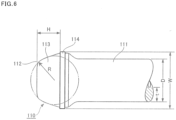
- PLTs 1 and 2 for the fuel piping for the internal combustion engine, the type of a stainless-steel fuel piping shown in FIG. 6 is known.
- This fuel piping has a connection head 110 including an edge face 112 formed at a connection end of a steel pipe 111 with a small diameter and a thick wall, an annular flange 114 formed to be spaced from the edge face 112 in the axial direction of the pipe 111, and a sealing face (forward sealing taper portion) 113 continuing from the edge face 112 to the annular flange 114 and tapering toward the edge.
- connection heads of the fuel injection line having the connection head formed by upsetting and the stainless-steel fuel piping having the connection head which is formed at the piping end and has the sealing face formed by pressing or the like known is a process of normalizing annealing by inductive heating prior to formation of the connection head 110 of the fuel injection line or the stainless-steel fuel piping thereon by pressing so that the cold deformation effect which occurs when the connection head 110 is formed by pressing or the like on the piping end can be produced without the formation of cracks and with only a moderate level of stresses being produced (see, PLT 1).
- the present invention has an object to solve problems, in particular, about the stainless-steel fuel piping as described below.
- a contact surface of a high-hardness sealing face makes deformation of a contact surface of the sealing face impossible because the contact surface follows a mating member if sufficient axial force cannot be available due to following rotation or the like in tightening of the piping. Therefore, there is a risk that sealing performance cannot be ensured.
- the contact surface is easily plastic-deformed to adapt to a mating member, thereby improving the sealing performance with relatively low torque.
- the present invention has been made to solve the problems, in particular, that there is the risk that the sealing performance cannot be ensured due to the hard sealing face and that the whole tightening portion is necessarily deformed in repeated tightening due to conceivable attachments and detachments of the piping in inspection and the like, and thereby the sealing performance cannot be also ensured in the stainless-steel fuel piping and a method of producing the piping.
- the invention aims to provide the stainless-steel fuel piping having a connection head with high sealing performance and a treatment method for softening a surface layer of the connection head.
- the stainless-steel fuel piping of the present invention includes a connection head that has a truncated-cone or truncated-arc shaped sealing face and is formed at a connection end of a steel pipe with a small diameter and a thick wall, wherein the connection head is subjected to softening heat treatment to a predetermined hardness on a surface layer of the sealing face.
- the method of softening a surface layer of an end of a stainless-steel fuel piping of the present invention includes irradiation to a desired area on the sealing face of the connection head with a laser to cause heating treatment due to thermal energy generation on the surface layer of the sealing face, thereby performing softening heat treatment only on the surface layer of the sealing face to a predetermined hardness.
- an another method of the invention includes formation of a labyrinth structure with a concave-convex pattern on the surface layer of the sealing face by laser to perform softening heat treatment only on the surface layer of the sealing face to the predetermined hardness due to heat effect caused by the laser to the concave-convex pattern of the labyrinth structure and its vicinity.
- the hardness of the softened area is preferably lower by 50 HV or more than that prior to the softening of the connection head.
- the stainless-steel fuel piping one having the wall thickness t of 0.125D to 0.27D, a radius R of a spherical sealing part of 0.51D to 0.65D, a distance H from the edge face to the most-expanded pipe portion of 0.5D to 0.7D, and a diameter W of the most-expanded pipe portion of 1.25D to 1.5D may be used as shown in FIG. 6 .
- the stainless-steel fuel piping of the present invention which has the connection head formed at the connection end of the thick-wall steel pipe, irradiating the surface layer of the sealing face with a laser produces thermal energy on the surface layer of the sealing face to subject the surface layer of the sealing face to softening heat treatment to the predetermined hardness.
- This can control deformation of a mating part in tightening of seal not to cause large deformation of the mating part to thereby ensure the sealing performance.
- the softening heat treatment only on the surface layer of the sealing face to the predetermined hardness it prevents the tightening portion from deforming as a whole in tightening several times to ensure the sealing performance.
- the method of softening the surface layer of an end of the stainless-steel fuel piping according to the invention employs the process of subjecting the surface layer of the sealing face and its vicinity to softening heat treatment to the predetermined hardness, it is possible to adjust the hardness of the surface layer of the sealing face depending on temperature and time during the heat treatment.
- because of cooling of only the sealing face at the piping end it allows for rapid cooling by self-heat capacity, which makes it possible to prevent sensitization that is a material deterioration phenomenon specific to stainless steel, namely which is a phenomenon showing the formation of a chromium depleted layer due to precipitation of chromium carbide at the grain boundaries in the structure and the condition of the structure with grain coarsening.
- another method of softening the surface layer of the end of the stainless-steel fuel piping employs the process of subjecting the surface layer of the sealing face to softening heat treatment to the predetermined hardness, and as the process of softening heat treatment, the labyrinth structure with the concave-convex pattern is formed by laser on the sealing face and softening heat treatment is subjected to the concave-convex pattern of the labyrinth structure and its vicinity, thereby achieving the similar effect to the above-described effect.
- the stainless-steel fuel piping shown in FIG. 1 is similar in structure to the conventional stainless-steel fuel piping shown in FIG. 6 , and it has a connection head 10 at a connection end of a steel pipe 11 with a thick wall, the connection head 10 being composed of a truncated-cone or truncated-arc shaped edge face (pressing seat face) 12, an annular flange 14 formed to be spaced from the edge face 12 in the axial direction of the pipe, and a sealing face 13 continuing from the edge face 12 to the annular flange 14 and tapering toward the edge.
- the stainless-steel fuel piping is subjected to softening heat treatment to a predetermined hardness on, for example, the entire circumference of a hatched area 13-1 of the sealing face 13 of the connection head 10, by laser irradiation.
- the reason that the area subjected to softening heat treatment to have the predetermined hardness is limited to the hatched area of the sealing face 13 of the connection head 10 is that especially when the sealing face 13 is softened, its contact surface is easily plastic-deformed to adapt to a mating member, thereby improving the sealing performance with relatively low torque, whereas when the whole of the tightening portion of the fuel piping is softened, the whole tightening portion is necessarily deformed in repeated tightening, thereby causing the problem that cannot ensure the sealing performance.
- softening treatment on the whole tightening portion results in a crushed edge of the sealing face, and thus leakage necessarily occurs, however, softening treatment only on the sealing face allows to keep the form of the edge to thereby ensure the sealing performance, which makes it possible to prevent leakage from occurring even if tightening is repeated several times.
- the stainless-steel fuel piping shown in FIG. 2 has a connection head 20 at a connection end of a steel pipe 21 with a thick wall, the connection head 20 being composed of a truncated-cone or truncated-arc shaped edge face (pressing seat face) 22, an arc-shaped portion 24 continuing and smoothly reducing the outside diameter toward the opposite side to the edge face in the axial direction of the pipe, and a sealing face 23 continuing from the edge face 22 toward the side of the thick-wall steel pipe 21 and tapering toward the edge, without the annular flange 14 shown in FIG. 1 structurally.
- This stainless-steel fuel piping is subjected to softening heat treatment to the predetermined hardness on almost the entirety (hatched area 23-1) of the sealing face 23, by laser irradiation.
- the stainless-steel fuel piping shown in FIG. 3 has a connection head 30 at a connection end of a steel pipe 31 with a thick wall, the connection head 30 being composed of a truncated-cone or truncated-arc shaped edge face (pressing seat face) 32, an arc-shaped portion 34 continuing and smoothly reducing the outside diameter toward the opposite side to the edge face in the axial direction of the pipe, and a sealing face 33 continuing from the edge face 32 toward the side of the thick-wall steel pipe 31 and tapering toward the edge, without the annular flange 14 shown in FIG. 1 structurally.
- This stainless-steel fuel piping is subjected to softening heat treatment to the predetermined hardness on a hatched area 33-1 of the sealing face 33, by laser irradiation.
- the stainless-steel fuel piping shown in FIG. 4 has a connection head 40 at a connection end of a steel pipe 41 with a thick wall, the connection head 40 being composed of a truncated-cone or truncated-arc shaped edge face (pressing seat face) 42, an arc-shaped portion 44 continuing and smoothly reducing the outside diameter toward the opposite side to the edge face in the axial direction of the pipe, and a sealing face 43 continuing from the edge face 42 toward the side of the thick-wall steel pipe 41 and tapering toward the edge, without the annular flange 14 shown in FIG. 1 structurally.
- This stainless-steel fuel piping is subjected to softening heat treatment to the predetermined hardness on a hatched area 43-1 of the sealing face 43, by laser irradiation.
- the stainless-steel fuel piping of the present invention is subjected to softening heat treatment to the predetermined hardness on the surface layer of the sealing face by laser irradiation and it allows for rapid cooling by self-heat capacity due to appropriate heat input and cooling to the sealing face at the piping end, thereby making it possible to prevent sensitization which is the material deterioration phenomena specific to stainless steel.
- deformation of a mating part can be controlled in tightening of seal to prevent the mating part from deforming highly, thereby ensuring the sealing performance.
- the method of softening the surface layer at the end of the stainless-steel fuel piping according to the present invention includes forming labyrinth grooves 50 simultaneously with the softening treatment by laser processing on the sealing face 13, 23, 33, or 43 of the connection head 10, 20, 30, or 40 at the end of the stainless-steel fuel piping shown in FIGs. 1 to 4 , respectively, to make a labyrinth structure softened on the sealing face as shown in FIGs. 5A and 5B .
- Each of the labyrinth grooves formed by laser processing has, for example, 43 ⁇ m in width, 10 ⁇ m in depth, and 100 ⁇ m in pitch (57 ⁇ m in width of crest).
- the labyrinth structure makes the surface layer of the sealing face softer to achieve a sealing face having a lower hardness than that of a sealing portion of a mating part and that of the inside of the connection head before the softening.
- the hardness of the sealing face having the labyrinth structure may be also adjusted by heating and cooling the sealing face after the formation of the labyrinth structure or by performing the softening heat treatment on the sealing face prior to the formation of the labyrinth structure.
- the method of softening the surface layer at the end of the stainless-steel fuel piping of the invention employs the way of forming the labyrinth seal structure by the laser on the surface layer of the sealing face to allow only the surface layer of the sealing face to be softened to have the predetermined hardness thanks to the labyrinth structure, as the process of performing the softening heat treatment on the surface layer of the sealing face of the connection head.
- the softening heat treatment it is preferable to perform the softening heat treatment to the predetermined hardness on an area within a range of 0.35 mm to 0.65D (D: the outer diameter of the stainless-steel fuel pipe) from the edge of the sealing face 13, 23, 33, or 43 and 0.05 mm or deeper and not more than half the pipe wall thickness in depth from the sealing face, although it is not particularly limited.
- the hardness of the softened area is preferably lower by 50 HV or more than that prior to the softening of the connection head.
- the stainless-steel fuel piping for the stainless-steel fuel piping, one can be used with the wall thickness t of 0.125D to 0.27D, the radius R of the sealing face of 0.51D to 0.65D, the distance H from the edge face to the most-expanded pipe portion of 0.5D to 0.7D, and the diameter W of the most-expanded pipe portion of 1.25D to 1.5D, as shown in FIG. 6 .
- a base material of the steel pipe used was a stainless-steel pipe material with the outer diameter D of 6.35 mm, the inner diameter d of 3.05 mm, the wall thickness t of 1.65 mm, the radius R of a spherical sealing part at the worked pipe end of 4 mm, and the distance H from the edge face to the most-expanded pipe portion of 3.1 mm.
- the stainless-steel pipe material was subjected to softening heat treatment to the predetermined hardness on the surface layer of the sealing face at its connection end by laser irradiation.
- the softening heat treatment was performed on an area of 0.5 mm from the edge of the sealing face and within not more than half the pipe wall thickness in depth from the sealing face, and the hardness HV was set as 169 to 252 HV
- Table 1 shows results of the tests for the softening heat treatment at the connection end of the stainless-steel pipe material in Example 1.
- Table 2 shows results of sealing tests in tightening to check the presence or absence of leakage when pressurized to 105 MPa.
- Hardness Measurement Point Distance of 0.1 (mm) from Outer surface Hardness Measurement Point: Distance of 0.1 (mm) from Inner surface Distance from Edge (mm) Unsoftened piping (HV) Surface-softened piping (HV) Whole-softened piping (HV) Unsoftened piping (HV) Surface-softened piping (HV) Whole-softened piping (HV) Unsoftened piping (HV) Surface-softened piping (HV) Whole-softened piping (HV) 0.35 310 180 165 306 289 180 0.5 289 185 178 305 273 185 1.0 310 169 - 204 206 - 1.5 316 241 187 235 233 194 2.0 317 252 291 320 2.5 326
- the laser irradiation to the surface layer of the sealing face causes thermal energy generation on the surface layer to provide a softened layer surface of the sealing face with the desired hardness.
- the contact surface of the sealing face is plastic-deformed in tightening to adapt to a mating member to thereby ensure the sealing performance.
- the results show that since only the surface layer of the sealing face was softened to the predetermined hardness, the tightening portion could be prevented from wholly deforming in the repeated tightening to thereby ensure the sealing performance. Consequently, it is proved that the softening heat treatment to the predetermined hardness is preferably performed on an area within the range of 0.35 mm to 0.65D from the edge of the sealing face and 0.05 mm or deeper and not more than half the pipe wall thickness in depth from the sealing face, and further the hardness of the softened area is preferably lower by 50 HV or more than that prior to the softening of the connection head, as described above.
Landscapes
- Engineering & Computer Science (AREA)
- Mechanical Engineering (AREA)
- General Engineering & Computer Science (AREA)
- Chemical & Material Sciences (AREA)
- Combustion & Propulsion (AREA)
- Physics & Mathematics (AREA)
- Thermal Sciences (AREA)
- Crystallography & Structural Chemistry (AREA)
- Materials Engineering (AREA)
- Metallurgy (AREA)
- Organic Chemistry (AREA)
- Optics & Photonics (AREA)
- Plasma & Fusion (AREA)
- Manufacturing & Machinery (AREA)
- Fuel-Injection Apparatus (AREA)
Abstract
Description
- The present invention relates to a stainless-steel fuel piping used as a fuel supply path for an internal combustion engine, high-pressure hydrogen gas piping used for fuel cells, and the like. In particular, the invention relates to the stainless-steel fuel piping having a connection head that is formed, for example, by press working at an end of the piping and a method for softening the connection head at the piping end.
- Known are fuel piping having connection heads including fuel injection lines (fuel injection pipes) having connection heads that are used for fuel supply paths for an internal combustion engine. For the fuel injection lines (fuel injection pipes), for example, known is a fuel injection line for the internal combustion engine including, at least one of the line's ends, a connection head formed thereon by upsetting, the connection head comprising a forward sealing taper portion formed by press of a punch member in the axial direction of the line (see, e.g. PLTs 1 and 2). Further, for the fuel piping for the internal combustion engine, the type of a stainless-steel fuel piping shown in
FIG. 6 is known. This fuel piping has aconnection head 110 including anedge face 112 formed at a connection end of asteel pipe 111 with a small diameter and a thick wall, anannular flange 114 formed to be spaced from theedge face 112 in the axial direction of thepipe 111, and a sealing face (forward sealing taper portion) 113 continuing from theedge face 112 to theannular flange 114 and tapering toward the edge. - With regard to production methods of such connection heads of the fuel injection line having the connection head formed by upsetting and the stainless-steel fuel piping having the connection head which is formed at the piping end and has the sealing face formed by pressing or the like, known is a process of normalizing annealing by inductive heating prior to formation of the
connection head 110 of the fuel injection line or the stainless-steel fuel piping thereon by pressing so that the cold deformation effect which occurs when theconnection head 110 is formed by pressing or the like on the piping end can be produced without the formation of cracks and with only a moderate level of stresses being produced (see, PLT 1). -
- PLT 1:
JP H1-203649 A - PLT 2:
JP H10-68367 A - The present invention has an object to solve problems, in particular, about the stainless-steel fuel piping as described below.
- When the stainless-steel fuel piping is used, a contact surface of a high-hardness sealing face (forward sealing taper portion) makes deformation of a contact surface of the sealing face impossible because the contact surface follows a mating member if sufficient axial force cannot be available due to following rotation or the like in tightening of the piping. Therefore, there is a risk that sealing performance cannot be ensured. In other words, when the sealing face is softened, the contact surface is easily plastic-deformed to adapt to a mating member, thereby improving the sealing performance with relatively low torque. However, if a whole of the tightening portion of the fuel piping is softened, the whole tightening portion is necessarily deformed in repeated tightening due to conceivable attachment and detachment of the piping in inspection and the like, which causes the problem that can ensure no sealing performance.
- The present invention has been made to solve the problems, in particular, that there is the risk that the sealing performance cannot be ensured due to the hard sealing face and that the whole tightening portion is necessarily deformed in repeated tightening due to conceivable attachments and detachments of the piping in inspection and the like, and thereby the sealing performance cannot be also ensured in the stainless-steel fuel piping and a method of producing the piping. Thus, the invention aims to provide the stainless-steel fuel piping having a connection head with high sealing performance and a treatment method for softening a surface layer of the connection head.
- The stainless-steel fuel piping of the present invention includes a connection head that has a truncated-cone or truncated-arc shaped sealing face and is formed at a connection end of a steel pipe with a small diameter and a thick wall, wherein the connection head is subjected to softening heat treatment to a predetermined hardness on a surface layer of the sealing face.
- The method of softening a surface layer of an end of a stainless-steel fuel piping of the present invention includes irradiation to a desired area on the sealing face of the connection head with a laser to cause heating treatment due to thermal energy generation on the surface layer of the sealing face, thereby performing softening heat treatment only on the surface layer of the sealing face to a predetermined hardness. Further, for the process of performing softening heat treatment on the surface layer of the sealing face of the connection head, an another method of the invention includes formation of a labyrinth structure with a concave-convex pattern on the surface layer of the sealing face by laser to perform softening heat treatment only on the surface layer of the sealing face to the predetermined hardness due to heat effect caused by the laser to the concave-convex pattern of the labyrinth structure and its vicinity.
- For a range to be softened to the predetermined hardness on the stainless-steel fuel piping of the invention, it is preferable that 0.35 mm to 0.65D (D: the outer diameter of the stainless-steel fuel pipe) from the edge of the sealing face, and 0.05 mm or deeper and not more than half the pipe wall thickness in depth from the sealing face. Additionally, the hardness of the softened area is preferably lower by 50 HV or more than that prior to the softening of the connection head. As for the stainless-steel fuel piping, one having the wall thickness t of 0.125D to 0.27D, a radius R of a spherical sealing part of 0.51D to 0.65D, a distance H from the edge face to the most-expanded pipe portion of 0.5D to 0.7D, and a diameter W of the most-expanded pipe portion of 1.25D to 1.5D may be used as shown in
FIG. 6 . - According to the stainless-steel fuel piping of the present invention, which has the connection head formed at the connection end of the thick-wall steel pipe, irradiating the surface layer of the sealing face with a laser produces thermal energy on the surface layer of the sealing face to subject the surface layer of the sealing face to softening heat treatment to the predetermined hardness. This can control deformation of a mating part in tightening of seal not to cause large deformation of the mating part to thereby ensure the sealing performance. Further, because of performing the softening heat treatment only on the surface layer of the sealing face to the predetermined hardness, it prevents the tightening portion from deforming as a whole in tightening several times to ensure the sealing performance.
- In addition, since the method of softening the surface layer of an end of the stainless-steel fuel piping according to the invention employs the process of subjecting the surface layer of the sealing face and its vicinity to softening heat treatment to the predetermined hardness, it is possible to adjust the hardness of the surface layer of the sealing face depending on temperature and time during the heat treatment. Besides, because of cooling of only the sealing face at the piping end, it allows for rapid cooling by self-heat capacity, which makes it possible to prevent sensitization that is a material deterioration phenomenon specific to stainless steel, namely which is a phenomenon showing the formation of a chromium depleted layer due to precipitation of chromium carbide at the grain boundaries in the structure and the condition of the structure with grain coarsening.
- Furthermore, another method of softening the surface layer of the end of the stainless-steel fuel piping according to the invention employs the process of subjecting the surface layer of the sealing face to softening heat treatment to the predetermined hardness, and as the process of softening heat treatment, the labyrinth structure with the concave-convex pattern is formed by laser on the sealing face and softening heat treatment is subjected to the concave-convex pattern of the labyrinth structure and its vicinity, thereby achieving the similar effect to the above-described effect.
-
-
FIG. 1 is a side view illustrating the first embodiment of the stainless-steel fuel piping of the present invention. -
FIG. 2 is a side view illustrating the second embodiment of the stainless-steel fuel piping of the present invention. -
FIG. 3 is a side view illustrating the third embodiment of the stainless-steel fuel piping of the present invention. -
FIG. 4 is a side view illustrating the fourth embodiment of the stainless-steel fuel piping of the present invention. -
FIGs. 5A and 5B are diagrams showing one example of the method for softening a surface layer at an end of the stainless-steel fuel piping of the invention, and in particular, illustrating labyrinth grooves processed by laser on the surface layer of the sealing face:FIG. 5A is a schematic diagram illustrating an enlarged part of the sealing face with the labyrinth grooves processed by the laser; andFIG. 5B is a sectional view ofFIG. 5A taken along the line b-b. -
FIG. 6 is a side view illustrating of one example of the conventional stainless-steel fuel piping, which is targeted by the present invention. - The stainless-steel fuel piping shown in
FIG. 1 is similar in structure to the conventional stainless-steel fuel piping shown inFIG. 6 , and it has aconnection head 10 at a connection end of asteel pipe 11 with a thick wall, theconnection head 10 being composed of a truncated-cone or truncated-arc shaped edge face (pressing seat face) 12, anannular flange 14 formed to be spaced from theedge face 12 in the axial direction of the pipe, and a sealingface 13 continuing from theedge face 12 to theannular flange 14 and tapering toward the edge. The stainless-steel fuel piping is subjected to softening heat treatment to a predetermined hardness on, for example, the entire circumference of a hatched area 13-1 of the sealingface 13 of theconnection head 10, by laser irradiation. - In this regard, the reason that the area subjected to softening heat treatment to have the predetermined hardness is limited to the hatched area of the sealing
face 13 of theconnection head 10 is that especially when the sealingface 13 is softened, its contact surface is easily plastic-deformed to adapt to a mating member, thereby improving the sealing performance with relatively low torque, whereas when the whole of the tightening portion of the fuel piping is softened, the whole tightening portion is necessarily deformed in repeated tightening, thereby causing the problem that cannot ensure the sealing performance. In addition, softening treatment on the whole tightening portion results in a crushed edge of the sealing face, and thus leakage necessarily occurs, however, softening treatment only on the sealing face allows to keep the form of the edge to thereby ensure the sealing performance, which makes it possible to prevent leakage from occurring even if tightening is repeated several times. - The stainless-steel fuel piping shown in
FIG. 2 has a connection head 20 at a connection end of asteel pipe 21 with a thick wall, the connection head 20 being composed of a truncated-cone or truncated-arc shaped edge face (pressing seat face) 22, an arc-shaped portion 24 continuing and smoothly reducing the outside diameter toward the opposite side to the edge face in the axial direction of the pipe, and a sealingface 23 continuing from theedge face 22 toward the side of the thick-wall steel pipe 21 and tapering toward the edge, without theannular flange 14 shown inFIG. 1 structurally. This stainless-steel fuel piping is subjected to softening heat treatment to the predetermined hardness on almost the entirety (hatched area 23-1) of the sealingface 23, by laser irradiation. - The stainless-steel fuel piping shown in
FIG. 3 has aconnection head 30 at a connection end of asteel pipe 31 with a thick wall, theconnection head 30 being composed of a truncated-cone or truncated-arc shaped edge face (pressing seat face) 32, an arc-shaped portion 34 continuing and smoothly reducing the outside diameter toward the opposite side to the edge face in the axial direction of the pipe, and a sealingface 33 continuing from theedge face 32 toward the side of the thick-wall steel pipe 31 and tapering toward the edge, without theannular flange 14 shown inFIG. 1 structurally. This stainless-steel fuel piping is subjected to softening heat treatment to the predetermined hardness on a hatched area 33-1 of the sealingface 33, by laser irradiation. - The stainless-steel fuel piping shown in
FIG. 4 has aconnection head 40 at a connection end of asteel pipe 41 with a thick wall, theconnection head 40 being composed of a truncated-cone or truncated-arc shaped edge face (pressing seat face) 42, an arc-shaped portion 44 continuing and smoothly reducing the outside diameter toward the opposite side to the edge face in the axial direction of the pipe, and a sealingface 43 continuing from theedge face 42 toward the side of the thick-wall steel pipe 41 and tapering toward the edge, without theannular flange 14 shown inFIG. 1 structurally. This stainless-steel fuel piping is subjected to softening heat treatment to the predetermined hardness on a hatched area 43-1 of the sealingface 43, by laser irradiation. - As described above, the stainless-steel fuel piping of the present invention is subjected to softening heat treatment to the predetermined hardness on the surface layer of the sealing face by laser irradiation and it allows for rapid cooling by self-heat capacity due to appropriate heat input and cooling to the sealing face at the piping end, thereby making it possible to prevent sensitization which is the material deterioration phenomena specific to stainless steel. Thus, deformation of a mating part can be controlled in tightening of seal to prevent the mating part from deforming highly, thereby ensuring the sealing performance. Furthermore, since only the surface layer of the sealing face is softened to the predetermined hardness, a hardness inside of the piping is maintained to control deformation in the whole of the connection head to load in tightening, which produce an effect to ensure the sealing performance in repeated tightening for several times.
- Then, a process for providing a concave-convex pattern is described based on
FIG. 5 , in addition to the softening treatment on the surface layer at the end of the stainless-steel fuel piping shown inFIGs. 1 to 4 . - The method of softening the surface layer at the end of the stainless-steel fuel piping according to the present invention includes forming
labyrinth grooves 50 simultaneously with the softening treatment by laser processing on the sealingface connection head FIGs. 1 to 4 , respectively, to make a labyrinth structure softened on the sealing face as shown inFIGs. 5A and 5B . Each of the labyrinth grooves formed by laser processing has, for example, 43 µm in width, 10 µm in depth, and 100 µm in pitch (57 µm in width of crest). The labyrinth structure makes the surface layer of the sealing face softer to achieve a sealing face having a lower hardness than that of a sealing portion of a mating part and that of the inside of the connection head before the softening. The hardness of the sealing face having the labyrinth structure may be also adjusted by heating and cooling the sealing face after the formation of the labyrinth structure or by performing the softening heat treatment on the sealing face prior to the formation of the labyrinth structure. - As described above, the method of softening the surface layer at the end of the stainless-steel fuel piping of the invention employs the way of forming the labyrinth seal structure by the laser on the surface layer of the sealing face to allow only the surface layer of the sealing face to be softened to have the predetermined hardness thanks to the labyrinth structure, as the process of performing the softening heat treatment on the surface layer of the sealing face of the connection head. This enables not only exact adjustment of the hardness of the surface layer of the sealing face at the end of the piping which has been work-hardened, but also rapid cooling by self-heat capacity due to proper heat input and cooling to the sealing face at the piping end, thereby making it also possible to prevent sensitization which is material deterioration phenomena specific to stainless steel.
- For the stainless-steel fuel piping of the invention, it is preferable to perform the softening heat treatment to the predetermined hardness on an area within a range of 0.35 mm to 0.65D (D: the outer diameter of the stainless-steel fuel pipe) from the edge of the sealing
face FIG. 6 . - The present invention is described more particularly by means of examples below, but it is not limited to the examples. Modifications and variations of the invention without departing from the scope and spirit of the invention are deemed to fall within the technical scope of the invention.
- In the examples, regarding effects shown on the surface layer of the sealing face on the connection head at the stainless-steel fuel piping end, sealing performance tests were conducted by varying the depth to be softened and then resultant sealing effects were observed.
- As a base material of the steel pipe, used was a stainless-steel pipe material with the outer diameter D of 6.35 mm, the inner diameter d of 3.05 mm, the wall thickness t of 1.65 mm, the radius R of a spherical sealing part at the worked pipe end of 4 mm, and the distance H from the edge face to the most-expanded pipe portion of 3.1 mm. The stainless-steel pipe material was subjected to softening heat treatment to the predetermined hardness on the surface layer of the sealing face at its connection end by laser irradiation. The softening heat treatment was performed on an area of 0.5 mm from the edge of the sealing face and within not more than half the pipe wall thickness in depth from the sealing face, and the hardness HV was set as 169 to 252 HV
- Table 1 shows results of the tests for the softening heat treatment at the connection end of the stainless-steel pipe material in Example 1. Table 2 shows results of sealing tests in tightening to check the presence or absence of leakage when pressurized to 105 MPa.
[Table 1] <Results of Tests using Steel pipe base material with Outer diameter D of 6.35 mm> Hardness Measurement Point: Distance of 0.1 (mm) from Outer surface Hardness Measurement Point: Distance of 0.1 (mm) from Inner surface Distance from Edge (mm) Unsoftened piping (HV) Surface-softened piping (HV) Whole-softened piping (HV) Unsoftened piping (HV) Surface-softened piping (HV) Whole-softened piping (HV) 0.35 310 180 165 306 289 180 0.5 289 185 178 305 273 185 1.0 310 169 - 204 206 - 1.5 316 241 187 235 233 194 2.0 317 252 291 320 2.5 326 287 198 356 334 172 3.0 323 288 - 337 356 - 3.5 311 276 257 357 357 201 4.0 269 275 - 326 309 - 4.5 299 308 237 281 256 225 5.0 341 329 - 200 193 - 5.5 317 317 196 200 187 198 [Table 2] Sealing Tests in Tightening (Pressure of 105 MPa) The Number of Tightening Whole softening Surface softening 1 ○ ○ 2 ○ ○ 3 ○ ○ 4 ○ ○ 5 × ○ 10 - ○ 15 - ○ 20 - ○ 25 - ○ 30 - ○ ∘: No leakage occurred ×: Leakage occurred - From the results shown in Tables 1 and 2, for the stainless-steel fuel piping with the connection head formed at the connection end of the thick-wall steel pipe, it became clear that when the laser irradiation was performed on the point of 0.5 mm from the edge of the piping, the hardness at the depth of 0.1 mm from the outer surface (surface layer) in the range of 0.35mm to 1 mm was lower by 50 HV or more than that of the unsoftened piping, whereas at the depth of 0.1 mm from the inner surface, the hardness was almost equal to that of the unsoftened piping in all range. With regard to the piping whole-softened by high frequency, it was softened by 50 HV or more compared to the unsoftened piping even when measured both at the depth of 0.1 mm from the inner surface and from the outer surface.
- As is also clear from the result of the example, for the stainless-steel fuel piping with the connection head formed at the connection end of the thick-wall steel pipe, the laser irradiation to the surface layer of the sealing face causes thermal energy generation on the surface layer to provide a softened layer surface of the sealing face with the desired hardness. Thus, the contact surface of the sealing face is plastic-deformed in tightening to adapt to a mating member to thereby ensure the sealing performance.
- In addition, the results show that since only the surface layer of the sealing face was softened to the predetermined hardness, the tightening portion could be prevented from wholly deforming in the repeated tightening to thereby ensure the sealing performance. Consequently, it is proved that the softening heat treatment to the predetermined hardness is preferably performed on an area within the range of 0.35 mm to 0.65D from the edge of the sealing face and 0.05 mm or deeper and not more than half the pipe wall thickness in depth from the sealing face, and further the hardness of the softened area is preferably lower by 50 HV or more than that prior to the softening of the connection head, as described above.
-
- 10, 20, 30, 40
- connection head
- 11, 21, 31, 41
- thick-wall steel pipe
- 12, 22, 32, 42
- edge face of piping
- 13, 23, 33, 43
- sealing face
- 14
- annular flange
- 24, 34, 44
- arc-shaped portion
- 13-1, 23-1, 33-1, 43-1
- hatched area of the sealing face
- 50
- labyrinth grooves
- D
- outer diameter of the stainless-steel fuel piping
- H
- distance from the edge face to the most-expanded pipe portion
- R
- radius of spherical sealing part
- t
- pipe wall thickness
- W
- diameter of the most-expanded pipe portion
Claims (3)
- A stainless-steel fuel piping, including a connection head at a connection end of a steel pipe with a small diameter and a thick wall, the connection head having a truncated-cone or truncated-arc shaped sealing face, characterized in that
the connection head has a surface layer subjected to softening heat treatment to a predetermined hardness on the sealing face. - A method of softening a surface layer of an end of a stainless-steel fuel piping, the piping including a connection head at a connection end of a steel pipe with a small diameter and a thick wall, the connection head having a truncated-cone or truncated-arc shaped sealing face, according to claim 1, the method comprising
irradiating a desired area on the sealing face of the connection head with a laser to cause heating treatment due to thermal energy generation on the surface layer of the sealing face to perform softening heat treatment only on the surface layer of the sealing face to a predetermined hardness. - A method of softening a surface layer of an end of a stainless-steel fuel piping, the method comprising, for a process of performing softening heat treatment only on the surface layer of a truncated-cone or truncated-arc shaped sealing face of a connection head according to claim 1,
forming a labyrinth structure with a concave-convex pattern on the surface layer of the sealing face by laser to perform softening heat treatment only on the surface layer of the sealing face to a predetermined hardness due to heat effect caused by the laser to the concave-convex pattern of the labyrinth structure and its vicinity.
Applications Claiming Priority (2)
| Application Number | Priority Date | Filing Date | Title |
|---|---|---|---|
| JP2021186548 | 2021-11-16 | ||
| PCT/JP2022/042601 WO2023090373A1 (en) | 2021-11-16 | 2022-11-16 | Stainless steel fuel pipe having connecting head portion, and treatment method for softening surface layer of said connecting head portion |
Publications (2)
| Publication Number | Publication Date |
|---|---|
| EP4435249A1 true EP4435249A1 (en) | 2024-09-25 |
| EP4435249A4 EP4435249A4 (en) | 2025-11-05 |
Family
ID=86397095
Family Applications (1)
| Application Number | Title | Priority Date | Filing Date |
|---|---|---|---|
| EP22895654.6A Pending EP4435249A4 (en) | 2021-11-16 | 2022-11-16 | STAINLESS STEEL FUEL PIPE WITH CONNECTION HEAD AND TREATMENT METHOD FOR SOFTENING THE SURFACE LAYER OF THE CONNECTION HEAD |
Country Status (6)
| Country | Link |
|---|---|
| US (1) | US20250019792A1 (en) |
| EP (1) | EP4435249A4 (en) |
| JP (1) | JPWO2023090373A1 (en) |
| KR (1) | KR20240091206A (en) |
| CN (1) | CN118251544A (en) |
| WO (1) | WO2023090373A1 (en) |
Family Cites Families (20)
| Publication number | Priority date | Publication date | Assignee | Title |
|---|---|---|---|---|
| US2189566A (en) * | 1937-12-30 | 1940-02-06 | Patex Sa | Coupling for tubes and pipes |
| US2439351A (en) * | 1944-01-03 | 1948-04-06 | Dow Chemical Co | Plastic tube fitting |
| US2748463A (en) * | 1949-09-22 | 1956-06-05 | Mueller Co | Method of coupling pipes |
| DE3801703C1 (en) | 1988-01-21 | 1989-02-09 | Juergen Dipl.-Ing. 8402 Neutraubling De Guido | |
| US5529349A (en) * | 1993-08-25 | 1996-06-25 | Itt Corporation | Mounting apparatus with reduced resistance bead seal |
| JPH1068367A (en) | 1996-08-28 | 1998-03-10 | Usui Internatl Ind Co Ltd | Structure of connecting head of high pressure fuel injection pipe |
| US6357801B1 (en) * | 1998-12-28 | 2002-03-19 | Usui Kokosai Sangyo Kaisha Limited | Flared connection structure of pipe end portion |
| JP2003021018A (en) * | 2001-07-09 | 2003-01-24 | Bosch Automotive Systems Corp | Connection device for rail and injection pipe |
| JP4854548B2 (en) * | 2006-03-14 | 2012-01-18 | 臼井国際産業株式会社 | High-pressure fuel injection pipe having a connecting head and a bent portion and method for manufacturing the same |
| JP4849468B2 (en) * | 2006-03-14 | 2012-01-11 | 臼井国際産業株式会社 | High-pressure fuel injection pipe having a connecting head and a bent portion and method for manufacturing the same |
| ITVR20080068A1 (en) * | 2008-06-11 | 2009-12-12 | Chesini Meccanica Srl | PROCEDURE FOR OBTAINING FUEL SUPPLY TO A ENGINE |
| US20100084856A1 (en) * | 2008-10-08 | 2010-04-08 | Gm Global Technology Operations, Inc. | High Pressure Fluid Connection |
| US8322004B2 (en) * | 2009-04-29 | 2012-12-04 | Caterpilar Inc. | Indirect laser induced residual stress in a fuel system component and fuel system using same |
| US8402948B2 (en) * | 2010-06-24 | 2013-03-26 | GM Global Technology Operations LLC | Engine assembly including fuel system with fuel line connector |
| DE102013004169A1 (en) * | 2013-03-09 | 2014-04-17 | Daimler Ag | Processing surface i.e. sealing surface, of metal construction part e.g. connector, of fuel system of combustion engine, comprises smoothening surface of metal construction part by supplying thermal energy using laser beam |
| JP2015117771A (en) * | 2013-12-18 | 2015-06-25 | 株式会社Fts | Seal structure formed of resin and metal |
| WO2015132056A1 (en) * | 2014-03-03 | 2015-09-11 | Siemens Aktiengesellschaft | Conical screw connection for a fuel line |
| CA2875512C (en) * | 2014-12-18 | 2015-12-08 | Westport Power Inc. | Sealing structure for gaseous fuel |
| US10479339B2 (en) * | 2016-01-19 | 2019-11-19 | Ford Global Technologies, Llc | Flare-type brake line assembly and method of making the same |
| DE102018217595A1 (en) * | 2018-10-15 | 2020-04-16 | Continental Automotive Gmbh | Fuel injector and method for producing a nozzle body for a fuel injector |
-
2022
- 2022-11-16 EP EP22895654.6A patent/EP4435249A4/en active Pending
- 2022-11-16 KR KR1020247018039A patent/KR20240091206A/en not_active Ceased
- 2022-11-16 JP JP2023562389A patent/JPWO2023090373A1/ja active Pending
- 2022-11-16 WO PCT/JP2022/042601 patent/WO2023090373A1/en not_active Ceased
- 2022-11-16 CN CN202280075905.8A patent/CN118251544A/en active Pending
- 2022-11-16 US US18/710,605 patent/US20250019792A1/en not_active Abandoned
Also Published As
| Publication number | Publication date |
|---|---|
| JPWO2023090373A1 (en) | 2023-05-25 |
| CN118251544A (en) | 2024-06-25 |
| US20250019792A1 (en) | 2025-01-16 |
| WO2023090373A1 (en) | 2023-05-25 |
| KR20240091206A (en) | 2024-06-21 |
| EP4435249A4 (en) | 2025-11-05 |
Similar Documents
| Publication | Publication Date | Title |
|---|---|---|
| US5265793A (en) | Small thick-walled composite metal tubing and process of producing the same | |
| KR101147719B1 (en) | Erosion preventive method and member with erosion preventive section | |
| KR940011851B1 (en) | Small thick-walled composite metal tubing and process for producing the same | |
| JPH01203649A (en) | Fuel injection conduit for internal combustion engine and manufacture thereof | |
| US20180051664A1 (en) | Method of manufacturing a fuel distributor | |
| KR20140022827A (en) | A poppet valve with a formed face, and method of making | |
| JP4849468B2 (en) | High-pressure fuel injection pipe having a connecting head and a bent portion and method for manufacturing the same | |
| EP4435249A1 (en) | Stainless steel fuel pipe having connecting head portion, and treatment method for softening surface layer of said connecting head portion | |
| EP2060641A1 (en) | Austenite-base stainless steel pipe, for boiler, having excellent high-temperature steam oxidation resistance | |
| KR20050086683A (en) | Method of increasing strength of cold worked part by ultrasonic shock treatment, and metal product with high fracture toughness and fatigue strength | |
| US7731807B2 (en) | Stainless steel sheet for a gasket | |
| CN114734128A (en) | Welding repair method for valve seat sealing surface | |
| JP2007307678A (en) | Shot peening method | |
| KR101593309B1 (en) | Method of heat treatment of heat resistant alloy containing tungsten for excellent creep property and heat resistant alloy the same | |
| JP4854548B2 (en) | High-pressure fuel injection pipe having a connecting head and a bent portion and method for manufacturing the same | |
| JP6434729B2 (en) | Ni-based alloy tube manufacturing method, Ni-based alloy high-frequency heated bending tube manufacturing method, Ni-based alloy welded tube manufacturing method, and boiler steam tube manufacturing method | |
| CN118438747A (en) | Multilayer composite stainless steel material and preparation method and application thereof | |
| JP2011067929A (en) | Machining method for equipment and piping of austenitic stainless steel, and equipment and piping for nuclear power plant machined by the method | |
| KR20220152177A (en) | Welding method for high chromium steel | |
| JPWO2023090373A5 (en) | ||
| CN115899216A (en) | Three-web welded gear and machining method | |
| JP7493737B1 (en) | Manufacturing method of half pipe joint | |
| US11066933B2 (en) | Rotor shaft and method for producing a rotor shaft | |
| CN120330433B (en) | Austenitic stainless steel bolts and their strengthening process | |
| US12338885B2 (en) | Gear component |
Legal Events
| Date | Code | Title | Description |
|---|---|---|---|
| STAA | Information on the status of an ep patent application or granted ep patent |
Free format text: STATUS: THE INTERNATIONAL PUBLICATION HAS BEEN MADE |
|
| PUAI | Public reference made under article 153(3) epc to a published international application that has entered the european phase |
Free format text: ORIGINAL CODE: 0009012 |
|
| STAA | Information on the status of an ep patent application or granted ep patent |
Free format text: STATUS: REQUEST FOR EXAMINATION WAS MADE |
|
| 17P | Request for examination filed |
Effective date: 20240530 |
|
| AK | Designated contracting states |
Kind code of ref document: A1 Designated state(s): AL AT BE BG CH CY CZ DE DK EE ES FI FR GB GR HR HU IE IS IT LI LT LU LV MC ME MK MT NL NO PL PT RO RS SE SI SK SM TR |
|
| DAV | Request for validation of the european patent (deleted) | ||
| DAX | Request for extension of the european patent (deleted) | ||
| A4 | Supplementary search report drawn up and despatched |
Effective date: 20251008 |
|
| RIC1 | Information provided on ipc code assigned before grant |
Ipc: F02M 55/02 20060101AFI20251001BHEP Ipc: F02M 55/00 20060101ALI20251001BHEP Ipc: F02M 61/16 20060101ALI20251001BHEP Ipc: H01M 50/00 20210101ALI20251001BHEP Ipc: B23K 26/352 20140101ALI20251001BHEP Ipc: B23K 26/362 20140101ALI20251001BHEP Ipc: F16L 19/028 20060101ALI20251001BHEP |