EP4432030A1 - Soft-reset - fehlerbehandlung bei der ausführbaren terminplanerzeugung einer fabrik - Google Patents
Soft-reset - fehlerbehandlung bei der ausführbaren terminplanerzeugung einer fabrik Download PDFInfo
- Publication number
- EP4432030A1 EP4432030A1 EP23162333.1A EP23162333A EP4432030A1 EP 4432030 A1 EP4432030 A1 EP 4432030A1 EP 23162333 A EP23162333 A EP 23162333A EP 4432030 A1 EP4432030 A1 EP 4432030A1
- Authority
- EP
- European Patent Office
- Prior art keywords
- operations
- schedule
- replacement plan
- shop floor
- transport
- Prior art date
- Legal status (The legal status is an assumption and is not a legal conclusion. Google has not performed a legal analysis and makes no representation as to the accuracy of the status listed.)
- Pending
Links
Images

Classifications
-
- G—PHYSICS
- G05—CONTROLLING; REGULATING
- G05B—CONTROL OR REGULATING SYSTEMS IN GENERAL; FUNCTIONAL ELEMENTS OF SUCH SYSTEMS; MONITORING OR TESTING ARRANGEMENTS FOR SUCH SYSTEMS OR ELEMENTS
- G05B19/00—Program-control systems
- G05B19/02—Program-control systems electric
- G05B19/418—Total factory control, i.e. centrally controlling a plurality of machines, e.g. direct or distributed numerical control [DNC], flexible manufacturing systems [FMS], integrated manufacturing systems [IMS] or computer integrated manufacturing [CIM]
- G05B19/41865—Total factory control, i.e. centrally controlling a plurality of machines, e.g. direct or distributed numerical control [DNC], flexible manufacturing systems [FMS], integrated manufacturing systems [IMS] or computer integrated manufacturing [CIM] characterised by job scheduling, process planning, material flow
-
- G—PHYSICS
- G05—CONTROLLING; REGULATING
- G05B—CONTROL OR REGULATING SYSTEMS IN GENERAL; FUNCTIONAL ELEMENTS OF SUCH SYSTEMS; MONITORING OR TESTING ARRANGEMENTS FOR SUCH SYSTEMS OR ELEMENTS
- G05B19/00—Program-control systems
- G05B19/02—Program-control systems electric
- G05B19/418—Total factory control, i.e. centrally controlling a plurality of machines, e.g. direct or distributed numerical control [DNC], flexible manufacturing systems [FMS], integrated manufacturing systems [IMS] or computer integrated manufacturing [CIM]
- G05B19/4188—Total factory control, i.e. centrally controlling a plurality of machines, e.g. direct or distributed numerical control [DNC], flexible manufacturing systems [FMS], integrated manufacturing systems [IMS] or computer integrated manufacturing [CIM] characterised by CIM planning or realisation
-
- G—PHYSICS
- G06—COMPUTING OR CALCULATING; COUNTING
- G06Q—INFORMATION AND COMMUNICATION TECHNOLOGY [ICT] SPECIALLY ADAPTED FOR ADMINISTRATIVE, COMMERCIAL, FINANCIAL, MANAGERIAL OR SUPERVISORY PURPOSES; SYSTEMS OR METHODS SPECIALLY ADAPTED FOR ADMINISTRATIVE, COMMERCIAL, FINANCIAL, MANAGERIAL OR SUPERVISORY PURPOSES, NOT OTHERWISE PROVIDED FOR
- G06Q10/00—Administration; Management
- G06Q10/06—Resources, workflows, human or project management; Enterprise or organisation planning; Enterprise or organisation modelling
- G06Q10/063—Operations research, analysis or management
- G06Q10/0631—Resource planning, allocation, distributing or scheduling for enterprises or organisations
- G06Q10/06311—Scheduling, planning or task assignment for a person or group
-
- G—PHYSICS
- G06—COMPUTING OR CALCULATING; COUNTING
- G06Q—INFORMATION AND COMMUNICATION TECHNOLOGY [ICT] SPECIALLY ADAPTED FOR ADMINISTRATIVE, COMMERCIAL, FINANCIAL, MANAGERIAL OR SUPERVISORY PURPOSES; SYSTEMS OR METHODS SPECIALLY ADAPTED FOR ADMINISTRATIVE, COMMERCIAL, FINANCIAL, MANAGERIAL OR SUPERVISORY PURPOSES, NOT OTHERWISE PROVIDED FOR
- G06Q10/00—Administration; Management
- G06Q10/08—Logistics, e.g. warehousing, loading or distribution; Inventory or stock management
- G06Q10/087—Inventory or stock management, e.g. order filling, procurement or balancing against orders
-
- G—PHYSICS
- G05—CONTROLLING; REGULATING
- G05B—CONTROL OR REGULATING SYSTEMS IN GENERAL; FUNCTIONAL ELEMENTS OF SUCH SYSTEMS; MONITORING OR TESTING ARRANGEMENTS FOR SUCH SYSTEMS OR ELEMENTS
- G05B2219/00—Program-control systems
- G05B2219/30—Nc systems
- G05B2219/31—From computer integrated manufacturing till monitoring
- G05B2219/31372—Mes manufacturing execution system
-
- G—PHYSICS
- G05—CONTROLLING; REGULATING
- G05B—CONTROL OR REGULATING SYSTEMS IN GENERAL; FUNCTIONAL ELEMENTS OF SUCH SYSTEMS; MONITORING OR TESTING ARRANGEMENTS FOR SUCH SYSTEMS OR ELEMENTS
- G05B2219/00—Program-control systems
- G05B2219/30—Nc systems
- G05B2219/32—Operator till task planning
- G05B2219/32252—Scheduling production, machining, job shop
-
- G—PHYSICS
- G05—CONTROLLING; REGULATING
- G05B—CONTROL OR REGULATING SYSTEMS IN GENERAL; FUNCTIONAL ELEMENTS OF SUCH SYSTEMS; MONITORING OR TESTING ARRANGEMENTS FOR SUCH SYSTEMS OR ELEMENTS
- G05B2219/00—Program-control systems
- G05B2219/30—Nc systems
- G05B2219/32—Operator till task planning
- G05B2219/32297—Adaptive scheduling, feedback of actual proces progress to adapt schedule
Definitions
- the present invention concerns management and operation of a shop floor, in particular automated handling of errors when operating the shop floor according to a schedule.
- shop floor production environments increasingly feature machines which can operate autonomously, allowing highly automated or even fully automated production processes.
- Such systems may be intended to operate with a low volume high mix product structure, such that for example a variety of different products may be provided, often in relatively low numbers, at least compared to high volumes provided by dedicated production plants. Due to the high variety in requirements for different products, the question how to organize and control the production on the shop floor is complex.
- a problem underlying the invention consists in providing an improved technique for handling errors when operating a shop floor.
- the shop floor comprises a plurality of automated machine arrangements, each machine arrangement being associated to one or more transfer stations, and/or one or more transfer stations being associated to a machine arrangement and/or each of the machine arrangements.
- the shop floor also comprises a plurality of transport devices being controllable to move containers for material between transfer stations of the machine arrangements and/or of one or more buffer areas.
- the method comprises receiving an indication that a deviation from a schedule being executed by the shop floor has occurred.
- the method also comprises determining a replacement plan.
- the replacement plan is based on the schedule.
- the replacement plan includes already started operations, and excludes at least some operations scheduled according to the schedule, e.g., for future execution according to the (e.g., now previous) schedule.
- the method also includes indicating the replacement plan for automated execution. It may be considered that a replacement plan may represent a schedule itself, e.g., a replacement schedule and/or a soft reset schedule and/or an updated schedule.
- the replacement plan may represent or indicate a minimal executable plan. According to the invention, errors or deviations occurring during automated execution of a current schedule may be handled in an automated way, without having to stop all processing on the shop floor.
- the method may comprise executing the replacement plan, and/or determining a new schedule.
- the new schedule may be based on order information pertaining to not yet considered or started orders, and/or may consider not yet completely fulfilled orders; the latter may be represented by a new or updated order.
- the replacement plan may allow a bridging time of operation before a new schedule with broader applicability may be provided and/or put into execution. Executing the replacement plan may be performed by a controlling system of the shop floor, in particular a MES.
- Predecessor operations e.g., logically necessary and/or operationally necessary and/or conditional
- Predecessor operations e.g., logically necessary and/or operationally necessary and/or conditional
- This may provide necessary material and/or conditions to execute the already started operations correctly.
- already started operations may be combined operations, such that predecessor operations may only be conditional for not yet started actions or steps of the operation already started. Finishing already started operations successfully may be facilitated.
- an operation may be a combined operation, which may comprise multiple actions or processing steps to be performed by a machine arrangement and/or transport device.
- an operation may be a productive operation, e.g., a dynamically defined productive operation, which may represent multiple actions to be performed. This may allow accommodation to instruction structures and/or protocols used within the shop floor.
- one or more reversible already started operations may be excluded from the replacement plan.
- a reversible operation may be an operation with no predecessor, and/or no successor operation (successor conditional on the operation), and/or which can be stopped and/or reversed without interference to other operations. This may help limiting the replacement plan, allowing quick return to normal operation.
- Such operations may be operations that have to be carried out for the already started operation to be finished successfully, and/or without one or more actions of the already started operation cannot be started. This may be according to a setup of the system, and/or based on assumptions made for the schedule and/or system. Accordingly, the replacement plan may reflect system conditions.
- the schedule may be based on order information.
- the method may comprise determining a fulfillable amount of ordered final products. Based on this, an order may be updated and/or a new order for missing material may be created, e.g., to determine a new schedule.
- the method may comprise adapting one or more productive operations, e.g., as part of determining the replacement plan. For example, a number of iterations or repetitions of one or more steps in the productive operation may be adapted, e.g., to compensate for reduced available input material due to scrap being produced. In some cases, if enough replacement input material is available, a number of steps may be increased, e.g., to produce a replacement for scrap.
- the method may comprise adapting one or more transport operations, for instance as part of determining the replacement plan.
- Adapting one or more transport operations may comprise changing a start and/or target of a transport, and/or adding or removing one or more transport. For example, a transport of additional input material may be added (which may not have been in the current schedule) to accommodate for scrap.
- a controlling system for a shop floor is proposed, the controlling system being adapted for performing a method as described herein.
- Indicating a replacement plan may comprise providing and/or transmitting the replacement plan to the shop floor and/or a controlling system and/or a MES.
- a deviation from the schedule may be indicated, and/or which operations are still included may be indicated.
- the replacement plan may be based on, and/or include, and/or consist of operations included in the current schedule.
- some operations may be added that were not in current schedule, in particular one or more transport operations, which may provide input material to one or more machine arrangements.
- no additional productive operations, and/or unproductive operations may be included in the replacement plan.
- a deviation, or an indication of a deviation, from the schedule may represent or indicate an error that occurred, e.g., a processing step having failed and/or scrap being produced, and/or failure of a component of the shop floor that is targeted for operation by the schedule, and/or new availability of a component (which may not have been considered when the schedule has been determined), and/or that a soft reset should be performed, and/or that a replacement plan should be indicated or provided.
- the replacement plan may be determined while the schedule is being executed, and/or within the planning horizon of the schedule.
- the replacement plan may have a shorter planning horizon than the schedule being executed.
- the schedule being executed may be considered a current schedule.
- a storage medium storing a computer program product as described herein is also proposed.
- the storage medium may be computer-readable and/or may be non-volatile and/or non-transitory.
- controlling system for a shop floor, the controlling system being adapted for performing a method as described herein and/or executing a computer program product as described herein.
- the controlling system may comprise a Manufacturing Execution System, MES, adapted for controlling execution of a schedule and/or a replacement plan, and a scheduling system adapted for receiving information from the MES, determining the replacement plan and for providing the replacement plan to the MES.
- MES Manufacturing Execution System
- a scheduling system adapted for receiving information from the MES, determining the replacement plan and for providing the replacement plan to the MES.
- the method may especially be carried out, completely or in part, by electronic execution means and/or a control device or system like a computer system, which may comprise processing circuitry and/or memory.
- the method may be formulated as a computer program product with program code means, which may be stored on non-volatile and/or non-transitory memory or storage medium, which may be computer-readable.
- the above-described system may comprise the computer system. Advantages or features of the method may apply to the system and computer program product and vice versa.
- This system can be implemented by hardware, firmware and/or software or a combination of them.
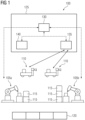
- Figure 1 schematically shows an exemplary shop floor 100.
- the shop floor 100 in general may be considered a manufacturing and/or processing environment or system, in particular a highly or fully automated environment or system.
- the shop floor 100 may be arranged in, and/or comprise, a building and/or one or more rooms or halls. It may be considered that a shop floor 100 may comprise different components, e.g., multiple machines or machine arrangements 105, and/or transport devices 110 for transporting material, in particular one or more AGVs (Automated Guided Vehicle).
- a shop floor 100 may comprise control devices and/or communication interfaces and/or monitoring devices, e.g., sensors like cameras and/or radar and/or lidar and/or scales, etc.
- a shop floor may be adapted to produce and/or manufacture one or more of different types of products, e.g., different electronics or mechatronics or toys or vehicles or mechanical products, or components of such products.
- a machine arrangement and/or machine 105 may be adapted for processing materials and/or manufacturing.
- a machine arrangement 105 may comprise one or more machines and/or processing devices, e.g., one or more tools and/or robots.
- a machine and/or machine arrangement 105 may be electronically and/digitally controlled and/or controllable, and/or may comprise one or more control devices and/or communication interfaces and/or monitoring devices.
- a machine or machine arrangement 105 may provide, e.g., via processing and/or manufacturing, an output material (e.g., in a lot size of a number of units) based on one or more input materials.
- a machine or machine arrangement 105 may receive information and/or instructions, e.g., for performing manufacturing and/or processing and/or one or more production steps or productive operation for such. It may be considered that a machine or machine arrangement 105 may be controlled or controllable by a controlling system like a MES, to perform one or more production steps. Production steps may be steps of processing and/or manufacturing and/or movement, e.g., performed on input material/s or a unit thereof, to produce an output material.
- a machine or machine arrangement 105 may be adapted, and/or comprise facilities, to move material, e.g., input material from and/or output material to a transfer station 115.
- Material may be input material or output material.
- Input material in general may be processed or unprocessed (raw) material, e.g., metal, ore, mechanical components, electronic components, optical components, etc.
- Different input materials may be provided to a machine or machine arrangement 105.
- Material may comprise one or more instances (units) of one type of material.
- Output material may be processed material.
- Material may comprise one or more instances (units) of one type of material.
- a unit of material may be standardized to be of the same type, and/or size, and/or weight, and/or composition. For example, multiple units of one material may comprise multiple electronic components of the same type, or multiple bars of metal of the same size.
- Input material for a machine arrangement 105 may be provided externally, e.g., via a buffer 120, or in the form of output material from a preceding processing of the shop floor 100.
- Processing and/or manufacturing may for example comprise one or more of applying one or more tools to input material/s, and/or performing one or more forming steps, and/or combining of different components (e.g., different input materials), and/or coating, and/or lasering, and/or painting, and/or welding, etc.
- Processing and/or manufacturing may comprise moving material, in particular within the machine arrangement 105 and/or to or from a transfer station 115 and/or a container.
- Output material for one machine or machine arrangement 105 may be input material for another machine or machine arrangement 105 with different processing and/or manufacturing setup, e.g., for further processing.
- Output material not intended for further processing by a shop floor machine arrangement 105 and/or the shop floor 100 may be considered a product or final product of the shop floor 100, which may be provided to a buffer, e.g., for removal and/or delivery to an external location.
- Input material that is intended as output material for further processing may be considered an intermediate product.
- a shop floor 100 may comprise and/or be controlled or controllable by a controlling system 125, which may for example comprise a MES (Manufacturing Execution System) 130.
- a controlling system 125 and/or MES 130 may comprise one or more control devices and/or software component/s.
- the controlling system 125 and/or MES 130 may be adapted to receive monitoring information from shop floor sensors and/or machine arrangements 105 and/or from transport device like AGVs 110 and/or other sources, for example a transport control system 135 and/or external sensors, for example drone sensors and/or sensors arranged in a building housing the shop floor.
- the controlling system 125 may be adapted to control, and/or provide instructions, to one or more machine arrangements and/or machines 105, e.g., via suitable communication interface/s (communication via communication interfaces is indicated with dashed lines in Figure 1 ). Control may be based on an operation schedule, which may be determined by the controlling system 125, for example a scheduling system 140 and/or the MES 130; the MES 130 may comprise the scheduling system 140, or it may be implemented as a separate control device or process, which may be in communication with the MES 130, and/or one or more other components of the controlling system 125 and/or the shop floor 100.
- the scheduling system 140 may receive information regarding and/or representing an order and/or operational state of the shop floor and/or individual subsystems (like the transport control system 135 and/or transport devices 110). Information may for example provided by the MES 130, and/or from one or more other components or subsystems, e.g., directly from the transport control system 135 and/or transport devices 110, and/or the machine arrangements 105, and/or a supervisor system, if such is implemented, for example to centrally monitor and/or control and/or evaluate the machine arrangements 105 and/or transport subsystem (e.g., AGVs 110 and/or transport control system 135).
- AGVs 110 and/or transport control system 135 e.g., AGVs 110 and/or transport control system 135.
- the MES 130, and/or the transport control system 135 and/or the scheduling system 140 may comprise one or more software components and/or modules and/or computer program products.
- a software or computer program product module may be provided for each action performed by a software.
- Figure 1 shows a centralized version of communication and control, but other architectures may be considered.
- a shop floor 100 may comprise and/or have access to one or more buffer areas (also referred to as buffers) 120, where input material may be delivered, and intermediate and final products may be stored.
- initial input material may be delivered to a buffer 120, which may be externally supplied to fulfill an order, and/or may be automatically requested based on an order. It may be assumed that a shop floor 100 may be informed about materials needed to fulfill an order (providing the desired number of units of a final product indicated in the order), e.g., based on the order and/or on information otherwise available, e.g., in a bill of process and/or database.
- Material may generally be provided to and/or from transfer stations 115 in containers.
- a container may be adapted to be able to contain a specific number of material units; different container types may be used for different materials, for example to allow ease of access for machines and/or robots.
- Containers of input material may be pre-prepared and/or provided at a buffer 120.
- the number of units of material for a container or container type may be pre-defined and/or fixed, e.g., for one or more types of material. For example, each container having the same input material may have, or be intended to have, the same number of units of this material.
- the number of units of output material may be dependent on the input material provided and/or a scheduling and/or an order. In some cases, a container with leftover input material may be transported below its intended number of units, e.g., if not all material has been needed to produce a desired number of output material units.
- a machine or machine arrangement 105 may be adapted to remove material from a container, and/or place material into a container.
- Transport of containers containing material may be provided using transport devices 110 like robots and/or AGVs.
- Transport devices 110 may be automated, e.g., remotely controlled by a transport control system 135 and/or independently controlled.
- Sensor input may be basis for transport control. It may be referred to transport to machines for brevity, which may be construed to mean transport to a transfer station of a machine. Machine and machine arrangement may be used interchangeably.
- a transfer station 115 may be adapted to receive and/or store a container, and/or make a container accessible for a transport device 110 and/or a machine or machine arrangement 105.
- the transfer station 115 may comprise facilities to receive and/or provide and/or store and/or lift up and/or lift down and/or move a container.
- To a machine or machine arrangement 105, or buffer area 120 there may be associated one or more transfer stations 115. Different numbers of transfer stations 115, and/or different transfer stations 115, may be associated to different machine arrangements 105 and/or different buffers 120.
- a transfer station 115 may be a (usually automated) handover point, where AGVs 110 can pick up or drop off containers.
- a machine 105 may have access to these stations and may use or deposit material in the containers there, e.g., if the station 115 is not part of a buffer 120.
- Each transfer station 115 may be adapted to accommodate one container.
- a transfer station may be for input material, or output material, or both, for example at different points in time and/or for different types of material. This may depend on facilities for movement of material to and/or from a container associated to a machine or machine arrangement 105. In some cases, different transfer stations may be suitable for different types of containers. It may be considered that a transfer station is separately operable, and/or it may be controllable by the controlling system 125.
- a transfer station 115 may comprise one or more sensors, to provide information or feedback to the controlling system 125, e.g., regarding containers and/or container content and/or container fill level, and/or status of AGVs 110 and/or a machine or machine arrangement 105, in particular the one it is associated to.
- An order and/or order information may specify and/or indicate a certain number of units of a required final product and/or corresponding input material needed to provide the final product, and/or a number of containers providing at least the needed input material/s.
- Different orders may specify or indicate or pertain to different types of products and/or different unit numbers.
- a BOP bill of process
- the BOP can also be flexible (e.g., the sequence of some steps may not be fixed).
- the production steps may be modeled in such a granularity that one production step for a unit of an order can be processed unit by unit. Performing several steps on one unit before working on the next one may not be necessary.
- Commissioned (e.g., initial) input material in appropriate containers for each order may be delivered externally to one of the buffers 120, e.g., from a loading station and/or a warehouse.
- Each step in the bill of process may be executed on one machine for all units of an order.
- a controlling system or central system 130 may trigger most or all operations necessary for the production to run, e.g., it may trigger and/or control one or more productive operations and/or unproductive operations for one or more machines. This may comprise the execution of a certain productive step or productive operation of a machine or machine arrangement 105 using input from prescribed transfer stations 115, and providing output to some transfer station 115, as well as a transport of some container from one transfer station 115 to another or to a buffer 120, or an "empty drive" which may be needed for an AGV 110 to get to a start location of a transport.
- the central system 130 may be responsible for having an overview and/or monitor what is currently processed, what is finished and what can and shall be processed next, for example based on information provided by transfer stations 115 and/or machines 105 and/or other sensors.
- a productive operation may be instructed to be carried out, wherein a productive operation may be based on a dynamic definition according to a schedule.
- the schedule may indicate a definition of a productive operation.
- a bill of process in this context may be dynamic or static.
- a fixed database may be utilized, which may detail which steps need to be done for a product and which machines can perform a certain step (maybe with additional setups); alternatively, a dynamic system may be used (e.g., a knowledge-graph base system), which can make recommendations what can be done where.
- Shop floor execution may be based on a plan or schedule which is generated in advance. Usually, the process starts with using some scheduling tool to generate a schedule as a basis. However, that plan may not have the necessary level of detail for automated shop floor processing, for example the required logistics may be not considered in adequate depth:
- Commercial scheduling tools like Opcenter APS
- a scheduling method and/or method of determining a replacement plan for a shop floor may be performed by a controlling system, in particular a scheduling system, and/or may be implemented as, and/or controlled by a computer program product.
- the scheduling system may in particular be a computer system and/or comprise processing circuitry and/or memory for performing the method.
- the shop floor may be a shop floor as described herein, in particular in the context of Figure 1 .
- a scheduling method may comprise receiving order information pertaining to one or more orders, and/or a bill of process.
- the bill of process may represent capabilities of machine arrangements of the shop floor.
- the order information may be provided by a central control system, in particular a MES.
- the order information may indicate, for at least one pending order, a number of units of a final product to be produced.
- Order information may indicate initial input material, and/or a location (e.g., buffer and/or transfer station of a buffer) of the container/s providing initial input material for the order, and/or a time limit for fulfilling the order.
- a location e.g., buffer and/or transfer station of a buffer
- a schedule may be determined based on transport options and/or based on generating transport options; a transport option may be generated based on, and/or pertaining to the order information. This may include considering initial input material information, and/or time limit information, e.g., as indicated by the order information.
- the required initial input material may be determined based on the final product and/or from order information. It should be noted that some initial input material may not necessarily be for initial use or transport, but may be intended for further processing steps, e.g., to be used after one or more productive operations have been performed for an order.
- the schedule may be provided for execution, e.g., to controlling system or a component thereof, e.g., an MES.
- Providing for execution may comprise transmitting the schedule to another system, e.g., an MES, and/or executing the schedule, for example controlling the shop floor, and/or one or more transport devices and/or one or more machine arrangements according to the schedule.
- Feedback from the shop floor may be received, e.g., feedback from the MES and/or central system, and/or one or more machine arrangements, and/or one or more transport devices, and/or a transport control system.
- Feedback may represent sensor information, and/or monitoring information, and/or status information (e.g., whether a production operation or transport has been completed), and/or error information, and/or one or more new and/or updated orders.
- An updated or new schedule may be determined; the updated or new schedule may be determined based on the feedback, which may for example exclude one or more transport options, and/or change timing.
- an error may occur, for example a processing step may fail, e.g., producing scrap. While for example delays may be handled by updating a schedule, some errors may require further measures.
- This invention describes a method to handle deviations or errors, in particular to deal with scrap parts and lot size adaption, for example in the context of iterative decision making and control processes without the need for human surveillance and without actively stopping ongoing production processes. Moreover, the method can also be used for automated adaptions in case of resource-dependent shop floor problems like temporary AGV or machine failures.
- the proposed approach may be referred to as "soft reset", during which active operations are continued; additional error specific data from other systems may not be needed in order to handle the error. Instead, a control process or execution or schedule may be adapted without disruptions.
- a processing step fails, this may mean that a unit of input material may be wasted (scrap) and/or a unit of output material is not produced as scheduled; this may have repercussions for further processing steps, which may not be able to produce the desired number of units of output material due to lack of sufficient input material. Since input is commissioned specifically for each order and intermediate products from previous production steps may be used, it may not be possible to just instruct production of one more unit to replace the scrap unit.
- This invention describes a soft reset feature for a control system or scheduling system, which may receive updates or feedback from execution of a schedule, e.g., from the MES (e.g., information indicating start and end time events of operations, number of successfully processed units of quantity and information on machine statuses, and/or information regarding errors, in particular regarding number of scrap units produced in a processing, in particular during execution of a productive operation). Decisions based on these updates or feedback may be provided back for execution, e.g., to the MES. Decisions may be for example in form of an updated schedule, or a set of instructions, e.g., to perform a soft-reset.
- MES e.g., information indicating start and end time events of operations, number of successfully processed units of quantity and information on machine statuses, and/or information regarding errors, in particular regarding number of scrap units produced in a processing, in particular during execution of a productive operation.
- Error handling may need to be dynamic and may not be solvable by executing a plan which was specified in advance due to the uncertain nature of error occurrence.
- the question how to properly execute automated error handling is particularly relevant for automated production management, for example for a shop floor as described herein.
- the proposed approach avoids performing what may be referred to as "hard reset" when an error occurs, where all processes are physically stopped, then it is determined at what state (e.g., regarding quantity of still available input materials) the shop floor currently is and if necessary, the state is changed such that the execution can resume.
- state e.g., regarding quantity of still available input materials
- the shop floor currently is and if necessary, the state is changed such that the execution can resume.
- a strategy is highly disruptive, requires a lot of time (e.g., gathering all necessary data to determine the current status) and may be unnecessary if there is no human operator who needs time for replanning anyway.
- One goal of an automated system is efficient resource usage.
- additional operations next to operations that can currently be executed may be considered. It may be assumed that there is a certain planning horizon, and that operations that could start within the planning horizon can already be planned and communicated to the MES. This also enables a predecessor-based MES to start processes earlier than planned if preceding operations finish sooner than expected.
- the planned status (which includes all planned operations, according to a schedule) and the realized status, which tracks which operations like productive operations or transports are partially or fully realized, in particular, which operations have started or are already completed.
- controlling system and/or scheduling system may be option-based; decisions may be taken (to determine a schedule, e.g., by selecting a series or chain of available options) by repeatedly or iteratively evaluating options for actions and choosing one (or none) to update the planned status.
- Each operation instructed by a schedule e.g., productive operation or non-productive operation or transport, may belong to some option for which it was added to the production execution plan (schedule). While embodiments based on transport-options has been referred to in detail, this concept does not require a specific option structure, thus other approaches may be considered.
- a schedule may represent operations that correspond to options selected from a set of options during option-based determination of the schedule, e.g., in a scheduling system.
- the schedule being executed may comprise instructing the operations, e.g., according to the schedule; an operation may be seen as an option to be realized.
- An operation or option may for example comprise one or more of a productive operation, non-productive operation (or corresponding processing steps), or a transport or movement of a transport device.
- An operation or option may comprise one or more processing steps; in some cases, an operation or option may correspond to an instruction structure of the controlling system and/or machine or transport system, which may for example provide for individual instruction causing a plurality of actions or processing steps to be performed by the receiving machine or transport device.
- Operations which cannot be separated on a system level may be part of the same option. For example, if the AGV transport system handles the instruction to pick up a container, transport it somewhere, and drop it off as one unit which cannot be interrupted or partially cancelled by an external system, then the three corresponding operations (pick-up, transport, drop-off) must be planned as part of the same option.
- an "empty drive" to a transport start location may usually be part of the same option as the transport itself.
- a controlling system like a MES encounters a situation where a soft reset should be performed, e.g., an error is detected, triggering further executions of operations may be avoided. For example, the controlling system may refrain from starting new operations (which may be indicated to be started according to a schedule being executed) since it cannot be sure if these operations will still be valid.
- Feedback e.g., that an error occurred and/or indicating that a soft reset should be executed may be provided to the scheduling system; the feedback may indicate how the produced output differs from the expected output, if applicable.
- a soft reset or associated schedule may be determined, and the result (e.g., in form of a schedule or set of instructions) may be communicated back to the MES, which may trigger or control actions or operations based on the new decisions.
- a soft reset procedure may ensure continued operation while being able to react as flexible as possible to unexpected changes.
- Some aspects of the procedure may aim at or comprise:
- a soft reset may also be helpful without a lot size reduction. If the MES encounters a scenario where it is advantageous to replan as much as possible, because the requirements have changed, triggering a soft reset would also be the right call. One example for that would be changes in machine availability, either because a new machine becomes available, or because there is a failure in some machine. In that case, part a) may be particularly relevant.
- a minimal executable plan would contain exactly the operations which were already started.
- an option may contain several closely related actions or operations or processing steps, which may be modeled as separate actions or operations to be able to adequately model predecessor relations.
- an option can also reflect actions that should be evaluated as one "block" during the decision process and/or when executed.
- an option may represent a combination of several actions and/or processing steps, which may different, or the same, e.g., when an action is to be repeated; a corresponding operation may also be referred to as combination operation.
- Operations may in general have implicit predecessor relations.
- the direct predecessors of an operation 0 are the operations which belong to a minimal set of all operations which must be finished before O can start (this set is unique and easily computable). Since an option is only chosen if all its operations or actions or processing steps can feasibly be added to the current planned status, this may also induce a partial order (and thus predecessor relations) on the options.
- a predecessor e.g., of successor like a step or option or transport or operation, in particular productive operation
- a predecessor may be an option and/or operation and/or movement and/or transport and/or action and/or processing step that has to be performed for a successor to be carried out.
- a predecessor may be considered logically and/or operationally necessary for a successor; performing the successor may be conditional on the predecessor occurring and/or being performed.
- an updated schedule may be determined, which may represent a minimal executable plan.
- a set S of all options which are needed to be included may be determined. It may be considered to add to, and/or include into, S all options, for which at least one operation or action is (at least partially) realized, specifically operations that have been started and/or that currently are executed.
- a set of reversible operation types may be defined. That is, if the only realized operations (currently executed) are reversible/stoppable, the option may be excluded from S and execution of the operation may be stopped instead. This may for example be an empty AGV drive, which was necessary to relocate the AGV if the AGV administration system allows stopping AGV drives. Starting from this set S, a transitive closure w.r.t. the predecessor relations may be determined. Any predecessor of an option in S also may be added to S until no further such predecessor exists.
- AGV A transports container F1 from transfer station X to Y.
- the transport of F1 has already started.
- Y is currently occupied by a container F2, because AGV B has not yet picked up container F2 to make room for F1. Since B is closer, that operation and its containing option have not started yet.
- the drop-off of F1 cannot be completed before B has not completed the pick-up of F2 (in other words, the pickup of F2 by B is a predecessor of the drop-off of F1 by A).
- the corresponding option for the pickup of F2 and/or corresponding option needs to be included in S as well.
- the algorithm makes assumptions about the order of options during the planning stage (when determining a schedule, for instance), these assumptions may be considered for the minimal feasible plan generation. For example, if an option of type A is planned before an option of type B can be planned, then including of an option of type B may lead to including the relevant options of type A. Note that this is not a strict predecessor relation on the execution side, but a planning sequence restriction, which (if it exists) must be considered during soft reset as well. On the other hand, it may be worthwhile to consider using planning rules in the control algorithm which keep S small, for example, not choosing an option too early if that causes a much larger set S. It may be considered that the fact that the smaller the set S, the more flexible we can react on the situation at hand after an error has occurred, e.g., by determining a new schedule to be executed after resolving the soft reset.
- a plan or schedule to restart execution management may be generated, e.g., based on the currently executed schedule.
- the options may be replanned in the order they were first selected, and/or options not selected in S may be removed from the planned status (schedule).
- the MES may be notified about cancelled operations, e.g., in the form of an updated schedule and/or information indicating and/or representative of the schedule, and/or of cancelled operations, and/or of kept operations.
- the MES may start triggering executions again.
- the shop floor management has a well-defined status with which it can continue, e.g., with a determining a new schedule based on available orders.
- the following BOP may be considered: Laser -> Assemble ⁇ - Depannel representing a process in which laser processing and depaneling, e.g., on different materials, are performed before the (different) materials are assembled.
- scrap may imply that non-empty input containers may exist somewhere in the system, so the automated control software or the controlling system may need to be able to manage cleanup operations.
- FIG. 2 A schematic flow diagram of the inventive method is shown in Figure 2 . It may be performed in the context of a shop floor as shown in Figure 1 .
- the method may be performed in particular by a control system, in particular a scheduling system 140. It may be assumed that the control system performing the method is informed about the current schedule, e.g., due to it having it determined itself, and/or due information received from the controlling system 125, in particular a MES 130.
- the method may include determining the schedule, and/or functionality provided by a scheduling system 140 as described herein.
- the method of determining a replacement plan may comprise an action S10 of receiving an indication that a deviation from a schedule being executed by the shop floor has occurred.
- This action may include receiving feedback, e.g., from a MES.
- the feedback may indicate the schedule, and/or operations already started (which may be not yet finished), and/or an error occurrence, and/or information specifying an error, and/or information regarding changes in the shop floor, and/or status information pertaining to one or more components of the shop floor, in particular one or more of the machine arrangements and/or transport devices and/or transfer stations.
- a computer program product and/or software may comprise a receiving module for performing action S10.
- a replacement plan is determined.
- the replacement plan is based on the schedule. It may be considered that the replacement plan includes already started operations and excludes at least some operations scheduled according to the schedule. These may be operations not linked to already started operations as included, e.g., linked by being predecessor and/or successor and/or conditionally linked.
- a computer program product and/or software may comprise a determining module for performing action S12.
- Action S14 comprises indicating the replacement plan for automated execution, e.g., to a component of the controlling system and/or a control device, in particular an MES.
- a computer program product and/or software may comprise an indicating module for performing action S10.
- a transport option may represent a possible transport or movement of a transport device to fulfill an order, e.g., to provide input material and/or move output material, and/or suitably position the transport device, e.g., to fulfill the final product/s of the order.
- a transport option may be based on one or more initial transport options, e.g., of initial input material provided at a buffer, as provided externally for fulfilling the order.
- the schedule may be based on processing orders and/or transport options associated to orders, in sequence, or at least partly in parallel, e.g., depending on the bill of process, and/or the available machines, and/or transport capacity, and/or available material.
- a transport option may be determined based on a productive operation definition, which may be dynamically determined as described herein, e.g., during determining the schedule and/or depending on transport options.
- a transport option may generally represent a transport possible to fulfill an order; this may for example limit potential initial transport options, as only one or a few potential initial processing steps and/or productive operations may be available.
- An unproductive operation may generally be an operation that may not directly be involved in processing material, but may be needed, e.g., for intermediate storage and/or setup or positioning of a machine arrangement or transport device, or maintenance, or monitoring, or communication.
- Transport options may be successively derived based on one or more potential initial transport options.
- a transport driven decision management is proposed, to determine the schedule.
- Possible transport options may be provided, and productive operations may be planned and/or executed as soon as all necessary criteria (e.g., enough input material and output space) are fulfilled. All possible transport options (e.g., in the context of pending orders) may be provided, and the most promising one may be selected, e.g., based on one or more optimization criteria and/or timing demands for one or more orders. It may be considered that the schedule is determined based on production operations determined based on transport options, and/or an order.
- the schedule may represent and/or comprise, at least in part, instructions to actualize a number and/or series of transport options.
- a transport option in general may indicate a transport device, and/or a timing, and/or a start for a transport, and/or a target, and/or whether and/or which container to transport, and/or a path to take, and/or potential co-pending traffic or movement by other transport devices.
- a start or target may in particular correspond to a transfer station.
- the schedule may also represent and/or comprise instructions for productive and/or unproductive operation and/or associated processing steps for one or more machines or machine arrangements.
- Generating transport options may be based on one or more of the following:
- the decision for the first transport of an order may determine the order sequencing on the machine.
- the evaluation which of these transports should be planned may be based on criteria for productive options in a "classical scheduling approach", but of course there may be additional transport-related decision criteria as well.
- the schedule may be dynamically updated, and/or performed repeatedly.
- the planning horizon of the scheduling (e.g., the time interval for which the scheduling is to be followed or executed by the shop floor) may be predetermined, and/or adapted dynamically, e.g., based on an order, and/or final product. For example, some products may intrinsically demand longer processing than others; correspondingly, a longer planning horizon may be used.
- the planning horizon can for example be 5 minutes or less, or 10 minutes or less, or 60 minutes or less.
- the planning horizon may be shorter than the execution time for one of the orders, and/or such that at least one schedule update is performed when executing one of the orders (e.g., from providing initial input material to providing the desired final product).
- an updated schedule may be determined for a succeeding time interval or planning horizon.
- a lot size one may be considered, planning one operation for producing a unit on a machine. This corresponds to a time window where the machine is blocked. Unproductive operations like a setup may be added. For larger lot sizes, one time window for producing several units may not be enough: If a production operation is communicated as one item, it may need to be executable after a fixed set of other (predecessor) operations is finished. Since the number of transfer stations and thus the number of slots for input and output containers is limited, it may not be possible to create or schedule a situation beforehand, where all units of one order can be produced without executing other operations in between (e.g., replenishing input, or removing an output container to free up space for a new one).
- a productive operation may be defined as the maximum number of unit execution steps for an order which use a fixed set of transfer stations for input and output material. After a productive operation, there may be a full output container, and/or an empty input container; the productive operation may be defined correspondingly. Accordingly, dynamically generating the productive operations for an order on a machine is proposed, based on which input will be available where and which transfer stations are free for output usage.
- This approach may minimize the necessary amount of communication and/or may be compatible with every sequence in which input containers are driven to the machine (provided deadlocks are avoided in transport planning).
- it may not be necessary to decide, before planning transports, whether to first use material, that can be transported directly from a previous machine, or material which is already in a buffer for intermediate storage.
- the schedule may be determined based on defining one or more productive operations, and/or based on thus-defined productive operations. It may be considered that a productive operation may be defined based on transport options and/or be dynamically defined.
- One iteration of the process or method may comprise receiving feedback from the MES, generating all currently plannable options (transport and productive options as described above) based on the feedback.
- the system may decide which option and/or options and/or set of options to take based on how the plan which extends the current choices by including the new option/s or set would look like.
- the schedule may be based on this consideration.
- the best choice (which can also be to do nothing) may then fixed or decided on, to determine the schedule.
- a certain schedule may be determined, but the schedule or determined times or timing may still change based on future MES feedback.
- Incorporating changed times may help making better decisions or improving scheduling. For example, if a machine or AGV is still busy due to some delay during execution of the schedule, an update may consider using alternative free resources.
- the MES can either work on a time-based or on a predecessor-based structure. That means, after all systems synchronize their time in the beginning, the concept and approaches are compatible with a triggering system which either starts a new operation after all predecessors (which may be communicated to the MES) are finished, or at a specified time.
- the management software or scheduling system may adapt to changes in estimated times. Already taken timing decisions of the schedule may be reviewed and/or changed and/or compensated for, based on feedback from the MES which operations finished when.
- the schedule may be based on information provided about a status of the shop floor, and/or one or more machines, and/or one or more transfer stations, and/or one or more transport devices.
- adaption capabilities facilitate making good decisions in a changing environment, represented in an efficient schedule.
- MES MES would have to trigger each operation separately, and also may have to wait for the feedback that the operation was finished).
- internal optimizing processes like parallelizing the physical manipulation of the workpiece and retrieving the next raw material is facilitated.
- the approaches described allow efficiently dealing with non-unit lot sizes and formulating a method for automated shop floor operation in the form of an executable schedule, which in particular may be executable without intermediate human interaction. Work in progress may be reduced, e.g., reducing the amount of material standing somewhere on the shop floor and waiting to be processed, and/or reducing production cycle times of customer orders.
- the described approaches are automated and adaptive, may optimize resource usage.
- the method may also be used to create mid- and long-term production plans or schedules with integrated logistics.
- a shop floor simulation may be used, which just does as estimated in the planning steps. This simulation may take the role of the shop floor on the MES side and is easy to implement.
- Such a schedule can be useful for capacity planning or delivery date estimation and is more precise than classical scheduling tools which only consider logistics in a second step or not at all.
- a control device or system may comprise circuitry, which may comprise integrated circuitry.
- Processing circuitry may comprise one or more processors and/or controllers (e.g., microcontrollers), and/or ASICs (Application Specific Integrated Circuitry) and/or FPGAs (Field Programmable Gate Array), or similar. It may be considered that processing circuitry comprises, and/or is (operatively) connected or connectable to one or more memories or memory arrangements.
- a memory arrangement may comprise one or more memories.
- a memory or storage medium may be adapted to store digital information.
- Examples for memories or storage media comprise volatile and non-volatile memory or media, and/or Random Access Memory (RAM), and/or Read-Only-Memory (ROM), and/or magnetic and/or optical memory, and/or flash memory, and/or hard disk memory, and/or EPROM or EEPROM (Erasable Programmable ROM or Electrically Erasable Programmable ROM).
- RAM Random Access Memory
- ROM Read-Only-Memory
- EPROM or EEPROM Erasable Programmable ROM or Electrically Erasable Programmable ROM
- a control device receives other computer-readable control signals in order to initiate the mentioned steering/control process by its processor(s).
Landscapes
- Business, Economics & Management (AREA)
- Engineering & Computer Science (AREA)
- Human Resources & Organizations (AREA)
- General Physics & Mathematics (AREA)
- Economics (AREA)
- Physics & Mathematics (AREA)
- Quality & Reliability (AREA)
- Entrepreneurship & Innovation (AREA)
- Strategic Management (AREA)
- Operations Research (AREA)
- General Engineering & Computer Science (AREA)
- Automation & Control Theory (AREA)
- Tourism & Hospitality (AREA)
- Manufacturing & Machinery (AREA)
- General Business, Economics & Management (AREA)
- Development Economics (AREA)
- Theoretical Computer Science (AREA)
- Marketing (AREA)
- Finance (AREA)
- Accounting & Taxation (AREA)
- Educational Administration (AREA)
- Game Theory and Decision Science (AREA)
- General Factory Administration (AREA)
Priority Applications (1)
| Application Number | Priority Date | Filing Date | Title |
|---|---|---|---|
| EP23162333.1A EP4432030A1 (de) | 2023-03-16 | 2023-03-16 | Soft-reset - fehlerbehandlung bei der ausführbaren terminplanerzeugung einer fabrik |
Applications Claiming Priority (1)
| Application Number | Priority Date | Filing Date | Title |
|---|---|---|---|
| EP23162333.1A EP4432030A1 (de) | 2023-03-16 | 2023-03-16 | Soft-reset - fehlerbehandlung bei der ausführbaren terminplanerzeugung einer fabrik |
Publications (1)
| Publication Number | Publication Date |
|---|---|
| EP4432030A1 true EP4432030A1 (de) | 2024-09-18 |
Family
ID=85703928
Family Applications (1)
| Application Number | Title | Priority Date | Filing Date |
|---|---|---|---|
| EP23162333.1A Pending EP4432030A1 (de) | 2023-03-16 | 2023-03-16 | Soft-reset - fehlerbehandlung bei der ausführbaren terminplanerzeugung einer fabrik |
Country Status (1)
| Country | Link |
|---|---|
| EP (1) | EP4432030A1 (de) |
Citations (4)
| Publication number | Priority date | Publication date | Assignee | Title |
|---|---|---|---|---|
| US20080294279A1 (en) * | 2007-05-24 | 2008-11-27 | Siemens Aktiengesellschaft | System and method for handling a production disturbance/opportunity event in a production execution system |
| WO2020086109A1 (en) * | 2018-10-26 | 2020-04-30 | Siemens Aktiengesellschaft | Receding horizon planning for logistics |
| EP3859619A1 (de) * | 2020-01-28 | 2021-08-04 | Siemens Corporation | Verfahren zur erzeugung eines produktionsplans für den betrieb einer anzahl von ressourcen |
| EP4095772A1 (de) * | 2021-05-28 | 2022-11-30 | Siemens Aktiengesellschaft | Optimierung eines produktionssystems |
-
2023
- 2023-03-16 EP EP23162333.1A patent/EP4432030A1/de active Pending
Patent Citations (4)
| Publication number | Priority date | Publication date | Assignee | Title |
|---|---|---|---|---|
| US20080294279A1 (en) * | 2007-05-24 | 2008-11-27 | Siemens Aktiengesellschaft | System and method for handling a production disturbance/opportunity event in a production execution system |
| WO2020086109A1 (en) * | 2018-10-26 | 2020-04-30 | Siemens Aktiengesellschaft | Receding horizon planning for logistics |
| EP3859619A1 (de) * | 2020-01-28 | 2021-08-04 | Siemens Corporation | Verfahren zur erzeugung eines produktionsplans für den betrieb einer anzahl von ressourcen |
| EP4095772A1 (de) * | 2021-05-28 | 2022-11-30 | Siemens Aktiengesellschaft | Optimierung eines produktionssystems |
Similar Documents
| Publication | Publication Date | Title |
|---|---|---|
| US12189400B2 (en) | Automated guided vehicle management system and method | |
| JP7391535B2 (ja) | マルチエージェントシステムにおけるロボットの動作方法、ロボット及びマルチエージェントシステム | |
| US20250085698A1 (en) | Optimisation-based scheduling method and system for a plurality of manufacturing machines | |
| US6564113B1 (en) | Lot start agent that calculates virtual WIP time in a multi-product and multi-bottleneck manufacturing environment | |
| EP4016217A1 (de) | Planungssystem und verfahren zur bearbeitung von werkstücken | |
| US8346596B2 (en) | Method for managing production system operations | |
| US20090222123A1 (en) | Method and system for scheduling a set of events in real time | |
| CN113131554B (zh) | 优化otg无线充电单元的配置的方法 | |
| TW201532118A (zh) | 用於控制多批工件處理的方法、儲存媒體及系統 | |
| Dang et al. | A heuristic approach to schedule mobile robots in flexible manufacturing environments | |
| EP4275098B1 (de) | System und verfahren zur bereitstellung von kurzfristigen dispatchentscheidungen zum betreiben mehrerer an produktionsprozessen beteiligter ressourcen unter berücksichtigung langfristiger ziele | |
| US20250054078A1 (en) | Machine schedule generation method and system | |
| JP7462809B2 (ja) | 自律システム及びその制御方法 | |
| US11182715B2 (en) | Systems and methods for orchestrating autonomously and manually performed operations | |
| WO2020086109A1 (en) | Receding horizon planning for logistics | |
| JP2023043147A (ja) | 部品供給システムの運用方法、その方法を遂行するプログラムを記録した記録媒体、及び部品積込スケジュールを修正するサーバー | |
| US7477958B2 (en) | Method of release and product flow management for a manufacturing facility | |
| CN120634202B (zh) | 一种基于生产节拍的动态仓储智能分拣方法、系统、设备及介质 | |
| JP3169001B2 (ja) | ロット搬送制御システム及びその搬送制御方法ならびに搬送制御プログラムを格納した記憶媒体 | |
| CN116703104A (zh) | 一种基于决策大模型的料箱机器人订单拣选方法及装置 | |
| Huang | Optimization of job shop scheduling with material handling by automated guided vehicle | |
| EP4432179A1 (de) | Effizientes ladenbodenmanagement mit integrierter logistik, eingabematerialverwaltung und nichteinheitlichen losgrössen | |
| JP7046020B2 (ja) | 運転管理装置および運転管理方法 | |
| Pfitzer et al. | Event-driven production rescheduling in job shop environments | |
| JP7437366B2 (ja) | セルベースのモビリティ生産システムの運営方法 |
Legal Events
| Date | Code | Title | Description |
|---|---|---|---|
| PUAI | Public reference made under article 153(3) epc to a published international application that has entered the european phase |
Free format text: ORIGINAL CODE: 0009012 |
|
| STAA | Information on the status of an ep patent application or granted ep patent |
Free format text: STATUS: THE APPLICATION HAS BEEN PUBLISHED |
|
| AK | Designated contracting states |
Kind code of ref document: A1 Designated state(s): AL AT BE BG CH CY CZ DE DK EE ES FI FR GB GR HR HU IE IS IT LI LT LU LV MC ME MK MT NL NO PL PT RO RS SE SI SK SM TR |
|
| STAA | Information on the status of an ep patent application or granted ep patent |
Free format text: STATUS: REQUEST FOR EXAMINATION WAS MADE |
|
| 17P | Request for examination filed |
Effective date: 20250204 |
|
| STAA | Information on the status of an ep patent application or granted ep patent |
Free format text: STATUS: EXAMINATION IS IN PROGRESS |
|
| 17Q | First examination report despatched |
Effective date: 20250902 |