EP4430979A1 - Zerlegbarer offener schuh und verfahren zur herstellung dieses schuhs - Google Patents
Zerlegbarer offener schuh und verfahren zur herstellung dieses schuhs Download PDFInfo
- Publication number
- EP4430979A1 EP4430979A1 EP24163289.2A EP24163289A EP4430979A1 EP 4430979 A1 EP4430979 A1 EP 4430979A1 EP 24163289 A EP24163289 A EP 24163289A EP 4430979 A1 EP4430979 A1 EP 4430979A1
- Authority
- EP
- European Patent Office
- Prior art keywords
- shoe
- sole
- removable
- shoe body
- strap
- Prior art date
- Legal status (The legal status is an assumption and is not a legal conclusion. Google has not performed a legal analysis and makes no representation as to the accuracy of the status listed.)
- Withdrawn
Links
Images


Classifications
-
- A—HUMAN NECESSITIES
- A43—FOOTWEAR
- A43B—CHARACTERISTIC FEATURES OF FOOTWEAR; PARTS OF FOOTWEAR
- A43B3/00—Footwear characterised by the shape or the use
- A43B3/10—Low shoes, e.g. comprising only a front strap; Slippers
- A43B3/101—Slippers, e.g. flip-flops or thong sandals
- A43B3/102—Slippers, e.g. flip-flops or thong sandals leaving the heel of the foot bare
- A43B3/103—Slippers, e.g. flip-flops or thong sandals leaving the heel of the foot bare characterised by the attachment of the toestrap
-
- A—HUMAN NECESSITIES
- A43—FOOTWEAR
- A43B—CHARACTERISTIC FEATURES OF FOOTWEAR; PARTS OF FOOTWEAR
- A43B3/00—Footwear characterised by the shape or the use
- A43B3/10—Low shoes, e.g. comprising only a front strap; Slippers
- A43B3/108—Low shoes, e.g. comprising only a front strap; Slippers characterised by the sole
-
- A—HUMAN NECESSITIES
- A43—FOOTWEAR
- A43B—CHARACTERISTIC FEATURES OF FOOTWEAR; PARTS OF FOOTWEAR
- A43B3/00—Footwear characterised by the shape or the use
- A43B3/12—Sandals; Strap guides thereon
- A43B3/122—Sandals; Strap guides thereon characterised by the attachment of the straps
-
- A—HUMAN NECESSITIES
- A43—FOOTWEAR
- A43B—CHARACTERISTIC FEATURES OF FOOTWEAR; PARTS OF FOOTWEAR
- A43B3/00—Footwear characterised by the shape or the use
- A43B3/12—Sandals; Strap guides thereon
- A43B3/128—Sandals; Strap guides thereon characterised by the sole
-
- A—HUMAN NECESSITIES
- A43—FOOTWEAR
- A43B—CHARACTERISTIC FEATURES OF FOOTWEAR; PARTS OF FOOTWEAR
- A43B3/00—Footwear characterised by the shape or the use
- A43B3/24—Collapsible or convertible
- A43B3/242—Collapsible or convertible characterised by the upper
-
- A—HUMAN NECESSITIES
- A43—FOOTWEAR
- A43B—CHARACTERISTIC FEATURES OF FOOTWEAR; PARTS OF FOOTWEAR
- A43B3/00—Footwear characterised by the shape or the use
- A43B3/24—Collapsible or convertible
- A43B3/244—Collapsible or convertible characterised by the attachment between upper and sole
-
- A—HUMAN NECESSITIES
- A43—FOOTWEAR
- A43B—CHARACTERISTIC FEATURES OF FOOTWEAR; PARTS OF FOOTWEAR
- A43B3/00—Footwear characterised by the shape or the use
- A43B3/24—Collapsible or convertible
- A43B3/246—Collapsible or convertible characterised by the sole
Definitions
- the present invention relates to a removable open shoe, in particular with a reconfigurable orthopedic sole, and a method of manufacturing this shoe.
- closed shoes in which the wearer's foot is completely hidden
- open shoes in which all or part of the foot is exposed.
- Open shoes such as sandals or flip-flops, are usually worn barefoot and quickly become dirty because soil, plant debris or sand can get on the upper surface of the sole and the sole is visible.
- the present invention aims to remedy all or part of these drawbacks.
- the present invention aims at a method of constituting a removable open shoe according to claim 1.
- This process has the advantage of ensuring improved comfort when wearing the shoe for the user since their foot or the orthopedic sole under their foot correspond perfectly to the removable sole on which they rest.
- the shoe adapted to the patient is produced by attaching the attachment means of each strap to the body of the shoe. It is noted that the ends of the straps are hidden by being inserted into the notches of the removable sole.
- orthopaedic correction elements can be inserted between the body and the removable sole, or above the removable sole, for example in the form of an orthopaedic insole.
- the removable sole can also be an orthopaedic insole. In the first case, these orthopaedic correction elements are protected from the support of the foot by the removable sole. Wearing the shoe is thus more comfortable.
- the straps can possibly be changed, for example following their wear or to change the appearance of the shoe.
- an orthopedic sole (or orthopedic element) can be positioned on the removable sole, and fixed to the shoe body through the removable sole.
- the shoe includes an orthotic insole having at least one lower extension configured to pass through a through opening of the removable insole and force-fit into a blind opening of the shoe body.
- the attachment of the removable sole to the body of the shoe is thus achieved by interlocking or force fitting, the friction forces between the two parts fitted together or embedded in a force-fitted manner ensuring that they are held in position without the need for any other fixing, for example by self-gripping fabrics.
- the shoe body includes a peripheral ledge or post that extends the lateral surface of the shoe body and projects above its upper surface and laterally retains the removable sole.
- the peripheral rim or post includes at least one attachment means consisting of a through opening
- at least one strap includes an attachment means consisting of a portion of a removable rivet configured to mechanically connect, in a releasable manner, to another portion of the removable rivet, the two portions of the removable rivet surrounding a through opening in the peripheral rim or post of the shoe body.
- the strap can go around the edge of the shoe body and, possibly, penetrate into this shoe body via through openings extending from housings on the surface or in the thickness of this shoe body.
- the shoe can thus be more aesthetic.
- At least one strap includes an attachment means consisting of a through opening
- the peripheral flange or post includes at least one attachment means consisting of a portion of a removable rivet configured to mechanically connect, in a releasable manner, to another portion of the removable rivet, the two portions of the removable rivet surrounding a through opening of the strap.
- the strap is attached to the edge of the shoe body and its end is hidden in a notch in the removable sole, possibly in a housing on the surface of the shoe body.
- the term “upper” or “top” refers to that which is at the top in the normal usage configuration of the shoe.
- the upper parts are at the top.
- lower or “bottom” what is at the bottom in the normal configuration of use of the shoe, for example the part of the body of the shoe in contact with a horizontal ground.
- front what is close to the support of the toes or turned towards the end of the shoe receiving this support
- rear what is close to the support of the heel or turned towards the end of the shoe receiving this heel.
- the front is on the right, and the back of the shoes is on the left.
- the shoe and the shoe body have a so-called “internal” side intended to receive the internal arch of the foot and a so-called “external” side is intended to receive the external arch of the foot.
- the internal side has a concavity or, at least, a convexity less than or equal to the convexity of the external side of the shoe.
- the so-called internal side is at the top right and the external side is at the bottom left.
- the person skilled in the art who has to design and manufacture the components of this shoe refers to predetermined user foot models. These foot models are known to the person skilled in the art, in particular through his knowledge general in the podiatric field and in the technical field of shoe manufacturing.
- the present invention relates to a "dismountable" open shoe.
- Each component of the shoe, body, insole, strap and possible orthopedic correction elements is independent of the other components and becomes integral with these other components once these components are assembled.
- an objective of the shoe object of the invention is to make it possible to place orthopedic correction elements between the body of the shoe and the removable sole, then to secure the components of the orthopedic shoe.
- the user can remove, replace or change all components of the shoe, independently of each other. He can thus wash them, modify the appearance of the shoe and modify the adaptation of the orthopedic correction elements.
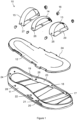
- the open shoe 10 object of the invention for example a sandal, is structured in the following manner.
- the body 11 of the shoe 10 is, by its lower surface, the part of the open shoe in contact with the ground.
- This body 11 can be made of any rigid or semi-rigid material, for example wood, natural or synthetic textile, a composite material based on resin, synthetic foam, in particular based on polymer, natural or synthetic rubber, leather or a combination of these materials.
- the shoe 10 is a removable open shoe, which comprises the shoe body 11, a removable sole 12, straps 13, 14 and 15 and, optionally, clips 16, an upper orthopedic sole (not shown) and/or orthopedic elements (not shown) positioned between the removable sole 12 and the shoe body 11.
- the number of straps is not limited to three and can be any number greater than or equal to one.
- a so-called “lower” face is intended to be in contact with the ground during walking and a so-called “upper” surface for supporting the foot is opposite the lower surface.
- a so-called “inner” side is intended to receive the inner arch of the foot and a so-called “outer” side is intended to receive the outer arch of the foot.
- This body 11 of the shoe 10 comprises, in its upper surface, at least one housing 17, 18 and 19, extending from at least one side of the upper surface.
- each housing 17, 18 and 19 extends from the inner side of the body 11 of the shoe 10 to the outer side of this shoe body 11.
- a housing extending from one side of the shoe body 11 does not extend to the other side. In this case, there may or may not be a housing in this other side.
- the shoe body 11 also comprises a rim, or peripheral post, 23 which extends the lateral surface of the shoe body 11 and protrudes above its upper surface and which laterally retains the removable sole 12.
- the shoe body does not comprise such a rim 23 or, in any case, not over the entire periphery of its upper surface.
- the shoe body 11 also comprises through lateral openings 20 in the rim 23.
- the through lateral openings 20 allow the passage of a lower extension 29 of a strap. In other embodiments, these openings 20 are absent.
- the shoe body 11 also includes means 21, 22 and 28 for attaching to the straps 13, 14 and 15, by means of the clips 16, presented below.
- the shoe body 11 also has rear holes 24. These rear holes 24 form clip supports for more complete strapping of the user's foot.
- the removable sole 12 has, seen from above, a geometry which corresponds to that of the upper surface of the body 11 of the shoe 10. In the event of the presence of the rim 23 in the shoe body, the removable sole 12 is engaged in the shoe body in contact with this rim 23, except in each extension of a lateral notch 24.
- the removable sole 12 is provided with at least one lateral notch superimposed on the end of a housing 17, 18 or 19 located on one side of the upper surface of the body 11 of the shoe 10. Thus, this notch 24 continues this housing and causes it to open, after a right angle, onto the upper surface of the removable sole 12.
- the attachment of the removable sole 12 to the body 11 of the shoe is, for example, carried out by means of self-gripping fabrics (better known under the name of Velcro, registered trademark), for example positioned at the front and at the back of the removable sole 12.
- the sole 12 may be made of any rigid, semi-rigid or flexible material, for example wood, natural or synthetic textile, a resin-based composite material, synthetic foam, in particular polymer-based, natural or synthetic rubber, leather or a combination of these materials.
- Each strap 13, 14 and 15 has an upper rounded part intended to surround, from above, the user's foot from one arch of the foot to the other, and at least one lower extension 26 of this rounded shape, intended to be housed in a housing 17, 18 or 19.
- each strap 13, 14 and 15 comprises two lower extensions 26 which, once the shoe 10 is assembled, extend into a housing in the shoe body 11, after passing through a lateral notch 24 in the removable sole 12.
- each strap 13, 14 and 15 comprises, in its upper rounded part and near its end (before the possible lower extension 26 which continues this rounded part), a means of attachment 25, 26 or 27 to the edge 23 of the body 11 of the shoe.
- This means of attachment 25, 26 or 27 comes, once the shoe 10 is assembled, in continuity with a means of attachment 21, 22 and 28 of the edge 23 of the body 11 of the shoe.
- the means of attachment 21, 22 and 28, on the one hand, and 25, 26 and 27, on the other hand, are connected by means of the clips 16.
- the clips 16 are, for example, removable rivet parts or snap fasteners. At least one of the fastening means 25, 26 and 27 consists of a complementary part of a clip 16 and connects to the clip 16 after the latter has passed through a through opening 28 of the shoe body 11. In the embodiment shown, the fastening means 28 on the inner side of the shoe body 11 as well as the rear fastening means 28 on the outer side of the shoe body 11 are thus through openings.
- the fastening means 21 and 22 of the shoe body 11 each consist of a part complementary to a clip 16, and connect to the clips 16 after the latter has passed through a through opening 25 or 26 of the strap 13 or 14.
- the attachment means 21 and 22 at the front on the external side of the shoe body 11 are thus through openings.
- the presence of a lateral through opening 20 does not require that a strap pass through this opening, so that the attachment of the strap to the shoe body 11 can be identical to that described above for the attachment means 28 on the inner side of the shoe.
- each lower extension 29 of a strap 13, 14 or 15 is secured with the body 11 of the shoe.
- at least one clip is implemented.
- a self-gripping fabric is implemented.
- At least one strap 13, 14 or 15 is configured, at least one lower extension 29, to successively pass through a notch 24 of the removable sole 12 and a housing, 17, 18 or 19 respectively, in the upper surface of the body 11 of the shoe.
- Each strap 13, 14 and 15 is provided, at at least one of its ends, with a means of attachment 25, 26, 27, to the body 11 of the shoe 10.
- the straps 13, 14 and 15 may be made of any flexible material, natural or synthetic textile, a composite material based on resin, synthetic foam, in particular based on polymer, natural or synthetic rubber, leather or a combination of these materials.
- the shoe 30 object of the second embodiment illustrated in figure 2 is similar to the first embodiment, except that the body 31 has, in its upper surface, blind openings 33 and the removable sole 32 has, in its thickness, pre-cut through openings 34 which, once the shoe 30 is mounted, overlap the blind openings 33.
- this additional sole comprises, underneath, flexible extensions which fit together forcefully (i.e. which are embedded), each, in a blind opening 33, through a through opening 34 of the removable sole 32.
- the through openings 34 are previously opened by removing the pre-cut material.
- the pre-cut material is not removed from the through openings 34.
- the openings 33 and 34 allow the positioning of an orthopedic sole in the removable shoe 30.
- the sole 32 is an orthopedic sole and the pre-cut through openings 34 are replaced by flexible extensions towards the bottom of these soles 32, which fit forcefully into the blind openings 33 of the shoe body 31.
- Embodiments of the shoe include an orthotic insole (not shown) having at least one lower extension configured to pass through a through opening 34 of the removable insole 32 and force-fit into a blind opening 33 of the shoe body 31.
- the attachment of the removable sole to the shoe body is achieved by force fitting, without it being necessary to provide another attachment, for example by self-gripping fabrics.
- the shoe body 11, 31 comprises a peripheral rim or upright 23 which extends the lateral surface of the shoe body and protrudes above its upper surface and which laterally retains the removable sole 12, 32.
- the peripheral rim or post 23 comprises at least one attachment means 28 consisting of a through opening
- at least one strap 15 comprises an attachment means 27 consisting of a portion of a removable rivet configured to mechanically connect, in a removable manner, to another portion 16 of removable rivet, the two portions of removable rivet surrounding a through opening in the peripheral rim or post 23 of the shoe body 12, 32.
- the outer portion of the strap, 13 and 14 in the embodiments shown can go around the rim of the shoe body.
- the lower extension 29 of the outer portion of the strap 13 and 14 penetrates into this shoe body through one of the through openings 20 in extension of housings 17 and 18 on the surface of the shoe body 11, 31.
- the through openings 20 continue in the thickness of this shoe body and not in housings 17 and 18 on the surface of this shoe body. The shoe can thus be more aesthetic.
- a method of manufacturing the removable sole 12 is described below, allowing it to receive a thermoformed orthopedic sole. Thanks to this method, the upper part of the sole 12 corresponds perfectly to the lower part of the thermoformed orthopedic sole, thus creating a reception lodge in which the thermoformed orthopedic sole will be melted, invisible and stable.
- thermoformed orthopedic sole During a first stage 41 (see figure 3 ), an impression is taken of the thermoformed orthopedic sole. This involves using a vacuum impression pad or mat. This pad or mat is equipped with an air pump to create a vacuum, thus fixing the shape that was given to it. With this device, each operation is reversible. If air is added again, the impression erases allowing another one to be created. It is also possible to use foam boxes whose foam can be deformed by pressure, this allowing prints to be made from a distance.
- thermoformed orthopedic insole By placing and embedding the pre-existing thermoformed orthopedic insole in this mat (vacuum or foam), it can be deformed, perfectly matching the shape of the lower part of the thermoformed orthopedic insole.
- the practitioner or the private client who received the foam box at home
- the vacuum impression cushion or mat the air vacuum of the mat is then created to fix this imprint.
- the foam box In the case of a private client, away from a practice, the foam box is closed and then sent to the manufacturer of the shoe (or, at least, of the removable insole 12 or 32).
- thermoformed orthopedic insole The imprint of the lower part of the thermoformed orthopedic insole and its self-gripping fabrics is then scanned.
- the scanner thus makes it possible to manufacture the removable insole 12 or 32, the shape of the upper part of which corresponds to the shape of the thermoformed orthopedic insole including its self-gripping fabrics.
- an impression is taken of the underside of a user's foot (also called the sole of the foot).
- a vacuum impression pad or mat is used.
- foam boxes whose foam can be deformed by pressure, which allows impressions to be taken remotely.
- the foam box By placing the user's foot on this mat (vacuum or foam), it is deformed, perfectly matching the shape of the sole of the foot.
- the practitioner or the individual customer who received the foam box at home
- the vacuum imprinting cushion or mat the air vacuum of the mat is then created to fix this imprint.
- the foam box In the case of a particular customer, at a distance from a practice, the foam box is closed and then sent to the manufacturer of the shoe (or, at least, of the removable sole 12 or 32).
- the imprint of the sole of the foot and its self-gripping fabrics is then scanned.
- the scanner thus makes it possible to manufacture the removable sole 12 or 32 whose shape of the upper part corresponds to the shape of the sole of the user's foot, including its self-gripping fabrics.
- step 43 Printing (step 43), preferably with a 3D printer, is then carried out.
- the removable sole 12 is placed in the body 11 or 31 of the open shoe 10 or 30, the manufacture and dimensions of which can be standardized, for example by identical series for the different sizes of shoes known to those skilled in the art.
- the thermoformed sole is placed above the removable sole 12 and is fixed by means of the self-gripping fabrics, the volume of which is reserved when taking the impression (step 44).
- FIG 3 represents, in the form of a flowchart, the steps of a first embodiment of the method which is the subject of the present invention.
- the shape of the lower face of an orthopedic sole is taken so that the upper part of the removable sole, 12 or 32, is the replica of this shape.
- FIG 4 represents, in the form of a flowchart, the steps of a second embodiment of the method which is the subject of the present invention.
- the shape of the lower part of a person's foot is taken so that the upper part of the removable sole, 12 or 32, is a replica of this shape.
Landscapes
- Footwear And Its Accessory, Manufacturing Method And Apparatuses (AREA)
Applications Claiming Priority (1)
| Application Number | Priority Date | Filing Date | Title |
|---|---|---|---|
| FR2302312A FR3146581A1 (fr) | 2022-07-19 | 2023-03-13 | Chaussure ouverte démontable et procede de fabrication de cette chaussure |
Publications (1)
| Publication Number | Publication Date |
|---|---|
| EP4430979A1 true EP4430979A1 (de) | 2024-09-18 |
Family
ID=90236192
Family Applications (1)
| Application Number | Title | Priority Date | Filing Date |
|---|---|---|---|
| EP24163289.2A Withdrawn EP4430979A1 (de) | 2023-03-13 | 2024-03-13 | Zerlegbarer offener schuh und verfahren zur herstellung dieses schuhs |
Country Status (1)
| Country | Link |
|---|---|
| EP (1) | EP4430979A1 (de) |
Citations (2)
| Publication number | Priority date | Publication date | Assignee | Title |
|---|---|---|---|---|
| US20180157228A1 (en) | 2006-04-21 | 2018-06-07 | Donald Spector | Method for creating custom orthopedic supports from computerized data inputs |
| CN110623366A (zh) | 2019-09-24 | 2019-12-31 | 晋江泉得利体育用品有限公司 | 一种沙滩鞋 |
-
2024
- 2024-03-13 EP EP24163289.2A patent/EP4430979A1/de not_active Withdrawn
Patent Citations (2)
| Publication number | Priority date | Publication date | Assignee | Title |
|---|---|---|---|---|
| US20180157228A1 (en) | 2006-04-21 | 2018-06-07 | Donald Spector | Method for creating custom orthopedic supports from computerized data inputs |
| CN110623366A (zh) | 2019-09-24 | 2019-12-31 | 晋江泉得利体育用品有限公司 | 一种沙滩鞋 |
Similar Documents
| Publication | Publication Date | Title |
|---|---|---|
| EP0750860B1 (de) | Schuh mit wenigstens teilweisem elastischem Futter | |
| EP2818068A1 (de) | Austauschbares Schuhsystem | |
| EP0086909B1 (de) | Einlage für Sportschuhe mit steifer oder halbsteifer Schale | |
| FR3057741A3 (fr) | Semelle/semelle interieure autonome adherant a la plante du pied sans utiliser de lanieres, de lacets ou d'autres moyens de fixation autour de la cheville ou sur le cou-de-pied | |
| FR2656990A1 (fr) | Chaussure de cyclisme a taquet de fixation a une pedale. | |
| FR2617685A1 (fr) | Article chaussant comprenant deux elements distincts | |
| WO2014033396A1 (fr) | Chaussure articulee a serrage automatique | |
| EP0657116A1 (de) | Komfortinnenschuh für Schischuh | |
| WO2004060218A1 (fr) | Dispositif pour le maintien des vertebres lombaires et/ou des muscles sacrospinaux | |
| USD885036S1 (en) | Footwear | |
| US20080022557A1 (en) | Method of construction and footware using mated components | |
| FR2970402A1 (fr) | Chaussure avec dispositif anti-glissement | |
| FR3016153A1 (fr) | Ensemble compose d'une chaussure et d'une plaque de retenue de la chaussure sur une pedale automatique de cycle, plaque de retenue pour un tel ensemble, et chaussure pour celui-ci | |
| USD885038S1 (en) | Footwear | |
| EP2273956B1 (de) | Fussgelenkschiene | |
| EP4430979A1 (de) | Zerlegbarer offener schuh und verfahren zur herstellung dieses schuhs | |
| FR3146581A1 (fr) | Chaussure ouverte démontable et procede de fabrication de cette chaussure | |
| EP2954797B1 (de) | Sportschuh | |
| EP2552269B1 (de) | Schutzelement für schuhwerk, insbesondere ballettschuh | |
| EP2757915B1 (de) | Schuhartikel mit einer gleitvorrichtung und mindestens einem modul | |
| EP2218347A1 (de) | Schuh mit abnehmbarer Vorderkappe | |
| USD897086S1 (en) | Footwear | |
| EP4334001B1 (de) | Schuh mit abnehmbarem transportmittel | |
| FR2866213A1 (fr) | Couvre-chaussure | |
| FR3023682A1 (fr) | Chausson externe interchangeable configure pour s'adapter a un article chaussant |
Legal Events
| Date | Code | Title | Description |
|---|---|---|---|
| PUAI | Public reference made under article 153(3) epc to a published international application that has entered the european phase |
Free format text: ORIGINAL CODE: 0009012 |
|
| STAA | Information on the status of an ep patent application or granted ep patent |
Free format text: STATUS: THE APPLICATION HAS BEEN PUBLISHED |
|
| AK | Designated contracting states |
Kind code of ref document: A1 Designated state(s): AL AT BE BG CH CY CZ DE DK EE ES FI FR GB GR HR HU IE IS IT LI LT LU LV MC ME MK MT NL NO PL PT RO RS SE SI SK SM TR |
|
| STAA | Information on the status of an ep patent application or granted ep patent |
Free format text: STATUS: THE APPLICATION IS DEEMED TO BE WITHDRAWN |
|
| 18D | Application deemed to be withdrawn |
Effective date: 20250319 |