EP4428186A1 - Composition de résine biodégradable ayant une teneur élevée en carbonate de calcium - Google Patents
Composition de résine biodégradable ayant une teneur élevée en carbonate de calcium Download PDFInfo
- Publication number
- EP4428186A1 EP4428186A1 EP22890231.8A EP22890231A EP4428186A1 EP 4428186 A1 EP4428186 A1 EP 4428186A1 EP 22890231 A EP22890231 A EP 22890231A EP 4428186 A1 EP4428186 A1 EP 4428186A1
- Authority
- EP
- European Patent Office
- Prior art keywords
- resin composition
- biodegradable
- biodegradable resin
- weight
- calcium carbonate
- Prior art date
- Legal status (The legal status is an assumption and is not a legal conclusion. Google has not performed a legal analysis and makes no representation as to the accuracy of the status listed.)
- Pending
Links
Images
Classifications
-
- C—CHEMISTRY; METALLURGY
- C08—ORGANIC MACROMOLECULAR COMPOUNDS; THEIR PREPARATION OR CHEMICAL WORKING-UP; COMPOSITIONS BASED THEREON
- C08K—Use of inorganic or non-macromolecular organic substances as compounding ingredients
- C08K5/00—Use of organic ingredients
- C08K5/04—Oxygen-containing compounds
- C08K5/10—Esters; Ether-esters
-
- C—CHEMISTRY; METALLURGY
- C08—ORGANIC MACROMOLECULAR COMPOUNDS; THEIR PREPARATION OR CHEMICAL WORKING-UP; COMPOSITIONS BASED THEREON
- C08L—COMPOSITIONS OF MACROMOLECULAR COMPOUNDS
- C08L67/00—Compositions of polyesters obtained by reactions forming a carboxylic ester link in the main chain; Compositions of derivatives of such polymers
- C08L67/04—Polyesters derived from hydroxycarboxylic acids, e.g. lactones
-
- C—CHEMISTRY; METALLURGY
- C08—ORGANIC MACROMOLECULAR COMPOUNDS; THEIR PREPARATION OR CHEMICAL WORKING-UP; COMPOSITIONS BASED THEREON
- C08G—MACROMOLECULAR COMPOUNDS OBTAINED OTHERWISE THAN BY REACTIONS ONLY INVOLVING UNSATURATED CARBON-TO-CARBON BONDS
- C08G63/00—Macromolecular compounds obtained by reactions forming a carboxylic ester link in the main chain of the macromolecule
- C08G63/02—Polyesters derived from hydroxycarboxylic acids or from polycarboxylic acids and polyhydroxy compounds
- C08G63/12—Polyesters derived from hydroxycarboxylic acids or from polycarboxylic acids and polyhydroxy compounds derived from polycarboxylic acids and polyhydroxy compounds
- C08G63/16—Dicarboxylic acids and dihydroxy compounds
- C08G63/18—Dicarboxylic acids and dihydroxy compounds the acids or hydroxy compounds containing carbocyclic rings
- C08G63/181—Acids containing aromatic rings
- C08G63/183—Terephthalic acids
-
- C—CHEMISTRY; METALLURGY
- C08—ORGANIC MACROMOLECULAR COMPOUNDS; THEIR PREPARATION OR CHEMICAL WORKING-UP; COMPOSITIONS BASED THEREON
- C08G—MACROMOLECULAR COMPOUNDS OBTAINED OTHERWISE THAN BY REACTIONS ONLY INVOLVING UNSATURATED CARBON-TO-CARBON BONDS
- C08G63/00—Macromolecular compounds obtained by reactions forming a carboxylic ester link in the main chain of the macromolecule
- C08G63/66—Polyesters containing oxygen in the form of ether groups
- C08G63/668—Polyesters containing oxygen in the form of ether groups derived from polycarboxylic acids and polyhydroxy compounds
-
- C—CHEMISTRY; METALLURGY
- C08—ORGANIC MACROMOLECULAR COMPOUNDS; THEIR PREPARATION OR CHEMICAL WORKING-UP; COMPOSITIONS BASED THEREON
- C08J—WORKING-UP; GENERAL PROCESSES OF COMPOUNDING; AFTER-TREATMENT NOT COVERED BY SUBCLASSES C08B, C08C, C08F, C08G or C08H
- C08J5/00—Manufacture of articles or shaped materials containing macromolecular substances
- C08J5/18—Manufacture of films or sheets
-
- C—CHEMISTRY; METALLURGY
- C08—ORGANIC MACROMOLECULAR COMPOUNDS; THEIR PREPARATION OR CHEMICAL WORKING-UP; COMPOSITIONS BASED THEREON
- C08K—Use of inorganic or non-macromolecular organic substances as compounding ingredients
- C08K3/00—Use of inorganic substances as compounding ingredients
- C08K3/18—Oxygen-containing compounds, e.g. metal carbonyls
- C08K3/24—Acids; Salts thereof
- C08K3/26—Carbonates; Bicarbonates
-
- C—CHEMISTRY; METALLURGY
- C08—ORGANIC MACROMOLECULAR COMPOUNDS; THEIR PREPARATION OR CHEMICAL WORKING-UP; COMPOSITIONS BASED THEREON
- C08K—Use of inorganic or non-macromolecular organic substances as compounding ingredients
- C08K5/00—Use of organic ingredients
- C08K5/0008—Organic ingredients according to more than one of the "one dot" groups of C08K5/01 - C08K5/59
- C08K5/0016—Plasticisers
-
- C—CHEMISTRY; METALLURGY
- C08—ORGANIC MACROMOLECULAR COMPOUNDS; THEIR PREPARATION OR CHEMICAL WORKING-UP; COMPOSITIONS BASED THEREON
- C08K—Use of inorganic or non-macromolecular organic substances as compounding ingredients
- C08K5/00—Use of organic ingredients
- C08K5/04—Oxygen-containing compounds
- C08K5/09—Carboxylic acids; Metal salts thereof; Anhydrides thereof
- C08K5/098—Metal salts of carboxylic acids
-
- C—CHEMISTRY; METALLURGY
- C08—ORGANIC MACROMOLECULAR COMPOUNDS; THEIR PREPARATION OR CHEMICAL WORKING-UP; COMPOSITIONS BASED THEREON
- C08K—Use of inorganic or non-macromolecular organic substances as compounding ingredients
- C08K5/00—Use of organic ingredients
- C08K5/04—Oxygen-containing compounds
- C08K5/10—Esters; Ether-esters
- C08K5/101—Esters; Ether-esters of monocarboxylic acids
- C08K5/103—Esters; Ether-esters of monocarboxylic acids with polyalcohols
-
- C—CHEMISTRY; METALLURGY
- C08—ORGANIC MACROMOLECULAR COMPOUNDS; THEIR PREPARATION OR CHEMICAL WORKING-UP; COMPOSITIONS BASED THEREON
- C08K—Use of inorganic or non-macromolecular organic substances as compounding ingredients
- C08K5/00—Use of organic ingredients
- C08K5/04—Oxygen-containing compounds
- C08K5/13—Phenols; Phenolates
-
- C—CHEMISTRY; METALLURGY
- C08—ORGANIC MACROMOLECULAR COMPOUNDS; THEIR PREPARATION OR CHEMICAL WORKING-UP; COMPOSITIONS BASED THEREON
- C08K—Use of inorganic or non-macromolecular organic substances as compounding ingredients
- C08K5/00—Use of organic ingredients
- C08K5/04—Oxygen-containing compounds
- C08K5/13—Phenols; Phenolates
- C08K5/134—Phenols containing ester groups
-
- C—CHEMISTRY; METALLURGY
- C08—ORGANIC MACROMOLECULAR COMPOUNDS; THEIR PREPARATION OR CHEMICAL WORKING-UP; COMPOSITIONS BASED THEREON
- C08K—Use of inorganic or non-macromolecular organic substances as compounding ingredients
- C08K5/00—Use of organic ingredients
- C08K5/49—Phosphorus-containing compounds
-
- C—CHEMISTRY; METALLURGY
- C08—ORGANIC MACROMOLECULAR COMPOUNDS; THEIR PREPARATION OR CHEMICAL WORKING-UP; COMPOSITIONS BASED THEREON
- C08K—Use of inorganic or non-macromolecular organic substances as compounding ingredients
- C08K5/00—Use of organic ingredients
- C08K5/49—Phosphorus-containing compounds
- C08K5/51—Phosphorus bound to oxygen
- C08K5/52—Phosphorus bound to oxygen only
- C08K5/524—Esters of phosphorous acids, e.g. of H3PO3
-
- C—CHEMISTRY; METALLURGY
- C08—ORGANIC MACROMOLECULAR COMPOUNDS; THEIR PREPARATION OR CHEMICAL WORKING-UP; COMPOSITIONS BASED THEREON
- C08K—Use of inorganic or non-macromolecular organic substances as compounding ingredients
- C08K5/00—Use of organic ingredients
- C08K5/49—Phosphorus-containing compounds
- C08K5/51—Phosphorus bound to oxygen
- C08K5/52—Phosphorus bound to oxygen only
- C08K5/524—Esters of phosphorous acids, e.g. of H3PO3
- C08K5/526—Esters of phosphorous acids, e.g. of H3PO3 with hydroxyaryl compounds
-
- C—CHEMISTRY; METALLURGY
- C08—ORGANIC MACROMOLECULAR COMPOUNDS; THEIR PREPARATION OR CHEMICAL WORKING-UP; COMPOSITIONS BASED THEREON
- C08L—COMPOSITIONS OF MACROMOLECULAR COMPOUNDS
- C08L67/00—Compositions of polyesters obtained by reactions forming a carboxylic ester link in the main chain; Compositions of derivatives of such polymers
- C08L67/02—Polyesters derived from dicarboxylic acids and dihydroxy compounds
-
- C—CHEMISTRY; METALLURGY
- C08—ORGANIC MACROMOLECULAR COMPOUNDS; THEIR PREPARATION OR CHEMICAL WORKING-UP; COMPOSITIONS BASED THEREON
- C08J—WORKING-UP; GENERAL PROCESSES OF COMPOUNDING; AFTER-TREATMENT NOT COVERED BY SUBCLASSES C08B, C08C, C08F, C08G or C08H
- C08J2367/00—Characterised by the use of polyesters obtained by reactions forming a carboxylic ester link in the main chain; Derivatives of such polymers
- C08J2367/04—Polyesters derived from hydroxy carboxylic acids, e.g. lactones
-
- C—CHEMISTRY; METALLURGY
- C08—ORGANIC MACROMOLECULAR COMPOUNDS; THEIR PREPARATION OR CHEMICAL WORKING-UP; COMPOSITIONS BASED THEREON
- C08J—WORKING-UP; GENERAL PROCESSES OF COMPOUNDING; AFTER-TREATMENT NOT COVERED BY SUBCLASSES C08B, C08C, C08F, C08G or C08H
- C08J2367/00—Characterised by the use of polyesters obtained by reactions forming a carboxylic ester link in the main chain; Derivatives of such polymers
- C08J2367/06—Unsaturated polyesters
-
- C—CHEMISTRY; METALLURGY
- C08—ORGANIC MACROMOLECULAR COMPOUNDS; THEIR PREPARATION OR CHEMICAL WORKING-UP; COMPOSITIONS BASED THEREON
- C08J—WORKING-UP; GENERAL PROCESSES OF COMPOUNDING; AFTER-TREATMENT NOT COVERED BY SUBCLASSES C08B, C08C, C08F, C08G or C08H
- C08J2467/00—Characterised by the use of polyesters obtained by reactions forming a carboxylic ester link in the main chain; Derivatives of such polymers
- C08J2467/04—Polyesters derived from hydroxy carboxylic acids, e.g. lactones
-
- C—CHEMISTRY; METALLURGY
- C08—ORGANIC MACROMOLECULAR COMPOUNDS; THEIR PREPARATION OR CHEMICAL WORKING-UP; COMPOSITIONS BASED THEREON
- C08K—Use of inorganic or non-macromolecular organic substances as compounding ingredients
- C08K3/00—Use of inorganic substances as compounding ingredients
- C08K3/18—Oxygen-containing compounds, e.g. metal carbonyls
- C08K3/24—Acids; Salts thereof
- C08K3/26—Carbonates; Bicarbonates
- C08K2003/265—Calcium, strontium or barium carbonate
-
- C—CHEMISTRY; METALLURGY
- C08—ORGANIC MACROMOLECULAR COMPOUNDS; THEIR PREPARATION OR CHEMICAL WORKING-UP; COMPOSITIONS BASED THEREON
- C08L—COMPOSITIONS OF MACROMOLECULAR COMPOUNDS
- C08L1/00—Compositions of cellulose, modified cellulose or cellulose derivatives
- C08L1/02—Cellulose; Modified cellulose
-
- C—CHEMISTRY; METALLURGY
- C08—ORGANIC MACROMOLECULAR COMPOUNDS; THEIR PREPARATION OR CHEMICAL WORKING-UP; COMPOSITIONS BASED THEREON
- C08L—COMPOSITIONS OF MACROMOLECULAR COMPOUNDS
- C08L2201/00—Properties
- C08L2201/06—Biodegradable
Definitions
- Embodiments relate to a biodegradable resin composition containing a high content of calcium carbonate, to a biodegradable polyester film, to a biodegradable polyester sheet, and to processes for preparing the same.
- PLA poly(lactic acid)
- PBAT polybutyleneadipate terephthalate
- PBS polybutylene succinate
- poly(lactic acid) as an aliphatic polyester has good mechanical properties, whereas it lacks flexibility attributed to its inherent crystal structure.
- Polybutylene adipate terephthalate as an aromatic aliphatic polyester has poor mechanical properties such as strength; thus, its use is limited.
- US Patent No. 9,096,758 discloses a biodegradable polyester foil with improved tear propagation characteristics by mixing a composition comprising PBAT, PBSet, PBAzt, PBST, or the like with a low content of calcium carbonate.
- These biodegradable polyester foils have limitations in that their physical properties are deteriorated when the content of calcium carbonate is increased, and high energy consumption is required in the process of preparing the polyester foils, resulting in an increased production cost and a reduced production efficiency.
- Patent Document 1 US Patent No. 9,096,758
- the embodiments aim to provide a biodegradable resin composition capable of maintaining excellent tensile strength and elongation, as well as excellent biodegradability, soil acidification prevention effect, and reduced production cost, while containing a high content of calcium carbonate, a biodegradable polyester film, a biodegradable polyester sheet, and processes for preparing the same.
- a biodegradable resin composition which comprises a biodegradable polyester resin and calcium carbonate (CaCOs), wherein the reduction rate of crystal peak represented by the following Equation 1 is 50% or more.
- a biodegradable polyester film which comprises a biodegradable resin composition comprising a biodegradable polyester resin and calcium carbonate (CaCOs), wherein the reduction rate of crystal peak of the biodegradable resin composition represented by the following Equation 1 is 50% or more.
- a biodegradable polyester sheet which comprises a biodegradable resin composition comprising a biodegradable polyester resin and calcium carbonate (CaCOs), wherein the reduction rate of crystal peak of the biodegradable resin composition represented by the following Equation 1 is 50% or more.
- Reduction rate of crystal peak R p ⁇ C p / R p
- R p is the heat of crystal fusion (J/g) of the biodegradable polyester resin in the temperature range of 70 to 90°C as measured using a differential scanning calorimeter (DSC) while the temperature is elevated from 40°C to 180°C at a rate of 10°C/minute and then lowered to -50°C at a rate of 10°C/minute
- C p is the heat of crystal fusion (J/g) of the biodegradable resin composition as measured under the same conditions as above.
- biodegradable resin composition which comprises inexpensive calcium carbonate in a high content, it is possible to reduce the production cost and to further improve its biodegradability through an increase in the biodegradation starting point and the promotion of chemical decomposition reactions.
- the acidification of soil can be prevented by neutralizing acid components formed during the decomposition of a product comprising a biodegradable resin composition.
- the biodegradable resin composition according to an embodiment which comprises calcium carbonate in a high content, it is possible to change the fluidity characteristics of the polymer, thereby adjusting the glass transition temperature (Tg) and crystal peak of the biodegradable resin composition.
- the biodegradable resin composition according to an embodiment comprises calcium carbonate in a high content, it is possible to maintain the isothermal weight loss rate at a low level and to maintain the content of calcium carbonate at a high level even during high-temperature processing.
- a molded article prepared from the biodegradable resin composition according to another embodiment particularly a biodegradable polyester film, it is possible to maintain tensile strength, elongation, and tear strength at least at a certain level although a biodegradable polyester resin is contained in a low content.
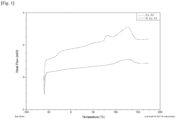
- Fig. 1 is a result of differential scanning calorimetry analysis of the biodegradable resin compositions of the Example and Reference Example.
- a biodegradable resin composition which comprises a biodegradable polyester resin and calcium carbonate (CaCOs), wherein the reduction rate of crystal peak represented by the following Equation 1 is 50% or more.
- Reduction rate of crystal peak R p ⁇ C p / R p
- R p is the heat of crystal fusion (J/g) of the biodegradable polyester resin in the temperature range of 70 to 90°C as measured using a differential scanning calorimeter (DSC) while the temperature is elevated from 40°C to 180°C at a rate of 10°C/minute and then lowered to -50°C at a rate of 10°C/minute.
- DSC differential scanning calorimeter
- C p is the heat of crystal fusion (J/g) of the biodegradable resin composition as measured under the same conditions as above.
- the biodegradable polyester resin comprises a first repeat unit and a second repeat unit, wherein the first repeat unit comprises a diol component and an aromatic dicarboxylic acid component, and the second repeat unit comprises a diol component and an aliphatic dicarboxylic acid component.
- the diol component comprises 1,4-butanediol or a derivative thereof.
- the diol component may comprise 1,4-butanediol or a derivative thereof in an amount of 95% by mole or more, 97% by mole or more, 98% by mole or more, 99% by mole or more, or 100% by mole, based on the total number of moles of the diol component.
- the diol component comprises 1,4-butanediol or a derivative thereof, it is possible to enhance the biodegradability, flexibility, and strength.
- the diol component is composed of 1,4-butanediol only, it is possible to maximize the biodegradability and the enhancement effect of strength.
- the diol component may further comprise a second diol different from the first diol, which is 1,4-butanediol or a derivative thereof.
- the second diol may be one or more selected from the group consisting of propanediol, hexanediol, cyclohexanedimethanol, and ethylene glycol.
- the second diol may be one or more selected from the group consisting of 1,3-propanediol, 1,2-propanediol, 1,2-hexanediol, 1,3-hexanediol, 1,4-hexanediol, 1,6-hexanediol, 2,3-hexanediol, 2,4-hexanediol, 2,5-hexanediol, 2,6-hexanediol, 3,4-hexanediol, 1,2-cyclohexanedimethanol, 1,3-cyclohexanedimethanol, 1,4-cyclohexanedimethanol, and ethylene glycol.
- the diol component may further comprise the second diol in an amount of 5% by mole or less, 3% by mole or less, 2% by mole or less, or 1% by mole or less, based on the total number of moles of the diol component.
- the dicarboxylic acid component of the present invention comprises an aliphatic dicarboxylic acid component and an aromatic dicarboxylic acid component.
- the aromatic dicarboxylic acid component is one or more selected from the group consisting of terephthalic acid, dimethyl terephthalic acid, and a derivative thereof.
- the aliphatic dicarboxylic acid component is one or more selected from the group consisting of adipic acid, succinic acid, and a derivative thereof.
- the aromatic dicarboxylic acid component may be terephthalic acid or dimethyl terephthalic acid, and the aliphatic dicarboxylic acid component may be adipic acid or succinic acid.
- the dicarboxylic acid component may comprise the aromatic dicarboxylic acid component in an amount of 15% by mole or more, 30% by mole or more, 45% by mole or more, 50% by mole or more, 75% by mole or more, 30% by mole to 90% by mole, 35% by mole to 80% by mole, 40% by mole to 75% by mole, 45% by mole to 65% by mole, or 45% by mole to 55% by mole, based on the total number of moles of the dicarboxylic acid component.
- the dicarboxylic acid component may comprise the aliphatic dicarboxylic acid component in an amount of 15% by mole or more, 30% by mole or more, 45% by mole or more, 50% by mole or more, 75% by mole or more, 30% by mole to 90% by mole, 35% by mole to 80% by mole, 40% by mole to 75% by mole, 45% by mole to 65% by mole, or 45% by mole to 55% by mole, based on the total number of moles of the dicarboxylic acid component.
- the molar ratio of the aromatic dicarboxylic acid component and the aliphatic dicarboxylic acid component may be 0.5 to 1.5:1, 0.7 to 1.3:1, or 0.8 to 1.2:1. As the molar ratio of the aromatic dicarboxylic acid component and the aliphatic dicarboxylic acid component satisfies the above range, it is possible to enhance the biodegradability and processability.
- the molar ratio of the diol component and the dicarboxylic acid component may be 0.5 to 2:1.
- the molar ratio of the diol component and the dicarboxylic acid component may be 0.5 to 1.8:1, 0.7 to 1.5:1, or 0.9 to 1.2:1.
- the molar ratio of the diol component and the dicarboxylic acid component satisfies the above range, it is possible to enhance all of the biodegradability, strength, and processability without discoloration such as yellowing.
- the biodegradable polyester resin of the present invention may further comprise nanocellulose.
- the nanocellulose is a natural nanocellulose in the form of a gel or dry powder. It is possible to enhance all of the dispersion stability, strength, and processability of a biodegradable polyester resin comprising the nanocellulose.
- the biodegradable polyester resin may comprise nanocellulose in an amount of 0.01 to 3% by weight based on the total weight of the biodegradable polyester resin.
- the content of the nanocellulose may be 0.01 to 2.5% by weight, 0.05 to 2% by weight, 0.07 to 1.8% by weight, 0.1 to 1.2% by weight, 0.1 to 1% by weight, or 0.15 to 0.7% by weight, based on the total weight of the biodegradable polyester resin.
- the content of the nanocellulose satisfies the above range, the biodegradability and strength can be further enhanced.
- the nanocellulose may be in the form of a dry powder or gel having secondary particles aggregated to a particle size of 1 ⁇ m to 50 ⁇ m.
- the nanocellulose may be in the form of a dry powder or gel having agglomerated secondary particles rather than single particles, wherein the size of the secondary particles may be 2 ⁇ m to 45 ⁇ m or 5 ⁇ m to 50 ⁇ m.
- the nanocellulose may be in the form of lyophilized powder to reduce its volume for convenient storage and transportation.
- the nanocellulose may have a diameter of 1 nm to 100 nm.
- the diameter of the nanocellulose may be 1 nm to 95 nm, 5 nm to 90 nm, 10 nm to 80 nm, 5 nm to 60 nm, or 15 nm to 60 nm.
- the nanocellulose may have a length of 5 nm to 10 ⁇ m.
- the length of the nanocellulose may be 5 nm to 5 ⁇ m, 5 nm to 1 ⁇ m, 10 nm to 700 nm, 20 nm to 500 nm, 60 nm to 300 nm, 80 nm to 200 nm, or 100 nm to 250 nm.
- the strength, in particular, tear strength can be further enhanced.
- the nanocellulose may function as a crystal nucleating agent, thereby enhancing the crystallization rate of the biodegradable resin composition and raising the crystallization temperature of the biodegradable resin composition.
- the nanocellulose may be one or more selected from the group consisting of cellulose nanocrystals, cellulose nanofibers, and microfibrillated cellulose. Cellulose nanocrystals or cellulose nanofibers are preferred from the viewpoint of strength and thermal characteristics. If the nanocellulose is employed in the biodegradable polyester resin, it is possible to further enhance the biodegradability, strength, and thermal characteristics.
- the biodegradable resin composition comprising the nanocellulose may have appropriate UV resistance characteristics, biodegradation rate, and hydrolysis rate.
- the nanocellulose may be one or more selected from the group consisting of hydroxymethyl cellulose, hydroxyethyl cellulose, hydroxypropyl cellulose, hydroxypropylmethyl cellulose, cellulose acetate, methyl cellulose, ethyl cellulose, propyl cellulose, butyl cellulose, pentyl cellulose, hexyl cellulose, and cyclohexyl cellulose.
- the nanocellulose according to an embodiment may have an average particle size of 200 nm or less and a particle size deviation of 20% or less.
- the average particle size of the nanocellulose dispersed in water may be 190 nm or less or 185 nm or less, and the particle size deviation may be 18% or less or 16% or less.
- the average particle size and particle size deviation of the nanocellulose satisfy the above ranges, both the dispersibility and durability of the nanocellulose are excellent.
- the nanocellulose may be pretreated with a bead mill or pretreated with ultrasonic waves.
- the nanocellulose may be obtained by pretreating nanocellulose dispersed in water with a bead mill or ultrasonic waves.
- the nanocellulose may be prepared by dispersing cellulose nanocrystals in the form of a dry powder or gel with a particle size of 1 ⁇ m to 50 ⁇ m in water and then pretreating them with a bead mill or ultrasonic waves.
- the nanocellulose specifically the nanocellulose dispersed in water
- the number of nanocellulose particles can be increased, whereby the dispersibility can be maximized.
- the nanocellulose may be pretreated with a silane coupling agent in an amount of 0.01 to 10% by weight based on the total weight of the nanocellulose.
- the nanocellulose may be pretreated with a silane coupling agent in an amount of 0.05 to 8% by weight, 0.1 to 8% by weight, 0.5 to 6% by weight, or 0.7 to 6% by weight, based on the total weight of the nanocellulose.
- the content of a silane coupling agent satisfies the above range, it is possible to maximize the interfacial adhesion, dispersibility, and compatibility.
- the biodegradable polyester resin comprising the same can be further enhanced in mechanical properties and durability, in particular, hydrolysis resistance.
- the biodegradable resin composition according to an embodiment comprises calcium carbonate in an amount of 30 to 80% by weight based on the total weight of the biodegradable resin composition.
- the biodegradable resin composition may comprise calcium carbonate (CaCO 3 ) in an amount of 30.5% by weight or more, 35% by weight or more, 45% by weight or more, 50% by weight or more, 55% by weight or more, 60% by weight or more, 65% by weight or more, 70% by weight or more, 75% by weight or more, 30 to 70% by weight, 40 to 75% by weight, 45 to 70% by weight, 30 to 45% by weight, 45 to 55% by weight, 45 to 49% by weight, 55 to 65% by weight, 60 to 75% by weight, 65 to 72% by weight, 60 to 70% by weight, or 65 to 70% by weight, based on the total weight of the biodegradable resin composition.
- CaCO 3 calcium carbonate
- the biodegradable resin composition comprises calcium carbonate in the above range, it is possible to reduce the production cost as calcium carbonate that is readily available and inexpensive is used in a high content, to further enhance the biodegradability by increasing the biodegradation starting point, and to prevent deterioration of the physical properties of a product by enhancing the dispersibility despite the high content of calcium carbonate.
- Calcium carbonate may be natural calcium carbonate obtained by mechanically pulverizing or classifying natural calcium carbonate whose main component is CaCO 3 , such as limestone, chalk, marble, shell, coral, and the like. It may be synthetic calcium carbonate produced by a chemical precipitation reaction or the like. Natural calcium carbonate is preferred from the viewpoint of increasing the surface area between the biodegradable particles and calcium carbonate and increasing the efficiency of biodegradation.
- the surface of calcium carbonate may be modified through physical treatment or chemical treatment.
- the physical surface modification method may be plasma treatment, corona treatment, or the like; and the chemical surface modification method may be surface treatment with a coupling agent such as a silane coupling agent or titanium coupling agent or a surfactant.
- the particle size of calcium carbonate is calculated from the measurement result of the specific surface area by the air permeation method using a specific surface area measuring device.
- the average particle diameter may be 0.1 ⁇ m to 10.0 ⁇ m, specifically, 0.5 ⁇ m to 5.0 ⁇ m or 1.0 ⁇ m to 3.0 ⁇ m.
- the particle size of calcium carbonate is within the above range, when the biodegradable polyester resin and calcium carbonate are kneaded, the viscosity may be maintained within a certain range, and the uniformity of particle size may be increased, thereby facilitating the production of molded articles.
- the specific surface area of calcium carbonate is measured by the nitrogen gas adsorption method.
- the specific surface area may be 0.1 m 2 /g to 10.0 m 2 /g, specifically, 0.2 m 2 /g to 5.0 m 2 /g or 1.0 m 2 /g to 3.0 m 2 /g.
- the specific surface area of calcium carbonate is within the above range, the surface area for biodegradable reactions of the biodegradable polyester resin in an article molded from the biodegradable resin composition is broadened, thereby favorably promoting the biodegradability in a natural environment, and the deterioration in processability of the biodegradable resin composition due to blending of calcium carbonate can be reduced.
- the degree of irregularity of calcium carbonate is indicated based on the sphericity of calcium carbonate.
- the sphericity of calcium carbonate may be 0.30 to 0.95, 0.50 to 0.93, or 0.60 to 0.90.
- the sphericity of calcium carbonate is within the above range, there may be a lot of fine voids caused by very weak adhesion or non-adhesion at the interface between the biodegradable polyester resin and calcium carbonate, thereby favorably promoting the biodegradability in a natural environment, and the strength and molding processability as a product may not be deteriorated.
- the additive may include fillers, lubricants, plasticizers, colorants, antioxidants, flame retardants, foaming agents, and chain extenders, in addition to calcium carbonate.
- additives that can be generally added to biodegradable polyester resin compositions such as coupling agents, fluidity enhancing agents, dispersants, UV absorbers, stabilizers, and antistatic agents. These additives may be used alone or in combination of two or more.
- the biodegradable resin composition may further comprise at least one selected from the group consisting of a lubricant, a plasticizer, an antioxidant, a chain extender, and a dispersant.
- the biodegradable resin composition comprises a plasticizer and an antioxidant.
- Additives may be blended in a kneading process or may be blended into the biodegradable resin composition before the kneading process.
- the amount of the additives added is not particularly limited as long as it is within the range capable of achieving the effect of the present invention.
- the amount of the additives may be 0.01 to 5% by weight, respectively, based on the total weight of the biodegradable resin composition. It is preferable that the total weight of the additives is 10% by weight or less based on the total weight of the biodegradable resin composition.
- Examples of the filler other than calcium carbonate include magnesium carbonate, zinc oxide, titanium oxide, silica, alumina, clay, talc, kaolin, aluminum hydroxide, magnesium hydroxide, aluminum silicate, magnesium silicate, calcium silicate, aluminum sulfate, magnesium sulfate, calcium sulfate, magnesium phosphate, barium sulfate, silica sand, carbon black, zeolite, molybdenum, diatomaceous earth, sericite, white sand, calcium sulfite, sodium sulfate, potassium titanate, bentonite, and graphite.
- the lubricant examples include a fatty acid-based lubricant including stearic acid, an aliphatic alcohol-based lubricant, an aliphatic amide-based lubricant including stearoamide, n-butyl stearate, methyl hydroxystearate, a polyhydric alcohol fatty acid ester, an aliphatic ester-based lubricant such as saturated fatty acid esters, fatty ester-based lubricants, and a fatty acid metal soap-based lubricant.
- a fatty acid-based lubricant including stearic acid
- an aliphatic alcohol-based lubricant an aliphatic amide-based lubricant including stearoamide, n-butyl stearate, methyl hydroxystearate
- a polyhydric alcohol fatty acid ester an aliphatic ester-based lubricant such as saturated fatty acid esters, fatty ester-based lubricants,
- the lubricant may be a stearate-based lubricant, and it may comprise at least one selected from the group consisting of calcium stearate, zinc stearate, barium stearate, magnesium stearate, glycerin stearate, and butyl stearate.
- the stearate-based lubricant reduces heat generation due to friction during mixing, melting, and processing of raw materials. It has an excellent dispersion effect for biodegradable polyester resins as compared with its cost and an excellent lubricating effect, thereby improving the production efficiency.
- the content of the lubricant may be 5% by weight or less, 1% by weight or less, less than 1% by weight, 0.9% by weight or less, 0.8% by weight or less, 0.7% by weight or less, 0.5% by weight or less, 0.3% by weight or less, or 0.1% by weight or less, based on the total weight of the biodegradable resin composition.
- the lubricant may be employed in an amount of 0.1 to 1% by weight, specifically, 0.1 to 0.5% by weight or 0.2 to 0.3% by weight, based on the total weight of the biodegradable resin composition.
- the content of the lubricant is within the above range, it is possible to enhance the production efficiency of the biodegradable resin composition without impairing the physical properties of the biodegradable resin composition.
- a plasticizer may be added to impart processability or flexibility to a molded article thus obtained. It may be glycerol, acrylate, glycerin, glycerol monostearate (GMS), sorbitol, or a mixture thereof.
- the content of the plasticizer is not particularly limited as long as it is within the range that can achieve the effect of the present invention.
- the plasticizer may be employed in an amount of 0 to 15% by weight, specifically, 0 to 13% by weight, 0.1 to 3% by weight, 4 to 11% by weight, 8 to 11% by weight, 4 to 8% by weight, 2 to 4% by weight, 1 to 3% by weight, or 1 to 2% by weight, based on the total weight of the biodegradable resin composition.
- the content of the plasticizer is within the above range, the elongation and tear resistance of an article molded from the biodegradable resin composition may be enhanced.
- an organic or inorganic pigment or a dye may be used.
- organic pigments such as azo-based, anthraquinone-based, phthalocyanine-based, quinacridone-based, isoindolinone-based, dioxazine-based, perinone-based, quinophthalone-based, and perylene-based pigments
- inorganic pigments such as ultramarine blue, titanium oxide, titanium yellow, iron oxide, chromium oxide, zinc oxide, and carbon black may be used.
- the antioxidant may be selected from the group consisting of a phosphorus-based antioxidant, a phenol-based antioxidant, or a pentaerythritol-based antioxidant. Each antioxidant may be used alone or in combination of two or more thereof. When two or more kinds of antioxidants are employed, a mixture of a phosphorus-based antioxidant and a phenol-based antioxidant may be preferably used to obtain functional effects in various temperature ranges.
- Examples of the phosphorus-based antioxidant include triesters, diesters, monoesters of phosphorous acid such as triphenyl phosphite, trisnonylphenyl phosphite, and tris(2,4-di-t-butylphenyl) phosphite, trimethyl phosphate, triethyl phosphate, tributyl phosphate, trioctyl phosphate, triphenyl phosphate, tricresyl phosphate, tris(nonylphenyl)phosphate, and 2-ethylphenyl diphenyl phosphate.
- triesters, diesters, monoesters of phosphorous acid such as triphenyl phosphite, trisnonylphenyl phosphite, and tris(2,4-di-t-butylphenyl) phosphite, trimethyl phosphate, triethyl phosphate, tribut
- phenol-based antioxidant examples include ⁇ -tocopherol, butylhydroxytoluene, cinafil alcohol, vitamin E, n-octadecyl-3-(3,5-di-t-butyl-4-hydroxyphenyl)propionate, 2-t-butyl-6-(3 '-t-butyl-5 '-methyl-2'-hydroxybenzyl)-4-methylphenyl acrylate, 2,6-di-t-butyl-4-(N,N-dimethylaminomethyl)phenol, 3,5-di-t-butyl-4-hydroxybenzyl phosphonate diethyl ester, 2,2-bis(((3-(3,5-di-tert-butyl-4-hydroxyphenyl)propanoyl)oxy)methyl)propane-1,3-diyl bis(3-(3,5-di-tert)-butyl-4-hydroxyphenyl)propanoate), pentaerythritol
- the antioxidant may be employed in an amount of 5% by weight or less, 3% by weight or less, 2% by weight or less, 1.5% by weight or less, 1% by weight or less, 0.5% by weight or less, 0.3% by weight or less, 0 to 5% by weight, 0.01 to 4% by weight, 0.1 to 3% by weight, 1 to 3% by weight, 1 to 2% by weight, 0.01 to 0.3% by weight, or 0.05 to 0.3% by weight, based on the total weight of the biodegradable resin composition.
- the weight ratio of the phosphorus-based antioxidant and the phenol-based antioxidant may be 1:10 to 10:1, 1:5 to 5:1, 1:1 to 5:1, 2:1 to 4:1, 2.5:1 to 3.5:1, 1:5 to 1:1, 1:2 to 1:4, or 1:2.5 to 1:3.5.
- a halogen-based flame retardant, a phosphorus-based flame retardant, or a non-phosphorus halogen-based flame retardant such as a metal hydrate may be used as the flame retardant.
- halogen-based flame retardants include halogenated bisphenol compounds such as halogenated bisphenyl alkanes, halogenated bisphenyl ethers, halogenated bisphenyl thioethers, and halogenated bisphenyl sulfones, and bisphenol-bis(alkyl ether) compounds such as brominated bisphenol A, brominated bisphenol S, chlorinated bisphenol A, and chlorinated bisphenol S.
- Examples of the phosphorus-based flame retardants include tris(diethyl phosphinic acid)aluminum, bisphenol A bis(diphenyl phosphate), triaryl isopropyl phosphate, cresyl di-2,6-xylenyl phosphate, and aromatic condensed phosphoric acid esters.
- metal hydrate examples include aluminum trihydrate, magnesium dihydroxide, and combinations thereof.
- Antimony oxides such as antimony trioxide and antimony pentoxide, zinc oxide, iron oxide, aluminum oxide, molybdenum oxide, titanium oxide, calcium oxide, magnesium oxide, or the like may be used as flame retardant aids to enhance the flame retardant effect.
- a foaming agent is added or injected by applying pressure to the biodegradable resin composition in a molten state. It is one that changes its phase from solid to gas, from liquid to gas, or gas itself, and is used to control the foaming ratio (foaming density) of a foam sheet.
- foaming agent examples include aliphatic hydrocarbons such as propane, butane, pentane, hexane, and heptane; alicyclic hydrocarbons such as cyclobutane, cyclopentane, and cyclohexane; halogenated hydrocarbons such as chlorodifluoromethane, difluoromethane, trifluoromethane, trichlorofluoromethane, dichloromethane, dichlorofluoromethane, dichlorodifluoromethane, chloromethane, chloroethane, dichlorotrifluoroethane, dichloropentafluoroethane, tetrafluoroethane, difluoroethane, pentafluoroethane, trifluoroethane, dichlorotetrafluoroethane, trichlorotrifluoroethane, tetrachlorodifluoroethane,
- a dispersant is used to increase the dispersibility of a solvent and solute.
- the dispersant may be, as an aliphatic polyester, at least one selected from the group consisting of poly(lactic acid) (hereinafter, referred to as PLA), poly(glycolic acid) (hereinafter, referred to as PGA), polycaprolactone (hereinafter, referred to as PCL), and polyhydroxyalkanoate (hereinafter, referred to as PHA), but it is not limited thereto.
- the biodegradable resin composition of the present invention further comprises at least one dispersant selected from the group consisting of poly(lactic acid), poly(glycolic acid), polycaprolactone, and polyhydroxyalkanoate.
- the content of the dispersant is not particularly limited as long as it is within the range capable of achieving the effect of the present invention.
- the dispersant may be employed in an amount of 1 to 20% by weight, specifically, 1 to 15% by weight, 1 to 13% by weight, 1 to 11% by weight, 2 to 10% by weight, 5 to 15% by weight, 7 to 12% by weight, 2 to 8% by weight, 5 to 8% by weight, or 2 to 5% by weight, based on the total weight of the biodegradable resin composition.
- the chain extender may be aromatic diisocyanates, aliphatic diisocyanates, isocyanurates, bisoxazolines, carboxylic acid anhydrides, or epoxides.
- the aromatic diisocyanate comprises tolylene 2,4-diisocyanate, tolylene 2,6-diisocyanate, 2,2'-diphenylmethane diisocyanate, 2,4'-diphenylmethane diisocyanate, 4,4'-diphenylmethane diisocyanate, naphthylene 1,5-diisocyanate, or xylylene diisocyanate.
- 2,2'-, 2,4'-, and 4,4'-diphenylmethane diisocyanates among the above are particularly preferred.
- the aliphatic diisocyanate refers to 1,6-hexamethylene diisocyanate, isophorone diisocyanate, or methylene bis(4-isocyanatocyclohexane).
- a particularly preferred aliphatic diisocyanate is isophorone diisocyanate, particularly preferably, 1,6-hexamethylene diisocyanate.
- the isocyanurate comprises isophorone diisocyanate or methylene bis(4-isocyanatocyclohexane).
- the bisoxazoline is 2,2'-bis(2-oxazoline), bis(2-oxazolinyl)methane, 1,2-bis(2-oxazolinyl)ethane, 1,3-bis(2-oxazolinyl)propane, or 1,4-bis(2-oxazolinyl)butane, particularly, 1,4-bis(2-oxazolinyl)benzene, 1,2-bis(2-oxazolinyl)benzene, or 1 ,3-bis(2-oxazolinyl)benzene.
- the epoxide refers to an epoxy-containing copolymer based on styrene, an acrylic acid ester, and/or a methacrylic acid ester. Preferred is a copolymer having a copolymer content of greater than 20%, greater than 30%, or greater than 50% by weight of gricidyl(meth)acrylate. It has an epoxy equivalent weight (EEW) of 150 to 3,000 g/eq or 200 to 500 g/eq.
- EW epoxy equivalent weight
- the epoxide is commercially available as Joncryl ® ADR from BASF Resins B.V.
- the chain extender may be employed in an amount of 1.5% by weight or less, 1% by weight or less, 0.5% by weight or less, 0.3% by weight or less, 0 to 1.5% by weight, 0.01 to 1% by weight, 0.1 to 1% by weight, 0.01 to 0.5% by weight, 0.01 to 1% by weight, or 0.1 to 0.5% by weight, based on the total weight of the biodegradable resin composition.
- the content of COOH terminal groups in the biodegradable polyester resin may be 10 to 50 eq/10 6 gr, 15 to 40 eq/10 6 gr, or 20 to 30 eq/10 6 gr.
- DSC differential scanning calorimetry
- a crystal melting temperature curve is obtained in which the glass transition temperature is measured at about -20°C, a crystal peak (heat of crystal fusion of 1 to 5 J/g or 1 to 3 J/g) attributed to butanediol appears in the temperature range of 70 to 90°C, and a crystal peak (heat of crystal fusion of 5 to 20 J/g or 13 to 17 J/g) attributed to the biodegradable polyester resin (PBAT) itself is detected in the temperature range of 100 to 150°C.
- the reduction rate of crystal peak according to Equation 1 in the temperature range of 70 to 90°C is 50% or more, 70% or more, 80% or more, 85% or more, 90% or more, 95% or more, 97% or more, 99% or more, or 100%.
- the crystal peak attributed to butanediol is significantly reduced in the measurement with DSC temperature elevation of the biodegradable resin composition.
- the reduction rate of crystal peak according to Equation 1A in the temperature range of 100 to 150°C may be 15% or more, 24% or more, 30% or more, 45% or more, 50% or more, 60% or more, 70% or more, 75% or more, 80% or more, 85% or more, or 90% or more, for example, 45% to 98%, 45% to 96%, or 50% to 90%.
- Reduction rate of crystal peak R p1 ⁇ C p1 / R p1
- R p1 is the heat of crystal fusion (J/g) of the biodegradable polyester resin in the temperature range of 100 to 150°C as measured using a differential scanning calorimeter (DSC) while the temperature is elevated from 40°C to 180°C at a rate of 10°C/minute and then lowered to -50°C at a rate of 10°C/minute.
- DSC differential scanning calorimeter
- C p1 is the heat of crystal fusion (J/g) of the biodegradable resin composition as measured under the same conditions as above.
- the glass transition temperature (Tg) may be -50°C or higher, -40°C or higher, -30°C or higher, -20°C or higher, -10°C or higher, and may be 30°C or lower, 20°C or lower, or 10°C or lower. It indicates that, in the biodegradable resin composition containing an excess of calcium carbonate, steric hindrance takes place between polymer chains due to calcium carbonate as an inorganic substance, which suppresses the fluidity of polymer chains, resulting in a tendency to raise the glass transition temperature (Tg).
- the biodegradable resin composition may have a melting temperature (Tm) of 60°C or higher, 80°C or higher, 90°C or higher, 100°C or higher, or 110°C or higher, and 150°C or lower, 140°C or lower, 130°C or lower, or 120°C or lower.
- Tm melting temperature
- the biodegradable resin composition may have a crystallization temperature (Tmc) of -10°C or higher, -5°C or higher, or 0°C or higher, and 80°C or lower, 60°C or lower, 50°C or lower, or 40°C or lower.
- Tmc crystallization temperature
- Fig. 1 shows the results of differential scanning calorimetry analysis with heating measurements twice at a rate of 20°C per minute.
- the glass transition temperature (Tg) was - 24.2°C
- the melting temperature (Tm) was 113.9°C
- the crystallization temperature (Tmc) was 33°C
- the cold crystallization temperature (Tcc) was not measured.
- the heat of crystal fusion attributed to the butanediol peak was 1 J/g
- the heat of crystal fusion attributed to the biodegradable polyester resin (PBAT) peak was 15 J/g.
- Thermogravimetric analysis is an analysis method that continuously measures the weight of a sample as a function of time or temperature while raising the temperature under certain conditions.
- the isothermal weight loss of the biodegradable resin composition may be 5% or less.
- the isothermal weight loss may be 4% or less, 3% or less, 2.5% or less, 2% or less, 1.5% or less, 1% or less, or 0.5% or less, and 0% or more or 0.1% or more.
- the isothermal weight loss is calculated as (W 0 - W 1 )/W 0 ⁇ 100, which indicates a change between the initial weight (W 0 ) of pellets and the weight (W 1 ) of the pellets after they are left under an isothermal condition of 210°C for 1 hour.
- the isothermal weight loss is within the above range, the thermal resistance of the biodegradable resin composition is ensured, thereby preventing the generation of vapor due to heat during extrusion and the reduction in molecular weight, and mechanical properties can be maintained at a certain level or higher.
- the change in the content of calcium carbonate in the biodegradable resin composition at 600°C may be 5% or less.
- the change in the content of calcium carbonate may be 4% or less, 3% or less, 2.5% or less, 2% or less, 1.5% or less, 1% or less, or 0.8% or less, and 0% or more or 0.1% or more.
- the change in the content of calcium carbonate is calculated as (W c0 - W c1 )/W c0 ⁇ 100, which indicates a change between the initial weight (W c0 ) of calcium carbonate in pellets of the biodegradable resin composition and the weight (W c1 ) of calcium carbonate in the pellet of the biodegradable resin composition at 600°C when the pellet of the biodegradable resin composition is heated at a rate of 20°C/minute.
- the biodegradable resin composition can maintain a high content of calcium carbonate (CaCO 3 ) even after processing at a high temperature.
- an article molded from the biodegradable resin composition.
- the molded article may be prepared by molding the biodegradable resin composition by a method known in the art such as extrusion or injection, and the molded article may be an injection molded article, an extrusion molded article, a thin film molded article, or a blower molded article, but it is not limited thereto.
- the molded article may be in the form of a film or sheet that can be used as agricultural mulching films, disposable gloves, food packaging materials, garbage bags, in the form of a fiber that can be used as fabrics, knitted fabrics, nonwoven fabrics, ropes, or in the form of a container that can be used as a container for food packaging such as a lunch box.
- the molded article may be prepared from the biodegradable resin composition, which can enhance the strength and processability, as well as durability.
- the molded article can show excellent properties when applied to packaging materials for products stored and transported at low temperatures, or garbage bags, mulching films, and disposable products that require excellent durability and elongation.
- the biodegradable resin composition or a molded article prepared therefrom may be biodegraded by 60% to 100% within 45 to 180 days in a natural state and may be composted at a constant temperature of 20 to 60°C and a constant humidity of 30 to 90%.
- a biodegradable polyester film which is an embodiment of the molded article, comprises the biodegradable resin composition.
- the biodegradable polyester film comprises a biodegradable resin composition comprising a biodegradable polyester resin and calcium carbonate (CaCOs), wherein the reduction rate of crystal peak of the biodegradable resin composition represented by Equation 1 is 50% or more.
- a biodegradable resin composition comprising a biodegradable polyester resin and calcium carbonate (CaCOs), wherein the reduction rate of crystal peak of the biodegradable resin composition represented by Equation 1 is 50% or more.
- the biodegradable polyester film may have a thickness of 5 ⁇ m to 200 ⁇ m.
- the thickness of the biodegradable polyester film may be 5 ⁇ m to 180 ⁇ m, 5 ⁇ m to 160 ⁇ m, 10 ⁇ m to 150 ⁇ m, 15 ⁇ m to 130 ⁇ m, 20 ⁇ m to 100 ⁇ m, 25 ⁇ m to 80 ⁇ m, 10 ⁇ m to 50 ⁇ m, 10 ⁇ m to 30 ⁇ m, or 25 ⁇ m to 60 ⁇ m.
- the biodegradable polyester film may have a tensile strength of 5 MPa or more.
- the tensile strength of the biodegradable polyester film may be 7 MPa or more, 9 MPa or more, 10 MPa or more, or 11 MPa or more, and 30 MPa or less, 27 MPa or less, 25 MPa or less, 23 MPa or less, or 21 MPa or less.
- the tensile strength of the biodegradable polyester film is within the above range, it has excellent mechanical properties since it can be stretched within a certain range while containing a high content of calcium carbonate. Thus, it can be used in a variety of ways, and the rate of biodegradation can be further enhanced after biodegradation begins.
- the biodegradable polyester film may have a tear strength of 75 N/mm or more.
- the tear strength of the biodegradable polyester film may be 75 N/mm or more, 80 N/mm or more, 85 N/mm or more, or 90 N/mm or more, and 200 N/mm or less, 180 N/mm or less, 150 N/mm or less, or 135 N/mm or less.
- the tear strength of the biodegradable polyester film is within the above range, it has excellent mechanical properties since it is not easily torn in a certain direction while containing a high content of calcium carbonate. Thus, it can be used in a variety of ways, and the rate of biodegradation can be further enhanced after biodegradation begins.
- the biodegradable polyester film may have an elongation of 85% or more.
- the elongation of the biodegradable polyester film may be 90% or more or 95% or more, and 700% or less, 650% or less, 600% or less, or 550% or less.
- the elongation of the biodegradable polyester film is within the above range, it is well stretched to some extent, and elasticity can be secured during product packaging, so that it can withstand a certain load.
- the biodegradable polyester film may have a sealing strength of 500 gf or more.
- the sealing strength of the biodegradable polyester film may be 600 gf or more, 700 gf or more, or 800 gf or more.
- a biodegradable polyester sheet which is an embodiment of the molded article, comprises the biodegradable resin composition.
- the biodegradable polyester sheet comprises a biodegradable resin composition comprising a biodegradable polyester resin and calcium carbonate (CaCOs), wherein the reduction rate of crystal peak of the biodegradable resin composition represented by Equation 1 is 50% or more.
- a biodegradable resin composition comprising a biodegradable polyester resin and calcium carbonate (CaCOs), wherein the reduction rate of crystal peak of the biodegradable resin composition represented by Equation 1 is 50% or more.
- the thickness of the biodegradable polyester sheet may be 5 ⁇ m to 180 ⁇ m, 5 ⁇ m to 160 ⁇ m, 10 ⁇ m to 150 ⁇ m, 15 ⁇ m to 130 ⁇ m, 20 ⁇ m to 100 ⁇ m, 25 ⁇ m to 80 ⁇ m, 10 ⁇ m to 50 ⁇ m, or 10 ⁇ m to 30 ⁇ m.
- the biodegradable polyester sheet may have a tensile strength of 5 MPa or more.
- the tensile strength of the biodegradable polyester sheet may be 6 MPa or more, 9 MPa or more, 10 MPa or more, 11 MPa or more, or 12 MPa or more, and 40 MPa or less, 35 MPa or less, 30 MPa or less, 27 MPa or less, 25 MPa or less, 23 MPa or less, or 21 MPa or less.
- the tensile strength of the biodegradable polyester sheet is within the above range, it has excellent mechanical properties since it can be stretched within a certain range while containing a high content of calcium carbonate. Thus, it can be used in a variety of ways, and the rate of biodegradation can be further enhanced after biodegradation begins.
- the biodegradable polyester sheet may have a modulus of 110 MPa to 350 MPa.
- the modulus of the biodegradable polyester sheet may be 120 MPa to 340 MPa, 150 MPa to 330 MPa, or 200 MPa to 330 MPa.
- the biodegradable polyester sheet may have an elongation of 10% or more.
- the elongation of the biodegradable polyester sheet may be 15% or more, 20% or more, 50% or more, or 70% or more, and 700% or less, 650% or less, 550% or less, 500% or less, or 450% or less.
- the elongation of the biodegradable polyester sheet is within the above range, it is well stretched to some extent, and elasticity can be secured during product packaging, so that it can withstand a certain load.
- the process for preparing a biodegradable polyester film or a biodegradable polyester sheet comprises subjecting a diol component and a dicarboxylic acid component to an esterification reaction to prepare a prepolymer; subjecting the prepolymer to a polycondensation reaction to prepare a biodegradable polyester resin (polymer); mixing the biodegradable polyester resin and calcium carbonate to prepare a biodegradable resin composition; preparing pellets from the biodegradable resin composition; and drying and melt-extruding the pellets.
- a diol component and a dicarboxylic acid component are subjected to an esterification reaction to prepare a prepolymer.
- the biodegradable resin composition comprises a diol component comprising 1,4-butanediol or a derivative thereof and at least one dicarboxylic acid component selected from the group consisting of terephthalic acid, dimethyl terephthalic acid, adipic acid, succinic acid, and derivatives thereof, which are subjected to an esterification reaction to prepare a prepolymer.
- diol component the aromatic dicarboxylic acid component, and the aliphatic dicarboxylic acid component are as described above.
- the two-step esterification reaction may comprise (1) subjecting the diol component and the aromatic dicarboxylic acid component to a primary esterification reaction; and (2) adding the diol component and the aliphatic dicarboxylic acid component to the reaction product of step (1) and subjecting them to a secondary esterification reaction.
- the biodegradable polyester resin of the present invention comprises nanocellulose
- the nanocellulose may be added in the second esterification reaction step, whereby the binding force of the nanocellulose can be enhanced.
- the addition of the nanocellulose, that is, nanocellulose dispersed in water, in the secondary esterification reaction step may further enhance the durability.
- the nanocellulose at a temperature of 100°C to 160°C, preferably 110°C to 140°C, from the viewpoint of the enhancement of hydrolysis resistance.
- the nanocellulose may be added at a rate of 2 kg/minute to 10 kg/minute, 2.5 kg/minute to 9.5 kg/minute, or 3 kg/minute to 8 kg/minute, to prevent agglomeration along with further enhancement of hydrolysis resistance and to maintain an appropriate process speed. If the addition rate is within the above range, an additional process is unnecessary, process efficiency can be enhanced, and re-agglomeration of nanocellulose can be prevented.
- the two-step esterification reaction may comprise (1) subjecting the diol component and the aromatic dicarboxylic acid component to a primary esterification reaction; and (2) adding the diol component, the aliphatic dicarboxylic acid component, and the nanocellulose to the reaction product of step (1) and subjecting them to a secondary esterification reaction.
- the esterification reaction may be carried out at 250°C or lower for 0.5 hour to 5 hours, respectively. Specifically, the esterification reaction may be carried out at atmospheric pressure at 240°C or lower, 235°C or lower, 180°C to 250°C, 185°C to 240°C, or 200°C to 240°C, until water and methanol as by-products theoretically reach 90%. For example, the esterification reaction may be carried out for 0.5 hour to 4.5 hours, 0.5 hour to 3.5 hours, or 1 hour to 3 hours, but it is not limited thereto.
- the prepolymer may have a number average molecular weight of 500 to 10,000.
- the number average molecular weight of the prepolymer may be 500 to 8,500, 500 to 7,000, 1,000 to 6,000, or 2,500 to 5,500.
- the number average molecular weight of the prepolymer satisfies the above range, it is possible to efficiently increase the molecular weight of the polymer in the polycondensation reaction, thereby further enhancing the strength characteristics.
- the number average molecular weight may be measured using gel permeation chromatography (GPC). Specifically, various data such as Mn, Mw, and Mp may be obtained by gel permeation chromatography. The molecular weight may be measured as a number average molecular weight (Mn) among them.
- the prepolymer is subjected to a polycondensation reaction to prepare a biodegradable polyester resin (polymer).
- the polycondensation reaction may be carried out at 180°C to 280°C and 1.0 Torr or less for 1 hour to 6 hours.
- the polycondensation reaction may be carried out at 190°C to 270°C, 210°C to 260°C, or 230°C to 255°C, at 0.9 Torr or less, 0.7 Torr or less, 0.2 Torr to 1.0 Torr, 0.3 Torr to 0.9 Torr, or 0.5 Torr to 0.9 Torr, for 1.5 hours to 5.5 hours, 2 hours to 5 hours, or 3.5 hours to 4.5 hours.
- the biodegradable polyester resin may have an intrinsic viscosity of 0.05 to 10 dl/gr.
- the biodegradable polyester resin When the biodegradable polyester resin is measured for melt viscosity with a rheometrics dynamic spectrometer (RDS) under a condition of 100 s -1 , it may be 1,000 to 30,000 poises.
- RDS rheometrics dynamic spectrometer
- the biodegradable polyester resin may have a number average molecular weight (Mn) of 40,000 or more.
- Mn number average molecular weight
- the number average molecular weight of the biodegradable polyester resin may be 43,000 or more, 45,000 or more, or 40,000 to 70,000.
- the biodegradable polyester resin may have a weight average molecular weight (Mw) of 60,000 or more.
- Mw weight average molecular weight
- the weight average molecular weight of the biodegradable polyester resin may be 65,000 or more, 75,000 or more, 80,000 or more, or 85,000 to 100,000.
- the biodegradable polyester resin may have a polydispersity index (PDI) of 1.2 to 2.0.
- PDI polydispersity index
- the polydispersity index of the biodegradable polyester resin may be 1.5 to 1.9 or 1.6 to 1.8.
- the number average molecular weight, weight average molecular weight, or polydispersity index of the biodegradable polyester resin satisfies the above range, strength and processability can be further enhanced.
- the biodegradable polyester resin may have an acid value of 1.8 mg KOH/g or less.
- the acid value of the biodegradable polyester resin may be 1.5 mg KOH/g or less, 1.3 mg KOH/g or less, or 1.25 mg KOH/g or less.
- improvement of the hydrolysis resistance can be maximized.
- biodegradable polyester resin and calcium carbonate are mixed to prepare a biodegradable resin composition.
- the biodegradable polyester resin and calcium carbonate may be appropriately selected according to the molding method (e.g., extrusion molding, injection molding, vacuum molding, or the like).
- the biodegradable polyester resin and calcium carbonate may be melt-kneaded before being introduced to the hopper of a molding machine, or the biodegradable polyester resin and calcium carbonate may be melt-kneaded simultaneously with molding integrally with the molding machine.
- Melt-kneading is preferably carried out by uniformly dispersing calcium carbonate in the biodegradable polyester resin and kneading by applying high shear stress.
- a kneader reactor, an extruder equipped with a single screw, or a twin screw kneader may preferably be used.
- plasticizers or additives may be additionally added in the mixing step.
- the mixing step is composed of one or more mixing stages.
- a one-stage mixing it may be composed of a single mixing for preparing a biodegradable resin composition comprising 61 to 80% by weight or 65 to 72% by weight of calcium carbonate based on the total weight of the biodegradable resin composition.
- a two-stage mixing it may be composed of preliminary mixing for preparing a biodegradable resin composition comprising 61 to 80% by weight or 65 to 72% by weight of calcium carbonate based on the total weight of the biodegradable resin composition; and secondary mixing for preparing a biodegradable resin composition comprising 30 to 60% by weight, 30 to 60% by weight, or 45 to 55% by weight of calcium carbonate based on the total weight of the biodegradable resin composition.
- the one or more stages of mixing may be a tandem continuous process.
- the temperature of the mixing step may be 150 to 190°C, 150 to 180°C, or 160 to 180°C. If the temperature of the mixing step is within the above range, the torque required during mixing may be reduced, and thermal decomposition of the mixed biodegradable resin composition may be prevented.
- pellets are prepared from the biodegradable resin composition.
- the biodegradable resin composition is fed to an extruder equipped with a single screw or an extruder equipped with twin screws, extruded at a temperature of 150°C to 180°C, cut with a hot-cut pellet cutter, and cooled to 50°C or lower, 40°C or lower, 30°C or lower, 25°C or lower, 5 to 50°C, 10 to 30°C, 15 to 25°C, or 20 to 25°C, to prepare pellets.
- the cutting step may be carried out using a pellet cutter without limitations as long as it is commonly used in the art, and the pellets may have various shapes.
- pellets are dried and melt-extruded.
- the pellets are dried and melt-extruded to prepare a biodegradable polyester film or a biodegradable polyester sheet.
- the drying may be carried out at 60°C to 100°C for 2 hours to 12 hours. Specifically, the drying may be carried out at 65°C to 95°C, 70°C to 90°C, or 75°C to 85°C, for 3 hours to 12 hours or 4 hours to 10 hours. As the drying process conditions of the pellets satisfy the above ranges, it is possible to further enhance the quality of a biodegradable polyester film thus produced.
- the melt-extrusion may be carried out at 270°C or lower.
- the melt-extrusion may be carried out at 265°C or lower, 260°C or lower, 255°C or lower, 130°C to 270°C, 130°C to 250°C, 140°C to 230°C, 150°C to 200°C, or 150°C to 180°C.
- the melt-extrusion may be carried out by a blown film process or a press process, but it is not limited thereto.
- the torque during the melt-extrusion may be 100 N ⁇ m to 300 N ⁇ m or 150 N ⁇ m to 250 N ⁇ m.
- Test Example 4 Crystallization temperature (Tc) and heat of crystal fusion ( ⁇ Hmc)
- Each sample of the biodegradable resin compositions of the Examples and Reference Examples was heated from 40°C to 180°C at a rate of 10°C/minute using a differential scanning calorimeter (DSC), isothermal was performed for 5 minutes to first remove the thermal history, the temperature was then lowered from 180°C to -50°C at a rate of 10°C/minute, and isothermal was performed for 5 minutes as a second cooling procedure.
- DSC differential scanning calorimeter
- a heat flow graph with respect to temperature was prepared in the second cooling procedure from which the crystallization temperature (°C), crystal peak, and heat of crystal fusion (J/g) were confirmed.
- a sample of the biodegradable polyester film or sheet of the Examples and Reference Examples was cut to a length of 100 mm and a width of 15 mm. According to ASTM D882, it was set in a universal testing machine (UTM; 4206-001) of INSTRON such that the distance between chucks was 50 mm. Tensile strength was measured at a tensile speed of 500 mm/minute.
- a sample of the biodegradable polyester film or sheet of the Examples and Reference Examples was cut to a length of 100 mm and a width of 15 mm.
- the maximum deformation immediately before breakage was measured at a rate of 500 mm/minute using a universal testing machine (UTM; 4206-001) of INSTRON. Elongation was calculated as the ratio of the maximum deformation to the initial length.
- a biodegradable polyester resin of Preparation Example 2 was prepared in the same manner as Preparation Example 1, except that the pretreated nanocellulose was not used.
- A400 of Kingfa may be used as a PBAT resin having the same composition without nanocellulose as a substitute for Preparation Example 2.
- calcium carbonate (WS-2200) and at least one selected from the group consisting of a plasticizer (acetylated monoglyceride, Biocizer), additive 1 (polycaprolactone; PCL), additive 2 (polylactic acid; PLA), antioxidant 1 (phenolic antioxidant, AO-60), and antioxidant 2 (phosphorus antioxidant, 2112 (AO)) were added to the polymer of Preparation Example 1 or Preparation Example 2, which was fed to a kneader reactor and kneaded at a temperature of 175°C, extruded with an extruder equipped with a single screw, cut with a hot-cut pellet cutter, and cooled to prepare a biodegradable resin composition in the form of pellets.
- a plasticizer acetylated monoglyceride, Biocizer
- additive 1 polycaprolactone
- PCL polylactic acid
- antioxidant 1 phenolic antioxidant, AO-60
- antioxidant 2 phosphorus antioxidant, 2112 (AO)
- Example A7 or Example A8 kneaded in the kneader reactor was fed to an extruder equipped with twin screws, and the polymer of Preparation Example 1 or Preparation Example 2 was additionally added thereto, thereby adjusting the contents of the components of the composition as shown in Table 3 below. It was extruded with an extruder equipped with a single screw, cut with a hot-cut pellet cutter, and cooled to prepare a biodegradable resin composition in the form of pellets.
- PLA calcium carbonate
- additives comprising a plasticizer (acetylated monoglyceride), a stabilizer (tris-2,4-tertiary-butyl phenyl phosphate, 2112 RG grade), and a chain extender (Joncryl) were added to the polymer of Preparation Example 1 or Preparation Example 2, which was fed to a kneader reactor and kneaded at a temperature of 175°C, extruded with an extruder equipped with a single screw, cut with a hot-cut pellet cutter, and cooled to prepare a biodegradable resin composition in the form of pellets.
- a plasticizer acetylated monoglyceride
- a stabilizer tris-2,4-tertiary-butyl phenyl phosphate, 2112 RG grade
- a chain extender Joncryl
- Table 5 shows the measurement results of the thermal properties of the biodegradable resin compositions of the present invention.
- Item TGA DSC Isothermal weight loss (210°C, 1 hr) Change in the content of calcium carbonate Tg (°C) Heat of crystal fusion at 70 to 90°C (J/g) Heat of crystal fusion at 100 to 150°C (J/g)
- Example A6 2.1% 70.5% - 0 0.6
- the biodegradable resin compositions of Examples A1 to A10 each had a low weight loss at a high temperature (210°C) despite a high content of calcium carbonate, as compared with the biodegradable resin compositions of Reference Examples A1 and A2 comprising 100% by weight of the resin of Preparation Example 1 or 2.
- Examples A1, A2, A4, and A9 each showed a weight loss of 1% or less.
- the change in the content of calcium carbonate was 2.5% or less in the biodegradable resin compositions of Examples A1 to A10, indicating that they can maintain a high content of CaCOs even after high-temperature processing.
- biodegradable resin compositions of Examples A1 to A10 each had the effect of reducing the glass transition temperature (Tg), as compared with the biodegradable resin compositions of Reference Examples A1 and A2 comprising 100% by weight of the resin of Preparation Example 1 or 2.
- the biodegradable resin compositions of Examples A1, A3, A4, A7, and A9 showed a reduction of 70% to 100% in the heat of crystal fusion at 70°C to 90°C and a reduction of 32% to 90% in the heat of crystal fusion at 100°C to 150°C with respect to Reference Example A1.
- the biodegradable resin compositions of Examples A2, A5, A6, A8, and A10 showed a reduction of 50% to 100% in the heat of crystal fusion at 70°C to 90°C and a reduction of 24.7% to 96% in the heat of crystal fusion at 100°C to 150°C with respect to Reference Example A2.
- biodegradable polyester resin pellets prepared from each of the biodegradable resin compositions of Examples A9 to A13 shown in Tables 3 and 4 above were dried at 80°C for 5 hours and then melt-extruded at 160°C using a blown film extruder (Blown Film Extrusion Line, manufacturer: Eugene Engineering) to prepare a biodegradable polyester film having a thickness of 50 ⁇ m.
- Table 6 shows the measurement results of the mechanical properties of the biodegradable polyester films of the present invention.
- Biodegradable resin composition Tensile strength (MPa) Elongation (%) Tear strength (N/mm) MD TD MD TD MD TD Example B1
- Example A9 20.7 10.8 164 370 132 108
- Example B2 Example A10 16.1 16.1 374 543 112 92
- Example B3 Example A11 11.3 12.8 120 180 95 84
- Example B4 Example A12 9.2 13.1 135 110 90 85 Reference Example B1 Example A13 3.5 5.6 80 78 60 72
- the biodegradable polyester films comprising a high content of calcium carbonate in Examples B1 and B2 were each excellent in tensile strength and elongation and good in tear strength. Although the biodegradable polyester films comprising a high content of calcium carbonate in Examples B3 and B4 were each reduced in tensile strength, elongation, and tear strength due to the addition of PLA, as compared with Examples B 1 and B2, they were maintained at least at a certain level required for commercialization.
- Pellets prepared from Preparation Example 1, Preparation Example 2 (Kingfa, A400), Resin A (JINHUI, Ecoworld), Resin B (TUNHE, TH80IT), or Resin C (BASF, Ecoflex C1200) were dried at 80°C for 5 hours and melt-extruded under the molding conditions of Tables 7 and 8 to prepare a biodegradable polyester sheet having a thickness of 20 ⁇ m.
- biodegradable polyester sheets containing a high content of calcium carbonate tensile strength or elongation was significantly reduced (Comparative Examples C1 and C2 in Table 7); thus, they were not suitable for preparing molded articles.
- the biodegradable polyester sheets of the present invention (Examples C2 to C13 in Table 8) were able to maintain tensile strength and elongation at least at a certain level as compared with Sheet 1 or Sheet 2.
Landscapes
- Chemical & Material Sciences (AREA)
- Health & Medical Sciences (AREA)
- Chemical Kinetics & Catalysis (AREA)
- Medicinal Chemistry (AREA)
- Polymers & Plastics (AREA)
- Organic Chemistry (AREA)
- Engineering & Computer Science (AREA)
- Manufacturing & Machinery (AREA)
- Materials Engineering (AREA)
- Compositions Of Macromolecular Compounds (AREA)
- Biological Depolymerization Polymers (AREA)
- Polyesters Or Polycarbonates (AREA)
Applications Claiming Priority (2)
| Application Number | Priority Date | Filing Date | Title |
|---|---|---|---|
| KR20210149234 | 2021-11-02 | ||
| PCT/KR2022/016055 WO2023080496A1 (fr) | 2021-11-02 | 2022-10-20 | Composition de résine biodégradable ayant une teneur élevée en carbonate de calcium |
Publications (2)
| Publication Number | Publication Date |
|---|---|
| EP4428186A1 true EP4428186A1 (fr) | 2024-09-11 |
| EP4428186A4 EP4428186A4 (fr) | 2025-10-22 |
Family
ID=86241412
Family Applications (1)
| Application Number | Title | Priority Date | Filing Date |
|---|---|---|---|
| EP22890231.8A Pending EP4428186A4 (fr) | 2021-11-02 | 2022-10-20 | Composition de résine biodégradable ayant une teneur élevée en carbonate de calcium |
Country Status (6)
| Country | Link |
|---|---|
| US (1) | US20240425673A1 (fr) |
| EP (1) | EP4428186A4 (fr) |
| JP (1) | JP2024540105A (fr) |
| KR (1) | KR102820087B1 (fr) |
| TW (1) | TWI886414B (fr) |
| WO (1) | WO2023080496A1 (fr) |
Cited By (1)
| Publication number | Priority date | Publication date | Assignee | Title |
|---|---|---|---|---|
| CN117430928A (zh) * | 2023-11-30 | 2024-01-23 | 金发科技股份有限公司 | 一种高填充母粒及其制备方法 |
Families Citing this family (8)
| Publication number | Priority date | Publication date | Assignee | Title |
|---|---|---|---|---|
| KR102685873B1 (ko) * | 2023-07-25 | 2024-07-17 | 에스케이티비엠지오스톤 주식회사 | 생분해성 폴리에스테르 수지 조성물 |
| CN120958104A (zh) * | 2023-05-10 | 2025-11-14 | 乐天精密化学株式会社 | 环保型土壤改良剂及其制造方法 |
| KR20240170292A (ko) * | 2023-05-26 | 2024-12-03 | 에스케이리비오 주식회사 | 생분해성 수지 조성물 및 이를 포함하는 생분해성 성형품 |
| KR102877044B1 (ko) * | 2023-07-05 | 2025-10-24 | 에스케이리비오 주식회사 | 생분해성 수지 조성물 및 이를 포함하는 생분해성 성형품 |
| KR20250020901A (ko) * | 2023-08-04 | 2025-02-11 | 에스케이리비오 주식회사 | 생분해성 수지 조성물 및 이를 포함하는 생분해성 성형품 |
| KR20250063089A (ko) * | 2023-10-30 | 2025-05-08 | 주식회사 뉴로팩 | 굴 패각 추출 탄산칼슘을 이용한 생분해성 필름 및 그 제조방법 |
| CN117700960B (zh) * | 2023-12-14 | 2024-12-06 | 浙江大学 | 一种可降解塑料及制备方法和在酸化土壤改良中的应用 |
| KR20250095916A (ko) * | 2023-12-20 | 2025-06-27 | 에스케이리비오 주식회사 | 생분해성 수지 조성물 및 이를 포함하는 생분해성 부직포 |
Family Cites Families (16)
| Publication number | Priority date | Publication date | Assignee | Title |
|---|---|---|---|---|
| KR101304144B1 (ko) * | 2011-05-13 | 2013-09-05 | (주)엘지하우시스 | 생분해성 시트 |
| US9096758B2 (en) | 2011-07-29 | 2015-08-04 | Basf Se | Biodegradable polyester foil |
| EP2905314B1 (fr) * | 2012-10-05 | 2020-03-11 | Kaneka Corporation | Composition de résine polyester et son procédé de production |
| JP2014162799A (ja) * | 2013-02-21 | 2014-09-08 | Toray Ind Inc | ポリ乳酸系マルチフィルム |
| JP6463736B2 (ja) * | 2013-05-17 | 2019-02-06 | ホリスター・インコーポレイテッドHollister Incorporated | 生分解性臭気バリアフィルム |
| JP6887796B2 (ja) * | 2015-12-24 | 2021-06-16 | アキレス株式会社 | 耐引裂伝播性を有する生分解性フィルム |
| CN106084681B (zh) * | 2016-07-22 | 2018-05-18 | 金发科技股份有限公司 | 一种可生物降解聚酯组合物 |
| WO2020060597A1 (fr) * | 2018-09-20 | 2020-03-26 | Danimer Bioplastics, Inc. | Articles extrudés profilés biodégradables |
| JP6612948B1 (ja) * | 2018-10-17 | 2019-11-27 | 孝 大野 | 樹脂複合材料の製造方法 |
| JP6675690B1 (ja) * | 2018-10-26 | 2020-04-01 | 株式会社Tbm | 生分解性樹脂成形品、及びその製造方法並びにこれに用いられるペレット体 |
| KR102198513B1 (ko) * | 2018-10-26 | 2021-01-05 | 주식회사 에이유 | 생분해 속도제어가 가능한 멀칭 필름용 수지 펠렛 제조방법 및 이를 이용한 생분해성 멀칭 필름 |
| KR102324258B1 (ko) * | 2019-09-30 | 2021-11-11 | 김선형 | 생분해성 수지 조성물 및 이로부터 제조된 식품 용기용 펠릿 |
| KR102128081B1 (ko) * | 2020-04-06 | 2020-06-30 | 유한회사 새한팩 | 친환경 생분해성 다층 랩 필름 |
| CN112980153A (zh) * | 2021-03-01 | 2021-06-18 | 北京惠林苑生物科技有限公司 | 全生物降解塑料地膜及其制备方法及其应用 |
| JP6916571B1 (ja) * | 2021-03-25 | 2021-08-11 | 株式会社Tbm | 樹脂組成物、及び成形品 |
| WO2024029818A1 (fr) * | 2022-08-02 | 2024-02-08 | 에스케이티비엠지오스톤 주식회사 | Composition de résine biodégradable et article moulé biodégradable la comprenant |
-
2022
- 2022-10-13 KR KR1020220131787A patent/KR102820087B1/ko active Active
- 2022-10-20 EP EP22890231.8A patent/EP4428186A4/fr active Pending
- 2022-10-20 TW TW111139850A patent/TWI886414B/zh active
- 2022-10-20 JP JP2024525405A patent/JP2024540105A/ja active Pending
- 2022-10-20 WO PCT/KR2022/016055 patent/WO2023080496A1/fr not_active Ceased
- 2022-10-20 US US18/704,919 patent/US20240425673A1/en active Pending
Cited By (1)
| Publication number | Priority date | Publication date | Assignee | Title |
|---|---|---|---|---|
| CN117430928A (zh) * | 2023-11-30 | 2024-01-23 | 金发科技股份有限公司 | 一种高填充母粒及其制备方法 |
Also Published As
| Publication number | Publication date |
|---|---|
| EP4428186A4 (fr) | 2025-10-22 |
| US20240425673A1 (en) | 2024-12-26 |
| KR20230063856A (ko) | 2023-05-09 |
| KR102820087B1 (ko) | 2025-06-12 |
| TW202330783A (zh) | 2023-08-01 |
| JP2024540105A (ja) | 2024-10-31 |
| TWI886414B (zh) | 2025-06-11 |
| WO2023080496A1 (fr) | 2023-05-11 |
Similar Documents
| Publication | Publication Date | Title |
|---|---|---|
| EP4428186A1 (fr) | Composition de résine biodégradable ayant une teneur élevée en carbonate de calcium | |
| EP4095180A1 (fr) | Résine de polyester biodégradable, son procédé de préparation, et film de polyester biodégradable la comprenant | |
| US8008373B2 (en) | Biodegradable polymer masterbatch, and a composition derived therefrom having improved physical properties | |
| JP2022181209A (ja) | 生分解性ポリエステル樹脂、その製造方法、およびそれを含む生分解性ポリエステル成形品 | |
| EP4563636A1 (fr) | Procédé de préparation d'une composition de résine biodégradable, composition de résine biodégradable ainsi préparée et produit moulé biodégradable la comprenant | |
| TWI878999B (zh) | 生物降解性樹脂組合物及包含其的生物降解性模製品 | |
| KR102735331B1 (ko) | 생분해성 수지 조성물 및 이를 포함하는 생분해성 성형품 | |
| KR102793337B1 (ko) | 생분해성 수지 조성물 및 이를 포함하는 생분해성 성형품 | |
| KR102877044B1 (ko) | 생분해성 수지 조성물 및 이를 포함하는 생분해성 성형품 | |
| TWI892319B (zh) | 生物可降解樹脂組成物 | |
| CN112703227B (zh) | 树脂组合物及其成形体 | |
| KR102720126B1 (ko) | 생분해성 수지 조성물 및 이를 포함하는 생분해성 성형품 | |
| KR20240079912A (ko) | 생분해성 수지 조성물 및 이를 포함하는 생분해성 성형품 | |
| US20250154336A1 (en) | Biodegradable resin composition and biodegradable molded article including the same | |
| KR102868075B1 (ko) | 통기성 필름용 생분해성 수지 조성물 및 이를 포함하는 통기성 필름 | |
| KR102685873B1 (ko) | 생분해성 폴리에스테르 수지 조성물 | |
| KR102774452B1 (ko) | 생분해성 폴리에스테르 수지, 이의 제조 방법, 및 이를 포함하는 생분해성 폴리에스테르 필름 | |
| KR20250007292A (ko) | 생분해성 수지 조성물의 제조 방법, 이에 의해 제조된 생분해성 수지 조성물, 이를 포함하는 생분해성 성형품 | |
| KR20250071167A (ko) | 생분해성 수지 조성물 및 이를 포함하는 생분해성 성형품 | |
| KR20240079914A (ko) | 생분해성 수지 조성물 및 이를 포함하는 생분해성 성형품 | |
| KR20240170292A (ko) | 생분해성 수지 조성물 및 이를 포함하는 생분해성 성형품 | |
| KR20250007828A (ko) | 생분해성 수지 조성물의 제조 방법, 이에 의해 제조된 생분해성 수지 조성물 | |
| KR20250020901A (ko) | 생분해성 수지 조성물 및 이를 포함하는 생분해성 성형품 | |
| KR20240086472A (ko) | 생분해성 수지 조성물, 이를 포함하는 생분해성 필름 및 이를 포함하는 생분해성 성형품 | |
| KR20250014382A (ko) | 생분해성 필름 및 이의 제조 방법 |
Legal Events
| Date | Code | Title | Description |
|---|---|---|---|
| STAA | Information on the status of an ep patent application or granted ep patent |
Free format text: STATUS: THE INTERNATIONAL PUBLICATION HAS BEEN MADE |
|
| PUAI | Public reference made under article 153(3) epc to a published international application that has entered the european phase |
Free format text: ORIGINAL CODE: 0009012 |
|
| STAA | Information on the status of an ep patent application or granted ep patent |
Free format text: STATUS: REQUEST FOR EXAMINATION WAS MADE |
|
| 17P | Request for examination filed |
Effective date: 20240521 |
|
| AK | Designated contracting states |
Kind code of ref document: A1 Designated state(s): AL AT BE BG CH CY CZ DE DK EE ES FI FR GB GR HR HU IE IS IT LI LT LU LV MC ME MK MT NL NO PL PT RO RS SE SI SK SM TR |
|
| P01 | Opt-out of the competence of the unified patent court (upc) registered |
Free format text: CASE NUMBER: APP_56442/2024 Effective date: 20241016 |
|
| DAV | Request for validation of the european patent (deleted) | ||
| DAX | Request for extension of the european patent (deleted) | ||
| A4 | Supplementary search report drawn up and despatched |
Effective date: 20250918 |
|
| RIC1 | Information provided on ipc code assigned before grant |
Ipc: C08K 3/26 20060101AFI20250912BHEP Ipc: C08K 5/098 20060101ALI20250912BHEP Ipc: C08K 5/10 20060101ALI20250912BHEP Ipc: C08K 5/103 20060101ALI20250912BHEP Ipc: C08L 67/02 20060101ALI20250912BHEP |