EP4425939A2 - Videoverarbeitungsverfahren, videoverarbeitungsvorrichtung und computerlesbares speichermedium - Google Patents
Videoverarbeitungsverfahren, videoverarbeitungsvorrichtung und computerlesbares speichermedium Download PDFInfo
- Publication number
- EP4425939A2 EP4425939A2 EP22887805.4A EP22887805A EP4425939A2 EP 4425939 A2 EP4425939 A2 EP 4425939A2 EP 22887805 A EP22887805 A EP 22887805A EP 4425939 A2 EP4425939 A2 EP 4425939A2
- Authority
- EP
- European Patent Office
- Prior art keywords
- duet
- user
- video
- videos
- recommended
- Prior art date
- Legal status (The legal status is an assumption and is not a legal conclusion. Google has not performed a legal analysis and makes no representation as to the accuracy of the status listed.)
- Pending
Links
Images







Classifications
-
- H—ELECTRICITY
- H04—ELECTRIC COMMUNICATION TECHNIQUE
- H04N—PICTORIAL COMMUNICATION, e.g. TELEVISION
- H04N21/00—Selective content distribution, e.g. interactive television or video on demand [VOD]
- H04N21/40—Client devices specifically adapted for the reception of or interaction with content, e.g. set-top-box [STB]; Operations thereof
- H04N21/41—Structure of client; Structure of client peripherals
- H04N21/414—Specialised client platforms, e.g. receiver in car or embedded in a mobile appliance
- H04N21/41407—Specialised client platforms, e.g. receiver in car or embedded in a mobile appliance embedded in a portable device, e.g. video client on a mobile phone, PDA, laptop
-
- H—ELECTRICITY
- H04—ELECTRIC COMMUNICATION TECHNIQUE
- H04N—PICTORIAL COMMUNICATION, e.g. TELEVISION
- H04N21/00—Selective content distribution, e.g. interactive television or video on demand [VOD]
- H04N21/40—Client devices specifically adapted for the reception of or interaction with content, e.g. set-top-box [STB]; Operations thereof
- H04N21/43—Processing of content or additional data, e.g. demultiplexing additional data from a digital video stream; Elementary client operations, e.g. monitoring of home network or synchronising decoder's clock; Client middleware
- H04N21/431—Generation of visual interfaces for content selection or interaction; Content or additional data rendering
- H04N21/4312—Generation of visual interfaces for content selection or interaction; Content or additional data rendering involving specific graphical features, e.g. screen layout, special fonts or colors, blinking icons, highlights or animations
- H04N21/4316—Generation of visual interfaces for content selection or interaction; Content or additional data rendering involving specific graphical features, e.g. screen layout, special fonts or colors, blinking icons, highlights or animations for displaying supplemental content in a region of the screen, e.g. an advertisement in a separate window
-
- H—ELECTRICITY
- H04—ELECTRIC COMMUNICATION TECHNIQUE
- H04L—TRANSMISSION OF DIGITAL INFORMATION, e.g. TELEGRAPHIC COMMUNICATION
- H04L51/00—User-to-user messaging in packet-switching networks, transmitted according to store-and-forward or real-time protocols, e.g. e-mail
- H04L51/07—User-to-user messaging in packet-switching networks, transmitted according to store-and-forward or real-time protocols, e.g. e-mail characterised by the inclusion of specific contents
- H04L51/10—Multimedia information
-
- G—PHYSICS
- G11—INFORMATION STORAGE
- G11B—INFORMATION STORAGE BASED ON RELATIVE MOVEMENT BETWEEN RECORD CARRIER AND TRANSDUCER
- G11B27/00—Editing; Indexing; Addressing; Timing or synchronising; Monitoring; Measuring tape travel
- G11B27/02—Editing, e.g. varying the order of information signals recorded on, or reproduced from, record carriers
- G11B27/031—Electronic editing of digitised analogue information signals, e.g. audio or video signals
-
- G—PHYSICS
- G11—INFORMATION STORAGE
- G11B—INFORMATION STORAGE BASED ON RELATIVE MOVEMENT BETWEEN RECORD CARRIER AND TRANSDUCER
- G11B27/00—Editing; Indexing; Addressing; Timing or synchronising; Monitoring; Measuring tape travel
- G11B27/10—Indexing; Addressing; Timing or synchronising; Measuring tape travel
- G11B27/102—Programmed access in sequence to addressed parts of tracks of operating record carriers
- G11B27/105—Programmed access in sequence to addressed parts of tracks of operating record carriers of operating discs
-
- G—PHYSICS
- G11—INFORMATION STORAGE
- G11B—INFORMATION STORAGE BASED ON RELATIVE MOVEMENT BETWEEN RECORD CARRIER AND TRANSDUCER
- G11B27/00—Editing; Indexing; Addressing; Timing or synchronising; Monitoring; Measuring tape travel
- G11B27/10—Indexing; Addressing; Timing or synchronising; Measuring tape travel
- G11B27/34—Indicating arrangements
-
- H—ELECTRICITY
- H04—ELECTRIC COMMUNICATION TECHNIQUE
- H04N—PICTORIAL COMMUNICATION, e.g. TELEVISION
- H04N21/00—Selective content distribution, e.g. interactive television or video on demand [VOD]
- H04N21/20—Servers specifically adapted for the distribution of content, e.g. VOD servers; Operations thereof
- H04N21/27—Server based end-user applications
- H04N21/274—Storing end-user multimedia data in response to end-user request, e.g. network recorder
- H04N21/2743—Video hosting of uploaded data from client
-
- H—ELECTRICITY
- H04—ELECTRIC COMMUNICATION TECHNIQUE
- H04N—PICTORIAL COMMUNICATION, e.g. TELEVISION
- H04N21/00—Selective content distribution, e.g. interactive television or video on demand [VOD]
- H04N21/40—Client devices specifically adapted for the reception of or interaction with content, e.g. set-top-box [STB]; Operations thereof
- H04N21/41—Structure of client; Structure of client peripherals
- H04N21/422—Input-only peripherals, i.e. input devices connected to specially adapted client devices, e.g. global positioning system [GPS]
- H04N21/4223—Cameras
-
- H—ELECTRICITY
- H04—ELECTRIC COMMUNICATION TECHNIQUE
- H04N—PICTORIAL COMMUNICATION, e.g. TELEVISION
- H04N21/00—Selective content distribution, e.g. interactive television or video on demand [VOD]
- H04N21/40—Client devices specifically adapted for the reception of or interaction with content, e.g. set-top-box [STB]; Operations thereof
- H04N21/43—Processing of content or additional data, e.g. demultiplexing additional data from a digital video stream; Elementary client operations, e.g. monitoring of home network or synchronising decoder's clock; Client middleware
- H04N21/431—Generation of visual interfaces for content selection or interaction; Content or additional data rendering
-
- H—ELECTRICITY
- H04—ELECTRIC COMMUNICATION TECHNIQUE
- H04N—PICTORIAL COMMUNICATION, e.g. TELEVISION
- H04N21/00—Selective content distribution, e.g. interactive television or video on demand [VOD]
- H04N21/40—Client devices specifically adapted for the reception of or interaction with content, e.g. set-top-box [STB]; Operations thereof
- H04N21/45—Management operations performed by the client for facilitating the reception of or the interaction with the content or administrating data related to the end-user or to the client device itself, e.g. learning user preferences for recommending movies, resolving scheduling conflicts
- H04N21/466—Learning process for intelligent management, e.g. learning user preferences for recommending movies
- H04N21/4667—Processing of monitored end-user data, e.g. trend analysis based on the log file of viewer selections
-
- H—ELECTRICITY
- H04—ELECTRIC COMMUNICATION TECHNIQUE
- H04N—PICTORIAL COMMUNICATION, e.g. TELEVISION
- H04N21/00—Selective content distribution, e.g. interactive television or video on demand [VOD]
- H04N21/40—Client devices specifically adapted for the reception of or interaction with content, e.g. set-top-box [STB]; Operations thereof
- H04N21/45—Management operations performed by the client for facilitating the reception of or the interaction with the content or administrating data related to the end-user or to the client device itself, e.g. learning user preferences for recommending movies, resolving scheduling conflicts
- H04N21/466—Learning process for intelligent management, e.g. learning user preferences for recommending movies
- H04N21/4668—Learning process for intelligent management, e.g. learning user preferences for recommending movies for recommending content, e.g. movies
-
- H—ELECTRICITY
- H04—ELECTRIC COMMUNICATION TECHNIQUE
- H04N—PICTORIAL COMMUNICATION, e.g. TELEVISION
- H04N21/00—Selective content distribution, e.g. interactive television or video on demand [VOD]
- H04N21/40—Client devices specifically adapted for the reception of or interaction with content, e.g. set-top-box [STB]; Operations thereof
- H04N21/47—End-user applications
- H04N21/472—End-user interface for requesting content, additional data or services; End-user interface for interacting with content, e.g. for content reservation or setting reminders, for requesting event notification, for manipulating displayed content
- H04N21/47217—End-user interface for requesting content, additional data or services; End-user interface for interacting with content, e.g. for content reservation or setting reminders, for requesting event notification, for manipulating displayed content for controlling playback functions for recorded or on-demand content, e.g. using progress bars, mode or play-point indicators or bookmarks
-
- H—ELECTRICITY
- H04—ELECTRIC COMMUNICATION TECHNIQUE
- H04N—PICTORIAL COMMUNICATION, e.g. TELEVISION
- H04N21/00—Selective content distribution, e.g. interactive television or video on demand [VOD]
- H04N21/40—Client devices specifically adapted for the reception of or interaction with content, e.g. set-top-box [STB]; Operations thereof
- H04N21/47—End-user applications
- H04N21/478—Supplemental services, e.g. displaying phone caller identification, shopping application
- H04N21/4788—Supplemental services, e.g. displaying phone caller identification, shopping application communicating with other users, e.g. chatting
-
- H—ELECTRICITY
- H04—ELECTRIC COMMUNICATION TECHNIQUE
- H04N—PICTORIAL COMMUNICATION, e.g. TELEVISION
- H04N21/00—Selective content distribution, e.g. interactive television or video on demand [VOD]
- H04N21/40—Client devices specifically adapted for the reception of or interaction with content, e.g. set-top-box [STB]; Operations thereof
- H04N21/47—End-user applications
- H04N21/482—End-user interface for programme selection
- H04N21/4826—End-user interface for programme selection using recommendation lists, e.g. of programmes or channels sorted out according to their score
-
- H—ELECTRICITY
- H04—ELECTRIC COMMUNICATION TECHNIQUE
- H04N—PICTORIAL COMMUNICATION, e.g. TELEVISION
- H04N21/00—Selective content distribution, e.g. interactive television or video on demand [VOD]
- H04N21/40—Client devices specifically adapted for the reception of or interaction with content, e.g. set-top-box [STB]; Operations thereof
- H04N21/47—End-user applications
- H04N21/485—End-user interface for client configuration
-
- H—ELECTRICITY
- H04—ELECTRIC COMMUNICATION TECHNIQUE
- H04N—PICTORIAL COMMUNICATION, e.g. TELEVISION
- H04N21/00—Selective content distribution, e.g. interactive television or video on demand [VOD]
- H04N21/80—Generation or processing of content or additional data by content creator independently of the distribution process; Content per se
- H04N21/85—Assembly of content; Generation of multimedia applications
- H04N21/854—Content authoring
Definitions
- the present disclosure relates to the field of computer technologies, and in particular, to a video processing method, a video processing apparatus, and a computer-readable storage medium.
- a social network can provide, according to user's input, various services, such as photo or video sharing, messaging, etc., to facilitate social interactions between users.
- the user can upload digital media to a system for browsing by others.
- the digital media can comprise image, video, audio, text, and the like.
- the user can post a self-created video onto the social network.
- Other users on the social network can interact by means of likes, comments, forwarding and the like when viewing interested videos, and can also interact by means of duet videos.
- a video processing method comprising:
- a video processing apparatus comprising:
- a video processing apparatus comprising: a memory; and a processor coupled to the memory, the processor being configured to perform, based on instructions stored in the memory, one or more steps of the video processing method of any of the embodiments according to the present disclosure.
- a non-transitory computer-readable storage medium having thereon stored a computer program which, when executed by a processor, performs the video processing method of any of the embodiments according to the present disclosure.
- a term “comprise” and variations thereof used in this disclosure are intended to be an open-minded term that comprises at least subsequent elements/features, but do not exclude other elements/features, i.e., “comprising but not limited to”. Furthermore, a term “include” and variations thereof used in this disclosure are intended to be an open-minded term that includes at least subsequent elements/features, but does not exclude other elements/features, i.e., “including but not limited to”. Thus, “comprise” is synonymous with “include”.
- a term “based on” means “based at least in part on”.
- One embodiment, “some embodiments”, or “an embodiment” termed throughout this specification means that a specific feature, structure, or characteristic described in conjunction with the embodiment is included in at least one embodiment of the present invention.
- the term “one embodiment” means “at least one embodiment”; the term “another embodiment” means “at least one other embodiment”; the term “some embodiments” means “at least some embodiments”.
- the phrases “in one embodiment”, “in some embodiments”, or “in an embodiment” appearing in various places throughout this specification do not necessarily all refer to a same embodiment, but can refer to the same embodiment.
- Names of messages or information exchanged between a plurality of devices in the embodiments of the present disclosure are for illustrative purposes only, and are not intended to limit the scope of these messages or information.
- the image or video can be acquired from a storage device, for example, an internal memory or an external storage device, and in another embodiment of the present disclosure, the image or video can be taken by a camera assembly.
- a type of the image or video is not specifically limited.
- the image or video can be a source image or video obtained by a camera device, or an image or video obtained by particularly processing the source image or video, such as preliminary filtering, antialiasing, color adjustment, contrast adjustment, normalization, and the like.
- the preprocessing operation can also comprise other types of preprocessing operations known in the art, which will not be repeated herein.
- a new mode is created in a shooting request, for example, alongside camera, template, live streaming, with which the user can quickly discover a content that is easy to collaborate with, for example a popular duet video.
- Fig. 1 illustrates a flow diagram of a video processing method according to some embodiments of the present disclosure.
- the video processing method comprises: step S1, providing an interactive interface of entering a duet mode for a user, in response to a shooting request of the user; step S3, presenting a plurality of recommended duet videos to the user through a duet mode interface, in response to the user's selection of the duet mode on the interactive interface; and step S5, performing a duet in response to a duet request inputted by the user based on one of the plurality of recommended duet videos.
- the interactive interface can be provided in response to the user's selection of a camera option on a display interface of a terminal.
- an entry to the duet is provided in a sharing interface, and according to an embodiment of the present disclosure, the entry to the duet is provided in a shooting interface, so that the user is capable of finding the duet interface more easily.
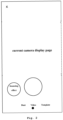
- Fig. 2 illustrates a schematic diagram of an interactive interface according to some embodiments of the present disclosure.
- Fig. 2 illustrates a current camera display page.
- Fig. 2 also illustrates options of Duet, Video, Template, etc. in a bottom carousel of the interactive interface.
- the Duet option can be provided on the left of the Video option.
- step S3 when the user scrolls on the interactive interface to the Duet option in the bottom carousel, or selects the Duet option, the user selects the duet mode.
- the user can also scroll to other options such as the Video option or Template option.
- the duet mode interface can be presented to the user, and a plurality of recommended duet videos are presented to the user through the duet mode interface.
- a page can also be referred to as a "duet discovery page”.
- the duet mode interface where the plurality of recommended duet videos are presented to the user can adopt different manners as needed.
- the plurality of recommended duet videos can be presented to the user in a thumbnail form.
- the plurality of recommended duet videos can also be sequentially presented to the user in a full-screen form.
- Fig. 3A illustrates a schematic diagram of a duet mode interface according to some embodiments of the present disclosure.
- the duet mode interface is a user interface where "Recommended duet videos" are displayed in two columns. For example, on a user interface in a form of 2 ⁇ 2 grids, thumbnails of 4 recommended duet videos are presented to the user. The user is allowed to scroll the videos for playing, to discover more duet contents. In a top-left corner of the user interface shown in Fig. 3A , there is an exit to return to a screen outside the camera, and the Video option is still shown at the bottom thereof.
- thumbnails of 1st to 4th recommended duet videos are presented to the user; and in response to a gesture of the user, such as swipe-up, more duet videos are presented to the user, for example, thumbnails of 5th to 8th recommended duet videos, 9th to 12th recommended duet videos, and more recommended duet videos, are sequentially presented to the user.
- thumbnails of more recommended duet videos such as 6, 8, and so on, can also be presented per screen.
- a thumbnail size can be adjusted according to an aspect ratio of a duet content. For example, a thumbnail can be set to be fixed in width and variable in height. A thumbnail of each duet video can be enlarged to the full screen.
- the presentation of the recommended duet videos in the thumbnail form can facilitate the user to discover an interested video more quickly.
- each tab is preloaded with thumbnails of a plurality of duet videos, for example, 20 thumbnails in 10 rows.
- thumbnails of duet videos for example, 20 thumbnails in 10 rows.
- a tag of its corresponding duet publish number is displayed on its thumbnail. Tagging the duet publish number on the thumbnail of each recommended duet video can facilitate the user to discover popular video contents.
- Fig. 3B illustrates a schematic diagram of a duet mode interface according to other embodiments of the present disclosure.
- the duet mode interface is a user interface where each of the "Recommended duet videos" is displayed in full screen.
- the plurality of recommended duet videos are sequentially presented to the user in the full-screen form.
- the 1st recommended duet video is presented to the user.
- the user can discover more duet contents by scrolling the video for playing. That is, in response to the user's gesture, for example, swipe-up, the 2nd recommended duet video, the 3rd recommended duet video, and more recommended duet videos are sequentially presented to the user.
- the presentation of the recommended duet videos in the full-screen form can provide the user with an immersive experience.
- the plurality of recommended duet videos can be presented to the user through the different user interfaces, and it will be described below which duet videos are presented to the user as the recommended duet videos.
- the presenting a plurality of recommended duet videos to the user through the duet mode interface comprises: ranking duet videos in a content pool according to a user behavior feature; and presenting a plurality of recommended duet videos ranked on top to the user according to the ranking result.
- the user behavior feature can comprise: Video View (W), publish number brought by a single view, duetted times, creation time, creation place, and the like.
- the publish number brought by the single view can be characterized by a ratio of the corresponding publish number to the Video View (Publish/W).
- the duet video in the content pool can be limited that its Video View is greater than a threshold.
- the threshold can be determined according to statistics of duet video number and Video View in different regions, for example, the threshold is set to 30 thousands for most countries or regions. In this way, regardless of whether the duet videos in the content pool are ranked according to the Video View or according to the publish number brought by the single view or other user behavior features, it is beneficial for discovering an interested video more efficiently by the user.
- the creation time of the duet video in the content pool can be limited to within a specified period of time.
- the creation time of the duet video in the content pool can be limited to no more than 7 days. This can ensure that the duet videos in the content pool are refreshed continuously, which is beneficial for discovering more popular duet videos by the user, to improve the user experience.
- a video with a status of "visible to everyone” and allowing everyone to duet with can be taken as a recommended duet video.
- privacy settings of the duet video in the content pool meet: a status being "visible to everyone ", and allowing everyone to duet with.
- the duet videos can be ranked according to the publish number brought by the single view or according to a Video View. For example, the greater the publish number brought by the single view or the greater the Video View, the higher the rank.
- Original videos can also be ranked according to duetted times (DT). For example, the more the duetted times, the higher the rank.
- DT duetted times
- one or more duet videos with a maximum Video View among duet videos corresponding to the original video is presented to the user. That is to say, a plurality of suggested duet videos corresponding to a plurality of original videos ranked on top are presented to the user according to the ranking result, wherein each suggested duet video is a duet video with a maximum video view in duet videos duetted with a corresponding original video.
- the duet video with the maximum Video View among the duet videos can be one or more duet videos.
- the creation time is also considered when ranking the duet videos in the content pool.
- the creation place is also considered when the duet videos in the content pool are ranked. Therefore, in order to discover more popular local duet videos, the videos can be ranked according to at least one of the creation time or creation place.
- the more recent the creation time of the video that is, the fewer the creation days, the higher its rank.
- different weights can be set according to different importance of the creation time in ranking, to better match the user's needs.
- only recommended duet videos ranked on top within each unit time can be presented according to the creation time. For example, for each of the above ranking logics, only top (for example, top 200) videos per day can be presented according to the creation time. In this way, the user can be made to more efficiently discover interested popular videos.
- the user After browsing the plurality of recommended duet videos or thumbnails, the user can select a video for duetting with, and input a duet request.
- Figs. 4A to 4D illustrate schematic diagrams of inputting a duet request to perform a duet according to some embodiments of the present disclosure.
- a duet mode video player plays the duet video selected by the user, such as a page shown in Fig. 4A .
- the user enters a display page of the source video as shown in Fig. 4C .
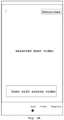
- Options of Return and "Duet with video” are provided on the source video of Fig. 4C .
- the user selects the "Duet with video” option, i.e., inputs a duet request, and can perform a duet with the source video.
- a display page for performing the duet is shown in Fig. 4D .
- the user selects the recommended duet video, and inputs the duet request through the display page of the corresponding source video to perform the duet with the source video. That is, in the step S5, the duet with the source video can be performed in response to the duet request inputted by the user based on the source video corresponding to the selected recommended duet video.
- the user can also directly input the duet request through a display page of the selected recommended duet video.
- a "Duet with source video” option is provided on the display page of the recommended duet video selected by the user.
- the user can directly enter the duet with the source video by selecting the "Duet with source video” option, and a display page for performing the duet is also shown in Fig. 4D . That is, in the step S5, the duet with the source video can also be performed in response to the duet request inputted by the user based on the selected recommended duet video.
- the "Duet with source video” option can be displayed, but the display of other metadata is limited.
- the duet mode video player can play the duet video, such as the page shown in Fig. 3B , which is similar to the page shown in Fig. 4A . Accordingly, the user clicks on the duet video on the page shown in Fig. 3B , and then the tooltip of "View source video" will appear, which is similar to the page shown in Fig. 4B . After clicking on the tooltip, the user enters the display page of the source video, as shown in Fig. 4C . The options of Return and "Duet with video" are provided on the source video of Fig. 4C . The user selects the "Duet with video” option, i.e., inputs the duet request, and can perform the duet with the source video. The display page for performing the duet is shown in Fig. 4D .
- the user can also, directly through the display page of the selected recommended duet video, input the duet request. Similar to the user-selected display page of the recommended duet video as shown in Fig. 4A , the "Duet with source video" option is also provided on the page shown in Fig. 3B . The user can directly enter the duet with the source video by selecting the "Duet with source video” option, and the display page for performing the duet is also shown in Fig. 4D .
- the duet with the source video is performed in response to the duet request inputted by the user based on one of the plurality of recommended duet videos.
- the duet with the selected recommended duet video can also be performed in response to the duet request inputted by the user based on the selected recommended duet video.
- a bouncing effect is animated on the display page to show the user that he/she can scroll to discover more contents.
- the user can scroll up and down to view a new video. If the user browses a first material, refresh is not allowed.
- a Favorites option can also be provided on the pages of Fig. 3B and Figs.4A to 4C , for example, on top-right corners. The user can click on the Favorites option and add a viewed video into the favorites.
- the user can be incentivized to use the viewed video in creation, or save it for later use, and the user can be enabled to get a better understanding of how to perform creation using the viewed video.
- the video processing method according to various embodiments of the present disclosure have been fully described.
- inspiration can be efficiently provided for potential creators, the efficiency of finding the duet videos by the user is improved, and the efficiency of discovering popular duet videos by the user is improved.
- a video processing apparatus capable of implementing the video processing method.
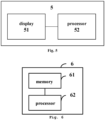
- Fig. 5 illustrates a block diagram of a video processing apparatus according to some embodiments of the present disclosure.
- a video processing apparatus 5 comprises a display 51 and a processor 52.
- the display 51 is configured to: provide an interactive interface of entering a duet mode for a user, in response to a shooting request of the user; and presenting a plurality of recommended duet videos to the user through a duet mode interface, in response to the user's selection of the duet mode on the interactive interface.
- the display 51 can perform the aforementioned steps S1 and S3 under the control of the processor 52.
- the processor 52 is configured to perform a duet in response to a duet request inputted by the user based on one of the plurality of recommended duet videos. For example, the processor 52 performs the aforementioned step S5.
- the apparatus can also comprise a memory, which can have thereon stored various information generated in operations by the video processing apparatus and the units included in the video processing apparatus, programs and data for the operations, and the like.
- the memory can be a volatile memory and/or non-volatile memory.
- the memory can include, but is not limited to, a random access memory (RAM), dynamic random access memory (DRAM), static random access memory (SRAM), read-only memory (ROM), flash memory.
- RAM random access memory
- DRAM dynamic random access memory
- SRAM static random access memory
- ROM read-only memory
- flash memory can also be located outside the video processing apparatus.
- Fig. 6 illustrates a block diagram of a video processing apparatus according to other embodiments of the present disclosure.
- a video processing apparatus 6 can be various types of devices, which can include, but are not limited to, for example, mobile terminals such as a mobile phone, a notebook computer, a digital broadcast receiver, a PDA (Personal Digital Assistant), a PAD (Tablet Personal Computer), a PMP (Portable Multimedia Player), a vehicle-mounted terminal (for example, a vehicle-mounted navigation terminal), and the like, and fixed terminals such as a digital TV, a desktop computer, and the like.
- mobile terminals such as a mobile phone, a notebook computer, a digital broadcast receiver, a PDA (Personal Digital Assistant), a PAD (Tablet Personal Computer), a PMP (Portable Multimedia Player), a vehicle-mounted terminal (for example, a vehicle-mounted navigation terminal), and the like
- PMP Portable Multimedia Player
- vehicle-mounted terminal for example, a vehicle-mounted navigation terminal
- fixed terminals such as a digital TV, a desktop computer, and the like.
- the video processing apparatus 6 comprises: a memory 61 and a processor 62 coupled to the memory 61. It should be noted that the components of the video processing apparatus 6 shown in Fig. 6 are only exemplary and not restrictive, and the video processing apparatus 6 can also have other components according to the needs of practical application.
- the processor 62 can control the other components in the video processing apparatus 6 to perform a desired function.
- the memory 61 is configured to store one or more computer-readable instructions.
- the processor 62 is configured to run the computer-readable instructions and when the computer-readable instructions are run by the processor 62, implements one or more steps of the method according to any of the above embodiments.
- the processor 62 is configured to run the computer-readable instructions and when the computer-readable instructions are run by the processor 62, perform a video processing method, comprising: providing an interactive interface of entering a duet mode for a user, in response to a shooting request of the user; presenting a plurality of recommended duet videos to the user through a duet mode interface, in response to the user's selection of the duet mode on the interactive interface; and performing a duet in response to a duet request inputted by the user based on one of the plurality of recommended duet videos.
- a video processing method comprising: providing an interactive interface of entering a duet mode for a user, in response to a shooting request of the user; presenting a plurality of recommended duet videos to the user through a duet mode interface, in response to the user's selection of the duet mode on the interactive interface; and performing a duet in response to a duet request inputted by the user based on one of the plurality of recommended duet videos.
- the processor 62 and the memory 61 can be in direct or indirect communication with each other.
- the processor 62 and the memory 61 can communicate through a network.
- the network can comprise a wireless network, a wired network, and/or any combination of wireless and wired networks.
- the processor 62 and the memory 61 can also communicate with each other through a system bus, which is not limited in the present disclosure.
- the processor 62 can be embodied as various suitable processors, processing devices, and the like, such as a central processing unit (CPU), graphics processing unit (GPU), network processor (NP), and the like; but can also be a digital signal processor (DSP), application specific integrated circuit (ASIC), field programmable gate array (FPGA) or other programmable logic device, discrete gate or transistor logic, discrete hardware component.
- the central processing unit (CPU) can be an X86 or ARM architecture, etc.
- the memory 61 can include any combination of various forms of non-transitory computer-readable storage media, such as a volatile memory and/or non-volatile memory.
- the memory 61 can include, for example, a system memory, which has thereon stored, for example, an operating system, application, boot loader, database, other program, and the like.
- Various applications and various data and the like can also be stored in the storage medium.
- a program constituting the software can be installed from a storage medium or a network to a computer system having a dedicated hardware structure, for example, a computer system of an electronic device 700 shown in Fig. 7 , which when having thereon installed the various programs, is capable of performing various functions including functions such as those described above, and the like,.
- a central processing unit (CPU) 701 executes various processes according to a program stored in a read-only memory (ROM) 702 or a program loaded from a storage portion 708 to a random access memory (RAM) 703.
- ROM read-only memory
- RAM random access memory
- the central processing unit is merely exemplary and can also be another type of processor, such as the various processors described above.
- the ROM 702, RAM 703, and storage portion 708 can be various forms of non-transitory computer-readable storage media, as described below. It should be noted that although the ROM 702, RAM 703, and storage portion 708 are shown separately in Fig. 7 , one or more of them can be combined or located in a same memory or storage module or different memories or storage modules.
- the CPU 701, ROM 702, and RAM 703 are connected to each other via a bus 704.
- An input/output interface 705 is also connected to the bus 704.
- an input portion 706 such as a touch screen, a touch pad, a keyboard, a mouse, an image sensor, a microphone, an accelerometer, a gyroscope, or the like
- an output portion 707 including a display such as a cathode ray tube (CRT), a liquid crystal display (LCD), a speaker, a vibrator, and the like
- a storage portion 708 including a hard disk, a magnetic tape, and the like
- a communication portion 709 including a network interface card such as a LAN card, a modem, and the like.
- the communication portion 709 allows communication processing to be performed via a network such as the Internet.
- the various devices or modules in the electronic device 700 are shown in Fig. 7 communicate through the bus 704, they can also communicate through a network or other means, wherein the network can comprise a wireless network, a wired network, and/or any combination of wireless and wired networks.
- a driver 710 is also connected to the input/output interface 705 as needed.
- a removable medium 711 such as a magnetic disk, an optical disk, a magneto-optical disk, a semiconductor memory, or the like is mounted on the drive 710 as needed, so that a computer program read out therefrom is installed in the storage portion 708 as needed.
- a program constituting the software can be installed from a network such as the Internet or a storage medium such as the removable medium 711.
- a process described above with reference to a flow diagram can be implemented as a computer software program.
- a computer program product is comprised, which comprises a computer program carried on a computer-readable medium, the computer program comprising program code for performing the method illustrated by the flow diagram.
- the computer program can be downloaded and installed from a network via the communication device 709, or installed from the storage portion 708, or installed from the ROM 702.
- the computer program when executed by the CPU 701, performs the above functions defined in the method of the embodiment of the present disclosure.
- the computer-readable medium can be tangible medium that can have thereon contained or stored a program for use by or in conjunction with an instruction execution system, apparatus, or device.
- the computer-readable medium can be a computer-readable signal medium or a non-transitory computer-readable storage medium or any combination of the two.
- the non-transitory computer-readable storage medium can be, for example, but is not limited to: an electronic, magnetic, optical, electromagnetic, infrared, or semiconductor system, apparatus, or device, or any combination of the above.
- non-transitory computer-readable storage medium can comprise, but are not limited to: an electrical connection having one or more wires, a portable computer diskette, a hard disk, a random access memory (RAM), a read-only memory (ROM), an erasable programmable read-only memory (EPROM or flash memory), an optical fiber, a portable compact disc read-only memory (CD-ROM), an optical storage device, a magnetic storage device, or any suitable combination of the above.
- the non-transitory computer-readable storage medium can be any tangible medium that has thereon contained or stored a program for use by or in conjunction with an instruction execution system, apparatus, or device.
- the computer-readable signal medium can comprise a data signal propagated in baseband or as part of a carrier wave, in which computer-readable program code is carried.
- a propagated data signal can take any of a variety of forms, including but not limited to, an electro-magnetic signal, an optical signal, or any suitable combination of the above.
- the computer-readable signal medium can also be any computer-readable medium other than the non-transitory computer-readable storage medium, and can send, propagate, or transmit a program for use by or in conjunction with an instruction execution system, apparatus, or device.
- the program code contained on the computer-readable medium can be transmitted using any suitable medium, including but not limited to: a wire, optical cable, RF (Radio Frequency), etc. , or any suitable combination of the above.
- the computer-readable medium can be included in the electronic device; can also be separate and not assembled into the electronic device.
- a computer program comprising: instructions which, when executed by a processor, cause the processor to perform the method of any of the embodiments described above.
- the instructions can be embodied as computer program code.
- computer program code for performing operations of the present disclosure can be written in one or more programming languages or any combination thereof, the programming language including but not limited to an object-oriented programming language such as Java, Smalltalk, C++, also including a conventional procedural programming language such as a "C" programming language or a similar programming language.
- the program code can be executed entirely on a user's computer, partly on the user's computer, as a stand-alone software package, partly on the user's computer and partly on a remote computer, or entirely on the remote computer or server.
- the remote computer can be connected to the user's computer through any type of network, including a local area network (LAN) or a wide area network (WAN), or can be connected to an external computer (for example, through the Internet using an Internet service provider).
- LAN local area network
- WAN wide area network
- each block in the flow diagram or block diagram can represent one module, program segment, or portion of code, which comprises one or more executable instructions for implementing specified logical functions.
- the functions noted in the blocks can also occur in a different order from the order noted in the drawings. For example, two blocks shown in succession can, in fact, be executed substantially in parallel, or they can sometimes be executed in the reverse order, which depends upon the functions involved.
- each block in the block diagrams and/or flow diagrams, and a combination of the blocks in the block diagrams and/or flow diagrams can be implemented by a special-purpose hardware-based system that performs the specified functions or operations, or a combination of special-purpose hardware and computer instructions.
- a involved module, component or unit described in an embodiment of the present disclosure can be implemented by software or hardware.
- a name of the module, component, or unit does not in some cases constitute a limitation on the module, component, or unit itself.
- exemplary hardware logic components that can be used comprise: a field programmable gate array (FPGA), application specific integrated circuit (ASIC), application specific standard product (ASSP), system on chip (SOC), complex programmable logic device (CPLD), and the like.
- FPGA field programmable gate array
- ASIC application specific integrated circuit
- ASSP application specific standard product
- SOC system on chip
- CPLD complex programmable logic device
Landscapes
- Engineering & Computer Science (AREA)
- Multimedia (AREA)
- Signal Processing (AREA)
- Databases & Information Systems (AREA)
- Human Computer Interaction (AREA)
- General Engineering & Computer Science (AREA)
- Marketing (AREA)
- Business, Economics & Management (AREA)
- Computer Networks & Wireless Communication (AREA)
- Computer Security & Cryptography (AREA)
- Software Systems (AREA)
- User Interface Of Digital Computer (AREA)
- Two-Way Televisions, Distribution Of Moving Picture Or The Like (AREA)
- Studio Devices (AREA)
Applications Claiming Priority (2)
| Application Number | Priority Date | Filing Date | Title |
|---|---|---|---|
| CN202111266487.4A CN116055442A (zh) | 2021-10-28 | 2021-10-28 | 视频处理方法、视频处理装置和计算机可读存储介质 |
| PCT/SG2022/050744 WO2023075679A2 (zh) | 2021-10-28 | 2022-10-20 | 视频处理方法、视频处理装置和计算机可读存储介质 |
Publications (2)
| Publication Number | Publication Date |
|---|---|
| EP4425939A2 true EP4425939A2 (de) | 2024-09-04 |
| EP4425939A4 EP4425939A4 (de) | 2025-02-26 |
Family
ID=86115137
Family Applications (1)
| Application Number | Title | Priority Date | Filing Date |
|---|---|---|---|
| EP22887805.4A Pending EP4425939A4 (de) | 2021-10-28 | 2022-10-20 | Videoverarbeitungsverfahren, videoverarbeitungsvorrichtung und computerlesbares speichermedium |
Country Status (5)
| Country | Link |
|---|---|
| US (2) | US11991410B2 (de) |
| EP (1) | EP4425939A4 (de) |
| JP (1) | JP7585556B2 (de) |
| CN (1) | CN116055442A (de) |
| WO (1) | WO2023075679A2 (de) |
Families Citing this family (2)
| Publication number | Priority date | Publication date | Assignee | Title |
|---|---|---|---|---|
| CN116055442A (zh) | 2021-10-28 | 2023-05-02 | 脸萌有限公司 | 视频处理方法、视频处理装置和计算机可读存储介质 |
| US12149787B2 (en) * | 2023-01-19 | 2024-11-19 | Snap Inc. | Video notification system |
Family Cites Families (19)
| Publication number | Priority date | Publication date | Assignee | Title |
|---|---|---|---|---|
| WO2004052010A1 (en) * | 2002-12-04 | 2004-06-17 | Koninklijke Philips Electronics N.V. | Recommendation of video content based on the user profile of users with similar viewing habits |
| JP5461354B2 (ja) * | 2010-09-28 | 2014-04-02 | 株式会社エクシング | 映像情報配信システム |
| US9583142B1 (en) | 2015-07-10 | 2017-02-28 | Musically Inc. | Social media platform for creating and sharing videos |
| US10824678B2 (en) * | 2017-06-03 | 2020-11-03 | Apple Inc. | Query completion suggestions |
| CN108989691B (zh) * | 2018-10-19 | 2021-04-06 | 北京微播视界科技有限公司 | 视频拍摄方法、装置、电子设备及计算机可读存储介质 |
| CN109982130A (zh) * | 2019-04-11 | 2019-07-05 | 北京字节跳动网络技术有限公司 | 一种视频拍摄方法、装置、电子设备及存储介质 |
| US20210035541A1 (en) * | 2019-07-31 | 2021-02-04 | Rovi Guides, Inc. | Systems and methods for recommending collaborative content |
| CN112351327A (zh) * | 2019-08-06 | 2021-02-09 | 北京字节跳动网络技术有限公司 | 人脸图像的处理方法、装置、终端及存储介质 |
| CN110868639B (zh) * | 2019-11-28 | 2021-03-12 | 北京达佳互联信息技术有限公司 | 视频合成方法及装置 |
| CN111163274B (zh) * | 2020-01-21 | 2022-04-22 | 海信视像科技股份有限公司 | 一种视频录制方法及显示设备 |
| CN111408136B (zh) | 2020-02-28 | 2021-02-26 | 苏州叠纸网络科技股份有限公司 | 一种游戏交互控制方法、装置及存储介质 |
| CN111327931B (zh) * | 2020-03-02 | 2022-02-11 | 青岛海信传媒网络技术有限公司 | 观看历史显示方法及显示设备 |
| CN111629151B (zh) | 2020-06-12 | 2023-01-24 | 北京字节跳动网络技术有限公司 | 视频合拍方法、装置、电子设备及计算机可读介质 |
| CN111767430B (zh) | 2020-06-30 | 2021-05-25 | 平安国际智慧城市科技股份有限公司 | 视频资源推送方法、视频资源推送装置及存储介质 |
| US20220237229A1 (en) * | 2021-01-26 | 2022-07-28 | Tableau Software, LLC | Content based related view recommendations |
| CN113271478B (zh) | 2021-05-17 | 2023-01-10 | 北京大米科技有限公司 | 学习视频推荐方法、信息交互方法和装置 |
| CN113395588A (zh) * | 2021-06-23 | 2021-09-14 | 北京字跳网络技术有限公司 | 一种视频处理方法、装置、设备及存储介质 |
| CN113553509B (zh) | 2021-07-29 | 2024-03-01 | 北京达佳互联信息技术有限公司 | 一种内容推荐方法、装置、电子设备及存储介质 |
| CN116055442A (zh) | 2021-10-28 | 2023-05-02 | 脸萌有限公司 | 视频处理方法、视频处理装置和计算机可读存储介质 |
-
2021
- 2021-10-28 CN CN202111266487.4A patent/CN116055442A/zh active Pending
-
2022
- 2022-04-19 US US17/723,881 patent/US11991410B2/en active Active
- 2022-10-20 JP JP2024525661A patent/JP7585556B2/ja active Active
- 2022-10-20 EP EP22887805.4A patent/EP4425939A4/de active Pending
- 2022-10-20 WO PCT/SG2022/050744 patent/WO2023075679A2/zh not_active Ceased
-
2024
- 2024-04-23 US US18/643,217 patent/US12401844B2/en active Active
Also Published As
| Publication number | Publication date |
|---|---|
| JP2024540182A (ja) | 2024-10-31 |
| US20240276057A1 (en) | 2024-08-15 |
| WO2023075679A3 (zh) | 2023-06-29 |
| US12401844B2 (en) | 2025-08-26 |
| EP4425939A4 (de) | 2025-02-26 |
| JP7585556B2 (ja) | 2024-11-18 |
| CN116055442A (zh) | 2023-05-02 |
| US11991410B2 (en) | 2024-05-21 |
| US20230139768A1 (en) | 2023-05-04 |
| WO2023075679A2 (zh) | 2023-05-04 |
Similar Documents
| Publication | Publication Date | Title |
|---|---|---|
| US12536240B2 (en) | Method, apparatus and device for implementing search | |
| US12401844B2 (en) | Video processing method, video processing apparatus, and non-transitory computer-readable storage medium | |
| US20240292052A1 (en) | Page display method and apparatus, electronic device and storage medium | |
| CN113253880B (zh) | 互动场景的页面的处理方法、装置及存储介质 | |
| US12386893B2 (en) | Video processing method, video processing apparatus, and computer-readable storage medium | |
| EP4343513B1 (de) | Informationspräsentationsverfahren und -vorrichtung sowie elektronische vorrichtung und speichermedium | |
| CN116089757A (zh) | 页面展示方法及装置、电子设备、存储介质和程序产品 | |
| KR102862444B1 (ko) | 비디오 처리 방법, 비디오 처리 장치 및 컴퓨터-판독가능 저장 매체 | |
| EP4429254A1 (de) | Videoverarbeitungsverfahren, videoverarbeitungsvorrichtung und computerlesbares speichermedium | |
| CN106503059A (zh) | 展示页面推送方法及装置 | |
| WO2025113546A1 (zh) | 多媒体内容的显示方法、装置、电子设备和存储介质 | |
| CN116828247A (zh) | 媒体内容流处理方法、装置、设备及存储介质 | |
| CN117979152A (zh) | 一种图像处理方法、装置、电子设备及存储介质 | |
| CN118627481A (zh) | 表格处理方法、装置、终端和存储介质 | |
| US20250260847A1 (en) | Information display method and apparatus, electronic device, and computer readable medium | |
| JP2025521195A (ja) | テキスト素材取得方法、装置、機器、媒体及びプログラム製品 | |
| US20200228746A1 (en) | Interfacing a television with a second device | |
| CN118708827A (zh) | 信息展示方法、装置、设备、存储介质及产品 | |
| CN112492399A (zh) | 信息显示方法、装置及电子设备 | |
| WO2026030918A1 (zh) | 交互方法、装置、存储介质和计算机程序产品 | |
| CN114968463A (zh) | 实体展示方法、装置、设备及介质 | |
| CN121691762A (zh) | 视频生成方法、装置、电子设备及存储介质 |
Legal Events
| Date | Code | Title | Description |
|---|---|---|---|
| STAA | Information on the status of an ep patent application or granted ep patent |
Free format text: STATUS: THE INTERNATIONAL PUBLICATION HAS BEEN MADE |
|
| PUAI | Public reference made under article 153(3) epc to a published international application that has entered the european phase |
Free format text: ORIGINAL CODE: 0009012 |
|
| STAA | Information on the status of an ep patent application or granted ep patent |
Free format text: STATUS: REQUEST FOR EXAMINATION WAS MADE |
|
| 17P | Request for examination filed |
Effective date: 20240528 |
|
| AK | Designated contracting states |
Kind code of ref document: A2 Designated state(s): AL AT BE BG CH CY CZ DE DK EE ES FI FR GB GR HR HU IE IS IT LI LT LU LV MC ME MK MT NL NO PL PT RO RS SE SI SK SM TR |
|
| DAV | Request for validation of the european patent (deleted) | ||
| DAX | Request for extension of the european patent (deleted) | ||
| A4 | Supplementary search report drawn up and despatched |
Effective date: 20250123 |
|
| RIC1 | Information provided on ipc code assigned before grant |
Ipc: G11B 27/34 20060101ALI20250117BHEP Ipc: G11B 27/031 20060101ALI20250117BHEP Ipc: H04N 5/265 20060101ALI20250117BHEP Ipc: H04N 23/62 20230101ALI20250117BHEP Ipc: H04N 21/472 20110101ALI20250117BHEP Ipc: H04N 21/431 20110101AFI20250117BHEP |
|
| STAA | Information on the status of an ep patent application or granted ep patent |
Free format text: STATUS: EXAMINATION IS IN PROGRESS |
|
| 17Q | First examination report despatched |
Effective date: 20251014 |