EP4425762A1 - Motor - Google Patents
Motor Download PDFInfo
- Publication number
- EP4425762A1 EP4425762A1 EP21962640.5A EP21962640A EP4425762A1 EP 4425762 A1 EP4425762 A1 EP 4425762A1 EP 21962640 A EP21962640 A EP 21962640A EP 4425762 A1 EP4425762 A1 EP 4425762A1
- Authority
- EP
- European Patent Office
- Prior art keywords
- stator
- housing
- motor
- extensions
- groove
- Prior art date
- Legal status (The legal status is an assumption and is not a legal conclusion. Google has not performed a legal analysis and makes no representation as to the accuracy of the status listed.)
- Pending
Links
Images



Classifications
-
- H—ELECTRICITY
- H02—GENERATION; CONVERSION OR DISTRIBUTION OF ELECTRIC POWER
- H02K—DYNAMO-ELECTRIC MACHINES
- H02K5/00—Casings; Enclosures; Supports
- H02K5/24—Casings; Enclosures; Supports specially adapted for suppression or reduction of noise or vibrations
-
- H—ELECTRICITY
- H02—GENERATION; CONVERSION OR DISTRIBUTION OF ELECTRIC POWER
- H02K—DYNAMO-ELECTRIC MACHINES
- H02K1/00—Details of the magnetic circuit
- H02K1/06—Details of the magnetic circuit characterised by the shape, form or construction
- H02K1/12—Stationary parts of the magnetic circuit
- H02K1/14—Stator cores with salient poles
-
- H—ELECTRICITY
- H02—GENERATION; CONVERSION OR DISTRIBUTION OF ELECTRIC POWER
- H02K—DYNAMO-ELECTRIC MACHINES
- H02K1/00—Details of the magnetic circuit
- H02K1/06—Details of the magnetic circuit characterised by the shape, form or construction
- H02K1/12—Stationary parts of the magnetic circuit
- H02K1/14—Stator cores with salient poles
- H02K1/145—Stator cores with salient poles having an annular coil, e.g. of the claw-pole type
-
- H—ELECTRICITY
- H02—GENERATION; CONVERSION OR DISTRIBUTION OF ELECTRIC POWER
- H02K—DYNAMO-ELECTRIC MACHINES
- H02K1/00—Details of the magnetic circuit
- H02K1/06—Details of the magnetic circuit characterised by the shape, form or construction
- H02K1/12—Stationary parts of the magnetic circuit
- H02K1/18—Means for mounting or fastening magnetic stationary parts on to, or to, the stator structures
- H02K1/185—Means for mounting or fastening magnetic stationary parts on to, or to, the stator structures to outer stators
-
- H—ELECTRICITY
- H02—GENERATION; CONVERSION OR DISTRIBUTION OF ELECTRIC POWER
- H02K—DYNAMO-ELECTRIC MACHINES
- H02K1/00—Details of the magnetic circuit
- H02K1/06—Details of the magnetic circuit characterised by the shape, form or construction
- H02K1/22—Rotating parts of the magnetic circuit
- H02K1/27—Rotor cores with permanent magnets
-
- H—ELECTRICITY
- H02—GENERATION; CONVERSION OR DISTRIBUTION OF ELECTRIC POWER
- H02K—DYNAMO-ELECTRIC MACHINES
- H02K5/00—Casings; Enclosures; Supports
- H02K5/04—Casings or enclosures characterised by the shape, form or construction thereof
- H02K5/16—Means for supporting bearings, e.g. insulating supports or means for fitting bearings in the bearing-shields
-
- H—ELECTRICITY
- H02—GENERATION; CONVERSION OR DISTRIBUTION OF ELECTRIC POWER
- H02K—DYNAMO-ELECTRIC MACHINES
- H02K5/00—Casings; Enclosures; Supports
- H02K5/04—Casings or enclosures characterised by the shape, form or construction thereof
- H02K5/16—Means for supporting bearings, e.g. insulating supports or means for fitting bearings in the bearing-shields
- H02K5/163—Means for supporting bearings, e.g. insulating supports or means for fitting bearings in the bearing-shields radially supporting the rotary shaft at only one end of the rotor
-
- H—ELECTRICITY
- H02—GENERATION; CONVERSION OR DISTRIBUTION OF ELECTRIC POWER
- H02K—DYNAMO-ELECTRIC MACHINES
- H02K7/00—Arrangements for handling mechanical energy structurally associated with dynamo-electric machines, e.g. structural association with mechanical driving motors or auxiliary dynamo-electric machines
- H02K7/08—Structural association with bearings
-
- H—ELECTRICITY
- H02—GENERATION; CONVERSION OR DISTRIBUTION OF ELECTRIC POWER
- H02K—DYNAMO-ELECTRIC MACHINES
- H02K7/00—Arrangements for handling mechanical energy structurally associated with dynamo-electric machines, e.g. structural association with mechanical driving motors or auxiliary dynamo-electric machines
- H02K7/08—Structural association with bearings
- H02K7/085—Structural association with bearings radially supporting the rotary shaft at only one end of the rotor
-
- H—ELECTRICITY
- H02—GENERATION; CONVERSION OR DISTRIBUTION OF ELECTRIC POWER
- H02K—DYNAMO-ELECTRIC MACHINES
- H02K7/00—Arrangements for handling mechanical energy structurally associated with dynamo-electric machines, e.g. structural association with mechanical driving motors or auxiliary dynamo-electric machines
- H02K7/14—Structural association with mechanical loads, e.g. with hand-held machine tools or fans
-
- H—ELECTRICITY
- H02—GENERATION; CONVERSION OR DISTRIBUTION OF ELECTRIC POWER
- H02K—DYNAMO-ELECTRIC MACHINES
- H02K9/00—Arrangements for cooling or ventilating
- H02K9/02—Arrangements for cooling or ventilating by ambient air flowing through the machine
- H02K9/04—Arrangements for cooling or ventilating by ambient air flowing through the machine having means for generating a flow of cooling medium
- H02K9/06—Arrangements for cooling or ventilating by ambient air flowing through the machine having means for generating a flow of cooling medium with fans or impellers driven by the machine shaft
-
- H—ELECTRICITY
- H02—GENERATION; CONVERSION OR DISTRIBUTION OF ELECTRIC POWER
- H02K—DYNAMO-ELECTRIC MACHINES
- H02K2213/00—Specific aspects, not otherwise provided for and not covered by codes H02K2201/00 - H02K2211/00
- H02K2213/03—Machines characterised by numerical values, ranges, mathematical expressions or similar information
Definitions
- the present disclosure relates to a motor. More particularly, the present disclosure relates to a vacuum cleaner motor.
- a vacuum cleaner is a home appliance that sucks foreign substances such as dust and collects them in a separate dust collection unit installed inside a main body.
- the vacuum cleaner requires high suction power to effectively suck foreign substances, and an intensity of the suction power may be proportional to a rotational force of a motor. That is, as the rotational force of the motor increases, a rotational speed of a fan connected to the motor increases, thereby increasing the suction power of foreign substances.
- a conventional vacuum cleaner motor is disclosed in a prior art below.
- both ends of a rotating shaft of a vacuum cleaner motor are supported by an upper bearing and a lower bearing.
- a rotor assembly is mounted on the rotating shaft between the upper bearing and the lower bearing.
- the lower bearing is mounted in the center of the bottom of a motor housing, and the upper bearing is mounted in the center of a bearing housing.
- the bearing housing is fixed to an upper surface of the motor housing.
- the bearing housing is fixed to the motor housing.
- a fastening member such as a screw passes through an edge of the bearing housing and is inserted into the fastening hole of the motor housing, and hence the bearing housing is fixed to the motor housing.
- a diameter of the fastening hole formed in the motor housing is generally formed to be slightly larger than an outer diameter of the fastening protrusion. That is, there is a certain amount of fastening tolerance in which the diameter of the fastening hole is larger than the outer diameter of the fastening protrusion.
- the bearing housing may be misalignedly coupled in a radial direction of the motor housing in a state in which the fastening protrusion is inserted into the fastening hole.
- a rotation axis of the motor is eccentric by a predetermined angle from a central axis of the motor housing. Due to the eccentricity of the rotation axis of the motor, an air gap between a stator and a mover is not uniform during high-speed rotation.
- An object of the present disclosure is to provide a motor that can reduce the generation of vibration and noise by maintaining a constant air gap between a stator and a mover.
- Another object of the present disclosure is to provide a motor that can improve efficiency of the motor.
- Another object of the present disclosure is to provide a motor that can minimize deformation and reduce the number of components by fixing a stator and a mover.
- a motor comprising a housing, a bearing disposed in the housing, a rotating shaft rotatably coupled to the bearing, an impeller cover disposed on an upper part of the housing, an impeller disposed inside the impeller cover and coupled to the rotating shaft, a magnet coupled to a lower area of the rotating shaft, a stator coupled to the housing and facing the magnet, and a coil wound around the stator.
- the housing may include a stator groove formed radially outward from an inner surface of the housing, and the stator may be press-fitted into the stator groove.
- the present disclosure can reduce the generation of vibration and noise by maintaining a constant distance between the magnet, which is a mover, and the stator, which is a stator, and thus can improve the efficiency of the motor.
- the present disclosure can minimize the deformation by fixing the stator to the housing without any additional configuration, and thus can reduce the number of components.
- the stator may include a stator core press-fitted into the stator groove, a plurality of teeth portions extending radially inward from the stator core, and a plurality of teeth shoes extending from the plurality of teeth portions in a circumferential direction.
- the housing may include a flange portion extending radially, a coupling portion formed in a central area of the flange portion, a bearing hole formed in a central area of the coupling portion, a plurality of extensions extending downward from a radially outer area of the flange portion, and the stator groove formed in a lower area of each of the plurality of extensions.
- the impeller cover may be bolted to an upper surface of the flange portion of the housing, and an inner peripheral surface of the impeller cover may be in contact with an outer peripheral surface of the coupling portion.
- the housing may include a bearing protrusion extending radially inward from a lower end of the coupling portion, and a lower end of the bearing may be supported by the bearing protrusion.
- An inner surface of each of the plurality of extensions may include a curved portion of which a radial radius increases as the inner surface of each of the plurality of extensions goes downward.
- the coil may not radially overlap the curved portion.
- each of the plurality of extensions may include a straight portion extending downward from the curved portion, and the magnet may radially overlap the straight portion.
- a straight line extending an inner surface of a lower end of each of the plurality of extensions in a vertical direction may be disposed between a bottom surface of the stator groove and the straight portion.
- a height of the coupling portion may be greater than a height of the flange portion.
- the stator may include a housing groove that is concavely formed inward from an outer peripheral surface of the stator, and the plurality of extensions may be press-fitted into the housing groove.
- a bottom surface of the housing groove may be in contact with a bottom surface of the stator groove.
- the housing groove may extend in a vertical direction and penetrates an upper surface and a lower surface of the stator, and both side surfaces of each of the plurality of extensions may be press-fitted into the housing groove.
- a radial depth of the housing groove may be less than a radial width of the lower area of each of the plurality of extensions where the stator groove is formed.
- the housing groove may include a bottom surface that is recessed radially inward from the outer peripheral surface of the stator, and side surfaces that extend from each of circumferential direction ends of the bottom surface to the outer peripheral surface of the stator and are in contact with both side surfaces of each of the plurality of extensions.
- the bottom surface of the housing groove may extend from an upper surface to a lower surface of the stator.
- each of the plurality of extensions where the stator groove is formed may be formed in a ' '-shape.
- An outer surface of each of the plurality of extensions may include a first area that is disposed radially outward as the outer surface of each of the plurality of extensions goes downward, a second area extending downward from the first area, and a third area that is disposed radially inward as the outer surface goes downward from the second area.
- stator may radially overlap the second and third areas and may not radially overlap the first area.
- the plurality of extensions may be arranged to be spaced apart at constant intervals in a circumferential direction of the flange portion.
- the stator groove may include a bottom surface that is recessed radially outward from an inner surface of each of the plurality of extensions, an upper contact surface that extends from an upper end of the bottom surface to the inner surface of each of the plurality of extensions and is in contact with an upper surface of the stator, and a lower contact surface that extends from a lower end of the bottom surface to the inner surface of each of the plurality of extensions and is in contact with a lower surface of the stator.
- a radial length of the lower contact surface of the stator groove may be less than a radial length of the upper contact surface.
- the present disclosure can provide a motor that reduces the generation of vibration and noise by maintaining a constant air gap between a stator and a mover.
- the present disclosure can also provide a motor that improves efficiency of the motor.
- the present disclosure can also provide a motor that minimizes deformation and reduces the number of components by fixing a stator and a mover.
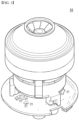
- FIG. 1 is a perspective view of a motor according to an embodiment of the present disclosure.
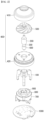
- FIG. 2 is an exploded perspective view of a motor according to an embodiment of the present disclosure.
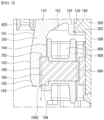
- FIG. 3 is a cross-sectional view of a motor according to an embodiment of the present disclosure.
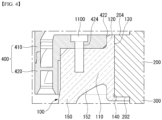
- FIG. 4 is an enlarged view of a portion A of FIG. 3 .
- FIG. 5 is an enlarged view of a portion B of FIG. 3 .
- FIG. 6 is a perspective view of a housing and a stator of a motor according to an embodiment of the present disclosure.
- FIG. 7 is a perspective view of a stator of a motor according to an embodiment of the present disclosure.
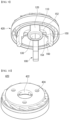
- FIGS. 8 and 9 are perspective views of a partial configuration of an impeller cover and a housing according to an embodiment of the present disclosure.
- FIG. 10 is a perspective view of a partial configuration of an impeller cover according to an embodiment of the present disclosure.
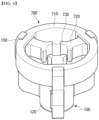
- FIGS. 11 and 12 are perspective views of a housing according to an embodiment of the present disclosure.
- a motor 10 may include a housing 100, a bearing 200, a rotating shaft 300, an impeller cover 400, an impeller 500, a magnet 600, a stator 700, an insulator 800, a coil 900, a controller 1000, and a coupling member 1100.
- the motor 10 can be implemented except for some of these components and does not exclude additional components.
- the motor 10 according to an embodiment of the present disclosure is described using a motor used in a vacuum cleaner as an example, but is not limited thereto and can be applied to various devices.
- an axial direction (or axially) can be understood to indicate a vertical direction based on FIG. 3
- a radial direction (or radially) can be understood to indicate a horizontal direction based on FIG. 3 .
- the housing 100 may be coupled to the impeller cover 400.
- An upper surface of the housing 100 may be coupled to a second impeller cover 420 of the impeller cover 400.
- the housing 100 may be disposed inside the second impeller cover 420.
- the stator 700 may be coupled to the housing 100.
- the stator 700 may be coupled to an inner side of the housing 100.
- the bearing 200 may be coupled to the housing 100.
- the bearing 200 may be coupled to the inner side of the housing 100.
- the housing 100 may be axially spaced apart from the impeller 500.
- the bearing 200, the rotating shaft 300, the magnet 600, the stator 700, the insulator 800, and the coil 900 may be disposed inside the housing 100.
- the housing 100 may include a flange portion 110, a coupling portion 120, a bearing hole 130, a bearing protrusion 140, a plurality of extensions 150, and a stator groove 160.
- the flange portion 110 may extend radially. An upper surface of the flange portion 110 may be coupled to the impeller cover 400. The upper surface of the flange portion 110 may be bolted to a lower surface of the second impeller cover 420. A fastening groove 112 may be formed on the upper surface of the flange portion 110 to be bolted to the lower surface of the second impeller cover 420. The fastening groove 112 of the flange portion 110 may axially overlap a fastening hole 424 of the second impeller cover 420. At least a portion of a radially outer surface of the flange portion 110 may be in contact with an inner surface of the impeller cover 400. At least a portion of the radially outer surface of the flange portion 110 may be in contact with an inner surface of the second impeller cover 420.
- the coupling portion 120 may be formed inside the flange portion 110.
- the coupling portion 120 may be formed in a central area of the flange portion 110.
- the coupling portion 120 may extend axially upward or downward from a radially inner area of the flange portion 110.
- the coupling portion 120 may be formed in a cylindrical shape.
- the bearing 200 may be coupled to the coupling portion 120.
- An axial length or height of the coupling portion 120 may be greater than an axial length or height of the flange portion 110. Through this, the coupling portion 120 can stably support the bearing 200.
- An outer peripheral surface or outer surface of an upper end of the coupling portion 120 may be in contact with the impeller cover 400.
- An outer peripheral surface or outer surface of an upper area of the coupling portion 120 may be in contact with an inner surface or inner peripheral surface 422 of the second impeller cover 420. Through this, a coupling position of the impeller cover 400 with respect to the housing 100 can be guided.
- the bearing hole 130 may be formed in a central area of the coupling portion 120.
- the bearing hole 130 may extend axially.
- the bearing 200 may be disposed in the bearing hole 130.
- An axial length or height of the bearing hole 130 may correspond to an axial length or height of the bearing 200.
- the bearing protrusion 140 may extend inward from the coupling portion 120.
- the bearing protrusion 140 may extend radially inward from a lower end of the coupling portion 120.
- the bearing protrusion 140 may axially support a lower end 202 of the bearing 200.
- the magnet 600 may be axially supported through an electronic interaction with the stator 700 and/or the coil 900, and the axially lower end 202 of the bearing 200 coupled to the rotating shaft 300 coupled to the magnet 600 may be supported by the bearing protrusion 140.
- the bearing 200 can be prevented from being separated from the housing 100 or moving axially.
- bearing protrusion 140 extends radially inward from the lower end of the coupling portion 120 so as to avoid interference with the impeller 500 and facilitate coupling between the components, by way of example.
- the bearing protrusion 140 may extend radially inward from the upper end and the lower end of the coupling portion 120 for structural stability and may axially support both an upper end 204 and the lower end 202 of the bearing 200.
- the plurality of extensions 150 may extend downward from the flange portion 110.
- the plurality of extensions 150 may extend downward from a radially outer area of the flange portion 110.
- the stator 700 may be coupled to the plurality of extensions 150.
- the stator groove 160 to which the stator 700 is coupled may be formed in a lower area of each of the plurality of extensions 150.
- An outermost surface of each of the plurality of extensions 150 may be disposed more radially outward than the outer surface of the flange portion 110. Through this, space efficiency can be improved.
- An embodiment of the present disclosure describes three extensions 150 by way of example, but is not limited thereto and can use two or extensions.
- the plurality of extensions 150 may be arranged to be spaced apart at constant intervals in a circumferential direction of the flange portion 110. Through this, structural stability can be improved.
- each of the plurality of extensions 150 may include a curved portion 152.
- the curved portion 152 may be connected to the flange portion 110.
- a radial radius of the curved portion 152 may increase as the curved portion 152 goes downward. Through this, the space efficiency can be improved.
- the curved portion 152 may radially overlap the bearing 200.
- the curved portion 152 may not radially overlap the magnet 600, the stator 700, the insulator 800, and the coil 900.
- the curved portion 152 may radially overlap the lower area of the second impeller cover 420.
- Each inner surface of the plurality of extensions 150 may include a straight portion 154.
- the straight portion 154 may extend axially downward from the curved portion 152.
- a radius of the straight portion 154 may be constant in the axial direction.
- the straight portion 154 may radially overlap the magnet 600, the stator 700, the insulator 800, and the coil 900.
- the stator groove 160 may be formed in the straight portion 154.
- the stator groove 160 may be concavely formed radially outward from the inner surface of the housing 100.
- the stator groove 160 may be formed in the lower area of each of the plurality of extensions 150.
- the stator groove 160 may be formed in the straight portion 154.
- the stator 700 may be coupled to the stator groove 160.
- a stator core 710 of the stator 700 may be press-fitted into the stator groove 160.
- the stator groove 160 may include a bottom surface 1602 that is recessed radially outward from the inner surface of each of the plurality of extensions 150, an upper contact surface 1604 that extends from an upper end of the bottom surface 1602 to the inner surface of each of the plurality of extensions 150 and is in contact with an upper surface 702 of the stator 700, and a lower contact surface 1606 that extends from a lower end of the bottom surface 1602 to the inner surface of each of the plurality of extensions 150 and is in contact with a lower surface 704 of the stator 700.
- a radial length of the lower contact surface 1606 of the stator groove 160 may be less than a radial length of the upper contact surface 1604.
- An outer peripheral surface of the stator 700 may be coupled to the bottom surface 1602 of the stator groove 160 by shrink fitting.
- the plurality of extensions 150 deform outwardly in the radial direction due to thermal expansion of the plurality of extensions 150.
- a housing groove 712 of the stator 700 passes through an inner surface 1562 of a lower end 156 of each of the plurality of extensions 150.
- the inner surfaces of the plurality of extensions 150 must be sufficiently deformed to allow the housing groove 712 of the stator 700 to pass through the inner surface 1562 of the lower end 156 of the plurality of extensions 150.
- the radial length of the lower contact surface 1606 of the stator groove 160 is less than the radial length of the upper contact surface 1604. Afterwards, when the heat cools down, the bottom surface 1602 of the stator groove 160 and a bottom surface 7122 of the housing groove 712 may be press-fitted to each other.
- An axial length or height of the stator groove 160 may be less than an axial length or height of the stator 700.
- the plurality of extensions 150 may be coupled to the housing groove 712 of the stator 700.
- a circumferential length of the plurality of extensions 150 may be less than a circumferential length of the housing groove 712 of the stator 700.
- a straight line L extending the inner surface 1562 of the lower end 156 of the plurality of extensions 150 in the vertical direction may be disposed between the bottom surface 1602 of the stator groove 160 and the straight portion 154.
- the lower area of the plurality of extensions 150 where the stator groove 160 is formed may be formed in a ' '-shape. Through this, the space efficiency can be improved.
- An outer surface of each of the plurality of extensions 150 may include a first area 151 that is disposed radially outward as the outer surface goes downward, a second area 153 extending downward from the first area 151, and a third area 155 that is disposed radially inward as the outer surface goes downward from the second area 153.
- a vertical length of the second area 153 may be greater than a vertical length of the third area 155
- a vertical length of the first area 151 may be greater than the vertical length of the second area 153.
- the stator 170 may radially overlap the second and third areas 153 and 155 and may not radially overlap the first area 151. Through this, the space efficiency can be improved.
- the present disclosure can reduce the generation of vibration and noise by maintaining a constant distance between the magnet 600, which is a mover, and the stator 700, which is a stator, through the shape of the housing 100, and thus can improve the efficiency of the motor 10.
- the present disclosure can minimize the deformation by fixing the stator 700 to the housing 100 without any additional configuration, and thus can reduce the number of components.
- the bearing 200 may be disposed inside the housing 100.
- the bearing 200 may be coupled to the coupling portion 120 of the housing 100.
- the bearing 200 may be disposed in the bearing hole 130 of the housing 100.
- the lower end 202 of the bearing 200 may be axially supported by the bearing protrusion 140.
- the bearing 200 may be formed in a cylindrical shape.
- the rotating shaft 300 may be rotatably coupled to the bearing 200.
- the rotating shaft 300 may be coupled to the bearing 200.
- the rotating shaft 300 may be rotatably coupled to the bearing 200.
- the rotating shaft 300 may extend axially.
- the magnet 600 may be coupled to the rotating shaft 300.
- the rotating shaft 300 may be coupled to the impeller 500.
- the rotating shaft 300 may rotate together with the magnet 600 to rotate the impeller 500 in one direction or another direction.
- the impeller cover 400 may be disposed on the upper part of the housing 100.
- the impeller cover 400 may be coupled to the upper surface of the flange portion 110 of the housing 100.
- the impeller cover 100 may be bolted to the upper surface of the flange portion 110 of the housing 100 through the coupling member 1100.
- the impeller 500 may be disposed inside the impeller cover 400.
- the inner surface of the impeller cover 400 may be radially spaced apart from the impeller 500.
- the impeller cover 400 may include a first impeller cover 410.
- the first impeller cover 410 may be coupled to the second impeller cover 420 through a stepped portion.
- a stepped portion of a lower end of the first impeller cover 410 may be engaged and coupled with a stepped portion of an upper end of a radially outer area of the second impeller cover 420.
- the impeller 500 may be disposed inside the first impeller cover 410.
- a blade of the impeller 500 may be disposed inside the first impeller cover 410.
- a radius of the first impeller cover 410 may decrease as it goes upward in the axial direction.
- the first impeller cover 410 may be formed in a cone shape with an open central area.
- the impeller cover 400 may include the second impeller cover 420.
- the second impeller cover 420 may be coupled to the first impeller cover 410 through the stepped portion.
- the stepped portion of the upper end of the radially outer area of the second impeller cover 420 may be engaged and coupled with the stepped portion of the lower end of the first impeller cover 410.
- the second impeller cover 420 may be bolted to the upper surface of the flange portion 110 of the housing 100 through the coupling member 1100.
- the second impeller cover 420 may include a fastening hole 424 penetrated by the coupling member 1100.
- the inner peripheral surface 422 of the second impeller cover 420 may be in contact with the outer peripheral surface of the upper area of the coupling portion 120 of the housing 100.
- the second impeller cover 420 may be referred to as a guide vane or a diffuser assembly.
- the second impeller cover 420 may guide air sucked through the first impeller cover 410 toward the controller 1000.
- the impeller 500 may be disposed inside the impeller cover 400.
- the impeller 500 may be coupled to the rotating shaft 300.
- the impeller 500 may rotate in one direction or another direction inside the impeller cover 400 based on the rotation of the rotating shaft 300.
- the magnet 600 may be coupled to the rotating shaft 300.
- the magnet 600 may be coupled to a lower area of the rotating shaft 300.
- the magnet 600 may face the stator 700 on which the coil 900 is wound.
- the magnet 600 may face a teeth shoe 730 of the stator 700.
- the magnet 600 may be formed in a cylindrical shape.
- the magnet 600 may radially overlap the plurality of extensions 150 of the housing 100.
- the magnet 600 may radially overlap the straight portion 154 of the housing 100.
- the magnet 600 may radially overlap the stator groove 160.
- the stator 700 may be coupled to the housing 100.
- the stator 700 may be coupled to the plurality of extensions 150 of the housing 100.
- the stator 700 may be press-fitted into the stator groove 160 of the housing 100.
- the stator 700 may face the magnet 600.
- the present disclosure can reduce the generation of vibration and noise by maintaining a constant distance between the magnet 600, which is a mover, and the stator 700, which is a stator, and thus can improve the efficiency of the motor 10.
- the present disclosure can minimize the deformation by fixing the stator 700 to the housing 100 without any additional configuration, and thus can reduce the number of components.
- the stator 700 may include the stator core 710.
- the stator core 710 may be formed in a cylindrical shape as a whole.
- the stator core 710 may be formed by axially stacking a plurality of core plates.
- the stator core 710 may be coupled to the housing 100.
- An axial length or height of the stator core 710 may be greater than the length or height of the stator groove 160.
- the stator core 710 may be press-fitted into the stator groove 160.
- the stator core 710 may include the housing groove 712 formed on its outer peripheral surface.
- the housing groove 712 may extend inward from the outer peripheral surface of the stator core 710 and may extend axially.
- At least one extension 150 of the housing 100 may be press-fitted into the housing groove 712.
- the circumferential length of the housing groove 712 may be less than the circumferential length of the plurality of extensions 150.
- a bottom surface of the housing groove 712 may be in contact with the stator groove 160 formed in the plurality of extensions 150.
- the housing groove 712 may include the bottom surface 7122 that is recessed radially inward from the outer peripheral surface of the stator 700, and side surfaces 7124 and 7126 that extend from each of circumferential direction ends of the bottom surface 7122 to the outer peripheral surface of the stator 700 and are in contact with both side surfaces 1502 and 1504 of each of the plurality of extensions 150.
- the bottom surface 7122 may extend from the upper surface 702 to the lower surface 704 of the stator 700.
- the bottom surface 7122 of the housing groove 712 may be in contact with the bottom surface 1602 of the stator groove 160.
- the housing groove 712 may extend in the vertical direction and penetrate the upper surface 702 and the lower surface 704 of the stator 700.
- Both side surfaces 1502 and 1504 of the plurality of extensions 150 may be press-fitted into the housing groove 712.
- a radial depth d1 of the housing groove 712 may be less than a radial width d2 of the lower area of the plurality of extensions 150 where the stator groove 160 is formed.
- the stator 700 may include a plurality of teeth portions 720.
- the plurality of teeth portions 720 may extend radially inward from the stator core 710.
- the coil 900 may be wound around the plurality of teeth portions 720.
- An embodiment of the present disclosure describes that the insulator 800 is disposed on the plurality of teeth portions 720 and the coil 900 is wound around the insulator 800, by way of example. However, the coil 900 may be directly wound around the plurality of teeth portions 720 without the insulator 800.
- the stator 700 may include a plurality of teeth shoes 730.
- the plurality of teeth shoes 730 may extend from the plurality of teeth portions 720 in the circumferential direction, respectively.
- the plurality of teeth shoes 730 may face the magnet 600.
- An embodiment of the present disclosure describes that the three teeth portions 720 and the three teeth shoes 730 are used, by way of example, but is not limited thereto and can variously change the number of teeth portions 720 and the number of teeth shoes 730 based on the type and the size of the motor 10.
- the insulator 800 may be coupled to the stator 700.
- the insulator 800 may include a plurality of insulator units respectively disposed on the plurality of teeth portions 720 of the stator 700.
- a plurality of coil units may be wound around the plurality of insulator units, respectively.
- the coil 900 may be wound around the stator 700.
- the coil 900 may be wound around the insulator 800.
- the coil 900 may include the plurality of coil units respectively wound around the plurality of insulator units. Only a part of the plurality of coil units may radially overlap the stator groove 160. The coil 900 may not radially overlap the curved portion 152 of the housing 100.
- an electric field may be formed in the stator 700, and the rotating shaft 300 may rotate in one direction or another direction by an electromagnetic interaction with the magnet 600.
- the coil 900 may be electrically connected to the controller 1000.
- the controller 1000 may be disposed on the lower part of the housing 100.
- the controller 1000 may be electrically connected to the coil 900.
- the controller 1000 may include a printed circuit board (PCB), a plurality of elements disposed on the PCB, and a power supply unit connected to a power source.
- the controller 1000 may control power and/or current provided to the coil 900.
- the coupling member 1100 may bolt the impeller cover 400 to the housing 100.
- the coupling member 1100 may pass through the fastening hole 424 of the second impeller cover 420 and may be inserted into the fastening groove 112 of the housing 100.
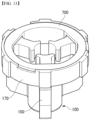
- FIG. 13 is a perspective view of a housing and a stator according to another embodiment of the present disclosure.
- a housing 100 may include a stator coupling portion 170 surrounding an outer peripheral surface of a stator 700.
- the stator coupling portion 170 may be formed in a lower area of each of a plurality of extensions 150.
- the outer peripheral surface of the stator 700 may be press-fitted to an inner peripheral surface of the stator coupling portion 170 through heat.
- Some embodiments or other embodiments of the present disclosure described above are not exclusive or distinct from each other. Some embodiments or other embodiments of the present disclosure described above can be used together or combined in configuration or function.
- configuration "A” described in an embodiment and/or the drawings and configuration "B” described in another embodiment and/or the drawings can be combined with each other. That is, even if the combination between the configurations is not directly described, the combination is possible except in cases where it is described that it is impossible to combine.
Landscapes
- Engineering & Computer Science (AREA)
- Power Engineering (AREA)
- Motor Or Generator Frames (AREA)
Applications Claiming Priority (2)
| Application Number | Priority Date | Filing Date | Title |
|---|---|---|---|
| KR1020210147061A KR102676619B1 (ko) | 2021-10-29 | 2021-10-29 | 모터 |
| PCT/KR2021/019177 WO2023075017A1 (ko) | 2021-10-29 | 2021-12-16 | 모터 |
Publications (2)
| Publication Number | Publication Date |
|---|---|
| EP4425762A1 true EP4425762A1 (de) | 2024-09-04 |
| EP4425762A4 EP4425762A4 (de) | 2025-11-12 |
Family
ID=86160015
Family Applications (1)
| Application Number | Title | Priority Date | Filing Date |
|---|---|---|---|
| EP21962640.5A Pending EP4425762A4 (de) | 2021-10-29 | 2021-12-16 | Motor |
Country Status (4)
| Country | Link |
|---|---|
| EP (1) | EP4425762A4 (de) |
| KR (1) | KR102676619B1 (de) |
| CN (1) | CN118120131A (de) |
| WO (1) | WO2023075017A1 (de) |
Family Cites Families (11)
| Publication number | Priority date | Publication date | Assignee | Title |
|---|---|---|---|---|
| KR19990039148U (ko) * | 1998-04-06 | 1999-11-05 | 배길성 | 모터용 하우징 |
| KR101287468B1 (ko) | 2006-08-25 | 2013-07-19 | 엘지전자 주식회사 | 모터조립체 및 이를 구비한 진공청소기 |
| JP5468747B2 (ja) * | 2007-06-05 | 2014-04-09 | レスメド・モーター・テクノロジーズ・インコーポレーテッド | 軸受管を有するブロワ |
| EP2961038B1 (de) * | 2014-06-05 | 2019-12-11 | Samsung Electronics Co., Ltd. | Staubsauger mit motoranordnung |
| KR102233312B1 (ko) * | 2014-06-05 | 2021-03-29 | 삼성전자주식회사 | 모터어셈블리 |
| KR101915846B1 (ko) * | 2016-09-09 | 2018-11-06 | 엘지전자 주식회사 | 구름 베어링 및 그를 갖는 모터 |
| KR102482007B1 (ko) * | 2017-09-06 | 2022-12-28 | 삼성전자주식회사 | 모터어셈블리 및 이를 포함하는 청소기 |
| KR102396910B1 (ko) * | 2018-04-26 | 2022-05-13 | 엘지전자 주식회사 | 팬 모터 |
| JP2020112061A (ja) * | 2019-01-09 | 2020-07-27 | 日本電産株式会社 | 送風装置および掃除機 |
| KR102175796B1 (ko) * | 2019-06-17 | 2020-11-06 | 디와이오토 주식회사 | 스테이터와 하우징의 조립 구조가 개선된 전동 워터 펌프 장치 |
| KR102311692B1 (ko) * | 2020-03-16 | 2021-10-12 | 엘지전자 주식회사 | 모터 |
-
2021
- 2021-10-29 KR KR1020210147061A patent/KR102676619B1/ko active Active
- 2021-12-16 WO PCT/KR2021/019177 patent/WO2023075017A1/ko not_active Ceased
- 2021-12-16 CN CN202180103344.3A patent/CN118120131A/zh active Pending
- 2021-12-16 EP EP21962640.5A patent/EP4425762A4/de active Pending
Also Published As
| Publication number | Publication date |
|---|---|
| KR102676619B1 (ko) | 2024-06-20 |
| CN118120131A (zh) | 2024-05-31 |
| EP4425762A4 (de) | 2025-11-12 |
| KR20230062111A (ko) | 2023-05-09 |
| WO2023075017A1 (ko) | 2023-05-04 |
Similar Documents
| Publication | Publication Date | Title |
|---|---|---|
| US10432058B2 (en) | Device for the vibration-decoupled mounting of a motor | |
| US6551074B2 (en) | Centrifugal fan with waterproof structure | |
| US7800263B2 (en) | Heat dissipating fan | |
| KR20180130861A (ko) | 모터 | |
| CN108886292A (zh) | 马达 | |
| US6309191B1 (en) | Brushless fan | |
| EP4425762A1 (de) | Motor | |
| US12038006B2 (en) | Electric pump including a motor unit and an axially extending attachment surface | |
| CN109904971B (zh) | 马达以及具有该马达的送风装置 | |
| EP4425768A1 (de) | Motor | |
| KR102287251B1 (ko) | 모터 | |
| KR102689961B1 (ko) | 모터 | |
| KR20200142971A (ko) | 모터 어셈블리 및 그 제조 방법 | |
| TWI776366B (zh) | 風扇馬達 | |
| EP4683184A1 (de) | Motor | |
| KR20230062063A (ko) | 모터 | |
| KR102734009B1 (ko) | 모터 | |
| EP4708640A1 (de) | Motor | |
| KR102701541B1 (ko) | 모터 | |
| US20220320982A1 (en) | Motor and electrical product | |
| US20220320983A1 (en) | Motor and electrical product | |
| KR102686935B1 (ko) | 전동공구 | |
| KR102537327B1 (ko) | 송풍팬 | |
| KR102684391B1 (ko) | 팬-모터 조립체 | |
| KR102879108B1 (ko) | 모터 및 모터 조립 방법 |
Legal Events
| Date | Code | Title | Description |
|---|---|---|---|
| STAA | Information on the status of an ep patent application or granted ep patent |
Free format text: STATUS: THE INTERNATIONAL PUBLICATION HAS BEEN MADE |
|
| PUAI | Public reference made under article 153(3) epc to a published international application that has entered the european phase |
Free format text: ORIGINAL CODE: 0009012 |
|
| STAA | Information on the status of an ep patent application or granted ep patent |
Free format text: STATUS: REQUEST FOR EXAMINATION WAS MADE |
|
| 17P | Request for examination filed |
Effective date: 20240529 |
|
| AK | Designated contracting states |
Kind code of ref document: A1 Designated state(s): AL AT BE BG CH CY CZ DE DK EE ES FI FR GB GR HR HU IE IS IT LI LT LU LV MC MK MT NL NO PL PT RO RS SE SI SK SM TR |
|
| DAV | Request for validation of the european patent (deleted) | ||
| DAX | Request for extension of the european patent (deleted) | ||
| A4 | Supplementary search report drawn up and despatched |
Effective date: 20251015 |
|
| RIC1 | Information provided on ipc code assigned before grant |
Ipc: H02K 5/24 20060101AFI20251009BHEP Ipc: H02K 7/14 20060101ALI20251009BHEP Ipc: H02K 1/27 20220101ALI20251009BHEP Ipc: H02K 1/14 20060101ALI20251009BHEP Ipc: H02K 7/08 20060101ALI20251009BHEP Ipc: H02K 5/16 20060101ALI20251009BHEP Ipc: H02K 9/06 20060101ALI20251009BHEP Ipc: H02K 1/18 20060101ALI20251009BHEP |