EP4425425A2 - Inspektion von teilen unter verwendung geometrischer modelle - Google Patents
Inspektion von teilen unter verwendung geometrischer modelle Download PDFInfo
- Publication number
- EP4425425A2 EP4425425A2 EP24157214.8A EP24157214A EP4425425A2 EP 4425425 A2 EP4425425 A2 EP 4425425A2 EP 24157214 A EP24157214 A EP 24157214A EP 4425425 A2 EP4425425 A2 EP 4425425A2
- Authority
- EP
- European Patent Office
- Prior art keywords
- features
- defect
- image
- pose
- imaging system
- Prior art date
- Legal status (The legal status is an assumption and is not a legal conclusion. Google has not performed a legal analysis and makes no representation as to the accuracy of the status listed.)
- Pending
Links
Images




Classifications
-
- G—PHYSICS
- G06—COMPUTING OR CALCULATING; COUNTING
- G06T—IMAGE DATA PROCESSING OR GENERATION, IN GENERAL
- G06T7/00—Image analysis
- G06T7/0002—Inspection of images, e.g. flaw detection
- G06T7/0004—Industrial image inspection
- G06T7/0006—Industrial image inspection using a design-rule based approach
-
- G—PHYSICS
- G06—COMPUTING OR CALCULATING; COUNTING
- G06T—IMAGE DATA PROCESSING OR GENERATION, IN GENERAL
- G06T7/00—Image analysis
- G06T7/0002—Inspection of images, e.g. flaw detection
- G06T7/0004—Industrial image inspection
- G06T7/001—Industrial image inspection using an image reference approach
-
- B—PERFORMING OPERATIONS; TRANSPORTING
- B25—HAND TOOLS; PORTABLE POWER-DRIVEN TOOLS; MANIPULATORS
- B25J—MANIPULATORS; CHAMBERS PROVIDED WITH MANIPULATION DEVICES
- B25J19/00—Accessories fitted to manipulators, e.g. for monitoring, for viewing; Safety devices combined with or specially adapted for use in connection with manipulators
- B25J19/02—Sensing devices
- B25J19/021—Optical sensing devices
-
- G—PHYSICS
- G06—COMPUTING OR CALCULATING; COUNTING
- G06T—IMAGE DATA PROCESSING OR GENERATION, IN GENERAL
- G06T17/00—Three-dimensional [3D] modelling for computer graphics
-
- G—PHYSICS
- G06—COMPUTING OR CALCULATING; COUNTING
- G06T—IMAGE DATA PROCESSING OR GENERATION, IN GENERAL
- G06T7/00—Image analysis
- G06T7/70—Determining position or orientation of objects or cameras
-
- G—PHYSICS
- G06—COMPUTING OR CALCULATING; COUNTING
- G06T—IMAGE DATA PROCESSING OR GENERATION, IN GENERAL
- G06T7/00—Image analysis
- G06T7/70—Determining position or orientation of objects or cameras
- G06T7/73—Determining position or orientation of objects or cameras using feature-based methods
- G06T7/75—Determining position or orientation of objects or cameras using feature-based methods involving models
-
- G—PHYSICS
- G06—COMPUTING OR CALCULATING; COUNTING
- G06T—IMAGE DATA PROCESSING OR GENERATION, IN GENERAL
- G06T2207/00—Indexing scheme for image analysis or image enhancement
- G06T2207/10—Image acquisition modality
- G06T2207/10028—Range image; Depth image; 3D point clouds
-
- G—PHYSICS
- G06—COMPUTING OR CALCULATING; COUNTING
- G06T—IMAGE DATA PROCESSING OR GENERATION, IN GENERAL
- G06T2207/00—Indexing scheme for image analysis or image enhancement
- G06T2207/30—Subject of image; Context of image processing
- G06T2207/30108—Industrial image inspection
- G06T2207/30164—Workpiece; Machine component
-
- G—PHYSICS
- G06—COMPUTING OR CALCULATING; COUNTING
- G06T—IMAGE DATA PROCESSING OR GENERATION, IN GENERAL
- G06T2207/00—Indexing scheme for image analysis or image enhancement
- G06T2207/30—Subject of image; Context of image processing
- G06T2207/30244—Camera pose
-
- G—PHYSICS
- G06—COMPUTING OR CALCULATING; COUNTING
- G06V—IMAGE OR VIDEO RECOGNITION OR UNDERSTANDING
- G06V10/00—Arrangements for image or video recognition or understanding
- G06V10/70—Arrangements for image or video recognition or understanding using pattern recognition or machine learning
- G06V10/74—Image or video pattern matching; Proximity measures in feature spaces
- G06V10/75—Organisation of the matching processes, e.g. simultaneous or sequential comparisons of image or video features; Coarse-fine approaches, e.g. multi-scale approaches; using context analysis; Selection of dictionaries
- G06V10/751—Comparing pixel values or logical combinations thereof, or feature values having positional relevance, e.g. template matching
-
- G—PHYSICS
- G06—COMPUTING OR CALCULATING; COUNTING
- G06V—IMAGE OR VIDEO RECOGNITION OR UNDERSTANDING
- G06V10/00—Arrangements for image or video recognition or understanding
- G06V10/70—Arrangements for image or video recognition or understanding using pattern recognition or machine learning
- G06V10/764—Arrangements for image or video recognition or understanding using pattern recognition or machine learning using classification, e.g. of video objects
Definitions
- the subject matter disclosed herein generally relates to inspecting parts using geometric models.
- Turbine engines such as gas turbine engines and hybrid electric turbine engines, use vanes to direct air within the engines.
- Turbine vanes direct and meter the hot combustion gasses onto turbine blades which spin to create rotational motion that is transferred to other turbine components such as a fan and/or compressor to create thrust and/or power.
- the direction and the amount of hot gas flow presented to a blade from the preceding vane can be directly correlated to the efficiency by which rotational energy can be extracted from the hot gas path flow. It is therefore useful to analyze components of turbine engines, such as vanes and turbine blades.
- a method in one exemplary embodiment, includes comparing features in an image of a part with features of models in a database and creating a list of candidate models for the part.
- the method further includes rendering a three-dimensional (3D) model at a pose/scale of an imaging system to generate a synthetic image that contains features of the part.
- the method further includes creating a part representation based on the features of the part, wherein the part representation depicts a defect of the part.
- the method further includes classifying a region of the part based on a set of rules for the part to determine whether the defect is within an allowable tolerance for the part.
- further embodiments of the method may include capturing the image of the part using the imaging system.
- further embodiments of the method may include determining values for a camera using the part representation.
- further embodiments of the method may include estimating the pose/scale of the imaging system.
- further embodiments of the method may include that the synthetic image comprises an indicium associated with a defect of the part.
- a processing system in another exemplary embodiment, includes a memory having computer readable instructions and a processing device for executing the computer readable instructions.
- the computer readable instructions control the processing device to perform operations.
- the operations may include retrieving a three-dimensional (3D) model for a part.
- the operations may further include performing a stress analysis for the part based on the 3D model for the part to determine whether the part meets a performance specification.
- further embodiments of the processing system may include that retrieving the 3D model for the part includes: comparing features in an image of the part with features of models in a database and creating a list of candidate models for the part; rendering a three-dimensional (3D) model at a pose/scale of an imaging system to generate a synthetic image that contains features of the part; and creating a part representation based on the features of the part, wherein the part representation depicts a defect of the part.
- processing system may include that the image of the part is captured using the imaging system.
- further embodiments of the processing system may include that a performance specification for the part defines a limit on a size of a defect for the part.
- processing system may include that the performance specification for the part defines a limit on a number of defects for the part.
- processing system may include that the performance specification for the part defines a limit a total amount of part deformity that is acceptable.
- a method in yet another exemplary embodiment, includes performing an optics-to-capturing-device transformation.
- the method further includes detecting a defect on an image plane.
- the defect includes, but is not limited to, dent, crack, or surface erosion.
- the method further includes transforming the defect to a point in a world coordinate system.
- the method further includes calculating an arm pose of a robotic arm based on the capturing device matching a location of the defect in a world coordinate system.
- the method further includes capturing, by the capturing device, an image of a part.
- further embodiments of the method may include that the capturing device is rigidly mounted to the robotic arm.
- a calibration pattern is rigidly mounted to a base of the robotic arm.
- further embodiments of the method may include that the base is affixed to a rotary table
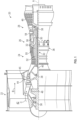
- FIG. 1 schematically illustrates a gas turbine engine 20.
- the gas turbine engine 20 is disclosed herein as a two-spool turbofan that generally incorporates a fan section 22, a compressor section 24, a combustor section 26 and a turbine section 28.
- the fan section 22 drives air along a bypass flow path B in a bypass duct, while the compressor section 24 drives air along a core flow path C for compression and communication into the combustor section 26 then expansion through the turbine section 28.
- FIG. 1 schematically illustrates a gas turbine engine 20.
- the gas turbine engine 20 is disclosed herein as a two-spool turbofan that generally incorporates a fan section 22, a compressor section 24, a combustor section 26 and a turbine section 28.
- the fan section 22 drives air along a bypass flow path B in a bypass duct
- the compressor section 24 drives air along a core flow path C for compression and communication into the combustor section 26 then expansion through the turbine section 28.
- the exemplary engine 20 generally includes a low speed spool 30 and a high speed spool 32 mounted for rotation about an engine central longitudinal axis A relative to an engine static structure 36 via several bearing systems 38. It should be understood that various bearing systems 38 at various locations may alternatively or additionally be provided, and the location of bearing systems 38 may be varied as appropriate to the application.
- the low speed spool 30 generally includes an inner shaft 40 that interconnects a fan 42, a low pressure compressor 44 and a low pressure turbine 46.
- the inner shaft 40 is connected to the fan 42 through a speed change mechanism, which in exemplary gas turbine engine 20 is illustrated as a geared architecture 48 to drive the fan 42 at a lower speed than the low speed spool 30.
- the high speed spool 32 includes an outer shaft 50 that interconnects a high pressure compressor 52 and high pressure turbine 54.
- a combustor 56 is arranged in exemplary gas turbine 20 between the high pressure compressor 52 and the high pressure turbine 54.
- An engine static structure 36 is arranged generally between the high pressure turbine 54 and the low pressure turbine 46.
- the engine static structure 36 further supports bearing systems 38 in the turbine section 28.
- the inner shaft 40 and the outer shaft 50 are concentric and rotate via bearing systems 38 about the engine central longitudinal axis A which is collinear with their longitudinal axes.
- stator vanes 45 in the low pressure compressor 44 and stator vanes 55 in the high pressure compressor 52 may be adjustable during operation of the gas turbine engine 20 to support various operating conditions. In other embodiments, the stator vanes 45, 55 may be held in a fixed position.
- the turbines 46, 54 rotationally drive the respective low speed spool 30 and high speed spool 32 in response to the expansion. It will be appreciated that each of the positions of the fan section 22, compressor section 24, combustor section 26, turbine section 28, and fan drive gear system 48 may be varied. For example, gear system 48 may be located aft of combustor section 26 or even aft of turbine section 28, and fan section 22 may be positioned forward or aft of the location of gear system 48.
- the engine 20 in one example is a high-bypass geared aircraft engine.
- the engine 20 bypass ratio is greater than about six (6), with an example embodiment being greater than about ten (10)
- the geared architecture 48 is an epicyclic gear train, such as a planetary gear system or other gear system, with a gear reduction ratio of greater than about 2.3
- the low pressure turbine 46 has a pressure ratio that is greater than about five.
- the engine 20 bypass ratio is greater than about ten (10:1)
- the fan diameter is significantly larger than that of the low pressure compressor 44
- the low pressure turbine 46 has a pressure ratio that is greater than about five 5:1.
- Low pressure turbine 46 pressure ratio is pressure measured prior to inlet of low pressure turbine 46 as related to the pressure at the outlet of the low pressure turbine 46 prior to an exhaust nozzle.
- the geared architecture 48 may be an epicycle gear train, such as a planetary gear system or other gear system, with a gear reduction ratio of greater than about 2.3:1. It should be understood, however, that the above parameters are only exemplary of one embodiment of a geared architecture engine and that the present disclosure is applicable to other gas turbine engines including direct drive turbofans.
- the fan section 22 of the engine 20 is designed for a particular flight condition--typically cruise at about 0.8Mach and about 35,000 feet (10,688 meters).
- 'TSFC' Thrust Specific Fuel Consumption
- Low fan pressure ratio is the pressure ratio across the fan blade alone, without a Fan Exit Guide Vane (“FEGV”) system.
- the low fan pressure ratio as disclosed herein according to one non-limiting embodiment is less than about 1.45.
- Low corrected fan tip speed is the actual fan tip speed in ft/sec divided by an industry standard temperature correction of [(Tram °R)/(518.7 °R)] 0.5 .
- the "Low corrected fan tip speed” as disclosed herein according to one non-limiting embodiment is less than about 1150 ft/second (350.5 m/sec).
- FIG. 1 illustrates one example of the gas turbine engine 20
- any number of spools, inclusion or omission of the gear system 48, and/or other elements and subsystems are contemplated.
- rotor systems described herein can be used in a variety of applications and need not be limited to gas turbine engines for aircraft applications.
- rotor systems can be included in power generation systems, which may be ground-based as a fixed position or mobile system, and other such applications.
- One or more of the components of the gas turbine engine 20 can be inspected according to one or more embodiments described herein.
- an embodiment provides a system for studying parts using geometric models, and another embodiment provides a method for an operator to investigate parts in real-time using models and data interactively.
- embodiments are described as inspecting components of the gas turbine engine 20, such as vanes and turbine blades, the scope of the claims is not so limited unless otherwise indicated, and the techniques described herein can be used to inspect other manufactured parts for which a geometric, appearance, texture, and dynamic model exists.
- a part such as a turbine blade or vane, arrives for inspection.
- a human operator studies the part by manipulating it, possibly under a microscope, and viewing the part directly or observing its electronic image.
- Through visual inspection the operator identifies defective areas of a part in accordance with the operator's training and knowledge.
- this process lacks consistency, repeatability, or accuracy.
- the degree to which this affects the repair process is part-dependent but may be substantial, which could make quality control difficult. Such difficulties are characteristic of multiple inspection tasks throughout the repair sequence.
- an embodiment involves using a reference model, such as a computer aided design (CAD) model for the part, but can also include a collection of pictures or 3D point-cloud scans taken at distinct views and modalities or a set of digital markings placed in an indexing system.
- CAD computer aided design
- a capturing device such as a camera, three-dimensional (3D) coordinate measurement device (e.g., a time of flight laser scanner), structured light 3D scanner, and/or the like, including combinations and/or multiples thereof, can be used to capture images or data for the part.
- the images or data need not be from the visible spectrum, e.g., from an infrared or ultraviolet camera or scanner.
- the images or data need not be from an electromagnetic phenomenon, e.g., from an ultrasonic sensor.
- FIG. 2 is a block diagram of a system 200 according to one or more embodiments described herein.
- the system 200 includes a processing system 210 and a capturing device 220.
- the capturing device 220 can be any suitable device for capturing images or data for a part to be scanned, such as object 230.
- the capturing device 220 may include a camera 232 to capture images of the object 230.
- the processing system 210 receives data about the object 230 from the capturing device 220.
- the capturing device 220 can use the images from a camera 232 to generate 3D data, such as using photogrammetry or another suitable technique.
- the processing system 210 receives the images from the capturing device 220 and uses those images to generate the 3D data.
- the processing system 210 can use the 3D data to generate a mesh surface for the object 230, for example.
- the features and functionality of the system 200 can be implemented, for example, as instructions stored on a computer-readable storage medium, as hardware modules, as special-purpose hardware (e.g., application specific hardware, application specific integrated circuits (ASICs), application specific special processors (ASSPs), field programmable gate arrays (FPGAs), as embedded controllers, hardwired circuitry, etc.), or as some combination or combinations of these and/or the like.
- the features and functionality described herein can be a combination of hardware and programming.
- the programming can be processor executable instructions stored on a tangible memory, and the hardware can include a processing device 212 for executing those instructions.
- a system memory 214 e.g., a random access memory, a read only memory, and/or the like, including combinations and/or multiples thereof
- a system memory 214 e.g., a random access memory, a read only memory, and/or the like, including combinations and/or multiples thereof
- FIG. 3A depicts a block diagram of a system 300 according to one or more embodiments described herein.
- the system 300 provides for inspecting parts using geometric models.
- the system 300 includes an imaging system 310 for capturing a picture 312 of the part to be inspected.
- the imaging system 310 is an example of the system 200.
- FIG. 3B depicts an example of an image 312 captured by the imaging system 310.
- the system 300 can identify defects 320 on the part.
- shaded areas (not shown) can be added around each of the defects 320 to visually highlight the defects 320.
- the system 300 can use augmented reality to visually highlight the defects 320.
- the system 300 can be used to perform a retrieval process, a presentation process, a comparison process, and/or an optimization process.
- the retrieval process provides for comparing the features in the picture of the part 312 with the features of CAD models in a database of CAD models 302 and creating a list of candidate models for the part.
- One or more embodiments provide for retrieving a reference model, revision history, and service notes from digital storage (e.g., the database of CAD models 302) and presenting that information to an operator (e.g., the human operator 314) in a way that facilitates repeatable inspection, consistent diagnosis of defects, and enhancing other metrics.
- the retrieval process involves identifying the part type, its features or number, and searching a database by these part attributes prior to presenting them to the operator 314.
- One approach for part identification is to automatically compare visual features of the part observed through the image with features observed in models stored in a repository, displaying a few top candidates to the operator for selection of a relevant CAD model 304.
- the presentation process provides for estimating an imaging system pose/scale using the estimation engine 306 and then rendering a 3D model at the pose/scale of the imaging system 310 to create, using the synthetic engine, a synthetic image 308 that contains relevant features of the part.
- One or more embodiments provide for displaying textual and multimedia information.
- the geometric model of the part can be displayed in the same pose, scale, and view as the imaged part by comparing the visual features of the selected model (from the database 302) these features would appear from a hypothesized projection, viewpoint, pose and scale, with the observed visual features, and optimizing the hypothesis to minimize projection, viewpoint, pose and scale errors.
- the comparison process creates a part representation based on features (e.g., holes, edges, textures, etc.) and uses a resulting representation to create detectors for feature in synthetic images, to merge adj acent views based on common features, and to learn sensitivity between features and camera pose/illumination/scale, etc.
- the comparison process involves creating a representation of the part based on a graph whose nodes are aspects indexed by pose, viewpoint, projection, and scale and whose edges connect adjoining views.
- the nodes contain a structure to capture the aspect of the model features as they would appear from a part pose, scene illumination, with a virtual camera viewpoint, its projection function, and scale.
- the features include edges, patches, corners, textures, holes, bars, cracks, crevices, and/or other markings that are visible, stable and distinct in inferring the aspect of the representation.
- the feature attributes include their positions, orientations, or size.
- One element of producing the representation is by generating a sequence of poses and viewpoints representing each aspect, applying detectors to predict the features, then pruning them by their visibility, strength, stability, persistence.
- Another element of producing the representation is to merge adjoining aspects that largely share features, and splitting an aspect where features under go much change.
- a third element of creating an aspect is to learn the sensitivity between feature attribute errors and part pose, and camera viewpoint, illumination, and scale errors.
- an element of the representation includes calculating the sensitivity between feature attribute errors and control variables used to manipulate the apparatus.
- the calculations of relationships between features in an expected 2D image and the 3D world empirically through simulation of the image from a model is provided.
- the comparison process involves comparing the feature attributes of the hypothesized aspect features and the features detected in the observed image of the part.
- the optimization process utilizes the representation to automatically determine best values of camera pose/scale/illumination.
- the optimization process involves the application of L0, L1 and L infinity norms with L2.
- the process involves combining one or more L norms, e.g., LO, L1, L2 and L infinity, in both a gradient and a Markov chain Monte Carol (MCMC) approach for finding the optimal values of the part pose, camera viewpoint, scale or kinematic control variables.
- L norms e.g., LO, L1, L2 and L infinity
- MCMC Markov chain Monte Carol
- One element of the comparison is to produce a matching viewpoint.
- Another element is to locate the matching part for identification.
- One possible application of optimization process includes tracking using inertial measurements or j oint angle measurements or kinematic measurements to select an approximate aspect and then to optimize from this initial condition. This is done, for example continually, as the object is manipulated to track the imaged view.
- An aspect of the presentation involves the human operator 314 manipulating the part or the camera and the program automatically adjusting the variables of the aspect to maintain a consistent view.
- the presentation could be a tandem display or an overlay.
- the features and functionality described herein can be applied to any repair processes as well as the inspection processes, can be used in a manual application to aid the human operator 314, for such tasks as inventory management, can provide for automated inspection application to provide a method in which the CAD model is utilized to improve accuracy/efficiency of automated inspection, and/or the like, including combinations and/or multiples thereof.
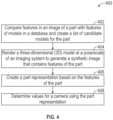
- FIG. 4 is a flow diagram of a method 400 according to one or more embodiments described herein.
- the method 400 can be performed using any suitable system and/or device.
- the method 400 can be performed using the processing system 210 of FIG. 2 , the system 300 of FIG. 3 , and/or the like, including combinations and/or multiples thereof.
- the method includes performing a retrieval process as described in FIG. 3 .
- the system 300 compares features in an image of a part with features of models in a database and creates a list of candidate models for the part. According to one or more embodiments described herein, this is performed using a random sample consensus (RANSAC) algorithm, a histogram of gradient features, and/or the like, including combinations and/or multiples thereof.
- the method 400 includes preforming a presentation process as described in FIG. 3 .
- the system 300 renders a three-dimensional (3D) model at a pose/scale of an imaging system to generate a synthetic image that contains features of the part. An example is shown, for example, in FIG.
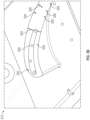
- an image 501 represents the synthetic image and shows a 3D model of a part 510 at a pose/scale of the imaging system 310.
- the image 501 includes features 512 of the CAD model.
- an image 502 of the part 510 can include at an indicium 514 (e.g., an augmented reality element) associated with a defect 516.
- the method 400 includes performing a comparison process as described in FIG. 3 .
- the system 300 creates a part representation based on the features of the part.
- the method 400 classifies regions of the part based on a set of rules defined in a technical manual or other similar source. This enables the system 300 to determine whether the defect is within an allowable tolerance for the part. For example, different regions can have different tolerances for defects, and different regions of a part can have different tolerances for defects.
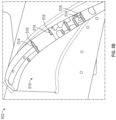
- FIG. 5C an image 503 shows the part 510 having a plurality of regions 520, 522, 524, 526, where each of the regions can have an associated tolerance based on where the defect is on the part 510.
- the processing system 210 of FIG. 2 can use the retrieval process of FIGS. 3 and 4 to conduct a performance-based assessment for a part.
- the processing system 210 can retrieve a 3D model for a part as described herein.
- the processing system 210 can then perform a stress analysis for the part based on the 3D model for the part to determine whether the part meets a performance specification.
- a technical manual or other source may define a performance specification for a part (e.g., the part is limited to a certain number of defects not to exceed a certain size).
- the processing system 210 maps the part to a 3D model as described herein, conducts a stress analysis by comparing limits for the part defined by the CAD model, and determines whether the part satisfies the limits for the part.
- This can be useful, for example, to determine whether multiple defects, in the aggregate, negatively affect performance.
- a part may define that no defect can be greater than 2 mm because a certain amount of part deformity occurs in such cases.
- multiple defects less than 2 mm may result in a similar (and undesirable) part deformity.
- the stress analysis can determine when this is the case to avoid part failure even where no single defect exceeds a limit, for example.
- the system 300 estimates the pose/scale for the camera of the imaging system 310 using the estimation engine 306.
- the estimation engine 306 can use one or more machine learning algorithms and/or other mathematical techniques.
- One example is as follows.
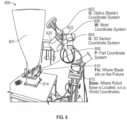
- FIG. 6 shows an imaging system 600 (e.g., the imaging system 310) that includes an optics coordinate system 602, a 3D-imaging sensor capturing device coordinate system 604, a wrist coordinate system 606, and a part coordinate system 608.
- the imaging system 600 also includes a fixture 610 ("FIX") to hold a part 601 and a base 612, in a world coordinate system, affixed to a rotary table 614.
- FIX fixture 610
- the part 601 may be held fixed and a robotic arm can move (e.g., rotate) about the part 601.
- An optics-to-capturing-device transformation can be performed.
- An InspectAR function detects a defect on the image plane and transforms it to a point in world coordinate system.
- the defect includes, but is not limited to, dent, crack, or surface erosion. This will be impacted by any error due to work cell calibration since R FIX BASE is involved.
- the robot calculates the arm pose based on capturing device matching the defect's (e.g., dent) location in the world coordinate system.
- the capturing device takes an image of the part.
- capturing device intrinsic, capturing device optics coordinate origin, and capturing device origin to wrist transforms may not be estimated as these values are all calculated based on CAD models and specification sheets.
- the InspectAR records R O I is defined in a "basler_cam.yaml" file, and R W O is defined in a "default_arm2cam file" for example.
- a camera 620 e.g., a capturing device
- a calibration pattern (not shown) is rigidly mounted to the base 612.
- the robot arm and calibration pattern poses are known, as is the rotary table position 614.
- the part 601 may be held fixed and the robotic arm 622 can move (e.g., rotate) about the part 601.
Landscapes
- Engineering & Computer Science (AREA)
- Physics & Mathematics (AREA)
- General Physics & Mathematics (AREA)
- Theoretical Computer Science (AREA)
- Computer Vision & Pattern Recognition (AREA)
- Quality & Reliability (AREA)
- Software Systems (AREA)
- Geometry (AREA)
- Robotics (AREA)
- Mechanical Engineering (AREA)
- Computer Graphics (AREA)
- Length Measuring Devices By Optical Means (AREA)
- Image Processing (AREA)
- Investigating Materials By The Use Of Optical Means Adapted For Particular Applications (AREA)
Applications Claiming Priority (1)
| Application Number | Priority Date | Filing Date | Title |
|---|---|---|---|
| US202363484336P | 2023-02-10 | 2023-02-10 |
Publications (2)
| Publication Number | Publication Date |
|---|---|
| EP4425425A2 true EP4425425A2 (de) | 2024-09-04 |
| EP4425425A3 EP4425425A3 (de) | 2024-11-13 |
Family
ID=89941003
Family Applications (1)
| Application Number | Title | Priority Date | Filing Date |
|---|---|---|---|
| EP24157214.8A Pending EP4425425A3 (de) | 2023-02-10 | 2024-02-12 | Inspektion von teilen unter verwendung geometrischer modelle |
Country Status (2)
| Country | Link |
|---|---|
| US (1) | US20240273706A1 (de) |
| EP (1) | EP4425425A3 (de) |
Families Citing this family (1)
| Publication number | Priority date | Publication date | Assignee | Title |
|---|---|---|---|---|
| CN119919497B (zh) * | 2025-03-31 | 2025-06-24 | 北京兴信易成机电工程有限公司 | 一种车辆涂胶定位方法、装置、电子设备及存储介质 |
Family Cites Families (6)
| Publication number | Priority date | Publication date | Assignee | Title |
|---|---|---|---|---|
| US10504218B2 (en) * | 2015-04-21 | 2019-12-10 | United Technologies Corporation | Method and system for automated inspection utilizing a multi-modal database |
| WO2018136262A1 (en) * | 2017-01-20 | 2018-07-26 | Aquifi, Inc. | Systems and methods for defect detection |
| US10878554B2 (en) * | 2017-10-26 | 2020-12-29 | United Technologies Corporation | Defect detection and measurement method |
| US11410298B2 (en) * | 2017-12-05 | 2022-08-09 | Raytheon Technologies Corporation | System and method for determining part damage |
| US12007220B2 (en) * | 2017-12-29 | 2024-06-11 | II John Tyson | Optical structural health monitoring |
| US11010887B2 (en) * | 2018-09-17 | 2021-05-18 | General Electric Company | Automated distress ranking system |
-
2024
- 2024-02-09 US US18/437,350 patent/US20240273706A1/en active Pending
- 2024-02-12 EP EP24157214.8A patent/EP4425425A3/de active Pending
Also Published As
| Publication number | Publication date |
|---|---|
| US20240273706A1 (en) | 2024-08-15 |
| EP4425425A3 (de) | 2024-11-13 |
Similar Documents
| Publication | Publication Date | Title |
|---|---|---|
| CN109900713B (zh) | 摄像引导的无人机风电叶片缺陷动态检测系统及其方法 | |
| US8244025B2 (en) | Method of coalescing information about inspected objects | |
| CN103842621B (zh) | 用于检查气涡轮机的内窥镜系统和相应方法 | |
| US5848115A (en) | Computed tomography metrology | |
| US6909800B2 (en) | Process and apparatus for locating coated cooling holes on turbine vanes | |
| US8477154B2 (en) | Method and system for interactive virtual inspection of modeled objects | |
| US20050201611A1 (en) | Non-contact measurement method and apparatus | |
| US20220084178A1 (en) | Method and device for inspecting hard-to-reach components | |
| JP6997726B2 (ja) | 目視検査デバイスのアーティキュレーションのための方法およびシステム | |
| EP4124822B1 (de) | System und verfahren zur verwendung einer werkzeuganordnung | |
| CN113034599B (zh) | 一种航空发动机的孔探检测装置和方法 | |
| EP3623788A1 (de) | Automatisiertes notrangordnungssystem | |
| EP4425425A2 (de) | Inspektion von teilen unter verwendung geometrischer modelle | |
| JP4695792B2 (ja) | 構造部分の非破壊壁厚検査方法 | |
| US20250191163A1 (en) | Analysing images of components | |
| EP4083377B1 (de) | Verfahren und system zur kriechüberwachung einer turbinenschaufel | |
| EP4311915A1 (de) | Durchführung einer statorschaufelklassifizierung für turbinentriebwerke unter verwendung strukturierter dreidimensionaler lichtabtastungen | |
| CN117168300A (zh) | 孔探仪定位方法、孔探检查方法和孔探设备 | |
| US11933690B2 (en) | Inspecting an interior of a gas turbine engine apparatus | |
| EP4600899A1 (de) | Inspektionssysteme und zugehörige verfahren für gasturbinenmotorkomponenten | |
| Endrulat et al. | Projection Method for Irreversible Thermochromic Paint Post-Processing Using Endoscope Images on Turbine Blade Surfaces | |
| CN120703091A (zh) | 一种基于激光修复的航空发动机缺损叶片检测装置及方法 | |
| HK1200893B (en) | Endoscopy system and corresponding method for examining gas turbines |
Legal Events
| Date | Code | Title | Description |
|---|---|---|---|
| PUAI | Public reference made under article 153(3) epc to a published international application that has entered the european phase |
Free format text: ORIGINAL CODE: 0009012 |
|
| STAA | Information on the status of an ep patent application or granted ep patent |
Free format text: STATUS: THE APPLICATION HAS BEEN PUBLISHED |
|
| AK | Designated contracting states |
Kind code of ref document: A2 Designated state(s): AL AT BE BG CH CY CZ DE DK EE ES FI FR GB GR HR HU IE IS IT LI LT LU LV MC ME MK MT NL NO PL PT RO RS SE SI SK SM TR |
|
| PUAL | Search report despatched |
Free format text: ORIGINAL CODE: 0009013 |
|
| AK | Designated contracting states |
Kind code of ref document: A3 Designated state(s): AL AT BE BG CH CY CZ DE DK EE ES FI FR GB GR HR HU IE IS IT LI LT LU LV MC ME MK MT NL NO PL PT RO RS SE SI SK SM TR |
|
| RIC1 | Information provided on ipc code assigned before grant |
Ipc: G01M 15/14 20060101ALN20241008BHEP Ipc: G06T 7/73 20170101ALI20241008BHEP Ipc: G06T 7/00 20170101AFI20241008BHEP |
|
| STAA | Information on the status of an ep patent application or granted ep patent |
Free format text: STATUS: REQUEST FOR EXAMINATION WAS MADE |
|
| 17P | Request for examination filed |
Effective date: 20250513 |