EP4424929A1 - Excavator - Google Patents
Excavator Download PDFInfo
- Publication number
- EP4424929A1 EP4424929A1 EP22887135.6A EP22887135A EP4424929A1 EP 4424929 A1 EP4424929 A1 EP 4424929A1 EP 22887135 A EP22887135 A EP 22887135A EP 4424929 A1 EP4424929 A1 EP 4424929A1
- Authority
- EP
- European Patent Office
- Prior art keywords
- operating oil
- valve
- control valve
- travelling
- pressure
- Prior art date
- Legal status (The legal status is an assumption and is not a legal conclusion. Google has not performed a legal analysis and makes no representation as to the accuracy of the status listed.)
- Pending
Links
- 238000007599 discharging Methods 0.000 claims description 63
- 238000004891 communication Methods 0.000 claims description 9
- 238000009412 basement excavation Methods 0.000 abstract description 9
- 238000000034 method Methods 0.000 description 18
- 230000002401 inhibitory effect Effects 0.000 description 17
- 230000008569 process Effects 0.000 description 17
- 230000000694 effects Effects 0.000 description 8
- 230000004044 response Effects 0.000 description 7
- 238000011144 upstream manufacturing Methods 0.000 description 7
- 238000010586 diagram Methods 0.000 description 6
- 239000013642 negative control Substances 0.000 description 5
- 230000008859 change Effects 0.000 description 3
- 239000000446 fuel Substances 0.000 description 3
- 238000006073 displacement reaction Methods 0.000 description 2
- 238000005265 energy consumption Methods 0.000 description 2
- 230000007246 mechanism Effects 0.000 description 2
- UFHFLCQGNIYNRP-UHFFFAOYSA-N Hydrogen Chemical compound [H][H] UFHFLCQGNIYNRP-UHFFFAOYSA-N 0.000 description 1
- 230000001133 acceleration Effects 0.000 description 1
- 230000005540 biological transmission Effects 0.000 description 1
- 210000000078 claw Anatomy 0.000 description 1
- 238000010276 construction Methods 0.000 description 1
- 238000001816 cooling Methods 0.000 description 1
- 229910052739 hydrogen Inorganic materials 0.000 description 1
- 239000001257 hydrogen Substances 0.000 description 1
- 238000009434 installation Methods 0.000 description 1
- 238000004519 manufacturing process Methods 0.000 description 1
- 238000012986 modification Methods 0.000 description 1
- 230000004048 modification Effects 0.000 description 1
- 230000007935 neutral effect Effects 0.000 description 1
- 238000005086 pumping Methods 0.000 description 1
- 230000004043 responsiveness Effects 0.000 description 1
- 238000007790 scraping Methods 0.000 description 1
- 239000002689 soil Substances 0.000 description 1
Images




Classifications
-
- E—FIXED CONSTRUCTIONS
- E02—HYDRAULIC ENGINEERING; FOUNDATIONS; SOIL SHIFTING
- E02F—DREDGING; SOIL-SHIFTING
- E02F9/00—Component parts of dredgers or soil-shifting machines, not restricted to one of the kinds covered by groups E02F3/00 - E02F7/00
- E02F9/20—Drives; Control devices
- E02F9/22—Hydraulic or pneumatic drives
- E02F9/2203—Arrangements for controlling the attitude of actuators, e.g. speed, floating function
-
- F—MECHANICAL ENGINEERING; LIGHTING; HEATING; WEAPONS; BLASTING
- F15—FLUID-PRESSURE ACTUATORS; HYDRAULICS OR PNEUMATICS IN GENERAL
- F15B—SYSTEMS ACTING BY MEANS OF FLUIDS IN GENERAL; FLUID-PRESSURE ACTUATORS, e.g. SERVOMOTORS; DETAILS OF FLUID-PRESSURE SYSTEMS, NOT OTHERWISE PROVIDED FOR
- F15B11/00—Servomotor systems without provision for follow-up action; Circuits therefor
- F15B11/02—Systems essentially incorporating special features for controlling the speed or actuating force of an output member
-
- E—FIXED CONSTRUCTIONS
- E02—HYDRAULIC ENGINEERING; FOUNDATIONS; SOIL SHIFTING
- E02F—DREDGING; SOIL-SHIFTING
- E02F9/00—Component parts of dredgers or soil-shifting machines, not restricted to one of the kinds covered by groups E02F3/00 - E02F7/00
- E02F9/20—Drives; Control devices
- E02F9/22—Hydraulic or pneumatic drives
- E02F9/2221—Control of flow rate; Load sensing arrangements
-
- E—FIXED CONSTRUCTIONS
- E02—HYDRAULIC ENGINEERING; FOUNDATIONS; SOIL SHIFTING
- E02F—DREDGING; SOIL-SHIFTING
- E02F9/00—Component parts of dredgers or soil-shifting machines, not restricted to one of the kinds covered by groups E02F3/00 - E02F7/00
- E02F9/20—Drives; Control devices
- E02F9/22—Hydraulic or pneumatic drives
- E02F9/2221—Control of flow rate; Load sensing arrangements
- E02F9/2239—Control of flow rate; Load sensing arrangements using two or more pumps with cross-assistance
- E02F9/2242—Control of flow rate; Load sensing arrangements using two or more pumps with cross-assistance including an electronic controller
-
- E—FIXED CONSTRUCTIONS
- E02—HYDRAULIC ENGINEERING; FOUNDATIONS; SOIL SHIFTING
- E02F—DREDGING; SOIL-SHIFTING
- E02F9/00—Component parts of dredgers or soil-shifting machines, not restricted to one of the kinds covered by groups E02F3/00 - E02F7/00
- E02F9/20—Drives; Control devices
- E02F9/22—Hydraulic or pneumatic drives
- E02F9/2264—Arrangements or adaptations of elements for hydraulic drives
- E02F9/2267—Valves or distributors
-
- E—FIXED CONSTRUCTIONS
- E02—HYDRAULIC ENGINEERING; FOUNDATIONS; SOIL SHIFTING
- E02F—DREDGING; SOIL-SHIFTING
- E02F9/00—Component parts of dredgers or soil-shifting machines, not restricted to one of the kinds covered by groups E02F3/00 - E02F7/00
- E02F9/20—Drives; Control devices
- E02F9/22—Hydraulic or pneumatic drives
- E02F9/2278—Hydraulic circuits
- E02F9/2282—Systems using center bypass type changeover valves
-
- E—FIXED CONSTRUCTIONS
- E02—HYDRAULIC ENGINEERING; FOUNDATIONS; SOIL SHIFTING
- E02F—DREDGING; SOIL-SHIFTING
- E02F9/00—Component parts of dredgers or soil-shifting machines, not restricted to one of the kinds covered by groups E02F3/00 - E02F7/00
- E02F9/20—Drives; Control devices
- E02F9/22—Hydraulic or pneumatic drives
- E02F9/2278—Hydraulic circuits
- E02F9/2285—Pilot-operated systems
-
- E—FIXED CONSTRUCTIONS
- E02—HYDRAULIC ENGINEERING; FOUNDATIONS; SOIL SHIFTING
- E02F—DREDGING; SOIL-SHIFTING
- E02F9/00—Component parts of dredgers or soil-shifting machines, not restricted to one of the kinds covered by groups E02F3/00 - E02F7/00
- E02F9/20—Drives; Control devices
- E02F9/22—Hydraulic or pneumatic drives
- E02F9/2278—Hydraulic circuits
- E02F9/2292—Systems with two or more pumps
-
- E—FIXED CONSTRUCTIONS
- E02—HYDRAULIC ENGINEERING; FOUNDATIONS; SOIL SHIFTING
- E02F—DREDGING; SOIL-SHIFTING
- E02F9/00—Component parts of dredgers or soil-shifting machines, not restricted to one of the kinds covered by groups E02F3/00 - E02F7/00
- E02F9/20—Drives; Control devices
- E02F9/22—Hydraulic or pneumatic drives
- E02F9/2278—Hydraulic circuits
- E02F9/2296—Systems with a variable displacement pump
-
- F—MECHANICAL ENGINEERING; LIGHTING; HEATING; WEAPONS; BLASTING
- F15—FLUID-PRESSURE ACTUATORS; HYDRAULICS OR PNEUMATICS IN GENERAL
- F15B—SYSTEMS ACTING BY MEANS OF FLUIDS IN GENERAL; FLUID-PRESSURE ACTUATORS, e.g. SERVOMOTORS; DETAILS OF FLUID-PRESSURE SYSTEMS, NOT OTHERWISE PROVIDED FOR
- F15B11/00—Servomotor systems without provision for follow-up action; Circuits therefor
- F15B11/16—Servomotor systems without provision for follow-up action; Circuits therefor with two or more servomotors
-
- F—MECHANICAL ENGINEERING; LIGHTING; HEATING; WEAPONS; BLASTING
- F15—FLUID-PRESSURE ACTUATORS; HYDRAULICS OR PNEUMATICS IN GENERAL
- F15B—SYSTEMS ACTING BY MEANS OF FLUIDS IN GENERAL; FLUID-PRESSURE ACTUATORS, e.g. SERVOMOTORS; DETAILS OF FLUID-PRESSURE SYSTEMS, NOT OTHERWISE PROVIDED FOR
- F15B11/00—Servomotor systems without provision for follow-up action; Circuits therefor
- F15B11/16—Servomotor systems without provision for follow-up action; Circuits therefor with two or more servomotors
- F15B11/17—Servomotor systems without provision for follow-up action; Circuits therefor with two or more servomotors using two or more pumps
-
- B—PERFORMING OPERATIONS; TRANSPORTING
- B60—VEHICLES IN GENERAL
- B60Y—INDEXING SCHEME RELATING TO ASPECTS CROSS-CUTTING VEHICLE TECHNOLOGY
- B60Y2200/00—Type of vehicle
- B60Y2200/40—Special vehicles
- B60Y2200/41—Construction vehicles, e.g. graders, excavators
- B60Y2200/412—Excavators
-
- E—FIXED CONSTRUCTIONS
- E02—HYDRAULIC ENGINEERING; FOUNDATIONS; SOIL SHIFTING
- E02F—DREDGING; SOIL-SHIFTING
- E02F3/00—Dredgers; Soil-shifting machines
- E02F3/04—Dredgers; Soil-shifting machines mechanically-driven
- E02F3/28—Dredgers; Soil-shifting machines mechanically-driven with digging tools mounted on a dipper- or bucket-arm, i.e. there is either one arm or a pair of arms, e.g. dippers, buckets
- E02F3/36—Component parts
- E02F3/42—Drives for dippers, buckets, dipper-arms or bucket-arms
- E02F3/43—Control of dipper or bucket position; Control of sequence of drive operations
- E02F3/435—Control of dipper or bucket position; Control of sequence of drive operations for dipper-arms, backhoes or the like
-
- F—MECHANICAL ENGINEERING; LIGHTING; HEATING; WEAPONS; BLASTING
- F15—FLUID-PRESSURE ACTUATORS; HYDRAULICS OR PNEUMATICS IN GENERAL
- F15B—SYSTEMS ACTING BY MEANS OF FLUIDS IN GENERAL; FLUID-PRESSURE ACTUATORS, e.g. SERVOMOTORS; DETAILS OF FLUID-PRESSURE SYSTEMS, NOT OTHERWISE PROVIDED FOR
- F15B2211/00—Circuits for servomotor systems
- F15B2211/30—Directional control
- F15B2211/305—Directional control characterised by the type of valves
- F15B2211/30525—Directional control valves, e.g. 4/3-directional control valve
-
- F—MECHANICAL ENGINEERING; LIGHTING; HEATING; WEAPONS; BLASTING
- F15—FLUID-PRESSURE ACTUATORS; HYDRAULICS OR PNEUMATICS IN GENERAL
- F15B—SYSTEMS ACTING BY MEANS OF FLUIDS IN GENERAL; FLUID-PRESSURE ACTUATORS, e.g. SERVOMOTORS; DETAILS OF FLUID-PRESSURE SYSTEMS, NOT OTHERWISE PROVIDED FOR
- F15B2211/00—Circuits for servomotor systems
- F15B2211/40—Flow control
- F15B2211/45—Control of bleed-off flow, e.g. control of bypass flow to the return line
Definitions
- the present disclosure relates to an excavator.
- the excavator disclosed in PTL 1 is at a risk of occurrence of a wasteful pressure drop while a complex operation for moving two hydraulic actuators simultaneously is being performed, because load pressures on the two hydraulic actuators are different from each other, i.e., because a throttle that limits the flow rate of the operating oil to be supplied to the hydraulic actuator that is under the lower load is provided in order to reliably supply the operating oil to the hydraulic actuator that is under the higher load pressure.
- an excavator that can reduce a pressure drop that may occur while a complex operation for moving at least two selected from a boom cylinder, an arm cylinder, and a bucket cylinder is being performed.
- An excavator includes a lower travelling body, an upper rotating body mounted rotatably on the lower travelling body, an attachment attached to the upper rotating body and including a boom, an arm, and a bucket, a control valve that is capable of merging flows of an operating oil, which are discharged from a plurality of hydraulic pumps respectively, with each other, and a control device that is capable of controlling functioning of the control valve, wherein the control device moves the control valve while at least two selected from the boom, the arm, and the bucket are moving simultaneously in a non-travelling state.
- the excavator described above can reduce a pressure drop that may occur while a complex operation for moving at least two selected from a boom cylinder, an arm cylinder, and a bucket cylinder is being performed.
- FIG. 1 is a side view of the excavator 100.
- An upper rotating body 3 is mounted on a lower travelling body 1 of the excavator 100 illustrated in FIG. 1 such that the upper rotating body 3 can rotate via a rotating mechanism 2.
- a boom 4 serving as a working component is attached to the upper rotating body 3.
- An arm 5 serving as a working component is attached to an end of the boom 4, and a bucket 6 serving as a working component and an end attachment is attached to an end of the arm 5.
- the boom 4, the arm 5, and the bucket 6 form an excavation attachment, which is an example of the attachment.
- the boom 4 is driven by a boom cylinder 7, the arm 5 is driven by an arm cylinder 8, and the bucket 6 is driven by a bucket cylinder 9.
- a cabin 10 is situated on the upper rotating body 3, and a power source such as an engine 11 or the like is mounted on the upper rotating body 3.
- FIG. 2 is a diagram illustrating an example of the configuration of a driving system mounted on the excavator of FIG. 1 .
- a mechanical power transmission line is denoted by a double line
- operating oil lines are denoted by solid lines
- pilot lines are denoted by broken lines
- electric control lines are denoted by dash-dot lines.
- the driving system of the excavator 100 mainly includes the engine 11, pump regulators 13, main pumps 14, a pilot pump 15, an operation device 26, discharging pressure sensors 28, an operation sensor 29, a controller 30, and the like.
- the engine 11 is an example of a power source of the excavator 100.
- the power source may be an electric motor, a fuel battery, a hydrogen engine, or the like.
- the engine 11 is a diesel engine that moves while maintaining a predetermined rotation rate.
- the output shaft of the engine 11 is coupled to the input shafts of the main pumps 14 and of the pilot pump 15.
- the main pumps 14 are an example of the hydraulic pumps, and can supply an operating oil to a control valve unit 17.
- the main pumps 14 are swash plate-type variable-displacement hydraulic pumps, and include a left main pump 14L and a right main pump 14R.
- the pump regulators 13 control the discharging amounts of the main pumps 14.
- the pump regulators 13 control the discharging amounts of the main pumps 14 by adjusting the tilt angles of the swash plates of the main pumps 14 in accordance with instructions from the controller 30.
- the pump regulators 13 may output information regarding the tilt angles of the swash plates to the controller 30.
- the pump regulators 13 include a left pump regulator 13L that controls the discharging amount of the left main pump 14L and a right pump regulator 13R that controls the discharging amount of the right main pump 14R.
- the pilot pump 15 supplies the operating oil to various hydraulic devices including the operation device 26.
- the pilot pump 15 is a fixed-displacement hydraulic pump.
- the pilot pump 15 may be omitted.
- the functions served by the pilot pump 15 may be realized by the main pumps 14. That is, the main pumps 14 may have a function for supplying the operating oil to the operation device 26 and the like after reducing the pressure of the operating oil via throttles or the like, aside from the function for supplying the operating oil to the control valve unit 17.
- the control valve unit 17 accommodates a plurality of control valves such that the control valves can move.
- the control valve unit 17 includes the plurality of control valves that control the circulation of the operating oil discharged from the main pumps 14.
- the control valve unit 17 can supply the operating oil discharged from the main pumps 14 selectively to one or a plurality of hydraulic actuators via the control valves.
- the plurality of control valves control the flow rates of the operating oil flowing into the hydraulic actuators from the main pumps 14, and the flow rates of the operating oil flowing into an operating oil tank T1 from the hydraulic actuators.
- the hydraulic actuators include the boom cylinder 7, the arm cylinder 8, the bucket cylinder 9, travelling hydraulic motors 20, and a rotating hydraulic motor 21.
- the travelling hydraulic motors 20 include a left travelling hydraulic motor 20L and a right travelling hydraulic motor 20R.
- the rotating hydraulic motor 21 is a hydraulic motor that rotates the upper rotating body 3.
- Oil paths 21P connected to the ports of the rotating hydraulic motor 21 are connected to an oil path 44 via relief valves 22 and check valves 23.
- the oil paths 21P include a left oil path 21PL and a right oil path 21PR.
- the relief valves 22 include a left relief valve 22L and a right relief valve 22R.
- the check valves 23 include a left check valve 23L and a right check valve 23R.
- the left relief valve 22L opens in response to the pressure of the operating oil in the left oil path 21PL reaching a predetermined relief pressure, and expels the operating oil in the left oil path 21PL to the oil path 44.
- the right relief valve 22R opens in response to the pressure of the operating oil in the right oil path 21PR reaching a predetermined relief pressure, and expels the operating oil in the right oil path 21PR to the oil path 44.
- the left check valve 23L opens in response to the pressure of the operating oil in the left oil path 21PL becoming lower than the pressure of the operating oil in the oil path 44, and replenishes the operating oil into the left oil path 21PL from the oil path 44.
- the right check valve 23R opens in response to the pressure of the operating oil in the right oil path 21PR becoming lower than the pressure of the operating oil in the oil path 44, and replenishes the operating oil into the right oil path 21PR from the oil path 44.
- the check valves 23 functioning in this way can replenish the operating oil to the ports on the suctioning side during braking of the rotating hydraulic motor 21.
- the operation device 26 is a device used by an operator to operate the hydraulic actuators.
- the operation device 26 is a hydraulic type, and supplies the operating oil discharged from the pilot pump 15 to the pilot ports of the control valves corresponding to the respective hydraulic actuators through the pilot lines.
- the pilot pressure which is the pressure of the operating oil to be supplied to each pilot port, is a pressure matching the direction in which and the amount by which a lever or a pedal forming the operation device 26 and corresponding to any hydraulic actuator is operated.
- the operation device 26 may be an electric type.
- the operation device 26 includes a left operation lever, a right operation lever, a left travelling lever, a right travelling lever, a left travelling operation pedal, a right travelling pedal, and the like.
- the left operation lever functions as an arm operation lever and a rotating operation lever.
- the right operation lever functions as a boom operation lever and a bucket operation lever.
- an attachment operation device at least one selected from the left travelling lever, the right travelling lever, the left travelling pedal, and the right travelling pedal may be referred to as "a travelling operation device”.
- the left travelling lever and the right travelling lever may be referred to as “travelling levers”, and the left travelling pedal and the right travelling pedal may be referred to as “travelling pedals”.
- Either or both of the left travelling lever and the left travelling pedal may be referred to as “a left travelling operation device”, and either or both of the right travelling lever and the right travelling pedal may be referred to as "a right travelling operation device”.
- a temperature sensor 27 detects the temperature of the operating oil in the operating oil tank T1, and outputs the detected value to the controller 30.
- the discharging pressure sensors 28 detect the discharging pressures of the main pumps 14 and output the detected values to the controller 30.
- the discharging pressure sensors 28 include a left discharging pressure sensor 28L that detects the discharging pressure of the left main pump 14L, and a right discharging pressure sensor 28R that detects the discharging pressure of the right main pump 14R.
- the operation sensor 29 is a device that detects the content of an operation performed by the operator via the operation device 26.
- the content of an operation includes, for example, an operation direction, an operation amount (operation angle), and the like.
- the operation sensor 29 is a pressure sensor that detects, in the form of a pressure, the direction in which and the amount by which a lever or a pedal forming the operation device 26 and corresponding to any hydraulic actuator is operated, and outputs the detected value to the controller 30.
- the content of an operation via the operation device 26 may be detected using an output from a device other than a pressure sensor, such as an operation angle sensor, an acceleration sensor, an angular velocity sensor, a resolver, a voltmeter, an ammeter, and the like.
- the controller 30 is an example of a processing circuit, and functions as a control device that controls the excavator 100.
- the controller 30 is constituted by a computer including a CPU, a volatile memory device, a nonvolatile memory device, and the like.
- An electromagnetic valve 31 is situated on a conduit line that connects the pilot pump 15 to the pilot port of a control valve 170 in the control valve unit 17, and can change the flow area of the conduit line.
- the electromagnetic valve 31 is an electromagnetic proportional control valve that functions in accordance with a control instruction output from the controller 30.
- the controller 30 can supply the operating oil discharged from the pilot pump 15 to the pilot port of the control valve 170 serving as a straight-travel valve via the electromagnetic valve 31 irrespective of an operation performed by the operator via the operation device 26. Then, the controller 30 can cause a pilot pressure generated by the electromagnetic valve 31 to act on the pilot port of the control valve 170.
- Center bypass oil paths 40 are operating oil lines that pass through the control valves situated in the control valve unit 17, and include a left center bypass oil path 40L and a right center bypass oil path 40R.
- the control valve 170 is a spool valve serving as a straight-travel valve. In principle, the control valve 170 remains still in a non-travelling state of the excavator 100. In the present embodiment, the control valve 170 switches the circulation of the operating oil such that the operating oil is supplied to the travelling hydraulic motors 20 from the main pumps 14 in such a suitable manner that the straight travelling performance of the lower travelling body 1 can be improved. Specifically, the valve position of the control valve 170 is switchable between a first valve position and a second valve position in accordance with a control instruction from the controller 30.
- valve position of the control valve 170 is at the first valve position while travelling operation devices are only being operated or while attachment operation devices are only being operated, and is at the second valve position while travelling operation devices and attachment operation devices are simultaneously being operated.
- the control valve 170 remains still in the non-travelling state of the excavator 100. That is, the valve position of the control valve 170 is kept at the first valve position unless travelling operation devices and attachment operation devices are simultaneously operated.
- the first valve position is a valve position at which the left main pump 14L and the left travelling hydraulic motor 20L are brought into communication with each other, and the right main pump 14R and the right travelling hydraulic motor 20R are brought into communication with each other.
- FIG. 3 illustrates a state of the driving system in a case of performing operations only on travelling operation devices and switching the control valve 170 to the first valve position. Specifically, FIG. 3 illustrates a state of the driving system while the left travelling lever and the right travelling lever are being operated in the forward travelling direction by the same operation amount. In this state, the left main pump 14L can supply the operating oil to the left travelling hydraulic motor 20L, and the right main pump 14R can supply the operating oil to the right travelling hydraulic motor 20R.
- FIG. 3 denotes the operating oil flowing from the left main pump 14L to the left travelling hydraulic motor 20L and the operating oil flowing from the right main pump 14R to the right travelling hydraulic motor 20R by bold solid lines.
- the second valve position is a valve position at which the left main pump 14L is brought into communication with each of the left travelling hydraulic motor 20L and the right travelling hydraulic motor 20R.
- FIG. 4 illustrates a state of the driving system while travelling operation devices and an attachment operation device are simultaneously being operated and the valve position of the control valve 170 is at the second valve position. Specifically, FIG. 4 illustrates a state of the driving system while the left travelling lever and the right travelling lever are being operated in the forward travelling direction by the same operation amount, and the left operation lever serving as the rotating operation lever is being operated in the right rotating direction. In this state, the left main pump 14L can supply the operating oil to each of the left travelling hydraulic motor 20L and the right travelling hydraulic motor 20R.
- FIG. 4 denotes the operating oil flowing from the left main pump 14L to each of the left travelling hydraulic motor 20L and the right travelling hydraulic motor 20R, and the operating oil flowing from the right main pump 14R to the rotating hydraulic motor 21 by bold solid lines.
- the control valve 170 can merge the operating oil discharged from the left main pump 14L and the operating oil discharged from the right main pump 14R with each other when its valve position is at a middle valve position between the first valve position and the second valve position.
- the controller 30 can supply the operating oil discharged from the pilot pump 15 to the pilot port of the control valve 170 serving as a straight-travel valve by outputting a control instruction (e.g., an instruction by an electric current) to the electromagnetic valve 31 in accordance with an operation performed by the operator via the operation device 26 or irrespective of an operation performed by the operator via the operation device 26. Then, the controller 30 can cause a pilot pressure generated by the electromagnetic valve 31 to act on the pilot port of the control valve 170. Hence, the controller 30 can switch the valve position of the control valve 170 between the first valve position and the second valve position at a desirably selected timing.
- a control instruction e.g., an instruction by an electric current
- Control valves 171 are spool valves that switch the circulation of the operating oil in order to supply the operating oil discharged from the main pumps 14 to the travelling hydraulic motors 20 and expel the operating oil discharged from the travelling hydraulic motors 20 to the operating oil tank.
- the control valves 171 include a control valve 171L and a control valve 171R.
- the control valve 171L switches the circulation of the operating oil in order to supply the operating oil discharged from the left main pump 14L to the left travelling hydraulic motor 20L and expel the operating oil discharged from the left travelling hydraulic motor 20L to the operating oil tank.
- the control valve 171R switches the circulation of the operating oil in order to supply the operating oil discharged from the left main pump 14L or the right main pump 14R to the right travelling hydraulic motor 20R and expel the operating oil discharged from the right travelling hydraulic motor 20R to the operating oil tank.
- a control valve 172 is a spool valve that switches the circulation of the operating oil in order to supply the operating oil discharged from the left main pump 14L to an optional hydraulic actuator and expel the operating oil discharged from the optional hydraulic actuator to the operating oil tank.
- the optional hydraulic actuator is, for example, a grapple opening/closing cylinder.
- a control valve 173 is a spool valve that switches the circulation of the operating oil in order to supply the operating oil discharged from the left main pump 14L to the rotating hydraulic motor 21 and expel the operating oil discharged from the rotating hydraulic motor 21 to the operating oil tank.
- a control valve 174 is a spool valve that supplies the operating oil discharged from the right main pump 14R to the bucket cylinder 9 and expels the operating oil in the bucket cylinder 9 to the operating oil tank.
- Control valves 175 are spool valves that switch the circulation of the operating oil in order to supply the operating oil discharged from the main pumps 14 to the boom cylinder 7 and expel the operating oil in the boom cylinder 7 to the operating oil tank.
- the control valves 175 include a control valve 175L and a control valve 175R.
- the control valve 175L moves only when an operation to raise the boom 4 is performed, and does not move when an operation to lower the boom 4 is performed.
- Control valves 176 are spool valves that switch the circulation of the operating oil in order to supply the operating oil discharged from the main pumps 14 to the arm cylinder 8 and expel the operating oil in the arm cylinder 8 to the operating oil tank.
- the control valves 176 include a control valve 176L and a control valve 176R.
- control valves 170 to 176 are pilot-type spool valves, but may be electromagnetic spool valves in a case where the operation device 26 is an electric type.
- an amount of a lever operation is input into the controller 30 in the form of an electric signal.
- An electromagnetic valve is situated between the pilot pump 15 and the pilot port of each of the control valves.
- the electromagnetic valve functions in accordance with an electric signal from the controller 30.
- the controller 30 can control the electromagnetic valve by means of an electric signal that matches the amount of a lever operation in response to a manual operation using an operation lever being performed, and can thereby increase or decrease the pilot pressure and move each control valve.
- Each control valve may be constituted by an electromagnetic spool valve as described above. In this case, the electromagnetic spool valve moves in accordance with an electric signal from the controller 30 matching the amount of a lever operation performed on an electric-type operation lever.
- Returning oil paths 41 are operating oil lines situated in the control valve unit 17, and include a left returning oil path 41L and a right returning oil path 41R.
- Parallel oil paths 42 are operating oil lines extending in parallel with the center bypass oil paths 40.
- the parallel oil paths 42 include a left parallel oil path 42L extending in parallel with the left center bypass oil path 40L, and a right parallel oil path 42R extending in parallel with the right center bypass oil path 40R.
- the left parallel oil path 42L can supply the operating oil to the control valves that are on the downstream side of the control valve 171L, 172, 173, or 175L when the circulation of the operating oil passing through the left center bypass oil path 40L is limited or interrupted by the control valve 171L, 172, 173, or 175L.
- the right parallel oil path 42R can supply the operating oil to the control valves that are on the downstream side of the control valves 171R, 174, or 175R when the circulation of the operating oil passing through the right center bypass oil path 40R is limited or interrupted by the control valves 171R, 174, or 175R.
- a throttle 60 is a fixed throttle situated on a position of the right parallel oil path 42R that is on the upstream side of the control valve 176R and on the downstream side of a branching point at which an oil path that joins the right parallel oil path 42R and the control valve 175R branches from the right parallel oil path 42R.
- the throttle 60 has a function for preventing the operating oil discharged from the right main pump 14R from mostly flowing into the arm cylinder 8 that is under a low load pressure while the arm cylinder 8 that is under the low load pressure and a hydraulic actuator (at least one selected from the boom cylinder 7, the bucket cylinder 9, and the right travelling hydraulic motor 20R) that is under a high load pressure are simultaneously being operated.
- the throttle 60 can function in this way because it can increase the pressure on the operating oil on its downstream side when the operating oil is going to flow into the arm cylinder 8 through the control valve 176R. Hence, even while, for example, the arm cylinder 8 under a low load pressure and the boom cylinder 7 under a high load pressure are being simultaneously operated, the driving system including the throttle 60 can reliably drive not only the arm cylinder 8 under the low load pressure but also the boom cylinder 7 under the high load pressure. The same applies in a case where the arm cylinder 8 that is under a low load pressure and the bucket cylinder 9 or the right travelling hydraulic motor 20R that is under a high load pressure are being simultaneously operated.
- Throttles 18 are situated on positions of the center bypass oil paths 40 that are respectively between the most downstream control valves 175 and the operating oil tank T1.
- the circulation of the operating oil discharged from the main pumps 14 is limited by the throttles 18.
- the throttles 18 generate control pressures (negative control pressures) for controlling the pump regulators 13.
- the throttles 18 are fixed throttles having a fixed opening area, and include a left throttle 18L and a right throttle 18R.
- the throttles 18 tend to have a higher stability to a sudden change in a control pressure as the opening area is larger.
- the throttles 18 tend to have a higher responsiveness to a control pressure as the opening area is smaller.
- the circulation of the operating oil discharged from the left main pump 14L is limited by the left throttle 18L. Then, the left throttle 18L generates a control pressure for controlling the left pump regulator 13L. Likewise, the circulation of the operating oil discharged from the right main pump 14R is limited by the right throttle 18R. Then, the right throttle 18R generates a control pressure for controlling the right pump regulator 13R.
- Control pressure sensors 19 are sensors that detect control pressures (negative control pressures) generated on the upstream side of the throttles 18, and include a left control pressure sensor 19L and a right control pressure sensor 19R. In the present embodiment, the control pressure sensors 19 output detected values to the controller 30.
- the controller 30 outputs instructions corresponding to the control pressures to the pump regulators 13.
- the pump regulators 13 control the discharging amounts of the main pumps 14 by adjusting the swash plate tilt angles of the main pumps 14 in accordance with the instructions. Specifically, the pump regulators 13 regulate the discharging amounts of the main pumps 14 to be lower as the control pressures are higher, and regulate the discharging amounts of the main pumps 14 to be higher as the control pressures are lower.
- the driving system of FIG. 2 can suppress wasteful energy consumption in the main pumps 14 while none of the hydraulic actuators are being operated. Wasteful energy consumption includes a pumping loss generated in the center bypass oil paths 40 by the operating oil discharged from the main pumps 14. It is ensured that while any hydraulic actuator is being operated, a necessary and sufficient operating oil can be reliably supplied to the hydraulic actuator, which is the target being operated, from the main pumps 14.
- the center bypass oil paths 40 and the returning oil paths 41 are connected on the downstream side of the throttles 18 to a junction to an oil path 43.
- the oil path 43 bifurcates on the downstream side of the junction, to be connected to an oil path 45 and to an oil path 46 that are outside the control valve unit 17. That is, flows of the operating oil flowing respectively through the center bypass oil paths 40 and the returning oil paths 41 arrive at the operating oil tank T1 by passing through the oil path 45 or the oil path 46 after merging with each other in the oil path 43.
- the oil path 43 is also connected to the rotating hydraulic motor 21 through the oil path 44, which is the operating oil line for making up any shortage in the operating oil on the suctioning side of the rotating hydraulic motor 21.
- the oil path 45 is an operating oil line connecting the oil path 43 and the operating oil tank T1.
- a check valve 50, an oil cooler 51, and a filter 53 are situated on the oil path 45.
- the check valve 50 is a valve that opens in response to a pressure difference between the primary side and the secondary side becoming higher than a predetermined valve-opening pressure difference.
- the check valve 50 is a spring-type non-return valve, and opens and flows the operating oil out of the control valve unit 17 into the oil cooler 51 in a case where the pressure on the upstream side is higher than the pressure on the downstream side and the pressure difference is higher than the valve-opening pressure difference.
- the check valve 50 functioning in this way can maintain the pressures on the operating oil in the oil path 43 and the oil path 44 at a level higher than the valve-opening pressure, and ensures reliable makeup for any shortage in the operating oil on the suctioning side of the rotating hydraulic motor 21.
- the valve-opening pressure is the lower limit of the back-pressure with respect to the throttles 18.
- the back-pressure with respect to the throttles 18 increases as the flow rate of the operating oil passing through the check valve 50 increases.
- the check valve 50 may be combined with the control valve unit 17, or may be omitted. In a case where the check valve 50 is omitted, a pressure drop in each of the oil path 45, the check valve 50, the oil cooler 51, and the filter 53 forms the back-pressure with respect to the throttles 18, and the back-pressure with respect to the throttles 18 increases as the flow rate of the operating oil passing through the oil path 45 increases.
- the oil cooler 51 is a device that cools the operating oil circulating through the driving system.
- the oil cooler 51 is included in a heat exchanger unit, which is cooled by a cooling fan driven by the engine 11.
- the heat exchanger unit includes a radiator, an intercooler, the oil cooler 51, and the like.
- the oil path 45 includes an oil path portion 45a connecting the check valve 50 and the oil cooler 51, and an oil path portion 45b connecting the oil cooler 51 and the operating oil tank T1.
- the filter 53 is situated on the oil path portion 45b.
- Th oil path 46 is a bypass oil path that bypasses the oil cooler 51.
- one end of the oil path 46 is connected to the oil path 43, and the other end thereof is connected to the operating oil tank T1. The one end may be connected to the oil path 45 between the check valve 50 and the oil cooler 51.
- a check valve 52 is situated on the oil path 46.
- the check valve 52 is a valve that opens in response to a pressure difference between the primary side and the secondary side becoming higher than a predetermined valve-opening pressure difference.
- the check valve 52 is a spring-type non-return valve, and opens and flows the operating oil out of the control valve unit 17 into the operating oil tank T1 in a case where the pressure on the upstream side is higher than the pressure on the downstream side and the pressure difference is higher than the valve-opening pressure difference.
- the valve-opening pressure difference of the check valve 52 is higher than the valve-opening pressure difference of the check valve 50.
- the operating oil in the control valve unit 17 flows first through the check valve 50, and flows next through the check valve 52 in the event of a pressure increase to a level higher than the valve-opening pressure due to any resistance in flowing through the oil cooler 51.
- the check valve 52 may be combined with the control valve unit 17.
- the pressure drop inhibiting process is a process for inhibiting a pressure drop that may occur in an operating oil line while a predetermined complex movement is being performed.
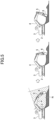
- FIG. 5 is a diagram illustrating the flow of a plowing-out work, which is an example of a work realized by a complex movement including an arm closing movement and a boom raising movement, which is an example of the predetermined complex movement.
- the plowing-out work is a work for scraping off extra undulations on the surface of the ground to a flat state.
- FIG. 6 is a flowchart illustrating the flow of the pressure drop inhibiting process.
- the controller 30 performs the pressure drop inhibiting process repeatedly at a predetermined control cycle.
- the operator positions the end of the bucket 6 such that the end of the bucket 6 comes to a desired height position from the ground, which is the working target, in a work area N of the excavation attachment (the boom 4, the arm 5, and the bucket 6) serving as a working device.
- the work area N means an area that is within reach of the end of the bucket 6.
- the bucket 6 is in an opening state (which is, for example, a state of the bucket 6 being at a bucket angle of 90 degrees or greater).
- the bucket angle is, for example, the degree of opening from the maximumly closed state of the bucket 6 (i.e., a pivoting angle of the bucket 6 about a bucket pin).
- the operator starts the plowing-out work by closing the arm 5 while gradually raising the boom 4. Specifically, the operator performs an arm closing movement by a full lever operation on the arm operation lever, and a boom raising movement by a micro-operation or a half lever operation on the boom operation lever.
- the micro-operation means for example, an operation by a lever operation amount that is less than 20% on the assumption that a lever operation amount when the operation lever is at a neutral position is 0% and a lever operation amount when the operation lever is maximumly inclined is 100%.
- the full lever operation means for example, an operation by a lever operation amount that is 80% or greater.
- the half lever operation means for example, an operation by a lever operation amount that is 20% or greater and less than 80%. In the following description, the micro-operation and the half lever operation may be collectively referred to as "non-full lever operations".
- the operator continues the plowing-out work by closing the arm 5 while gradually raising the boom 4 from the state illustrated in the center of FIG. 5 .
- the operator continues the arm closing movement by a full lever operation on the arm operation lever, and continues the boom raising movement by a micro-operation or a half lever operation of the boom operation lever.
- extra undulations on the surface of the ground are scraped off to a flat state by the end of the claw of the bucket 6.
- the operating oil discharged from the left main pump 14L arrives at the control valve 176L through each of the left center bypass oil path 40L and the left parallel oil path 42L, and then arrives at a bottom-side oil chamber of the arm cylinder 8 through the control valve 176L.
- Part of the operating oil discharged from the right main pump 14R arrives at the control valve 176R through the right parallel oil path 42R, and then arrives at the bottom-side oil chamber of the arm cylinder 8 through the control valve 176R.
- Another part of the operating oil discharged from the right main pump 14R arrives at the control valve 175R through the right parallel oil path 42R, and then arrives at a bottom-side oil chamber of the boom cylinder 7 through the control valve 175R.
- the discharging amounts of the left main pump 14L and the right main pump 14R are increased to the maximum discharging amounts through the negative control, because the arm operation lever is in a full lever operation.
- the right parallel oil path 42R leading to the control valve 176R applies a higher pressure on the operating oil on the upstream side of the throttle 60 than the pressure applied on the operating oil on the downstream side of the throttle 60, in order to prevent the operating oil discharged from the right main pump 14R from being inhibited from flowing into the boom cylinder 7 due to the operating oil discharged from the right main pump 14R mostly flowing into the arm cylinder 8 in a complex movement (first complex movement) including: an arm closing movement realized by a micro-operation or a half lever operation on the arm operation lever; and a boom raising movement realized by a micro-operation or a half lever operation on the boom operation lever, i.e., in order to prevent the boom raising movement from slowing down in spite of the load on the complex movement being low.
- first complex movement including: an arm closing movement realized by a micro-operation or a half lever operation on the arm operation lever; and a boom raising movement realized by a micro-operation or a half lever operation on the boom operation lever, i.e., in order
- the operating oil discharged from the right main pump 14R experiences a pressure drop when the operating oil passes through the throttle 60.
- the pressure drop is higher, as the flow rate of the operating oil discharged from the right main pump 14R is higher.
- the pressure drop occurring at the throttle 60 is particularly high in a plowing-out work realized by a complex movement (second complex movement) including: an arm closing movement realized by a full lever operation on the arm operation lever; and a boom raising movement realized by a micro-operation or a half lever operation on the boom operation lever.
- the lever operation amount of the boom operation lever in the second complex movement is smaller than the lever operation amount of the boom operation lever in the first complex movement.
- This also entails a smaller opening area of a PC port (pump-cylinder port) of the control valves 175, resulting in a higher pressure drop in the oil paths on the right main pump 14R side.
- the excavator 100 reduces pressure drop that occurs at the throttle 60 by performing the pressure drop inhibiting process in a case of performing a predetermined complex movement such as the complex movement in the plowing-out work.
- the controller 30 mounted on the excavator 100 outputs a control instruction to the electromagnetic valve 31 to control the control valve 170, which remains non-moving in a non-travelling state in principle, to move exceptionally, to thereby reduce pressure drop occurring at the throttle 60.
- the controller 30 determines whether a predetermined complex movement is performed or not (step ST1). In the illustrated example, the controller 30 determines whether a predetermined complex movement is performed or not based on an output from the operation sensor 29.
- the predetermined complex movement includes the complex movement for realizing the plowing-out work.
- the complex movement for realizing the plowing-out work is, for example, a complex movement including: an arm closing movement realized by a full lever operation on the arm operation lever; and a boom raising movement realized by a micro-operation or a half lever operation on the boom operation lever.
- the controller 30 may determine whether a predetermined movement is performed or not based on an output from any other sensor than the operation sensor 29.
- the controller 30 may determine whether a predetermined complex movement is performed or not based on an output from a boom angle sensor, an arm angle sensor, a bucket angle sensor, and the like, or based on an output from an image sensor such as a space recognition device (a camera or a LIDAR) mounted on the upper rotating body 3 and the like.
- a space recognition device a camera or a LIDAR
- step ST1 NO
- the controller 30 terminates the current pressure drop inhibiting process, because it can be estimated that no pressure drop that should be reduced is occurring in the operating oil lines.
- step ST1 determining that a predetermined complex movement is performed (step ST1: YES)
- the controller 30 compares the discharging pressure P1 of the left main pump 14L and the discharging pressure P2 of the right main pump 14R (step ST2).
- the controller 30 determines whether or not the discharging pressure P2 of the right main pump 14R detected by the right discharging pressure sensor 28R is higher than the discharging pressure P1 of the left main pump 14L detected by the left discharging pressure sensor 28L.
- step ST2 NO
- the controller 30 terminates the current pressure drop inhibiting process, because it can be estimated that no pressure drop that should be reduced is occurring in the operating oil lines.
- the controller 30 moves the control valve 170 serving as a straight-travel valve (step ST3).
- the controller 30 outputs a control instruction to the electromagnetic valve 31, to set the valve position of the control valve 170 at the middle valve position between the first valve position and the second valve position.
- the discharging pressure P1 after the control valve 170 is moved is higher than the discharging pressure P1 before the control valve 170 is moved, and the discharging pressure P2 after the control valve 170 is moved is lower than the discharging pressure P2 before the control valve 170 is moved.
- the discharging pressure P1 and the discharging pressure P2 being the same value may include the differential pressure between the discharging pressure P1 and the discharging pressure P2 being lower than a previously set predetermined value.
- FIG. 7 illustrates, for example, a state of the driving system while the plowing-out work is being performed.
- FIG. 7 illustrates a state of the driving system when the valve position of the control valve 170 is positioned at the middle valve position while a complex movement including a boom raising movement by a half lever operation and an arm closing movement by a full lever operation is being performed.
- FIG. 7 denotes the operating oil flowing into the bottom-side oil chamber of the arm cylinder 8 from the left main pump 14L, and the operating oil flowing into the bottom-side oil chamber of the arm cylinder 8 and into the bottom-side oil chamber of the boom cylinder 7 from the right main pump 14R by bold solid lines.
- part of the operating oil discharged from the right main pump 14R passes through the right center bypass oil path 40R, the control valve 170, and the left parallel oil path 42L to arrive at the control valve 176L, and then passes through the control valve 176L to arrive at the bottom-side oil chamber of the arm cylinder 8.
- Another part of the operating oil discharged from the right main pump 14R passes through the right parallel oil path 42R to arrive at the control valve 176R, and then passes through the control valve 176R to arrive at the bottom-side oil chamber of the arm cylinder 8.
- Yet another part of the operating oil discharged from the right main pump 14R passes through the right parallel oil path 42R to arrive at the control valve 175R, and then passes through the control valve 175R to arrive at the bottom-side oil chamber of the boom cylinder 7.
- no pressure drop occurs at the throttle 60, because the discharging pressure P1 of the left main pump 14L and the discharging pressure P2 of the right main pump 14R have become the same value, i.e., the pressure of the operating oil on the upstream side of the throttle 60 and the pressure of the operating oil on the downstream side of the throttle 60 have become the same value.
- the controller 30 can suppress pressure drop occurring in the operating oil line.
- the excavator 100 can avoid making the movement of the excavation attachment unstable due to including the configuration that can realize the pressure drop inhibiting process, because the pressure drop inhibiting process is realized by the configuration including the throttle 60, i.e., because the throttle 60 can, also in the configuration that can realize the pressure drop inhibiting process, inhibit or prevent the operating oil, which should flow into the hydraulic actuator under a high load pressure (boom cylinder 7), from flowing into the hydraulic actuator under a low load pressure (arm cylinder 8).
- boost cylinder 7 high load pressure
- arm cylinder 8 low load pressure
- the controller 30 may determine that the discharging pressure P2 is higher than the discharging pressure P1 in a case where the differential pressure between the discharging pressure P2, which is higher than the discharging pressure P1, and the discharging pressure P1 is higher than or equal to a previously set predetermined value. That is, the controller 30 may determine that the discharging pressure P2 is not higher than the discharging pressure P1 even in a case where the discharging pressure P2 is higher than the discharging pressure P1 as long as the differential pressure between them is lower than the predetermined value.
- the controller 30 may maintain the control valve 170 at the moved state until a predetermined cancel condition becomes satisfied after the control valve 170 serving as a straight-travel valve is moved. That is, even after the discharging pressure P1 and the discharging pressure P2 become the same value after the valve position of the control valve 170 is positioned at the middle valve position, the controller 30 may maintain the valve position of the control valve 170 positioned at the middle position unless the predetermined cancel condition becomes satisfied, in order to maintain the state of the pressure drop being reduced.
- the predetermined cancel condition is the predetermined complex movement, which is determined to be performed in the step ST1, being determined to be no longer performed.
- the controller 30 switches the valve position of the control valve 170 to the first valve position in a case of determining that the complex movement including a boom raising movement and an arm closing movement, which is determined to be performed in the step ST1, is no longer performed based on an output from the operation sensor 29. Specifically, the controller 30 switches the valve position of the control valve 170 to the first valve position when the complex movement including a boom raising movement and an arm closing movement is changed to a single movement including only a boom raising movement.
- the controller 30 moves the control valve 170 serving as a straight-travel valve while a predetermined complex movement, which is a complex movement including an arm closing movement by a full lever operation and a boom raising movement by a non-full lever operation, is being performed.
- a predetermined complex movement which is a complex movement including an arm closing movement by a full lever operation and a boom raising movement by a non-full lever operation
- the controller 30 may move the control valve 170 serving as a straight-travel valve while any other predetermined complex movement is being performed, such as a complex movement including an arm closing movement by a full lever operation and a boom lowering movement by a non-full lever operation, a complex movement including an arm closing movement by a full lever operation and a bucket closing movement by a non-full lever operation, a complex movement including an arm opening movement by a full lever operation and a boom raising movement by a non-full lever operation, a complex movement including an arm opening movement by a full lever operation and a boom lowering movement by non-full lever operation, a complex movement including an arm opening movement by a full lever operation and a bucket opening movement by a non-full lever operation, and the like.
- a complex movement including an arm closing movement by a full lever operation and a boom lowering movement by a non-full lever operation such as a complex movement including an arm closing movement by a full lever operation and a boom lowering movement by a non-full
- a complex movement including an arm closing movement by a full lever operation and a boom raising movement performed by a non-full lever operation, which is performed to realize the plowing-out work may be a complex movement including an arm closing movement by a full lever operation and a boom raising movement by a non-full lever operation, which is performed to realize any other work such as an excavation work, or may be a complex movement including an arm closing movement by a full lever operation and a boom raising movement performed by a non-full lever operation, which is performed in the air (in a state in which the excavation attachment does not touch the soil or the like).
- the excavator 100 includes the lower travelling body 1, the upper rotating body 3 mounted rotatably on the lower travelling body 1, the excavation attachment, which is an example of the attachment attached to the upper rotating body 3 and including the boom 4, the arm 5, and the bucket 6, the control valve 170 serving as a straight-travel valve that can merge flows of the operating oil, which are discharged from a plurality of hydraulic pumps respectively, with each other, and the controller 30 serving as a control device that can control the functioning of the control valve 170.
- the controller 30 moves the control valve 170 and performs the pressure drop inhibiting process while at least two selected from the boom 4, the arm 5, and the bucket 6 are simultaneously moving in a non-travelling state.
- the control valve 170 serving as a straight-travel valve is situated between the right main pump 14R and the control valve 171R on the right center bypass oil path 40R, and is situated at the point at which the left parallel oil path 42L is parted to the left main pump 14L side and the control valve 172 side.
- the valve position of the control valve 170 serving as a straight-travel valve is switchable while travelling operation devices are being operated.
- the valve position of the control valve 170 is switchable even while no travelling operation devices are being operated.
- control valve 170 serving as a straight-travel valve is switchable between the first valve position at which the control valve 170 can supply the operating oil discharged from the left main pump 14L to the left parallel oil path 42L and can supply the operating oil discharged from the right main pump 14R to the right center bypass oil path 40R, and the second valve position at which the control valve 170 can supply the operating oil discharged from the left main pump 14L to the right center bypass oil path 40R and can supply the operating oil discharged from the right main pump 14R to the left parallel oil path 42L.
- control valve 170 serving as a straight-travel valve can supply flows of the operating oil, which are discharged from the left main pump 14L and the right main pump respectively, after merging them with each other, to the left parallel oil path 42L and the right center bypass oil path 40R respectively when the control valve 170 is at the middle valve position between the first valve position and the second valve position.
- the arm 5, and the bucket 6 are simultaneously moving in a non-travelling state is, for example, when at least two selected from the boom 4, the arm 5, and the bucket 6 are simultaneously being operated in a non-travelling operation.
- the controller 30 may determine whether at least two selected from the boom 4, the arm 5, and the bucket 6 are simultaneously moving in a non-travelling state or not based on an output from the operation sensor 29. Alternatively, the controller 30 may determine whether at least two selected from the boom 4, the arm 5, and the bucket 6 are simultaneously moving or not based on an output from the boom angle sensor, the arm angle sensor, the bucket angle sensor, and the like. Alternatively, the controller 30 may determine whether the excavator 100 is in a travelling state or not based on an output from a positioning device such as a GNSS and the like.
- the controller 30 may determine whether at least two selected from the boom 4, the arm 5, and the bucket 6 are simultaneously moving in a non-travelling state or not based on an output from an image sensor such as a space recognition device (a camera or a LIDAR) mounted on the upper rotating body 3 and the like.
- an image sensor such as a space recognition device (a camera or a LIDAR) mounted on the upper rotating body 3 and the like.
- the configuration described above has an effect of enabling reducing pressure drop that may occur while a complex operation for moving at least two selected from the boom cylinder 7, the arm cylinder 8, and the bucket cylinder 9 is being performed.
- the configuration described above has an effect of enabling improving the fuel efficiency or improving the moving speed of the excavation attachment.
- the configuration described above which is a configuration for performing the pressure drop inhibiting process by using the existing straight-travel valve (the control valve 170), has an effect of enabling reducing pressure drop in the operating oil lines without employing a relatively expensive method such as changing the fixed throttle (the throttle 60) to a variable throttle, situating an electromagnetic proportional valve on the pilot lines of the control valves 176, or the like.
- the configuration described above which is a configuration for performing the pressure drop inhibiting process by using the existing straight-travel valve (the control valve 170)
- the configuration described above has an effect of enabling omitting an electromagnetic proportional valve from an excavator including the electromagnetic proportional valve on the pilot lines of the control valves 176 and reducing the production costs.
- the controller 30 may move the control valve 170 serving as a straight-travel valve while a complex movement including an arm closing movement and either or both of a boom raising movement and a bucket closing movement is being performed.
- the controller 30 may move the control valve 170 serving as a straight-travel valve only in a case where the operation amount of an arm closing operation is greater than the operation amount of a boom raising operation and the operation amount of a bucket closing operation. That is, the controller 30 does not need to move the control valve 170 in a case where the operation amount of an arm closing operation is less than or equal to the operation amount of a boom raising operation even while a complex movement including an arm closing movement and a boom raising movement is being performed, because it can be estimated that a pressure drop occurring in the operating oil lines is low.
- the excavator 100 may include the left main pump 14L serving as a first hydraulic pump that can supply the operating oil to the left travelling hydraulic motor 20L and the right travelling hydraulic motor 20R, and the right main pump 14R serving as a second hydraulic pump that can supply the operating oil to the right travelling hydraulic motor 20R.
- the controller 30 may move the control valve 170 serving as a straight-travel valve to merge the operating oil discharged from the left main pump 14L and the operating oil discharged from the right main pump 14R with each other as illustrated in FIG. 7 , in a case where the discharging pressure P2 of the right main pump 14R is higher than the discharging pressure P1 of the left main pump 14L while at least two selected from the boom 4, the arm 5, and the bucket 6 are simultaneously moving in a non-travelling state.
- the control valve 170 serving as a straight-travel valve may be switchable between the first valve position at which the left main pump 14L and the left travelling hydraulic motor 20L are brought into communication and the right main pump 14R and the right travelling hydraulic motor 20R are brought into communication as illustrated in FIG. 3 , and the second valve position at which the left main pump 14L is brought into communication with each of the left travelling hydraulic motor 20L and the right travelling hydraulic motor 20R as illustrated in FIG. 4 .
- control valve 170 may merge the operating oil discharged from the left main pump 14L and the operating oil discharged from the right main pump 14R with each other when its valve position is at the middle valve position between the first valve position and the second valve position.
- This configuration has an effect of enabling reducing pressure drop that may occur while a complex operation for moving at least two selected from the boom cylinder 7, the arm cylinder 8, and the bucket cylinder 9 is being performed, because reducing a differential pressure between the discharging pressure P2 of the right main pump 14R and the discharging pressure P1 of the left main pump 14L can reduce a differential pressure between the pressure of the operating oil on the upstream side of the throttle 60 and the pressure of the operating oil on the downstream side of the throttle 60.
- this configuration has an effect of, for example, enabling improving the fuel efficiency or improving the moving speed of the excavation attachment.
- the case in the plowing-out work has been illustrated.
- the work to which the present invention can be applied is not limited to the plowing-out work.
- the opening area of the PC port of the control valves of the hydraulic circuit on the right main pump 14R side is smaller than the opening area of the PC port of the control valves of the hydraulic circuit on the left main pump 14L side
- the discharging pressure of the right main pump 14R is higher than the discharging pressure of the left main pump 14L.
- the present invention can be applied to any type of work in which, as described, the discharging pressure of the right main pump 14R is higher than the discharging pressure of the left main pump 14L depending on the difference in the opening areas of the PC ports of the control valves situated on the left and right hydraulic circuits.
- control valve 170 is formed as a 4-port and 2-chamber spool valve.
- the controller 30 controls the operating oil discharged from the left main pump 14L and the operating oil discharged from the right main pump 14R to be merged with each other by using the middle valve position of the control valve 170 between the first valve position and the second valve position.
- control valve 170 may be formed as a 4-port and 3-chamber spool valve having a middle valve position as an independent third valve position. That is, the control valve 170 may be formed as a 4-port and 3-chamber spool valve having an independent third valve position at which a merging path joining the left parallel oil path 42L and the right center bypass oil path 40R with each other is provided.
- the control valve 170 may be able to change the opening area of the merging path joining the left parallel oil path 42L and the right center bypass oil path 40R with each other, depending on the stroke amount of the merging path.
Landscapes
- Engineering & Computer Science (AREA)
- General Engineering & Computer Science (AREA)
- Mining & Mineral Resources (AREA)
- Civil Engineering (AREA)
- Structural Engineering (AREA)
- Physics & Mathematics (AREA)
- Fluid Mechanics (AREA)
- Mechanical Engineering (AREA)
- Operation Control Of Excavators (AREA)
- Fluid-Pressure Circuits (AREA)
Abstract
Description
- The present disclosure relates to an excavator.
- An excavator that can move a plurality of hydraulic actuators simultaneously using an operating oil discharged from hydraulic pumps has been known (see PTL 1).
- [PTL 1] International Publication No.
WO 2016/056442 - However, the excavator disclosed in PTL 1 is at a risk of occurrence of a wasteful pressure drop while a complex operation for moving two hydraulic actuators simultaneously is being performed, because load pressures on the two hydraulic actuators are different from each other, i.e., because a throttle that limits the flow rate of the operating oil to be supplied to the hydraulic actuator that is under the lower load is provided in order to reliably supply the operating oil to the hydraulic actuator that is under the higher load pressure.
- In view of the above, it is desirable to provide an excavator that can reduce a pressure drop that may occur while a complex operation for moving at least two selected from a boom cylinder, an arm cylinder, and a bucket cylinder is being performed.
- An excavator according to an embodiment of the present invention includes a lower travelling body, an upper rotating body mounted rotatably on the lower travelling body, an attachment attached to the upper rotating body and including a boom, an arm, and a bucket, a control valve that is capable of merging flows of an operating oil, which are discharged from a plurality of hydraulic pumps respectively, with each other, and a control device that is capable of controlling functioning of the control valve, wherein the control device moves the control valve while at least two selected from the boom, the arm, and the bucket are moving simultaneously in a non-travelling state.
- The excavator described above can reduce a pressure drop that may occur while a complex operation for moving at least two selected from a boom cylinder, an arm cylinder, and a bucket cylinder is being performed.
-
- [
FIG. 1] FIG. 1 is a side view of an excavator according to an embodiment of the present invention. - [
FIG. 2] FIG. 2 is a schematic diagram illustrating an example of the configuration of a driving system mounted on the excavator ofFIG. 1 . - [
FIG. 3] FIG. 3 is a diagram illustrating a state of the driving system while the excavator is travelling. - [
FIG. 4] FIG. 4 is a diagram illustrating a state of the driving system while the excavator is rotating while travelling. - [
FIG. 5] FIG. 5 is a diagram illustrating the flow of a plowing-out work. - [
FIG. 6] FIG. 6 is a flowchart illustrating the flow of an example of a pressure drop inhibiting process. - [
FIG. 7] FIG. 7 is a drawing illustrating a state of the driving system while a plowing-out work is being performed. - First, an
excavator 100 as a construction machine according to an embodiment of the present invention will be described with reference toFIG. 1. FIG. 1 is a side view of theexcavator 100. An upper rotatingbody 3 is mounted on a lower travelling body 1 of theexcavator 100 illustrated inFIG. 1 such that the upper rotatingbody 3 can rotate via arotating mechanism 2. Aboom 4 serving as a working component is attached to the upper rotatingbody 3. Anarm 5 serving as a working component is attached to an end of theboom 4, and abucket 6 serving as a working component and an end attachment is attached to an end of thearm 5. Theboom 4, thearm 5, and thebucket 6 form an excavation attachment, which is an example of the attachment. Theboom 4 is driven by aboom cylinder 7, thearm 5 is driven by anarm cylinder 8, and thebucket 6 is driven by abucket cylinder 9. Acabin 10 is situated on the upper rotatingbody 3, and a power source such as anengine 11 or the like is mounted on the upper rotatingbody 3. -
FIG. 2 is a diagram illustrating an example of the configuration of a driving system mounted on the excavator ofFIG. 1 . InFIG. 2 , a mechanical power transmission line is denoted by a double line, operating oil lines are denoted by solid lines, pilot lines are denoted by broken lines, and electric control lines are denoted by dash-dot lines. - The driving system of the
excavator 100 mainly includes theengine 11,pump regulators 13,main pumps 14, apilot pump 15, an operation device 26,discharging pressure sensors 28, anoperation sensor 29, acontroller 30, and the like. - The
engine 11 is an example of a power source of theexcavator 100. The power source may be an electric motor, a fuel battery, a hydrogen engine, or the like. In the present embodiment, theengine 11 is a diesel engine that moves while maintaining a predetermined rotation rate. The output shaft of theengine 11 is coupled to the input shafts of themain pumps 14 and of thepilot pump 15. - The
main pumps 14 are an example of the hydraulic pumps, and can supply an operating oil to acontrol valve unit 17. In the present embodiment, themain pumps 14 are swash plate-type variable-displacement hydraulic pumps, and include a leftmain pump 14L and a rightmain pump 14R. - The
pump regulators 13 control the discharging amounts of themain pumps 14. In the present embodiment, thepump regulators 13 control the discharging amounts of themain pumps 14 by adjusting the tilt angles of the swash plates of themain pumps 14 in accordance with instructions from thecontroller 30. Thepump regulators 13 may output information regarding the tilt angles of the swash plates to thecontroller 30. Specifically, thepump regulators 13 include aleft pump regulator 13L that controls the discharging amount of the leftmain pump 14L and aright pump regulator 13R that controls the discharging amount of the rightmain pump 14R. - The
pilot pump 15 supplies the operating oil to various hydraulic devices including the operation device 26. In the present embodiment, thepilot pump 15 is a fixed-displacement hydraulic pump. However, thepilot pump 15 may be omitted. In this case, the functions served by thepilot pump 15 may be realized by themain pumps 14. That is, themain pumps 14 may have a function for supplying the operating oil to the operation device 26 and the like after reducing the pressure of the operating oil via throttles or the like, aside from the function for supplying the operating oil to thecontrol valve unit 17. - The
control valve unit 17 accommodates a plurality of control valves such that the control valves can move. In the present embodiment, thecontrol valve unit 17 includes the plurality of control valves that control the circulation of the operating oil discharged from themain pumps 14. Thecontrol valve unit 17 can supply the operating oil discharged from themain pumps 14 selectively to one or a plurality of hydraulic actuators via the control valves. The plurality of control valves control the flow rates of the operating oil flowing into the hydraulic actuators from themain pumps 14, and the flow rates of the operating oil flowing into an operating oil tank T1 from the hydraulic actuators. The hydraulic actuators include theboom cylinder 7, thearm cylinder 8, thebucket cylinder 9, travellinghydraulic motors 20, and a rotatinghydraulic motor 21. The travellinghydraulic motors 20 include a left travellinghydraulic motor 20L and a right travellinghydraulic motor 20R. - The rotating
hydraulic motor 21 is a hydraulic motor that rotates the upper rotatingbody 3.Oil paths 21P connected to the ports of the rotatinghydraulic motor 21 are connected to anoil path 44 via relief valves 22 andcheck valves 23. Specifically, theoil paths 21P include a left oil path 21PL and a right oil path 21PR. The relief valves 22 include a left relief valve 22L and a right relief valve 22R. Thecheck valves 23 include aleft check valve 23L and aright check valve 23R. - The left relief valve 22L opens in response to the pressure of the operating oil in the left oil path 21PL reaching a predetermined relief pressure, and expels the operating oil in the left oil path 21PL to the
oil path 44. The right relief valve 22R opens in response to the pressure of the operating oil in the right oil path 21PR reaching a predetermined relief pressure, and expels the operating oil in the right oil path 21PR to theoil path 44. - The
left check valve 23L opens in response to the pressure of the operating oil in the left oil path 21PL becoming lower than the pressure of the operating oil in theoil path 44, and replenishes the operating oil into the left oil path 21PL from theoil path 44. Theright check valve 23R opens in response to the pressure of the operating oil in the right oil path 21PR becoming lower than the pressure of the operating oil in theoil path 44, and replenishes the operating oil into the right oil path 21PR from theoil path 44. Thecheck valves 23 functioning in this way can replenish the operating oil to the ports on the suctioning side during braking of the rotatinghydraulic motor 21. - The operation device 26 is a device used by an operator to operate the hydraulic actuators. In the present embodiment, the operation device 26 is a hydraulic type, and supplies the operating oil discharged from the
pilot pump 15 to the pilot ports of the control valves corresponding to the respective hydraulic actuators through the pilot lines. The pilot pressure, which is the pressure of the operating oil to be supplied to each pilot port, is a pressure matching the direction in which and the amount by which a lever or a pedal forming the operation device 26 and corresponding to any hydraulic actuator is operated. However, the operation device 26 may be an electric type. - Specifically, the operation device 26 includes a left operation lever, a right operation lever, a left travelling lever, a right travelling lever, a left travelling operation pedal, a right travelling pedal, and the like. The left operation lever functions as an arm operation lever and a rotating operation lever. The right operation lever functions as a boom operation lever and a bucket operation lever. In the following description, either or both of the left operation lever and the right operation lever may be referred to as "an attachment operation device", and at least one selected from the left travelling lever, the right travelling lever, the left travelling pedal, and the right travelling pedal may be referred to as "a travelling operation device". The left travelling lever and the right travelling lever may be referred to as "travelling levers", and the left travelling pedal and the right travelling pedal may be referred to as "travelling pedals". Either or both of the left travelling lever and the left travelling pedal may be referred to as "a left travelling operation device", and either or both of the right travelling lever and the right travelling pedal may be referred to as "a right travelling operation device".
- A
temperature sensor 27 detects the temperature of the operating oil in the operating oil tank T1, and outputs the detected value to thecontroller 30. - The discharging
pressure sensors 28 detect the discharging pressures of themain pumps 14 and output the detected values to thecontroller 30. In the present embodiment, the dischargingpressure sensors 28 include a left dischargingpressure sensor 28L that detects the discharging pressure of the leftmain pump 14L, and a right dischargingpressure sensor 28R that detects the discharging pressure of the rightmain pump 14R. - The
operation sensor 29 is a device that detects the content of an operation performed by the operator via the operation device 26. The content of an operation includes, for example, an operation direction, an operation amount (operation angle), and the like. In the present embodiment, theoperation sensor 29 is a pressure sensor that detects, in the form of a pressure, the direction in which and the amount by which a lever or a pedal forming the operation device 26 and corresponding to any hydraulic actuator is operated, and outputs the detected value to thecontroller 30. The content of an operation via the operation device 26 may be detected using an output from a device other than a pressure sensor, such as an operation angle sensor, an acceleration sensor, an angular velocity sensor, a resolver, a voltmeter, an ammeter, and the like. - The
controller 30 is an example of a processing circuit, and functions as a control device that controls theexcavator 100. In the present embodiment, thecontroller 30 is constituted by a computer including a CPU, a volatile memory device, a nonvolatile memory device, and the like. - An
electromagnetic valve 31 is situated on a conduit line that connects thepilot pump 15 to the pilot port of acontrol valve 170 in thecontrol valve unit 17, and can change the flow area of the conduit line. In the present embodiment, theelectromagnetic valve 31 is an electromagnetic proportional control valve that functions in accordance with a control instruction output from thecontroller 30. Hence, thecontroller 30 can supply the operating oil discharged from thepilot pump 15 to the pilot port of thecontrol valve 170 serving as a straight-travel valve via theelectromagnetic valve 31 irrespective of an operation performed by the operator via the operation device 26. Then, thecontroller 30 can cause a pilot pressure generated by theelectromagnetic valve 31 to act on the pilot port of thecontrol valve 170. - Center
bypass oil paths 40 are operating oil lines that pass through the control valves situated in thecontrol valve unit 17, and include a left centerbypass oil path 40L and a right centerbypass oil path 40R. - The
control valve 170 is a spool valve serving as a straight-travel valve. In principle, thecontrol valve 170 remains still in a non-travelling state of theexcavator 100. In the present embodiment, thecontrol valve 170 switches the circulation of the operating oil such that the operating oil is supplied to the travellinghydraulic motors 20 from themain pumps 14 in such a suitable manner that the straight travelling performance of the lower travelling body 1 can be improved. Specifically, the valve position of thecontrol valve 170 is switchable between a first valve position and a second valve position in accordance with a control instruction from thecontroller 30. - More specifically, the valve position of the
control valve 170 is at the first valve position while travelling operation devices are only being operated or while attachment operation devices are only being operated, and is at the second valve position while travelling operation devices and attachment operation devices are simultaneously being operated. As described above, in principle, thecontrol valve 170 remains still in the non-travelling state of theexcavator 100. That is, the valve position of thecontrol valve 170 is kept at the first valve position unless travelling operation devices and attachment operation devices are simultaneously operated. - The first valve position is a valve position at which the left
main pump 14L and the left travellinghydraulic motor 20L are brought into communication with each other, and the rightmain pump 14R and the right travellinghydraulic motor 20R are brought into communication with each other.FIG. 3 illustrates a state of the driving system in a case of performing operations only on travelling operation devices and switching thecontrol valve 170 to the first valve position. Specifically,FIG. 3 illustrates a state of the driving system while the left travelling lever and the right travelling lever are being operated in the forward travelling direction by the same operation amount. In this state, the leftmain pump 14L can supply the operating oil to the left travellinghydraulic motor 20L, and the rightmain pump 14R can supply the operating oil to the right travellinghydraulic motor 20R. For clarity,FIG. 3 denotes the operating oil flowing from the leftmain pump 14L to the left travellinghydraulic motor 20L and the operating oil flowing from the rightmain pump 14R to the right travellinghydraulic motor 20R by bold solid lines. - The second valve position is a valve position at which the left
main pump 14L is brought into communication with each of the left travellinghydraulic motor 20L and the right travellinghydraulic motor 20R.FIG. 4 illustrates a state of the driving system while travelling operation devices and an attachment operation device are simultaneously being operated and the valve position of thecontrol valve 170 is at the second valve position. Specifically,FIG. 4 illustrates a state of the driving system while the left travelling lever and the right travelling lever are being operated in the forward travelling direction by the same operation amount, and the left operation lever serving as the rotating operation lever is being operated in the right rotating direction. In this state, the leftmain pump 14L can supply the operating oil to each of the left travellinghydraulic motor 20L and the right travellinghydraulic motor 20R. For clarity,FIG. 4 denotes the operating oil flowing from the leftmain pump 14L to each of the left travellinghydraulic motor 20L and the right travellinghydraulic motor 20R, and the operating oil flowing from the rightmain pump 14R to the rotatinghydraulic motor 21 by bold solid lines. - The
control valve 170 can merge the operating oil discharged from the leftmain pump 14L and the operating oil discharged from the rightmain pump 14R with each other when its valve position is at a middle valve position between the first valve position and the second valve position. - The
controller 30 can supply the operating oil discharged from thepilot pump 15 to the pilot port of thecontrol valve 170 serving as a straight-travel valve by outputting a control instruction (e.g., an instruction by an electric current) to theelectromagnetic valve 31 in accordance with an operation performed by the operator via the operation device 26 or irrespective of an operation performed by the operator via the operation device 26. Then, thecontroller 30 can cause a pilot pressure generated by theelectromagnetic valve 31 to act on the pilot port of thecontrol valve 170. Hence, thecontroller 30 can switch the valve position of thecontrol valve 170 between the first valve position and the second valve position at a desirably selected timing. -
Control valves 171 are spool valves that switch the circulation of the operating oil in order to supply the operating oil discharged from themain pumps 14 to the travellinghydraulic motors 20 and expel the operating oil discharged from the travellinghydraulic motors 20 to the operating oil tank. Specifically, thecontrol valves 171 include acontrol valve 171L and acontrol valve 171R. Thecontrol valve 171L switches the circulation of the operating oil in order to supply the operating oil discharged from the leftmain pump 14L to the left travellinghydraulic motor 20L and expel the operating oil discharged from the left travellinghydraulic motor 20L to the operating oil tank. Thecontrol valve 171R switches the circulation of the operating oil in order to supply the operating oil discharged from the leftmain pump 14L or the rightmain pump 14R to the right travellinghydraulic motor 20R and expel the operating oil discharged from the right travellinghydraulic motor 20R to the operating oil tank. - A
control valve 172 is a spool valve that switches the circulation of the operating oil in order to supply the operating oil discharged from the leftmain pump 14L to an optional hydraulic actuator and expel the operating oil discharged from the optional hydraulic actuator to the operating oil tank. The optional hydraulic actuator is, for example, a grapple opening/closing cylinder. - A
control valve 173 is a spool valve that switches the circulation of the operating oil in order to supply the operating oil discharged from the leftmain pump 14L to the rotatinghydraulic motor 21 and expel the operating oil discharged from the rotatinghydraulic motor 21 to the operating oil tank. - A
control valve 174 is a spool valve that supplies the operating oil discharged from the rightmain pump 14R to thebucket cylinder 9 and expels the operating oil in thebucket cylinder 9 to the operating oil tank. -
Control valves 175 are spool valves that switch the circulation of the operating oil in order to supply the operating oil discharged from themain pumps 14 to theboom cylinder 7 and expel the operating oil in theboom cylinder 7 to the operating oil tank. Specifically, thecontrol valves 175 include acontrol valve 175L and acontrol valve 175R. Thecontrol valve 175L moves only when an operation to raise theboom 4 is performed, and does not move when an operation to lower theboom 4 is performed. -
Control valves 176 are spool valves that switch the circulation of the operating oil in order to supply the operating oil discharged from themain pumps 14 to thearm cylinder 8 and expel the operating oil in thearm cylinder 8 to the operating oil tank. Specifically, thecontrol valves 176 include acontrol valve 176L and acontrol valve 176R. - In the present embodiment, the
control valves 170 to 176 are pilot-type spool valves, but may be electromagnetic spool valves in a case where the operation device 26 is an electric type. - In a case where the operation levers serving as the operation device 26 are electric types, an amount of a lever operation is input into the
controller 30 in the form of an electric signal. An electromagnetic valve is situated between thepilot pump 15 and the pilot port of each of the control valves. The electromagnetic valve functions in accordance with an electric signal from thecontroller 30. By the electromagnetic valve functioning in this way, thecontroller 30 can control the electromagnetic valve by means of an electric signal that matches the amount of a lever operation in response to a manual operation using an operation lever being performed, and can thereby increase or decrease the pilot pressure and move each control valve. Each control valve may be constituted by an electromagnetic spool valve as described above. In this case, the electromagnetic spool valve moves in accordance with an electric signal from thecontroller 30 matching the amount of a lever operation performed on an electric-type operation lever. - Returning
oil paths 41 are operating oil lines situated in thecontrol valve unit 17, and include a left returningoil path 41L and a right returningoil path 41R. The operating oil that has flowed out of a hydraulic actuator and passed thecontrol valves 171 to 176 flows toward the operating oil tank T1 by passing through the returningoil paths 41. -
Parallel oil paths 42 are operating oil lines extending in parallel with the centerbypass oil paths 40. In the present embodiment, theparallel oil paths 42 include a leftparallel oil path 42L extending in parallel with the left centerbypass oil path 40L, and a rightparallel oil path 42R extending in parallel with the right centerbypass oil path 40R. The leftparallel oil path 42L can supply the operating oil to the control valves that are on the downstream side of thecontrol valve bypass oil path 40L is limited or interrupted by thecontrol valve parallel oil path 42R can supply the operating oil to the control valves that are on the downstream side of thecontrol valves bypass oil path 40R is limited or interrupted by thecontrol valves - A
throttle 60 is a fixed throttle situated on a position of the rightparallel oil path 42R that is on the upstream side of thecontrol valve 176R and on the downstream side of a branching point at which an oil path that joins the rightparallel oil path 42R and thecontrol valve 175R branches from the rightparallel oil path 42R. In the illustrated example, for example, thethrottle 60 has a function for preventing the operating oil discharged from the rightmain pump 14R from mostly flowing into thearm cylinder 8 that is under a low load pressure while thearm cylinder 8 that is under the low load pressure and a hydraulic actuator (at least one selected from theboom cylinder 7, thebucket cylinder 9, and the right travellinghydraulic motor 20R) that is under a high load pressure are simultaneously being operated. Thethrottle 60 can function in this way because it can increase the pressure on the operating oil on its downstream side when the operating oil is going to flow into thearm cylinder 8 through thecontrol valve 176R. Hence, even while, for example, thearm cylinder 8 under a low load pressure and theboom cylinder 7 under a high load pressure are being simultaneously operated, the driving system including thethrottle 60 can reliably drive not only thearm cylinder 8 under the low load pressure but also theboom cylinder 7 under the high load pressure. The same applies in a case where thearm cylinder 8 that is under a low load pressure and thebucket cylinder 9 or the right travellinghydraulic motor 20R that is under a high load pressure are being simultaneously operated. - Here, negative control employed by the driving system of
FIG. 2 will be described.Throttles 18 are situated on positions of the centerbypass oil paths 40 that are respectively between the mostdownstream control valves 175 and the operating oil tank T1. The circulation of the operating oil discharged from themain pumps 14 is limited by thethrottles 18. Thethrottles 18 generate control pressures (negative control pressures) for controlling the pump regulators 13. Specifically, thethrottles 18 are fixed throttles having a fixed opening area, and include aleft throttle 18L and aright throttle 18R. Thethrottles 18 tend to have a higher stability to a sudden change in a control pressure as the opening area is larger. Thethrottles 18 tend to have a higher responsiveness to a control pressure as the opening area is smaller. The circulation of the operating oil discharged from the leftmain pump 14L is limited by theleft throttle 18L. Then, theleft throttle 18L generates a control pressure for controlling theleft pump regulator 13L. Likewise, the circulation of the operating oil discharged from the rightmain pump 14R is limited by theright throttle 18R. Then, theright throttle 18R generates a control pressure for controlling theright pump regulator 13R. -
Control pressure sensors 19 are sensors that detect control pressures (negative control pressures) generated on the upstream side of thethrottles 18, and include a leftcontrol pressure sensor 19L and a rightcontrol pressure sensor 19R. In the present embodiment, thecontrol pressure sensors 19 output detected values to thecontroller 30. Thecontroller 30 outputs instructions corresponding to the control pressures to the pump regulators 13. Thepump regulators 13 control the discharging amounts of themain pumps 14 by adjusting the swash plate tilt angles of themain pumps 14 in accordance with the instructions. Specifically, thepump regulators 13 regulate the discharging amounts of themain pumps 14 to be lower as the control pressures are higher, and regulate the discharging amounts of themain pumps 14 to be higher as the control pressures are lower. - By the negative control, the driving system of
FIG. 2 can suppress wasteful energy consumption in themain pumps 14 while none of the hydraulic actuators are being operated. Wasteful energy consumption includes a pumping loss generated in the centerbypass oil paths 40 by the operating oil discharged from the main pumps 14. It is ensured that while any hydraulic actuator is being operated, a necessary and sufficient operating oil can be reliably supplied to the hydraulic actuator, which is the target being operated, from the main pumps 14. - The center
bypass oil paths 40 and the returningoil paths 41 are connected on the downstream side of thethrottles 18 to a junction to anoil path 43. Theoil path 43 bifurcates on the downstream side of the junction, to be connected to anoil path 45 and to anoil path 46 that are outside thecontrol valve unit 17. That is, flows of the operating oil flowing respectively through the centerbypass oil paths 40 and the returningoil paths 41 arrive at the operating oil tank T1 by passing through theoil path 45 or theoil path 46 after merging with each other in theoil path 43. Theoil path 43 is also connected to the rotatinghydraulic motor 21 through theoil path 44, which is the operating oil line for making up any shortage in the operating oil on the suctioning side of the rotatinghydraulic motor 21. - The
oil path 45 is an operating oil line connecting theoil path 43 and the operating oil tank T1. Acheck valve 50, anoil cooler 51, and afilter 53 are situated on theoil path 45. - The
check valve 50 is a valve that opens in response to a pressure difference between the primary side and the secondary side becoming higher than a predetermined valve-opening pressure difference. In the present embodiment, thecheck valve 50 is a spring-type non-return valve, and opens and flows the operating oil out of thecontrol valve unit 17 into theoil cooler 51 in a case where the pressure on the upstream side is higher than the pressure on the downstream side and the pressure difference is higher than the valve-opening pressure difference. Thecheck valve 50 functioning in this way can maintain the pressures on the operating oil in theoil path 43 and theoil path 44 at a level higher than the valve-opening pressure, and ensures reliable makeup for any shortage in the operating oil on the suctioning side of the rotatinghydraulic motor 21. In this case, the valve-opening pressure is the lower limit of the back-pressure with respect to thethrottles 18. The back-pressure with respect to thethrottles 18 increases as the flow rate of the operating oil passing through thecheck valve 50 increases. Thecheck valve 50 may be combined with thecontrol valve unit 17, or may be omitted. In a case where thecheck valve 50 is omitted, a pressure drop in each of theoil path 45, thecheck valve 50, theoil cooler 51, and thefilter 53 forms the back-pressure with respect to thethrottles 18, and the back-pressure with respect to thethrottles 18 increases as the flow rate of the operating oil passing through theoil path 45 increases. - The
oil cooler 51 is a device that cools the operating oil circulating through the driving system. In the present embodiment, theoil cooler 51 is included in a heat exchanger unit, which is cooled by a cooling fan driven by theengine 11. The heat exchanger unit includes a radiator, an intercooler, theoil cooler 51, and the like. In the present embodiment, theoil path 45 includes anoil path portion 45a connecting thecheck valve 50 and theoil cooler 51, and anoil path portion 45b connecting theoil cooler 51 and the operating oil tank T1. Thefilter 53 is situated on theoil path portion 45b. -
Th oil path 46 is a bypass oil path that bypasses theoil cooler 51. In the present embodiment, one end of theoil path 46 is connected to theoil path 43, and the other end thereof is connected to the operating oil tank T1. The one end may be connected to theoil path 45 between thecheck valve 50 and theoil cooler 51. Acheck valve 52 is situated on theoil path 46. - Like the
check valve 50, thecheck valve 52 is a valve that opens in response to a pressure difference between the primary side and the secondary side becoming higher than a predetermined valve-opening pressure difference. In the present embodiment, thecheck valve 52 is a spring-type non-return valve, and opens and flows the operating oil out of thecontrol valve unit 17 into the operating oil tank T1 in a case where the pressure on the upstream side is higher than the pressure on the downstream side and the pressure difference is higher than the valve-opening pressure difference. The valve-opening pressure difference of thecheck valve 52 is higher than the valve-opening pressure difference of thecheck valve 50. Hence, the operating oil in thecontrol valve unit 17 flows first through thecheck valve 50, and flows next through thecheck valve 52 in the event of a pressure increase to a level higher than the valve-opening pressure due to any resistance in flowing through theoil cooler 51. Thecheck valve 52 may be combined with thecontrol valve unit 17. - Next, a pressure drop inhibiting process will be described with reference to
FIG. 5 andFIG. 6 . The pressure drop inhibiting process is a process for inhibiting a pressure drop that may occur in an operating oil line while a predetermined complex movement is being performed.FIG. 5 is a diagram illustrating the flow of a plowing-out work, which is an example of a work realized by a complex movement including an arm closing movement and a boom raising movement, which is an example of the predetermined complex movement. The plowing-out work is a work for scraping off extra undulations on the surface of the ground to a flat state.FIG. 6 is a flowchart illustrating the flow of the pressure drop inhibiting process. Thecontroller 30 performs the pressure drop inhibiting process repeatedly at a predetermined control cycle. - As illustrated on the left side of
FIG. 5 , first, the operator positions the end of thebucket 6 such that the end of thebucket 6 comes to a desired height position from the ground, which is the working target, in a work area N of the excavation attachment (theboom 4, thearm 5, and the bucket 6) serving as a working device. For example, the work area N means an area that is within reach of the end of thebucket 6. Here, thebucket 6 is in an opening state (which is, for example, a state of thebucket 6 being at a bucket angle of 90 degrees or greater). The bucket angle is, for example, the degree of opening from the maximumly closed state of the bucket 6 (i.e., a pivoting angle of thebucket 6 about a bucket pin). - Next, as illustrated in the center of
FIG. 5 , the operator starts the plowing-out work by closing thearm 5 while gradually raising theboom 4. Specifically, the operator performs an arm closing movement by a full lever operation on the arm operation lever, and a boom raising movement by a micro-operation or a half lever operation on the boom operation lever. - The micro-operation means, for example, an operation by a lever operation amount that is less than 20% on the assumption that a lever operation amount when the operation lever is at a neutral position is 0% and a lever operation amount when the operation lever is maximumly inclined is 100%. The full lever operation means, for example, an operation by a lever operation amount that is 80% or greater. The half lever operation means, for example, an operation by a lever operation amount that is 20% or greater and less than 80%. In the following description, the micro-operation and the half lever operation may be collectively referred to as "non-full lever operations".
- Next, as illustrated on the right side of
FIG. 5 , the operator continues the plowing-out work by closing thearm 5 while gradually raising theboom 4 from the state illustrated in the center ofFIG. 5 . Specifically, the operator continues the arm closing movement by a full lever operation on the arm operation lever, and continues the boom raising movement by a micro-operation or a half lever operation of the boom operation lever. As a result, extra undulations on the surface of the ground are scraped off to a flat state by the end of the claw of thebucket 6. - In a case where the pressure drop inhibiting process is not performed in the plowing-out work, the operating oil discharged from the left
main pump 14L arrives at thecontrol valve 176L through each of the left centerbypass oil path 40L and the leftparallel oil path 42L, and then arrives at a bottom-side oil chamber of thearm cylinder 8 through thecontrol valve 176L. Part of the operating oil discharged from the rightmain pump 14R arrives at thecontrol valve 176R through the rightparallel oil path 42R, and then arrives at the bottom-side oil chamber of thearm cylinder 8 through thecontrol valve 176R. Another part of the operating oil discharged from the rightmain pump 14R arrives at thecontrol valve 175R through the rightparallel oil path 42R, and then arrives at a bottom-side oil chamber of theboom cylinder 7 through thecontrol valve 175R. The discharging amounts of the leftmain pump 14L and the rightmain pump 14R are increased to the maximum discharging amounts through the negative control, because the arm operation lever is in a full lever operation. - With the cross-section of the flow path of the right
parallel oil path 42R being narrowed by thethrottle 60, the rightparallel oil path 42R leading to thecontrol valve 176R applies a higher pressure on the operating oil on the upstream side of thethrottle 60 than the pressure applied on the operating oil on the downstream side of thethrottle 60, in order to prevent the operating oil discharged from the rightmain pump 14R from being inhibited from flowing into theboom cylinder 7 due to the operating oil discharged from the rightmain pump 14R mostly flowing into thearm cylinder 8 in a complex movement (first complex movement) including: an arm closing movement realized by a micro-operation or a half lever operation on the arm operation lever; and a boom raising movement realized by a micro-operation or a half lever operation on the boom operation lever, i.e., in order to prevent the boom raising movement from slowing down in spite of the load on the complex movement being low. - However, the operating oil discharged from the right
main pump 14R experiences a pressure drop when the operating oil passes through thethrottle 60. The pressure drop is higher, as the flow rate of the operating oil discharged from the rightmain pump 14R is higher. The pressure drop occurring at thethrottle 60 is particularly high in a plowing-out work realized by a complex movement (second complex movement) including: an arm closing movement realized by a full lever operation on the arm operation lever; and a boom raising movement realized by a micro-operation or a half lever operation on the boom operation lever. Here, the lever operation amount of the boom operation lever in the second complex movement is smaller than the lever operation amount of the boom operation lever in the first complex movement. This also entails a smaller opening area of a PC port (pump-cylinder port) of thecontrol valves 175, resulting in a higher pressure drop in the oil paths on the rightmain pump 14R side. - Hence, the
excavator 100 according to the present embodiment reduces pressure drop that occurs at thethrottle 60 by performing the pressure drop inhibiting process in a case of performing a predetermined complex movement such as the complex movement in the plowing-out work. Specifically, thecontroller 30 mounted on theexcavator 100 outputs a control instruction to theelectromagnetic valve 31 to control thecontrol valve 170, which remains non-moving in a non-travelling state in principle, to move exceptionally, to thereby reduce pressure drop occurring at thethrottle 60. - More specifically, as illustrated in
FIG. 6 , thecontroller 30 determines whether a predetermined complex movement is performed or not (step ST1). In the illustrated example, thecontroller 30 determines whether a predetermined complex movement is performed or not based on an output from theoperation sensor 29. The predetermined complex movement includes the complex movement for realizing the plowing-out work. The complex movement for realizing the plowing-out work is, for example, a complex movement including: an arm closing movement realized by a full lever operation on the arm operation lever; and a boom raising movement realized by a micro-operation or a half lever operation on the boom operation lever. Thecontroller 30 may determine whether a predetermined movement is performed or not based on an output from any other sensor than theoperation sensor 29. For example, thecontroller 30 may determine whether a predetermined complex movement is performed or not based on an output from a boom angle sensor, an arm angle sensor, a bucket angle sensor, and the like, or based on an output from an image sensor such as a space recognition device (a camera or a LIDAR) mounted on the upperrotating body 3 and the like. - In a case of determining that no predetermined complex movement is performed (step ST1: NO), the
controller 30 terminates the current pressure drop inhibiting process, because it can be estimated that no pressure drop that should be reduced is occurring in the operating oil lines. - In a case of determining that a predetermined complex movement is performed (step ST1: YES), the
controller 30 compares the discharging pressure P1 of the leftmain pump 14L and the discharging pressure P2 of the rightmain pump 14R (step ST2). In the illustrated example, thecontroller 30 determines whether or not the discharging pressure P2 of the rightmain pump 14R detected by the right dischargingpressure sensor 28R is higher than the discharging pressure P1 of the leftmain pump 14L detected by the left dischargingpressure sensor 28L. - In a case of determining that the discharging pressure P2 is not higher than the discharging pressure P1 (step ST2: NO), i.e., in a case of determining that the discharging pressure P2 is lower than or equal to the discharging pressure P1, the
controller 30 terminates the current pressure drop inhibiting process, because it can be estimated that no pressure drop that should be reduced is occurring in the operating oil lines. - On the other hand, in a case of determining that the discharging pressure P2 is higher than the discharging pressure P1 (step ST2: YES), the
controller 30 moves thecontrol valve 170 serving as a straight-travel valve (step ST3). In the illustrated example, thecontroller 30 outputs a control instruction to theelectromagnetic valve 31, to set the valve position of thecontrol valve 170 at the middle valve position between the first valve position and the second valve position. As a result, the operating oil discharged from the leftmain pump 14L and the operating oil discharged from the rightmain pump 14R merge at thecontrol valve 170, and the discharging pressure P1 and the discharging pressure P2 become the same value. In this case, the discharging pressure P1 after thecontrol valve 170 is moved is higher than the discharging pressure P1 before thecontrol valve 170 is moved, and the discharging pressure P2 after thecontrol valve 170 is moved is lower than the discharging pressure P2 before thecontrol valve 170 is moved. The discharging pressure P1 and the discharging pressure P2 being the same value may include the differential pressure between the discharging pressure P1 and the discharging pressure P2 being lower than a previously set predetermined value. -
FIG. 7 illustrates, for example, a state of the driving system while the plowing-out work is being performed. Specifically,FIG. 7 illustrates a state of the driving system when the valve position of thecontrol valve 170 is positioned at the middle valve position while a complex movement including a boom raising movement by a half lever operation and an arm closing movement by a full lever operation is being performed. For clarity,FIG. 7 denotes the operating oil flowing into the bottom-side oil chamber of thearm cylinder 8 from the leftmain pump 14L, and the operating oil flowing into the bottom-side oil chamber of thearm cylinder 8 and into the bottom-side oil chamber of theboom cylinder 7 from the rightmain pump 14R by bold solid lines. - As illustrated in
FIG. 7 , when the valve position of thecontrol valve 170 is positioned at the middle valve position, part of the operating oil discharged from the rightmain pump 14R passes through the right centerbypass oil path 40R, thecontrol valve 170, and the leftparallel oil path 42L to arrive at thecontrol valve 176L, and then passes through thecontrol valve 176L to arrive at the bottom-side oil chamber of thearm cylinder 8. Another part of the operating oil discharged from the rightmain pump 14R passes through the rightparallel oil path 42R to arrive at thecontrol valve 176R, and then passes through thecontrol valve 176R to arrive at the bottom-side oil chamber of thearm cylinder 8. Yet another part of the operating oil discharged from the rightmain pump 14R passes through the rightparallel oil path 42R to arrive at thecontrol valve 175R, and then passes through thecontrol valve 175R to arrive at the bottom-side oil chamber of theboom cylinder 7. In this state, no pressure drop occurs at thethrottle 60, because the discharging pressure P1 of the leftmain pump 14L and the discharging pressure P2 of the rightmain pump 14R have become the same value, i.e., the pressure of the operating oil on the upstream side of thethrottle 60 and the pressure of the operating oil on the downstream side of thethrottle 60 have become the same value. - By performing the pressure drop inhibiting process in this way, i.e., by positioning the valve position of the
control valve 170 at the middle valve position while a predetermined complex movement is being performed, thecontroller 30 can suppress pressure drop occurring in the operating oil line. Moreover, theexcavator 100 can avoid making the movement of the excavation attachment unstable due to including the configuration that can realize the pressure drop inhibiting process, because the pressure drop inhibiting process is realized by the configuration including thethrottle 60, i.e., because thethrottle 60 can, also in the configuration that can realize the pressure drop inhibiting process, inhibit or prevent the operating oil, which should flow into the hydraulic actuator under a high load pressure (boom cylinder 7), from flowing into the hydraulic actuator under a low load pressure (arm cylinder 8). - The
controller 30 may determine that the discharging pressure P2 is higher than the discharging pressure P1 in a case where the differential pressure between the discharging pressure P2, which is higher than the discharging pressure P1, and the discharging pressure P1 is higher than or equal to a previously set predetermined value. That is, thecontroller 30 may determine that the discharging pressure P2 is not higher than the discharging pressure P1 even in a case where the discharging pressure P2 is higher than the discharging pressure P1 as long as the differential pressure between them is lower than the predetermined value. - The
controller 30 may maintain thecontrol valve 170 at the moved state until a predetermined cancel condition becomes satisfied after thecontrol valve 170 serving as a straight-travel valve is moved. That is, even after the discharging pressure P1 and the discharging pressure P2 become the same value after the valve position of thecontrol valve 170 is positioned at the middle valve position, thecontroller 30 may maintain the valve position of thecontrol valve 170 positioned at the middle position unless the predetermined cancel condition becomes satisfied, in order to maintain the state of the pressure drop being reduced. In the illustrated example, the predetermined cancel condition is the predetermined complex movement, which is determined to be performed in the step ST1, being determined to be no longer performed. Specifically, in a typical example, thecontroller 30 switches the valve position of thecontrol valve 170 to the first valve position in a case of determining that the complex movement including a boom raising movement and an arm closing movement, which is determined to be performed in the step ST1, is no longer performed based on an output from theoperation sensor 29. Specifically, thecontroller 30 switches the valve position of thecontrol valve 170 to the first valve position when the complex movement including a boom raising movement and an arm closing movement is changed to a single movement including only a boom raising movement. - In the example described above, the
controller 30 moves thecontrol valve 170 serving as a straight-travel valve while a predetermined complex movement, which is a complex movement including an arm closing movement by a full lever operation and a boom raising movement by a non-full lever operation, is being performed. However, thecontroller 30 may move thecontrol valve 170 serving as a straight-travel valve while any other predetermined complex movement is being performed, such as a complex movement including an arm closing movement by a full lever operation and a boom lowering movement by a non-full lever operation, a complex movement including an arm closing movement by a full lever operation and a bucket closing movement by a non-full lever operation, a complex movement including an arm opening movement by a full lever operation and a boom raising movement by a non-full lever operation, a complex movement including an arm opening movement by a full lever operation and a boom lowering movement by non-full lever operation, a complex movement including an arm opening movement by a full lever operation and a bucket opening movement by a non-full lever operation, and the like. - A complex movement including an arm closing movement by a full lever operation and a boom raising movement performed by a non-full lever operation, which is performed to realize the plowing-out work, may be a complex movement including an arm closing movement by a full lever operation and a boom raising movement by a non-full lever operation, which is performed to realize any other work such as an excavation work, or may be a complex movement including an arm closing movement by a full lever operation and a boom raising movement performed by a non-full lever operation, which is performed in the air (in a state in which the excavation attachment does not touch the soil or the like).
- As described above, as illustrated in
FIG. 1 andFIG. 2 , theexcavator 100 according to an embodiment of the present invention includes the lower travelling body 1, the upperrotating body 3 mounted rotatably on the lower travelling body 1, the excavation attachment, which is an example of the attachment attached to the upperrotating body 3 and including theboom 4, thearm 5, and thebucket 6, thecontrol valve 170 serving as a straight-travel valve that can merge flows of the operating oil, which are discharged from a plurality of hydraulic pumps respectively, with each other, and thecontroller 30 serving as a control device that can control the functioning of thecontrol valve 170. Thecontroller 30 moves thecontrol valve 170 and performs the pressure drop inhibiting process while at least two selected from theboom 4, thearm 5, and thebucket 6 are simultaneously moving in a non-travelling state. In the example illustrated inFIG. 2 , thecontrol valve 170 serving as a straight-travel valve is situated between the rightmain pump 14R and thecontrol valve 171R on the right centerbypass oil path 40R, and is situated at the point at which the leftparallel oil path 42L is parted to the leftmain pump 14L side and thecontrol valve 172 side. Basically, the valve position of thecontrol valve 170 serving as a straight-travel valve is switchable while travelling operation devices are being operated. However, in the present embodiment, the valve position of thecontrol valve 170 is switchable even while no travelling operation devices are being operated. Specifically, thecontrol valve 170 serving as a straight-travel valve is switchable between the first valve position at which thecontrol valve 170 can supply the operating oil discharged from the leftmain pump 14L to the leftparallel oil path 42L and can supply the operating oil discharged from the rightmain pump 14R to the right centerbypass oil path 40R, and the second valve position at which thecontrol valve 170 can supply the operating oil discharged from the leftmain pump 14L to the right centerbypass oil path 40R and can supply the operating oil discharged from the rightmain pump 14R to the leftparallel oil path 42L. Moreover, thecontrol valve 170 serving as a straight-travel valve can supply flows of the operating oil, which are discharged from the leftmain pump 14L and the right main pump respectively, after merging them with each other, to the leftparallel oil path 42L and the right centerbypass oil path 40R respectively when thecontrol valve 170 is at the middle valve position between the first valve position and the second valve position. - When at least two selected from the
boom 4, thearm 5, and thebucket 6 are simultaneously moving in a non-travelling state is, for example, when at least two selected from theboom 4, thearm 5, and thebucket 6 are simultaneously being operated in a non-travelling operation. - The
controller 30 may determine whether at least two selected from theboom 4, thearm 5, and thebucket 6 are simultaneously moving in a non-travelling state or not based on an output from theoperation sensor 29. Alternatively, thecontroller 30 may determine whether at least two selected from theboom 4, thearm 5, and thebucket 6 are simultaneously moving or not based on an output from the boom angle sensor, the arm angle sensor, the bucket angle sensor, and the like. Alternatively, thecontroller 30 may determine whether theexcavator 100 is in a travelling state or not based on an output from a positioning device such as a GNSS and the like. Alternatively, thecontroller 30 may determine whether at least two selected from theboom 4, thearm 5, and thebucket 6 are simultaneously moving in a non-travelling state or not based on an output from an image sensor such as a space recognition device (a camera or a LIDAR) mounted on the upperrotating body 3 and the like. - The configuration described above has an effect of enabling reducing pressure drop that may occur while a complex operation for moving at least two selected from the
boom cylinder 7, thearm cylinder 8, and thebucket cylinder 9 is being performed. Hence, the configuration described above has an effect of enabling improving the fuel efficiency or improving the moving speed of the excavation attachment. - The configuration described above, which is a configuration for performing the pressure drop inhibiting process by using the existing straight-travel valve (the control valve 170), has an effect of enabling reducing pressure drop in the operating oil lines without employing a relatively expensive method such as changing the fixed throttle (the throttle 60) to a variable throttle, situating an electromagnetic proportional valve on the pilot lines of the
control valves 176, or the like. Moreover, the configuration described above, which is a configuration for performing the pressure drop inhibiting process by using the existing straight-travel valve (the control valve 170), has an effect of enabling reducing pressure drop in the operating oil lines without employing a structure or a configuration that needs a separate space for installation. Moreover, the configuration described above has an effect of enabling omitting an electromagnetic proportional valve from an excavator including the electromagnetic proportional valve on the pilot lines of thecontrol valves 176 and reducing the production costs. - The
controller 30 may move thecontrol valve 170 serving as a straight-travel valve while a complex movement including an arm closing movement and either or both of a boom raising movement and a bucket closing movement is being performed. - Alternatively, the
controller 30 may move thecontrol valve 170 serving as a straight-travel valve only in a case where the operation amount of an arm closing operation is greater than the operation amount of a boom raising operation and the operation amount of a bucket closing operation. That is, thecontroller 30 does not need to move thecontrol valve 170 in a case where the operation amount of an arm closing operation is less than or equal to the operation amount of a boom raising operation even while a complex movement including an arm closing movement and a boom raising movement is being performed, because it can be estimated that a pressure drop occurring in the operating oil lines is low. - As illustrated in
FIG. 2 , theexcavator 100 may include the leftmain pump 14L serving as a first hydraulic pump that can supply the operating oil to the left travellinghydraulic motor 20L and the right travellinghydraulic motor 20R, and the rightmain pump 14R serving as a second hydraulic pump that can supply the operating oil to the right travellinghydraulic motor 20R. - In this case, the
controller 30 may move thecontrol valve 170 serving as a straight-travel valve to merge the operating oil discharged from the leftmain pump 14L and the operating oil discharged from the rightmain pump 14R with each other as illustrated inFIG. 7 , in a case where the discharging pressure P2 of the rightmain pump 14R is higher than the discharging pressure P1 of the leftmain pump 14L while at least two selected from theboom 4, thearm 5, and thebucket 6 are simultaneously moving in a non-travelling state. - The
control valve 170 serving as a straight-travel valve may be switchable between the first valve position at which the leftmain pump 14L and the left travellinghydraulic motor 20L are brought into communication and the rightmain pump 14R and the right travellinghydraulic motor 20R are brought into communication as illustrated inFIG. 3 , and the second valve position at which the leftmain pump 14L is brought into communication with each of the left travellinghydraulic motor 20L and the right travellinghydraulic motor 20R as illustrated inFIG. 4 . - In this case, the
control valve 170 may merge the operating oil discharged from the leftmain pump 14L and the operating oil discharged from the rightmain pump 14R with each other when its valve position is at the middle valve position between the first valve position and the second valve position. - This configuration has an effect of enabling reducing pressure drop that may occur while a complex operation for moving at least two selected from the
boom cylinder 7, thearm cylinder 8, and thebucket cylinder 9 is being performed, because reducing a differential pressure between the discharging pressure P2 of the rightmain pump 14R and the discharging pressure P1 of the leftmain pump 14L can reduce a differential pressure between the pressure of the operating oil on the upstream side of thethrottle 60 and the pressure of the operating oil on the downstream side of thethrottle 60. Hence, this configuration has an effect of, for example, enabling improving the fuel efficiency or improving the moving speed of the excavation attachment. In the embodiment described above, the case in the plowing-out work has been illustrated. However, the work to which the present invention can be applied is not limited to the plowing-out work. In a case where the opening area of the PC port of the control valves of the hydraulic circuit on the rightmain pump 14R side is smaller than the opening area of the PC port of the control valves of the hydraulic circuit on the leftmain pump 14L side, the discharging pressure of the rightmain pump 14R is higher than the discharging pressure of the leftmain pump 14L. The present invention can be applied to any type of work in which, as described, the discharging pressure of the rightmain pump 14R is higher than the discharging pressure of the leftmain pump 14L depending on the difference in the opening areas of the PC ports of the control valves situated on the left and right hydraulic circuits. - A preferable embodiment of the present invention has been described above. However, the present invention is not limited to the embodiment described above and an embodiment described below. Various modifications, replacements, and the like are applicable to the embodiment described above and an embodiment described below without departing from the scope of the present invention. The features described with reference to the embodiment described above and an embodiment described below may be appropriately combined unless the features technically conflict.
- For example, in the embodiment described above, the
control valve 170 is formed as a 4-port and 2-chamber spool valve. Thecontroller 30 controls the operating oil discharged from the leftmain pump 14L and the operating oil discharged from the rightmain pump 14R to be merged with each other by using the middle valve position of thecontrol valve 170 between the first valve position and the second valve position. - However, the
control valve 170 may be formed as a 4-port and 3-chamber spool valve having a middle valve position as an independent third valve position. That is, thecontrol valve 170 may be formed as a 4-port and 3-chamber spool valve having an independent third valve position at which a merging path joining the leftparallel oil path 42L and the right centerbypass oil path 40R with each other is provided. - The
control valve 170 may be able to change the opening area of the merging path joining the leftparallel oil path 42L and the right centerbypass oil path 40R with each other, depending on the stroke amount of the merging path. - The present application claims priority to
Japanese Patent Application No. 2021-177017 filed October 29, 2021 - 1 lower travelling body, 2---rotating mechanism, 3---upper rotating body, 4---boom, 5---arm, 6---bucket, 7---boom cylinder, 8---arm cylinder, 9-bucket cylinder, 10---cabin, 11---engine, 13---pump regulator, 14---main pump, 15---pilot pump, 17-control valve unit, 18---throttle, 19---control pressure sensor, 20---travelling hydraulic motor, 20L--left travelling hydraulic motor, 20R---right travelling hydraulic motor, 21---rotating hydraulic motor, 21P---oil path, 22---relief valve, 23---check valve, 26---operation device, 27---temperature sensor, 28---discharging pressure sensor, 29---operation sensor, 30---controller, 31---electromagnetic valve, 40---center bypass oil path, 41---returning oil path, 42---parallel oil path, 43 to 46---oil path, 45a and 45b---oil path portion, 50---check valve, 51---oil cooler, 52---check valve, 53---filter, 60---throttle, 170 to 176---control valve
Claims (5)
- An excavator, comprising:a lower travelling body;an upper rotating body mounted rotatably on the lower travelling body;an attachment attached to the upper rotating body and including a boom, an arm, and a bucket;a control valve that is capable of merging flows of an operating oil, which are discharged from a plurality of hydraulic pumps respectively, with each other; anda control device that is capable of controlling functioning of the control valve,wherein the control device moves the control valve while at least two selected from the boom, the arm, and the bucket are moving simultaneously in a non-travelling state.
- The excavator according to claim 1,wherein the plurality of hydraulic pumps include a first hydraulic pump that is capable of supplying the operating oil to a left travelling hydraulic motor and to a right travelling hydraulic motor, and a second hydraulic pump that is capable of supplying the operating oil to the right travelling hydraulic motor, andthe control device moves the control valve to merge the operating oil discharged from the first hydraulic pump and the operating oil discharged from the second hydraulic pump with each other in a case where a discharging pressure of the second hydraulic pump is higher than a discharging pressure of the first hydraulic pump while at least two selected from the boom, the arm, and the bucket are moving simultaneously in the non-travelling state.
- The excavator according to claim 2,wherein the control valve is switchable between a first valve position at which the first hydraulic pump and the left travelling hydraulic motor are brought into communication and the second hydraulic pump and the right travelling hydraulic motor are brought into communication, and a second valve position at which the first hydraulic pump is brought into communication with each of the left travelling hydraulic motor and the right travelling hydraulic motor, andthe control valve merges the operating oil discharged from the first hydraulic pump and the operating oil discharged from the second hydraulic pump with each other when the control valve is at a middle valve position between the first valve position and the second valve position.
- The excavator according to claim 1,
wherein the control device moves the control valve while a complex operation including an arm closing operation, and either or both of a boom raising operation and a bucket closing operation is being performed. - The excavator according to claim 4,
wherein an operation amount of the arm closing operation is greater than an operation amount of the boom raising operation and an operation amount of the bucket closing operation.
Applications Claiming Priority (2)
| Application Number | Priority Date | Filing Date | Title |
|---|---|---|---|
| JP2021177017 | 2021-10-29 | ||
| PCT/JP2022/040197 WO2023074810A1 (en) | 2021-10-29 | 2022-10-27 | Excavator |
Publications (2)
| Publication Number | Publication Date |
|---|---|
| EP4424929A1 true EP4424929A1 (en) | 2024-09-04 |
| EP4424929A4 EP4424929A4 (en) | 2025-05-07 |
Family
ID=86160006
Family Applications (1)
| Application Number | Title | Priority Date | Filing Date |
|---|---|---|---|
| EP22887135.6A Pending EP4424929A4 (en) | 2021-10-29 | 2022-10-27 | Excavator |
Country Status (6)
| Country | Link |
|---|---|
| US (1) | US12467232B2 (en) |
| EP (1) | EP4424929A4 (en) |
| JP (1) | JPWO2023074810A1 (en) |
| KR (1) | KR20240087638A (en) |
| CN (1) | CN117897538A (en) |
| WO (1) | WO2023074810A1 (en) |
Family Cites Families (9)
| Publication number | Priority date | Publication date | Assignee | Title |
|---|---|---|---|---|
| JP2003004005A (en) * | 2001-06-22 | 2003-01-08 | Kobelco Contstruction Machinery Ltd | Hydraulic control circuit of construction machine |
| JP3816893B2 (en) * | 2003-04-17 | 2006-08-30 | 日立建機株式会社 | Hydraulic drive |
| US7178333B2 (en) * | 2004-03-18 | 2007-02-20 | Kobelco Construction Machinery Co., Ltd. | Hydraulic control system for hydraulic excavator |
| JP5107195B2 (en) * | 2008-09-18 | 2012-12-26 | 住友建機株式会社 | Construction machinery |
| JP5390875B2 (en) * | 2009-01-29 | 2014-01-15 | 株式会社小松製作所 | Work vehicle, control method of work vehicle, and calibration method of swash plate sensor of hydraulic pump in work vehicle |
| JP2013249849A (en) * | 2012-05-30 | 2013-12-12 | Kobe Steel Ltd | Hydraulic control apparatus of work machine |
| KR102393674B1 (en) | 2014-10-06 | 2022-05-02 | 스미도모쥬기가이고교 가부시키가이샤 | Shovel |
| JP6893894B2 (en) * | 2018-03-27 | 2021-06-23 | ヤンマーパワーテクノロジー株式会社 | Work vehicle flood control circuit |
| JP2021177017A (en) | 2020-04-30 | 2021-11-11 | 株式会社リヒトラブ | Face protector |
-
2022
- 2022-10-27 CN CN202280058701.3A patent/CN117897538A/en active Pending
- 2022-10-27 JP JP2023556643A patent/JPWO2023074810A1/ja active Pending
- 2022-10-27 EP EP22887135.6A patent/EP4424929A4/en active Pending
- 2022-10-27 WO PCT/JP2022/040197 patent/WO2023074810A1/en not_active Ceased
- 2022-10-27 KR KR1020247006056A patent/KR20240087638A/en active Pending
-
2024
- 2024-04-22 US US18/642,158 patent/US12467232B2/en active Active
Also Published As
| Publication number | Publication date |
|---|---|
| WO2023074810A1 (en) | 2023-05-04 |
| US12467232B2 (en) | 2025-11-11 |
| CN117897538A (en) | 2024-04-16 |
| KR20240087638A (en) | 2024-06-19 |
| US20240271390A1 (en) | 2024-08-15 |
| EP4424929A4 (en) | 2025-05-07 |
| JPWO2023074810A1 (en) | 2023-05-04 |
Similar Documents
| Publication | Publication Date | Title |
|---|---|---|
| US10294633B2 (en) | Hydraulic drive system of construction machine | |
| US20160252107A1 (en) | Hydraulic excavator drive system | |
| JP6450487B1 (en) | Hydraulic excavator drive system | |
| CN110831839B (en) | Shovel and shovel control method | |
| JP4446822B2 (en) | Hydraulic drive device for work vehicle | |
| WO2019054366A1 (en) | Hydraulic drive system for construction machine | |
| EP4012115B1 (en) | Excavator | |
| US12312773B2 (en) | Excavator | |
| JP2022123288A (en) | hydraulic drive system | |
| CN111344459B (en) | Drive system of construction machinery | |
| US10107310B2 (en) | Hydraulic drive system | |
| EP4424929A1 (en) | Excavator | |
| US11434937B2 (en) | Excavator and control valve for excavator | |
| KR20240087640A (en) | shovel | |
| JP7330263B2 (en) | Excavator | |
| JP6999320B2 (en) | Excavator | |
| WO2021124767A1 (en) | Hydraulic circuit for construction machine | |
| JP7003135B2 (en) | Excavator | |
| JP6957253B2 (en) | Excavator | |
| JP6896528B2 (en) | Excavator | |
| JP2009293669A (en) | Construction machine |
Legal Events
| Date | Code | Title | Description |
|---|---|---|---|
| STAA | Information on the status of an ep patent application or granted ep patent |
Free format text: STATUS: THE INTERNATIONAL PUBLICATION HAS BEEN MADE |
|
| PUAI | Public reference made under article 153(3) epc to a published international application that has entered the european phase |
Free format text: ORIGINAL CODE: 0009012 |
|
| STAA | Information on the status of an ep patent application or granted ep patent |
Free format text: STATUS: REQUEST FOR EXAMINATION WAS MADE |
|
| 17P | Request for examination filed |
Effective date: 20240429 |
|
| AK | Designated contracting states |
Kind code of ref document: A1 Designated state(s): AL AT BE BG CH CY CZ DE DK EE ES FI FR GB GR HR HU IE IS IT LI LT LU LV MC ME MK MT NL NO PL PT RO RS SE SI SK SM TR |
|
| DAV | Request for validation of the european patent (deleted) | ||
| DAX | Request for extension of the european patent (deleted) | ||
| STAA | Information on the status of an ep patent application or granted ep patent |
Free format text: STATUS: EXAMINATION IS IN PROGRESS |
|
| A4 | Supplementary search report drawn up and despatched |
Effective date: 20250403 |
|
| RIC1 | Information provided on ipc code assigned before grant |
Ipc: F15B 11/02 20060101ALI20250328BHEP Ipc: E02F 9/22 20060101AFI20250328BHEP |
|
| 17Q | First examination report despatched |
Effective date: 20250415 |