EP4424298A2 - Antimicrobial compositions - Google Patents
Antimicrobial compositions Download PDFInfo
- Publication number
- EP4424298A2 EP4424298A2 EP24176810.0A EP24176810A EP4424298A2 EP 4424298 A2 EP4424298 A2 EP 4424298A2 EP 24176810 A EP24176810 A EP 24176810A EP 4424298 A2 EP4424298 A2 EP 4424298A2
- Authority
- EP
- European Patent Office
- Prior art keywords
- esters
- sorbitan
- glyceryl
- carbon atoms
- formula
- Prior art date
- Legal status (The legal status is an assumption and is not a legal conclusion. Google has not performed a legal analysis and makes no representation as to the accuracy of the status listed.)
- Withdrawn
Links
Classifications
-
- A—HUMAN NECESSITIES
- A61—MEDICAL OR VETERINARY SCIENCE; HYGIENE
- A61Q—SPECIFIC USE OF COSMETICS OR SIMILAR TOILETRY PREPARATIONS
- A61Q15/00—Anti-perspirants or body deodorants
-
- A—HUMAN NECESSITIES
- A61—MEDICAL OR VETERINARY SCIENCE; HYGIENE
- A61K—PREPARATIONS FOR MEDICAL, DENTAL OR TOILETRY PURPOSES
- A61K8/00—Cosmetics or similar toiletry preparations
- A61K8/18—Cosmetics or similar toiletry preparations characterised by the composition
- A61K8/19—Cosmetics or similar toiletry preparations characterised by the composition containing inorganic ingredients
- A61K8/27—Zinc; Compounds thereof
-
- A—HUMAN NECESSITIES
- A61—MEDICAL OR VETERINARY SCIENCE; HYGIENE
- A61K—PREPARATIONS FOR MEDICAL, DENTAL OR TOILETRY PURPOSES
- A61K8/00—Cosmetics or similar toiletry preparations
- A61K8/18—Cosmetics or similar toiletry preparations characterised by the composition
- A61K8/30—Cosmetics or similar toiletry preparations characterised by the composition containing organic compounds
- A61K8/33—Cosmetics or similar toiletry preparations characterised by the composition containing organic compounds containing oxygen
-
- A—HUMAN NECESSITIES
- A61—MEDICAL OR VETERINARY SCIENCE; HYGIENE
- A61K—PREPARATIONS FOR MEDICAL, DENTAL OR TOILETRY PURPOSES
- A61K8/00—Cosmetics or similar toiletry preparations
- A61K8/18—Cosmetics or similar toiletry preparations characterised by the composition
- A61K8/30—Cosmetics or similar toiletry preparations characterised by the composition containing organic compounds
- A61K8/33—Cosmetics or similar toiletry preparations characterised by the composition containing organic compounds containing oxygen
- A61K8/36—Carboxylic acids; Salts or anhydrides thereof
- A61K8/361—Carboxylic acids having more than seven carbon atoms in an unbroken chain; Salts or anhydrides thereof
-
- A—HUMAN NECESSITIES
- A61—MEDICAL OR VETERINARY SCIENCE; HYGIENE
- A61K—PREPARATIONS FOR MEDICAL, DENTAL OR TOILETRY PURPOSES
- A61K8/00—Cosmetics or similar toiletry preparations
- A61K8/18—Cosmetics or similar toiletry preparations characterised by the composition
- A61K8/30—Cosmetics or similar toiletry preparations characterised by the composition containing organic compounds
- A61K8/33—Cosmetics or similar toiletry preparations characterised by the composition containing organic compounds containing oxygen
- A61K8/37—Esters of carboxylic acids
-
- A—HUMAN NECESSITIES
- A61—MEDICAL OR VETERINARY SCIENCE; HYGIENE
- A61K—PREPARATIONS FOR MEDICAL, DENTAL OR TOILETRY PURPOSES
- A61K8/00—Cosmetics or similar toiletry preparations
- A61K8/18—Cosmetics or similar toiletry preparations characterised by the composition
- A61K8/30—Cosmetics or similar toiletry preparations characterised by the composition containing organic compounds
- A61K8/33—Cosmetics or similar toiletry preparations characterised by the composition containing organic compounds containing oxygen
- A61K8/37—Esters of carboxylic acids
- A61K8/375—Esters of carboxylic acids the alcohol moiety containing more than one hydroxy group
-
- A—HUMAN NECESSITIES
- A61—MEDICAL OR VETERINARY SCIENCE; HYGIENE
- A61K—PREPARATIONS FOR MEDICAL, DENTAL OR TOILETRY PURPOSES
- A61K8/00—Cosmetics or similar toiletry preparations
- A61K8/18—Cosmetics or similar toiletry preparations characterised by the composition
- A61K8/30—Cosmetics or similar toiletry preparations characterised by the composition containing organic compounds
- A61K8/49—Cosmetics or similar toiletry preparations characterised by the composition containing organic compounds containing heterocyclic compounds
- A61K8/4973—Cosmetics or similar toiletry preparations characterised by the composition containing organic compounds containing heterocyclic compounds with oxygen as the only hetero atom
Definitions
- Embodiments of the present disclosure generally relate to antimicrobial compositions, as well as related methods, formulations, and uses.
- the present disclosure relates to a composition that improves the action of antiperspirants and deodorants in preventing and/or reducing body odor.
- Embodiments disclosed herein are based on renewable raw materials and are toxicologically acceptable.
- compositions comprising certain antimicrobial compounds and/or one or more further substances that are active against body odor. It has been found that the antimicrobial activity of such compositions is superior to that of the individual components.
- an antimicrobial composition comprising
- the method comprises adding to the antiperspirant or the deodorant at least one compound selected from glyceryl ethers, glyceryl esters, sorbitan esters, isosorbide esters, and N-methyl cyclic glucamides according to formula (I), wherein R is a saturated hydrocarbon chain having 5 to 23 carbon atoms or an unsaturated hydrocarbon chain having 5 to 23 carbon atoms.
- glyceryl ethers glyceryl esters, sorbitan esters, isosorbide esters, and N-methyl cyclic glucamides according to formula (I), wherein R is a saturated hydrocarbon chain having 5 to 23 carbon atoms or an unsaturated hydrocarbon chain having 5 to 23 carbon atoms, to improve the action of an antiperspirant or a deodorant in preventing and/or reducing body odor.
- QS or "QSP” means sufficient quantity for 100 % or for 100 g. +/- indicates the standard deviation. All ranges are inclusive and combinable.
- the number of significant digits conveys neither a limitation on the indicated amounts nor on the accuracy of the measurements.
- ambient conditions means at 1 atmosphere (atm) of pressure and at 50 % relative humidity.
- min means "minute” or “minutes.”
- h means "hour” or "hours.”
- g following a number means “gram” or “grams.”
- compositions, formulations, methods, uses, and processes of the present invention can comprise, consist of, and consist essentially of the elements and limitations of the invention described herein, as well as any of the additional or optional ingredients, components, steps, or limitations described herein.
- Embodiments and aspects described herein may comprise or be combinable with elements, features or components of other embodiments and/or aspects despite not being expressly exemplified in combination, unless an incompatibility is stated.
- “Derivatives” includes but is not limited to, amide, ether, ester, amino, carboxyl, acetyl, acid, salt and/or alcohol derivatives of a given compound. In at least one embodiment, “derivatives thereof” means the amide, ether, ester, amino, carboxyl, acetyl, acid, salt and alcohol derivatives.
- Molecular weight or "M.Wt.” or “MW” and grammatical equivalents mean the number average molecular weight.
- Substantially free from or “substantially free of” means less than 1 %, or less than 0.8 %, or less than 0.5 %, or less than 0.3 %, or about 0 %, by total weight of the composition or formulation.
- Viscosity is measured at 25°C using a HAAKE Rotation Viscometer VT 550 with cooling/heating vessel and sensor systems according to DIN 53019 at a shear rate of 12.9 s-1.
- Water-soluble refers to any material that is sufficiently soluble in water to form a clear solution to the naked eye at a concentration of 0.1 % by weight of the material in water at 25°C.
- water-insoluble refers to any material that is not “water-soluble”.
- the "hydroxyl value" of a substance is to be understood as meaning the amount of KOH in milligrams equivalent to the amount of acetic acid bound during the acetylation of 1 g of substance. Suitable determination methods for determining the hydroxyl value are, for instance, DGF C-V 17 a (53), Ph. Eur. 2.5.3 Method A and DIN 53240.
- hydroxyl values are determined analogously to DIN 53240-2.
- the following procedure is adopted: 1 g, accurate to 0.1 mg, of the homogenized sample to be measured is weighed out, then 20.00 mL of acetylation mixture (acetylation mixture: 50 mL of acetic anhydride are stirred into 1 L of pyridine) are added. The sample is dissolved completely in the acetylation mixture, if required with stirring and heating. 5 mL of catalyst solution (catalyst solution: 2 g of 4-dimethylaminopyridine are dissolved in 100 mL of pyridine) are added.
- OHV Vb ⁇ Va ⁇ c ⁇ t ⁇ M
- an antimicrobial composition Described herein are embodiments of an antimicrobial composition. Also described herein are embodiments of a formulation comprising an antimicrobial compound.
- antimicrobial means to inhibit the growth of certain microbes, such as odor-causing bacteria or fungus, that are found on the surface of the skin.
- antimicrobial activity is the inhibition of the growth of certain microbes, such as odor-causing bacteria or fungus, that are found on the surface of the skin.
- an “antimicrobial agent” is a substance that inhibits the growth of certain microbes, such as odor-causing bacteria or fungus, that are found on the surface of the skin.
- the antimicrobial composition described herein comprises (A) at least one compound selected from glyceryl ethers, glyceryl esters, sorbitan esters, isosorbide esters, and N-methyl cyclic glucamides according to Formula (I), wherein R is a saturated hydrocarbon chain having 5 to 23 carbon atoms or an unsaturated hydrocarbon chain having 5 to 23 carbon atoms.
- the antimicrobial composition described herein comprises (A) at least one glyceryl ether, at least one glyceryl ester, at least one sorbitan ester, at least one isosorbide ester, at least one N-methyl cyclic glucamide according to Formula (I), or any combination of these.
- the antimicrobial composition comprises (A) at least one glyceryl ether.
- the glyceryl ether is a mono- or diether of glycerin and one or more C 6 -C 20 fatty alcohols.
- the glyceryl ether is a mono- or diether of glycerin and one or more C 8 -C 14 fatty alcohols.
- the glyceryl ether is a monoether of glycerin and one or more C 8 fatty alcohols.
- the antimicrobial composition described herein comprises ethylhexylglycerin, methylheptylglycerin, caprylyl glyceryl ether, or mixtures thereof. In embodiments, the antimicrobial composition described herein comprises caprylyl glyceryl ether.
- the antimicrobial composition described herein comprises (A) at least one glyceryl ester.
- the glyceryl ester is glyceryl caprylate or glyceryl caprate.
- the antimicrobial composition described herein comprises a mixture of glyceryl caprylate and glyceryl caprate.
- the antimicrobial composition described herein comprises (A) at least one sorbitan ester.
- the sorbitan ester is a mono-, di-, or triester of sorbitan and one or more C 6 -C 20 fatty acids.
- the sorbitan ester is a mono- or diester of sorbitan and one or more C 8 -C 14 fatty acids.
- the sorbitan ester is a mono- or diester of sorbitan and caprylic acid.
- the antimicrobial composition described herein comprises sorbitan caprylate, sorbitan stearate, sorbitan olivate, sorbitan oleate, sorbitan caprate, sorbitan laurate, sorbitan myristate, sorbitan caproate, or mixtures thereof.
- the antimicrobial composition described herein comprises sorbitan caprylate.
- the antimicrobial composition described herein comprises at least one sorbitan ester with a hydroxyl value of less than or equal to 320, less than or equal to 285, less than or equal to 245, or less than or equal to 225.
- the antimicrobial composition described herein comprises (A) at least one isosorbide ester.
- the isosorbide ester is a mono- or diester of isosorbide and one or more C 6 -C 20 fatty acids.
- the isosorbide ester is a mono- or diester of isosorbide and one or more C 8 -C 14 fatty acids.
- the isosorbide ester is a mono- or diester of isosorbide and caprylic acid.
- the antimicrobial composition described herein comprises isosorbide caprylate, isosorbide stearate, isosorbide olivate, isosorbide oleate, isosorbide caprate, isosorbide laurate, isosorbide myristate, isosorbide caproate, or mixtures thereof.
- the antimicrobial composition described herein comprises isosorbide caprylate.
- the antimicrobial composition described herein comprises at least one isosorbide ester with a hydroxyl value of less than or equal to 320, less than or equal to 285, less than or equal to 245, or less than or equal to 225.
- the antimicrobial composition described herein comprises a mixture of at least one sorbitan ester and at least one isosorbide ester.
- the mixture of the at least one sorbitan ester and the at least one isosorbide ester has a hydroxyl value that is less than or equal to 320, less than or equal to 285, less than or equal to 245, or less than or equal to 225.
- the antimicrobial composition described herein comprises (A) at least one N-methyl cyclic glucamide according to Formula (I), wherein R is a saturated hydrocarbon chain having 5 to 23 carbon atoms or an unsaturated hydrocarbon chain having 5 to 23 carbon atoms.
- R in Formula (I) is a saturated hydrocarbon chain having 5 to 17 carbon atoms, 8 to 13 carbon atoms, 10 to 12 carbon atoms, or 7 to 9 carbon atoms. In some embodiments, R in Formula (I) is an unsaturated hydrocarbon chain having 5 to 17 carbon atoms, 8 to 13 carbon atoms, 10 to 12 carbon atoms, or 7 to 9 carbon atoms.
- the antimicrobial composition described herein comprises a mixture of N-methyl cyclic glucamides according to Formula (I).
- the antimicrobial composition described herein comprises a mixture of at least one N-methyl cyclic glucamide according to Formula (I) wherein R is - (CH 2 ) 6 CH 3 and at least one N-methyl cyclic glucamide according to Formula (I) wherein R is -(CH 2 ) 8 CH 3 .
- the antimicrobial composition described herein comprises a mixture of N-methyl cyclic glucamides according to Formula (I) wherein R is -(CH 2 ) 6 CH 3 and N-methyl cyclic glucamides according to Formula (I) wherein R is -(CH 2 ) 8 CH 3 in a weight ratio of from 1:9 to 9:1 or from 3:7 to 7:3.
- the antimicrobial composition described herein comprises a mixture of at least one N-methyl cyclic glucamide according to Formula (I) wherein R is - (CH 2 ) 10 CH 3 and at least one N-methyl cyclic glucamide according to Formula (I) wherein R is -(CH 2 ) 12 CH 3 .
- the antimicrobial composition described herein comprises a mixture of N-methyl cyclic glucamides according to Formula (I) wherein R is -(CH 2 ) 10 CH 3 and N-methyl cyclic glucamides according to Formula (I) wherein R is -(CH 2 ) 12 CH 3 in a weight ratio of from 1:9 to 9:1 or from 3:7 to 7:3.
- the antimicrobial composition described herein also comprises (B) at least one further substance that is active against body odor.
- a "further substance active against body odor” is understood as meaning a substance that is different from a glyceryl ether, a glyceryl ester, a sorbitan ester, an isosorbide ester, and an N-methyl cyclic glucamide according to Formula (I).
- a "further substance active against body odor” can include any material that is known or otherwise effective in preventing and/or reducing body odor associated with perspiration.
- the antimicrobial composition described herein comprises (B) at least one further substance active against body odor selected from Acorus gramineus root/stem/luffa cylindrica fruit/ Camellia sinensis leaf extract, adipic acid/neopentyl glycol crosspolymer, Alpinia uralensis stalk/leaf water, amber powder, ammonium phenolsulfonate, ammonium silver zeolite, ammonium silver zinc aluminium silicate, benzalkonium bromide, benzalkonium cetyl phosphate, benzalkonium chloride, benzalkonium saccharinate, benzethonium chloride, Boesenbergia pandurata rhizome extract, bromochlorophene, Bursera graveolens fruit oil, butyl acrylate/ethyltrimonium chloride methacrylate/styrene copolymer, t-butyl methylphenoxy phenol
- antimicrobial compositions described herein can be prepared as a blend by methods known in the art, e.g., by mixing the components.
- the antimicrobial composition described herein is a blend comprising, based on the total weight of (A) and (B) in the blend, from 10 wt.-% to 90 wt.-%, from 15 wt.-% to 90 wt.-%, from 20 wt.-% to 90 wt.-%, from 25 wt.-% to 90 wt.-%, from 30 wt.-% to 90 wt.-%, from 35 wt.-% to 90 wt.-%, from 40 wt.-% to 90 wt.-%, from 45 wt.-% to 90 wt.-%, from 50 wt.-% to 90 wt.-%, from 55 wt.-% to 90 wt.-%, from 60 wt.-% to 90 wt.-%, from 65 wt.-% to 90 wt.-%, from 70 wt.-% to 90 wt.
- the antimicrobial composition described herein is a blend comprising, based on the total weight of (A) and (B) in the blend, from 10 wt.-% to 90 wt.-%, from 15 wt.-% to 90 wt.-%, from 20 wt.-% to 90 wt.-%, from 25 wt.-% to 90 wt.-%, from 30 wt.-% to 90 wt.-%, from 35 wt.-% to 90 wt.-%, from 40 wt.-% to 90 wt.-%, from 45 wt.-% to 90 wt.-%, from 50 wt.-% to 90 wt.-%, from 55 wt.-% to 90 wt.-%, from 60 wt.-% to 90 wt.-%, from 65 wt.-% to 90 wt.-%, from 70 wt.-% to 90 wt.
- the antimicrobial composition described herein is a blend comprising from 10 to 60 wt.-% of (A) and from 40 to 90 wt.-% of (B), such as from 20 to 50 wt.-% of (A) and from 50 to 80 wt.-% of (B) or from 30 to 40 wt.-% of (A) and from 50 to 70 wt.-% of (B), based on the total weight of (A) and (B) in the blend.
- the antimicrobial composition described herein is a blend comprising from 20 wt.-% to 70 wt.-% of (A) and from 30 wt.-% to 80 wt.-% of (B), such as from 30 wt.-% to 60 wt.-% of (A) and from 40 wt.-% to 70 wt.-% of (B) or from 40 wt.-% to 50 wt.-% of (A) and from 50 wt.-% to 60 wt.-% of (B), based on the total weight of (A) and (B) in the blend.
- the antimicrobial composition described herein is a blend comprising 50 wt.-% of (A) and 50 wt.-% of (B), based on the total weight of (A) and (B) in the blend.
- the antimicrobial composition described herein is a blend comprising a weight-to-weight ratio of (A):(B) of from 10:1 to 1:10, from 9:1 to 1:9, from 8:1 to 1:8, from 7:1 to 1:7, from 6:1 to 1:6, from 5:1 to 1:5, from 4:1 to 1:4, from 3:1 to 1:3, from 2:1 to 1:2, or from 1.5:1 to 1:1.5.
- the antimicrobial composition described herein is a blend comprising a weight-to-weight ratio of (A):(B) of 1:1.
- the present disclosure also relates to a formulation comprising
- the formulation described herein comprises, based on the total weight of the formulation, from 0.1 wt.-% to 10 wt.-%, from 0.2 wt.-% to 10 wt.-%, from 0.5 wt.-% to 10 wt.-%, from 0.8 wt.-% to 10 wt.-%, from 1 wt.-% to 10 wt.-%, from 1.5 wt.-% to 10 wt.-%, from 2 wt.-% to 10 wt.-%, from 2.5 wt.-% to 10 wt.-%, from 3 wt.-% to 10 wt.-%, from 3.5 wt.-% to 10 wt.-%, from 4 wt.-% to 10 wt.-%, from 4.5 wt.-% to 10 wt.-%, from 5 wt.-% to 10 wt.-%, from 5.5 wt.
- the formulation described herein comprises, based on the total weight of the formulation, from 0.1 wt.-% to 10 wt.-%, from 0.2 wt.-% to 10 wt.-%, from 0.5 wt.-% to 10 wt.-%, from 0.8 wt.-% to 10 wt.-%, from 1 wt.-% to 10 wt.-%, from 1.5 wt.-% to 10 wt.-%, from 2 wt.-% to 10 wt.-%, from 2.5 wt.-% to 10 wt.-%, from 3 wt.-% to 10 wt.-%, from 3.5 wt.-% to 10 wt.-%, from 4 wt.-% to 10 wt.-%, from 4.5 wt.-% to 10 wt.-%, from 5 wt.-% to 10 wt.-%, from 5.5 wt.
- the formulation described herein comprises from 0.1 wt.-% to 10 wt.-% of (A) and from 0.1 wt.-% to 10 wt.-% of (B), based on the total weight of the formulation. In embodiments, the formulation described herein comprises from 0.1 wt.-% to 10 wt.-% of (A) and from 0.2 wt.-% to 8 wt.-% of (B), based on the total weight of the formulation. In embodiments, the formulation described herein comprises from 0.1 wt.-% to 10 wt.-% of (A) and from 0.5 wt.-% to 6 wt.-% of (B), based on the total weight of the formulation. In embodiments, the formulation described herein comprises from 0.1 wt.-% to 10 wt.-% of (A) and from 1 wt.-% to 4 wt.-% of (B), based on the total weight of the formulation.
- the formulation described herein comprises from 0.2 wt.-% to 8 wt.-% of (A) and from 0.1 wt.-% to 10 wt.-% of (B), based on the total weight of the formulation. In embodiments, the formulation described herein comprises from 0.2 wt.-% to 8 wt.-% of (A) and from 0.2 wt.-% to 8 wt.-% of (B), based on the total weight of the formulation. In embodiments, the formulation described herein comprises from 0.2 wt.-% to 8 wt.-% of (A) and from 0.5 wt.-% to 6 wt.-% of (B), based on the total weight of the formulation. In embodiments, the formulation described herein comprises from 0.2 wt.-% to 8 wt.-% of (A) and from 1 wt.-% to 4 wt.-% of (B), based on the total weight of the formulation.
- the formulation described herein comprises from 0.5 wt.-% to 6 wt.-% of (A) and from 0.1 wt.-% to 10 wt.-% of (B), based on the total weight of the formulation. In embodiments, the formulation described herein comprises from 0.5 wt.-% to 6 wt.-% of (A) and from 0.2 wt.-% to 8 wt.-% of (B), based on the total weight of the formulation. In embodiments, the formulation described herein comprises from 0.5 wt.-% to 6 wt.-% of (A) and from 0.5 wt.-% to 6 wt.-% of (B), based on the total weight of the formulation. In embodiments, the formulation described herein comprises from 0.5 wt.-% to 6 wt.-% of (A) and from 1 wt.-% to 4 wt.-% of (B), based on the total weight of the formulation.
- the formulation described herein comprises from 1 wt.-% to 4 wt.-% of (A) and from 0.1 wt.-% to 10 wt.-% of (B), based on the total weight of the formulation. In embodiments, the formulation described herein comprises from 1 wt.-% to 4 wt.-% of (A) and from 0.2 wt.-% to 8 wt.-% of (B), based on the total weight of the formulation.
- the formulation described herein comprises from 1 wt.-% to 4 wt.-% of (A) and from 0.5 wt.-% to 6 wt.-% of (A) and from 1 wt.-% to 4 wt.-% of (B), based on the total weight of the formulation. In embodiments, the formulation described herein comprises from 1 wt.-% to 4 wt.-% of (A) and from 1 wt.-% to 4 wt.-% of (B), based on the total weight of the formulation.
- Embodiments of the formulation described herein comprise (A) and (B) in a weight-to-weight ratio of from 10:1 to 1:10 of from 9:1 to 1:9, from 8:1 to 1:8, from 7:1 to 1:7, from 6:1 to 1:6, from 5:1 to 1:5, from 4:1 to 1:4, from 3:1 to 1:3, from 2:1 to 1:2 or from 1.5:1 to 1:1.5.
- the formulation described herein comprises a weight-to-weight ratio of (A):(B) of 1:1.
- the formulation is a leave-on skin care formulation, such as a deodorant or an antiperspirant.
- the deodorant or antiperspirant is in the form of a stick, roll-on, spray, gel, lotion, or cream.
- the deodorant or antiperspirant is formulated on an aqueous or aqueous-alcoholic basis or is in the form of an emulsion or dispersion.
- the deodorant or antiperspirant is in the form of oil-in-water emulsion.
- the deodorant or antiperspirant has a pH value of from 2 to 11, from 4.5 to 8.5, or from 5.0 to 6.5.
- the formulation described herein comprises at least one additive common in cosmetology, pharmacy, and dermatology, which are hereinafter called auxiliaries.
- the formulation comprises an auxiliary.
- the auxiliary is cosmetically acceptable.
- the auxiliary is selected from the group consisting of oily substances, waxes, emulsifiers, coemulsifiers, solubilizers, cationic polymers, film formers, superfatting agents, refatting agents, foam stabilizers, stabilizers, active biogenic substances, preservatives, preservation boosting ingredients, anti-fungal substances, anti-dandruff agents, dyes or pigments, particulate substances, opacifiers, abrasives, absorbents, anticaking agents, bulking agents, pearlizing agents, direct dyes, perfumes or fragrances, carriers, solvents or diluents, propellants, functional acids, active ingredients, skin-brightening agents, self-tanning agents, exfoliants, enzyme
- the formulation described herein comprises one or more oily substance or wax.
- the formulation described herein comprises an oily substance or wax, wherein the oily substance or wax are selected from the group consisting of silicone oils, volatile or nonvolatile, linear, branched or cyclic, optionally with organic modification; phenylsilicones; silicone resins and silicone gums; mineral oils such as paraffin oil or vaseline oil; oils of animal origin such as perhydrosqualene, lanolin; oils of plant origin such as liquid triglycerides, e.g., sunflower oil, corn oil, soybean oil, rice oil, jojoba oil, babassu oil, pumpkin oil, grapeseed oil, sesame oil, walnut oil, apricot oil, macadamia oil, avocado oil, sweet almond oil, lady's-smock oil, castor oil, triglycerides of caprylic/capric acids, olive oil, peanut oil, rapeseed oil, argan oil, abys
- the formulation described herein comprises one or more emollients.
- Suitable emollients include, but are not limited to, propylene glycol, polypropylene glycol (like dipropylene glycol, tripropylene glycol, etc.), diethylene glycol, triethylene glycol, PEG-4, PEG-8, 1,2 pentanediol, 1,2 hexanediol, hexylene glycol, glycerin, C 2 to C 20 monohydric alcohols, C 2 to C 40 dihydric or polyhydric alcohols, alkyl ethers of polyhydric and monohydric alcohols, volatile silicone emollients such as cyclopentasiloxane, nonvolatile silicone emollients such as dimethicone, mineral oils, polydecenes, petrolatum, highly branched hydrocarbons, and non-polar fatty acid and fatty alcohol esters, and mixtures thereof and mixtures thereof.
- the formulation described herein comprises, based on the total weight of the composition, from 0.5 wt.-% to 25 wt.-%, from 1.0 wt.-% to 20 wt%, from 1.5 wt.-% to 15 wt%, or from 2 wt.-% to 10 wt% of at least one emollient.
- the formulation described herein comprises one or more emulsifiers.
- Suitable emulsifiers can include any of a wide variety of nonionic, cationic, anionic, and zwitterionic emulsifiers.
- Suitable emulsifier types include esters of glycerin, esters of propylene glycol, fatty acid esters of polyethylene glycol, fatty acid esters of polypropylene glycol, esters of sorbitol, esters of sorbitan anhydrides, carboxylic acid copolymers, esters and ethers of glucose, ethoxylated ethers, ethoxylated alcohols, alkyl phosphates, polyoxyethylene fatty ether phosphates, fatty acid amides, acyl lactylates, soaps and mixtures thereof.
- Suitable emulsifiers can include, but are not limited to, polyethylene glycol 20 sorbitan monolaurate (Polysorbate 20), polyethylene glycol 5 soya sterol, Steareth-20, Ceteareth-20, PPG-2 methyl glucose ether distearate, Ceteth-10, Polysorbate 80, cetyl phosphate, potassium cetyl phosphate, diethanolamine cetyl phosphate, Polysorbate 60, glyceryl stearate, PEG-100 stearate, and mixtures thereof.
- the formulation described herein comprises, based on the total weight of the composition, from 0.5 wt.-% to 20 wt.-%, from 1.0 wt.-% to 18 wt%, from 1.5 wt.-% to 15 wt%, from 2 wt.-% to 10 wt%, or from 2.5 wt% to 8 wt% of at least one emulsifier.
- the formulation described herein comprises one or more humectant or moisturizing materials.
- Suitable materials include, but are not limited to, urea; guanidine; glycolic acid and glycolate salts (e.g., ammonium and quaternary alkyl ammonium); lactic acid and lactate salts ( e.g., ammonium and quaternary alkyl ammonium); aloe vera in any of its variety of forms ( e.g., aloe vera gel); polyhydroxy alcohols such as sorbitol, glycerol, hexanetriol, propylene glycol, butylene glycol, hexylene glycol and the like; polyethylene glycols; sugars and starches; sugar and starch derivatives ( e.g., alkoxylated glucose); hyaluronic acid; lactamide monoethanolamine; acetamide monoethanolamine: and mixtures thereof.
- the formulation described herein comprise glycerol, butylene glycol, hexylene glycol, or mixtures thereof.
- the formulation described herein comprises, based on the total weight of the composition, from 0.5 wt.-% to 10 wt.-%, from 1.0 wt.-% to 8 wt%, from 1.5 wt.-% to 6 wt%, or from 2 wt.-% to 4 wt% of at least one humectant or moisturizer.
- the formulation described herein comprises one or more viscosity modifiers or thickening and/or gelling agents.
- the viscosity-modifying substance is preferably a thickening polymer.
- the thickening polymer selected from the group consisting of: copolymers of at least one first monomer type, which is chosen from acrylic acid and methacrylic acid, and at least one second monomer type, which is chosen from esters of acrylic acid and ethoxylated fatty alcohol, crosslinked polyacrylic acid, crosslinked copolymers of at least one first monomer type, which is chosen from acrylic acid and methacrylic acid, and at least one second monomer type, which is chosen from esters of acrylic acid with C 10 - to C 30 -alcohols; copolymers of at least one first monomer type, which is chosen from acrylic acid and methacrylic acid, and at least one second monomer type, which is chosen from esters of itaconic acid and ethoxylated fatty alcohol; copolymers of at
- the viscosity modifier or thickening and/or gelling agent is selected from the group consisting of carbomers, acrylates copolymers, xanthan gum, hydroxyethylcellulose, laureth-2, and combinations thereof.
- the formulation described herein comprises, based on the total weight of the composition, from 0.01 wt.-% to 15 wt.-%, from 0.1 wt.-% to 10 wt.-%, from 0.5 wt.-% to 5 wt.-% of at least one viscosity modifier or thickening and/or gelling agent.
- the formulation described herein comprises one or more carriers, solvents, or diluents.
- the formulation described herein comprises a solvent, wherein the solvent comprises water and/or alcohol.
- Solvent is useful for providing the compounds used in present invention in liquid form.
- the solvent is cosmetically acceptable.
- the formulation described herein comprises at least 10 wt.-% water. Water is useful for economic reasons but also because it is cosmetically acceptable.
- the compositions comprise water-miscible or water-soluble solvents such as lower alkyl alcohols.
- the formulation as otherwise described herein comprises C 1 -C 5 alkyl monohydric alcohols, preferably C 2 -C 3 alkyl alcohols.
- the alcohols which may be present are, in particular, lower monohydric or polyhydric alcohols having 1 to 4 carbon atoms customarily used for cosmetic purposes, such as preferably ethanol and isopropanol.
- the composition comprises a water-soluble polyhydric alcohol.
- the water-soluble polyhydric alcohols are polyhydric alcohols having two or more hydroxyl groups in the molecule.
- the water-soluble polyhydric alcohol is selected from the group consisting of: dihydric alcohols such as ethylene glycol, propylene glycol, trimethylene glycol, 1,2-butylene glycol, 1,3-butylene glycol, 1,4-butylene glycol, tetramethylene glycol, 2,3-butylene glycol, pentamethylene glycol, 2-butene-1,4-diol, hexylene glycol, octylene glycol; trihydric alcohols such as glycerine, trimethylol propane, 1,2,6-hexanetriol and the like; tetrahydric alcohols such as penthaerythritol; pentahydric alcohols such as xylytol, etc.; hexahydric alcohols such as sorbitol, mannitol; polyhydric alcohol polymers such as diethylene glycol, dipropylene glycol, polyethylene glycol, polypropylene glycol, tetra
- the composition comprises a solvent selected from the group consisting of water, glycols, ethanol, and combinations thereof.
- the composition comprises an aqueous, alcoholic or aqueous-alcoholic solvent, and wherein the aqueous, alcoholic or aqueous-alcoholic solvent comprises water, ethanol, propanol, isopropanol, 1,2-propylene glycol, 1,3-propylene glycol, isobutanol, butanol, butyl glycol, butyl diglycol, glycerol, or a mixture thereof; preferably wherein the aqueous, alcoholic or aqueous-alcoholic solvent comprises water, ethanol, propanol, isopropanol, 1,2-propylene glycol, 1,3-propylene glycol, glycerol, or mixtures thereof; more preferably wherein the aqueous, alcoholic or aqueous-alcoholic solvent comprises water, isopropanol, 1,2-propylene glycol, 1,
- the formulation described herein comprises a solvent selected from the group consisting of plant oil, honey, plant-derived sugar compositions, and mixtures thereof.
- the formulation described herein comprises, based on the total weight of the composition, from 0.5 wt.-% to 90 wt.-%, from 1.0 wt.-% to 80 wt.-%, from 5 wt.-% to 70 wt.-%, or from 10 wt.-% to 60 wt% of at least one carrier, solvent, and/or diluent.
- the formulation described herein comprises one or more skin conditioning agents.
- Skin conditioning agents such as emollients, humectants and occlusive agents are ingredients which help to maintain the soft and smooth appearance of the skin or which help to improve the condition of dry or damaged skin.
- the skin conditioning agent is selected from the group consisting of oily substances, functional acids or active ingredients, fatty acid N-alkylpolyhydroxyalkyl amides, fatty acids, triglycerides, panthenol, allantoin, bisabolol, glycerol, sorbitol, urea and derivatives thereof, trehalose, erythrulose, pyrrolidone carboxylic acid (PCA) and its salts, polyglucuronic acid, gluconolactone, petrolatum, ubichinon-10 and ubiquinol.
- PCA pyrrolidone carboxylic acid
- the skin conditioning agent is selected from the group consisting of urea, glycerine, pyrrolidone carboxylic acid (PCA) and its salts, panthenol, petrolatum, and combinations thereof.
- the formulation described herein comprises, based on the total weight of the composition, from 0.001 wt.-% to 5.0 wt.-%, from 0.05 wt.-% to 3.0 wt.-%, or from 0.1 wt.-% to 1.0 wt.-% of at least one skin conditioning agent.
- the formulation described herein comprises one or more alkalizing agents or pH adjusting agents.
- ammonia or caustic soda is suitable, but water-soluble, physiologically tolerable salts of organic and inorganic bases can also be considered.
- the pH adjusting agent is selected from ammonium hydrogen carbonate, ammonia, monoethanolamine, ammonium hydroxide, ammonium carbonate.
- the alkalizing agents is selected from the group consisting of 2-amino-2-methyl-1-propanol, 2-amino-2-methyl-1,3-propanediol, 2-amino-2-ethyl-1,3-propanediol, tris(hydroxyl-methyl)-aminomethane, 2-amino-1-butanole, tris-(2-hydroxypropyl)-amine, 2,2-iminobisethanol, lysine, iminourea (guanidine carbonate), tetrahydro-1,4-oxazine, 2-amino-5-guanidin-valeric acid, 2-aminoethansulfonic acid, diethanolamine, triethanolamine, N-methyl ethanolamine, isopropanolamine, diisopropanolamine, triisopropanolamine, glucamine, sodium hydroxide, potassium hydroxide, lithium hydroxide and magnesium oxide, and mixtures thereof.
- the formulation described herein comprises an acid selected from the group consisting of hydrochloric acid, phosphoric acid, acetic acid, formic acid, sulfuric acid, hydrochloric acid, citric acid, ascorbic acid, and mixtures thereof.
- Citric acid is most preferred in that it has high consumer acceptance.
- the acidic pH is adjusted with a buffer such as a phosphate buffer, a TRIS buffer or a citric buffer.
- the buffers may be used alone or in combination with an acid.
- the alkalizing or pH adjusting agent is selected from the group consisting of triethanolamine, sodium hydroxide, lactic acid, citric acid, and combinations thereof.
- the formulation described herein comprises, based on the total weight of the composition, from 0.001 wt.-% to 5.0 wt.-%, from 0.01 wt.-% to 3.0 wt.-%, or from 0.1 wt.-% to 1.0 wt.-% of at least one alkalizing or pH adjusting agent.
- the formulation described herein comprises at least one antioxidant.
- the antioxidant is selected from the group consisting of amino acids, peptides, sugars, imidazoles, carotinoids, carotenes, chlorogenic acid, lipoic acid, thiols, thiol glycosyl esters, thiol N-acetyl esters, thiol methyl esters, thiol ethyl esters, thiol propyl esters, thiol amyl esters, thiol butyl esters, thiol lauryl esters, thiol palmitoyl esters, thiol oleyl esters, thiol linoleyl esters, thiol cholesteryl esters, thiol glyceryl esters, dilaurylthiodipropionate, distearylthiodipropionate, thiodipropionic acid, metal chelators,
- the antioxidant is selected from the group consisting of glycine, histidine, tyrosine, tryptophan, urocaninic acid, D,L-carnosine, D-carnosine, L-carnosine, beta-carotene, alpha-carotene, lycopene, dihydrolipoic acid, aurothioglucose, propylthiouracil, thioredoxine, glutathione, cysteine, cystine, cystamine, buthioninsulfoximine, homocysteinsulfoximine, buthioninsulfone, penta-, hexa-, heptathioninsulfoximine, hydroxyfatty acids, palmitic acid, phytinic acid, lactoferrin, citric acid, lactic acid, malic acid, humic acid, bile acid, bilirubin, biliverdin, EDTA, EGTA, linoleic acid, lin
- the antioxidant is selected from the group consisting of vitamin A, vitamin A derivatives, vitamin E, vitamin E derivatives, and combinations thereof.
- the formulation described herein comprises, based on the total weight of the composition, from 0.001 wt % to 10 wt %, from 0.05 wt % to 5.0 wt %, from 0.1 wt % to 3.0 wt %, or from 0.05 wt % to 1.0 wt % of at least one antioxidant.
- the formulation described herein comprises at least one preservative.
- the preservative can be one or more of benzyl alcohol, Piroctone Olamine, phenoxyethanol, parabens, pentanediol, benzoic acid/sodium benzoate, and sorbic acid/potassium sorbate.
- Other organic acids can also be used to provide antimicrobial protection.
- the preservative can be one or more of phenoxyethanol, benzyl paraben, butyl paraben, ethyl paraben, isobutyl paraben, isopropyl paraben, methyl paraben, propyl paraben, iodopropynyl butylcarbamate, methyldibromoglutaronitrile, DMDM hydantoin and combinations thereof.
- the formulation described herein comprises a preservative selected from the group consisting of cetyltrimethyl ammonium chloride, cetylpyridinium chloride, benzethonium chloride, diisobutylethoxyethyldimethyl benzylammonium chloride, sodium N-lauryl sarcosinate, sodium-N-palmethyl sarcosinate, lauroyl sarcosine, N-myristoylglycine, potassium-N-laurylsarcosine, trimethylammonium chloride, sodium aluminium chlorohydroxylactate, triethyl citrate, tricetylmethylammonium chloride, 2,4,4'-trichloro-2'-hydroxydiphenylether (Triclosan), phenoxyethanol, 1,5-pentandiol, 1,6-hexandiol, 3,4,4'-trichlorocarbanilide (Triclocarban), diaminoalkylamide, L-lyctyl
- the formulation described herein comprises, based on the total weight of the composition, from 0.01 wt.-% to 5.0 wt % wt.-%, or from 0.05 wt.-% to 1.0 wt.-% of at least one preservative.
- the formulation described herein comprises a propellant.
- the propellant is selected from compressed gas propellants and liquefied gas propellants.
- the compressed gas propellants are selected from the group consisting of air, nitrogen (N 2 ), nitrous oxide (N 2 O), carbon dioxide (CO 2 ), and mixtures thereof; preferably air, nitrogen (N 2 ), and mixtures thereof; most preferably nitrogen (N 2 ).
- the liquefied gas propellants are selected from the group consisting of dimethylether (DME), 1,1-difluoroethane (HFC-152a), 1,1,1,2-tetrafluoroethane (HFC-134a), pentane, n-butane, iso-butane, propane, trans-1,3,3,3-tetrafluoropropene (HF0-1234ze), and mixtures thereof, preferably dimethylether (DME), 1,1-difluoroethane (HFC-152a), and mixtures thereof.
- DME dimethylether
- HFC-152a 1,1-difluoroethane
- HFC-134a 1,1,1,2-tetrafluoroethane
- pentane n-butane
- iso-butane propane, trans-1,3,3,3-tetrafluoropropene (HF0-1234ze)
- HF0-1234ze trans-1,3,3,3-tetrafluoro
- the propellant is selected from the group consisting of nitrogen, carbon dioxide, pentane, n-butane, iso-butane, propane, and combinations thereof.
- the formulation described herein comprises, based on the total weight of the composition, from 0.5 wt.-% to 60 wt.-%, from 1.0 wt.-% to 50 wt.-%, or from 2.0 wt.-% to 40 wt.-% of propellants.
- the present disclosure also relates to a method of improving the action of an antiperspirant or a deodorant, wherein the method comprises adding to the antiperspirant or the deodorant at least one compound selected from glyceryl ethers, glyceryl esters, sorbitan esters, isosorbide esters, and N-methyl cyclic glucamides according to formula (I), wherein R in Formula (I) is as defined elsewhere in this disclosure.
- the antiperspirant or deodorant comprises at least one substance that is active against body odor.
- the at least one further substance that is active against body odor is selected from zinc ricinoleate, triethyl citrate, and mixtures thereof.
- the present disclosure also relates to the use of at least one compound selected from glyceryl ethers, glyceryl esters, sorbitan esters, isosorbide esters, and N-methyl cyclic glucamides according to formula (I), wherein R in Formula (I) is as defined elsewhere in this disclosure, in an antiperspirant or a deodorant.
- the antiperspirant or the deodorant comprises at least one further substance that is active against body odor.
- the at least one further substance that is active against body odor is selected from zinc ricinoleate, triethyl citrate, and mixtures thereof.
- the present disclosure also relates to the use of at least one compound selected from glyceryl ethers, glyceryl esters, sorbitan esters, isosorbide esters, and N-methyl cyclic glucamides according to formula (I), wherein R in Formula (I) is as defined elsewhere in this disclosure, to improve the action of an antiperspirant or a deodorant.
- the antiperspirant or the deodorant comprises at least one further substance that is active against body odor.
- the at least one further substance that is active against body odor is selected from zinc ricinoleate, triethyl citrate, and mixtures thereof.
- the present disclosure also relates to the use of at least one compound selected from glyceryl ethers, glyceryl esters, sorbitan esters, isosorbide esters, and N-methyl cyclic glucamides according to formula (I) wherein R in Formula (I) is as defined elsewhere in this disclosure, to inhibit the growth of certain odor-causing microbes.
- odor-causing microbes include some species of bacteria or fungi, such as Brevibacterium linens, Corynebacterium jeikeium, and Corynebacterium xerosis.
- the present disclosure also relates to the use of at least one compound selected from glyceryl ethers, glyceryl esters, sorbitan esters, isosorbide esters, and N-methyl cyclic glucamides according to formula (I) wherein R in Formula (I) is as defined elsewhere in this disclosure,
- the at least one further substance that is active against body odor is selected from zinc ricinoleate, triethyl citrate, and mixtures thereof.
- the present disclosure also relates to the use of at least one compound selected from glyceryl ethers, glyceryl esters, sorbitan esters, isosorbide esters, and N-methyl cyclic glucamides according to formula (I), wherein R in Formula (I) is as defined elsewhere in this disclosure, as an antimicrobial agent.
- the present disclosure also relates to the use of at least one compound selected from glyceryl ethers, glyceryl esters, sorbitan esters, isosorbide esters, and N-methyl cyclic glucamides according to formula (I), wherein R in Formula (I) is as defined elsewhere in this disclosure,
- the at least one further substance that is active against body odor is selected from zinc ricinoleate, triethyl citrate, and mixtures thereof.
- the present disclosure also relates to the use of at least one compound selected from glyceryl ethers, glyceryl esters, sorbitan esters, isosorbide esters, and N-methyl cyclic glucamides according to formula (I), wherein R in Formula (I) is as defined elsewhere in this disclosure, for preventing or reducing body odor.
- the present disclosure also relates to the use of at least one compound selected from glyceryl ethers, glyceryl esters, sorbitan esters, isosorbide esters, and N-methyl cyclic glucamides according to formula (I), wherein R in Formula (I) is as defined elsewhere in this disclosure,
- the at least one further substance that is active against body odor is selected from zinc ricinoleate, triethyl citrate, and mixtures thereof.
- the present disclosure also relates to at least one compound selected from glyceryl ethers, glyceryl esters, sorbitan esters, isosorbide esters, and N-methyl cyclic glucamides according to formula (I), wherein R in Formula (I) is as defined elsewhere in this disclosure, for the use of preventing or reducing body odor.
- the present disclosure also relates to at least one compound selected from glyceryl ethers, glyceryl esters, sorbitan esters, isosorbide esters, and N-methyl cyclic glucamides according to formula (I), wherein R in Formula (I) is as defined elsewhere in this disclosure,
- the at least one further substance that is active against body odor is selected from zinc ricinoleate, triethyl citrate, and mixtures thereof.
- Velsan ® CGE is commercially available from Clariant. Chemical name: Caprylyl glyceryl ether.
- Velsan ® Flex is commercially available from Clariant. Chemical name: Capryloyl/Caproyl Anhydro Methyl Glucamide (and) Water, active content: 70 wt.-%. Capryloyl/Caproyl Anhydro Methyl Glucamide is a mixture of compounds of Formula (I) wherein R is -(CH 2 ) 8 CH 3 and compounds of Formula (I) wherein R is -(CH 2 ) 6 CH 3 .
- Velsan ® EHG S is commercially available from Clariant. Chemical name: Ethylhexylglycerin.
- Zinc ricinoleate and triethyl citrate are commercially available from Evonik and Jungbunzlauer, respectively.
- the antibacterial efficacy of the samples was assessed by challenging each sample formulation with a prescribed inoculum of a suitable microorganism, storing the inoculated samples at a prescribed temperature, withdrawing samples from the container at specified intervals of time and counting the organisms in the samples so removed.
- the antimicrobial properties of a sample are adequate if, in the conditions of the test, there is a significant fall or no increase, as appropriate, in the number of microorganisms in the inoculated preparation after the times and at the temperatures prescribed.
- test bacteria Brevibacterium linens DSM 20425 (gram positive organism), Corynebacterium jeikeium DSM 7112 (gram positive organism), Corynebacterium xerosis DSM 20743 (gram positive organism), and Staphylococcus hominis DSM 20328 (gram positive organism).
- the bacterial cultures were grown on oblique agar tubes consisting of tryptic soy ("TS")-Agar + 0.5% Tween 80 + 0.1% Lecithin. The cultures were incubated for 18-48 h, at 30 °C ⁇ 2.5 °C. After 18-24 h, the cultures were checked for lush growth; if no growth, a 48h culture was used or the cultivation was repeated. 9 mL ⁇ 0.1 mL of a 0.9% NaCl + 0.05% Tween solution was applied to the respective organism.
- TS tryptic soy
- the cells were carefully scraped off the agar surface with an inoculation loop and carefully removed from the oblique agar shortly after the vortexer.
- the bacteria suspension was decanted into an empty 50 mL centrifuge tube with a standing edge and mixed on the vortexer for about 1 minute.
- the inoculum was adjusted to a strength of 1-5 ⁇ 10 7 CFU/mL.
- Staphylococcus hominis The bacterial culture was grown on oblique agar tubes consisting of TS agar. The culture was incubated for 18-24h h, at 30 °C ⁇ 2.5 °C and checked for lush growth. 9 mL ⁇ 0.1 mL of a 0.9% NaCl solution was applied to the organism. The cells were carefully scraped off the agar surface with an inoculation loop and mixed with the vortexer to form a cell suspension. The inoculum was adjusted to a strength of 1-5 ⁇ 10 7 CFU/mL.
- Each sample of Examples 1-6 was inoculated with 200 ⁇ L of the inoculum suspension of an organism and the time was recorded.
- the bacterial count determinations of each sample were carried out after 3 hours, 6 hours, 24 hours, and/or 48 hours.
- the appropriate agar was added to the petri dishes.
- samples inoculated with Brevibacterium linens, Corynebacterium jeikeium, or Corynebacterium xerosis TS-Agar +0.5% Tween was used.
- the dilution solution was the 0.9% NaCl +0.05% Tween solution.
- the samples inoculated with Staphylococcus hominis DSM 20328 were diluted with 0.9% NaCl solution and the plates were poured with TS-Agar. The petri dishes were incubated at 30.5°C ⁇ 2.5°C for 4-5 days.
- the challenge test results are presented as the logarithmic reduction in bacterial count as measured at various intervals of time.
- Test System 1 was used to prepare Example 1 (Samples 1-9) and Example 2 (Samples 10-18).
- Test System 2 was used to prepare Example 3 (Samples 19-27), Example 4 (Samples 28-36), and Example 5 (Samples 37-45).
- Example 6 Phase Ingredients Weight Percent A Cetiol MM ( Myrisyl Myristate ) 1.00 % Lanette 0 ( Cetearyl Alcohol ) 2.00 % Isopropyl Palmitate 1.00 % Imwitor 372 P ( Glyceryl Stearate Citrate ) 3.00 % B Velsan Flex Q.s. C Xanthan Gum FNCSP-PC ( Xantham Gum ) 0.50 % Glycerin 3.00 % D-Panthenol 1.00 % Water ad 100 %
- samples containing at least one deodorant active (A) or (B) consistently resulted in a larger logarithmic decrease in bacterial count, particularly for the first six hours, than the samples that did not contain a deodorant active (Samples 1, 10, 19, 28, 37, and 46).
- the data further reveal that the antibacterial properties of the deodorant actives (A) are generally superior to those of the deodorant actives (B), especially for the first six hours.
- the samples containing only 1.0 wt.-% of Velsan CGE or Velsan EHG S were all more effective at inhibiting bacterial growth than the samples containing only 1.0 wt.-% of zinc ricinoleate or triethyl citrate (Samples 4, 14, 22, 32, and 40), up to at least the 6-hour mark.
- the samples containing only Velsan Flex (Example 6, Samples 47-52) exhibited dramatically reduced bacterial growth, especially for the first six hours, even at relatively low doses ( e.g., Samples 48 and 49).
- compositions comprising a combination of deodorant actives (A) and (B) display an enhanced antibacterial effect relative to compositions containing only deodorant active (A) or deodorant active (B).
- Samples 6-8, 15-17, 24-26, 33-35, and 42-44 which contained zinc ricinoleate or triethyl citrate (a deodorant active (B)) plus Velsan CGE or Velsan EHG S (a deodorant active (A)), showed improved bacterial growth inhibition relative to the samples containing only a deodorant active (B) (Samples 2-5, 11-14, 20-23, 29-32, and 38-41) or a deodorant active (A) (Samples 9, 18, 27, 36, and 45).
- the deodorant actives and combinations thereof appear to show some selectivity for certain bacterial species.
- the inhibition of Staphylococcus hominis is much less remarkable compared to the other bacterial species tested.
Landscapes
- Health & Medical Sciences (AREA)
- Life Sciences & Earth Sciences (AREA)
- Animal Behavior & Ethology (AREA)
- General Health & Medical Sciences (AREA)
- Public Health (AREA)
- Veterinary Medicine (AREA)
- Birds (AREA)
- Epidemiology (AREA)
- Emergency Medicine (AREA)
- Chemical & Material Sciences (AREA)
- Inorganic Chemistry (AREA)
- Agricultural Chemicals And Associated Chemicals (AREA)
Abstract
Description
- Embodiments of the present disclosure generally relate to antimicrobial compositions, as well as related methods, formulations, and uses.
- Numerous active substances are known that can be used in antiperspirants and deodorants for combating body odor. A disadvantage of using many of these active substances, however, is that their preparation is often complex and based on synthetic raw materials. For some of these active substances, such as e.g., for aluminum-containing substances, alternatives are also sought for toxicological reasons. Additionally, the action of the active against body odor is often in need of improvement, as high use concentrations are necessary for an adequate action. Antiperspirants and deodorants with a long-lasting action in excess of 24 hours are increasingly in demand from consumers.
- The present disclosure relates to a composition that improves the action of antiperspirants and deodorants in preventing and/or reducing body odor. Embodiments disclosed herein are based on renewable raw materials and are toxicologically acceptable.
- In particular, the disclosure is drawn to compositions comprising certain antimicrobial compounds and/or one or more further substances that are active against body odor. It has been found that the antimicrobial activity of such compositions is superior to that of the individual components.
- Disclosed herein is an antimicrobial composition comprising
- (A) at least one compound selected from glyceryl ethers, glyceryl esters, sorbitan esters, isosorbide esters, and N-methyl cyclic glucamides according to formula (I),

- (B) at least one further substance that is active against body odor.
- Further described herein is a method of improving the action of an antiperspirant or a deodorant, wherein the method comprises adding to the antiperspirant or the deodorant at least one compound selected from glyceryl ethers, glyceryl esters, sorbitan esters, isosorbide esters, and N-methyl cyclic glucamides according to formula (I),

- Further described herein is the use of at least one compound selected from glyceryl ethers, glyceryl esters, sorbitan esters, isosorbide esters, and N-methyl cyclic glucamides according to formula (I),

to improve the action of an antiperspirant or a deodorant in preventing and/or reducing body odor. - Additional features and advantages will be set forth in the detailed description which follows, and in part will be readily apparent to those skilled in the art from that description or recognized by practicing the embodiments described herein, including the detailed description which follows and the claims. It is to be understood that both the foregoing general description and the following detailed description describe various embodiments and are intended to provide an overview or framework for understanding the nature and character of the claimed subject matter.
- Reference will now be made in detail to various embodiments of antimicrobial compositions that improve the action of an antiperspirant or deodorant in preventing and/or reducing body odor.
- In this document, including in all embodiments of all aspects of the present disclosure, the following definitions apply unless specifically stated otherwise:
As used herein, the singular forms "a," "an" and "the" include plural. Thus, for example, reference to "a" component includes aspects havingtwo or more such components, unless the context clearly indicates otherwise. - All percentages are by weight (w/w) of the total composition. All ratios are weight ratios. "wt.-%" means percentage by weight. References to 'parts,' e.g., a mixture of 1 part X and 3 parts Y, is a ratio by weight.
- "QS" or "QSP" means sufficient quantity for 100 % or for 100 g. +/- indicates the standard deviation. All ranges are inclusive and combinable.
- The number of significant digits conveys neither a limitation on the indicated amounts nor on the accuracy of the measurements.
- All measurements are understood to be made at 23°C and at ambient conditions, where "ambient conditions" means at 1 atmosphere (atm) of pressure and at 50 % relative humidity.
- Herein "min" means "minute" or "minutes."
- Herein "h" means "hour" or "hours."
- Herein "mol" means "mole."
- Herein "g" following a number means "gram" or "grams."
- Herein, "comprising" means that other steps and other ingredients can be in addition. "Comprising" encompasses the terms "consisting of" and "consisting essentially of". The compositions, formulations, methods, uses, and processes of the present invention can comprise, consist of, and consist essentially of the elements and limitations of the invention described herein, as well as any of the additional or optional ingredients, components, steps, or limitations described herein. Embodiments and aspects described herein may comprise or be combinable with elements, features or components of other embodiments and/or aspects despite not being expressly exemplified in combination, unless an incompatibility is stated.
- Where amount ranges are given, these are to be understood as being the total amount of said ingredient in the composition, or where more than one species fall within the scope of the ingredient definition, the total amount of all ingredients fitting that definition, in the composition.
- "Derivatives" includes but is not limited to, amide, ether, ester, amino, carboxyl, acetyl, acid, salt and/or alcohol derivatives of a given compound. In at least one embodiment, "derivatives thereof" means the amide, ether, ester, amino, carboxyl, acetyl, acid, salt and alcohol derivatives.
- "Molecular weight" or "M.Wt." or "MW" and grammatical equivalents mean the number average molecular weight.
- "Substantially free from" or "substantially free of" means less than 1 %, or less than 0.8 %, or less than 0.5 %, or less than 0.3 %, or about 0 %, by total weight of the composition or formulation.
- "Viscosity" is measured at 25°C using a HAAKE Rotation Viscometer VT 550 with cooling/heating vessel and sensor systems according to DIN 53019 at a shear rate of 12.9 s-1.
- "Water-soluble" refers to any material that is sufficiently soluble in water to form a clear solution to the naked eye at a concentration of 0.1 % by weight of the material in water at 25°C. The term "water-insoluble" refers to any material that is not "water-soluble".
- As used herein, the "hydroxyl value" of a substance is to be understood as meaning the amount of KOH in milligrams equivalent to the amount of acetic acid bound during the acetylation of 1 g of substance. Suitable determination methods for determining the hydroxyl value are, for instance, DGF C-V 17 a (53), Ph. Eur. 2.5.3 Method A and DIN 53240.
- In the present disclosure, hydroxyl values are determined analogously to DIN 53240-2. Here, the following procedure is adopted: 1 g, accurate to 0.1 mg, of the homogenized sample to be measured is weighed out, then 20.00 mL of acetylation mixture (acetylation mixture: 50 mL of acetic anhydride are stirred into 1 L of pyridine) are added. The sample is dissolved completely in the acetylation mixture, if required with stirring and heating. 5 mL of catalyst solution (catalyst solution: 2 g of 4-dimethylaminopyridine are dissolved in 100 mL of pyridine) are added.
- The reaction vessel is closed and placed into the water bath, preheated to 55° C, for 10 minutes, with mixing. 10 mL of fully deionized water are then added to the reaction solution, the reaction vessel is closed again, and the mixture is once more allowed to react in the water bath with shaking for 10 minutes. The sample is then cooled to room temperature (25° C). 50 mL of 2-propanol and 2 drops of phenolphthalein are then added. This solution is titrated with aqueous sodium hydroxide solution (aqueous sodium hydroxide solution c = 0.5 mol/L) (Va). Under identical conditions, but without any sample added, the efficacy of the acetylation mixture is determined (Vb).
- From the aqueous sodium hydroxide solution consumed in the determination of the efficacy and the titration of the sample, the hydroxyl value (OHV) is calculated using the following formula:

- OHV = hydroxyl value in mg KOH/g substance
- Va = aqueous sodium hydroxide solution consumed in mL during the titration of the sample
- Vb = aqueous sodium hydroxide solution consumed in mL during the titration of efficacy
- c = molar concentration of the aqueous sodium hydroxide solution in mol/L
- t = titer of the aqueous sodium hydroxide solution
- M = molar mass of KOH = 56.11 g/mol
- E = sample weighed out in g
- (Vb-Va) is the amount of aqueous sodium hydroxide solution used in mL, which is equivalent to the amount of acetic acid bound during the above-described acetylation of the sample to be measured.
- Unless otherwise expressly stated, it is in no way intended that any method set forth herein be construed as requiring that its steps be performed in a specific order, nor that with any apparatus specific orientations be required. Accordingly, where a method claim does not actually recite an order to be followed by its steps, or that any apparatus claim does not actually recite an order or orientation to individual components, or it is not otherwise specifically stated in the claims or description that the steps are to be limited to a specific order, or that a specific order or orientation to components of an apparatus is not recited, it is in no way intended that an order or orientation be inferred, in any respect. This holds for any possible non-express basis for interpretation, including matters of logic with respect to arrangement of steps, operational flow, order of components, or orientation of components; plain meaning derived from grammatical organization or punctuation; and the number or type of embodiments described in the specification.
- Described herein are embodiments of an antimicrobial composition. Also described herein are embodiments of a formulation comprising an antimicrobial compound. As used herein, "antimicrobial" means to inhibit the growth of certain microbes, such as odor-causing bacteria or fungus, that are found on the surface of the skin. As used herein, "antimicrobial activity" is the inhibition of the growth of certain microbes, such as odor-causing bacteria or fungus, that are found on the surface of the skin. As used herein, an "antimicrobial agent" is a substance that inhibits the growth of certain microbes, such as odor-causing bacteria or fungus, that are found on the surface of the skin.
- Further described herein are embodiments of various uses and methods, such as for improving the effectiveness of an antiperspirant or a deodorant in preventing and/or reducing body odor. As used herein, "improve the action of an antiperspirant or a deodorant" means to enhance the effectiveness of the deodorant or the antiperspirant in preventing and/or reducing body odor.
- The antimicrobial composition described herein comprises (A) at least one compound selected from glyceryl ethers, glyceryl esters, sorbitan esters, isosorbide esters, and N-methyl cyclic glucamides according to Formula (I),

- In embodiments, the antimicrobial composition described herein comprises (A) at least one glyceryl ether, at least one glyceryl ester, at least one sorbitan ester, at least one isosorbide ester, at least one N-methyl cyclic glucamide according to Formula (I), or any combination of these.
- In embodiments, the antimicrobial composition comprises (A) at least one glyceryl ether. In some embodiments, the glyceryl ether is a mono- or diether of glycerin and one or more C6-C20 fatty alcohols. In some embodiments, the glyceryl ether is a mono- or diether of glycerin and one or more C8-C14 fatty alcohols. In some embodiments, the glyceryl ether is a monoether of glycerin and one or more C8 fatty alcohols. In embodiments, the antimicrobial composition described herein comprises ethylhexylglycerin, methylheptylglycerin, caprylyl glyceryl ether, or mixtures thereof. In embodiments, the antimicrobial composition described herein comprises caprylyl glyceryl ether.
- In embodiments, the antimicrobial composition described herein comprises (A) at least one glyceryl ester. In embodiments, the glyceryl ester is glyceryl caprylate or glyceryl caprate. In embodiments, the antimicrobial composition described herein comprises a mixture of glyceryl caprylate and glyceryl caprate.
- In embodiments, the antimicrobial composition described herein comprises (A) at least one sorbitan ester. In some embodiments, the sorbitan ester is a mono-, di-, or triester of sorbitan and one or more C6-C20 fatty acids. In some embodiments, the sorbitan ester is a mono- or diester of sorbitan and one or more C8-C14 fatty acids. In some embodiments, the sorbitan ester is a mono- or diester of sorbitan and caprylic acid. In some embodiments, the antimicrobial composition described herein comprises sorbitan caprylate, sorbitan stearate, sorbitan olivate, sorbitan oleate, sorbitan caprate, sorbitan laurate, sorbitan myristate, sorbitan caproate, or mixtures thereof. In embodiments, the antimicrobial composition described herein comprises sorbitan caprylate. In some embodiments, the antimicrobial composition described herein comprises at least one sorbitan ester with a hydroxyl value of less than or equal to 320, less than or equal to 285, less than or equal to 245, or less than or equal to 225.
- In embodiments, the antimicrobial composition described herein comprises (A) at least one isosorbide ester. In some embodiments, the isosorbide ester is a mono- or diester of isosorbide and one or more C6-C20 fatty acids. In some embodiments, the isosorbide ester is a mono- or diester of isosorbide and one or more C8-C14 fatty acids. In some embodiments, the isosorbide ester is a mono- or diester of isosorbide and caprylic acid. In some embodiments, the antimicrobial composition described herein comprises isosorbide caprylate, isosorbide stearate, isosorbide olivate, isosorbide oleate, isosorbide caprate, isosorbide laurate, isosorbide myristate, isosorbide caproate, or mixtures thereof. In embodiments, the antimicrobial composition described herein comprises isosorbide caprylate. In some embodiments, the antimicrobial composition described herein comprises at least one isosorbide ester with a hydroxyl value of less than or equal to 320, less than or equal to 285, less than or equal to 245, or less than or equal to 225.
- In some embodiments, the antimicrobial composition described herein comprises a mixture of at least one sorbitan ester and at least one isosorbide ester. In some embodiments, the mixture of the at least one sorbitan ester and the at least one isosorbide ester has a hydroxyl value that is less than or equal to 320, less than or equal to 285, less than or equal to 245, or less than or equal to 225.
- In embodiments, the antimicrobial composition described herein comprises (A) at least one N-methyl cyclic glucamide according to Formula (I),

- In some embodiments, R in Formula (I) is a saturated hydrocarbon chain having 5 to 17 carbon atoms, 8 to 13 carbon atoms, 10 to 12 carbon atoms, or 7 to 9 carbon atoms. In some embodiments, R in Formula (I) is an unsaturated hydrocarbon chain having 5 to 17 carbon atoms, 8 to 13 carbon atoms, 10 to 12 carbon atoms, or 7 to 9 carbon atoms. In some embodiments, R in Formula (I) is -(CH2)6CH3, -(CH2)8CH3, -(CH2)10CH3, -(CH2)12CH3, - (CH2)7CH=CH2, or -(CH2)7CH=CHCH2CH3.
- In embodiments, the antimicrobial composition described herein comprises a mixture of N-methyl cyclic glucamides according to Formula (I).
- In some embodiments, the antimicrobial composition described herein comprises a mixture of at least one N-methyl cyclic glucamide according to Formula (I) wherein R is - (CH2)6CH3 and at least one N-methyl cyclic glucamide according to Formula (I) wherein R is -(CH2)8CH3. In embodiments, the antimicrobial composition described herein comprises a mixture of N-methyl cyclic glucamides according to Formula (I) wherein R is -(CH2)6CH3 and N-methyl cyclic glucamides according to Formula (I) wherein R is -(CH2)8CH3 in a weight ratio of from 1:9 to 9:1 or from 3:7 to 7:3.
- In some embodiments, the antimicrobial composition described herein comprises a mixture of at least one N-methyl cyclic glucamide according to Formula (I) wherein R is - (CH2)10CH3 and at least one N-methyl cyclic glucamide according to Formula (I) wherein R is -(CH2)12CH3. In embodiments, the antimicrobial composition described herein comprises a mixture of N-methyl cyclic glucamides according to Formula (I) wherein R is -(CH2)10CH3 and N-methyl cyclic glucamides according to Formula (I) wherein R is -(CH2)12CH3 in a weight ratio of from 1:9 to 9:1 or from 3:7 to 7:3.
- In some embodiments, the antimicrobial composition described herein comprises a mixture of at least one N-methyl cyclic glucamide according to Formula (I) wherein R is - (CH2)7CH=CH2 and at least one N-methyl cyclic glucamide according to Formula (I) wherein R is -(CH2)7CH=CHCH2CH3. In embodiments, the antimicrobial composition described herein comprises a mixture of N-methyl cyclic glucamides according to Formula (I) wherein R is - (CH2)7CH=CH2 and N-methyl cyclic glucamides according to Formula (I) wherein R is - (CH2)7CH=CHCH2CH3 in a weight ratio of from 1:9 to 9:1 or from 3:7 to 7:3.
- In some embodiments, the antimicrobial composition described herein comprises a mixture of N-methyl cyclic glucamides according to Formula (I) wherein the R-C=0 residue in Formula (I) is derived from coconut fatty acids. As used herein, the expression "the R-C=0 residue in Formula (I) is derived from coconut fatty acids" means that the carbon chain length distribution of the R-C=0 residues in the mixture of N-methyl cyclic glucamides according to Formula (I) corresponds to the carbon chain length distribution of the fatty acids (e.g., bound as triglycerides) in coconut oil.
- In some embodiments, the antimicrobial composition described herein comprises a mixture of N-methyl cyclic glucamides according to Formula (I) wherein the R-C=0 residue in Formula (I) is derived from soybean fatty acids. As used herein, the expression "the R-C=0 residue in Formula (I) is derived from soybean fatty acids" means that the carbon chain length distribution of the R-C=0 residues in the mixture of N-methyl cyclic glucamides according to Formula (I) corresponds to the carbon chain length distribution of the fatty acids (e.g., bound as triglycerides) in soybean oil.
- The antimicrobial composition described herein also comprises (B) at least one further substance that is active against body odor. In the context of the present disclosure, a "further substance active against body odor" is understood as meaning a substance that is different from a glyceryl ether, a glyceryl ester, a sorbitan ester, an isosorbide ester, and an N-methyl cyclic glucamide according to Formula (I). A "further substance active against body odor" can include any material that is known or otherwise effective in preventing and/or reducing body odor associated with perspiration.
- In embodiments, the antimicrobial composition described herein comprises (B) at least one further substance active against body odor selected from Acorus gramineus root/stem/luffa cylindrica fruit/Camellia sinensis leaf extract, adipic acid/neopentyl glycol crosspolymer, Alpinia uralensis stalk/leaf water, amber powder, ammonium phenolsulfonate, ammonium silver zeolite, ammonium silver zinc aluminium silicate, benzalkonium bromide, benzalkonium cetyl phosphate, benzalkonium chloride, benzalkonium saccharinate, benzethonium chloride, Boesenbergia pandurata rhizome extract, bromochlorophene, Bursera graveolens fruit oil, butyl acrylate/ethyltrimonium chloride methacrylate/styrene copolymer, t-butyl methylphenoxy phenol, butyloctanoic acid, calcium magnesium silicate, Callicarpa macrophylia flower extract, Candida bombicola/glucose/methyl rapeseedate ferment, capramidoethyl capramidopropyldimonium methosultate, caprylol gold of pleasure amino acids, caprylyl glycol, Castanea crenata (chestnut) pellicle extract, cetylpyridinium chloride, chitosan, chlorophyllin copper complex, chlorothymol, chloroxylenol, Citrus reticulata (tangerine) peel oil, cioflucarban, Coix lacryma-jobi Ma-Yuen seed/Pueraria lobata root/Gandodenna lucidum (mushroom) extract, colloidal platinum, Curcuma heyneana root powder, cyciopentadecanone, dequalinium chloride, dichlorophene, dichloro-m-xylenol, dimethiconepeg-15 crosspolymer, dimethylbicycloheptyl ethanone, dipotassium capryloyl glutamate, disodium capryloyl glutamate, disoclium dihydroxyethyl sultosuccinylundecylenate, domiphen bromide, ethylhexylglycerin, fermented vegetable, ferric chloride, geranic acid, glyceryl caprylate, glyceryl caprylate/caprate, hexachlorophene, hexanediolpeg-2 cocomonium chloride/tdi copolymer, Humulus lupulus (hops) cone extract, hydrolyzed cellulose, hydrolyzed sasa veitchii extract, ketoglutaric acid, Hypericum perforatum flower/twig extract, laury isoquinolinium bromide, laurylpyridinium chloride, macelignan, Mentha aquatica water, methylbenzethonium chloride, 2-methyl 5-cyclohexylpentanol, methyl phenylbutanol, methyl undecylenate, Michelia champaca flower oil, Micrococcus/hydrolyzed nonfat milk ferment octadecenedicic acid, octanediol, octenidine HCI, oligopeptide-10, oxidized beta-glucan, Pandanus amaryilifolius leaf extract, panduratin A Pelargonium graveolens water, phenol, Phyllostachys edulis stem extract, Piper betle leaf oil, piroctonol, piroctone olamine, polyaminopropyl biguanide stearate, potassium capryloyl glutamate, rapeseed sophorolipids, Rosmarinus officinalis (rosemary) flower extract, Saccharornvoes/Persimmon fruit juice ferment extract, Saccharomycsi/Rhodobacteri/Lactobacillus/Leuconostoc/Streptornyces Griseus/Aspergillus/Bacillus ferment filtrate, Sasa senanensis leaf extract, Sasa senanensis leaf powder, scallop shell powder, shikimic acid, silver citrate, silver chloride (and) titanium dioxide, silver chloride (and) titanium dioxide (and) diethylhexyl sodium sulfosuccinate (and) propylene glycol, silver copper zeolite, silver lactate, sodium bicarbonate, sodium capryloyl glutamate, sodium phenolsulfonate, Stemmacantha carthamoides root extract, totarol, triclocarban, triclosan, tricyclodecenyl propionate, triethyl citrate, Urginea maritima tuber extract, zeolite, zinc dimethicone PEG-8 succinate, zinc lactate, zinc phenoisulfonate, zinc ricinoleate, zinc silicate, and zirconium powder. In embodiments, the antimicrobial composition described herein comprises zinc ricinoleate, triethyl citrate, or mixtures thereof.
- The antimicrobial compositions described herein can be prepared as a blend by methods known in the art, e.g., by mixing the components.
- In embodiments, the antimicrobial composition described herein is a blend comprising, based on the total weight of (A) and (B) in the blend, from 10 wt.-% to 90 wt.-%, from 15 wt.-% to 90 wt.-%, from 20 wt.-% to 90 wt.-%, from 25 wt.-% to 90 wt.-%, from 30 wt.-% to 90 wt.-%, from 35 wt.-% to 90 wt.-%, from 40 wt.-% to 90 wt.-%, from 45 wt.-% to 90 wt.-%, from 50 wt.-% to 90 wt.-%, from 55 wt.-% to 90 wt.-%, from 60 wt.-% to 90 wt.-%, from 65 wt.-% to 90 wt.-%, from 70 wt.-% to 90 wt.-%, from 75 wt.-% to 90 wt.-%, from 80 wt.-% to 90 wt.-%, from 85 wt.-% to 90 wt.-%, from 10 wt.-% to 85 wt.-%, from 15 wt.-% to 85 wt.-%, from 20 wt.-% to 85 wt.-%, from 25 wt.-% to 85 wt.-%, from 30 wt.-% to 85 wt.-%, from 35 wt.-% to 85 wt.-%, from 40 wt.-% to 85 wt.-%, from 45 wt.-% to 85 wt.-%, from 50 wt.-% to 85 wt.-%, from 55 wt.-% to 85 wt.-%, from 60 wt.-% to 85 wt.-%, from 65 wt.-% to 85 wt.-%, from 70 wt.-% to 85 wt.-%, from 75 wt.-% to 85 wt.-%, from 80 wt.-% to 85 wt.-%, from 10 wt.-% to 80 wt.-%, from 15 wt.-% to 80 wt.-%, from 20 wt.-% to 80 wt.-%, from 25 wt.-% to 80 wt.-%, from 30 wt.-% to 80 wt.-%, from 35 wt.-% to 80 wt.-%, from 40 wt.-% to 80 wt.-%, from 45 wt.-% to 80 wt.-%, from 50 wt.-% to 80 wt.-%, from 55 wt.-% to 80 wt.-%, from 60 wt.-% to 80 wt.-%, from 65 wt.-% to 80 wt.-%, from 70 wt.-% to 80 wt.-%, from 75 wt.-% to 80 wt.-%, from 10 wt.-% to 75 wt.-%, from 15 wt.-% to 75 wt.-%, from 20 wt.-% to 75 wt.-%, from 25 wt.-% to 75 wt.-%, from 30 wt.-% to 75 wt.-%, from 35 wt.-% to 75 wt.-%, from 40 wt.-% to 75 wt.-%, from 45 wt.-% to 75 wt.-%, from 50 wt.-% to 75 wt.-%, from 55 wt.-% to 75 wt.-%, from 60 wt.-% to 75 wt.-%, from 65 wt.-% to 75 wt.-%, from 70 wt.-% to 75 wt.-%, from 10 wt.-% to 70 wt.-%, from 15 wt.-% to 70 wt.-%, from 20 wt.-% to 70 wt.-%, from 25 wt.-% to 70 wt.-%, from 30 wt.-% to 70 wt.-%, from 35 wt.-% to 70 wt.-%, from 40 wt.-% to 70 wt.-%, from 45 wt.-% to 70 wt.-%, from 50 wt.-% to 70 wt.-%, from 55 wt.-% to 70 wt.-%, from 60 wt.-% to 70 wt.-%, from 65 wt.-% to 70 wt.-%, from 10 wt.-% to 65 wt.-%, from 15 wt.-% to 65 wt.-%, from 20 wt.-% to 65 wt.-%, from 25 wt.-% to 65 wt.-%, from 30 wt.-% to 65 wt.-%, from 35 wt.-% to 65 wt.-%, from 40 wt.-% to 65 wt.-%, from 45 wt.-% to 65 wt.-%, from 50 wt.-% to 65 wt.-%, from 55 wt.-% to 65 wt.-%, from 60 wt.-% to 65 wt.-%, from 10 wt.-% to 60 wt.-%, from 15 wt.-% to 60 wt.-%, from 20 wt.-% to 60 wt.-%, from 25 wt.-% to 60 wt.-%, from 30 wt.-% to 60 wt.-%, from 35 wt.-% to 60 wt.-%, from 40 wt.-% to 60 wt.-%, from 45 wt.-% to 60 wt.-%, from 50 wt.-% to 60 wt.-%, from 55 wt.-% to 60 wt.-%, from 10 wt.-% to 55 wt.-%, from 15 wt.-% to 55 wt.-%, from 20 wt.-% to 55 wt.-%, from 25 wt.-% to 55 wt.-%, from 30 wt.-% to 55 wt.-%, from 35 wt.-% to 55 wt.-%, from 40 wt.-% to 55 wt.-%, from 45 wt.-% to 55 wt.-%, from 50 wt.-% to 55 wt.-%, from 10 wt.-% to 50 wt.-%, from 15 wt.-% to 50 wt.-%, from 20 wt.-% to 50 wt.-%, from 25 wt.-% to 50 wt.-%, from 30 wt.-% to 50 wt.-%, from 35 wt.-% to 50 wt.-%, from 40 wt.-% to 50 wt.-%, from 45 wt.-% to 50 wt.-%, from 10 wt.-% to 45 wt.-%, from 15 wt.-% to 45 wt.-%, from 20 wt.-% to 45 wt.-%,from 25 wt.-% to 45 wt.-%, from 30 wt.-% to 45 wt.-%, from 35 wt.-% to 45 wt.-%, from 40 wt.-% to 45 wt.-%, 10 wt.-% to 40 wt.-%, from 15 wt.-% to 40 wt.-%, from 20 wt.-% to 40 wt.-%, from 25 wt.-% to 40 wt.-%, from 30 wt.-% to 40 wt.-%, from 35 wt.-% to 40 wt.-%, 10 wt.-% to 30 wt.-%, from 15 wt.-% to 30 wt.-%, from 20 wt.-% to 30 wt.-%, from 25 wt.-% to 30 wt.-%, 10 wt.-% to 25 wt.-%, from 15 wt.-% to 25 wt.-%, from 20 wt.-% to 25 wt.-%, 10 wt.-% to 20 wt.-%, or from 15 wt.-% to 20 wt.-%, of (A) the at least one compound selected from glyceryl ethers, glyceryl esters, sorbitan esters, isosorbide esters, and N-methyl cyclic glucamides according to Formula (I).
- In embodiments, the antimicrobial composition described herein is a blend comprising, based on the total weight of (A) and (B) in the blend, from 10 wt.-% to 90 wt.-%, from 15 wt.-% to 90 wt.-%, from 20 wt.-% to 90 wt.-%, from 25 wt.-% to 90 wt.-%, from 30 wt.-% to 90 wt.-%, from 35 wt.-% to 90 wt.-%, from 40 wt.-% to 90 wt.-%, from 45 wt.-% to 90 wt.-%, from 50 wt.-% to 90 wt.-%, from 55 wt.-% to 90 wt.-%, from 60 wt.-% to 90 wt.-%, from 65 wt.-% to 90 wt.-%, from 70 wt.-% to 90 wt.-%, from 75 wt.-% to 90 wt.-%, from 80 wt.-% to 90 wt.-%, from 85 wt.-% to 90 wt.-%, from 10 wt.-% to 85 wt.-%, from 15 wt.-% to 85 wt.-%, from 20 wt.-% to 85 wt.-%, from 25 wt.-% to 85 wt.-%, from 30 wt.-% to 85 wt.-%, from 35 wt.-% to 85 wt.-%, from 40 wt.-% to 85 wt.-%, from 45 wt.-% to 85 wt.-%, from 50 wt.-% to 85 wt.-%, from 55 wt.-% to 85 wt.-%, from 60 wt.-% to 85 wt.-%, from 65 wt.-% to 85 wt.-%, from 70 wt.-% to 85 wt.-%, from 75 wt.-% to 85 wt.-%, from 80 wt.-% to 85 wt.-%, from 10 wt.-% to 80 wt.-%, from 15 wt.-% to 80 wt.-%, from 20 wt.-% to 80 wt.-%, from 25 wt.-% to 80 wt.-%, from 30 wt.-% to 80 wt.-%, from 35 wt.-% to 80 wt.-%, from 40 wt.-% to 80 wt.-%, from 45 wt.-% to 80 wt.-%, from 50 wt.-% to 80 wt.-%, from 55 wt.-% to 80 wt.-%, from 60 wt.-% to 80 wt.-%, from 65 wt.-% to 80 wt.-%, from 70 wt.-% to 80 wt.-%, from 75 wt.-% to 80 wt.-%, from 10 wt.-% to 75 wt.-%, from 15 wt.-% to 75 wt.-%, from 20 wt.-% to 75 wt.-%, from 25 wt.-% to 75 wt.-%, from 30 wt.-% to 75 wt.-%, from 35 wt.-% to 75 wt.-%, from 40 wt.-% to 75 wt.-%, from 45 wt.-% to 75 wt.-%, from 50 wt.-% to 75 wt.-%, from 55 wt.-% to 75 wt.-%, from 60 wt.-% to 75 wt.-%, from 65 wt.-% to 75 wt.-%, from 70 wt.-% to 75 wt.-%, from 10 wt.-% to 70 wt.-%, from 15 wt.-% to 70 wt.-%, from 20 wt.-% to 70 wt.-%, from 25 wt.-% to 70 wt.-%, from 30 wt.-% to 70 wt.-%, from 35 wt.-% to 70 wt.-%, from 40 wt.-% to 70 wt.-%, from 45 wt.-% to 70 wt.-%, from 50 wt.-% to 70 wt.-%, from 55 wt.-% to 70 wt.-%, from 60 wt.-% to 70 wt.-%, from 65 wt.-% to 70 wt.-%, from 10 wt.-% to 65 wt.-%, from 15 wt.-% to 65 wt.-%, from 20 wt.-% to 65 wt.-%, from 25 wt.-% to 65 wt.-%, from 30 wt.-% to 65 wt.-%, from 35 wt.-% to 65 wt.-%, from 40 wt.-% to 65 wt.-%, from 45 wt.-% to 65 wt.-%, from 50 wt.-% to 65 wt.-%, from 55 wt.-% to 65 wt.-%, from 60 wt.-% to 65 wt.-%, from 10 wt.-% to 60 wt.-%, from 15 wt.-% to 60 wt.-%, from 20 wt.-% to 60 wt.-%, from 25 wt.-% to 60 wt.-%, from 30 wt.-% to 60 wt.-%, from 35 wt.-% to 60 wt.-%, from 40 wt.-% to 60 wt.-%, from 45 wt.-% to 60 wt.-%, from 50 wt.-% to 60 wt.-%, from 55 wt.-% to 60 wt.-%, from 10 wt.-% to 55 wt.-%, from 15 wt.-% to 55 wt.-%, from 20 wt.-% to 55 wt.-%, from 25 wt.-% to 55 wt.-%, from 30 wt.-% to 55 wt.-%, from 35 wt.-% to 55 wt.-%, from 40 wt.-% to 55 wt.-%, from 45 wt.-% to 55 wt.-%, from 50 wt.-% to 55 wt.-%, from 10 wt.-% to 50 wt.-%, from 15 wt.-% to 50 wt.-%, from 20 wt.-% to 50 wt.-%, from 25 wt.-% to 50 wt.-%, from 30 wt.-% to 50 wt.-%, from 35 wt.-% to 50 wt.-%, from 40 wt.-% to 50 wt.-%, from 45 wt.-% to 50 wt.-%, from 10 wt.-% to 45 wt.-%, from 15 wt.-% to 45 wt.-%, from 20 wt.-% to 45 wt.-%,from 25 wt.-% to 45 wt.-%, from 30 wt.-% to 45 wt.-%, from 35 wt.-% to 45 wt.-%, from 40 wt.-% to 45 wt.-%, 10 wt.-% to 40 wt.-%, from 15 wt.-% to 40 wt.-%, from 20 wt.-% to 40 wt.-%, from 25 wt.-% to 40 wt.-%, from 30 wt.-% to 40 wt.-%, from 35 wt.-% to 40 wt.-%, 10 wt.-% to 30 wt.-%, from 15 wt.-% to 30 wt.-%, from 20 wt.-% to 30 wt.-%, from 25 wt.-% to 30 wt.-%, 10 wt.-% to 25 wt.-%, from 15 wt.-% to 25 wt.-%, from 20 wt.-% to 25 wt.-%, 10 wt.-% to 20 wt.-%, or from 15 wt.-% to 20 wt.-%, of (B) the further substance active against body odor.
- In embodiments, the antimicrobial composition described herein is a blend comprising from 10 to 60 wt.-% of (A) and from 40 to 90 wt.-% of (B), such as from 20 to 50 wt.-% of (A) and from 50 to 80 wt.-% of (B) or from 30 to 40 wt.-% of (A) and from 50 to 70 wt.-% of (B), based on the total weight of (A) and (B) in the blend. In embodiments, the antimicrobial composition described herein is a blend comprising from 20 wt.-% to 70 wt.-% of (A) and from 30 wt.-% to 80 wt.-% of (B), such as from 30 wt.-% to 60 wt.-% of (A) and from 40 wt.-% to 70 wt.-% of (B) or from 40 wt.-% to 50 wt.-% of (A) and from 50 wt.-% to 60 wt.-% of (B), based on the total weight of (A) and (B) in the blend. In embodiments, the antimicrobial composition described herein is a blend comprising 50 wt.-% of (A) and 50 wt.-% of (B), based on the total weight of (A) and (B) in the blend.
- In embodiments, the antimicrobial composition described herein is a blend comprising a weight-to-weight ratio of (A):(B) of from 10:1 to 1:10, from 9:1 to 1:9, from 8:1 to 1:8, from 7:1 to 1:7, from 6:1 to 1:6, from 5:1 to 1:5, from 4:1 to 1:4, from 3:1 to 1:3, from 2:1 to 1:2, or from 1.5:1 to 1:1.5. In embodiments, the antimicrobial composition described herein is a blend comprising a weight-to-weight ratio of (A):(B) of 1:1.
- The present disclosure also relates to a formulation comprising
- (A) at least one compound selected from glyceryl ethers, glyceryl esters, sorbitan esters, isosorbide esters, and N-methyl cyclic glucamides according to Formula (I),

- (B) at least one further substance that is active against body odor.
- In embodiments of the formulation described herein, (A) and (B) are as defined elsewhere in this disclosure.
- In embodiments, the formulation described herein comprises, based on the total weight of the formulation, from 0.1 wt.-% to 10 wt.-%, from 0.2 wt.-% to 10 wt.-%, from 0.5 wt.-% to 10 wt.-%, from 0.8 wt.-% to 10 wt.-%, from 1 wt.-% to 10 wt.-%, from 1.5 wt.-% to 10 wt.-%, from 2 wt.-% to 10 wt.-%, from 2.5 wt.-% to 10 wt.-%, from 3 wt.-% to 10 wt.-%, from 3.5 wt.-% to 10 wt.-%, from 4 wt.-% to 10 wt.-%, from 4.5 wt.-% to 10 wt.-%, from 5 wt.-% to 10 wt.-%, from 5.5 wt.-% to 10 wt.-%, from 6 wt.-% to 10 wt.-%, from 6.5 wt.-% to 10 wt.-%, from 7 wt.-% to 10 wt.-%, from 7.5 wt.-% to 10 wt.-%, 8 wt.-% to 10 wt.-%, from 8.5 wt.-% to 10 wt.-%, from 9 wt.-% to 10 wt.-%, from 9.5 wt.-% to 10 wt.-%, from 0.1 wt.-% to 8 wt.-%, from 0.2 wt.-% to 8 wt.-%, from 0.5 wt.-% to 8 wt.-%, from 0.8 wt.-% to 8 wt.-%, from 1 wt.-% to 8 wt.-%, from 1.5 wt.-% to 8 wt.-%, from 2 wt.-% to 8 wt.-%, from 2.5 wt.-% to 8 wt.-%, from 3 wt.-% to 8 wt.-%, from 3.5 wt.-% to 8 wt.-%, from 4 wt.-% to 8 wt.-%, from 4.5 wt.-% to 8 wt.-%, from 5 wt.-% to 8 wt.-%, from 5.5 wt.-% to 8 wt.-%, from 6 wt.-% to 8 wt.-%, from 6.5 wt.-% to 8 wt.-%, from 7 wt.-% to 8 wt.-%, from 7.5 wt.-% to 8 wt.-%, from 0.1 wt.-% to 6 wt.-%, from 0.2 wt.-% to 6 wt.-%, from 0.5 wt.-% to 6 wt.-%, from 0.8 wt.-% to 6 wt.-%, from 1 wt.-% to 6 wt.-%, from 1.5 wt.-% to 6 wt.-%, from 2 wt.-% to 6 wt.-%, from 2.5 wt.-% to 6 wt.-%, from 3 wt.-% to 6 wt.-%, from 3.5 wt.-% to 6 wt.-%, from 4 wt.-% to 6 wt.-%, from 4.5 wt.-% to 6 wt.-%, from 5 wt.-% to 6 wt.-%, from 5.5 wt.-% to 6 wt.-%, from 0.1 wt.-% to 4 wt.-%, from 0.2 wt.-% to 4 wt.-%, from 0.5 wt.-% to 4 wt.-%, from 0.8 wt.-% to 4 wt.-%, from 1 wt.-% to 4 wt.-%, from 1.5 wt.-% to 4 wt.-%, from 2 wt.-% to 4 wt.-%, from 2.5 wt.-% to 4 wt.-%, from 3 wt.-% to 4 wt.-%, from 3.5 wt.-% to 4 wt.-%, from 0.1 wt.-% to 2 wt.-%, from 0.2 wt.-% to 2 wt.-%, from 0.5 wt.-% to 2 wt.-%, from 0.8 wt.-% to 2 wt.-%, from 1 wt.-% to 2 wt.-%, from 1.5 wt.-% to 2 wt.-%, from 0.1 wt.-% to 1.5 wt.-%, from 0.2 wt.-% to 1.5 wt.-%, from 0.5 wt.-% to 1.5 wt.-%, from 0.8 wt.-% to 1.5 wt.-%, from 1 wt.-% to 1.5 wt.-%, from 0.1 wt.-% to 1 wt.-%, from 0.2 wt.-% to 1 wt.-%, from 0.5 wt.-% to 1 wt.-%, from 0.8 wt.-% to 1 wt.-%, from 0.1 wt.-% to 0.8 wt.-%, from 0.2 wt.-% to 0.8 wt.-%, from 0.5 wt.-% to 0.8 wt.-%, from 0.1 wt.-% to 0.5 wt.-%, from 0.2 wt.-% to 0.5 wt.-%, or from 0.1 wt.-% to 0.2 wt.-%, of (A) the at least one compound selected from glyceryl ethers, glyceryl esters, sorbitan esters, isosorbide esters, and N-methyl cyclic glucamides according to Formula (I).
- In embodiments, the formulation described herein comprises, based on the total weight of the formulation, from 0.1 wt.-% to 10 wt.-%, from 0.2 wt.-% to 10 wt.-%, from 0.5 wt.-% to 10 wt.-%, from 0.8 wt.-% to 10 wt.-%, from 1 wt.-% to 10 wt.-%, from 1.5 wt.-% to 10 wt.-%, from 2 wt.-% to 10 wt.-%, from 2.5 wt.-% to 10 wt.-%, from 3 wt.-% to 10 wt.-%, from 3.5 wt.-% to 10 wt.-%, from 4 wt.-% to 10 wt.-%, from 4.5 wt.-% to 10 wt.-%, from 5 wt.-% to 10 wt.-%, from 5.5 wt.-% to 10 wt.-%, from 6 wt.-% to 10 wt.-%, from 6.5 wt.-% to 10 wt.-%, from 7 wt.-% to 10 wt.-%, from 7.5 wt.-% to 10 wt.-%, 8 wt.-% to 10 wt.-%, from 8.5 wt.-% to 10 wt.-%, from 9 wt.-% to 10 wt.-%, from 9.5 wt.-% to 10 wt.-%, from 0.1 wt.-% to 8 wt.-%, from 0.2 wt.-% to 8 wt.-%, from 0.5 wt.-% to 8 wt.-%, from 0.8 wt.-% to 8 wt.-%, from 1 wt.-% to 8 wt.-%, from 1.5 wt.-% to 8 wt.-%, from 2 wt.-% to 8 wt.-%, from 2.5 wt.-% to 8 wt.-%, from 3 wt.-% to 8 wt.-%, from 3.5 wt.-% to 8 wt.-%, from 4 wt.-% to 8 wt.-%, from 4.5 wt.-% to 8 wt.-%, from 5 wt.-% to 8 wt.-%, from 5.5 wt.-% to 8 wt.-%, from 6 wt.-% to 8 wt.-%, from 6.5 wt.-% to 8 wt.-%, from 7 wt.-% to 8 wt.-%, from 7.5 wt.-% to 8 wt.-%, from 0.1 wt.-% to 6 wt.-%, from 0.2 wt.-% to 6 wt.-%, from 0.5 wt.-% to 6 wt.-%, from 0.8 wt.-% to 6 wt.-%, from 1 wt.-% to 6 wt.-%, from 1.5 wt.-% to 6 wt.-%, from 2 wt.-% to 6 wt.-%, from 2.5 wt.-% to 6 wt.-%, from 3 wt.-% to 6 wt.-%, from 3.5 wt.-% to 6 wt.-%, from 4 wt.-% to 6 wt.-%, from 4.5 wt.-% to 6 wt.-%, from 5 wt.-% to 6 wt.-%, from 5.5 wt.-% to 6 wt.-%, from 0.1 wt.-% to 4 wt.-%, from 0.2 wt.-% to 4 wt.-%, from 0.5 wt.-% to 4 wt.-%, from 0.8 wt.-% to 4 wt.-%, from 1 wt.-% to 4 wt.-%, from 1.5 wt.-% to 4 wt.-%, from 2 wt.-% to 4 wt.-%, from 2.5 wt.-% to 4 wt.-%, from 3 wt.-% to 4 wt.-%, from 3.5 wt.-% to 4 wt.-%, from 0.1 wt.-% to 2 wt.-%, from 0.2 wt.-% to 2 wt.-%, from 0.5 wt.-% to 2 wt.-%, from 0.8 wt.-% to 2 wt.-%, from 1 wt.-% to 2 wt.-%, from 1.5 wt.-% to 2 wt.-%, from 0.1 wt.-% to 1.5 wt.-%, from 0.2 wt.-% to 1.5 wt.-%, from 0.5 wt.-% to 1.5 wt.-%, from 0.8 wt.-% to 1.5 wt.-%, from 1 wt.-% to 1.5 wt.-%, from 0.1 wt.-% to 1 wt.-%, from 0.2 wt.-% to 1 wt.-%, from 0.5 wt.-% to 1 wt.-%, from 0.8 wt.-% to 1 wt.-%, from 0.1 wt.-% to 0.8 wt.-%, from 0.2 wt.-% to 0.8 wt.-%, from 0.5 wt.-% to 0.8 wt.-%, from 0.1 wt.-% to 0.5 wt.-%, from 0.2 wt.-% to 0.5 wt.-%, or from 0.1 wt.-% to 0.2 wt.-%, of (B) the further substance active against body odor.
- In embodiments, the formulation described herein comprises from 0.1 wt.-% to 10 wt.-% of (A) and from 0.1 wt.-% to 10 wt.-% of (B), based on the total weight of the formulation. In embodiments, the formulation described herein comprises from 0.1 wt.-% to 10 wt.-% of (A) and from 0.2 wt.-% to 8 wt.-% of (B), based on the total weight of the formulation. In embodiments, the formulation described herein comprises from 0.1 wt.-% to 10 wt.-% of (A) and from 0.5 wt.-% to 6 wt.-% of (B), based on the total weight of the formulation. In embodiments, the formulation described herein comprises from 0.1 wt.-% to 10 wt.-% of (A) and from 1 wt.-% to 4 wt.-% of (B), based on the total weight of the formulation.
- In embodiments, the formulation described herein comprises from 0.2 wt.-% to 8 wt.-% of (A) and from 0.1 wt.-% to 10 wt.-% of (B), based on the total weight of the formulation. In embodiments, the formulation described herein comprises from 0.2 wt.-% to 8 wt.-% of (A) and from 0.2 wt.-% to 8 wt.-% of (B), based on the total weight of the formulation. In embodiments, the formulation described herein comprises from 0.2 wt.-% to 8 wt.-% of (A) and from 0.5 wt.-% to 6 wt.-% of (B), based on the total weight of the formulation. In embodiments, the formulation described herein comprises from 0.2 wt.-% to 8 wt.-% of (A) and from 1 wt.-% to 4 wt.-% of (B), based on the total weight of the formulation.
- In embodiments, the formulation described herein comprises from 0.5 wt.-% to 6 wt.-% of (A) and from 0.1 wt.-% to 10 wt.-% of (B), based on the total weight of the formulation. In embodiments, the formulation described herein comprises from 0.5 wt.-% to 6 wt.-% of (A) and from 0.2 wt.-% to 8 wt.-% of (B), based on the total weight of the formulation. In embodiments, the formulation described herein comprises from 0.5 wt.-% to 6 wt.-% of (A) and from 0.5 wt.-% to 6 wt.-% of (B), based on the total weight of the formulation. In embodiments, the formulation described herein comprises from 0.5 wt.-% to 6 wt.-% of (A) and from 1 wt.-% to 4 wt.-% of (B), based on the total weight of the formulation.
- In embodiments, the formulation described herein comprises from 1 wt.-% to 4 wt.-% of (A) and from 0.1 wt.-% to 10 wt.-% of (B), based on the total weight of the formulation. In embodiments, the formulation described herein comprises from 1 wt.-% to 4 wt.-% of (A) and from 0.2 wt.-% to 8 wt.-% of (B), based on the total weight of the formulation. In embodiments, the formulation described herein comprises from 1 wt.-% to 4 wt.-% of (A) and from 0.5 wt.-% to 6 wt.-% of (A) and from 1 wt.-% to 4 wt.-% of (B), based on the total weight of the formulation. In embodiments, the formulation described herein comprises from 1 wt.-% to 4 wt.-% of (A) and from 1 wt.-% to 4 wt.-% of (B), based on the total weight of the formulation.
- Embodiments of the formulation described herein comprise (A) and (B) in a weight-to-weight ratio of from 10:1 to 1:10 of from 9:1 to 1:9, from 8:1 to 1:8, from 7:1 to 1:7, from 6:1 to 1:6, from 5:1 to 1:5, from 4:1 to 1:4, from 3:1 to 1:3, from 2:1 to 1:2 or from 1.5:1 to 1:1.5. In some embodiments, the formulation described herein comprises a weight-to-weight ratio of (A):(B) of 1:1.
- In various embodiments, the formulation is a leave-on skin care formulation, such as a deodorant or an antiperspirant. In some embodiments, the deodorant or antiperspirant is in the form of a stick, roll-on, spray, gel, lotion, or cream. In embodiments, the deodorant or antiperspirant is formulated on an aqueous or aqueous-alcoholic basis or is in the form of an emulsion or dispersion. In some embodiments, the deodorant or antiperspirant is in the form of oil-in-water emulsion. The deodorant or antiperspirant has a pH value of from 2 to 11, from 4.5 to 8.5, or from 5.0 to 6.5.
- In embodiments, the formulation described herein comprises at least one additive common in cosmetology, pharmacy, and dermatology, which are hereinafter called auxiliaries. In some embodiments, the formulation comprises an auxiliary. In embodiments, the auxiliary is cosmetically acceptable. In some embodiments, the auxiliary is selected from the group consisting of oily substances, waxes, emulsifiers, coemulsifiers, solubilizers, cationic polymers, film formers, superfatting agents, refatting agents, foam stabilizers, stabilizers, active biogenic substances, preservatives, preservation boosting ingredients, anti-fungal substances, anti-dandruff agents, dyes or pigments, particulate substances, opacifiers, abrasives, absorbents, anticaking agents, bulking agents, pearlizing agents, direct dyes, perfumes or fragrances, carriers, solvents or diluents, propellants, functional acids, active ingredients, skin-brightening agents, self-tanning agents, exfoliants, enzymes, anti-acne agents, deodorants and anti-perspirants, viscosity modifiers, thickening and gelling agents, pH adjusting agents, buffering agents, anti-oxidants, chelants, astringents, sunscreens, sun protection agents, UV filters, skin conditioning agents, emollients, humectants, occlusive agents, pediculocides, anti-foaming agents, flavouring agents, electrolytes, oxidizing agents, reducing agents, and combinations thereof.
- In embodiments, the formulation described herein comprises one or more oily substance or wax. In certain embodiments, the formulation described herein comprises an oily substance or wax, wherein the oily substance or wax are selected from the group consisting of silicone oils, volatile or nonvolatile, linear, branched or cyclic, optionally with organic modification; phenylsilicones; silicone resins and silicone gums; mineral oils such as paraffin oil or vaseline oil; oils of animal origin such as perhydrosqualene, lanolin; oils of plant origin such as liquid triglycerides, e.g., sunflower oil, corn oil, soybean oil, rice oil, jojoba oil, babassu oil, pumpkin oil, grapeseed oil, sesame oil, walnut oil, apricot oil, macadamia oil, avocado oil, sweet almond oil, lady's-smock oil, castor oil, triglycerides of caprylic/capric acids, olive oil, peanut oil, rapeseed oil, argan oil, abyssinian oil, and coconut oil; synthetic oils such as purcellin oil, isoparaffins, linear and/or branched fatty alcohols and fatty acid esters, preferably guerbet alcohols having 6 to 18, preferably 8 to 10, carbon atoms; esters of linear (C6-C13) fatty acids with linear (C6-C20) fatty alcohols; esters of branched (C6-C13) carboxylic acids with linear (C6-C20) fatty alcohols, esters of linear (C6-C18) fatty acids with branched alcohols, especially 2-ethylhexanol; esters of linear and/or branched fatty acids with polyhydric alcohols (such as dimerdiol or trimerdiol, for example) and/or guerbet alcohols; triglycerides based on (C6-C10) fatty acids; esters such as dioctyl adipate, diisopropyl dimer dilinoleate; propylene glycols/dicaprylate or waxes such as beeswax, paraffin wax or microwaxes, alone or in combination with hydrophilic waxes, such as cetylstearyl alcohol, for example; fluorinated and perfluorinated oils; fluorinated silicone oils; mixtures of the aforementioned compounds.
- In embodiments, the formulation described herein comprises one or more emollients. Suitable emollients include, but are not limited to, propylene glycol, polypropylene glycol (like dipropylene glycol, tripropylene glycol, etc.), diethylene glycol, triethylene glycol, PEG-4, PEG-8, 1,2 pentanediol, 1,2 hexanediol, hexylene glycol, glycerin, C2 to C20 monohydric alcohols, C2 to C40 dihydric or polyhydric alcohols, alkyl ethers of polyhydric and monohydric alcohols, volatile silicone emollients such as cyclopentasiloxane, nonvolatile silicone emollients such as dimethicone, mineral oils, polydecenes, petrolatum, highly branched hydrocarbons, and non-polar fatty acid and fatty alcohol esters, and mixtures thereof and mixtures thereof. In embodiments, the formulation described herein comprises, based on the total weight of the composition, from 0.5 wt.-% to 25 wt.-%, from 1.0 wt.-% to 20 wt%, from 1.5 wt.-% to 15 wt%, or from 2 wt.-% to 10 wt% of at least one emollient.
- In embodiments, the formulation described herein comprises one or more emulsifiers. Suitable emulsifiers can include any of a wide variety of nonionic, cationic, anionic, and zwitterionic emulsifiers. Suitable emulsifier types include esters of glycerin, esters of propylene glycol, fatty acid esters of polyethylene glycol, fatty acid esters of polypropylene glycol, esters of sorbitol, esters of sorbitan anhydrides, carboxylic acid copolymers, esters and ethers of glucose, ethoxylated ethers, ethoxylated alcohols, alkyl phosphates, polyoxyethylene fatty ether phosphates, fatty acid amides, acyl lactylates, soaps and mixtures thereof. Suitable emulsifiers can include, but are not limited to, polyethylene glycol 20 sorbitan monolaurate (Polysorbate 20), polyethylene glycol 5 soya sterol, Steareth-20, Ceteareth-20, PPG-2 methyl glucose ether distearate, Ceteth-10, Polysorbate 80, cetyl phosphate, potassium cetyl phosphate, diethanolamine cetyl phosphate, Polysorbate 60, glyceryl stearate, PEG-100 stearate, and mixtures thereof. In embodiments, the formulation described herein comprises, based on the total weight of the composition, from 0.5 wt.-% to 20 wt.-%, from 1.0 wt.-% to 18 wt%, from 1.5 wt.-% to 15 wt%, from 2 wt.-% to 10 wt%, or from 2.5 wt% to 8 wt% of at least one emulsifier.
- In embodiments, the formulation described herein comprises one or more humectant or moisturizing materials. Suitable materials include, but are not limited to, urea; guanidine; glycolic acid and glycolate salts (e.g., ammonium and quaternary alkyl ammonium); lactic acid and lactate salts (e.g., ammonium and quaternary alkyl ammonium); aloe vera in any of its variety of forms (e.g., aloe vera gel); polyhydroxy alcohols such as sorbitol, glycerol, hexanetriol, propylene glycol, butylene glycol, hexylene glycol and the like; polyethylene glycols; sugars and starches; sugar and starch derivatives (e.g., alkoxylated glucose); hyaluronic acid; lactamide monoethanolamine; acetamide monoethanolamine: and mixtures thereof. In some embodiments, the formulation described herein comprise glycerol, butylene glycol, hexylene glycol, or mixtures thereof. In embodiments, the formulation described herein comprises, based on the total weight of the composition, from 0.5 wt.-% to 10 wt.-%, from 1.0 wt.-% to 8 wt%, from 1.5 wt.-% to 6 wt%, or from 2 wt.-% to 4 wt% of at least one humectant or moisturizer.
- In embodiments, the formulation described herein comprises one or more viscosity modifiers or thickening and/or gelling agents. The viscosity-modifying substance is preferably a thickening polymer. In certain embodiments, the thickening polymer selected from the group consisting of: copolymers of at least one first monomer type, which is chosen from acrylic acid and methacrylic acid, and at least one second monomer type, which is chosen from esters of acrylic acid and ethoxylated fatty alcohol, crosslinked polyacrylic acid, crosslinked copolymers of at least one first monomer type, which is chosen from acrylic acid and methacrylic acid, and at least one second monomer type, which is chosen from esters of acrylic acid with C10- to C30-alcohols; copolymers of at least one first monomer type, which is chosen from acrylic acid and methacrylic acid, and at least one second monomer type, which is chosen from esters of itaconic acid and ethoxylated fatty alcohol; copolymers of at least one first monomer type, which is chosen from acrylic acid and methacrylic acid, at least one second monomer type, which is chosen from esters of itaconic acid and ethoxylated C10-to C30-alcohol and a third monomer type, chosen from C1- to C4-aminoalkyl acrylates; copolymers of two or more monomers chosen from acrylic acid, methacrylic acid, acrylic esters and methacrylic esters; copolymers of vinylpyrrolidone and ammonium acryloyldimethyltaurate; copolymers of ammonium acryloyldimethyltaurate and monomers chosen from esters of methacrylic acid and ethoxylated fatty alcohols, hydroxyethylcellulose, hydroxypropylcellulose, hydroxypropylguar, glyceryl polyacrylate, glyceryl polymethacrylate, copolymers of at least one C2-, C3- or C4-alkylene and styrene, polyurethanes, hydroxypropyl starch phosphate, polyacrylamide, copolymer of maleic anhydride and methyl vinyl ether crosslinked with decadiene, carob seed flour, gums such as guar gum, karaya gum, xanthan gum or dehydroxanthan gum, carrageenan, hydrolyzed corn starch; copolymers of polyethylene oxide, fatty alcohols and saturated methylenediphenyl diisocyanate (e.g., PEG-150/stearyl alcohol/SMDI copolymer), and mixtures thereof. In a preferred embodiment, the viscosity modifier or thickening and/or gelling agent is selected from the group consisting of carbomers, acrylates copolymers, xanthan gum, hydroxyethylcellulose, laureth-2, and combinations thereof. In embodiments, the formulation described herein comprises, based on the total weight of the composition, from 0.01 wt.-% to 15 wt.-%, from 0.1 wt.-% to 10 wt.-%, from 0.5 wt.-% to 5 wt.-% of at least one viscosity modifier or thickening and/or gelling agent.
- In embodiments, the formulation described herein comprises one or more carriers, solvents, or diluents. In embodiments, the formulation described herein comprises a solvent, wherein the solvent comprises water and/or alcohol. Solvent is useful for providing the compounds used in present invention in liquid form. In certain embodiments, the solvent is cosmetically acceptable. In embodiments, the formulation described herein comprises at least 10 wt.-% water. Water is useful for economic reasons but also because it is cosmetically acceptable. Optionally the compositions comprise water-miscible or water-soluble solvents such as lower alkyl alcohols. In certain embodiments, the formulation as otherwise described herein comprises C1-C5 alkyl monohydric alcohols, preferably C2-C3 alkyl alcohols. The alcohols which may be present are, in particular, lower monohydric or polyhydric alcohols having 1 to 4 carbon atoms customarily used for cosmetic purposes, such as preferably ethanol and isopropanol. Optionally, the composition comprises a water-soluble polyhydric alcohol. In certain embodiments, the water-soluble polyhydric alcohols are polyhydric alcohols having two or more hydroxyl groups in the molecule. In certain embodiments, the water-soluble polyhydric alcohol is selected from the group consisting of: dihydric alcohols such as ethylene glycol, propylene glycol, trimethylene glycol, 1,2-butylene glycol, 1,3-butylene glycol, 1,4-butylene glycol, tetramethylene glycol, 2,3-butylene glycol, pentamethylene glycol, 2-butene-1,4-diol, hexylene glycol, octylene glycol; trihydric alcohols such as glycerine, trimethylol propane, 1,2,6-hexanetriol and the like; tetrahydric alcohols such as penthaerythritol; pentahydric alcohols such as xylytol, etc.; hexahydric alcohols such as sorbitol, mannitol; polyhydric alcohol polymers such as diethylene glycol, dipropylene glycol, polyethylene glycol, polypropylene glycol, tetraethylene glycol, diglycerine, polyethylene glycol, triglycerine, tetraglycerine, polyglycerine; dihydric alcohol alkyl ethers such as ethylene glycol monomethyl ether, ethylene glycol monoethyl ether, ethylene glycol monobutyl ether, ethylene glycol monophenyl ether, ethylene glycol monohexyl ether, ethylene glycol mono-2-methylhexyl ether, ethylene glycol isoamyl ether, ethylene glycol benzyl ether, ethylene glycol isopropyl ether, ethylene glycol dimethyl ether, ethylene glycol diethyl ether, ethylene glycol dibutyl ether; dihydric alcohol alkyl ethers such as diethylene glycol monomethyl ether, diethylene glycol monoethyl ether, diethylene glycol monobutyl ether, diethylene glycol dimethyl ether, diethylene glycol diethyl ether, diethylene glycol butyl ether, diethylene glycol methyl ethyl ether, triethylene glycol monomethyl ether, triethylene glycol monoethyl ether, propylene glycol monomethyl ether, propylene glycol monoethyl ether, propylene glycol monobutyl ether, propylene glycol isopropyl ether, dipropylene glycol methyl ether, dipropylene glycol ethyl ether, dipropylene glycol butyl ether; dihydric alcohol ether esters such as ethylene glycol monomethyl ether acetate, ethylene glycol monoethyl ether acetate, ethylene glycol monobutyl ether acetate, ethylene glycol monophenyl ether acetate, ethylene glycol diadipate, ethylene glycol disuccinate, diethylene glycol monoethyl ether acetate, diethylene glycol monobutyl ether acetate, propylene glycol monomethyl ether acetate, propylene glycol monoethyl ether acetate, propylene glycol monopropyl ether acetate, propylene glycol monophenyl ether acetate; glycerine monoalkyl ethers such as xyl alcohol, selachyl alcohol, batyl alcohol; sugar alcohols such as sorbitol, maltitol, maltotriose, mannitol, sucrose, erythritol, glucose, fructose, starch sugar, maltose, xylytose, starch sugar reduced alcohol, glysolid, tetrahydrofurfuryl alcohol, POE tetrahydrofurfuryl alcohol, POP butyl ether, POP POE butyl ether, tripolyoxypropylene glycerine ether, POP glycerine ether, POP glycerine ether phosphoric acid, POP POE pentanerythritol ether, and mixtures thereof. In a preferred embodiment, the composition comprises a solvent selected from the group consisting of water, glycols, ethanol, and combinations thereof. In a preferred embodiment, the composition comprises an aqueous, alcoholic or aqueous-alcoholic solvent, and wherein the aqueous, alcoholic or aqueous-alcoholic solvent comprises water, ethanol, propanol, isopropanol, 1,2-propylene glycol, 1,3-propylene glycol, isobutanol, butanol, butyl glycol, butyl diglycol, glycerol, or a mixture thereof; preferably wherein the aqueous, alcoholic or aqueous-alcoholic solvent comprises water, ethanol, propanol, isopropanol, 1,2-propylene glycol, 1,3-propylene glycol, glycerol, or mixtures thereof; more preferably wherein the aqueous, alcoholic or aqueous-alcoholic solvent comprises water, isopropanol, 1,2-propylene glycol, 1,3-propylene glycol, or mixtures thereof; even more preferably wherein the aqueous, alcoholic or aqueous-alcoholic solvent consists of water or consists of a mixture of water and an alcohol wherein the alcohol is selected from the group consisting of isopropanol, 1,2-propylene glycol and 1,3-propylene glycol. Natural solvents can also be used. In certain embodiments, the formulation described herein comprises a solvent selected from the group consisting of plant oil, honey, plant-derived sugar compositions, and mixtures thereof. In embodiments, the formulation described herein comprises, based on the total weight of the composition, from 0.5 wt.-% to 90 wt.-%, from 1.0 wt.-% to 80 wt.-%, from 5 wt.-% to 70 wt.-%, or from 10 wt.-% to 60 wt% of at least one carrier, solvent, and/or diluent.
- In embodiments, the formulation described herein comprises one or more skin conditioning agents. Skin conditioning agents such as emollients, humectants and occlusive agents are ingredients which help to maintain the soft and smooth appearance of the skin or which help to improve the condition of dry or damaged skin. In embodiments, the skin conditioning agent is selected from the group consisting of oily substances, functional acids or active ingredients, fatty acid N-alkylpolyhydroxyalkyl amides, fatty acids, triglycerides, panthenol, allantoin, bisabolol, glycerol, sorbitol, urea and derivatives thereof, trehalose, erythrulose, pyrrolidone carboxylic acid (PCA) and its salts, polyglucuronic acid, gluconolactone, petrolatum, ubichinon-10 and ubiquinol. In embodiments, the skin conditioning agent is selected from the group consisting of urea, glycerine, pyrrolidone carboxylic acid (PCA) and its salts, panthenol, petrolatum, and combinations thereof. In embodiments, the formulation described herein comprises, based on the total weight of the composition, from 0.001 wt.-% to 5.0 wt.-%, from 0.05 wt.-% to 3.0 wt.-%, or from 0.1 wt.-% to 1.0 wt.-% of at least one skin conditioning agent.
- In embodiments, the formulation described herein comprises one or more alkalizing agents or pH adjusting agents. In embodiments, ammonia or caustic soda is suitable, but water-soluble, physiologically tolerable salts of organic and inorganic bases can also be considered. Optionally, the pH adjusting agent is selected from ammonium hydrogen carbonate, ammonia, monoethanolamine, ammonium hydroxide, ammonium carbonate. In certain embodiments, the alkalizing agents is selected from the group consisting of 2-amino-2-methyl-1-propanol, 2-amino-2-methyl-1,3-propanediol, 2-amino-2-ethyl-1,3-propanediol, tris(hydroxyl-methyl)-aminomethane, 2-amino-1-butanole, tris-(2-hydroxypropyl)-amine, 2,2-iminobisethanol, lysine, iminourea (guanidine carbonate), tetrahydro-1,4-oxazine, 2-amino-5-guanidin-valeric acid, 2-aminoethansulfonic acid, diethanolamine, triethanolamine, N-methyl ethanolamine, isopropanolamine, diisopropanolamine, triisopropanolamine, glucamine, sodium hydroxide, potassium hydroxide, lithium hydroxide and magnesium oxide, and mixtures thereof. To establish an acidic pH value, and acid can be included. In embodiments, the formulation described herein comprises an acid selected from the group consisting of hydrochloric acid, phosphoric acid, acetic acid, formic acid, sulfuric acid, hydrochloric acid, citric acid, ascorbic acid, and mixtures thereof. Citric acid is most preferred in that it has high consumer acceptance. In certain embodiments, the acidic pH is adjusted with a buffer such as a phosphate buffer, a TRIS buffer or a citric buffer. The buffers may be used alone or in combination with an acid. In a preferred embodiment, the alkalizing or pH adjusting agent is selected from the group consisting of triethanolamine, sodium hydroxide, lactic acid, citric acid, and combinations thereof. In embodiments, the formulation described herein comprises, based on the total weight of the composition, from 0.001 wt.-% to 5.0 wt.-%, from 0.01 wt.-% to 3.0 wt.-%, or from 0.1 wt.-% to 1.0 wt.-% of at least one alkalizing or pH adjusting agent.
- In embodiments, the formulation described herein comprises at least one antioxidant. In some embodiments, the antioxidant is selected from the group consisting of amino acids, peptides, sugars, imidazoles, carotinoids, carotenes, chlorogenic acid, lipoic acid, thiols, thiol glycosyl esters, thiol N-acetyl esters, thiol methyl esters, thiol ethyl esters, thiol propyl esters, thiol amyl esters, thiol butyl esters, thiol lauryl esters, thiol palmitoyl esters, thiol oleyl esters, thiol linoleyl esters, thiol cholesteryl esters, thiol glyceryl esters, dilaurylthiodipropionate, distearylthiodipropionate, thiodipropionic acid, metal chelators, hydroxy acids, fatty acids, folic acids, vitamin C, tocopherol, vitamin A, stilbenes, derivatives and combinations thereof. In some embodiments, the antioxidant is selected from the group consisting of glycine, histidine, tyrosine, tryptophan, urocaninic acid, D,L-carnosine, D-carnosine, L-carnosine, beta-carotene, alpha-carotene, lycopene, dihydrolipoic acid, aurothioglucose, propylthiouracil, thioredoxine, glutathione, cysteine, cystine, cystamine, buthioninsulfoximine, homocysteinsulfoximine, buthioninsulfone, penta-, hexa-, heptathioninsulfoximine, hydroxyfatty acids, palmitic acid, phytinic acid, lactoferrin, citric acid, lactic acid, malic acid, humic acid, bile acid, bilirubin, biliverdin, EDTA, EGTA, linoleic acid, linolenic acid, oleic acid, butylhydroxyanisol, trihydroxybutyrophenone, ubichinon, ubichinol, ascorbylpalmitate, Mg-ascorbylphosphate, ascorbylacetate, vitamin E acetate, vitamin A palmitate, carnosine, mannose, ZnO, ZnSO4, selenium methionine, stilbenes, superoxide dismutase, and combinations thereof. In certain embodiments, the antioxidant is selected from the group consisting of vitamin A, vitamin A derivatives, vitamin E, vitamin E derivatives, and combinations thereof. In embodiments, the formulation described herein comprises, based on the total weight of the composition, from 0.001 wt % to 10 wt %, from 0.05 wt % to 5.0 wt %, from 0.1 wt % to 3.0 wt %, or from 0.05 wt % to 1.0 wt % of at least one antioxidant.
- In embodiments, the formulation described herein comprises at least one preservative. In some embodiments, the preservative can be one or more of benzyl alcohol, Piroctone Olamine, phenoxyethanol, parabens, pentanediol, benzoic acid/sodium benzoate, and sorbic acid/potassium sorbate. Other organic acids can also be used to provide antimicrobial protection. In some embodiments, the preservative can be one or more of phenoxyethanol, benzyl paraben, butyl paraben, ethyl paraben, isobutyl paraben, isopropyl paraben, methyl paraben, propyl paraben, iodopropynyl butylcarbamate, methyldibromoglutaronitrile, DMDM hydantoin and combinations thereof. In some embodiments, the formulation described herein comprises a preservative selected from the group consisting of cetyltrimethyl ammonium chloride, cetylpyridinium chloride, benzethonium chloride, diisobutylethoxyethyldimethyl benzylammonium chloride, sodium N-lauryl sarcosinate, sodium-N-palmethyl sarcosinate, lauroyl sarcosine, N-myristoylglycine, potassium-N-laurylsarcosine, trimethylammonium chloride, sodium aluminium chlorohydroxylactate, triethyl citrate, tricetylmethylammonium chloride, 2,4,4'-trichloro-2'-hydroxydiphenylether (Triclosan), phenoxyethanol, 1,5-pentandiol, 1,6-hexandiol, 3,4,4'-trichlorocarbanilide (Triclocarban), diaminoalkylamide, L-lysine hexadecylamide, heavy metal citrate salts, salicylate, piroctose, zinc salts, pyrithione and its heavy metal salts, zinc pyrithione, zinc phenol sulfate, farnesol, ketoconazol, oxiconazol, bifonazole, butoconazole, cloconazole, clotrimazole, econazole, enilconazole, fenticonazole, isoconazole, miconazole, sulconazole, tioconazole, fluconazole, itraconazole, terconazole, naftifine, terbinafine, selenium disulfide, methylchloroisothiazolinone, methylisothiazolinone, methyldibromo glutaronitrile, silver chloride (AgCl), diazolidinyl urea, imidazolidinyl urea, dehydroacetic acid, undecylenic acid, chlorphenesin, proprionic acid, salicylic acid, chloroxylenol, sodium salts of diethylhexylsulfosuccinate, sodiumbenzoate, phenoxyethanol, (RS)-1-(4-chlorophenoxy)-1-imidazol-1-yl-3,3-dimethylbutan-2-one (climbazole), benzyl alcohol, phenoxyisopropanol, parabens such as butyl-, ethyl-, methyl- and propylparaben and their salts, 2-Bromo-2-nitropropane-1,3-diol, polyaminopropyl biguanide, phenoxyisopropanol, iodopropynyl butylcarbamate, benzalkonium chloride, benzethonium chloride, pentandiol, 1,2-octanediol, ethylhexylglycerin, sorbic acid, benzoic acid, lactic acid, imidazolidinyl urea, diazolidinyl urea, dimethylol dimethyl hydantoin (DMDMH), chlorhexidine, sodium salts of hydroxymethyl glycinate, hydroxyethylglycine of sorbic acid, and combinations thereof. In embodiments, the formulation described herein comprises, based on the total weight of the composition, from 0.01 wt.-% to 5.0 wt % wt.-%, or from 0.05 wt.-% to 1.0 wt.-% of at least one preservative.
- In embodiments, the formulation described herein comprises a propellant. In embodiments, the propellant is selected from compressed gas propellants and liquefied gas propellants. In embodiments, the compressed gas propellants are selected from the group consisting of air, nitrogen (N2), nitrous oxide (N2O), carbon dioxide (CO2), and mixtures thereof; preferably air, nitrogen (N2), and mixtures thereof; most preferably nitrogen (N2). In embodiments, the liquefied gas propellants are selected from the group consisting of dimethylether (DME), 1,1-difluoroethane (HFC-152a), 1,1,1,2-tetrafluoroethane (HFC-134a), pentane, n-butane, iso-butane, propane, trans-1,3,3,3-tetrafluoropropene (HF0-1234ze), and mixtures thereof, preferably dimethylether (DME), 1,1-difluoroethane (HFC-152a), and mixtures thereof. In a preferred embodiment, the propellant is selected from the group consisting of nitrogen, carbon dioxide, pentane, n-butane, iso-butane, propane, and combinations thereof. In embodiments, the formulation described herein comprises, based on the total weight of the composition, from 0.5 wt.-% to 60 wt.-%, from 1.0 wt.-% to 50 wt.-%, or from 2.0 wt.-% to 40 wt.-% of propellants.
- The present disclosure also relates to a method of improving the action of an antiperspirant or a deodorant, wherein the method comprises adding to the antiperspirant or the deodorant at least one compound selected from glyceryl ethers, glyceryl esters, sorbitan esters, isosorbide esters, and N-methyl cyclic glucamides according to formula (I),

- In embodiments of the method of improving the action of an antiperspirant or a deodorant disclosed herein, the antiperspirant or deodorant comprises at least one substance that is active against body odor. In embodiments, the at least one further substance that is active against body odor is selected from zinc ricinoleate, triethyl citrate, and mixtures thereof.
- The present disclosure also relates to the use of at least one compound selected from glyceryl ethers, glyceryl esters, sorbitan esters, isosorbide esters, and N-methyl cyclic glucamides according to formula (I),

in an antiperspirant or a deodorant. - In embodiments, the antiperspirant or the deodorant comprises at least one further substance that is active against body odor. In embodiments, the at least one further substance that is active against body odor is selected from zinc ricinoleate, triethyl citrate, and mixtures thereof.
- The present disclosure also relates to the use of at least one compound selected from glyceryl ethers, glyceryl esters, sorbitan esters, isosorbide esters, and N-methyl cyclic glucamides according to formula (I),

to improve the action of an antiperspirant or a deodorant. - In embodiments, the antiperspirant or the deodorant comprises at least one further substance that is active against body odor. In embodiments, the at least one further substance that is active against body odor is selected from zinc ricinoleate, triethyl citrate, and mixtures thereof.
- The present disclosure also relates to the use of at least one compound selected from glyceryl ethers, glyceryl esters, sorbitan esters, isosorbide esters, and N-methyl cyclic glucamides according to formula (I)

to inhibit the growth of certain odor-causing microbes. - Examples of odor-causing microbes include some species of bacteria or fungi, such as Brevibacterium linens, Corynebacterium jeikeium, and Corynebacterium xerosis.
- The present disclosure also relates to the use of at least one compound selected from glyceryl ethers, glyceryl esters, sorbitan esters, isosorbide esters, and N-methyl cyclic glucamides according to formula (I)

- and at least one further substance that is active against body odor
- to inhibit the growth of certain odor-causing microbes.
- Examples of odor-causing microbes are as provided hereinabove. In embodiments, the at least one further substance that is active against body odor is selected from zinc ricinoleate, triethyl citrate, and mixtures thereof.
- The present disclosure also relates to the use of at least one compound selected from glyceryl ethers, glyceryl esters, sorbitan esters, isosorbide esters, and N-methyl cyclic glucamides according to formula (I),

as an antimicrobial agent. - The present disclosure also relates to the use of at least one compound selected from glyceryl ethers, glyceryl esters, sorbitan esters, isosorbide esters, and N-methyl cyclic glucamides according to formula (I),

- and at least one further substance that is active against body odor,
- as an antimicrobial agent.
- In embodiments, the at least one further substance that is active against body odor is selected from zinc ricinoleate, triethyl citrate, and mixtures thereof.
- The present disclosure also relates to the use of at least one compound selected from glyceryl ethers, glyceryl esters, sorbitan esters, isosorbide esters, and N-methyl cyclic glucamides according to formula (I),

for preventing or reducing body odor. - The present disclosure also relates to the use of at least one compound selected from glyceryl ethers, glyceryl esters, sorbitan esters, isosorbide esters, and N-methyl cyclic glucamides according to formula (I),

- and at least one further substance that is active against body odor,
- for preventing or reducing body odor.
- In embodiments, the at least one further substance that is active against body odor is selected from zinc ricinoleate, triethyl citrate, and mixtures thereof.
- The present disclosure also relates to at least one compound selected from glyceryl ethers, glyceryl esters, sorbitan esters, isosorbide esters, and N-methyl cyclic glucamides according to formula (I),

for the use of preventing or reducing body odor. - The present disclosure also relates to at least one compound selected from glyceryl ethers, glyceryl esters, sorbitan esters, isosorbide esters, and N-methyl cyclic glucamides according to formula (I),

- and at least one further substance that is active against body odor,
- for the use of preventing or reducing body odor.
- In embodiments, the at least one further substance that is active against body odor is selected from zinc ricinoleate, triethyl citrate, and mixtures thereof.
- Embodiments of the present disclosure will be further clarified by the following examples.
- Velsan® CGE is commercially available from Clariant. Chemical name: Caprylyl glyceryl ether.
- Velsan® Flex is commercially available from Clariant. Chemical name: Capryloyl/Caproyl Anhydro Methyl Glucamide (and) Water, active content: 70 wt.-%. Capryloyl/Caproyl Anhydro Methyl Glucamide is a mixture of compounds of Formula (I) wherein R is -(CH2)8CH3 and compounds of Formula (I) wherein R is -(CH2)6CH3.
- Velsan® EHG S is commercially available from Clariant. Chemical name: Ethylhexylglycerin.
- Zinc ricinoleate and triethyl citrate are commercially available from Evonik and Jungbunzlauer, respectively.
- Samples comprising (A) Velsan® CGE, Velsan® Flex, or Velsan® EHG S and/or (B) zinc ricinoleate or triethyl citrate were prepared as Examples 1-6. Herein, (A) and (B) may be referred to individually as a "deodorant active" or, collectively, as "deodorant actives."
- The antibacterial efficacy of the samples was assessed by challenging each sample formulation with a prescribed inoculum of a suitable microorganism, storing the inoculated samples at a prescribed temperature, withdrawing samples from the container at specified intervals of time and counting the organisms in the samples so removed. The antimicrobial properties of a sample are adequate if, in the conditions of the test, there is a significant fall or no increase, as appropriate, in the number of microorganisms in the inoculated preparation after the times and at the temperatures prescribed.
- As representative microorganisms the following test bacteria were used: Brevibacterium linens DSM 20425 (gram positive organism), Corynebacterium jeikeium DSM 7112 (gram positive organism), Corynebacterium xerosis DSM 20743 (gram positive organism), and Staphylococcus hominis DSM 20328 (gram positive organism).
- The challenge tests were carried out according to the following procedure:
- Brevibacterium linens, Corynebacterium jeikeium, and Corynebacterium xerosis. The bacterial cultures were grown on oblique agar tubes consisting of tryptic soy ("TS")-Agar + 0.5% Tween 80 + 0.1% Lecithin. The cultures were incubated for 18-48 h, at 30 °C ± 2.5 °C. After 18-24 h, the cultures were checked for lush growth; if no growth, a 48h culture was used or the cultivation was repeated. 9 mL ± 0.1 mL of a 0.9% NaCl + 0.05% Tween solution was applied to the respective organism. The cells were carefully scraped off the agar surface with an inoculation loop and carefully removed from the oblique agar shortly after the vortexer. The bacteria suspension was decanted into an empty 50 mL centrifuge tube with a standing edge and mixed on the vortexer for about 1 minute. The inoculum was adjusted to a strength of 1-5 × 10⁷ CFU/mL.
- Staphylococcus hominis. The bacterial culture was grown on oblique agar tubes consisting of TS agar. The culture was incubated for 18-24h h, at 30 °C ± 2.5 °C and checked for lush growth. 9 mL ± 0.1 mL of a 0.9% NaCl solution was applied to the organism. The cells were carefully scraped off the agar surface with an inoculation loop and mixed with the vortexer to form a cell suspension. The inoculum was adjusted to a strength of 1-5 × 10⁷ CFU/mL.
- Each sample of Examples 1-6 was inoculated with 200 µL of the inoculum suspension of an organism and the time was recorded.
- The bacterial count determinations of each sample were carried out after 3 hours, 6 hours, 24 hours, and/or 48 hours.
- The number of ten-fold serial dilutions required for each sample was determined, with 10-1 to 10-4 dilutions being suitable for counting bacteria. Using a 1 mL flask stroke pipette and 9 mL dilution solution, the following procedure was used to create a dilution series:
- 1. Each time a dilution is made, it is mixed with the vortexer.
- 2. Transfer 1.0 ± 0.1 mL or 1.0 ± 0.1 g of the undiluted sample to 9 mL dilution solution to produce a 10-1 dilution.
- 3. Transfer 1.0 ± 0.1 mL of the 10-1 dilution to the petri dish labeled 10-1.
- 4. Transfer 1.0 ± 0.1 mL of the 10-1 dilution to 9 mL of dilution solution to produce a 10-2 dilution.
- 5. Transfer 1.0 ± 0.1 mL of the 10-2 dilution into the petri dish labeled 10-2.
- 6. Transfer 1.0 ± 0.1 mL of the 10-2 dilution to 9 mL of dilution solution to produce a 10-3 dilution.
- 7. Transfer 1.0 ± 0.1 mL of the 10-3 dilution to the petri dish labeled 10-3.
- 8. Transfer 1.0 ± 0.1 mL of the 10-3 dilution to 9 mL dilution solution to produce a 10-4 dilution.
- 9. Transfer 1.0 ± 0.1 mL of the 10-4 dilution to the petri dish labeled 10-4.
- Once all dilutions were complete, the appropriate agar was added to the petri dishes. For samples inoculated with Brevibacterium linens, Corynebacterium jeikeium, or Corynebacterium xerosis TS-Agar +0.5% Tween was used. The dilution solution was the 0.9% NaCl +0.05% Tween solution. The samples inoculated with Staphylococcus hominis DSM 20328 were diluted with 0.9% NaCl solution and the plates were poured with TS-Agar. The petri dishes were incubated at 30.5°C ± 2.5°C for 4-5 days.
- The challenge test results are presented as the logarithmic reduction in bacterial count as measured at various intervals of time.
- Test System 1 was used to prepare Example 1 (Samples 1-9) and Example 2 (Samples 10-18).
-
Phase Ingredients Weight Percent A Plantasens Olive LD (Clariant) (Hydrogenated Ethylhexyl Olivate (and) Hydrogenated Olive Oil Unsaponifiables) 2.00 % Cetiol OE (Dicaprylyl Ether) 4.00 % Eutanol G (Octyldodecanol) 2.00 % Genapol HS 200 (Clariant) (Steareth-20) 3.00 % Genapol HS 20 (Steareth-2) 1.20 % B Zinc ricinoleate Q.s. Triethyl citrate Q.s. Velsan CGE (Caprylyl Glyceryl Ether) Q.s. C Xanthan Gum FNCSP-PC (Xantham Gum) 0.05 % Glycerin 2.00 % Water ad 100 % -

-
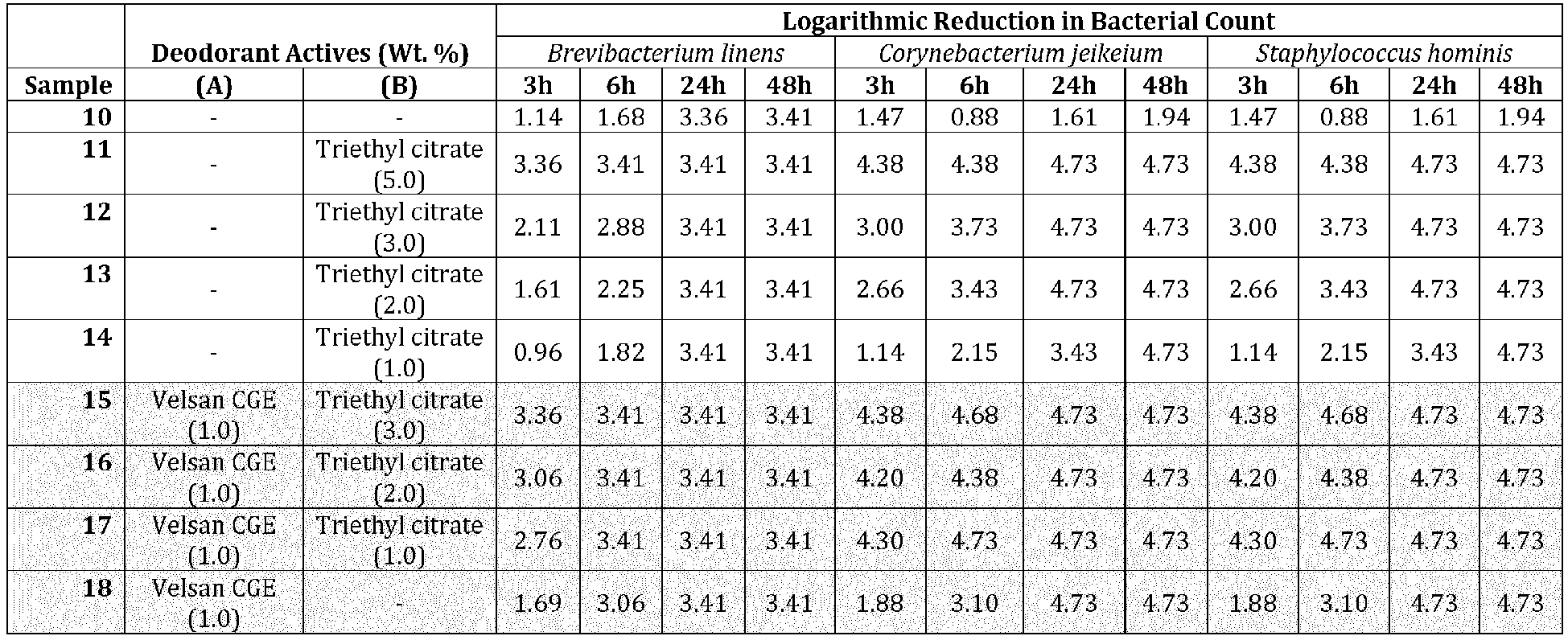
- Test System 2 was used to prepare Example 3 (Samples 19-27), Example 4 (Samples 28-36), and Example 5 (Samples 37-45).
-
Phase Ingredients Weight Percent A Cetiol MM (Myrisyl Myristate) 1.00 % Lanette 0 (Cetearyl Alcohol) 2.00 % Isopropyl Palmitate 1.00 % Imwitor 372 P (Glyceryl Stearate Citrate) 3.00 % B Zinc ricinoleate Q.s. Triethyl citrate Q.s. Velsan CGE (Caprylyl Glyceryl Ether) Q.s. or Velsan EHG S (Ethylhexylglycerin) C Xanthan Gum FNCSP-PC (Xantham Gum) 0.50 % Glycerin 3.00 % D-Panthenol 1.00 % Water ad 100 % -

-

-

- Test System 3 was used to prepare Example 6 (Samples 46-52).
Phase Ingredients Weight Percent A Cetiol MM (Myrisyl Myristate) 1.00 % Lanette 0 (Cetearyl Alcohol) 2.00 % Isopropyl Palmitate 1.00 % Imwitor 372 P (Glyceryl Stearate Citrate) 3.00 % B Velsan Flex Q.s. C Xanthan Gum FNCSP-PC (Xantham Gum) 0.50 % Glycerin 3.00 % D-Panthenol 1.00 % Water ad 100 % -

- The samples containing at least one deodorant active (A) or (B) (Samples 2-8, 11-18, 20-27, 29-36, 38-45, and 47-52) consistently resulted in a larger logarithmic decrease in bacterial count, particularly for the first six hours, than the samples that did not contain a deodorant active (Samples 1, 10, 19, 28, 37, and 46).
- The data further reveal that the antibacterial properties of the deodorant actives (A) are generally superior to those of the deodorant actives (B), especially for the first six hours. For instance, the samples containing only 1.0 wt.-% of Velsan CGE or Velsan EHG S (Samples 9, 18, 27, 36, and 45) were all more effective at inhibiting bacterial growth than the samples containing only 1.0 wt.-% of zinc ricinoleate or triethyl citrate (Samples 4, 14, 22, 32, and 40), up to at least the 6-hour mark. The samples containing only Velsan Flex (Example 6, Samples 47-52) exhibited dramatically reduced bacterial growth, especially for the first six hours, even at relatively low doses (e.g., Samples 48 and 49).
- Most importantly, however, the data indicate that certain compositions comprising a combination of deodorant actives (A) and (B) display an enhanced antibacterial effect relative to compositions containing only deodorant active (A) or deodorant active (B). Specifically, Samples 6-8, 15-17, 24-26, 33-35, and 42-44, which contained zinc ricinoleate or triethyl citrate (a deodorant active (B)) plus Velsan CGE or Velsan EHG S (a deodorant active (A)), showed improved bacterial growth inhibition relative to the samples containing only a deodorant active (B) (Samples 2-5, 11-14, 20-23, 29-32, and 38-41) or a deodorant active (A) (Samples 9, 18, 27, 36, and 45).
- The above-described effect is most significant for at least the first six hours, but in many cases is observed even longer. As shown by the data, the "boost" in activity provided by the combination of the two deodorant actives means that the same antibacterial effect can be achieved at an overall lower dose of active ingredients.
- Finally, the deodorant actives and combinations thereof appear to show some selectivity for certain bacterial species. In particular, the inhibition of Staphylococcus hominis is much less remarkable compared to the other bacterial species tested.
- It will be apparent to those skilled in the art that various modifications and variations can be made to the embodiments described herein without departing from the spirit and scope of the claimed subject matter. Thus, it is intended that the specification cover the modifications and variations of the various embodiments described herein provided such modification and variations come within the scope of the appended claims and their equivalents.
Claims (15)
- An antimicrobial composition comprising(A) at least one compound selected from glyceryl ethers, glyceryl esters, sorbitan esters, isosorbide esters, and N-methyl cyclic glucamides according to formula (I),
 (B) at least one further substance that is active against body odor.
 - The composition according to claim 1, wherein the composition comprises (A) at least one glyceryl ether selected froma monoether of glycerin and a C6-C20 fatty alcohol; anda diether of glycerin and one or more C6-C20 fatty alcohols.
- The composition according to claim 1 or 2, wherein the composition comprises (A) at least one glyceryl ether selected from caprylyl glyceryl ether, ethylhexylglycerin, and methylheptylglycerin.
- The composition according to any one of claims 1 to 3, wherein (B) is selected from zinc ricinoleate, triethyl citrate, and mixtures thereof.
- The composition according to any one of claims 1 to 4, wherein the composition comprises (A) at least one glyceryl ester selected from glyceryl caprylate and glyceryl caprate.
- The composition according to any one of claims 1 to 5, wherein the composition comprises (A) at least one sorbitan ester selected froma monoester of sorbitan and a C6-C20 fatty acid;a diester of sorbitan and one or more C6-C20 fatty acids; anda triester of sorbitan and one or more C6-C20 fatty acids.
- The composition according to any one of claims 1 to 6, wherein the composition comprises (A) at least one sorbitan ester selected from sorbitan caprylate, sorbitan stearate, sorbitan olivate, sorbitan oleate, sorbitan caprate, sorbitan laurate, sorbitan myristate, and sorbitan caproate.
- The composition according to any one of claims 1 to 7, wherein the composition comprises (A) at least one isosorbide ester selected froma monoester of isosorbide and a C6-C20 fatty acid; anda diester of isosorbide and one or more C6-C20 fatty acids.
- The composition according to any one of claims 1 to 8, wherein the composition comprises (A) at least one N-methyl cyclic glucamide according to Formula (I) wherein R in Formula (I) is a saturated hydrocarbon chain having 5 to 17 carbon atoms or an unsaturated hydrocarbon chain having 5 to 17 carbon atoms.
- The composition according to any one of claims 1 to 9, wherein the composition is a blend comprising from 20 wt.-% to 70 wt.-% of (A) and from 30 wt.-% to 80 wt.-% of (B), based on the total weight of (A) and (B) in the blend.
- The composition according to any one of claims 1 to 10, wherein the composition is a blend comprising (A) and (B) in a weight-to-weight ratio of from 10:1 to 1:10.
- A method of improving the action of an antiperspirant or a deodorant, wherein the method comprises adding to the antiperspirant or the deodorant at least one compound selected from glyceryl ethers, glyceryl esters, sorbitan esters, isosorbide esters, and N-methyl cyclic glucamides according to formula (I),

- A formulation comprising(A) from 0.1 wt.-% to 10 wt.-%, based on the total weight of the formulation, of at least one compound selected from glyceryl ethers, glyceryl esters, sorbitan esters, isosorbide esters, and N-methyl cyclic glucamides according to formula (I),
 (B) from 0.1 wt.-% to 10 wt.-%, based on the total weight of the formulation, of at least one further substance that is active against body odor.
 - The formulation according to claim 13, wherein (A) is caprylyl glyceryl ether and (B) is selected from zinc ricinoleate, triethyl citrate, and mixtures thereof.
- Use of at least one compound selected from glyceryl ethers, glyceryl esters, sorbitan esters, isosorbide esters, and N-methyl cyclic glucamides according to formula (I),

in an antiperspirant or a deodorant.
Priority Applications (2)
| Application Number | Priority Date | Filing Date | Title |
|---|---|---|---|
| EP24176810.0A EP4424298A3 (en) | 2024-05-18 | 2024-05-18 | Antimicrobial compositions |
| PCT/EP2025/063610 WO2025242577A2 (en) | 2024-05-18 | 2025-05-16 | Antimicrobial compositions |
Applications Claiming Priority (1)
| Application Number | Priority Date | Filing Date | Title |
|---|---|---|---|
| EP24176810.0A EP4424298A3 (en) | 2024-05-18 | 2024-05-18 | Antimicrobial compositions |
Publications (2)
| Publication Number | Publication Date |
|---|---|
| EP4424298A2 true EP4424298A2 (en) | 2024-09-04 |
| EP4424298A3 EP4424298A3 (en) | 2025-04-09 |
Family
ID=91186687
Family Applications (1)
| Application Number | Title | Priority Date | Filing Date |
|---|---|---|---|
| EP24176810.0A Withdrawn EP4424298A3 (en) | 2024-05-18 | 2024-05-18 | Antimicrobial compositions |
Country Status (2)
| Country | Link |
|---|---|
| EP (1) | EP4424298A3 (en) |
| WO (1) | WO2025242577A2 (en) |
Cited By (1)
| Publication number | Priority date | Publication date | Assignee | Title |
|---|---|---|---|---|
| WO2026021724A1 (en) * | 2024-07-22 | 2026-01-29 | Beiersdorf Ag | Selective deodorant comprising methylheptylglycerin |
Family Cites Families (18)
| Publication number | Priority date | Publication date | Assignee | Title |
|---|---|---|---|---|
| DE102004032734A1 (en) * | 2004-03-18 | 2005-10-06 | Henkel Kgaa | Prebiotic substances for deodorants |
| DE102005012476A1 (en) * | 2005-03-16 | 2006-09-21 | Henkel Kgaa | Use of a substance in cosmetic deodorant composition or antitranspirant composition to reduce body odor, by inhibiting Staphylococcus hominis |
| US20070092463A1 (en) * | 2005-10-26 | 2007-04-26 | Kim Joo W | Semi (soft)-solid antiperspirant compositions |
| DE102009022444A1 (en) * | 2009-05-23 | 2010-01-07 | Clariant International Limited | Liquid composition, useful to preserve e.g. cream, comprises sorbitan monocaprylate and antimicrobial agent comprising organic acid and its salts, formaldehyde donor, isothiazolinone, paraben ester and its salts and pyridone and its salts |
| DE202010011395U1 (en) * | 2010-08-13 | 2010-11-11 | Beiersdorf Ag | Stabilized W / O emulsions |
| BR112014002670A2 (en) * | 2011-08-04 | 2017-03-01 | Clariant Int Ltd | use of isosorbide monoesters as antimicrobially active compounds |
| DE102011119033A1 (en) * | 2011-11-22 | 2012-09-06 | Clariant International Ltd. | Use of a composition comprising isosorbide caprylate/caprate in antiperspirant and deodorant to improve their effect for reducing the body odor |
| CN104487047A (en) * | 2012-05-08 | 2015-04-01 | 默克专利股份有限公司 | Use of cyclohexanol ethers having antimicrobial properties |
| DE102014217316A1 (en) * | 2014-08-29 | 2016-03-03 | Henkel Ag & Co. Kgaa | Low-electrolyte preparations against body odor |
| AU2017285148B2 (en) * | 2016-06-17 | 2019-05-16 | Unilever Global Ip Limited | Deodorant products |
| US10758476B1 (en) * | 2017-09-18 | 2020-09-01 | Type A Brands, Llc | Deodorant with sweat-activated technology |
| FR3108034B1 (en) * | 2020-03-11 | 2022-09-09 | Hyteck | Deodorant composition |
| EP3944852A1 (en) * | 2020-07-28 | 2022-02-02 | Clariant International Ltd | Use of a booster to enhance the anti-dandruff or preservative activity of piroctone olamine |
| WO2022122137A1 (en) * | 2020-12-09 | 2022-06-16 | Symrise Ag | Compositions comprising antimicrobials and (bio)-alkanediols for skin protection |
| WO2022128882A1 (en) * | 2020-12-17 | 2022-06-23 | Evonik Dr. Straetmans Gmbh | N-heptyl-glyceryl ether and synergistically active preservatives |
| EP4091675A1 (en) * | 2021-07-19 | 2022-11-23 | Clariant International Ltd | Cosmetic composition comprising piroctone and a fragrance |
| EP4408385A1 (en) * | 2021-10-01 | 2024-08-07 | Clariant International Ltd | Sugar amides and mixtures thereof |
| CH720165A2 (en) * | 2022-10-26 | 2024-04-30 | Chemtek Ug | Compositions with N-acylglycamines |
-
2024
- 2024-05-18 EP EP24176810.0A patent/EP4424298A3/en not_active Withdrawn
-
2025
- 2025-05-16 WO PCT/EP2025/063610 patent/WO2025242577A2/en active Pending
Cited By (1)
| Publication number | Priority date | Publication date | Assignee | Title |
|---|---|---|---|---|
| WO2026021724A1 (en) * | 2024-07-22 | 2026-01-29 | Beiersdorf Ag | Selective deodorant comprising methylheptylglycerin |
Also Published As
| Publication number | Publication date |
|---|---|
| EP4424298A3 (en) | 2025-04-09 |
| WO2025242577A3 (en) | 2026-01-02 |
| WO2025242577A2 (en) | 2025-11-27 |
Similar Documents
| Publication | Publication Date | Title |
|---|---|---|
| US20120251460A1 (en) | Use of vanillin derivatives as a preservative, preservation method, compounds, and composition | |
| KR101189344B1 (en) | Self-preserving skin care formulation | |
| US8629180B2 (en) | Antiseptic agent composition | |
| JP7608217B2 (en) | Composition for topical application to the skin | |
| US20180360712A1 (en) | Cosmetic composition and use thereof | |
| WO2025242577A2 (en) | Antimicrobial compositions | |
| KR20190001136A (en) | Composition of face-lifting pack for improving skin condition comprising oligopeptides | |
| JP2016027033A (en) | Composition for external application, ophthalmic composition, antibacterial agent, and antibacterial method | |
| JP4915713B2 (en) | Antibacterial composition | |
| KR101705805B1 (en) | Antibacterial or preservative composition containing 3-butoxy-1,2-propanediol | |
| CN117815158A (en) | Repairing and whitening composition and preparation method thereof | |
| EP3988079A1 (en) | Preservative for externally-applied dermal preparation, and cosmetic composition and pharmaceutical composition each comprising same | |
| KR101702648B1 (en) | A preservative for skin external application, and a cosmetic composition and a pharmaceutical composition comprising the same | |
| CN118922167A (en) | Skin lightening compositions | |
| WO2021056522A1 (en) | Cosmetic composition for caring for keratin materials | |
| KR101945987B1 (en) | A preservative comprising tyrosol for skin external application, and a cosmetic composition and a pharmaceutical composition comprising the same | |
| CN114869790A (en) | Antioxidant composition containing ferulic acid and skin care product and application thereof | |
| JPH05286843A (en) | Skin cosmetic containing culture mixture of suehirotake @(3754/24)schizophyllum commue) | |
| KR20220058468A (en) | A preservative comprising alkanediol, and caprylyl glyceryl ether or ethylhexyl glycerin for skin external application, and a cosmetic composition comprising the same | |
| KR20170001067A (en) | A preservative for skin external application, and a cosmetic composition and a pharmaceutical composition comprising the same | |
| JP2003533458A (en) | Use of N, N'-dibenzylethylenediamine-N, N'-diacetate derivatives as antifouling agents | |
| US20250090435A1 (en) | Preservatives for cosmetic and pharmaceutical compositions | |
| JP2002114660A (en) | Malodor generation suppressing composition | |
| JP2004067626A (en) | External preparation composition | |
| JP2024083777A (en) | Composition |
Legal Events
| Date | Code | Title | Description |
|---|---|---|---|
| PUAI | Public reference made under article 153(3) epc to a published international application that has entered the european phase |
Free format text: ORIGINAL CODE: 0009012 |
|
| STAA | Information on the status of an ep patent application or granted ep patent |
Free format text: STATUS: THE APPLICATION HAS BEEN PUBLISHED |
|
| AK | Designated contracting states |
Kind code of ref document: A2 Designated state(s): AL AT BE BG CH CY CZ DE DK EE ES FI FR GB GR HR HU IE IS IT LI LT LU LV MC ME MK MT NL NO PL PT RO RS SE SI SK SM TR |
|
| RIC1 | Information provided on ipc code assigned before grant |
Ipc: A61Q 15/00 20060101ALI20241122BHEP Ipc: A61K 8/49 20060101ALI20241122BHEP Ipc: A61K 8/37 20060101ALI20241122BHEP Ipc: A61K 8/36 20060101ALI20241122BHEP Ipc: A61K 8/33 20060101ALI20241122BHEP Ipc: A61K 8/27 20060101AFI20241122BHEP |
|
| PUAL | Search report despatched |
Free format text: ORIGINAL CODE: 0009013 |
|
| AK | Designated contracting states |
Kind code of ref document: A3 Designated state(s): AL AT BE BG CH CY CZ DE DK EE ES FI FR GB GR HR HU IE IS IT LI LT LU LV MC ME MK MT NL NO PL PT RO RS SE SI SK SM TR |
|
| RIC1 | Information provided on ipc code assigned before grant |
Ipc: A61Q 15/00 20060101ALI20250305BHEP Ipc: A61K 8/49 20060101ALI20250305BHEP Ipc: A61K 8/37 20060101ALI20250305BHEP Ipc: A61K 8/36 20060101ALI20250305BHEP Ipc: A61K 8/33 20060101ALI20250305BHEP Ipc: A61K 8/27 20060101AFI20250305BHEP |
|
| STAA | Information on the status of an ep patent application or granted ep patent |
Free format text: STATUS: THE APPLICATION HAS BEEN WITHDRAWN |
|
| 18W | Application withdrawn |
Effective date: 20250528 |