EP4423884B1 - Kühlmittelversorgungssystem für eine elektrisch betriebene fahrzeugachse - Google Patents
Kühlmittelversorgungssystem für eine elektrisch betriebene fahrzeugachse Download PDFInfo
- Publication number
- EP4423884B1 EP4423884B1 EP22758165.9A EP22758165A EP4423884B1 EP 4423884 B1 EP4423884 B1 EP 4423884B1 EP 22758165 A EP22758165 A EP 22758165A EP 4423884 B1 EP4423884 B1 EP 4423884B1
- Authority
- EP
- European Patent Office
- Prior art keywords
- coolant
- transmission
- sump
- stator housing
- slosh
- Prior art date
- Legal status (The legal status is an assumption and is not a legal conclusion. Google has not performed a legal analysis and makes no representation as to the accuracy of the status listed.)
- Active
Links
Images


Classifications
-
- H—ELECTRICITY
- H02—GENERATION; CONVERSION OR DISTRIBUTION OF ELECTRIC POWER
- H02K—DYNAMO-ELECTRIC MACHINES
- H02K9/00—Arrangements for cooling or ventilating
- H02K9/19—Arrangements for cooling or ventilating for machines with closed casing and closed-circuit cooling using a liquid cooling medium, e.g. oil
-
- B—PERFORMING OPERATIONS; TRANSPORTING
- B60—VEHICLES IN GENERAL
- B60K—ARRANGEMENT OR MOUNTING OF PROPULSION UNITS OR OF TRANSMISSIONS IN VEHICLES; ARRANGEMENT OR MOUNTING OF PLURAL DIVERSE PRIME-MOVERS IN VEHICLES; AUXILIARY DRIVES FOR VEHICLES; INSTRUMENTATION OR DASHBOARDS FOR VEHICLES; ARRANGEMENTS IN CONNECTION WITH COOLING, AIR INTAKE, GAS EXHAUST OR FUEL SUPPLY OF PROPULSION UNITS IN VEHICLES
- B60K11/00—Arrangement in connection with cooling of propulsion units
- B60K11/02—Arrangement in connection with cooling of propulsion units with liquid cooling
-
- H—ELECTRICITY
- H02—GENERATION; CONVERSION OR DISTRIBUTION OF ELECTRIC POWER
- H02K—DYNAMO-ELECTRIC MACHINES
- H02K1/00—Details of the magnetic circuit
- H02K1/06—Details of the magnetic circuit characterised by the shape, form or construction
- H02K1/22—Rotating parts of the magnetic circuit
- H02K1/32—Rotating parts of the magnetic circuit with channels or ducts for flow of cooling medium
-
- H—ELECTRICITY
- H02—GENERATION; CONVERSION OR DISTRIBUTION OF ELECTRIC POWER
- H02K—DYNAMO-ELECTRIC MACHINES
- H02K7/00—Arrangements for handling mechanical energy structurally associated with dynamo-electric machines, e.g. structural association with mechanical driving motors or auxiliary dynamo-electric machines
- H02K7/10—Structural association with clutches, brakes, gears, pulleys or mechanical starters
- H02K7/116—Structural association with clutches, brakes, gears, pulleys or mechanical starters with gears
-
- H—ELECTRICITY
- H02—GENERATION; CONVERSION OR DISTRIBUTION OF ELECTRIC POWER
- H02K—DYNAMO-ELECTRIC MACHINES
- H02K9/00—Arrangements for cooling or ventilating
- H02K9/19—Arrangements for cooling or ventilating for machines with closed casing and closed-circuit cooling using a liquid cooling medium, e.g. oil
- H02K9/193—Arrangements for cooling or ventilating for machines with closed casing and closed-circuit cooling using a liquid cooling medium, e.g. oil with provision for replenishing the cooling medium; with means for preventing leakage of the cooling medium
-
- H—ELECTRICITY
- H02—GENERATION; CONVERSION OR DISTRIBUTION OF ELECTRIC POWER
- H02K—DYNAMO-ELECTRIC MACHINES
- H02K9/00—Arrangements for cooling or ventilating
- H02K9/19—Arrangements for cooling or ventilating for machines with closed casing and closed-circuit cooling using a liquid cooling medium, e.g. oil
- H02K9/197—Arrangements for cooling or ventilating for machines with closed casing and closed-circuit cooling using a liquid cooling medium, e.g. oil in which the rotor or stator space is fluid-tight, e.g. to provide for different cooling media for rotor and stator
-
- H—ELECTRICITY
- H02—GENERATION; CONVERSION OR DISTRIBUTION OF ELECTRIC POWER
- H02K—DYNAMO-ELECTRIC MACHINES
- H02K2213/00—Specific aspects, not otherwise provided for and not covered by codes H02K2201/00 - H02K2211/00
- H02K2213/03—Machines characterised by numerical values, ranges, mathematical expressions or similar information
Definitions
- the invention relates to a coolant supply system for a drive device of an electrically operated vehicle axle of a two-track vehicle according to the preamble of claim 1 or according to the preamble of claim 10.
- an electrically driven vehicle axle can have an electric motor. This can be arranged axially parallel to the flange shafts leading to the vehicle wheels.
- the electric motor can drive the power via a single or double spur gear stage to an axle differential and then to the flange shafts of the vehicle axle leading to the vehicle wheels.
- Such an electric machine can be implemented as a wet-running electric machine with a cylindrical stator housing.
- a stator/rotor assembly is installed in the stator housing.
- a winding head chamber is located axially on both sides of the stator/rotor assembly, at the bottom of which coolant collects and drains into a coolant sump.
- the two winding chambers are fluidly connected to each other via the coolant sump.
- the coolant sump is located centrally, vertically aligned below the rotor axis, at the lowest point.
- the coolant sump extends essentially over the entire axial length of the stator housing.
- Such a stator housing geometry is problematic with regard to package optimization, since the stator housing height and the coolant sump height add up to a comparatively large overall height. Reducing the overall height by reducing the coolant sump flow cross-section is not possible in terms of coolant sump functionality. Furthermore, such a reduction in the coolant sump flow cross-section is not easily feasible from a manufacturing (i.e., casting) perspective.
- the CN 112 271 876 A discloses a coolant supply system.
- DE 11 2011 103349 T5 A coolant drain system and method for an electrical machine are known.
- EP 3 411 941 B1 discloses a cooling device for an electrical machine.
- CN 109 997 296 A A rotor, an electrical machine and a method for producing a rotor are known.
- CA 2 116 900 A1 discloses a generic coolant supply system.
- the object of the invention is to provide a coolant supply system for a drive device of an electrically operated vehicle axle of a two-track vehicle, which has a reduced installation space requirement in the electric machine vertical direction compared to the prior art.
- the coolant sump can extend continuously over the entire axial length of the stator housing in the axial direction of the stator housing. Furthermore, the coolant sump is designed as follows with regard to different driving conditions, such as acceleration, cornering, uphill or downhill driving: According to the invention, the coolant sump is divided into two slosh channels. These are arranged with a transverse offset on both sides of the rotor axis vertical plane.
- the electric motor is installed transversely, parallel to the vehicle axle.
- a first extraction point can be positioned on the left side of the vehicle, while a second extraction point can be positioned on the right side of the vehicle.
- the coolant in the coolant sump or in the slosh channels
- the coolant in the coolant sump or in the slosh channels
- the coolant in the coolant sump is displaced towards the left-hand extraction point due to centrifugal force. Therefore, when cornering, the coolant can be reliably returned to the coolant tank either from the first extraction point or from the second extraction point.
- the two slosh channels also ensure reliable coolant circulation when the vehicle is traveling uphill or downhill.
- the slosh channel at the rear ensures fluid communication between the winding head chambers.
- the slosh channel at the front ensures fluid communication between the winding head chambers.
- the electric motor can drive via a single or double spur gear stage to an axle differential and from there to the flange shafts of the vehicle axle leading to the vehicle wheels.
- the coolant supply system also has a transmission hydraulic circuit.
- the coolant tank, the transmission interior, and a transmission sump formed on the transmission floor can be integrated into the transmission hydraulic circuit.
- the transmission sump the coolant draining from the transmission components is collected at a transmission extraction point and from there returned to the coolant tank with the aid of a transmission return pump.
- the transmission can be flange-mounted directly to one of the stator housing axial sides of the electric motor, so that the stator housing is axially extended with the transmission housing.
- an end wall of the stator housing near the gearbox can have a coolant passage. This connects the winding head space near the gearbox with the gearbox sump.
- the coolant passage can, for example, be positioned vertically aligned with the rotor axis. In this way, the gearbox-side extraction point can perform a dual function, extracting not only the coolant collecting in the gearbox sump, but also the coolant transferred from the stator housing.
- the slosh channels are each connected to the coolant passages with the respective winding head space. Furthermore, it is preferred if at least one of the two slosh channels is connected to the transmission sump via a channel opening.
- the two extraction points can be positioned in a diagonal arrangement described below.
- the transmission-side extraction point can be positioned on a common side with respect to the vertical plane of the rotor axis, together with the slosh channel formed by the channel opening.
- the transmission-remote extraction point and the slosh channel not connected to the transmission sump can be arranged on the opposite side of the vertical plane of the rotor axis.
- each of the two extraction points can be assigned a return pump.
- the return pumps can be arranged on a common stator housing axial side, in particular together with the transmission.
- the extraction point arranged on a stator housing axial side remote from the pump or transmission can be connected to an electric machine return pump via a return line.
- the stator housing can be realized as a single cast part, onto which the slosh channels, the return line, and the transverse channel described later are formed as a single piece.
- the return line and the two slosh channels can extend parallel to the rotor axis.
- a transverse channel can be formed on one of the stator housing axial sides, particularly on the stator housing axial side remote from the gearbox.
- the two slosh channels and preferably the return line open into the transverse channel.
- the transverse channel can establish a flow connection between the two slosh channels and the winding head space.
- the cross channel is connected to the winding head chamber via a coolant passage.
- the cross channel can not only provide a flow connection but also serve as a receiving chamber. in which a sieve element can be inserted to filter the coolant flowing through.
- a coolant supply system for a drive device of an electrically operated vehicle axle with an electric machine which has a cylindrical stator housing in which a winding head chamber is located axially on both sides of a rotor/stator arrangement, at the bottom of which winding head chamber coolant collects, wherein the two winding head chambers are fluidically connected to one another via a coolant sump, and wherein the stator housing height and the coolant sump height in the vertical direction of the electric machine add up to a total height, and wherein, to reduce the total height, the coolant sump is offset by a transverse offset from a rotor axis vertical plane, so that the stator housing height and the coolant sump height in the vertical direction of the electric machine at least partially overlap by an overlap dimension, wherein an electric machine hydraulic circuit is provided in which the coolant sump is integrated, from which coolant can be returned to a coolant tank at suction points by means of at least one return pump.
- a coolant sump is integrated, from which coolant can
- a drive device for a vehicle axle of a two-track vehicle is indicated.
- the drive device has an electric machine which is arranged in a transverse installation axially parallel to the flange shafts 3 leading to the vehicle wheels.
- a stator 4 with a cooperating rotor 5 is arranged in a stator housing 2 of the electric machine.
- the rotor shaft 6 is rotatably mounted in bearing openings on axially opposite housing walls 8, 9 of the stator housing 2.
- the rotor shaft 6 of the electric machine is connected in a rotationally fixed manner, for example via a spline, to a transmission input shaft 17 of a transmission 19.
- the transmission 19 is implemented as a two-stage spur gear that drives to an axle differential 20.
- the axle differential 20 is positioned outside a transmission housing 21. In fact, the axle differential 20 can be positioned together with the two-stage spur gear within the transmission housing 21.
- the stator 4 has a plurality of stator windings, of which in the Fig. 1 only two stator windings 21 are roughly indicated.
- Each stator winding 21 has a winding head on each axial side, which projects into a winding head chamber 27.
- Each winding head chamber 27 is integrated into an electric machine hydraulic circuit E, described later, with the aid of which the respective winding head chamber 27 can be supplied with coolant in order to cool the winding heads of the stator 4.
- a coolant/air mixture moves in a vortex flow around the rotor shaft 5, which rotates at high speed.
- the electric machine hydraulic circuit E has a coolant tank 35, which is connected via a suction line to a suction pump 37.
- a pressure line leads from the suction pump 37 to coolant supply lines 41, 43.
- coolant is fed into a radially outer circumferential annular gap 45.
- the coolant is guided via radially outer stator channels 47 to a further annular gap 49 in the right-hand winding head space 27.
- the two annular gaps 45, 47 are separated from the respective Winding head space 27 is separated.
- Each of the splash rings 44 has nozzles 46 distributed in the circumferential direction, through which coolant (i.e., oil) can be injected into the respective winding head space 27.
- coolant is guided through the rotor shaft 6 and via a flow connection 51 into radially inner stator channels 53 up to the right winding head space 27.
- coolant is spun radially outward toward the winding heads from the flow connection 51 and from the right opening of the radially inner stator channels 53.
- the two winding head spaces 27 are essentially coolant-tightly separated from each other in the stator housing interior by means of the stator/rotor arrangement.
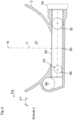
- two slosh channels 54, 55 ( Fig. 2 ) are provided, which extend on the outside of the stator housing in the axial direction over the entire axial length of the stator housing.
- Each of the two slosh channels 54, 55 is arranged with a transverse offset ⁇ x relative to a rotor axis vertical plane V. In this way, the stator housing height h 1 partially overlaps the slosh channel height h 2 in the electric machine vertical direction z by an overlap dimension ⁇ z. The total height h total is therefore reduced by the overlap dimension ⁇ z.
- the gearbox 19 is flanged to the left axial side of the stator housing.
- An interior of the gearbox 19 and a gearbox sump 56 formed on the gearbox base are integrated into a gearbox hydraulic circuit G.
- the coolant draining from the gearbox components collects at a gearbox-side suction point A1.
- the gearbox-side suction point A1 is connected via a return line 67 to a gearbox return pump 58, which returns coolant to the coolant tank 35.
- a coolant passage 60 is formed in the housing end wall 8 of the stator housing 2 near the gearbox. This connects the winding head space 27 near the gearbox with the gearbox sump 56.
- the Coolant passage 60 is in the Figure 1 or 2 positioned in vertical alignment with the rotor axis R.
- the rear slosh channel 55 in the direction of travel FR is connected via a channel opening 61 ( Figure 2 ) in direct flow connection with the transmission sump 56, while the front slosh channel 54 in the direction of travel FR has no direct connection to the transmission sump 56.
- the two slosh channels 54, 55 are in the Fig. 2 also connected to the winding head space 27 near the gear unit via coolant passages 48, 50.
- the electric motor is installed transversely, parallel to the vehicle axle.
- the transmission-side extraction point A1 is positioned on the left side of the vehicle, while an extraction point A2 away from the transmission is positioned on the right side of the vehicle.
- the coolant is displaced by centrifugal force via the slosh channels 54, 55 towards the right extraction point A2.
- the coolant is displaced by centrifugal force via the slosh channels 54, 55 towards the left extraction point A1. Therefore, when cornering, the coolant can be reliably returned to the coolant tank 35 either via the left extraction point A1 or via the right extraction point A2.
- a transverse channel 65 is formed on the stator housing base, into which the two slosh channels 54, 55 and the return line 66 described later open.
- the transverse channel 65 establishes a flow connection between the two slosh channels 54, 55 and the winding head space 27 remote from the gearbox.
- the transverse channel 65 is connected to the winding head space 27 remote from the gearbox at a coolant passage 69.
- a sieve element 64 can also be inserted into the transverse channel 65 to filter the coolant flowing through.
- the suction pump 37, the gear return pump 58, and an electric machine return pump 71 are components of a multiple pump (combination pump).
- the individual pumps are driven by a common drive shaft.
- the common drive shaft is in turn connected to an electric motor acting as the drive.
- All pumps 37, 58, 71 are in the Figure 1 Positioned in a space-saving manner on the left axial side of the stator housing.
- the suction point A2 located on the axial side of the stator housing remote from the pump, is connected to the electric machine return pump 71 via the return line 66.
- the return line 66 is aligned axially parallel to the two slosh channels 54, 55.
- the stator housing 2 can preferably be realized as a cast part, onto which both the two slosh channels 54, 55 and the return line 66 are formed integrally and from the same material.
- the two extraction points A1, A2 are positioned diagonally with respect to the rotor axis vertical plane V.
- the transmission-side extraction point A1 and the channel opening 61 of the rear slosh channel 55 in the direction of travel FR are arranged at the rear and on the left side of the vehicle with respect to the rotor axis vertical plane ( Fig. 2 ).
- the extraction point A2 i.e. the outlet opening of the return line 66
- the transmission-side extraction point A1 and the channel opening 61 of the rear slosh channel 55 in the direction of travel FR are arranged at the rear and on the left side of the vehicle with respect to the rotor axis vertical plane ( Fig. 2 ).
- the extraction point A2 i.e. the outlet opening of the return line 66
- the transmission-side extraction point A1 and the channel opening 61 of the rear slosh channel 55 in the direction of travel FR are arranged at the rear and on the left side of the vehicle with respect to the rotor axi
Landscapes
- Engineering & Computer Science (AREA)
- Power Engineering (AREA)
- Chemical & Material Sciences (AREA)
- Combustion & Propulsion (AREA)
- Transportation (AREA)
- Mechanical Engineering (AREA)
- Motor Or Generator Cooling System (AREA)
Description
- Die Erfindung betrifft ein Kühlmittelversorgungssystem für eine Antriebsvorrichtung einer elektrisch betriebenen Fahrzeugachse eines zweispurigen Fahrzeugs nach dem Oberbegriff des Anspruches 1 oder nach dem Oberbegriff des Anspruches 10.
- Bei einem elektrisch betriebenen, zweispurigen Fahrzeug kann beispielhaft eine elektrisch angetriebene Fahrzeugachse eine Elektromaschine aufweisen. Diese kann achsparallel zu den, zu den Fahrzeugrädern geführten Flanschwellen angeordnet sein. In diesem Fall kann die Elektromaschine über eine einfache oder doppelte Stirnrad-Getriebestufe auf ein Achsdifferenzial und weiter auf die zu den Fahrzeugrädern geführten Flanschwellen der Fahrzeug-Fahrzeugachse abtreiben.
- Eine solche Elektromaschine kann als eine nasslaufende Elektromaschine realisiert sein, die ein zylindrisches Statorgehäuse aufweist. In dem Statorgehäuse ist eine Stator-/Rotor-Anordnung eingebaut. Axial beidseitig der Stator-/Rotor-Anordnung befindet sich ein Wickelkopfraum, an dessen Boden sich Kühlmittel sammelt, das in einen Kühlmittelsumpf abläuft. Die beiden Wickelräume sind über den Kühlmittelsumpf miteinander strömungstechnisch verbunden.
- Im Stand der Technik ist der Kühlmittelsumpf in vertikaler Flucht unterhalb der Rotorachse am tiefsten Punkt zentral angeordnet. Der Kühlmittelsumpf erstreckt sich im Wesentlichen über die gesamte Statorgehäuse-Axiallänge. Eine solche Statorgehäuse-Geometrie ist im Hinblick auf eine Package-Optimierung problematisch, da sich die Statorgehäuse-Bauhöhe und die Kühlmittelsumpf-Bauhöhe zu einer vergleichsweise großen Gesamt-Bauhöhe aufaddieren. Eine Reduzierung der Gesamt-Bauhöhe durch eine Verringerung des Kühlmittelsumpf-Strömungsquerschnitts ist im Hinblick auf die Kühlmittelsumpf-Funktionsfähigkeit nicht möglich. Zudem ist eine solche Verringerung des Kühlmittelsumpf-Strömungsquerschnitts aus fertigungstechnischer (das heißt gusstechnischer) Sicht nicht ohne weiteres möglichdurchführbar.
- Aus der
DE 10 2019 114 476 A1 ist eine Ölwanne mit zweigeteiltem Sammelraum bekannt. Aus derDE 2 139 740 A ist eine Ölwanne für einen Motor bekannt. Aus derDE 10 2008 040 691 A1 ist ein Getriebeölraum bekannt. - Die
CN 112 271 876 A offenbart ein Kühlmittelversorgungssystem. Aus derDE 11 2011 103349 T5 sind ein Kühlmittel-Ablasssystem und ein Verfahren für eine elektrische Maschine bekannt. DieEP 3 411 941 B1 offenbart eine Kühlvorrichtung für eine elektrische Maschine. Aus derCN 109 997 296 A sind ein Rotor, eine elektrische Maschine und ein Verfahren zur Herstellung eines Rotors bekannt. DieCA 2 116 900 A1 offenbart ein gattungsgemäßes Kühlmittelversorgungssystem. - Die Aufgabe der Erfindung besteht darin, ein Kühlmittelversorgungssystem für eine Antriebsvorrichtung einer elektrisch betriebenen Fahrzeugachse eines zweispurigen Fahrzeugs bereitzustellen, das im Vergleich zum Stand der Technik einen reduzierten Bauraumbedarf in der Elektromaschinen-Hochrichtung aufweist.
- Die Aufgabe ist durch die Merkmale der unabhängigen Ansprüche gelöst. Bevorzugte Weiterbildungen der Erfindung sind in den Unteransprüchen offenbart.
- Die Erfindung geht von einem Kühlmittelversorgungssystem für eine Antriebsvorrichtung einer elektrisch betriebenen Fahrzeugachse eines zweispurigen Fahrzeugs aus. Die Antriebsvorrichtung weist eine nasslaufende Elektromaschine auf. Die einem zylindrischen Statorgehäuse der Elektromaschine ist eine Rotor-/Stator-Anordnung eingebaut. Beidseitig dieser Rotor-/Stator-Anordnung befindet sich jeweils ein Wickelkopfraum. An dessen Boden sammelt sich Kühlmittel, das in einen Kühlmittelsumpf abläuft. Die beiden Wickelkopfräume sind über den Kühlmittelsumpf miteinander strömungstechnisch verbunden. Gemäß dem kennzeichnenden Teil des Anspruches 1 wird die Gesamt-Bauhöhe der Elektromaschine wie folgt reduziert: so ist der Kühlmittelsumpf um einen Querversatz von einer Rotorachsen-Vertikalebene versetzt positioniert. Auf diese Weise kann sich die Statorgehäuse-Bauhöhe und die Kühlmittelsumpf-Bauhöhe in der Elektromaschinen-Hochrichtung um ein Überlappmaß zumindest teilweise überlagern. Im Vergleich zum Stand der Technik wird somit die Gesamt-Bauhöhe der Elektromaschine um das Überlappmaß reduziert.
- Der Kühlmittelsumpf kann sich in der Statorgehäuse-Axialrichtung durchgängig über die gesamte Statorgehäuse-Axiallänge erstrecken. Zudem ist der Kühlmittelsumpf im Hinblick auf unterschiedliche Fahrbetriebszustände, zum Beispiel einer Beschleunigungsfahrt, einer Kurvenfahrt, einer Bergauf- oder Bergabfahrt wie folgt gestaltet: So ist der Kühlmittelsumpf erfindungsgemäß aufgeteilt in zwei Schwappkanäle. Diese sind jeweils mit Querversatz versetzt beidseitig der Rotorachsen-Vertikalebene angeordnet.
- Die Elektromaschine ist erfindungsgemäß im Quereinbau achsparallel zur Fahrzeugachse verbaut. In diesem Fall kann insbesondere eine erste Absaugstelle auf einer linken Fahrzeugseite positioniert sein, während eine zweite Absaugstelle auf der rechten Fahrzeugseite positioniert sein kann. Bei einer Fahrzeug-Kurvenfahrt nach links verlagert sich daher das Kühlmittel im Kühlmittelsumpf (bzw. in den Schwappkanälen) fliehkraftbedingt in Richtung der rechten Absaugstelle. Im Gegensatz dazu verlagert sich bei einer Kurvenfahrt nach rechts das Kühlmittel im Kühlmittelsumpf (bzw. in den Schwappkanälen) fliehkraftbedingt in Richtung der linken Absaugstelle. Von daher kann das Kühlmittel bei Kurvenfahrten betriebssicher entweder von der ersten Absaugstelle oder von der zweiten Absaugstelle in den Kühlmitteltank rückgeführt werden.
- Durch die beiden Schwappkanäle ist zudem eine betriebssichere Kühlmittel-Umwälzung bei einer Fahrzeug-Bergauffahrt bzw. einer Fahrzeug-Bergabfahrt gewährleistet. In der Bergauffahrt gewährleistet der in Fahrtrichtung hintere Schwappkanal eine strömungstechnische Verbindung zwischen den Wickelkopfräumen. In der Bergabfahrt gewährleistet der in der Fahrtrichtung vordere Schwappkanal eine strömungstechnische Verbindung zwischen den Wickelkopfräumen.
- In der Fahrzeugachse kann die Elektromaschine über eine einfache oder doppelte Stirnrad-Getriebestufe auf ein Achsdifferential und von dort weiter auf die zu den Fahrzeugrädern geführten Flanschwellen der Fahrzeugachse abtreiben. In diesem Fall ist es bevorzugt, wenn das Kühlmittelversorgungssystem zusätzlich einen Getriebe-Hydraulikkreis aufweist. In dem Getriebe-Hydraulikkreis kann der Kühlmitteltank, der Getriebe-Innenraum und ein am Getriebeboden ausgebildeter Getriebe-Sumpf eingebunden sein. Im Getriebe-Sumpf wird das von Getriebekomponenten ablaufende Kühlmittel an einer Getriebe-Absaugstelle gesammelt und von dort mit Hilfe einer Getriebe-Rückführpumpe in den Kühlmitteltank rückgeführt. Das Getriebe kann unmittelbar an einer der Statorgehäuse-Axialseiten der Elektromaschine angeflanscht sein, so dass das Statorgehäuse mit dem Getriebegehäuse axial verlängert ist.
- In einer bevorzugten Ausführungsvariante kann eine getriebenahe Stirnwand des Statorgehäuses einen Kühlmittel-Durchtritt aufweisen. Dieser verbindet den getriebenahen Wickelkopfraum mit dem Getriebe-Sumpf. Der Kühlmittel-Durchtritt kann beispielhaft in Vertikalflucht zur Rotorachse positioniert sein. Auf diese Weise kann die getriebeseitige Absaugstelle in Doppelfunktion nicht nur das sich im Getriebe-Sumpf sammelnde Kühlmittel, sondern auch das vom Statorgehäuse übergeleitete Kühlmittel absaugen.
- Im Hinblick auf eine einwandfreie Strömungsverbindung zwischen den beiden voneinander axial beabstandeten Wickelkopfräumen ist es bevorzugt, wenn die Schwappkanäle jeweils an Kühlmittel-Durchtritten mit dem jeweiligen Wickelkopfraum verbunden sind. Zudem ist es bevorzugt, wenn zumindest einer der beiden Schwappkanäle über eine Kanalöffnung mit dem Getriebe-Sumpf verbunden ist.
- In einer besonders bevorzugten Ausführungsvariante können die beiden Absaugstellen in einer nachfolgend beschriebenen Diagonalanordnung positioniert sein. In diesem Fall kann die getriebeseitige Absaugstelle zusammen mit der Kanalöffnung ausgebildeten Schwappkanal mit Bezug auf die Rotorachsen-Vertikalebene auf einer gemeinsamen Seite positioniert sein. Demgegenüber kann die getriebeferne Absaugstelle sowie der nicht mit dem Getriebe-Sumpf verbundene Schwappkanal auf der gegenüberliegenden Seite der Rotorachsen-Vertikalebene angeordnet sein. Bevorzugt kann jeder der beiden Absaugstellen jeweils eine Rückführpumpe zugeordnet sein. In einer bauraumgünstigen Ausführungsvariante können die Rückführpumpen an einer gemeinsamen Statorgehäuse-Axialseite angeordnet sein, und zwar insbesondere zusammen mit dem Getriebe. Die an einer pumpenfernen bzw. getriebefernen Statorgehäuse-Axialseite angeordnete Absaugstelle kann in diesem Fall über eine Rückführleitung mit einer Elektromaschinen-Rückführpumpe verbunden sein. Das Statorgehäuse kann als ein Gussteil realisiert sein, an dem die Schwappkanäle sowie die Rückführleitung und der später beschriebene Querkanal materialeinheitlich sowie einstückig angeformt sind. Die Rückführleitung sowie die beiden Schwappkanäle können sich achsparallel zur Rotorachse erstrecken.
- An einer der Statorgehäuse-Axialseiten, insbesondere an der getriebefernen Statorgehäuse-Axialseite, kann ein Querkanal ausgebildet sein. In den Querkanal münden die beiden Schwappkanäle sowie bevorzugt die Rückführleitung. Der Querkanal kann eine Strömungsverbindung zwischen den beiden Schwappkanälen und dem Wickelkopfraum herstellen.
- Hierzu ist der Querkanal an einem Kühlmittel-Durchtritt mit dem Wickelkopfraum verbunden. In Doppelfunktion kann der Querkanal nicht nur eine Strömungsverbindung bereitstellen, sondern zusätzlich auch als Aufnahmeraum wirken, in dem ein Siebelement einsetzbar ist, das das durchlaufende Kühlmittel filtert.
- Erfindungsgemäß ist außerdem ein Kühlmittelversorgungssystem für eine Antriebsvorrichtung einer elektrisch betriebenen Fahrzeugachse mit einer Elektromaschine, die ein zylindrisches Statorgehäuse aufweist, in dem sich axial beidseitig einer Rotor-/Stator-Anordnung ein Wickelkopfraum befindet, an dessen Boden sich Kühlmittel sammelt, wobei die beiden Wickelkopfräume über einen Kühlmittelsumpf miteinander strömungstechnisch verbunden sind, und wobei sich die Statorgehäuse-Bauhöhe sowie die Kühlmittelsumpf-Bauhöhe in der Elektromaschinen-Hochrichtung zu einer Gesamt-Bauhöhe aufaddieren, und wobei zur Reduzierung der Gesamt-Bauhöhe der Kühlmittelsumpf um einen Querversatz von einer Rotorachsen-Vertikalebene versetzt ist, so dass sich die Statorgehäuse-Bauhöhe und die Kühlmittelsumpf-Bauhöhe in der Elektromaschinen-Hochrichtung um ein Überlappmaß zumindest teilweise überlagern, wobei ein Elektromaschinen-Hydraulikkreis bereitgestellt ist, in dem der Kühlmittelsumpf eingebunden ist, von dem an Absaugstellen Kühlmittel mittels zumindest einer Rückführpumpe in einen Kühlmitteltank rückführbar ist. Erfindungsgemäß ist an einer Statorgehäuse-Axialseite ein Querkanal ausgebildet, in den zwei Schwappkanäle münden, wobei der Querkanal die beiden Schwappkanäle miteinander verbindet.
- Nachfolgend ist ein Ausführungsbeispiel der Erfindung anhand der beigefügten Figuren beschrieben.
- Es zeigen:
- Fig. 1
- in einer grob schematischen Schnittdarstellung die Elektromaschine mit zugeordnetem Kühlmittelversorgungssystem;
- Fig. 2 bis 4
- jeweils unterschiedliche Schnittdarstellungen der Elektromaschine.
- In der
Fig. 1 ist eine Antriebsvorrichtung für eine Fahrzeugachse eines zweispurigen Fahrzeugs angedeutet. Die Antriebsvorrichtung weist eine Elektromaschine auf, die im Quereinbau achsparallel zu den, zu den Fahrzeugrädern geführten Flanschwellen 3 angeordnet ist. In einem Statorgehäuse 2 der Elektromaschine ist ein Stator 4 mit einem damit zusammenwirkenden Rotor 5 angeordnet. Die Rotorwelle 6 ist an axial gegenüberliegenden Gehäusewänden 8, 9 des Statorgehäuses 2 in Lageröffnungen drehgelagert. Die Rotorwelle 6 der Elektromaschine ist zum Beispiel über eine Passverzahnung drehfest mit einer Getriebeeingangswelle 17 eines Getriebes 19 verbunden. In derFig. 1 ist das Getriebe 19 als ein zweistufiges Stirnradgetriebe realisiert, das auf ein Achsdifferential 20 abtreibt. In derFig. 1 ist das Achsdifferential 20 aus Gründen der Übersichtlichkeit außerhalb eines Getriebegehäuses 21 positioniert. Tatsächlich kann das Achsdifferential 20 zusammen mit dem zweistufigen Stirnradgetriebe innerhalb des Getriebegehäuses 21 positioniert sein. - In der
Fig. 1 weist der Stator 4 eine Vielzahl von Statorwicklungen auf, von denen in derFig. 1 lediglich zwei Statorwicklungen 21 grob angedeutet sind. Jede Statorwicklung 21 weist axial beidseitig jeweils einen Wickelkopf auf, der in einen Wickelkopfraum 27 einragt. Jeder Wickelkopfraum 27 ist in einem später beschriebenen Elektromaschinen-Hydraulikkreis E eingebunden, mit dessen Hilfe der jeweilige Wickelkopfraum 27 mit Kühlmittel beaufschlagbar ist, um die Wickelköpfe des Stators 4 zu kühlen. In jedem der Wickelkopfräume 27 bewegt sich ein Kühlmittel/Luftgemisch in Wirbelströmung um die sich mit hoher Drehzahl drehende Rotorwelle 5. - Wie aus der
Figur 1 weiter hervorgeht, weist der Elektromaschinen-Hydraulikkreis E einen Kühlmitteltank 35 auf, der über eine Saugleitung mit einer Saugpumpe 37 verbunden ist. Von der Saugpumpe 37 führt eine Druckleitung zu Kühlmittel-Versorgungsleitungen 41, 43. Mittels der Versorgungsleitung 41 wird Kühlmittel in einen radial äußeren umlaufenden Ringspalt 45 gespeist. Von dort wird das Kühlmittel über radial äußere Statorkanäle 47 zu einem weiteren Ringspalt 49 im rechten Wickelkopfraum 27 geführt. Die beiden Ringspalte 45, 47 sind über Spritzringe 44 vom jeweiligen Wickelkopfraum 27 getrennt. Jede der Spritzringe 44 weist in Umfangsrichtung verteilte Düsen 46 auf, über die Kühlmittel (das heißt Öl) in den jeweiligen Wickelkopfraum 27 einspritzbar ist. - Mittels der Versorgungsleitung 43 wird Kühlmittel durch die Rotorwelle 6 geführt und über eine Strömungsverbindung 51 in radial innere Statorkanäle 53 bis in den rechten Wickelkopfraum 27 geleitet. Zudem wird Kühlmittel ausgehend von der Strömungsverbindung 51 sowie ausgehend von der rechten Mündungsöffnung der radial inneren Statorkanäle 53 nach radial außen in Richtung Wickelköpfe abgeschleudert.
- Die beiden Wickelkopfräume 27 sind im Statorgehäuse-Innenraum mittels der Stator-/Rotor-Anordnung voneinander im Wesentlichen kühlmitteldicht getrennt. Um eine Strömungsverbindung zwischen den Wickelkopfräumen 27 bereitzustellen, sind zwei Schwappkanäle 54, 55 (
Fig. 2 ) bereitgestellt, die sich an der Statorgehäuse-Außenseite in Axialrichtung über die gesamte Statorgehäuse-Axiallänge erstrecken. Zur Reduzierung der Gesamt-Bauhöhe hges ist in derFig. 2 jeder der beiden Schwappkanäle 54, 55 mit einem Querversatz Δx versetzt zu einer Rotorachsen-Vertikalebene V angeordnet. Auf diese Weise überlagert sich die Statorgehäuse-Bauhöhe h1 teilweise mit der Schwappkanal-Bauhöhe h2 in der Elektromaschinen-Hochrichtung z um ein Überlappmaß Δz. Die Gesamt-Bauhöhe hges reduziert sich daher um das Überlappmaß Δz. - In der
Figur 1 ist das Getriebe 19 an der linken Statorgehäuse-Axialseite angeflanscht. Ein Innenraum des Getriebes 19 und ein am Getriebeboden ausgebildeter Getriebe-Sumpf 56 ist in einem Getriebe-Hydraulikkreis G eingebunden. Im Getriebe-Hydraulikkreis G sammelt sich das von Getriebekomponenten ablaufende Kühlmittel an einer getriebeseitigen Absaugstelle A1. Die getriebeseitige Absaugstelle A1 ist über eine Rückführleitung 67 mit einer Getriebe-Rückführpumpe 58 verbunden, die Kühlmittel in den Kühlmitteltank 35 rückführt. Zudem ist in der getriebenahen Gehäuse-Stirnwand 8 des Statorgehäuses 2 ein Kühlmittel-Durchtritt 60 ausgebildet. Dieser verbindet den getriebenahen Wickelkopfraum 27 mit dem Getriebe-Sumpf 56. Der Kühlmittel-Durchtritt 60 ist in derFigur 1 oder2 in Vertikalflucht zur Rotorachse R positioniert. Zudem ist der in der Fahrtrichtung FR hintere Schwappkanal 55 über eine Kanalöffnung 61 (Figur 2 ) in direkter Strömungsverbindung mit dem Getriebe-Sumpf 56, während der in der Fahrtrichtung FR vordere Schwappkanal 54 keine direkte Verbindung zum Getriebe-Sumpf 56 aufweist. Die beiden Schwappkanäle 54, 55 sind in derFig. 2 außerdem an Kühlmittel-Durchtritten 48, 50 mit dem getriebenahen Wickelkopfraum 27 verbunden. - Wie bereits erwähnt, ist in der
Figur 1 die Elektromaschine im Quereinbau achsparallel zur Fahrzeugachse verbaut. In derFigur 1 ist die getriebeseitige Absaugstelle A1 auf der linken Fahrzeugseite positioniert, während eine getriebeferne Absaugstelle A2 auf der rechten Fahrzeugseite positioniert ist. Bei einer Fahrzeug-Kurvenfahrt nach links wird das Kühlmittel über die Schwappkanäle 54, 55 fliehkraftbedingt in Richtung rechte Absaugstelle A2 verlagert. Demgegenüber wird bei einer Fahrzeug-Kurvenfahrt nach rechts das Kühlmittel über die Schwappkanäle 54, 55 fliehkraftbedingt in Richtung linke Absaugstelle A1 verlagert. Von daher ist bei Kurvenfahrten das Kühlmittel betriebssicher entweder über die linke Absaugstelle A1 oder über die rechte Absaugstelle A2 in den Kühlmitteltank 35 rückführbar. - An der getriebefernen Statorgehäuse-Axialseite ist in der
Figur 4 am Statorgehäuseboden ein Querkanal 65 ausgebildet, in den die beiden Schwappkanäle 54, 55 sowie die später beschriebene Rückführleitung 66 münden. Der Querkanal 65 stellt eine Strömungsverbindung zwischen den beiden Schwappkanälen 54, 55 und dem getriebefernen Wickelkopfraum 27 her. Hierzu ist der Querkanal 65 an einem Kühlmittel-Durchtritt 69 mit dem getriebefernen Wickelkopfraum 27 verbunden. In den Querkanal 65 ist zudem ein Siebelement 64 einsetzbar, das das durchlaufende Kühlmittel filtert. - In der
Fig. 1 sind die Saugpumpe 37, die Getriebe-Rückführpumpe 58 und eine Elektromaschinen-Rückführpumpe 71 Bestandteile einer Mehrfachpumpe (Kombinationspumpe). Bei einer solchen Mehrfachpumpe werden die Einzelpumpen mit einer gemeinsamen Antriebswelle angetrieben. Die gemeinsame Antriebswelle ist wiederum in trieblicher Verbindung mit einem als Antrieb wirkenden Elektromotor. Sämtliche Pumpen 37, 58, 71 sind in derFigur 1 bauraumgünstig an der linken Statorgehäuse-Axialseite positioniert. Die an der pumpenfernen Statorgehäuse-Axialseite angeordnete Absaugstelle A2 ist über die Rückführleitung 66 mit der Elektromaschinen-Rückführpumpe 71 verbunden. Die Rückführleitung 66 ist in den Figuren achsparallel zu den beiden Schwappkanälen 54, 55 ausgerichtet. Das Statorgehäuse 2 kann bevorzugt als ein Gussteil realisiert sein, an dem sowohl die beiden Schwappkanäle 54, 55 als auch die Rückführleitung 66 materialeinheitlich und einstückig angeformt sind. - Um bei unterschiedlichen Fahrbetriebszuständen, das heißt Kurvenfahrt und/oder Steigungsfahrten eine betriebssichere Kühlmittel-Umwälzung zu gewährleisten, ist es bevorzugt, wenn die beiden Absaugstellen A1, A2 mit Bezug auf die Rotorachsen-Vertikalebene V in diagonaler Anordnung positioniert sind. Hierzu ist die getriebeseitige Absaugstelle A1 und die Kanalöffnung 61 des in der Fahrtrichtung FR hinteren Schwappkanals 55 mit Bezug auf die Rotorachsen-Vertikalebene hinten sowie auf der linken Fahrzeugseite angeordnet (
Fig. 2 ). Demgegenüber ist die getriebeferne Absaugstelle A2 (das heißt die getriebeferne Mündungsöffnung der Rückführleitung 66) auf der rechten Fahrzeugseite sowie in der Fahrtrichtung FR (das heißt mit Bezug auf die Rotorachsen-Vertikalebene V) vorne positioniert (Fig. 1 und4 ). -
- 2
- Statorgehäuse
- 3
- Flanschwellen
- 4
- Stator
- 5
- Rotor
- 6
- Rotorwelle
- 8, 9
- Gehäusewänden
- 17
- Getriebeeingangswelle
- 19
- Getriebe
- 21
- Statorwicklungen
- 27
- Wickelkopfraum
- 35
- Kühlmitteltank
- 37
- Saugpumpe
- 41, 43
- Kühlmittel-Versorgungsleitungen
- 44
- Kühlmittel-Spritzringe
- 45
- Ringspalt
- 46
- Düsen
- 47
- radial äußere Statorkanäle
- 48
- Kühlmittel-Durchtritten
- 49
- Ringspalt
- 50
- Kühlmittel-Durchtritten
- 51
- Strömungsverbindung
- 53
- radial innere Statorkanäle
- 54, 55
- Schwappkanäle
- 56
- Getriebe-Sumpf
- 58
- Getriebe-Rückführpumpe
- 59
- Elektromaschinen-Rückführpumpe
- 60
- Kühlmittel-Durchtritt
- 61
- Kanalöffnung
- 63
- Getriebe-Innenraum
- 64
- Siebelement
- 65
- Querkanal
- 66
- Rückführleitung
- 67
- Rückführleitung
- 69
- Kühlmittel-Durchtritt
- 71
- Elektromaschinen-Rückführpumpe
- V
- Rotorachsen-Vertikalebene
- 54, 55
- Schwappkanäle
- R
- Rotorachse
- h1
- Statorgehäuse-Bauhöhe
- h2
- Schwappkanal-Bauhöhe
- hges
- Gesamt-Bauhöhe
- Δz
- Überlappmaß
- Δx
- Querversatz
- E
- Elektromaschinen-Hydraulikkreis
- G
- Getriebe-Hydraulikkreis
- A1
- getriebeseitige Absaugstelle
- A2
- getriebeferne Absaugstelle
- R
- Rotorachse
- V
- Rotorachsen-Vertikalebene
- Z
- Zahneingriffsstelle
Claims (10)
- Kühlmittelversorgungssystem für eine Antriebsvorrichtung einer elektrisch betriebenen Fahrzeugachse mit einer Elektromaschine, die ein zylindrisches Statorgehäuse (2) aufweist, in dem sich axial beidseitig einer Rotor-/Stator-Anordnung ein Wickelkopfraum (27) befindet, an dessen Boden sich Kühlmittel sammelt, wobei die beiden Wickelkopfräume (27) über einen Kühlmittelsumpf (54, 55) miteinander strömungstechnisch verbunden sind, undwobei sich die Statorgehäuse-Bauhöhe (h1) sowie die Kühlmittelsumpf-Bauhöhe (h2) in der Elektromaschinen-Hochrichtung (z) zu einer Gesamt-Bauhöhe (hges) aufaddieren, undwobei zur Reduzierung der Gesamt-Bauhöhe (hges) der Kühlmittelsumpf (54, 55) um einen Querversatz (Δx) von einer Rotorachsen-Vertikalebene (V) versetzt ist, so dass sich die Statorgehäuse-Bauhöhe (h1) und die Kühlmittelsumpf-Bauhöhe (h2) in der Elektromaschinen-Hochrichtung (z) um ein Überlappmaß (Δz) zumindest teilweise überlagern, undwobei die Elektromaschine im Quereinbau achsparallel zur Fahrzeugachse verbaut ist,dadurch gekennzeichnet,dass der Kühlmittelsumpf aufgeteilt ist in zwei Schwappkanäle (54, 55), die jeweils mit Querversatz (Δx) versetzt beidseitig der Rotorachsen-Vertikalebene (V) angeordnet sind, unddass bei einer Fahrzeug-Bergauffahrt ein in Fahrtrichtung (FR) hinterer Schwappkanal (55) ein querkraftbedingtes Überströmen von Kühlmittel zwischen den Wickelkopfräumen (27) gewährleistet, oderbei einer Fahrzeug-Bergabfahrt ein in Fahrtrichtung (FR) vorderer Schwappkanal (54) ein querkraftbedingtes Überströmen von Kühlmittel zwischen den Wickelkopfräumen (27) gewährleistet.
- Kühlmittelversorgungssystem nach Anspruch 1, dadurch gekennzeichnet, dass sich der Kühlmittelsumpf (54, 55) in der Statorgehäuse-Axialrichtung durchgängig über die gesamte Statorgehäuse-Axiallänge erstreckt.
- Kühlmittelversorgungssystem nach Anspruch 1 oder 2, dadurch gekennzeichnet, dass ein Elektromaschinen-Hydraulikkreis (E) bereitgestellt ist, in dem der Kühlmittelsumpf (54, 55) eingebunden ist, von dem an Absaugstellen (A1, A2) Kühlmittel mittels zumindest einer Rückführpumpe (58, 71) in einen Kühlmitteltank (35) rückführbar ist.
- Kühlmittelversorgungssystem nach Anspruch 1, 2 oder 3, dadurch gekennzeichnet, dass eine erste, bevorzugt getriebenahe Absaugstelle (A1) auf der einen Fahrzeugseite positioniert ist und eine zweite, bevorzugt getriebeferne Absaugstelle (A2) auf der anderen Fahrzeugseite positioniert ist, und dass insbesondere bei einer Fahrzeug-Kurvenfahrt nach links sich das Kühlmittel im Kühlmittelsumpf (54, 55) fliehkraftbedingt in Richtung rechte Absaugstelle (A2) verlagert, oder bei einer Kurvenfahrt nach rechts sich das Kühlmittel im Kühlmittelsumpf (54, 55) fliehkraftbedingt in Richtung linke Absaugstelle (A1) verlagert, so dass bevorzugt bei Kurvenfahrten das Kühlmittel betriebssicher entweder an der ersten oder zweiten Absaugstelle (A1, A2) in den Kühlmitteltank (35) rückführbar ist.
- Kühlmittelversorgungssystem nach einem der vorhergehenden Ansprüche, dadurch gekennzeichnet, dass in der Antriebsvorrichtung die Elektromaschine über ein Getriebe (19) auf, zu den Fahrzeugrädern geführte Flanschwellen (3) abtreibt, und dass ein Getriebe-Hydraulikkreis (G) bereitgestellt ist, in dem ein Getrieberaum (63) und ein am Getriebeboden ausgebildeter Getriebe-Sumpf (56) eingebunden ist, in dem sich das von Getriebekomponenten ablaufende Kühlmittel an einer getriebeseitigen Absaugstelle (A1) sammelt, von der das Kühlmittel mit einer Getriebe-Rückführpumpe (58) in den Kühlmitteltank (35) rückführbar ist, und dass insbesondere das Getriebe (19) an einer Statorgehäuse-Axialseite angeordnet ist.
- Kühlmittelversorgungssystem nach Anspruch 5, dadurch gekennzeichnet, dass eine getriebenahe Stirnwand (8) des Statorgehäuses (2) einen Kühlmittel-Durchtritt (60) aufweist, der den getriebenahen Wickelkopfraum (27) mit dem Getriebe-Sumpf (56) verbindet, so dass die getriebeseitige Absaugstelle (A1) in Doppelfunktion nicht nur das sich im Getriebe-Sumpf (56) sammelnde Kühlmittel, sondern auch das vom Statorgehäuse (2) übergeleitete Kühlmittel absaugt, und dass insbesondere der Kühlmittel-Durchtritt (60) in Vertikalflucht zur Rotorachse (R) positioniert ist, und/oder dass die Schwappkanäle (54, 55) über Kühlmittel-Durchtritte (48, 50, 69) mit dem jeweiligen Wickelkopfraum (27) verbunden sind, und/oder dass insbesondere zumindest einer der Schwappkanäle (54, 55) über eine Kanalöffnung (61) mit dem Getriebe-Sumpf (56) verbunden ist.
- Kühlmittelversorgungssystem nach einem der vorhergehenden Ansprüche, dadurch gekennzeichnet, dass die Rückführpumpen (58, 71) an einer gemeinsamen Statorgehäuse-Axialseite angeordnet sind, und dass die an einer pumpenfernen Axialseite angeordnete Absaugstelle (A2) über eine Rückführleitung (66) mit einer Elektromaschinen-Rückführpumpe (71) verbunden ist, und/oder dass der mit der Kanalöffnung (61) ausgebildete Schwappkanal (55) und die getriebeseitige Absaugstelle (A1) mit Bezug auf die Rotorachsen-Vertikalebene (V) auf der gleichen Seite positioniert sind, und/oder dass die getriebeferne bzw. pumpenferne Absaugstelle (A2) und der nicht mit dem Getriebe-Sumpf (56) verbundene Schwappkanal (54) auf der gegenüberliegenden Seite der Rotorachsen-Vertikalebene (V) angeordnet sind, so dass insbesondere die beiden Absaugstellen (A1, A2) mit Bezug auf die Rotorachsen-Vertikalebene (V) in diagonaler Anordnung positioniert sind.
- Kühlmittelversorgungssystem nach einem der vorhergehenden Ansprüche, dadurch gekennzeichnet, dass an einer Statorgehäuse-Axialseite, insbesondere der getriebefernen Statorgehäuse-Axialseite, ein Querkanal (65) ausgebildet ist, in den die beiden Schwappkanäle (54, 55) sowie bevorzugt die Rückführleitung (66) mündet, und dass der Querkanal (65) die beiden Schwappkanäle (54, 55) miteinander verbindet, und dass insbesondere der Querkanal (65) an einem Kühlmittel-Durchtritt (69) mit dem Wickelkopfraum (27) verbunden ist.
- Kühlmittelversorgungssystem nach Anspruch 8, dadurch gekennzeichnet, dass in den Querkanal (65) ein Siebelement (64) einsetzbar ist, das das durchlaufende Kühlmittel filtert.
- Kühlmittelversorgungssystem für eine Antriebsvorrichtung einer elektrisch betriebenen Fahrzeugachse mit einer Elektromaschine, die ein zylindrisches Statorgehäuse (2) aufweist, in dem sich axial beidseitig einer Rotor-/Stator-Anordnung ein Wickelkopfraum (27) befindet, an dessen Boden sich Kühlmittel sammelt,wobei die beiden Wickelkopfräume (27) über einen Kühlmittelsumpf (54, 55) miteinander strömungstechnisch verbunden sind, und wobei sich die Statorgehäuse-Bauhöhe (h1) sowie die Kühlmittelsumpf-Bauhöhe (h2) in der Elektromaschinen-Hochrichtung (z) zu einer Gesamt-Bauhöhe (hges) aufaddieren, undwobei zur Reduzierung der Gesamt-Bauhöhe (hges) der Kühlmittelsumpf (54, 55) um einen Querversatz (Δx) von einer Rotorachsen-Vertikalebene (V) versetzt ist, so dass sich die Statorgehäuse-Bauhöhe (h1) und die Kühlmittelsumpf-Bauhöhe (h2) in der Elektromaschinen-Hochrichtung (z) um ein Überlappmaß (Δz) zumindest teilweise überlagern, wobei ein Elektromaschinen-Hydraulikkreis (E) bereitgestellt ist, in dem der Kühlmittelsumpf (54, 55) eingebunden ist, von dem an Absaugstellen (A1, A2) Kühlmittel mittels zumindest einer Rückführpumpe (58, 71) in einen Kühlmitteltank (35) rückführbar ist,dadurch gekennzeichnet,dass der Kühlmittelsumpf aufgeteilt ist in zwei Schwappkanäle (54, 55), die jeweils mit Querversatz (Δx) versetzt beidseitig der Rotorachsen-Vertikalebene (V) angeordnet sind, unddass an einer Statorgehäuse-Axialseite ein Querkanal (65) ausgebildet ist, in den die zwei Schwappkanäle (54, 55) münden, unddass der Querkanal (65) die beiden Schwappkanäle (54, 55) miteinander verbindet.
Applications Claiming Priority (2)
| Application Number | Priority Date | Filing Date | Title |
|---|---|---|---|
| DE102021128067.2A DE102021128067A1 (de) | 2021-10-28 | 2021-10-28 | Kühlmittelversorgungssystem für eine elektrisch betriebene Fahrzeugachse |
| PCT/EP2022/071064 WO2023072445A1 (de) | 2021-10-28 | 2022-07-27 | Kühlmittelversorgungssystem für eine elektrisch betriebene fahrzeugachse |
Publications (2)
| Publication Number | Publication Date |
|---|---|
| EP4423884A1 EP4423884A1 (de) | 2024-09-04 |
| EP4423884B1 true EP4423884B1 (de) | 2025-03-19 |
Family
ID=83050141
Family Applications (1)
| Application Number | Title | Priority Date | Filing Date |
|---|---|---|---|
| EP22758165.9A Active EP4423884B1 (de) | 2021-10-28 | 2022-07-27 | Kühlmittelversorgungssystem für eine elektrisch betriebene fahrzeugachse |
Country Status (5)
| Country | Link |
|---|---|
| US (1) | US12249898B2 (de) |
| EP (1) | EP4423884B1 (de) |
| CN (1) | CN118140389B (de) |
| DE (1) | DE102021128067A1 (de) |
| WO (1) | WO2023072445A1 (de) |
Families Citing this family (4)
| Publication number | Priority date | Publication date | Assignee | Title |
|---|---|---|---|---|
| DE102023128782B3 (de) * | 2023-10-19 | 2025-04-17 | Audi Aktiengesellschaft | Elektrische Antriebsmaschine |
| DE102023211057A1 (de) * | 2023-11-08 | 2025-05-08 | Zf Friedrichshafen Ag | Ölleitring eines Stators einer elektrischen Maschine und elektrische Maschine in achsparalleler Anordnung mit Ölleitring |
| DE102023212588A1 (de) * | 2023-12-13 | 2025-06-18 | Zf Friedrichshafen Ag | Antriebseinrichtung und Kraftfahrzeug mit einer solchen Antriebseinrichtung |
| DE102023212589A1 (de) * | 2023-12-13 | 2025-06-18 | Zf Friedrichshafen Ag | Antriebseinrichtung und Kraftfahrzeug mit einer solchen Antriebseinrichtung |
Family Cites Families (16)
| Publication number | Priority date | Publication date | Assignee | Title |
|---|---|---|---|---|
| DE2139740A1 (de) | 1971-08-07 | 1973-03-08 | Daimler Benz Ag | Oelwanne fuer einen motor |
| CA2116900A1 (en) * | 1994-03-03 | 1995-09-04 | Carlo C. Di Pietro | Electric vehicle motor |
| DE102008040691A1 (de) | 2008-07-24 | 2010-02-25 | Zf Friedrichshafen Ag | Getriebeölraum |
| EP2572435A4 (de) | 2010-05-21 | 2014-11-26 | Remy Technologies Llc | Statorwicklungsanordnung und -verfahren |
| US8593021B2 (en) * | 2010-10-04 | 2013-11-26 | Remy Technologies, Llc | Coolant drainage system and method for electric machines |
| CN103748769A (zh) * | 2011-08-18 | 2014-04-23 | 雷米科技有限责任公司 | 电机冷却 |
| DE102011084031A1 (de) | 2011-10-05 | 2013-04-11 | Schaeffler Technologies AG & Co. KG | Elektromotorische Getriebevorrichtung mit Ölsumpfbereich |
| DE102011055192B4 (de) | 2011-11-10 | 2014-05-22 | Gkn Walterscheid Gmbh | Generatoreinheit |
| US9306433B2 (en) * | 2013-03-13 | 2016-04-05 | E-Aam Driveline Systems Ab | Drive module with spray cooling of electric motor |
| JP2015217746A (ja) * | 2014-05-15 | 2015-12-07 | Ntn株式会社 | インホイールモータ駆動装置 |
| FR3047365B1 (fr) * | 2016-02-03 | 2018-01-26 | Renault S.A.S | Dispositif de refroidissement pour une machine electrique. |
| DE102017201117A1 (de) * | 2017-01-24 | 2018-07-26 | Bayerische Motoren Werke Aktiengesellschaft | Verfahren zum Kühlen einer elektrischen Maschine sowie elektrische Maschine |
| FR3080506B1 (fr) * | 2018-04-20 | 2021-03-19 | Renault Sas | Dispositif de refroidissement de machine electrique et machine electrique comprenant un tel dispositif |
| US11242019B2 (en) | 2018-10-10 | 2022-02-08 | GM Global Technology Operations LLC | Cooling and lubrication system for a motor vehicle drive unit |
| DE102019114476A1 (de) | 2019-05-29 | 2020-12-03 | Schaeffler Technologies AG & Co. KG | Ölwanne mit zweigeteiltem Sammelraum, sowie Trockensumpfschmierung und Verbrennungskraftmaschine |
| CN112271876B (zh) | 2020-10-20 | 2025-11-07 | 丽水方德智驱应用技术研究院有限公司 | 一种油冷电机 |
-
2021
- 2021-10-28 DE DE102021128067.2A patent/DE102021128067A1/de active Pending
-
2022
- 2022-07-27 US US18/699,966 patent/US12249898B2/en active Active
- 2022-07-27 EP EP22758165.9A patent/EP4423884B1/de active Active
- 2022-07-27 WO PCT/EP2022/071064 patent/WO2023072445A1/de not_active Ceased
- 2022-07-27 CN CN202280071215.5A patent/CN118140389B/zh active Active
Also Published As
| Publication number | Publication date |
|---|---|
| DE102021128067A1 (de) | 2023-05-04 |
| US20240333102A1 (en) | 2024-10-03 |
| CN118140389A (zh) | 2024-06-04 |
| EP4423884A1 (de) | 2024-09-04 |
| US12249898B2 (en) | 2025-03-11 |
| CN118140389B (zh) | 2025-02-28 |
| WO2023072445A1 (de) | 2023-05-04 |
Similar Documents
| Publication | Publication Date | Title |
|---|---|---|
| EP4423884B1 (de) | Kühlmittelversorgungssystem für eine elektrisch betriebene fahrzeugachse | |
| EP4423409B1 (de) | Kühlmittelversorgungssystem für eine elektrisch betriebene fahrzeugachse | |
| EP4406101B1 (de) | Kühlmittelversorgung für einen elektrischen fahrzeugachsantrieb | |
| DE102018211360B4 (de) | Schmiermittelversorgungssystem für eine Antriebsvorrichtung eines elektrisch betriebenen Fahrzeugs | |
| EP4416831B1 (de) | Kühlmittelversorgungssystem für einen elektrischen fahrzeugachsantrieb | |
| EP4302000B1 (de) | Schmiermittelversorgungssystem für eine antriebsvorrichtung eines elektrisch betriebenen fahrzeugs | |
| DE102018211356B4 (de) | Schmiermittelversorgungssystem für eine Antriebsvorrichtung eines elektrisch betriebenen Fahrzeugs | |
| EP4433725B1 (de) | Antriebsvorrichtung für eine elektrifizierte fahrzeugachse | |
| EP4367781B1 (de) | Kühlmittelversorgungssystem für eine elektromaschine | |
| DE102021207713B3 (de) | Antriebseinheit | |
| DE102018211359B4 (de) | Schmiermittelversorgungssystem für eine Antriebsvorrichtung eines elektrisch betriebenen Fahrzeugs | |
| DE112020003949T5 (de) | Pumpe | |
| DE102019217510A1 (de) | Rotor, Elektromaschine und Kraftfahrzeug | |
| DE102019207787A1 (de) | Elektrischer Antrieb für ein Fahrzeug in einem Gehäuse | |
| DE102018211357B4 (de) | Schmiermittelversorgungssystem für eine Antriebsvorrichtung eines elektrisch betriebenen Fahrzeugs | |
| DE102021117504A1 (de) | Kühlmittelversorgungssystem für eine Antriebsvorrichtung eines elektrisch betriebenen Fahrzeugs | |
| DE102018211358B4 (de) | Schmiermittelversorgungssystem für eine Antriebsvorrichtung eines elektrisch betriebenen Fahrzeugs | |
| WO2023104230A1 (de) | Antriebssystem und antriebsgetriebe | |
| EP4409163B1 (de) | Antriebseinrichtung für ein kraftfahrzeug mit einem in einem maschinengehäuse ausgebildeten betriebsmitteltank | |
| WO2025124816A1 (de) | Antriebseinrichtung und kraftfahrzeug mit einer solchen antriebseinrichtung | |
| EP4708638A1 (de) | Getriebe-antriebseinheit und ein verfahren zum betreiben einer solchen | |
| DE102023120223A1 (de) | Antriebssystem mit Hydraulikmittelversorgungseinrichtung und passiver Getriebepumpe mit erhöhter Robustheit | |
| DE102022112057A1 (de) | Kühlölleitung in einem Gehäuseinnenraum einer elektrischen Antriebseinheit |
Legal Events
| Date | Code | Title | Description |
|---|---|---|---|
| STAA | Information on the status of an ep patent application or granted ep patent |
Free format text: STATUS: UNKNOWN |
|
| STAA | Information on the status of an ep patent application or granted ep patent |
Free format text: STATUS: THE INTERNATIONAL PUBLICATION HAS BEEN MADE |
|
| PUAI | Public reference made under article 153(3) epc to a published international application that has entered the european phase |
Free format text: ORIGINAL CODE: 0009012 |
|
| STAA | Information on the status of an ep patent application or granted ep patent |
Free format text: STATUS: REQUEST FOR EXAMINATION WAS MADE |
|
| 17P | Request for examination filed |
Effective date: 20240313 |
|
| AK | Designated contracting states |
Kind code of ref document: A1 Designated state(s): AL AT BE BG CH CY CZ DE DK EE ES FI FR GB GR HR HU IE IS IT LI LT LU LV MC MK MT NL NO PL PT RO RS SE SI SK SM TR |
|
| GRAP | Despatch of communication of intention to grant a patent |
Free format text: ORIGINAL CODE: EPIDOSNIGR1 |
|
| STAA | Information on the status of an ep patent application or granted ep patent |
Free format text: STATUS: GRANT OF PATENT IS INTENDED |
|
| DAV | Request for validation of the european patent (deleted) | ||
| DAX | Request for extension of the european patent (deleted) | ||
| INTG | Intention to grant announced |
Effective date: 20241011 |
|
| P01 | Opt-out of the competence of the unified patent court (upc) registered |
Free format text: CASE NUMBER: APP_64748/2024 Effective date: 20241206 |
|
| GRAS | Grant fee paid |
Free format text: ORIGINAL CODE: EPIDOSNIGR3 |
|
| GRAA | (expected) grant |
Free format text: ORIGINAL CODE: 0009210 |
|
| STAA | Information on the status of an ep patent application or granted ep patent |
Free format text: STATUS: THE PATENT HAS BEEN GRANTED |
|
| AK | Designated contracting states |
Kind code of ref document: B1 Designated state(s): AL AT BE BG CH CY CZ DE DK EE ES FI FR GB GR HR HU IE IS IT LI LT LU LV MC MK MT NL NO PL PT RO RS SE SI SK SM TR |
|
| REG | Reference to a national code |
Ref country code: GB Ref legal event code: FG4D Free format text: NOT ENGLISH |
|
| REG | Reference to a national code |
Ref country code: CH Ref legal event code: EP |
|
| REG | Reference to a national code |
Ref country code: DE Ref legal event code: R096 Ref document number: 502022003287 Country of ref document: DE |
|
| REG | Reference to a national code |
Ref country code: IE Ref legal event code: FG4D Free format text: LANGUAGE OF EP DOCUMENT: GERMAN |
|
| PG25 | Lapsed in a contracting state [announced via postgrant information from national office to epo] |
Ref country code: RS Free format text: LAPSE BECAUSE OF FAILURE TO SUBMIT A TRANSLATION OF THE DESCRIPTION OR TO PAY THE FEE WITHIN THE PRESCRIBED TIME-LIMIT Effective date: 20250619 |
|
| PG25 | Lapsed in a contracting state [announced via postgrant information from national office to epo] |
Ref country code: FI Free format text: LAPSE BECAUSE OF FAILURE TO SUBMIT A TRANSLATION OF THE DESCRIPTION OR TO PAY THE FEE WITHIN THE PRESCRIBED TIME-LIMIT Effective date: 20250319 |
|
| REG | Reference to a national code |
Ref country code: LT Ref legal event code: MG9D |
|
| PG25 | Lapsed in a contracting state [announced via postgrant information from national office to epo] |
Ref country code: NO Free format text: LAPSE BECAUSE OF FAILURE TO SUBMIT A TRANSLATION OF THE DESCRIPTION OR TO PAY THE FEE WITHIN THE PRESCRIBED TIME-LIMIT Effective date: 20250619 |
|
| PG25 | Lapsed in a contracting state [announced via postgrant information from national office to epo] |
Ref country code: HR Free format text: LAPSE BECAUSE OF FAILURE TO SUBMIT A TRANSLATION OF THE DESCRIPTION OR TO PAY THE FEE WITHIN THE PRESCRIBED TIME-LIMIT Effective date: 20250319 |
|
| PG25 | Lapsed in a contracting state [announced via postgrant information from national office to epo] |
Ref country code: LV Free format text: LAPSE BECAUSE OF FAILURE TO SUBMIT A TRANSLATION OF THE DESCRIPTION OR TO PAY THE FEE WITHIN THE PRESCRIBED TIME-LIMIT Effective date: 20250319 |
|
| PG25 | Lapsed in a contracting state [announced via postgrant information from national office to epo] |
Ref country code: GR Free format text: LAPSE BECAUSE OF FAILURE TO SUBMIT A TRANSLATION OF THE DESCRIPTION OR TO PAY THE FEE WITHIN THE PRESCRIBED TIME-LIMIT Effective date: 20250620 Ref country code: BG Free format text: LAPSE BECAUSE OF FAILURE TO SUBMIT A TRANSLATION OF THE DESCRIPTION OR TO PAY THE FEE WITHIN THE PRESCRIBED TIME-LIMIT Effective date: 20250319 |
|
| PG25 | Lapsed in a contracting state [announced via postgrant information from national office to epo] |
Ref country code: NL Free format text: LAPSE BECAUSE OF FAILURE TO SUBMIT A TRANSLATION OF THE DESCRIPTION OR TO PAY THE FEE WITHIN THE PRESCRIBED TIME-LIMIT Effective date: 20250319 |
|
| PG25 | Lapsed in a contracting state [announced via postgrant information from national office to epo] |
Ref country code: SE Free format text: LAPSE BECAUSE OF FAILURE TO SUBMIT A TRANSLATION OF THE DESCRIPTION OR TO PAY THE FEE WITHIN THE PRESCRIBED TIME-LIMIT Effective date: 20250319 |
|
| PG25 | Lapsed in a contracting state [announced via postgrant information from national office to epo] |
Ref country code: SM Free format text: LAPSE BECAUSE OF FAILURE TO SUBMIT A TRANSLATION OF THE DESCRIPTION OR TO PAY THE FEE WITHIN THE PRESCRIBED TIME-LIMIT Effective date: 20250319 |
|
| PG25 | Lapsed in a contracting state [announced via postgrant information from national office to epo] |
Ref country code: ES Free format text: LAPSE BECAUSE OF FAILURE TO SUBMIT A TRANSLATION OF THE DESCRIPTION OR TO PAY THE FEE WITHIN THE PRESCRIBED TIME-LIMIT Effective date: 20250319 Ref country code: PT Free format text: LAPSE BECAUSE OF FAILURE TO SUBMIT A TRANSLATION OF THE DESCRIPTION OR TO PAY THE FEE WITHIN THE PRESCRIBED TIME-LIMIT Effective date: 20250721 |
|
| PGFP | Annual fee paid to national office [announced via postgrant information from national office to epo] |
Ref country code: DE Payment date: 20250731 Year of fee payment: 4 |
|
| PG25 | Lapsed in a contracting state [announced via postgrant information from national office to epo] |
Ref country code: PL Free format text: LAPSE BECAUSE OF FAILURE TO SUBMIT A TRANSLATION OF THE DESCRIPTION OR TO PAY THE FEE WITHIN THE PRESCRIBED TIME-LIMIT Effective date: 20250319 Ref country code: IT Free format text: LAPSE BECAUSE OF FAILURE TO SUBMIT A TRANSLATION OF THE DESCRIPTION OR TO PAY THE FEE WITHIN THE PRESCRIBED TIME-LIMIT Effective date: 20250319 |
|
| PGFP | Annual fee paid to national office [announced via postgrant information from national office to epo] |
Ref country code: AT Payment date: 20251020 Year of fee payment: 4 Ref country code: FR Payment date: 20250729 Year of fee payment: 4 |
|
| PG25 | Lapsed in a contracting state [announced via postgrant information from national office to epo] |
Ref country code: EE Free format text: LAPSE BECAUSE OF FAILURE TO SUBMIT A TRANSLATION OF THE DESCRIPTION OR TO PAY THE FEE WITHIN THE PRESCRIBED TIME-LIMIT Effective date: 20250319 Ref country code: CZ Free format text: LAPSE BECAUSE OF FAILURE TO SUBMIT A TRANSLATION OF THE DESCRIPTION OR TO PAY THE FEE WITHIN THE PRESCRIBED TIME-LIMIT Effective date: 20250319 |
|
| PG25 | Lapsed in a contracting state [announced via postgrant information from national office to epo] |
Ref country code: RO Free format text: LAPSE BECAUSE OF FAILURE TO SUBMIT A TRANSLATION OF THE DESCRIPTION OR TO PAY THE FEE WITHIN THE PRESCRIBED TIME-LIMIT Effective date: 20250319 |
|
| PG25 | Lapsed in a contracting state [announced via postgrant information from national office to epo] |
Ref country code: SK Free format text: LAPSE BECAUSE OF FAILURE TO SUBMIT A TRANSLATION OF THE DESCRIPTION OR TO PAY THE FEE WITHIN THE PRESCRIBED TIME-LIMIT Effective date: 20250319 |
|
| PG25 | Lapsed in a contracting state [announced via postgrant information from national office to epo] |
Ref country code: IS Free format text: LAPSE BECAUSE OF FAILURE TO SUBMIT A TRANSLATION OF THE DESCRIPTION OR TO PAY THE FEE WITHIN THE PRESCRIBED TIME-LIMIT Effective date: 20250719 |
|
| REG | Reference to a national code |
Ref country code: DE Ref legal event code: R097 Ref document number: 502022003287 Country of ref document: DE |
|
| PG25 | Lapsed in a contracting state [announced via postgrant information from national office to epo] |
Ref country code: DK Free format text: LAPSE BECAUSE OF FAILURE TO SUBMIT A TRANSLATION OF THE DESCRIPTION OR TO PAY THE FEE WITHIN THE PRESCRIBED TIME-LIMIT Effective date: 20250319 |
|
| PLBE | No opposition filed within time limit |
Free format text: ORIGINAL CODE: 0009261 |
|
| STAA | Information on the status of an ep patent application or granted ep patent |
Free format text: STATUS: NO OPPOSITION FILED WITHIN TIME LIMIT |
|
| REG | Reference to a national code |
Ref country code: CH Ref legal event code: L10 Free format text: ST27 STATUS EVENT CODE: U-0-0-L10-L00 (AS PROVIDED BY THE NATIONAL OFFICE) Effective date: 20260128 |
|
| REG | Reference to a national code |
Ref country code: CH Ref legal event code: H13 Free format text: ST27 STATUS EVENT CODE: U-0-0-H10-H13 (AS PROVIDED BY THE NATIONAL OFFICE) Effective date: 20260224 |
|
| 26N | No opposition filed |
Effective date: 20251222 |
|
| PG25 | Lapsed in a contracting state [announced via postgrant information from national office to epo] |
Ref country code: LU Free format text: LAPSE BECAUSE OF NON-PAYMENT OF DUE FEES Effective date: 20250727 |
|
| REG | Reference to a national code |
Ref country code: BE Ref legal event code: MM Effective date: 20250731 |
|
| PG25 | Lapsed in a contracting state [announced via postgrant information from national office to epo] |
Ref country code: BE Free format text: LAPSE BECAUSE OF NON-PAYMENT OF DUE FEES Effective date: 20250731 |
|
| PG25 | Lapsed in a contracting state [announced via postgrant information from national office to epo] |
Ref country code: CH Free format text: LAPSE BECAUSE OF NON-PAYMENT OF DUE FEES Effective date: 20250731 |