EP4421410A1 - Binary refrigeration device - Google Patents
Binary refrigeration device Download PDFInfo
- Publication number
- EP4421410A1 EP4421410A1 EP21961455.9A EP21961455A EP4421410A1 EP 4421410 A1 EP4421410 A1 EP 4421410A1 EP 21961455 A EP21961455 A EP 21961455A EP 4421410 A1 EP4421410 A1 EP 4421410A1
- Authority
- EP
- European Patent Office
- Prior art keywords
- heat exchanger
- refrigerant
- exchanger unit
- refrigeration cycle
- valve
- Prior art date
- Legal status (The legal status is an assumption and is not a legal conclusion. Google has not performed a legal analysis and makes no representation as to the accuracy of the status listed.)
- Withdrawn
Links
Images











Classifications
-
- F—MECHANICAL ENGINEERING; LIGHTING; HEATING; WEAPONS; BLASTING
- F25—REFRIGERATION OR COOLING; COMBINED HEATING AND REFRIGERATION SYSTEMS; HEAT PUMP SYSTEMS; MANUFACTURE OR STORAGE OF ICE; LIQUEFACTION SOLIDIFICATION OF GASES
- F25B—REFRIGERATION MACHINES, PLANTS OR SYSTEMS; COMBINED HEATING AND REFRIGERATION SYSTEMS; HEAT PUMP SYSTEMS
- F25B7/00—Compression machines, plants or systems, with cascade operation, i.e. with two or more circuits, the heat from the condenser of one circuit being absorbed by the evaporator of the next circuit
-
- F—MECHANICAL ENGINEERING; LIGHTING; HEATING; WEAPONS; BLASTING
- F25—REFRIGERATION OR COOLING; COMBINED HEATING AND REFRIGERATION SYSTEMS; HEAT PUMP SYSTEMS; MANUFACTURE OR STORAGE OF ICE; LIQUEFACTION SOLIDIFICATION OF GASES
- F25B—REFRIGERATION MACHINES, PLANTS OR SYSTEMS; COMBINED HEATING AND REFRIGERATION SYSTEMS; HEAT PUMP SYSTEMS
- F25B13/00—Compression machines, plants or systems, with reversible cycle
-
- F—MECHANICAL ENGINEERING; LIGHTING; HEATING; WEAPONS; BLASTING
- F25—REFRIGERATION OR COOLING; COMBINED HEATING AND REFRIGERATION SYSTEMS; HEAT PUMP SYSTEMS; MANUFACTURE OR STORAGE OF ICE; LIQUEFACTION SOLIDIFICATION OF GASES
- F25B—REFRIGERATION MACHINES, PLANTS OR SYSTEMS; COMBINED HEATING AND REFRIGERATION SYSTEMS; HEAT PUMP SYSTEMS
- F25B41/00—Fluid-circulation arrangements
- F25B41/20—Disposition of valves, e.g. of on-off valves or flow control valves
-
- F—MECHANICAL ENGINEERING; LIGHTING; HEATING; WEAPONS; BLASTING
- F25—REFRIGERATION OR COOLING; COMBINED HEATING AND REFRIGERATION SYSTEMS; HEAT PUMP SYSTEMS; MANUFACTURE OR STORAGE OF ICE; LIQUEFACTION SOLIDIFICATION OF GASES
- F25B—REFRIGERATION MACHINES, PLANTS OR SYSTEMS; COMBINED HEATING AND REFRIGERATION SYSTEMS; HEAT PUMP SYSTEMS
- F25B49/00—Arrangement or mounting of control or safety devices
- F25B49/02—Arrangement or mounting of control or safety devices for compression type machines, plants or systems
-
- F—MECHANICAL ENGINEERING; LIGHTING; HEATING; WEAPONS; BLASTING
- F25—REFRIGERATION OR COOLING; COMBINED HEATING AND REFRIGERATION SYSTEMS; HEAT PUMP SYSTEMS; MANUFACTURE OR STORAGE OF ICE; LIQUEFACTION SOLIDIFICATION OF GASES
- F25B—REFRIGERATION MACHINES, PLANTS OR SYSTEMS; COMBINED HEATING AND REFRIGERATION SYSTEMS; HEAT PUMP SYSTEMS
- F25B5/00—Compression machines, plants or systems, with several evaporator circuits, e.g. for varying refrigerating capacity
- F25B5/04—Compression machines, plants or systems, with several evaporator circuits, e.g. for varying refrigerating capacity arranged in series
-
- F—MECHANICAL ENGINEERING; LIGHTING; HEATING; WEAPONS; BLASTING
- F25—REFRIGERATION OR COOLING; COMBINED HEATING AND REFRIGERATION SYSTEMS; HEAT PUMP SYSTEMS; MANUFACTURE OR STORAGE OF ICE; LIQUEFACTION SOLIDIFICATION OF GASES
- F25B—REFRIGERATION MACHINES, PLANTS OR SYSTEMS; COMBINED HEATING AND REFRIGERATION SYSTEMS; HEAT PUMP SYSTEMS
- F25B6/00—Compression machines, plants or systems, with several condenser circuits
- F25B6/02—Compression machines, plants or systems, with several condenser circuits arranged in parallel
-
- F—MECHANICAL ENGINEERING; LIGHTING; HEATING; WEAPONS; BLASTING
- F25—REFRIGERATION OR COOLING; COMBINED HEATING AND REFRIGERATION SYSTEMS; HEAT PUMP SYSTEMS; MANUFACTURE OR STORAGE OF ICE; LIQUEFACTION SOLIDIFICATION OF GASES
- F25B—REFRIGERATION MACHINES, PLANTS OR SYSTEMS; COMBINED HEATING AND REFRIGERATION SYSTEMS; HEAT PUMP SYSTEMS
- F25B2600/00—Control issues
- F25B2600/02—Compressor control
- F25B2600/025—Compressor control by controlling speed
- F25B2600/0253—Compressor control by controlling speed with variable speed
-
- F—MECHANICAL ENGINEERING; LIGHTING; HEATING; WEAPONS; BLASTING
- F25—REFRIGERATION OR COOLING; COMBINED HEATING AND REFRIGERATION SYSTEMS; HEAT PUMP SYSTEMS; MANUFACTURE OR STORAGE OF ICE; LIQUEFACTION SOLIDIFICATION OF GASES
- F25B—REFRIGERATION MACHINES, PLANTS OR SYSTEMS; COMBINED HEATING AND REFRIGERATION SYSTEMS; HEAT PUMP SYSTEMS
- F25B2700/00—Sensing or detecting of parameters; Sensors therefor
- F25B2700/19—Pressures
- F25B2700/193—Pressures of the compressor
- F25B2700/1933—Suction pressures
-
- F—MECHANICAL ENGINEERING; LIGHTING; HEATING; WEAPONS; BLASTING
- F25—REFRIGERATION OR COOLING; COMBINED HEATING AND REFRIGERATION SYSTEMS; HEAT PUMP SYSTEMS; MANUFACTURE OR STORAGE OF ICE; LIQUEFACTION SOLIDIFICATION OF GASES
- F25B—REFRIGERATION MACHINES, PLANTS OR SYSTEMS; COMBINED HEATING AND REFRIGERATION SYSTEMS; HEAT PUMP SYSTEMS
- F25B2700/00—Sensing or detecting of parameters; Sensors therefor
- F25B2700/21—Temperatures
- F25B2700/2106—Temperatures of fresh outdoor air
-
- F—MECHANICAL ENGINEERING; LIGHTING; HEATING; WEAPONS; BLASTING
- F25—REFRIGERATION OR COOLING; COMBINED HEATING AND REFRIGERATION SYSTEMS; HEAT PUMP SYSTEMS; MANUFACTURE OR STORAGE OF ICE; LIQUEFACTION SOLIDIFICATION OF GASES
- F25B—REFRIGERATION MACHINES, PLANTS OR SYSTEMS; COMBINED HEATING AND REFRIGERATION SYSTEMS; HEAT PUMP SYSTEMS
- F25B2700/00—Sensing or detecting of parameters; Sensors therefor
- F25B2700/21—Temperatures
- F25B2700/2115—Temperatures of a compressor or the drive means therefor
- F25B2700/21151—Temperatures of a compressor or the drive means therefor at the suction side of the compressor
-
- F—MECHANICAL ENGINEERING; LIGHTING; HEATING; WEAPONS; BLASTING
- F25—REFRIGERATION OR COOLING; COMBINED HEATING AND REFRIGERATION SYSTEMS; HEAT PUMP SYSTEMS; MANUFACTURE OR STORAGE OF ICE; LIQUEFACTION SOLIDIFICATION OF GASES
- F25B—REFRIGERATION MACHINES, PLANTS OR SYSTEMS; COMBINED HEATING AND REFRIGERATION SYSTEMS; HEAT PUMP SYSTEMS
- F25B2700/00—Sensing or detecting of parameters; Sensors therefor
- F25B2700/21—Temperatures
- F25B2700/2115—Temperatures of a compressor or the drive means therefor
- F25B2700/21152—Temperatures of a compressor or the drive means therefor at the discharge side of the compressor
Definitions
- the present disclosure relates to a binary refrigeration apparatus.
- a binary refrigeration apparatus having a first refrigeration cycle for circulating a first refrigerant on the high-temperature side and a second refrigeration cycle for circulating a second refrigerant on the low-temperature side.
- the first refrigeration cycle is referred to as "high-stage refrigeration cycle”.
- the second refrigeration cycle is referred to as "low-stage refrigeration cycle”.
- a cascade condenser In the binary refrigeration apparatus, a cascade condenser is provided.
- the cascade condenser includes an evaporator in the first refrigeration cycle and a condenser in the second refrigeration cycle, and is configured to perform heat exchange between the first refrigerant and the second refrigerant.
- a multi-stage refrigeration cycle is formed in which the first refrigeration cycle is coupled to the second refrigeration cycle by the cascade condenser.
- Such a binary refrigeration apparatus is disclosed in PTL 1.
- a natural circulation circuit is provided to circulate a refrigerant between the cascade condenser and a liquid receiver in the low-stage refrigeration cycle.
- the high-stage refrigeration cycle is operated in order to suppress pressure increase in the low-stage refrigeration cycle.
- the refrigerant in the low-stage refrigeration cycle is cooled by the cascade condenser when the low-stage refrigeration cycle is stopped.
- the refrigerant cooled by the cascade condenser is supplied to the liquid receiver in the low-stage refrigeration cycle.
- a vapor refrigerant included in the refrigerant stored in the liquid receiver is supplied to the cascade condenser, with the result that the refrigerant circulates in the natural circulation circuit.
- PTL 1 discloses that when the low-stage refrigeration cycle is stopped, not only the high-stage refrigeration cycle is operated but also the refrigerant cooled by the cascade condenser is naturally circulated, thereby suppressing pressure increase in the low-stage refrigeration cycle when the low-stage refrigeration cycle is stopped.
- each of various types of devices is configured to have a capacity required for a normal cooling operation in the binary refrigeration apparatus. Therefore, in the conventional binary refrigeration apparatus as disclosed in PTL 1, a capacity for evaporating the refrigerant by an evaporator included in the cascade heat exchanger in the high-stage refrigeration cycle that is the first refrigeration cycle is insufficient during a pressure suppression operation for suppressing pressure increase in the low-stage refrigeration cycle when the low-stage refrigeration cycle that is the second refrigeration cycle is stopped. Thus, in the conventional binary refrigeration apparatus disclosed in PTL 1, an operation state of the high-stage refrigeration cycle that is the first refrigeration cycle becomes unstable, disadvantageously.
- a binary refrigeration apparatus of the present disclosure is to solve the above-described problem and has an object to stabilize an operation state of a first refrigeration cycle when a second refrigeration cycle is stopped in the binary refrigeration apparatus.
- the present disclosure relates to a binary refrigeration apparatus.
- the binary refrigeration apparatus comprises: a first refrigeration cycle in which a first refrigerant circulates, the first refrigeration cycle comprising a first compressor, a condensation device, a first expansion valve, and a cascade heat exchanger; and a second refrigeration cycle in which a second refrigerant circulates, the second refrigeration cycle comprising a second compressor, the cascade heat exchanger, a second expansion valve, and a second evaporator.
- the cascade heat exchanger is used as a first evaporator in the first refrigeration cycle and as a second condenser in the second refrigeration cycle by performing heat exchange between the first refrigerant and the second refrigerant.
- the condensation device comprises a first heat exchanger unit configured to condense the first refrigerant, and a second heat exchanger unit configured to condense or evaporate the first refrigerant.
- the binary refrigeration apparatus further comprises a switching device configured to switch a state of the second heat exchanger unit between a first state in which the first refrigerant is condensed and a second state in which the first refrigerant is evaporated. In a first operation for performing cooling by the second evaporator in the second refrigeration cycle, the switching device is configured to bring the second heat exchanger unit into the first state, and in a second operation for suppressing a pressure in the second refrigeration cycle, the switching device is configured to bring the second heat exchanger unit into the second state.
- the second heat exchanger unit of the condensation device in the second operation for suppressing the pressure of the second refrigeration cycle, is switched by the switching device to the second state in which the first refrigerant is evaporated, so that a capacity for evaporating the first refrigerant in the first refrigeration cycle is increased in the second operation for suppressing the pressure of the second refrigeration cycle, thereby stabilizing an operation state of the first refrigeration cycle when the second refrigeration cycle is stopped.
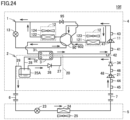
- FIG. 1 and 2 is an overall configuration diagram of a binary refrigeration apparatus 10 according to a first embodiment.
- Each of Figs. 1 and 2 functionally shows connection relation and arrangement configuration among devices in binary refrigeration apparatus 10, and does not necessarily show an arrangement in a physical space.
- binary refrigeration apparatus 10 comprises a first refrigeration cycle 1 and a second refrigeration cycle 2.
- First refrigeration cycle 1 is a high-stage refrigeration cycle.
- Second refrigeration cycle 2 is a low-stage refrigeration cycle.
- first refrigeration cycle 1 and second refrigeration cycle 2 are coupled together by a cascade heat exchanger 3 so as to form a refrigeration cycle having a multi-stage configuration.
- first refrigeration cycle 1 a first refrigerant circulates.
- second refrigeration cycle 2 a second refrigerant circulates.
- the first refrigerant is, for example, a propane refrigerant.
- the second refrigerant is, for example, a carbon dioxide refrigerant. It should be noted that as the first refrigerant and the second refrigerant, the same type of refrigerant may be used or different types of refrigerants may be used.
- first refrigerant and the second refrigerant it is preferable to select a refrigerant having high performance, low GWP (Global Warming Potential), low combustibility, and low toxicity.
- second refrigeration cycle 2 is a path having an indoor unit provided in a room in and out of which a person is considered to come frequently, a refrigerant having no influence on the human body, such as low combustibility and low toxicity, is used as the second refrigerant.
- first refrigeration cycle 1 is installed in a space such as an outdoor space in and out of which a person is less likely to come, a high-performance refrigerant is used as the first refrigerant.
- a CO2 refrigerant is used for second refrigeration cycle 2
- an R290 refrigerant, R1234yf refrigerant, or R32 refrigerant is used for first refrigeration cycle 1.
- a high-pressure refrigerant is used as the second refrigerant in second refrigeration cycle 2
- a design using a device and a tube each having a high pressure resistance is required.
- a device or a tube each having a low pressure resistance may be used in second refrigeration cycle 2 by performing an operation for suppressing pressure increase in second refrigeration cycle 2 using first refrigeration cycle 1.
- first refrigeration cycle 1 and second refrigeration cycle 2 are accommodated in an outdoor unit 4 or a cooling unit 5.
- Outdoor unit 4 may be referred to as an outdoor unit.
- Cooling unit 5 may be referred to as an indoor unit.
- Extension tubes 6 and 7 are provided between cooling unit 5 or cooling unit 5, outdoor unit 4 and cooling unit 5.
- First refrigeration cycle 1 comprises a first compressor 11, a condensation device 12, a first expansion valve 13, and cascade heat exchanger 3.
- First refrigeration cycle 1 further comprises a switching device 80 constituted of a first on-off valve 81, a second on-off valve 82, a third on-off valve 83, a fourth on-off valve 84, and a fifth on-off valve 85.
- Condensation device 12 comprises a first heat exchanger unit 121, a second heat exchanger unit 122, a first fan 123, and a second fan 124.
- First heat exchanger unit 121 is used as a condenser configured to condense the first refrigerant.
- Second heat exchanger unit 122 is in a state selected from a first state in which second heat exchanger unit 122 is used as a condenser configured to condense the first refrigerant and a second state in which second heat exchanger unit 122 is used as an evaporator configured to evaporate the first refrigerant.
- Switching device 80 is controlled by a controller 100 shown in Fig. 3 , and switches the state of second heat exchanger unit 122 between the first state and the second state.
- First fan 123 sends air to first heat exchanger unit 121.
- Second fan 124 sends air to second heat exchanger unit 122.
- First expansion valve 13 is constituted of an electronic expansion valve.
- Cascade heat exchanger 3 comprises an evaporator unit 31 and a condenser unit 32, and is configured to perform heat exchange between the first refrigerant and the second refrigerant.
- Evaporator unit 31 of cascade heat exchanger 3 is used as an evaporator in first refrigeration cycle 1.
- Second refrigeration cycle 2 comprises a second compressor 21, cascade heat exchanger 3, a second expansion valve 23, and an evaporator 24.
- Second refrigeration cycle 2 further comprises a third fan 25 and extension tubes 6, 7.
- Condenser unit 32 of cascade heat exchanger 3 is used as a condenser in second refrigeration cycle 2.
- Second expansion valve 23 is constituted of an electronic expansion valve.
- Third fan 25 sends air to evaporator 24.
- binary refrigeration apparatus 10 the first refrigerant on the high-temperature side is circulated by first refrigeration cycle 1, and the second refrigerant on the low-temperature side is circulated by second refrigeration cycle 2.
- heat exchange is performed in cascade heat exchanger 3 between the first refrigerant flowing through first heat exchanger unit 121 and the second refrigerant flowing through second heat exchanger unit 122, thereby forming a refrigeration cycle having a multi-stage configuration.
- cooling is performed in a low-temperature range of, for example, minus several ten degrees by such a refrigeration cycle having a multi-stage configuration.
- a first suction pressure sensor 41 configured to detect a suction pressure of first compressor 11 and a first suction temperature sensor 42 configured to detect a suction temperature of first compressor 11 are provided between the suction side of first compressor 11 and cascade heat exchanger 3.
- a first discharging pressure sensor 43 configured to detect a discharging pressure of first compressor 11 is provided between the discharge side of first compressor 11 and condensation device 12.
- First compressor 11 is provided with a first frequency sensor 47 configured to detect an operation frequency of first compressor 11.
- a second suction pressure sensor 44 configured to detect a suction pressure of second compressor 21 and a second suction temperature sensor 45 configured to detect a suction temperature of second compressor 21 are provided between the suction side of second compressor 21 and cascade heat exchanger 3.
- a second discharging pressure sensor 46 configured to detect a discharging pressure of second compressor 21 is provided between the discharge side of second compressor 21 and cascade heat exchanger 3.
- Second compressor 21 is provided with a second frequency sensor 48 configured to detect an operation frequency of second compressor 21.
- FIG. 3 is a block diagram showing the exemplary control configuration of binary refrigeration apparatus 10 according to the first embodiment.
- Controller 100 comprises a CPU (Central Processing Unit) 101, a memory 102 (ROM (Read Only Memory) and RAM (Random Access Memory)), an input/output buffer (not shown) configured to input/output various types of signals, and the like.
- CPU Central Processing Unit
- memory 102 ROM (Read Only Memory) and RAM (Random Access Memory)
- input/output buffer not shown
- CPU 101 loads a program stored in the ROM into the RAM or the like and executes the program.
- the program stored in the ROM is a program in which a processing procedure of control in controller 100 is written.
- the program for controller 100 comprises: a main routine program functioning as a core of the program; and a subroutine program invoked from the main program so as to be executed.
- Controller 100 performs control for each device in binary refrigeration apparatus 10 in accordance with these programs. This control is not limited to processing by software, and the processing can be performed by dedicated hardware (electronic circuit).
- Controller 100 receives detection signals output from various sensors such as first suction pressure sensor 41, first suction temperature sensor 42, first discharging pressure sensor 43, first frequency sensor 47, second suction pressure sensor 44, second suction temperature sensor 45, second discharging pressure sensor 46, and second frequency sensor 48.
- Controller 100 outputs control signals to various devices such as first compressor 11, first fan 123, second fan 124, first on-off valve 81, second on-off valve 82, third on-off valve 83, fourth on-off valve 84, fifth on-off valve 85, first expansion valve 13, second compressor 21, second expansion valve 23, and third fan 25 so as to control the various control devices.
- various devices such as first compressor 11, first fan 123, second fan 124, first on-off valve 81, second on-off valve 82, third on-off valve 83, fourth on-off valve 84, fifth on-off valve 85, first expansion valve 13, second compressor 21, second expansion valve 23, and third fan 25 so as to control the various control devices.
- Fig. 3 also shows exemplary connection among a fourth fan 33, a fifth fan 128, a first pump 141, a second pump 142, and an outdoor air temperature sensor 49, which are not provided in the first embodiment but are provided in other embodiments described later.
- Controller 100 controls first compressor 11, first compressor 11, first fan 123, second fan 124, first on-off valve 81, second on-off valve 82, third on-off valve 83, fourth on-off valve 84, fifth on-off valve 85, first expansion valve 13, second compressor 21, second expansion valve 23, and third fan 25 in accordance with detection results of various sensors such as first suction pressure sensor 41, first suction temperature sensor 42, first discharging pressure sensor 43, first frequency sensor 47, second suction pressure sensor 44, second suction temperature sensor 45, second discharging pressure sensor 46, and second frequency sensor 48.
- Controller 100 controls a frequency of first compressor 11 in order to adjust an evaporation temperature of the first refrigerant in first refrigeration cycle 1. Controller 100 controls a frequency of second compressor 12 in order to adjust an evaporation temperature of the second refrigerant in second refrigeration cycle 2. In order to adjust the condensing temperatures or the evaporation temperatures in the heat exchangers corresponding to first fan 123, second fan 124, and third fan 25, controller 100 controls a rotation speed of each fan to control a flow rate of a heat medium. Controller 100 controls a degree of opening of first expansion valve 13 in order to adjust a degree of superheat on the suction side of first compressor 11. Controller 100 controls a degree of opening of second expansion valve 23 in order to adjust a degree of superheat on the suction side of second compressor 12.
- FIG. 1 flow of the first refrigerant and flow of the second refrigerant in the cooling operation are indicated by straight arrows.
- the cooling operation is a normal operation in which first compressor 11 of first refrigeration cycle 1 and second compressor 21 of second refrigeration cycle 2 are driven to perform cooling in the low-temperature range such as minus several ten degrees by the refrigeration cycle having a multi-stage configuration.
- both first heat exchanger unit 121 and second heat exchanger unit 122 are each used as a condenser.
- the operation of binary refrigeration apparatus 10 during the cooling operation will be described below with reference to Fig. 1 .
- first refrigeration cycle 1 performs the following operation.
- First compressor 11 compresses the suctioned first refrigerant and discharges the compressed first refrigerant as a high-temperature and high-pressure gas refrigerant.
- both first heat exchanger unit 121 and second heat exchanger unit 122 are each used as a condenser in condensation device 12.
- controller 100 brings first on-off valve 81, second on-off valve 82, and fifth on-off valve 85 into an opened state and brings third on-off valve 83 and fourth on-off valve 84 into a closed state in switching device 80.
- first to fourth on-off valves 81 to 84 in the cooling operation, a first path in which the first refrigerant flows through first heat exchanger unit 121, and a second path in which the first refrigerant flows through first on-off valve 81, second heat exchanger unit 122 and second on-off valve 82 are formed between first compressor 11 and first expansion valve 13.
- condensation device 12 the high-temperature and high-pressure first refrigerant discharged from first compressor 11 is branched into first heat exchanger unit 121 and second heat exchanger unit 122 and flows as indicated by arrows in the figure.
- both first heat exchanger unit 121 and second heat exchanger unit 122 are each used as a condenser.
- condensation device 12 condenses the first refrigerant by exchanging heat between the high-temperature high-pressure first refrigerant having flowed thereinto and the outdoor air in each of first heat exchanger unit 121 and second heat exchanger unit 122.
- first heat exchanger unit 121 By sending air to first heat exchanger unit 121 by first fan 123, condensation of the first refrigerant in first heat exchanger unit 121 is promoted.
- second heat exchanger unit 122 By sending air to second heat exchanger unit 122 by second fan 124, condensation of the first refrigerant in second heat exchanger unit 122 is promoted.
- Controller 100 controls an amount of air to be sent to first heat exchanger unit 121 by first fan 123, thereby controlling an amount of heat exchange between the first refrigerant and the outdoor air in first heat exchanger unit 121. Controller 100 controls an amount of air to be sent to second heat exchanger unit 122 by second fan 124, thereby controlling an amount of heat exchange between the first refrigerant and the outdoor air in second heat exchanger unit 122.
- the first refrigerant condensed in condensation device 12 is changed into a liquid phase refrigerant and is supplied to first expansion valve 13.
- first expansion valve 13 the first refrigerant condensed in condensation device 12 is expanded and reduced in pressure, with the result that the first refrigerant becomes a low-pressure two-phase refrigerant.
- the first refrigerant expanded by first expansion valve 13 is supplied to cascade heat exchanger 3 through fifth on-off valve 85 that is in the opened state.
- the first refrigerant flows into evaporator unit 31.
- first refrigeration cycle 1 the first refrigerant having flowed into evaporator unit 31 exchanges heat with the second refrigerant having flowed into condenser unit 32 of cascade heat exchanger 3 in second refrigeration cycle 2 and the two-phase refrigerant is accordingly evaporated to become a gas refrigerant and is supplied to the suction side of first compressor 11.
- second refrigeration cycle 2 performs the following operation.
- Second compressor 21 compresses the suctioned second refrigerant and discharges the compressed second refrigerant as a high-temperature and high-pressure gas refrigerant.
- the second refrigerant discharged from second compressor 21 is supplied to cascade heat exchanger 3.
- cascade heat exchanger 3 the second refrigerant flows into condenser unit 32.
- the second refrigerant having flowed into condenser unit 32 in second refrigeration cycle 2 is condensed by heat exchange with the first refrigerant having flowed into condenser unit 32 of cascade heat exchanger 3 in second refrigeration cycle 2.
- the second refrigerant condensed in condenser unit 32 of cascade heat exchanger 3 is changed into a liquid phase refrigerant and is supplied to second expansion valve 23.
- second expansion valve 23 the second refrigerant condensed in condenser unit 32 is expanded and reduced in pressure, with the result that the second refrigerant becomes a low-pressure two-phase refrigerant.
- the second refrigerant expanded by second expansion valve 23 is supplied to evaporator 24.
- the second refrigerant having flowed into evaporator 24 in second refrigeration cycle 2 exchanges heat with the outdoor air, with the result that the two-phase refrigerant is evaporated to become a gas refrigerant and is supplied to the suction side of second compressor 21.
- Controller 100 controls a rotation speed of third fan 25 so as to control an amount of air to be sent by third fan 25 to evaporator 24.
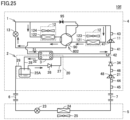
- FIG. 2 the flow of the first refrigerant in the pressure increase suppression operation is indicated by straight arrows.
- the pressure increase suppression operation is an operation for suppressing pressure increase in second refrigeration cycle 2 when the cooling operation is stopped, by cooling second refrigeration cycle 2 in cascade heat exchanger 3 using first refrigeration cycle 1 in such a manner that first compressor 11 of first refrigeration cycle 1 is driven with second compressor 21 of second refrigeration cycle 2 being stopped.
- both first compressor 11 of first refrigeration cycle 1 and second compressor 21 of second refrigeration cycle 2 are stopped, the pressure in second refrigeration cycle 2 is increased as follows.
- second refrigeration cycle 2 if both second compressor 21 are stopped, heat received from the outdoor air at a portion such as a tube may cause an excessive increase of pressure in the tube in second refrigeration cycle 2. Since the carbon dioxide refrigerant is used as the second refrigerant in second refrigeration cycle 2, a component such as the tube may be damaged by the excessive increase of pressure in the tube.
- controller 100 when the cooling operation is stopped, controller 100 performs control to stop second compressor 21 of second refrigeration cycle 2 and perform the pressure increase suppression operation for circulating the first refrigerant by driving first compressor 11 of first refrigeration cycle 1.
- the circulation of the first refrigerant in first refrigeration cycle 1 when the cooling operation is stopped promotes heat exchange between the first refrigerant and the second refrigerant in cascade heat exchanger 3 to suppress a temperature increase in second refrigeration cycle 2, with the result that the pressure increase in the tube of second refrigeration cycle 2 can be suppressed.
- first heat exchanger unit 121 is used as a condenser
- second heat exchanger unit 122 is used as an evaporator.
- the operation of binary refrigeration apparatus 10 during the pressure increase suppression operation will be described below with reference to Fig. 2 .
- second compressor 21 is stopped in second refrigeration cycle 2, and the second refrigerant does not basically circulate as shown in Fig. 2 .
- first compressor 11 In the pressure increase suppression operation, first compressor 11 is driven in first refrigeration cycle 1. In the pressure increase suppression operation, in first refrigeration cycle 1, the first refrigerant circulates by performing the same operation as the above-described cooling operation except for condensation device 12.
- first heat exchanger unit 121 is used as a condenser
- second heat exchanger unit 122 is used as an evaporator.
- controller 100 brings first on-off valve 81, second on-off valve 82, and fifth on-off valve 85 into the closed state and brings third on-off valve 83 and fourth on-off valve 84 into the opened state in switching device 80.
- first to fourth on-off valves 81 to 84 in the pressure increase suppression operation, a path in which the first refrigerant flows through only first heat exchanger unit 121 is formed in condensation device 12 between the suction side of first compressor 11 and first expansion valve 13.
- the high-temperature and high-pressure first refrigerant discharged from first compressor 11 flows only through first heat exchanger unit 121 in condensation device 12 as indicated by arrows in the figure, with the result that only first heat exchanger unit 121 is used as a condenser.
- condensation device 12 condenses the first refrigerant by exchanging heat only by first heat exchanger unit 121 between the high-temperature and high-pressure first refrigerant having flowed thereinto and the outdoor air.
- cascade heat exchanger 3 the first refrigerant having flowed into evaporator unit 31 exchanges heat with the second refrigerant to result in a second stage of evaporation to become a gas refrigerant, and is supplied to the suction side of first compressor 11.
- cascade heat exchanger 3 heat exchange is performed between the first refrigerant in first refrigeration cycle 1 and the second refrigerant in second refrigeration cycle 2, with the result that the second refrigerant is cooled.
- second refrigeration cycle 2 is cooled by first refrigeration cycle 1, thereby suppressing the pressure increase in second refrigeration cycle 2.
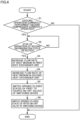
- Fig. 4 is a flowchart of the function switching control for second heat exchanger unit 122 in the pressure increase suppression operation.
- the function switching control of Fig. 4 is performed by controller 100.
- controller 100 determines whether or not the cooling operation is currently being performed.
- the determination in step S 1 as to whether or not the cooling operation is being performed is made by checking, by controller 100, the operation state of binary refrigeration apparatus 10 in accordance with detection signals from various sensors provided in second refrigeration cycle 2. For example, when second compressor 21 is being operated, it can be determined that the cooling operation is currently being performed.
- Each of the various sensors may be a sensor that can check the operation state of binary refrigeration apparatus 10.
- Controller 100 determines whether or not second compressor 21 is being operated, in accordance with, for example, a frequency of second compressor 12 detected by the second frequency sensor.
- second suction pressure sensor 44, second suction temperature sensor 45, second discharging pressure sensor 46, and the like may be each used as a sensor that can check the operation state of binary refrigeration apparatus 10.
- controller 100 ends the processing.
- controller 100 determines in a step S2 whether or not it is detected that the operation of the second refrigeration cycle is stopped.
- the determination in step S2 as to whether or not the operation of the second refrigeration cycle is stopped is made by checking, by controller 100, the operation state of binary refrigeration apparatus 10 in accordance with the detection signals from the various sensors provided in second refrigeration cycle 2 as described above. For example, when the operation of second compressor 21 is stopped, it can be determined that the operation of the second refrigeration cycle is stopped.
- controller 100 When it is not detected in step S2 that the operation of the second refrigeration cycle is stopped, controller 100 repeats the determination in step S2. On the other hand, when it is detected in step S2 that the operation of the second refrigeration cycle is stopped, controller 100 performs the processing of steps S3 to S6 because switching from the cooling operation to the pressure increase suppression operation is being performed.
- controller 100 increases the flow rate of the heat medium in first heat exchanger unit 121.
- the heat medium is air to be sent to first heat exchanger unit 121 by first fan 123.
- the rotation speed of first fan 123 is increased to increase an amount of air by first fan 123.
- the amount of air by first fan 123 may be increased to the maximum value of a setting value of the amount of air, or may be increased by a predetermined amount of air.
- controller 100 After a first reference period has elapsed from the increase of the amount of air by first fan 123 in step S3, controller 100 increases the flow rate of the heat medium in second heat exchanger unit 122 in step S4.
- the heat medium is air to be sent to second heat exchanger unit 122 by second fan 124.
- the rotation speed of second fan 124 is increased to increase an amount of air by second fan 124.
- the amount of air by second fan 124 may be increased to the maximum value of a setting value of the amount of air, or may be increased by a predetermined amount of air.
- controller 100 switches the opened/closed states of first on-off valve 81, second on-off valve 82, third on-off valve 83, and fourth on-off valve 84 of switching device 80 to the opened/closed states in the pressure increase suppression operation as shown in Fig. 2 in step S5.
- the second reference period is set to a period having a length equal to or less than the first reference period.
- controller 100 switches the opened/closed state of fifth on-off valve 85 of switching device 80 to the opened/closed state in the pressure increase suppression operation as shown in Fig. 2 , and ends the processing.
- second heat exchanger unit 122 is switched by switching device 80 between the first state in which second heat exchanger unit 122 serves as a condenser configured to condense the first refrigerant and the second state in which second heat exchanger unit 122 serves as an evaporator configured to evaporate the first refrigerant.
- Controller 100 performs control to make switching to the first state in which second heat exchanger unit 122 serves as a condenser when the cooling operation is performed, and make switching to the second state in which second heat exchanger unit 122 serves as an evaporator when the pressure increase control operation is performed.
- the condensation by first heat exchanger unit 121 when switching from the cooling operation to the pressure increase suppression operation, the condensation by first heat exchanger unit 121 can be promoted by increasing the flow rate of the heat medium to be sent to first heat exchanger unit 121 used as the condenser in step S3. Since the condensation by first heat exchanger unit 121 is promoted, the amount of the first refrigerant in second heat exchanger unit 122 to be switched to the evaporator can be relatively reduced. Since the amount of the first refrigerant in second heat exchanger unit 122 to be switched to the evaporator is reduced in this way, occurrence of liquid back can be suppressed in the suction portion of first compressor 11 when second heat exchanger unit 122 is switched to the evaporator.
- step S4 when switching from the cooling operation to the pressure increase suppression operation, the heat medium at a high flow rate can be sent to second heat exchanger unit 122 immediately after switching to the pressure increase suppression operation. This makes it possible to further promote evaporation of the first refrigerant in second heat exchanger unit 122 after switching to the pressure increase suppression operation.
- the second reference period from the increase of the flow rate of the heat medium to be sent to second heat exchanger unit 122 in step S4 to the switching of the on-off valves in switching device 80 in step S5 is set to the length equal to or less than that of the first reference period from the increase of the flow rate of the heat medium to be sent to first heat exchanger unit 121 in step S3 to the increase of the flow rate of the heat medium to be sent to second heat exchanger unit 122 in step S4, the first refrigerant can be suppressed from being condensed before second heat exchanger unit 122 is used as an evaporator.
- First heat exchanger unit 121 has a structure with a larger volume of heat exchange than that of second heat exchanger unit 122. For example, when the total of the heat exchange volume of first heat exchanger unit 121 and the heat exchange volume of second heat exchanger unit 122 in condensation device 12 is unchanged, the heat exchange volume of first heat exchanger unit 121 is larger than the heat exchange volume of second heat exchanger unit 122. In such a configuration, heat exchange performance of condensation device 12 as a condenser is higher than that in a configuration in which the heat exchange volume of first heat exchanger unit 121 and the heat exchange volume of second heat exchanger unit 122 are the same.
- the condensation performance during the pressure increase control operation is improved as compared with a case where these heat exchange volumes are the same, with the result that the pressure in first refrigeration cycle 1 can be suppressed from being excessively increased during the pressure increase control operation. Further, since the pressure in first refrigeration cycle 1 can be suppressed from being excessively increased during the pressure increase control operation, power consumption necessary for the operation state of first refrigeration cycle 1 during the pressure increase control operation can be suppressed.
- each of first on-off valve 81 and second on-off valve 82 may be provided at a position as close as possible to a branch position at which the path between first compressor 11 and first expansion valve 13 is branched toward second heat exchanger unit 122.
- the first refrigerant can be prevented from remaining in a path from the branch position to the position of first on-off valve 81 and in a path from the branch position to the position of second on-off valve 82. Since the refrigerant can be prevented from remaining therein in this way, a total amount of the first refrigerant required in first refrigeration cycle 1 can be suppressed.
- the following effect can be obtained.
- the capacity for evaporating the first refrigerant in first refrigeration cycle 1 is increased, evaporation of the first refrigerant is promoted, thereby suppressing occurrence of liquid back to first compressor 11. This makes it possible to stabilize the operation state of first refrigeration cycle 1 when second refrigeration cycle 2 is stopped.
- the capacity for evaporating the first refrigerant in first refrigeration cycle 1 is increased in the pressure increase suppression operation, the first refrigerant suctioned into first compressor 11 can be stably formed into a superheated gas, with the result that controller 100 can be suppressed from performing control to repeatedly stop and restart first compressor 11 due to insufficient capacity for evaporating the first refrigerant in first refrigeration cycle 1. This makes it possible to stabilize the operation state of first refrigeration cycle 1 when second refrigeration cycle 2 is stopped.
- the temperature and pressure of the second refrigerant in second refrigeration cycle 2 can be stabilized by suppressing first compressor 11 from being stopped and restarted repeatedly in the pressure increase suppression operation.
- the tube of second refrigeration cycle 2 can be suppressed from being raptured due to an instantaneous pressure increase in the second refrigerant of second refrigeration cycle 2.
- first refrigeration cycle 1 when a plurality of first compressors 11 are connected in parallel to operate, the capacity for evaporating the first refrigerant can be increased as compared with a case where one first compressor 11 is operated. However, in such a case, the operation state of binary refrigeration apparatus 10 becomes unstable, disadvantageously. On the other hand, since the control is performed in the pressure increase suppression operation to switch second heat exchanger unit 122 of condensation device 12 to the state in which the first refrigerant is evaporated, the capacity for evaporating the first refrigerant can be increased, thereby stabilizing the operation state of binary refrigeration apparatus 10.
- the refrigeration oil is not supplied to any of the first compressors in an imbalanced manner in binary refrigeration apparatus 10, with the result that the reliability of the operation of binary refrigeration apparatus 10 can be improved.
- binary refrigeration apparatus 10 does not need to be provided with, for example, a uniform oil mechanism or the like to avoid the imbalance of the refrigeration oil among the plurality of first compressors 11, with the result that an increase in the number of components of binary refrigeration apparatus 10 can be suppressed to suppress increased manufacturing cost.
- the flow rate of the heat medium can be adjusted individually depending on whether second heat exchanger unit 122 is used as a condenser or an evaporator.
- controller 100 can control the flow rate of the heat medium to be supplied to second heat exchanger unit 122 by second fan 124 so as to cause the condensation temperature of second heat exchanger unit 122 to have a reference temperature.
- controller 100 can control the flow rate of the heat medium to be supplied to second heat exchanger unit 122 by second fan 124 so as to cause the suction portion of first compressor 11 to have an appropriate evaporation temperature.
- binary refrigeration apparatus 10 since the high-pressure refrigerant such as a carbon dioxide refrigerant is used as the second refrigerant sealed in second refrigeration cycle 2, even when the tube connecting outdoor unit 4 and cooling unit 5 is long, an increase in pressure loss due to the long tube can be suppressed.
- the high-pressure refrigerant such as a carbon dioxide refrigerant
- binary refrigeration apparatus 10 since the non-toxic refrigerant such as a carbon dioxide refrigerant is used as the second refrigerant sealed in second refrigeration cycle 2, an influence on human body can be suppressed even if the second refrigerant is leaked in the room in which cooling unit 5 is provided when a person comes in or out of the room.
- non-toxic refrigerant such as a carbon dioxide refrigerant
- binary refrigeration apparatus 10 since the non-combustible refrigerant such as a carbon dioxide refrigerant is used as the second refrigerant sealed in second refrigeration cycle 2, occurrence of fire can be suppressed even if the second refrigerant is leaked in the room in which cooling unit 5 is provided.
- non-combustible refrigerant such as a carbon dioxide refrigerant
- binary refrigeration apparatus 10 since the two-system refrigerant circuit with first refrigeration cycle 1 and second refrigeration cycle 2 are provided and the high-pressure refrigerant such as a carbon dioxide refrigerant is used as the second refrigerant sealed in second refrigeration cycle 2, an increase of pressure in second refrigeration cycle 2 can be suppressed to a reference pressure or less.
- a device and a tube each having a pressure resistance setting that is not very high can be used in binary refrigeration apparatus 10. Since the device and tube each having a pressure resistance setting that is not very high, the manufacturing cost of the entire system of binary refrigeration apparatus 10 can be suppressed from being increased.
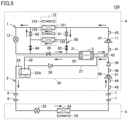
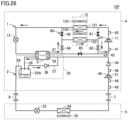
- FIG. 5 and 6 is an overall configuration diagram of a binary refrigeration apparatus 10A according to a second embodiment.
- binary refrigeration apparatus 10A of the second embodiment is different from binary refrigeration apparatus 10 of the first embodiment in that a natural circulation path 20 for the second refrigerant is provided in second refrigeration cycle 2.
- FIG. 5 flow of the refrigerant in the cooling operation is indicated by arrows.
- Fig. 6 flow of the refrigerant in the pressure increase suppression operation is indicated by arrows.
- Natural circulation path 20 is a path allowing for natural circulation of the second refrigerant in the pressure increase suppression operation. Natural circulation path 20 comprises a first tube 27, a second tube 28, a third tube 29, a liquid receiver 25A, and a check valve 26. Liquid receiver 25A is provided between cascade heat exchanger 3 and second expansion valve 23 in second refrigeration cycle 2.
- First tube 27 is provided between an inlet of condenser unit 32 of cascade heat exchanger 3 and liquid receiver 25A.
- First tube 27 is provided with a check valve 26 that allows the second refrigerant to flow only in a direction from liquid receiver 25A toward the inlet of condenser unit 32 of cascade heat exchanger 3.
- Second tube 28 is provided between an outlet of condenser unit 32 of cascade heat exchanger 3 and liquid receiver 25A.
- Third tube 29 is provided between second expansion valve 23 and liquid receiver 25A.
- Liquid receiver 25A is a tank having an inner space for storing the second refrigerant having flowed thereinto from first tube 27. An end portion of each of first tube 27 and second tube 28 is opened at an upper portion of the inner space of liquid receiver 25A. Third tube 29 is opened at a lower portion of the inner space of liquid receiver 25A.
- Condenser unit 32 of cascade heat exchanger 3 is provided such that the outlet side thereof is located at a position lower than that of the inlet side thereof.
- Liquid receiver 25A is provided at a position lower than that of the outlet of condenser unit 32 of cascade heat exchanger 3.
- Liquid receiver 25A is a tank having an inner space for storing the second refrigerant having flowed from first tube 27.
- first tube 27 and second tube 28 An end portion of each of first tube 27 and second tube 28 is opened at an upper portion of the inner space of liquid receiver 25A.
- Third tube 29 is opened at a lower portion of the inner space of liquid receiver 25A.
- the second refrigerant which has become a supercooled refrigerant due to heat exchange by condenser unit 32 of cascade condenser 30, is dropped from second tube 28 into the inner space of liquid receiver 25A, and is supplied to second expansion valve 23 through third tube 29.
- the second refrigerant which has become a supercooled refrigerant due to heat exchange by condenser unit 32 of cascade condenser 30, is dropped from second tube 28 into the inner space of liquid receiver 25A, passes through first tube 27 and check valve 26, and is supplied to the inlet side of condenser unit 32.
- the second refrigerant which has become a supercooled refrigerant
- the volume of the second refrigerant existing on the upper side with respect to condenser unit 32 is decreased.
- the pressure is negative on the upper side with respect to condenser unit 32 and the pressure is positive on the liquid receiver 25A side, i.e., the lower side with respect to condenser unit 32.
- the gas refrigerant of the second refrigerant stored in liquid receiver 25A passes through first tube 27 and check valve 26, and is suctioned up to the inlet side of condenser unit 32.
- the gas refrigerant suctioned up to the inlet side of condenser unit 32 flows into condenser unit 32, and exchanges heat again.
- the second refrigerant having exchanged heat in condenser unit 32 becomes a supercooled refrigerant, and is dropped into liquid receiver 25A through second tube 28.
- the pressure increase in second refrigeration cycle 2 can be effectively suppressed by repeating such natural circulation of the second refrigerant flowing in natural circulation path 20.
- liquid receiver 25A is provided between cascade heat exchanger 3 and second expansion valve 23, the pressure in second refrigeration cycle 2 can be stabilized with respect to variation of load in second refrigeration cycle 2. Further, since liquid receiver 25A is provided between cascade heat exchanger 3 and second expansion valve 23 in binary refrigeration apparatus 10A, it is possible to readily handle a change in sealing amount of the second refrigerant that is required depending on the length of the tube connecting outdoor unit 4 and cooling unit 5.
- first heat exchanger unit 121 has a structure having a larger heat exchange volume than that of second heat exchanger unit 122.
- the heat exchange volume of second heat exchanger unit 122 is smaller than that of first heat exchanger unit 121, with the result that the evaporation capacity of second heat exchanger unit 122 can be prevented from becoming too large.
- an intermediate cooler 35 is provided between second compressor 21 and condenser unit 32 of cascade heat exchanger 3 in second refrigeration cycle 2 of each of binary refrigeration apparatuses 10, 10A having the configuration shown in the second embodiment.
- the configuration in which intermediate cooler 35 is provided in binary refrigeration apparatus 10A of the second embodiment will be described as a representative example.
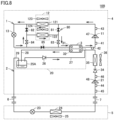
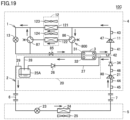
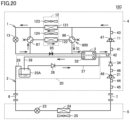
- FIG. 7 and 8 is an overall configuration diagram of a binary refrigeration apparatus 10B according to the third embodiment.
- binary refrigeration apparatus 10B of the third embodiment is different from binary refrigeration apparatus 10A of the second embodiment in that intermediate cooler 35 and a fourth fan 36 are provided in second refrigeration cycle 2.
- FIG. 7 flow of the refrigerant in the cooling operation is indicated by arrows.
- Fig. 8 flow of the refrigerant in the pressure increase suppression operation is indicated by arrows.
- Intermediate cooler 35 is provided between second compressor 21 and condenser unit 32 of cascade heat exchanger 3.
- Fourth fan 36 sends air to intermediate cooler 35.
- controller 100 outputs a control signal to fourth fan 36 so as to control fourth fan 36.
- intermediate cooler 35 is provided between second compressor 21 and condenser unit 32 of cascade heat exchanger 3 in binary refrigeration apparatus 10B, heat of the second refrigerant can be radiated by intermediate cooler 35 in second refrigeration cycle 2 during the cooling operation.
- intermediate cooler 35 By radiating the heat of the second refrigerant by intermediate cooler 35, the condensation capacity of condenser unit 32 of cascade heat exchanger 3 can be reduced.
- the evaporation capacity required for evaporator unit 31 of cascade heat exchanger 3 of first refrigeration cycle 1 can be suppressed by reducing the condensation capacity of condenser unit 32, heat exchange efficiency between the first refrigerant and the second refrigerant in cascade heat exchanger 3 can be improved.
- intermediate cooler 35 and fourth fan 36 shown in Figs. 7 and 8 may be provided in binary refrigeration apparatus 10 shown in Figs. 1 and 2 .
- a heat exchanger 70 in which condensation device 12 and intermediate cooler 35 are integrated is provided as a modification of binary refrigeration apparatus 10B comprising intermediate cooler 35 shown in the third embodiment.
- Fig. 9 is a diagram showing a configuration of heat exchanger 70 according to the fourth embodiment.
- heat exchanger 70 of the fourth embodiment is configured as a heat exchanger in which first heat exchanger unit 121 in condensation device 12 shown in Fig. 9 and intermediate cooler 35 shown in Fig. 9 are integrated.
- second heat exchanger unit 122 and switching device 80 in condensation device 12 are not shown.
- Heat exchanger 70 shown in Fig. 9 comprises first heat exchanger unit 121 and intermediate cooler 35 shown in Fig. 9 , and these are configured as one heat exchanger unit structure.
- a fifth fan 128 configured to send air to heat exchanger 70 is provided in the vicinity of heat exchanger 70.
- controller 100 outputs a control signal to fifth fan 128 so as to control fifth fan 128.
- first heat exchanger unit 121, second heat exchanger unit 122, and intermediate cooler 35 may be integrated.
- second heat exchanger unit 122 and intermediate cooler 35 may be integrated.
- Fig. 10 is a diagram showing configurations of the headers according to the fifth embodiment.
- a first header 91 and a second header 92 are connected to both ends of a tube body of first heat exchanger unit 121.
- a third header 93 and a fourth header 94 are connected to both ends of a tube body of second heat exchanger unit 122.
- First header 91 is provided at a portion at which the tube from first compressor 11 is branched to condensation device 12 and switching device 80.
- First header 91 is configured to distribute, to first heat exchanger unit 121 and switching device 80, the first refrigerant supplied from first compressor 11.
- Second header 92 is provided at a portion at which the tube from first heat exchanger unit 121 to first expansion valve 13 and the tube from second on-off valve 82 of switching device 80 are merged together. Second header 92 is configured to merge the first refrigerant flowing out from first heat exchanger unit 121 with the first refrigerant flowing out from second on-off valve 82, and supply the merged first refrigerant to first expansion valve 13.
- Third header 93 is provided between first on-off valve 81 and third on-off valve 83.
- Third header 93 is configured to supply, to second heat exchanger unit 122, the first refrigerant supplied through first on-off valve 81 during the cooling operation, or to supply, toward third on-off valve 83, the first refrigerant flowing out from second heat exchanger unit 122 during the pressure increase suppression operation.
- Fourth header 94 is provided between second on-off valve 82 and fourth on-off valve 84. Fourth header 94 is configured to supply, toward second on-off valve 82, the first refrigerant flowing out from second heat exchanger unit 122 during the cooling operation, or to supply, to second heat exchanger unit 122, the first refrigerant supplied through fourth on-off valve 84 during the pressure increase suppression operation.
- First header 91, first on-off valve 81, third header 93, and third on-off valve 83 may be provided as individual components, or may be integrated as a switching unit 901 as shown in Fig. 10 .
- Second header 92, second on-off valve 82, fourth header 94, and fourth on-off valve 84 may be provided as individual components, or may be integrated as a switching unit 902 as shown in Fig. 10 .
- switching unit 901 in which first header 91, first on-off valve 81, third header 93, and third on-off valve 83 are integrated and switching unit 902 in which second header 92, second on-off valve 82, fourth header 94, and fourth on-off valve 84 are integrated are provided, the number of components of the binary refrigeration apparatus can be reduced. Further, an installation area of the binary refrigeration apparatus can be smaller in space.
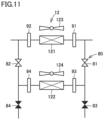
- Fig. 11 is a diagram showing configurations of the headers according to the sixth embodiment.
- the configuration of Fig. 11 is different from the configuration of Fig. 10 in that first header 91, second header 92, third header 93, and fourth header 94 are provided to be separated from switching device 80 and are provided close to first heat exchanger unit 121 and second heat exchanger unit 122 with respect to switching device 80.
- First header 91 is provided at a position close to first heat exchanger unit 121 with respect to a branch portion at which the tube from first compressor 11 is branched to condensation device 12 and switching device 80.
- First header 91 is configured to supply, to first heat exchanger unit 121 through first header 91, the first refrigerant supplied from the branch portion.
- Second header 92 is provided at a position close to first heat exchanger unit 121 with respect to the merging portion at which the tube from first heat exchanger unit 121 toward first expansion valve 13 is merged with the tube from second on-off valve 82 of switching device 80. Second header 92 is configured to supply, to the merging portion through second header 92, the first refrigerant flowing out from first heat exchanger unit 121.
- Third header 93 is provided in a tube branched from between first on-off valve 81 and third on-off valve 83 to reach second heat exchanger unit 122.
- Third header 93 is configured to supply, to second heat exchanger unit 122, the first refrigerant supplied through first on-off valve 81 during the cooling operation, or to supply, to third on-off valve 83, the first refrigerant flowing out from second heat exchanger unit 122 during the pressure increase suppression operation.
- Fourth header 94 is provided in a tube branched from between second on-off valve 82 and fourth on-off valve 84 to reach second heat exchanger unit 122. Fourth header 94 is configured to supply, toward second on-off valve 82, the first refrigerant flowing out from second heat exchanger unit 122 during the cooling operation, or to supply, toward second heat exchanger unit 122, the first refrigerant supplied through fourth on-off valve 84 during the pressure increase suppression operation.
- first heat exchanger unit 121 and second heat exchanger unit 122 are arranged side by side in an upward/downward direction in condensation device 12.
- Fig. 12 is a diagram showing arrangements of first heat exchanger unit 121 and second heat exchanger unit 122 according to the seventh embodiment.
- condensation device 12 it is desirable that an air sending direction of first fan 123 to first heat exchanger unit 121 and an air sending direction of second fan 124 to second heat exchanger unit 122 do not overlap with each other. This is due to the following reason: when one of first heat exchanger unit 121 and second heat exchanger unit 122 is affected by air sent by the other, the heat exchange capacity for the first refrigerant is suppressed.
- Fig. 12 shows a configuration in which first heat exchanger unit 121 and first fan 123 are arranged side by side with second heat exchanger unit 122 and second fan 124 in the upward/downward direction.
- first heat exchanger unit 121 is shown to be larger than second heat exchanger unit 122 because first heat exchanger unit 121 has a larger volume for heat exchange than that of second heat exchanger unit 122.
- Fig. 12 shows a configuration in which first heat exchanger unit 121 and first fan 123 are arranged side by side with second heat exchanger unit 122 and second fan 124 in the upward/downward direction.
- first heat exchanger unit 121 is shown to be larger than second heat exchanger unit 122 because first heat exchanger unit 121 has a larger volume for heat exchange than that of second heat exchanger unit 122.
- first heat exchanger unit 121 and second heat exchanger unit 122 can be suppressed from being affected by the heat of the air sent from the other. Accordingly, heat exchange of the first refrigerant is promoted in each of first heat exchanger unit 121 and second heat exchanger unit 122, thereby improving the heat exchange capacity for the first refrigerant. Thus, the pressure in first refrigeration cycle 1 can be suppressed from being increased excessively.
- first heat exchanger unit 121 and second heat exchanger unit 122 are arranged side by side in the leftward/rightward direction in condensation device 12.
- Fig. 13 is a diagram showing arrangements of first heat exchanger unit 121 and second heat exchanger unit 122 according to the eighth embodiment.
- Fig. 13 shows a configuration in which first heat exchanger unit 121 and first fan 123 are arranged side by side with second heat exchanger unit 122 and second fan 124 in the leftward/rightward direction.
- first heat exchanger unit 121 is shown to be larger than second heat exchanger unit 122 because the volume of first heat exchanger unit 121 for heat exchange is larger than that of second heat exchanger unit 122.
- Fig. 13 shows a configuration in which first heat exchanger unit 121 and first fan 123 are arranged side by side with second heat exchanger unit 122 and second fan 124 in the leftward/rightward direction.
- first heat exchanger unit 121 is shown to be larger than second heat exchanger unit 122 because the volume of first heat exchanger unit 121 for heat exchange is larger than that of second heat exchanger unit 122.
- each of a first heat exchanger unit 121A and a second heat exchanger unit 122A employs water for heat exchange in condensation device 12.
- Fig. 14 is a diagram showing arrangements of first heat exchanger unit 121A and second heat exchanger unit 122A according to the ninth embodiment.
- condensation device 12 instead of first heat exchanger unit 121 and second heat exchanger unit 122 that each exchange heat with air as shown in Fig. 12 and the like, first heat exchanger unit 121A and second heat exchanger unit 122A that each employs water for heat exchange as shown in Fig. 14 may be provided.
- first heat exchanger unit 121A and second heat exchanger unit 122A individually performs heat exchange using water as a heat medium.
- a first pump 141 configured to supply water to first heat exchanger unit 121A
- a second pump 142 configured to supply water to second heat exchanger unit 122A are each provided as a device configured to supply the heat medium as shown in Fig. 14 .
- first heat exchanger unit 121A is shown to be larger than second heat exchanger unit 122A because first heat exchanger unit 121A has a larger volume for heat exchange than that of second heat exchanger unit 122A.
- First heat exchanger unit 121A comprises a first heat exchanger unit 1211 and a second heat exchanger unit 1212. Water is supplied from first pump 141 to first heat exchanger unit 1211. The first refrigerant is supplied from switching device 80 to second heat exchanger unit 1212. With this configuration, in first heat exchanger unit 121A, heat exchange is performed between the first refrigerant in first heat exchanger unit 1211 and the water in second heat exchanger unit 1212.
- Second heat exchanger unit 122A comprises a first heat exchanger unit 1221 and a second heat exchanger unit 1222. Water is supplied from second pump 142 to first heat exchanger unit 1221. The first refrigerant is supplied from switching device 80 to second heat exchanger unit 1222. With this configuration, in first heat exchanger unit 121A, heat exchange is performed between the first refrigerant in first heat exchanger unit 1211 and the water in second heat exchanger unit 1212.
- Fig. 14 water is supplied from first pump 141 to first heat exchanger unit 121A, and water is supplied from second pump 142 to second heat exchanger unit 122A.
- water for heat exchange is supplied to first heat exchanger unit 121A and second heat exchanger unit 122A from the different sources through the different paths.
- first heat exchanger unit 121A and second heat exchanger unit 122A since water for heat exchange is supplied to first heat exchanger unit 121A and second heat exchanger unit 122A from the different sources through the different paths, one of first heat exchanger unit 121A and second heat exchanger unit 122A can be suppressed from being affected by heat of the water from the other. Accordingly, heat exchange of the first refrigerant is promoted in each of first heat exchanger unit 121A and second heat exchanger unit 122A, thereby improving the heat exchange capacity for the first refrigerant. Thus, pressure in first refrigeration cycle 1 can be suppressed from being increased excessively.
- a flat tube heat exchanger or a circular tube heat exchanger may be used.
- first heat exchanger unit 121 of condensation device 12 pressure in first refrigeration cycle 1 can be suppressed from being increased excessively in each of the cooling operation and the pressure increase suppression operation. This is because the flat tube heat exchanger has higher heat exchanger efficiency than those of the other types of heat exchangers.
- Fig. 15 is a cross sectional view showing an exemplary flat tube 50 provided in the flat tube heat exchanger.
- a plurality of paths 51 in each of which the refrigerant flows are provided in flat tube 50 by partitioning the inside of the flat and elliptic tube.
- the flat tube heat exchanger using flat tube 50 as first heat exchanger unit 121 can have higher heat exchange efficiency than those when the other types of heat exchangers are used.
- the heat exchange efficiency of first heat exchanger unit 121 can be improved.
- second heat exchanger unit 122 of condensation device 12 is used for both a condenser and an evaporator, a circular tube heat exchanger may be used therefor in order to defrost and drain a generated frost in a short time when second heat exchanger unit 122 is used as the evaporator.
- controller 100 controls a high-stage expansion valve 300 so as to cause a degree of superheat of the outlet side of cascade heat exchanger 3 to be a predetermined reference value with the frequency of first compressor 11 being set to a reference frequency in the pressure increase suppression operation.
- controller 100 controls the flow rate of the heat medium to be supplied by second fan 124 to second heat exchanger unit 122 used as an evaporator, so as to cause the pressure in second refrigeration cycle 2 to fall within a predetermined threshold value range of the pressure with the frequency of first compressor 11 being set to the reference frequency in the pressure increase suppression operation.
- the following describes pressure control for second refrigeration cycle 2 as performed by controller 100 in the above-described pressure increase suppression operation.
- the pressure in second refrigeration cycle 2 may be controlled to one pressure target value in the pressure increase suppression operation, or the pressure in second refrigeration cycle 2 may be controlled to fall within a target pressure range.
- exemplary pressure control will be described in which the pressure in second refrigeration cycle 2 is controlled to fall within the target pressure range.
- Fig. 16 is a flowchart of the pressure control for second refrigeration cycle 2 in the pressure increase suppression operation.
- the pressure control of Fig. 16 is a subroutine program that is invoked and executed repeatedly at a certain cycle during execution of the processing of the pressure increase suppression operation as included in the main program of the control by controller 100.
- controller 100 sets the operation frequency of first compressor 11 to the reference frequency in the pressure increase suppression operation.
- the reference frequency in the pressure increase suppression operation is lower than the reference frequency set in the cooling operation, for example.
- controller 100 determines whether or not a detection value of the pressure in second refrigeration cycle 2 is lower than a first threshold value.
- the first threshold value is a value used to set the upper limit of the target pressure range of second refrigeration cycle 2 in the pressure increase suppression operation. Specifically, in step S12, it is determined whether or not the pressure detected by second discharging pressure sensor 46 is lower than the first threshold value. When the pressure detected by second discharging pressure sensor 46 is not lower than the first threshold value, the evaporation temperature of the second refrigerant is high to be equal to or higher than the upper limit value of the control, and it is necessary to increase an amount of heat to be exchanged in cascade heat exchanger 3.
- controller 100 decreases, in a step S 13, the flow rate of the heat medium to be supplied to second heat exchanger unit 122 or second heat exchanger unit 122A, and returns to step S12.
- controller 100 performs control to decrease the degree of opening of first expansion valve 13, thereby decreasing the evaporation temperature in first refrigeration cycle 1.
- second heat exchanger unit 122 is used as an evaporator.
- the flow rate of the heat medium in the case of second heat exchanger unit 122 is a flow rate of air to be supplied by first fan 123.
- the flow rate of the heat medium in the case of second heat exchanger unit 122A is the flow rate of the water to be supplied by first pump 141.
- controller 100 determines whether or not the detection value of the pressure in second refrigeration cycle 2 is higher than a second threshold value in step S14.
- the second threshold value is a value used to set the lower limit of the target pressure range of second refrigeration cycle 2 in the pressure increase suppression operation.
- controller 100 increases, in a step S 15, the flow rate of the heat medium to be supplied to second heat exchanger unit 122 or second heat exchanger unit 122A, and returns to step S14.
- the flow rate of the heat medium supplied to second heat exchanger unit 122 is increased, the degree of dryness at the outlet of second heat exchanger unit 122 becomes high to increase the outlet temperature of cascade heat exchanger 3, thus resulting in an increased degree of superheat.
- controller 100 performs control to increase the degree of opening of first expansion valve 13, thereby increasing the evaporation temperature in first refrigeration cycle 1.
- controller 100 When it is determined in step S14 that the detection value of the pressure is higher than the second threshold value, controller 100 returns to the main routine. Thereafter, the pressure control for second refrigeration cycle 2 as shown in Fig. 16 is repeatedly performed during the pressure increase suppression operation.
- the first threshold value is set to, for example, +7.7°C
- the second threshold value is set to, for example, -29°C that is a temperature higher than a temperature corresponding to the lower limit of the low pressure during the operation of first compressor 11.
- each of the first threshold value and the second threshold value is preferably around 0°C, for example, the first threshold value may be set to +2°C and the second threshold value may be set to -2°C in order to prevent freezing while securing a margin to the upper limit of the pressure of the pressure resistance.
- the second threshold value when the second threshold value is set to a value equal to or higher than 0°C, freezing of second refrigeration cycle 2 can be prevented.
- the saturation temperature of carbon dioxide when the first threshold value is 7.7°C or lower, it is possible to use a device and a tube each having a low pressure resistance and each used for R410A or the like.
- the first threshold value when the first refrigerant is carbon dioxide, the first threshold value may be set to, for example, 5°C with a margin to the upper limit of the pressure resistance, or may be set to 3°C with a further margin to the upper limit of the pressure resistance.
- controller 100 can control the pressure in second refrigeration cycle 2 to fall within the pressure range between the first threshold value and the second threshold value. Further, since the heat medium to be supplied to second heat exchanger unit 122 by second fan 124 is controlled to cause the pressure detected by second discharging pressure sensor 46 to fall within the reference range between the first threshold value and the second threshold value, the heat exchange capacity of cascade heat exchanger 3 can be adjusted in accordance with a situation that changes the pressure in second refrigeration cycle 2, such as outdoor air temperature and disturbance.
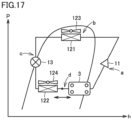
- Fig. 17 is a Mollier diagram showing a state of the first refrigerant during the pressure increase suppression operation.
- the vertical axis represents a pressure P
- the horizontal axis represents a specific enthalpy.
- saturated liquid line and saturated vapor line are indicated by curves.
- a compression process a for the first refrigerant, a condensation process b for the first refrigerant, an expansion process c for the first refrigerant, and an evaporation process d for the first refrigerant are shown in association with devices involved in the respective processes in first refrigeration cycle 1 during the pressure increase suppression operation.
- the first refrigerant is compressed by first compressor 11 to increase the pressure and specific enthalpy of the first refrigerant.
- the first refrigerant is condensed by first heat exchanger unit 121 (121A) to decrease the specific enthalpy of the first refrigerant with the pressure of the first refrigerant being maintained.
- the first refrigerant is expanded by first expansion valve 13 to decrease the pressure of the first refrigerant with the specific enthalpy of the first refrigerant being maintained.
- evaporation process d a second stage of evaporation is performed by second heat exchanger unit 122 (122A) and a second stage of evaporation is then performed by evaporator unit 31 of cascade heat exchanger 3 to increase the specific enthalpy of the first refrigerant with the pressure of the first refrigerant being maintained.
- a relative ratio of an amount of increase of the specific enthalpy by second heat exchanger unit 122 and an amount of increase of the specific enthalpy by evaporator unit 31 of cascade heat exchanger 3 is increased or decreased depending on an amount of supply of the heat medium by second fan 124 (second pump 142).
- second refrigeration cycle 2 when the operation of the binary refrigeration apparatus is stopped has a pressure corresponding to an outdoor air temperature when first refrigeration cycle 1 is not operated.
- first refrigeration cycle 1 For example, when a carbon dioxide refrigerant is used as the second refrigerant, if the outdoor air temperature reaches 30°C, the pressure in second refrigeration cycle 2 may exceed the pressure resistance of each of tubes and devices used in a general refrigeration cycle.
- the binary refrigeration apparatus performs the pressure increase suppression operation as described above when the operation is stopped.
- the pressure in second refrigeration cycle 2 is sufficiently lower than the pressure resistance of each of the tubes and devices, for example, when the outdoor air temperature is 7°C or lower, there is no possibility that the pressure resistance of each of the tubes and devices is exceeded even though the pressure increase suppression operation is not performed.
- controller 100 performs control to stop first refrigeration cycle 1 when the pressure in second refrigeration cycle 2 becomes lower than a threshold value during the pressure increase suppression operation.
- an outdoor air temperature sensor 49 configured to detect an outdoor air temperature of the binary refrigeration apparatus is provided as shown in Fig. 3 .
- a detection signal of outdoor air temperature sensor 49 is input to controller 100.
- Fig. 18 is a flowchart of the stop control for first refrigeration cycle 1 during the pressure increase suppression operation.
- the control of Fig. 18 is a subroutine program that is invoked and executed repeatedly at a certain cycle during execution of the processing of the pressure increase suppression operation as included in the main program of the control by controller 100.
- controller 100 determines whether or not a detection value of the outdoor air temperature detected by outdoor air temperature sensor 49 is lower than a third threshold value.
- the third threshold value is set to an outdoor air temperature value equal to or lower than an outdoor air temperature corresponding to the pressure of the setting value of the pressure resistance of each of the tubes and devices of second refrigeration cycle 2.
- controller 100 brings first refrigeration cycle 1 into the operation state in a step S22 or maintains the operation state of first refrigeration cycle 1 and returns to the main routine.
- controller 100 determines in a step S23 whether or not the detection value of the pressure in second refrigeration cycle 2 is lower than a fourth threshold value.
- the fourth threshold value is a pressure set to be equal to or lower than the first threshold value, and is a pressure value recognized as having no possibility of exceeding the pressure resistance of each of the tubes and devices even though the pressure increase suppression operation is not performed. Specifically, in step S21, it is determined whether or not the pressure detected by second discharging pressure sensor 46 is lower than the first threshold value.
- controller 100 brings first refrigeration cycle 1 into the operation state in step S22 or maintains the operation state of first refrigeration cycle 1 and returns to the main routine.
- step S23 the operation of first refrigeration cycle 1 is stopped in step S25, and it returns to the main routine.
- step S25 at least first compressor 11 is stopped.
- first refrigeration cycle 1 Since the stop control for first refrigeration cycle 1 during the pressure increase suppression operation as shown in Fig. 18 is performed, the operation of first refrigeration cycle 1 can be stopped when it is recognized that there is no possibility that the pressure resistance of each of the tubes and devices is exceeded even through the pressure increase suppression operation is performed. Since the operation of first refrigeration cycle 1 can be stopped in accordance with the detection value of the outdoor air temperature and the detection value of the pressure in second refrigeration cycle 2 in this way, power consumption of the binary refrigeration apparatus can be reduced.
- switching device 800 comprising four-way valves is provided instead of switching device 80 described above.
- FIG. 19 and 20 is a diagram showing an overall configuration of a binary refrigeration apparatus 10C comprising switching device 800 according to the thirteenth embodiment.
- Switching device 800 shown in each of Figs. 19 and 20 is different from switching device 80 shown in Fig. 5 and the like in the following points.
- a first four-way valve 86 is provided instead of first on-off valve 81 and third on-off valve 83.
- a second four-way valve 87 is provided instead of second on-off valve 82 and fourth on-off valve 84.
- switching device 800 comprises first four-way valve 86, second four-way valve 87, and fifth on-off valve 85.
- Each of first four-way valve 86 and second four-way valve 87 are used in such a manner that one port is sealed.
- Fig. 21 is a block diagram showing an exemplary control configuration of binary refrigeration apparatus 10C.
- the configuration of Fig. 21 is different from the configuration of Fig. 3 in that controller 100 outputs a control signal to each of first four-way valve 86, second four-way valve 87, and fifth on-off valve 85 so as to control switching device 800.
- Fig. 21 also shows an exemplary connection among a first three-way valve 88, a second three-way valve 89, a six-way valve 90, and a sixth on-off valve 95, which are not provided in the thirteenth embodiment but are provided in other embodiments described later.
- FIG. 19 flow of the first refrigerant and flow of the second refrigerant in the cooling operation are indicated by straight arrows.
- both first heat exchanger unit 121 and second heat exchanger unit 122 are each used as a condenser.
- controller 100 controls first four-way valve 86 and second four-way valve 87 to form, between first compressor 11 and first expansion valve 13 in switching device 800, a path in which second heat exchanger unit 122 is connected to first heat exchanger unit 121 in parallel. In that case, controller 100 controls fifth on-off valve 85 to the opened state.
- first four-way valve 86 and second four-way valve 87 in the cooling operation, a first path in which the first refrigerant flows through first heat exchanger unit 121, and a second path in which the first refrigerant flows through first four-way valve 86, second heat exchanger unit 122 and second four-way valve 87 are formed between first compressor 11 and first expansion valve 13.
- both first heat exchanger unit 121 and second heat exchanger unit 122 are each used as a condenser in condensation device 12.
- FIG. 20 flow of the first refrigerant and flow of the second refrigerant in the cooling operation are indicated by straight arrows.
- first heat exchanger unit 121 is used as a condenser and second heat exchanger unit 122 is used as an evaporator in condensation device 12.
- controller 100 controls the first four-way valve and second four-way valve 87 so as to form, in switching device 800, a path in which second heat exchanger unit 122 is connected between first expansion valve 13 and evaporator unit 31 of cascade heat exchanger 3. In that case, controller 100 controls fifth on-off valve 85 to the closed state.
- first four-way valve 86 and second four-way valve 87 in the pressure increase suppression operation, a path in which the first refrigerant flows through second four-way valve 87, second heat exchanger unit 122, and first four-way valve 86 is formed between first expansion valve 13 and evaporator unit 31 of cascade heat exchanger 3.
- first heat exchanger unit 121 is used as a condenser and second heat exchanger unit 122 is used as an evaporator in condensation device 12.
- switching device 800 is controlled by controller 100 so as to form the same path as that in switching device 80 described above during each of the cooling operation and the pressure increase suppression operation.
- binary refrigeration apparatus 10C the same path for the first refrigerant as the path in each of binary refrigeration apparatus 10, binary refrigeration apparatus 10A, and binary refrigeration apparatus 10B is formed during each of the cooling operation and the pressure increase suppression operation.
- first four-way valve 86 and second four-way valve 87 may be a four-way valve driven based on a differential pressure between the suction temperature of first compressor 11 detected by first suction temperature sensor 42 and the discharging pressure of first compressor 11 detected by first discharging pressure sensor 43.
- switching device 800 comprises the two four-way valves in binary refrigeration apparatus 10D, the number of components can be reduced, thereby suppressing increased manufacturing cost. Further, since switching device 800 comprises two four-way valves in binary refrigeration apparatus 10D, the number of valves controlled by controller 100 can be reduced.
- switching device 801 comprising four-way valves is provided instead of switching device 80 described above.
- FIG. 22 and 23 is a diagram showing an overall configuration of a binary refrigeration apparatus 10D comprising switching device 801 according to the fourteenth embodiment.
- Switching device 801 shown in Figs. 22 and 23 is different from switching device 800 shown in Fig. 20 and the like in the following points.
- a first three-way valve 88 is provided instead of first four-way valve 86.
- a second three-way valve 89 is provided instead of second four-way valve 87.
- switching device 801 comprises first four-way valve 86, second three-way valve 89, and fifth on-off valve 85.
- controller 100 outputs a control signal to each of first three-way valve 88, second three-way valve 89, and fifth on-off valve 85 so as to control switching device 801.
- FIG. 22 flow of the first refrigerant and flow of the second refrigerant in the cooling operation are indicated by straight arrows.
- both first heat exchanger unit 121 and second heat exchanger unit 122 are each used as a condenser.
- controller 100 controls first three-way valve 88 and second three-way valve 89 to form, between first compressor 11 and first expansion valve 13 in switching device 801, a path in which second heat exchanger unit 122 is connected to first heat exchanger unit 121 in parallel. In that case, controller 100 controls fifth on-off valve 85 to the opened state.
- first three-way valve 88 and second three-way valve 89 in the cooling operation, a first path in which the first refrigerant flows through first heat exchanger unit 121, and a second path in which the first refrigerant flows through first three-way valve 88, second heat exchanger unit 122 and second three-way valve 89 are formed between first compressor 11 and first expansion valve 13.
- both first heat exchanger unit 121 and second heat exchanger unit 122 are each used as a condenser in condensation device 12.
- FIG. 23 flow of the first refrigerant and flow of the second refrigerant in the pressure increase suppression operation are indicated by straight arrows.
- first heat exchanger unit 121 is used as a condenser and second heat exchanger unit 122 is used as an evaporator in condensation device 12.
- controller 100 controls first three-way valve 88 and second three-way valve 89 so as to form, in switching device 801, a path in which second heat exchanger unit 122 is connected between first expansion valve 13 and evaporator unit 31 of cascade heat exchanger 3. In that case, controller 100 controls the fifth on-off valve to the closed state.
- first heat exchanger unit 121 is used as a condenser and second heat exchanger unit 122 is used as an evaporator in condensation device 12.
- switching device 801 is controlled by controller 100 so as to form the path similar to that in switching device 80 described above during each of the cooling operation and the pressure increase suppression operation.
- the path for the first refrigerant similar to that in each of binary refrigeration apparatus 10, binary refrigeration apparatus 10A, binary refrigeration apparatus 10B, and binary refrigeration apparatus 10C is formed during each of the cooling operation and the pressure increase suppression operation.
- switching device 801 comprises the two three-way valves in binary refrigeration apparatus 10D
- the number of components can be reduced, thereby suppressing increased manufacturing cost.
- switching device 801 comprises the two three-way valves in binary refrigeration apparatus 10D
- the number of valves controlled by controller 100 can be reduced.
- a work of sealing the port is not necessary for each of first three-way valve 88 and second three-way valve 89, thereby improving workability in constructing binary refrigeration apparatus 10E. With such an improvement in workability, processing cost for devices can be reduced.
- switching device 802 comprising a six-way valve is provided instead of switching device 80 described above.
- FIG. 24 and 25 is a diagram showing an overall configuration of a binary refrigeration apparatus 10E comprising switching device 802 according to the fifteenth embodiment.
- Switching device 802 shown in Figs. 24 and 25 is different from switching device 80 shown in Fig. 5 and the like in the following points.
- a six-way valve 90 and a sixth on-off valve 95 are provided instead of first on-off valve 81, second on-off valve 82, third on-off valve 83, fourth on-off valve 84, and fifth on-off valve 85.
- switching device 802 comprises six-way valve 90 and sixth on-off valve 95.
- controller 100 outputs a control signal to each of six-way valve 90 and sixth on-off valve 95 so as to control switching device 802.
- FIG. 24 flow of the first refrigerant and flow of the second refrigerant in the cooling operation are indicated by straight arrows.
- both first heat exchanger unit 121 and second heat exchanger unit 122 are each used as a condenser.
- controller 100 controls six-way valve 90 and sixth on-off valve 95 to form, between first compressor 11 and first expansion valve 13 in switching device 802, a path in which second heat exchanger unit 122 and first heat exchanger unit 121 are connected in parallel. In that case, controller 100 controls sixth on-off valve 95 to an opened state.
- first heat exchanger unit 121 and second heat exchanger unit 122 are each used as a condenser in condensation device 12.
- FIG. 25 flow of the first refrigerant and flow of the second refrigerant in the pressure increase suppression operation are indicated by straight arrows.
- first heat exchanger unit 121 is used as a condenser and second heat exchanger unit 122 is used as an evaporator in condensation device 12.
- controller 100 controls six-way valve 90 and sixth on-off valve 95 so as to form, between first compressor 11 and first expansion valve 13 in switching device 802, a path in which the first refrigerant flows through first heat exchanger unit 121 and six-way valve 90. Further, controller 100 controls six-way valve 90 and sixth on-off valve 95 so as to form, between first expansion valve 13 and evaporator unit 31 of cascade heat exchanger 3 in switching device 802, a path in which the first refrigerant flows through second heat exchanger unit 122 and six-way valve 90. In that case, controller 100 controls sixth on-off valve 95 to the closed state.
- first heat exchanger unit 121 is used as a condenser and second heat exchanger unit 122 is used as an evaporator in condensation device 12.
- switching device 802 is controlled by controller 100 so as to form the path similar to that in switching device 80 described above during each of the cooling operation and the pressure increase suppression operation.
- binary refrigeration apparatus 10E the path for the first refrigerant similar to the path in each of binary refrigeration apparatus 10, binary refrigeration apparatus 10A, binary refrigeration apparatus 10B, binary refrigeration apparatus 10C, and binary refrigeration apparatus 10D is formed during each of the cooling operation and the pressure increase suppression operation.
- switching device 802 comprises one six-way valve in binary refrigeration apparatus 10E
- the number of components can be reduced, thereby suppressing increased manufacturing cost.
- switching device 802 comprises one six-way valve in binary refrigeration apparatus 10E
- the number of valves controlled by controller 100 can be reduced.
- a work of sealing the port is not necessary for six-way valve 90, thereby improving workability in constructing binary refrigeration apparatus 10E. With such an improvement in workability, processing cost for devices can be reduced.
- first refrigerant expanded by first expansion valve 13 is evaporated in evaporator unit 31 of cascade heat exchanger 3, is then evaporated in second heat exchanger unit 122, and is supplied to first compressor 11 in the pressure increase suppression operation.
- Fig. 26 is a diagram showing an overall configuration of a binary refrigeration apparatus 10F according to the sixteenth embodiment.
- Binary refrigeration apparatus 10F shown in Fig. 26 is different from binary refrigeration apparatus 10A shown in Fig. 5 and the like in the following point.
- switching device 80 and cascade heat exchanger 3 are provided in a positional relation opposite to that of binary refrigeration apparatus 10A.
- cascade heat exchanger 3 is provided at a position close to first expansion valve 13 with respect to switching device 80.
- switching device 80 is provided at a position close to the suction side of first compressor 11 with respect to cascade heat exchanger 3.
- An operation of binary refrigeration apparatus 10F during the cooling operation is the same as the operation of binary refrigeration apparatus 10A during the cooling operation shown in Fig. 5 and the like.
- the first refrigerant expanded by first expansion valve 13 is evaporated in evaporator unit 31 of cascade heat exchanger 3, and is then supplied to the inlet of first compressor 11 through fifth on-off valve 85.
- FIG. 26 flow of the first refrigerant and flow of the second refrigerant in the pressure increase suppression operation are indicated by straight arrows.
- controller 100 brings first on-off valve 81, second on-off valve 82, and fifth on-off valve 85 into the closed state and brings third on-off valve 83 and fourth on-off valve 84 into the opened state in switching device 80.
- first on-off valve 81 to fifth on-off valve 85 in the pressure increase suppression operation, a path in which the first refrigerant flows through only first heat exchanger unit 121 of condensation device 12 is formed between the suction side of first compressor 11 and first expansion valve 13.
- first heat exchanger unit 121 since the high-temperature high-pressure first refrigerant discharged from first compressor 11 flows only to first heat exchanger unit 121 as indicated by an arrow in the figure, only first heat exchanger unit 121 is used as a condenser in condensation device 12.
- the first refrigerant expanded by first expansion valve 13 is first supplied to evaporator unit 31 of cascade heat exchanger 3 and exchanges heat with the outdoor air to result in a first stage of evaporation.
- fifth on-off valve 85 is in the closed state and third on-off valve 83 and fourth on-off valve 84 are each in the opened state. Therefore, the first refrigerant that has passed through evaporator unit 31 of cascade heat exchanger 3 is supplied to the inlet of first compressor 11 through fourth on-off valve 84, second heat exchanger unit 122, and third on-off valve 83.
- the first refrigerant having flowed into second heat exchanger unit 122 exchanges heat with the outdoor air to result in a second stage of evaporation.
- Controller 100 controls the flow rate of the heat exchange medium to be supplied from second fan 124 to second heat exchanger unit 122 such that a temperature or degree of superheat obtained through the detection value of first suction temperature sensor 42 becomes a predetermined threshold value.
- binary refrigeration apparatus 10F basically, various types of control similar to those in binary refrigeration apparatus 10 according to the first embodiment are performed by controller 100.
- binary refrigeration apparatus 10F according to the sixteenth embodiment is different from binary refrigeration apparatus 10 according to the first embodiment in that the degree of superheat obtained through the detection value of first suction temperature sensor 42 can be set up to a degree of superheat corresponding to the outdoor air temperature.
- switching device 80 is provided between cascade heat exchanger 3 and first compressor 11 in first refrigeration cycle 1 in the configuration of binary refrigeration apparatus 10F, the state of the refrigerant on the outlet side of cascade heat exchanger 3 does not need to be the superheated gas state in order to suppress the liquid back to first compressor 11.
- the cooling in second refrigeration cycle 2 can be performed more efficiently.
- the evaporation temperature of second refrigeration cycle 2 when the pressure in second refrigeration cycle 2 becomes the reference pressure can be made higher than that in binary refrigeration apparatus 10 of the first embodiment.
- the suction temperature of first compressor 11 can be made higher than that in the first embodiment.
- occurrence of liquid back to first compressor 11 can be more suppressed than in the first embodiment, thereby improving reliability of binary refrigeration apparatus 10F.
- Binary refrigeration apparatus 10 comprises: a first refrigeration cycle 1 in which a first refrigerant circulates, first refrigeration cycle 1 comprising a first compressor 11, a condensation device 12, a first expansion valve 13, and a cascade heat exchanger 3; and a second refrigeration cycle 2 in which a second refrigerant circulates, second refrigeration cycle 2 comprising a second compressor 21, cascade heat exchanger 3, a second expansion valve 23, and an evaporator 24.
- Cascade heat exchanger 3 is used as an evaporator in first refrigeration cycle 1 and as a condenser in second refrigeration cycle 2 by performing heat exchange between the first refrigerant and the second refrigerant.
- Condensation device 12 comprises a first heat exchanger unit 121 configured to condense the first refrigerant, and a second heat exchanger unit 122 configured to condense or evaporate the first refrigerant.
- Binary refrigeration apparatus 10 further comprises a switching device 80 configured to switch a state of second heat exchanger unit 122 between a first state in which the first refrigerant is condensed and a second state in which the first refrigerant is evaporated.
- switching device 80 In a cooling operation that is a first operation for performing cooling by evaporator 24 in second refrigeration cycle 2, switching device 80 is configured to bring second heat exchanger unit 122 into the first state, and in a pressure increase suppression operation that is a second operation for suppressing a pressure in second refrigeration cycle 2, switching device 80 is configured to bring second heat exchanger unit 122 into the second state.
- switching device 80 comprises a first on-off valve 81, a second on-off valve 82, a third on-off valve 83, a fourth on-off valve 84, and a fifth on-off valve 85, each of which serves as a switching valve.
- the switching valve is configured to switch the state of second heat exchanger unit 122 between the first state and the second state by switching a path in which the first refrigerant is supplied to second heat exchanger unit 122.
- switching device 80 can use the switching valve such as first on-off valve 81, second on-off valve 82, third on-off valve 83, fourth on-off valve 84, and fifth on-off valve 85 so as to switch the path in which the first refrigerant is supplied to second heat exchanger unit 122, thereby switching the state of second heat exchanger unit 122 between the first state and the second state.
- switching valve such as first on-off valve 81, second on-off valve 82, third on-off valve 83, fourth on-off valve 84, and fifth on-off valve 85
- binary refrigeration apparatus 10 further comprises a controller 100 configured to control switching device 80.
- Controller 100 is configured to control the switching valve such as first on-off valve 81, second on-off valve 82, third on-off valve 83, fourth on-off valve 84, and fifth on-off valve 85 so as to switch the path in which the first refrigerant is supplied to second heat exchanger unit 122.
- the path in which the first refrigerant is supplied to the second heat exchanger unit comprises a first path provided between first compressor 11 and first expansion valve 13, and a second path provided between first expansion valve 13 and cascade heat exchanger 3.
- Controller 100 is configured to control the switching valve such as first on-off valve 81, second on-off valve 82, third on-off valve 83, fourth on-off valve 84, and fifth on-off valve 85 so as to perform control to switch between the first path and the second path.
- the switching valve comprises: a first on-off valve 81, a second on-off valve 82, a third on-off valve 83, and a fourth on-off valve 84, each of which serves as a first switching valve configured to switch between a first connection state and a second connection state, the first connection state being a state in which second heat exchanger unit 122 is connected to a path for the first refrigerant between first compressor 11 and first expansion valve 13, the second connection state being a state in which second heat exchanger unit 122 is connected to a path for the first refrigerant between first expansion valve 13 and cascade heat exchanger 3; and a fifth on-off valve 85 serving as a second switching valve configured to switch the path for the first refrigerant between first expansion valve 13 and cascade heat exchanger 3 from a first supply path to a second supply path in the second connection state, the first supply path being a path in which the first refrigerant is directly supplied from first expansion valve 13 to cascade heat exchanger 3, the second supply path being a path
- binary refrigeration apparatus 10 further comprises: a first fan 123 serving as a first supplying device configured to supply first heat exchanger unit 121 with a first heat exchange medium for adjusting an amount of heat exchange of first heat exchanger unit 121; and a second fan 124 serving as a second supplying device configured to supply second heat exchanger unit 122 with a second heat exchange medium for adjusting an amount of heat exchange of second heat exchanger unit 122.
- Controller 100 is configured to control an amount of supply of the first heat exchange medium by the first supplying device, and is configured to control an amount of supply of the second heat exchange medium by the second supplying device.
- controller 100 can control the amount of supply of the first heat exchange medium so as to allow first heat exchanger unit 121 to have a temperature suitable for condensation and can control the amount of supply of the first heat exchange medium so as to allow second heat exchanger unit 122 to have a temperature suitable for condensation or evaporation, the amount of supply of the first heat exchange medium and the amount of supply of the second heat exchange medium can be adjusted so as to individually allow each of first heat exchanger unit 121 and second heat exchanger unit 122 to have a temperature suitable for condensation or evaporation.
- a supply path for the first heat exchange medium is different from a supply path for the second heat exchange medium.
- one of first heat exchanger unit 121 and second heat exchanger unit 122 can be suppressed from being affected by heat from a heat medium that is the heat exchange medium supplied to the other.
- heat exchange of the first refrigerant is promoted in each of first heat exchanger unit 121 and second heat exchanger unit 122, thereby improving a heat exchange capacity for the first refrigerant.
- controller 100 when switching from the cooling operation serving as the first operation to the pressure increase suppression operation serving as the second operation, controller 100 is configured to increase the amount of supply of the first heat exchange medium by first fan 123 serving as the first supplying device as compared with the first operation (step S3), and then increase the amount of supply of the second heat exchange medium by second fan 124 serving as the second supplying device as compared with the first operation (step S4).
- controller 100 when switching from the cooling operation serving as the first operation to the pressure increase suppression operation serving as the second operation, controller 100 is configured to increase the amount of supply of the second heat exchange medium by the second supplying device as compared with the first operation, and then switch the state of the second heat exchanger unit to the second state using the switching device.
- controller 100 when switching from the cooling operation serving as the first operation to the pressure increase suppression operation serving as the second operation, controller 100 is configured to increase the amount of supply of the first heat exchange medium by first fan 123 serving as the first supplying device as compared with the first operation (step S3), and then increase the amount of supply of the second heat exchange medium by second fan 124 serving as the second supplying device as compared with the first operation (step S4), and is configured to switch the state of the second heat exchanger unit to the second state using the switching device (step S5) after increasing the amount of supply of the second heat exchange medium by the second supplying device (step S4).
- binary refrigeration apparatus 10 further comprises a second suction pressure sensor 44 serving as a pressure sensor configured to detect a pressure of a path between second compressor 21 and cascade heat exchanger 3.
- controller 100 is configured to control the second heat exchange medium to be supplied from second fan 124 serving as the second supplying device to second heat exchanger unit 122, so as to cause the pressure detected by the pressure sensor to fall within a reference range (steps S12 to S14).
- the heat exchange capacity of cascade heat exchanger 3 can be adjusted in accordance with a situation that changes the pressure in second refrigeration cycle 2, such as outdoor air temperature and disturbance.
- binary refrigeration apparatus 10 further comprises: an outdoor air temperature sensor 49 configured to detect an outdoor air temperature; and a second suction pressure sensor 44 serving as a pressure sensor configured to detect a pressure of a path between second compressor 21 and the cascade heat exchanger.
- controller 100 is configured to stop the first compressor when the outdoor air temperature detected by outdoor air temperature sensor 49 is lower than a first reference value and the pressure detected by the pressure sensor is lower than a second reference value (step S25).
- first refrigeration cycle 1 when it is recognized that there is no possibility of exceeding the pressure resistance of each of tubes and devices even through the pressure increase suppression operation is not performed, the operation of first refrigeration cycle 1 can be stopped by stopping the first compressor.
- first heat exchanger unit 121 is a flat tube 50 type heat exchanger. With such a configuration, heat exchange efficiency of first heat exchanger unit 121 can be improved.
- first heat exchanger unit 121 has a larger volume than a volume of second heat exchanger unit 122.
- condensation performance of first heat exchanger unit 121 during the pressure increase control operation is improved, thereby suppressing the pressure in first refrigeration cycle 1 from being increased excessively during the pressure increase control operation.
Landscapes
- Engineering & Computer Science (AREA)
- Physics & Mathematics (AREA)
- Mechanical Engineering (AREA)
- Thermal Sciences (AREA)
- General Engineering & Computer Science (AREA)
- Devices That Are Associated With Refrigeration Equipment (AREA)
- Compression-Type Refrigeration Machines With Reversible Cycles (AREA)
Applications Claiming Priority (1)
| Application Number | Priority Date | Filing Date | Title |
|---|---|---|---|
| PCT/JP2021/039135 WO2023067807A1 (ja) | 2021-10-22 | 2021-10-22 | 二元冷凍装置 |
Publications (1)
| Publication Number | Publication Date |
|---|---|
| EP4421410A1 true EP4421410A1 (en) | 2024-08-28 |
Family
ID=86058087
Family Applications (1)
| Application Number | Title | Priority Date | Filing Date |
|---|---|---|---|
| EP21961455.9A Withdrawn EP4421410A1 (en) | 2021-10-22 | 2021-10-22 | Binary refrigeration device |
Country Status (4)
| Country | Link |
|---|---|
| EP (1) | EP4421410A1 (https=) |
| JP (1) | JPWO2023067807A1 (https=) |
| CN (1) | CN118103644A (https=) |
| WO (1) | WO2023067807A1 (https=) |
Families Citing this family (1)
| Publication number | Priority date | Publication date | Assignee | Title |
|---|---|---|---|---|
| CN116817478B (zh) * | 2023-06-01 | 2025-09-05 | 青岛海尔空调电子有限公司 | 冷凝机组及用于冷凝机组控制的方法、装置和存储介质 |
Family Cites Families (3)
| Publication number | Priority date | Publication date | Assignee | Title |
|---|---|---|---|---|
| WO2013160929A1 (ja) * | 2012-04-23 | 2013-10-31 | 三菱電機株式会社 | 冷凍サイクルシステム |
| EP3617612B1 (en) * | 2017-04-25 | 2021-09-01 | Mitsubishi Electric Corporation | Binary refrigeration device |
| JP2018087693A (ja) * | 2018-03-05 | 2018-06-07 | サンデンホールディングス株式会社 | 冷凍装置 |
-
2021
- 2021-10-22 WO PCT/JP2021/039135 patent/WO2023067807A1/ja not_active Ceased
- 2021-10-22 JP JP2023554217A patent/JPWO2023067807A1/ja not_active Withdrawn
- 2021-10-22 EP EP21961455.9A patent/EP4421410A1/en not_active Withdrawn
- 2021-10-22 CN CN202180103392.2A patent/CN118103644A/zh active Pending
Also Published As
| Publication number | Publication date |
|---|---|
| JPWO2023067807A1 (https=) | 2023-04-27 |
| CN118103644A (zh) | 2024-05-28 |
| WO2023067807A1 (ja) | 2023-04-27 |
Similar Documents
| Publication | Publication Date | Title |
|---|---|---|
| EP2995885B1 (en) | Binary refrigeration device | |
| EP3062031B1 (en) | Air conditioner | |
| EP2309204B1 (en) | Refrigeration device | |
| JP5318099B2 (ja) | 冷凍サイクル装置、並びにその制御方法 | |
| EP2833086B1 (en) | Air-conditioning apparatus | |
| JP5709844B2 (ja) | 空気調和装置 | |
| EP3690349B1 (en) | Air conditioner | |
| EP2770276B1 (en) | Heat pump | |
| EP3242096B1 (en) | Regenerative air conditioner | |
| EP2902726B1 (en) | Combined air-conditioning and hot-water supply system | |
| EP4102153B1 (en) | Refrigeration cycle device | |
| EP3483523A1 (en) | Refrigeration cycle apparatus and air-conditioning apparatus provided with same | |
| EP3760947B1 (en) | Refrigeration device | |
| EP3106779A1 (en) | Refrigeration device | |
| EP3543624A1 (en) | Air conditioner | |
| EP4303504B1 (en) | Heat source unit and refrigeration apparatus | |
| EP3282208B1 (en) | Refrigeration apparatus | |
| EP3483518B1 (en) | Heat source unit for refrigeration device | |
| KR20080020431A (ko) | 냉동사이클 및 이를 이용한 공기조화기와 냉장고 | |
| EP4421410A1 (en) | Binary refrigeration device | |
| KR20050072299A (ko) | 냉난방 공기조화시스템 | |
| KR101692243B1 (ko) | 캐스캐이드 사이클을 이용한 히트 펌프 | |
| EP4015939B1 (en) | Refrigeration device | |
| KR20180056854A (ko) | 압축기의 흡입온도 조절이 가능한 고용량 급속 냉각 초저온 냉동기 | |
| EP4328525B1 (en) | Refrigeration cycle apparatus |
Legal Events
| Date | Code | Title | Description |
|---|---|---|---|
| STAA | Information on the status of an ep patent application or granted ep patent |
Free format text: STATUS: THE INTERNATIONAL PUBLICATION HAS BEEN MADE |
|
| PUAI | Public reference made under article 153(3) epc to a published international application that has entered the european phase |
Free format text: ORIGINAL CODE: 0009012 |
|
| STAA | Information on the status of an ep patent application or granted ep patent |
Free format text: STATUS: REQUEST FOR EXAMINATION WAS MADE |
|
| 17P | Request for examination filed |
Effective date: 20240416 |
|
| AK | Designated contracting states |
Kind code of ref document: A1 Designated state(s): AL AT BE BG CH CY CZ DE DK EE ES FI FR GB GR HR HU IE IS IT LI LT LU LV MC MK MT NL NO PL PT RO RS SE SI SK SM TR |
|
| STAA | Information on the status of an ep patent application or granted ep patent |
Free format text: STATUS: THE APPLICATION HAS BEEN WITHDRAWN |
|
| 18W | Application withdrawn |
Effective date: 20240827 |