EP4420757A2 - System zur erfassung von atmosphärischem kohlendioxid - Google Patents
System zur erfassung von atmosphärischem kohlendioxid Download PDFInfo
- Publication number
- EP4420757A2 EP4420757A2 EP24154871.8A EP24154871A EP4420757A2 EP 4420757 A2 EP4420757 A2 EP 4420757A2 EP 24154871 A EP24154871 A EP 24154871A EP 4420757 A2 EP4420757 A2 EP 4420757A2
- Authority
- EP
- European Patent Office
- Prior art keywords
- sorbent
- chemical component
- compartment
- state
- solid
- Prior art date
- Legal status (The legal status is an assumption and is not a legal conclusion. Google has not performed a legal analysis and makes no representation as to the accuracy of the status listed.)
- Pending
Links
Images



Classifications
-
- B—PERFORMING OPERATIONS; TRANSPORTING
- B01—PHYSICAL OR CHEMICAL PROCESSES OR APPARATUS IN GENERAL
- B01D—SEPARATION
- B01D53/00—Separation of gases or vapours; Recovering vapours of volatile solvents from gases; Chemical or biological purification of waste gases, e.g. engine exhaust gases, smoke, fumes, flue gases, aerosols
- B01D53/02—Separation of gases or vapours; Recovering vapours of volatile solvents from gases; Chemical or biological purification of waste gases, e.g. engine exhaust gases, smoke, fumes, flue gases, aerosols by adsorption, e.g. preparative gas chromatography
- B01D53/04—Separation of gases or vapours; Recovering vapours of volatile solvents from gases; Chemical or biological purification of waste gases, e.g. engine exhaust gases, smoke, fumes, flue gases, aerosols by adsorption, e.g. preparative gas chromatography with stationary adsorbents
-
- B—PERFORMING OPERATIONS; TRANSPORTING
- B01—PHYSICAL OR CHEMICAL PROCESSES OR APPARATUS IN GENERAL
- B01D—SEPARATION
- B01D53/00—Separation of gases or vapours; Recovering vapours of volatile solvents from gases; Chemical or biological purification of waste gases, e.g. engine exhaust gases, smoke, fumes, flue gases, aerosols
- B01D53/02—Separation of gases or vapours; Recovering vapours of volatile solvents from gases; Chemical or biological purification of waste gases, e.g. engine exhaust gases, smoke, fumes, flue gases, aerosols by adsorption, e.g. preparative gas chromatography
- B01D53/04—Separation of gases or vapours; Recovering vapours of volatile solvents from gases; Chemical or biological purification of waste gases, e.g. engine exhaust gases, smoke, fumes, flue gases, aerosols by adsorption, e.g. preparative gas chromatography with stationary adsorbents
- B01D53/0407—Constructional details of adsorbing systems
-
- B—PERFORMING OPERATIONS; TRANSPORTING
- B01—PHYSICAL OR CHEMICAL PROCESSES OR APPARATUS IN GENERAL
- B01D—SEPARATION
- B01D53/00—Separation of gases or vapours; Recovering vapours of volatile solvents from gases; Chemical or biological purification of waste gases, e.g. engine exhaust gases, smoke, fumes, flue gases, aerosols
- B01D53/14—Separation of gases or vapours; Recovering vapours of volatile solvents from gases; Chemical or biological purification of waste gases, e.g. engine exhaust gases, smoke, fumes, flue gases, aerosols by absorption
- B01D53/1456—Removing acid components
- B01D53/1475—Removing carbon dioxide
-
- B—PERFORMING OPERATIONS; TRANSPORTING
- B01—PHYSICAL OR CHEMICAL PROCESSES OR APPARATUS IN GENERAL
- B01D—SEPARATION
- B01D53/00—Separation of gases or vapours; Recovering vapours of volatile solvents from gases; Chemical or biological purification of waste gases, e.g. engine exhaust gases, smoke, fumes, flue gases, aerosols
- B01D53/14—Separation of gases or vapours; Recovering vapours of volatile solvents from gases; Chemical or biological purification of waste gases, e.g. engine exhaust gases, smoke, fumes, flue gases, aerosols by absorption
- B01D53/18—Absorbing units; Liquid distributors therefor
-
- B—PERFORMING OPERATIONS; TRANSPORTING
- B01—PHYSICAL OR CHEMICAL PROCESSES OR APPARATUS IN GENERAL
- B01D—SEPARATION
- B01D53/00—Separation of gases or vapours; Recovering vapours of volatile solvents from gases; Chemical or biological purification of waste gases, e.g. engine exhaust gases, smoke, fumes, flue gases, aerosols
- B01D53/34—Chemical or biological purification of waste gases
- B01D53/46—Removing components of defined structure
- B01D53/62—Carbon oxides
-
- B—PERFORMING OPERATIONS; TRANSPORTING
- B01—PHYSICAL OR CHEMICAL PROCESSES OR APPARATUS IN GENERAL
- B01D—SEPARATION
- B01D53/00—Separation of gases or vapours; Recovering vapours of volatile solvents from gases; Chemical or biological purification of waste gases, e.g. engine exhaust gases, smoke, fumes, flue gases, aerosols
- B01D53/34—Chemical or biological purification of waste gases
- B01D53/74—General processes for purification of waste gases; Apparatus or devices specially adapted therefor
- B01D53/81—Solid phase processes
- B01D53/82—Solid phase processes with stationary reactants
-
- B—PERFORMING OPERATIONS; TRANSPORTING
- B01—PHYSICAL OR CHEMICAL PROCESSES OR APPARATUS IN GENERAL
- B01D—SEPARATION
- B01D53/00—Separation of gases or vapours; Recovering vapours of volatile solvents from gases; Chemical or biological purification of waste gases, e.g. engine exhaust gases, smoke, fumes, flue gases, aerosols
- B01D53/34—Chemical or biological purification of waste gases
- B01D53/96—Regeneration, reactivation or recycling of reactants
- B01D53/965—Regeneration, reactivation or recycling of reactants including an electrochemical process step
-
- B—PERFORMING OPERATIONS; TRANSPORTING
- B01—PHYSICAL OR CHEMICAL PROCESSES OR APPARATUS IN GENERAL
- B01D—SEPARATION
- B01D2253/00—Adsorbents used in seperation treatment of gases and vapours
- B01D2253/20—Organic adsorbents
-
- B—PERFORMING OPERATIONS; TRANSPORTING
- B01—PHYSICAL OR CHEMICAL PROCESSES OR APPARATUS IN GENERAL
- B01D—SEPARATION
- B01D2253/00—Adsorbents used in seperation treatment of gases and vapours
- B01D2253/25—Coated, impregnated or composite adsorbents
-
- B—PERFORMING OPERATIONS; TRANSPORTING
- B01—PHYSICAL OR CHEMICAL PROCESSES OR APPARATUS IN GENERAL
- B01D—SEPARATION
- B01D2257/00—Components to be removed
- B01D2257/50—Carbon oxides
- B01D2257/504—Carbon dioxide
-
- B—PERFORMING OPERATIONS; TRANSPORTING
- B01—PHYSICAL OR CHEMICAL PROCESSES OR APPARATUS IN GENERAL
- B01D—SEPARATION
- B01D2258/00—Sources of waste gases
- B01D2258/06—Polluted air
-
- B—PERFORMING OPERATIONS; TRANSPORTING
- B01—PHYSICAL OR CHEMICAL PROCESSES OR APPARATUS IN GENERAL
- B01D—SEPARATION
- B01D2259/00—Type of treatment
- B01D2259/40—Further details for adsorption processes and devices
- B01D2259/40083—Regeneration of adsorbents in processes other than pressure or temperature swing adsorption
-
- Y—GENERAL TAGGING OF NEW TECHNOLOGICAL DEVELOPMENTS; GENERAL TAGGING OF CROSS-SECTIONAL TECHNOLOGIES SPANNING OVER SEVERAL SECTIONS OF THE IPC; TECHNICAL SUBJECTS COVERED BY FORMER USPC CROSS-REFERENCE ART COLLECTIONS [XRACs] AND DIGESTS
- Y02—TECHNOLOGIES OR APPLICATIONS FOR MITIGATION OR ADAPTATION AGAINST CLIMATE CHANGE
- Y02C—CAPTURE, STORAGE, SEQUESTRATION OR DISPOSAL OF GREENHOUSE GASES [GHG]
- Y02C20/00—Capture or disposal of greenhouse gases
- Y02C20/40—Capture or disposal of greenhouse gases of CO2
Definitions
- the present disclosure relates to a system for capture of atmospheric carbon dioxide (CO 2 ) using a sorbent, regeneration of the sorbent, and a method of using the system.
- CO 2 atmospheric carbon dioxide
- Carbon dioxide is a notorious greenhouse gas whose emissions have been sharply on the rise since the Industrial Revolution began in the 18 th century. Since then, the CO 2 emissions have been a confirmed culprit in the climate change around the world. Recent findings of the International Panel on Climate Change have proposed that the CO 2 emissions should be halved by 2030 to avoid further negative impact on the planet.
- Various technologies have been developed to capture atmospheric CO 2 , but their drawbacks prevent realization of more widespread CO 2 sequestration from air.
- an atmospheric CO 2 capture system in at least one embodiment, includes a compartment housing a solid CO 2 sorbent, an exchange fluid including a chemical component with selectivity towards CO 2 , and an electrochemical cell in fluid communication with the compartment.
- the system has a cycle including a first state of sorbing CO 2 from incoming air onto the solid CO 2 sorbent until a saturation point is reached, a second state of regenerating the sorbent by flooding the compartment with the exchange fluid to detach CO 2 from the saturated sorbent and bind the detached CO 2 to the chemical component, and a third state of regenerating the chemical component by detaching CO 2 from the chemical component in the electrochemical cell and releasing the CO 2 from the system.
- the chemical component may include an amine dissolved in an aqueous solution.
- the first and second states may be repeated before the system proceeds to the third state.
- a temperature of the solid sorbent may be maintained at a constant value throughout the first, second, and third states.
- the third state may further include providing the regenerated chemical component to the compartment during a second state of a following cycle.
- the solid CO 2 sorbent may be an amine-based sorbent.
- the CO 2 bound to the chemical component formed in the second state may be provided into the compartment in the first state of a following cycle.
- the second and third state may be repeated before the system proceeds to the first state in the following cycle.
- an atmospheric CO 2 capture system may include a compartment housing a solid amine-functionalized CO 2 sorbent, a first exchange solution including a first chemical component with a selectivity towards amines, a second exchange solution including a second chemical component with a selectivity towards the first chemical component, and an electrochemical cell connected to the compartment.
- the system may have a first state of sorbing CO 2 from incoming air onto the solid sorbent until a saturation point is reached, a second state of regenerating the solid amine-functionalized CO 2 sorbent by flooding the compartment with the first exchange fluid to detach CO 2 from the saturated sorbent and bind the first chemical component to the solid sorbent, removing the first exchange solution from the compartment, and flooding the compartment with the second exchange solution to detach the first chemical component from the solid sorbent to bind it to the second chemical component, and a third state of regenerating the first and/or second chemical components by detaching them from each other in the electrochemical cell.
- the CO 2 may be released from the compartment in the second state.
- the first chemical component may include one or more metal ions.
- the second chemical component may include an amine.
- the system may be free of a heating element.
- the solid amine-functionalized CO 2 sorbent may maintain a constant temperature throughout the states.
- a direct air capture (DAC) system may include at least one compartment housing a solid amine-functionalized CO 2 sorbent, at least one exchange fluid including a first chemical component with a preferential affinity towards CO 2 , amines, or a second chemical component, an electrochemical cell fluidly connected to the compartment, and one or more conduits structured to provide the chemical component in a pristine form from the electrochemical cell to the compartment.
- the system may include a plurality of the compartments, each fluidly connected to the electrochemical cell.
- the at least one exchange fluid may include a first exchange fluid and a second exchange fluid.
- the first exchange fluid may include a chemical component with selectivity to CO 2 and the second exchange fluid includes a chemical component with selectivity to the first chemical component.
- the solid sorbent may maintain a constant temperature.
- the system may include a first chemical component different from the second chemical component.
- the term “substantially,” “generally,” or “about” means that the amount or value in question may be the specific value designated or some other value in its neighborhood. Generally, the term “about” denoting a certain value is intended to denote a range within ⁇ 5% of the value. As one example, the phrase “about 100” denotes a range of 100 ⁇ 5, i.e. the range from 95 to 105. Generally, when the term “about” is used, it can be expected that similar results or effects according to the disclosure can be obtained within a range of ⁇ 5% of the indicated value.
- the term “substantially” may modify a value or relative characteristic disclosed or claimed in the present disclosure. In such instances, “substantially” may signify that the value or relative characteristic it modifies is within ⁇ 0%, 0.1%, 0.5%, 1%, 2%, 3%, 4%, 5% or 10% of the value or relative characteristic.
- integer ranges explicitly include all intervening integers.
- the integer range 1-10 explicitly includes 1, 2, 3, 4, 5, 6, 7, 8, 9, and 10.
- the range 1 to 100 includes 1, 2, 3, 4. . . . 97, 98, 99, 100.
- intervening numbers that are increments of the difference between the upper limit and the lower limit divided by 10 can be taken as alternative upper or lower limits. For example, if the range is 1.1. to 2.1 the following numbers 1.2, 1.3, 1.4, 1.5, 1.6, 1.7, 1.8, 1.9, and 2.0 can be selected as lower or upper limits.
- concentrations, temperature, and reaction conditions e.g., pressure, pH, flow rates, etc .
- concentrations, temperature, and reaction conditions can be practiced with plus or minus 50 percent of the values indicated rounded to or truncated to two significant figures of the value provided in the examples.
- concentrations, temperature, and reaction conditions e.g., pressure, pH, flow rates, etc .
- concentrations, temperature, and reaction conditions can be practiced with plus or minus 30 percent of the values indicated rounded to or truncated to two significant figures of the value provided in the examples.
- concentrations, temperature, and reaction conditions e.g ., pressure, pH, flow rates, etc .
- concentrations, temperature, and reaction conditions can be practiced with plus or minus 10 percent of the values indicated rounded to or truncated to two significant figures of the value provided in the examples.
- values of the subscripts can be plus or minus 50 percent of the values indicated rounded to or truncated to two significant figures. For example, if CH 2 O is indicated, a compound of formula C (0.8-1.2) H (1.6-2.4) O (0.8-1.2) .
- values of the subscripts can be plus or minus 30 percent of the values indicated rounded to or truncated to two significant figures.
- values of the subscripts can be plus or minus 20 percent of the values indicated rounded to or truncated to two significant figures.
- the term “and/or” means that either all or only one of the elements of said group may be present.
- a and/or B means “only A, or only B, or both A and B”.
- only A the term also covers the possibility that B is absent, i.e. "only A, but not B”.
- one or more means “at least one” and the term “at least one” means “one or more.”
- Carbon dioxide or CO 2 is a primary greenhouse gas accounting for about 80% of all U.S. annual greenhouse gas emissions from human activities.
- the CO 2 emissions are a wellrecognized global problem.
- Greenhouse gasses are gasses that trap heat in the atmosphere. The heat trapping causes changes in the radiative balance of the Earth that alter climate and weather patterns at global and regional scales.
- CO 2 is a chemical compound made up of molecules that each have one carbon atom covalently double bonded to two oxygen atoms. CO 2 is found in the gas state at ambient temperature. In the air, CO 2 is transparent to visible light but absorbs infrared radiation, thereby acting as a greenhouse gas.
- CO 2 enters the atmosphere through burning of fossil fuels such as coal, natural gas, and oil, solid waste, trees and other biological materials. CO 2 further enters the atmosphere as a result of certain chemical reactions such as manufacturing of cement or aluminum. Additionally, when methane enters the atmosphere, it combines with oxygen to form CO 2 .
- DAC direct air capture
- a sorbent 20 chosen to selectively absorb CO 2 is exposed to air until it reaches a desired saturation point.
- air is passed over an amine-functionalized sorbent 20, which separates CO 2 from the incoming gas stream, denoted as air.
- the sorbent is regenerated by stripping the absorbed CO 2 from the sorbent 20 and storing the captured CO 2 at high pressure and purity for later utilization or sequestration, marked as B.
- the CO 2 bound to the solid sorbent 20 is detached using a change in temperature, pressure, humidity level, or other stimulus, marked as A, regenerating the sorbent to its pristine state and releasing the CO 2 for storage or utilization.
- A a change in temperature, pressure, humidity level, or other stimulus
- the process can then be repeated.
- the line connecting "Amine” to "porous support” denotes that the amines are chemically bonded to the support.
- the regeneration stage requires energy input to desorb the captured CO 2 .
- the energy may come in the form of heat, changes in external pressure, changes in humidity, or potential.
- the energy cost of the DAC process, as well as the useful life of the sorbent material, are largely determined by the efficiency of the regeneration stage, making it an important design component of any DAC process.
- a high energy demand for the desorption of the sorbent is an obstacle to successful use of the process.
- the heat typically used for the desorption is such that damage to the sorbent frequently occurs due to thermal and oxidative stress. Further still, the desorption efficiency is limited such that less than 100% of the sorbent is typically recovered, with the recovery efficiency dropping over time.
- a typical sorbent technology in DAC includes a porous support material functionalized with amine-containing molecules or polymers.
- a porous silica or cellulose support material may be functionalized with amine-containing molecules or polyethyleneimine (PEI).
- PEI polyethyleneimine
- the amines react spontaneously with CO 2 to separate the CO 2 from the air while the porous support material provides a high surface area for the amine/air interface, ensures thar the air can flow through the sorbent, and anchors the amines in the solid sorbent, preventing their volatilization.
- State-of-the-art solid sorbent systems based on supported amines are typically regenerated by heating to a temperature where the CO 2 no longer favorably binds to the amines, about or above 100°C, exposure to high-temperature steam, exposure to vacuum, or a combination of the above.
- These regeneration processes are very energy intensive, and in the case of high-temperature desorption, contribute to the degradation of the amine sorbent by thermal degradation and oxidation. Hence, such systems are not sustainable.
- the systems for CO 2 stream capture may use liquid sorbents.
- the CO 2 containing gas is bubbled through a liquid containing amine-containing molecules that react favorably with CO 2 .
- the liquid sorbent solution may be regenerated analogously to the solid sorbent by heating.
- EMAR electrochemically mediated amine regeneration
- the EMAR process involves pumping the CO 2 -saturated amines through a series of tanks where Cu-metal is electrochemically stripped to form Cu 2+ ions, which then displace the absorbed CO 2 , releasing the displaced CO 2 as high-pressure gas for storage, and Cu 2+ ions bound to the amines are electrochemically plated as Cu-metal, regenerating the amine sorbent to its initial state.
- the EMAR process has been shown to be energetically competitive with thermal regeneration, while offering advantages in modularity and thermal management.
- Fig. 2 shows a schematic depiction of the electrochemical cell system 100 structured to carry out the EMAR process.
- Fig. 2 shows a liquid sorbent 120', specifically a liquid amine-containing solution (R-NH 2 ), being saturated with CO 2 in the sorbent tank 105.
- the liquid sorbent solution 120' is pumped through an electrochemical cell 130 having a first compartment 132 containing Cu 2+ ions, second compartment 134, and a membrane 136 separating the compartments 132, 134.
- the solution 120' is first pumped to a first compartment 132 of the electrochemical cell 130 containing Cu 2+ ions where the Cu-ions exchange with the CO 2 bound to the amines, marked as step (a).
- the solution containing Cu-exchanged amines and CO 2 is then pumped to a flash tank 110, marked as step (b), where CO 2 is allowed to gas-off to a storage facility B, marked as step (c).
- step (b) the solution containing Cu-exchanged amines and CO 2 is then pumped to a flash tank 110, marked as step (b), where CO 2 is allowed to gas-off to a storage facility B, marked as step (c).
- the Cu-bound amines are regenerated in the second compartment 134 of the electrochemical cell 130 by electro-plating Cu onto a Cu-electrode 138 and pumping the pristine amines back to the sorbent tank 105.
- the cell contains a supporting electrolyte with a Cu-salt 140, and the anion-exchange membrane 136, which allows the supporting anions from the electrolyte salt to pass through, but blocks the Cu cations.
- the liquid sorbent systems are typically pumping systems utilizing multiple tanks or chambers to move liquid between places.
- the CO 2 is typically pumped from the initial sorbent tank to one or more containers before it can be removed from the system. This increases spatial requirements, complexity, and cost.
- a system structured to sequester CO 2 from dilute sources may be a DAC system.
- the system is arranged to capture CO 2 from air, atmosphere.
- the capture may be direct capture.
- the CO 2 may be anthropogenic CO 2 , legacy CO 2 , naturally produced CO 2 , CO 2 from various sources such as decomposition CO 2 , ocean release CO 2 , respiration CO 2 , industrial sources CO 2 , deforestation CO 2 , fossil fuel burning CO 2 , transportation CO 2 , fuel combustion CO 2 , exhaust CO 2 , the like, or their combination.
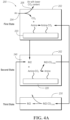
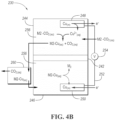
- the system includes several components which cooperate mechanically, physically, chemically, fluidly, or a combination thereof. Non-limiting examples of the systems disclosed herein are shown in Figs. 3 , 4A , 4B , and 5 .
- the system disclosed herein includes at least one container.
- the system may include 2, 3, 4, 5, 6, or more containers. But the system may include a single container or just two containers.
- the container may be a tank, vessel, compartment, canister, capsule, tub, chamber, cistern, flask, receptacle, or the like.
- the container may be a closed, enclosable, openable, sealable, and/or resealable container.
- the container may include or house a solid CO 2 sorbent having a porous support and amine-based chemistry which is attached or immobilized on the support.
- the sorbent may be a solid amine sorbent.
- the sorbent may be a DAC sorbent.
- the sorbent may be an amine-functionalized sorbent.
- Amine-based sorbents allow for efficient absorption of CO 2 due to high chemical reactivity with CO 2 and relatively low cost.
- Non-limiting example support materials may include mesoporous silica or polymeric materials such as cellulose, polymethylmethacrylate (PMMA), or polystyrene (PS).
- PMMA polymethylmethacrylate
- PS polystyrene
- the amine may be attached by impregnation, grafting or the like.
- the container may include one or more air inputs structured as resealable or enclosable openings, one or more conduits connecting one or more portions of the system and arranged to lead one or more fluids between various portions of the system.
- the fluids may be air, exchange liquid(s), electrolyte(s), etc.
- the system may further include one or more exchange fluids or solutions.
- the system may include a first exchange fluid and a second exchange fluid, which may be the same or different.
- the exchange fluids may differ in their volume, composition, and/or other properties.
- An exchange fluid may be a fluid or solution including a chemical component which strips a previously-bound component from the solid sorbent.
- the previously-bound component may be CO 2 , CO 2 related electrochemical intermediates, metal ion(s), M1, or a combination thereof.
- the component may have selectivity, preferential affinity, and/or high chemical reactivity towards the CO 2 , another chemical component, or amines. Selectivity or preferential affinity of the component may be defined as the discrimination shown by a reagent (component) in competitive attack on two or more substances (such as CO 2 and amines or M1 and amines).
- the exchange fluid may include a component structured to strongly bind to CO 2 such that when the exchange fluid comes in contact with the CO 2 -bound in the solid sorbent, the CO 2 is removed from the sorbent and binds to the component instead.
- an exchange fluid may include a component structured to strongly bind to amines such that when the exchange fluid comes in contact with the CO 2 -bound in the solid sorbent, the CO 2 is removed from the sorbent and the component binds to the sorbent instead.
- an exchange fluid may include a component structured to strongly bind to another component such as metal ion(s) such that when the exchange fluid comes in contact with the other component (metal ion(s)) previously bound in the solid sorbent, the other component (metal ion(s)) is removed from the sorbent and binds to the component instead.
- another component such as metal ion(s) such that when the exchange fluid comes in contact with the other component (metal ion(s)) previously bound in the solid sorbent, the other component (metal ion(s)) is removed from the sorbent and binds to the component instead.
- the exchange fluid may be provided, structured, or configured to remove the CO 2 from the solid sorbent, the system, or both, and/or regenerate the solid sorbent.
- the exchange fluid is thus structured to mediate transport of CO 2 , related electrochemical intermediates, and/or other components in the systems disclosed herein.
- the one or more exchange fluids may be thus structured to mediate transport of CO 2 , related electrochemical intermediates, and/or other components between the solid sorbent in the at least one compartment and the electrodes of the electrochemical cell.
- the exchange fluid enables use of a single compartment which may be flooded and drained with one or more exchange fluids during steps one, two, and/or three.
- the exchange fluid may be an aqueous solution.
- a non-limiting example of the exchange fluid may be pure amine liquid or liquid mixture of amines.
- the component in the exchange fluid may include one or more molecules M1 or M2.
- the molecules M1 may be metal ion(s).
- Non-limiting example of the metal ions may be Cu 2+ , Zn 2+ , Pb 2+ , Ag 2+ , Mg 2+ , or Al 3+ .
- M1 may be present or dissolved in the exchange fluid.
- the exchange fluid may be provided into the at least one compartment after a desired and/or predetermined amount of CO 2 saturation into the solid sorbent is reached.
- M1 may be chemically structured to bind to the solid sorbent amines and thus remove, desorb, displace CO 2 previously absorbed onto the solid sorbent.
- the CO 2 may be removed or stripped from the solid sorbent, and M1 may bind to the sorbent instead.
- a non-limiting example of such a chemical component M1 is shown in Fig. 5 and Example 2.
- the molecule(s) M2 may be dissolved in the exchange fluid.
- the exchange fluid may be provided into the at least one compartment after a desired and/or predetermined amount of CO 2 saturation into the solid sorbent is reached.
- the molecules M2 may be chemically structured to bind the CO 2 previously absorbed onto the solid sorbent. In other words, the CO 2 may be removed or stripped from the solid sorbent into a dissolved state and bound to the molecule M2 instead.
- a non-limiting example of such a chemical component M2 is shown in Figs. 4A , 4B , and Example 1.
- M2 may be ethylenediamine (EDA), diethylenetriamine (DETA), triethylenetetramine (TETA), monoethanolamine (MEA), or another small molecular amine.
- EDA ethylenediamine
- DETA diethylenetriamine
- TETA triethylenetetramine
- MEA monoethanolamine
- M2 may be chosen on the basis of the binding energy between M2, CO 2 , and/or the metal ion(s) M1.
- M2 may be chosen such that the binding energy between M1 and M2 is larger than that between M1 and the solid amine sorbent.
- M2 may be chosen such that the binding energy between M2 and CO 2 is larger than that between CO 2 and the solid amine sorbent.
- the system further includes an electrochemical cell.
- the electrochemical cell may include one or more compartments such as the first compartment and the second compartment.
- the compartments may be divided by a membrane, which is semi-permeable, selectively permeable, or non-permeable to one or more chemical species, components, or ions.
- the cell may include an electrolyte.
- the electrolyte may include a salt solution.
- a non-limiting example solution may be Cu-salt solution.
- Other salt solutions may include Zn, Pb, Ag, Mg, Al, or other metals.
- Each compartment may include an electrode, a cathode and an anode, respectively.
- the electrodes may be symmetrical or asymmetrical.
- the electrodes may include metal ions such as M1.
- the electrodes may include a metallic form of the M1 elements such as Cu, Zn, Pb, Ag, Mg, Al, or the like.
- the electrode(s) may include one or more layered oxides of the form (M1) a (X)O z where X is V, Cr, Mn, Ni, Co, or Fe; with 0 ⁇ a ⁇ 1 and 1.9 ⁇ z ⁇ 2.6.
- the cell may further include an electrical circuit connecting the electrodes and including a voltage source.
- the cell may be connected to the at least one container via one or more conduits.
- the electrochemical cell may be provided, structured, or configured to regenerate molecule M1, M2, or both, and/or release CO 2 .
- the system disclosed herein may have one or more states, stages, or steps.
- the system may have 1, 2, or 3 states. Each state may be repeatable. Each state may include one or more cycles.
- the CO 2 sorbent may bind CO 2 until a predetermined point.
- the predetermined point may reflect a full or partial saturation point or a predetermined level of CO 2 saturation.
- the air with lower concentration of CO 2 may exit the system, compartment, or both.
- the first state may be a state of CO 2 saturation and/or CO 2 release.
- the compartment may be flooded with an exchange fluid.
- the compartment may be flooded with two exchange fluids, each separately.
- the exchange fluids may be provided into the container and drained, one by one.
- the CO 2 may be removed from the solid sorbent and released from the compartment.
- the solid sorbent may be regenerated via the exchange fluid(s) including a component M1, M2, or both.
- the second state may be a state of CO 2 desaturation and release and/or solid sorbent regeneration.
- the exchange fluid with M1, M2, M1-M2 complex(s), and/or M2-CO 2 may be removed from the compartment, which houses the solid sorbent, and provided into an electrochemical cell.
- component chemistry and/or voltage may be utilized to regenerate M1, M2, or both.
- CO 2 may be removed from M2-CO 2 and released into storage and/or for utilization.
- the third state may be a state of M1, M2 regeneration.
- the system may lack or be free of a heating element (internal or external), for example a heating element connected to or influencing and increasing temperature of the one or more compartments housing the solid sorbent.
- a heating element internal or external
- the temperature of the system and of the sorbent in stages one, two, and/or three may be relatively constant, without fluctuations, without desirable or predetermined fluctuations, without increase above about 70°C, 80°C, 90°C, 100°C, 110°C, 120°C, 130°C, or more.
- the temperature of the sorbent may be maintained, kept, retained at a relative constant value throughout the first, second, and third states.
- the system may include a single chamber containing the solid CO 2 sorbent such that CO 2 removal may be realized within the single chamber.
- the single compartment may include the solid sorbent binding the CO 2 , and the CO 2 may be released from the single compartment after flooding the compartment with an exchange liquid. After the flooding, the CO 2 may be directly released into a storage and/or for utilization. Alternatively, after the flooding, the CO 2 may be bound to a molecule M2 and stay in the compartment which may be drained of the exchange liquid, air input may be opened, and next cycle or round of CO 2 sorption onto the solid sorbent may be realized.
- the traditional liquid sorbent systems typically pump the entire volume of the liquid sorbent with the bound CO 2 through the regeneration system of the electrochemical cell.
- the final CO 2 efficiency is thus determined by the entire process including sorption and regeneration.
- the system disclosed herein features physically separate sorption and desorption stage and the regeneration of M1, M2 stage.
- the system disclosed herein may thus increase CO 2 removal efficiency by having multiple cycles of CO 2 sorption (first state), solid sorbent regeneration (second state), or both before regeneration of M1, M2, or both are initiated due to the possibility of repeated flooding and draining with the exchange fluid(s).
- the system disclosed herein may include multi-step M1, M2 regeneration to increase efficiency of the regeneration of M1, M2, or both.
- the second and third step may be repeated before the first step in the next cycle begins.
- the efficiency of the CO 2 removal may be determined by the quantity of the fluid which is being input and removed, quantity of the fluid being cycled, etc. In one or more embodiments, about 80-100, 82-98, or 85-95 vol.% of the first exchange liquid, second exchange liquid, or both, added during a given cycle, may be removed from the system at a predetermined time or interval.
- the EMAR or electrochemical cell may be used only for the regeneration of the molecules M1, M2, or both while the regeneration of the sorbent, and/or release of CO 2 may happen in the original compartment. This is in contrast to the liquid sorbent systems which typically pump the entire volume of the liquid sorbent bound to CO 2 through the EMAR system.
- the EMAR or electrochemical cell is thus required as a middle step for CO 2 removal in the traditional system, but not in the herein-disclosed system.
- the system described herein may include multiple compartments, each housing a solid sorbent.
- a non-limiting example of such system 500 is shown in Fig. 3 .
- the multiple compartments 502 may be flooded and drained one time or multiple times before M1, M2, M1-M2, and/or M2-CO 2 regeneration stage in the electrochemical cell 530 is initiated.
- the system may include 1, 2, 3, 4, 5, 6, 7, 8, 9, 10, or more compartments 502 which may each have or cycle between states one and two.
- 502 may correspond to 202, 302, or another configuration of the compartment.
- the system may also include a single regeneration system configured as an electrochemical cell or EMAR 530 to provide the third state. 530 may correspond to 230, 330, or another configuration of the cell.
- the single regeneration system 530 may be common to all the containers 502.
- the system may thus include one electrochemical cell fluidly connected to the multiple compartments and accepting the one or more exchange fluids from the multiple compartments. Such system has the advantage of lower capital cost.
- the chemistry of the exchange fluids and its components may be the same or different for the multiple compartments.
- the volumes of the compartments, the exchange fluids may be the same or different.
- the single cell may accept the fluids from at least some or all of the compartments at the same time. Alternatively, the single cell may accept the fluids from various compartments in a predetermined manner, random manner, scheduled manner, one by one, two at a time, etc.
- the system disclosed herein may thus combine electrochemical regeneration applicable with a solid DAC sorbent for direct capture of atmospheric CO 2 or capture of CO 2 from dilute sources such as air.
- the advantages of the system described herein include an energy efficient route to regenerate solid amine sorbents without requiring heating, which offers substantial advantages in improved energy efficiency, increased sorbent lifetime, simplified thermal management, and modularity. Specifically, regarding thermal management, high heat or steam is not needed for the sorbent regeneration. As such, the sorbent does not succumb to thermal degeneration, and the system's energy demands are lower than the prior art systems.
- a non-limiting example system 200 may include a compartment 202 with an opening 204 structured as an air input.
- the compartment 202 may include a solid amine-functionalized sorbent 220.
- the system may have one or more states, steps, or stages. In the first state, upon entry into the compartment 202, the CO 2 from the air is bound to the amine of the sorbent 220, and air with a lower CO 2 concentration exits via an opening 206 structured as an air output. In the first state, within the compartment 202, the air may be passed through the solid amine-functionalized sorbent 220 until a desired or predetermined level of CO 2 is reached.
- the external air flow is stopped, and the sorbent 220 is regenerated.
- the sorbent 220 in the compartment 202 may be flooded with a solution 240 containing dissolved molecules M2.
- the CO 2 may be stripped from the solid sorbent 220 by the solution 240.
- the M2 molecule may bind to the CO 2 stronger than the solid amine such that the CO 2 transitions from being bound to the solid sorbent 220 to being bound to the molecule M2.
- the aqueous M2-CO 2 solution removes a desired amount of CO 2 from the solid sorbent, the solution may be separated from the solid sorbent, allowing the sorbent to return to the first state, ready for additional CO 2 capture in the next cycle.
- the separation may be provided by draining the M2-CO 2 solution via the exit opening 206 or another opening.
- the solid sorbent 220 is thus regenerated via the exchange solution 240, not an EMAR or electrochemical cell.
- an electrochemical cell 230 may be utilized for the regeneration of the molecule M2.
- the drained M2-CO 2 solution may be either reused for the second state in the following cycle(s), passed through an EMAR cycle to regenerate molecule M2 and extract the bound CO 2 , or both.
- an electrochemical cell 230 is utilized.
- the electrochemical cell 230 may include a membrane 242 separating two compartments 244, 246, each having an electrode 248 (cathode), 250 (anode).
- the electrodes may be connected via an electrical circuit 252 with a voltage source 254.
- the electrochemical cell 230 may be flooded with an electrolyte 256 such as Cu-salt electrolyte.
- the M2-CO 2 solution enters the first compartment 244 of the cell 230 which contains Cu 2+ ions.
- the Cu 2+ ions exchange with the CO 2 bound to the molecule M.
- the solution of M2-Cu together with CO 2 may be moved into a tank 260. The moving may be by pumping, draining, or otherwise. CO 2 may be removed directly from the first compartment 244. CO 2 may be gassed-off to a storage facility or removed from the system 200.
- M2-Cu solution may be moved into the second compartment 246 of the cell 230, via the tank 260 or directly, for example by pumping or drainage.
- the Cu may be electroplated onto the electrode 250, utilizing the circuit 252 and the voltage source 254.
- M2 molecule may be removed from the second compartment 246 to the compartment 202 for utilization in the second state of the next cycle(s).
- a non-limiting example system 300 may include a compartment 302 with an opening 304 structured as an air input.
- the compartment 302 may include a solid amine-functionalized sorbent 320.
- the system 300 may have one or more states, steps, or stages. In the first state, upon entry into the compartment 302, the CO 2 from the air is bound to the amine of the sorbent 320, and air with a lower CO 2 concentration exits via an opening 306 structured as an air output. In the first state, within the compartment 302, the air may be passed through the solid amine-functionalized sorbent 320 until a desired level of CO 2 is reached.
- the external air flow is stopped, and CO 2 is stripped from the sorbent and removed from the system 300.
- the sorbent 320 in the compartment 302 may be flooded with a first solution 340 containing molecule M1 which may be metal ion(s).
- the metal ion(s) M1 may favorably bind to the amine groups in the solid sorbent 320, displacing the bound CO 2 into the closed sorbent chamber 302.
- the CO 2 may be stripped from the solid sorbent 320 by the metal ion(s) M1 in the first solution 340.
- the displaced CO 2 is then removed from the compartment 302 for subsequent storage or utilization. The removal may be by venting.
- the first solution 340 is removed from the compartment 302, for example by draining, pumping, sucking, or the like.
- the first solution 340 may be replaced with a second solution 341, which contains a molecule M2 structured to strongly bind to the metal ion(s) M1 and stripping the metal ion(s) M1 from the solid sorbent 320.
- M2 may include ethylenediamine (EDA) or another suitably chosen small molecular amine.
- an electrochemical cell 330 may be utilized for the regeneration of M1, M2, or both.
- the electrochemical cell 330 may include a membrane 342 separating two compartments 344 (cathode chamber), 346 (anode chamber), each having an electrode 348 (cathode), 350 (anode).
- the electrodes may be connected via an electrical circuit 352 with a voltage source 354.
- the second solution 341 including the M1-M2 complex(es) may be then passed through the electrochemical cell 330, where the metal ions are electrochemically removed from the second solution 341.
- the removal may be realized by electroplating or intercalation, for example Cu electrodeposition onto a metallic Cu electrode or Ag intercalation into a layered oxide cathode 348.
- the removal of the metal ions regenerates the initial state of the second solution 341.
- the anode chamber 346 may contain a symmetric anode 350, where M1 may be stripped from the anode into the anode chamber 346, creating the source of metal ions M1 for the first solution 340.
- a method of reducing CO 2 in air or atmosphere is disclosed herein.
- the method may include direct air capture (DAC).
- the method may include utilizing one or more systems disclosed herein.
- the method may include providing a compartment housing a solid CO 2 sorbent.
- the method may include passing air (initial or input air) through the compartment with the solid sorbent until a predetermined value of saturation is reached.
- the method may include releasing air with lower concentration of CO 2 than the initial CO 2 concentration in the input air from the compartment.
- the method may further include providing an exchange liquid, fluid, or solution into the compartment to regenerate the sorbent once the sorbent is saturated to a desired or predetermined level.
- the sorbent regeneration may include detaching the CO 2 from the solid sorbent to a component M2 present in the exchange fluid.
- the method may thus include stripping the CO 2 sorped onto the solid sorbent from the sorbent and binding with M2 within the compartment.
- the method may include removing the exchange fluid with the M2-CO 2 from the compartment. The removal may be to an electrochemical cell to regenerate M2 and release CO 2 .
- the method may include regenerating M2 by utilizing voltage and chemistry of the cell such as metal ions of the electrodes, which may exchange with the CO 2 in the cathode compartment of the cell.
- the method may include releasing the detached CO 2 from the cell.
- the releasing may be realized via a separate tank.
- the method may include providing the M2-metal ion composition to the anode compartment of the cell to detach M2 molecule from the M2-metal ion composition.
- the detaching may be provided via metal plating, utilizing the electrode.
- the method may include reusing the pristine M2 in the next sorbent regeneration cycle in the compartment.
- the method may include repeating the sorption and desorption cycle within the compartment by repeatedly flooding the compartment with the exchange fluid(s) and draining the exchange fluid(s) form the compartment.
- the repeating may be once, twice, three times, more times, predetermined amount of times.
- the sorbent regeneration may include providing more than one exchange liquid or solution.
- the more than one liquids may be provided one at a time, one by one, one after the other.
- the method may include providing an exchange fluid having one or more molecules M1, which bind to the amine present in the solid sorbent and detach CO 2 from the solid sorbent.
- the method may include removing the displaced, detached, or stripped CO 2 from the compartment.
- the method may subsequently include providing a second exchange liquid into the compartment.
- the first and second exchange liquids may differ in composition, volume, and/or another property.
- the second exchange liquid may include molecule(s) M2 which bind stronger to the molecule(s) M1 than to the sorbent, strip M1 from the solid sorbent, and form complex(es) M1-M2.
- the method may further include providing the M1-M2 complex(es) into an electrochemical cell for recovery of the M1, M2, or both.
- the recovery may be realized via electroplating or otherwise, utilizing chemistry of the cell, voltage, or both.
- the method may include cycling pristine M1, M2, or both to the compartment for the next sorbent regeneration cycle.
- the method may include providing more than one compartment such as 2, 3, 4, 5, 6, 7, 8, 9, 10, or more compartments, each housing a solid sorbent.
- the method may include sorbing and desorbing CO 2 from the solid sorbent once or more times in each compartment before providing the M1-M2 complex(es) and/or M2-CO 2 to the electrochemical cell for the M1, M2 recovery.
Landscapes
- Chemical & Material Sciences (AREA)
- Engineering & Computer Science (AREA)
- Chemical Kinetics & Catalysis (AREA)
- Analytical Chemistry (AREA)
- General Chemical & Material Sciences (AREA)
- Oil, Petroleum & Natural Gas (AREA)
- Environmental & Geological Engineering (AREA)
- Biomedical Technology (AREA)
- Health & Medical Sciences (AREA)
- Electrochemistry (AREA)
- Life Sciences & Earth Sciences (AREA)
- Sustainable Development (AREA)
- Gas Separation By Absorption (AREA)
- Separation Of Gases By Adsorption (AREA)
- Solid-Sorbent Or Filter-Aiding Compositions (AREA)
- Treating Waste Gases (AREA)
Applications Claiming Priority (1)
| Application Number | Priority Date | Filing Date | Title |
|---|---|---|---|
| US18/162,326 US20240252983A1 (en) | 2023-01-31 | 2023-01-31 | Atmospheric carbon dioxide capture system |
Publications (2)
| Publication Number | Publication Date |
|---|---|
| EP4420757A2 true EP4420757A2 (de) | 2024-08-28 |
| EP4420757A3 EP4420757A3 (de) | 2025-01-15 |
Family
ID=89771689
Family Applications (1)
| Application Number | Title | Priority Date | Filing Date |
|---|---|---|---|
| EP24154871.8A Pending EP4420757A3 (de) | 2023-01-31 | 2024-01-31 | System zur erfassung von atmosphärischem kohlendioxid |
Country Status (3)
| Country | Link |
|---|---|
| US (1) | US20240252983A1 (de) |
| EP (1) | EP4420757A3 (de) |
| CN (1) | CN118416643A (de) |
Families Citing this family (1)
| Publication number | Priority date | Publication date | Assignee | Title |
|---|---|---|---|---|
| EP4699682A1 (de) * | 2024-08-21 | 2026-02-25 | Nederlandse Organisatie voor toegepast- natuurwetenschappelijk onderzoek TNO | Regenerierung eines festen co2-sorptionsmittels |
Family Cites Families (4)
| Publication number | Priority date | Publication date | Assignee | Title |
|---|---|---|---|---|
| ES2784490T3 (es) * | 2006-10-02 | 2020-09-28 | Carbon Sink Inc | Método para extraer dióxido de carbono del aire |
| US8202350B2 (en) * | 2009-06-25 | 2012-06-19 | Sri International | Method and apparatus for gas removal |
| WO2021225642A1 (en) * | 2020-05-04 | 2021-11-11 | Infinmium Technology, Llc | Process for capture of carbon dioxide from air and the direct conversion of carbon dioxide into fuels and chemicals |
| CN116133744A (zh) * | 2020-07-22 | 2023-05-16 | 马修·阿特伍德 | 利用电磁激发辐射解吸固体胺吸附剂以释放二氧化碳的直接空气捕集的设备、方法和系统 |
-
2023
- 2023-01-31 US US18/162,326 patent/US20240252983A1/en active Pending
-
2024
- 2024-01-31 CN CN202410141186.6A patent/CN118416643A/zh active Pending
- 2024-01-31 EP EP24154871.8A patent/EP4420757A3/de active Pending
Also Published As
| Publication number | Publication date |
|---|---|
| US20240252983A1 (en) | 2024-08-01 |
| EP4420757A3 (de) | 2025-01-15 |
| CN118416643A (zh) | 2024-08-02 |
Similar Documents
| Publication | Publication Date | Title |
|---|---|---|
| Mollick et al. | Benchmark uranium extraction from seawater using an ionic macroporous metal–organic framework | |
| CN102350220B (zh) | 一种用于脱除、回收、富集料液或废水中的氨或有机胺的稳定气态膜装置及方法 | |
| RU2472572C2 (ru) | Улавливание диоксида углерода(со2) из воздуха | |
| CN107530632A (zh) | 用于碳捕获和能源生产的综合方法 | |
| EA027334B1 (ru) | Способы прямого осмотического разделения | |
| EP4420757A2 (de) | System zur erfassung von atmosphärischem kohlendioxid | |
| AU2011305488B2 (en) | Osmotically driven membrane processes and systems and methods for draw solute recovery | |
| JP2024510034A (ja) | 気体から標的種を捕捉する方法 | |
| Sheikh et al. | Ammonia recovery from municipal wastewater using hybrid NaOH closed-loop membrane contactor and ion exchange system | |
| KR20120119673A (ko) | 분리막을 이용한 연소배가스 처리시스템 | |
| JP2023537291A (ja) | 水溶性気体の結合、輸送、反応活性化、変換、保存および放出のための方法 | |
| US11446604B2 (en) | Methods and systems for removing CO2 from a feed gas | |
| CN105264705A (zh) | 用于从气体流产生能量的方法以及用于从烟道气产生能量的系统与设备 | |
| CN101657246A (zh) | 从空气中捕获二氧化碳 | |
| US20230107163A1 (en) | Systems and Methods for Gas-Liquid Contactors for Rapid Carbon Capture | |
| US20250214035A1 (en) | Carbon dioxide capturing apparatus and capturing method | |
| US20240252984A1 (en) | Atmospheric carbon dioxide capture system | |
| Badiei et al. | Overview of carbon dioxide separation technology | |
| CN113000034A (zh) | 基于天然植物多酚复合涂层的铀离子亲和膜的制备方法 | |
| CN109535474B (zh) | 一种包覆型浸渍树脂及其制备方法和其在选择性吸附污酸中铼的应用 | |
| EP4164778B1 (de) | Polymermembran auf basis poröser metallorganischer gerüste zur dekontamination von verunreinigtem wasser | |
| Wang et al. | Application of polymeric membrane in CO2 capture from post combustion | |
| Argurio et al. | A study on neodymium recovery from aqueous solutions for designing a new generation of sandwich liquid membrane | |
| RU2837431C1 (ru) | Способ связывания, транспорта, активации реакции, химического превращения, хранения и высвобождения водорастворимых газов | |
| CN112495189A (zh) | 三隔室电渗析脱除deta碳捕集过程中hss的方法 |
Legal Events
| Date | Code | Title | Description |
|---|---|---|---|
| PUAI | Public reference made under article 153(3) epc to a published international application that has entered the european phase |
Free format text: ORIGINAL CODE: 0009012 |
|
| STAA | Information on the status of an ep patent application or granted ep patent |
Free format text: STATUS: THE APPLICATION HAS BEEN PUBLISHED |
|
| AK | Designated contracting states |
Kind code of ref document: A2 Designated state(s): AL AT BE BG CH CY CZ DE DK EE ES FI FR GB GR HR HU IE IS IT LI LT LU LV MC ME MK MT NL NO PL PT RO RS SE SI SK SM TR |
|
| PUAL | Search report despatched |
Free format text: ORIGINAL CODE: 0009013 |
|
| AK | Designated contracting states |
Kind code of ref document: A3 Designated state(s): AL AT BE BG CH CY CZ DE DK EE ES FI FR GB GR HR HU IE IS IT LI LT LU LV MC ME MK MT NL NO PL PT RO RS SE SI SK SM TR |
|
| RIC1 | Information provided on ipc code assigned before grant |
Ipc: B01D 53/62 20060101ALI20241210BHEP Ipc: B01D 53/04 20060101AFI20241210BHEP |
|
| STAA | Information on the status of an ep patent application or granted ep patent |
Free format text: STATUS: REQUEST FOR EXAMINATION WAS MADE |
|
| 17P | Request for examination filed |
Effective date: 20250715 |