EP4416112B1 - Verfahren zur herstellung einer gekrümmten laminierten verglasung - Google Patents
Verfahren zur herstellung einer gekrümmten laminierten verglasung Download PDFInfo
- Publication number
- EP4416112B1 EP4416112B1 EP22802063.2A EP22802063A EP4416112B1 EP 4416112 B1 EP4416112 B1 EP 4416112B1 EP 22802063 A EP22802063 A EP 22802063A EP 4416112 B1 EP4416112 B1 EP 4416112B1
- Authority
- EP
- European Patent Office
- Prior art keywords
- enamel
- glass sheet
- stack
- layer
- glass
- Prior art date
- Legal status (The legal status is an assumption and is not a legal conclusion. Google has not performed a legal analysis and makes no representation as to the accuracy of the status listed.)
- Active
Links
Images
Classifications
-
- B—PERFORMING OPERATIONS; TRANSPORTING
- B32—LAYERED PRODUCTS
- B32B—LAYERED PRODUCTS, i.e. PRODUCTS BUILT-UP OF STRATA OF FLAT OR NON-FLAT, e.g. CELLULAR OR HONEYCOMB, FORM
- B32B38/00—Ancillary operations in connection with laminating processes
- B32B38/18—Handling of layers or the laminate
- B32B38/1866—Handling of layers or the laminate conforming the layers or laminate to a convex or concave profile
-
- C—CHEMISTRY; METALLURGY
- C03—GLASS; MINERAL OR SLAG WOOL
- C03C—CHEMICAL COMPOSITION OF GLASSES, GLAZES OR VITREOUS ENAMELS; SURFACE TREATMENT OF GLASS; SURFACE TREATMENT OF FIBRES OR FILAMENTS MADE FROM GLASS, MINERALS OR SLAGS; JOINING GLASS TO GLASS OR OTHER MATERIALS
- C03C27/00—Joining pieces of glass to pieces of other inorganic material; Joining glass to glass other than by fusing
- C03C27/06—Joining glass to glass by processes other than fusing
- C03C27/10—Joining glass to glass by processes other than fusing with the aid of adhesive specially adapted for that purpose
-
- B—PERFORMING OPERATIONS; TRANSPORTING
- B32—LAYERED PRODUCTS
- B32B—LAYERED PRODUCTS, i.e. PRODUCTS BUILT-UP OF STRATA OF FLAT OR NON-FLAT, e.g. CELLULAR OR HONEYCOMB, FORM
- B32B1/00—Layered products having a non-planar shape
-
- B—PERFORMING OPERATIONS; TRANSPORTING
- B32—LAYERED PRODUCTS
- B32B—LAYERED PRODUCTS, i.e. PRODUCTS BUILT-UP OF STRATA OF FLAT OR NON-FLAT, e.g. CELLULAR OR HONEYCOMB, FORM
- B32B17/00—Layered products essentially comprising sheet glass, or glass, slag, or like fibres
- B32B17/06—Layered products essentially comprising sheet glass, or glass, slag, or like fibres comprising glass as the main or only constituent of a layer, next to another layer of a specific material
- B32B17/10—Layered products essentially comprising sheet glass, or glass, slag, or like fibres comprising glass as the main or only constituent of a layer, next to another layer of a specific material of synthetic resin
- B32B17/10005—Layered products essentially comprising sheet glass, or glass, slag, or like fibres comprising glass as the main or only constituent of a layer, next to another layer of a specific material of synthetic resin laminated safety glass or glazing
- B32B17/10009—Layered products essentially comprising sheet glass, or glass, slag, or like fibres comprising glass as the main or only constituent of a layer, next to another layer of a specific material of synthetic resin laminated safety glass or glazing characterized by the number, the constitution or treatment of glass sheets
- B32B17/10036—Layered products essentially comprising sheet glass, or glass, slag, or like fibres comprising glass as the main or only constituent of a layer, next to another layer of a specific material of synthetic resin laminated safety glass or glazing characterized by the number, the constitution or treatment of glass sheets comprising two outer glass sheets
-
- B—PERFORMING OPERATIONS; TRANSPORTING
- B32—LAYERED PRODUCTS
- B32B—LAYERED PRODUCTS, i.e. PRODUCTS BUILT-UP OF STRATA OF FLAT OR NON-FLAT, e.g. CELLULAR OR HONEYCOMB, FORM
- B32B17/00—Layered products essentially comprising sheet glass, or glass, slag, or like fibres
- B32B17/06—Layered products essentially comprising sheet glass, or glass, slag, or like fibres comprising glass as the main or only constituent of a layer, next to another layer of a specific material
- B32B17/10—Layered products essentially comprising sheet glass, or glass, slag, or like fibres comprising glass as the main or only constituent of a layer, next to another layer of a specific material of synthetic resin
- B32B17/10005—Layered products essentially comprising sheet glass, or glass, slag, or like fibres comprising glass as the main or only constituent of a layer, next to another layer of a specific material of synthetic resin laminated safety glass or glazing
- B32B17/10165—Functional features of the laminated safety glass or glazing
- B32B17/10174—Coatings of a metallic or dielectric material on a constituent layer of glass or polymer
- B32B17/1022—Metallic coatings
-
- B—PERFORMING OPERATIONS; TRANSPORTING
- B32—LAYERED PRODUCTS
- B32B—LAYERED PRODUCTS, i.e. PRODUCTS BUILT-UP OF STRATA OF FLAT OR NON-FLAT, e.g. CELLULAR OR HONEYCOMB, FORM
- B32B38/00—Ancillary operations in connection with laminating processes
- B32B38/0036—Heat treatment
-
- B—PERFORMING OPERATIONS; TRANSPORTING
- B32—LAYERED PRODUCTS
- B32B—LAYERED PRODUCTS, i.e. PRODUCTS BUILT-UP OF STRATA OF FLAT OR NON-FLAT, e.g. CELLULAR OR HONEYCOMB, FORM
- B32B38/00—Ancillary operations in connection with laminating processes
- B32B38/14—Printing or colouring
- B32B38/145—Printing
-
- B—PERFORMING OPERATIONS; TRANSPORTING
- B32—LAYERED PRODUCTS
- B32B—LAYERED PRODUCTS, i.e. PRODUCTS BUILT-UP OF STRATA OF FLAT OR NON-FLAT, e.g. CELLULAR OR HONEYCOMB, FORM
- B32B7/00—Layered products characterised by the relation between layers; Layered products characterised by the relative orientation of features between layers, or by the relative values of a measurable parameter between layers, i.e. products comprising layers having different physical, chemical or physicochemical properties; Layered products characterised by the interconnection of layers
- B32B7/04—Interconnection of layers
- B32B7/12—Interconnection of layers using interposed adhesives or interposed materials with bonding properties
-
- C—CHEMISTRY; METALLURGY
- C03—GLASS; MINERAL OR SLAG WOOL
- C03C—CHEMICAL COMPOSITION OF GLASSES, GLAZES OR VITREOUS ENAMELS; SURFACE TREATMENT OF GLASS; SURFACE TREATMENT OF FIBRES OR FILAMENTS MADE FROM GLASS, MINERALS OR SLAGS; JOINING GLASS TO GLASS OR OTHER MATERIALS
- C03C14/00—Glass compositions containing a non-glass component, e.g. compositions containing fibres, filaments, whiskers, platelets, or the like, dispersed in a glass matrix
- C03C14/004—Glass compositions containing a non-glass component, e.g. compositions containing fibres, filaments, whiskers, platelets, or the like, dispersed in a glass matrix the non-glass component being in the form of particles or flakes
-
- C—CHEMISTRY; METALLURGY
- C03—GLASS; MINERAL OR SLAG WOOL
- C03C—CHEMICAL COMPOSITION OF GLASSES, GLAZES OR VITREOUS ENAMELS; SURFACE TREATMENT OF GLASS; SURFACE TREATMENT OF FIBRES OR FILAMENTS MADE FROM GLASS, MINERALS OR SLAGS; JOINING GLASS TO GLASS OR OTHER MATERIALS
- C03C17/00—Surface treatment of glass, not in the form of fibres or filaments, by coating
- C03C17/34—Surface treatment of glass, not in the form of fibres or filaments, by coating with at least two coatings having different compositions
- C03C17/36—Surface treatment of glass, not in the form of fibres or filaments, by coating with at least two coatings having different compositions at least one coating being a metal
-
- C—CHEMISTRY; METALLURGY
- C03—GLASS; MINERAL OR SLAG WOOL
- C03C—CHEMICAL COMPOSITION OF GLASSES, GLAZES OR VITREOUS ENAMELS; SURFACE TREATMENT OF GLASS; SURFACE TREATMENT OF FIBRES OR FILAMENTS MADE FROM GLASS, MINERALS OR SLAGS; JOINING GLASS TO GLASS OR OTHER MATERIALS
- C03C17/00—Surface treatment of glass, not in the form of fibres or filaments, by coating
- C03C17/34—Surface treatment of glass, not in the form of fibres or filaments, by coating with at least two coatings having different compositions
- C03C17/36—Surface treatment of glass, not in the form of fibres or filaments, by coating with at least two coatings having different compositions at least one coating being a metal
- C03C17/3602—Surface treatment of glass, not in the form of fibres or filaments, by coating with at least two coatings having different compositions at least one coating being a metal the metal being present as a layer
- C03C17/3626—Surface treatment of glass, not in the form of fibres or filaments, by coating with at least two coatings having different compositions at least one coating being a metal the metal being present as a layer one layer at least containing a nitride, oxynitride, boronitride or carbonitride
-
- C—CHEMISTRY; METALLURGY
- C03—GLASS; MINERAL OR SLAG WOOL
- C03C—CHEMICAL COMPOSITION OF GLASSES, GLAZES OR VITREOUS ENAMELS; SURFACE TREATMENT OF GLASS; SURFACE TREATMENT OF FIBRES OR FILAMENTS MADE FROM GLASS, MINERALS OR SLAGS; JOINING GLASS TO GLASS OR OTHER MATERIALS
- C03C17/00—Surface treatment of glass, not in the form of fibres or filaments, by coating
- C03C17/34—Surface treatment of glass, not in the form of fibres or filaments, by coating with at least two coatings having different compositions
- C03C17/36—Surface treatment of glass, not in the form of fibres or filaments, by coating with at least two coatings having different compositions at least one coating being a metal
- C03C17/3602—Surface treatment of glass, not in the form of fibres or filaments, by coating with at least two coatings having different compositions at least one coating being a metal the metal being present as a layer
- C03C17/3639—Multilayers containing at least two functional metal layers
-
- C—CHEMISTRY; METALLURGY
- C03—GLASS; MINERAL OR SLAG WOOL
- C03C—CHEMICAL COMPOSITION OF GLASSES, GLAZES OR VITREOUS ENAMELS; SURFACE TREATMENT OF GLASS; SURFACE TREATMENT OF FIBRES OR FILAMENTS MADE FROM GLASS, MINERALS OR SLAGS; JOINING GLASS TO GLASS OR OTHER MATERIALS
- C03C17/00—Surface treatment of glass, not in the form of fibres or filaments, by coating
- C03C17/34—Surface treatment of glass, not in the form of fibres or filaments, by coating with at least two coatings having different compositions
- C03C17/36—Surface treatment of glass, not in the form of fibres or filaments, by coating with at least two coatings having different compositions at least one coating being a metal
- C03C17/3602—Surface treatment of glass, not in the form of fibres or filaments, by coating with at least two coatings having different compositions at least one coating being a metal the metal being present as a layer
- C03C17/3644—Surface treatment of glass, not in the form of fibres or filaments, by coating with at least two coatings having different compositions at least one coating being a metal the metal being present as a layer the metal being silver
-
- C—CHEMISTRY; METALLURGY
- C03—GLASS; MINERAL OR SLAG WOOL
- C03C—CHEMICAL COMPOSITION OF GLASSES, GLAZES OR VITREOUS ENAMELS; SURFACE TREATMENT OF GLASS; SURFACE TREATMENT OF FIBRES OR FILAMENTS MADE FROM GLASS, MINERALS OR SLAGS; JOINING GLASS TO GLASS OR OTHER MATERIALS
- C03C17/00—Surface treatment of glass, not in the form of fibres or filaments, by coating
- C03C17/34—Surface treatment of glass, not in the form of fibres or filaments, by coating with at least two coatings having different compositions
- C03C17/36—Surface treatment of glass, not in the form of fibres or filaments, by coating with at least two coatings having different compositions at least one coating being a metal
- C03C17/3602—Surface treatment of glass, not in the form of fibres or filaments, by coating with at least two coatings having different compositions at least one coating being a metal the metal being present as a layer
- C03C17/3649—Surface treatment of glass, not in the form of fibres or filaments, by coating with at least two coatings having different compositions at least one coating being a metal the metal being present as a layer made of metals other than silver
-
- C—CHEMISTRY; METALLURGY
- C03—GLASS; MINERAL OR SLAG WOOL
- C03C—CHEMICAL COMPOSITION OF GLASSES, GLAZES OR VITREOUS ENAMELS; SURFACE TREATMENT OF GLASS; SURFACE TREATMENT OF FIBRES OR FILAMENTS MADE FROM GLASS, MINERALS OR SLAGS; JOINING GLASS TO GLASS OR OTHER MATERIALS
- C03C17/00—Surface treatment of glass, not in the form of fibres or filaments, by coating
- C03C17/34—Surface treatment of glass, not in the form of fibres or filaments, by coating with at least two coatings having different compositions
- C03C17/36—Surface treatment of glass, not in the form of fibres or filaments, by coating with at least two coatings having different compositions at least one coating being a metal
- C03C17/3602—Surface treatment of glass, not in the form of fibres or filaments, by coating with at least two coatings having different compositions at least one coating being a metal the metal being present as a layer
- C03C17/3652—Surface treatment of glass, not in the form of fibres or filaments, by coating with at least two coatings having different compositions at least one coating being a metal the metal being present as a layer the coating stack containing at least one sacrificial layer to protect the metal from oxidation
-
- C—CHEMISTRY; METALLURGY
- C03—GLASS; MINERAL OR SLAG WOOL
- C03C—CHEMICAL COMPOSITION OF GLASSES, GLAZES OR VITREOUS ENAMELS; SURFACE TREATMENT OF GLASS; SURFACE TREATMENT OF FIBRES OR FILAMENTS MADE FROM GLASS, MINERALS OR SLAGS; JOINING GLASS TO GLASS OR OTHER MATERIALS
- C03C17/00—Surface treatment of glass, not in the form of fibres or filaments, by coating
- C03C17/34—Surface treatment of glass, not in the form of fibres or filaments, by coating with at least two coatings having different compositions
- C03C17/36—Surface treatment of glass, not in the form of fibres or filaments, by coating with at least two coatings having different compositions at least one coating being a metal
- C03C17/3602—Surface treatment of glass, not in the form of fibres or filaments, by coating with at least two coatings having different compositions at least one coating being a metal the metal being present as a layer
- C03C17/3657—Surface treatment of glass, not in the form of fibres or filaments, by coating with at least two coatings having different compositions at least one coating being a metal the metal being present as a layer the multilayer coating having optical properties
- C03C17/366—Low-emissivity or solar control coatings
-
- C—CHEMISTRY; METALLURGY
- C03—GLASS; MINERAL OR SLAG WOOL
- C03C—CHEMICAL COMPOSITION OF GLASSES, GLAZES OR VITREOUS ENAMELS; SURFACE TREATMENT OF GLASS; SURFACE TREATMENT OF FIBRES OR FILAMENTS MADE FROM GLASS, MINERALS OR SLAGS; JOINING GLASS TO GLASS OR OTHER MATERIALS
- C03C17/00—Surface treatment of glass, not in the form of fibres or filaments, by coating
- C03C17/34—Surface treatment of glass, not in the form of fibres or filaments, by coating with at least two coatings having different compositions
- C03C17/36—Surface treatment of glass, not in the form of fibres or filaments, by coating with at least two coatings having different compositions at least one coating being a metal
- C03C17/3602—Surface treatment of glass, not in the form of fibres or filaments, by coating with at least two coatings having different compositions at least one coating being a metal the metal being present as a layer
- C03C17/3681—Surface treatment of glass, not in the form of fibres or filaments, by coating with at least two coatings having different compositions at least one coating being a metal the metal being present as a layer the multilayer coating being used in glazing, e.g. windows or windscreens
-
- C—CHEMISTRY; METALLURGY
- C03—GLASS; MINERAL OR SLAG WOOL
- C03C—CHEMICAL COMPOSITION OF GLASSES, GLAZES OR VITREOUS ENAMELS; SURFACE TREATMENT OF GLASS; SURFACE TREATMENT OF FIBRES OR FILAMENTS MADE FROM GLASS, MINERALS OR SLAGS; JOINING GLASS TO GLASS OR OTHER MATERIALS
- C03C8/00—Enamels; Glazes; Fusion seal compositions being frit compositions having non-frit additions
- C03C8/14—Glass frit mixtures having non-frit additions, e.g. opacifiers, colorants, mill-additions
- C03C8/16—Glass frit mixtures having non-frit additions, e.g. opacifiers, colorants, mill-additions with vehicle or suspending agents, e.g. slip
-
- B—PERFORMING OPERATIONS; TRANSPORTING
- B32—LAYERED PRODUCTS
- B32B—LAYERED PRODUCTS, i.e. PRODUCTS BUILT-UP OF STRATA OF FLAT OR NON-FLAT, e.g. CELLULAR OR HONEYCOMB, FORM
- B32B2250/00—Layers arrangement
- B32B2250/02—2 layers
-
- B—PERFORMING OPERATIONS; TRANSPORTING
- B32—LAYERED PRODUCTS
- B32B—LAYERED PRODUCTS, i.e. PRODUCTS BUILT-UP OF STRATA OF FLAT OR NON-FLAT, e.g. CELLULAR OR HONEYCOMB, FORM
- B32B2255/00—Coating on the layer surface
- B32B2255/20—Inorganic coating
-
- B—PERFORMING OPERATIONS; TRANSPORTING
- B32—LAYERED PRODUCTS
- B32B—LAYERED PRODUCTS, i.e. PRODUCTS BUILT-UP OF STRATA OF FLAT OR NON-FLAT, e.g. CELLULAR OR HONEYCOMB, FORM
- B32B2264/00—Composition or properties of particles which form a particulate layer or are present as additives
- B32B2264/10—Inorganic particles
- B32B2264/102—Oxide or hydroxide
- B32B2264/1025—Zinc oxide
-
- B—PERFORMING OPERATIONS; TRANSPORTING
- B32—LAYERED PRODUCTS
- B32B—LAYERED PRODUCTS, i.e. PRODUCTS BUILT-UP OF STRATA OF FLAT OR NON-FLAT, e.g. CELLULAR OR HONEYCOMB, FORM
- B32B2264/00—Composition or properties of particles which form a particulate layer or are present as additives
- B32B2264/30—Particles characterised by physical dimension
- B32B2264/302—Average diameter in the range from 100 nm to 1000 nm
-
- B—PERFORMING OPERATIONS; TRANSPORTING
- B32—LAYERED PRODUCTS
- B32B—LAYERED PRODUCTS, i.e. PRODUCTS BUILT-UP OF STRATA OF FLAT OR NON-FLAT, e.g. CELLULAR OR HONEYCOMB, FORM
- B32B2264/00—Composition or properties of particles which form a particulate layer or are present as additives
- B32B2264/30—Particles characterised by physical dimension
- B32B2264/303—Average diameter greater than 1µm
-
- B—PERFORMING OPERATIONS; TRANSPORTING
- B32—LAYERED PRODUCTS
- B32B—LAYERED PRODUCTS, i.e. PRODUCTS BUILT-UP OF STRATA OF FLAT OR NON-FLAT, e.g. CELLULAR OR HONEYCOMB, FORM
- B32B2307/00—Properties of the layers or laminate
- B32B2307/20—Properties of the layers or laminate having particular electrical or magnetic properties, e.g. piezoelectric
- B32B2307/202—Conductive
-
- B—PERFORMING OPERATIONS; TRANSPORTING
- B32—LAYERED PRODUCTS
- B32B—LAYERED PRODUCTS, i.e. PRODUCTS BUILT-UP OF STRATA OF FLAT OR NON-FLAT, e.g. CELLULAR OR HONEYCOMB, FORM
- B32B2307/00—Properties of the layers or laminate
- B32B2307/30—Properties of the layers or laminate having particular thermal properties
- B32B2307/304—Insulating
-
- B—PERFORMING OPERATIONS; TRANSPORTING
- B32—LAYERED PRODUCTS
- B32B—LAYERED PRODUCTS, i.e. PRODUCTS BUILT-UP OF STRATA OF FLAT OR NON-FLAT, e.g. CELLULAR OR HONEYCOMB, FORM
- B32B2307/00—Properties of the layers or laminate
- B32B2307/40—Properties of the layers or laminate having particular optical properties
- B32B2307/402—Coloured
- B32B2307/4026—Coloured within the layer by addition of a colorant, e.g. pigments, dyes
-
- B—PERFORMING OPERATIONS; TRANSPORTING
- B32—LAYERED PRODUCTS
- B32B—LAYERED PRODUCTS, i.e. PRODUCTS BUILT-UP OF STRATA OF FLAT OR NON-FLAT, e.g. CELLULAR OR HONEYCOMB, FORM
- B32B2307/00—Properties of the layers or laminate
- B32B2307/40—Properties of the layers or laminate having particular optical properties
- B32B2307/412—Transparent
-
- B—PERFORMING OPERATIONS; TRANSPORTING
- B32—LAYERED PRODUCTS
- B32B—LAYERED PRODUCTS, i.e. PRODUCTS BUILT-UP OF STRATA OF FLAT OR NON-FLAT, e.g. CELLULAR OR HONEYCOMB, FORM
- B32B2605/00—Vehicles
-
- C—CHEMISTRY; METALLURGY
- C03—GLASS; MINERAL OR SLAG WOOL
- C03C—CHEMICAL COMPOSITION OF GLASSES, GLAZES OR VITREOUS ENAMELS; SURFACE TREATMENT OF GLASS; SURFACE TREATMENT OF FIBRES OR FILAMENTS MADE FROM GLASS, MINERALS OR SLAGS; JOINING GLASS TO GLASS OR OTHER MATERIALS
- C03C2214/00—Nature of the non-vitreous component
- C03C2214/04—Particles; Flakes
-
- C—CHEMISTRY; METALLURGY
- C03—GLASS; MINERAL OR SLAG WOOL
- C03C—CHEMICAL COMPOSITION OF GLASSES, GLAZES OR VITREOUS ENAMELS; SURFACE TREATMENT OF GLASS; SURFACE TREATMENT OF FIBRES OR FILAMENTS MADE FROM GLASS, MINERALS OR SLAGS; JOINING GLASS TO GLASS OR OTHER MATERIALS
- C03C2217/00—Coatings on glass
- C03C2217/40—Coatings comprising at least one inhomogeneous layer
- C03C2217/43—Coatings comprising at least one inhomogeneous layer consisting of a dispersed phase in a continuous phase
- C03C2217/44—Coatings comprising at least one inhomogeneous layer consisting of a dispersed phase in a continuous phase characterized by the composition of the continuous phase
- C03C2217/45—Inorganic continuous phases
- C03C2217/452—Glass
-
- C—CHEMISTRY; METALLURGY
- C03—GLASS; MINERAL OR SLAG WOOL
- C03C—CHEMICAL COMPOSITION OF GLASSES, GLAZES OR VITREOUS ENAMELS; SURFACE TREATMENT OF GLASS; SURFACE TREATMENT OF FIBRES OR FILAMENTS MADE FROM GLASS, MINERALS OR SLAGS; JOINING GLASS TO GLASS OR OTHER MATERIALS
- C03C2217/00—Coatings on glass
- C03C2217/40—Coatings comprising at least one inhomogeneous layer
- C03C2217/43—Coatings comprising at least one inhomogeneous layer consisting of a dispersed phase in a continuous phase
- C03C2217/46—Coatings comprising at least one inhomogeneous layer consisting of a dispersed phase in a continuous phase characterized by the dispersed phase
- C03C2217/47—Coatings comprising at least one inhomogeneous layer consisting of a dispersed phase in a continuous phase characterized by the dispersed phase consisting of a specific material
- C03C2217/475—Inorganic materials
-
- C—CHEMISTRY; METALLURGY
- C03—GLASS; MINERAL OR SLAG WOOL
- C03C—CHEMICAL COMPOSITION OF GLASSES, GLAZES OR VITREOUS ENAMELS; SURFACE TREATMENT OF GLASS; SURFACE TREATMENT OF FIBRES OR FILAMENTS MADE FROM GLASS, MINERALS OR SLAGS; JOINING GLASS TO GLASS OR OTHER MATERIALS
- C03C2217/00—Coatings on glass
- C03C2217/40—Coatings comprising at least one inhomogeneous layer
- C03C2217/43—Coatings comprising at least one inhomogeneous layer consisting of a dispersed phase in a continuous phase
- C03C2217/46—Coatings comprising at least one inhomogeneous layer consisting of a dispersed phase in a continuous phase characterized by the dispersed phase
- C03C2217/48—Coatings comprising at least one inhomogeneous layer consisting of a dispersed phase in a continuous phase characterized by the dispersed phase having a specific function
- C03C2217/485—Pigments
Definitions
- the invention relates to the field of laminated curved glazing for motor vehicles, for example for roofs or windshields, comprising a sheet of glass coated with a stack of thin layers and a layer of enamel.
- Laminated glass is a type of glass in which two sheets of glass are adhesively bonded together using a lamination interlayer. This interlayer not only helps retain shards of glass in the event of breakage, but also provides other features, particularly in terms of burglary resistance and improved acoustic properties.
- These glazings often include coatings of various types, intended to provide different properties.
- Layers of enamel are often applied to part of the glazing, usually in the form of a peripheral strip intended to conceal and protect from ultraviolet radiation the polymer seals used to fix and position the glazing on the bodywork opening. Enamelled areas also conceal the fixing areas of the interior rearview mirror and various connectors and sensors.
- these enamel layers are generally arranged on face 2, the faces being traditionally numbered starting from the face intended to be positioned on the outside of the vehicle. Face 2 is therefore a face in contact with the lamination interlayer.
- the aesthetic appearance of the enamel layer seen from the outside of the vehicle is of particular importance for car manufacturers.
- the enamel is generally obtained by firing above 500°C a composition comprising a glass frit and pigments.
- a glass frit consists of fine particles of a low-melting point glass, which under the effect of a firing heat treatment softens and adheres to the glass sheet. This forms a mineral layer, generally opaque, with high chemical and mechanical resistance, adhering perfectly to the glass while maintaining the pigment particles.
- the firing step is generally carried out simultaneously with the bending of the glass sheet.
- the two sheets of glass in the glazing are often bent together, with the sheet of glass intended for positioning inside the vehicle usually being arranged on top of the other sheet of glass, which carries the enamel.
- each sheet of glass is bent separately.
- the enamel it is necessary for the enamel to have non-stick properties in order to prevent any sticking between the two sheets of glass or between the glass sheet and the bending tools during bending.
- enamels containing bismuth are usually used, i.e. obtained from glass frits containing bismuth oxide.
- Coatings can also be present on one of the glass sheets of the laminated glazing.
- These can notably be electrically conductive layers, which can provide two types of functionalities.
- the electrically conductive layers can, on the one hand, when current leads are provided, dissipate heat by Joule effect. These are then heating layers, useful for example for defrosting or demisting. These layers also have solar control or low emissivity properties due to their reflection of infrared radiation. The layers are then appreciated for improving thermal comfort or for the energy savings they provide, by reducing consumption for heating or air conditioning.
- These stacks of layers are generally arranged on face 3 of the laminated glazing, therefore also in contact with the lamination interlayer.
- the request WO 2019/106264 proposes to modify the stack of thin layers by adding an oxide layer between the stack and the enamel containing bismuth. However, it is not always possible to make such a modification.
- WO 2020/150324 A1 discloses a curved vehicle glazing comprising a multi-layer stack and an enamel layer comprising silver particles, partially covering the multi-layer stack
- the invention aims to overcome these drawbacks.
- the invention also relates to a laminated curved glazing, in particular for a windshield or roof of a motor vehicle, obtained or capable of being obtained by this method.
- This glazing comprises a first sheet of glass coated on at least part of one of its faces with a stack of thin layers coated on part of its surface with a layer of enamel comprising zinc oxide particles having a volume particle size distribution such that the d90 is at most 5 ⁇ m, said first sheet of glass being laminated with an additional sheet of glass by means of a lamination interlayer, said layer of enamel being turned towards said lamination interlayer.
- the use of zinc oxide particles helps to reduce the mechanical embrittlement of the glass by the enamel and to improve the optical properties of the enamel, while reducing the risk of sticking during bending, either between the two sheets of glass or between the glass sheet and the bending tools, depending on the bending process used.
- the thin film stack and the enamel layer are collectively referred to as "the coatings”.
- the first glass sheet may be flat or curved.
- the first glass sheet is generally flat at the time of deposition of the stack of thin layers and then of the enamel layer, and is then curved during step c.
- the first glass sheet is therefore curved in the curved laminated glazing according to the invention.
- the glass of the first glass sheet is typically a soda-lime-silica glass, but other glasses, for example borosilicates or aluminosilicates, may also be used.
- the first glass sheet is preferably obtained by floatation, that is, by a process consisting of pouring molten glass onto a bath of molten tin.
- the first glass sheet may be made of clear glass or tinted glass, preferably tinted glass, for example green, gray or blue.
- the chemical composition of the first glass sheet advantageously comprises iron oxide, in a weight content ranging from 0.5 to 2%. It may also comprise other coloring agents, such as for example cobalt oxide, chromium oxide, nickel oxide, erbium oxide, or selenium.
- the first glass sheet preferably has a thickness in a range from 0.7 to 19 mm, in particular from 1 to 10 mm, particularly from 2 to 6 mm, or even from 2 to 4 mm.
- the lateral dimensions of the first sheet of glass (and the additional sheet of glass) must be adapted according to those of the laminated glazing into which it is intended to be integrated.
- the first sheet of glass (and/or the additional sheet of glass) preferably has a surface area of at least 1 m 2 .
- the first glass sheet is preferably coated with the stack of thin layers over at least 70%, in particular over at least 90%, or even over the entire surface of the face of the glass sheet. Certain areas may not be coated in order in particular to provide communication windows allowing waves to pass through.
- the stack is preferably coated with the enamel layer over 2 to 25%, in particular 3 to 20%, or even 5 to 15% of its surface.
- the enamel layer preferably comprises a peripheral band, that is to say a band closed on itself which, from each point on the periphery of the first glass sheet, extends towards the inside of the first glass sheet over a certain width, generally variable, typically between 1 and 20 cm depending on the areas of the final glazing.
- the stack of thin layers is preferably in contact with the glass sheet.
- the enamel layer is preferably in contact with the stack of thin layers.
- the term “contact” means physical contact.
- the term “based on” preferably means that the layer in question comprises at least 50% by weight of the material in question, in particular 60%, or even 70%, and even 80% or 90%.
- the layer may even essentially consist of or consist of this material. By “essentially consist”, it is meant that the layer may include impurities without any influence on its properties.
- oxide or nitride do not necessarily mean that the oxides or nitrides are stoichiometric. They may in fact be substoichiometric, superstoichiometric or stoichiometric.
- the stack preferably comprises at least one nitride-based layer.
- the nitride is in particular a nitride of at least one element chosen from aluminum, silicon, zirconium, titanium. It may comprise a nitride of at least two or three of these elements, for example a silicon and zirconium nitride, or a silicon and aluminum nitride.
- the nitride-based layer is a silicon nitride-based layer, more particularly a layer consisting essentially of a silicon nitride.
- the silicon nitride layer When the silicon nitride layer is deposited by sputtering, it generally contains aluminum, since it is customary to dope silicon targets with aluminum in order to accelerate deposition rates.
- the nitride-based layer preferably has a physical thickness in a range from 2 to 100 nm, in particular from 5 to 80 nm.
- Nitride-based layers are commonly used in many thin-film stacks because they have advantageous blocking properties, in that they prevent oxidation of other layers present in the stack, in particular functional layers which will be described below.
- the stack preferably comprises at least one functional layer, in particular an electrically conductive functional layer.
- the functional layer is preferably comprised between two thin dielectric layers, at least one of which is a nitride-based layer.
- Other possible dielectric layers are, for example, oxide or oxynitride layers.
- low-emissivity glazing allows part of the solar radiation to be reflected outwards in hot weather, and therefore limits the heating of the passenger compartment of said vehicles, and where appropriate reduces air conditioning costs. Conversely, in cold weather, these glazings allow heat to be retained within the passenger compartment, and consequently reduce the energy effort of heating. The same is true in the case of glazing fitted to buildings.
- the stack of thin layers comprises at least one silver layer, in particular one, two or three, or even four silver layers.
- the physical thickness of the silver layer or, where appropriate, the sum of the thicknesses of the silver layers is preferably between 2 and 50 nm, in particular between 3 and 40 nm.
- the stack of thin layers comprises at least one layer of indium and tin oxide. Its physical thickness is preferably between 30 and 200 nm, in particular between 40 and 150 nm.
- each of these layers is preferably framed by at least two dielectric layers.
- the dielectric layers are preferably based on oxide, nitride and/or oxynitride of at least one element chosen from silicon, aluminum, titanium, zinc, zirconium and tin.
- At least part of the thin-film stack can be deposited by various known techniques, for example by chemical vapor deposition (CVD), or by cathode sputtering, in particular assisted by a magnetic field (magnetron process).
- CVD chemical vapor deposition
- cathode sputtering in particular assisted by a magnetic field (magnetron process).
- the stack of thin layers is preferably deposited by cathode sputtering, in particular assisted by a magnetic field.
- a plasma is created under a high vacuum in the vicinity of a target comprising the chemical elements to be deposited.
- the active species of the plasma by bombarding the target, tear off said elements, which are deposited on the glass sheet, forming the desired thin layer.
- This process is called "reactive" when the layer is made of a material resulting from a chemical reaction between the elements torn off the target and the gas contained in the plasma.
- the major advantage of this process lies in the possibility of depositing a very complex stack of layers on the same line by successively moving the glass sheet under different targets, generally in a single device.
- the aforementioned stacks have electricity conduction and infrared reflection properties useful for providing a heating function (defrosting, demisting) and/or a thermal insulation function.
- enamel composition refers to the liquid composition used to deposit a wet enamel layer during step b.
- enamel layer is used to describe the layer at each stage of the process, both the wet layer (before any pre-firing, and where appropriate before drying) and the final layer (after firing).
- the enamel layer is preferably deposited from an enamel composition comprising at least one pigment, at least one glass frit and the zinc oxide particles.
- the enamel composition like the enamel layer, preferably does not comprise lead oxide.
- the enamel composition generally further comprises an organic medium, intended to facilitate the application of the composition to the substrate as well as its temporary adhesion thereto, and which is removed during pre-firing or during firing of the enamel, if applicable.
- the medium typically comprises solvents, diluents, oils and/or resins.
- the glass frit is capable of dissolving the underlying layer stack.
- the glass frit is based on bismuth and zinc borosilicate (or borate).
- the bismuth and/or boron contents are preferably higher than those of the glass frits usually used in order to make it more "aggressive" towards the layer stack.
- the pigments preferably comprise one or more oxides selected from chromium, copper, iron, manganese, cobalt and nickel oxides. These may be, for example, copper and/or iron chromates.
- Zero oxide particles means particles consisting of or consisting mainly of zinc oxide (impurities may be present). This term therefore does not cover glass frit particles, which may contain zinc oxide in its composition.
- d90 we classically mean the value such that 90% of the particles (by volume) have a size smaller than this value.
- the particle size distribution in particle volume is preferably determined by laser granulometry.
- the zinc oxide particles have a volume particle size distribution such that the d90 is at most 3 ⁇ m, in particular at most 1 ⁇ m.
- the zinc oxide particles have a volume particle size distribution such that the d50 is between 200 and 900 nm, in particular between 300 and 800 nm.
- the content of zinc oxide particles in the enamel composition is preferably between 2 and 10% by weight, in particular between 3 and 8% by weight.
- the enamel composition further comprises refractory particles having a diameter of at least 20 ⁇ m in a volume proportion of at least 0.5%, but no particles having a diameter greater than 80 ⁇ m.
- Refractory particles are particles whose morphology is not significantly affected during bending. These particles must have a melting or softening temperature well above the temperatures experienced during bending, and must also not be dissolved by the frit. Refractory particles are notably based on metal oxides or metals. Metal oxides are notably simple oxides, such as for example aluminum, zirconium or titanium oxide, or complex oxides such as high-melting glass frits or inorganic pigments (the latter being notably called "complex inorganic colored pigments" or CICP).
- a sufficient proportion of "large” refractory particles also helps prevent the glass sheets from sticking together during bending, or the glass sheet from sticking with the bending tools. Due to their size, large refractory particles create a morphology during bending in which the particles form peaks, with the molten or softened glass frit gathering in the valleys. This size of 20 ⁇ m and above is much larger than that of the glass frit and pigments conventionally used.
- the volume proportion of refractory particles having a size (or diameter) of 20 ⁇ m and more is preferably determined by laser granulometry. This proportion is at least 0.5% and preferably at least 1%, in particular at least 2% and even at least 3%.
- the enamel composition contains refractory particles whose diameter is at least 30 ⁇ m, in particular at least 40 ⁇ m, and even at least 50 ⁇ m, in the aforementioned volume proportions.
- the fineness of the enamel composition is between 20 and 80 ⁇ m, notably between 40 and 60 ⁇ m.
- the enamel composition does not contain particles (refractory or not) with a diameter greater than 80 ⁇ m in order to allow good deposition by screen printing.
- the presence of such particles can be determined by laser granulometry or using a Hegman gauge.
- the enamel layer is deposited by screen printing.
- a screen printing screen is placed on the glass sheet, which includes meshes, some of which are sealed.
- the enamel composition is then deposited on the screen, and a doctor blade is then applied to force the enamel composition through the screen in the areas where the meshes of the screen are not sealed, so as to form a wet enamel layer.
- the mesh opening of the screen is preferably at least 40 ⁇ m, in particular at least 60 ⁇ m, or even at least 70 ⁇ m.
- the mesh opening is preferably at most 100 ⁇ m, in particular at most 80 ⁇ m.
- the thickness of the wet enamel layer is preferably between 15 and 40 ⁇ m, in particular between 20 and 30 ⁇ m.
- Step b is preferably immediately followed by a drying step, intended to remove at least part of the solvent contained in the enamel composition.
- a drying step intended to remove at least part of the solvent contained in the enamel composition.
- Such drying is typically carried out at a temperature between 120 and 180°C.
- Bending can be carried out by gravity (the glass deforms under its own weight) or by pressing, at temperatures typically ranging from 550 to 650°C.
- the two sheets of glass are bent separately. In this case, it is important to avoid any sticking between the first sheet of glass and the bending tools.
- the first glass sheet and the additional glass sheet are curved together, the enamel layer facing said additional glass sheet.
- the glass sheets can be kept apart by placing an interlayer powder between them ensuring a space of a few tens of micrometers, typically 20 to 50 ⁇ m.
- the interlayer powder is, for example, based on calcium and/or magnesium carbonate.
- the enamel layer is opaque, black in color.
- Its clarity L* measured in reflection on the glass side is preferably less than 5. It has been observed that the addition of zinc oxide particles makes it possible to reduce the value of the clarity L*, and therefore to obtain a deeper black enamel.
- the enamel layer advantageously forms a band on the periphery of the first glass sheet.
- the enamel layer is able to conceal and protect against ultraviolet radiation joints, connection elements, or even sensors.
- the method preferably comprises, between step b) and step c), a step b1) of pre-firing the enamel layer during which the stack of thin layers located under the enamel layer is at least partially dissolved by said enamel layer.
- This step is particularly useful in the second embodiment previously described, in which the first glass sheet and the additional glass sheet are curved together, with the enamel layer facing the additional glass sheet.
- the dissolution of the thin-film stack by the enamel makes it possible to avoid the aforementioned interactions.
- the constituent elements of the stack are dissolved in the enamel layer, which is, at least after the bending step (step c), in direct contact with the glass sheet.
- the complete dissolution of the thin-film stack can be observed, in particular, by electron microscopy. Electrical measurements, particularly of square resistance, also make it possible to observe the dissolution of the stack.
- the pre-baking step is preferably carried out at a temperature between 150 and 800°C, in particular between 500 and 700°C.
- Such pre-firing makes it possible to eliminate the organic medium, or in general any organic component possibly present in the enamel layer.
- the thin-film stack is preferably at least partially dissolved by the enamel layer.
- the stack may even be completely dissolved by the enamel layer during pre-firing. Alternatively, it may only be partially dissolved during pre-firing, and is then completely dissolved during bending (step c).
- the lamination step can be carried out by autoclave treatment, for example at temperatures of 110 to 160°C and under a pressure of 10 to 15 bars. Prior to autoclave treatment, the air trapped between the glass sheets and the lamination interlayer can be removed by calendering or by vacuum.
- the additional sheet is preferably the inner sheet of the laminated glazing, i.e. the sheet located on the concave side of the glazing, intended to be positioned inside the vehicle passenger compartment.
- the coatings are arranged on face 2 of the laminated glazing.
- the additional glass sheet can be made of soda-lime-silica glass, or borosilicate or aluminosilicate glass. It can be clear or tinted glass. Its thickness is preferably between 0.5 and 4 mm, especially between 1 and 3 mm.
- the additional glass sheet has a thickness of between 0.5 and 1.2 mm.
- the additional glass sheet is in particular made of sodium aluminosilicate glass, preferably chemically reinforced.
- the additional glass sheet is preferably the inner sheet of the laminated glazing.
- the invention is particularly useful for this type of configuration, for which it is difficult to arrange the stack of thin layers on face 3.
- Chemical strengthening also called "ion exchange" consists of bringing the surface of the glass into contact with a molten potassium salt (for example potassium nitrate), so as to strengthen the surface of the glass by exchanging ions of the glass (here sodium ions) with ions of larger ionic radius (here potassium ions).
- the surface stress is at least 300 MPa, in particular 400 and even 500 MPa, and at most 700 MPa
- the thickness of the compression zone is at least 20 ⁇ m, typically between 20 and 50 ⁇ m.
- the stress profile can be determined in a known manner using a polarizing microscope equipped with a Babinet compensator.
- the chemical toughening step is preferably carried out at a temperature ranging from 380 to 550°C, and for a duration ranging from 30 minutes to 3 hours.
- the chemical strengthening is preferably carried out after the bending step but before the lamination step.
- the glazing obtained is preferably a motor vehicle windshield, in particular a heated windshield.
- the additional glass sheet carries on the face opposite the face facing the lamination interlayer (preferably face 4, the additional sheet being the inner sheet) an additional stack of thin layers, in particular a low-emissivity stack, comprising a transparent conductive oxide, in particular indium tin oxide (ITO).
- ITO indium tin oxide
- the lamination interlayer and/or the additional glass sheet is preferably tinted, the glass sheet carrying the coatings being able to be made of clear glass.
- the glazing obtained is preferably a motor vehicle roof.
- a laminated curved roof comprising, from the exterior of the vehicle, a sheet of clear glass coated on face 2 with a stack of thin layers comprising at least one layer of silver then a layer of enamel, a PVB lamination interlayer (preferably tinted), and an additional glass sheet of tinted glass, carrying on face 4 a stack of low-emissivity thin layers, in particular based on ITO.
- the lamination interlayer preferably comprises at least one sheet of polyvinyl acetal, in particular polyvinyl butyral (PVB).
- PVB polyvinyl butyral
- the lamination interlayer can be tinted or untinted if necessary to regulate the optical or thermal properties of the glazing.
- the lamination interlayer can advantageously have sound absorption properties in order to absorb sounds of airborne or solid-borne origin. It can in particular be made for this purpose of three polymeric sheets, including two so-called external PVB sheets framing an internal polymeric sheet, possibly made of PVB, of lower hardness than that of the external sheets.
- the lamination interlayer may also have thermal insulation properties, in particular infrared radiation reflection.
- it may comprise a coating of low-emissivity thin layers, for example a coating comprising a thin layer of silver or a coating alternating dielectric layers of different refractive indices, deposited on an internal PET sheet framed by two external PVB sheets.
- the thickness of the lamination interlayer is generally in the range of 0.3 to 1.5 mm, in particular 0.5 to 1 mm.
- the lamination interlayer may have a thinner thickness on one edge of the glazing than in the center of the glazing in order to avoid the formation of a double image when using a head-up display (HUD).
- HUD head-up display
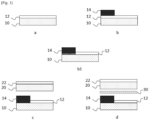
- FIG. 1 schematically illustrates an embodiment of the method according to the invention. It represents a schematic section of a part of the glass sheets and the elements deposited on the glass sheets, near their periphery. The various elements are obviously not shown to scale, so as to be able to visualize them.
- the first glass sheet 10 coated with the stack of thin layers 12 is provided in step a, then a part of the stack 12 is coated with a layer of enamel 14, in particular by screen printing (step b).
- step b1 The assembly then undergoes pre-firing (step b1), which in the case shown, leads to a partial dissolution of the stack 12 by the enamel 14.
- the view shown being only that of the end of the glass sheet, the curving is not shown here.
- the diagram illustrates the fact that at the end of the curving, the enamel 14 has completely dissolved the underlying stack of thin layers 12.
- step d the first glass sheet 10 coated with the stack of thin layers 12 and the enamel layer 14 and the additional glass sheet 20 coated with the additional stack 22 are assembled using the lamination interlayer 30.
- the diagram here represents each of the separate elements, in exploded view.
- the method implemented in the first series of examples corresponds to the embodiment of the [ Fig. 1 ].
- the enamel composition included, in addition to the glass frit, black pigments and the medium, 5% by weight of large refractory oxide particles having a size greater than 20 ⁇ m.
- 5% by weight of ZnO particles were further added to the enamel composition.
- the enamel layer was deposited by screen printing, then the enamel was dried (150°C, 1 to 2 minutes) before being pre-fired at approximately 650-680°C.
- the assembly was curved at more than 600°C for 350 to 500 seconds.
- the aesthetics more particularly the black color seen from face 1, was evaluated by measuring the clarity L* in reflection (illuminant D65, reference observer 10°).
- the value of L* obtained was on average 4.5, compared to 5.1 for the comparative example (without ZnO particles).
- the example comparative also presented a slight blur in reflection, unlike the example according to the invention.
- the laminated glazing units also underwent 3-point bending tests.
- the breaking force was 128 N, compared to 172 N for the example according to the invention.
- the values given are average values for a sample of 20 glazing units.
- the examples in this second series of examples differ from those in the first series in that the bending of the two sheets of glass was carried out separately, by pressing at a temperature of 610-630°C.
- the enamel composition included, in addition to the glass frit, black pigments and the medium, 5% by weight of large refractory oxide particles having a size greater than 20 ⁇ m.
- 5% by weight of ZnO particles were further added to the enamel composition.
- a third example according to the invention contained 10% by weight of such particles.
Landscapes
- Chemical & Material Sciences (AREA)
- Engineering & Computer Science (AREA)
- Chemical Kinetics & Catalysis (AREA)
- Organic Chemistry (AREA)
- Materials Engineering (AREA)
- Geochemistry & Mineralogy (AREA)
- General Chemical & Material Sciences (AREA)
- Life Sciences & Earth Sciences (AREA)
- Ceramic Engineering (AREA)
- Physics & Mathematics (AREA)
- Thermal Sciences (AREA)
- Mechanical Engineering (AREA)
- Dispersion Chemistry (AREA)
- Joining Of Glass To Other Materials (AREA)
- Surface Treatment Of Glass (AREA)
- Laminated Bodies (AREA)
Claims (13)
- Verfahren zum Erhalten einer gebogenen Verbundverglasung, insbesondere für eine Windschutzscheibe oder ein Dach eines Kraftfahrzeugs, umfassend die folgenden Schritte:a. Bereitstellen einer ersten Glasscheibe (10), die auf mindestens einem Teil einer ihrer Flächen mit einem Dünnschichtstapel (12) beschichtet ist,b. einen Schritt eines Aufbringens einer Emailschicht (14) auf einen Teil der Oberfläche des Dünnschichtstapels (12), wobei das Aufbringen durch Siebdruck einer Emailzusammensetzung erfolgt, umfassend zu 1 bis 15 Gew.-% Zinkoxidpartikel, die eine derartige Volumenkorngrößenverteilung aufweisen, dass der d90-Wert höchstens 5 µm beträgt,c. einen Schritt des Biegens der ersten Glasscheibe (10), wobei der Dünnschichtstapel (12), der sich unter der Emailschicht (14) befindet, mindestens am Ende dieses Schritts vollständig von der Emailschicht (14) aufgelöst wird, dannd. einen Schritt eines Laminierens der ersten Glasscheibe (10) mit einer zusätzlichen Glasscheibe (20) mittels einer Verbundzwischenlage (30), sodass die Emailschicht (14) der Zwischenlage (30) zugewandt ist.
- Verfahren nach Anspruch 1, wobei der Dünnschichtstapel (12) mindestens eine Funktionsschicht, insbesondere eine elektrisch leitfähige Funktionsschicht, umfasst.
- Verfahren nach dem vorstehenden Anspruch, wobei die elektrisch leitfähige Funktionsschicht aus Metallschichten, insbesondere aus Silber oder aus Niob, ausgewählt ist, und Schichten aus einem transparenten leitfähigen Oxid insbesondere aus Indium- und Zinnoxid, dotierten Zinnoxiden und dotierten Zinkoxiden ausgewählt sind.
- Verfahren nach einem der vorstehenden Ansprüche, wobei nach Schritt c die Emailschicht (14) undurchsichtig ist, einen schwarzen Farbton besitzt und einen Streifen am Rand der ersten Glasscheibe (10) ausbildet.
- Verfahren nach einem der vorstehenden Ansprüche, wobei die Zinkoxidpartikel eine derartige Volumenkorngrößenverteilung aufweisen, dass der d90-Wert höchstens 1 µm beträgt.
- Verfahren nach einem der vorstehenden Ansprüche, wobei die Zinkoxidpartikel eine derartige Volumenkorngrößenverteilung derart aufweisen, dass der d50-Wert zwischen 200 und 900 nm, insbesondere zwischen 300 und 800 nm, beträgt.
- Verfahren nach einem der vorstehenden Ansprüche, wobei der Gehalt an Zinkoxidpartikeln in der Emailzusammensetzung zwischen 2 und 10 Gew.-%, insbesondere zwischen 3 und 8 Gew.-%, beträgt.
- Verfahren nach einem der vorstehenden Ansprüche, wobei die Emailzusammensetzung ferner feuerfeste Partikel, die einen Durchmesser von mindestens 20 µm aufweisen, in einem Volumenanteil von mindestens 0,5 %, jedoch keine Partikel, die einen Durchmesser von mehr als 80 µm aufweisen, umfasst.
- Verfahren nach dem vorstehenden Anspruch, wobei die feuerfesten Partikel auf Metalloxiden oder Metallen basieren.
- Verfahren nach einem der vorstehenden Ansprüche, wobei das Aufbringen der Emailschicht (14) durch Siebdruck mittels eines Siebdrucksiebs, das eine Maschenweite von mindestens 40 µm aufweist, erfolgt.
- Verfahren nach einem der vorstehenden Ansprüche, wobei:- das Verfahren zwischen Schritt b) und Schritt c) einen Schritt b1) des Vorbrennens der Emailschicht (14), bei dem der Dünnschichtstapel (12), der sich unter der Emailschicht (14) befindet, mindestens teilweise durch die Emailschicht (14) aufgelöst wird, und- in Schritt c) die erste Glasscheibe (10) und die zusätzliche Glasscheibe (20) zusammen gebogen werden, wobei die Emailschicht (14) der zusätzlichen Glasscheibe (20) zugewandt ist.
- Verfahren nach einem der vorstehenden Ansprüche, wobei die zusätzliche Glasscheibe (20) auf der Seite, die der Seite gegenüberliegt, die der Verbundzwischenlage (30) zugewandt ist, einen zusätzlichen Dünnschichtstapel (22), insbesondere einen Stapel mit niedriger Emissivität, umfassend ein leitfähiges transparentes Oxid, trägt.
- Gebogene Verbundverglasung, insbesondere für eine Windschutzscheibe oder ein Dach eines Kraftfahrzeugs, die durch das Verfahren nach einem der vorstehenden Ansprüche erhalten wird, umfassend eine erste Glasscheibe (10), die auf mindestens einem Teil einer ihrer Flächen mit einem Dünnschichtstapel (12) beschichtet ist, wobei die erste Glasscheibe (10) auf einem Teil ihrer Oberfläche mit einer Emailschicht (14) beschichtet ist, umfassend Zinkoxidpartikel, die eine derartige Volumenkorngrößenverteilung aufweisen, dass der d90-Wert höchstens 5 µm beträgt, wobei die erste Glasscheibe (10) mittels einer Verbundzwischenschicht (30) mit einer zusätzlichen Glasscheibe (20) laminiert ist, wobei die Emailschicht (14) der Verbundzwischenschicht (30) zugewandt ist.
Applications Claiming Priority (2)
| Application Number | Priority Date | Filing Date | Title |
|---|---|---|---|
| FR2110796A FR3127941B1 (fr) | 2021-10-12 | 2021-10-12 | Procédé d’obtention d’un vitrage bombé feuilleté |
| PCT/EP2022/078075 WO2023061925A1 (fr) | 2021-10-12 | 2022-10-10 | Procédé d'obtention d'un vitrage bombé feuilleté |
Publications (2)
| Publication Number | Publication Date |
|---|---|
| EP4416112A1 EP4416112A1 (de) | 2024-08-21 |
| EP4416112B1 true EP4416112B1 (de) | 2025-05-21 |
Family
ID=78827923
Family Applications (1)
| Application Number | Title | Priority Date | Filing Date |
|---|---|---|---|
| EP22802063.2A Active EP4416112B1 (de) | 2021-10-12 | 2022-10-10 | Verfahren zur herstellung einer gekrümmten laminierten verglasung |
Country Status (5)
| Country | Link |
|---|---|
| US (1) | US20250282132A1 (de) |
| EP (1) | EP4416112B1 (de) |
| CN (1) | CN116348428B (de) |
| FR (1) | FR3127941B1 (de) |
| WO (1) | WO2023061925A1 (de) |
Family Cites Families (10)
| Publication number | Priority date | Publication date | Assignee | Title |
|---|---|---|---|---|
| EP0916624B1 (de) * | 1997-11-11 | 2001-07-25 | Kawasaki Steel Corporation | Porzellan-emailliertes Stahlblech und Fritten zur Emaillierung |
| AU2794800A (en) | 1998-11-06 | 2000-06-05 | Glaverbel | Glazing panels |
| US7832233B2 (en) * | 2005-05-18 | 2010-11-16 | Ferro Corporation | Method of making staged burnout enamels for second surface firing of multilayer glass structures |
| MX2007016092A (es) * | 2005-06-20 | 2008-03-10 | Dow Global Technologies Inc | Revestimiento protector para vidrio de ventana. |
| ES2985992T3 (es) | 2013-02-28 | 2024-11-08 | Guardian Glass Llc | Unidades de ventana fabricadas utilizando frita cerámica que disuelve recubrimientos depositados por depósito físico de vapor (PVD) y/o métodos asociados |
| CN105565670B (zh) * | 2016-01-12 | 2018-08-14 | 曹文 | 一种陶瓷或搪瓷杀菌釉面材料及其制备方法及其应用 |
| FR3050730B1 (fr) * | 2016-04-27 | 2018-04-13 | Saint-Gobain Glass France | Procede d'impression d'email pour vitrage feuillete a couches fonctionnelles |
| FR3074167B1 (fr) | 2017-11-30 | 2019-11-15 | Saint-Gobain Glass France | Feuille de verre revetue d'un empilement de couches minces et d'une couche d'email. |
| EP3911528A4 (de) * | 2019-01-15 | 2022-03-30 | Central Glass Co., Ltd. | Leitfähige sammelschiene für elektrische verbindung auf fahrzeugfenster |
| FR3093105B1 (fr) * | 2019-02-22 | 2021-02-26 | Saint Gobain | Feuille de verre revêtue d’une couche de peinture minérale et d’un empilement de couches minces |
-
2021
- 2021-10-12 FR FR2110796A patent/FR3127941B1/fr active Active
-
2022
- 2022-10-10 EP EP22802063.2A patent/EP4416112B1/de active Active
- 2022-10-10 US US18/700,557 patent/US20250282132A1/en active Pending
- 2022-10-10 WO PCT/EP2022/078075 patent/WO2023061925A1/fr not_active Ceased
- 2022-10-10 CN CN202280006902.9A patent/CN116348428B/zh active Active
Also Published As
| Publication number | Publication date |
|---|---|
| CN116348428B (zh) | 2024-10-22 |
| EP4416112A1 (de) | 2024-08-21 |
| US20250282132A1 (en) | 2025-09-11 |
| FR3127941B1 (fr) | 2023-09-08 |
| WO2023061925A1 (fr) | 2023-04-20 |
| FR3127941A1 (fr) | 2023-04-14 |
| CN116348428A (zh) | 2023-06-27 |
Similar Documents
| Publication | Publication Date | Title |
|---|---|---|
| EP4225711B1 (de) | Verfahren zur herstellung einer gekrümmten laminierten verglasung | |
| EP3717421A1 (de) | Glasscheibe mit beschichtung aus einem dünnschichtstapel und mit einer emailschicht | |
| WO2022153001A1 (fr) | Procédé d'obtention d'un vitrage bombé feuilleté | |
| EP4244057B1 (de) | Verbundscheibe für ein fahrzeug, insbesondere ein kraftfahrzeug | |
| EP4263454B1 (de) | Verfahren zur herstellung einer gekrümmten laminierten verglasung | |
| WO2022153002A1 (fr) | Procédé d'obtention d'un vitrage bombé feuilleté | |
| WO2023209025A1 (fr) | Vitrage comprenant une zone de décor | |
| EP3927671B1 (de) | Glasscheibe beschichtet mit einer schicht aus mineralischem lack und einem stapel von dünnen schichten | |
| WO2023242040A1 (fr) | Procédé d'obtention d'un vitrage bombé feuilleté | |
| FR3118963A1 (fr) | Procédé d’obtention d’un vitrage bombé feuilleté | |
| EP4118043A1 (de) | Glasscheibe mit einer beschichtung aus einem dünnschichtstapel und einer emailschicht | |
| FR3119793A1 (fr) | Procédé d’obtention d’un vitrage bombé feuilleté | |
| WO2023061925A1 (fr) | Procédé d'obtention d'un vitrage bombé feuilleté | |
| FR3118768A1 (fr) | Procédé d’obtention d’un vitrage bombé feuilleté | |
| FR3159385A1 (fr) | Procédé d’obtention d’un vitrage feuilleté bombé | |
| WO2024046998A1 (fr) | Procédé d'obtention d'un vitrage bombé feuilleté | |
| WO2025003334A1 (fr) | Procédé d'obtention d'un vitrage bombé muni d'un empilement de couches minces et d'une couche d'émail, comportant une étape d'ablation partielle de l'empilement | |
| WO2022058691A1 (fr) | Procede d'obtention d'un vitrage bombe feuillete | |
| WO2026008502A1 (fr) | Feuille de verre revêtue d'une couche sol-gel et d'un empilement de couches minces |
Legal Events
| Date | Code | Title | Description |
|---|---|---|---|
| STAA | Information on the status of an ep patent application or granted ep patent |
Free format text: STATUS: UNKNOWN |
|
| STAA | Information on the status of an ep patent application or granted ep patent |
Free format text: STATUS: THE INTERNATIONAL PUBLICATION HAS BEEN MADE |
|
| PUAI | Public reference made under article 153(3) epc to a published international application that has entered the european phase |
Free format text: ORIGINAL CODE: 0009012 |
|
| STAA | Information on the status of an ep patent application or granted ep patent |
Free format text: STATUS: REQUEST FOR EXAMINATION WAS MADE |
|
| 17P | Request for examination filed |
Effective date: 20240513 |
|
| AK | Designated contracting states |
Kind code of ref document: A1 Designated state(s): AL AT BE BG CH CY CZ DE DK EE ES FI FR GB GR HR HU IE IS IT LI LT LU LV MC ME MK MT NL NO PL PT RO RS SE SI SK SM TR |
|
| GRAP | Despatch of communication of intention to grant a patent |
Free format text: ORIGINAL CODE: EPIDOSNIGR1 |
|
| STAA | Information on the status of an ep patent application or granted ep patent |
Free format text: STATUS: GRANT OF PATENT IS INTENDED |
|
| DAV | Request for validation of the european patent (deleted) | ||
| DAX | Request for extension of the european patent (deleted) | ||
| INTG | Intention to grant announced |
Effective date: 20250107 |
|
| GRAS | Grant fee paid |
Free format text: ORIGINAL CODE: EPIDOSNIGR3 |
|
| GRAA | (expected) grant |
Free format text: ORIGINAL CODE: 0009210 |
|
| STAA | Information on the status of an ep patent application or granted ep patent |
Free format text: STATUS: THE PATENT HAS BEEN GRANTED |
|
| RAP1 | Party data changed (applicant data changed or rights of an application transferred) |
Owner name: SAINT-GOBAIN SEKURIT FRANCE |
|
| AK | Designated contracting states |
Kind code of ref document: B1 Designated state(s): AL AT BE BG CH CY CZ DE DK EE ES FI FR GB GR HR HU IE IS IT LI LT LU LV MC ME MK MT NL NO PL PT RO RS SE SI SK SM TR |
|
| REG | Reference to a national code |
Ref country code: GB Ref legal event code: FG4D Free format text: NOT ENGLISH |
|
| REG | Reference to a national code |
Ref country code: CH Ref legal event code: EP |
|
| REG | Reference to a national code |
Ref country code: DE Ref legal event code: R096 Ref document number: 602022015045 Country of ref document: DE |
|
| REG | Reference to a national code |
Ref country code: IE Ref legal event code: FG4D Free format text: LANGUAGE OF EP DOCUMENT: FRENCH |
|
| REG | Reference to a national code |
Ref country code: NL Ref legal event code: MP Effective date: 20250521 |
|
| PG25 | Lapsed in a contracting state [announced via postgrant information from national office to epo] |
Ref country code: FI Free format text: LAPSE BECAUSE OF FAILURE TO SUBMIT A TRANSLATION OF THE DESCRIPTION OR TO PAY THE FEE WITHIN THE PRESCRIBED TIME-LIMIT Effective date: 20250521 Ref country code: ES Free format text: LAPSE BECAUSE OF FAILURE TO SUBMIT A TRANSLATION OF THE DESCRIPTION OR TO PAY THE FEE WITHIN THE PRESCRIBED TIME-LIMIT Effective date: 20250521 Ref country code: PT Free format text: LAPSE BECAUSE OF FAILURE TO SUBMIT A TRANSLATION OF THE DESCRIPTION OR TO PAY THE FEE WITHIN THE PRESCRIBED TIME-LIMIT Effective date: 20250922 |
|
| REG | Reference to a national code |
Ref country code: LT Ref legal event code: MG9D |
|
| PG25 | Lapsed in a contracting state [announced via postgrant information from national office to epo] |
Ref country code: NO Free format text: LAPSE BECAUSE OF FAILURE TO SUBMIT A TRANSLATION OF THE DESCRIPTION OR TO PAY THE FEE WITHIN THE PRESCRIBED TIME-LIMIT Effective date: 20250821 Ref country code: GR Free format text: LAPSE BECAUSE OF FAILURE TO SUBMIT A TRANSLATION OF THE DESCRIPTION OR TO PAY THE FEE WITHIN THE PRESCRIBED TIME-LIMIT Effective date: 20250822 |
|
| PG25 | Lapsed in a contracting state [announced via postgrant information from national office to epo] |
Ref country code: NL Free format text: LAPSE BECAUSE OF FAILURE TO SUBMIT A TRANSLATION OF THE DESCRIPTION OR TO PAY THE FEE WITHIN THE PRESCRIBED TIME-LIMIT Effective date: 20250521 Ref country code: PL Free format text: LAPSE BECAUSE OF FAILURE TO SUBMIT A TRANSLATION OF THE DESCRIPTION OR TO PAY THE FEE WITHIN THE PRESCRIBED TIME-LIMIT Effective date: 20250521 |
|
| PG25 | Lapsed in a contracting state [announced via postgrant information from national office to epo] |
Ref country code: BG Free format text: LAPSE BECAUSE OF FAILURE TO SUBMIT A TRANSLATION OF THE DESCRIPTION OR TO PAY THE FEE WITHIN THE PRESCRIBED TIME-LIMIT Effective date: 20250521 |
|
| PG25 | Lapsed in a contracting state [announced via postgrant information from national office to epo] |
Ref country code: HR Free format text: LAPSE BECAUSE OF FAILURE TO SUBMIT A TRANSLATION OF THE DESCRIPTION OR TO PAY THE FEE WITHIN THE PRESCRIBED TIME-LIMIT Effective date: 20250521 |
|
| PGFP | Annual fee paid to national office [announced via postgrant information from national office to epo] |
Ref country code: FR Payment date: 20250908 Year of fee payment: 4 |
|
| PG25 | Lapsed in a contracting state [announced via postgrant information from national office to epo] |
Ref country code: RS Free format text: LAPSE BECAUSE OF FAILURE TO SUBMIT A TRANSLATION OF THE DESCRIPTION OR TO PAY THE FEE WITHIN THE PRESCRIBED TIME-LIMIT Effective date: 20250821 |
|
| PG25 | Lapsed in a contracting state [announced via postgrant information from national office to epo] |
Ref country code: IS Free format text: LAPSE BECAUSE OF FAILURE TO SUBMIT A TRANSLATION OF THE DESCRIPTION OR TO PAY THE FEE WITHIN THE PRESCRIBED TIME-LIMIT Effective date: 20250921 |
|
| PG25 | Lapsed in a contracting state [announced via postgrant information from national office to epo] |
Ref country code: LV Free format text: LAPSE BECAUSE OF FAILURE TO SUBMIT A TRANSLATION OF THE DESCRIPTION OR TO PAY THE FEE WITHIN THE PRESCRIBED TIME-LIMIT Effective date: 20250521 |
|
| REG | Reference to a national code |
Ref country code: AT Ref legal event code: MK05 Ref document number: 1796652 Country of ref document: AT Kind code of ref document: T Effective date: 20250521 |
|
| PGFP | Annual fee paid to national office [announced via postgrant information from national office to epo] |
Ref country code: DE Payment date: 20250902 Year of fee payment: 4 |
|
| PG25 | Lapsed in a contracting state [announced via postgrant information from national office to epo] |
Ref country code: AT Free format text: LAPSE BECAUSE OF FAILURE TO SUBMIT A TRANSLATION OF THE DESCRIPTION OR TO PAY THE FEE WITHIN THE PRESCRIBED TIME-LIMIT Effective date: 20250521 Ref country code: DK Free format text: LAPSE BECAUSE OF FAILURE TO SUBMIT A TRANSLATION OF THE DESCRIPTION OR TO PAY THE FEE WITHIN THE PRESCRIBED TIME-LIMIT Effective date: 20250521 Ref country code: SM Free format text: LAPSE BECAUSE OF FAILURE TO SUBMIT A TRANSLATION OF THE DESCRIPTION OR TO PAY THE FEE WITHIN THE PRESCRIBED TIME-LIMIT Effective date: 20250521 |
|
| PG25 | Lapsed in a contracting state [announced via postgrant information from national office to epo] |
Ref country code: CZ Free format text: LAPSE BECAUSE OF FAILURE TO SUBMIT A TRANSLATION OF THE DESCRIPTION OR TO PAY THE FEE WITHIN THE PRESCRIBED TIME-LIMIT Effective date: 20250521 |
|
| PG25 | Lapsed in a contracting state [announced via postgrant information from national office to epo] |
Ref country code: EE Free format text: LAPSE BECAUSE OF FAILURE TO SUBMIT A TRANSLATION OF THE DESCRIPTION OR TO PAY THE FEE WITHIN THE PRESCRIBED TIME-LIMIT Effective date: 20250521 |
|
| PG25 | Lapsed in a contracting state [announced via postgrant information from national office to epo] |
Ref country code: SK Free format text: LAPSE BECAUSE OF FAILURE TO SUBMIT A TRANSLATION OF THE DESCRIPTION OR TO PAY THE FEE WITHIN THE PRESCRIBED TIME-LIMIT Effective date: 20250521 |
|
| PG25 | Lapsed in a contracting state [announced via postgrant information from national office to epo] |
Ref country code: IT Free format text: LAPSE BECAUSE OF FAILURE TO SUBMIT A TRANSLATION OF THE DESCRIPTION OR TO PAY THE FEE WITHIN THE PRESCRIBED TIME-LIMIT Effective date: 20250521 |
|
| REG | Reference to a national code |
Ref country code: DE Ref legal event code: R097 Ref document number: 602022015045 Country of ref document: DE |
|
| PG25 | Lapsed in a contracting state [announced via postgrant information from national office to epo] |
Ref country code: RO Free format text: LAPSE BECAUSE OF FAILURE TO SUBMIT A TRANSLATION OF THE DESCRIPTION OR TO PAY THE FEE WITHIN THE PRESCRIBED TIME-LIMIT Effective date: 20250521 |
|
| PLBE | No opposition filed within time limit |
Free format text: ORIGINAL CODE: 0009261 |
|
| STAA | Information on the status of an ep patent application or granted ep patent |
Free format text: STATUS: NO OPPOSITION FILED WITHIN TIME LIMIT |
|
| REG | Reference to a national code |
Ref country code: CH Ref legal event code: L10 Free format text: ST27 STATUS EVENT CODE: U-0-0-L10-L00 (AS PROVIDED BY THE NATIONAL OFFICE) Effective date: 20260402 |
|
| 26N | No opposition filed |
Effective date: 20260224 |