EP4414141A1 - Adaptive compliant assembly mechanism for cross-scale micro-parts - Google Patents
Adaptive compliant assembly mechanism for cross-scale micro-parts Download PDFInfo
- Publication number
- EP4414141A1 EP4414141A1 EP22923360.6A EP22923360A EP4414141A1 EP 4414141 A1 EP4414141 A1 EP 4414141A1 EP 22923360 A EP22923360 A EP 22923360A EP 4414141 A1 EP4414141 A1 EP 4414141A1
- Authority
- EP
- European Patent Office
- Prior art keywords
- gripping
- compliant
- micro
- parts
- cross
- Prior art date
- Legal status (The legal status is an assumption and is not a legal conclusion. Google has not performed a legal analysis and makes no representation as to the accuracy of the status listed.)
- Pending
Links
Images


Classifications
-
- B—PERFORMING OPERATIONS; TRANSPORTING
- B25—HAND TOOLS; PORTABLE POWER-DRIVEN TOOLS; MANIPULATORS
- B25J—MANIPULATORS; CHAMBERS PROVIDED WITH MANIPULATION DEVICES
- B25J15/00—Gripping heads and other end effectors
- B25J15/08—Gripping heads and other end effectors having finger members
- B25J15/10—Gripping heads and other end effectors having finger members with three or more finger members
-
- B—PERFORMING OPERATIONS; TRANSPORTING
- B25—HAND TOOLS; PORTABLE POWER-DRIVEN TOOLS; MANIPULATORS
- B25J—MANIPULATORS; CHAMBERS PROVIDED WITH MANIPULATION DEVICES
- B25J11/00—Manipulators not otherwise provided for
-
- A—HUMAN NECESSITIES
- A61—MEDICAL OR VETERINARY SCIENCE; HYGIENE
- A61B—DIAGNOSIS; SURGERY; IDENTIFICATION
- A61B17/00—Surgical instruments, devices or methods
- A61B17/56—Surgical instruments or methods for treatment of bones or joints; Devices specially adapted therefor
- A61B17/58—Surgical instruments or methods for treatment of bones or joints; Devices specially adapted therefor for osteosynthesis, e.g. bone plates, screws or setting implements
- A61B17/68—Internal fixation devices, including fasteners and spinal fixators, even if a part thereof projects from the skin
- A61B17/70—Spinal positioners or stabilisers, e.g. stabilisers comprising fluid filler in an implant
- A61B17/7001—Screws or hooks combined with longitudinal elements which do not contact vertebrae
- A61B17/7032—Screws or hooks with U-shaped head or back through which longitudinal rods pass
-
- B—PERFORMING OPERATIONS; TRANSPORTING
- B25—HAND TOOLS; PORTABLE POWER-DRIVEN TOOLS; MANIPULATORS
- B25J—MANIPULATORS; CHAMBERS PROVIDED WITH MANIPULATION DEVICES
- B25J15/00—Gripping heads and other end effectors
-
- B—PERFORMING OPERATIONS; TRANSPORTING
- B25—HAND TOOLS; PORTABLE POWER-DRIVEN TOOLS; MANIPULATORS
- B25J—MANIPULATORS; CHAMBERS PROVIDED WITH MANIPULATION DEVICES
- B25J15/00—Gripping heads and other end effectors
- B25J15/0028—Gripping heads and other end effectors with movable, e.g. pivoting gripping jaw surfaces
-
- B—PERFORMING OPERATIONS; TRANSPORTING
- B25—HAND TOOLS; PORTABLE POWER-DRIVEN TOOLS; MANIPULATORS
- B25J—MANIPULATORS; CHAMBERS PROVIDED WITH MANIPULATION DEVICES
- B25J15/00—Gripping heads and other end effectors
- B25J15/02—Gripping heads and other end effectors servo-actuated
- B25J15/0206—Gripping heads and other end effectors servo-actuated comprising articulated grippers
- B25J15/024—Gripping heads and other end effectors servo-actuated comprising articulated grippers having fingers directly connected to actuator
-
- B—PERFORMING OPERATIONS; TRANSPORTING
- B25—HAND TOOLS; PORTABLE POWER-DRIVEN TOOLS; MANIPULATORS
- B25J—MANIPULATORS; CHAMBERS PROVIDED WITH MANIPULATION DEVICES
- B25J15/00—Gripping heads and other end effectors
- B25J15/04—Gripping heads and other end effectors with provision for the remote detachment or exchange of the head or parts thereof
- B25J15/0475—Exchangeable fingers
-
- B—PERFORMING OPERATIONS; TRANSPORTING
- B25—HAND TOOLS; PORTABLE POWER-DRIVEN TOOLS; MANIPULATORS
- B25J—MANIPULATORS; CHAMBERS PROVIDED WITH MANIPULATION DEVICES
- B25J7/00—Micromanipulators
-
- B—PERFORMING OPERATIONS; TRANSPORTING
- B25—HAND TOOLS; PORTABLE POWER-DRIVEN TOOLS; MANIPULATORS
- B25J—MANIPULATORS; CHAMBERS PROVIDED WITH MANIPULATION DEVICES
- B25J9/00—Program-controlled manipulators
- B25J9/0009—Constructional details, e.g. manipulator supports, bases
- B25J9/0015—Flexure members, i.e. parts of manipulators having a narrowed section allowing articulation by flexion
-
- G—PHYSICS
- G06—COMPUTING OR CALCULATING; COUNTING
- G06F—ELECTRIC DIGITAL DATA PROCESSING
- G06F1/00—Details not covered by groups G06F3/00 - G06F13/00 and G06F21/00
- G06F1/16—Constructional details or arrangements
- G06F1/1613—Constructional details or arrangements for portable computers
- G06F1/1632—External expansion units, e.g. docking stations
Definitions
- the invention belongs to the technical field of micro-assembly, and relates particularly to an adaptive compliant assembly mechanism for cross-scale micro-parts.
- Micro-assembly is a technology that assembles micro-parts ranging in size from microns to millimeters within a small error range to form a microsystem. It is widely applied in the processing and manufacturing of medical testing equipment, optical communication components, micro-sensors, microsatellite equipment and other products. It is the core and foundation of micro-nano manufacturing field. Assembly mechanisms are components that directly perform operations such as gripping, transporting, and placing micro-assembly objects. They play a crucial role in a micro-assembly system, directly restricting the assembly quality and efficiency of the micro-system, and influencing the design, development and industrial application of a micro-electromechanical system.
- Compliant mechanism is the most commonly used form of assembly mechanism, is a type of mechanical structure that relies on its own elastic deformation to transmit force, displacement and energy, and has the advantages of assembly-free, no gap, no friction, and integral fabricating.
- the sizes and weights of assembly mechanisms are often strictly limited, making it impossible to equip with piezoelectric actuators of large stroke and complex displacement amplification mechanisms, so it is difficult to achieve a large working stroke.
- micro-manipulation tasks require the involvement of micro-parts with different shapes and sizes. These parts characteristic sizes range from microns to millimeters, and the size span far exceeds the maximum working stroke of assembly mechanisms. Therefore, it is difficult for a single assembly mechanism to cope with the assembly requirements of complex microelectromechanical systems.
- Previous solutions typically involved employing multiple sets of micromanipulators or micro-grippers to achieve adaptive micro-assembly of parts of different shapes and sizes. For example, the Lawrence Livermore National Laboratory in the United States uses up to six sets of manipulating robot systems to assemble inertial confinement fusion micro-targets involving parts of various shapes and sizes.
- Lofroth and Avci have designed a novel modular compliant gripper, which features mounting holes at its end for installing gripping tips suitable for different objects to be manipulated ( Lofroth M, Avci E. Development of a novel modular compliant gripper for manipulation of micro objects [J]. Micromachines, 2019, 10(5): 313 .). Nonetheless, the gripper exhibits limitations such as a small displacement amplification ratio, complex configuration, and large structural size. Additionally, the use of bolts for fixing makes it highly susceptible to damage the gripping tips during the installation process, and it is difficult to achieve automated replacement, thereby reducing the efficiency of micro-manipulation tasks.
- the present invention aims to address the limitations of existing assembly mechanisms, which suffer from poor universality and a limited application scope. It provides an adaptive compliant assembly mechanism for cross-scale micro-parts.
- the present invention can realize adaptive gripping manipulations of micro-parts with characteristic sizes ranging from microns to millimeters.
- the mechanism has the advantages of compact structure, small volume, light weight. It allows for the precise assembly of micro-parts, and can also be used for the adaptive assembly of multiple varieties and multiple batches of micro-devices.
- the present invention provides an adaptive compliant assembly mechanism for cross-scale micro-parts.
- the mechanism includes a compliant gripping mechanism, a first piezoelectric stack actuator, a second piezoelectric stack actuator and a compliant cellular jaw.
- the compliant gripping mechanism is a symmetric structure that includes a first gripping arm, a second gripping arm, and a displacement amplification mechanism.
- the first gripping arm and the second gripping arm are arranged symmetrically about an axis, and both have one end connected to the displacement amplification mechanism.
- the first piezoelectric stack actuator and the second piezoelectric stack actuator are respectively embedded in both sides of the displacement amplification mechanism.
- the compliant cellular jaw is detachably provided at a free end of the first gripping arm and the free end of the second gripping arm. This detachable provision of the compliant cellular jaw facilitates its assembly and replacement.
- the compliant cellular jaw serves as a replaceable module, enabling the adaptive gripping of micro-parts with various shapes and sizes. When the compliant cell jaw is detached, the compliant gripping mechanism can independently grip micro-parts with particular shapes and sizes.
- a first notch and a second notch are respectively provided on both sides of the displacement amplification mechanism, wherein the first piezoelectric stack actuator and the second piezoelectric stack actuator are respectively provided in the first notch and the second notch.
- the compliant gripping mechanism further includes a mounting base, and the root of the displacement amplification mechanism is connected to the mounting base which is provided with mounting holes. Through these mounting holes, micro-grippers can be installed on micromanipulators and precise positioning platforms.
- the compliant cellular jaw is connected to the first gripping arm and the second gripping arm by snap fit joints.
- the first gripping surface and the second gripping surface are respectively provided on ends of the first gripping arm and the second gripping arm, which are used not only for positioning and installing the compliant cellular jaw, but also for directly gripping micro-parts.
- the first gripping surface and the second gripping surface are respectively provided with a first mating part and a second mating part
- the compliant cellular jaw is provided with a first corresponding mating part and a second corresponding mating part.
- the first corresponding mating part and the second corresponding mating part are respectively matched with the first mating part and the second mating part, to unlock or lock the compliant cellular jaw, facilitating its easy detachment and replacement.
- the gripping surfaces can be provided on the inner side of the first docking mechanism, the inner side of the second docking mechanism, and the outer side of the flexure beam.
- the tips of the embosses on all gripping surfaces are located on a circumference of the same inscribed circle whose radius is determined by shapes and sizes of micro-parts.
- Matching gripping surfaces can be designed for micro-parts of different shapes and sizes.
- two flexure beams and three gripping surfaces are provided, namely the third gripping surface, the fourth gripping surface and the fifth gripping surface.
- the third gripping surface is provided on the inner side of the first docking mechanism
- the fourth gripping surface is provided on the inner side of the second docking mechanism
- the fifth gripping surface is provided on the outer side of the flexure beam.
- Embosses are provided at both ends of the third gripping surface, both ends of the fourth gripping surface and at both ends of the fifth gripping surface.
- the tips of all embosses are located on the circumference of the same inscribed circle. The radius of this inscribed circle can be adjusted to accommodate micro-parts ranging in size from microns to the millimeters.
- the first docking guide groove and the second docking guide groove are respectively provided at the first docking mechanism and the second docking mechanism.
- the cross-sections of the first docking guide groove and the second docking guide groove are respectively match with the first gripping surface and the second gripping surface.
- the first gripping arm and the second gripping arm are detachably connected into the first docking guide groove and the second docking guide groove, respectively.
- the overall connection arrangement of the modular compliant micro-gripper for micro-assembly is as follows: the first piezoelectric stack actuator and the second piezoelectric stack actuator are respectively installed in the first notch and the second notch, with interference fit.
- the pre-tightening of the flexure beam can be achieved by calculating the relationship between the pre-tightening force and the interference amount; the compliant cellular jaw is mounted on both the first gripping arm and the second gripping arm, and is locked cooperatively by the mating parts of the gripping surfaces and the corresponding mating parts of the docking guide grooves.
- the present invention offers several advantageous effects, including but not limited to:
- an adaptive compliant assembly mechanism for cross-scale micro-parts provided in the present invention, has a replaceable compliant cell jaw 4 and is suitable for adaptive assembly of micro-parts with characteristic scales ranging from microns to millimeters.
- This mechanism enables batch assembly of micro-parts, and can also be used for compliant assembly of small batches, multiple varieties, and multiple batches of micro-devices.
- the adaptive compliant assembly mechanism for cross-scale micro-parts includes a compliant gripping mechanism 1, a first piezoelectric stack actuator 2, a second piezoelectric stack actuator 3 and a compliant cellular jaw 4.
- the compliant gripping mechanism 1 is a symmetrical structure processed using slow-feeding wire cutting, which includes a first gripping arm 1-1, a second gripping arm 1-2, a displacement amplification mechanism 1-3 and a mounting base 1-4.
- the first gripping arm 1-1 and the second gripping arm 1-2 are arranged symmetrically about an axis, and connected to the displacement amplification mechanism 1-3 whose root is connected to the mounting base 1-4.
- the displacement amplification mechanism 1-3 features a first notch 1-3-1 and a second notch 1-3-2 on both sides.
- the cross-sectional shapes of the first notch 1-3-1 and the second notch 1-3-2 are adapted to the shapes of the piezoelectric stack actuators.
- the first piezoelectric stack actuator 2 and the second piezoelectric stack actuator 3 are respectively provided within the first notch 1-3-1 and the second notch 1-3-2.
- the displacement amplification mechanism 1-3 is used to amplify the output displacement of the piezoelectric actuators.
- the mounting base 1-4 is equipped with two mounting holes for installing the compliant assembly mechanism provided in the present invention onto other platforms.
- the compliant gripping mechanism 1 is a planar symmetrical structure. In other embodiments, the gripping mechanism may be configured as a three-dimensional axisymmetric structure to have multiple gripping arms.
- the mounting holes are circular through holes.
- the first notch 1-3-1 and the second notch 1-3-2 are located on both sides of the middle part of the displacement amplification mechanism 1-3.
- the cross-sectional shapes of the piezoelectric stack actuator, the first notch 1-3-1 and the second notch 1-3-2 are rectangular.
- the piezoelectric actuators have other shapes, the first notch 1-3-1 and the second notch 1-3-2 are also adjusted according to the shapes of the piezoelectric actuators.
- the first gripping surface 1-1-1 and the second gripping surface 1-2-1 are respectively provided on the ends of the first gripping arm 1-1 and the second gripping arm 1-2; the upper surfaces of the roots of the first gripping surface 1-1-1 and the second gripping surface 1-2-1 are respectively provided with a first mating part 1-1-2 and a second mating part 1-2-2 with embosses which can improve the clamping effect.
- the snap fit joints can also be provided in other forms or at other locations according to actual needs.
- the first gripping surface 1-1-1 and the second gripping surface 1-2-1 have a wedged cross-sectional shape.
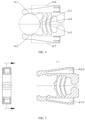
- the compliant cellular jaw 4 is a symmetrical structure, including a third gripping surface 4-1, a fourth gripping surface 4-2, a fifth gripping surface 4-3, a first flexure beam 4-4, a second flexure beam 4-5, a first docking mechanism 4-6 and a second docking mechanism 4-7.
- the first docking mechanism 4-6 and the second docking mechanism 4-7 are arranged symmetrically about an axis, and are connected by the fifth gripping surface 4-3, the first flexure beam 4-4 and the second flexure beam 4-5.
- the third gripping surface 4-1 and the fourth gripping surface 4-2 are respectively connected to the first docking mechanism 4-6 and the second docking mechanism 4-7.
- Both ends of the third gripping surface 4-1, both ends of the fourth gripping surface 4-2 and both ends of the fifth gripping surface 4-3 are provided with embosses to maintain point contact with micro-parts, thus ensuring the gripping stability and the reliable release for micro-parts.
- the tips of the embosses are all located on the circumference of the same inscribed circle whose radius is determined by micro-parts.
- Matching gripping surfaces may be designed for micro-parts of different shapes and sizes.
- the flexure beams have the function of connecting the two docking mechanisms with each other and increasing the stiffness of the entire structure.
- one flexure beam or other number of flexure beams may be provided.
- the number of gripping surfaces in the compliant cellular jaw 4 can also be set as other values.
- the first docking guide groove 4-6-1 and the second docking guide groove 4-7-1 are respectively provided in the first docking mechanism 4-6 and the second docking mechanism 4-7.
- the roots of the first docking guide groove 4-6-1 and the second docking guide groove 4-7-1 are respectively equipped with a first corresponding mating part 4-6-2 and a second corresponding mating part 4-7-2 with embosses, which are used to cooperate with the first mating part 1-1-2 and the second mating part 1-2-2 to complete the locking of the compliant cellular jaw 4.
- the docking guide grooves can guide the compliant cellular jaw to a mounting position, thereby reducing the requirements for the absolute positioning accuracy of micro-manipulating mechanisms and making it easier to realize automated installation and replacement.
- embosses can enhance the clamping effect.
- An adaptive compliant assembly mechanism for cross-scale micro-parts provided in the embodiments of the present invention has the overall connection relationship as follows: the first piezoelectric stack actuator 2 and the second piezoelectric stack actuator 3 are respectively installed with an interference fit in the first notch 1-3-1 and the second notch 1-3-2 to achieve the pre-tightening of the piezoelectric stack actuators; the compliant cellular jaw 4 is installed on the first gripping arm 1-1 and the second gripping arm 1-2, and is fixed by snap fit joints; referring to FIG.
- the specific fixing mode is as follows: the first gripping surface 1-1-1 is inserted into the first docking guide groove 4-6-1 and is locked through the first corresponding mating part 4-6-2 and the first mating part 1-1-2, while the second gripping surface 1-2-1 is inserted into the second docking guide groove 4-7-1 and is locked through the second corresponding mating part 4-7-2 and the second mating part 1-2-2.
- the piezoelectric stack actuators are embedded inside the compliant gripping mechanism while optimizing the positions of the actuators and the configuration of the compliant mechanism, thus obtaining the compliant mechanism with a larger working stroke. Based on the lever principle, the embedding of the piezoelectric stack actuators inside the compliant gripping mechanism, the ratio of effort arm to load arm can be made larger, thereby achieving a larger displacement amplification ratio and working stroke.
- the compliant cellular jaw 4 is a replaceable module.
- the tips of the embosses on the third gripping surface 4-1, fourth gripping surface 4-2 and fifth gripping surface 4-3 are located on the circumference of the same inscribed circle whose radius is adapted to the shapes and sizes of micro-parts, enabling adaptive gripping of micro-parts of various shapes and sizes.
- the compliant gripping mechanism 1 can also work independently, with the first gripping arm 1-1 and the second gripping arm 1-2 capable of gripping micro-parts.
- the working process of the compliant assembly mechanism provided in the embodiments of the present invention is as follows: firstly, the compliant assembly mechanism is assembled as shown in the figures, and is installed on a micro-manipulation platform; when gripping micro-parts, the first piezoelectric stack actuator 2 and the second piezoelectric stack actuator 3 are respectively loaded with driving voltages, and the output force of the actuators causes the displacement amplification mechanism 1-3 to deform, driving the first gripping arm 1-1 and the second gripping arm 1-2 move toward each other; this enables the gripping of micro-parts of fixed sizes.
- the compliant cellular jaw 4 is provided, the compliant cell jaw 4 can be further driven to work.
- the first gripping arm 1-1 and the second gripping arm 1-2 drive the third gripping surface 4-1, fourth gripping surface 4-2 and the fifth gripping surface 4-3 to move; wherein, the third gripping surface 4-1 and the fourth gripping surface 4-2 move perpendicular to the axis toward each other, while the movement direction of the fifth gripping surface 4-3 is parallel to the axis, thereby realizing a three-finger gripping of micro-parts.
- the original compliant cell jaw 4 can be disassembled and is replaced with a matching compliant cell jaw 4, thus achieving the gripping of micro-parts of different sizes and shapes.
- the power supplies of the first piezoelectric stack actuator 2 and the second piezoelectric stack actuator 3 are turned off, and the compliant gripping mechanism 1 returns to its original state, with the first gripping arm 1-1 and the second gripping arm 1-2 open, driving the third gripping surface 4-1, the fourth gripping surface 4-2 and the fifth gripping surface 4-3 to open, so that micro-parts are released.
Landscapes
- Engineering & Computer Science (AREA)
- Robotics (AREA)
- Mechanical Engineering (AREA)
- Health & Medical Sciences (AREA)
- Orthopedic Medicine & Surgery (AREA)
- Life Sciences & Earth Sciences (AREA)
- Surgery (AREA)
- Neurology (AREA)
- Theoretical Computer Science (AREA)
- Nuclear Medicine, Radiotherapy & Molecular Imaging (AREA)
- Heart & Thoracic Surgery (AREA)
- General Engineering & Computer Science (AREA)
- Physics & Mathematics (AREA)
- Human Computer Interaction (AREA)
- Computer Hardware Design (AREA)
- Biomedical Technology (AREA)
- General Physics & Mathematics (AREA)
- Medical Informatics (AREA)
- Molecular Biology (AREA)
- Animal Behavior & Ethology (AREA)
- General Health & Medical Sciences (AREA)
- Public Health (AREA)
- Veterinary Medicine (AREA)
- Manipulator (AREA)
- Micromachines (AREA)
Abstract
Description
- The invention belongs to the technical field of micro-assembly, and relates particularly to an adaptive compliant assembly mechanism for cross-scale micro-parts.
- Micro-assembly is a technology that assembles micro-parts ranging in size from microns to millimeters within a small error range to form a microsystem. It is widely applied in the processing and manufacturing of medical testing equipment, optical communication components, micro-sensors, microsatellite equipment and other products. It is the core and foundation of micro-nano manufacturing field. Assembly mechanisms are components that directly perform operations such as gripping, transporting, and placing micro-assembly objects. They play a crucial role in a micro-assembly system, directly restricting the assembly quality and efficiency of the micro-system, and influencing the design, development and industrial application of a micro-electromechanical system.
- Compliant mechanism is the most commonly used form of assembly mechanism, is a type of mechanical structure that relies on its own elastic deformation to transmit force, displacement and energy, and has the advantages of assembly-free, no gap, no friction, and integral fabricating. However, due to the narrow environment of micro-assembly systems and the limited load-bearing capacity of micromanipulators, the sizes and weights of assembly mechanisms are often strictly limited, making it impossible to equip with piezoelectric actuators of large stroke and complex displacement amplification mechanisms, so it is difficult to achieve a large working stroke.
- However, with the development of microelectromechanical systems towards the integration of multiple material and functional devices, micro-manipulation tasks require the involvement of micro-parts with different shapes and sizes. These parts characteristic sizes range from microns to millimeters, and the size span far exceeds the maximum working stroke of assembly mechanisms. Therefore, it is difficult for a single assembly mechanism to cope with the assembly requirements of complex microelectromechanical systems. Previous solutions typically involved employing multiple sets of micromanipulators or micro-grippers to achieve adaptive micro-assembly of parts of different shapes and sizes. For example, the Lawrence Livermore National Laboratory in the United States uses up to six sets of manipulating robot systems to assemble inertial confinement fusion micro-targets involving parts of various shapes and sizes. However, this approach significantly increases the difficulty and cost of automated control of assembly equipment. Therefore, there is an urgent need to develop an adaptive assembly mechanism suitable for cross-scale micro-parts. Lofroth and Avci have designed a novel modular compliant gripper, which features mounting holes at its end for installing gripping tips suitable for different objects to be manipulated (Lofroth M, Avci E. Development of a novel modular compliant gripper for manipulation of micro objects [J]. Micromachines, 2019, 10(5): 313.). Nonetheless, the gripper exhibits limitations such as a small displacement amplification ratio, complex configuration, and large structural size. Additionally, the use of bolts for fixing makes it highly susceptible to damage the gripping tips during the installation process, and it is difficult to achieve automated replacement, thereby reducing the efficiency of micro-manipulation tasks.
- The present invention aims to address the limitations of existing assembly mechanisms, which suffer from poor universality and a limited application scope. It provides an adaptive compliant assembly mechanism for cross-scale micro-parts. The present invention can realize adaptive gripping manipulations of micro-parts with characteristic sizes ranging from microns to millimeters. The mechanism has the advantages of compact structure, small volume, light weight. It allows for the precise assembly of micro-parts, and can also be used for the adaptive assembly of multiple varieties and multiple batches of micro-devices.
- To achieve the above objectives, the present invention provides an adaptive compliant assembly mechanism for cross-scale micro-parts. The mechanism includes a compliant gripping mechanism, a first piezoelectric stack actuator, a second piezoelectric stack actuator and a compliant cellular jaw.
- The compliant gripping mechanism is a symmetric structure that includes a first gripping arm, a second gripping arm, and a displacement amplification mechanism. The first gripping arm and the second gripping arm are arranged symmetrically about an axis, and both have one end connected to the displacement amplification mechanism.
- The first piezoelectric stack actuator and the second piezoelectric stack actuator are respectively embedded in both sides of the displacement amplification mechanism.
- The compliant cellular jaw is detachably provided at a free end of the first gripping arm and the free end of the second gripping arm. This detachable provision of the compliant cellular jaw facilitates its assembly and replacement. The compliant cellular jaw serves as a replaceable module, enabling the adaptive gripping of micro-parts with various shapes and sizes. When the compliant cell jaw is detached, the compliant gripping mechanism can independently grip micro-parts with particular shapes and sizes.
- Preferably, a first notch and a second notch are respectively provided on both sides of the displacement amplification mechanism, wherein the first piezoelectric stack actuator and the second piezoelectric stack actuator are respectively provided in the first notch and the second notch.
- Preferably, the compliant gripping mechanism further includes a mounting base, and the root of the displacement amplification mechanism is connected to the mounting base which is provided with mounting holes. Through these mounting holes, micro-grippers can be installed on micromanipulators and precise positioning platforms.
- Preferably, the compliant cellular jaw is connected to the first gripping arm and the second gripping arm by snap fit joints.
- Preferably, the first gripping surface and the second gripping surface are respectively provided on ends of the first gripping arm and the second gripping arm, which are used not only for positioning and installing the compliant cellular jaw, but also for directly gripping micro-parts. The first gripping surface and the second gripping surface are respectively provided with a first mating part and a second mating part, and the compliant cellular jaw is provided with a first corresponding mating part and a second corresponding mating part. The first corresponding mating part and the second corresponding mating part are respectively matched with the first mating part and the second mating part, to unlock or lock the compliant cellular jaw, facilitating its easy detachment and replacement.
- Preferably, the compliant cellular jaw is a symmetrical structure, and includes a first docking mechanism, a second docking mechanism and the flexure beams; the first docking mechanism and the second docking mechanism are arranged symmetrically, and are connected to each other through the flexure beam. Additionally, the compliant cellular jaw is further equipped with gripping surfaces.
- Preferably, the gripping surfaces can be provided on the inner side of the first docking mechanism, the inner side of the second docking mechanism, and the outer side of the flexure beam.
- Preferably, each gripping surface is designed with embosses which allow for point contact with the parts when gripping the parts. By providing embosses to maintain point contact with micro-parts, surface forces such as adhesion forces, capillary forces between the gripping surfaces and micro-parts is reduced, which not only ensures the gripping stability but also enables the reliable release of micro-parts.
- Preferably, when two or more gripping surfaces are provided, the tips of the embosses on all gripping surfaces are located on a circumference of the same inscribed circle whose radius is determined by shapes and sizes of micro-parts. Matching gripping surfaces can be designed for micro-parts of different shapes and sizes.
- Specifically, two flexure beams and three gripping surfaces are provided, namely the third gripping surface, the fourth gripping surface and the fifth gripping surface. The third gripping surface is provided on the inner side of the first docking mechanism, the fourth gripping surface is provided on the inner side of the second docking mechanism, and the fifth gripping surface is provided on the outer side of the flexure beam. Embosses are provided at both ends of the third gripping surface, both ends of the fourth gripping surface and at both ends of the fifth gripping surface. The tips of all embosses are located on the circumference of the same inscribed circle. The radius of this inscribed circle can be adjusted to accommodate micro-parts ranging in size from microns to the millimeters.
- Preferably, the first docking guide groove and the second docking guide groove are respectively provided at the first docking mechanism and the second docking mechanism. The cross-sections of the first docking guide groove and the second docking guide groove are respectively match with the first gripping surface and the second gripping surface. The first gripping arm and the second gripping arm are detachably connected into the first docking guide groove and the second docking guide groove, respectively.
- The overall connection arrangement of the modular compliant micro-gripper for micro-assembly is as follows: the first piezoelectric stack actuator and the second piezoelectric stack actuator are respectively installed in the first notch and the second notch, with interference fit. The pre-tightening of the flexure beam can be achieved by calculating the relationship between the pre-tightening force and the interference amount; the compliant cellular jaw is mounted on both the first gripping arm and the second gripping arm, and is locked cooperatively by the mating parts of the gripping surfaces and the corresponding mating parts of the docking guide grooves.
- Compared with the prior art, the present invention offers several advantageous effects, including but not limited to:
- (1) The present invention enables the adaptive gripping of objects ranging in size from microns to millimeters by replacing different modular compliant cellular jaws based on the shapes and sizes of micro-parts, allowing for precise assembly of micro-parts. It facilitates the compliant assembly of multiple varieties and multiple batches of micro-devices.
- (2) The embedded piezoelectric stack actuators within the compliant gripping mechanism provides a large displacement amplification ratio and working stroke. With simple and compact structure, small volume and light weight, they can be conveniently installed on micro-manipulation platforms.
- (3) The snap fit joints between the compliant gripping mechanism and the compliant cellular ensures a simple structure, fewer components and a stable connection, so that it is easy to achieve automated installation and replacement.
- (4) The compliant gripping mechanism is integrally formed by slow-feeding wire cutting, with high stiffness, good integrity, and high movement accuracy.
- (5) The compliant cellular jaw uses multiple gripping surfaces and point contact to grip micro-parts, ensuring the gripping stability and the reliable release for micro-parts.
-
-
FIG. 1 is an overall structure diagram of an adaptive compliant assembly mechanism for cross-scale micro-parts. -
FIG. 2 is a top view of a compliant gripping mechanism. -
FIG. 3 is a schematic diagram of the first gripping arm and the second gripping arm of a compliant gripping mechanism. -
FIG. 4 is a schematic structure diagram of a compliant cellular jaw. -
FIG. 5 is an A-A cross-sectional view of the side view of a compliant cellular jaw. -
FIG. 6 is a B-B cross-sectional view of the top view of a compliant cellular jaw. -
FIG. 7 is a schematic diagram of the buckle connection between a compliant cellular jaw and a compliant gripping mechanism. - In the drawings: 1. compliant gripping mechanism; 1-1: first gripping arm; 1-1-1: first gripping surface; 1-1-2: first mating part; 1-2: second gripping arm; 1-2-1: second gripping surface; 1-2-2: second mating part; 1-3: displacement amplification mechanism; 1-3-1: first notch; 1-3-2: second notch; 1-4: mounting base; 2: first piezoelectric stack actuator; 3: second piezoelectric stack actuator; 4: compliant cellular jaw; 4-1: third gripping surface; 4-2: fourth gripping surface; 4-3: fifth gripping surface; 4-4: first flexure beam; 4-5: second flexure beam; 4-6: first docking mechanism; 4-6-1: first docking guide groove; 4-6-2: first corresponding mating part; 4-7: second docking mechanism; 4-7-1: second docking guide groove; and 4-7-2: second corresponding mating part.
- Specific embodiments of the present invention will be further described in detail below in combination with the accompanying drawings. It should be noted that these specific embodiments are only specific illustrations and are not the limitation to the present invention.
- Referring to
FIG. 1 , an adaptive compliant assembly mechanism for cross-scale micro-parts provided in the present invention, has a replaceablecompliant cell jaw 4 and is suitable for adaptive assembly of micro-parts with characteristic scales ranging from microns to millimeters. This mechanism enables batch assembly of micro-parts, and can also be used for compliant assembly of small batches, multiple varieties, and multiple batches of micro-devices. - Referring to
FIG. 1 , the adaptive compliant assembly mechanism for cross-scale micro-parts provided in the present invention includes a compliantgripping mechanism 1, a firstpiezoelectric stack actuator 2, a secondpiezoelectric stack actuator 3 and a compliantcellular jaw 4. - In the present invention, referring to
FIG. 2 , the compliantgripping mechanism 1 is a symmetrical structure processed using slow-feeding wire cutting, which includes a first gripping arm 1-1, a second gripping arm 1-2, a displacement amplification mechanism 1-3 and a mounting base 1-4. The first gripping arm 1-1 and the second gripping arm 1-2 are arranged symmetrically about an axis, and connected to the displacement amplification mechanism 1-3 whose root is connected to the mounting base 1-4. The displacement amplification mechanism 1-3 features a first notch 1-3-1 and a second notch 1-3-2 on both sides. The cross-sectional shapes of the first notch 1-3-1 and the second notch 1-3-2 are adapted to the shapes of the piezoelectric stack actuators. The firstpiezoelectric stack actuator 2 and the secondpiezoelectric stack actuator 3 are respectively provided within the first notch 1-3-1 and the second notch 1-3-2. The displacement amplification mechanism 1-3 is used to amplify the output displacement of the piezoelectric actuators. The mounting base 1-4 is equipped with two mounting holes for installing the compliant assembly mechanism provided in the present invention onto other platforms. - In some embodiments of the present invention, the compliant
gripping mechanism 1 is a planar symmetrical structure. In other embodiments, the gripping mechanism may be configured as a three-dimensional axisymmetric structure to have multiple gripping arms. - In some embodiments of the present invention, the mounting holes are circular through holes.
- In some embodiments of the present invention, the first notch 1-3-1 and the second notch 1-3-2 are located on both sides of the middle part of the displacement amplification mechanism 1-3. The cross-sectional shapes of the piezoelectric stack actuator, the first notch 1-3-1 and the second notch 1-3-2 are rectangular. Of course, in other embodiments, if the piezoelectric actuators have other shapes, the first notch 1-3-1 and the second notch 1-3-2 are also adjusted according to the shapes of the piezoelectric actuators.
- In the present invention, referring to
FIG. 3 , the first gripping surface 1-1-1 and the second gripping surface 1-2-1 are respectively provided on the ends of the the first gripping arm 1-1 and the second gripping arm 1-2; the upper surfaces of the roots of the first gripping surface 1-1-1 and the second gripping surface 1-2-1 are respectively provided with a first mating part 1-1-2 and a second mating part 1-2-2 with embosses which can improve the clamping effect. In other embodiments, the snap fit joints can also be provided in other forms or at other locations according to actual needs. - In some embodiments of the present invention, the first gripping surface 1-1-1 and the second gripping surface 1-2-1 have a wedged cross-sectional shape.
- In some embodiments of the present invention, referring to
FIG. 4 , the compliantcellular jaw 4 is a symmetrical structure, including a third gripping surface 4-1, a fourth gripping surface 4-2, a fifth gripping surface 4-3, a first flexure beam 4-4, a second flexure beam 4-5, a first docking mechanism 4-6 and a second docking mechanism 4-7. The first docking mechanism 4-6 and the second docking mechanism 4-7 are arranged symmetrically about an axis, and are connected by the fifth gripping surface 4-3, the first flexure beam 4-4 and the second flexure beam 4-5. The third gripping surface 4-1 and the fourth gripping surface 4-2 are respectively connected to the first docking mechanism 4-6 and the second docking mechanism 4-7. Both ends of the third gripping surface 4-1, both ends of the fourth gripping surface 4-2 and both ends of the fifth gripping surface 4-3 are provided with embosses to maintain point contact with micro-parts, thus ensuring the gripping stability and the reliable release for micro-parts. The tips of the embosses are all located on the circumference of the same inscribed circle whose radius is determined by micro-parts. Matching gripping surfaces may be designed for micro-parts of different shapes and sizes. - Wherein, the flexure beams have the function of connecting the two docking mechanisms with each other and increasing the stiffness of the entire structure. In other embodiments, one flexure beam or other number of flexure beams may be provided.
- Wherein, the number of gripping surfaces in the compliant
cellular jaw 4 can also be set as other values. - In some embodiments of the present invention, referring to
FIG. 5 , the first docking guide groove 4-6-1 and the second docking guide groove 4-7-1 are respectively provided in the first docking mechanism 4-6 and the second docking mechanism 4-7. - In some embodiments of the present invention, referring to
FIG. 6 , the roots of the first docking guide groove 4-6-1 and the second docking guide groove 4-7-1 are respectively equipped with a first corresponding mating part 4-6-2 and a second corresponding mating part 4-7-2 with embosses, which are used to cooperate with the first mating part 1-1-2 and the second mating part 1-2-2 to complete the locking of the compliantcellular jaw 4. Wherein, the docking guide grooves can guide the compliant cellular jaw to a mounting position, thereby reducing the requirements for the absolute positioning accuracy of micro-manipulating mechanisms and making it easier to realize automated installation and replacement. The provision of embosses can enhance the clamping effect. - An adaptive compliant assembly mechanism for cross-scale micro-parts provided in the embodiments of the present invention has the overall connection relationship as follows: the first
piezoelectric stack actuator 2 and the secondpiezoelectric stack actuator 3 are respectively installed with an interference fit in the first notch 1-3-1 and the second notch 1-3-2 to achieve the pre-tightening of the piezoelectric stack actuators; the compliantcellular jaw 4 is installed on the first gripping arm 1-1 and the second gripping arm 1-2, and is fixed by snap fit joints; referring toFIG. 7 , the specific fixing mode is as follows: the first gripping surface 1-1-1 is inserted into the first docking guide groove 4-6-1 and is locked through the first corresponding mating part 4-6-2 and the first mating part 1-1-2, while the second gripping surface 1-2-1 is inserted into the second docking guide groove 4-7-1 and is locked through the second corresponding mating part 4-7-2 and the second mating part 1-2-2. Wherein, the piezoelectric stack actuators are embedded inside the compliant gripping mechanism while optimizing the positions of the actuators and the configuration of the compliant mechanism, thus obtaining the compliant mechanism with a larger working stroke. Based on the lever principle, the embedding of the piezoelectric stack actuators inside the compliant gripping mechanism, the ratio of effort arm to load arm can be made larger, thereby achieving a larger displacement amplification ratio and working stroke. - The compliant
cellular jaw 4 is a replaceable module. The tips of the embosses on the third gripping surface 4-1, fourth gripping surface 4-2 and fifth gripping surface 4-3 are located on the circumference of the same inscribed circle whose radius is adapted to the shapes and sizes of micro-parts, enabling adaptive gripping of micro-parts of various shapes and sizes. The compliantgripping mechanism 1 can also work independently, with the first gripping arm 1-1 and the second gripping arm 1-2 capable of gripping micro-parts. - The working process of the compliant assembly mechanism provided in the embodiments of the present invention is as follows: firstly, the compliant assembly mechanism is assembled as shown in the figures, and is installed on a micro-manipulation platform; when gripping micro-parts, the first
piezoelectric stack actuator 2 and the secondpiezoelectric stack actuator 3 are respectively loaded with driving voltages, and the output force of the actuators causes the displacement amplification mechanism 1-3 to deform, driving the first gripping arm 1-1 and the second gripping arm 1-2 move toward each other; this enables the gripping of micro-parts of fixed sizes. When the compliantcellular jaw 4 is provided, thecompliant cell jaw 4 can be further driven to work. When the compliantgripping mechanism 1 is equipped with the compliantcellular jaw 4, the first gripping arm 1-1 and the second gripping arm 1-2 drive the third gripping surface 4-1, fourth gripping surface 4-2 and the fifth gripping surface 4-3 to move; wherein, the third gripping surface 4-1 and the fourth gripping surface 4-2 move perpendicular to the axis toward each other, while the movement direction of the fifth gripping surface 4-3 is parallel to the axis, thereby realizing a three-finger gripping of micro-parts. When there is a need for griping micro-parts of different sizes and shapes, the originalcompliant cell jaw 4 can be disassembled and is replaced with a matchingcompliant cell jaw 4, thus achieving the gripping of micro-parts of different sizes and shapes. When releasing micro-parts, the power supplies of the firstpiezoelectric stack actuator 2 and the secondpiezoelectric stack actuator 3 are turned off, and the compliantgripping mechanism 1 returns to its original state, with the first gripping arm 1-1 and the second gripping arm 1-2 open, driving the third gripping surface 4-1, the fourth gripping surface 4-2 and the fifth gripping surface 4-3 to open, so that micro-parts are released. - The above embodiments of the present invention are only for clearly illustrating the examples provided in the present invention, and are not intended to limit the implementations of the present invention. For those skilled in the art, other different forms of changes or modifications can be made based on the above description. An exhaustive list of all implementations is neither necessary nor possible here. Any modifications, equivalent substitutions and improvements made within the spirit and principles of the present invention should be included in the protection scope of the claims of the present invention.
Claims (10)
- An adaptive compliant assembly mechanism for cross-scale micro-parts, characterized by comprising a compliant gripping mechanism (1), a first piezoelectric stack actuator (2), a second piezoelectric stack actuator (3) and a compliant cellular jaw (4);wherein the compliant gripping mechanism (1) is a symmetrical structure and comprises a first gripping arm (1-1), a second gripping arm (1-2), and a displacement amplification mechanism (1-3); the first gripping arm (1-1) and the second gripping arm (1-2) are arranged symmetrically about an axis and both have one end connected to the displacement amplification mechanism (1-3);the first piezoelectric stack actuator (2) and the second piezoelectric stack actuator (3) are respectively embedded in both sides of the displacement amplification mechanism (1-3); andthe compliant cellular jaw (4) is detachably provided at a free end of the first gripping arm (1-1) and a free end of the second gripping arm (1-2).
- The adaptive compliant assembly mechanism for cross-scale micro-parts according to claim 1, characterized in that, a first notch (1-3-1) and a second notch (1-3-2) are respectively provided on both sides of the displacement amplification mechanism (1-3), and the first piezoelectric stack actuator (2) and the second piezoelectric stack actuator (3) are respectively provided in the first notch (1-3-1) and the second notch (1-3-2).
- The adaptive compliant assembly mechanism for cross-scale micro-parts according to claim 1, characterized in that, the compliant gripping mechanism (1) is capable of being configured as a three-dimensional axisymmetric structure, and comprises multiple gripping arms.
- The adaptive compliant assembly mechanism for cross-scale micro-parts according to claim 1, characterized in that, the compliant cellular jaw (4) is connected to the first gripping arm (1-1) and the second gripping arm (1-2) by buckle connection.
- The adaptive compliant assembly mechanism for cross-scale micro-parts according to claim 4, characterized in that, a first gripping surface (1-1-1) and a second gripping surface (1-2-1) on are respectively provided on ends of the first gripping arm (1-1) and the second gripping arm (1-2), the first gripping surface (1-1-1) and the second gripping surface (1-2-1) are respectively provided with a first mating part (1-1-2) and a second mating part (1-2-2), and the compliant cellular jaw (4) is provided with a first corresponding mating part (4-6-2) and a second corresponding mating part (4-7-2) that are respectively matched with the first mating part (1-1-2) and the second mating part (1-2-2), to unlock or lock the compliant cellular jaw (4).
- The adaptive compliant assembly mechanism for cross-scale micro-parts according to any one of claims 1-5, characterized in that, the compliant cellular jaw (4) is a symmetrical structure and comprises a first docking mechanism (4-6), a second docking mechanism (4-7) and a flexure beam (4-5); the first docking mechanism (4-6) and the second docking mechanism (4-7) are arranged opposite to each other, and are connected to each other through the flexure beam (4-5); and, the compliant cellular jaw (4) is further provided with gripping surfaces.
- The adaptive compliant assembly mechanism for cross-scale micro-parts according to claim 6, characterized in that, the gripping surfaces are capable of being provided on an inner side of the first docking mechanism (4-6), an inner side of the second docking mechanism (4-7), and an outer side of the flexure beam (4-5).
- The adaptive compliant assembly mechanism for cross-scale micro-parts according to claim 7, characterized in that, each gripping surface is provided with embosses, and, when gripping parts, each emboss is in point contact with the parts.
- The adaptive compliant assembly mechanism for cross-scale micro-parts according to claim 7, characterized in that, when two or more gripping surfaces are provided, tips of the embosses on all gripping surfaces are located on the circumference of a same inscribed circle whose radius is determined by shapes and sizes of micro-parts.
- The adaptive compliant assembly mechanism for cross-scale micro-parts according to claim 6, characterized in that, a first docking guide groove (4-6-1) and a second docking guide groove (4-7-1) are respectively provided at the first docking mechanism (4-6) and the second docking mechanism (4-7), and the first gripping arm (1-1) and the second gripping arm (1-2) are detachably connected into the first docking guide groove (4-6-1) and the second docking guide groove (4-7-1) respectively.
Applications Claiming Priority (2)
| Application Number | Priority Date | Filing Date | Title |
|---|---|---|---|
| CN202210103425.XA CN114619423B (en) | 2022-01-27 | 2022-01-27 | Cross-scale micro part self-adaptive compliant assembly mechanism |
| PCT/CN2022/128477 WO2023142562A1 (en) | 2022-01-27 | 2022-10-31 | Adaptive compliant assembly mechanism for cross-scale micro-parts |
Publications (2)
| Publication Number | Publication Date |
|---|---|
| EP4414141A1 true EP4414141A1 (en) | 2024-08-14 |
| EP4414141A4 EP4414141A4 (en) | 2025-01-15 |
Family
ID=81898615
Family Applications (1)
| Application Number | Title | Priority Date | Filing Date |
|---|---|---|---|
| EP22923360.6A Pending EP4414141A4 (en) | 2022-01-27 | 2022-10-31 | ADAPTIVE FLEXIBLE ASSEMBLY MECHANISM FOR MICROPARTS ON MULTIPLE SCALES |
Country Status (5)
| Country | Link |
|---|---|
| US (1) | US20260166757A1 (en) |
| EP (1) | EP4414141A4 (en) |
| JP (1) | JP7749264B2 (en) |
| CN (1) | CN114619423B (en) |
| WO (1) | WO2023142562A1 (en) |
Families Citing this family (4)
| Publication number | Priority date | Publication date | Assignee | Title |
|---|---|---|---|---|
| CN114619423B (en) * | 2022-01-27 | 2023-11-21 | 华南理工大学 | Cross-scale micro part self-adaptive compliant assembly mechanism |
| CN118269024B (en) * | 2024-05-30 | 2024-08-13 | 华东交通大学 | Composite piezoelectric driving three-degree-of-freedom compliant micro gripper with low parasitic displacement |
| CN119408054B (en) * | 2024-09-27 | 2025-12-02 | 玄甲智能科技有限公司 | A flexible gripper device and operating method for pre-embedding micro parts in injection molding |
| CN120080339B (en) * | 2025-04-03 | 2026-02-27 | 华南理工大学 | A hybrid driven compliant micro-gripping mechanism and method thereof |
Family Cites Families (23)
| Publication number | Priority date | Publication date | Assignee | Title |
|---|---|---|---|---|
| JPS61142091A (en) * | 1984-12-14 | 1986-06-28 | 株式会社日立製作所 | Body gripper |
| JPH04130189U (en) * | 1991-05-24 | 1992-11-30 | 日本電気株式会社 | Hand with chip parts |
| US5332275A (en) * | 1991-11-27 | 1994-07-26 | Microscience Group, Inc. | Microgripper |
| JPH0890477A (en) * | 1994-09-29 | 1996-04-09 | Shimadzu Corp | Micro grip |
| JP3079503B2 (en) * | 1995-09-13 | 2000-08-21 | 株式会社新川 | Clamping device |
| JP2000353719A (en) * | 1999-06-11 | 2000-12-19 | Matsushita Electric Ind Co Ltd | Wire clamp mechanism in wire bonding equipment |
| DE10107402A1 (en) * | 2001-02-14 | 2002-08-29 | Ruben Keoschkerjan | Piezo-electric parallel micro-gripper e.g. for positioning objects in micro-optics and micro-electronics, uses two parallel guides with solid hinges and two lever drives fixed on base |
| CN1166554C (en) * | 2001-12-07 | 2004-09-15 | 清华大学 | A Piezoelectric Flexible Drive Amplified and Adjustable Range Micro Gripping Hand |
| JP2006030017A (en) * | 2004-07-16 | 2006-02-02 | Sii Nanotechnology Inc | Probe and micro sample pickup mechanism |
| KR101014226B1 (en) * | 2008-02-11 | 2011-02-14 | 전자부품연구원 | Gripper and its driving method |
| FR2959437B1 (en) * | 2010-04-30 | 2012-06-08 | Centre Nat Rech Scient | MICRO-ACTUATOR AND MICRO-PINCE |
| ES2384853B1 (en) * | 2010-12-17 | 2013-05-20 | Jesus HERNANDEZ JUANPERA | AUTONOMOUS PORTABLE DEVICE, SPECIFICALLY APPLICABLE IN SURGERY, MICRO-COMPONENT AND SIMILAR HANDLING |
| CN202622796U (en) * | 2012-06-04 | 2012-12-26 | 中国科学院自动化研究所 | Piezoelectric drive micro-clamper for precise assembly |
| CN104647347B (en) * | 2014-09-26 | 2016-08-24 | 浙江大学 | The piezoelectric microgripper amplified based on flexible hinge |
| CN105773573A (en) * | 2016-01-22 | 2016-07-20 | 陈昊哲 | High-precision micro-gripper |
| CN106671061B (en) | 2016-07-29 | 2019-05-17 | 苏州大学 | Single-finger structure, micromanipulator gripper and micromanipulator |
| CN107457765A (en) * | 2017-08-18 | 2017-12-12 | 天津大学 | A kind of driving type piezoelectric actuator three-level displacement equations micro clamping device |
| CN109079828B (en) * | 2018-08-24 | 2023-05-23 | 南京航空航天大学 | A piezoelectrically driven articulated mechanical finger and its driving method |
| CN109732563B (en) * | 2019-03-20 | 2021-12-28 | 哈尔滨工业大学 | Piezoelectric-driven passive flexible micro clamp |
| CN110788834B (en) * | 2019-11-13 | 2020-12-04 | 宁波大学 | A three-degree-of-freedom flexible hinge mechanism piezoelectric micro-clamp |
| FR3102946B1 (en) * | 2019-11-13 | 2022-04-01 | Percipio Robotics | Device for microactuator and microactuator equipped with such a device |
| CN214352422U (en) * | 2021-02-08 | 2021-10-08 | 苏州市职业大学 | A two-stage magnification flexible micro-clamp |
| CN114619423B (en) * | 2022-01-27 | 2023-11-21 | 华南理工大学 | Cross-scale micro part self-adaptive compliant assembly mechanism |
-
2022
- 2022-01-27 CN CN202210103425.XA patent/CN114619423B/en active Active
- 2022-10-31 WO PCT/CN2022/128477 patent/WO2023142562A1/en not_active Ceased
- 2022-10-31 JP JP2024528536A patent/JP7749264B2/en active Active
- 2022-10-31 EP EP22923360.6A patent/EP4414141A4/en active Pending
- 2022-10-31 US US18/707,887 patent/US20260166757A1/en active Pending
Also Published As
| Publication number | Publication date |
|---|---|
| EP4414141A4 (en) | 2025-01-15 |
| WO2023142562A1 (en) | 2023-08-03 |
| US20260166757A1 (en) | 2026-06-18 |
| JP7749264B2 (en) | 2025-10-06 |
| JP2024544983A (en) | 2024-12-05 |
| CN114619423B (en) | 2023-11-21 |
| CN114619423A (en) | 2022-06-14 |
Similar Documents
| Publication | Publication Date | Title |
|---|---|---|
| JP7749264B2 (en) | Self-adaptive compliant assembly mechanism for cross-scale micro-components | |
| Wang et al. | Design of a novel dual-axis micromanipulator with an asymmetric compliant structure | |
| Merlet | Parallel manipulators: state of the art and perspectives | |
| CN111299996B (en) | Micro-clamping robot | |
| CN109732563B (en) | Piezoelectric-driven passive flexible micro clamp | |
| CN102581854A (en) | Piezoelectric driving micro gripper | |
| Breguet et al. | Stick and slip actuators and parallel architectures dedicated to microrobotics | |
| Belfiore et al. | Design, optimization and construction of MEMS-based micro grippers for cell manipulation | |
| Lu et al. | A monolithic microgripper with high efficiency and high accuracy for optical fiber assembly | |
| Liu et al. | Design of a 3D-printed polymeric compliant constant-force buffering gripping mechanism | |
| Last et al. | Out of plane motion of assembled microstructures using a single-mask SOI process | |
| Wenjie et al. | Design of a flexure-based gripper used in optical fiber handling | |
| Qian et al. | Design and analysis of a compliant micro-gripper with LBL type displacement amplifier | |
| Zhang et al. | Structure and design of microgrippers: A survey | |
| Maekawa et al. | Development of a micro transfer arm for a microfactory | |
| Belfiore et al. | Development of a MEMS technology CSFH based microgripper | |
| CN202438997U (en) | Mini-sized piezoelectric driving type clamping device | |
| CN117961851A (en) | A XY two-degree-of-freedom precision positioning platform based on Z-type compliant hinges | |
| Menciassi et al. | A sensorized/spl mu/electro discharge machined superelastic alloy microgripper for micromanipulation: simulation and characterization | |
| Kozlowski et al. | Micro-scale force-fit insertion | |
| Krishnan et al. | A multi-fingered micromechanism for coordinated micro/nano manipulation | |
| CN216940723U (en) | Safety clamping jaw and industrial robot | |
| Murthy et al. | A four degree of freedom microrobot with large work volume | |
| Heriban et al. | Design of silicon finger tips for a moc (microrobot on chip) microgripper | |
| CN209599224U (en) | The complicated automatic microoperation arm-and-hand system of the micro- part of multi-configuration |
Legal Events
| Date | Code | Title | Description |
|---|---|---|---|
| STAA | Information on the status of an ep patent application or granted ep patent |
Free format text: STATUS: THE INTERNATIONAL PUBLICATION HAS BEEN MADE |
|
| PUAI | Public reference made under article 153(3) epc to a published international application that has entered the european phase |
Free format text: ORIGINAL CODE: 0009012 |
|
| STAA | Information on the status of an ep patent application or granted ep patent |
Free format text: STATUS: REQUEST FOR EXAMINATION WAS MADE |
|
| 17P | Request for examination filed |
Effective date: 20240506 |
|
| AK | Designated contracting states |
Kind code of ref document: A1 Designated state(s): AL AT BE BG CH CY CZ DE DK EE ES FI FR GB GR HR HU IE IS IT LI LT LU LV MC ME MK MT NL NO PL PT RO RS SE SI SK SM TR |
|
| A4 | Supplementary search report drawn up and despatched |
Effective date: 20241212 |
|
| RIC1 | Information provided on ipc code assigned before grant |
Ipc: B25J 15/04 20060101ALI20241206BHEP Ipc: B25J 15/00 20060101ALI20241206BHEP Ipc: B25J 11/00 20060101ALI20241206BHEP Ipc: B25J 7/00 20060101AFI20241206BHEP |
|
| DAV | Request for validation of the european patent (deleted) | ||
| DAX | Request for extension of the european patent (deleted) |