EP4411441A1 - Indexierter optischer koppler zur kopplung von glasfasern - Google Patents
Indexierter optischer koppler zur kopplung von glasfasern Download PDFInfo
- Publication number
- EP4411441A1 EP4411441A1 EP24155343.7A EP24155343A EP4411441A1 EP 4411441 A1 EP4411441 A1 EP 4411441A1 EP 24155343 A EP24155343 A EP 24155343A EP 4411441 A1 EP4411441 A1 EP 4411441A1
- Authority
- EP
- European Patent Office
- Prior art keywords
- optical
- connector
- optical fibers
- bolt
- optics line
- Prior art date
- Legal status (The legal status is an assumption and is not a legal conclusion. Google has not performed a legal analysis and makes no representation as to the accuracy of the status listed.)
- Pending
Links
Images






Classifications
-
- G—PHYSICS
- G02—OPTICS
- G02B—OPTICAL ELEMENTS, SYSTEMS OR APPARATUS
- G02B6/00—Light guides; Structural details of arrangements comprising light guides and other optical elements, e.g. couplings
- G02B6/24—Coupling light guides
- G02B6/36—Mechanical coupling means
- G02B6/3604—Rotary joints allowing relative rotational movement between opposing fibre or fibre bundle ends
-
- G—PHYSICS
- G02—OPTICS
- G02B—OPTICAL ELEMENTS, SYSTEMS OR APPARATUS
- G02B6/00—Light guides; Structural details of arrangements comprising light guides and other optical elements, e.g. couplings
- G02B6/24—Coupling light guides
- G02B6/36—Mechanical coupling means
- G02B6/38—Mechanical coupling means having fibre to fibre mating means
- G02B6/3807—Dismountable connectors, i.e. comprising plugs
- G02B6/389—Dismountable connectors, i.e. comprising plugs characterised by the method of fastening connecting plugs and sockets, e.g. screw- or nut-lock, snap-in, bayonet type
- G02B6/3894—Screw-lock type
-
- G—PHYSICS
- G02—OPTICS
- G02B—OPTICAL ELEMENTS, SYSTEMS OR APPARATUS
- G02B6/00—Light guides; Structural details of arrangements comprising light guides and other optical elements, e.g. couplings
- G02B6/24—Coupling light guides
- G02B6/36—Mechanical coupling means
- G02B6/38—Mechanical coupling means having fibre to fibre mating means
- G02B6/3807—Dismountable connectors, i.e. comprising plugs
- G02B6/381—Dismountable connectors, i.e. comprising plugs of the ferrule type, e.g. fibre ends embedded in ferrules, connecting a pair of fibres
- G02B6/3825—Dismountable connectors, i.e. comprising plugs of the ferrule type, e.g. fibre ends embedded in ferrules, connecting a pair of fibres with an intermediate part, e.g. adapter, receptacle, linking two plugs
-
- G—PHYSICS
- G02—OPTICS
- G02B—OPTICAL ELEMENTS, SYSTEMS OR APPARATUS
- G02B6/00—Light guides; Structural details of arrangements comprising light guides and other optical elements, e.g. couplings
- G02B6/24—Coupling light guides
- G02B6/36—Mechanical coupling means
- G02B6/38—Mechanical coupling means having fibre to fibre mating means
- G02B6/3807—Dismountable connectors, i.e. comprising plugs
- G02B6/3873—Connectors using guide surfaces for aligning ferrule ends, e.g. tubes, sleeves, V-grooves, rods, pins, balls
- G02B6/3885—Multicore or multichannel optical connectors, i.e. one single ferrule containing more than one fibre, e.g. ribbon type
-
- G—PHYSICS
- G02—OPTICS
- G02B—OPTICAL ELEMENTS, SYSTEMS OR APPARATUS
- G02B6/00—Light guides; Structural details of arrangements comprising light guides and other optical elements, e.g. couplings
- G02B6/24—Coupling light guides
- G02B6/36—Mechanical coupling means
- G02B6/40—Mechanical coupling means having fibre bundle mating means
-
- G—PHYSICS
- G02—OPTICS
- G02B—OPTICAL ELEMENTS, SYSTEMS OR APPARATUS
- G02B6/00—Light guides; Structural details of arrangements comprising light guides and other optical elements, e.g. couplings
- G02B6/44—Mechanical structures for providing tensile strength and external protection for fibres, e.g. optical transmission cables
- G02B6/4401—Optical cables
- G02B6/441—Optical cables built up from sub-bundles
Definitions
- This disclosure relates generally to optics and, more particularly, to an optical coupler for coupling optical fibers.
- Optical fibers may be used for various applications including transmitting light signals for an optical probe.
- Optical fibers may be optically coupled together by an optical coupler.
- Various types and configurations of optical couplers are known in the art. While these known optical couplers have various benefits, there is still room in the art for improvement. There is a need in the art, for example, for an optical coupler which can provide improve light transmission between optical fibers.
- an optical system includes a first optics line, a second optics line and an optical coupler removably connecting the first optics line to the second optics line.
- the first optics line includes a plurality of first optical fibers.
- the second optics line includes a plurality of second optical fibers.
- the optical coupler aligns an end of each of the first optical fibers with an end of a respective one of the second optical fibers to optically couple each of the first optical fibers to the respective one of the second optical fibers.
- another optical system includes a first optics line, a second optics line and an optical coupler.
- the first optics line includes a plurality of first optical fibers.
- the second optics line includes a plurality of second optical fibers.
- the optical coupler longitudinally connects and optically couples the first optical fibers to the second optical fibers.
- the optical coupler includes a first connector, a second connector and a key.
- the first connector is mounted to an end of the first optics line.
- the first connector includes a first groove.
- the second connector is mounted to an end of the second optics line.
- the second connector includes a second groove.
- the key extends longitudinally within the first groove and the second groove.
- another optical system includes a first optics line, a second optics line and an optical coupler removably connecting the first optics line to the second optics line.
- the first optics line includes a plurality of first optical fibers.
- the second optics line includes a plurality of second optical fibers.
- the optical coupler arranges the first optical fibers relative to the second optical fibers to facilitate more than seventy percent light transmission between each of the first optical fibers and a respective one of the second optical fibers.
- a first of the first optical fibers may be coaxial with a first of the second optical fibers within the optical coupler.
- a second of the first optical fibers may be coaxial with a second of the second optical fibers within the optical coupler.
- the optical coupler may also include a bolt and a nut threaded onto the bolt.
- the first optics line may be optically coupled with the second optics line within the bolt.
- the bolt may include a bolt groove.
- the key may also extend longitudinally within the bolt groove.
- Each of the first optical fibers may be coaxial with the respective one of the second optical fibers.
- the end of each of the first optical fibers may laterally overlap at least ninety percent of the end of the respective one of the second optical fibers.
- the first optical fibers may include a central first optical fiber and a plurality of peripheral first optical fibers arranged circumferentially about the central first optical fiber.
- the optical coupler may include a bolt and a nut threaded onto the bolt.
- the first optics line may project into the bolt.
- the second optics line may project into the nut.
- the first optical fibers may be optically coupled to the second optical fibers at an interface within the bolt.
- the optical coupler may include a first connector and a second connector abutted longitudinally against the first connector.
- the first optical fibers may project longitudinally through a bore of the first connector to an end face of the first connector.
- the first optical fibers may be bonded to the first connector.
- the second optical fibers may project longitudinally through a bore of the second connector to an end face of the second connector.
- the second optical fibers may be bonded to the second connector.
- the first connector and the second connector may be rotationally fixed within the optical coupler.
- the first connector and the second connector may be indexed to facilitate the aligning of the end of each of the first optical fibers with the end of the respective one of the second optical fibers.
- the first connector may include a first connector groove.
- the second connector may include a second connector groove.
- the optical coupler may also include a key arranged in the first connector groove and the second connector groove.
- the optical coupler may also include a bolt and a nut threaded onto the bolt.
- the first optics line may project into the bolt.
- the second optics line may project through an endwall of the nut and into the bolt.
- the bolt may include a bolt groove.
- the key may also be arranged in the bolt groove.
- the first optics line may also include a first optical sheath connected to the first connector.
- the first optical fibers may project out from the first optical sheath into the bore of the first connector.
- the second optics line may also include a second optical sheath connected to the second connector. The second optical fibers may project out from the second optical sheath into the bore of the second connector.
- the optical coupler may include a key configured to clock the first optics line and the second optics line about a longitudinal centerline such that the end of each of the first optical fibers is aligned with the end of the respective one of the second optical fibers.
- the optical system may also include an optical probe comprising the first optics line or the second optics line.
- the optical system may also include a light source optically coupled to the first optics line or the second optics line.
- the optical system may also include a light sensor optically coupled to the first optics line or the second optics line.
- the present disclosure may include any one or more of the individual features disclosed above and/or below alone or in any combination thereof.
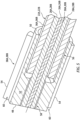
- FIGS. 1 and 2 illustrate a portion of an optical system 20.
- This optical system 20 includes a first optics line 22A, a second optics line 22B and an indexed optical coupler 24 configured to removably (e.g., severably) connect the first optics line 22A to the second optics line 22B.
- Each of the optics lines 22A, 22B (generally referred to as "22") is a longitudinally extending line (e.g., cable, conduit, etc.) of optical members.
- Each of the optics lines 22A, 22B of FIG. 2 includes a bundle (e.g., a grouping) of multiple optical fibers 26A and 28A, 26B and 28B.
- one of the optical fibers 26A, 26B (generally referred to as "26") may be centrally located within the bundle and referred to as a central optical fiber.
- each optics line 22A, 22B extends longitudinally along a longitudinal centerline 30A, 30B of the respective optics line 22A, 22B.
- each of the optical fibers 26, 28 extends longitudinally along a longitudinal centerline 32, 34 of the respective optical fiber 26, 28.
- the longitudinal centerline 32 of the central optical fiber 26 may be coaxial with the longitudinal centerline 30 of the respective optics line 22.
- the central optical fiber 26 may radially engage (e.g., contact) and/or be positioned radially adjacent each of the peripheral optical fibers 28.
- Each of the peripheral optical fibers 28 may be disposed circumferentially between and may circumferentially engage a set of circumferentially neighboring (e.g., adjacent) peripheral optical fibers 28.
- the present disclosure is not limited to the foregoing exemplary arrangement of the optical fibers 26 and 28 within the bundle / the optics line 22.
- the respective optics line 22 may include multiple central optical fibers 26 surrounded by the peripheral optical fibers 28.
- Each of the optics lines 22A, 22B may also include an optical sheath 36A, 36B (generally referred to as "36") such as, but not limited to, hypo-tubing, insulative tubing, non-transparent tubing and the like.
- the optical sheath 36 extends longitudinally along at least a portion of the respective optics line 22 external to the optical coupler 24.
- the optical sheath 36 may also extend longitudinally along a portion of the respective optics line 22 internal to the optical coupler 24.
- An end portion of the respective optics line 22 and its optical fibers 26 and 28 within the optical coupler 24, however, may be uncovered by the optical sheath 36.
- the optical sheath 36 of FIG. 3 extends circumferentially about (e.g., completely around) the bundle of the optical fibers 26 and 28.
- the optical sheath 36 may thereby circumscribe and completely house, shield, protect and/or otherwise cover a select longitudinal length of the bundle of the optical fibers 26 and 28.
- the optical coupler 24 includes a plurality of line connectors 38A and 38B (generally referred to as "38") (e.g., line end fittings) respectively arranged with the optics lines 22A, 22B.
- the optical coupler 24 of FIG. 2 also includes a coupler key 40, a coupler bolt 42 and a coupler nut 44, where the coupler bolt 42 and the coupler nut 44 form a housing structure 46 for an optical interface between (a) the first optics line 22A and its first optical fibers 26A and 28A and (b) the second optics line 22B and its second optical fibers 26B and 28B.
- each line connector 38 extends longitudinally between and to an end face 48 and a base end 50 of the respective line connector 38.
- Each line connector 38 includes a connector base 52 and one or more connector protrusions 54 (e.g., ribs).
- the connector base 52 extends longitudinally from the connector base end 50 to the connection end face 48.
- the connector base 52 extends circumferentially about (e.g., completely around) the longitudinal centerline 30, which longitudinal centerline 30 may also be a longitudinal axis of the respective line connector 38.
- the connector base 52 of FIG. 5 includes a line receptacle 56 (e.g., a counterbore) and a fiber receptacle 58 (e.g., a bore).
- the line receptacle 56 projects longitudinally into the respective line connector 38 and its connector base 52 from the connector base end 50 to the fiber receptacle 58.
- the fiber receptacle 58 projects longitudinally into the respective line connector 38 and its connector base 52 from the connector end face 48 to the line receptacle 56.
- An annular shelf is formed at an intersection between the line receptacle 56 and the fiber receptacle 58.
- the shelf of FIG. 5 extends radially outward from an outer surface forming the fiber receptacle 58 to an outer surface forming the line receptacle 56.
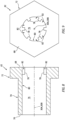
- Each of the connector protrusions 54 is connected to (e.g., formed integral with) the connector base 52. Each connector protrusion 54 projects radially out from the connector base 52 to a radial outer distal side of the respective connector protrusion 54. Each connector protrusion 54 extends longitudinally along the connector base 52. Each connector protrusion 54 of FIG. 5 , for example, extends longitudinally from the connector end face 48 to or about the connector base end 50. Referring to FIG. 6 , the connector protrusions 54 are distributed circumferentially about the connector base 52 in a circular array.
- each connector protrusion 54 is located circumferentially between and circumferentially spaced from a set of circumferential neighboring (e.g., adjacent) connector protrusions 54.
- each circumferentially neighboring pair of the connector protrusions 54 forms a connector groove 60; e.g., a channel, a slot, etc.
- Each connector groove 60 extends circumferentially within the respective line connector 38 between the respective circumferentially neighboring pair of the connector protrusions 54.
- Each connector groove 60 projects radially into the respective line connector 38 to the connector base 52. Referring to FIG. 5 , each connector groove 60 extends longitudinally through the respective line connector 38.
- the line connector 38 of FIG. 6 is thereby provided with an array of the connector grooves 60, which connector grooves 60 are circumferentially interspersed with the connector protrusions 54.
- each optics line 22 and its optical fibers 26 and 28 is mated with the respective line connector 38.
- An end portion of each optics line 22, for example, may be inserted into the respective line connector 38.
- the optical sheath 36 of FIG. 5 projects longitudinally into the line receptacle 56 and may be abutted longitudinally against or disposed near the annular shelf.
- the optical sheath 36 may also be bonded (e.g., brazed, glued, etc.) to the line connector 38 and its connector base 52.
- the optical fibers 26 and 28 of FIG. 5 project longitudinally out from the optical sheath 36 into the fiber receptacle 58.
- optical fibers 26 and 28 may extend longitudinally through the fiber receptacle 58 to (or about) the connector end face 48.
- the optical fibers 26 and 28 may also be bonded (e.g., glued) to the line connector 38 and its connector base 52.
- each peripheral optical fiber 28 of FIG. 6 is circumferentially aligned with a respective one of the connector grooves 60. More particularly, each longitudinal centerline 34 is circumferentially aligned with (e.g., located on a common ray 62 out from the longitudinal centerline 30 as) a circumferential center of the respective connector groove 60.
- the present disclosure is not limited to such an exemplary arrangement.
- each peripheral optical fiber 28 and its longitudinal centerline 34 may be circumferentially aligned with a respective one of the connector protrusions 54 and its circumferential center. While the specific arrangement of the optical fibers 26 and 28 may vary and the relative location of those optical fibers 26 and 28 relative to the line connector 38 may vary, these arrangements in general should be the same for each set of optical fibers 26A and 28A, 26B and 28B and the line connector 38A, 38B.
- the arrangement of the first optical fibers 26A and 28A and the first connector 38A in general should match (e.g., be the same as) and/or otherwise compliment (e.g., mirror, etc.) the arrangement of the second optical fibers 26B and 28B and the second connector 38B.
- the optical fibers 26 and 28 may be bonded to the line connector 38 using a (e.g., brass) fiber guide 64; e.g., a consumable fiber holder.
- This fiber guide 64 is configured to receive and hold the optical fibers 26 and 28 in a select arrangement.
- the fiber guide 64 is also configured to arrange the optical fibers 26 and 28 relative to the line connector 38 in the select manner.
- the fiber guide 64 may include one or more arms 66 that project longitudinally into the respective connector grooves 60.
- the fiber guide 64 may be removed.
- the fiber guide 64 may be ground off (e.g., polished away) until the connector end face 48 is exposed and/or defined. This removal process may also serve to provide the optical fibers 26 and 28 with polished (e.g., optically unobstructed) ends.
- the present disclosure is not limited to such an exemplary process for arranging the optical fibers 26 and 28 with the respective line connector 38.
- the coupler bolt 42 extends longitudinally along the longitudinal centerline 30 between and to a head end 68 of the coupler bolt 42 and a shaft end 70 of the coupler bolt 42, which longitudinal centerline 30 may be a longitudinal centerline of the coupler bolt 42.
- the coupler bolt 42 includes a bolt head 72 and a bolt shaft 74 connected to (e.g., formed integral with) the bolt head 72.
- the bolt head 72 is disposed at the head end 68.
- the bolt shaft 74 projects longitudinally out from the bolt head 72 along the longitudinal centerline 30 to the shaft end 70.
- the coupler bolt 42 of FIG. 8 also includes an interior bore 76 and one or more bolt protrusions 78.
- the interior bore 76 extends longitudinally through the coupler bolt 42 and its bolt member 72 and 74 along the longitudinal centerline 30 from the head end 68 to the shaft end 70.
- the bolt protrusions 78 are arranged within the interior bore 76. More particularly, each of the bolt protrusions 78 is connected to (e.g., formed integral with) a base 80 of the coupler bolt 42, which bolt base 80 is formed by one or more of the bolt members 72 and 74.
- Each bolt protrusion 78 projects radially out from the bolt base 80 (in a radial inward direction towards the longitudinal centerline 30) to a radial inner distal side of the respective bolt protrusion 78.
- Each bolt protrusion 78 extends longitudinally along the bolt base 80.
- Each bolt protrusion 78 of FIG. 8 for example, extends longitudinally from or about the head end 68 to an opposing end longitudinally spaced from the shaft end 70.
- Each bolt protrusion 78 of FIG. 8 in particular, may extend longitudinally along a partial length of the bolt head 72. Referring to FIG. 9 , the bolt protrusions 78 are distributed circumferentially about the longitudinal centerline 30 in a circular array.
- each bolt protrusion 78 is located circumferentially between and circumferentially spaced from a set of circumferential neighboring (e.g., adjacent) bolt protrusions 78.
- each circumferentially neighboring pair of the bolt protrusions 78 forms a bolt groove 82; e.g., a channel, a slot, etc.
- Each bolt groove 82 extends circumferentially within the bolt base 80 between the respective circumferentially neighboring pair of the bolt protrusions 78.
- Each bolt groove 82 projects radially into the bolt base 80 to an outer side of the bolt groove 82. Referring to FIG. 8 , each bolt groove 82 extends longitudinally through the respective bolt base 80.
- the coupler bolt 42 of FIG. 9 is thereby provided with an array of the bolt grooves 82, which bolt grooves 82 are circumferentially interspersed with the bolt protrusions 78.
- the coupler nut 44 extends longitudinally along the longitudinal centerline 30 between and to a line end 84 of the coupler nut 44 and a bolt end 86 of the coupler nut 44, which longitudinal centerline 30 may be a longitudinal centerline of the coupler nut 44.
- the coupler nut 44 includes a bolt receptacle 88 (e.g., a tapped counterbore) and a line receptacle 90 (e.g., a bore).
- the bolt receptacle 88 projects longitudinally into the coupler nut 44 from the bolt end 86 to an endwall 92 of the coupler nut 44 at the line end 84.
- the line receptacle 90 projects longitudinally into the coupler nut 44 and through its endwall 92 from the line end 84 to the bolt receptacle 88.
- An annular shelf is formed at an intersection between the bolt receptacle 88 and the line receptacle 90.
- the shelf of FIG. 2 extends radially outward from an outer surface forming the line receptacle 90 to an outer surface forming the bolt receptacle 88.
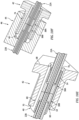
- FIGS. 10A-F illustrate an exemplary sequence for assembling the optical system 20 of FIGS. 1 and 2 .
- each optics line 22 and its optical fibers 26 and 28 are mated with and connected to the respective line connector 38.
- the first connector 38A is mated with the coupler bolt 42.
- the first connector 38A for example, is inserted into the interior bore 76 from the head end 68. More particularly, each connector protrusion 54 is circumferentially aligned with and passed longitudinally through a respective one of the bolt grooves 82.
- the coupler bolt 42 is rotated about the first connector 38A and/or vice versa to (a) circumferentially align each connector groove 60 of the first connector 38A with a respective one of the bolt grooves 82 and (b) circumferentially align each connector protrusion 54 of the first connector 38A with a respective one of the bolt protrusions 78.
- the key 40 is mated with a respective one of the connector grooves 60 of the first connector 38A and a respective one of the bolt grooves 82. The key 40 of FIG.
- 10D is inserted into the interior bore 76 from the shaft end 70 and moved (e.g., translated, slid, passed, etc.) longitudinally through the respective connector groove 60 of the first connector 38A and into the respective bolt groove 82.
- the key 40 may thereby rotationally lock (e.g., fix) the first connector 38A to the coupler bolt 42.
- the second connector 38B is mated with the coupler bolt 42.
- the second connector 38B for example, is inserted into the interior bore 76 from the shaft end 70.
- the key 40 is mated with (e.g., moves into) a respective one of the connector grooves 60 of the second connector 38B.
- the key 40 may thereby also rotationally lock (e.g., fix) the second connector 38B to the coupler bolt 42.
- each connector protrusion 54 of the second connector 38B is circumferentially aligned with a respective one of the connector protrusions 54 of the first connector 3 8A.
- the coupler nut 44 is mated with the coupler bolt 42.
- the coupler nut 44 of FIG. 10F is threaded onto the bolt shaft 74 and torqued as specified, for example, in a design specification. With this arrangement, the key 40 is longitudinally captured within the housing structure 46.
- each first optical fiber 26A, 28A of the first optics line 22A is aligned with a respective one of the second optical fibers 26B, 28B of the second optics line 22B.
- each first optical fiber 26A, 28A and its longitudinal centerline 32, 34 may be substantially or completely coaxial with the respective second optical fiber 26B, 28B and its longitudinal centerline 32, 34.
- first optical fibers 26A and 26B, 28A and 28B may completely (e.g., 100%) laterally overlap the end of the second optical fiber 26B, 28B, and vice versa.
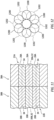
- the alignment between the first optical fibers 26A and 28A and the second optical fibers 26B and 28B may promote enhance light transmission between the first optical fibers 26A and 28A and the second optical fibers 26B and 28B. For example, at least sixty, seventy or even eighty percent (60%, 70% or 80%) of light may be transmitted between a respective set of the optical fibers 26A and 26B, 28A and 28B.
- first optical fibers 1200 are (e.g., circumferentially) misaligned from second optical fibers 1202, less than forty or thirty percent (40-30%) of light may be transferred.
- the optical system 20 of FIGS. 1 and 2 may be used for various applications.
- the optical system 20, for example, may be used for communicating information (e.g., light signals) between various devices; e.g., from a signal transmitter to a signal receiver, between transceivers, etc.
- the optical system 20 may also or alternatively be used for measuring one or more parameters.
- the optical system 20 of FIG. 13 is configured for measuring one or more operational parameters of a rotor 94.
- This rotor 94 may be a bladed rotor 96 for a gas turbine engine 98.
- the bladed rotor 96 examples include, but are not limited to, a propulsor rotor (e.g., a fan rotor), a compressor rotor or any other ducted rotor within and/or rotatably driven by the gas turbine engine 98.
- the present disclosure is not limited to measuring operational parameters for a bladed rotor, nor to measuring operational parameters for gas turbine engine applications.
- the optical system 20 (here, a measurement system), for example, may alternatively be configured to measure one or more operational parameters of any rotor in or coupled to various other types of rotational equipment such as, but not limited to, a reciprocating piston engine, a rotary engine, an electric motor and the like.
- the optical system 20 is described below with reference to the bladed rotor 96.
- the operation parameters may include a blade time of arrival (BTOA) for one or more rotor blades 100 of the bladed rotor 96.
- the blade time of arrival may be indicative of a point in time when a tip 102 (or another portion) of one of the rotor blades 100 arrives at or crosses (e.g., passes) a measurement location; e.g., a probe location.
- the operational parameters may also or alternatively include a blade tip clearance (BTC).
- the blade tip clearance may be indicative of a (e.g., minimum or average) radial distance between the tip 102 of one of the rotor blades 100 and a duct wall 106 circumscribing and housing the bladed rotor 96.
- the optical system 20 of FIG. 13 includes an optical probe 104 that is mounted to the wall 106; e.g., a duct wall housing the bladed rotor 96.
- This optical probe 104 includes the first optics line 22A (or alternatively the second optics line 22B).
- the optical system 20 of FIG. 13 also includes one or more other optical system components 108. These optical system components 108 are in signal communication with the optical probe 104 through the second optics line 22B (or alternatively the first optics line 22A). Examples of the optical system components 108 include, but are not limited to, a light emission device such as an LED or a laser, a light sensing device such as a light receptor, a processor, etc.
- Utilizing the optics lines 22 and the optical coupler 24 to optically couple the optical probe 104 to the optical system component(s) 108 may facilitate arranging the optical probe 104 in difficult to reach locations.
- the optical probe 104 may first be routed, as needed, to mount with the wall 106.
- the optical coupler 24 may be assembled to connect the optical probe 104 to the other optical system component(s) 108.
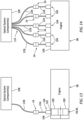
- the gas turbine engine 98 is configured with multiple optical probes 104 as shown, for example, in FIG. 14 .
- the optical probes 104 may similarly be arranged with the gas turbine engine 98 and then plugged into a harness 110 for the optical system components 108.
Landscapes
- Physics & Mathematics (AREA)
- General Physics & Mathematics (AREA)
- Optics & Photonics (AREA)
- Mechanical Coupling Of Light Guides (AREA)
Applications Claiming Priority (1)
| Application Number | Priority Date | Filing Date | Title |
|---|---|---|---|
| US18/104,686 US20240255712A1 (en) | 2023-02-01 | 2023-02-01 | Indexed optical coupler for coupling optical fibers |
Publications (1)
| Publication Number | Publication Date |
|---|---|
| EP4411441A1 true EP4411441A1 (de) | 2024-08-07 |
Family
ID=89834179
Family Applications (1)
| Application Number | Title | Priority Date | Filing Date |
|---|---|---|---|
| EP24155343.7A Pending EP4411441A1 (de) | 2023-02-01 | 2024-02-01 | Indexierter optischer koppler zur kopplung von glasfasern |
Country Status (2)
| Country | Link |
|---|---|
| US (1) | US20240255712A1 (de) |
| EP (1) | EP4411441A1 (de) |
Citations (7)
| Publication number | Priority date | Publication date | Assignee | Title |
|---|---|---|---|---|
| US3914015A (en) * | 1974-10-15 | 1975-10-21 | Itt | Fiber optic connector and assembly method |
| US4009931A (en) * | 1974-03-20 | 1977-03-01 | The Deutsch Company Electronic Components Division | Optical waveguide connector |
| US7517157B1 (en) * | 2007-11-08 | 2009-04-14 | The Boeing Company | All-plastic optical mini-connector |
| US8280205B2 (en) * | 2010-07-23 | 2012-10-02 | Tyco Electronics Corporation | Fiber optic connector and alignment mechanism for single lens multi-fiber connector |
| US20190011648A1 (en) * | 2017-07-06 | 2019-01-10 | Intuitive Surgical Operations, Inc. | Method of coupling optical fiber bundles |
| US20210255402A1 (en) * | 2018-10-15 | 2021-08-19 | Corning Research & Development Corporation | Ferrules including keying features and fiber optic junctions including the same |
| US20220043219A1 (en) * | 2020-08-06 | 2022-02-10 | Canon U.S.A., Inc. | Self-aligning rotating optical connector |
Family Cites Families (22)
| Publication number | Priority date | Publication date | Assignee | Title |
|---|---|---|---|---|
| US6962445B2 (en) * | 2003-09-08 | 2005-11-08 | Adc Telecommunications, Inc. | Ruggedized fiber optic connection |
| US7572065B2 (en) * | 2007-01-24 | 2009-08-11 | Adc Telecommunications, Inc. | Hardened fiber optic connector |
| US7785016B2 (en) * | 2007-03-12 | 2010-08-31 | Corning Cable Systems Llc | Fiber optic adapter and connector assemblies |
| EP2717081B1 (de) * | 2012-10-02 | 2020-11-18 | Corning Research & Development Corporation | Glasfaserverteilerhülse |
| US9028154B2 (en) * | 2013-02-01 | 2015-05-12 | Avago Technologies General Ip (Singapore) Pte. Ltd. | Adapter for cleaning an optical junction and reducing optical back reflection |
| US9519114B2 (en) * | 2014-07-03 | 2016-12-13 | Commscope Technologies Llc | Optical fiber connector for multi-fiber cable |
| WO2016004347A1 (en) * | 2014-07-03 | 2016-01-07 | Adc Telecommunications, Inc. | Optical fiber connector for multi-fiber cable |
| JP6390370B2 (ja) * | 2014-11-14 | 2018-09-19 | 住友電気工業株式会社 | アダプタと光コネクタ結合システム |
| US9594219B2 (en) * | 2015-01-15 | 2017-03-14 | Commscope Technologies Llc | Hermetically sealed telecommunications enclosure with adapter assembly |
| EP3317929B1 (de) * | 2015-07-01 | 2021-05-12 | Go!Foton Holdings, Inc. | Mechanismus zur erfassung der einrastung eines steckverbinders |
| AU2016323386B2 (en) * | 2015-09-14 | 2021-04-22 | CommScope Connectivity Belgium BVBA | Terminal enclosure with modular aspects and modules for interfacing with the terminal enclosure |
| MX2018012657A (es) * | 2016-05-23 | 2019-02-28 | CommScope Connectivity Belgium BVBA | Caja para terminacion optica con ataduras autosuficientes robustas. |
| US11291353B2 (en) * | 2017-11-10 | 2022-04-05 | Neurescence Inc. | Miniature lens-fiber connector with live focusing capability |
| BR112020020133A2 (pt) * | 2018-04-02 | 2021-01-05 | Senko Advanced Components, Inc. | Sistema de conector |
| US10948664B2 (en) * | 2018-05-08 | 2021-03-16 | Senko Advanced Components, Inc. | Ingress protected optical fiber connector having a reduced diameter with a removable retaining nut |
| US11209599B2 (en) * | 2018-07-05 | 2021-12-28 | Senko Advanced Components, Inc. | Ingress protected, outdoor rated adapter and method of assembly to an outdoor connector |
| US11531166B2 (en) * | 2019-04-29 | 2022-12-20 | Corning Research & Development Corporation | Optical connector assemblies, optical receptacle assemblies and optical connection systems having multiple optical fibers |
| US10852487B1 (en) * | 2019-08-09 | 2020-12-01 | Corning Research & Development Corporation | Hardened optical cable assemblies, optical plug connector assemblies, optical receptacle assemblies and optical connection systems having multiple optical fibers |
| BR112022015543A2 (pt) * | 2020-02-12 | 2022-09-27 | Commscope Technologies Llc | Sistemas, dispositivos e métodos para adicionar capacidade a uma rede de fibra óptica |
| EP4107563A4 (de) * | 2020-02-21 | 2024-02-14 | Senko Advanced Components Inc. | Faseroptische verbinder und dazugehörende adapter |
| US20210382238A1 (en) * | 2020-06-09 | 2021-12-09 | Senko Advanced Components, Inc. | Multiport assembly and associated components |
| CN116348795A (zh) * | 2020-08-31 | 2023-06-27 | 康宁研究与开发公司 | 被构造用于与不同连接器配合的凸形插塞光学连接器 |
-
2023
- 2023-02-01 US US18/104,686 patent/US20240255712A1/en active Pending
-
2024
- 2024-02-01 EP EP24155343.7A patent/EP4411441A1/de active Pending
Patent Citations (7)
| Publication number | Priority date | Publication date | Assignee | Title |
|---|---|---|---|---|
| US4009931A (en) * | 1974-03-20 | 1977-03-01 | The Deutsch Company Electronic Components Division | Optical waveguide connector |
| US3914015A (en) * | 1974-10-15 | 1975-10-21 | Itt | Fiber optic connector and assembly method |
| US7517157B1 (en) * | 2007-11-08 | 2009-04-14 | The Boeing Company | All-plastic optical mini-connector |
| US8280205B2 (en) * | 2010-07-23 | 2012-10-02 | Tyco Electronics Corporation | Fiber optic connector and alignment mechanism for single lens multi-fiber connector |
| US20190011648A1 (en) * | 2017-07-06 | 2019-01-10 | Intuitive Surgical Operations, Inc. | Method of coupling optical fiber bundles |
| US20210255402A1 (en) * | 2018-10-15 | 2021-08-19 | Corning Research & Development Corporation | Ferrules including keying features and fiber optic junctions including the same |
| US20220043219A1 (en) * | 2020-08-06 | 2022-02-10 | Canon U.S.A., Inc. | Self-aligning rotating optical connector |
Also Published As
| Publication number | Publication date |
|---|---|
| US20240255712A1 (en) | 2024-08-01 |
Similar Documents
| Publication | Publication Date | Title |
|---|---|---|
| US20240201447A1 (en) | Fiber optic/electrical connection system | |
| EP4439142A1 (de) | Kopplung von optischen fasern und flüssigkeitsdurchgängen | |
| US4896939A (en) | Hybrid fiber optic/electrical cable and connector | |
| EP0205984B1 (de) | Endstück für optische Faser und Verfahren zur Herstellung | |
| US8083419B2 (en) | Optical module with an optical device electrically isolated from a sleeve shell | |
| US4895425A (en) | Plug-in optical fiber connector | |
| CN101449190B (zh) | 用于无线接入的光纤缆线和光纤缆线组件 | |
| EP3556029B1 (de) | Optische faserprüfvorrichtung mit kombinierter lichtmessung und fehlererkennung | |
| US4832435A (en) | Positioning mechanism of optical fiber connector | |
| WO1996041225A1 (en) | Rotatable fibre optic joint | |
| WO2010124165A1 (en) | Inductively and optically coupled interconnect | |
| CN87106047A (zh) | 离轴光通讯系统 | |
| US10133006B1 (en) | Soft contacting rotational interface system for transmitting RF and optical signals concurrently across thereof | |
| EP4411441A1 (de) | Indexierter optischer koppler zur kopplung von glasfasern | |
| EP4435483A2 (de) | Kopplung von optischen fasern und kühlflüssigkeitsdurchgängen | |
| WO2004044530A1 (en) | Fiber optic sensing system | |
| US10845549B2 (en) | Multiplex optical fiber connector | |
| US7325977B2 (en) | Optical coupling | |
| US20040086236A1 (en) | Tunable fiber optic connector and device and method for tuning a connector | |
| CN100447602C (zh) | 光纤终端定位器 | |
| US20240099561A1 (en) | Endoscope connection mechanism, endoscope adapter, and endoscope system | |
| CN116327129B (zh) | 一种光纤探头及共聚焦显微成像系统 | |
| CN215860528U (zh) | 一种活塞销孔油膜测试系统 | |
| US12117653B2 (en) | Optical fiber connection and method of immobilizing the same | |
| JP2007241105A (ja) | コネクタ |
Legal Events
| Date | Code | Title | Description |
|---|---|---|---|
| PUAI | Public reference made under article 153(3) epc to a published international application that has entered the european phase |
Free format text: ORIGINAL CODE: 0009012 |
|
| STAA | Information on the status of an ep patent application or granted ep patent |
Free format text: STATUS: THE APPLICATION HAS BEEN PUBLISHED |
|
| AK | Designated contracting states |
Kind code of ref document: A1 Designated state(s): AL AT BE BG CH CY CZ DE DK EE ES FI FR GB GR HR HU IE IS IT LI LT LU LV MC ME MK MT NL NO PL PT RO RS SE SI SK SM TR |
|
| STAA | Information on the status of an ep patent application or granted ep patent |
Free format text: STATUS: REQUEST FOR EXAMINATION WAS MADE |
|
| 17P | Request for examination filed |
Effective date: 20250207 |