EP4410344A1 - Oronasales kissen und patientenschnittstellenvorrichtung - Google Patents
Oronasales kissen und patientenschnittstellenvorrichtung Download PDFInfo
- Publication number
- EP4410344A1 EP4410344A1 EP22875201.0A EP22875201A EP4410344A1 EP 4410344 A1 EP4410344 A1 EP 4410344A1 EP 22875201 A EP22875201 A EP 22875201A EP 4410344 A1 EP4410344 A1 EP 4410344A1
- Authority
- EP
- European Patent Office
- Prior art keywords
- oronasal
- oral
- wearer
- cushion according
- nasal
- Prior art date
- Legal status (The legal status is an assumption and is not a legal conclusion. Google has not performed a legal analysis and makes no representation as to the accuracy of the status listed.)
- Pending
Links
Images



Classifications
-
- A—HUMAN NECESSITIES
- A61—MEDICAL OR VETERINARY SCIENCE; HYGIENE
- A61M—DEVICES FOR INTRODUCING MEDIA INTO, OR ONTO, THE BODY; DEVICES FOR TRANSDUCING BODY MEDIA OR FOR TAKING MEDIA FROM THE BODY; DEVICES FOR PRODUCING OR ENDING SLEEP OR STUPOR
- A61M16/00—Devices for influencing the respiratory system of patients by gas treatment, e.g. ventilators; Tracheal tubes
- A61M16/06—Respiratory or anaesthetic masks
- A61M16/0605—Means for improving the adaptation of the mask to the patient
- A61M16/0616—Means for improving the adaptation of the mask to the patient with face sealing means comprising a flap or membrane projecting inwards, such that sealing increases with increasing inhalation gas pressure
-
- A—HUMAN NECESSITIES
- A61—MEDICAL OR VETERINARY SCIENCE; HYGIENE
- A61M—DEVICES FOR INTRODUCING MEDIA INTO, OR ONTO, THE BODY; DEVICES FOR TRANSDUCING BODY MEDIA OR FOR TAKING MEDIA FROM THE BODY; DEVICES FOR PRODUCING OR ENDING SLEEP OR STUPOR
- A61M16/00—Devices for influencing the respiratory system of patients by gas treatment, e.g. ventilators; Tracheal tubes
- A61M16/06—Respiratory or anaesthetic masks
- A61M16/0605—Means for improving the adaptation of the mask to the patient
-
- A—HUMAN NECESSITIES
- A61—MEDICAL OR VETERINARY SCIENCE; HYGIENE
- A61M—DEVICES FOR INTRODUCING MEDIA INTO, OR ONTO, THE BODY; DEVICES FOR TRANSDUCING BODY MEDIA OR FOR TAKING MEDIA FROM THE BODY; DEVICES FOR PRODUCING OR ENDING SLEEP OR STUPOR
- A61M16/00—Devices for influencing the respiratory system of patients by gas treatment, e.g. ventilators; Tracheal tubes
- A61M16/06—Respiratory or anaesthetic masks
- A61M16/0605—Means for improving the adaptation of the mask to the patient
- A61M16/0611—Means for improving the adaptation of the mask to the patient with a gusset portion
-
- A—HUMAN NECESSITIES
- A61—MEDICAL OR VETERINARY SCIENCE; HYGIENE
- A61M—DEVICES FOR INTRODUCING MEDIA INTO, OR ONTO, THE BODY; DEVICES FOR TRANSDUCING BODY MEDIA OR FOR TAKING MEDIA FROM THE BODY; DEVICES FOR PRODUCING OR ENDING SLEEP OR STUPOR
- A61M2202/00—Special media to be introduced, removed or treated
- A61M2202/02—Gases
- A61M2202/0225—Carbon oxides, e.g. Carbon dioxide
Definitions
- the present disclosure relates to the technical field of the treatment of respiratory-related diseases, and in particular to an oronasal cushion and a patient interface device.
- Respiratory-system-related diseases are accompanied by a series of breathing disorders, characterized by apnea, hypopnea and hyperpnea.
- respiratory diseases include obstructive sleep apnea (OSA), respiratory insufficiency, obesity, chronic obstructive pulmonary disease (COPD) and the like.
- OSA obstructive sleep apnea
- COPD chronic obstructive pulmonary disease
- a patient interface device also known as a face mask, is generally used for the treatment of the above respiratory diseases.
- a full-face mask is an interface configuration that is most frequently used by a wearer.
- the full-face mask will simultaneously cover and seal oral features and nasal features of the wearer during the treatment, which results in some insurmountable defects of the full-face mask itself.
- the full-face mask needs to cover the nose and mouth of the wearer when it is used, so the full-face mask will be bulky in the entirety, and it will seriously affect the visual field of the wearer when being used.
- the full-face mask covers the nose of the wearer, it will also press the sensitive nasal bridge region of the wearer, and is unfriendly to wearers who suffer from claustrophobia, and so on. All of these defects may lead to the resistance of the wearer.
- the present disclosure provides an oronasal cushion and a patient interface device to solve the above technical problems.
- the present disclosure provides an oronasal cushion, including a nasal structure and an oral structure connected to each other, a penetrating cavity is formed inside the nasal structure and the oral structure, and the cavity is configured to receive pressurized gas; the nasal structure is adapted to fit around nostrils of a wearer for sealing, and the oral structure is adapted to fit around a mouth of the wearer for sealing;
- the nasal structure includes a nasal opening in communication with the cavity and a nasal soft pad part surrounding the nasal opening, the nasal opening is configured to surround a lower side of the nostrils of the wearer in response to the oronasal cushion being put on by the wearer, and the nasal soft pad part is adapted to fit around the nostrils of the wearer for sealing.
- the nasal soft pad part includes a soft intermediate part disposed around the nasal opening, the intermediate part is configured to accommodate the nose of the wearer without submerging a nasal apex of the wearer, and the intermediate part deforms in response to an increase in the pressure in the cavity, to fit around the nostrils of the wearer'.
- the nasal soft pad part further includes a first lateral support part and a second lateral support part connected to the intermediate part respectively;
- the intermediate part is configured to be further away from an upper end of the oronasal cushion than the first lateral support part and the second lateral support part.
- rigidity of both the first lateral support part and the second lateral support part is greater than rigidity of the intermediate part.
- a thickness of the first lateral support part and a thickness of the second lateral support part are greater than a thickness of the intermediate part.
- the intermediate part is a structure with uniform thickness.
- a thickness of the intermediate part is 0.2mm ⁇ 1.0mm.
- the intermediate part includes one or more local thickened part.
- the local thickened part is provided at a peripheral edge of the intermediate part.
- a thickness of the local thickened part is 0.2mm ⁇ 1.2mm.
- a thickness of the first lateral support part and a thickness of the second lateral support part are both 0.6mm ⁇ 1.5mm.
- the oronasal cushion also includes an oronasal transition part disposed between a rear side of the intermediate part and the oral structure, the oronasal transition part is configured to fit with an upper lip region of the wearer in response to the oronasal cushion being put on by the wearer; and a thickness of the oronasal transition part is the same as a thickness of the intermediate part.
- the oronasal transition part is configured as a concave structure recessed in a direction away from upper lip of the wearer.
- the thickness of the oronasal transition part is the same as the thickness of the intermediate part.
- two sides of the oronasal transition part are respectively connected to the first lateral support part and the second lateral support part by recessing in a direction away from upper lip of the wearer.
- the oronasal cushion also includes an oronasal connection part provided between the nasal structure and the oral structure, and a thickness of the oronasal connection part is variable.
- the oronasal connection part includes a first oronasal connection part located between the first lateral support part and a side part of the oral structure, a second oronasal connection part located between the second lateral part and the side part of the oral structure and a third oronasal connection part located between a front side of the nasal structure and a front side of the oral structure; and a thickness of the first oronasal connection part and a thickness of the second oronasal connection part are both greater than a thickness of the third oronasal connection part.
- the thickness of the oronasal connection part is 0.2mm ⁇ 0.6mm.
- the oral structure further includes an oral opening in communication with the cavity, the oral soft pad part is disposed around the oral opening, and the oral opening is configured to accommodate the mouth of the wearer in response to the oronasal cushion being put on by the wearer;
- a region of the oral structure where the oral opening is located is recessed inward the cavity, and a region of the oral structure where the oral soft pad part is located protrudes outward the cavity.
- the oral opening is configured in an elliptical or quasi-elliptical shape.
- the oral soft pad part includes an oral ambilateral part and a chin part, and an oronasal transition part and the chin part are respectively connected to an upper side and a lower side of the oral ambilateral part; the oral ambilateral part is configured to fit with the face of the wearer in response to the oronasal cushion being put on by the wearer, and the chin part is configured to fit with chin of the wearer in response to the oronasal cushion being put on by the wearer.
- the oral ambilateral part includes a face contact region surrounding the oral opening, a face support region smoothly connected to the face contact region and extending toward a front side of the oral structure, and an oral transition region surrounding the oral opening; the oral transition region is smoothly connected to the face contact region and the face support region.
- a thickness of the oral transition region is less than a thickness of the face support region.
- a thickness of the face contact region is less than or equal to a thickness of the face support region.
- a thickness of the face support region is 1.2mm ⁇ 2.5mm.
- a thickness of the oral transition region is 0.3mm ⁇ 0.6mm.
- the chin part includes a chin contact region surrounding the oral opening and a chin transition region smoothly connected to the chin contact region, the chin transition region extends to a front side of the oronasal cushion, or the chin transition region is connected with the chin support region.
- a thickness of the chin transition region is the same as a thickness of the chin contact region.
- a thickness of the chin transition region is 0.2mm ⁇ 0.8mm.
- the reinforcing structure is located on a front side of the oral structure and is connected to the oral soft pad part of the oral structure, the reinforcing structure is provided with an air inlet in communication with the cavity, the air inlet is provided with a sealing part, and the air inlet is sealingly connected to a frame of a patient interface device through the sealing part, and the pressured gas is allowed to be supplied into the cavity through the air inlet.
- the reinforcing structure and the oral structure are integrally formed from the same material; or
- the reinforcing structure and the oral structure are made from different materials respectively, and are connected through a connection part on the reinforcing structure.
- a part between the air inlet of the reinforcement structure and the connection part on the reinforcement structure is a support transition region, and a thickness of the support transition region is 0.8mm ⁇ 2.5mm.
- the reinforcing structure is made from Polycarbonate (PC), Polypropylene (PP), acrylic and Acrylonitrile Butadiene Styrene (ABS).
- PC Polycarbonate
- PP Polypropylene
- ABS Acrylonitrile Butadiene Styrene
- the nasal structure and the oral structure are made from the same or different materials.
- the nasal structure is made from one or more of silicone rubber, foam, thermoplastic elastomer, thermosetting material, resin and textile.
- the oral structure is made from one or more of silicone rubber, foam, thermoplastic elastomer, thermosetting material, resin and textile.
- the present disclosure provides an oronasal cushion, including a nasal structure and an oral structure connected to each other; the nasal structure is adapted to fit around nostrils of a wearer for sealing; wherein the nasal structure is configured so that no clamping effect is applied on ala nasi of the wearer when the nasal structure is pressed against the bottom of the wearer's nose for sealing by the pressurized gas; the oral structure is configured to accommodate a mouth of the wearer and fit around the mouth of the wearer in response to the oronasal cushion being put on by the wearer; wherein the oronasal cushion also includes exhaust components and/or ventilation components; the exhaust components are configured to discharge the gas exhaled by the wearer in the oronasal cushion, and the ventilation components are configured to ensure the oronasal cushion to be communicated with the environment when no gas is supplied into the oronasal cushion.
- the oronasal cushion further includes a reinforcing structure located on a front side of the oral structure and connected to an oral soft pad part of the oral structure, and an air inlet is provided on the reinforcing structure, the exhaust components are arranged on both sides of the air inlet, respectively.
- the oronasal cushion further includes a reinforcing structure located on a front side of the oral structure and connected to an oral soft pad part of the oral structure, and an air inlet is provided on the reinforcing structure, the ventilation components are arranged on both sides of the air inlet, respectively.
- the oronasal cushion further includes a reinforcing structure located on a front side of the oral structure and connected to an oral soft pad part of the oral structure, and an air inlet is provided on the reinforcing structure, the exhaust component and the ventilation component are arranged on both sides of the air inlet, respectively.
- the exhaust component comprises exhaust holes, and an inner hole diameter of each of the exhaust holes is less or greater than an outer hole diameter of each of the exhaust holes.
- the exhaust holes are in a shape of a strip, an oblong or a circle.
- the exhaust component comprises a plurality of exhaust holes that are arranged in a circular arrangement, an elliptical arrangement, or an array hole arrangement.
- the exhaust holes are arranged in a divergent manner, and a number of adjacent exhaust holes for each exhaust hole is at most 6.
- the exhaust holes are provided on both sides of the air inlet and far away from the air inlet.
- the exhaust holes are formed by kissing off on the mold.
- the ventilation component comprises a safety valve port and a safety valve disc; when no gas is supplied into the oronasal cushion, the safety valve disc opens the safety valve port, to allow the oronasal cushion to communicate with the environment; when gas is supplied into the oronasal cushion, the safety valve disc closes the safety valve port.
- the present disclosure also provides a patient interface device, including the oronasal cushion as described above and a frame, the oronasal cushion is sealingly connected to the frame.
- the advantages of the present disclosure are as follows: since the nasal opening in the nasal structure surrounds the lower side of the nostrils of the wearer for ventilation, the oronasal cushion of the present disclosure does not need to cover the nose of the wearer, thereby reducing its overall volume and making it more compact and lightweight. Thus, it is less likely to cause claustrophobia and makes it more comfortable to wear. Moreover, the nasal soft pad part adaptively fits around the nostrils of the wearer for sealing, so the ala nasi of the wearer will not be clamped, thereby further improving the wearing comfort, and improving treatment effectiveness and treatment compliance of the wearer. In addition, by constructing the nasal structure and the oral structure separately, the internal cavity can withstand higher pressure to adapt to the treatment needs of different symptoms.
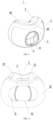
- the present disclosure provides an oronasal cushion 1 that is arranged around a lower side of the nostrils of the wearer when being put on.
- the oronasal cushion 1 of the present disclosure includes a nasal structure 2 and an oral structure 3 connected to each other.
- a penetrating cavity 6 is formed inside the nasal structure 2 and the oral structure 3.
- the cavity 6 may receive pressurized gas from a pressure device, and deliver the pressurized gas to the nose and mouth of the wearer through the nasal structure 2 and the oral structure 3 respectively. Therefore, the cavity 6 has an applicable pressure range of 4-40 hpa when it receives the pressurized gas, so it is necessary to provide the oral structure 3 to accommodate the mouth of the wearer and share part functions of the face contact and support.
- the nasal structure 2 includes a nasal opening 21 connected with the cavity 6 and a nasal soft pad part 22 surrounding the nasal opening 21.
- the nasal opening 21 is configured to surround the lower side of the nostrils of the wearer in response to the oronasal cushion 1 being put on by the wearer, and the nasal soft pad part 22 is configured to fit around the nostrils of the wearer for sealing.
- the nasal soft pad part 22 includes an intermediate part 23 provided around the nasal opening 21 as well as a first lateral support part and a second lateral support part provided on two sides of the intermediate part 23. Since the first lateral support part and the second lateral support part may be constructed according to the same structure, hereinafter, the first lateral support part and the second lateral support part will no longer be distinguished, but are collectively referred to as the nasal ambilateral part 24. It should be understood that the first lateral support part and the second lateral support part may also be different in terms of thicknesses, materials or the like.
- the intermediate part 23 deforms in response to an increase of the pressure within the cavity 6 to fit around the nostrils of the wearer.
- the thickness of the intermediate part 23 may be, for example, 0.2-1.0 mm, that is, the region where the intermediate part 23 is located is a thin film region. Therefore, when being under pressure, the intermediate part 23 will expand and deform so that it can fit closely around the nostrils of the wearer. Accordingly, although there are individual differences in the nose of the wearer, it is ensured that the intermediate part 23 can fit around the nostrils of different wearers due to the deformability of the intermediate part 23, thereby improving the scope of application and sealing stability of the intermediate part 23.
- the nasal structure 2 can fit around the nostrils of the user for sealing adaptively, and the nasal structure 2 is configured such that the nasal structure 2 has no clamping effect against the alae nasi of the patient when it leans against the bottom of the nose of the wearer due to the pressurized gas for sealing.
- the deformability of the film can ensure that the intermediate part 23 fits around the nostrils of the wearer adaptively, thereby improving the tightness of the contact between the oronasal cushion 1 and the face of the wearer and connection stability.
- the intermediate part 23 is recessed inward the cavity 6, that is, the intermediate part 23 is slightly lower than the nasal ambilateral part 24 (as shown in FIG. 5a ). Therefore, the height of the intermediate part 23 will approach to the height of the nasal ambilateral part 24 when the intermediate part 23 is expanded by the pressure in the cavity 6, as shown in FIG.5b .
- the intermediate part 23 When the intermediate part 23 is expanded, it changes from an original small arc circle to a large arc circle, and the intermediate part 23 and the nasal ambilateral part 24 can even be located in almost the same plane, thus ensuring that the part of the oronasal cushion 1 that is in contact with the face of the wearer is under the nose of the wearer to horizontally hold the nose, rather than wrapping around the alae nasi of the wearer.
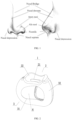
- the oronasal cushion 1 of the present disclosure can ensure the sealing stability without clamping the alae nasi of the wearer, so that the oronasal cushion 1 does not require to be strictly adapted to the width of the nose of the wearer (the distance between the alae nasi on both sides, as shown in FIG. 1 ), thereby increasing its adaptability to the population.
- the intermediate part 23 is slightly lower than the nasal ambilateral part 24 when being not deformed, and can be located at the position shown by the thick dotted line in FIG. 5a when being expanded and deformed. As can be seen more clearly in FIG. 5b , the intermediate part 23 upward after deformation, so as to seal around the nostrils of the wearer N1, without covering the ala nasi N2 and the nasal depression N5 of the wearer.
- the oronasal cushion 1 of the present disclosure does not clamp the ala nasi of the wearer, the contact region between the oronasal cushion and the ala nasi of the wearers can be reduced, and the wearing comfort can be improved.
- the front end 25 of the intermediate part 23 will not exceed the nasal apex N3 of the wearer, so that the nasal bridge N4 of the wearer will not be pressed when the oronasal cushion is put on, which can further improve the wearing comfort and also provide the wearer with a better field of view when the oronasal cushion is put on.
- the nasal ambilateral part 24 are mainly used for supporting, so the stress thereof is greater than that of the intermediate part 23. Therefore, the thickness of the nasal ambilateral part 24 can be set to be greater than the thickness of the intermediate part 23.
- the thickness of the nasal ambilateral part 24 may be 0.6-1.5 mm, preferably 0.8-1.2 mm, so that the rigidity of the nasal ambilateral part 24 may be greater than that of the intermediate part 23.
- the nasal ambilateral part 24 extend on both sides of the intermediate part 23 respectively.
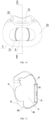
- the dotted line in FIG. 6a shows the dividing line between the nasal ambilateral part 24 and the intermediate part 23, that is, the regions of the nasal ambilateral part 24 only extend in a small local region close to the face wearing side.
- the nasal ambilateral part 24 first contact the face of the wearer and are closer to muscles of the cheek F of the wearer (as shown in FIG. 5a and FIG. 5b ).
- the wearer does not feel the force exerted on the nasal ambilateral part 2 significantly, so the facial pressure when the oronasal cushion 1 is worn can be effectively distributed by the nasal ambilateral part 24, thereby improving the wearing comfort.
- the nasal ambilateral part 24 are close to the face of the wearer, in this case, the sealing stability of the oronasal cushion 1 at the nose depends on the supporting force of the nasal ambilateral part 24 and the expansion force of the intermediate part 23.
- the region of the ambilateral part 24 only extends in a small local region close to the face wearing side.
- an oronasal connection part 88 is provided between two sides of the nasal structure 2 and the oral structure 3 and between the front sides of the nasal structure 2 and the oral structure 3 respectively.
- the oronasal connection part 88 includes: a first oronasal connection part located between the above-mentioned first lateral support part and the side of the oral structure 3; a second oronasal connection part located between the above-mentioned second lateral support part and the side of the oral structure 3; and a third oronasal connection part located between the front side of the nasal structure 2 (specifically the intermediate partial region 26 described below) and the front side of the oral structure 3.
- the oronasal connection part 88 has a variable thickness.
- the thicknesses of the first oronasal connection part and the second oronasal connection part that are between the nasal ambilateral part 24 and the oral structure 3 is generally equal to or greater than the thickness of the third oronasal connection part of the nasal ambilateral part 24.
- the intermediate part 23 includes an intermediate partial region 26.
- the intermediate partial region 26 is basically located at an edge region of the nasal structure 2 that is not easily accessible by the wearer's nose.
- the thickness of the intermediate partial region 26 is slightly greater than that of the intermediate part 23, for example 0.2mm ⁇ 1.2mm, preferably 0.8 ⁇ 0.9mm, and the intermediate partial region 26 is mainly used for maintaining a rough shape of the film region of the intermediate part 23 when it is not inflated.
- intermediate partial region 26 may also have the same thickness as the intermediate part 23 to ensure that there is no major impact on use.
- the transition thickness of the oronasal connection part 88 between the oral structure 3 and the intermediate part 23 of the nasal structure 2 may also be set as a film thickness.
- the thickness of the oronasal connection part 88 may be set as 0.2 ⁇ 0.6mm, preferably 0.3mm ⁇ 0.5mm, so that the oronasal connection part 88 can better supplement the sealing at the nose region when it is inflated.
- the nasal ambilateral part 24 extends on both sides of the intermediate part 23 until reaching an outer front end of the intermediate part 23, so as to increase the area of the support region, as shown in FIG. 8 , the dotted line indicates the dividing line between the nasal ambilateral part 24 and the intermediate part 23.
- the area of the nasal ambilateral part 24 is larger, which can provide better supporting. Therefore, in this case, the sealing stability of the oronasal cushion 1 at the nose mainly depends on the supporting forces of the nasal ambilateral part 24.
- the region of the ambilateral part 24 extends to the front side in a large range.
- the intermediate part 23 has a thin thickness and is a thin film region. Accordingly, optionally, the intermediate part 23 may be configured as a structure with a uniform thickness. Optionally, the intermediate part 23 further has one or more local thickened parts 25 to thicken local regions.
- the number of nasal openings 21 may be set as needed. In this embodiment, one nasal opening 21 is shown, and multiple nasal openings 21 may also be provided as needed. For example, two nasal openings 21 are provided, and the nasal openings correspond to two nostrils of the wearer respectively, and surround the lower side of the wearer's corresponding nostrils when the oronasal cushion is worn.
- the oronasal cushion 1 also includes an oronasal transition part 5 disposed between the nasal structure 2 and the oral structure 3.
- the oronasal transition part 5 and the upper lip region of the wearer have a close fit in response to the oronasal cushion 1 being put on by the wearer.
- the oronasal transition part 5 is configured as a concave shape in a direction away from the upper lip.
- the thickness of the oronasal transition part 5 may be set to be the same as or similar to the thickness of the intermediate part 23, that is, the region where the oronasal transition part 5 is located is also a film region, so as to ensure that the force on the upper lip region of the wearer is small enough when the oronasal cushion is worn, thereby improving the wearing comfort.
- a transition trend from the nasal ambilateral part 24 to the oronasal transition part 5 may be a concave shape in a direction away from the upper lip, so that the nasal ambilateral part 24 can contact the vicinity of the nasal depression N5 on the face first when the oronasal cushion is worn. Therefore, the nasal ambilateral part 24 is an important supporting point for the face F when a mask is worn.
- the force on the nasal ambilateral part 24 is greater than that on the sensitive intermediate part 23 of the nose and the oronasal transition part 5.
- the nasal ambilateral part 24 supports the vicinity of the nasal depression N5, and is closer to the muscle of the cheek F (as shown in FIG. 5b ), so the perception of force is not obvious, which can effectively distribute the pressure of wearing the pad on the face and improve the wearing comfort.
- the oral structure 3 will be described in detail below.
- the oral structure 3 includes an oral opening 31 in communication with the cavity and an oral soft pad part 32 provided around the oral opening 31.
- the oral opening 31 is configured to accommodate the mouth of the wearer in response to the oronasal cushion 1 being put on by the wearer.
- the oral soft pad part 32 is configured to fit with the face of the wearer in response to the oronasal cushion 1 being put on by the wearer. Therefore, the oral structure 3 as a whole presents a tendency that the middle part where the oral opening 31 is located is recessed inward the cavity 6, while the ambilateral part where the oral soft pad part 32 is located protrudes outside, thereby ensuring a larger contact area between the oral soft pad part 32 and the face of the wearer to ensure the sealing effect.
- the cross section of the oral opening 31 in a radial direction is quasi-elliptical or elliptical, and when the cushion is worn, the oral soft pad part 32 seals the mouth of the wearer.
- the oral soft pad part 32 includes an oral ambilateral part 34 and a chin part 35, and the dotted line indicates the dividing line between the oral ambilateral part 34 and the chin part 35.
- the oronasal transition part 5 and the chin part 35 are connected to the upper and lower sides of the oral ambilateral part 34, respectively; the oral ambilateral part 34 is configured to fit with the face of the wearer in response to the oronasal cushion 1 being put on by the wearer, and the chin part 35 is configured to fit with the chin of the wearer in response to the oronasal cushion 1 being put on by the wearer.
- the oral ambilateral part 34 includes: a face contact region 341 surrounding the oral opening 31; a face support region 342 that is smoothly connected to the face contact region 341 and extends toward the front side of the oral structure 3; and an oral transition region 343 surrounding the oral opening 31, which is smoothly connected to the face contact region 341 and the face support region 342.
- the thickness of the oral transition region 343 is less than the thickness of the face support region 342, and the thickness of the face contact region 341 is less than or equal to the thickness of the face support region 342.
- the face support region 342 is the main force-bearing support place to ensure the sealing stability with the wearer's face. Therefore, the face support region 342 needs to have a certain rigidity, then the thickness thereof may be 1.2-2.5mm, preferably about 1.5mm.
- the face contact region 341 is close to the face of the wearer, thus it may have the same thickness as the face support region 342.
- the oral transition region 343 may have a smaller thickness, for example 0.3 ⁇ 0.6mm, and the region where the oral transition region 343 is located may also be a film region. Alternatively, the oral transition region 343 may also adopt other thicknesses less than the face support region 342.
- the chin part 35 includes a chin contact region 351 surrounding the oral opening 31, a chin transition region 353 smoothly connected to the chin contact region 351, and a chin support region 352 that is smoothly transited and connected to the chin transition region 353.
- the area of the chin support region 352 may be very small, and even approaches to zero. At this time, the area of the chin transition region 353 is larger, and the chin transition region 353 may directly extend to the front side of the oronasal cushion 1.
- the chin contact region 351 may have a smaller thickness, forming a thin film region.
- the thickness of the chin contact region may be 0.2 ⁇ 0.8mm, preferably 0.2-0.5mm.
- the thickness d4 of the chin transition region 353 is the same as or approximate to the thickness d5 of the chin contact region 351, thereby reducing the force exerted on the chin of the wearer when the oronasal cushion is worn, and improving the wearing comfort.
- the oronasal cushion 1 also includes a reinforcing structure 4 that is located on the front side of the oral structure 3 and connected to the oral soft pad part 32 of the oral structure 3.
- the reinforcing structure 4 is provided with an air inlet 41 in communication with the cavity, and the air inlet 41 is provided with a sealing part 411.
- the air inlet 41 is sealingly connected to the frame of the patient interface device through the sealing part 411. The pressurized gas may be supplied into the cavity through the air inlet 41.
- the reinforcing structure 4 and the oral structure 3 are integrally formed through injection molding.
- the reinforcing structure 4 and the oral structure 3 are formed from different materials respectively, and they are connected through the connecting part 43 on the reinforcing structure 4.
- the connection part 43 may be a mechanical connection component or a chemical adhesive layer.
- the part between the air inlet 41 and the connection part 43 of the reinforcing structure 4 is a supporting transition region 42.
- the thickness of the supporting transition region 42 may be between 0.8-2.5 mm, preferably between 1.2-1.8 mm. In this way, not only the strength of the reinforcing structure 4 but also the portability thereof can be ensured.
- the reinforcing structure 4 may be made from plastic materials such as Polycarbonate (PC) or Polypropylene (PP), or other thermoplastic materials such as highly transparent acrylic and Acrylonitrile Butadiene Styrene (ABS).
- PC Polycarbonate
- PP Polypropylene
- ABS Acrylonitrile Butadiene Styrene
- the reinforcing structure 4 is made from transparent PC.
- Both the nasal structure 2 and the oral structure 3 may be made from silicone rubber, or one or more of foam, thermoplastic elastomer, thermosetting material, foam, resin, textile and other materials.
- both the nasal structure 2 and the oral structure 3 are made from silicone rubber
- the silicone rubber with a Shore hardness of 30-40 is preferred.
- Embodiment 2 Based on Embodiment 1 described above, the present disclosure provides a modified embodiment, that is, Embodiment 2, as shown in FIG. 12 to FIG. 15 .
- the difference between this embodiment and Embodiment 1 lies in that the reinforcing structure 4 and the oral structure 3 are made from the same material, and form an integral body.
- the material of the nasal structure 2 may also be the same as the material of the reinforcing structure 4 and the oral structure 3, that is, the entire oronasal cushion 1 is made from the same material.
- the material of the oronasal cushion 1 may be one or more of silicone rubber, foam, thermoplastic elastomer, thermosetting material, foam, resin, textile and other materials.
- silicone rubber When the material of the oronasal cushion 1 is silicone rubber, silicone rubber with a Shore hardness of 30-40 is preferred.
- Embodiment 3 Based on the above embodiments, the present disclosure provides a modified embodiment, that is, Embodiment 3. Only the differences from the previous embodiments will be described below, and the similarities will not be repeated.
- the difference between this embodiment and the foregoing embodiments lies in that the oronasal cushion 1 is configured with exhaust components 60 on the upper front side thereof.
- the exhaust component 60 includes a plurality of exhaust holes 61 provided on the oronasal cushion 1.
- the exhaust hole 61 is in the shape of a strip, an oblong, a circle, an oval or a special shape, etc.
- the exhaust hole 61 is in a long strip shape, which can have a larger area per hole on a narrower surface in the exhaust direction, so that a minimum number of holes can be achieved when the total exhaust gas volume is an expected constant value, which can also reduce the noise and blowing effect on your bed partner.
- a plurality of exhaust holes 61 may be arranged in a circular arrangement, an elliptical arrangement, an array hole arrangement, or a special-shaped arrangement, etc. It can be understood that the "ellipse” described in the present disclosure is an approximately elliptical structure or an elliptical-like structure, and is not limited to an ellipse formed according to standard formulas and curvature.
- the inner hole area of the exhaust hole 61 is greater or less than the outer hole area of the exhaust hole 61. Since exhaust holes with the same inner and outer diameters will generate greater noise, the inner hole diameter of the exhaust hole 61 is set to be different from the outer hole diameter of the exhaust hole 61, so as to significantly reduce the exhaust noise.
- the exhaust holes 61 are arranged in a divergent manner, and the exhaust holes 61 are arranged as diffusely as possible.
- the number of adjacent exhaust holes 61 for each exhaust hole 61 is at most 6.
- the exhaust holes are provided on both sides of the air inlet 41 and far away from the air inlet 41.
- the exhaust holes 61 are realized through multiple slides on the mold, or through later laser drilling.
- these solutions are costly, cannot guarantee the quality of the holes, and have high noises.
- the exhaust hole 61 is formed by kissing off through the mold.
- the exhaust hole 61 formed by kissing off through the mold has better process formability and lower process cost, can ensure the quality of the hole, and has lower noise during use.
- Embodiment 4 Based on the above embodiments, the present disclosure provides a modified embodiment, that is, Embodiment 4. Only the differences from the foregoing embodiments will be described below, and the similarities will not be repeated.
- the oronasal cushion 1 is configured with ventilation components.
- the oronasal cushion includes a second body, and a ventilation component 70 (or can be called a safety member) is provided on the second body.
- the second main body may be integrally formed with the oronasal cushion 1.
- the ventilation component 70 is disposed on both sides of the air inlet 41 and far away from the air inlet 41.
- the ventilation component 70 includes a safety valve port 501 and a safety valve disc 502 provided on the upper front side of the oronasal cushion 1.
- the safety valve disc 502 closes the safety valve port 501, so that the pressurized gas is supplied to the wearer through the oronasal cushion 1.
- the safety valve port 501 is opened by the safety valve disc 502, so that the oronasal cushion 1 is communicated with the atmosphere through the safety valve port, and the wearer can breathe the air outside the oronasal cushion through the safety valve port 501, avoiding the risk of strangulation.
- the implement of opening the safety valve port 501 by the safety valve disc 502 can be achieved by using an existing safety valve disc to open the safety valve port, which will not be described in detail in the present disclosure.
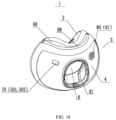
- Embodiment 5 Please refer to FIG. 18 , based on various embodiments described above, the present disclosure provides a modified embodiment, that is, Embodiment 5. Only the differences from the foregoing embodiments will be described below, and the similarities will not be repeated.
- the difference between this embodiment and the foregoing embodiments lies in that the oronasal cushion 1 is provided with both the exhaust components 60 (exhaust holes 61) and the ventilation components 70.
- the specific arrangement manner of the exhaust holes 61 and the ventilation components 70 may adopt the arrangement manner in Embodiment 3 and Embodiment 4, and will not be repeated here.
- the present disclosure also provides a patient interface device, including: a nasal mask, the above-mentioned oronasal cushion 1 provided in the nasal mask, and a frame connected to the oronasal cushion 1.
- the frame is provided with a headband for fixing with the head of the wearer.
- a flexible pipe is connected between the frame and the pressure device, through which the pressurized gas is delivered into the cavity of the nasal mask, and then enters the respiratory tract of the wearer through the nasal opening 21 and the oral opening 31.
Landscapes
- Health & Medical Sciences (AREA)
- Emergency Medicine (AREA)
- Pulmonology (AREA)
- Engineering & Computer Science (AREA)
- Anesthesiology (AREA)
- Biomedical Technology (AREA)
- Heart & Thoracic Surgery (AREA)
- Hematology (AREA)
- Life Sciences & Earth Sciences (AREA)
- Animal Behavior & Ethology (AREA)
- General Health & Medical Sciences (AREA)
- Public Health (AREA)
- Veterinary Medicine (AREA)
- Orthopedics, Nursing, And Contraception (AREA)
Applications Claiming Priority (2)
| Application Number | Priority Date | Filing Date | Title |
|---|---|---|---|
| CN202111165555.8A CN114010902B (zh) | 2021-09-30 | 2021-09-30 | 口鼻衬垫及患者接口装置 |
| PCT/CN2022/123530 WO2023051821A1 (zh) | 2021-09-30 | 2022-09-30 | 口鼻衬垫及患者接口装置 |
Publications (2)
| Publication Number | Publication Date |
|---|---|
| EP4410344A1 true EP4410344A1 (de) | 2024-08-07 |
| EP4410344A4 EP4410344A4 (de) | 2025-01-01 |
Family
ID=80055557
Family Applications (1)
| Application Number | Title | Priority Date | Filing Date |
|---|---|---|---|
| EP22875201.0A Pending EP4410344A4 (de) | 2021-09-30 | 2022-09-30 | Oronasales kissen und patientenschnittstellenvorrichtung |
Country Status (4)
| Country | Link |
|---|---|
| US (1) | US20240382711A1 (de) |
| EP (1) | EP4410344A4 (de) |
| CN (1) | CN114010902B (de) |
| WO (1) | WO2023051821A1 (de) |
Families Citing this family (5)
| Publication number | Priority date | Publication date | Assignee | Title |
|---|---|---|---|---|
| USD941993S1 (en) * | 2019-08-23 | 2022-01-25 | ResMed Pty Ltd | Tube headgear for patient interface |
| USD1089628S1 (en) * | 2021-09-30 | 2025-08-19 | Bmc (Tianjin) Medical Co., Ltd. | Cushion for respiratory mask |
| JP1730794S (ja) * | 2021-09-30 | 2022-11-28 | 呼吸マスク | |
| CN114010902B (zh) * | 2021-09-30 | 2024-03-19 | 天津怡和嘉业医疗科技有限公司 | 口鼻衬垫及患者接口装置 |
| USD1084299S1 (en) * | 2024-04-30 | 2025-07-15 | Dcstar Inc | Mask |
Family Cites Families (10)
| Publication number | Priority date | Publication date | Assignee | Title |
|---|---|---|---|---|
| US7448386B2 (en) * | 2005-12-07 | 2008-11-11 | Ric Investments, Llc | Full face respiratory mask with integrated nasal interface |
| EP2621572B1 (de) * | 2010-09-30 | 2019-11-06 | ResMed Pty Ltd | Patientenschnittstellensysteme |
| NZ701074A (en) * | 2010-09-30 | 2015-10-30 | Resmed Ltd | Mask system |
| US10987477B2 (en) * | 2013-02-04 | 2021-04-27 | ResMed Pty Ltd | Respiratory apparatus |
| EP2968820B1 (de) * | 2013-03-13 | 2019-05-08 | Koninklijke Philips N.V. | Subnasales dichtungskissen |
| CN106413788B (zh) * | 2014-06-17 | 2019-12-20 | 费雪派克医疗保健有限公司 | 患者接口 |
| NZ796359A (en) * | 2018-03-28 | 2024-08-30 | ResMed Pty Ltd | Patient interface |
| US20200206446A1 (en) * | 2018-12-27 | 2020-07-02 | Respitore, LLC | Oro-Nasal Ventilation Face Mask |
| CN114010902B (zh) * | 2021-09-30 | 2024-03-19 | 天津怡和嘉业医疗科技有限公司 | 口鼻衬垫及患者接口装置 |
| CN217366825U (zh) * | 2021-09-30 | 2022-09-06 | 天津怡和嘉业医疗科技有限公司 | 口鼻衬垫及患者接口装置 |
-
2021
- 2021-09-30 CN CN202111165555.8A patent/CN114010902B/zh active Active
-
2022
- 2022-09-30 EP EP22875201.0A patent/EP4410344A4/de active Pending
- 2022-09-30 WO PCT/CN2022/123530 patent/WO2023051821A1/zh not_active Ceased
- 2022-09-30 US US18/692,347 patent/US20240382711A1/en active Pending
Also Published As
| Publication number | Publication date |
|---|---|
| CN114010902B (zh) | 2024-03-19 |
| CN114010902A (zh) | 2022-02-08 |
| WO2023051821A1 (zh) | 2023-04-06 |
| EP4410344A4 (de) | 2025-01-01 |
| US20240382711A1 (en) | 2024-11-21 |
Similar Documents
| Publication | Publication Date | Title |
|---|---|---|
| EP4410344A1 (de) | Oronasales kissen und patientenschnittstellenvorrichtung | |
| EP1755719B1 (de) | Polster für eine patientenschnittstelle | |
| CN105102049B (zh) | 鼻腔插管和包括该鼻腔插管的患者接口设备 | |
| US8136523B2 (en) | Ventilation mask with continuous seal connected by resilient cushion | |
| AU2005304985B2 (en) | Respiratory mask seal and mask using same | |
| CN101370557B (zh) | 带有缓冲垫的患者接口装置 | |
| EP2968820B1 (de) | Subnasales dichtungskissen | |
| EP4410343A1 (de) | Abgasanordnung, belüftungsanordnung, rahmenanordnung und maskensystem | |
| EP1301233B1 (de) | Nasenmaske mit integralgeformten banden | |
| US9604023B2 (en) | Respiratory mask with ribbed contacting surface | |
| US20060254593A1 (en) | Full-face mask | |
| EP3351282A1 (de) | Atemmaske | |
| JP2013542809A (ja) | 呼吸装置 | |
| EP4400139A1 (de) | Gasentladungsanordnung, rahmenanordnung, auskleidungsanordnung und patientenschnittstellenvorrichtung | |
| EP3903865B1 (de) | Kissen für atemmaske, atemmaske und beatmungsbehandlungsvorrichtung | |
| CN216985990U (zh) | 排气组件、通气组件、框架组件及面罩系统 | |
| CN217366825U (zh) | 口鼻衬垫及患者接口装置 | |
| CN216777697U (zh) | 鼻衬垫及患者接口装置 | |
| CN113926039B (zh) | 鼻衬垫及患者接口装置 | |
| CN217187361U (zh) | 排气组件、框架组件、衬垫组件及患者接口装置 | |
| CN209864958U (zh) | 呼吸面罩的衬垫、呼吸面罩以及通气治疗设备 | |
| CN223746807U (zh) | 呼吸面罩的衬垫及呼吸面罩 | |
| RU2574574C2 (ru) | Дыхательный аппарат |
Legal Events
| Date | Code | Title | Description |
|---|---|---|---|
| STAA | Information on the status of an ep patent application or granted ep patent |
Free format text: STATUS: THE INTERNATIONAL PUBLICATION HAS BEEN MADE |
|
| PUAI | Public reference made under article 153(3) epc to a published international application that has entered the european phase |
Free format text: ORIGINAL CODE: 0009012 |
|
| STAA | Information on the status of an ep patent application or granted ep patent |
Free format text: STATUS: REQUEST FOR EXAMINATION WAS MADE |
|
| 17P | Request for examination filed |
Effective date: 20240314 |
|
| AK | Designated contracting states |
Kind code of ref document: A1 Designated state(s): AL AT BE BG CH CY CZ DE DK EE ES FI FR GB GR HR HU IE IS IT LI LT LU LV MC MK MT NL NO PL PT RO RS SE SI SK SM TR |
|
| A4 | Supplementary search report drawn up and despatched |
Effective date: 20241128 |
|
| RIC1 | Information provided on ipc code assigned before grant |
Ipc: A61M 16/06 20060101AFI20241122BHEP |
|
| DAV | Request for validation of the european patent (deleted) | ||
| DAX | Request for extension of the european patent (deleted) | ||
| GRAP | Despatch of communication of intention to grant a patent |
Free format text: ORIGINAL CODE: EPIDOSNIGR1 |
|
| STAA | Information on the status of an ep patent application or granted ep patent |
Free format text: STATUS: GRANT OF PATENT IS INTENDED |
|
| INTG | Intention to grant announced |
Effective date: 20260113 |