EP4408561B1 - Purification method and uses thereof - Google Patents
Purification method and uses thereof Download PDFInfo
- Publication number
- EP4408561B1 EP4408561B1 EP22789502.6A EP22789502A EP4408561B1 EP 4408561 B1 EP4408561 B1 EP 4408561B1 EP 22789502 A EP22789502 A EP 22789502A EP 4408561 B1 EP4408561 B1 EP 4408561B1
- Authority
- EP
- European Patent Office
- Prior art keywords
- adsorber
- upstream
- inlet
- section
- eluent
- Prior art date
- Legal status (The legal status is an assumption and is not a legal conclusion. Google has not performed a legal analysis and makes no representation as to the accuracy of the status listed.)
- Active
Links
Images






Classifications
-
- B—PERFORMING OPERATIONS; TRANSPORTING
- B01—PHYSICAL OR CHEMICAL PROCESSES OR APPARATUS IN GENERAL
- B01D—SEPARATION
- B01D15/00—Separating processes involving the treatment of liquids with solid sorbents; Apparatus therefor
- B01D15/08—Selective adsorption, e.g. chromatography
- B01D15/10—Selective adsorption, e.g. chromatography characterised by constructional or operational features
- B01D15/18—Selective adsorption, e.g. chromatography characterised by constructional or operational features relating to flow patterns
- B01D15/1864—Selective adsorption, e.g. chromatography characterised by constructional or operational features relating to flow patterns using two or more columns
- B01D15/1871—Selective adsorption, e.g. chromatography characterised by constructional or operational features relating to flow patterns using two or more columns placed in series
-
- B—PERFORMING OPERATIONS; TRANSPORTING
- B01—PHYSICAL OR CHEMICAL PROCESSES OR APPARATUS IN GENERAL
- B01D—SEPARATION
- B01D15/00—Separating processes involving the treatment of liquids with solid sorbents; Apparatus therefor
- B01D15/08—Selective adsorption, e.g. chromatography
- B01D15/10—Selective adsorption, e.g. chromatography characterised by constructional or operational features
- B01D15/18—Selective adsorption, e.g. chromatography characterised by constructional or operational features relating to flow patterns
- B01D15/1807—Selective adsorption, e.g. chromatography characterised by constructional or operational features relating to flow patterns using counter-currents, e.g. fluidised beds
-
- B—PERFORMING OPERATIONS; TRANSPORTING
- B01—PHYSICAL OR CHEMICAL PROCESSES OR APPARATUS IN GENERAL
- B01D—SEPARATION
- B01D15/00—Separating processes involving the treatment of liquids with solid sorbents; Apparatus therefor
- B01D15/08—Selective adsorption, e.g. chromatography
- B01D15/10—Selective adsorption, e.g. chromatography characterised by constructional or operational features
- B01D15/18—Selective adsorption, e.g. chromatography characterised by constructional or operational features relating to flow patterns
- B01D15/1814—Recycling of the fraction to be distributed
-
- C—CHEMISTRY; METALLURGY
- C07—ORGANIC CHEMISTRY
- C07K—PEPTIDES
- C07K1/00—General methods for the preparation of peptides, i.e. processes for the organic chemical preparation of peptides or proteins of any length
- C07K1/14—Extraction; Separation; Purification
- C07K1/16—Extraction; Separation; Purification by chromatography
-
- C—CHEMISTRY; METALLURGY
- C12—BIOCHEMISTRY; BEER; SPIRITS; WINE; VINEGAR; MICROBIOLOGY; ENZYMOLOGY; MUTATION OR GENETIC ENGINEERING
- C12N—MICROORGANISMS OR ENZYMES; COMPOSITIONS THEREOF; PROPAGATING, PRESERVING, OR MAINTAINING MICROORGANISMS; MUTATION OR GENETIC ENGINEERING; CULTURE MEDIA
- C12N15/00—Mutation or genetic engineering; DNA or RNA concerning genetic engineering, vectors, e.g. plasmids, or their isolation, preparation or purification; Use of hosts therefor
- C12N15/09—Recombinant DNA-technology
- C12N15/10—Processes for the isolation, preparation or purification of DNA or RNA
- C12N15/1003—Extracting or separating nucleic acids from biological samples, e.g. pure separation or isolation methods; Conditions, buffers or apparatuses therefor
- C12N15/1006—Extracting or separating nucleic acids from biological samples, e.g. pure separation or isolation methods; Conditions, buffers or apparatuses therefor by means of a solid support carrier, e.g. particles, polymers
- C12N15/101—Extracting or separating nucleic acids from biological samples, e.g. pure separation or isolation methods; Conditions, buffers or apparatuses therefor by means of a solid support carrier, e.g. particles, polymers by chromatography, e.g. electrophoresis, ion-exchange, reverse phase
Definitions
- the present invention relates to a cyclic chromatographic method for producing high-purity therapeutics originating from chemical synthesis such as peptides and oligonucleotides.
- the target compound is obtained by chemical synthesis. In this process, apart from the target compound, product-related impurities are generated that need to be removed in the downstream process.
- chromatography Due to its high selectivity, chromatography is an indispensable unit operation for removal of product-related impurities.
- the objective of chromatography is producing a product pool that meets purity specifications, while maintaining a high product yield and throughput.
- MCSGP is has been described for 2-8 column configurations, in practice mainly the 2-adsorber configuration is used due to lower equipment complexity and higher operational flexibility as opposed to setups using more columns.
- the proposed additional recycling phases transfer the chromatographic profile from one chromatographic adsorber to the other whereby inline dilution is applied so that the chromatographic profile is re-adsorbed on the downstream adsorber.
- this in-line dilution is done in a way that eluent with none or a low modifier content is essentially constantly added between the two columns to decrease the elutropic strength of the downstream liquid slowing down elution in the downstream column.
- Typical modifiers in case of reverse phase chromatography are organic solvents, while in ion exchange typical modifiers are salts (modifying the ionic strength) or acids/bases (modifying the pH).
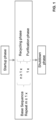
- the Recycling Phase itself consists of one cycle, i.e. of one interconnected (IC-R) and one disconnected (B-R) step.
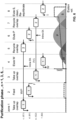
- the outlet of the first adsorber 1 is connected to the inlet of the second adsorber 2 while feeding with solvent, preferably with a gradient (see further below, in particular Fig. 5 ).
- Inline dilution is performed in between the adsorbers. Inline dilution takes place with the base solvent and thus without gradient.
- the outlet of the second adsorber 2 is connected to the inlet of the first adsorber 1, i.e., the second adsorber 2 is upstream of the first adsorber 1 and inline dilution is performed between the two adsorbers.
- the adsorbers are disconnected and purified product P is eluted and collected from the second adsorber 2 while new feed mixture F is loaded onto the first adsorber 1.
- the adsorbers are connected and the second adsorber 2 is upstream of the first adsorber 1 and inline dilution is performed between the two adsorbers.
- the outlet of the first adsorber 1 is connected to the inlet of the second adsorber 2, i.e., the first adsorber 1 is upstream of the second adsorber 2 and inline dilution is performed between the two adsorbers.
- the adsorbers are disconnected and purified product P is eluted and collected from the first adsorber 1 while new feed mixture F is loaded onto the second adsorber 2.
- the adsorbers are connected and the first adsorber 1 is upstream of the second adsorber 2 and inline dilution is performed between the two adsorbers.
- the second shutdown phase, Shutdown Phase II consists of the same steps as the previous Purification Phase of the process with some modification, but is extended by additional steps to elute product P and to elute impurities S, but it is operated without further loading of new feed mixture F.
- the positions of the adsorbers in the steps IC1-SD, B1-SD, IC2-SD, and B2-SD is exchanged, i.e. in the interconnected step IC1-SD, the outlet of the first adsorber 1 is connected to the inlet of the second adsorber 2, such that the first adsorber 1 is upstream of the second adsorber 2.
- the positions of the adsorbers in the phases B1-SD, IC2-SD, and B2-SD are exchanged.
- gradients in particular linear gradients may be and preferably will be used in any steps to enhance separation of the compounds and/or modify the speed of elution by changing the gradient slope.
- a first adsorber section has a first adsorber section inlet and a first adsorber section outlet
- a second adsorber section has a second adsorber section inlet and a second adsorber section outlet.
- the proposed method comprises at least one Base sequence having at least one Recycling Phase followed by only one Purification Phase, wherein preferably Base sequences are repeated in a cyclic manner at least twice.
- said Recycling Phase consists of at least one recycling sequence, preferably of a sequence of only one or at least two, or at least three, or at least four, recycling sequences, comprising the following steps:
- the upstream section inlet is loaded via the upstream adsorber inlet with eluent with a gradient in the form of a temporally changing modifier concentration and the stream exiting the upstream adsorber section outlet is diluted inline before entering the downstream adsorber section inlet with eluent without modifier or with a different, preferably lower, modifier concentration than at the inlet of the upstream adsorber section.
- the previous upstream adsorber is cleaned, e.g. with eluent with a higher modifier concentration than at the end of the preceding interconnected recycling step or with a different modifier or with a cleaning solution, and regenerated and wherein eluent with a gradient in the form of a temporally changing modifier concentration is loaded to the previous downstream adsorber inlet.
- the previously upstream adsorber section of preceding step a. is cleaned with eluent, e.g. with a higher modifier concentration than at the end of the preceding interconnected recycling step or with a different modifier, or with a cleaning solution, and regenerated and eluent with a gradient in the form of a temporally changing modifier concentration is loaded to the inlet of the previously downstream adsorber section of step a. to elute weakly adsorbing impurities W as far as not overlapping with product P.
- eluent e.g. with a higher modifier concentration than at the end of the preceding interconnected recycling step or with a different modifier, or with a cleaning solution
- Yet another preferred embodiment is characterised in that in said Purification Phase in said first interconnected purification step IC1 the upstream adsorber section is loaded via the upstream adsorber inlet with eluent with a gradient in the form of a temporally changing modifier concentration and the stream exiting the upstream adsorber section outlet is diluted inline before entering the downstream adsorber section inlet with eluent without modifier or with a different modifier concentration than at the inlet of the upstream adsorber section. Furthermore it is preferred if in said first batch purification step B1 product P is eluted from the previous upstream adsorber section by loading it via its inlet with eluent with a gradient in the form of a temporally changing modifier concentration.
- purification step B1-SD product P can be eluted from the previous upstream adsorber section by loading via the upstream adsorber inlet with eluent with a gradient in the form of a temporally changing modifier concentration and the previous downstream adsorber section is either idle or eluent is supplied to the previous downstream adsorber section inlet, preferably the base solvent.
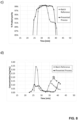
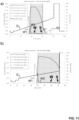
- the presented process was simulated for the purification of an oligonucleotide by anion exchange chromatography.
- the gradient is illustrated with G in Figs. 10 and 11 . Two columns of 0.5 cm inner diameter and 10 cm bed height, packed with YMC SmartSep Q30 were used.
- a mechanistic model based on a bi-Langmuir adsorption isotherm was employed and calibrated using a set of single column gradient experiments with various gradient slopes and loads.
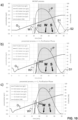
- the rectangular shaded areas in Figures 10 a-c indicate the product collection intervals.
- n 0 (regular MCSGP process, Fig. 10a )
- the product collected in the product elution window becomes much purer. This is a consequence of the better removal of "W" and "S" impurities that are indicated by arrows in Figures 10 a-c .
Landscapes
- Chemical & Material Sciences (AREA)
- Analytical Chemistry (AREA)
- Chemical Kinetics & Catalysis (AREA)
- Life Sciences & Earth Sciences (AREA)
- Health & Medical Sciences (AREA)
- Genetics & Genomics (AREA)
- Engineering & Computer Science (AREA)
- Organic Chemistry (AREA)
- Biomedical Technology (AREA)
- Biochemistry (AREA)
- Biophysics (AREA)
- Biotechnology (AREA)
- Molecular Biology (AREA)
- Sustainable Development (AREA)
- Bioinformatics & Cheminformatics (AREA)
- General Health & Medical Sciences (AREA)
- Wood Science & Technology (AREA)
- Zoology (AREA)
- General Engineering & Computer Science (AREA)
- Microbiology (AREA)
- Physics & Mathematics (AREA)
- Medicinal Chemistry (AREA)
- Proteomics, Peptides & Aminoacids (AREA)
- Plant Pathology (AREA)
- Crystallography & Structural Chemistry (AREA)
- Treatment Of Liquids With Adsorbents In General (AREA)
- Peptides Or Proteins (AREA)
Applications Claiming Priority (2)
| Application Number | Priority Date | Filing Date | Title |
|---|---|---|---|
| EP21199535 | 2021-09-28 | ||
| PCT/EP2022/075490 WO2023052126A1 (en) | 2021-09-28 | 2022-09-14 | Purification method and uses thereof |
Publications (3)
| Publication Number | Publication Date |
|---|---|
| EP4408561A1 EP4408561A1 (en) | 2024-08-07 |
| EP4408561C0 EP4408561C0 (en) | 2025-04-16 |
| EP4408561B1 true EP4408561B1 (en) | 2025-04-16 |
Family
ID=78085430
Family Applications (1)
| Application Number | Title | Priority Date | Filing Date |
|---|---|---|---|
| EP22789502.6A Active EP4408561B1 (en) | 2021-09-28 | 2022-09-14 | Purification method and uses thereof |
Country Status (9)
| Country | Link |
|---|---|
| US (1) | US20250121300A1 (pl) |
| EP (1) | EP4408561B1 (pl) |
| JP (1) | JP2024538610A (pl) |
| KR (1) | KR20240065316A (pl) |
| CN (1) | CN118055797A (pl) |
| CA (1) | CA3227614A1 (pl) |
| IL (1) | IL310482A (pl) |
| PL (1) | PL4408561T3 (pl) |
| WO (1) | WO2023052126A1 (pl) |
Family Cites Families (5)
| Publication number | Priority date | Publication date | Assignee | Title |
|---|---|---|---|---|
| EP1716900A1 (en) * | 2005-04-29 | 2006-11-02 | Eidgenössische Technische Hochschule Zürich | Method and device for chromatographic purification |
| EP2772289B1 (en) * | 2013-03-01 | 2015-05-06 | ChromaCon AG | Chromatographic process for enrichment and isolation |
| US10099156B2 (en) * | 2013-04-08 | 2018-10-16 | Chromacon Ag | Chromatographic purification method |
| EP3484599B1 (en) * | 2016-07-13 | 2020-04-22 | ChromaCon AG | Purification method and uses thereof |
| EP3512616B2 (en) * | 2017-11-16 | 2022-07-27 | ChromaCon AG | Method for monitoring, evaluating, and controlling a cyclic chromatographic purification process |
-
2022
- 2022-09-14 CA CA3227614A patent/CA3227614A1/en active Pending
- 2022-09-14 WO PCT/EP2022/075490 patent/WO2023052126A1/en not_active Ceased
- 2022-09-14 IL IL310482A patent/IL310482A/en unknown
- 2022-09-14 PL PL22789502.6T patent/PL4408561T3/pl unknown
- 2022-09-14 CN CN202280065143.3A patent/CN118055797A/zh active Pending
- 2022-09-14 JP JP2024519324A patent/JP2024538610A/ja active Pending
- 2022-09-14 KR KR1020247014157A patent/KR20240065316A/ko active Pending
- 2022-09-14 EP EP22789502.6A patent/EP4408561B1/en active Active
- 2022-09-14 US US18/685,404 patent/US20250121300A1/en active Pending
Also Published As
| Publication number | Publication date |
|---|---|
| PL4408561T3 (pl) | 2025-06-02 |
| JP2024538610A (ja) | 2024-10-23 |
| EP4408561C0 (en) | 2025-04-16 |
| KR20240065316A (ko) | 2024-05-14 |
| WO2023052126A1 (en) | 2023-04-06 |
| CA3227614A1 (en) | 2023-04-06 |
| CN118055797A (zh) | 2024-05-17 |
| IL310482A (en) | 2024-03-01 |
| US20250121300A1 (en) | 2025-04-17 |
| EP4408561A1 (en) | 2024-08-07 |
Similar Documents
| Publication | Publication Date | Title |
|---|---|---|
| EP1877769B1 (en) | Method and device for chromatographic purification | |
| US8182696B2 (en) | Multicolumn sequential separation process | |
| EP2772289B1 (en) | Chromatographic process for enrichment and isolation | |
| CN101272838B (zh) | 分离混合物组分的方法和装置 | |
| EP1106602B1 (en) | Simulated moving bed chromatographic purification of amino acids | |
| Müller-Späth et al. | Enabling high purities and yields in therapeutic peptide purification using multicolumn countercurrent solvent gradient purification | |
| EP3484599B1 (en) | Purification method and uses thereof | |
| EP1349866B1 (en) | Insulin purification using simulated moving bed technology | |
| US20030216543A1 (en) | Insulin purification using simulated moving bed technology | |
| WO2001087452A2 (en) | Standing wave design of single and tandem simulated moving beds for resolving multicomponent mixtures | |
| EP4408561B1 (en) | Purification method and uses thereof | |
| US10974168B2 (en) | Materials and methods for the selective recovery of monovalent products from aqueous solutions using continuous ion exchange | |
| Chen et al. | Continuous ion-exchange chromatography for protein polishing and enrichment | |
| Müller‐Späth et al. | Multicolumn countercurrent gradient chromatography for the purification of biopharmaceuticals | |
| CN115925573B (zh) | 一种d-泛酸钙的纯化方法 | |
| KR101036554B1 (ko) | 4구역 모사이동층 크로마토그래피의 비동기적 시동방법 | |
| Mun | Enhanced separation performance of the simulated moving bed process with two raffinate and two extract products |
Legal Events
| Date | Code | Title | Description |
|---|---|---|---|
| STAA | Information on the status of an ep patent application or granted ep patent |
Free format text: STATUS: UNKNOWN |
|
| STAA | Information on the status of an ep patent application or granted ep patent |
Free format text: STATUS: THE INTERNATIONAL PUBLICATION HAS BEEN MADE |
|
| PUAI | Public reference made under article 153(3) epc to a published international application that has entered the european phase |
Free format text: ORIGINAL CODE: 0009012 |
|
| STAA | Information on the status of an ep patent application or granted ep patent |
Free format text: STATUS: REQUEST FOR EXAMINATION WAS MADE |
|
| 17P | Request for examination filed |
Effective date: 20240326 |
|
| AK | Designated contracting states |
Kind code of ref document: A1 Designated state(s): AL AT BE BG CH CY CZ DE DK EE ES FI FR GB GR HR HU IE IS IT LI LT LU LV MC MK MT NL NO PL PT RO RS SE SI SK SM TR |
|
| DAV | Request for validation of the european patent (deleted) | ||
| DAX | Request for extension of the european patent (deleted) | ||
| GRAP | Despatch of communication of intention to grant a patent |
Free format text: ORIGINAL CODE: EPIDOSNIGR1 |
|
| STAA | Information on the status of an ep patent application or granted ep patent |
Free format text: STATUS: GRANT OF PATENT IS INTENDED |
|
| GRAS | Grant fee paid |
Free format text: ORIGINAL CODE: EPIDOSNIGR3 |
|
| GRAA | (expected) grant |
Free format text: ORIGINAL CODE: 0009210 |
|
| STAA | Information on the status of an ep patent application or granted ep patent |
Free format text: STATUS: THE PATENT HAS BEEN GRANTED |
|
| INTG | Intention to grant announced |
Effective date: 20250304 |
|
| AK | Designated contracting states |
Kind code of ref document: B1 Designated state(s): AL AT BE BG CH CY CZ DE DK EE ES FI FR GB GR HR HU IE IS IT LI LT LU LV MC MK MT NL NO PL PT RO RS SE SI SK SM TR |
|
| REG | Reference to a national code |
Ref country code: GB Ref legal event code: FG4D |
|
| REG | Reference to a national code |
Ref country code: CH Ref legal event code: EP |
|
| REG | Reference to a national code |
Ref country code: IE Ref legal event code: FG4D |
|
| U01 | Request for unitary effect filed |
Effective date: 20250422 |
|
| U07 | Unitary effect registered |
Designated state(s): AT BE BG DE DK EE FI FR IT LT LU LV MT NL PT RO SE SI Effective date: 20250428 |
|
| REG | Reference to a national code |
Ref country code: CH Ref legal event code: U11 Free format text: ST27 STATUS EVENT CODE: U-0-0-U10-U11 (AS PROVIDED BY THE NATIONAL OFFICE) Effective date: 20251001 |
|
| PG25 | Lapsed in a contracting state [announced via postgrant information from national office to epo] |
Ref country code: ES Free format text: LAPSE BECAUSE OF FAILURE TO SUBMIT A TRANSLATION OF THE DESCRIPTION OR TO PAY THE FEE WITHIN THE PRESCRIBED TIME-LIMIT Effective date: 20250416 |
|
| PG25 | Lapsed in a contracting state [announced via postgrant information from national office to epo] |
Ref country code: NO Free format text: LAPSE BECAUSE OF FAILURE TO SUBMIT A TRANSLATION OF THE DESCRIPTION OR TO PAY THE FEE WITHIN THE PRESCRIBED TIME-LIMIT Effective date: 20250716 Ref country code: GR Free format text: LAPSE BECAUSE OF FAILURE TO SUBMIT A TRANSLATION OF THE DESCRIPTION OR TO PAY THE FEE WITHIN THE PRESCRIBED TIME-LIMIT Effective date: 20250717 |
|
| PGFP | Annual fee paid to national office [announced via postgrant information from national office to epo] |
Ref country code: PL Payment date: 20250826 Year of fee payment: 4 |
|
| U20 | Renewal fee for the european patent with unitary effect paid |
Year of fee payment: 4 Effective date: 20250911 |
|
| PG25 | Lapsed in a contracting state [announced via postgrant information from national office to epo] |
Ref country code: HR Free format text: LAPSE BECAUSE OF FAILURE TO SUBMIT A TRANSLATION OF THE DESCRIPTION OR TO PAY THE FEE WITHIN THE PRESCRIBED TIME-LIMIT Effective date: 20250416 |
|
| PG25 | Lapsed in a contracting state [announced via postgrant information from national office to epo] |
Ref country code: RS Free format text: LAPSE BECAUSE OF FAILURE TO SUBMIT A TRANSLATION OF THE DESCRIPTION OR TO PAY THE FEE WITHIN THE PRESCRIBED TIME-LIMIT Effective date: 20250716 |
|
| PGFP | Annual fee paid to national office [announced via postgrant information from national office to epo] |
Ref country code: IE Payment date: 20250918 Year of fee payment: 4 |
|
| PG25 | Lapsed in a contracting state [announced via postgrant information from national office to epo] |
Ref country code: IS Free format text: LAPSE BECAUSE OF FAILURE TO SUBMIT A TRANSLATION OF THE DESCRIPTION OR TO PAY THE FEE WITHIN THE PRESCRIBED TIME-LIMIT Effective date: 20250816 |
|
| PG25 | Lapsed in a contracting state [announced via postgrant information from national office to epo] |
Ref country code: SM Free format text: LAPSE BECAUSE OF FAILURE TO SUBMIT A TRANSLATION OF THE DESCRIPTION OR TO PAY THE FEE WITHIN THE PRESCRIBED TIME-LIMIT Effective date: 20250416 |
|
| PGFP | Annual fee paid to national office [announced via postgrant information from national office to epo] |
Ref country code: CH Payment date: 20251001 Year of fee payment: 4 |
|
| PG25 | Lapsed in a contracting state [announced via postgrant information from national office to epo] |
Ref country code: CZ Free format text: LAPSE BECAUSE OF FAILURE TO SUBMIT A TRANSLATION OF THE DESCRIPTION OR TO PAY THE FEE WITHIN THE PRESCRIBED TIME-LIMIT Effective date: 20250416 |
|
| PG25 | Lapsed in a contracting state [announced via postgrant information from national office to epo] |
Ref country code: SK Free format text: LAPSE BECAUSE OF FAILURE TO SUBMIT A TRANSLATION OF THE DESCRIPTION OR TO PAY THE FEE WITHIN THE PRESCRIBED TIME-LIMIT Effective date: 20250416 |