EP4407902A2 - Gruppierung und verwendung von kurzen sequenzsignalen - Google Patents
Gruppierung und verwendung von kurzen sequenzsignalen Download PDFInfo
- Publication number
- EP4407902A2 EP4407902A2 EP24178519.5A EP24178519A EP4407902A2 EP 4407902 A2 EP4407902 A2 EP 4407902A2 EP 24178519 A EP24178519 A EP 24178519A EP 4407902 A2 EP4407902 A2 EP 4407902A2
- Authority
- EP
- European Patent Office
- Prior art keywords
- sequence
- length
- corresponds
- target
- target sequence
- Prior art date
- Legal status (The legal status is an assumption and is not a legal conclusion. Google has not performed a legal analysis and makes no representation as to the accuracy of the status listed.)
- Pending
Links
Images

Classifications
-
- H—ELECTRICITY
- H04—ELECTRIC COMMUNICATION TECHNIQUE
- H04J—MULTIPLEX COMMUNICATION
- H04J11/00—Orthogonal multiplex systems, e.g. using WALSH codes
- H04J11/0023—Interference mitigation or co-ordination
- H04J11/005—Interference mitigation or co-ordination of intercell interference
-
- H—ELECTRICITY
- H04—ELECTRIC COMMUNICATION TECHNIQUE
- H04J—MULTIPLEX COMMUNICATION
- H04J13/00—Code division multiplex systems
- H04J13/0007—Code type
- H04J13/0055—ZCZ [zero correlation zone]
- H04J13/0059—CAZAC [constant-amplitude and zero auto-correlation]
- H04J13/0062—Zadoff-Chu
-
- H—ELECTRICITY
- H04—ELECTRIC COMMUNICATION TECHNIQUE
- H04J—MULTIPLEX COMMUNICATION
- H04J13/00—Code division multiplex systems
- H04J13/16—Code allocation
-
- H—ELECTRICITY
- H04—ELECTRIC COMMUNICATION TECHNIQUE
- H04L—TRANSMISSION OF DIGITAL INFORMATION, e.g. TELEGRAPHIC COMMUNICATION
- H04L25/00—Baseband systems
- H04L25/02—Details ; arrangements for supplying electrical power along data transmission lines
- H04L25/03—Shaping networks in transmitter or receiver, e.g. adaptive shaping networks
- H04L25/03006—Arrangements for removing intersymbol interference
- H04L25/03178—Arrangements involving sequence estimation techniques
-
- H—ELECTRICITY
- H04—ELECTRIC COMMUNICATION TECHNIQUE
- H04L—TRANSMISSION OF DIGITAL INFORMATION, e.g. TELEGRAPHIC COMMUNICATION
- H04L27/00—Modulated-carrier systems
- H04L27/26—Systems using multi-frequency codes
- H04L27/2601—Multicarrier modulation systems
- H04L27/2602—Signal structure
- H04L27/261—Details of reference signals
- H04L27/2613—Structure of the reference signals
-
- H—ELECTRICITY
- H04—ELECTRIC COMMUNICATION TECHNIQUE
- H04L—TRANSMISSION OF DIGITAL INFORMATION, e.g. TELEGRAPHIC COMMUNICATION
- H04L27/00—Modulated-carrier systems
- H04L27/26—Systems using multi-frequency codes
- H04L27/2601—Multicarrier modulation systems
- H04L27/2647—Arrangements specific to the receiver only
- H04L27/2655—Synchronisation arrangements
- H04L27/2689—Link with other circuits, i.e. special connections between synchronisation arrangements and other circuits for achieving synchronisation
- H04L27/2692—Link with other circuits, i.e. special connections between synchronisation arrangements and other circuits for achieving synchronisation with preamble design, i.e. with negotiation of the synchronisation sequence with transmitter or sequence linked to the algorithm used at the receiver
-
- H—ELECTRICITY
- H04—ELECTRIC COMMUNICATION TECHNIQUE
- H04L—TRANSMISSION OF DIGITAL INFORMATION, e.g. TELEGRAPHIC COMMUNICATION
- H04L5/00—Arrangements affording multiple use of the transmission path
- H04L5/0001—Arrangements for dividing the transmission path
- H04L5/0014—Three-dimensional division
- H04L5/0016—Time-frequency-code
- H04L5/0021—Time-frequency-code in which codes are applied as a frequency-domain sequences, e.g. MC-CDMA
-
- H—ELECTRICITY
- H04—ELECTRIC COMMUNICATION TECHNIQUE
- H04W—WIRELESS COMMUNICATION NETWORKS
- H04W72/00—Local resource management
- H04W72/20—Control channels or signalling for resource management
- H04W72/21—Control channels or signalling for resource management in the uplink direction of a wireless link, i.e. towards the network
Definitions
- This disclosure is directed generally to digital wireless communications.
- LTE Long-Term Evolution
- 3GPP 3rd Generation Partnership Project
- LTE Advanced LTE-A
- 5G The 5th generation of wireless system, known as 5G, advances the LTE and LTE-A wireless standards and is committed to supporting higher data-rates, large number of connections, ultra-low latency, high reliability and other emerging business needs.
- This disclosure relates to methods, systems, and devices for grouping and using short sequences in wireless communications, such as Physical Uplink Control Channel (PUCCH) and/or short PUCCH transmissions.
- PUCCH Physical Uplink Control Channel
- An exemplary embodiment discloses a method for wireless communication.
- the method comprises communicating with a wireless communication node based, at least in part, on a distinguished target sequence included in a distinguished sequence group, the distinguished sequence group selected from a plurality of sequence groups.
- the distinguished target sequence is a member of a target sequence set, and each target sequence of the target sequence set is allocated to an individual sequence group of the plurality of sequence groups based, at least in part, on a value of correlation between the target sequence and at least one other sequence of the individual sequence group.
- the distinguished sequence group is selected based, at least in part, on identification of at least a cell, user, or communication channel.
- each target sequence of the target sequence set is a distinct lengh-12 sequence.
- communicating with the wireless communication node comprises using the distinguished target sequence for transmitting wireless signals to the wireless communication node or receiving wireless signals from the wireless communication node.
- the wireless communication node is a user equipment (UE) or a base station.
- each target sequence of the target sequence set is allocated to an individual sequence group of the plurality of sequence groups is further based on a comparison of (1) the value of correlation between the target sequence and the at least one other sequence of the individual sequence group and (2) at least a value of correlation between the target sequence and one or more sequences of another sequence group.
- u is a group index that identifies one of the plurality of sequence groups and wherein relationships between values of u and values of ⁇ ( n ) are shown in the table below:
- the plurality of sequence groups includes at least one of:
- the plurality of sequence groups include at least one of
- the plurality of sequence groups include at least one of
- the above-described methods are embodied in the form of processor-executable code and stored in a computer-readable program medium.
- a device that is configured or operable to perform the above-described methods is disclosed.
- enhanced mobile broadband eMBB
- ultra high reliability and low latency communication URLLC
- massive machine type communications mMTC
- New Radio (NR) technology currently under standardization in 5G, has proposed the use of short PUCCH transmissions. More specifically, this disclosure relates to the grouping and use of new short sequences that are orthogonal and meet performance requirements of the short PUCCH under consideration in the 3GPP standards organization.
- the PUCCH or short PUCCH is a wireless channel used to transmit information from mobile stations or user equipment (UE) to a base station.
- the UE may use the PUCCH to transmit information such as an Acknowledgement (ACK), Non-Acknowledgement (NACK), and scheduling request (SR).
- ACK Acknowledgement
- NACK Non-Acknowledgement
- SR scheduling request
- the UE can transmit ACK/NACK to the base station to inform the base station whether the UE has properly decoded the data transmitted by the base station.
- a scheduling request (SR) is used by the UE to request uplink resources to transmit data.
- a set of 30 length-12 base sequences for short PUCCH has been adopted for NR.
- uplink sequences are grouped into multiple sequence groups for use in wireless communications.
- each sequence group can include at least two sequences of different lengths, and different sequence groups can be allocated for use by different cells.
- similar sequence grouping and allocation can be adopted.
- new length-12 sequences have been introduced in NR. Therefore, sequence grouping and allocation for the newly introduced length-12 sequences is desired.
- the presently disclosed technology addresses the grouping of the length-12 sequences adopted in NR with other sequences (e.g., sequences currently used in LTE), and the use of the newly configured sequence groups in wireless communications.
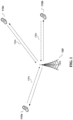
- FIG. 1 shows an exemplary base station and UEs in wireless communications that use PUCCH and/or short PUCCH channels.
- the base station (120) can transmit channel resources allocated to the plurality of UEs (110a-110c).
- the UEs (110a-110c) can transmit information using allocated sequences via PUCCH and/or short PUCCH channels (130a-130c) to the base station (120).
- the presently disclosed technology provides various embodiments of sequence grouping and use in wireless communications between the base station and the UEs.
- the presently disclosed technology includes allocating into a same sequence group sequences that (1) have different lengths and (2) have high cross-correlations between or among themselves. In allocating the newly introduced NR sequences into existing LTE sequence groups, the presently disclosed technology accounts for cross-correlations between these newly introduced sequences and the existing LTE sequences.
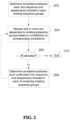
- FIG. 2 shows an exemplary flowchart of a method for allocating new sequences (e.g., the newly introduced length-12 NR sequences) into existing sequence groups (e.g., sequence groups currently used in LTE), in accordance with some embodiments of the presently disclosed technology.
- the newly generated lengh-12 NR sequences are denoted by S 1,i , where i represents a sequence index selected from 0, 1, 2, ..., 29 and the value of S 1,i can be found in Table-1 above.
- Current LTE sequences of length-X are denoted by S 2,u , wherein X can be 12, 24, 36 or other multiples of 12 and specific S 2,u values can be found in TS36.211.
- the sequences of S 2,u belong to 30 sequence groups, where u represents a sequence group index selected from 0, 1, 2, ..., 29.
- the method includes determining correlations between each new sequence and sequence(s) included in each existing sequence groups.
- the method includes computing cross correlations between each of the 30 S 1,i sequences and the S 2,u sequence included in each of the 30 sequence groups.
- the cross correlation values can be represented in a cross correlation matrix XCORR i,u .
- xcorr_coeffs NFFT*IFFT Seq1 .*conj Seq2 , NFFT / length Seq1
- IFFT(X, N) is the N_point Inverse Fourier Transform operation
- Seq1 and Seq2 denote the two sequences
- conj() is the complex conjugate operation.
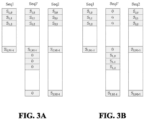
- FIGs. 3A and 3B show two examples of zeros padding application, in accordance with some embodiments of the presently disclosed technology.
- cross correlations between the length-12 NR sequence and other existing length-X base sequences can be calculated.
- the method includes allocating one or more new sequences to existing sequence groups based on condition(s) on corresponding correlations.
- cross correlation values that exceed certain threshold or are relatively large can serve as bases for allocating new sequences to existing groups.
- the method includes identifying the maximum cross correlation value within a corresponding row of the cross correlation matrix XCORR i,u .
- a group index u umax(i) that corresponds to the identified maximum cross correlation value is selected, and the new NR sequence S 1,i is allocated to existing sequence group of index umax(i).
- the method includes determining whether all of the new sequences have been allocated. If so, the method ends at block 210. If not, the method proceeds to block 208.
- the method includes determining correlations between each unallocated new sequence and sequence(s) included in each of the remaining existing sequence groups. This can be achieved in a manner similar to block 202, and a new cross correlation matrix (of smaller size) can be generated. Then the method proceeds back to block 204 to continue allocating unallocated new sequence(s) into remaining existing sequence groups.
- Table-5 NR sequence grouping based on cross correlation with length-24 LTE sequences, where the cross correlation values corresponding to groups 8, 9, 11, 14, 17, and 24 exceed 0.8 Group Index u Sequence Index i ⁇ (0) ⁇ (1) ⁇ (2) ⁇ (3) ⁇ (4) ⁇ (5) ⁇ (6) ⁇ (7) ⁇ (8) ⁇ (9) ⁇ (10) ⁇ (11) 0 7 -3 3 -3 3 -3 -1 -1 3 3 1 -3 1 15 -3 -3 3 1 -3 -3 -3 -1 3 -1 1 3 2 29 -3 3 1 -1 3 3 -3 1 -1 1 -1 1 3 24 -3 3 3 1 -3 3 -1 1 3 -3 3 -3 4 27 -3 3 1 -3 1 3 -1 -1 1 3 3 3 5 28 -3 3 -3 3 -3 -3 -3 3 -1 -1 -1 -1 1 3 3 5 28 -3 3 -3 3 -3 -3 -3 3 -1 -1
- Table-6 sequence grouping based on cross correlation with length-12 LTE sequences, where the cross correlation values corresponding to groups 0, 1, 3, 11, 13, 15, 18, 22, 25, 27, and 29 exceed 0.78 and the cross correlation values corresponding to groups 3, 13, 15, 22, and 25 exceed 0.8 Group Index u Sequence Index i ⁇ (0) ⁇ (1) ⁇ (2) ⁇ (3) ⁇ (4) ⁇ (5) ⁇ (6) ⁇ (7) ⁇ (8) ⁇ (9) ⁇ (10) ⁇ (11) 0 29 -3 3 1 -1 3 3 -3 1 -1 1 -1 1 1 1 1 1 -3 3 1 -3 1 3 -1 1 3 3 3 2 28 -3 3 3 1 -3 3 -1 1 3 -3 3 -3 3 20 -3 3 1 3 -3 1 1 1 1 3 -3 3 4 22 -1 -3 3 -3 -3 -3 -3 -1 1 -1 1 1 1 3 -3 3 4 22 -1 -3 3 -3 -3 -3 -3 -1 1 -1 1 1 1 1 3 -3 3 4 22 -1 -3 3 -3 -3
- Table-7 sequence grouping based on cross correlation with length-36 LTE sequences, where the cross correlation values corresponding to groups 1, 2, 6, 15, 16, 22, 23, and 27 exceed 0.8 Group Index u Sequence Index i ⁇ (0) ⁇ (1) ⁇ (2) ⁇ (3) ⁇ (4) ⁇ (5) ⁇ (6) ⁇ (7) ⁇ (8) ⁇ (9) ⁇ (10) ⁇ (11) 0 29 -3 3 1 -1 3 3 -3 1 -1 1 -1 1 1 1 27 -3 3 1 -3 1 3 -1 3 -1 1 3 3 3 2 24 -3 3 3 1 -3 3 -1 1 3 -3 3 -3 3 3 3 3 3 3 3 3 3 1 3 -3 1 3 -3 1 1 1 1 3 -3 3 4 11 -1 -3 3 -1 -3 -3 -3 -1 1 -1 1 -3 5 15 -3 -3 3 1 -3 -3 -3 -1 3
- the method of FIG. 2 can determine cross correlations between an individual new sequence and multiple existing sequences (e.g., both lengh-24 and length-36 sequences) of a same existing group, for example, at blocks 202 and/or 208.
- a comparison among these cross correlation values can be performed to determine a group-level cross correlation value (e.g., the maximum cross correlation value resulted from the comparison) for the new sequence and the existing group, and sequence allocation can be performed based thereon.
- a group-level cross correlation value e.g., the maximum cross correlation value resulted from the comparison
- Table-8 sequence grouping based on cross correlation with length-24 and length-36 LTE sequences, where the cross correlation values corresponding to groups 1, 2, 6, 8, 9, 11, 14-17, 23, 24, and 27 exceed 0.8 Group Index u Sequence Index i ⁇ (0) ⁇ (1) ⁇ (2) ⁇ (3) ⁇ (4) ⁇ (5) ⁇ (6) ⁇ (7) ⁇ (8) ⁇ (9) ⁇ (10) ⁇ (11) 0 29 -3 3 1 -1 3 3 -3 1 -1 1 -1 1 1 1 27 -3 3 1 -3 1 3 -1 3 -1 1 3 3 3 2 24 -3 3 3 1 -3 3 -1 1 3 -3 3 -3 3 3 3 3 3 3 3 3 1 3 -3 1 3 -3 1 1 1 1 3 -3 3 4 11 -1 -3 3 -1 -3 -3 -3 -1 1 -1 1 -3 5 15 -3 -3 3 1 -3 -3 -3 -1 3 -1 1 3 6 26 1 -1 3 -1 -1 -1 -3 -1 1 1 1 1 -3 7 23 -3
- Various communication nodes can use the grouping of new NR sequences, as disclosed herein, for communication with other communication node(s).
- the sequence group number(s) for use by a UE is determined based on a group hopping pattern and a sequence shift pattern, which is known between the base station and UE.
- the group hopping pattern is cell-specific and the UE can obtain the group hopping pattern based on Cell ID.
- a same or similar mechanism can be implemented in NR for sequence group based communication.
- sequence group number(s) can be provided from base station to UE, for example, by higher layer signaling through RRC (Radio Resource Control), physical layer signaling through DCI (Downlink Control Information), or the like.
- RRC Radio Resource Control
- DCI Downlink Control Information
- the UE can select a suitable sequence from the sequence group for transmission, for example, based on sequence length.
- Sequence grouping based on the presently disclosed technology can mitigate interference between or among different cells, at least because the cross correlations between the sequences used for different cells are relatively low.
- FIG. 4 shows an exemplary block diagram of a UE 400 utilizing sequence groups, in accordance with some embodiments of the presently disclosed technology.
- the UE 400 includes at least one processor 410 and a memory 405 having instructions stored thereupon. The instructions upon execution by the processor 410 configure the UE 400 to perform several operations using the various modules.
- the UE 400 can include a sequence determining module 425.
- the sequence determining module 425 can determine sequence group(s) for use by the UE (e.g., based on identification of at least a cell, user, or communication channel ), select sequence(s) from a sequence group for data transmission based thereon, or perform other sequence determining related functions, in accordance with various embodiments of the presently disclosed technology.
- the receiver 420 can receive one or more messages (e.g., including information providing or assigning sequence groups to cells), and the transmitter 415 can transmit data (e.g., via short PUCCH to a base station) using one or more sequences selected from sequence group(s) configured in accordance with various embodiments of the presently disclosed technology.
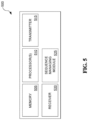
- FIG. 5 shows an exemplary block diagram of a base station 500 managing sequence groups, in accordance with some embodiments of the presently disclosed technology.
- the base station 500 includes at least one processor 510 and a memory 505 having instructions stored thereupon. The instructions upon execution by the processor 510 configure the base station 500 to perform several operations using the various modules.
- the base station 500 can include a sequence managing module 525.
- the sequence managing module 525 can allocate and group sequences, assign sequence groups to cells, determine sequence group(s) used by UE(s), or perform other sequence related functions, in accordance with various embodiments of the presently disclosed technology.
- the receiver 520 can receive data transmitted using sequence(s) selected from sequence group(s) that are configured in accordance with various embodiments of the presently disclosed technology, and the transmitter 515 can transmit one or more messages (e.g., for providing or assigning sequence groups to cells) to one or more UEs.
- a computer-readable medium may include removable and non-removable storage devices including, but not limited to, Read Only Memory (ROM), Random Access Memory (RAM), compact discs (CDs), digital versatile discs (DVD), etc. Therefore, the computer-readable media can include a non-transitory storage media.
- program modules may include routines, programs, objects, components, data structures, etc. that perform particular tasks or implement particular abstract data types.
- Computer- or processor-executable instructions, associated data structures, and program modules represent examples of program code for executing steps of the methods disclosed herein. The particular sequence of such executable instructions or associated data structures represents examples of corresponding acts for implementing the functions described in such steps or processes.
- a hardware circuit implementation can include discrete analog and/or digital components that are, for example, integrated as part of a printed circuit board.
- the disclosed components or modules can be implemented as an Application Specific Integrated Circuit (ASIC) and/or as a Field Programmable Gate Array (FPGA) device.
- ASIC Application Specific Integrated Circuit
- FPGA Field Programmable Gate Array
- DSP digital signal processor
- the various components or sub-components within each module may be implemented in software, hardware or firmware.
- the connectivity between the modules and/or components within the modules may be provided using any one of the connectivity methods and media that is known in the art, including, but not limited to, communications over the Internet, wired, or wireless networks using the appropriate protocols.
Landscapes
- Engineering & Computer Science (AREA)
- Signal Processing (AREA)
- Computer Networks & Wireless Communication (AREA)
- Power Engineering (AREA)
- Mobile Radio Communication Systems (AREA)
- Lubricants (AREA)
Priority Applications (1)
| Application Number | Priority Date | Filing Date | Title |
|---|---|---|---|
| EP24178519.5A EP4407902A3 (de) | 2017-11-10 | 2017-11-10 | Gruppierung und verwendung von kurzen sequenzsignalen |
Applications Claiming Priority (3)
| Application Number | Priority Date | Filing Date | Title |
|---|---|---|---|
| EP17931303.6A EP3707869B1 (de) | 2017-11-10 | 2017-11-10 | Gruppierung und verwendung von kurzen sequenzsignalen |
| EP24178519.5A EP4407902A3 (de) | 2017-11-10 | 2017-11-10 | Gruppierung und verwendung von kurzen sequenzsignalen |
| PCT/CN2017/110525 WO2019090715A1 (en) | 2017-11-10 | 2017-11-10 | Grouping and use of short sequence signals |
Related Parent Applications (2)
| Application Number | Title | Priority Date | Filing Date |
|---|---|---|---|
| EP17931303.6A Division EP3707869B1 (de) | 2017-11-10 | 2017-11-10 | Gruppierung und verwendung von kurzen sequenzsignalen |
| EP17931303.6A Division-Into EP3707869B1 (de) | 2017-11-10 | 2017-11-10 | Gruppierung und verwendung von kurzen sequenzsignalen |
Publications (2)
| Publication Number | Publication Date |
|---|---|
| EP4407902A2 true EP4407902A2 (de) | 2024-07-31 |
| EP4407902A3 EP4407902A3 (de) | 2024-10-30 |
Family
ID=66437387
Family Applications (3)
| Application Number | Title | Priority Date | Filing Date |
|---|---|---|---|
| EP24178519.5A Pending EP4407902A3 (de) | 2017-11-10 | 2017-11-10 | Gruppierung und verwendung von kurzen sequenzsignalen |
| EP17931303.6A Active EP3707869B1 (de) | 2017-11-10 | 2017-11-10 | Gruppierung und verwendung von kurzen sequenzsignalen |
| EP18876352.8A Active EP3707870B1 (de) | 2017-11-10 | 2018-02-11 | Gruppierung und verwendung von kurzen sequenzsignalen |
Family Applications After (2)
| Application Number | Title | Priority Date | Filing Date |
|---|---|---|---|
| EP17931303.6A Active EP3707869B1 (de) | 2017-11-10 | 2017-11-10 | Gruppierung und verwendung von kurzen sequenzsignalen |
| EP18876352.8A Active EP3707870B1 (de) | 2017-11-10 | 2018-02-11 | Gruppierung und verwendung von kurzen sequenzsignalen |
Country Status (10)
| Country | Link |
|---|---|
| US (4) | US11469847B2 (de) |
| EP (3) | EP4407902A3 (de) |
| JP (3) | JP7062763B2 (de) |
| KR (4) | KR102404611B1 (de) |
| CN (4) | CN113328825B (de) |
| CA (3) | CA3174639A1 (de) |
| DK (1) | DK3707870T3 (de) |
| FI (1) | FI3707870T3 (de) |
| SG (2) | SG11202004267RA (de) |
| WO (2) | WO2019090715A1 (de) |
Families Citing this family (8)
| Publication number | Priority date | Publication date | Assignee | Title |
|---|---|---|---|---|
| JP7062763B2 (ja) | 2017-11-10 | 2022-05-06 | 中興通訊股▲ふん▼有限公司 | 短シーケンス信号のグループ化および使用 |
| CN109842478A (zh) * | 2017-11-26 | 2019-06-04 | 华为技术有限公司 | 一种序列确定方法和装置 |
| US10439779B2 (en) | 2017-11-26 | 2019-10-08 | Huawei Technologies Co., Ltd. | Sequence determining method and apparatus |
| US11228473B2 (en) * | 2017-11-29 | 2022-01-18 | Qualcomm Incorporated | Signal generation using low peak-to-average power ratio base sequences |
| US11502720B2 (en) * | 2018-02-16 | 2022-11-15 | Ntt Docomo, Inc. | User terminal and radio communication method |
| CN113366896B (zh) * | 2019-02-03 | 2022-11-04 | 华为技术有限公司 | 参考信号接收与发送方法、装置及系统 |
| KR20220101473A (ko) * | 2021-01-11 | 2022-07-19 | 삼성전자주식회사 | 무선 통신 시스템에서 제어 채널 전송을 위한 장치 및 방법 |
| CN120880824B (zh) * | 2025-09-26 | 2025-12-09 | 国网四川省电力公司阿坝供电公司 | 一种用于微网并网的序列生成方法、装置、设备及介质 |
Family Cites Families (31)
| Publication number | Priority date | Publication date | Assignee | Title |
|---|---|---|---|---|
| CN1201514C (zh) * | 2001-04-18 | 2005-05-11 | 连宇通信有限公司 | 码分多址系统中三进制扩频序列编码的实现方法 |
| US6917645B2 (en) * | 2001-12-14 | 2005-07-12 | Samsung Electronics Co., Ltd. | Apparatus and method for detecting pilot channel signals with low signal-to-noise |
| US9088384B2 (en) * | 2005-10-27 | 2015-07-21 | Qualcomm Incorporated | Pilot symbol transmission in wireless communication systems |
| CN101924598B (zh) * | 2006-09-30 | 2012-11-21 | 华为技术有限公司 | 通信系统中序列分配方法、序列处理方法及装置 |
| KR20080072508A (ko) | 2007-02-02 | 2008-08-06 | 엘지전자 주식회사 | 다양한 자원 블록 길이를 가지는 시퀀스 할당 방법 및 이를위한 시퀀스 그룹핑 방법 |
| WO2008106894A1 (en) | 2007-03-07 | 2008-09-12 | Huawei Technologies Co., Ltd. | Sequence distributing, processing method and apparatus in communication system |
| ES2448821T3 (es) | 2007-03-19 | 2014-03-17 | Godo Kaisha Ip Bridge 1 | Método de informe de secuencia y dispositivo de informe de secuencia |
| JP5024533B2 (ja) * | 2007-06-19 | 2012-09-12 | 日本電気株式会社 | 移動通信システムにおけるリファレンス信号系列の割当方法および装置 |
| JP5106531B2 (ja) * | 2007-06-19 | 2012-12-26 | パナソニック株式会社 | 系列割当方法、送信方法、無線移動局装置および基地局装置 |
| US20090046645A1 (en) * | 2007-08-13 | 2009-02-19 | Pierre Bertrand | Uplink Reference Signal Sequence Assignments in Wireless Networks |
| CN101179860B (zh) * | 2007-12-05 | 2011-03-16 | 中兴通讯股份有限公司 | 随机接入信道的zc序列排序方法和装置 |
| KR101520682B1 (ko) | 2008-04-29 | 2015-05-15 | 엘지전자 주식회사 | 시퀀스 그루핑 방법 및 시퀀스 전송 방법 |
| KR101650606B1 (ko) * | 2009-05-21 | 2016-08-23 | 엘지전자 주식회사 | 다중 안테나 시스템에서 참조 신호 전송 방법 및 장치 |
| KR101733489B1 (ko) * | 2010-01-17 | 2017-05-24 | 엘지전자 주식회사 | 무선 통신 시스템에서 제어 정보의 전송 방법 및 장치 |
| CN102238747A (zh) * | 2010-04-30 | 2011-11-09 | 夏普株式会社 | 上行物理控制信息传输方法,基站和用户设备 |
| KR20120023200A (ko) | 2010-08-24 | 2012-03-13 | 주식회사 팬택 | Mimo 환경에서의 시퀀스 및 시퀀스 그룹 호핑 정보를 이용한 참조신호 생성 방법 및 장치 |
| KR101572397B1 (ko) | 2011-08-16 | 2015-11-26 | 엘지전자 주식회사 | 무선 통신 시스템에서 상향링크 참조 신호 전송 방법 및 장치 |
| JP5162699B1 (ja) * | 2011-10-04 | 2013-03-13 | シャープ株式会社 | 移動局装置、基地局装置、無線通信方法、無線通信システムおよび集積回路 |
| CN103139916B (zh) * | 2011-11-29 | 2016-03-02 | 华为技术有限公司 | 在物理上行控制信道上传输数据的方法和装置 |
| CN104202712B (zh) * | 2014-01-24 | 2019-07-23 | 中兴通讯股份有限公司 | 设备到设备同步信号的发送方法及装置、用户设备 |
| KR20150110243A (ko) * | 2014-03-21 | 2015-10-02 | 삼성전자주식회사 | 기기 간 통신에서 기준 신호 생성 방법 및 장치 |
| WO2015149301A1 (zh) * | 2014-04-02 | 2015-10-08 | 华为技术有限公司 | 传输信号的方法和装置 |
| US20160125130A1 (en) | 2014-11-05 | 2016-05-05 | Agilent Technologies, Inc. | Method for assigning target-enriched sequence reads to a genomic location |
| DK3520306T3 (da) * | 2016-09-30 | 2021-03-22 | Ericsson Telefon Ab L M | Effekt- og ressourceeffektive uplink-DMRS-sekvenser til IFDMA |
| CN106973402B (zh) * | 2017-05-05 | 2019-08-23 | 电子科技大学 | 一种用于lte超大小区随机接入时延的检测方法 |
| CN107222282B (zh) * | 2017-06-09 | 2019-04-16 | 电信科学技术第五研究所有限公司 | 一种lte系统prach信道中zc序列的dft算法 |
| CN109274473B (zh) * | 2017-09-08 | 2019-10-22 | 华为技术有限公司 | 基于序列的信号处理方法及装置 |
| FI3684021T3 (fi) | 2017-09-15 | 2025-01-07 | Ntt Docomo Inc | Käyttäjäpääte ja langaton tiedonsiirtomenetelmä |
| US10728073B2 (en) * | 2017-10-02 | 2020-07-28 | Qualcomm Incorporated | Computer generated sequence design and hypothesis mapping |
| JP7062763B2 (ja) | 2017-11-10 | 2022-05-06 | 中興通訊股▲ふん▼有限公司 | 短シーケンス信号のグループ化および使用 |
| US10439779B2 (en) * | 2017-11-26 | 2019-10-08 | Huawei Technologies Co., Ltd. | Sequence determining method and apparatus |
-
2017
- 2017-11-10 JP JP2020525979A patent/JP7062763B2/ja active Active
- 2017-11-10 CN CN202110536388.7A patent/CN113328825B/zh active Active
- 2017-11-10 KR KR1020207016379A patent/KR102404611B1/ko active Active
- 2017-11-10 KR KR1020227017467A patent/KR102621482B1/ko active Active
- 2017-11-10 SG SG11202004267RA patent/SG11202004267RA/en unknown
- 2017-11-10 EP EP24178519.5A patent/EP4407902A3/de active Pending
- 2017-11-10 WO PCT/CN2017/110525 patent/WO2019090715A1/en not_active Ceased
- 2017-11-10 EP EP17931303.6A patent/EP3707869B1/de active Active
- 2017-11-10 CN CN201780098147.0A patent/CN111587564B/zh active Active
- 2017-11-10 CA CA3174639A patent/CA3174639A1/en active Pending
- 2017-11-10 CA CA3082232A patent/CA3082232C/en active Active
-
2018
- 2018-02-11 FI FIEP18876352.8T patent/FI3707870T3/fi active
- 2018-02-11 EP EP18876352.8A patent/EP3707870B1/de active Active
- 2018-02-11 KR KR1020237013161A patent/KR20230054776A/ko not_active Ceased
- 2018-02-11 CA CA3082236A patent/CA3082236C/en active Active
- 2018-02-11 KR KR1020207016375A patent/KR20200086324A/ko not_active Ceased
- 2018-02-11 CN CN202110436474.0A patent/CN113162721B/zh active Active
- 2018-02-11 CN CN201880086147.3A patent/CN111587565B9/zh active Active
- 2018-02-11 SG SG11202004262SA patent/SG11202004262SA/en unknown
- 2018-02-11 JP JP2020525949A patent/JP7084993B2/ja active Active
- 2018-02-11 DK DK18876352.8T patent/DK3707870T3/da active
- 2018-02-11 WO PCT/CN2018/076298 patent/WO2019091014A1/en not_active Ceased
-
2020
- 2020-05-11 US US16/872,303 patent/US11469847B2/en active Active
- 2020-05-11 US US16/872,252 patent/US11533120B2/en active Active
-
2022
- 2022-03-18 US US17/694,137 patent/US11621810B2/en active Active
- 2022-04-20 JP JP2022069202A patent/JP7352685B2/ja active Active
- 2022-10-10 US US17/962,758 patent/US11641256B2/en active Active
Also Published As
Similar Documents
| Publication | Publication Date | Title |
|---|---|---|
| US11621810B2 (en) | Grouping and use of short sequence signals | |
| US10153883B2 (en) | Method for communicating in mobile system | |
| US20180205515A1 (en) | Data transmission method, terminal device, and base station | |
| US12238725B2 (en) | Mapping schemes for uplink control transmissions in wireless communication systems | |
| CN111294154B (zh) | 信息传输方法和设备 | |
| CN109217999B (zh) | 一种lte网络pucch信道导频方法及设备 | |
| US20230146287A1 (en) | Cyclic shift based mapping schemes for uplink control transmissions |
Legal Events
| Date | Code | Title | Description |
|---|---|---|---|
| PUAI | Public reference made under article 153(3) epc to a published international application that has entered the european phase |
Free format text: ORIGINAL CODE: 0009012 |
|
| STAA | Information on the status of an ep patent application or granted ep patent |
Free format text: STATUS: THE APPLICATION HAS BEEN PUBLISHED |
|
| AC | Divisional application: reference to earlier application |
Ref document number: 3707869 Country of ref document: EP Kind code of ref document: P |
|
| AK | Designated contracting states |
Kind code of ref document: A2 Designated state(s): AL AT BE BG CH CY CZ DE DK EE ES FI FR GB GR HR HU IE IS IT LI LT LU LV MC MK MT NL NO PL PT RO RS SE SI SK SM TR |
|
| REG | Reference to a national code |
Ref country code: DE Ref legal event code: R079 Free format text: PREVIOUS MAIN CLASS: H04J0013160000 Ipc: H04L0027260000 |
|
| PUAL | Search report despatched |
Free format text: ORIGINAL CODE: 0009013 |
|
| AK | Designated contracting states |
Kind code of ref document: A3 Designated state(s): AL AT BE BG CH CY CZ DE DK EE ES FI FR GB GR HR HU IE IS IT LI LT LU LV MC MK MT NL NO PL PT RO RS SE SI SK SM TR |
|
| RIC1 | Information provided on ipc code assigned before grant |
Ipc: H04J 13/16 20110101ALI20240920BHEP Ipc: H04J 13/00 20110101ALI20240920BHEP Ipc: H04J 11/00 20060101ALI20240920BHEP Ipc: H04L 5/00 20060101ALI20240920BHEP Ipc: H04L 27/26 20060101AFI20240920BHEP |
|
| STAA | Information on the status of an ep patent application or granted ep patent |
Free format text: STATUS: REQUEST FOR EXAMINATION WAS MADE |
|
| 17P | Request for examination filed |
Effective date: 20250108 |
|
| GRAP | Despatch of communication of intention to grant a patent |
Free format text: ORIGINAL CODE: EPIDOSNIGR1 |
|
| STAA | Information on the status of an ep patent application or granted ep patent |
Free format text: STATUS: GRANT OF PATENT IS INTENDED |
|
| INTG | Intention to grant announced |
Effective date: 20260220 |