EP4404589A1 - Gehäuse für ein ohrstück und verfahren zur herstellung eines gehäuses für ein ohrstück - Google Patents
Gehäuse für ein ohrstück und verfahren zur herstellung eines gehäuses für ein ohrstück Download PDFInfo
- Publication number
- EP4404589A1 EP4404589A1 EP23152231.9A EP23152231A EP4404589A1 EP 4404589 A1 EP4404589 A1 EP 4404589A1 EP 23152231 A EP23152231 A EP 23152231A EP 4404589 A1 EP4404589 A1 EP 4404589A1
- Authority
- EP
- European Patent Office
- Prior art keywords
- model
- ear canal
- housing
- user
- offset
- Prior art date
- Legal status (The legal status is an assumption and is not a legal conclusion. Google has not performed a legal analysis and makes no representation as to the accuracy of the status listed.)
- Withdrawn
Links
Images

Classifications
-
- H—ELECTRICITY
- H04—ELECTRIC COMMUNICATION TECHNIQUE
- H04R—LOUDSPEAKERS, MICROPHONES, GRAMOPHONE PICK-UPS OR LIKE ACOUSTIC ELECTROMECHANICAL TRANSDUCERS; ELECTRIC HEARING AIDS; PUBLIC ADDRESS SYSTEMS
- H04R25/00—Electric hearing aids
- H04R25/65—Housing parts, e.g. shells, tips or moulds, or their manufacture
- H04R25/658—Manufacture of housing parts
-
- H—ELECTRICITY
- H04—ELECTRIC COMMUNICATION TECHNIQUE
- H04R—LOUDSPEAKERS, MICROPHONES, GRAMOPHONE PICK-UPS OR LIKE ACOUSTIC ELECTROMECHANICAL TRANSDUCERS; ELECTRIC HEARING AIDS; PUBLIC ADDRESS SYSTEMS
- H04R25/00—Electric hearing aids
- H04R25/65—Housing parts, e.g. shells, tips or moulds, or their manufacture
- H04R25/652—Ear tips; Ear moulds
-
- H—ELECTRICITY
- H04—ELECTRIC COMMUNICATION TECHNIQUE
- H04R—LOUDSPEAKERS, MICROPHONES, GRAMOPHONE PICK-UPS OR LIKE ACOUSTIC ELECTROMECHANICAL TRANSDUCERS; ELECTRIC HEARING AIDS; PUBLIC ADDRESS SYSTEMS
- H04R2225/00—Details of deaf aids covered by H04R25/00, not provided for in any of its subgroups
- H04R2225/77—Design aspects, e.g. CAD, of hearing aid tips, moulds or housings
Definitions
- the invention relates to a method for producing a housing for an earpiece and to a housing for an earpiece.
- waxing also known as global waxing.
- a silicone impression would be manually cut (this cutting is also referred to as detailing) to be sized such that it meets the goals of the application, e.g. components would fit into a shell of the corresponding size.
- the detailed impression would be dipped in a basin of liquid wax, once, twice or maybe more, with the intent of increasing its size.
- Such a waxed detailed impression would then be slightly bigger than the actual impression of the ear canal, providing increased sealing and/or better retention, ideally both.
- the amount of waxing depends on tissue compliance, user experience, and the application in mind for the shell or mold.
- a processing step analogue to the global waxing is also performed: after detailing, after the detailing step, the detailed model undergoes offsetting, by a selectable amount, which results in oversizing of the shape much similar to (repeated) submersion into liquid wax in the manual process.
- the tip area i.e. the bony region
- the bony region may be inside offset (negatively offset) as a first detailing operation.
- the intent is to basically counteract later global waxing of the detailed shape. Only then would the normal detailing start. Obviously, this applies only to deep-reaching devices, reaching to or past the second bend and hence actually extending into the bony area. In particular, this may affect a custom shell or a custom mold which may be fabricated from titanium or acrylic or a thermoplastic material.
- a shell for IIC (Invisible In the Canal) devices which are thin-walled and at least partially invisible in the canal, or a housing for a RIC (receiver in the canal) device may be directly printed in an additive manufacturing way (3D printed), e.g., titanium or acrylic.
- 3D printed additive manufacturing way
- titanium shells do not need any lacquering. Hence, they may be offset (globally wax) a bit more, correcting for the layer which would be normally added by lacquering. They may also be offset a bit more in tendency in order to increase the fit-rate needed to deliver on the at least partially invisibility promise of IIC devices.
- the second downside may be addressed by offsetting the undetailed model, i.e. the input ear model shape, instead of offsetting the detailed model, the entire shape resulting from shaping of the undetailed model.
- the original model which may be based on an ear impression, needs to be kept as the ground truth, as the relevant anatomical information about the customer's ear, namely but not exclusively for quality control and acoustic computations.
- a different approach is thus needed.
- EP 1 345 470 A2 describes a body-worn device being manufactured by preparing a digitised three-dimensional representation of an individual's body area where the body-worn device shall be applied. From such a digitised three-dimensional representation there are characteristic features of the individual's area which can be automatically determined as digitised. In dependency from such determining, the digitised representation is amended in a detailing step. The result is a digitised representation. This detailed digitised representation controls the shell manufacturing process the resulting shell of which is assembled to the body-worn device.
- the object is achieved by a method according to claim 1 or 8, and by a housing for an earpiece according to claim 13.
- a method for producing a housing for an earpiece configured to be at least partially inserted into an ear canal of a user comprising:
- expanding of the outer surface comprises:
- the three-dimensional model may be determined by measuring an ear canal of a user. This may be achieved by taking an impression of the ear canal using a moldable material, e.g. silicone, and scanning the impression. Likewise, it is possible to determine the three-dimensional model by inserting a probe into the ear canal for directly scanning the ear canal. The scan data may be converted into a point cloud model or triangle mesh with thousands of points or triangles. This model may then be digitally processed in a software, e.g. by expanding, i.e. adding an expansion layer on top of a surface of the model, and/or by detailing, i.e. virtually cutting the model for locally reducing a size of the model, e.g.
- a software e.g. by expanding, i.e. adding an expansion layer on top of a surface of the model, and/or by detailing, i.e. virtually cutting the model for locally reducing a size of the model, e.g.
- the earpiece e.g. a receiver, one or more microphones, sensors, circuitry and/or venting.
- the optimum placement for these internal components may also be determined in the software, taking into account the user's anatomy and audiological needs.
- the finished build of the model may then be used to fabricate the housing shell, e.g. by 3D printing.
- the second position marks the beginning of a first portion of a contact surface of the model near a medial end of the model.
- the medial end may be defined as an end facing a tympanic membrane inside the ear canal when the housing shell is at least partially inserted into the ear canal.
- the offset gradually decreases between the first position and the second position down to zero.
- the method further comprises a detailing step, comprising reducing a size of the model at a distal end and/or at a medial or proximal end and/or inwardly.
- the distal end may be defined as an end pointing away from the tympanic membrane when the housing shell is at least partially inserted into the ear canal.
- the detailing step is performed after expanding.
- the first position is located in an area of the model reproducing the ear canal from a first bend to a second bend of the ear canal, in particular at the second bend.
- the model is expanded with a uniform offset distal from the gradual decrease.
- the housing is a shell, in particular a custom shell.
- the housing is a mold, in particular a custom mold.
- a method for producing a housing for an earpiece configured to be at least partially inserted into an ear canal of a user comprising:
- a detailing step comprising reducing a size of the model at a distal end and/or at a medial or proximal end and/or inwardly, wherein the detailing step is performed after expanding.
- the model may be uniformly expanded prior to detailing.
- the model may be locally and/or gradually expanded, e.g. as described above.
- the housing shell is made of titanium.
- the housing shell may be made of an acrylic material.
- the housing shell is used to produce an earpiece for an Invisible In the Canal hearing device.
- a housing for an earpiece configured to be at least partially inserted into an ear canal of a user, wherein the housing comprises an outer surface at least partially expanded relative to a user-specific ear canal geometry by an offset.
- the offset gradually decreases between a first position at which the is configured to be positioned within a cartilage region of the ear canal and a second position at which the is configured to be positioned within a bony region of the ear canal.
- the housing may be produced by any one of the methods described above.
- Figure 1 is a schematic view of a model 1 of a user-specific ear canal geometry.
- the model may be based, e.g., on an ear canal impression taken from the user and/or an ear canal scan.
- the model 1 may be generated and processed in a method for producing a housing for an earpiece configured to be at least partially inserted into an ear canal of a user, the method comprising:
- the housing may be provided as a housing shell or a mold.
- a size of the model 1 may be reduced at a distal end and/or at a medial or proximal end and/or inwardly.
- the steps of expanding and detailing may typically be performed in a software for processing the model 1.
- the undetailed model i.e. the input of shaping
- Figure 2 is a schematic view of the model 1 after expanding, resulting in an expansion layer 2 being added to the outside of the model 1.
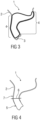
- Figure 3 is a schematic view of the model 1 after shaping or detailing, i.e. virtually cutting, i.e. reducing, the model 1 to be sized such that components can be fit into it and to reduce a length at a tip 3 of the model 1, i.e. the area which will extend the deepest into the ear canal. Shaping or detailing will however not alter contact surfaces 4 of the model, i.e. surfaces which will be in contact with the ear canal walls.
- the expansion layer 2 is not uniformly applied to the entire model 1. Instead, the expansion layer 2 is applied with a gradual decrease of thickness from a desired offset down to a reduced offset, e.g. zero, leaving a first portion 5 of the contact surface 4 near the tip 3 which will contact a bony area within the ear canal unexpanded. Hence, build-up of pressure is avoided where it would hurt.
- Figure 4 is a schematic view of an embodiment of the model 1 with a gradually applied expansion layer 2 as described above.
- a starting line 6 indicates where the expansion offset starts decreasing.
- the starting line 6 may for example be placed at a position of the contact surface 4 intended to contact the second bend of the ear canal.
- the offset i.e. the thickness of the expansion layer 2
- the offset may be configured to fall to zero at the latest when it reaches the first portion 5 of the contact surface 4 near the tip 3 which will contact a bony area within the ear canal.
- the location of this first portion 5 may for example be determined individually for each hearing device user.
- Such gradual expansion can be initialized automatically.
- the gradual decrease of the expansion layer 2 may start between the first bend and the second bend, or only at the second bend, depending on where the bony region of the individual hearing device user starts.
- the housing of the earpiece may be made of titanium, e.g. by an additive manufacturing method such as 3D printing, based on the model 1.
- the housing of the earpiece may be made of acrylic, e.g. by an additive manufacturing method such as 3D printing, based on the model 1.
- the housing is configured to form part of an IIC (Invisible In the Canal) device. In an exemplary embodiment, the housing is configured to form part of a RIC (Receiver In the Canal) device.
- IIC Invisible In the Canal
- RIC Receiveiver In the Canal
- a control software for controlling the processing of the model there may be an option provided to allow for manual setting of the gradual decrease, either only by providing a starting line 6 together with a transition distance, or an ending line together with a transition distance, or by both providing a starting line 6 and an ending line, where the offset should have reached zero or in fact a different second offsetting value.
- the described method may be part of a method for manufacturing a body-worn electronic device adapted to the shape of an individual's body area, e.g. as described in EP 1 345 470 A2 , which is hereby incorporated by reference in its entirety.
- This method for manufacturing a body-worn device e.g. a hearing device, adapted to the shape of an individual's body area, e.g. an ear canal, may comprise:
- Detailing may comprise at least one of cutting, surface treating, offsetting, fixing, relaxing and increasing at least a part of the digitized representation, whereby such actions may be performed digitally.
- the detailing step is for example described in paragraphs [0045] to [0047] of EP 1 345 470 A2 and may comprise (virtually) cutting the model 1, in particular at a distal end and at a medial or proximal end, thus creating partial surfaces which may differ from the measured ear canal geometry. Further, detailing may include defining components to be arranged in the model 1 of the housing for an earpiece.
- Surface offsetting is described in paragraph [0047] of EP 1 345 470 A2 . This surface offsetting may in particular be replaced by the one or more of the methods described above with reference to the figures.
- the step of automatically determining the at least one characteristic feature may comprise performing such determining by automatically investigating the digitized representation under the constraint of predetermined geometrical rules. Thereby, e.g. rules with respect to curvature, surface areas of cross-sections, etc., of the digitized representation are investigated under predetermined criteria so as to find at the digitized representation the location of the respective characteristic feature.
- the determining step may comprise comparing the digitized representation with a digital representation of a standard of the body area.
- characteristic features of the standard may be exploited as the respective characteristic features of the digitized representation actually treated and may thus be taken at least as a first approximation of such characteristic features to be automatically determined at the digitized representation.
- the step of determining is not essential for the present invention. Instead, the subsequent steps may likewise be performed directly using data of an ear canal measurement.
- the step of preparing the digitized representation may be performed by scanning a cast of the body area.
- the step of preparing the digitized representation may be performed by three-dimensional scanning of the body area directly.
Landscapes
- Engineering & Computer Science (AREA)
- Manufacturing & Machinery (AREA)
- Health & Medical Sciences (AREA)
- General Health & Medical Sciences (AREA)
- Neurosurgery (AREA)
- Otolaryngology (AREA)
- Physics & Mathematics (AREA)
- Acoustics & Sound (AREA)
- Signal Processing (AREA)
- Prostheses (AREA)
Priority Applications (1)
| Application Number | Priority Date | Filing Date | Title |
|---|---|---|---|
| EP23152231.9A EP4404589A1 (de) | 2023-01-18 | 2023-01-18 | Gehäuse für ein ohrstück und verfahren zur herstellung eines gehäuses für ein ohrstück |
Applications Claiming Priority (1)
| Application Number | Priority Date | Filing Date | Title |
|---|---|---|---|
| EP23152231.9A EP4404589A1 (de) | 2023-01-18 | 2023-01-18 | Gehäuse für ein ohrstück und verfahren zur herstellung eines gehäuses für ein ohrstück |
Publications (1)
| Publication Number | Publication Date |
|---|---|
| EP4404589A1 true EP4404589A1 (de) | 2024-07-24 |
Family
ID=84982314
Family Applications (1)
| Application Number | Title | Priority Date | Filing Date |
|---|---|---|---|
| EP23152231.9A Withdrawn EP4404589A1 (de) | 2023-01-18 | 2023-01-18 | Gehäuse für ein ohrstück und verfahren zur herstellung eines gehäuses für ein ohrstück |
Country Status (1)
| Country | Link |
|---|---|
| EP (1) | EP4404589A1 (de) |
Citations (4)
| Publication number | Priority date | Publication date | Assignee | Title |
|---|---|---|---|---|
| EP1345470A2 (de) | 2003-04-03 | 2003-09-17 | Phonak Ag | Verfahren zur Herstellung eines am Körper zu tragenden elektronischen Gerätes, welches an den Form eines Körperteils eines Individuum angepasst ist. |
| US20070189564A1 (en) * | 2006-02-03 | 2007-08-16 | Mcbagonluri Fred | System comprising an automated tool and appertaining method for hearing aid design |
| US20190007762A1 (en) * | 2017-06-30 | 2019-01-03 | Bose Corporation | Customized Ear Tips |
| US20200186905A1 (en) * | 2017-08-24 | 2020-06-11 | Sonova Ag | In-ear housing with customized retention |
-
2023
- 2023-01-18 EP EP23152231.9A patent/EP4404589A1/de not_active Withdrawn
Patent Citations (4)
| Publication number | Priority date | Publication date | Assignee | Title |
|---|---|---|---|---|
| EP1345470A2 (de) | 2003-04-03 | 2003-09-17 | Phonak Ag | Verfahren zur Herstellung eines am Körper zu tragenden elektronischen Gerätes, welches an den Form eines Körperteils eines Individuum angepasst ist. |
| US20070189564A1 (en) * | 2006-02-03 | 2007-08-16 | Mcbagonluri Fred | System comprising an automated tool and appertaining method for hearing aid design |
| US20190007762A1 (en) * | 2017-06-30 | 2019-01-03 | Bose Corporation | Customized Ear Tips |
| US20200186905A1 (en) * | 2017-08-24 | 2020-06-11 | Sonova Ag | In-ear housing with customized retention |
Similar Documents
| Publication | Publication Date | Title |
|---|---|---|
| US20220248154A1 (en) | Hearing assistance device | |
| DK2335426T3 (en) | PROCEDURE FOR THE MANUFACTURING OF A HEARING WHICH HAS AN INDIVIDUALLY CUSTOMIZED ELASTIC COMPONENT | |
| EP1574111B1 (de) | Interaktive binaurale gehäuse-modellierung für hörgeräte | |
| US20050117765A1 (en) | Hearing aid assembly | |
| EP3198890B1 (de) | Abdrucknahmekissen, verfahren zur abdrucknahme, abdruck und verfahren zur herstellung einer individuell angepassten gehörgangschale | |
| US7084870B2 (en) | Interactive binaural shell modeling for hearing aids | |
| US10986432B2 (en) | Customized ear tips | |
| US8285408B2 (en) | System and method for designing an ear insert device | |
| EP1625770B1 (de) | Synchronisierte verarbeitung von ohrgehäusen für gehörapparate | |
| WO2008021289A2 (en) | In the ear hearing aid utilizing annular acoustic seals | |
| US10652677B2 (en) | Hearing assistance device and method of forming same | |
| CN110582049B (zh) | 用于制造听力装置的部件的方法 | |
| US11317225B2 (en) | In-ear housing with customized retention | |
| CA2453490A1 (en) | Method for manufacturing a body-worn electronic device adapted to the shape of an individual's body area | |
| EP4404589A1 (de) | Gehäuse für ein ohrstück und verfahren zur herstellung eines gehäuses für ein ohrstück | |
| US20120224734A1 (en) | Hearing aid and method of fabricating the same | |
| KR100965785B1 (ko) | 귓속형 맞춤 보청기의 쉘 제조방법 | |
| EP1705950B1 (de) | Verfahren zur individuellen Anpassung eines Hörgeräts | |
| US10158954B1 (en) | Template based custom ear insert virtual shaping method | |
| DK2048895T3 (en) | Computer-controlled rule-based binaural molding system and method for hearing aid design | |
| US12418759B2 (en) | Hearing device having a shell that includes a compressible region and methods of manufacturing the same | |
| EP4002883A1 (de) | Automatische positionsbestimmung für das gehäuse eines hörgerätes | |
| Jarng et al. | Developmental tendency of hearing aid semi-auto-manufacturing |
Legal Events
| Date | Code | Title | Description |
|---|---|---|---|
| PUAI | Public reference made under article 153(3) epc to a published international application that has entered the european phase |
Free format text: ORIGINAL CODE: 0009012 |
|
| STAA | Information on the status of an ep patent application or granted ep patent |
Free format text: STATUS: THE APPLICATION HAS BEEN PUBLISHED |
|
| AK | Designated contracting states |
Kind code of ref document: A1 Designated state(s): AL AT BE BG CH CY CZ DE DK EE ES FI FR GB GR HR HU IE IS IT LI LT LU LV MC ME MK MT NL NO PL PT RO RS SE SI SK SM TR |
|
| STAA | Information on the status of an ep patent application or granted ep patent |
Free format text: STATUS: THE APPLICATION IS DEEMED TO BE WITHDRAWN |
|
| 18D | Application deemed to be withdrawn |
Effective date: 20250125 |