EP4404547B1 - Proaktive telefonnummerüberwachung auf der basis des antwortanfallsverhältnisses - Google Patents
Proaktive telefonnummerüberwachung auf der basis des antwortanfallsverhältnisses Download PDFInfo
- Publication number
- EP4404547B1 EP4404547B1 EP24152155.8A EP24152155A EP4404547B1 EP 4404547 B1 EP4404547 B1 EP 4404547B1 EP 24152155 A EP24152155 A EP 24152155A EP 4404547 B1 EP4404547 B1 EP 4404547B1
- Authority
- EP
- European Patent Office
- Prior art keywords
- detection period
- asr
- previous
- previous detection
- periods
- Prior art date
- Legal status (The legal status is an assumption and is not a legal conclusion. Google has not performed a legal analysis and makes no representation as to the accuracy of the status listed.)
- Active
Links
Images

Classifications
-
- H—ELECTRICITY
- H04—ELECTRIC COMMUNICATION TECHNIQUE
- H04M—TELEPHONIC COMMUNICATION
- H04M3/00—Automatic or semi-automatic exchanges
- H04M3/08—Indicating faults in circuits or apparatus
- H04M3/10—Providing fault- or trouble-signals
-
- H—ELECTRICITY
- H04—ELECTRIC COMMUNICATION TECHNIQUE
- H04M—TELEPHONIC COMMUNICATION
- H04M15/00—Arrangements for metering, time-control or time indication ; Metering, charging or billing arrangements for voice wireline or wireless communications, e.g. VoIP
- H04M15/10—Metering calls from calling party, i.e. A-party charged for the communication
- H04M15/12—Discriminative metering, charging or billing
- H04M15/22—Discriminative metering, charging or billing according to time of day
-
- H—ELECTRICITY
- H04—ELECTRIC COMMUNICATION TECHNIQUE
- H04M—TELEPHONIC COMMUNICATION
- H04M15/00—Arrangements for metering, time-control or time indication ; Metering, charging or billing arrangements for voice wireline or wireless communications, e.g. VoIP
- H04M15/41—Billing record details, i.e. parameters, identifiers, structure of call data record [CDR]
-
- H—ELECTRICITY
- H04—ELECTRIC COMMUNICATION TECHNIQUE
- H04M—TELEPHONIC COMMUNICATION
- H04M15/00—Arrangements for metering, time-control or time indication ; Metering, charging or billing arrangements for voice wireline or wireless communications, e.g. VoIP
- H04M15/58—Arrangements for metering, time-control or time indication ; Metering, charging or billing arrangements for voice wireline or wireless communications, e.g. VoIP based on statistics of usage or network monitoring
-
- H—ELECTRICITY
- H04—ELECTRIC COMMUNICATION TECHNIQUE
- H04M—TELEPHONIC COMMUNICATION
- H04M15/00—Arrangements for metering, time-control or time indication ; Metering, charging or billing arrangements for voice wireline or wireless communications, e.g. VoIP
- H04M15/59—Arrangements for metering, time-control or time indication ; Metering, charging or billing arrangements for voice wireline or wireless communications, e.g. VoIP based on real time
-
- H—ELECTRICITY
- H04—ELECTRIC COMMUNICATION TECHNIQUE
- H04M—TELEPHONIC COMMUNICATION
- H04M15/00—Arrangements for metering, time-control or time indication ; Metering, charging or billing arrangements for voice wireline or wireless communications, e.g. VoIP
- H04M15/70—Administration or customization aspects; Counter-checking correct charges
- H04M15/725—Administration or customization aspects; Counter-checking correct charges by the operator
-
- H—ELECTRICITY
- H04—ELECTRIC COMMUNICATION TECHNIQUE
- H04W—WIRELESS COMMUNICATION NETWORKS
- H04W4/00—Services specially adapted for wireless communication networks; Facilities therefor
- H04W4/24—Accounting or billing
-
- H—ELECTRICITY
- H04—ELECTRIC COMMUNICATION TECHNIQUE
- H04M—TELEPHONIC COMMUNICATION
- H04M2203/00—Aspects of automatic or semi-automatic exchanges
- H04M2203/55—Aspects of automatic or semi-automatic exchanges related to network data storage and management
- H04M2203/555—Statistics, e.g. about subscribers but not being call statistics
- H04M2203/556—Statistical analysis and interpretation
-
- H—ELECTRICITY
- H04—ELECTRIC COMMUNICATION TECHNIQUE
- H04M—TELEPHONIC COMMUNICATION
- H04M3/00—Automatic or semi-automatic exchanges
- H04M3/22—Arrangements for supervision, monitoring or testing
- H04M3/2281—Call monitoring, e.g. for law enforcement purposes; Call tracing; Detection or prevention of malicious calls
Definitions
- Telephone numbers are used by individuals and organizations, such as businesses, for a variety of reasons. Whatever the intended use, the customer expects the phone number(s) to work. Of course, situations occur in which a phone number does not work as desired. The customer may recognize a problem and report it to a provider. That typically starts a process that takes considerable time and may present the customer with considerable inconvenience. In some instances, the customer is unable to recognize a problem so it may go unreported and persist for an extended period of time.
- Any delay between a time when a phone number begins experiencing a problem and remediation of the problem is undesirable. Any such delays are inconvenient and can prove costly to consumers of telephony services who rely on functional phone numbers to conduct business. Service providers also need to provide reliable service to maintain their customer relationships.
- An illustrative example embodiment of a method of monitoring a plurality of phone numbers includes, for each phone number, detecting call activity involving the phone number during a detection period having a preselected duration, determining an answer seizure ratio (ASR) during the detection period from the call activity, determining a difference between the ASR during the detection period and an ASR from at least one previous detection period, determining that the difference satisfies at least one preselected criterion, and instigating a procedure to investigate or repair the phone number when the difference satisfies the at least one preselected criterion.
- the method may be executed by a computing device including at least one processor and memory associated with the at least one processor.
- the method may be part of a computer program which may be stored on a memory device. The steps above of detecting and determining may be performed automatically.
- the at least one previous detection period has a duration that equals the preselected duration.
- the at least one previous detection period comprises a plurality of previous detection periods each having the duration, each of the plurality of previous detection periods has an associated ASR, and automatically determining the difference between the ASR during the detection period and the ASR from the at least one previous detection period comprises determining the difference between an average ASR of the ASRs of the plurality of previous detection periods and the ASR during the detection period.
- the preselected duration is one hour and the plurality of previous detections periods are a most recent twenty-four hours prior to the detection period.
- the detection period occurs during an identified time of one day and the at least one previous detection period occurred during the identified time of at least one other day prior to the one day.
- the detection period is one hour and the at least one previous detection period is an hour immediately preceding the one hour.
- the method includes determining a machine-learned model of ASRs for each of a plurality of sets of detection periods and selecting the at least one previous detection period using the machine-learned model.
- the method includes determining a machine-learned model of ASRs for each of a plurality of sets of detection periods.
- the at least one preselected criterion is based on the machine-learned model.
- the at least one preselected criterion is satisfied when the ASR of the detection period is less than approximately 75% of the ASR of the at least one previous detection period.
- the method includes determining a standard deviation of the ASR of a plurality of previous detection periods and wherein the at least preselected criterion is satisfied when the ASR of the detection period is less than the ASR of the at least one previous detection period by an amount equal to at least one standard deviation.
- An illustrative example embodiment of a system for monitoring phone numbers includes a computing device having at least one processor and memory associated with the processor.
- a telephone network supports a plurality of telephone numbers.
- the computing device is configured to detect call activity involving the phone number during a detection period having a preselected duration, determine an answer seizure ratio (ASR) for the phone number during the detection period from the call activity, determine a difference between the ASR during the detection period and an ASR from at least one previous detection period for the phone number.
- ASR answer seizure ratio
- the computing device instigates a procedure to investigate or repair the phone number.
- the at least one previous detection period has a duration that equals the preselected duration.
- the at least one previous detection period comprises a plurality of previous detection periods each having the duration, each of the plurality of previous detection periods has an associated ASR, and automatically determining the difference between the ASR during the detection period and the ASR from the at least one previous detection period comprises determining the difference between an average ASR of the ASRs of the plurality of previous detection periods and the ASR during the detection period.
- the preselected duration is one hour and the plurality of previous detections periods are a most recent twenty-four hours prior to the detection period.
- the detection period occurs during an identified time of one day and the at least one previous detection period occurred during the identified time of at least one other day prior to the one day.
- the detection period is one hour and the at least one previous detection period is an hour immediately preceding the one hour.
- the computing device is configured to determine a machine-learned model of ASRs for each of a plurality of sets of detection periods and select the at least one previous detection period using the machine-learned model.
- the computing device is configured to determine a machine-learned model of ASRs for each of a plurality of sets of detection periods and determine the at least one preselected criterion using the machine-learned model.
- the computing device is configured to determine that the at least one preselected criterion is satisfied when the ASR of the detection period is less than approximately 75% of the ASR of the at least one previous detection period.
- the computing device is configured to determine a standard deviation of the ASR of a plurality of previous detection periods and determine that the at least preselected criterion is satisfied when the ASR of the detection period is less than the ASR of the at least one previous detection period by an amount equal to at least one standard deviation.
- Embodiments of this invention provide automated phone number monitoring based on an answer seizure ratio (ASR) during a detection period, which is the number of answered calls to a phone number divided by the total number of calls to that phone number.
- ASR answer seizure ratio
- a computing device 22 which is particularly configured or programmed to be part of a telephony platform, includes at least one processor 24 and memory 26 associated with the processor 24.
- the computing device 22 is schematically illustrated as a single device for discussion purposes. Some embodiments include multiple devices, such as a plurality of processors that are part of a cloud computing network.
- the computing device 22 is linked to or otherwise has access to a telephone network 30 that includes known equipment to facilitate calls in a known manner.
- the telephone network 30 supports a plurality of phone numbers 32.
- the computing device 22 monitors each of the phone numbers 32 to determine whether any of the phone numbers 32 is malfunctioning.
- the computing device 22 obtains data directly from the telephone network 30 and uses that data to determine the call activity for each of the phone numbers 32.
- the call activity corresponds to information or data that may be included in call detail records, such as the calling number, the called number, whether the call was answered, and call duration.
- the computing device 22 is configured or programmed to determine the call activity by operating like at least one of a session border controller or a session initiation protocol (SIP) application server.
- SIP session initiation protocol
- the data obtained by the computing device 22 corresponds to actual call activity for each phone number 32 during a detection period having a preselected duration.
- the computing device 22 determines the ASR for each phone number during the detection period and uses information regarding the ASR from at least one previous detection period to determine whether the phone number 32 may be malfunctioning in a way that requires repair.
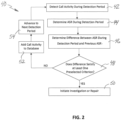
- Figure 2 is a flowchart diagram 40 summarizing an example method implemented by the computing device 22 for monitoring each of the phone numbers 32.
- the computing device 22 detects call activity involving the phone number 32 during a detection period having a preselected duration. In this example embodiment, the detection period lasts for one hour. Other detection period durations are useful in some embodiments.
- the call activity will typically include a number of calls placed to the phone number, a number of calls to the phone number that were answered, a duration of each answered call, and other information.
- the computing device 22 uses the information regarding the number of placed calls and the number of answered calls to determine the ASR during the detection period at 44.
- the computing device 22 determines a difference between the ASR of the detection period and an ASR of at least one previous detection period.
- the previous ASR is from an immediately preceding detection period. For example, when the detection period is from 12 o'clock to 1 o'clock, the previous ASR is from 11 o'clock to 12 o'clock.
- the previous ASR used at 46 is based on when the detection period occurs. For example, when the detection period is during the afternoon on one day, the previous ASR is selected from the same time during the afternoon on a previous day, which may be an immediately preceding day or another previous day, such as the same day of the week or a most recent day that is considered relevant. This approach avoids differences that are expected to occur depending on the day, such as the difference in expected call activity on a weekend compared to a week day, from impacting the determinations made by the computing device 22.
- the previous ASR used for determining the difference at 46 is based on a plurality of previous detection periods. For example, when the detection period duration is one hour, the computing device 22 determines an average ASR of a selected set of preceding one-hour detection periods. One example set includes the immediately preceding 24 hours. Another example set includes the hour during the same time of day over a span of several days or weeks. The computing device 22 determines the difference between the average ASR of the set and the ASR of the detection period at 46.
- the computing device determines, at 48, whether the difference determined at 46 satisfies at least one preselected criterion. When the criterion is satisfied, that indicates a problem or potential problem with the phone number 32.
- the criterion is a threshold difference.
- the criterion is satisfied when the ASR of the detection period determined at 44 is less than the previous ASR by an amount that exceeds the threshold.
- the threshold in some embodiments is based on a percentage of the previous ASR. For example, when the ASR determined at 44 is less than 75% of the previous ASR, the criterion is satisfied. In other words, when the ASR of the detection period is less than the previous ASR and the difference determined at 46 is more than 25% of the previous ASR, the criterion is satisfied.
- Another example threshold is based on a standard deviation of the ASR.
- the computing device 22 in such an embodiment determines a standard deviation of the ASR over time using the ASRs from a selected set of previous detection periods.
- the criterion used at 48 equals one standard deviation in some embodiments such that when the ASR of the detection period determined at 44 is less than the previous ASR by at least one standard deviation indicates a problem or potential problem.
- the computing device 22 Instigates an investigation or repair procedure at 50.
- the computing device 22 generates a report, an alert, or communicates with another portion of the telephone network 30 to initiate the investigation or repair.
- the computing device 22 updates the database of call activity and ASR information to include such information from the detection period at 52.
- a next detection period begins at 54 and the computing device 22 again performs the method steps indicated at 42-48.
- the computing device 22 is configured to use machine learning when selecting a previous detection period for purposes of determining a difference between the ASRs of the detection period and a previous detection period.
- the computing device uses machine learning to recognize a pattern of ASRs over time and uses that pattern to select at least one previous detection period that provides a useful ASR comparison. For example, when a phone number regularly receives a large call volume during certain times and a low call volume during other times, the machine learning model indicates which times are expected to have low or high call volumes.
- the computing device 22 determines where a detection period currently being considered fits with the machine learning model. If the detection period fits with the times during which the phone number regularly receives large call volumes, then an ASR from such times is used for determining the difference that may indicate a problem with the phone number.
- Other example embodiments include machine learning for determining the criterion used to determine whether the difference in ASRs indicates a problem with the phone number.
- the machine learning model indicates a pattern that the ASR for a phone number follows over time. If the model indicates that the ASR typically drops at a certain time of day, a threshold difference used by the computing device to determine whether there is a problem with the phone number can be increased to accommodate the expected increase in that difference at that time of day.
- the example disclosed system and method provide automated phone number monitoring based on ASR that is fully automated and improves the economies associated with identifying and remedying problems with individual phone numbers.
Landscapes
- Engineering & Computer Science (AREA)
- Signal Processing (AREA)
- Computer Networks & Wireless Communication (AREA)
- Business, Economics & Management (AREA)
- Accounting & Taxation (AREA)
- Physics & Mathematics (AREA)
- Probability & Statistics with Applications (AREA)
- Telephonic Communication Services (AREA)
Claims (20)
- Ein Verfahren zum Überwachen einer Vielzahl von Telefonnummern, wobei das Verfahren, für jede Telefonnummer, Folgendes umfasst:Erfassen (42) von Anrufaktivität unter Beteiligung der Telefonnummer, während eines Erfassungszeitraums mit einer vorausgewählten Dauer;Bestimmen (44) eines Verhältnisses zwischen beantworteten Anrufen zu getätigten Anrufen (answer seizure ratio, ASR) während des Erfassungszeitraums aus der Anrufaktivität;Bestimmen (46) einer Differenz zwischen dem ASR während des Erfassungszeitraums und einem ASR für die Telefonnummer aus mindestens einem vorherigen Erfassungszeitraum; undBestimmen (48), dass die Differenz mindestens ein vorausgewähltes Kriterium erfüllt, und Einleiten eines Prozesses zum Untersuchen oder Reparieren (50) der Telefonnummer, wenn die Differenz das mindestens eine vorausgewählte Kriterium erfüllt.
- Das Verfahren gemäß Anspruch 1, wobei der mindestens eine vorherige Erfassungszeitraum eine Dauer hat, die gleich der vorausgewählten Dauer ist.
- Das Verfahren gemäß Anspruch 2, wobeider mindestens eine vorherige Erfassungszeitraum eine Vielzahl vorheriger Erfassungszeiträume umfasst, die jeweils die Dauer haben,wobei jeder der Vielzahl vorheriger Erfassungszeiträume ein zugeordnetes ASR aufweist, undwobei Bestimmen der Differenz zwischen dem ASR während des Erfassungszeitraums und dem ASR aus dem mindestens einen vorherigen Erfassungszeitraum Bestimmen der Differenz zwischen einem durchschnittlichen ASR der ASRs der Vielzahl vorheriger Erfassungszeiträume und dem ASR während des Erfassungszeitraums umfasst.
- Das Verfahren gemäß Anspruch 3, wobeidie vorausgewählte Dauer eine Stunde beträgt, unddie Vielzahl vorheriger Erfassungszeiträume innerhalb der letzten 24 Stunden vor dem Erfassungszeitraum liegt.
- Das Verfahren gemäß Anspruch 1, wobeider Erfassungszeitraum zu einer identifizierten Tageszeit auftritt, undder mindestens eine vorherige Erfassungszeitraum während der identifizierten Zeit an mindestens einem anderen Tag vor diesem einen Tag auftrat.
- Das Verfahren gemäß Anspruch 1, wobeidie Erfassungsdauer eine Stunde beträgt, undder mindestens eine vorherige Erfassungszeitraum eine Stunde unmittelbar vor der einen Stunde ist.
- Das Verfahren gemäß Anspruch 1, umfassendBestimmen eines maschinengelernten Modells von ASRs für jeden einer Vielzahl von Sätzen von Erfassungszeiträumen, undAuswählen des mindestens einen vorherigen Erfassungszeitraums unter Verwendung des maschinengelernten Modells.
- Das Verfahren gemäß Anspruch 1, umfassend Bestimmen eines maschinengelernten Modells von ASRs für jeden einer Vielzahl von Sätzen von Erfassungszeiträumen, und
wobei das mindestens eine vorausgewählte Kriterium auf dem maschinengelernten Modell basiert. - Das Verfahren gemäß Anspruch 1, wobei das mindestens eine vorausgewählte Kriterium erfüllt ist, wenn der ASR des Erfassungszeitraums weniger als etwa 75 % des ASR des mindestens einen vorherigen Erfassungszeitraums beträgt.
- Das Verfahren gemäß Anspruch 1, umfassend das Bestimmen einer Standardabweichung des ASR einer Vielzahl vorheriger Erfassungszeiträume, und wobei das mindestens eine vorausgewählte Kriterium erfüllt ist, wenn das ASR des Erfassungszeitraums kleiner ist als das ASR des mindestens einen vorherigen Erfassungszeitraums, um einen Betrag, der gleich mindestens einer Standardabweichung ist.
- Ein System zur Überwachung einer Vielzahl von Telefonnummern, das System umfassend:eine Computervorrichtung (22), beinhaltend mindestens einen Prozessor (24) und einen dem mindestens einen Prozessor zugeordneten Speicher (26); undein Telefonnetz (30) beinhaltend eine Vielzahl von Telefonnummern (32),wobei die Computervorrichtung, für jede Telefonnummer, konfiguriert ist zum:Erfassen von Anrufaktivität unter Beteiligung der Telefonnummer während eines Erfassungszeitraums mit einer vorausgewählten Dauer;Bestimmen eines Verhältnisses zwischen beantworteten Anrufen zu getätigten Anrufen (answer seizure ratio, ASR) während des Erfassungszeitraums aus der Anrufaktivität;Bestimmen einer Differenz zwischen dem ASR für die Telefonnummer während des Erfassungszeitraums und einem ASR für die Telefonnummer aus mindestens einem vorherigen Erfassungszeitraum; undBestimmen, dass der Unterschied mindestens ein vorausgewähltes Kriterium erfüllt, und Einleiten eines Prozesses zum Untersuchen oder Reparieren der Telefonnummer, wenn der Unterschied mindestens ein vorausgewähltes Kriterium erfüllt.
- Das System gemäß Anspruch 11, wobei der mindestens eine vorherigen Erfassungszeitraum eine Dauer hat, die gleich der vorausgewählten Dauer ist.
- Das System gemäß Anspruch 12, wobeider mindestens eine vorherige Erfassungszeitraum eine Vielzahl vorheriger Erfassungszeiträume umfasst, die jeweils die Dauer haben,jeder der Vielzahl vorheriger Erfassungszeiträume ein zugeordnetes ASR hat, undBestimmen der Differenz zwischen dem ASR während des Erfassungszeitraums und dem ASR aus dem mindestens einen vorherigen Erfassungszeitraum Bestimmen der Differenz zwischen einem durchschnittlichen ASR der ASRs der Vielzahl vorheriger Erfassungszeiträume und dem ASR während des Erfassungszeitraums umfasst.
- Das System gemäß Anspruch 13, wobeidie vorausgewählte Dauer eine Stunde beträgt, unddie Vielzahl vorheriger Erfassungszeiträume innerhalb der letzten 24 Stunden vor dem Erfassungszeitraum liegt.
- Das System gemäß Anspruch 11, wobeider Erfassungszeitraum zu einer identifizierten Tageszeit auftritt, undder mindestens eine vorherige Erfassungszeitraum während der identifizierten Zeit von mindestens einem anderen Tag vor diesem einen Tag auftrat.
- Das System gemäß Anspruch 11, wobeidie Erfassungsdauer eine Stunde beträgt, undder mindestens eine vorherige Erfassungszeitraum eine Stunde unmittelbar vor der einen Stunde ist.
- Das System gemäß Anspruch 11, wobei die Computervorrichtung konfiguriert ist zumBestimmen eines maschinengelernten Modells von ASRs für jeden einer Vielzahl von Sätzen von Erfassungszeiträumen, undAuswählen des mindestens einen vorherigen Erfassungszeitraum unter Verwendung des maschinengelernten Modells.
- Das System gemäß Anspruch 11, wobei die Computervorrichtung konfiguriert zumBestimmen eines maschinengelernten Modells von ASRs für jeden einer Vielzahl von Sätzen von Erfassungszeiträumen, undBestimmen des mindestens einen vorausgewählten Kriteriums unter Verwendung des maschinengelernten Modells.
- Das System gemäß Anspruch 11, wobei die Computervorrichtung konfiguriert ist zum Bestimmen, dass das mindestens eine vorausgewählte Kriterium erfüllt ist, wenn das ASR des Erfassungszeitraums weniger als etwa 75 % des ASR des mindestens einen vorherigen Erfassungszeitraums beträgt.
- Das System gemäß Anspruch 11, wobei die Computervorrichtung konfiguriert ist zumBestimmen einer Standardabweichung des ASR einer Vielzahl von vorherigen Erfassungszeiträumen, undBestimmen, dass das mindestens vorausgewählte Kriterium erfüllt ist, wenn das ASR des Erfassungszeitraums kleiner ist als das ASR des mindestens einen vorherigen Erfassungszeitraums, um einen Betrag, der gleich mindestens einer Standardabweichung ist.
Applications Claiming Priority (1)
| Application Number | Priority Date | Filing Date | Title |
|---|---|---|---|
| US18/155,271 US11956381B1 (en) | 2023-01-17 | 2023-01-17 | Proactive telephone number monitoring based on answer seizure ratio |
Publications (3)
| Publication Number | Publication Date |
|---|---|
| EP4404547A1 EP4404547A1 (de) | 2024-07-24 |
| EP4404547B1 true EP4404547B1 (de) | 2025-02-19 |
| EP4404547C0 EP4404547C0 (de) | 2025-02-19 |
Family
ID=89620551
Family Applications (1)
| Application Number | Title | Priority Date | Filing Date |
|---|---|---|---|
| EP24152155.8A Active EP4404547B1 (de) | 2023-01-17 | 2024-01-16 | Proaktive telefonnummerüberwachung auf der basis des antwortanfallsverhältnisses |
Country Status (2)
| Country | Link |
|---|---|
| US (1) | US11956381B1 (de) |
| EP (1) | EP4404547B1 (de) |
Family Cites Families (15)
| Publication number | Priority date | Publication date | Assignee | Title |
|---|---|---|---|---|
| WO1993023962A1 (en) * | 1992-05-12 | 1993-11-25 | British Telecommunications Public Limited Company | Method of controlling traffic in a telecommunication network |
| US5509063A (en) | 1992-05-12 | 1996-04-16 | British Telecommunications Public Limited Company | Method of controlling a telecommunications network using call gapping |
| US5459777A (en) | 1993-10-28 | 1995-10-17 | British Telecommunications Public Limited Company | Telecommunications network traffic management system |
| US5550903A (en) * | 1993-12-08 | 1996-08-27 | Lucent Technologies Inc. | Method for monitoring telephone completion data |
| US5761502A (en) * | 1995-12-29 | 1998-06-02 | Mci Corporation | System and method for managing a telecommunications network by associating and correlating network events |
| EP1889461B1 (de) * | 2005-06-01 | 2014-01-22 | Fair Isaac Corporation | Netzwerkversicherungsanalytiksystem |
| US20090041205A1 (en) * | 2007-08-10 | 2009-02-12 | Tekelec | Methods, systems, and computer program products for detecting and mitigating ping call events in a communications network |
| US8068410B2 (en) | 2009-02-27 | 2011-11-29 | Ibasis, Inc. | Bias correction for scrubbing providers |
| US20110033032A1 (en) * | 2009-08-10 | 2011-02-10 | Ibasis, Inc. | Detecting false answer supervision |
| US9560180B2 (en) * | 2011-12-24 | 2017-01-31 | Vonage Business Inc. | Systems and methods for adjusting carrier quality metrics for intrinsic impairments |
| US8787541B1 (en) * | 2013-02-19 | 2014-07-22 | Tata Communications (America) Inc. | System and method for quality auto-blending in call routing |
| US9614756B2 (en) | 2015-03-25 | 2017-04-04 | Ca, Inc. | VOIP route selection using call metrics |
| US20160373575A1 (en) * | 2015-06-19 | 2016-12-22 | SipNav, LLC | Telecommunications and Network Traffic Control System |
| US11271960B2 (en) * | 2017-12-06 | 2022-03-08 | Ribbon Communications Operating Company, Inc. | Communications methods and apparatus for dynamic detection and/or mitigation of anomalies |
| US11418642B1 (en) * | 2022-03-31 | 2022-08-16 | Bandwidth Inc. | Methods, systems and computer program products for determining root causes of detected anomalies in a telecommunications network |
-
2023
- 2023-01-17 US US18/155,271 patent/US11956381B1/en active Active
-
2024
- 2024-01-16 EP EP24152155.8A patent/EP4404547B1/de active Active
Also Published As
| Publication number | Publication date |
|---|---|
| US11956381B1 (en) | 2024-04-09 |
| EP4404547A1 (de) | 2024-07-24 |
| EP4404547C0 (de) | 2025-02-19 |
Similar Documents
| Publication | Publication Date | Title |
|---|---|---|
| US8488769B1 (en) | Non-scheduled training for an agent in a call center | |
| US8352867B2 (en) | Predictive monitoring dashboard | |
| US9083799B2 (en) | Workflow management in contact centers | |
| US11469939B2 (en) | Method and apparatus for providing trouble isolation via a network | |
| EP1826999B1 (de) | Benutzerdefinierter Anrufvermittler auf Prioritätsbasis | |
| CN111130939B (zh) | 一种流量控制方法、装置、计算机设备及存储介质 | |
| US6363145B1 (en) | Apparatus and method for automated voice analysis in ACD silent call monitoring | |
| US7715546B2 (en) | System and method for updating contact records | |
| US20080225872A1 (en) | Dynamically defining queues and agents in a contact center | |
| US5926528A (en) | Call pacing method | |
| US6449341B1 (en) | Apparatus and method for managing a software system via analysis of call center trouble tickets | |
| US8811581B1 (en) | Reporting unavailable trunk-related resources for a predictive dialer using a dynamic pacing algorithm | |
| US8869173B2 (en) | Adaptive application interface management | |
| US20100299153A1 (en) | System, method and program for determining compliance with a service level agreement | |
| CN111953772B (zh) | 请求处理方法、装置、服务器及存储介质 | |
| US9813559B1 (en) | Addressing trunk-related resource deficiencies for a predictive dialer using a dynamic pacing algorithm | |
| CA2229494A1 (en) | Method and apparatus for handling processing errors in telecommunications exchanges | |
| US9392114B1 (en) | Systems and method for call center agent performance improvement driven by call reason norms | |
| CN111581055B (zh) | 业务系统的控制方法及装置、电子设备和可读存储介质 | |
| US10346221B2 (en) | Determining life-cycle of task flow performance for telecommunication service order | |
| EP4404547A1 (de) | Proaktive telefonnummerüberwachung auf der basis des antwortanfallsverhältnisses | |
| CN110536032A (zh) | 消息发送方法、装置、电子设备及存储介质 | |
| CN111078417B (zh) | 账号调度方法、装置、计算机设备及存储介质 | |
| CN108763017B (zh) | 金融业务的应用软件数据处理方法、服务端及存储介质 | |
| CN113645066A (zh) | 一种提高海量码号运营效率与提高接通率的方法和系统 |
Legal Events
| Date | Code | Title | Description |
|---|---|---|---|
| PUAI | Public reference made under article 153(3) epc to a published international application that has entered the european phase |
Free format text: ORIGINAL CODE: 0009012 |
|
| STAA | Information on the status of an ep patent application or granted ep patent |
Free format text: STATUS: REQUEST FOR EXAMINATION WAS MADE |
|
| 17P | Request for examination filed |
Effective date: 20240527 |
|
| AK | Designated contracting states |
Kind code of ref document: A1 Designated state(s): AL AT BE BG CH CY CZ DE DK EE ES FI FR GB GR HR HU IE IS IT LI LT LU LV MC ME MK MT NL NO PL PT RO RS SE SI SK SM TR |
|
| RBV | Designated contracting states (corrected) |
Designated state(s): AL AT BE BG CH CY CZ DE DK EE ES FI FR GB GR HR HU IE IS IT LI LT LU LV MC ME MK MT NL NO PL PT RO RS SE SI SK SM TR |
|
| GRAP | Despatch of communication of intention to grant a patent |
Free format text: ORIGINAL CODE: EPIDOSNIGR1 |
|
| STAA | Information on the status of an ep patent application or granted ep patent |
Free format text: STATUS: GRANT OF PATENT IS INTENDED |
|
| INTG | Intention to grant announced |
Effective date: 20241011 |
|
| GRAS | Grant fee paid |
Free format text: ORIGINAL CODE: EPIDOSNIGR3 |
|
| GRAA | (expected) grant |
Free format text: ORIGINAL CODE: 0009210 |
|
| STAA | Information on the status of an ep patent application or granted ep patent |
Free format text: STATUS: THE PATENT HAS BEEN GRANTED |
|
| AK | Designated contracting states |
Kind code of ref document: B1 Designated state(s): AL AT BE BG CH CY CZ DE DK EE ES FI FR GB GR HR HU IE IS IT LI LT LU LV MC ME MK MT NL NO PL PT RO RS SE SI SK SM TR |
|
| REG | Reference to a national code |
Ref country code: GB Ref legal event code: FG4D |
|
| REG | Reference to a national code |
Ref country code: CH Ref legal event code: EP |
|
| REG | Reference to a national code |
Ref country code: DE Ref legal event code: R096 Ref document number: 602024000013 Country of ref document: DE |
|
| REG | Reference to a national code |
Ref country code: IE Ref legal event code: FG4D |
|
| U01 | Request for unitary effect filed |
Effective date: 20250226 |
|
| U07 | Unitary effect registered |
Designated state(s): AT BE BG DE DK EE FI FR IT LT LU LV MT NL PT RO SE SI Effective date: 20250306 |
|
| PG25 | Lapsed in a contracting state [announced via postgrant information from national office to epo] |
Ref country code: RS Free format text: LAPSE BECAUSE OF FAILURE TO SUBMIT A TRANSLATION OF THE DESCRIPTION OR TO PAY THE FEE WITHIN THE PRESCRIBED TIME-LIMIT Effective date: 20250519 |
|
| PG25 | Lapsed in a contracting state [announced via postgrant information from national office to epo] |
Ref country code: PL Free format text: LAPSE BECAUSE OF FAILURE TO SUBMIT A TRANSLATION OF THE DESCRIPTION OR TO PAY THE FEE WITHIN THE PRESCRIBED TIME-LIMIT Effective date: 20250219 |
|
| PG25 | Lapsed in a contracting state [announced via postgrant information from national office to epo] |
Ref country code: ES Free format text: LAPSE BECAUSE OF FAILURE TO SUBMIT A TRANSLATION OF THE DESCRIPTION OR TO PAY THE FEE WITHIN THE PRESCRIBED TIME-LIMIT Effective date: 20250219 |
|
| PG25 | Lapsed in a contracting state [announced via postgrant information from national office to epo] |
Ref country code: IS Free format text: LAPSE BECAUSE OF FAILURE TO SUBMIT A TRANSLATION OF THE DESCRIPTION OR TO PAY THE FEE WITHIN THE PRESCRIBED TIME-LIMIT Effective date: 20250619 Ref country code: NO Free format text: LAPSE BECAUSE OF FAILURE TO SUBMIT A TRANSLATION OF THE DESCRIPTION OR TO PAY THE FEE WITHIN THE PRESCRIBED TIME-LIMIT Effective date: 20250519 |
|
| PG25 | Lapsed in a contracting state [announced via postgrant information from national office to epo] |
Ref country code: HR Free format text: LAPSE BECAUSE OF FAILURE TO SUBMIT A TRANSLATION OF THE DESCRIPTION OR TO PAY THE FEE WITHIN THE PRESCRIBED TIME-LIMIT Effective date: 20250219 |
|
| PG25 | Lapsed in a contracting state [announced via postgrant information from national office to epo] |
Ref country code: GR Free format text: LAPSE BECAUSE OF FAILURE TO SUBMIT A TRANSLATION OF THE DESCRIPTION OR TO PAY THE FEE WITHIN THE PRESCRIBED TIME-LIMIT Effective date: 20250520 |
|
| PG25 | Lapsed in a contracting state [announced via postgrant information from national office to epo] |
Ref country code: SM Free format text: LAPSE BECAUSE OF FAILURE TO SUBMIT A TRANSLATION OF THE DESCRIPTION OR TO PAY THE FEE WITHIN THE PRESCRIBED TIME-LIMIT Effective date: 20250219 |
|
| PG25 | Lapsed in a contracting state [announced via postgrant information from national office to epo] |
Ref country code: CZ Free format text: LAPSE BECAUSE OF FAILURE TO SUBMIT A TRANSLATION OF THE DESCRIPTION OR TO PAY THE FEE WITHIN THE PRESCRIBED TIME-LIMIT Effective date: 20250219 |
|
| PG25 | Lapsed in a contracting state [announced via postgrant information from national office to epo] |
Ref country code: SK Free format text: LAPSE BECAUSE OF FAILURE TO SUBMIT A TRANSLATION OF THE DESCRIPTION OR TO PAY THE FEE WITHIN THE PRESCRIBED TIME-LIMIT Effective date: 20250219 |
|
| PLBE | No opposition filed within time limit |
Free format text: ORIGINAL CODE: 0009261 |
|
| STAA | Information on the status of an ep patent application or granted ep patent |
Free format text: STATUS: NO OPPOSITION FILED WITHIN TIME LIMIT |
|
| 26N | No opposition filed |
Effective date: 20251120 |
|
| U20 | Renewal fee for the european patent with unitary effect paid |
Year of fee payment: 3 Effective date: 20260106 |