EP4404490A1 - Signalübertragungsverfahren und -vorrichtung, vorrichtung und speichermedium - Google Patents
Signalübertragungsverfahren und -vorrichtung, vorrichtung und speichermedium Download PDFInfo
- Publication number
- EP4404490A1 EP4404490A1 EP22866689.7A EP22866689A EP4404490A1 EP 4404490 A1 EP4404490 A1 EP 4404490A1 EP 22866689 A EP22866689 A EP 22866689A EP 4404490 A1 EP4404490 A1 EP 4404490A1
- Authority
- EP
- European Patent Office
- Prior art keywords
- signal
- time
- window
- delay
- domain
- Prior art date
- Legal status (The legal status is an assumption and is not a legal conclusion. Google has not performed a legal analysis and makes no representation as to the accuracy of the status listed.)
- Pending
Links
Images




Classifications
-
- H—ELECTRICITY
- H04—ELECTRIC COMMUNICATION TECHNIQUE
- H04L—TRANSMISSION OF DIGITAL INFORMATION, e.g. TELEGRAPHIC COMMUNICATION
- H04L5/00—Arrangements affording multiple use of the transmission path
-
- H—ELECTRICITY
- H04—ELECTRIC COMMUNICATION TECHNIQUE
- H04L—TRANSMISSION OF DIGITAL INFORMATION, e.g. TELEGRAPHIC COMMUNICATION
- H04L27/00—Modulated-carrier systems
- H04L27/26—Systems using multi-frequency codes
- H04L27/2601—Multicarrier modulation systems
- H04L27/2602—Signal structure
- H04L27/261—Details of reference signals
-
- H—ELECTRICITY
- H04—ELECTRIC COMMUNICATION TECHNIQUE
- H04L—TRANSMISSION OF DIGITAL INFORMATION, e.g. TELEGRAPHIC COMMUNICATION
- H04L27/00—Modulated-carrier systems
- H04L27/26—Systems using multi-frequency codes
- H04L27/2601—Multicarrier modulation systems
- H04L27/2626—Arrangements specific to the transmitter only
- H04L27/2627—Modulators
- H04L27/2639—Modulators using other transforms, e.g. discrete cosine transforms, Orthogonal Time Frequency and Space [OTFS] or hermetic transforms
-
- H—ELECTRICITY
- H04—ELECTRIC COMMUNICATION TECHNIQUE
- H04L—TRANSMISSION OF DIGITAL INFORMATION, e.g. TELEGRAPHIC COMMUNICATION
- H04L5/00—Arrangements affording multiple use of the transmission path
- H04L5/0001—Arrangements for dividing the transmission path
- H04L5/0003—Two-dimensional division
- H04L5/0005—Time-frequency
-
- H—ELECTRICITY
- H04—ELECTRIC COMMUNICATION TECHNIQUE
- H04L—TRANSMISSION OF DIGITAL INFORMATION, e.g. TELEGRAPHIC COMMUNICATION
- H04L5/00—Arrangements affording multiple use of the transmission path
- H04L5/003—Arrangements for allocating sub-channels of the transmission path
- H04L5/0048—Allocation of pilot signals, i.e. of signals known to the receiver
Definitions
- This application relates to the field of communication technologies, and specifically, to a signal transmission method and apparatus, a device, and a storage medium.
- An orthogonal time-frequency space (Orthogonal Time Frequency Space, OTFS) system is designed based on grid quantization of a delay-Doppler domain.
- OTFS Orthogonal Time Frequency Space
- a delay and a Doppler frequency shift of a wireless channel are actually any values and are not necessarily integer multiples of the delay and the Doppler resolution of the OTFS system, that is, a decimal delay or decimal Doppler.
- a quantity of points of FFT in the system is not necessarily equal to a quantity of points of SFFT of OTFS, causing diffusion of delay and Doppler. All the decimal delay, the decimal Doppler, the delay diffusion, the Doppler diffusion cause inaccurate channel estimation and further affect signal detection.
- Embodiments of this application provide a signal transmission method and apparatus, a device, and a storage medium, capable of resolving a problem of a performance loss caused by diffusion.
- a signal transmission method includes:
- a signal transmission method includes:
- a signal transmission apparatus includes:
- a signal transmission apparatus includes:
- a communication device including a processor, a memory, and programs or instructions stored in the memory and executable on the processor, where when the programs or the instructions are executed by the processor, the steps of the method according to the first aspect are implemented.
- a terminal including a processor and a communication interface, where the processor is configured to:
- a communication device including a processor, a memory, and programs or instructions stored in the memory and executable on the processor, where when the programs or the instructions are executed by the processor, the steps of the method according to the second aspect are implemented.
- a communication device including a processor and a communication interface, where the processor is configured to:
- a readable storage medium storing programs or instructions, where when the programs or the instructions are executed by a processor, the steps of the method according to the first aspect or the steps of the method according to the second aspect are implemented.
- a chip including a processor and a communication interface, where the communication interface is coupled to the processor, and the processor is configured to run programs or instructions to implement the steps of the method according to the first aspect or the steps of the method according to the second aspect.
- a computer program/program product stored in a non-volatile storage medium, where the program/program product is executed by at least one processor to implement the steps of the method according to the first aspect or the steps of the method according to the second aspect.
- windowing is performed on a transmitted signal in the time-frequency domain at at least one of the receive side and the transmit side of the first signal, to effectively reduce a side lobe of signal transmission, thereby reducing diffusion of the signal and improving signal transmission performance.
- first and second are used to distinguish similar objects, but are not used to describe a specific sequence or order. It should be understood that the terminology in such a way are interchangeable in appropriate circumstances, so that the embodiments of this application can be implemented in orders other than the order illustrated or described herein.
- the objects distinguished by “first” and “second” are usually of a same type, without limiting a quantity of objects, for example, there may be one or more first objects.
- “and/or” in the description and the claims means at least one of the connected objects, and the character “/" in this specification generally indicates an "or” relationship between the associated objects.
- LTE Long Term Evolution
- LTE-Advanced LTE-Advanced
- LTE-A Long Term Evolution-Advanced
- CDMA code division multiple address
- time division multiple access Time Division Multiple Access
- FDMA frequency division multiple access
- OFDMA Orthogonal Frequency Division Multiple Access
- SC-FDMA single-carrier Frequency-Division Multiple Access
- system and “network” in the embodiments of this application are often used interchangeably, and the described technologies can be used not only for the above-mentioned systems and radio technologies, but also for other systems and radio technologies.
- the following description describes a New Radio (New Radio, NR) system for exemplary purposes, and uses NR terms in most of the following descriptions, but these technologies are also applicable to applications other than the NR system application, such as a 6 th generation (6 th Generation, 6G) communication system.
- NR New Radio
- 6G 6 th Generation
- FIG. 1 is a structural diagram of a wireless communication system to which an embodiment of this application is applicable.
- the wireless communication system includes a terminal 11 and a network side device 12.
- the terminal 11 may also be referred to as a terminal device or a user terminal (User Equipment, UE).
- UE User Equipment
- the terminal 11 may be a mobile phone, a tablet computer (Tablet Personal Computer), a laptop computer (Laptop Computer) or referred to as a notebook computer, a personal digital assistant (Personal Digital Assistant, PDA), a palmtop computer, a netbook, an ultra-mobile personal computer (ultra-mobile personal computer, UMPC), a mobile Internet device (Mobile Internet Device, MID), an augmented reality (augmented reality, AR)/virtual reality (virtual reality, VR) device, a robot, a wearable device (Wearable Device), vehicular user equipment (VUE), pedestrian user equipment (PUE), a smart household (a home device having a wireless communication function, for example, a refrigerator, a television, a washing machine, or a furniture, and other terminal side devices.
- a wireless communication function for example, a refrigerator, a television, a washing machine, or a furniture, and other terminal side devices.
- the wearable device includes a smartwatch, a smart band, a smart headset, smart glasses, smart jewelry (a smart bracelet, a smart hand chain, a smart ring, a smart necklace, a smart bangle, a smart anklet, and the like), a smart wristband, smart clothing, a game console, or the like. It should be noted that, a specific type of the terminal 11 is not limited in this embodiment of this application.
- the network side device 12 may be a base station or a core network.
- the base station may be referred to as a Node B, an evolved Node B, an access point, a base transceiver station (Base Transceiver Station, BTS), a radio base station, a radio transceiver, a basic service set (Basic Service Set, BSS), an extended service set (Extended Service Set, ESS), a node B, an evolved node B (eNB), a home node B, a home evolved node B, a WLAN access point, a Wi-Fi node, a transmitting/receiving point (Transmitting Receiving Point, TRP), or some other suitable term in the field, provided that a same technical effect is achieved.
- the base station is not limited to a specific technical term. It should be noted that, in this embodiment of this application, only a base station in an NR system is used as an example, but the specific type of the base station is not limited.
- a delay and Doppler of a channel are essentially determined by a multipath channel.
- Signals arriving at a receiver through different paths differ in a time of arrival due to different propagation paths.
- c is a speed of light.
- incoherent superposition of the echoes on a receiver side causes jitter of an amplitude of an observed signal, that is, a fading effect.
- Doppler spread of the multipath channel is also caused by a multipath effect.
- the signal is a superposition of component signals with different delays and Doppler from different paths and is reflected as a reception signal with fading and a frequency shift relative to an original signal as a whole.
- Delay-Doppler analysis on a channel is helpful to collect delay-Doppler information of each path to reflect a delay-Doppler response of the channel.
- a full name of an OTFS modulation technology is orthogonal time frequency space (Orthogonal Time Frequency Space) modulation.
- the technology is to logically map information in a data packet with a size being M ⁇ N, for example, a QAM (Quadrature Amplitude Modulation) symbol, to a M ⁇ N grid point on a two-dimensional delay-Doppler plane, that is, a QAM symbol in the data packet is modulated by using a pulse in each grid point.
- a data set on the M ⁇ N delay-Doppler domain plane may be transformed into a N ⁇ M time-frequency domain plane.
- This transformation is mathematically referred to as inverse sympletic Fourier transform (Inverse Sympletic Finite Fourier Transform, ISFFT).
- sympletic Fourier transform Sympletic Fourier Transform
- SFFT sampletic Fourier Transform
- the physical meaning thereof is that a delay and a Doppler effect of a signal are actually a linear superposition effect of a series of echoes with different time and frequency offsets after the signal passes through a multipath channel. That is, delay-Doppler analysis and time-frequency domain analysis can be obtained through conversion between the ISFFT and the SFFT.
- FIG. 2 is a schematic diagram of conversion between a delay-Doppler plane and a time-frequency plane according to an embodiment of this application.
- a time-varying multipath channel can be changed into a time-invariant (within specific duration) two-dimensional delay-Doppler domain channel, which directly reflects a channel delay-Doppler response feature caused by a geometrical feature of a relative position of a reflector between a transmitter and a receiver in a wireless link.
- the delay-Doppler domain analysis eliminates a difficulty of tracking a time-varying fading feature in conventional time-frequency domain analysis, and by analyzing a time-invariant delay-Doppler channel, all diversity features of a time-frequency domain channel are extracted, so that the time-frequency domain channel is calculated by using a conversion relationship between the delay-Doppler domain and the time-frequency domain.
- quantities of delay paths and Doppler frequency shifts of a channel are far less than quantities of time domain responses and frequency domain responses of the channel, and the channel represented by using the delay-Doppler domain is relatively simple. Therefore, by using the OTFS technology, analysis is performed in the delay-Doppler domain, so that encapsulation of a reference signal can be more compact and flexible, which especially helps to support a large antenna array in a large-scale MIMO system.
- a core of OTFS modulation is that a QAM symbol defined on the delay-Doppler plane is converted into the time-frequency domain for sending, and then is received by the receive end and is converted into the delay-Doppler domain for processing. Therefore, a wireless channel response analysis method in the delay-Doppler domain may be introduced.
- FIG. 3 is a schematic diagram of channel response relationships in different planes according to an embodiment of this application. As shown in FIG. 3 , relationships between expressions of a channel response of a signal in different planes when the signal passes through a linear time-varying wireless channel are reflected.
- a time domain reception signal is r ( t )
- a corresponding frequency domain reception signal is R(f)
- r ( t ) ⁇ R ( f ) ⁇ .
- analysis of the OTFS system in the delay-Doppler domain can be implemented by relying on a communication framework established in the time-frequency domain and adding an additional signal processing process on a transmit end and a receive end.
- the additional signal processing is formed by only Fourier transform and can be completely implemented by existing hardware without adding a new module.
- the OTFS technology can be implemented as a pre-processing module and a post-processing module of a filtered orthogonal frequency division multiplexing (Orthogonal frequency division multiplexing, OFDM) system, so that the OTFS technology has good compatibility with a multicarrier system under an existing communication technology architecture such as an NR technology architecture.
- OFDM orthogonal frequency division multiplexing
- an implementation of the transmit end is as follows: a QAM symbol including to-be-sent information is carried by a waveform of a delay-Doppler plane, and the waveform is converted into a waveform of a time-frequency domain plane in a conventional multicarrier system through two-dimensional inverse sympletic finite Fourier transform (Inverse Sympletic Finite Fourier Transform, ISFFT), and then is converted into a time domain sampling point through symbol-level one-dimensional inverse fast Fourier transform (Inverse Fast Fourier Transform, IFFT) and serial-to-parallel conversion and the time domain sampling point is sent.
- ISFFT Inverse Sympletic Finite Fourier Transform
- IFFT inverse Fast Fourier Transform
- FIG. 4 is a schematic diagram of a processing process of a transmit end and a receive end of an OTFS multicarrier system according to an embodiment of this application.
- a receive end of the OTFS system is substantially an inverse process of a transmit end: after being received by a receiver, the time domain sampling point is first converted into the waveform of the time-frequency domain plane through parallel-to-serial conversion and symbol-level one-dimensional fast Fourier transform (Fast Fourier Transform, FFT), then is converted into the waveform of the delay-Doppler domain plane through two-dimensional sympletic finite Fourier transform (Sympletic Finite Fourier Transform, SFFT), and then processing of the receiver is performed on the QAM symbol carried by the waveform of the delay-Doppler domain, where processing includes channel estimation and equalization, demodulation, decoding, and the like.
- FFT symbol-level one-dimensional fast Fourier transform
- SFFT two-dimensional sympletic finite Fourier transform
- the channel in the OTFS system may be expressed in a very compact form.
- the channel estimation overheads of the OTFS system are less and more accurate.
- Another advantage of the OTFS is to deal with an extreme Doppler channel.
- the Doppler feature of the channel can be completely presented, which is beneficial for signal analysis and processing in a Doppler-sensitive scenario (for example, high-speed movement and a millimeter wave).
- a transmitter maps a pilot pulse to the delay-Doppler domain
- a receiver estimates a channel response h ( v, ⁇ ) of the delay-Doppler domain through analysis of the delay-Doppler image of the pilot, and may further obtain a channel response expression of the time-frequency domain according to the relationships in FIG. 3 , thereby facilitating signal analysis and processing.
- FIG. 5 is a schematic diagram of pilot mapping in a delay-Doppler domain according to an embodiment of this application.
- a manner of pilot mapping in the delay-Doppler domain may be shown in FIG. 5 .
- a transmission signal in FIG. 5 is formed by guard symbols (a non-shadowed part) whose area is (2 l ⁇ +1)(4 k v +1)-1 and that surround a single pilot (a small block with a number being 1) located on ( l p , k p ) and a data part (a region other than the guard symbols) of MN - (2 l ⁇ +1)(4 k v +1).
- an area of the guard symbols should meet the following condition: l ⁇ ⁇ ⁇ max M ⁇ ⁇ , k ⁇ ⁇ ⁇ max N ⁇ T where ⁇ max and v max are respectively a maximum delay and a maximum Doppler frequency shift of all paths of a channel.
- FIG. 6 is a first schematic flowchart of a signal transmission method according to an embodiment of this application. As shown in FIG. 6 , the method includes the following steps.
- Step 600 A first communication device converts a first signal into a time-frequency domain to obtain a second signal.
- Step 610 The first communication device performs windowing on the second signal in the time-frequency domain.
- the first communication device includes a transmit end of the first signal and/or a receive end of the first signal;
- the first communication device may be a terminal, and a communication peer end may be a network side device.
- the transmit end of the first signal may be the first communication device, that is, the terminal, and the receive end of the first signal may be the communication peer end, that is, the network side device.
- the first communication device may be a terminal, and a communication peer end may be a network side device.
- the receive end of the first signal may be the first communication device, that is, the terminal, and the transmit end of the first signal may be the communication peer end, that is, the network side device.
- the first communication device may be a network side device, and a communication peer end may be a terminal.
- the transmit end of the first signal may be the first communication device, that is, the network side device, and the receive end of the first signal may be the communication peer end, that is, the terminal.
- the first communication device may be a network side device, and a communication peer end may be a terminal.
- the receive end of the first signal may be the first communication device, that is, the network side device, and the transmit end of the first signal may be the communication peer end, that is, the terminal.
- the first communication device may be a terminal, and a communication peer end may be another terminal.
- the transmit end of the first signal may be the first communication device, that is, the terminal, and the receive end of the first signal may be the communication peer end, that is, the another terminal.
- windowing may be performed in the time-frequency domain at at least one time node of before transmission of the first signal and after transmission of the signal, to reduce side lobes of the signal, thereby reducing diffusion of the signal and improving signal transmission performance.
- windowing may be performed in the time-frequency domain at only the transmit end of the first signal.
- windowing may be performed in the time-frequency domain at only the receive end of the first signal.
- windowing may be performed in the time-frequency domain at both the transmit end and the receive end of the first signal.
- the transmit end of the first signal is also a transmit end of the second signal
- the receive end of the first signal is also a receive end of the second signal
- the transmission process of the first signal may be understood as a transmission process of the same information content included in the first signal and the second signal.
- FIG. 7 is a schematic diagram of a communication process of a transmit end according to an embodiment of this application.
- the first signal is a signal mapped by the first communication device to the delay-Doppler domain.
- the first communication device may convert the first signal (a two-dimensional signal, which may be represented by using a matrix) in the delay-Doppler domain into the second signal (a two-dimensional signal, which may be represented by using a matrix) in the time-frequency domain, then perform windowing (weighted processing) on the second signal, and then convert the second signal into time domain and send the second signal.
- the signal transmission method may specifically include the following steps a1 to a5.
- the first communication device may map a data signal of a modulated first signal to a region in which data can be placed in the delay-Doppler domain.
- the first communication device may map a pilot signal of the first signal to a region in which a pilot can be placed in the delay-Doppler domain.
- the first communication device may perform inverse sympletic Fourier transform on the first signal in the delay-Doppler domain to obtain the second signal in the time-frequency domain, that is, convert the first signal into the time-frequency domain.
- the first communication device may perform time-frequency windowing (weighted processing) on the second signal in the time-frequency domain.
- the first communication device may perform Heisenberg transform (Heisenberg Transform) on the signal obtained through windowing to convert the signal into time domain and send the signal.
- Heisenberg transform Heisenberg Transform
- FIG. 8 is a schematic diagram of a communication process of a receive end according to an embodiment of this application.
- the first communication device may convert the first signal received in time domain into the second signal (a two-dimensional signal, which may be represented by using a matrix) in the time-frequency domain, perform windowing (weighted processing) on the second signal in the time-frequency domain, and then convert the second signal obtained through windowing into the delay-Doppler domain, where the second signal in the delay-Doppler domain is the two-dimensional signal and may be represented by using a matrix.
- the first signal is a signal received by the first communication device in time domain
- the signal transmission method may specifically include the following steps b1 to b5.
- the first communication device may perform Wigner transform (Wigner Transform) on the first signal received in time domain to obtain the second signal in the time-frequency domain, that is, convert the first signal from time domain to the time-frequency domain.
- Wigner transform Waveform
- the first communication device may perform time-frequency windowing on the second signal in the time-frequency domain.
- the first communication device may perform sympletic Fourier transform on the second signal obtained through windowing in the time-frequency domain, and convert the second signal into the delay-Doppler domain, to obtain the second signal in the delay-Doppler domain.
- the first communication device may find a pilot signal region from the signal in the delay-Doppler domain according to a pilot signal mapping rule of the transmit end of the currently received first signal, and perform channel estimation.
- the first communication device may find a data signal region from the signal in the delay-Doppler domain according to a data signal mapping rule of the transmit end of the currently received first signal, and perform signal detection.
- windowing shown in FIG. 8 is not performed at the receive end.
- windowing shown in FIG. 8 may be performed at the receive end.
- the first signal received in step b1 is a signal on which windowing shown in FIG. 7 is not performed at the transmit end.
- the signal transmission method provided in this embodiment of this application is applicable to transmission of all types of signals.
- the signal transmission method provided in this embodiment of this application is applicable to an uplink transmission scenario.
- the signal transmission method provided in this embodiment of this application is applicable to a downlink transmission scenario.
- windowing is performed on a transmitted signal in the time-frequency domain at at least one of the receive side and the transmit side of the first signal, to effectively reduce a side lobe of signal transmission, thereby reducing diffusion of the signal and improving signal transmission performance.
- the performing, by the first communication device, windowing on the second signal in the time-frequency domain includes: performing, by the first communication device, windowing on the second signal in the time-frequency domain based on a type of a pilot signal of the second signal in the delay-Doppler domain.
- the type of the pilot signal of the second signal in the delay-Doppler domain may include at least of the following: a pilot signal used for demodulation; and a pilot signal used for measuring quality of a physical channel.
- windowing may be implemented in a same manner.
- the pilot signal of the second signal in the delay-Doppler domain is the pilot signal used for demodulation and the pilot signal used for measuring quality of a physical channel
- windowing may also be implemented in different manners.
- the first communication device may perform windowing on the second signal in the time-frequency domain based on the type of the pilot signal of the second signal in the delay-Doppler domain.
- windowing by comprehensively considering a function (that is, a type) of the pilot signal part of the second signal in the delay-Doppler domain, same or different windowing is performed on the second signal, so that the signal transmission method provided in this embodiment of this application is applicable to more scenarios, and signal transmission performance can be effectively improved in more scenarios.
- the performing, by the first communication device, windowing on the second signal in the time-frequency domain based on a type of a pilot signal of the second signal in the delay-Doppler domain includes: in a case that the pilot signal is a pilot signal used for demodulation, performing, by the first communication device, windowing on the second signal in the time-frequency domain.
- the pilot signal is the pilot signal used for demodulation
- the data signal and the pilot signal may be directly converted into the time-frequency domain, and windowing is performed.
- the pilot signal is the pilot signal used for demodulation
- the pilot signal part and the data signal part of the second signal in the delay-Doppler domain are converted into the time-frequency domain, and then same windowing may be performed, for example, a same window may be added.
- the performing, by the first communication device, windowing on the second signal in the time-frequency domain based on a type of a pilot signal of the second signal in the delay-Doppler domain includes:
- a time-frequency unit may be a frame, or may be a slot, or may be any period of time resource or time-frequency resource. This is not limited in this embodiment of this application.
- a time-frequency unit is a frame is used as an example.
- the pilot signal is the pilot signal used for measuring quality of a physical channel
- a frame in which the data signal is located may be converted into the time-frequency domain and windowing is performed, and then is converted into time domain and the data signal is sent.
- a frame in which the pilot signal is located is converted into the time-frequency domain and then windowing may not be performed, and then is converted into time domain and the pilot signal is sent.
- a time-frequency unit is a frame is used as an example. If the pilot signal and the data signal of the second signal in the delay-Doppler domain are sent in two different frames, windowing needs to be performed on the data signal after the data signal is converted into the time-frequency domain, and windowing may not be performed on the pilot signal after the pilot signal part is converted into the time-frequency domain.
- a time-frequency unit is a frame is used as an example.
- the pilot signal is the pilot signal used for measuring quality of a physical channel, and when the data signal part and the pilot signal part of the second signal in the delay-Doppler domain are sent in different frames, a frame in which the data signal is located may be converted into the time-frequency domain and windowing is performed, and then is converted into time domain and the data signal is sent.
- windowing may be performed at only the transmit end of the first signal, and additional window removal does not need to be performed at the receive end of the first signal.
- the performing, by the first communication device, windowing on the second signal in the time-frequency domain based on a type of a pilot signal of the second signal in the delay-Doppler domain includes: in a case that the pilot signal is a pilot signal used for measuring quality of a physical channel, performing, by the first communication device, windowing on the second signal in the time-frequency domain.
- the pilot signal is the pilot signal used for measuring quality of a physical channel
- the data signal and the pilot signal of the second signal in the delay-Doppler domain may be directly converted into the time-frequency domain and then windowing is performed.
- the pilot signal is the pilot signal used for measuring quality of a physical channel
- the data signal and the pilot signal of the second signal in the delay-Doppler domain may be directly converted into the time-frequency domain and then windowing is performed.
- a time-frequency unit is frame is used as an example.
- the pilot signal is the pilot signal used for measuring quality of a physical channel, and when the data signal and the pilot signal are sent in a same frame, the data signal and the pilot signal of the second signal in the delay-Doppler domain may be directly converted into the time-frequency domain and then windowing is performed.
- a time-frequency unit is frame is used as an example.
- the pilot signal is the pilot signal used for measuring quality of a physical channel, and when the data signal and the pilot signal are not sent in a same frame, the data signal and the pilot signal of the second signal in the delay-Doppler domain may be directly converted into the time-frequency domain and then windowing is performed.
- the pilot signal is the pilot signal used for measuring quality of a physical channel
- the pilot signal and the data signal of the second signal in the delay-Doppler domain may be converted into the time-frequency domain and then same windowing is performed, for example, a same window may be added.
- the pilot signal is the pilot signal used for measuring quality of a physical channel
- the data signal and the pilot signal of the second signal in the delay-Doppler domain are directly converted into the time-frequency domain and then windowing is performed
- the receive end of the first signal may remove an impact of the windowing on the pilot signal by using an algorithm.
- a mapping manner of the second signal in the delay-Doppler domain is a special mapping manner.
- the mapping manner of the second signal in the delay-Doppler domain is the special mapping manner.
- pilot signal is the pilot signal used for measuring quality of a physical channel
- special mapping may be first performed in the special mapping manner in the delay-Doppler domain, then the data signal and the pilot signal are converted into the time-frequency domain, and windowing is performed.
- the pilot signal is the pilot signal used for measuring quality of a physical channel
- special resource mapping is performed in the delay-Doppler domain
- the data signal and the pilot signal are converted into the time-frequency domain, and windowing is performed, so that windowing can be successfully performed on only the data signal part and windowing is not successfully performed on the pilot signal part.
- windowing may be performed at only the transmit end, and additional window removal does not need to be performed at the receive end of the first signal.
- the special mapping manner includes skipping placing a data signal and the pilot signal at a first grid position in the delay-Doppler domain.
- the data signal and the pilot signal may not be placed at the first grid position in the delay-Doppler domain.
- the first grid position may be preset.
- the special mapping manner is special resource mapping, that is, a specific grid position (the first grid position) in the delay-Doppler domain may be left blank without placing data.
- the first grid position includes at least one of the following:
- the at least one grid position whose delay subscript is the same as the delay subscript of the pilot signal other than the grid position at which the pilot signal has been placed may be left blank without placing data.
- the at least one grid position whose Doppler subscript is the same as the Doppler subscript of the pilot signal other than the grid position at which the pilot signal has been placed may be left blank without placing data.
- the at least one grid position whose delay subscript is the same as the delay subscript of the pilot signal and the at least one grid position whose Doppler subscript is the same as the Doppler sub script of the pilot signal other than the grid position at which the pilot signal has been placed may be left blank without placing data.
- a grid position of a pilot in the delay-Doppler domain is (c, d), where c represents a subscript in a delay direction, and d represents a subscript in a Doppler direction.
- the first grid position is at least one of the following c1 and c2.
- c1 at least one grid position in other grid positions other than the grid position at which the pilot has been placed in all grids whose delay subscripts are c in the delay-Doppler domain.
- c2 at least one grid position in other grid positions other than the grid position at which the pilot has been placed in all grids whose Doppler subscripts are d in the delay-Doppler domain.
- the first grid position includes at least one of the following:
- all the grid positions whose delay subscripts are the same as the delay subscript of the pilot signal except the grid position at which the pilot signal has been placed may be left blank without placing data.
- all the grid positions whose Doppler subscripts are the same as the Doppler subscript of the pilot signal except the grid position at which the pilot signal has been placed may be left blank without placing data.
- all the grid positions whose Doppler subscripts are the same as the Doppler subscript of the pilot signal and all the grid positions whose delay subscripts are the same as the delay subscript of the pilot signal except the grid position at which the pilot signal has been placed may be left blank without placing data.
- a grid position of a pilot in the delay-Doppler domain is (c, d), where c represents a subscript in a delay direction, and d represents a subscript in a Doppler direction.
- the first grid position is at least one of the following d1 and d2.
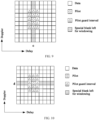
- FIG. 9 is a first schematic diagram of a special mapping manner according to an embodiment of this application. As shown in FIG. 9 , a grid position of a slash shadow is a first implementation of the special mapping manner, that is, a special blank is left for windowing.
- FIG. 10 is a second schematic diagram of a special mapping manner according to an embodiment of this application. As shown in FIG. 10 , a grid position of a slash shadow is a second implementation the special mapping manner, that is, a special blank is left for windowing.
- the performing, by the first communication device, windowing on the second signal in the time-frequency domain includes: performing, by the first communication device, two-dimensional windowing on the second signal in the time-frequency domain.
- windowing weighted processing
- that windowing (weighted processing) is performed in the time-frequency domain may indicate that two-dimensional windowing is performed in the time-frequency domain, where the second signal may be represented by using a two-dimensional matrix.
- the performing, by the first communication device, two-dimensional windowing on the second signal in the time-frequency domain includes:
- point multiplication may be performed on the second signal (a two-dimensional signal, which may be represented by using a matrix) that is converted into the time-frequency domain and the window matrix that has a same dimension as the second signal.
- the second signal a two-dimensional signal, which may be represented by using a matrix
- a signal in the time-frequency domain is X
- a dimension of the signal is M rows and N columns
- M represents a quantity of points in a frequency direction
- N represents a quantity of points in a time direction
- a window matrix is W
- a dimension of the window matrix is also M rows and N columns
- the signal in the time-frequency domain obtained through windowing is represented as X ⁇
- ⁇ represents a matrix point multiplication operation, which is also referred to as symbol-wise multiplication.
- window matrices used for twice windowing may be the same or may be different.
- the window matrix is determined based on a window function.
- the window matrix used for windowing may be determined based on some existing or preset window functions or window functions indicated by the communication peer end or indicated by a high layer.
- a manner of constructing the window matrix by using the window function may be specified in a protocol or preset or indicated by the communication peer end or indicated by a high layer.
- At least one row in all rows of the window matrix includes a target row vector in a time direction, and the target row vector in the time direction is determined based on the window function.
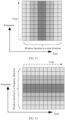
- FIG. 11 is a first schematic diagram of a window matrix according to an embodiment of this application.
- the window matrix may be a matrix obtained by copying a window function in a time direction in a frequency direction.
- the window function in the time direction is W T
- a dimension of the window function is one row and N columns, that is, a row vector.
- At least one column in all columns of the window matrix includes a target column vector in a time direction, and the target column vector in the time direction is determined based on the window function.
- the second signal in the time-frequency domain is X
- a dimension of the second signal is N rows and M columns
- W is a matrix of N rows and M columns
- the second signal in the time-frequency domain obtained through windowing is represented as X ⁇
- W T is a column vector of N rows and one column
- W F is a row vector of one row and M columns.
- each row of the window matrix is a target row vector in a time direction, and the target row vector in the time direction is determined based on the window function.
- a signal in the time-frequency domain is X
- a dimension of the signal is M rows and N columns, where M represents a quantity of points in a frequency direction, and N represents a quantity of points in a time direction
- a window matrix is W
- a dimension of the window matrix is also M rows and N columns
- the second signal in the time-frequency domain obtained through windowing is represented as X ⁇
- each column of the window matrix is a target column vector in a time direction, and the target column vector in the time direction is determined based on the window function.
- the second signal in the time-frequency domain is X
- a dimension of the second signal is N rows and M columns
- W is a matrix of N rows and M columns
- the second signal in the time-frequency domain obtained through windowing is represented as X ⁇
- W T is a column vector of N rows and one column
- W F is a row vector of one row and M columns.
- At least one column in all columns of the window matrix includes a target column vector in a frequency direction, and the target column vector in the frequency direction is determined based on the window function.
- FIG. 12 is a second schematic diagram of a window matrix according to an embodiment of this application.
- the window matrix may be a matrix obtained by copying a window function in a frequency direction in a time direction.
- the window function in the frequency direction is W F
- a dimension of the window function is M rows and one column, that is, a column vector.
- At least one row in all rows of the window matrix includes a target row vector in a frequency direction, and the target row vector in the frequency direction is determined based on the window function.
- the second signal in the time-frequency domain is X
- a dimension of the second signal is N rows and M columns
- W is a matrix of N rows and M columns
- the second signal in the time-frequency domain obtained through windowing is represented as X ⁇
- W T is a column vector of N rows and one column (in the time direction)
- W F is a row vector of one row and M columns (in the frequency direction).
- each column of the window matrix is a target column vector in a frequency direction, and the target column vector in the frequency direction is determined based on the window function.
- a signal in the time-frequency domain is X
- a dimension of the signal is M rows and N columns, where M represents a quantity of points in a frequency direction, and N represents a quantity of points in a time direction
- a window matrix is W
- a dimension of the window matrix is also M rows and N columns
- the second signal in the time-frequency domain obtained through windowing is represented as X ⁇
- each row of the window matrix is a target row vector in a frequency direction, and the target row vector in the frequency direction is determined based on the window function.
- the second signal in the time-frequency domain is X
- a dimension of the second signal is N rows and M columns
- W is a matrix of N rows and M columns
- the second signal in the time-frequency domain obtained through windowing is represented as X ⁇
- W T is a column vector of N rows and one column
- W F is a row vector of one row and M columns.
- the window function includes a row vector in a time direction and a column vector in a frequency direction; and the window matrix is determined based on joint construction of the row vector in the time direction and the column vector in the frequency direction.
- a signal in the time-frequency domain is X
- a dimension of the signal is M rows and N columns, where M represents a quantity of points in a frequency direction, and N represents a quantity of points in a time direction
- a window matrix is W
- a dimension of the window matrix is also M rows and N columns
- the second signal in the time-frequency domain obtained through windowing is represented as X ⁇
- the window matrix is obtained by performing a matrix multiplication operation on the column vector in the frequency direction and the row vector in the time direction.
- FIG. 13 is a third schematic diagram of a window matrix according to an embodiment of this application. As shown in FIG.
- the window function includes a column vector in a time direction and a row vector in a frequency direction; and the window matrix is determined based on joint construction of the column vector in the time direction and the row vector in the frequency direction.
- the second signal in the time-frequency domain is X
- a dimension of the second signal is N rows and M columns
- W is a matrix of N rows and M columns
- the second signal in the time-frequency domain obtained through windowing is represented as X ⁇
- W T is a column vector of N rows and one column
- W F is a row vector of one row and M columns.
- the window matrix is obtained by performing a matrix multiplication operation on the column vector in the time direction and the row vector in the frequency direction.
- the second signal in the time-frequency domain is X
- a dimension of the second signal is N rows and M columns
- W is a matrix of N rows and M columns
- the second signal in the time-frequency domain obtained through windowing is represented as X ⁇
- W T is a column vector of N rows and one column
- W F is a row vector of one row and M columns.
- the window matrix is constructed by using the window function in the time direction, and windowing in the time direction is implemented, thereby effectively overcoming diffusion of the signal, and especially effectively overcoming diffusion of the signal in a Doppler direction.
- the window matrix is constructed by using the window function in the time direction, and windowing in the time direction is implemented, thereby effectively overcoming diffusion of the signal, and especially overcoming diffusion of the signal in a Doppler direction.
- the window matrix is constructed by using the window function in the Doppler direction, and windowing in the Doppler direction is implemented, thereby effectively overcoming diffusion of the signal, and especially effectively overcoming diffusion of the signal in the time direction.
- the time direction is a delay domain direction in the delay-Doppler domain
- the Doppler direction is a Doppler domain direction in the delay-Doppler domain
- the window function is determined based on at least one of the following: a rectangle window, a Gaussian window, a confined Gaussian window, an approximate confined Gaussian window, a Hamming Hamming window, Hanning Hann window, a Bartlett Bartlett window, a triangular window, a Bartlett-Hanning Bartlett-Hann window, a Blackman Blackman window, a Kaiser Kaiser window, a Nuttall Nuttall window, a Blackman-Nuttall Blackman-Nuttall window, a Blackman-Harris Blackman-Harris window, a flat top window, a Basel window, an exponential sine window, an exponential cosine window, and a Dolph-Chebyshev window.
- one window function may be selected from the following window functions, or some window functions may be selected from the following window functions, and then combination window (the combination may be multiplication, addition, weighted addition, or another manner) is performed, to obtain a sum of the window functions: a rectangle window, a Gaussian window, a confined Gaussian window, an approximate confined Gaussian window, a Hamming Hamming window, Hanning Hann window, a Bartlett Bartlett window, a triangular window, a Bartlett-Hanning Bartlett-Hann window, a Blackman Blackman window, a Kaiser Kaiser window, a Nuttall Nuttall window, a Blackman-Nuttall Blackman-Nuttall window, a Blackman-Harris Blackman-Harris window, a flat top window, a Basel window, an exponential sine window, an exponential cosine window, a Dolph-Chebyshev window, and the like.
- parameter information of the window function is predefined in a protocol or preset, and the parameter information is used for at least one of the following:
- the parameter information of the window function may be predefined in a protocol or preset or indicated by the communication peer end or indicated by a high layer, the window function used for constructing the window matrix is determined based on the parameter information, and a manner of constructing the window matrix is determined based on the window function.
- the parameter information of the window function may be predefined in a protocol or preset or indicated by the communication peer end or indicated by a high layer, the window function used for constructing the window matrix is determined based on the parameter information, and a manner of constructing the window matrix determined based on the window function may be preset or learned in any other possible manner. This is not limited in this embodiment of this application.
- the parameter information of the window function may be predefined in a protocol or preset or indicated by the communication peer end or indicated by a high layer, a manner of determining the window matrix based on the window function is determined based on the parameter information, and a specifically used window function may be preset or learned in any other possible manner. This is not limited in this embodiment of this application.
- the parameter information of the window function may be predefined in a protocol or preset or indicated by the communication peer end or indicated by a high layer, the window matrix is directly determined based on the parameter information, and the window function may also be learned while the window matrix is directly learned based on the parameter information, or a construction manner of the window matrix is determined based on the window function, or the window function is learned and a construction manner of the window matrix is determined based on the window function. This is not limited in this embodiment of this application.
- the method further includes: sending, by the first communication device, first signaling to a communication peer end, where the first signaling is used for indicating the parameter information of the window function.
- the first communication device may send the first signaling to the communication peer end to indicate the parameter information of the window function to the communication peer end.
- the communication peer end may learn, based on the first signaling, the window matrix used for windowing and may perform a corresponding operation, for example, windowing or additional window removal.
- the first signaling includes at least one of the following:
- the first signaling may include any one or a combination of a plurality of the following:
- the type of the pilot signal is predefined in a protocol or preset.
- the type of the pilot signal of the second signal in the delay-Doppler domain may include at least of the following: a pilot signal used for demodulation; and a pilot signal used for measuring quality of a physical channel.
- the type of the pilot signal (that is, the pilot signal used for demodulation or the pilot signal used for measuring quality of a physical channel) may be predefined in a protocol or preset.
- the transmit end indicates the pilot to the receive end or the first communication device indicates the pilot to the communication peer end.
- the method further includes: sending, by the first communication device, second signaling to a communication peer end, where the second signaling is used for indicating the type of the pilot signal.
- the first communication device may send the second signaling to the communication peer end to indicate the type of the pilot signal to the communication peer end.
- the communication peer end may learn, based on the second signaling, the type of the pilot signal and may perform a corresponding operation.
- the first signaling and the second signaling may be two signaling that are sent simultaneously or two signaling that are not sent simultaneously.
- the second signaling includes at least one of the following:
- the second signaling may include any one or a combination of a plurality of the following:
- FIG. 14 is a second schematic flowchart of a signal transmission method according to an embodiment of this application. As shown in FIG. 14 , the method includes the following steps.
- Step 1400 A second communication device receives, in time domain, a third signal sent by a first communication device, where the third signal is sent in time domain after the first communication device converts a first signal from a delay-Doppler domain to a time-frequency domain to obtain a second signal and performs windowing on the second signal.
- the second communication device may receive the third signal sent by the first communication device.
- the first communication device is a transmit end of the first signal.
- the first communication device first converts the first signal from the delay-Doppler domain to the time-frequency domain to obtain the second signal, performs windowing on the second signal, and converts the second signal into the third signal in time domain and then sends the third signal.
- the first communication device may be a terminal, and a communication peer end (that is, the second communication device) may be a network side device.
- the transmit end of the first signal may be the first communication device, that is, the terminal, and the receive end of the first signal may be the communication peer end (that is, the second communication device), that is, the network side device.
- the first communication device may be a network side device, and a communication peer end (that is, the second communication device) may be a terminal.
- the transmit end of the first signal may be the first communication device, that is, the network side device, and the receive end of the first signal may be the communication peer end (that is, the second communication device), that is, the terminal.
- the first communication device may be a terminal, and a communication peer end (that is, the second communication device) may be another terminal.
- the transmit end of the first signal may be the first communication device, that is, the terminal, and the receive end of the first signal may be the communication peer end (that is, the second communication device), that is, the another terminal.
- windowing may be performed in the time-frequency domain at at least one time node of before transmission of the first signal and after transmission of the signal, to reduce side lobes of the signal, thereby reducing diffusion of the signal and improving signal transmission performance.
- windowing may be performed in the time-frequency domain at only the transmit end (the first communication device) of the first signal.
- the second communication device does not perform windowing shown in FIG. 8 on a received signal.
- windowing may be performed in the time-frequency domain at both the transmit end and the receive end of the first signal.
- the second communication device may perform a windowing process shown in FIG. 8 .
- the third signal received by the second communication device is the first signal in FIG. 8 . Details are not described herein again.
- the transmit end of the first signal is also a transmit end of the second signal
- the receive end of the first signal is also a receive end of the second signal
- the transmission process of the first signal may be understood as a transmission process of the same information content included in the first signal and the second signal.
- windowing is performed on a transmitted signal in the time-frequency domain at the transmit side of the first signal, to effectively reduce a side lobe of signal transmission, thereby reducing diffusion of the signal and improving signal transmission performance.
- the method further includes: in a case that a pilot signal of the second signal in the delay-Doppler domain is a pilot signal used for measuring quality of a physical channel, removing, by the second communication device, an impact of the windowing on the pilot signal.
- the second communication device may remove an impact of the windowing on the pilot signal by using an algorithm, for example, by using a window matrix pointwise division algorithm.
- the method further includes:
- the second communication device may learn, based on the first signaling, the window matrix used for windowing and may perform a corresponding operation, for example, windowing or additional window removal.
- the second communication device may obtain the parameter information of the window function, determine, based on the parameter information, the window function used for constructing the window matrix, and determine a construction manner of the window matrix based on the window function; and further determine the window matrix based on the window function and the construction manner of the window matrix.
- the second communication device may obtain the parameter information of the window function, and determine, based on the parameter information, the window function used for constructing the window matrix.
- a manner of determining the window matrix based on the window function may be preset or learned in any other possible manner. This is not limited in this embodiment of this application. Further, the window matrix may be determined based on the window function and the construction manner of the window matrix.
- the second communication device may obtain the parameter information of the window function, directly determine the window matrix based on the parameter information, and may further learn the window function while learning the window matrix based on the parameter information, or determine a construction manner of the window matrix based on the window function, or learn the window function and determine a construction manner of the window matrix based on the window function. This is not limited in this embodiment of this application.
- the method further includes:
- the second communication device may learn, based on the second signaling, the type of the pilot signal and may perform a corresponding operation.
- the type of the pilot signal of the second signal in the delay-Doppler domain may include at least of the following: a pilot signal used for demodulation; and a pilot signal used for measuring quality of a physical channel.
- windowing is performed on a transmitted signal in the time-frequency domain at the transmit side of the first signal, to effectively reduce a side lobe of signal transmission, thereby reducing diffusion of the signal and improving signal transmission performance.
- the signal transmission method provided in the embodiments of this application may be performed by a signal transmission apparatus or a control module configured to perform the signal transmission method in the signal transmission apparatus.
- the signal transmission apparatus provided in this embodiment of this application is described by using an example in which the signal transmission apparatus executes the signal transmission method.
- the conversion module 1510 is configured to convert a first signal into a time-frequency domain to obtain a second signal.
- the processing module 1520 is configured to perform windowing on the second signal in the time-frequency domain, where
- the signal transmission apparatus may convert the first signal into the time-frequency domain through the conversion module 1510 to obtain the second signal, and perform windowing on the second signal in the time-frequency domain through the processing module 1520.
- the first signal may be converted from the delay-Doppler domain to the time-frequency domain through the conversion module 1510, and then windowing is performed on the second signal in the time-frequency domain through the processing module 1520, and finally the second signal is converted into time domain and is sent.
- the first signal may be received in time domain, then the first signal is converted from time domain to the time-frequency domain through the conversion module 1510, then windowing is performed on the second signal in the time-frequency domain through the processing module 1520, and finally the second signal is converted into the delay-Doppler domain.
- windowing is performed on a transmitted signal in the time-frequency domain at at least one of the receive side and the transmit side of the first signal, to effectively reduce a side lobe of signal transmission, thereby reducing diffusion of the signal and improving signal transmission performance.
- the processing module is further configured to: performing, by the first communication device, windowing on the second signal in the time-frequency domain based on a type of a pilot signal of the second signal in the delay-Doppler domain.
- the processing module is further configured to: in a case that the pilot signal is a pilot signal used for demodulation, performing, by the first communication device, windowing on the second signal in the time-frequency domain.
- processing module is further configured to:
- the processing module is further configured to: in a case that the pilot signal is a pilot signal used for measuring quality of a physical channel, performing, by the first communication device, windowing on the second signal in the time-frequency domain.
- the pilot signal is a pilot signal used for measuring quality of a physical channel
- a mapping manner of the second signal in the delay-Doppler domain is a special mapping manner.
- the special mapping manner includes skipping placing a data signal and the pilot signal at a first grid position in the delay-Doppler domain.
- the first grid position includes at least one of the following:
- the first grid position includes at least one of the following:
- the processing module is further configured to: performing, by the first communication device, two-dimensional windowing on the second signal in the time-frequency domain.
- the window matrix is determined based on a window function.
- At least one row in all rows of the window matrix includes a target row vector in a time direction, and the target row vector in the time direction is determined based on the window function.
- At least one column in all columns of the window matrix includes a target column vector in a time direction, and the target column vector in the time direction is determined based on the window function.
- each row of the window matrix is a target row vector in a time direction, and the target row vector in the time direction is determined based on the window function.
- each column of the window matrix is a target column vector in a time direction, and the target column vector in the time direction is determined based on the window function.
- At least one row in all rows of the window matrix includes a target row vector in a frequency direction, and the target row vector in the frequency direction is determined based on the window function.
- each column of the window matrix is a target column vector in a frequency direction, and the target column vector in the frequency direction is determined based on the window function.
- each row of the window matrix is a target row vector in a frequency direction, and the target row vector in the frequency direction is determined based on the window function.
- the window function includes a row vector in a time direction and a column vector in a frequency direction; and the window matrix is determined based on joint construction of the row vector in the time direction and the column vector in the frequency direction.
- the window matrix is obtained by performing a matrix multiplication operation on the column vector in the frequency direction and the row vector in the time direction.
- the window function includes a column vector in a time direction and a row vector in a frequency direction; and the window matrix is determined based on joint construction of the column vector in the time direction and the row vector in the frequency direction.
- the window matrix is obtained by performing a matrix multiplication operation on the column vector in the time direction and the row vector in the frequency direction.
- the window function is determined based on at least one of the following: a rectangle window, a Gaussian window, a confined Gaussian window, an approximate confined Gaussian window, a Hamming Hamming window, Hanning Hann window, a Bartlett Bartlett window, a triangular window, a Bartlett-Hanning Bartlett-Hann window, a Blackman Blackman window, a Kaiser Kaiser window, a Nuttall Nuttall window, a Blackman-Nuttall Blackman-Nuttall window, a Blackman-Harris Blackman-Harris window, a flat top window, a Basel window, an exponential sine window, an exponential cosine window, and a Dolph-Chebyshev window.
- parameter information of the window function is predefined in a protocol or preset, and the parameter information is used for at least one of the following:
- the apparatus further includes: a first sending module, configured to send first signaling to a communication peer end, where the first signaling is used for indicating the parameter information of the window function.
- a first sending module configured to send first signaling to a communication peer end, where the first signaling is used for indicating the parameter information of the window function.
- the first signaling includes at least one of the following:
- the apparatus further includes: a second sending module, configured to send second signaling to a communication peer end, where the second signaling is used for indicating the type of the pilot signal.
- a second sending module configured to send second signaling to a communication peer end, where the second signaling is used for indicating the type of the pilot signal.
- the second signaling includes at least one of the following:
- windowing is performed on a transmitted signal in the time-frequency domain at at least one of the receive side and the transmit side of the first signal, to effectively reduce a side lobe of signal transmission, thereby reducing diffusion of the signal and improving signal transmission performance.
- the signal transmission apparatus in this embodiment of this application may be an apparatus, an apparatus or an electronic device having an operating system, or may be a component, an integrated circuit, or a chip in a terminal.
- the apparatus or the electronic device may be a mobile terminal or may be a non-mobile terminal.
- the mobile terminal may include, but not limited to, a type of the terminal 11 listed above.
- the non-mobile terminal may be a server, a network attached storage (Network Attached Storage, NAS), a personal computer (personal computer, PC), a television (television, TV), a teller machine, a self-service machine, or the like. This is not specifically limited in this embodiment of this application.
- the signal transmission apparatus provided in this embodiment of this application can implement the processes implemented in the method embodiments of FIG. 2 to FIG. 14 and achieves the same technical effects. To avoid repetition, details are not described herein again.
- FIG. 16 is a second schematic structural diagram of a signal transmission apparatus according to an embodiment of this application. As shown in FIG. 16 , the apparatus includes: a first receiving module 1610.
- the first receiving module 1610 is configured to receive, in time domain, a third signal sent by a first communication device, where the third signal is sent in time domain after the first communication device converts a first signal from a delay-Doppler domain to a time-frequency domain to obtain a second signal and performs windowing on the second signal.
- the signal transmission apparatus may receive, through the first receiving module 1610 in time domain, the second signal sent in time domain after the transmit end of the first signal converts the first signal from the delay-Doppler domain to the time-frequency domain.
- the apparatus further includes:
- the apparatus further includes:
- windowing is performed on a transmitted signal in the time-frequency domain at the transmit side of the first signal, and then the signal is received at a communication peer side, to effectively reduce a side lobe of signal transmission, thereby reducing diffusion of the signal and improving signal transmission performance.
- the signal transmission apparatus provided in this embodiment of this application can implement the processes implemented in the method embodiments of FIG. 2 to FIG. 14 and achieves the same technical effects. To avoid repetition, details are not described herein again.
- FIG. 17 is a schematic structural diagram of a communication device according to an embodiment of this application.
- this embodiment of this application further provides a communication device 1700, including a processor 1701, a memory 1702, and programs or instructions stored on the memory 1702 and executable on the processor 1701.
- the communication device 1700 is a terminal
- the programs or the instructions are executed by the processor 1701 to implement each process of the foregoing embodiments of the signal transmission method, and the same technical effects can be achieved.
- the communication device 1700 is a network side device
- the programs or the instructions are executed by the processors 1701 to implement each process of the foregoing embodiments of the signal transmission method, and the same technical effect can be achieved. To avoid repetition, details are not repeated herein.
- An embodiment of this application further provides a communication device, including a processor and a communication interface, where the processor is configured to:
- the first communication apparatus may be a network side device, and the second communication device may be a terminal.
- the first communication device may be a terminal
- the second communication device may be a terminal
- the terminal 1800 includes, but not limited to, at least some components of a radio frequency unit 1801, a network module 1802, an audio output unit 1803, an input unit 1804, a sensor 1805, a display unit 1806, a user input unit 1807, an interface unit 1808, a memory 1809, a processor 1810, and the like.
- the terminal 1800 may further include a power supply (for example, a battery) for supplying power to the components.
- the power supply may logically connect to the processor 1810 by a power supply management system, thereby implementing functions, such as charging, discharging, and power consumption management, by using the power supply management system.
- a terminal structure shown in FIG. 18 does not constitute a limitation to the terminal, and the terminal may include more or fewer components than those shown in the figure, or some components may be combined, or a different component deployment may be used. Details are not described herein again.
- the input unit 1804 may include a graphics processing unit (Graphics Processing Unit, GPU) 18041 and a microphone 18042.
- the graphics processing unit 18041 performs processing on image data of a static picture or a video that is obtained by an image acquisition device (for example, a camera) in a video acquisition mode or an image acquisition mode.
- the display unit 1806 may include a display panel 18061, for example, the display panel 18061 configured in a form such as a liquid crystal display or an organic light-emitting diode.
- the user input unit 1807 includes a touch panel 18071 and another input device 18072.
- the touch panel 18071 is also referred to as a touchscreen.
- the memory 1809 may be configured to store a software program or instructions and various data.
- the memory 1809 may mainly include a program or instruction storage area and a data storage area.
- the program or instruction storage area may store an operating system, an application program or instruction required by at least one function (for example, a sound playback function and an image display function), and the like.
- the memory 1809 may include a high speed random access memory, and may further include a non-volatile memory.
- the processor 1810 may include one or more processing units.
- the processor 1810 may integrate an application processor and a modem processor.
- the application processor mainly processes an operating system, a user interface, an application program or instructions, and the like.
- the modem processor mainly processes wireless communication, for example, a baseband processor. It may be understood that the foregoing modem processor may either not be integrated into the processor 1810.
- the processor 1810 is configured to:
- the processor 1810 is configured to: perform windowing on the second signal in the time-frequency domain based on a type of a pilot signal of the second signal in the delay-Doppler domain.
- the processor 1810 is configured to: in a case that the pilot signal is a pilot signal used for demodulation, perform windowing on the second signal in the time-frequency domain.
- the processor 1810 is configured to:
- the processor 1810 is configured to: in a case that the pilot signal is a pilot signal used for measuring quality of a physical channel, perform windowing on the second signal in the time-frequency domain.
- a mapping manner of the second signal in the delay-Doppler domain is a special mapping manner.
- the special mapping manner includes skipping placing a data signal and the pilot signal at a first grid position in the delay-Doppler domain.
- the first grid position includes at least one of the following:
- the first grid position includes at least one of the following:
- the processor 1810 is configured to: perform two-dimensional windowing on the second signal in the time-frequency domain.
- the processor 1810 is configured to:
- the window matrix is determined based on a window function.
- At least one row in all rows of the window matrix includes a target row vector in a time direction, and the target row vector in the time direction is determined based on the window function.
- At least one column in all columns of the window matrix includes a target column vector in a time direction, and the target column vector in the time direction is determined based on the window function.
- each row of the window matrix is a target row vector in a time direction, and the target row vector in the time direction is determined based on the window function.
- each column of the window matrix is a target column vector in a time direction, and the target column vector in the time direction is determined based on the window function.
- At least one column in all columns of the window matrix includes a target column vector in a frequency direction, and the target column vector in the frequency direction is determined based on the window function.
- At least one row in all rows of the window matrix includes a target row vector in a frequency direction, and the target row vector in the frequency direction is determined based on the window function.
- each column of the window matrix is a target column vector in a frequency direction, and the target column vector in the frequency direction is determined based on the window function.
- each row of the window matrix is a target row vector in a frequency direction, and the target row vector in the frequency direction is determined based on the window function.
- the window function includes a row vector in a time direction and a column vector in a frequency direction; and the window matrix is determined based on joint construction of the row vector in the time direction and the column vector in the frequency direction.
- the window matrix is obtained by performing a matrix multiplication operation on the column vector in the frequency direction and the row vector in the time direction.
- the window function includes a column vector in a time direction and a row vector in a frequency direction; and the window matrix is determined based on joint construction of the column vector in the time direction and the row vector in the frequency direction.
- the window matrix is obtained by performing a matrix multiplication operation on the column vector in the time direction and the row vector in the frequency direction.
- the window function is determined based on at least one of the following: a rectangle window, a Gaussian window, a confined Gaussian window, an approximate confined Gaussian window, a Hamming Hamming window, Hanning Hann window, a Bartlett Bartlett window, a triangular window, a Bartlett-Hanning Bartlett-Hann window, a Blackman Blackman window, a Kaiser Kaiser window, a Nuttall Nuttall window, a Blackman-Nuttall Blackman-Nuttall window, a Blackman-Harris Blackman-Harris window, a flat top window, a Basel window, an exponential sine window, an exponential cosine window, and a Dolph-Chebyshev window.
- parameter information of the window function is predefined in a protocol or preset, and the parameter information is used for at least one of the following:
- the processor 1810 is configured to: send first signaling to a communication peer end, where the first signaling is used for indicating the parameter information of the window function.
- the first signaling includes at least one of the following:
- the type of the pilot signal is predefined in a protocol or preset.
- the processor 1810 is configured to: send second signaling to a communication peer end, where the second signaling is used for indicating the type of the pilot signal.
- the second signaling includes at least one of the following:
- windowing is performed on a transmitted signal in the time-frequency domain at at least one of the receive side and the transmit side of the first signal, to effectively reduce a side lobe of signal transmission, thereby reducing diffusion of the signal and improving signal transmission performance.
- the processor 1810 is configured to:
- windowing is performed on a transmitted signal in the time-frequency domain at the transmit side of the first signal, and then the signal is received at a communication peer side, to effectively reduce a side lobe of signal transmission, thereby reducing diffusion of the signal and improving signal transmission performance.
- the processor 1810 is configured to: in a case that the pilot signal of the second signal in the delay-Doppler domain is a pilot signal used for measuring quality of a physical channel, remove an impact of the windowing on the pilot signal.
- the processor 1810 is configured to:
- the processor 1810 is configured to:
- windowing is performed on a transmitted signal in the time-frequency domain at the transmit side of the first signal, and then the signal is received at a communication peer side, to effectively reduce a side lobe of signal transmission, thereby reducing diffusion of the signal and improving signal transmission performance.
- An embodiment of this application further provides a communication device, including a processor and a communication interface, where the communication interface is configured to:
- the communication device embodiment corresponds to the method embodiment of the second communication device, and each implementation process and implementation of the method embodiments are applicable to the communication device embodiment and can achieve the same technical effect.
- the first communication device may be a terminal
- the second communication device may be a network side device.
- the first communication apparatus may be a network side device, and the second communication device may be a terminal.
- the first communication device may be a terminal
- the second communication device may be a terminal
- FIG. 19 is a schematic structural diagram of a network side device according to an embodiment of this application.
- the network side device 1900 includes an antenna 1901, a radio frequency apparatus 1902, and a baseband apparatus 1903.
- the antenna 1901 is connected to the radio frequency apparatus 1902.
- the radio frequency apparatus 1902 receives, by using the antenna 1901, information, and sends the received information to the baseband apparatus 1903 for processing.
- the baseband apparatus 1903 processes to-be-sent information, and sends the information to the radio frequency apparatus 1902.
- the radio frequency apparatus 1902 processes the received information and sends out the information by using the antenna 1901.
- the frequency band processing apparatus may be located in the baseband apparatus 1903, the methods performed by the network-side device in the foregoing embodiments may be implemented in the baseband apparatus 1903, and the baseband apparatus 1903 includes a processor 1904 and a memory 1905.
- the baseband apparatus 1903 may include, for example, at least one baseband plate.
- a plurality of chips are disposed on the baseband plate. As shown in FIG. 19 , one of the plurality of chips is, for example, the processor 1904, and is connected to the memory 1905, to invoke a program in the memory 1905 to perform operations of the network device in the foregoing method embodiment.
- the baseband apparatus 1903 may further include a network interface 1906, configured to exchange information with the radio frequency apparatus 1902.
- the interface is, for example, a common public radio interface (common public radio interface, CPRI).
- the network side device in this embodiment of the present invention further includes: instructions or programs stored on the memory 1905 and executable on the processor 1904, the processor 1904 invokes the instructions or programs in the memory 1905 to perform the methods performed by the modules in FIG. 14 or FIG. 15 , and the same technical effects are achieved. To avoid repetitions, details are not described herein again.
- the processor 1904 is configured to:
- windowing is performed on a transmitted signal in the time-frequency domain at at least one of the receive side and the transmit side of the first signal, to effectively reduce a side lobe of signal transmission, thereby reducing diffusion of the signal and improving signal transmission performance.
- the processor 1904 is configured to: perform windowing on the second signal in the time-frequency domain based on a type of a pilot signal of the second signal in the delay-Doppler domain.
- the processor 1904 is configured to: in a case that the pilot signal is a pilot signal used for demodulation, perform windowing on the second signal in the time-frequency domain.
- the processor 1904 is configured to:
- the processor 1904 is configured to: in a case that the pilot signal is a pilot signal used for measuring quality of a physical channel, performing, by the first communication device, windowing on the second signal in the time-frequency domain.
- a mapping manner of the second signal in the delay-Doppler domain is a special mapping manner.
- the special mapping manner includes skipping placing a data signal and the pilot signal at a first grid position in the delay-Doppler domain.
- the first grid position includes at least one of the following:
- the first grid position includes at least one of the following:
- the processor 1904 is configured to: perform two-dimensional windowing on the second signal in the time-frequency domain.
- the processor 1904 is configured to:
- the window matrix is determined based on a window function.
- At least one row in all rows of the window matrix includes a target row vector in a time direction, and the target row vector in the time direction is determined based on the window function.
- At least one column in all columns of the window matrix includes a target column vector in a time direction, and the target column vector in the time direction is determined based on the window function.
- each row of the window matrix is a target row vector in a time direction, and the target row vector in the time direction is determined based on the window function.
- each column of the window matrix is a target column vector in a time direction, and the target column vector in the time direction is determined based on the window function.
- At least one column in all columns of the window matrix includes a target column vector in a frequency direction, and the target column vector in the frequency direction is determined based on the window function.
- At least one row in all rows of the window matrix includes a target row vector in a frequency direction, and the target row vector in the frequency direction is determined based on the window function.
- each column of the window matrix is a target column vector in a frequency direction, and the target column vector in the frequency direction is determined based on the window function.
- each row of the window matrix is a target row vector in a frequency direction, and the target row vector in the frequency direction is determined based on the window function.
- the window function includes a row vector in a time direction and a column vector in a frequency direction; and the window matrix is determined based on joint construction of the row vector in the time direction and the column vector in the frequency direction.
- the window matrix is obtained by performing a matrix multiplication operation on the column vector in the frequency direction and the row vector in the time direction.
- the window function includes a column vector in a time direction and a row vector in a frequency direction; and the window matrix is determined based on joint construction of the column vector in the time direction and the row vector in the frequency direction.
- the window matrix is obtained by performing a matrix multiplication operation on the column vector in the time direction and the row vector in the frequency direction.
- the window function is determined based on at least one of the following: a rectangle window, a Gaussian window, a confined Gaussian window, an approximate confined Gaussian window, a Hamming Hamming window, Hanning Hann window, a Bartlett Bartlett window, a triangular window, a Bartlett-Hanning Bartlett-Hann window, a Blackman Blackman window, a Kaiser Kaiser window, a Nuttall Nuttall window, a Blackman-Nuttall Blackman-Nuttall window, a Blackman-Harris Blackman-Harris window, a flat top window, a Basel window, an exponential sine window, an exponential cosine window, and a Dolph-Chebyshev window.
- parameter information of the window function is predefined in a protocol or preset, and the parameter information is used for at least one of the following:
- the processor 1904 is configured to: send first signaling to a communication peer end, where the first signaling is used for indicating the parameter information of the window function.
- the first signaling includes at least one of the following:
- the type of the pilot signal is predefined in a protocol or preset.
- the processor 1904 is configured to: send second signaling to a communication peer end, where the second signaling is used for indicating the type of the pilot signal.
- the second signaling includes at least one of the following:
- windowing is performed on a transmitted signal in the time-frequency domain at at least one of the receive side and the transmit side of the first signal, to effectively reduce a side lobe of signal transmission, thereby reducing diffusion of the signal and improving signal transmission performance.
- the processor 1904 is configured to:
- windowing is performed on a transmitted signal in the time-frequency domain at the transmit side of the first signal, and then the signal is received at a communication peer side, to effectively reduce a side lobe of signal transmission, thereby reducing diffusion of the signal and improving signal transmission performance.
- the processor 1904 is configured to: in a case that the pilot signal of the second signal in the delay-Doppler domain is a pilot signal used for measuring quality of a physical channel, remove an impact of the windowing on the pilot signal.
- the processor 1904 is configured to:
- the processor 1904 is configured to:
- windowing is performed on a transmitted signal in the time-frequency domain at the transmit side of the first signal, and then the signal is received at a communication peer side, to effectively reduce a side lobe of signal transmission, thereby reducing diffusion of the signal and improving signal transmission performance.
- An embodiment of this application further provides a readable storage medium, storing programs or instructions, where the programs or the instructions are executed by a processor to implement each process of the foregoing embodiments of the signal transmission method, and the same technical effect can be achieved. To avoid repetition, details are not repeated herein.
- the processor is the processor in the terminal in the foregoing embodiment.
- the readable storage medium includes a computer-readable storage medium such as a computer read-only memory (Read-Only Memory, ROM), a random access memory (Random Access Memory, RAM), a magnetic disk, or an optical disc.
- An embodiment of this application further provides a chip, including a processor and a communication interface, where the communication interface is coupled to the processor, and the processor is configured to run programs or the instructions, to implement each process of the foregoing embodiments of the signal transmission method, and the same technical effect can be achieved. To avoid repetition, details are not repeated herein.
- the chip mentioned in this embodiment of this application may also be referred to as a system-level chip, a system chip, a chip system, a system on chip, or the like.
- An embodiment of this application further provides a computer program/program product, stored in a non-volatile storage medium, where the program/program product is executed by at least one processor to implement each process of the method embodiments reported by the system message, and the same technical effect can be achieved. To avoid repetition, details are not repeated herein.
- the methods in the foregoing embodiments may be implemented by means of software and a necessary general hardware platform, and certainly, may also be implemented by hardware, but in many cases, the former manner is a better implementation.
- the technical solutions of this application essentially or the part contributing to the related art may be implemented in the form of a computer software product.
- the computer software product is stored in a storage medium (such as a ROM/RAM, a magnetic disk, or an optical disc), and includes several instructions for instructing a terminal (which may be a mobile phone, a computer, a server, a network device, or the like) to perform the method described in the embodiments of this application.
Landscapes
- Engineering & Computer Science (AREA)
- Signal Processing (AREA)
- Computer Networks & Wireless Communication (AREA)
- Physics & Mathematics (AREA)
- Discrete Mathematics (AREA)
- General Physics & Mathematics (AREA)
- Mobile Radio Communication Systems (AREA)
Applications Claiming Priority (2)
| Application Number | Priority Date | Filing Date | Title |
|---|---|---|---|
| CN202111071208.9A CN115811386B (zh) | 2021-09-13 | 2021-09-13 | 信号传输方法、装置、设备及存储介质 |
| PCT/CN2022/117756 WO2023036226A1 (zh) | 2021-09-13 | 2022-09-08 | 信号传输方法、装置、设备及存储介质 |
Publications (2)
| Publication Number | Publication Date |
|---|---|
| EP4404490A1 true EP4404490A1 (de) | 2024-07-24 |
| EP4404490A4 EP4404490A4 (de) | 2025-02-26 |
Family
ID=85481339
Family Applications (1)
| Application Number | Title | Priority Date | Filing Date |
|---|---|---|---|
| EP22866689.7A Pending EP4404490A4 (de) | 2021-09-13 | 2022-09-08 | Signalübertragungsverfahren und -vorrichtung, vorrichtung und speichermedium |
Country Status (5)
| Country | Link |
|---|---|
| US (1) | US20240223319A1 (de) |
| EP (1) | EP4404490A4 (de) |
| JP (1) | JP2024535024A (de) |
| CN (1) | CN115811386B (de) |
| WO (1) | WO2023036226A1 (de) |
Families Citing this family (3)
| Publication number | Priority date | Publication date | Assignee | Title |
|---|---|---|---|---|
| US12388680B2 (en) * | 2022-05-17 | 2025-08-12 | The Indian Institute Of Technology Kharagpur | Method and system for pilot design and channel estimation in presence of nonlinearity in the delay-doppler domain for mmWave OTFS systems |
| CN116915550A (zh) * | 2023-06-12 | 2023-10-20 | 哈尔滨工业大学 | 一种基于加窗处理的mimo-otfs信道估计方法 |
| CN117813888A (zh) * | 2023-11-09 | 2024-04-02 | 北京小米移动软件有限公司 | Otfs的资源配置方法、装置及存储介质 |
Family Cites Families (10)
| Publication number | Priority date | Publication date | Assignee | Title |
|---|---|---|---|---|
| JP2007235201A (ja) * | 2006-02-27 | 2007-09-13 | Toshiba Corp | 基地局および無線通信方法 |
| US8111787B2 (en) * | 2008-11-05 | 2012-02-07 | Telefonaktiebolaget L M Ericsson (Publ) | OFDM channel estimation method and apparatus |
| US10411843B2 (en) * | 2012-06-25 | 2019-09-10 | Cohere Technologies, Inc. | Orthogonal time frequency space communication system compatible with OFDM |
| CN108781160B (zh) * | 2015-11-18 | 2022-04-29 | 凝聚技术公司 | 正交时间频率空间调制技术 |
| WO2017165697A1 (en) * | 2016-03-23 | 2017-09-28 | Cohere Technologies | Receiver-side processing of orthogonal time frequency space modulated signals |
| WO2017173160A1 (en) * | 2016-03-31 | 2017-10-05 | Cohere Technologies | Channel acquisition using orthogonal time frequency space modulated pilot signal |
| CN110677361B (zh) * | 2019-08-28 | 2020-08-28 | 北京邮电大学 | 正交时频空系统的信号均衡方法、均衡器及存储介质 |
| CN110730145B (zh) * | 2019-09-02 | 2021-01-08 | 北京邮电大学 | 一种正交时频空系统线性均衡方法、装置与电子设备 |
| CN110677359A (zh) * | 2019-09-03 | 2020-01-10 | 北京邮电大学 | 正交时频空系统的信号接收方法、接收装置及存储介质 |
| CN112202479A (zh) * | 2020-08-19 | 2021-01-08 | 北京邮电大学 | 多入多出-正交时频空系统的低复杂度信号检测方法 |
-
2021
- 2021-09-13 CN CN202111071208.9A patent/CN115811386B/zh active Active
-
2022
- 2022-09-08 WO PCT/CN2022/117756 patent/WO2023036226A1/zh not_active Ceased
- 2022-09-08 EP EP22866689.7A patent/EP4404490A4/de active Pending
- 2022-09-08 JP JP2024516484A patent/JP2024535024A/ja active Pending
-
2024
- 2024-03-12 US US18/602,896 patent/US20240223319A1/en active Pending
Also Published As
| Publication number | Publication date |
|---|---|
| US20240223319A1 (en) | 2024-07-04 |
| JP2024535024A (ja) | 2024-09-26 |
| CN115811386B (zh) | 2025-10-28 |
| WO2023036226A1 (zh) | 2023-03-16 |
| EP4404490A4 (de) | 2025-02-26 |
| CN115811386A (zh) | 2023-03-17 |
Similar Documents
| Publication | Publication Date | Title |
|---|---|---|
| EP4294083B1 (de) | Zugriffsverfahren und -vorrichtung sowie kommunikationsvorrichtung und lesbares speichermedium | |
| US20230224115A1 (en) | Pilot Reception Processing Method, Pilot Transmission Method, and Related Device | |
| US20240223319A1 (en) | Signal Transmission Method and Device | |
| EP4195601A1 (de) | Datensendeverfahren, datenempfangs- und verarbeitungsverfahren und zugehörige vorrichtung | |
| US12604304B2 (en) | Beam control method and apparatus for intelligent surface device and electronic device | |
| US20230318894A1 (en) | Pilot transmission method and apparatus, network side device, and storage medium | |
| EP4451580A1 (de) | Interferenzmessverfahren und -vorrichtung, vorrichtung und speichermedium | |
| EP4387179A1 (de) | Verfahren und vorrichtung zur datenübertragungsverarbeitung, kommunikationsvorrichtung und speichermedium | |
| US12231281B2 (en) | Frame structure indication method, frame structure updating method, and related device | |
| CN115001644B (zh) | 同步信号传输方法、装置、设备及存储介质 | |
| WO2023040956A1 (zh) | 映射方法、装置、设备及存储介质 | |
| US20240146359A1 (en) | Transmission processing method and apparatus, communication device, and readable storage medium | |
| CN116866132A (zh) | 信号传输方法、装置、发送端设备及接收端设备 | |
| WO2024240037A1 (zh) | 信号传输方法、装置、信号发送设备及信号接收设备 | |
| CN118174998A (zh) | 信号发送方法、信号接收方法及设备 |
Legal Events
| Date | Code | Title | Description |
|---|---|---|---|
| STAA | Information on the status of an ep patent application or granted ep patent |
Free format text: STATUS: THE INTERNATIONAL PUBLICATION HAS BEEN MADE |
|
| PUAI | Public reference made under article 153(3) epc to a published international application that has entered the european phase |
Free format text: ORIGINAL CODE: 0009012 |
|
| STAA | Information on the status of an ep patent application or granted ep patent |
Free format text: STATUS: REQUEST FOR EXAMINATION WAS MADE |
|
| 17P | Request for examination filed |
Effective date: 20240411 |
|
| AK | Designated contracting states |
Kind code of ref document: A1 Designated state(s): AL AT BE BG CH CY CZ DE DK EE ES FI FR GB GR HR HU IE IS IT LI LT LU LV MC MK MT NL NO PL PT RO RS SE SI SK SM TR |
|
| DAV | Request for validation of the european patent (deleted) | ||
| DAX | Request for extension of the european patent (deleted) | ||
| A4 | Supplementary search report drawn up and despatched |
Effective date: 20250124 |
|
| RIC1 | Information provided on ipc code assigned before grant |
Ipc: H04L 27/26 20060101ALI20250120BHEP Ipc: H04L 5/00 20060101AFI20250120BHEP |