EP4404420A1 - Übertragungsende für drahtloses laden, ladebasis und system - Google Patents
Übertragungsende für drahtloses laden, ladebasis und system Download PDFInfo
- Publication number
- EP4404420A1 EP4404420A1 EP22921743.5A EP22921743A EP4404420A1 EP 4404420 A1 EP4404420 A1 EP 4404420A1 EP 22921743 A EP22921743 A EP 22921743A EP 4404420 A1 EP4404420 A1 EP 4404420A1
- Authority
- EP
- European Patent Office
- Prior art keywords
- transmitting
- transmitting coil
- terminal
- working
- coils
- Prior art date
- Legal status (The legal status is an assumption and is not a legal conclusion. Google has not performed a legal analysis and makes no representation as to the accuracy of the status listed.)
- Pending
Links
Images




Classifications
-
- H—ELECTRICITY
- H02—GENERATION; CONVERSION OR DISTRIBUTION OF ELECTRIC POWER
- H02J—ELECTRIC POWER NETWORKS; CIRCUIT ARRANGEMENTS OR SYSTEMS FOR SUPPLYING OR DISTRIBUTING ELECTRIC POWER; SYSTEMS FOR STORING ELECTRIC ENERGY
- H02J50/00—Circuit arrangements or systems for wireless supply or distribution of electric power
- H02J50/40—Circuit arrangements or systems for wireless supply or distribution of electric power using two or more transmitting or receiving devices
- H02J50/402—Circuit arrangements or systems for wireless supply or distribution of electric power using two or more transmitting or receiving devices the two or more transmitting or the two or more receiving devices being integrated in the same unit, e.g. power mats with several coils or antennas with several sub-antennas
-
- H—ELECTRICITY
- H02—GENERATION; CONVERSION OR DISTRIBUTION OF ELECTRIC POWER
- H02J—ELECTRIC POWER NETWORKS; CIRCUIT ARRANGEMENTS OR SYSTEMS FOR SUPPLYING OR DISTRIBUTING ELECTRIC POWER; SYSTEMS FOR STORING ELECTRIC ENERGY
- H02J50/00—Circuit arrangements or systems for wireless supply or distribution of electric power
- H02J50/10—Circuit arrangements or systems for wireless supply or distribution of electric power using inductive coupling
- H02J50/12—Circuit arrangements or systems for wireless supply or distribution of electric power using inductive coupling of the resonant type
-
- H—ELECTRICITY
- H02—GENERATION; CONVERSION OR DISTRIBUTION OF ELECTRIC POWER
- H02J—ELECTRIC POWER NETWORKS; CIRCUIT ARRANGEMENTS OR SYSTEMS FOR SUPPLYING OR DISTRIBUTING ELECTRIC POWER; SYSTEMS FOR STORING ELECTRIC ENERGY
- H02J50/00—Circuit arrangements or systems for wireless supply or distribution of electric power
- H02J50/005—Mechanical details of housing or structure aiming to accommodate the power transfer means, e.g. mechanical integration of coils, antennas or transducers into emitting or receiving devices
-
- H—ELECTRICITY
- H02—GENERATION; CONVERSION OR DISTRIBUTION OF ELECTRIC POWER
- H02J—ELECTRIC POWER NETWORKS; CIRCUIT ARRANGEMENTS OR SYSTEMS FOR SUPPLYING OR DISTRIBUTING ELECTRIC POWER; SYSTEMS FOR STORING ELECTRIC ENERGY
- H02J50/00—Circuit arrangements or systems for wireless supply or distribution of electric power
- H02J50/70—Circuit arrangements or systems for wireless supply or distribution of electric power involving the reduction of electric, magnetic or electromagnetic leakage fields
-
- H—ELECTRICITY
- H02—GENERATION; CONVERSION OR DISTRIBUTION OF ELECTRIC POWER
- H02J—ELECTRIC POWER NETWORKS; CIRCUIT ARRANGEMENTS OR SYSTEMS FOR SUPPLYING OR DISTRIBUTING ELECTRIC POWER; SYSTEMS FOR STORING ELECTRIC ENERGY
- H02J7/00—Circuit arrangements for charging or discharging batteries or for supplying loads from batteries
- H02J7/60—Circuit arrangements for charging or discharging batteries or for supplying loads from batteries including safety or protection arrangements
-
- Y—GENERAL TAGGING OF NEW TECHNOLOGICAL DEVELOPMENTS; GENERAL TAGGING OF CROSS-SECTIONAL TECHNOLOGIES SPANNING OVER SEVERAL SECTIONS OF THE IPC; TECHNICAL SUBJECTS COVERED BY FORMER USPC CROSS-REFERENCE ART COLLECTIONS [XRACs] AND DIGESTS
- Y02—TECHNOLOGIES OR APPLICATIONS FOR MITIGATION OR ADAPTATION AGAINST CLIMATE CHANGE
- Y02T—CLIMATE CHANGE MITIGATION TECHNOLOGIES RELATED TO TRANSPORTATION
- Y02T10/00—Road transport of goods or passengers
- Y02T10/60—Other road transportation technologies with climate change mitigation effect
- Y02T10/70—Energy storage systems for electromobility, e.g. batteries
Definitions
- This application relates to the field of wireless charging technologies for electronic devices, and in particular, to a wireless charging transmitting terminal, charging base, and system.
- a wireless charging technology implements wireless transmission of electric energy by using a conductive medium such as an electric field, a magnetic field, a microwave, or a laser. Due to its advantages such as no wire restriction and no plugging, the wireless charging technology currently is more widely used in electronic devices.
- the electronic device may be a mobile phone or a wearable device.
- the wireless charging device includes a transmitting coil, and the electronic device includes a receive coil. The wireless transmission of the electric energy is implemented between the transmitting coil and the receive coil through electromagnetic field coupling.
- a principle of the wireless charging technology is to transmit electric energy through magnetic field coupling between a transmitting coil at a transmitting terminal and a receive coil at a receiving terminal.
- the wireless charging device refers to a charging base
- the electronic device refers to the mobile phone.
- the transmitting coil is located in the charging base
- the receive coil is located inside the mobile phone.
- the wireless charging transmitting terminal includes a plurality of transmitting coils to meet charging requirements of a user in different scenarios. For example, one transmitting coil with highest charging efficiency may be selected from the plurality of transmitting coils based on charging efficiency to perform wireless charging.
- the charging base with the plurality of transmitting coils has problems of large conducted emission (CE, Conducted Emission) and large radiated emission (RE, Radiated Emission).
- this application provides a wireless charging transmitting terminal, charging base, and system, so as to reduce super-conducted emission and radiated emission of the transmitting terminal.
- this application provides a transmitting terminal, including an inverter circuit, n transmitting coils, a suppression circuit, and a controller, where n is an integer greater than or equal to 2; each of the n transmitting coils is connected to an output terminal of the inverter circuit; the inverter circuit is configured to convert a direct current into an alternating current and transmit the alternating current to at least one of the n transmitting coils, the at least one of the n transmitting coils works, and a remaining transmitting coil does not work; and the controller is configured to ground the non-working transmitting coil through the suppression circuit, to suppress a conducted emission and a radiated emission of the non-working transmitting coil.
- the suppression circuit is added to the transmitting terminal provided in this application to reduce the conducted emission and the radiated emission generated by the non-working transmitting coil.
- the controller controls the suppression circuit to implement grounding of the non-working transmitting coil, to transfer the conducted emission and the radiated emission of the non-working transmitting coil to the ground and reduce the conducted emission and the radiated emission generated by the non-working transmitting coil, thereby overall suppressing an interfering signal generated by the transmitting terminal.
- the suppression circuit provided in this application may include a switch.
- the switch is controlled to directly ground the non-working transmitting coil, to transfer the interfering signal to the ground.
- the suppression circuit may include a copper mesh.
- the copper mesh may shield interfering signal radiation, to transfer the interfering signal to the ground.
- the suppression circuit may include a capacitor. The two terminals of the transmitting coil are grounded through the capacitor, to implement high-frequency grounding of the transmitting coil, thereby filtering out the interfering signal generated by the transmitting coil.
- the suppression circuit includes n first switches, the n first switches are in a one-to-one correspondence with the n transmitting coils, and each of the n transmitting coils is grounded through a corresponding first switch; and the controller is specifically configured to control a first switch corresponding to the non-working transmitting coil to turn on, and control a first switch corresponding to the working transmitting coil to turn off.
- the transmitting coil is prevented, as much as possible, from being directly grounded, but is grounded through a ground network.
- the suppression circuit further includes ground networks, each of the n transmitting coils is grounded through the corresponding first switch and a corresponding ground network, and the ground network includes at least one of a capacitor or an inductor.
- the ground network includes the inductor and the capacitor connected in series.
- the transmitting terminal provided in this application includes the ground network.
- the non-working transmitting coil is grounded through the inductor and the capacitor, in other words, ground impedance of the non-working transmitting coil is increased, to avoid energy wastes caused by transferring of excessive energy of the working transmitting coil to the ground.
- the transmitting terminal further includes n resonant networks, the n transmitting coils are in a one-to-one correspondence with the n resonant networks, and the resonant network includes at least a capacitor; and a resonant network corresponding to each of the n transmitting coils is connected between the output terminal of the inverter circuit and the transmitting coil.
- a first terminal of the suppression circuit is connected between the transmitting coil and the resonant network, and a second terminal of the suppression circuit is grounded.
- a first terminal of the suppression circuit is connected between the output terminal of the inverter circuit and the resonant network, and a second terminal of the suppression circuit is grounded.
- the transmitting terminal further includes 2n second switches; each of the n transmitting coils corresponds to two switches in the 2n second switches; a first terminal of each transmitting coil is connected to a first output terminal of the inverter circuit through one of the two switches, and a second terminal of each transmitting coil is connected to a second output terminal of the inverter circuit through the other of the two switches; and the controller is further configured to control a second switch corresponding to the working transmitting coil to turn on, and control a second switch corresponding to the non-working transmitting coil to turn off.
- the conducted emission or the radiated emission may be suppressed through grounding of at least one of the inductor or the capacitor.
- the suppression circuit includes n copper meshes, the n transmitting coils are in a one-to-one correspondence with the n copper meshes, and the copper mesh covers a part or the whole of a corresponding transmitting coil; and the controller is configured to control a copper mesh of the non-working transmitting coil to be connected to the ground, and control a copper mesh of the working transmitting coil to be disconnected from the ground.
- two terminals of the non-working transmitting coil are directly grounded through capacitors in another simplest manner, and no switch is needed for controlling, that is, grounding is implemented always through the capacitors.
- the suppression circuit includes 2n capacitors; each of the n transmitting coils corresponds to two capacitors in the 2n capacitors; and a first terminal of each transmitting coil is grounded through one of the two capacitors, and a second terminal of each transmitting coil is grounded through the other of the two capacitors.
- this application further provides a wireless charging base, configured to perform wireless charging for an electronic device, and including: a power interface, an inverter circuit, n transmitting coils, a controller, and a transmitting coil base plate, where n is an integer greater than or equal to 2;
- the power interface is configured to connect to a direct current transmitted by an adapter;
- the transmitting coil base plate is configured to place the n transmitting coils;
- each of the n transmitting coils is connected to an output terminal of the inverter circuit;
- the inverter circuit is configured to convert a direct current into an alternating current and transmit the alternating current to at least one of the n transmitting coils, the at least one of the n transmitting coils works, and a remaining transmitting coil does not work;
- the controller is configured to ground the non-working transmitting coil through a suppression circuit, to suppress a conducted emission and a radiated emission of the non-working transmitting coil.
- the suppression circuit includes n first switches, the n first switches are in a one-to-one correspondence with the n transmitting coils, and each of the n transmitting coils is grounded through a corresponding first switch; and the controller is specifically configured to control a first switch corresponding to the non-working transmitting coil to turn on, and control a first switch corresponding to the working transmitting coil to turn off.
- the suppression circuit further includes ground networks, each of the n transmitting coils is grounded through the corresponding first switch and a corresponding ground network, and the ground network includes at least one of a capacitor or an inductor.
- the ground network includes the inductor and the capacitor connected in series.
- this application further provides a wireless charging system, including the transmitting terminal or the base described above, and further including an electronic device, where the transmitting terminal is configured to perform wireless charging for the electronic device.
- the technical solutions provided in this application have the following beneficial effects:
- the wireless charging transmitting terminal provided in this application includes a plurality of transmitting coils. Although the non-working transmitting coil is not connected to the output terminal of the inverter circuit, there is also a coupling path, causing an interfering signal on a side of the inverter circuit to be transferred to the non-working transmitting coil.
- interference is generated on a printed circuit board PCB of the transmitting terminal and a body diode of each switching transistor in the inverter circuit, leading to energy consumption on the non-working transmitting coil.
- the conducted emission and the radiated emission are also generated on the non-working transmitting coil.
- the suppression circuit is added to the transmitting terminal provided in this embodiment of this application to reduce the conducted emission and the radiated emission generated by the non-working transmitting coil.
- the controller controls the suppression circuit to implement grounding of the non-working transmitting coil, to transfer the conducted emission and the radiated emission of the non-working transmitting coil to the ground and reduce the conducted emission and the radiated emission generated by the non-working transmitting coil, thereby overall suppressing an interfering signal generated by the transmitting terminal.
- the electronic device may be a mobile phone (mobile phone), a tablet computer (pad), a computer with a wireless transceiver function, an intelligent wearable product (for example, a smartwatch, a smart band, or a headset), a virtual reality (Virtual Reality, VR) terminal device, an augmented reality (Augmented Reality AR) terminal device, or the like that has a wireless device.
- the electronic device may alternatively be an electronic product such as a wireless charging electric vehicle, a wireless charging household appliance (for example, a soy milk maker or a sweeping robot), or an unmanned aerial vehicle.
- the following first describes an application scenario of wireless charging of the electronic device, and an example in which the electronic device is a mobile phone is used for description.
- FIG. 1 is a schematic diagram of a wireless charging system according to an embodiment of this application.
- a wireless charging device is a wireless charger 02.
- the wireless charger 02 is configured to perform wireless charging for an electronic device 01 (namely, the mobile phone), and the wireless charger 02 may also be referred to as a wireless charging base.
- the wireless charger 02 shown in the figure supports horizontal placement of the electronic device 01 above the wireless charger 02.
- the wireless charger 02 may further have another form, for example, may be a vertical wireless charger having a specific degree of inclination, so that the electronic device 01 can lean against the wireless charger 02.
- the wireless charging system includes a wireless charging receiving (Receive, RX) terminal and a battery that are disposed in the electronic device 01, and the wireless charging receiving terminal is configured to charge the battery.
- RX wireless charging receiving
- the wireless charging system further includes a wireless charging transmitting (Transmit, TX) terminal 30 disposed in the wireless charger 02, and an adapter coupled to the wireless charging transmitting terminal 30.
- the adapter is configured to provide charging electric energy, that is, the adapter may convert an alternating current power supply into a direct current and provide the direct current to the wireless charging transmitting terminal.
- the wireless charging transmitting terminal 30 transmits power to the wireless charging receiving terminal.
- a control signal or charging data may be transmitted between the wireless charging transmitting terminal 30 and the wireless charging receiving terminal.
- the transmission of the control signal or the transmission of the charging data may be implemented through in-band communication, or may be implemented through out-of-band communication.
- a wireless connection is implemented between the wireless charging transmitting terminal 30 and the wireless charging receiving terminal 20 in an out-of-band communication manner such as Bluetooth (Bluetooth), wireless-fidelity (Wireless-Fidelity, WiFi), Zigbee (Zigbee), a radio frequency identification (Radio Frequency Identification, RFID) technology, a long range (Long range, Lora) wireless technology, or a near field communication (Near Field Communication, NFC) technology, so that wireless communication can be established between the wireless charging transmitting terminal 30 and the wireless charging receiving terminal 20.
- Bluetooth Bluetooth
- wireless-fidelity Wireless-Fidelity, WiFi
- Zigbee Zigbee
- RFID Radio Frequency Identification
- RFID long range
- Lora Long range
- NFC Near Field Communication
- the charging data may be used to indicate a charging type.
- the charging data may be a charging protocol, for example, a wireless charging standard Qi released by a wireless power consortium (Wireless Power Consortium, WPC), for example, a BPP (Basic Power Profile) protocol or an EPP (Extended Power Profile) protocol.
- WPC Wireless Power Consortium
- BPP Basic Power Profile
- EPP Extended Power Profile
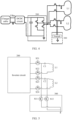
- FIG. 2A is a diagram of a circuit of a wireless charging system according to an embodiment of this application.
- a transmitting terminal includes one transmitting coil is used in this embodiment for description.
- a wireless charging transmitting apparatus 30 is configured to transmit magnetic field energy.
- the wireless charging transmitting apparatus 30 may be located in the wireless charging device.
- the wireless charging transmitting apparatus 30 includes an inverter circuit DC/AC 31.
- An input terminal of the inverter circuit DC/AC 31 is configured to connect to a direct current power supply, for example, connect to a direct current output by the adapter.
- An output terminal of the inverter circuit DC/AC 31 is connected to a resonant network.
- the resonant network includes a resonant capacitor C1 and a transmitting coil L1.
- the resonant capacitor C1 and the transmitting coil L1 resonate in series.
- a wireless charging receiving apparatus 20 is configured to receive the magnetic field energy transmitted by the wireless charging transmitting apparatus 30.
- the wireless charging receiving apparatus 20 may be located in the electronic device.
- the in-band communication is recommended to transmit the control signal and the charging data, and the control signal is carried in transmission of wireless power. Therefore, a precondition for transmitting the control signal is that an alternating magnetic field generated by a current of the transmitting coil can establish a sufficient induced voltage on a receive coil to form power transmission.
- a signal strength packet returned by the wireless charging receiving apparatus 20, the two successfully establish communication.
- a wireless charging QI protocol When wireless charging is performed between the wireless charging device and the electronic device, a wireless charging QI protocol is applicable.
- the QI protocol specifies that phases of wireless charging include the Ping phase (a before-ping phase), an identification and configuration phase, and a power transfer phase.
- the wireless charging device and the electronic device When the wireless charging device and the electronic device enter the ping phase, it indicates that the wireless charging device and the electronic device are located in a communicable area, that is, a before-ping area. When the wireless charging device and the electronic device are located in a non-communicable area, the wireless charging device and the electronic device do not enter the before-ping area, which is also referred to as entering a non-before-ping area, a non-power transmission area, or a non-signal strength packet detection area.
- the wireless charging receiving apparatus 20 includes a receive coil L, a capacitor C2, and a rectifier circuit AC/DC 21.
- the rectifier circuit AC/DC 21 converts an alternating current output by the receive coil L into a direct current to charge the battery.
- the wireless charging device After the wireless charging device converts input electric energy into magnetic field energy, the wireless charging device transmits the magnetic field energy by using the wireless charging transmitting apparatus 30.
- the electronic device receives, by using the wireless charging receiving apparatus 20, the magnetic field energy emitted by the wireless charging device, and converts the magnetic field energy into the electric energy, to charge the electronic device. In this way, the electric energy is wirelessly transmitted from the wireless charging device to the electronic device.
- some wireless charging transmitting terminal includes a plurality of transmitting coils, so that a degree of freedom of wireless charging of the electronic device can be increased.
- a specific quantity of transmitting coils is not specifically limited.
- the transmitting terminal includes at least two transmitting coils, for example, may include three transmitting coils, four transmitting coils, or more transmitting coils.
- one transmitting coil with highest charging efficiency in the plurality of transmitting coils may be selected to wirelessly charge the electronic device, and the other transmitting coil does not work.
- the transmitting terminal may also control the plurality of transmitting coils to simultaneously charge a plurality of receiving terminals.
- the receiving terminals may include a mobile phone, a watch, a headset, and the like.
- the transmitting coil is an inductor element
- the inverter circuit included in the transmitting terminal includes many switching transistors
- the switching transistor usually includes an anti-parallel body diode. All these are sources of conducted interference and radiated interference, and these interfering signals are transferred to the non-working transmitting coil.
- the plurality of transmitting coils each are disposed in a disk form, disks are staggered in physical space, and the transmitting coils overlap each other on a projection of a radial plane of the wireless charging base.
- the transmitting coils partially overlap each other, there is capacitive coupling between different transmitting coils, which also increases a propagation path of the interfering signal.
- the following describes the path of the interfering signal existing at the transmitting terminals of the plurality of transmitting coils.
- FIG. 2B is a schematic diagram of a test at a wireless charging transmitting terminal according to an embodiment of this application.
- the charger 02 When the charger 02 is connected to a Boost circuit 100, the charger 02 is also connected to an LISN 1000. In an actual test, a spectrum analyzer is needed to observe whether there is an interfering signal flowing through the LISN 1000. When the interfering signal flows through the LISN 1000, interference is caused to a mains supply.
- the transmitting terminal includes a suppression circuit. Conducted interference and radiated interference of a non-working transmitting coil may be suppressed through the suppression circuit, that is, an interfering signal is prevented from being transferred from the non-working transmitting coil to the mobile phone. In other words, transferring of the interfering signal from the mobile phone to the ground is cut off, and is not detected by the LISN. Therefore, power consumption of the transmitting terminal can be reduced, and charging efficiency of the transmitting terminal can be improved.
- FIG. 3 is a schematic diagram of a wireless charging transmitting terminal according to an embodiment of this application.
- the wireless charging transmitting terminal provided in this embodiment of this application includes an inverter circuit 200, n transmitting coils, a suppression circuit 300, and a controller 400, where n is an integer greater than or equal to 2.
- n is 2, that is, two transmitting coils are used for description, namely, a first transmitting coil L1 and a second transmitting coil L2.
- n may be a larger integer, which is not specifically limited in this embodiment of this application.
- Each of the n transmitting coils is connected to an output terminal of the inverter circuit 200.
- the first transmitting coil L 1 is connected to the output terminal of the inverter circuit 200
- the second transmitting coil L2 is connected to the output terminal of the inverter circuit 200.
- a specific implementation form of the inverter circuit 200 is not specifically limited in this embodiment of this application, for example, may be a full bridge or a half bridge.
- the inverter circuit 200 may be a bidirectional power conversion circuit, which is not specifically limited.
- the inverter circuit 200 is configured to convert a direct current into an alternating current and transmit the alternating current to at least one of the n transmitting coils.
- the at least one of the n transmitting coils works, and a remaining transmitting coil does not work.
- one transmitting coil works, and the other transmitting coil does not work, that is, only one transmitting coil transmits energy to a receiving terminal, that is, an electronic device side at a same time.
- a switch may be correspondingly disposed on each transmitting coil.
- the transmitting terminal further includes 2n second switches; each of the n transmitting coils corresponds to two switches in the 2n second switches; a first terminal of each transmitting coil is connected to a first output terminal of the inverter circuit through one of the two switches, and a second terminal of each transmitting coil is connected to a second output terminal of the inverter circuit through the other of the two switches; and the controller is further configured to control a second switch corresponding to the working transmitting coil to turn on, and control a second switch corresponding to the non-working transmitting coil to turn off.
- Each transmitting coil includes two terminals, and the two terminals of the transmitting coil are respectively connected to a positive output terminal and a negative output terminal of the inverter circuit 200. Therefore, each transmitting coil needs to correspond to two second switches.
- FIG. 3 is merely an example in which one transmitting coil corresponds to one switch.
- Each transmitting coil is connected to the output terminal of the inverter circuit 200 through the corresponding switch.
- the switch When the switch is turned on, the transmitting coil is connected to the inverter circuit 200.
- the switch When the switch is turned off, the transmitting coil is disconnected from the inverter circuit 200.
- the first transmitting coil L1 corresponds to one second switch S1
- the second transmitting coil L2 corresponds to the other second switch S2.
- the controller 400 controls S1 to turn on and controls S2 to turn off, that is, the output terminal of the inverter circuit 200 is connected to the first transmitting coil L1.
- the controller 400 is configured to ground the non-working transmitting coil through the suppression circuit 300, to suppress a conducted emission and a radiated emission of the non-working transmitting coil.
- the non-working transmitting coil is not connected to the output terminal of the inverter circuit 200, there is also a coupling path, causing an interfering signal on a side of the inverter circuit 200 to be transferred to the non-working transmitting coil.
- interference is generated on a printed circuit board PCB of the transmitting terminal and a body diode of each switching transistor in the inverter circuit 200, leading to energy consumption on the non-working transmitting coil.
- the conducted emission and the radiated emission are also generated on the non-working transmitting coil.
- the suppression circuit 300 is added to the transmitting terminal provided in this embodiment of this application to reduce the conducted emission and the radiated emission generated by the non-working transmitting coil.
- the controller 400 controls the suppression circuit 300 to implement grounding of the non-working transmitting coil, to transfer the conducted emission and the radiated emission of the non-working transmitting coil to the ground and reduce the conducted emission and the radiated emission generated by the non-working transmitting coil, thereby overall suppressing an interfering signal generated by the transmitting terminal.
- the suppression circuit provided in this embodiment of this application may include a switch.
- the switch is controlled to directly ground the non-working transmitting coil, to transfer the interfering signal to the ground.
- the suppression circuit may include a copper mesh.
- the copper mesh may shield interfering signal radiation, to transfer the interfering signal to the ground.
- the suppression circuit may include a capacitor. The two terminals of the transmitting coil are grounded through the capacitor, to implement high-frequency grounding of the transmitting coil, thereby filtering out the interfering signal generated by the transmitting coil.
- FIG. 4 is a schematic diagram of yet another wireless charging transmitting terminal according to an embodiment of this application.
- the transmitting terminal provided in this embodiment continues to be described by using two transmitting coils L1 and L2 as an example.
- a first terminal of L1 is grounded through a switch in the suppression circuit 300, and a first terminal of L2 is also grounded through the switch in the suppression circuit 300.
- the transmitting terminal provided in this embodiment of this application further includes a DCDC circuit.
- the DCDC circuit may be a boost circuit
- the boost circuit may be implemented by a Boost circuit.
- the inverter circuit 200 may be a full-bridge inverter circuit, that is, include four switching transistors.
- the transmitting terminal provided in this embodiment of this application may be a wireless charging base.
- the base needs to be connected to a charger through a charger cable, and the charger converts an alternating current into a direct current. Therefore, a current transmitted on the charger cable is the direct current.
- the charger cable is connected to the DCDC circuit through a direct current bus VBus, an output terminal of the DCDC circuit is connected to an input terminal of the inverter circuit 200, and the output terminal of the inverter circuit 200 is connected to each transmitting coil through a switch.
- FIG. 5 is a schematic diagram of still another wireless charging transmitting terminal according to an embodiment of this application.
- the suppression circuit of the wireless charging transmitting terminal includes n first switches, the n first switches are in a one-to-one correspondence with the n transmitting coils, and each of the n transmitting coils is grounded through a corresponding first switch.
- two switches continue to be used as an example for description.
- a first terminal of the first transmitting coil L1 is grounded through one first switch S11, and a first terminal of the second transmitting coil L2 is grounded through the other first switch S 12.
- the controller (not shown in the figure) is specifically configured to control a first switch corresponding to the non-working transmitting coil to turn on, and control a first switch corresponding to the working transmitting coil to turn off.
- the controller may control the first switch S11 corresponding to the first transmitting coil L1 to turn off, and control the first switch S12 corresponding to the second transmitting coil L2 to turn on, that is, to be grounded. In this way, a conducted emission and a radiated emission generated by the second transmitting coil L2 are transferred to the ground, and do not affect the first transmitting coil L1 and the receiving terminal.
- each switching transistor in embodiments of this application may be a MOS transistor, or may be an IGBT transistor, or may be a semiconductor switch device in another form. This is not specifically limited in embodiments of this application.
- each transmitting coil corresponds to two second switches
- the first transmitting coil L1 corresponds to second switches S21 and S22.
- the first terminal of the first transmitting coil L1 is connected to the positive output terminal of the inverter circuit 200 through S21
- the second terminal of the first transmitting coil L1 is connected to the negative output terminal of the inverter circuit 200 through S22.
- the first terminal of the second transmitting coil L2 is connected to the positive output terminal of the inverter circuit 200 through S23
- a second terminal of the second transmitting coil L2 is connected to the negative output terminal of the inverter circuit 200 through S24.
- the transmitting terminal provided in this embodiment of this application further includes n resonant networks, and the n transmitting coils are in a one-to-one correspondence with the n resonant networks.
- a resonant network corresponding to each of the n transmitting coils is connected between the output terminal of the inverter circuit and the transmitting coil.
- the resonant network includes one capacitor
- a specific implementation form of the resonant network is not specifically limited in this application.
- the resonant network includes a capacitor and an inductor, or may include only a capacitor. There may be one or more capacitors.
- the resonant network includes an inductor, there may be one or more inductors.
- the first transmitting coil L1 corresponds to a resonant network C1
- the second transmitting coil L2 corresponds to a resonant network C2.
- a specific location at which the suppression circuit 300 is connected is not specifically limited in this embodiment of this application.
- a first terminal of the suppression circuit 300 is connected between the second switch and the resonant network, and a second terminal of the suppression circuit 300 is grounded.
- the first terminal of the suppression circuit 300 may be connected between the resonant network and the transmitting coil.
- the non-working transmitting coil is directly grounded.
- the transmitting coil is prevented, as much as possible, from being directly grounded, but is grounded through a ground network.
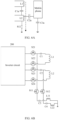
- FIG. 6A is a schematic diagram of direct grounding of a non-working transmitting coil according to an embodiment of this application.
- the transmitting terminal provided in this embodiment of this application includes the ground network.
- the non-working transmitting coil is grounded through the ground network, in other words, ground impedance of the non-working transmitting coil is increased, to avoid energy wastes caused by transferring of excessive energy of the working transmitting coil to the ground.
- the suppression circuit in the transmitting terminal provided in this embodiment of this application includes the switch, and the transmitting coil may be grounded through the switch in the suppression circuit.
- the controller only needs to control an action of the switch, to implement grounding of the non-working transmitting coil and disconnecting of the working transmitting coil from the ground, so that the conducted emission and the radiated emission generated by the non-working transmitting coil can be transferred to the ground, thereby suppressing the interfering signal generated by the non-working transmitting coil, and improving wireless charging efficiency of the transmitting terminal.
- FIG. 6B and FIG. 6C are schematic diagrams of yet another wireless charging transmitting terminal according to an embodiment of this application.
- the suppression circuit in the transmitting terminal provided in this embodiment of this application further includes ground networks.
- Each transmitting coil corresponds to one ground network, that is, a quantity of the ground networks is the same as a quantity of the transmitting coils.
- Each of the n transmitting coils is grounded through the corresponding first switch and a corresponding ground network, and the ground network includes at least one of a capacitor or an inductor.
- the ground network may include only a capacitor, or may include only an inductor.
- the ground network may further include another circuit element, for example, an inductor.
- FIG. 6B and FIG. 6C an example in which the ground network includes an inductor and a capacitor is used for description. That is, the ground network includes the inductor and the capacitor connected in series.
- FIG. 6B an example in which L1 is used as the working transmitting coil and L2 is used as the non-working transmitting coil is used for description.
- FIG. 6B is a schematic diagram of a specific implementation solution
- FIG. 6C is merely an equivalent circuit diagram.
- a ground network corresponding to the first transmitting coil L1 includes a capacitor C3 and an inductor L11 connected in series.
- a first terminal of the first transmitting coil L1 is grounded through the first switch S11, the capacitor C3, and the inductor L11 that are connected in series
- a first terminal of the second transmitting coil L2 is grounded through the first switch S12, a capacitor C4, and an inductor L22 that are connected in series.
- L2 is not directly grounded, but is grounded through the capacitor C4 and the inductor L22 connected in series. Because C4 and L22 increase ground impedance of L2, no energy waste is caused by transferring of excessive energy of L1 to the ground through L2. Therefore, working efficiency can be ensured while interference is reduced.
- the suppression circuit includes the capacitor and the inductor connected in series, to reduce power consumption generated by the suppression circuit and improve working efficiency of the transmitting terminal.
- the capacitor and the inductor connected in series can form series resonance. Specific quantities and a connection manner of the capacitor and the inductor are not specifically limited in this embodiment of this application. For example, the capacitor and the inductor may alternatively form parallel resonance.
- the suppression circuit is connected between the resonant network and the inverter circuit.
- a first terminal of the suppression circuit is connected between the output terminal of the inverter circuit and the resonant network, and a second terminal of the suppression circuit is grounded.
- a first terminal of the suppression circuit is connected between the resonant network and the transmitting coil, and a second terminal of the suppression circuit is grounded.
- FIG. 6D is a schematic diagram of another wireless charging transmitting terminal according to an embodiment of this application.
- a first terminal of the first transmitting coil L1 is grounded through the first switch S11, the capacitor C3, and the inductor L11 that are connected in series, and a first terminal of the second transmitting coil L2 is grounded through the first switch S12, a capacitor C4, and an inductor L22 that are connected in series.
- S12 is turned on and S11 is turned off.
- the conducted emission and the radiated emission on the non-working L2 are transferred to the ground through C4 and L22 connected in series, thereby reducing impact of the interfering signal on L1 and the receiving terminal, reducing power consumption, and improving charging efficiency of the transmitting terminal.
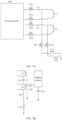
- FIG. 7A is a schematic diagram of another transmitting terminal according to an embodiment of this application.
- the ground network in the suppression circuit in the transmitting terminal provided in this embodiment includes only an inductor.
- a first terminal of the first transmitting coil L1 is grounded through the first switch S11 and the inductor L11, and a first terminal of the second transmitting coil L2 is grounded through the first switch S12 and an inductor L22.
- FIG. 7B is a schematic diagram of grounding of a non-working transmitting coil through a capacitor according to an embodiment of this application.
- the first transmitting coil L1 works, the second transmitting coil L2 does not work, and L2 is grounded through the inductor L22. Because the inductor L22 is added, ground impedance of L2 is increased, thereby preventing excessive energy of L1 from being transferred to the ground through L2.
- the ground network in FIG. 6C and FIG. 6D includes the capacitor and the inductor connected in series.
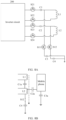
- FIG. 8A is a schematic diagram of still another transmitting terminal according to an embodiment of this application.
- the ground network in the suppression circuit in the transmitting terminal provided in this embodiment includes only a capacitor.
- a first terminal of the first transmitting coil L1 is grounded through the first switch S11 and the capacitor C3
- a first terminal of the second transmitting coil L2 is grounded through the first switch S12 and a capacitor C4.
- ground impedance of the non-working transmitting coil may also be increased, to avoid energy wastes caused by transferring of excessive energy of the working transmitting coil to the ground. Therefore, interference resistance can be ensured, and high working efficiency can be ensured as much as possible.
- FIG. 8B is a schematic diagram of grounding of a non-working transmitting coil through a capacitor according to an embodiment of this application.
- the first transmitting coil L1 works, the second transmitting coil L2 does not work, and L2 is grounded through the capacitor C4. Because the capacitor C4 is added, ground impedance of L2 is increased, thereby preventing excessive energy of L1 from being transferred to the ground through L2.
- the embodiments described above describe a case in which there is capacitive coupling interference between the first transmitting coil and the second transmitting coil.
- the following describes a case in which there is inductive coupling interference between the first transmitting coil and the second transmitting coil. Because there is mutual inductance M between the first transmitting coil L1 and the second transmitting coil L2, there is also inductive coupling between the first transmitting coil L1 and the second transmitting coil L2.
- FIG. 9A is an equivalent schematic diagram of inductive coupling according to an embodiment of this application.
- first transmitting coil L1 works and the second transmitting coil L2 does not work is still used as an example. Because there is the mutual inductance M between L1 and L2, energy of L1 may be transferred to L2.
- L2 has a capacitor connected in series, and the capacitor is configured to adjust a waveform. In this case, I is consumed in the inductor and the capacitor connected in series, which causes energy losses.
- the non-working transmitting coil can be grounded through the ground network instead of being directly grounded.
- FIG. 9B is an equivalent schematic diagram of another type of inductive coupling according to an embodiment of this application.
- the ground network includes a capacitor.
- L2 does not work, and a first terminal of L2 is grounded through the switch S12 and a capacitor C4 connected in series.
- a second terminal of L2 may also be grounded through a switch. That is, the two terminals of L2 may be both grounded.
- the ground network only the ground network is added, and the ground network includes the capacitor. In this case, ground impedance of L2 can be increased, so that a magnitude of I is reduced and power consumption is reduced.
- the ground network corresponding to L2 may be grounded through the inductor and the capacitor connected in series, as shown in FIG. 6B .
- the ground network may also include an inductor. Details are not described herein again.
- whether the inductor and the capacitor connected in series form resonance is not specifically limited.
- a resonance frequency may be suppressed.
- a function of the capacitor in the ground network is to perform high frequency filtering on the interfering signal, and a function of the inductor in the ground network is to perform low frequency filtering on the interfering signal.
- an embodiment of this application further provides an implementation, in which the suppression circuit includes no switch but includes only a capacitor, and two terminals of the non-working transmitting coil are directly grounded through the capacitor, which is described in detail below with reference to the accompanying drawings.
- FIG. 10 is a schematic diagram of another transmitting terminal according to an embodiment of this application.
- the suppression circuit in the transmitting terminal provided in this embodiment includes 2n capacitors.
- Each of the n transmitting coils corresponds to two capacitors in the 2n capacitors, that is, each transmitting coil corresponds to two capacitors.
- a first terminal of each transmitting coil is grounded through one of the two capacitors, and a second terminal of each transmitting coil is grounded through the other of the two capacitors, that is, the two terminals of each transmitting coil are separately grounded through one capacitor.
- the suppression circuit includes the capacitor, the two terminals of each transmitting coil are separately grounded through one capacitor, and the non-working transmitting coil is grounded through the capacitors, so that high-frequency grounding can be implemented to filter out the interfering signal.
- an embodiment of this application further provides another wireless charging transmitting terminal.
- the suppression circuit may be implemented by using a copper mesh.
- the copper mesh is used to cover the transmitting coil, to shield the interfering signal generated by the non-working transmitting coil, and transmit the interfering signal to the ground.
- the suppression circuit provided in this embodiment of this application includes n copper meshes.
- the n transmitting coils are in a one-to-one correspondence with the n copper meshes.
- the copper mesh covers a part or the whole of a corresponding transmitting coil.
- the copper mesh may cover only a part of the transmitting coil, or may cover all of the transmitting coil, and one transmitting coil corresponds to at least one copper mesh.
- the controller is configured to control a copper mesh of the non-working transmitting coil to be connected to the ground, and control a copper mesh of the working transmitting coil to be disconnected from the ground.
- an embodiment of this application further provides a wireless charging base, and reference may be still made to the wireless charging base 02 shown in FIG. 1 .
- the wireless charging base is configured to perform wireless charging for an electronic device, and includes a power interface, an inverter circuit, n transmitting coils, a controller, and a transmitting coil base plate, where n is an integer greater than or equal to 2.
- the power interface is configured to connect to a direct current transmitted by an adapter.
- the transmitting coil base plate is configured to place the n transmitting coils.
- Each of the n transmitting coils is connected to an output terminal of the inverter circuit.
- the inverter circuit is configured to convert a direct current into an alternating current and transmit the alternating current to at least one of the n transmitting coils, the at least one of the n transmitting coils works, and a remaining transmitting coil does not work.
- the controller is configured to ground the non-working transmitting coil through a suppression circuit, to suppress a conducted emission and a radiated emission of the non-working transmitting coil.
- the non-working transmitting coil is not connected to the output terminal of the inverter circuit, there is also a coupling path, causing an interfering signal on a side of the inverter circuit to be transferred to the non-working transmitting coil.
- interference is generated on a printed circuit board PCB of the transmitting terminal and a body diode of each switching transistor in the inverter circuit, leading to energy consumption on the non-working transmitting coil.
- the conducted emission and the radiated emission are also generated on the non-working transmitting coil.
- the suppression circuit is added to the transmitting terminal provided in this embodiment of this application to reduce the conducted emission and the radiated emission generated by the non-working transmitting coil.
- the controller controls the suppression circuit to implement grounding of the non-working transmitting coil, to transfer the conducted emission and the radiated emission of the non-working transmitting coil to the ground and reduce the conducted emission and the radiated emission generated by the non-working transmitting coil, thereby overall suppressing an interfering signal generated by the transmitting terminal.
- the suppression circuit provided in this embodiment of this application may include a switch.
- the switch is controlled to directly ground the non-working transmitting coil, to transfer the interfering signal to the ground.
- the suppression circuit may include a copper mesh.
- the copper mesh may shield interfering signal radiation, to transfer the interfering signal to the ground.
- the suppression circuit may include a capacitor. The two terminals of the transmitting coil are grounded through the capacitor, to implement high-frequency grounding of the transmitting coil, thereby filtering out the interfering signal generated by the transmitting coil.
- the suppression circuit includes n first switches, the n first switches are in a one-to-one correspondence with the n transmitting coils, and each of the n transmitting coils is grounded through a corresponding first switch; and the controller is specifically configured to control a first switch corresponding to the non-working transmitting coil to turn on, and control a first switch corresponding to the working transmitting coil to turn off.
- the suppression circuit further includes ground networks, each of the n transmitting coils is grounded through the corresponding first switch and a corresponding ground network, and the ground network includes at least one of a capacitor or an inductor.
- the ground network includes the inductor and the capacitor connected in series.
- an embodiment of this application further provides a wireless charging system, including the transmitting terminal described in the foregoing embodiments, and further including an electronic device, where the transmitting terminal is configured to perform wireless charging for the electronic device.
- the electronic device may be a mobile phone.
- the transmitting terminal provided in this embodiment of this application is configured to perform wireless charging for the mobile phone.
- the transmitting terminal includes a plurality of transmitting coils. During actual working, one transmitting coil with highest charging efficiency is selected from the plurality of transmitting coils to charge the mobile phone.
- interfering signals such as a conducted emission and a radiated emission are generated on a remaining non-working transmitting coil.
- the interfering signal may be suppressed by using a suppression circuit, to reduce power consumption of the transmitting terminal, and improve wireless charging efficiency.
- At least one of a, b, or c may represent a, b, c, "a and b", “a and c", “b and c", or "a, b, and c", where a, b, and c may be singular or plural.
Landscapes
- Engineering & Computer Science (AREA)
- Power Engineering (AREA)
- Computer Networks & Wireless Communication (AREA)
- Physics & Mathematics (AREA)
- Electromagnetism (AREA)
- Charge And Discharge Circuits For Batteries Or The Like (AREA)
Applications Claiming Priority (2)
| Application Number | Priority Date | Filing Date | Title |
|---|---|---|---|
| CN202210065718.3A CN114530949B (zh) | 2022-01-20 | 2022-01-20 | 一种无线充电的发射端、充电底座及系统 |
| PCT/CN2022/142495 WO2023138322A1 (zh) | 2022-01-20 | 2022-12-27 | 一种无线充电的发射端、充电底座及系统 |
Publications (2)
| Publication Number | Publication Date |
|---|---|
| EP4404420A1 true EP4404420A1 (de) | 2024-07-24 |
| EP4404420A4 EP4404420A4 (de) | 2025-07-23 |
Family
ID=81621831
Family Applications (1)
| Application Number | Title | Priority Date | Filing Date |
|---|---|---|---|
| EP22921743.5A Pending EP4404420A4 (de) | 2022-01-20 | 2022-12-27 | Übertragungsende für drahtloses laden, ladebasis und system |
Country Status (4)
| Country | Link |
|---|---|
| US (1) | US20250055322A1 (de) |
| EP (1) | EP4404420A4 (de) |
| CN (3) | CN114530949B (de) |
| WO (1) | WO2023138322A1 (de) |
Families Citing this family (2)
| Publication number | Priority date | Publication date | Assignee | Title |
|---|---|---|---|---|
| CN114530949B (zh) * | 2022-01-20 | 2023-01-20 | 荣耀终端有限公司 | 一种无线充电的发射端、充电底座及系统 |
| CN117154959B (zh) * | 2023-02-14 | 2024-09-17 | 荣耀终端有限公司 | 充电系统及方法 |
Family Cites Families (33)
| Publication number | Priority date | Publication date | Assignee | Title |
|---|---|---|---|---|
| AU2008339692B2 (en) * | 2007-12-21 | 2014-08-21 | Access Business Group International Llc | Circuitry for inductive power transfer |
| CN101505174A (zh) * | 2008-02-04 | 2009-08-12 | 深圳华为通信技术有限公司 | 抑制电磁干扰的接口电路及方法 |
| US8655272B2 (en) * | 2009-07-07 | 2014-02-18 | Nokia Corporation | Wireless charging coil filtering |
| KR101246692B1 (ko) * | 2011-07-14 | 2013-03-21 | 주식회사 한림포스텍 | 무선전력 통신시스템용 전력 전송장치 |
| US10135305B2 (en) * | 2014-06-10 | 2018-11-20 | Mediatek Singapore Pte. Ltd. | Multi-mode wireless power transmitter |
| JP2016005393A (ja) * | 2014-06-18 | 2016-01-12 | Tdk株式会社 | 非接触給電システム |
| CN104167830B (zh) * | 2014-08-26 | 2016-10-19 | 哈尔滨工业大学 | 空载时屏蔽电磁辐射的无线能量传输装置 |
| US9837864B2 (en) * | 2015-03-26 | 2017-12-05 | Integrated Device Technology, Inc. | Apparatuses and wireless power transmitters having multiple transmit coils and related method |
| US20160284465A1 (en) * | 2015-03-29 | 2016-09-29 | Sanjaya Maniktala | Electromagnetic Interference Shield for Wireless Power Transfer |
| WO2016186520A1 (en) * | 2015-05-15 | 2016-11-24 | Powerbyproxi Limited | Inductive power transmitter |
| CN107636933B (zh) * | 2015-05-25 | 2020-06-26 | 株式会社村田制作所 | 无线供电系统 |
| CN106410991B (zh) * | 2015-07-30 | 2021-08-27 | 松下知识产权经营株式会社 | 异物检测装置、无线送电装置以及无线电力传输系统 |
| US9923584B2 (en) * | 2015-09-03 | 2018-03-20 | Qualcomm Incorporated | Rectifiers for wireless power transfer with impedance inverting filters for reduced electromagnetic interference |
| EP3139466A1 (de) * | 2015-09-07 | 2017-03-08 | Continental Automotive GmbH | Leistungswandlermodul für induktives laden für fahrzeuge und verfahren zum betrieb eines leistungswandlermoduls |
| US10530174B2 (en) * | 2016-04-01 | 2020-01-07 | Intel Corporation | Shield for a wireless power transmitter |
| KR20170124185A (ko) * | 2016-05-02 | 2017-11-10 | 엘지이노텍 주식회사 | 무선 전력 수신 장치 |
| US10561049B2 (en) * | 2016-10-28 | 2020-02-11 | Integrated Device Technology, Inc. | Interference filter for wireless power transfer systems |
| KR20180097080A (ko) * | 2017-02-22 | 2018-08-30 | 엘지이노텍 주식회사 | 멀티 코일 모듈 |
| CN106941284B (zh) * | 2017-03-24 | 2020-08-25 | 哈尔滨工业大学深圳研究生院 | 一种耦合谐振式水下无线充电装置及方法 |
| CN106877520A (zh) * | 2017-04-12 | 2017-06-20 | 北京聚精瑞生医疗科技有限公司 | 手术室无线供电系统 |
| CN107222034B (zh) * | 2017-07-11 | 2020-07-17 | 天津工业大学 | 一种共地结构的新型谐振式无线电能传输方法及装置 |
| KR102413858B1 (ko) * | 2017-08-31 | 2022-06-28 | 엘지전자 주식회사 | 제어 알고리즘이 개선된 유도 가열 및 무선 전력 전송 장치 |
| TWI794327B (zh) * | 2017-11-21 | 2023-03-01 | 台灣東電化股份有限公司 | 無線裝置 |
| CN207691509U (zh) * | 2018-01-12 | 2018-08-03 | 深圳市派一电源科技有限公司 | 无线充电电路及无线充电装置 |
| US10886781B2 (en) * | 2018-04-03 | 2021-01-05 | Apple Inc. | Wireless power transmitting circuitry with multiple modes |
| CN208113226U (zh) * | 2018-04-10 | 2018-11-16 | Oppo广东移动通信有限公司 | 电子设备 |
| KR102552493B1 (ko) * | 2018-06-20 | 2023-07-11 | 현대자동차주식회사 | 전자파 차폐 기능을 가지는 무선충전기 |
| CN208369270U (zh) * | 2018-06-26 | 2019-01-11 | 深圳市亿品奇科技有限公司 | 线圈模组充电电路、两组线圈模组充电电路和充电器 |
| KR102654913B1 (ko) * | 2018-10-26 | 2024-04-03 | 현대자동차주식회사 | 무선 충전용 차폐유닛 및 이의 제조방법과 이를 포함하는 무선충전기 |
| JP7286363B2 (ja) * | 2019-03-22 | 2023-06-05 | 東芝テック株式会社 | 受電システムおよび給電システム |
| NL2024485B1 (en) * | 2019-12-17 | 2021-09-02 | Prodrive Tech Bv | Apparatus for inductive power transfer |
| CN212695774U (zh) * | 2020-05-28 | 2021-03-12 | 惠州市雨林科技有限公司 | 一种带emc屏蔽的无线充电器线圈 |
| CN114530949B (zh) * | 2022-01-20 | 2023-01-20 | 荣耀终端有限公司 | 一种无线充电的发射端、充电底座及系统 |
-
2022
- 2022-01-20 CN CN202210065718.3A patent/CN114530949B/zh active Active
- 2022-01-20 CN CN202211735410.1A patent/CN115955016B/zh active Active
- 2022-01-20 CN CN202310004877.7A patent/CN115986963B/zh active Active
- 2022-12-27 US US18/720,188 patent/US20250055322A1/en active Pending
- 2022-12-27 EP EP22921743.5A patent/EP4404420A4/de active Pending
- 2022-12-27 WO PCT/CN2022/142495 patent/WO2023138322A1/zh not_active Ceased
Also Published As
| Publication number | Publication date |
|---|---|
| US20250055322A1 (en) | 2025-02-13 |
| CN114530949A (zh) | 2022-05-24 |
| CN115955016A (zh) | 2023-04-11 |
| WO2023138322A1 (zh) | 2023-07-27 |
| CN115986963A (zh) | 2023-04-18 |
| CN115986963B (zh) | 2024-04-19 |
| CN115955016B (zh) | 2024-12-06 |
| EP4404420A4 (de) | 2025-07-23 |
| CN114530949B (zh) | 2023-01-20 |
Similar Documents
| Publication | Publication Date | Title |
|---|---|---|
| US10027377B2 (en) | Wireless power supply apparatus | |
| CN103580300B (zh) | 接收器及执行接收器操作的方法 | |
| EP3022823B1 (de) | System und verfahren für gleichzeitige effiziente datenübertragung und drahtlose stromübertragung | |
| US10326315B2 (en) | Wireless power transmission apparatus | |
| US9225195B2 (en) | Wireless power receiver for increased charging efficiency | |
| EP4404420A1 (de) | Übertragungsende für drahtloses laden, ladebasis und system | |
| EP2720383A2 (de) | Drahtlose stromübertragungsvorrichtung und system damit | |
| KR101837121B1 (ko) | 듀얼 밴드 무선 전력 수신기 | |
| EP3036817A1 (de) | Systeme, vorrichtung und verfahren für einen drahtlosen dualmodusstromempfänger | |
| KR102608558B1 (ko) | 전력 중계 장치 및 시스템 | |
| WO2009111597A2 (en) | Packaging and details of a wireless power device | |
| JP2014060916A (ja) | 無線送電のための受動受信機 | |
| KR20140043975A (ko) | 유선-무선 전력 전송 장치 및 그 방법 | |
| US12176969B2 (en) | Terminal device and method for controlling terminal device | |
| WO2024051086A9 (zh) | 一种电力接收装置、电力发送装置及电力传输方法 | |
| CN109586383B (zh) | 无线充电系统、方法及智能电子设备 | |
| WO2021227652A1 (zh) | 无线充电设备和待充电设备 | |
| CN106787254B (zh) | 无线电能接收端和无线供电系统 | |
| CN113890197B (zh) | 一种高充电效率的碗状无线充电装置 | |
| TW202501951A (zh) | 車輛充電方法、車輛充電系統和車輛 | |
| KR20160070539A (ko) | 무선전력 송신부 | |
| CN106816966A (zh) | 无线充电和nfc双线圈共存电路 | |
| KR20160070540A (ko) | 무선전력 송신부 | |
| KR20160148239A (ko) | 무선 전력 수신 장치 및 무선 전력 전송 시스템 | |
| CN208299547U (zh) | 双线圈共存电路 |
Legal Events
| Date | Code | Title | Description |
|---|---|---|---|
| STAA | Information on the status of an ep patent application or granted ep patent |
Free format text: STATUS: THE INTERNATIONAL PUBLICATION HAS BEEN MADE |
|
| PUAI | Public reference made under article 153(3) epc to a published international application that has entered the european phase |
Free format text: ORIGINAL CODE: 0009012 |
|
| STAA | Information on the status of an ep patent application or granted ep patent |
Free format text: STATUS: REQUEST FOR EXAMINATION WAS MADE |
|
| 17P | Request for examination filed |
Effective date: 20240418 |
|
| AK | Designated contracting states |
Kind code of ref document: A1 Designated state(s): AL AT BE BG CH CY CZ DE DK EE ES FI FR GB GR HR HU IE IS IT LI LT LU LV MC ME MK MT NL NO PL PT RO RS SE SI SK SM TR |
|
| DAV | Request for validation of the european patent (deleted) | ||
| DAX | Request for extension of the european patent (deleted) | ||
| A4 | Supplementary search report drawn up and despatched |
Effective date: 20250623 |
|
| RIC1 | Information provided on ipc code assigned before grant |
Ipc: H02J 7/00 20060101AFI20250616BHEP Ipc: H02J 50/40 20160101ALI20250616BHEP Ipc: H02J 50/12 20160101ALI20250616BHEP Ipc: H02J 50/70 20160101ALI20250616BHEP |
|
| STAA | Information on the status of an ep patent application or granted ep patent |
Free format text: STATUS: EXAMINATION IS IN PROGRESS |
|
| 17Q | First examination report despatched |
Effective date: 20260219 |