EP4404298A1 - Neuartiges einkörperteilchen für ein positivelektrodenaktivmaterial und verfahren zur herstellung eines neuartigen einkörperpulvers - Google Patents
Neuartiges einkörperteilchen für ein positivelektrodenaktivmaterial und verfahren zur herstellung eines neuartigen einkörperpulvers Download PDFInfo
- Publication number
- EP4404298A1 EP4404298A1 EP22870293.2A EP22870293A EP4404298A1 EP 4404298 A1 EP4404298 A1 EP 4404298A1 EP 22870293 A EP22870293 A EP 22870293A EP 4404298 A1 EP4404298 A1 EP 4404298A1
- Authority
- EP
- European Patent Office
- Prior art keywords
- coating layer
- novel
- calcining
- body particle
- core
- Prior art date
- Legal status (The legal status is an assumption and is not a legal conclusion. Google has not performed a legal analysis and makes no representation as to the accuracy of the status listed.)
- Pending
Links
Images
Classifications
-
- H—ELECTRICITY
- H01—ELECTRIC ELEMENTS
- H01M—PROCESSES OR MEANS, e.g. BATTERIES, FOR THE DIRECT CONVERSION OF CHEMICAL ENERGY INTO ELECTRICAL ENERGY
- H01M4/00—Electrodes
- H01M4/02—Electrodes composed of, or comprising, active material
- H01M4/36—Selection of substances as active materials, active masses, active liquids
-
- C—CHEMISTRY; METALLURGY
- C01—INORGANIC CHEMISTRY
- C01G—COMPOUNDS CONTAINING METALS NOT COVERED BY SUBCLASSES C01D OR C01F
- C01G53/00—Compounds of nickel
- C01G53/40—Complex oxides containing nickel and at least one other metal element
- C01G53/42—Complex oxides containing nickel and at least one other metal element containing alkali metals, e.g. LiNiO2
- C01G53/44—Complex oxides containing nickel and at least one other metal element containing alkali metals, e.g. LiNiO2 containing manganese
- C01G53/50—Complex oxides containing nickel and at least one other metal element containing alkali metals, e.g. LiNiO2 containing manganese of the type (MnO2)n-, e.g. Li(NixMn1-x)O2 or Li(MyNixMn1-x-y)O2
-
- C—CHEMISTRY; METALLURGY
- C01—INORGANIC CHEMISTRY
- C01G—COMPOUNDS CONTAINING METALS NOT COVERED BY SUBCLASSES C01D OR C01F
- C01G53/00—Compounds of nickel
- C01G53/80—Compounds containing nickel, with or without oxygen or hydrogen, and containing one or more other elements
- C01G53/82—Compounds containing nickel, with or without oxygen or hydrogen, and containing two or more other elements
-
- H—ELECTRICITY
- H01—ELECTRIC ELEMENTS
- H01M—PROCESSES OR MEANS, e.g. BATTERIES, FOR THE DIRECT CONVERSION OF CHEMICAL ENERGY INTO ELECTRICAL ENERGY
- H01M10/00—Secondary cells; Manufacture thereof
- H01M10/05—Accumulators with non-aqueous electrolyte
- H01M10/052—Li-accumulators
-
- H—ELECTRICITY
- H01—ELECTRIC ELEMENTS
- H01M—PROCESSES OR MEANS, e.g. BATTERIES, FOR THE DIRECT CONVERSION OF CHEMICAL ENERGY INTO ELECTRICAL ENERGY
- H01M4/00—Electrodes
- H01M4/02—Electrodes composed of, or comprising, active material
- H01M4/13—Electrodes for accumulators with non-aqueous electrolyte, e.g. for lithium-accumulators; Processes of manufacture thereof
- H01M4/131—Electrodes based on mixed oxides or hydroxides, or on mixtures of oxides or hydroxides, e.g. LiCoOx
-
- H—ELECTRICITY
- H01—ELECTRIC ELEMENTS
- H01M—PROCESSES OR MEANS, e.g. BATTERIES, FOR THE DIRECT CONVERSION OF CHEMICAL ENERGY INTO ELECTRICAL ENERGY
- H01M4/00—Electrodes
- H01M4/02—Electrodes composed of, or comprising, active material
- H01M4/36—Selection of substances as active materials, active masses, active liquids
- H01M4/362—Composites
- H01M4/366—Composites as layered products
-
- H—ELECTRICITY
- H01—ELECTRIC ELEMENTS
- H01M—PROCESSES OR MEANS, e.g. BATTERIES, FOR THE DIRECT CONVERSION OF CHEMICAL ENERGY INTO ELECTRICAL ENERGY
- H01M4/00—Electrodes
- H01M4/02—Electrodes composed of, or comprising, active material
- H01M4/36—Selection of substances as active materials, active masses, active liquids
- H01M4/48—Selection of substances as active materials, active masses, active liquids of inorganic oxides or hydroxides
- H01M4/50—Selection of substances as active materials, active masses, active liquids of inorganic oxides or hydroxides of manganese
- H01M4/505—Selection of substances as active materials, active masses, active liquids of inorganic oxides or hydroxides of manganese of mixed oxides or hydroxides containing manganese for inserting or intercalating light metals, e.g. LiMn2O4 or LiMn2OxFy
-
- H—ELECTRICITY
- H01—ELECTRIC ELEMENTS
- H01M—PROCESSES OR MEANS, e.g. BATTERIES, FOR THE DIRECT CONVERSION OF CHEMICAL ENERGY INTO ELECTRICAL ENERGY
- H01M4/00—Electrodes
- H01M4/02—Electrodes composed of, or comprising, active material
- H01M4/36—Selection of substances as active materials, active masses, active liquids
- H01M4/48—Selection of substances as active materials, active masses, active liquids of inorganic oxides or hydroxides
- H01M4/52—Selection of substances as active materials, active masses, active liquids of inorganic oxides or hydroxides of nickel, cobalt or iron
- H01M4/525—Selection of substances as active materials, active masses, active liquids of inorganic oxides or hydroxides of nickel, cobalt or iron of mixed oxides or hydroxides containing iron, cobalt or nickel for inserting or intercalating light metals, e.g. LiNiO2, LiCoO2 or LiCoOxFy
-
- H—ELECTRICITY
- H01—ELECTRIC ELEMENTS
- H01M—PROCESSES OR MEANS, e.g. BATTERIES, FOR THE DIRECT CONVERSION OF CHEMICAL ENERGY INTO ELECTRICAL ENERGY
- H01M4/00—Electrodes
- H01M4/02—Electrodes composed of, or comprising, active material
- H01M4/62—Selection of inactive substances as ingredients for active masses, e.g. binders, fillers
-
- C—CHEMISTRY; METALLURGY
- C01—INORGANIC CHEMISTRY
- C01P—INDEXING SCHEME RELATING TO STRUCTURAL AND PHYSICAL ASPECTS OF SOLID INORGANIC COMPOUNDS
- C01P2002/00—Crystal-structural characteristics
- C01P2002/50—Solid solutions
- C01P2002/52—Solid solutions containing elements as dopants
- C01P2002/54—Solid solutions containing elements as dopants one element only
-
- C—CHEMISTRY; METALLURGY
- C01—INORGANIC CHEMISTRY
- C01P—INDEXING SCHEME RELATING TO STRUCTURAL AND PHYSICAL ASPECTS OF SOLID INORGANIC COMPOUNDS
- C01P2002/00—Crystal-structural characteristics
- C01P2002/70—Crystal-structural characteristics defined by measured X-ray, neutron or electron diffraction data
- C01P2002/72—Crystal-structural characteristics defined by measured X-ray, neutron or electron diffraction data by d-values or two theta-values, e.g. as X-ray diagram
-
- C—CHEMISTRY; METALLURGY
- C01—INORGANIC CHEMISTRY
- C01P—INDEXING SCHEME RELATING TO STRUCTURAL AND PHYSICAL ASPECTS OF SOLID INORGANIC COMPOUNDS
- C01P2002/00—Crystal-structural characteristics
- C01P2002/70—Crystal-structural characteristics defined by measured X-ray, neutron or electron diffraction data
- C01P2002/74—Crystal-structural characteristics defined by measured X-ray, neutron or electron diffraction data by peak-intensities or a ratio thereof only
-
- C—CHEMISTRY; METALLURGY
- C01—INORGANIC CHEMISTRY
- C01P—INDEXING SCHEME RELATING TO STRUCTURAL AND PHYSICAL ASPECTS OF SOLID INORGANIC COMPOUNDS
- C01P2002/00—Crystal-structural characteristics
- C01P2002/70—Crystal-structural characteristics defined by measured X-ray, neutron or electron diffraction data
- C01P2002/77—Crystal-structural characteristics defined by measured X-ray, neutron or electron diffraction data by unit-cell parameters, atom positions or structure diagrams
-
- C—CHEMISTRY; METALLURGY
- C01—INORGANIC CHEMISTRY
- C01P—INDEXING SCHEME RELATING TO STRUCTURAL AND PHYSICAL ASPECTS OF SOLID INORGANIC COMPOUNDS
- C01P2006/00—Physical properties of inorganic compounds
- C01P2006/40—Electric properties
-
- C—CHEMISTRY; METALLURGY
- C01—INORGANIC CHEMISTRY
- C01P—INDEXING SCHEME RELATING TO STRUCTURAL AND PHYSICAL ASPECTS OF SOLID INORGANIC COMPOUNDS
- C01P2006/00—Physical properties of inorganic compounds
- C01P2006/80—Compositional purity
-
- Y—GENERAL TAGGING OF NEW TECHNOLOGICAL DEVELOPMENTS; GENERAL TAGGING OF CROSS-SECTIONAL TECHNOLOGIES SPANNING OVER SEVERAL SECTIONS OF THE IPC; TECHNICAL SUBJECTS COVERED BY FORMER USPC CROSS-REFERENCE ART COLLECTIONS [XRACs] AND DIGESTS
- Y02—TECHNOLOGIES OR APPLICATIONS FOR MITIGATION OR ADAPTATION AGAINST CLIMATE CHANGE
- Y02E—REDUCTION OF GREENHOUSE GAS [GHG] EMISSIONS, RELATED TO ENERGY GENERATION, TRANSMISSION OR DISTRIBUTION
- Y02E60/00—Enabling technologies; Technologies with a potential or indirect contribution to GHG emissions mitigation
- Y02E60/10—Energy storage using batteries
Definitions
- the present invention relates to a novel one-body particle for cathode active materials and a method of preparing a novel one-body powder, and more particularly to a novel one-body particle that contains a core in the form of a non-aggregated primary particle, and Co and a structure-stabilizing element in the coating layer of the core, and thus is capable of alleviating oxygen desorption, and improving resistance, capacity, efficiency, residual lithium, and lifespan characteristics, while solving the problems of conventional secondary particle structures, and a method of preparing a novel one-body powder.
- Lithium secondary batteries are used in various fields such as mobile devices, energy storage systems, and electric vehicles due to the high energy density and voltage, long cycle life, and low self-discharge rate thereof.
- the cathode active material particle used in a lithium secondary battery generally has a structure of secondary particle having a size of several ⁇ m in which fine primary particles having a sub-micron size are aggregated.
- Such a secondary particle structure has a problem in that the secondary particle is broken as the aggregated primary particles are separated during repeated charging and discharging, causing deterioration in battery characteristics. Since this problem is due to the structural characteristics of the secondary particle, it is difficult to solve the problem without changing the structure thereof. Therefore, a one-body particle cathode active material having a novel structure has been developed.
- This one-body active material has a "non-aggregated single particle (primary particle)" structure rather than a conventional “secondary particle structure including aggregated primary particles” and undergoes no particle separation during charging and discharging, and thus solves problems occurring in secondary particle active materials because there is almost no particle aggregation.
- the expression "there is almost no particle aggregation” means that a small amount of aggregate is inevitably present during the preparation of new one-body particles/powders. That is, it is impossible for all particles to be completely separated from one another due to technical limitations, so some aggregate may be unintentionally formed.
- the proportion of some aggregated particles may be within 30% of the total active material powder. Such some aggregated particles are not secondary particles.
- active material encompasses both “particle” and “powder” including a plurality of particles.
- particles and powders are commonly called “active materials”. It is common to distinguish whether the term refers to particles or powder depending on the context in which it is used, but in the present invention, “particles” and “active material (powder)" are expressed separately to avoid confusion.
- the novel one-body particle has a size of several ⁇ m and does not have an aggregate structure, thus causing no particle separation during charging and discharging, and fundamentally solving problems occurring in secondary particle structures.
- the secondary particle active material has been commercialized for a long time and has been applied to various industrial fields, but the one-body particle active material is used only for research purposes because it is very difficult to secure stability thereof. This is due to structural differences therebetween. As described above, the reason for this is that problems of the secondary particle active material that are difficult to solve can be easily avoided by the one-body particle, whereas problems that do not need to be considered in the secondary particle active material are critical in the one-body particle, and are very difficult to solve. The present applicant developed the present invention in view of the problems caused by such structural differences.
- Oxygen desorption is a typical problem of one-body particles.
- the extent of oxygen desorption increases in proportion to the calcination temperature and the Ni content, and when the calcination temperature is low, the degree of oxygen desorption is very low, even when the Ni content is high.
- high-Ni (60 mol% or more of Ni) active materials in the form of secondary particles undergo very little oxygen desorption because the calcination temperature is as low as 700 to 800°C during production.
- the calcination temperature is decreased to about 700°C and thus there is almost no oxygen desorption.
- various studies are being conducted on secondary particle active materials to further improve capacity/output/efficiency, etc. rather than oxygen desorption.
- one-body particles have a high calcination temperature of about 850 to about 1,000°C, thus increasing oxygen desorption. It is impossible to produce a one-body particle structure at a low calcination temperature, so it is difficult to greatly lower the calcination temperature even when the Ni content is increased, and thus there is a problem in that it is difficult to reduce the oxygen desorption phenomenon. Oxygen desorption usually occurs on the surface of one-body particles.
- the degree of oxygen desorption is not severe, but when the Ni content thereof is 60% or more, the degree of oxygen desorption increases, and particularly, when the Ni content thereof is 80% or more, it becomes very severe. It is impossible to solve this problem due to the high calcination temperature.
- Oxygen desorption causes production, in an excessive amount, of NiO, which is a rock-salt structure, in the layered structure of the cathode active material, and increased Li byproducts. Due to repeated charging and discharging, NiO gradually increases to cause increased resistance and an increased amount of Li byproducts causes various side reactions, which results in deterioration of battery performance such as capacity reduction. It is necessary to solve the problem of oxygen desorption in order to commercialize a one-body active material.
- Mn which functions to improve structural stability, is contained therein along with Ni.
- Ni When the Ni content increases, the Mn content relatively decreases, thus causing problems of deteriorated structural stability and lifespan. That is, in order to produce high-Ni one-body particles having excellent properties, the two problems of oxygen desorption and lifespan reduction must be solved.
- Japanese Patent Laid-Open Publication No. 2003-068300 which pertains to a representative prior art related to one-body particles, discloses a one-body particle having an average particle diameter of 0.2 ⁇ m or more to 5 ⁇ m or less and a solution to the structural problems of secondary particle active materials as described above. Also, this patent discloses a lithium nickel-manganese composite oxide represented by LiNi 0.5 Mn 0.5 O 2 as an example of the one-body particle. However, the patent gives no consideration to the problem of oxygen desorption due to a high calcination temperature or to the problem of severe oxygen desorption due to high Ni content such as 60% or more.
- Korean Patent No. 10-1971442 which pertains to a representative prior art related to a secondary particle active material, discloses secondary particles in which sub-micron-sized primary particles are aggregated, wherein the concentration of cobalt at the grain boundary between the primary particles is higher than the concentration of cobalt inside the primary particles.
- the patent also discloses a secondary particle structure and thus cannot solve the above-described structural problem and does not consider the problem of oxygen desorption occurring in one-body particles.
- the characteristic whereby a high concentration of cobalt is located at the grain boundary formed between the primary particles does not appear in structurally completely different one-body particles, and thus does not solve the problem resulting from the structural characteristics of the one-body particles described above.
- NiO which is a rock-salt structure that is stoichiometrically generated by oxygen desorption during the production of one-body particles and powders, and that, at the same time, solves the problem of deterioration in lifespan that occurs when the Mn content decreases due to the increase in the Ni content.
- the secondary particle structure of the conventional cathode active material is in the form of densely aggregated primary particles, so there is an interface between closely adhered primary particles, whereas novel one-body particles for the cathode active material of the present invention are present as non-aggregated primary particles, and thus do not exhibit the above-mentioned structural characteristics and avoid the problem of separation between the aggregated primary particles.
- the present inventors found that, when a coating layer containing Co and the structure-stabilizing element is formed on the core, the oxygen desorption phenomenon was alleviated, thus leading to improved resistance/capacity/efficiency/residual lithium and lifespan characteristics. Based on this finding, the present invention was completed.
- a novel one-body particle for cathode active materials including:
- the novel one-body particle according to the present invention includes a core present as a non-aggregated primary particle and a coating layer formed in at least a part of the core, wherein the coating layer contains Co and a structure-stabilizing element.
- the core of the novel one-body particles of the present invention may be a lithium transition metal oxide containing Ni and the content of Ni may be 60 mol% or more, which may cause severe oxygen desorption during the calcination process, and in particular, preferably 80% or more, which may cause very severe oxygen desorption.
- Ni-based one-body particles that contain Ni as a main component among transition metals contain Mn to thereby improve lifespan characteristics.
- the Ni content increases, the maximum possible content of Mn is relatively reduced, thus reducing structural stability and deteriorating lifespan.
- the present invention when Co is contained in the coating layer of the one-body particles, oxygen desorption is alleviated, and the capacity, efficiency and lifespan are improved by the action of Co contained in the coating layer.
- Mn which is homogeneously distributed in the entire volume of the novel one-body particle prepared through primary calcination, remarkably improves lifespan characteristics compared to Co in the coating layer formed through secondary calcination, so even if a coating layer containing Co is formed when the Mn content decreases, the lifespan characteristics are deteriorated.
- the present inventors reviewed additional methods of further improving the lifespan together with the inclusion of Co in various technical aspects.
- Factors that decrease the lifespan of a secondary battery are combined factors rather than a specific single factor, and a representative factor is the deformation/collapse of the crystal structure due to charging and discharging.
- the crystal structure contracts/expands, and the distance between the O (oxygen) layers that are separated from one another repeatedly increases and decreases. As this process is repeated, the crystal structure is deformed/collapsed, and the lifespan characteristics are deteriorated. This means that the deformation/collapse of the crystal structure can be suppressed if the distance between the O (oxygen) layers is maintained during charging and discharging.
- the present inventors predicted that the above-mentioned problems can be solved if these factors are improved.
- bond dissociation energy BDE
- bond energy BDE
- the bond dissociation energy (BDE) with oxygen of each material is widely known through known literature such as Lange's Handbook of Chemistry, and thus a description thereof will be omitted herein.
- the present inventors predicted that, if a material that can bind with strong energy (“structure-stabilizing element”) to maintain the distance between O (oxygen) layers during charging and discharging is used in combination with Co, deformation/collapse of the crystal structure can be suppressed, and reviewed the criteria for selecting suitable substances therefor.
- structure-stabilizing element a material that can bind with strong energy
- structure-stabilizing element means an element having a BDE greater than the bond dissociation energy (BDE) of Co and O, among elements that may constitute the cathode active material, the types of these elements and the bond dissociation energy thereof with O (oxygen) are as follows, and one element, or two or more elements and/or compounds, may be applied: Zr (760 kJ/mol), Ti (662 kJ/mol), Al (512 kJ/mol), P (596.6 kJ/mol), Si (798 kJ/mol), B (806 kJ/mol), W (653 kJ/mol), Mg (394 kJ/mol), Sn (548 kJ/mol).
- BDE bond dissociation energy
- the structure-stabilizing element in the present invention may include one or more elements selected from the group consisting of Zr, Ti, Al, P, Si, B, W, Mg, and Sn.
- the structure-stabilizing element contains B, it has a synergetic effect with Co, thus greatly improving the resistance and capacity characteristics.
- Co is used to supply desorbed oxygen and at the same time to reduce residual lithium, thereby improving the layer structure recovery and resistance/capacity/efficiency/residual lithium and lifespan of the novel one-body particles, and an element with a strong bond dissociation energy (BDE) with oxygen is used therewith to form a coating layer so as to suppress the movement of the O (oxygen) layer during charging and discharging, suppress deformation/collapse of the crystal structure, and further prolong the lifespan.
- BDE bond dissociation energy
- the core is present as a non-aggregated primary particle.
- the non-aggregated primary particle may have an average particle diameter (D50) of 1 ⁇ m to 10 ⁇ m so as to exhibit appropriate properties for a cathode active material.
- the cathode active material is present as non-aggregated primary particles having the particle size as described above, thus solving the problems of the conventional secondary particle structure in which the secondary particles are broken and cleaved into primary particles during repeated charging and discharging, thus causing deteriorated battery characteristics.
- the coating layer may be formed outside the outermost surface of the core, depending on the production method thereof, or may penetrate to a certain depth inside the surface of the core, so as to define a part of the surface of the core as a coating layer having a certain thickness.
- the former provides a structure in which the coating layer is formed in an outward direction from the surface of the core
- the latter provides a structure in which the coating layer is formed in an inward direction from the surface of the core. That is, elements may be combined from outside the core surface to form a coating layer having a composition different from that of the core, or elements diffuse inwards from the core surface to form a coating layer in which a part of the core surface has a composition different from that of the core. Both may be formed in combination.
- the coating layer when the coating layer includes two or more layers, a part or the entirety of Co and the structure-stabilizing element may not be present in some layers. However, the remaining layer(s) among the plurality of layers contain Co and/or a structure-stabilizing element and thus the coating layer including all of the plurality of layers may be defined as a layer containing Co and a structure-stabilizing element.
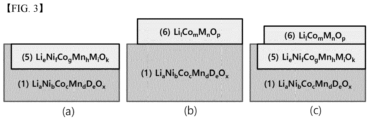
- the coating layer are schematically shown in FIGS. 2 and 3 , and will be described again later.
- a process of producing an active material as an oxide by calcination of a mixture of a transition metal precursor with a Li raw material (together with a doping raw material in some cases) is referred to as "primary calcination”, and a process of calcination of the active material that has undergone additional primary calcination at a relatively low temperature is referred to as “secondary/tertiary/n th calcination” depending on the number of additional calcinations.
- the location and structure of the coating layer may vary depending on the calcination temperature and Ni content.
- the coating layer formed in the outer direction from the core surface may be classified as an "outer coating layer” and the coating layer formed in the inner direction from the core surface may be classified as an "internal coating layer” depending on the location of the coating layer based on the core surface.
- the coating layers may be formed differently depending on the calcination temperature under the constant Ni content conditions.
- the Ni content is about 80% and calcination is performed at a low temperature of less than 500 to 700°C, the amount of Co penetrating the inside of the core decreases and a significant amount of Co reacts with Li on the surface to form a coating layer in the form of LCO (LiCoO 2 ).
- LCO LiCoO 2
- Co when calcination is performed at a high temperature of 700 to 800°C under the constant Ni content conditions, a significant amount of Co diffuses from the core surface to the core inside to a predetermined depth, forming a coating layer with a predetermined thickness.
- Co is characterized by entering the core along with a large amount of oxygen (O).
- O oxygen
- Co is supplied into the core along with oxygen (O).
- oxygen oxygen
- the crystal structure which has become unstable due to oxygen desorption, is restored to a uniform layered structure due to recombination with the oxygen introduced inside the core, thus improving resistance/capacity/efficiency/lifespan characteristics.
- the coating layers formed on the surface of the core and inside the core near the core surface have their own characteristic effects and the coating layers having a composite structure, that is, a composite structure in which some of the coating layers are formed on the surface of the core and others are formed inside the core also have excellent effects.
- the thickness of the coating layer should be within 10% of the average particle diameter of the core so that the coating layer includes the area where oxygen desorption mainly occurs.
- the coating layer may include at least one of an external coating layer that contains at least one of Co, Zr, Ti, Al, P, Si, B, W, Mg, and Sn, and is formed outward from the core surface, and an internal coating layer that contains at least one of Ni, Co, and Mn (preferably, Ni and Co) and at least one of Zr, Ti, Al, P, Si, B, W, Mg, and Sn, and is formed inward from the core surface.
- an external coating layer that contains at least one of Co, Zr, Ti, Al, P, Si, B, W, Mg, and Sn, and is formed outward from the core surface
- an internal coating layer that contains at least one of Ni, Co, and Mn (preferably, Ni and Co) and at least one of Zr, Ti, Al, P, Si, B, W, Mg, and Sn, and is formed inward from the core surface.
- the coating layer includes a plurality of layers, such as two or more external coating layers, or two or more internal coating layers, or a combination of one or more external coating layers and one or more internal coating layers, some layers may not contain some or all of the elements, but the coating layer at least satisfies the requirement of containing Co and structure-stabilizing element from the overall viewpoint of the coating layer.
- the core which is a lithium transition metal oxide containing Ni
- the coating layer may include at least one of the following Formulas 2 to 6 and examples of coating layers formed based thereon are shown in FIGS. 2 and 3 .
- the coating layer may be formed as a single layer or may be formed as two or more layers depending on the Ni content, calcination temperature, calcination method, or the like.
- f satisfies 0 ⁇ f ⁇ 1.
- f satisfies 0 ⁇ f ⁇ 1.
- Examples 5 to 11 which will be described later may include one or two or more coating layers of Formulas 2 to 4, and Examples 1 to 4 may include one or more coating layers of Formulas 5 to 6.
- the material when the coating layer is mainly formed inside the core may have the composition of Formula 2 or 5
- the material when the coating layer is mainly formed outside the core may have the composition of Formula 3, 4 or 6.
- Compositions of Formulas 2 to 4 and compositions of Formulas 5 to 6 may be present in combination.
- M in the internal coating layers of Formulas 2 and 5 may be partially derived from the core, or partially derived from the raw materials for producing the coating layer, or partially derived from the core and partially derived from the coating layer raw materials.
- the same element as the structure-stabilizing element among the element(s) constituting the core is contained.
- at least one of Co and the structure-stabilizing element may have a higher content in the coating layer than in the core, and preferably, both Co and the structure-stabilizing element may have a higher content in the coating layer than in the core.
- the content of at least one of Co and the structure-stabilizing element in the coating layer may be at least 10% higher than the content (mol%) of the same element in the core.
- the coating layer may include a spinel structure formed through low-temperature calcination, or a layered structure formed through relatively high-temperature calcination.
- the novel one-body particle of the present invention can satisfy one or more of the following conditions of the ratio of (003)/(104) exceeds 1.52 upon XRD pattern measurement and the C-axis length exceeds 14.2000 ⁇ upon XRD pattern measurement and preferably, both of the above conditions.
- the difference in the ratio of the layered structure that satisfies the rhombohedral (R-3m) structure can be confirmed by comparing the intensity ratio of peaks (003) to (104) in the XRD pattern. As the ratio of (003)/(104) increases, the cation mixing rate due to movement of Ni 4+ ions decreases, which means that the layered structure is well formed.
- the novel one-body particle of the present invention generally satisfies the requirement that the ratio of (003)/(104) is greater than 1.52.
- novel one-particle of the present invention increases the distance between metals by combining Co and structure-stabilizing element with oxygen in the layered structure of the active material and thus generally satisfies the requirement that the C-axis length exceeds 14.2000 ⁇ .
- the present invention also provides a method of preparing a novel one-body powder containing unaggregated one-body particles and specifically, the method may include the following steps:
- the structure-stabilizing element has a greater bond-dissociation energy (BDE) with oxygen (O) than the bond-dissociation energy between Co and oxygen (O).
- the one-body particle is not made in the form of one unit of particle, but a plurality of one-body particles because of the characteristics of general processes. Therefore, the preparation method is defined as a method of preparing a one-body powder containing a plurality of one-body particles.
- the "transition metal precursor containing Ni” is interpreted to include both a precursor containing Ni and a precursor containing Ni and one or more transition metals other than Ni, and they may be prepared, for example, by coprecipitation.
- “Li raw material” is a material containing lithium, for example, Li 2 CO 3 , LiOH, or the like.
- doping raw materials may be further mixed with the first mixture in the preparation step (a).
- the primary calcination (b) is a step of calcining the prepared first mixture to produce a primary calcination product.
- the calcination temperature varies depending on the particle shape (one-body structure/secondary particle structure) and Ni content. In the examples described later, the primary calcination was performed at 890 to 930°C, but the range may be selected from 700 to 1,000°C. If necessary, the calcination may be performed in several divided temperature sections within the corresponding temperature range.
- the primary calcination product that has underwent the primary calcination at high temperature is in an oxide state. When the primary calcination product is mixed with a doping raw material in the preparation step (a), a doped cathode active material oxide powder (primary calcination product) is prepared.
- the coating layer forming step (c) of forming a coating layer containing Co and a structure-stabilizing element in at least a part of the primary calcination product may be configured in various ways as follows depending on the type of the desired coating layer.
- the coating layer forming step (c) may include secondary calcining including mixing the primary calcination product with a Co raw material and a structure-stabilizing element raw material and calcining the resulting mixture.
- the coating layer forming step (c) includes secondary calcining including mixing the primary calcination product with the Co raw material and calcining the resulting mixture, and tertiary calcining including mixing the secondary calcination product with a structure-stabilizing element raw material and calcining the resulting mixture.
- the coating layer forming step (c) includes secondary calcining including mixing the primary calcination product with the Co raw material and calcining the resulting mixture, and tertiary calcining including mixing the secondary calcination product with a Co raw material and calcining the resulting mixture.
- Co raw material is a material containing Co.
- the Co raw material may be selected from hydroxides such as Co(OH) 2 and Co(OH) 3 , oxide, and various salts such as CoSO 4
- structure-stabilizing element raw material is a material containing a structure-stabilizing element, for example, oxide, any of various salts, and hydroxides of structure-stabilizing element such as H 3 BO 3 , B 2 O 3 , ZrO 2 , TiO 2 , Al 2 O 3 , or (NH 4 ) 3 PO 4 , but is not limited thereto.
- the structure-stabilizing element is preferably B (boron).
- the calcination temperature for forming the coating layer may vary depending on the type of structure-stabilizing element used along with Co and the type of coating layer (single layer/multilayer), and may range from 250 to 800°C, for example.
- Examples 1 to 4 correspond to the first embodiment (A)
- Examples 6 to 11 correspond to the second embodiment (B)
- Example 5 corresponds to the third embodiment (C).
- the secondary calcination and tertiary calcination temperatures may be appropriately set depending on the type of Co raw material and structure-stabilizing element raw material.
- the present invention also provides an electrode and a secondary battery including the novel one-body particle.
- the configuration and production method of the electrode and secondary battery are known in the art, and thus a detailed description thereof will be omitted herein.
- the novel one-body particle according to the present invention has effects of solving the problem of the conventional secondary particle structure in the cathode active material having a high Ni content, alleviating oxygen desorption that occurs during calcination of the one-body particle, and greatly improving resistance/capacity/efficiency/residual lithium/lifespan characteristics.
- NiSO 4 as a nickel precursor, CoSO 4 as a cobalt precursor, and MnSO 4 as a manganese precursor were added at a molar ratio of 0.88:0.04:0.08 to water to prepare an aqueous solution of a nickel-cobalt-manganese hydroxide precursor.
- An aqueous solution of sodium hydroxide was slowly added dropwise while stirring the aqueous solution for 5 hours to neutralize the aqueous precursor solution to thereby precipitate Ni 0.88 Co 0.04 Mn 0.08 (OH) 2 as nickel-cobalt-manganese hydroxide.
- the precursor (nickel-cobalt-manganese hydroxide) thus obtained was mixed with LiOH, followed by primary calcination at 910°C for 6 hours to prepare LiNi 0.88 Co 0.04 Mn 0.08 O 2 .
- NiSO 4 as a nickel precursor and CoSO 4 as a cobalt precursor were added at a molar ratio of 0.88:0.12 to water to prepare an aqueous solution of a nickel-cobalt-manganese hydroxide precursor.
- An aqueous solution of sodium hydroxide was slowly added dropwise while stirring the aqueous solution for 5 hours to neutralize the aqueous precursor solution to thereby precipitate Ni 0.88 Co 0.12 (OH) 2 as nickel-cobalt hydroxide.
- the precursor (nickel-cobalt hydroxide) thus obtained was mixed with LiOH, followed by primary calcination at 910°C for 6 hours to prepare LiNi 0.88 Co 0.12 O 2 .
- Co(OH) 2 corresponding to 1.5 mol of Co was mixed with the primarily calcined cathode active material of Comparative Example 1, followed by secondary calcination at 750°C for 7 hours to form a coating layer containing cobalt (Co) on the surface of the active material.
- NiSO 4 as a nickel precursor, CoSO 4 as a cobalt precursor, and MnSO 4 as a manganese precursor were added at a molar ratio of 0.75:0.1:0.15 to water to prepare an aqueous solution of a nickel-cobalt-manganese hydroxide precursor.
- An aqueous solution of sodium hydroxide was slowly added dropwise while stirring the aqueous solution for 5 hours to neutralize the aqueous precursor solution to thereby precipitate Ni 0.75 Co 0.1 Mn 0.15 (OH) 2 as nickel-cobalt-manganese hydroxide.
- the precursor (nickel-cobalt-manganese hydroxide) thus obtained was mixed with LiOH, followed by primary calcination at 890°C for 6 hours to prepare LiNi 0.75 Co 0.1 Mn 0.15 O 2 .
- NiSO 4 as a nickel precursor, CoSO 4 as a cobalt precursor, and MnSO 4 as a manganese precursor were added at a molar ratio of 0.95:0.025:0.025 to water to prepare an aqueous solution of a nickel-cobalt-manganese hydroxide precursor.
- An aqueous solution of sodium hydroxide was slowly added dropwise while stirring the aqueous solution for 5 hours to neutralize the aqueous precursor solution to thereby precipitate Ni 0.95 Co 0.025 Mn 0.025 (OH) 2 as nickel-cobalt-manganese hydroxide.
- the precursor (nickel-cobalt-manganese hydroxide) thus obtained was mixed with LiOH, followed by primary calcination at 930°C for 6 hours to prepare LiNi 0.95 Co 0.025 Mn 0.025 O 2 .
- B 2 O 3 corresponding to 0.05 mol of B was mixed with the primarily calcined cathode active material of Comparative Example 1, followed by secondary calcination at 300°C for 7 hours to form a coating layer containing boron (B) on the surface of the active material.
- Co(OH) 2 corresponding to 1.5 mol of Co was mixed with the active material thus obtained, followed by tertiary calcination at 750°C for 7 hours to form a coating layer containing Co (cobalt).
- Co(OH) 2 corresponding to 1.5 mol of Co was mixed with the primarily calcined cathode active material of Comparative Example 1, followed by secondary calcination at 750°C for 7 hours to form a coating layer containing cobalt (Co).
- B 2 O 3 corresponding to 0.05 mol of B was mixed with the active material thus obtained, followed by tertiary calcination at 450°C for 7 hours to form a coating layer containing B (boron).
- Co(OH) 2 corresponding to 1.5 mol of Co was mixed with the primarily calcined cathode active material of Comparative Example 1, followed by secondary calcination at 750°C for 7 hours to form a coating layer containing cobalt (Co).
- B 2 O 3 corresponding to 0.05 mol of B was mixed with the active material thus obtained, followed by tertiary calcination at 300°C for 7 hours to form a coating layer containing B (boron).
- Co(OH) 2 corresponding to 1.5 mol of Co was mixed with the primarily calcined cathode active material of Comparative Example 1, followed by secondary calcination at 500°C for 7 hours to form a coating layer containing cobalt (Co).
- B 2 O 3 corresponding to 0.05 mol of B was mixed with the active material thus obtained, followed by tertiary calcination at 300°C for 7 hours to form a coating layer containing B (boron).
- Co(OH) 2 corresponding to 1.5 mol of Co was mixed with the primarily calcined cathode active material of Comparative Example 1, followed by secondary calcination at 750°C for 7 hours to form a coating layer containing cobalt (Co).
- B 2 O 3 corresponding to 0.05 mol of B was mixed with the active material thus obtained, followed by tertiary calcination at 250°C for 7 hours to form a coating layer containing B (boron).
- NiSO 4 as a nickel precursor, CoSO 4 as a cobalt precursor, and MnSO 4 as a manganese precursor were added at a molar ratio of 0.75:0.10:0.15 to water to prepare an aqueous solution of a nickel-cobalt-manganese hydroxide precursor.
- An aqueous solution of sodium hydroxide was slowly added dropwise while stirring the aqueous solution for 5 hours to neutralize the aqueous precursor solution to thereby precipitate Ni 0.75 Co 0.10 Mn 0.15 (OH) 2 as nickel-cobalt-manganese hydroxide.
- the precursor (nickel-cobalt-manganese hydroxide) thus obtained was mixed with LiOH, followed by primary calcination at 930°C for 6 hours to prepare LiNi 0.75 Co 0.10 Mn 0.15 O 2 .
- Co(OH) 2 corresponding to 1.5 mol of Co was mixed with the primarily calcined cathode active material, followed by secondary calcination at 750°C for 7 hours to form a coating layer containing cobalt (Co).
- B 2 O 3 corresponding to 0.05 mol of B was mixed with the active material thus obtained, followed by tertiary calcination at 300°C for 7 hours to form a coating layer containing B (boron).
- NiSO 4 as a nickel precursor, CoSO 4 as a cobalt precursor, and MnSO 4 as a manganese precursor were added at a molar ratio of 0.92:0.04:0.04 to water to prepare an aqueous solution of a nickel-cobalt-manganese hydroxide precursor.
- An aqueous solution of sodium hydroxide was slowly added dropwise while stirring the aqueous solution for 5 hours to neutralize the aqueous precursor solution to thereby precipitate Ni 0.92 Co 0.04 Mn 0.04 (OH) 2 as nickel-cobalt-manganese hydroxide.
- the precursor (nickel-cobalt-manganese hydroxide) thus obtained was mixed with LiOH, followed by primary calcination at 890°C for 6 hours to prepare LiNi 0.92 Co 0.04 Mn 0.04 O 2 .
- Co(OH) 2 corresponding to 1.5 mol of Co was mixed with the primarily calcined cathode active material, followed by secondary calcination at 750°C for 7 hours to form a coating layer containing cobalt (Co).
- B 2 O 3 corresponding to 0.05 mol of B was mixed with the active material thus obtained, followed by tertiary calcination at 300°C for 7 hours to form a coating layer containing B (boron).
- the cation active material synthesized in each of Comparative Examples 1 to 5, and Examples 1 to 11, Super-P as a conductive material, and PVdF as a binder were mixed at a weight ratio of 96:2:2 in the presence of N-methylpyrrolidone as a solvent to prepare a cathode active material slurry.
- the cathode active material slurry was applied onto an aluminum current collector, dried at 120°C, and then rolled to produce a cathode.
- a porous polyethylene film as a separator was interposed between the cathode produced as described above and an anode as a Li metal to produce an electrode assembly, the electrode assembly was placed in a battery case, and an electrolyte was injected into the battery case to produce a lithium secondary battery.
- Each of the lithium secondary batteries thus produced was subjected to charge (at 0.1C, 4.25V) and discharge (at 0.1C, 2.5V).
- the results are shown in Table 1 below.
- Residual lithium was measured under the following conditions in the cathode active materials prepared in Comparative Examples 1 to 5 and Examples 1 to 11, and the results are shown in Table 1 below.
- a lithium secondary battery was prepared based on each of the cathode active materials prepared in Comparative Examples 1 to 5 and Examples 1 to 11 and was subjected to charge (at 0.5C and 4.25V) and discharge (at 1.0C and 2.5V) 50 times at 45°C, and the lifespan and resistance increment thereof were measured.
- the results are shown in Table 1 below.
- Examples 1 to 4 exhibit improvement in resistance, charge and discharge capacity, lifespan, and resistance increment compared to Comparative Examples 1 to 3.
- Examples 1 to 4 have an effect of improving lifespan and resistance increment compared to Comparative Example 3, which means that B (boron) acts as a structure-stabilizing element.
- Example 5 exhibits improvement in charge and discharge capacity, lifespan, and resistance increment compared to Comparative Example 3
- Examples 6 to 9 exhibits great improvement in charge and discharge capacity, lifespan, and resistance increment compared to Comparative Example 3.
- Ni70-based and Ni90-based compositions corresponding to Examples 10 and 11 exhibit increased charge and discharge capacity, decreased resistance increment, and improved lifespan compared to those of Comparative Examples 4 and 5.
- Ni compositions other than Ni80-based compositions can further improve lifespan characteristics due to improved structural stability through the structural stabilizing element.
- B boron
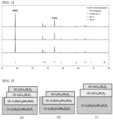
- the XRD patterns of the cathode active materials prepared in Comparative Example 1, Example 7, and Example 8 were measured under the following measurement conditions, and the results are shown in FIG. 1 .
- Example 1 exhibits a ratio of (003)/(104) of 1.52
- Example 8 exhibits a ratio of (003)/(104) of 1.62
- Example 7 exhibits a ratio of (003)/(104) of 1.69, which indicates that the ratio of layered structure formed in the coating layer of Example 7 was the highest.
- Comparative Example 1 exhibits a C-axis length of 14.2000 ⁇
- Example 8 exhibits a C-axis length of 14.2003 ⁇
- Example 7 exhibits a C-axis length of 14.2018 ⁇ , which indicates that the Co and structure-stabilizing element of Example 7 bonds to oxygen in the layered structure of the cathode active material to increase the distance between metals
- Example 8 has a relatively poor layered structure in the coating layer compared to Example 7, which is consistent with the surface diffusion results of Co and structure-stabilizing element shown in FIG. 1 .
Landscapes
- Chemical & Material Sciences (AREA)
- Chemical Kinetics & Catalysis (AREA)
- Electrochemistry (AREA)
- General Chemical & Material Sciences (AREA)
- Inorganic Chemistry (AREA)
- Organic Chemistry (AREA)
- Composite Materials (AREA)
- Engineering & Computer Science (AREA)
- Manufacturing & Machinery (AREA)
- Materials Engineering (AREA)
- Battery Electrode And Active Subsutance (AREA)
Applications Claiming Priority (2)
| Application Number | Priority Date | Filing Date | Title |
|---|---|---|---|
| KR1020210123124A KR102410700B1 (ko) | 2021-09-15 | 2021-09-15 | 양극 활물질용 신규 단일체 입자 및 신규 단일체 분말 제조방법 |
| PCT/KR2022/013757 WO2023043209A1 (ko) | 2021-09-15 | 2022-09-15 | 양극 활물질용 신규 단일체 입자 및 신규 단일체 분말 제조방법 |
Publications (2)
| Publication Number | Publication Date |
|---|---|
| EP4404298A1 true EP4404298A1 (de) | 2024-07-24 |
| EP4404298A4 EP4404298A4 (de) | 2025-10-08 |
Family
ID=82217053
Family Applications (1)
| Application Number | Title | Priority Date | Filing Date |
|---|---|---|---|
| EP22870293.2A Pending EP4404298A4 (de) | 2021-09-15 | 2022-09-15 | Neuartiges einkörperteilchen für ein positivelektrodenaktivmaterial und verfahren zur herstellung eines neuartigen einkörperpulvers |
Country Status (3)
| Country | Link |
|---|---|
| EP (1) | EP4404298A4 (de) |
| KR (1) | KR102410700B1 (de) |
| WO (1) | WO2023043209A1 (de) |
Cited By (1)
| Publication number | Priority date | Publication date | Assignee | Title |
|---|---|---|---|---|
| EP4325600A4 (de) * | 2021-10-01 | 2024-10-16 | LG Energy Solution, Ltd. | Verfahren zur herstellung eines kathodenaktivmaterials für eine lithiumsekundärbatterie und damit hergestelltes kathodenaktivmaterial |
Families Citing this family (12)
| Publication number | Priority date | Publication date | Assignee | Title |
|---|---|---|---|---|
| KR102749968B1 (ko) * | 2020-06-12 | 2025-01-03 | 주식회사 에코프로비엠 | 양극 활물질 및 이를 포함하는 리튬 이차전지 |
| KR102410700B1 (ko) * | 2021-09-15 | 2022-06-22 | 주식회사 엘 앤 에프 | 양극 활물질용 신규 단일체 입자 및 신규 단일체 분말 제조방법 |
| CN119452479A (zh) * | 2022-09-30 | 2025-02-14 | 株式会社Lg新能源 | 正极材料、正极和二次电池 |
| KR102895413B1 (ko) * | 2022-09-30 | 2025-12-05 | 주식회사 엘지에너지솔루션 | 양극재, 양극 및 이차전지 |
| KR102629076B1 (ko) * | 2022-12-09 | 2024-01-25 | 주식회사 엘 앤 에프 | 양극 활물질 및 이를 포함하는 이차전지 |
| JP2025517006A (ja) * | 2022-12-15 | 2025-05-30 | エルジー エナジー ソリューション リミテッド | 正極活物質およびこれを含む正極 |
| US12191488B2 (en) * | 2022-12-15 | 2025-01-07 | Lg Energy Solution, Ltd. | Positive electrode active material and positive electrode including the same |
| KR102804477B1 (ko) * | 2023-05-18 | 2025-05-12 | 주식회사 엘지화학 | 양극재, 이를 포함하는 양극 및 리튬 이차 전지 |
| KR102833612B1 (ko) * | 2023-05-18 | 2025-07-14 | 주식회사 엘지화학 | 양극재, 이를 포함하는 양극 및 리튬 이차 전지 |
| WO2024248567A1 (ko) * | 2023-06-02 | 2024-12-05 | 주식회사 엘지화학 | 양극 활물질, 및 이를 포함하는 양극 및 리튬 이차전지 |
| US12341190B2 (en) * | 2023-08-04 | 2025-06-24 | Action Battery Technologies, Inc. | Coated single crystalline metal oxide materials and method for producing the same |
| WO2025080039A1 (ko) * | 2023-10-12 | 2025-04-17 | 주식회사 엘지화학 | 양극 활물질 및 이의 제조 방법 |
Family Cites Families (10)
| Publication number | Priority date | Publication date | Assignee | Title |
|---|---|---|---|---|
| JP2003068300A (ja) | 2001-08-24 | 2003-03-07 | Toyota Central Res & Dev Lab Inc | リチウム二次電池用正極活物質材料およびそれを用いたリチウム二次電池 |
| US9209455B2 (en) | 2011-08-16 | 2015-12-08 | Tiax Llc | Polycrystalline metal oxide, methods of manufacture thereof, and articles comprising the same |
| KR102314045B1 (ko) * | 2014-12-18 | 2021-10-18 | 삼성에스디아이 주식회사 | 복합 양극 활물질, 그 제조방법, 이를 포함한 양극 및 리튬 전지 |
| KR102065716B1 (ko) * | 2015-10-20 | 2020-02-11 | 주식회사 엘지화학 | 다층 구조의 금속 산화물들을 포함하는 양극 활물질 제조용 전구체 및 이를 사용하여 제조된 리튬 이차전지용 양극 활물질 |
| CN110993940A (zh) * | 2016-07-05 | 2020-04-10 | 株式会社半导体能源研究所 | 正极活性物质 |
| KR20190048923A (ko) * | 2017-10-31 | 2019-05-09 | 울산과학기술원 | 이차전지용 양극활물질, 이의 제조방법 및 이를 포함하는 이차전지 |
| KR102654264B1 (ko) * | 2018-08-13 | 2024-04-02 | 에스케이온 주식회사 | 리튬 이차 전지용 양극 활물질, 이의 제조방법 및 이를 포함하는 리튬 이차 전지 |
| KR102596885B1 (ko) * | 2018-08-24 | 2023-10-31 | 주식회사 엘지에너지솔루션 | 리튬 이차 전지용 양극 활물질, 이의 제조 방법, 및 이를 포함하는 리튬 이차 전지 |
| KR102144056B1 (ko) * | 2019-12-24 | 2020-08-12 | 주식회사 에스엠랩 | 양극활물질, 이의 제조방법 및 이를 포함하는 양극을 포함한 리튬이차전지 |
| KR102410700B1 (ko) * | 2021-09-15 | 2022-06-22 | 주식회사 엘 앤 에프 | 양극 활물질용 신규 단일체 입자 및 신규 단일체 분말 제조방법 |
-
2021
- 2021-09-15 KR KR1020210123124A patent/KR102410700B1/ko active Active
-
2022
- 2022-09-15 EP EP22870293.2A patent/EP4404298A4/de active Pending
- 2022-09-15 WO PCT/KR2022/013757 patent/WO2023043209A1/ko not_active Ceased
Cited By (1)
| Publication number | Priority date | Publication date | Assignee | Title |
|---|---|---|---|---|
| EP4325600A4 (de) * | 2021-10-01 | 2024-10-16 | LG Energy Solution, Ltd. | Verfahren zur herstellung eines kathodenaktivmaterials für eine lithiumsekundärbatterie und damit hergestelltes kathodenaktivmaterial |
Also Published As
| Publication number | Publication date |
|---|---|
| EP4404298A4 (de) | 2025-10-08 |
| WO2023043209A1 (ko) | 2023-03-23 |
| KR102410700B1 (ko) | 2022-06-22 |
Similar Documents
| Publication | Publication Date | Title |
|---|---|---|
| EP4404298A1 (de) | Neuartiges einkörperteilchen für ein positivelektrodenaktivmaterial und verfahren zur herstellung eines neuartigen einkörperpulvers | |
| US12308418B2 (en) | Secondary battery active material | |
| US7678503B2 (en) | Surface and bulk modified high capacity layered oxide cathodes with low irreversible capacity loss | |
| KR102885370B1 (ko) | 리튬 이차 전지용 양극 활물질, 이의 제조방법 및 이를 포함하는 리튬 이차 전지 | |
| KR101470092B1 (ko) | 양극 활물질, 이의 제조방법 및 이를 포함하는 리튬 이차 전지 | |
| KR20220089183A (ko) | 리튬 이차 전지용 양극 활물질, 이의 제조방법 및 이를 포함하는 리튬 이차 전지 | |
| KR20230095271A (ko) | 리튬 이차 전지용 양극 활물질, 이의 제조방법 및 이를 포함하는 리튬 이차 전지 | |
| KR20220135551A (ko) | 리튬 이차 전지용 양극 활물질 및 이를 포함하는 리튬 이차 전지 | |
| EP4531135A1 (de) | Agglomerationsartiges multielement-positivelektrodenmaterial, herstellungsverfahren dafür, verwendung davon und lithium-ionen-batterie | |
| KR20250047968A (ko) | Co 및 구조 안정화 원소가 코팅된 양극 활물질용 신규 단일체 입자 | |
| US11362333B2 (en) | Cobalt-free layered oxide cathodes | |
| US12027697B2 (en) | One-body particle for cathode active material | |
| KR100872370B1 (ko) | 리튬 이차전지용 스피넬형 양극 활물질 및 그 제조방법 | |
| KR20250094475A (ko) | 무코발트 양극 활물질 및 이를 포함하는 리튬이차전지 | |
| KR102390956B1 (ko) | 스피넬 복합고용체 산화물, 이의 제조 방법, 이를 포함하는 양극 활물질 및 리튬 이차 전지 | |
| EP4471896A1 (de) | Einkörperpartikel und aktives material für sekundärbatterie damit | |
| EP4636850A1 (de) | Kathodenaktivmaterial für eine festkörperbatterie, herstellungsverfahren dafür und festkörperbatterie damit | |
| KR102618005B1 (ko) | 양극 활물질의 제조 방법 | |
| KR102922802B1 (ko) | 리튬 이차 전지용 양극재 및 양극재의 제조방법 | |
| EP4597663A1 (de) | Sekundärbatterie mit nichtwässrigem elektrolyten | |
| US20250391855A1 (en) | Positive electrode active material, positive electrode plate, and non-aqueous electrolyte secondary battery | |
| KR102629076B1 (ko) | 양극 활물질 및 이를 포함하는 이차전지 | |
| EP4636865A1 (de) | Positivelektrodenaktivmaterialvorläufer für lithiumsekundärbatterie, positivelektrodenaktivmaterial und lithiumsekundärbatterie damit | |
| EP4614615A1 (de) | Lithiumverbundoxid und kathodenaktivmaterial für sekundärbatterie damit | |
| KR20260001788A (ko) | 리튬 이차 전지용 양극 활물질의 제조방법 |
Legal Events
| Date | Code | Title | Description |
|---|---|---|---|
| STAA | Information on the status of an ep patent application or granted ep patent |
Free format text: STATUS: THE INTERNATIONAL PUBLICATION HAS BEEN MADE |
|
| PUAI | Public reference made under article 153(3) epc to a published international application that has entered the european phase |
Free format text: ORIGINAL CODE: 0009012 |
|
| STAA | Information on the status of an ep patent application or granted ep patent |
Free format text: STATUS: REQUEST FOR EXAMINATION WAS MADE |
|
| 17P | Request for examination filed |
Effective date: 20240305 |
|
| AK | Designated contracting states |
Kind code of ref document: A1 Designated state(s): AL AT BE BG CH CY CZ DE DK EE ES FI FR GB GR HR HU IE IS IT LI LT LU LV MC MK MT NL NO PL PT RO RS SE SI SK SM TR |
|
| DAV | Request for validation of the european patent (deleted) | ||
| DAX | Request for extension of the european patent (deleted) | ||
| A4 | Supplementary search report drawn up and despatched |
Effective date: 20250908 |
|
| RIC1 | Information provided on ipc code assigned before grant |
Ipc: H01M 4/36 20060101AFI20250902BHEP Ipc: H01M 4/525 20100101ALI20250902BHEP Ipc: H01M 4/505 20100101ALI20250902BHEP Ipc: H01M 4/62 20060101ALI20250902BHEP Ipc: C01G 53/00 20060101ALI20250902BHEP Ipc: H01M 10/052 20100101ALI20250902BHEP |