EP4404201B1 - Verfahren zur krebserkennung - Google Patents
Verfahren zur krebserkennung Download PDFInfo
- Publication number
- EP4404201B1 EP4404201B1 EP24177632.7A EP24177632A EP4404201B1 EP 4404201 B1 EP4404201 B1 EP 4404201B1 EP 24177632 A EP24177632 A EP 24177632A EP 4404201 B1 EP4404201 B1 EP 4404201B1
- Authority
- EP
- European Patent Office
- Prior art keywords
- str
- cancer
- sra
- awc
- activation
- Prior art date
- Legal status (The legal status is an assumption and is not a legal conclusion. Google has not performed a legal analysis and makes no representation as to the accuracy of the status listed.)
- Active
Links
Images




Classifications
-
- G—PHYSICS
- G01—MEASURING; TESTING
- G01N—INVESTIGATING OR ANALYSING MATERIALS BY DETERMINING THEIR CHEMICAL OR PHYSICAL PROPERTIES
- G01N33/00—Investigating or analysing materials by specific methods not covered by groups G01N1/00 - G01N31/00
- G01N33/48—Biological material, e.g. blood, urine; Haemocytometers
- G01N33/483—Physical analysis of biological material
- G01N33/487—Physical analysis of biological material of liquid biological material
- G01N33/493—Physical analysis of biological material of liquid biological material urine
-
- G—PHYSICS
- G01—MEASURING; TESTING
- G01N—INVESTIGATING OR ANALYSING MATERIALS BY DETERMINING THEIR CHEMICAL OR PHYSICAL PROPERTIES
- G01N33/00—Investigating or analysing materials by specific methods not covered by groups G01N1/00 - G01N31/00
- G01N33/48—Biological material, e.g. blood, urine; Haemocytometers
- G01N33/50—Chemical analysis of biological material, e.g. blood, urine; Testing involving biospecific ligand binding methods; Immunological testing
- G01N33/53—Immunoassay; Biospecific binding assay; Materials therefor
- G01N33/575—Immunoassay; Biospecific binding assay; Materials therefor for cancer
- G01N33/5758—Immunoassay; Biospecific binding assay; Materials therefor for cancer involving compounds serving as markers for tumours, cancers or neoplasias, e.g. cellular determinants, receptors, heat shock/stress proteins, A-protein, oligosaccharides or metabolites
- G01N33/57585—Immunoassay; Biospecific binding assay; Materials therefor for cancer involving compounds serving as markers for tumours, cancers or neoplasias, e.g. cellular determinants, receptors, heat shock/stress proteins, A-protein, oligosaccharides or metabolites involving compounds identifiable in body fluids
-
- G—PHYSICS
- G01—MEASURING; TESTING
- G01N—INVESTIGATING OR ANALYSING MATERIALS BY DETERMINING THEIR CHEMICAL OR PHYSICAL PROPERTIES
- G01N33/00—Investigating or analysing materials by specific methods not covered by groups G01N1/00 - G01N31/00
- G01N33/0001—Investigating or analysing materials by specific methods not covered by groups G01N1/00 - G01N31/00 by organoleptic means
-
- G—PHYSICS
- G01—MEASURING; TESTING
- G01N—INVESTIGATING OR ANALYSING MATERIALS BY DETERMINING THEIR CHEMICAL OR PHYSICAL PROPERTIES
- G01N2333/00—Assays involving biological materials from specific organisms or of a specific nature
- G01N2333/435—Assays involving biological materials from specific organisms or of a specific nature from animals; from humans
- G01N2333/43504—Assays involving biological materials from specific organisms or of a specific nature from animals; from humans from invertebrates
- G01N2333/43526—Assays involving biological materials from specific organisms or of a specific nature from animals; from humans from invertebrates from worms
- G01N2333/4353—Assays involving biological materials from specific organisms or of a specific nature from animals; from humans from invertebrates from worms from nematodes
- G01N2333/43534—Assays involving biological materials from specific organisms or of a specific nature from animals; from humans from invertebrates from worms from nematodes from Caenorhabditis
Definitions
- Olfaction is one of the primary mechanisms through which many animals adapt to the environmental changes.
- Olfactory receptors which in all animals belong to the G-protein coupled receptors (GPCRs) family, play a crucial role in distinguishing the wide range of volatile or soluble molecules by directly binding them with high accuracy.
- Chemical sensitivity is particularly present in those organisms lacking long-range sensory mechanisms like hearing and vision.
- the genome of the nematode Caenorhabditis elegans possesses a remarkable number of genes encoding chemosensory receptors making it able to detect a similar number of odorants as mammals, despite the extremely low number of chemosensory neurons available.
- Cancer is a disease that deeply alters the metabolome of the organism, potentially introducing its own characteristic waste products in biofluids. It has been reported that cancer tissues exude volatile compounds, and taking advantage of the extraordinary sense of smell of dogs and mice, previous studies allowed to demonstrate the existence of not yet known cancer-specific odorants in biological fluids. Animals perceive as odours a large variety of volatile molecules through olfactory perception. The ability to respond adaptively to any chemical alteration of the surrounding world is of pivotal importance for life and health in most animal species. Indeed, odours serve animals as environmental trackers to localize food and water sources, for nesting, and to discriminate conspecifics (pheromones) from individuals of other species (allelochemicals). Different compounds or different ratios of the same compound result in determining a specific odour fingerprint that may modulate such behaviours.
- GPCRs G-protein coupled receptors
- ORNs olfactory neurons
- the urine volatilome which includes the signatures of metabolic breakdown of food, contaminants, drugs, endogenous and bacterial by-products, is strictly related to the state of health of the individual. Altered concentrations in the volatilome have been found in spectra of GC/MS on cancer biofluids but, to date, the identification of specific cancer biomarkers through these methods may be problematic for two main reasons: the sensitivity up to the micromolar range and the wide battery of metabolites with altered concentrations which may not be cancer-specific. Among this wide number of molecules, the high sensitivity and specificity of the C . elegans olfactory system may guide the identification of the essential metabolic signature of cancer.
- Hirotsu suggests that to detect cancer, it is possible to perform chemotaxis assays on a small population of C . elegans with urine samples. Positive chemotaxis indices are associated with cancer, while negative ones with a healthy condition. The reported sensitivity is 95.8% and the specificity is 95.0%.
- the paper When reporting the results about calcium imaging on the AWC neuron, the paper does not provide a statistically significant way to measure the neuronal response and to relate it to the discriminating preference displayed by C . elegans during chemotaxis assays in association with positive or control samples.
- the work of Hirotsu indicates the neuronal response to urine collected from people with cancer could be used in order to detect cancer in urine.
- This kind of analysis involved a limited number of samples (2 positive samples from gastric cancer patients and 2 control ones) and did not include any sample collected from women with breast cancer.
- the samples of urine were administered at a dilution of 10- 1 and for a time window of exposure to C . elegans of 10 seconds.
- the AWC neuron activates upon removal of positive samples and control samples as well, although the intensity of its activation is significantly lower in the latter case.
- the AWC neuron reportedly activates upon removal of attractants and may contribute to mediate attraction. Its activation in response to removal of control samples is lower in intensity, but not different in any other aspect from the activation in response to removal of positive samples, and as such, it cannot account for the preferential behaviour of C . elegans observed during chemotaxis.
- C . elegans attraction behaviour towards urine samples collected from women with cancer and of avoidance of those from healthy subjects is strongly influenced by the female hormone cycle and identified a window in which a chemotactic test on urine with C . elegans can reliably allow detection of urine samples deriving from women affected by cancer from samples derived from healthy controls and also introduced the requirement, in the test, that the subject to be tested must not take drugs altering the hormonal cycle.
- Figures 1 C and 1 D show chemotaxis indices obtained on urine samples collected over a month from six control subjects demonstrating that the chemotaxis indices are influenced by the hormonal cycle. In particular, during the estradiol and progesterone peaks indices become positive.
- the authors of the present invention identified receptors that are involved in cancer metabolites, indicating that a specific alteration of a restricted number of metabolites is sufficient for the highly accurate cancer discriminating behaviour of C . elegans.
- the authors of the present invention also identified a new measurement, herein defined as the "neuronal activation index" or NAI, which allows to quantify in a statistically significant manner the difference between the responses obtained for positive and negative samples in a calcium imaging test on C . elegans AWC neurons.
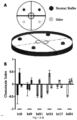
- FIG. 1 C.elegans chemotaxis assays towards urine samples from healthy subjects and cancer patients(A) Population chemotaxis assay plate design.
- a 10 cm diameter Petri dish was used to conduct chemotaxis assays. The plate was divided into four quadrants, two odorant areas (+) and two control areas (-).
- One microliter of either cancer or control urine samples diluted at 10 -1 was placed on the odorant areas (+).
- C . elegans The chemotaxis index of C . elegans is influenced by female hormones. Chemotaxis assays on urine collected from six healthy women (hd) during different days of the month, showed a variability in the chemotaxis index, suggesting an influence by female hormones. Error bars indicate SEM of three independent experiments.
- C-D C . elegans responses to urine collected from healthy donors is influenced by menstrual cycle rhythmicity. Chemotaxis assays were performed using urine collected from six healthy donors (hd), three times a week, starting two days after the end of the period until the next period.
- AWC is the main olfactory neuron mediating attraction towards cancer urine samples
- A Chemosensory neurons mediating aversive response (ASH and AWB) and attraction (AWC) located in the head. All neurons present processes extending to the tip of the nose.
- B Olfactory sensory neurons, downstream interneurons and motoneurons.
- AWC ON neurons show reliable responses, making them the best candidate for comparisons with the CI.
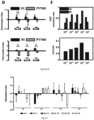
- D AWC neurons sense cancer metabolites.
- Population (top) and single-animal (bottom) chemotaxis assays showed that AWC genetically ablated worms are unable to sense cancer metabolites.
- Bar plots indicate chemotaxis indices or chemotaxis scores in response to three informative cancer samples (bc16, bc19, and bc39). Error bars reported in population assays indicate SEM of three independent experiments (*p ⁇ 0.05; **p ⁇ 0.002, Student's t test).
- Figure 2F The 1:10 dilution was found to be the best concentration to discriminate between BC urine samples and controls. Several concentrations of urines were tested via population chemotaxis assays. The maximum attraction to BC samples (bc), as well as the greater avoidance towards controls (hd), peaked at a 1:10 dilution. Error bars indicate SEM of three independent experiments.
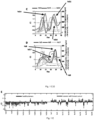
- Figure 2G Preference inversion for control samples in AWC depends on the exposure time.
- AWC activation rates and corresponding NAls obtained for the same control sample as a function of the length of the stimulus time (top graph and bottom graph respectively).
- the NAI highlights how the stimulus presented for 40 seconds or longer times elicits attractive-like responses in the majority of the tested nematodes, whereas shorter time-windows are associated with no response from most of the collected AWC traces.
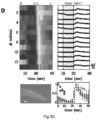
- Figure 3 Wide-field imaging of neural activity upon chemical stimulation.
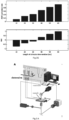
- A The sketch showing the experimental setup for simultaneous chemical stimulation via electro-valves and recording of neural responses via 470 nm blue excitation of GCaMP (blue line) and its emission (green line), and 660 nm light (red line) for transmission images.
- FIG. 1 Top view showing pulse arena geometry in two different conditions (buffer or odor filling).
- C-D Heatmaps and individual traces representing peak normalized neural responses (F/F0) across 12 animals and time from (C) healthy donors and (D) cancer subjects recorded on AWC ON neuron (pictures show a crop of a wide-field 4X fluorescence image on a head with a quiescent AWC ON neuron (top) and a chemically stimulated one (bottom)). Box plots show the corresponding population average peak F/F0. The central mark indicates the median, and the boxes indicate the 25th and 75th percentiles, respectively. The whiskers extend to the most extreme data points not considered outliers, and the outliers are plotted individually using the '+' symbol.
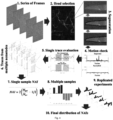
- FIG. 4 Pipeline of the post-processing processes. Starting from a series of frames (1), heads are selected and segmented for AWC ON identification (2-3). If the nematode stays still during the acquisition, it will pass the motion check and the trace will be evaluated (4-6). The NAI is calculated considering all viable traces available in the acquisition (7). Each experimental run tests about 4 positive samples and 4 control ones (8). Averaging between different days of experiments (9) finally yields an average NAI and a standard deviation for each sample (10). More details are reported in the Methods section.
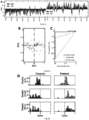
- FIG. 5 Bar plot of the resulting NAI and CI values for each sample of the control (blue bars) and positive group (red bars) reported with the corresponding standard deviation calculated assuming a binomial distribution of the variables. Although both indexes show a clear tendency (positive values for cancer samples, negative values for control group), the accuracy and the contrast associated with the NAI is evidently higher if compared to the CI.
- B The scatter plot shows the first two principal components of the PCA analysis. The text boxes report the outcome of the analysis, which show that NAls contribute to most of the separation between the points of the two groups.
- C ROC curves obtained for the CI (left graph), for NAI (center graph) and the first component of the principal component analysis (right graph).
- FIG. 6 Chemotaxis index of animals knock-out for the indicated gene Strains whose CI is significantly lower with respect to that of N2 are considered as strong candidates for sensing breast cancer metabolites. Statistical significance was calculated using unpaired Student's T-Test. Graph is presented as the average of assays performed using two different urine samples. Error bars represent SEM (* P ⁇ 0.05, ** P ⁇ 0.01).
- C. elegans reacts in different ways to samples collected from the same female individual depending on moment of the female hormonal cycle in which the samples were collected.
- the authors of the present invention have therefore identified a time window with respect to the female hormonal cycle for detecting cancer in a woman in assays wherein the reaction to the urine smell of C . elegans, or of a soil free-living nematode is used.
- the study carried out by the inventors is reported.
- the study specifically targeted breast cancer at different stages (I-IV), and of both types (lobular and ductal) over 36 positive samples and 36 control samples (age and group matched).
- the same set of samples were tested in chemotaxis assays as well as in calcium imaging experiments.
- the present invention therefore provides methods as defined in the claims of detecting cancer. Also disclosed is an in vitro method for detecting cancer in a woman, characterized by detecting cancer using, as an indicator, the reaction of free-living soil nematodes to the smell a urine sample of said woman; wherein the urine is collected at least two days after the last menstrual cycle and not later than five days after the same menstrual cycle.
- nematodes are an extremely broad phylum and that, although sharing a number of essential common features, roundworms can be parasitic or non-parasitic, the parasitic ones being adapted to insects, mammalians, fishes, plants and more, the non-parasitic (free living) ones being adapted to living in soil, water such as sea, lakes, rivers, ponds etc.
- nematodes rely for their feeding and survival on smell, their sense of smell is highly developed and specialised. It is known, for example, that parasitic nematodes respond to odours in a very different manner compared to soil free-living ones.
- all the embodiments of the invention are is considered to be reasonably applicable to nematodes having life habits similar to C. elegans , such as free-living soil nematodes.
- the methods as well as the assays of the invention are considered to be further reasonably applicable to bacterial feeders free-living soil nematodes.
- the free-living soil nematode is C . elegans.
- the reaction to the smell of urine of the nematode can be a chemotactic reaction, a neuronal reaction or a receptor reaction of the nematode under observation.
- the reaction is a chemotactic reaction.
- NAI ranges from -1 to +1, just like the chemotaxis index, CI .
- a positive NAI is associated with a majority of responses in which activation upon sample removal (attraction) is observed, while a negative NAI is to be associated with experiments in which the majority of nematodes did not respond, i.e. their responses measured through calcium imaging did not satisfy the following rule: (I off - I on > 3 ⁇ on ).
- a similar kind of quantification is obtained with the activation rate, but in this case, the AR ranges from 0 to 1, unlike the CI and the NAI. and values higher than 0.5 are to be associated with attraction -associated responses.
- Any microfluidic system suitable for simultaneously analysing the olfactory response to stimulus solutions of a number of C. elegans (also defined herein as behavioural arenas), having worm loading channel/s and channel/s for liquid inflow and outflow are suitable for the assay of the invention.
- the system according to the invention allows the administration of solutions of interest (sampls, neutral solutions, other) to C . elegans in a timely precise manner.
- the behavioural arena is of a size, suitable to confining multiple nematodes under the field of view of a device for image acquisition, such as, e.g. a camera.
- said first period of time is of 8-12 seconds (e.g. 10 seconds)
- said intermediate period of time is of 10-20 seconds
- said last period of time is of at least 30 seconds.
- the last period is applied in order to bring back the neuron to the baseline fluorescence. Any time longer than 30 is suitable but not necessary. The inventors have verified that 30 seconds are sufficient for reverting the neuron to the baseline fluorescence. No upper value for this time period is needed for the reasons above. In practical terms, in order to speed up the procedures, an upper value could be to a maximum of 60 seconds, therefore 30-60 seconds, however, in principle the upper value could be even of hours.
- said I on is measured for a period of time of about 8-15 seconds, such as about 10 seconds, preferably at least after 2 seconds from the introduction of said urine sample.
- said I off is measured for a period of time of about 8-15 seconds, such as about 10 seconds, preferably at least after 2 seconds from the introduction of said olfactory neutral solution.
- said urine sample can be, by way of example, at a 10 -2 , 10 -3 , 10 -4 or 10 -5 dilution.
- a preferred dilution is 10 -2 .
- said urine sample is collected at least two days after the last menstrual cycle and not later than five days after the same menstrual cycle.
- the AWC ON neuron of the assayed nematodes expresses a calcium indicator. This can be done using transgenic worms coding for a gene expressing a calcium indicator on the neuron of interest.
- Examples of the calcium indicator gene include: a Yellow Cameleon (YC) gene; a GCaMP gene such, as, by way of example, the gene expressing GCaMP3 (circularly permuted green fluorescent protein-calmodulin-M13 peptide version 3).
- YC Yellow Cameleon
- GCaMP3 circularly permuted green fluorescent protein-calmodulin-M13 peptide version 3
- Methods for ligating the indicator to a receptor on the neuron of interest are well known in the art, such as methods of ligating an indicator gene immediately downstream of a promoter, microinjection methods and the like and are described, by way of example, in " Molecular Cloning: A Laboratory Manual (4th Edition)” (Cold Spring Harbor Laboratory Press (2012 )), or other laboratory manuals.
- a DNA solution can be injected into the gonad of a nematode according to a known method ( Mello, C. C., Kramer, J. M., Stinchcomb, D.& Ambros, V. Efficient gene transfer in C. elegans: extrachromosomal maintenance and integration of transforming sequences. EMBO J 10, 3959-3970 (1991 ).).
- GPRC C. elegans receptors that are involved in the positive chemotactic response to cancer samples.
- receptors AWA and AWC Sra-13 ; Str-2; Odr-10; Sra-17 and Str-130 receptors are involved in the positive chemotactic response to cancer samples observed in C . elegans, while Srsx-5 and Str-199 are not.
- C . elegans mutants defective for the activity of each of Sra-13 ; Str-2; Odr-10; Sra-17 and Str-130 receptors have shown a lower chemotactic response (i.e. a lower chemotactic index) when compared to wild type C . elegans when stimulated with cancer patients urine, whereas no difference in chemotactic response between mutants and wild type was observed following the same stimulation on C . elegans mutants defective for the activity of each of Srsx-5 and Str-199.
- object of the present invention is also a method for cancer detection in a subject comprising
- the method can comprise analysis also of Srsx-5 and/or Str-199 receptors activity.
- the invention hence also encompasses a method for cancer detection in a subject comprising subjecting C . elegans AWA and AWC GPCR receptors to odorant stimuli with a biological fluid sample deriving from a subject, and analysing the stimulation of at least Sra-13; Str-2; Odr-10; Sra-17 and Str-130,
- additional GPCR receptors that can be analysed are one or more of Srsx-3; Srsx-37; Srt-7; Srt-28; Srt-29; Srt-45; Srt-47; Srx-1; Srx-47; Srab-7; Srab-9; Srab-13; Srab-16; Srv-34; Str-261, Srd-17; Sre-4, Sri-14; Srj-21; Srj-22.
- said assessment of the GPCR receptors activation can be carried out using Saccharomyces cerevisiae strains comprising each, a DNA coding for one of said AWC and/or AWA GPCR receptors, coupled to Saccharomyces cerevisiae G ⁇ subunit so to express a GPCR-G ⁇ chimera, each of said yeast strains also comprising a pheromone-responsive fluorescent transcriptional reporter gene so that upon activation of the GPCR-G ⁇ chimera, the pheromone-responsive fluorescent transcriptional reporter gene is activated and the fluorescent reporter protein is expressed in the yeast.
- Suitable Saccharomyces cerevisiae strains can be prepared as described in WO2014/169336 , or with any other recombinant DNA technology.
- the protocol described by Kapolka et al in PNAS 2020, vol 117, no. 23 pp 13117-13126 DCyFIR: a high-throughput CRISPR platform for multiplexed G protein-coupled receptor profiling and ligand discovery " can be adapted in order to express C. elegans GPCRs instead of human GPCRs.
- GPCRs can be CRISPR-integrated directly into the yeast Saccharomyces cerevisiae genome.
- the GPCR of the nematode can be coupled to the G ⁇ subunit of the yeast using a G ⁇ C-terminal chimera in which the last five residues of the G ⁇ of the yeast are replaced with the last five residues of one of the four G ⁇ of the nematode in the C-terminal (ODR3, GPA2, GPA3, GPA13).
- Each strain will also contain a pheromone-responsive fluorescent transcriptional reporter. The strains thus obtained can be tested with cancer patients urine samples. The activation of the GPCR-Ga pair due to the interaction with specific cancer metabolites will lead to the transcription of the fluorescent gene.
- said assessment is carried out by putting in contact with said sample distinct Saccharomyces cerevisiae strains comprising each, a DNA coding for one of said AWC and/or AWA GPCR receptors, coupled to Saccharomyces cerevisiae G ⁇ subunit so to express a GPCR- G ⁇ chimera, each of said yeast strains also comprising a pheromone-responsive fluorescent transcriptional reporter gene, said GPCR receptors being at least Sra-13; Str-2; Odr-10; Sra-17 and Str-130 , wherein, when emission of fluorescence is observed in at least in Saccharomyces cerevisiae strains expressing Sra-13- G ⁇ ; Saccharomyces cerevisiae strains expressing Str-2- G ⁇ ; Saccharomyces cerevisiae strains expressing Odr-10 -G ⁇ ; Saccharomyces cerevisiae strains expressing Sra-17 -G ⁇ and Saccharomyces cerevisiae strain
- additional Saccharomyces cerevisiae strains that can be used are one or more distinct Saccharomyces cerevisiae strains comprising each, a DNA coding for one of said AWC and/or AWA GPCR receptors, coupled to Saccharomyces cerevisiae G ⁇ subunit so to express a GPCR- G ⁇ chimera, each of said yeast strains also comprising a pheromone-responsive fluorescent transcriptional reporter gene, said AWC and/or AWA GPCR receptors being Srsx-3; Srsx-37; Srt-7; Srt-28; Srt-29; Srt-45; Srt-47; Srx-1; Srx-47; Srab-7; Srab-9; Srab-13; Srab-16; Srv-34; Str-261, Srd-17; Sre-4, Sri-14; Srj-21; Srj-22.
- the invention also provides an apparatus for calculating a neuronal activation index NAI, comprising:
- a suitable device is, e.g. described in detail in EP3698133A1 disclosing an apparatus for automatically detecting the neuronal response of C. elegans. The device is described in detail in figures 1 to 6 of the document.
- the AWA neuron expresses a lower number of chemoreceptors (9) if compared to those on AWC neurons (22) with two receptors in common with AWC: this makes it sensitive to a lower array of chemicals.
- Responses from the AWB neurons seem to not correlate with either addition or removal of attractant or repellent (although showing calcium related dynamics during the experiment) while the ASH neuron does not respond to either attractant or repellent removal/addition.
- the AWC ON neuron instead shows robust hyperpolarization during addition of cancer urine and strong depolarization upon its removal in a stereotyped fashion while it is often silent with healthy control samples.
- Nematodes were loaded onto a custom-designed microfluidic device with an all-liquid environment with a design based on the pulse arena of ( Figs. 3 (A-B)). The results were acquired for 36 women with breast cancer and 36 healthy subjects. Each sample has been tested in at least two different sessions, in which a minimum of 25 worms has been exposed to the odorant. This means that the NAI reported for every patient is obtained considering a minimum of 50 nematodes.
- Figure 3 panels (C-D) show typical traces obtained for one sample of both groups.
- a rule for the systematical identification of significant activation events in the AWC ON neuron was also defined. To do this, a custom script that extracts the fluorescence traces from the videos and evaluates them was employed.
- Figure 4 shows the pipeline of the post-processing process for an example image. More details are reported in the relative section of Methods.
- the mutant strains harbouring deletion of individual GPCRs expressed in AWC neurons was observed.
- str-2 and str-130 are expressed in AWC neurons exclusively, while sra-13 is expressed in both AWA and AWC neurons (Table 2).
- C . elegans The ability of C . elegans to efficiently discriminate between subjects diagnosed with breast cancer and healthy controls by responding to urine, a bio-fluid that harbours an odour signature that is cancer-specific, is herein reported.
- the strongest evidence showing that C . elegans detects cancer smells in urine resides in the nematode binary behaviour observed in chemotaxis assays and calcium imaging analyses. Indeed, we measured with discrete accuracy ( ⁇ 97.18%) that urine from cancer subjects induced attraction while avoidance was observed towards control samples.
- the data in the present description show that the response of the nematode is dependent on the female hormone cycle, a phenomenon that has not been previously reported.
- AWC neurons express more than twenty different kinds of G-protein coupled receptors with unknown functions. Chemotaxis assays using AWC specific GPCR knock-out mutants showed involvement of three of these GPCRs, namely, str-2 , str-130 and sra-13 , suggesting a role for these receptors in recognizing cancer related molecules.
- AWA neuron expresses approximately half the amount of the olfactory receptors expressed in AWC. This may result in a lower number of binding candidate molecules and in a lower probability for the neuron to respond to urine.
- Control urine avoidance behaviour should also require G protein signaling pathways.
- ASH and AWB neurons the main neurons mediating repulsion to volatile molecules, do not seem to induce avoidance from control urine.
- their neuronal dynamics are not reliable when the animals are exposed to control samples.
- the avoidance response from control samples could be the result of a complicated neuronal interaction involving several sensory neurons and a sophisticated signal transduction apparatus associated to possible co-expression and heterodimerization of GPCRs and could be more context-dependent with respect to the cancer attractive behaviour.
- the biochemical complexity in the chemoreceptors expression may be an evolutionary adaptation mechanism to counterbalance the neuro-anatomical simplicity of C . elegans nervous system and its low plasticity.
Landscapes
- Health & Medical Sciences (AREA)
- Life Sciences & Earth Sciences (AREA)
- Engineering & Computer Science (AREA)
- Chemical & Material Sciences (AREA)
- Biomedical Technology (AREA)
- Immunology (AREA)
- Physics & Mathematics (AREA)
- Urology & Nephrology (AREA)
- General Physics & Mathematics (AREA)
- General Health & Medical Sciences (AREA)
- Pathology (AREA)
- Biochemistry (AREA)
- Food Science & Technology (AREA)
- Medicinal Chemistry (AREA)
- Analytical Chemistry (AREA)
- Hematology (AREA)
- Molecular Biology (AREA)
- Biophysics (AREA)
- Cell Biology (AREA)
- Biotechnology (AREA)
- Microbiology (AREA)
- Investigating Or Analysing Biological Materials (AREA)
- Measuring Or Testing Involving Enzymes Or Micro-Organisms (AREA)
- Apparatus Associated With Microorganisms And Enzymes (AREA)
- Micro-Organisms Or Cultivation Processes Thereof (AREA)
Claims (7)
- Verfahren zum Nachweisen von Krebs, umfassendAussetzen von AWA- und AWC-GPCR-Rezeptoren von C. elegans gegenüber Geruchsreizen mit einer biologischen Flüssigkeitsprobe, die von einem Subjekt stammt, und Beurteilen der Aktivierung oder Nichtaktivierung von mindestens Sra-13; Str-2; Odr-10; Sra-17 und Str-130, wobei,wenn mindestens Sra-13; Str-2; Odr-10; Sra-17 und Str-130 aktiviert sind, bei dem Subjekt Krebs festgestellt wird.
- Verfahren nach Anspruch 1,wobei die Rezeptoren, für die eine Bewertung der Aktivierung oder Nichtaktivierung durchgeführt wird, ferner Srsx-5 oder Str-199 umfassen und wenn mindestens Sra-13; Str-2; Odr-10; Sra-17 und Str-130 aktiviert sind und Srsx-5 oder Str-199 nicht aktiviert sind, bei dem Subjekt Krebs festgestellt wird; oderwobei die Rezeptoren, für die eine Bewertung der Aktivierung oder Nichtaktivierung durchgeführt wird, ferner Srsx-5 und Str-199 umfassen und wenn mindestens Sra-13; Str-2; Odr-10; Sra-17 und Str-130 aktiviert sind und Srsx-5 und Str-199 nicht aktiviert sind, bei dem Subjekt Krebs festgestellt.
- Verfahren nach Anspruch 1 oder 2, ferner umfassend ein Analysieren eines oder mehrerer zusätzlicher GPCR-Rezeptoren, ausgewählt aus Srsx-3; Srsx-37; Srt-7; Srt-28; Srt-29; Srt-45; Srt-47; Srx-1; Srx-47; Srab-7; Srab-9; Srab-13; Srab-16; Srv-34; Str-261, Srd-17; Sre-4, Sri-14; Srj-21 und Srj-22.
- Verfahren nach einem der Ansprüche 1 bis 3, wobei die Bewertung der GPCR-Rezeptoraktivierung unter Verwendung von Saccharomyces cerevisiae-Stämmen durchgeführt werden kann, die jeweils eine DNA umfassen, die für einen der AWC- und/oder AWA-GPCR-Rezeptoren kodiert, gekoppelt an die Gα-Untereinheit Saccharomyces cerevisiae, um eine GPCR-Gα-Chimäre zu exprimieren, wobei jeder der Hefestämme auch ein pheromonreaktives fluoreszierendes Transkriptionsreportergen umfasst, so dass bei Aktivierung der GPCR-Gα-Chimäre das pheromonreaktive fluoreszierende Transkriptionsreportergen aktiviert und das fluoreszierende Reporterprotein in der Hefe exprimiert wird.
- Verfahren nach einem der Ansprüche 1 bis 4, wobei die Bewertung durchgeführt wird, indem verschiedene Saccharomyces cerevisiae-Stämme mit der Probe in Kontakt gebracht werden, die jeweils eine DNA umfassen, die für einen der AWC- und/oder AWA-GPCR-Rezeptoren kodiert, gekoppelt an die Gα-Untereinheit Saccharomyces cerevisiae, um eine GPCR-Gα-Chimäre zu exprimieren, wobei jeder dieser Hefestämme auch ein Pheromon-responsives fluoreszierendes Transkriptionsreportergen umfasst, wobei die GPCR-Rezeptoren mindestens Sra-13; Str-2; Odr-10; Sra-17 und Str-130 sind;
wobei, wenn die Emission von Fluoreszenz mindestens beobachtet wird mindestens in Saccharomyces cerevisiae-Stämmen, die Sra-13-Gα exprimieren; Saccharomyces cerevisiae-Stämmen, die Str-2-Gα exprimieren; Saccharomyces cerevisiae-Stämmen, die Odr-10-Gα exprimieren; Saccharomyces cerevisiae-Stämmen, die Sra-17-Gα exprimieren und Saccharomyces cerevisiae-Stämmen, die Str-130-Gα, Sra-13; Str-2; Odr-10 exprimieren; werden Sra-17 und Str-130 GPCR-Rezeptoren als aktiviert bewertet. - Verfahren nach einem der Ansprüche 1 bis 5, wobei es sich bei dem Krebs um Brustkrebs handelt.
- Verfahren nach einem der Ansprüche 1 bis 6, wobei die biologische Flüssigkeit Urin ist.
Applications Claiming Priority (3)
| Application Number | Priority Date | Filing Date | Title |
|---|---|---|---|
| IT202100002294 | 2021-02-03 | ||
| EP22702054.2A EP4288780B1 (de) | 2021-02-03 | 2022-02-01 | Verfahren zur krebserkennung |
| PCT/IB2022/050852 WO2022167924A1 (en) | 2021-02-03 | 2022-02-01 | Methods for cancer detection |
Related Parent Applications (2)
| Application Number | Title | Priority Date | Filing Date |
|---|---|---|---|
| EP22702054.2A Division EP4288780B1 (de) | 2021-02-03 | 2022-02-01 | Verfahren zur krebserkennung |
| EP22702054.2A Division-Into EP4288780B1 (de) | 2021-02-03 | 2022-02-01 | Verfahren zur krebserkennung |
Publications (4)
| Publication Number | Publication Date |
|---|---|
| EP4404201A2 EP4404201A2 (de) | 2024-07-24 |
| EP4404201A3 EP4404201A3 (de) | 2024-08-07 |
| EP4404201B1 true EP4404201B1 (de) | 2025-07-02 |
| EP4404201C0 EP4404201C0 (de) | 2025-07-02 |
Family
ID=75539784
Family Applications (2)
| Application Number | Title | Priority Date | Filing Date |
|---|---|---|---|
| EP22702054.2A Active EP4288780B1 (de) | 2021-02-03 | 2022-02-01 | Verfahren zur krebserkennung |
| EP24177632.7A Active EP4404201B1 (de) | 2021-02-03 | 2022-02-01 | Verfahren zur krebserkennung |
Family Applications Before (1)
| Application Number | Title | Priority Date | Filing Date |
|---|---|---|---|
| EP22702054.2A Active EP4288780B1 (de) | 2021-02-03 | 2022-02-01 | Verfahren zur krebserkennung |
Country Status (5)
| Country | Link |
|---|---|
| US (1) | US20240102988A1 (de) |
| EP (2) | EP4288780B1 (de) |
| JP (1) | JP7627471B6 (de) |
| CN (1) | CN116940843A (de) |
| WO (1) | WO2022167924A1 (de) |
Family Cites Families (7)
| Publication number | Priority date | Publication date | Assignee | Title |
|---|---|---|---|---|
| WO2009039284A1 (en) | 2007-09-18 | 2009-03-26 | Georgia Tech Research Corporation | Systems and methods for high-throughput detection and sorting |
| EP2496697B1 (de) | 2009-11-06 | 2017-04-12 | Howard Hughes Medical Institute | Genetisch kodierte calciumindikatoren und verwendungsverfahren dafür |
| US20140178305A1 (en) * | 2012-12-20 | 2014-06-26 | California Institute Of Technology | Identification and use of anxiolytic compounds |
| EP2986733A4 (de) | 2013-04-16 | 2016-08-31 | Commw Scient Ind Res Org | G-protein-gekoppelte rezeptorbibliotheken |
| JP6336481B2 (ja) * | 2013-12-10 | 2018-06-06 | 国立大学法人九州大学 | 線虫の嗅覚を用いた癌検出法 |
| CN108424951A (zh) | 2017-02-14 | 2018-08-21 | 重庆浦洛通生物信息技术有限公司 | 利用线虫进行癌症早期检测的方法 |
| IT201700119113A1 (it) | 2017-10-20 | 2019-04-20 | Crestoptics S P A | Apparato e metodo per il rilevamento automatizzato di sostanze odoranti in soluzione tramite impiego di nematodi Chaenorabditis Elegans |
-
2022
- 2022-02-01 JP JP2023547360A patent/JP7627471B6/ja active Active
- 2022-02-01 EP EP22702054.2A patent/EP4288780B1/de active Active
- 2022-02-01 CN CN202280013380.5A patent/CN116940843A/zh active Pending
- 2022-02-01 WO PCT/IB2022/050852 patent/WO2022167924A1/en not_active Ceased
- 2022-02-01 EP EP24177632.7A patent/EP4404201B1/de active Active
- 2022-02-01 US US18/264,074 patent/US20240102988A1/en active Pending
Also Published As
| Publication number | Publication date |
|---|---|
| EP4288780C0 (de) | 2025-06-04 |
| WO2022167924A1 (en) | 2022-08-11 |
| US20240102988A1 (en) | 2024-03-28 |
| JP7627471B2 (ja) | 2025-02-06 |
| EP4288780B1 (de) | 2025-06-04 |
| EP4404201C0 (de) | 2025-07-02 |
| EP4404201A3 (de) | 2024-08-07 |
| CN116940843A (zh) | 2023-10-24 |
| JP2024507723A (ja) | 2024-02-21 |
| JP7627471B6 (ja) | 2025-03-07 |
| EP4288780A1 (de) | 2023-12-13 |
| EP4404201A2 (de) | 2024-07-24 |
Similar Documents
| Publication | Publication Date | Title |
|---|---|---|
| JP7770483B2 (ja) | 線虫の嗅覚を用いた癌検出法 | |
| Hirotsu et al. | A highly accurate inclusive cancer screening test using Caenorhabditis elegans scent detection | |
| Annerino et al. | Parkinson’s disease is not associated with gastrointestinal myenteric ganglion neuron loss | |
| Lanza et al. | C. elegans-based chemosensation strategy for the early detection of cancer metabolites in urine samples | |
| Koffie et al. | Oligomeric amyloid β associates with postsynaptic densities and correlates with excitatory synapse loss near senile plaques | |
| Mai et al. | Whole‐brain mapping of neuronal activity evoked by maternal separation in neonatal mice: an association with ultrasound vocalization | |
| CN108424951A (zh) | 利用线虫进行癌症早期检测的方法 | |
| EP4288780B1 (de) | Verfahren zur krebserkennung | |
| HK40098647B (en) | Methods for cancer detection | |
| HK40098647A (en) | Methods for cancer detection | |
| Prasad et al. | Bilateral JNK activation is a hallmark of interface contractility and promotes elimination of aberrant cells | |
| CN118501459A (zh) | 使用组织样本的癌的检测方法 | |
| WO2018181869A1 (ja) | 線虫変異体を含むがんの診断薬および該変異体を用いた走性行動評価方法 | |
| Lanza | C. elegans based strategy for high-throughput early cancer detection through urine analysis | |
| Szpankowski | Coordination of Axonal Transport Revealed by Particle Tracking and Quantitative Immunofluorescence | |
| HK1229424B (en) | Cancer detection method using sense of smell of nematode |
Legal Events
| Date | Code | Title | Description |
|---|---|---|---|
| PUAI | Public reference made under article 153(3) epc to a published international application that has entered the european phase |
Free format text: ORIGINAL CODE: 0009012 |
|
| STAA | Information on the status of an ep patent application or granted ep patent |
Free format text: STATUS: REQUEST FOR EXAMINATION WAS MADE |
|
| REG | Reference to a national code |
Ref country code: DE Ref legal event code: R079 Free format text: PREVIOUS MAIN CLASS: G16B0040000000 Ipc: G01N0033574000 Ref document number: 602022017136 Country of ref document: DE |
|
| PUAL | Search report despatched |
Free format text: ORIGINAL CODE: 0009013 |
|
| 17P | Request for examination filed |
Effective date: 20240523 |
|
| AC | Divisional application: reference to earlier application |
Ref document number: 4288780 Country of ref document: EP Kind code of ref document: P |
|
| AK | Designated contracting states |
Kind code of ref document: A2 Designated state(s): AL AT BE BG CH CY CZ DE DK EE ES FI FR GB GR HR HU IE IS IT LI LT LU LV MC MK MT NL NO PL PT RO RS SE SI SK SM TR |
|
| AK | Designated contracting states |
Kind code of ref document: A3 Designated state(s): AL AT BE BG CH CY CZ DE DK EE ES FI FR GB GR HR HU IE IS IT LI LT LU LV MC MK MT NL NO PL PT RO RS SE SI SK SM TR |
|
| RIC1 | Information provided on ipc code assigned before grant |
Ipc: G16B 40/00 20190101ALI20240702BHEP Ipc: B01L 3/00 20060101ALI20240702BHEP Ipc: G01N 33/574 20060101AFI20240702BHEP |
|
| GRAP | Despatch of communication of intention to grant a patent |
Free format text: ORIGINAL CODE: EPIDOSNIGR1 |
|
| STAA | Information on the status of an ep patent application or granted ep patent |
Free format text: STATUS: GRANT OF PATENT IS INTENDED |
|
| INTG | Intention to grant announced |
Effective date: 20250113 |
|
| RAP3 | Party data changed (applicant data changed or rights of an application transferred) |
Owner name: FONDAZIONE ISTITUTO ITALIANO DI TECNOLOGIA Owner name: DISRUPTIVE TECHNOLOGICAL ADVANCES IN LIFESCIENCE S.R.L.- SOCIETA BENEFIT,IN FORMA ABBREVIATA, D-TAILS S.R.L. SB |
|
| GRAS | Grant fee paid |
Free format text: ORIGINAL CODE: EPIDOSNIGR3 |
|
| GRAA | (expected) grant |
Free format text: ORIGINAL CODE: 0009210 |
|
| STAA | Information on the status of an ep patent application or granted ep patent |
Free format text: STATUS: THE PATENT HAS BEEN GRANTED |
|
| AC | Divisional application: reference to earlier application |
Ref document number: 4288780 Country of ref document: EP Kind code of ref document: P |
|
| AK | Designated contracting states |
Kind code of ref document: B1 Designated state(s): AL AT BE BG CH CY CZ DE DK EE ES FI FR GB GR HR HU IE IS IT LI LT LU LV MC MK MT NL NO PL PT RO RS SE SI SK SM TR |
|
| REG | Reference to a national code |
Ref country code: GB Ref legal event code: FG4D |
|
| REG | Reference to a national code |
Ref country code: CH Ref legal event code: EP |
|
| REG | Reference to a national code |
Ref country code: DE Ref legal event code: R096 Ref document number: 602022017136 Country of ref document: DE |
|
| REG | Reference to a national code |
Ref country code: IE Ref legal event code: FG4D |
|
| U01 | Request for unitary effect filed |
Effective date: 20250710 |
|
| U07 | Unitary effect registered |
Designated state(s): AT BE BG DE DK EE FI FR IT LT LU LV MT NL PT RO SE SI Effective date: 20250716 |
|
| PG25 | Lapsed in a contracting state [announced via postgrant information from national office to epo] |
Ref country code: IS Free format text: LAPSE BECAUSE OF FAILURE TO SUBMIT A TRANSLATION OF THE DESCRIPTION OR TO PAY THE FEE WITHIN THE PRESCRIBED TIME-LIMIT Effective date: 20251102 |
|
| PG25 | Lapsed in a contracting state [announced via postgrant information from national office to epo] |
Ref country code: NO Free format text: LAPSE BECAUSE OF FAILURE TO SUBMIT A TRANSLATION OF THE DESCRIPTION OR TO PAY THE FEE WITHIN THE PRESCRIBED TIME-LIMIT Effective date: 20251002 |
|
| PG25 | Lapsed in a contracting state [announced via postgrant information from national office to epo] |
Ref country code: HR Free format text: LAPSE BECAUSE OF FAILURE TO SUBMIT A TRANSLATION OF THE DESCRIPTION OR TO PAY THE FEE WITHIN THE PRESCRIBED TIME-LIMIT Effective date: 20250702 |
|
| PG25 | Lapsed in a contracting state [announced via postgrant information from national office to epo] |
Ref country code: GR Free format text: LAPSE BECAUSE OF FAILURE TO SUBMIT A TRANSLATION OF THE DESCRIPTION OR TO PAY THE FEE WITHIN THE PRESCRIBED TIME-LIMIT Effective date: 20251003 |
|
| PG25 | Lapsed in a contracting state [announced via postgrant information from national office to epo] |
Ref country code: CZ Free format text: LAPSE BECAUSE OF FAILURE TO SUBMIT A TRANSLATION OF THE DESCRIPTION OR TO PAY THE FEE WITHIN THE PRESCRIBED TIME-LIMIT Effective date: 20250702 |
|
| PG25 | Lapsed in a contracting state [announced via postgrant information from national office to epo] |
Ref country code: PL Free format text: LAPSE BECAUSE OF FAILURE TO SUBMIT A TRANSLATION OF THE DESCRIPTION OR TO PAY THE FEE WITHIN THE PRESCRIBED TIME-LIMIT Effective date: 20250702 |
|
| PG25 | Lapsed in a contracting state [announced via postgrant information from national office to epo] |
Ref country code: RS Free format text: LAPSE BECAUSE OF FAILURE TO SUBMIT A TRANSLATION OF THE DESCRIPTION OR TO PAY THE FEE WITHIN THE PRESCRIBED TIME-LIMIT Effective date: 20251002 |
|
| PG25 | Lapsed in a contracting state [announced via postgrant information from national office to epo] |
Ref country code: ES Free format text: LAPSE BECAUSE OF FAILURE TO SUBMIT A TRANSLATION OF THE DESCRIPTION OR TO PAY THE FEE WITHIN THE PRESCRIBED TIME-LIMIT Effective date: 20250702 |
|
| REG | Reference to a national code |
Ref country code: CH Ref legal event code: U11 Free format text: ST27 STATUS EVENT CODE: U-0-0-U10-U11 (AS PROVIDED BY THE NATIONAL OFFICE) Effective date: 20260301 |
|
| U20 | Renewal fee for the european patent with unitary effect paid |
Year of fee payment: 5 Effective date: 20260129 |
|
| PG25 | Lapsed in a contracting state [announced via postgrant information from national office to epo] |
Ref country code: SM Free format text: LAPSE BECAUSE OF FAILURE TO SUBMIT A TRANSLATION OF THE DESCRIPTION OR TO PAY THE FEE WITHIN THE PRESCRIBED TIME-LIMIT Effective date: 20250702 |
|
| PGFP | Annual fee paid to national office [announced via postgrant information from national office to epo] |
Ref country code: GB Payment date: 20260220 Year of fee payment: 5 |
|
| PGFP | Annual fee paid to national office [announced via postgrant information from national office to epo] |
Ref country code: CH Payment date: 20260301 Year of fee payment: 5 |
|
| PG25 | Lapsed in a contracting state [announced via postgrant information from national office to epo] |
Ref country code: SK Free format text: LAPSE BECAUSE OF FAILURE TO SUBMIT A TRANSLATION OF THE DESCRIPTION OR TO PAY THE FEE WITHIN THE PRESCRIBED TIME-LIMIT Effective date: 20250702 |
|
| PLBE | No opposition filed within time limit |
Free format text: ORIGINAL CODE: 0009261 |
|
| STAA | Information on the status of an ep patent application or granted ep patent |
Free format text: STATUS: NO OPPOSITION FILED WITHIN TIME LIMIT |