EP4404164A2 - Verfahren und systeme zur inbetriebnahme, inspektion und wartung eines angeschlossenen feueralarmsystems - Google Patents
Verfahren und systeme zur inbetriebnahme, inspektion und wartung eines angeschlossenen feueralarmsystems Download PDFInfo
- Publication number
- EP4404164A2 EP4404164A2 EP24180919.3A EP24180919A EP4404164A2 EP 4404164 A2 EP4404164 A2 EP 4404164A2 EP 24180919 A EP24180919 A EP 24180919A EP 4404164 A2 EP4404164 A2 EP 4404164A2
- Authority
- EP
- European Patent Office
- Prior art keywords
- fire alarm
- alarm system
- devices
- technician
- database
- Prior art date
- Legal status (The legal status is an assumption and is not a legal conclusion. Google has not performed a legal analysis and makes no representation as to the accuracy of the status listed.)
- Granted
Links
Images
Classifications
-
- G—PHYSICS
- G08—SIGNALLING
- G08B—SIGNALLING SYSTEMS, e.g. PERSONAL CALLING SYSTEMS; ORDER TELEGRAPHS; ALARM SYSTEMS
- G08B29/00—Checking or monitoring of signalling or alarm systems; Prevention or correction of operating errors, e.g. preventing unauthorised operation
- G08B29/12—Checking intermittently signalling or alarm systems
- G08B29/14—Checking intermittently signalling or alarm systems checking the detection circuits
- G08B29/145—Checking intermittently signalling or alarm systems checking the detection circuits of fire detection circuits
-
- G—PHYSICS
- G08—SIGNALLING
- G08B—SIGNALLING SYSTEMS, e.g. PERSONAL CALLING SYSTEMS; ORDER TELEGRAPHS; ALARM SYSTEMS
- G08B29/00—Checking or monitoring of signalling or alarm systems; Prevention or correction of operating errors, e.g. preventing unauthorised operation
- G08B29/12—Checking intermittently signalling or alarm systems
-
- G—PHYSICS
- G06—COMPUTING OR CALCULATING; COUNTING
- G06F—ELECTRIC DIGITAL DATA PROCESSING
- G06F16/00—Information retrieval; Database structures therefor; File system structures therefor
- G06F16/20—Information retrieval; Database structures therefor; File system structures therefor of structured data, e.g. relational data
- G06F16/24—Querying
- G06F16/245—Query processing
-
- G—PHYSICS
- G06—COMPUTING OR CALCULATING; COUNTING
- G06F—ELECTRIC DIGITAL DATA PROCESSING
- G06F16/00—Information retrieval; Database structures therefor; File system structures therefor
- G06F16/20—Information retrieval; Database structures therefor; File system structures therefor of structured data, e.g. relational data
- G06F16/24—Querying
- G06F16/248—Presentation of query results
-
- G—PHYSICS
- G08—SIGNALLING
- G08B—SIGNALLING SYSTEMS, e.g. PERSONAL CALLING SYSTEMS; ORDER TELEGRAPHS; ALARM SYSTEMS
- G08B29/00—Checking or monitoring of signalling or alarm systems; Prevention or correction of operating errors, e.g. preventing unauthorised operation
- G08B29/18—Prevention or correction of operating errors
-
- G—PHYSICS
- G08—SIGNALLING
- G08B—SIGNALLING SYSTEMS, e.g. PERSONAL CALLING SYSTEMS; ORDER TELEGRAPHS; ALARM SYSTEMS
- G08B5/00—Visible signalling systems, e.g. visible personal calling systems or remote indication of seats occupied
- G08B5/22—Visible signalling systems, e.g. visible personal calling systems or remote indication of seats occupied using electric transmission; using electromagnetic transmission
- G08B5/36—Visible signalling systems, e.g. visible personal calling systems or remote indication of seats occupied using electric transmission; using electromagnetic transmission using visible light sources
-
- G—PHYSICS
- G08—SIGNALLING
- G08B—SIGNALLING SYSTEMS, e.g. PERSONAL CALLING SYSTEMS; ORDER TELEGRAPHS; ALARM SYSTEMS
- G08B17/00—Fire alarms; Alarms responsive to explosion
-
- H—ELECTRICITY
- H04—ELECTRIC COMMUNICATION TECHNIQUE
- H04W—WIRELESS COMMUNICATION NETWORKS
- H04W88/00—Devices specially adapted for wireless communication networks, e.g. terminals, base stations or access point devices
- H04W88/02—Terminal devices
Definitions
- the present disclosure relates to methods and systems for commission, inspection, and maintenance of a connected fire alarm system.
- ESDs cannot take on more sites because they will not be able to afford to hire or keep on costly engineers for commissioning and inspection work, for example, to clean some devices that have become dirty in a building
- ESDs need trained technicians who are well informed about the layout, equipment, and service history of a specific a site.
- the ESD does not want to send a technician that is not informed about the system utilized by the building and the building owner would like the technician most knowledgeable about their site working at their site.
- a technician can take the information with them as they move toward the location of the particular fire alarm system device.
- the system may also use the information to guide the technician to the particular fire alarm system device in a number of ways, as discussed herein.
- a or "a number of” something can refer to one or more such things.
- a number of devices can refer to one or more devices.
- a plurality of' means two or more things.
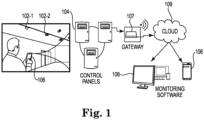
- Figure 1 illustrates a system for commission, inspection, and maintenance of a connected fire alarm system according to an embodiment of the present disclosure.
- Figure 1 illustrates a system having monitoring software (fire alarm system control application) on a remote computing device 108 and a mobile device 106, communicating via a wide area network (e.g., cloud) 109, with a number of control panels 104, and a number of fire alarm system devices 102-1, 102-2.
- monitoring software fire alarm system control application
- a gateway 107 is installed at the building being monitored by the fire alarm system to facilitate the communication between the monitoring software on remote devices 106 and 108 and the control panels 104.
- the one or more control panels 104 include a database therein that contains data about each fire alarm system device. Any suitable data can be contained therein. Examples of suitable data include: device address, device label, location information, make, model, service history, commission date, maintenance schedule items list, suggested maintenance timeframe information, historical service interval time periods, zone information, group information, and loop information.
- zone means a number of fire alarm system devices that are located in a particular area of the building (e.g., a zone can be all devices in a conference room or the west wing of a floor of a building).
- a building may have a plurality of zones.
- group means a number of fire alarm system devices that have a common characteristic and are grouped together by the technician (e.g., a group can be all devices of a particular make/model, devices being of a certain age, or devices having a particular functionality in common).
- a building may have a plurality of groups.
- loop means a number of fire alarm system devices that are part of a sub-system of the overall system of a building.
- a building may have a plurality of loops each comprised of a different set of fire alarm system devices.
- Location information can be any information that can be used to identify the location of a particular fire alarm system device. Examples of location information include: what floor a fire alarm system device is located on, a particular area of the building (e.g., west wing), or a particular room (e.g., conference room).
- Service history information can be any information that can be useful to a technician regarding the service history of a particular fire alarm system device.
- Examples of service history information include: commission date, date of last service, type of service performed, technician notes on the condition of the fire alarm system device at the time of the last service, and emerging problems with the fire alarm system device.
- a specific condition can include membership in a group of devices having a common maintenance condition, as discussed herein. For example, it may be advantageous to work on devices of the same group at the same time or to confirm that devices that should be part of a group are all members of that group. It may also be helpful to work on all devices having a common maintenance condition at the same time (e.g., device cleaning may require the same tools and materials, so the technician can quickly move from one device to the next if they all require that same service). This may be beneficial, for example, to identify and group all devices that were commissioned on a certain date and may need replacement.
- a specific location can be a location in a group of devices at a particular physical location, within a particular floor, or within a particular loop.
- the search utility can identify fire alarm system devices that have a common specific location and/or have a common specific condition. This may be beneficial, for example, in identifying whether all devices in the conference room are members of the group labeled "Conf Room".
- the remote computing device 108 can be beneficial, for example, if a technician that is knowledgeable about the building is unable to visit the building. In such instances, a less knowledgeable technician may be on-site, but the more knowledgeable technician can access the control panels and assist the less knowledgeable technician from a remote location.
- the system has the ability to search for a specific device on a floor of the building through a process such as the following.
- the technician comes to building, connects a gateway to a system control panel. Once the gateway is operational, allowing access by the technician's mobile device to the control panel of the fire alarm system of the building, the technician opens a mobile monitoring application on the mobile device and gets access to the system control panel via the gateway.
- the mobile monitoring application includes a search utility that allows the technician to search for one or more devices that are in a specific condition and/or location.
- the technician can, then, command the one or more particular fire alarm system devices to respond by activating a physical identification signal, from an indicator located on the fire alarm system device, in a specific state.
- Any suitable state can be utilized. Some suitable states include: a certain color of light, a pattern of light pulses, a combination of alternating colors, etc.
- the technician then walks around the floor, looking at the indicators (e.g., a visual indicator such as a particular colored light or pattern of light pulses) on the fire alarm system devices and is quickly able to identify and access to the one or more fire alarm system devices indicating the specific condition by locating the one or more fire alarm system devices with an indicator exhibiting the specific state.
- the indicators e.g., a visual indicator such as a particular colored light or pattern of light pulses
- Another unique functionality provided by such a system is the ability to securely search for a group of devices that are potentially due for maintenance or replacement in the near future. This can be accomplished, for instance, by reviewing the service history of each particular fire alarm system device identified, by reviewing device maintenance levels, and/or consulting general service maintenance guidelines for a particular fire alarm system device model to identify suggested maintenance timeframe information, for example.
- smoke detectors can go into different maintenance levels like: low chamber value, maintenance alert, and maintenance urgent and such maintenance level information can be used to identify a fire alarm system device in need of a particular type of service.
- fire alarm system devices exhibiting such levels can be grouped and presented to the technician, via the mobile device, such that the technician can perform appropriate service to all fire alarm system devices of a particular level.
- the technician can come to the building and search for fire alarm system devices with obscuration levels above a threshold (OBSCURATION (% PER FOOT)) higher than X%.
- OBSCURATION % PER FOOT
- the technician receives a list of the fire alarm system devices meeting such criteria on the technician's mobile device.
- the technician realizes that there are Y number of devices in first floor, Z number of devices in second floor, and so on.
- the technician then moves to the first floor and commands all of the Y number of fire alarm system devices on the list that are on the first floor, using the technician's mobile device, to signal the technician by initiating a particular physical identification signal on the fire alarm system devices.
- the technician can then walk around the floor and identify the fire alarm system devices that responded to this command based on them exhibiting the physical identification signal.
- the technician then, performs the required maintenance/replacement, and moves to the next device that is providing the specific indication (physical identification signal).
- the system can then update that the fire alarm system device is returning to an in-service state and informs the technician on the mobile device.
- the technician quickly completes this maintenance work and can move on to the next customer site.
- each fire alarm system device can be placed in-service and out-of-service independently by the technician via the monitoring application on the mobile device. This allows for less devices being out-of-service during the maintenance process which reduces risk and liability of a fire starting during the maintenance period when devices are out-of-service.
- a peak value is the highest alarm level reached in the past one week based on data about the particular fire alarm system device. This ability allows a technician to search for all devices that had a peak value during this maintenance period using the mobile device.
- These devices having peak values greater than a threshold value can be grouped together and presented to the technician via the mobile device. Based on this information, the fire alarm system devices of the group can each be diagnosed and adjustments to set points, programming, or other suitable adjustments can be made, or the fire alarm system device can be replaced.
- the system has the ability to quickly locate the particular fire alarm system device or a set of devices on a floor by asking the system to sound the nearest sounder (typically hardwired to a wall of a building) emitting an audible signal.
- This feature enables the technician to quickly search for a fire alarm system device on a floor. If the floor has a huge coverage area and is new to the technician, it will be difficult for the technician to search for a particular fire alarm system device. Even where a physical identification signal is implemented, as discussed above, the technician needs to walk around the floor to see the fire alarm system devices that are responding by generating their physical identification signals. This may be tiring for a technician and will cost time, effort, and energy.
- the technician will command the system by asking the sounder nearest to a particular fire alarm system device to be activated based on one or more criteria (e.g., circuit wiring layout of the system or cooperative detector settings, zone settings, etc.). So, when the nearest sounder is activated, it will become simpler for the technician to identify and reach the location of the particular fire alarm system device easily by hearing the sounder and moving toward that direction. Once the technician reaches the sounder, the technician can switch off the sounder, via the mobile device and look around to find the particular fire alarm system device that is responding with its physical identification signal.
- criteria e.g., circuit wiring layout of the system or cooperative detector settings, zone settings, etc.
- Another function provided by the system includes the ability to test cooperative multi-detector sensors during commissioning time.
- Cooperative multi-detector sensing is the ability of a fire alarm system device such as a smoke detector to consider readings from nearby detectors in making alarm or pre-alarm decisions. Many buildings use this feature to minimize the number of false alarms in the building. However, during commissioning, testing this feature is a complex effort.
- a technician can pick one or more fire alarm system devices to go into cooperative mode using the mobile device.
- the technician can create the configuration from the floor of the fire alarm system devices, via system functionality on the mobile device, rather than through physical access to the control panel, where in the technician would have to be on the floor of the control panel.
- the technician can activate the first fire alarm system device and the corresponding cooperative fire alarm system devices to ensure cooperative rules are applied correctly. This can all be accomplished via the mobile device and at the location proximate to one or more of the listed fire alarm system devices, rather than from a location near the control panel.
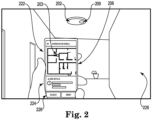
- Figure 2 illustrates a mobile device for use in a system for commission, inspection, and maintenance of a connected fire alarm system according to an embodiment of the present disclosure.
- the mobile device provides substantial unique functions to the fire alarm system in embodiments of the present disclosure.
- Figure 2 illustrates a graphical user interface (GUI) of a monitoring application on a mobile device.
- the mobile device 206 includes a number of functional buttons 226, some information 224 about the particular fire alarm system device the technician is being directed to, a schematic map 222 depicting the actual layout of the part of building 228 the technician is traversing, including the location of a fire alarm system device 202 depicted on the map at 203.
- the fire alarm system device 202 also includes an indicator 209 for generating a physical identification signal to help the technician identify the correct device needing maintenance.
- the information provided at 224 can be any information helpful to the technician.
- suitable information can be device identification number, model identifier, brand, maintenance history, upcoming maintenance from a maintenance schedule.
- the information can also include group, loop, or zone name and/or identifiers of other group, loop, or zone fire alarm system devices.
- the interface can have a number of functional buttons 226 and can be configured to provide any function described herein that is attributed to the mobile device.
- the two buttons shown in Figure 2 provide a mechanism to silence a sounder, if a signal has been sent to sound the sounder as a guide to the technician or as part of a test procedure carried out by the technician.
- the other button is used to reset the status of the particular fire alarm system device on which maintenance is being performed, for example, once the testing/maintenance procedures have been accomplished.
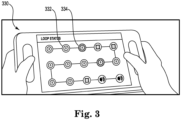
- Figure 3 illustrates another type of mobile device for use in a system for commission, inspection, and maintenance of a connected fire alarm system according to an embodiment of the present disclosure.
- a loop of fire alarm system devices is shown.
- Each different icon presented on the GUI of the mobile device 330 represents a different fire alarm system device in the loop, which as indicated by the illustration is an interconnected group of devices.
- the different patterns on the icons represent different types of fire alarm system devices, such as smoke detectors, fire detectors, carbon dioxide detectors, audible alarm devices, user interaction devices such as pull switches, etc.
- some devices are indicated as not needing to be addressed for maintenance at 332 (e.g., outer ring of icon is not shaded) and others are indicated as needing to be examined for service issues at 334 (e.g., outer ring of icon shaded).
- the technician can easily identify which devices are in a particular loop, which need attention and which don't, the type of devices in the loop, and their arrangement in the loop. This can be significantly helpful to a technician attempting to handle many maintenance or troubleshooting tasks with respect to the system.
- FIG. 1 Another functionality that can be provided by the system described in Figure 1 provides the ability to give/update the fire alarm system device labels at the location of the particular fire alarm system device using his mobile device.
- One of the major challenges technicians face during commissioning and maintenance time is to ensure the right labels are given to each of the fire alarm system devices at the right locations.
- two technicians are needed, one at the fire alarm system device location and the other at the panel location. In such a process, the first technician would activate the fire alarm system device and the second technician would be at the panel location to ensure a correct label is showing up on the panel. This process is complex and time consuming and prone to errors in communication between the technicians.
- a single technician can also now command all the fire alarm system devices with a specific label to be activated at the same time.
- the technician might search for all devices with label Conf Room ABC to respond, if the technician observes that a specific device is not responding in the conf room, the technician realizes that and fixes it, as the technician is located in the conference room with their mobile device rather than at the control panel which is not in the conference room and may, likely, not even be on the same floor as the conference room.
- one sample procedure for accomplishing this is as follows.
- the technician commands all of the fire alarm system devices in a particular area to provide a specific physical identification signal.
- the technician approaches a fire alarm system device that is not providing the specific physical identification signal, fixes the issue, and activates the fixed fire alarm system device.
- the activation event appears on the GUI of the mobile device.
- the technician sees the label that the fire alarm system device has been assigned and will have an option to change the label at that time. As the reader can understand, such a process saves huge commissioning time, effort, and cost, among other benefits.
- the customized device labeling is discussed below in more detail with respect to Figure 4 .
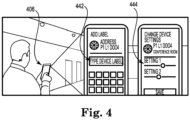
- Figure 4 illustrates user interface screens on a mobile device for use in a system for commission, inspection, and maintenance of a connected fire alarm system according to an embodiment of the present disclosure.
- the mobile monitoring application on mobile device 406 can have a functionality to allow the technician to customize the identification information of a particular fire alarm system device.
- a suitable label may be "conference room” as shown in the right depiction of the GUI in Figure 4 , wherein it provides the fire alarm system device address: P1L1D004 and the customized label: CONFERENCE ROOM.
- the GUI can also provide functionality to change one or more fire alarm system device settings.
- Figure 4 at 444 illustrates two setting types being adjustable. Any suitable setting may be adjusted. For instance, a first alarm threshold and a second alarm threshold may be adjusted based, for example, on historical data regarding alarm triggering events for this particular fire alarm system device.
- the changes discussed above are done from the mobile device to the database in the control panel, the changes can register on the system in near real time. This can be beneficial, for example, where multiple technicians may be moving around a building doing maintenance, as the system is up to date whenever they look at information about a particular fire alarm system device.
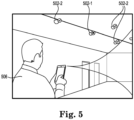
- Figure 5 illustrates multiple fire alarm system devices for use in the commission, inspection, and maintenance of a connected fire alarm system according to an embodiment of the present disclosure.
- the fire alarm system devices can have different physical identification signals which help a technician identify those needing maintenance.
- devices can even have different physical identification signals to identify different types of service needed. For example, if the embodiment of Figure 5 had such a functionality, the fire alarm system device 502-1 may need a first type of maintenance performed on it, while devices 502-2 may need a different type of maintenance.
- physical identification signals can be used to identify members of a specific group, loop, or zone. This can be helpful, for example, in determining if a device is part of the wrong group, loop, or zone.
- device 502-1 has a different indicator than devices 502-2. In such an embodiment, if all devices shown were to be members of Zone 1 (indicated by the check mark in Figure 5 ), this would indicate to the technician that device 502-1 is a member of a different zone and should be reassigned to Zone 1.
- embodiments of the present disclosure can provide a number of benefits.
- embodiments can provide the: ability to search for a specific fire alarm system device on a floor using a mobile device, ability to securely search for a group of fire alarm system devices that are potentially due for maintenance or replacement, for example, based on the service history or general maintenance schedule, ability to quickly locate the fire alarm system device or a set of fire alarm system devices on a floor by asking the system to sound the nearest sounder based, for example, on the circuit diagram of the system or based on multi-criteria settings selected via the monitoring application located on a mobile device, ability to test cooperative multi-detector sensors during commissioning, and ability to give/update the fire alarm system device labels on the floor near the fire alarm system device using the mobile device, among other benefits.
Landscapes
- Engineering & Computer Science (AREA)
- Physics & Mathematics (AREA)
- General Physics & Mathematics (AREA)
- Theoretical Computer Science (AREA)
- Computer Security & Cryptography (AREA)
- Computational Linguistics (AREA)
- Data Mining & Analysis (AREA)
- Databases & Information Systems (AREA)
- General Engineering & Computer Science (AREA)
- Electromagnetism (AREA)
- Business, Economics & Management (AREA)
- Emergency Management (AREA)
- Fire Alarms (AREA)
- Telephonic Communication Services (AREA)
Applications Claiming Priority (2)
| Application Number | Priority Date | Filing Date | Title |
|---|---|---|---|
| US202063020287P | 2020-05-05 | 2020-05-05 | |
| EP21172137.8A EP3907718B1 (de) | 2020-05-05 | 2021-05-04 | Verfahren und system zur inbetriebnahme, inspektion und wartung eines angeschlossenen brandmeldesystems |
Related Parent Applications (2)
| Application Number | Title | Priority Date | Filing Date |
|---|---|---|---|
| EP21172137.8A Division EP3907718B1 (de) | 2020-05-05 | 2021-05-04 | Verfahren und system zur inbetriebnahme, inspektion und wartung eines angeschlossenen brandmeldesystems |
| EP21172137.8A Division-Into EP3907718B1 (de) | 2020-05-05 | 2021-05-04 | Verfahren und system zur inbetriebnahme, inspektion und wartung eines angeschlossenen brandmeldesystems |
Publications (3)
| Publication Number | Publication Date |
|---|---|
| EP4404164A2 true EP4404164A2 (de) | 2024-07-24 |
| EP4404164A3 EP4404164A3 (de) | 2024-10-30 |
| EP4404164B1 EP4404164B1 (de) | 2026-01-14 |
Family
ID=75825449
Family Applications (2)
| Application Number | Title | Priority Date | Filing Date |
|---|---|---|---|
| EP21172137.8A Active EP3907718B1 (de) | 2020-05-05 | 2021-05-04 | Verfahren und system zur inbetriebnahme, inspektion und wartung eines angeschlossenen brandmeldesystems |
| EP24180919.3A Active EP4404164B1 (de) | 2020-05-05 | 2021-05-04 | System und verfahren eines feueralarms |
Family Applications Before (1)
| Application Number | Title | Priority Date | Filing Date |
|---|---|---|---|
| EP21172137.8A Active EP3907718B1 (de) | 2020-05-05 | 2021-05-04 | Verfahren und system zur inbetriebnahme, inspektion und wartung eines angeschlossenen brandmeldesystems |
Country Status (2)
| Country | Link |
|---|---|
| US (2) | US11935391B2 (de) |
| EP (2) | EP3907718B1 (de) |
Families Citing this family (11)
| Publication number | Priority date | Publication date | Assignee | Title |
|---|---|---|---|---|
| US11972676B2 (en) * | 2021-10-25 | 2024-04-30 | Honeywell International Inc. | Initiating a fire response at a self-testing fire sensing device |
| US11749096B2 (en) * | 2021-12-15 | 2023-09-05 | Honeywell International Inc. | Event device operation |
| US11984016B2 (en) * | 2021-12-17 | 2024-05-14 | Honeywell International Inc. | Predictive analytics of fire systems to reduce unplanned site visits and efficient maintenance planning |
| US12198531B2 (en) * | 2022-01-19 | 2025-01-14 | Tyco Fire & Security Gmbh | Smoke detector self-test |
| EP4500502A1 (de) * | 2022-03-30 | 2025-02-05 | Johnson Controls Tyco IP Holdings LLP | Systeme und verfahren zur überwachung von brandmeldesystemen |
| US12142133B2 (en) * | 2022-07-25 | 2024-11-12 | SiemensIndustry, Inc. | Fire safety device address and location verification |
| US12131624B2 (en) * | 2022-08-25 | 2024-10-29 | Honeywell International Inc. | Maintenance prediction for devices of a fire system |
| US20240203240A1 (en) * | 2022-12-16 | 2024-06-20 | Honeywell International Inc. | Self-testing hazard sensing device diagnostics |
| US20240212480A1 (en) * | 2022-12-23 | 2024-06-27 | Carrier Corporation | Hazard detection evaluation system |
| CN121794730A (zh) * | 2023-08-16 | 2026-04-03 | 西门子瑞士有限公司 | 用于视觉检查火警警报器的方法和装置 |
| US20250377226A1 (en) * | 2024-06-10 | 2025-12-11 | Kidde Fire Protection, Llc | System and method for controlling sensors associated with fire and smoke alarms |
Family Cites Families (8)
| Publication number | Priority date | Publication date | Assignee | Title |
|---|---|---|---|---|
| US7167088B2 (en) | 2002-05-10 | 2007-01-23 | Simplexgrinnell Lp | Wireless walk through test system |
| US9552720B2 (en) * | 2014-01-17 | 2017-01-24 | Tyco Fire & Security Gmbh | Testing system and method for fire alarm system |
| US9830806B2 (en) * | 2014-06-02 | 2017-11-28 | Tyco New Zealand Limited | Systems enabling testing of fire control panels together with remote control and providing text-to-speech of event data |
| KR101482715B1 (ko) * | 2014-07-01 | 2015-01-15 | 김경주 | 이동통신단말기와 연동된 화재 대피 장치 |
| US10982868B2 (en) * | 2015-05-04 | 2021-04-20 | Johnson Controls Technology Company | HVAC equipment having locating systems and methods |
| US9905115B2 (en) | 2016-07-01 | 2018-02-27 | Honeywell International Inc. | Systems and methods for installing, commissioning, testing, and maintaining a fire alarm control panel via a mobile device |
| US9978256B1 (en) * | 2016-11-03 | 2018-05-22 | Tyco Fire & Security Gmbh | Method and system for monitoring fire alarm systems |
| US11520946B2 (en) * | 2019-04-09 | 2022-12-06 | Johnson Controls Tyco IP Holdings LLP | Cloud-based fire protection system and method |
-
2021
- 2021-05-04 EP EP21172137.8A patent/EP3907718B1/de active Active
- 2021-05-04 EP EP24180919.3A patent/EP4404164B1/de active Active
- 2021-05-05 US US17/308,108 patent/US11935391B2/en active Active
-
2024
- 2024-03-19 US US18/609,550 patent/US20240282188A1/en active Pending
Also Published As
| Publication number | Publication date |
|---|---|
| EP3907718A1 (de) | 2021-11-10 |
| US11935391B2 (en) | 2024-03-19 |
| US20210350692A1 (en) | 2021-11-11 |
| EP4404164B1 (de) | 2026-01-14 |
| EP4404164A3 (de) | 2024-10-30 |
| US20240282188A1 (en) | 2024-08-22 |
| EP3907718B1 (de) | 2024-07-24 |
Similar Documents
| Publication | Publication Date | Title |
|---|---|---|
| EP4404164B1 (de) | System und verfahren eines feueralarms | |
| US20240378990A1 (en) | Walk test for fire alarm systems using a mobile device | |
| US7049951B2 (en) | Integrated communication of building control system and fire safety system information | |
| KR100392923B1 (ko) | 산업장치의프로세스데이터를분석하는방법 | |
| EP3594919B1 (de) | System und verfahren zur vorrichtungsadressenzuweisung in einem alarmsystem mit interaktiver adressenzuweisung zur schnelleren inbetriebnahme | |
| US20140009279A1 (en) | Fire control panel | |
| JP7451218B2 (ja) | 清掃管理装置 | |
| EP4210016A1 (de) | Automatisierte visuelle inspektion von alarmsystemereignisvorrichtungen | |
| JP2025164901A (ja) | 火災監視システム | |
| EP4386702A1 (de) | Alarmsystemdetektorgeofencing | |
| EP4310810A1 (de) | Durchführung einer selbstreinigung einer branderfassungsvorrichtung | |
| US12429838B2 (en) | Building automation system and method for managing causal chain for fault detection and diagnostics | |
| EP4411685A1 (de) | Konfiguration von ursache-wirkung-matrizen unter verwendung von ereignisdetektionsvorrichtungen eines alarmsystems | |
| US20250340401A1 (en) | Maintenance management system of passenger transfer device | |
| EP4276787B1 (de) | Verfahren und system zur verbesserung der effizienz von systemtests für ein system mit mehreren sensoren | |
| US20240171938A1 (en) | Systems, methods, and processes of creating a route through a facility based on communication between a portable device and event detection devices with built-in communication components | |
| JP7390457B1 (ja) | 照明制御・状態監視システム | |
| US20250230015A1 (en) | Maintenance management system of passenger transfer device | |
| KR20240133530A (ko) | 승객 이송 장치의 유지 관리 시스템 | |
| JP2022157919A (ja) | 火災感知器 | |
| JP2021012747A (ja) | 火災受信機 |
Legal Events
| Date | Code | Title | Description |
|---|---|---|---|
| PUAI | Public reference made under article 153(3) epc to a published international application that has entered the european phase |
Free format text: ORIGINAL CODE: 0009012 |
|
| STAA | Information on the status of an ep patent application or granted ep patent |
Free format text: STATUS: THE APPLICATION HAS BEEN PUBLISHED |
|
| AC | Divisional application: reference to earlier application |
Ref document number: 3907718 Country of ref document: EP Kind code of ref document: P |
|
| AK | Designated contracting states |
Kind code of ref document: A2 Designated state(s): AL AT BE BG CH CY CZ DE DK EE ES FI FR GB GR HR HU IE IS IT LI LT LU LV MC MK MT NL NO PL PT RO RS SE SI SK SM TR |
|
| REG | Reference to a national code |
Free format text: PREVIOUS MAIN CLASS: G08B0017000000 Ref country code: DE Ref legal event code: R079 Ref document number: 602021046237 Country of ref document: DE Free format text: PREVIOUS MAIN CLASS: G08B0017000000 Ipc: G08B0029140000 |
|
| PUAL | Search report despatched |
Free format text: ORIGINAL CODE: 0009013 |
|
| AK | Designated contracting states |
Kind code of ref document: A3 Designated state(s): AL AT BE BG CH CY CZ DE DK EE ES FI FR GB GR HR HU IE IS IT LI LT LU LV MC MK MT NL NO PL PT RO RS SE SI SK SM TR |
|
| RIC1 | Information provided on ipc code assigned before grant |
Ipc: G08B 25/10 20060101ALN20240920BHEP Ipc: G08B 29/14 20060101AFI20240920BHEP Ipc: G08B 17/00 20060101ALI20240920BHEP |
|
| STAA | Information on the status of an ep patent application or granted ep patent |
Free format text: STATUS: REQUEST FOR EXAMINATION WAS MADE |
|
| 17P | Request for examination filed |
Effective date: 20250415 |
|
| GRAP | Despatch of communication of intention to grant a patent |
Free format text: ORIGINAL CODE: EPIDOSNIGR1 |
|
| RIC1 | Information provided on ipc code assigned before grant |
Ipc: G08B 29/14 20060101AFI20250723BHEP Ipc: G08B 17/00 20060101ALI20250723BHEP Ipc: G08B 25/10 20060101ALN20250723BHEP |
|
| STAA | Information on the status of an ep patent application or granted ep patent |
Free format text: STATUS: GRANT OF PATENT IS INTENDED |
|
| RIC1 | Information provided on ipc code assigned before grant |
Ipc: G08B 29/14 20060101AFI20250821BHEP Ipc: G08B 17/00 20060101ALI20250821BHEP Ipc: G08B 25/10 20060101ALN20250821BHEP |
|
| INTG | Intention to grant announced |
Effective date: 20250828 |
|
| GRAS | Grant fee paid |
Free format text: ORIGINAL CODE: EPIDOSNIGR3 |
|
| GRAA | (expected) grant |
Free format text: ORIGINAL CODE: 0009210 |
|
| STAA | Information on the status of an ep patent application or granted ep patent |
Free format text: STATUS: THE PATENT HAS BEEN GRANTED |
|
| AC | Divisional application: reference to earlier application |
Ref document number: 3907718 Country of ref document: EP Kind code of ref document: P |
|
| AK | Designated contracting states |
Kind code of ref document: B1 Designated state(s): AL AT BE BG CH CY CZ DE DK EE ES FI FR GB GR HR HU IE IS IT LI LT LU LV MC MK MT NL NO PL PT RO RS SE SI SK SM TR |
|
| REG | Reference to a national code |
Ref country code: CH Ref legal event code: F10 Free format text: ST27 STATUS EVENT CODE: U-0-0-F10-F00 (AS PROVIDED BY THE NATIONAL OFFICE) Effective date: 20260114 Ref country code: GB Ref legal event code: FG4D |
|
| REG | Reference to a national code |
Ref country code: DE Ref legal event code: R096 Ref document number: 602021046237 Country of ref document: DE |
|
| REG | Reference to a national code |
Ref country code: IE Ref legal event code: FG4D |