EP4403672A2 - Wasserelektrolysevorrichtung - Google Patents
Wasserelektrolysevorrichtung Download PDFInfo
- Publication number
- EP4403672A2 EP4403672A2 EP23216362.6A EP23216362A EP4403672A2 EP 4403672 A2 EP4403672 A2 EP 4403672A2 EP 23216362 A EP23216362 A EP 23216362A EP 4403672 A2 EP4403672 A2 EP 4403672A2
- Authority
- EP
- European Patent Office
- Prior art keywords
- water electrolysis
- water
- piping
- hydrogen
- gas
- Prior art date
- Legal status (The legal status is an assumption and is not a legal conclusion. Google has not performed a legal analysis and makes no representation as to the accuracy of the status listed.)
- Granted
Links
Images


Classifications
-
- C—CHEMISTRY; METALLURGY
- C25—ELECTROLYTIC OR ELECTROPHORETIC PROCESSES; APPARATUS THEREFOR
- C25B—ELECTROLYTIC OR ELECTROPHORETIC PROCESSES FOR THE PRODUCTION OF COMPOUNDS OR NON-METALS; APPARATUS THEREFOR
- C25B9/00—Cells or assemblies of cells; Constructional parts of cells; Assemblies of constructional parts, e.g. electrode-diaphragm assemblies; Process-related cell features
- C25B9/70—Assemblies comprising two or more cells
-
- B—PERFORMING OPERATIONS; TRANSPORTING
- B01—PHYSICAL OR CHEMICAL PROCESSES OR APPARATUS IN GENERAL
- B01D—SEPARATION
- B01D19/00—Degasification of liquids
- B01D19/0031—Degasification of liquids by filtration
-
- C—CHEMISTRY; METALLURGY
- C25—ELECTROLYTIC OR ELECTROPHORETIC PROCESSES; APPARATUS THEREFOR
- C25B—ELECTROLYTIC OR ELECTROPHORETIC PROCESSES FOR THE PRODUCTION OF COMPOUNDS OR NON-METALS; APPARATUS THEREFOR
- C25B1/00—Electrolytic production of inorganic compounds or non-metals
- C25B1/01—Products
- C25B1/02—Hydrogen or oxygen
- C25B1/04—Hydrogen or oxygen by electrolysis of water
-
- C—CHEMISTRY; METALLURGY
- C25—ELECTROLYTIC OR ELECTROPHORETIC PROCESSES; APPARATUS THEREFOR
- C25B—ELECTROLYTIC OR ELECTROPHORETIC PROCESSES FOR THE PRODUCTION OF COMPOUNDS OR NON-METALS; APPARATUS THEREFOR
- C25B15/00—Operating or servicing cells
- C25B15/08—Supplying or removing reactants or electrolytes; Regeneration of electrolytes
-
- C—CHEMISTRY; METALLURGY
- C25—ELECTROLYTIC OR ELECTROPHORETIC PROCESSES; APPARATUS THEREFOR
- C25B—ELECTROLYTIC OR ELECTROPHORETIC PROCESSES FOR THE PRODUCTION OF COMPOUNDS OR NON-METALS; APPARATUS THEREFOR
- C25B15/00—Operating or servicing cells
- C25B15/08—Supplying or removing reactants or electrolytes; Regeneration of electrolytes
- C25B15/083—Separating products
-
- C—CHEMISTRY; METALLURGY
- C25—ELECTROLYTIC OR ELECTROPHORETIC PROCESSES; APPARATUS THEREFOR
- C25B—ELECTROLYTIC OR ELECTROPHORETIC PROCESSES FOR THE PRODUCTION OF COMPOUNDS OR NON-METALS; APPARATUS THEREFOR
- C25B15/00—Operating or servicing cells
- C25B15/08—Supplying or removing reactants or electrolytes; Regeneration of electrolytes
- C25B15/085—Removing impurities
-
- C—CHEMISTRY; METALLURGY
- C25—ELECTROLYTIC OR ELECTROPHORETIC PROCESSES; APPARATUS THEREFOR
- C25B—ELECTROLYTIC OR ELECTROPHORETIC PROCESSES FOR THE PRODUCTION OF COMPOUNDS OR NON-METALS; APPARATUS THEREFOR
- C25B9/00—Cells or assemblies of cells; Constructional parts of cells; Assemblies of constructional parts, e.g. electrode-diaphragm assemblies; Process-related cell features
- C25B9/60—Constructional parts of cells
-
- C—CHEMISTRY; METALLURGY
- C25—ELECTROLYTIC OR ELECTROPHORETIC PROCESSES; APPARATUS THEREFOR
- C25B—ELECTROLYTIC OR ELECTROPHORETIC PROCESSES FOR THE PRODUCTION OF COMPOUNDS OR NON-METALS; APPARATUS THEREFOR
- C25B9/00—Cells or assemblies of cells; Constructional parts of cells; Assemblies of constructional parts, e.g. electrode-diaphragm assemblies; Process-related cell features
- C25B9/70—Assemblies comprising two or more cells
- C25B9/73—Assemblies comprising two or more cells of the filter-press type
-
- C—CHEMISTRY; METALLURGY
- C25—ELECTROLYTIC OR ELECTROPHORETIC PROCESSES; APPARATUS THEREFOR
- C25B—ELECTROLYTIC OR ELECTROPHORETIC PROCESSES FOR THE PRODUCTION OF COMPOUNDS OR NON-METALS; APPARATUS THEREFOR
- C25B9/00—Cells or assemblies of cells; Constructional parts of cells; Assemblies of constructional parts, e.g. electrode-diaphragm assemblies; Process-related cell features
- C25B9/70—Assemblies comprising two or more cells
- C25B9/73—Assemblies comprising two or more cells of the filter-press type
- C25B9/77—Assemblies comprising two or more cells of the filter-press type having diaphragms
-
- Y—GENERAL TAGGING OF NEW TECHNOLOGICAL DEVELOPMENTS; GENERAL TAGGING OF CROSS-SECTIONAL TECHNOLOGIES SPANNING OVER SEVERAL SECTIONS OF THE IPC; TECHNICAL SUBJECTS COVERED BY FORMER USPC CROSS-REFERENCE ART COLLECTIONS [XRACs] AND DIGESTS
- Y02—TECHNOLOGIES OR APPLICATIONS FOR MITIGATION OR ADAPTATION AGAINST CLIMATE CHANGE
- Y02E—REDUCTION OF GREENHOUSE GAS [GHG] EMISSIONS, RELATED TO ENERGY GENERATION, TRANSMISSION OR DISTRIBUTION
- Y02E60/00—Enabling technologies; Technologies with a potential or indirect contribution to GHG emissions mitigation
- Y02E60/30—Hydrogen technology
- Y02E60/36—Hydrogen production from non-carbon containing sources, e.g. by water electrolysis
Definitions
- the present disclosure relates to a water electrolysis device.
- JP 2012-052208 A discloses supplying diluting air to a gas-liquid separator that separates water and oxygen in a water electrolysis device, in order to dilute hydrogen that has become incorporated.
- the present disclosure provides a water electrolysis device capable of suppressing concentration of hydrogen that has become incorporated in the water supply side passage.
- a water electrolysis device configured to obtain hydrogen and oxygen by performing electrolysis of water with a plurality of water electrolysis cells, and includes a water electrolysis stack that includes the water electrolysis cells, a water supply side passage including first piping through which water supplied to the water electrolysis stack flows, and second piping, a hydrogen side passage through which hydrogen generated in the water electrolysis stack flows, a gas-liquid separator that is provided in the water supply side passage and that is configured to perform gas-liquid separation of a fluid containing oxygen and water discharged from the water electrolysis stack, and a hydrogen combustion member that contains a hydrogen combustion catalyst and that is disposed on an inner side of the second piping.
- the second piping connects the water electrolysis stack and the gas-liquid separator.
- the water electrolysis device may further include an agitation member disposed between the water electrolysis stack and the hydrogen combustion member in the second piping.
- the second piping may include a first piping portion of which a pipe axis is inclined within a range of 30° to 90° with respect to a horizontal direction, in which water discharged from the water electrolysis stack flows upward from below.
- the hydrogen combustion member may be disposed on an inner side of the first piping portion.
- the pipe axis of the first piping portion may be inclined within a range of 60° to 90° with respect to the horizontal direction.
- the pipe axis of the first piping portion may be inclined within a range of 75° to 90° with respect to the horizontal direction.
- the water electrolysis device may further include a protruding portion
- the second piping may include a second piping portion of which a pipe axis is horizontal, or is inclined in a range of 45° or less with respect to a horizontal direction
- the hydrogen combustion member may be disposed on an inner side of the second piping portion
- the protruding portion may be disposed on the inner side of the second piping portion and may be configured to divide a gaseous portion between the hydrogen combustion member and the gas-liquid separator.
- the gaseous portion may be contained in the fluid containing oxygen and water discharged from the water electrolysis stack (20).
- hydrogen can be consumed and reduced before reaching the gas-liquid separator, and accordingly the concentration of hydrogen incorporated in the water supply side passage can be suppressed, and the trouble of containing hydrogen can be suppressed.
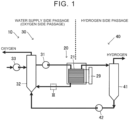
- FIG. 1 conceptually represents a water electrolysis device 10 according to an embodiment.
- the water electrolysis device 10 includes a water electrolysis stack 20, a water supply side passage (oxygen side passage) 30 and a hydrogen side passage 40.
- water is supplied from the water supply side passage 30 to water electrolysis cells 21 provided in the water electrolysis stack 20, and the water is decomposed into hydrogen and oxygen by application of electricity thereto, thereby yielding hydrogen that is separated to the hydrogen side passage 40.
- FIG. 2 conceptually illustrates an embodiment of the water electrolysis cell 21.
- the water electrolysis cell 21 is a unit element for decomposing water into hydrogen and oxygen, and a plurality of such water electrolysis cells 21 is stacked and disposed in the water electrolysis stack 20.
- the water electrolysis cells 21 are known water electrolysis cells, and each water electrolysis cell 21 according to the present embodiment is made up of a plurality of layers, one of which serves as an oxygen generating electrode (anode), and another of which serves as a hydrogen generating electrode (cathode), with a solid polymer electrolyte membrane 22 interposed therebetween.
- the material making up the solid polymer electrolyte membrane 22 is a solid polymer material, examples of which include an ion exchange membrane that has proton conductivity, which is made of a fluororesin, a hydrocarbon resin material, or the like. This exhibits good proton conductivity (electrical conductivity) under wet conditions.
- ion exchange membrane that has proton conductivity
- a more specific example is Nafion (registered trademark), which is a perfluorosulfonic acid membrane.
- the oxygen generating electrode (anode) is provided with an oxygen electrode catalyst layer 23, an oxygen electrode gas diffusion layer 24, and an oxygen electrode separator 25 in this order from the solid polymer electrolyte membrane 22 side.
- the oxygen electrode catalyst layer 23 is a layer made of an electrode catalyst containing at least one or more of noble metal catalysts such as platinum (Pt), ruthenium (Ru), iridium (Ir), and so forth, and oxides thereof.
- the oxygen electrode gas diffusion layer 24 is made up of a member having gas permeability and electroconductivity. Specific examples include porous electroconductive members made of metal fibers, metal particles, and so forth.
- the oxygen electrode separator 25 has channels 25a through which water supplied to the oxygen electrode gas diffusion layer 24, generated oxygen, and excess water flow.
- the hydrogen generating electrode (cathode) is provided on a face of the solid polymer electrolyte membrane 22 opposite to the face on which the oxygen generating electrode is disposed, and a hydrogen electrode catalyst layer 26, a hydrogen electrode gas diffusion layer 27, and a hydrogen electrode separator 28 are provided in this order from the solid polymer electrolyte membrane 22 side.
- the hydrogen electrode catalyst layer 26 include a layer containing Pt or the like.
- the hydrogen electrode gas diffusion layer 27 is made up of a member having gas permeability and electroconductivity. Specific examples include porous members such as carbon cloth, carbon paper, and so forth.
- the hydrogen electrode separator 28 is a member provided with channels 28a through which generated hydrogen and accompanying water flow.
- Applying electricity across the oxygen generating electrode and the hydrogen generating electrode by an electric power source 29 causes the water (H 2 O) supplied to the oxygen generating electrode from the channels 25a of the oxygen electrode separator 25 to be decomposed into oxygen, electrons, and protons (H + ) at the oxygen electrode catalyst layer 23 to which potential is applied.
- the protons travel through the solid polymer electrolyte membrane 22 to the hydrogen electrode catalyst layer 26.
- the electrons separated at the oxygen electrode catalyst layer 23 reach the hydrogen electrode catalyst layer 26 through an external circuit.
- the protons then receive electrons at the hydrogen electrode catalyst layer 26, thereby generating hydrogen.
- the generated hydrogen and the accompanying water reach the hydrogen electrode separator 28, are discharged from the channels 28a, and travel to the hydrogen side passage 40.
- the oxygen separated at the oxygen electrode catalyst layer 23 and excess water reach the oxygen electrode separator 25 are discharged from the channels 25a, and travel to the water supply side passage 30.
- the water supply side passage (oxygen side passage) 30 is a passage including piping for supplying water to the water electrolysis cells 21 of the water electrolysis stack 20 in order to obtain oxygen.
- water is supplied toward the water electrolysis stack 20 by a pump 31 on the water supply side passage 30.
- the piping through which water supplied toward the water electrolysis stack 20 flows can be regarded as an example of first piping.
- a cooler for cooling the water or an ion exchanger for removing ions contained in the water may be disposed between the pump 31 and the water electrolysis stack 20 as necessary.
- oxygen generated at the water electrolysis stack 20 and unused water are discharged from the water electrolysis stack 20 and supplied to a gas-liquid separator 32.
- the piping connecting the water electrolysis stack 20 and the gas-liquid separator 32 can be regarded as an example of second piping. Water and oxygen are separated in the gas-liquid separator 32, the separated oxygen is discharged, and the water is supplied to the pump 31 again. Note that any insufficient water is supplied from the pump 33 to the gas-liquid separator 32.
- Each of the pieces of equipment described above is connected by piping, forming a fluid passage.
- a hydrogen combustion member 34 is disposed in the piping between the water electrolysis stack 20 and the gas-liquid separator 32. This will be described below.
- FIG. 3 is a diagram illustrating the hydrogen combustion member 34 according to a first embodiment and the form of placement thereof, and represents inside of the piping at a portion indicated by III in FIG. 1 .
- FIG. 1 is a diagram conceptually representing the water electrolysis device 10 according to an embodiment, and accordingly the shape of the portion III illustrated in FIG. 1 does not have to be a rectilinear shape as illustrated in FIG. 1 .
- the hydrogen combustion member is disposed on an inner side of the piping through which fluid (water and oxygen, and unintentionally-incorporated hydrogen) discharged from the water electrolysis stack is guided from the water electrolysis stack to the gas-liquid separator, regardless of the specific form thereof.
- the hydrogen combustion member is a member provided with a hydrogen combustion catalyst, and promotes reaction between hydrogen and oxygen that come into contact with the catalyst (causes combustion of the hydrogen) so as to be converted into water.
- a known hydrogen combustion catalyst can be used, examples of which include platinum, palladium, ruthenium, rhodium, nickel, and so forth, although not limited thereto in particular.
- the hydrogen combustion member has the hydrogen combustion catalyst carried on a surface of a carrier having a plurality of holes through which fluid can pass (surface including inner surfaces of the holes).
- a carrier having a plurality of holes through which fluid can pass (surface including inner surfaces of the holes).
- a net (mesh) or a columnar member e.g., a honeycomb structure
- Examples of the material of the carrier include ceramics and so forth.
- a hydrogen combustion member such as this is disposed on the inner side of the piping, and is configured such that the fluid flowing through the inner side of the piping passes through the hydrogen combustion member.
- the number of hydrogen combustion members disposed may be one, or a plurality thereof may be disposed along the direction in which the fluid flows.
- the hydrogen combustion member is a pressure loss factor, and accordingly disposing thereof in the water supply side passage of the water electrolysis device is performed within a range in which pressure loss is tolerable.
- a piping portion A in which the hydrogen combustion member 34 is disposed is configured such that an axial line (pipe axis) O of the piping is vertical (90° to horizontal). It will be assumed that the fluid flows upward from below as indicated by a straight arrow in FIG. 3 .
- the piping portion A can be regarded as an example of a first piping portion. According to such a configuration, gaseous components contained in the fluid can be dispersed with respect to the liquid component to reduce non-uniformity, and the opportunities of the gas coming into contact with the catalyst of the hydrogen combustion member 34 can be increased.
- the angle of the axial line O of the piping in the piping portion A is not limited to being vertical (90°), and it is sufficient for the configuration to be such that fluid flows upward from below at some extent of an angle.
- the angle of the axial line O of the piping is 30° or more and 90° or less with respect to a horizontal direction.
- an angle that is close to 90° is effective, and accordingly the angle may be 60° or more, and 75° or more.
- an agitation member 35 is further disposed upstream of the hydrogen combustion member 34 (between the water electrolysis stack 20 and the hydrogen combustion member 34).
- the agitation member 35 is a member that is capable of agitating the fluid flowing therethrough, thereby further dispersing the gaseous components contained in the fluid into the liquid component.
- the specific form of the agitation member 35 is not limited in particular, as long as agitation of the fluid can be realized.
- a net (mesh), rotary blades that rotate with the flow of fluid, projections that cause turbulence (such as those which produces a vortex on the downstream side thereof), and so forth, can be used.
- the position of the agitation member 35 is not limited in particular, as long as it is disposed between the water electrolysis stack 20 and the hydrogen combustion member 34.
- the agitation member 35 may be disposed within the piping portion A from the perspective of efficiently reflecting the agitating effect of the agitation member 35 at the hydrogen combustion member 34.
- FIG. 4 is a diagram illustrating the hydrogen combustion member 34 according to a second embodiment and the form of placement thereof, and represents inside of the piping of the portion indicated by III in FIG. 1 .
- the hydrogen combustion member 34 is disposed on the inner side of the piping through which fluid (water and oxygen, and unintentionally-contained hydrogen) discharged from the water electrolysis stack 20 is guided from the water electrolysis stack 20 to the gas-liquid separator 32, in the same way as described in the first embodiment.
- the form of the hydrogen combustion member 34 can be thought of in the same manner as described above, and accordingly description thereof will be omitted.
- a piping portion B in which the hydrogen combustion member 34 is disposed is configured such that the axial line O of the piping is horizontal (0° to horizontal).
- the piping portion B can be regarded as an example of a second piping portion.
- the fluid flows from right to left in the plane of the drawing as indicated by a straight arrow in FIG. 4 .
- the fluid passes through the hydrogen combustion member 34, and accordingly the gas comes into contact with the catalyst of the hydrogen combustion member 34, resulting in combustion of the hydrogen, whereby the amount of hydrogen can be reduced, thereby suppressing the concentration thereof.
- the agitation member 35 may be disposed upstream of the hydrogen combustion member 34 (between the water electrolysis stack 20 and the hydrogen combustion member 34).
- the agitation member 35 is as described above.
- the fluid that is flowing can be agitated, the gaseous component contained in the fluid can be dispersed in the liquid component, and the opportunities of the gas coming into contact with the catalyst of the hydrogen combustion member 34 can be increased.
- the fluid naturally separates into a gaseous portion in which gas flows at an upper side in the pipe, and a liquid portion in which liquid flows at a lower side in the pipe, as illustrated in FIG. 4 .
- Disposing the hydrogen combustion member 34 in the pipe in such a separated state may result in a portion of the hydrogen combustion member 34 that is in contact with the gas of the gaseous portion exhibiting vigorous combustion, and there is concern that the temperature will rise, and that the combustion will move away from the hydrogen combustion member 34 and be carried downstream in the gaseous portion.
- a protruding portion 36 that divides the gaseous portion is provided on the inner side of the piping between the hydrogen combustion member 34 and the gas-liquid separator 32 (i.e., downstream from the hydrogen combustion member 34), as illustrated in FIG. 4 .
- the protruding portion 36 is a protruding member that protrudes from an inner wall of the piping portion B, having a height capable of dividing the gaseous portion, and the protruding portion 36 may partition the gaseous portion and a distal end thereof may reach the liquid portion.
- the gaseous portion can be divided in a sure manner.
- the protruding portion 36 can suppress the combustion from departing from the hydrogen combustion member 34 and being carried downstream in the gaseous portion.
- the form in which the protruding portion 36 is disposed in this way is not limited to when the angle of the axial line O of the pipe is horizontal (0° from horizontal) and may include arrangements in which the piping extends laterally, inclined at a somewhat shallow angle. Specifically, the angle of the axial line O of the piping is 0° or more and 45° or less with respect to the horizontal direction.
- the hydrogen side passage 40 is a passage including piping for extracting hydrogen separated at the water electrolysis stack 20. Hydrogen and water discharged from the water electrolysis cells 21 of the water electrolysis stack 20 are supplied to a gas-liquid separator 41 through the hydrogen side passage 40.
- the gas-liquid separator 41 separates the water and the hydrogen.
- the hydrogen separated by the gas-liquid separator 41 is collected, dehumidified and so forth, and stored in a tank.
- the water separated by the gas-liquid separator 41 is fed by the pump 42 to the gas-liquid separator 32 on the water supply side passage 30, and reused. Each of these pieces of equipment is connected by piping.
- the hydrogen can be removed from the fluid flowing through the piping on the water supply side passage before reaching the gas-liquid separator, and accordingly the hydrogen can be consumed and reduced, thereby suppressing the concentration thereof. Accordingly, the trouble of a large amount of hydrogen being contained can be suppressed without mixing in gas for dilution. Even when gas is mixed in for dilution, the concentration of hydrogen itself is already suppressed, and accordingly the occurrence of locally high hydrogen concentration portions can be suppressed.
Landscapes
- Chemical & Material Sciences (AREA)
- Chemical Kinetics & Catalysis (AREA)
- Engineering & Computer Science (AREA)
- Electrochemistry (AREA)
- Materials Engineering (AREA)
- Metallurgy (AREA)
- Organic Chemistry (AREA)
- Inorganic Chemistry (AREA)
- Electrolytic Production Of Non-Metals, Compounds, Apparatuses Therefor (AREA)
Applications Claiming Priority (1)
| Application Number | Priority Date | Filing Date | Title |
|---|---|---|---|
| JP2022209906A JP2024093491A (ja) | 2022-12-27 | 2022-12-27 | 水電解装置 |
Publications (4)
| Publication Number | Publication Date |
|---|---|
| EP4403672A2 true EP4403672A2 (de) | 2024-07-24 |
| EP4403672A3 EP4403672A3 (de) | 2024-10-23 |
| EP4403672B1 EP4403672B1 (de) | 2025-11-19 |
| EP4403672C0 EP4403672C0 (de) | 2025-11-19 |
Family
ID=89222513
Family Applications (1)
| Application Number | Title | Priority Date | Filing Date |
|---|---|---|---|
| EP23216362.6A Active EP4403672B1 (de) | 2022-12-27 | 2023-12-13 | Wasserelektrolysevorrichtung |
Country Status (5)
| Country | Link |
|---|---|
| US (1) | US20240209518A1 (de) |
| EP (1) | EP4403672B1 (de) |
| JP (1) | JP2024093491A (de) |
| KR (1) | KR102907550B1 (de) |
| CN (1) | CN118256940A (de) |
Citations (1)
| Publication number | Priority date | Publication date | Assignee | Title |
|---|---|---|---|---|
| JP2012052208A (ja) | 2010-09-03 | 2012-03-15 | Honda Motor Co Ltd | 水電解システムの運転方法 |
Family Cites Families (11)
| Publication number | Priority date | Publication date | Assignee | Title |
|---|---|---|---|---|
| JP4146722B2 (ja) * | 2000-09-15 | 2008-09-10 | シーメンス アクチエンゲゼルシヤフト | 燃料電池装置とその運転方法 |
| JP5256592B2 (ja) * | 2006-08-22 | 2013-08-07 | トヨタ自動車株式会社 | 燃料電池システム |
| DE202007005963U1 (de) * | 2007-04-25 | 2007-06-28 | Chin, Jih-Chin, Xindian City | Generator für Wasser- und Sauerstoff |
| JP2009228041A (ja) * | 2008-03-21 | 2009-10-08 | Kurita Water Ind Ltd | 電解装置および電解方法 |
| JP6194297B2 (ja) * | 2014-09-08 | 2017-09-06 | 本田技研工業株式会社 | 水電解システム |
| JP2018076577A (ja) * | 2016-11-11 | 2018-05-17 | 学校法人 工学院大学 | 水電解装置、水素水の製造方法 |
| WO2020039218A1 (en) * | 2018-08-20 | 2020-02-27 | Thalesnano Energy Zrt. | Modular electrolyzer cell to generate gaseous hydrogen at high pressure and with high purity |
| AU2019374584B2 (en) * | 2018-11-05 | 2022-04-14 | Asahi Kasei Kabushiki Kaisha | Method of producing hydrogen |
| JP7216598B2 (ja) * | 2019-04-08 | 2023-02-01 | 株式会社神鋼環境ソリューション | 水素・酸素発生装置 |
| JP7440057B2 (ja) * | 2020-01-09 | 2024-02-28 | ヤマハファインテック株式会社 | 水素ガス混合装置 |
| CN114000171B (zh) * | 2021-10-21 | 2023-04-07 | 中国华能集团清洁能源技术研究院有限公司 | 一种带有氢氧再结合反应器的电解制氢系统及方法 |
-
2022
- 2022-12-27 JP JP2022209906A patent/JP2024093491A/ja active Pending
-
2023
- 2023-12-08 CN CN202311680599.3A patent/CN118256940A/zh active Pending
- 2023-12-13 EP EP23216362.6A patent/EP4403672B1/de active Active
- 2023-12-19 US US18/545,620 patent/US20240209518A1/en active Pending
- 2023-12-21 KR KR1020230187878A patent/KR102907550B1/ko active Active
Patent Citations (1)
| Publication number | Priority date | Publication date | Assignee | Title |
|---|---|---|---|---|
| JP2012052208A (ja) | 2010-09-03 | 2012-03-15 | Honda Motor Co Ltd | 水電解システムの運転方法 |
Also Published As
| Publication number | Publication date |
|---|---|
| CN118256940A (zh) | 2024-06-28 |
| JP2024093491A (ja) | 2024-07-09 |
| EP4403672A3 (de) | 2024-10-23 |
| KR20240104008A (ko) | 2024-07-04 |
| EP4403672B1 (de) | 2025-11-19 |
| KR102907550B1 (ko) | 2026-01-05 |
| US20240209518A1 (en) | 2024-06-27 |
| EP4403672C0 (de) | 2025-11-19 |
Similar Documents
| Publication | Publication Date | Title |
|---|---|---|
| US12024783B2 (en) | Producing hydrogen in a PEM water electrolyser system, PEM water electrolyser cell, stack and system | |
| EP3581681A2 (de) | Elektrochemische wasserstoffpumpe | |
| EP3306725A1 (de) | Gasdiffusionsschicht und elektrochemische wasserstoffpumpe | |
| US20240120510A1 (en) | Gas diffusion layer, separator and electrochemical reactor | |
| CN110073532A (zh) | 用于燃料电池的双极板和燃料电池 | |
| US12046781B2 (en) | Compression apparatus | |
| EP4403672B1 (de) | Wasserelektrolysevorrichtung | |
| DE102021108787A1 (de) | Befeuchtungsvorrichtung für eine brennstoffzelle | |
| WO2011036834A1 (ja) | 直接酸化型燃料電池 | |
| WO2009141990A1 (ja) | 燃料電池用セパレータ及びそれを備える燃料電池 | |
| US20240110299A1 (en) | Support, electrode, membrane electrode assembly, electrochemical cell, stack, and electrolyzer | |
| WO2011118138A1 (ja) | 直接酸化型燃料電池 | |
| US7871729B2 (en) | System and method for mixing gases in a fuel cell exhaust system | |
| JP2021119256A (ja) | 電気化学デバイス | |
| Kol’tsova et al. | Computer aided simulation of hydrogen–oxygen (air) fuel cell with regard to the degradation mechanism of platinum catalyst on the cathode | |
| JP7677300B2 (ja) | 燃料電池システム | |
| US20230223556A1 (en) | Electrode catalyst layer and membrane electrode assembly | |
| CN101473475A (zh) | 管型燃料电池 | |
| Sreenivasulu et al. | A theoretical simulation of a PEM fuel cell with 4‐serpentine flow channel | |
| US6833167B2 (en) | Methanol fuel cell comprising a membrane which conducts metal cations | |
| JP2024088079A (ja) | 水電解装置 | |
| Demir | Performance Characterization and Analysis of Electrolyzers | |
| JP2024117416A (ja) | 水電解装置 | |
| CN116314913A (zh) | 一种新型阳极流场的直接液体燃料电池 | |
| Gabbasa et al. | A Review of New Progress in Unitized Regenerative Fuel Cell System |
Legal Events
| Date | Code | Title | Description |
|---|---|---|---|
| PUAI | Public reference made under article 153(3) epc to a published international application that has entered the european phase |
Free format text: ORIGINAL CODE: 0009012 |
|
| STAA | Information on the status of an ep patent application or granted ep patent |
Free format text: STATUS: REQUEST FOR EXAMINATION WAS MADE |
|
| 17P | Request for examination filed |
Effective date: 20231213 |
|
| AK | Designated contracting states |
Kind code of ref document: A2 Designated state(s): AL AT BE BG CH CY CZ DE DK EE ES FI FR GB GR HR HU IE IS IT LI LT LU LV MC ME MK MT NL NO PL PT RO RS SE SI SK SM TR |
|
| PUAL | Search report despatched |
Free format text: ORIGINAL CODE: 0009013 |
|
| AK | Designated contracting states |
Kind code of ref document: A3 Designated state(s): AL AT BE BG CH CY CZ DE DK EE ES FI FR GB GR HR HU IE IS IT LI LT LU LV MC ME MK MT NL NO PL PT RO RS SE SI SK SM TR |
|
| RIC1 | Information provided on ipc code assigned before grant |
Ipc: C25B 9/77 20210101ALI20240919BHEP Ipc: C25B 15/08 20060101ALI20240919BHEP Ipc: C25B 9/73 20210101ALI20240919BHEP Ipc: C25B 1/04 20210101AFI20240919BHEP |
|
| GRAP | Despatch of communication of intention to grant a patent |
Free format text: ORIGINAL CODE: EPIDOSNIGR1 |
|
| STAA | Information on the status of an ep patent application or granted ep patent |
Free format text: STATUS: GRANT OF PATENT IS INTENDED |
|
| INTG | Intention to grant announced |
Effective date: 20250904 |
|
| GRAS | Grant fee paid |
Free format text: ORIGINAL CODE: EPIDOSNIGR3 |
|
| GRAA | (expected) grant |
Free format text: ORIGINAL CODE: 0009210 |
|
| STAA | Information on the status of an ep patent application or granted ep patent |
Free format text: STATUS: THE PATENT HAS BEEN GRANTED |
|
| AK | Designated contracting states |
Kind code of ref document: B1 Designated state(s): AL AT BE BG CH CY CZ DE DK EE ES FI FR GB GR HR HU IE IS IT LI LT LU LV MC ME MK MT NL NO PL PT RO RS SE SI SK SM TR |
|
| REG | Reference to a national code |
Ref country code: CH Ref legal event code: F10 Free format text: ST27 STATUS EVENT CODE: U-0-0-F10-F00 (AS PROVIDED BY THE NATIONAL OFFICE) Effective date: 20251119 Ref country code: GB Ref legal event code: FG4D |
|
| REG | Reference to a national code |
Ref country code: DE Ref legal event code: R096 Ref document number: 602023008752 Country of ref document: DE |
|
| REG | Reference to a national code |
Ref country code: IE Ref legal event code: FG4D |
|
| PGFP | Annual fee paid to national office [announced via postgrant information from national office to epo] |
Ref country code: AT Payment date: 20260113 Year of fee payment: 3 |
|
| U01 | Request for unitary effect filed |
Effective date: 20251217 |
|
| U07 | Unitary effect registered |
Designated state(s): AT BE BG DE DK EE FI FR IT LT LU LV MT NL PT RO SE SI Effective date: 20260102 |
|
| U20 | Renewal fee for the european patent with unitary effect paid |
Year of fee payment: 3 Effective date: 20260106 |
|
| PG25 | Lapsed in a contracting state [announced via postgrant information from national office to epo] |
Ref country code: ES Free format text: LAPSE BECAUSE OF FAILURE TO SUBMIT A TRANSLATION OF THE DESCRIPTION OR TO PAY THE FEE WITHIN THE PRESCRIBED TIME-LIMIT Effective date: 20251119 |
|
| PG25 | Lapsed in a contracting state [announced via postgrant information from national office to epo] |
Ref country code: NO Free format text: LAPSE BECAUSE OF FAILURE TO SUBMIT A TRANSLATION OF THE DESCRIPTION OR TO PAY THE FEE WITHIN THE PRESCRIBED TIME-LIMIT Effective date: 20260219 |
|
| PG25 | Lapsed in a contracting state [announced via postgrant information from national office to epo] |
Ref country code: HR Free format text: LAPSE BECAUSE OF FAILURE TO SUBMIT A TRANSLATION OF THE DESCRIPTION OR TO PAY THE FEE WITHIN THE PRESCRIBED TIME-LIMIT Effective date: 20251119 |
|
| PG25 | Lapsed in a contracting state [announced via postgrant information from national office to epo] |
Ref country code: RS Free format text: LAPSE BECAUSE OF FAILURE TO SUBMIT A TRANSLATION OF THE DESCRIPTION OR TO PAY THE FEE WITHIN THE PRESCRIBED TIME-LIMIT Effective date: 20260219 |
|
| PG25 | Lapsed in a contracting state [announced via postgrant information from national office to epo] |
Ref country code: IS Free format text: LAPSE BECAUSE OF FAILURE TO SUBMIT A TRANSLATION OF THE DESCRIPTION OR TO PAY THE FEE WITHIN THE PRESCRIBED TIME-LIMIT Effective date: 20260319 |