EP4401166A2 - Verbundpartikel, positivelektrode und festkörperbatterie - Google Patents
Verbundpartikel, positivelektrode und festkörperbatterie Download PDFInfo
- Publication number
- EP4401166A2 EP4401166A2 EP23216018.4A EP23216018A EP4401166A2 EP 4401166 A2 EP4401166 A2 EP 4401166A2 EP 23216018 A EP23216018 A EP 23216018A EP 4401166 A2 EP4401166 A2 EP 4401166A2
- Authority
- EP
- European Patent Office
- Prior art keywords
- layer
- positive electrode
- active material
- electrode active
- particle
- Prior art date
- Legal status (The legal status is an assumption and is not a legal conclusion. Google has not performed a legal analysis and makes no representation as to the accuracy of the status listed.)
- Pending
Links
Images



Classifications
-
- H—ELECTRICITY
- H01—ELECTRIC ELEMENTS
- H01M—PROCESSES OR MEANS, e.g. BATTERIES, FOR THE DIRECT CONVERSION OF CHEMICAL ENERGY INTO ELECTRICAL ENERGY
- H01M4/00—Electrodes
- H01M4/02—Electrodes composed of, or comprising, active material
- H01M4/62—Selection of inactive substances as ingredients for active masses, e.g. binders, fillers
- H01M4/628—Inhibitors, e.g. gassing inhibitors, corrosion inhibitors
-
- H—ELECTRICITY
- H01—ELECTRIC ELEMENTS
- H01M—PROCESSES OR MEANS, e.g. BATTERIES, FOR THE DIRECT CONVERSION OF CHEMICAL ENERGY INTO ELECTRICAL ENERGY
- H01M10/00—Secondary cells; Manufacture thereof
- H01M10/05—Accumulators with non-aqueous electrolyte
- H01M10/052—Li-accumulators
-
- H—ELECTRICITY
- H01—ELECTRIC ELEMENTS
- H01M—PROCESSES OR MEANS, e.g. BATTERIES, FOR THE DIRECT CONVERSION OF CHEMICAL ENERGY INTO ELECTRICAL ENERGY
- H01M10/00—Secondary cells; Manufacture thereof
- H01M10/05—Accumulators with non-aqueous electrolyte
- H01M10/056—Accumulators with non-aqueous electrolyte characterised by the materials used as electrolytes, e.g. mixed inorganic/organic electrolytes
- H01M10/0561—Accumulators with non-aqueous electrolyte characterised by the materials used as electrolytes, e.g. mixed inorganic/organic electrolytes the electrolyte being constituted of inorganic materials only
- H01M10/0562—Solid materials
-
- H—ELECTRICITY
- H01—ELECTRIC ELEMENTS
- H01M—PROCESSES OR MEANS, e.g. BATTERIES, FOR THE DIRECT CONVERSION OF CHEMICAL ENERGY INTO ELECTRICAL ENERGY
- H01M10/00—Secondary cells; Manufacture thereof
- H01M10/05—Accumulators with non-aqueous electrolyte
- H01M10/058—Construction or manufacture
-
- H—ELECTRICITY
- H01—ELECTRIC ELEMENTS
- H01M—PROCESSES OR MEANS, e.g. BATTERIES, FOR THE DIRECT CONVERSION OF CHEMICAL ENERGY INTO ELECTRICAL ENERGY
- H01M4/00—Electrodes
- H01M4/02—Electrodes composed of, or comprising, active material
- H01M4/13—Electrodes for accumulators with non-aqueous electrolyte, e.g. for lithium-accumulators; Processes of manufacture thereof
- H01M4/131—Electrodes based on mixed oxides or hydroxides, or on mixtures of oxides or hydroxides, e.g. LiCoOx
-
- H—ELECTRICITY
- H01—ELECTRIC ELEMENTS
- H01M—PROCESSES OR MEANS, e.g. BATTERIES, FOR THE DIRECT CONVERSION OF CHEMICAL ENERGY INTO ELECTRICAL ENERGY
- H01M4/00—Electrodes
- H01M4/02—Electrodes composed of, or comprising, active material
- H01M4/13—Electrodes for accumulators with non-aqueous electrolyte, e.g. for lithium-accumulators; Processes of manufacture thereof
- H01M4/136—Electrodes based on inorganic compounds other than oxides or hydroxides, e.g. sulfides, selenides, tellurides, halogenides or LiCoFy
-
- H—ELECTRICITY
- H01—ELECTRIC ELEMENTS
- H01M—PROCESSES OR MEANS, e.g. BATTERIES, FOR THE DIRECT CONVERSION OF CHEMICAL ENERGY INTO ELECTRICAL ENERGY
- H01M4/00—Electrodes
- H01M4/02—Electrodes composed of, or comprising, active material
- H01M4/36—Selection of substances as active materials, active masses, active liquids
- H01M4/362—Composites
- H01M4/366—Composites as layered products
-
- H—ELECTRICITY
- H01—ELECTRIC ELEMENTS
- H01M—PROCESSES OR MEANS, e.g. BATTERIES, FOR THE DIRECT CONVERSION OF CHEMICAL ENERGY INTO ELECTRICAL ENERGY
- H01M4/00—Electrodes
- H01M4/02—Electrodes composed of, or comprising, active material
- H01M4/36—Selection of substances as active materials, active masses, active liquids
- H01M4/48—Selection of substances as active materials, active masses, active liquids of inorganic oxides or hydroxides
- H01M4/485—Selection of substances as active materials, active masses, active liquids of inorganic oxides or hydroxides of mixed oxides or hydroxides for inserting or intercalating light metals, e.g. LiTi2O4 or LiTi2OxFy
-
- H—ELECTRICITY
- H01—ELECTRIC ELEMENTS
- H01M—PROCESSES OR MEANS, e.g. BATTERIES, FOR THE DIRECT CONVERSION OF CHEMICAL ENERGY INTO ELECTRICAL ENERGY
- H01M4/00—Electrodes
- H01M4/02—Electrodes composed of, or comprising, active material
- H01M4/36—Selection of substances as active materials, active masses, active liquids
- H01M4/58—Selection of substances as active materials, active masses, active liquids of inorganic compounds other than oxides or hydroxides, e.g. sulfides, selenides, tellurides, halogenides or LiCoFy; of polyanionic structures, e.g. phosphates, silicates or borates
- H01M4/5825—Oxygenated metallic salts or polyanionic structures, e.g. borates, phosphates, silicates, olivines
-
- H—ELECTRICITY
- H01—ELECTRIC ELEMENTS
- H01M—PROCESSES OR MEANS, e.g. BATTERIES, FOR THE DIRECT CONVERSION OF CHEMICAL ENERGY INTO ELECTRICAL ENERGY
- H01M4/00—Electrodes
- H01M4/02—Electrodes composed of, or comprising, active material
- H01M2004/026—Electrodes composed of, or comprising, active material characterised by the polarity
- H01M2004/028—Positive electrodes
-
- H—ELECTRICITY
- H01—ELECTRIC ELEMENTS
- H01M—PROCESSES OR MEANS, e.g. BATTERIES, FOR THE DIRECT CONVERSION OF CHEMICAL ENERGY INTO ELECTRICAL ENERGY
- H01M2300/00—Electrolytes
- H01M2300/0017—Non-aqueous electrolytes
- H01M2300/0065—Solid electrolytes
- H01M2300/0068—Solid electrolytes inorganic
-
- Y—GENERAL TAGGING OF NEW TECHNOLOGICAL DEVELOPMENTS; GENERAL TAGGING OF CROSS-SECTIONAL TECHNOLOGIES SPANNING OVER SEVERAL SECTIONS OF THE IPC; TECHNICAL SUBJECTS COVERED BY FORMER USPC CROSS-REFERENCE ART COLLECTIONS [XRACs] AND DIGESTS
- Y02—TECHNOLOGIES OR APPLICATIONS FOR MITIGATION OR ADAPTATION AGAINST CLIMATE CHANGE
- Y02E—REDUCTION OF GREENHOUSE GAS [GHG] EMISSIONS, RELATED TO ENERGY GENERATION, TRANSMISSION OR DISTRIBUTION
- Y02E60/00—Enabling technologies; Technologies with a potential or indirect contribution to GHG emissions mitigation
- Y02E60/10—Energy storage using batteries
Definitions
- the present disclosure relates to a composite particle, a positive electrode, and an all-solid-state battery.
- Japanese Patent Laying-Open No. 2010-135090 discloses a positive electrode active material for an all-solid-state battery, which comprises a reaction-reducing member (a coating film) formed by a vapor phase process and consisting of a polyanion-structure-containing compound (such as a compound having a PO 4 3- orthophosphoric acid framework, for example).
- a reaction-reducing member a coating film
- a polyanion-structure-containing compound such as a compound having a PO 4 3- orthophosphoric acid framework, for example.
- An all-solid-state battery comprises a sulfide solid electrolyte.
- the sulfide solid electrolyte comes into direct contact with positive electrode active material particles, the sulfide solid electrolyte may become degraded. As a result of degradation of the sulfide solid electrolyte (an ion conduction path), battery resistance may increase.
- forming a coating film on the surface of the positive electrode active material particles has been suggested. The coating film may inhibit direct contact between the positive electrode active material particles and the sulfide solid electrolyte, thereby reducing degradation of the sulfide solid electrolyte. As a result, battery resistance is expected to be reduced.
- the coating film is made of a phosphorus compound
- neutralization reaction may occur between the phosphorus compound (such as a phosphoric acid compound) which is highly acid and the positive electrode active material which is alkaline, and thereby a high-resistance layer may be formed, leading to an increase in battery resistance (such as initial resistance).
- An object of the present disclosure is to reduce battery resistance.
- the first layer including an alkaline oxide is interposed between the second layer including a phosphorus compound and the positive electrode active material particle.
- reaction between the phosphorus compound of the second layer and the positive electrode active material particle is inhibited, and thereby battery resistance is reduced.
- the first layer is characteristically low in resistance, at the time when the first layer is in contact with a solid electrolyte that surrounds it inside a positive electrode, there is a possibility that the alkaline oxide (a compound including Li and at least one of Nb and C) can degrade during charge/discharge at a high electric potential, leading to an increase in battery resistance (an increase in battery resistance increment).
- the second layer is interposed between the first layer and the solid electrolyte, and thereby degradation of the alkaline oxide in the first layer is inhibited. As a result, battery resistance is reduced.
- a positive electrode comprising the composite particle according to any one of (1) to (3) and a sulfide solid electrolyte.
- An all-solid-state battery comprising the positive electrode according to (4), a negative electrode, and a separator.
- Expressions such as “comprise”, “include”, and “have” are open-ended expressions.
- an additional component may or may not be further included.
- the expression “consist of” is a closed-end expression. However, even when a closed-end expression is used, impurities present under ordinary circumstances as well as an additional element irrelevant to the technique according to the present disclosure are not excluded.
- a particle may mean not only “one particle” but also “a group of particles (powder, particles)”.
- a numerical range such as “from m to n%” includes both the upper limit and the lower limit, unless otherwise specified. That is, “from m to n%” means a numerical range of "not less than m% and not more than n%". Moreover, “not less than m% and not more than n%” includes “more than m% and less than n%”. Further, any numerical value selected from a certain numerical range may be used as a new upper limit or a new lower limit. For example, any numerical value from a certain numerical range may be combined with any numerical value described in another location of the present specification or in a table or a drawing to set a new numerical range.
- this stoichiometric composition formula is merely a typical example of the compound.
- the compound may have a non-stoichiometric composition.
- D50 refers to a particle size in volume-based particle size distribution at which the cumulative frequency accumulated from the small particle size side reaches 50%. D50 may be measured by laser diffraction.
- Fig. 1 is a conceptual view illustrating a composite particle according to the present embodiment.
- a composite particle 100 may also be called "a covered positive electrode active material" and the like, for example.
- Composite particle 100 includes a positive electrode active material particle 110 and a coating film 120.
- Composite particle 100 may form an aggregate, for example. More specifically, a single composite particle 100 may include two or more positive electrode active material particles 110.
- Composite particle 100 may have a D50 from 1 to 50 ⁇ m, or may have a D50 from 1 to 20 ⁇ m, or may have a D50 from 5 to 15 ⁇ m, for example.
- Coating film 120 is a shell for composite particle 100. Coating film 120 covers at least part of the surface of positive electrode active material particle 110. Coating film 120 includes a first layer 121 and a second layer 122. First layer 121 covers at least part of the surface of positive electrode active material particle 110. Second layer 122 covers at least part of the surface of first layer 121.
- first layer 121 cover substantially the entire surface of the positive electrode active material particle and second layer 122 cover substantially the entire surface of the first layer 121.
- part of the surface of the positive electrode active material particle may not be covered with first layer 121 and part of the surface of first layer 121 may not be covered with second layer 122.
- first layer 121 and second layer 122 may completely overlap, or may partly overlap with one another. That is, as long as an effect of the present disclosure is exhibited, coating film 120 may partly include a monolayer structure.
- the covering rate which is the rate of covering with first layer 121, may be higher than the covering rate with second layer 122. That is, as long as an effect of the present disclosure is exhibited, part of first layer 121 may be exposed on the surface of coating film 120.
- the covering rate with first layer 121 may be less than the covering rate with second layer 122. That is, as long as an effect of the present disclosure is exhibited, part of second layer 122 may be in contact with the surface of positive electrode active material particle 110.
- coating film 120 may include a single first layer 121 and a single second layer 122.
- coating film 120 may include a plurality of first layers 121 and a plurality of second layers 122.
- first layer(s) 121 and second layer(s) 122 may be stacked alternately on top of one another.
- the total number of first layer(s) 121 and second layer(s) 122 may be 2 to 10, or may be 2 to 4, for example.
- coating film 120 may further include an additional layer.
- Coating film 120 may further include a third layer and a fourth layer (not illustrated), for example. The composition of the third layer and that of the fourth layer may be different from that of first layer 121 and that of second layer 122.
- First layer 121 includes an alkaline oxide including Li and M.
- M is at least one of niobium (Nb) and carbon (C).
- the alkaline oxide has a pH above 7 when the oxide itself or its precursor is dissolved in water.
- the alkaline oxide may be represented by the following formula (3) or the following formula (4), for example.
- each of y, z, and x is any numeral.
- Each of y, z, and x may be identified by XPS and/or the like, for example.
- y may satisfy the relationship of 0 ⁇ y ⁇ 2.5, for example. With y being less than 2.5, initial resistance is expected to be reduced.
- y may be 1.5 or less, or may be 1 or less, or may be 0.5 or less, for example.
- Examples of the alkaline oxide represented by the formula (3) include LiNbO 3 , Li 3 NbO 4 , Li 8 Nb 2 O 9 , LiNbsOs, and LiNbO 2 .
- Examples of the alkaline oxide represented by the formula (4) include Li 2 CO 3 .
- the alkaline oxide includes Li 2 CO 3 as its main phase and may include some LiHCO 3 which can be produced from Li 2 CO 3 in the atmosphere.
- Second layer 122 includes a phosphorus compound.
- the phosphorus compound is a compound that includes at least P.
- Examples of the phosphorus compound include a phosphoric acid compound.
- First layer 121 may include a phosphoric acid framework, for example. The presence of a phosphoric acid framework may be checked by TOF-SIMS (Time-of-Flight Secondary Ion Mass Spectrometry).
- TOF-SIMS Time-of-Flight Secondary Ion Mass Spectrometry
- second layer 122 includes a phosphoric acid framework, fragments of PO 2 - , PO 3 - , and/or the like are detected in TOF-SIMS of composite particle 100.
- Second layer 122 may further include Li.
- the phosphorus compound may be represented by the following formula (5), for example. Li y PO x (5)
- each of y and x is any numeral.
- Each of y and x may be identified by XPS and/or the like, for example.
- y may satisfy the relationship of 0 ⁇ y ⁇ 2.5, for example. With y being less than 2.5, initial resistance is expected to be reduced.
- y may be 1.5 or less, or may be 1 or less, or may be 0.5 or less, or may be zero, for example.
- Examples of the phosphorus compound represented by the formula (5) include Li 0.5 PO 3 and PO x , Li 4 P 2 O 7 , Li 3 PO 4 .
- Coating film 120 (the entirety of the film) may have a thickness from 5 to 100 nm, or may have a thickness from 5 to 50 nm, or may have a thickness from 10 to 30 nm, or may have a thickness from 20 to 30 nm, for example.
- the film thickness (the thickness of the coating film) may be measured by the procedure described below.
- the composite particle is embedded in a resin material to prepare a sample.
- an ion milling apparatus a cross section of the sample is exposed.
- an ion milling apparatus with the trade name "Arblade (registered trademark) 5000" manufactured by Hitachi High-Technologies (or a similar product) may be used.
- the cross section of the sample is examined with an SEM (Scanning Electron Microscope).
- an SEM apparatus with the trade name "SU8030” manufactured by Hitachi High-Technologies (or a similar product) may be used.
- the film thickness is measured in twenty fields of view. The arithmetic mean of a total of these 200 measurements of film thickness is regarded as the film thickness.
- the covering rate which is the rate at which the surface of positive electrode active material particle 110 is covered with coating film 120, may be 95% or more, for example. With the covering rate being 95% or more, initial resistance is expected to be reduced.
- the covering rate may be from 95 to 100%, or may be from 96 to 100%, for example.
- the covering rate may be measured by XPS (X-ray Photoelectron Spectroscopy).
- XPS X-ray Photoelectron Spectroscopy
- an XPS apparatus with the trade name "PHI X-tool” manufactured by ULVAC-PHI (or a similar product) may be used.
- a sample powder consisting of the composite particle is loaded in the XPS apparatus.
- Narrow scan analysis is carried out.
- the measurement data is processed with an analysis software.
- an analysis software with the trade name "MulTiPak" manufactured by ULVAC-PHI (or a similar product) may be used.
- the measurement data is analyzed to detect a plurality of types of elements. From the area of each peak, the ratio of the detected element is determined.
- the covering rate is determined.
- ⁇ I 1 / I 0 + I 1 ⁇ 100
- Positive electrode active material particle 110 is the core of composite particle 100.
- Positive electrode active material particle 110 may be a secondary particle (an aggregate of primary particles).
- Positive electrode active material particle 110 (secondary particle) may have a D50 from 1 to 50 ⁇ m, or may have a D50 from 1 to 20 ⁇ m, or may have a D50 from 5 to 15 ⁇ m, for example.
- the primary particles may have a maximum Feret diameter from 0.1 to 3 ⁇ m, for example.
- Positive electrode active material particle 110 may include a transition metal oxide, a polyanion compound, and/or the like, for example.
- the composition may be uniform, or may be non-uniform. For example, there may be a gradient in the composition from the surface of the particle toward the center.
- the composition may change contiguously, or may change non-contiguously (in steps).
- the transition metal oxide may have any crystal structure.
- the transition metal oxide may include a crystal structure that belongs to a space group R-3m and/or the like.
- a compound represented by the general formula "LiMO 2 " may have a crystal structure that belongs to a space group R-3m.
- the transition metal oxide may be represented by the following formula (C-1), for example. Li 1-a Ni x M 1-x O 2 (C-1)
- M may include, for example, at least one selected from the group consisting of Co, Mn, and Al.
- x may satisfy the relationship of 0 ⁇ x ⁇ 0.1, 0.1 ⁇ x ⁇ 0.2, 0.2 ⁇ x ⁇ 0.3, 0.3 ⁇ x ⁇ 0.4, 0.4 ⁇ x ⁇ 0.5, 0.5 ⁇ x ⁇ 0.6, 0.6 ⁇ x ⁇ 0.7, 0.7 ⁇ x ⁇ 0.8, 0.8 ⁇ x ⁇ 0.9, or 0.9 ⁇ x ⁇ 1, for example.
- a may satisfy the relationship of -0.4 ⁇ a ⁇ 0.4, - 0.3 ⁇ a ⁇ 0.3, -0.2 ⁇ a ⁇ 0.2, or -0.1 ⁇ a ⁇ 0.1, for example.
- the transition metal oxide may include, for example, at least one selected from the group consisting of LiCoO 2 , LiMnO 2 , LiNi 0.9 Co 0.1 O 2 , LiNi 0.9 Mn 0.1 O 2 , and LiNiO 2 .
- the transition metal oxide may be represented by the following formula (C-2), for example.
- a compound represented by the following formula (C-2) may also be called "NCM”. Li 1-a Ni x Co y Mn z O 2 (C-2)
- x may satisfy the relationship of 0 ⁇ x ⁇ 0.1, 0.1 ⁇ x ⁇ 0.2, 0.2 ⁇ x ⁇ 0.3, 0.3 ⁇ x ⁇ 0.4, 0.4 ⁇ x ⁇ 0.5, 0.5 ⁇ x ⁇ 0.6, 0.6 ⁇ x ⁇ 0.7, 0.7 ⁇ x ⁇ 0.8, 0.8 ⁇ x ⁇ 0.9, or 0.9 ⁇ x ⁇ 1, for example.
- y may satisfy the relationship of 0 ⁇ y ⁇ 0.1, 0.1 ⁇ y ⁇ 0.2, 0.2 ⁇ y ⁇ 0.3, 0.3 ⁇ y ⁇ 0.4, 0.4 ⁇ y ⁇ 0.5, 0.5 ⁇ y ⁇ 0.6, 0.6 ⁇ y ⁇ 0.7, 0.7 ⁇ y ⁇ 0.8, 0.8 ⁇ y ⁇ 0.9, or 0.9 ⁇ y ⁇ 1, for example.
- z may satisfy the relationship of 0 ⁇ z ⁇ 0.1, 0.1 ⁇ z ⁇ 0.2, 0.2 ⁇ z ⁇ 0.3, 0.3 ⁇ z ⁇ 0.4, 0.4 ⁇ z ⁇ 0.5, 0.5 ⁇ z ⁇ 0.6, 0.6 ⁇ z ⁇ 0.7, 0.7 ⁇ z ⁇ 0.8, 0.8 ⁇ z ⁇ 0.9, or 0.9 ⁇ z ⁇ 1, for example.
- NCM may include, for example, at least one selected from the group consisting of LiNi 1/3 Co 1/3 Mn 1/3 O 2 , LiNi 0.4 Co 0.3 Mn 0.3 O 2 , LiNi 0.3 Co 0.4 Mn 0.3 O 2 , LiNi 0.3 Co 0.3 Mn 0.4 O 2 , LiNi 0.5 Co 0.2 Mn 0.3 O 2 , LiNi 0.5 Co 0.3 Mn 0.2 O 2 , LiNi 0.5 Co 0.4 Mn 0.1 O 2 , LiNi 0.5 Co 0.1 Mn 0.4 O 2 , LiNi 0.6 Co 0.2 Mn 0.2 O 2 , LiNi 0.6 Co 0.3 Mn 0.1 O 2 , LiNi 0.6 Co 0.1 Mn 0.3 O 2 , LiNi 0.6 Co 0.1 Mn 0.3 O 2 , LiNi 0.7 Co 0.1 Mn 0.2 O 2 , LiNi 0.7 Co 0.2 Mn 0.1 O 2 , LiNi 0.8 Co 0.1 Mn 0.1 O 2
- the transition metal oxide may be represented by the following formula (C-3), for example.
- a compound represented by the following formula (C-3) may also be called "NCA”.
- x may satisfy the relationship of 0 ⁇ x ⁇ 0.1, 0.1 ⁇ x ⁇ 0.2, 0.2 ⁇ x ⁇ 0.3, 0.3 ⁇ x ⁇ 0.4, 0.4 ⁇ x ⁇ 0.5, 0.5 ⁇ x ⁇ 0.6, 0.6 ⁇ x ⁇ 0.7, 0.7 ⁇ x ⁇ 0.8, 0.8 ⁇ x ⁇ 0.9, or 0.9 ⁇ x ⁇ 1, for example.
- y may satisfy the relationship of 0 ⁇ y ⁇ 0.1, 0.1 ⁇ y ⁇ 0.2, 0.2 ⁇ y ⁇ 0.3, 0.3 ⁇ y ⁇ 0.4, 0.4 ⁇ y ⁇ 0.5, 0.5 ⁇ y ⁇ 0.6, 0.6 ⁇ y ⁇ 0.7, 0.7 ⁇ y ⁇ 0.8, 0.8 ⁇ y ⁇ 0.9, or 0.9 ⁇ y ⁇ 1, for example.
- z may satisfy the relationship of 0 ⁇ z ⁇ 0.1, 0.1 ⁇ z ⁇ 0.2, 0.2 ⁇ z ⁇ 0.3, 0.3 ⁇ z ⁇ 0.4, 0.4 ⁇ z ⁇ 0.5, 0.5 ⁇ z ⁇ 0.6, 0.6 ⁇ z ⁇ 0.7, 0.7 ⁇ z ⁇ 0.8, 0.8 ⁇ z ⁇ 0.9, or 0.9 ⁇ z ⁇ 1, for example.
- NCA may include, for example, at least one selected from the group consisting of LiNi 0.7 Co 0.1 Al 0.2 O 2 , LiNi 0.7 Co 0.2 Al 0.1 O 2 , LiNi 0.8 Co 0.1 Al 0.1 O 2 , LiNi 0.8 Co 0.17 Al 0.03 O 2 , LiNi 0.8 Co 0.15 Al 0.05 O 2 , and LiNi 0.9 Co 0.05 Al 0.05 O 2 .
- the positive electrode active material may include two or more NCMs and/or the like, for example.
- the positive electrode active material may include NCM (0.6 ⁇ x) and NCM (x ⁇ 0.6), for example.
- NCM (0.6 ⁇ x) refers to a compound in which x (Ni ratio) in the above formula (C-2) is 0.6 or more.
- NCM (0.6 ⁇ x) may also be called “a high-nickel material", for example.
- NCM (0.6 ⁇ x) includes LiNi 0.8 Co 0.1 Mn 0.1 O 2 and/or the like, for example.
- NCM(x ⁇ 0.6) refers to a compound in which x (Ni ratio) in the above formula (C-2) is less than 0.6.
- NCM (x ⁇ 0.6) includes LiNi 1/3 Co 1/3 Mn 1/3 O 2 and/or the like, for example.
- the positive electrode active material may include NCA and NCM, for example.
- the Ni ratio may be the same or may be different.
- the Ni ratio of NCA may be more than the Ni ratio of NCM.
- the Ni ratio of NCA may be less than the Ni ratio of NCM.
- the transition metal oxide may include a crystal structure that belongs to a space group C2/m and/or the like, for example.
- the transition metal oxide may be represented by the following formula (C-4), for example. Li 2 MO 3 (C-4)
- M may include, for example, at least one selected from the group consisting of Ni, Co, Mn, and Fe.
- the positive electrode active material may include a mixture of LiMO 2 (space group R-3m) and Li 2 MO 3 (space group C2/m), for example.
- the positive electrode active material may include a solid solution that is formed of LiMO 2 and Li 2 MO 3 (Li 2 MO 3 -LiMO 2 ), and/or the like, for example.
- the transition metal oxide may include a crystal structure that belongs to a space group Fd-3m, and/or the like, for example.
- the transition metal oxide may be represented by, for example, the following formula (C-5): LiMn 2-x M x O 4 (C-5) where the relationship of 0 ⁇ x ⁇ 2 is satisfied.
- M may include, for example, at least one selected from the group consisting of Ni, Fe, and Zn.
- LiM 2 O 4 (space group Fd-3m) may include, for example, at least one selected from the group consisting of LiMn 2 O 4 and LiMn 1.5 Ni 0.5 O 4 .
- the positive electrode active material may include a mixture of LiMO 2 (space group R-3m) and LiM 2 O 4 (space group Fd-3m), for example.
- the polyanion compound may include a phosphoric acid salt (such as LiFePO 4 for example), a silicic acid salt, a boric acid salt, and/or the like, for example.
- the polyanion compound may be represented by the following formulae (C-6) to (C-9), for example.
- LiMPO 4 (C-6) Li 2-x MPO 4 F (C-7) Li 2 MSiO 4 (C-8) LiMBO 3 (C-9)
- M may include, for example, at least one selected from the group consisting of Fe, Mn, Co.
- the relationship of 0 ⁇ x ⁇ 2 may be satisfied, for example.
- the positive electrode active material may include a mixture of LiMO 2 (space group R-3m) and the polyanion compound, for example.
- a dopant may be added.
- the dopant may be diffused throughout the entire particle, or may be locally distributed.
- the dopant may be locally distributed on the particle surface.
- the dopant may be a substituted solid solution atom, or may be an intruding solid solution atom.
- the amount of the dopant to be added (the molar fraction relative to the total amount of the positive electrode active material) may be from 0.01 to 5%, or may be from 0.1 to 3%, or may be from 0.1 to 1%, for example.
- a single type of dopant may be added, or two or more types of dopant may be added. The two or more dopants may form a complex.
- the dopant may include, for example, at least one selected from the group consisting of B, C, N, a halogen, Si, Na, Mg, Al, Mn, Co, Cr, Sc, Ti, V, Cu, Zn, Ga, Ge, Se, Sr, Y, Zr, Nb, Mo, In, Pb, Bi, Sb, Sn, W, La, Ce, Pr, Nd, Pm, Sm, Eu, Gd, Tb, Dy, Ho, Er, Tm, Yb, Lu, and an actinoid.
- NCA a combination of "Zr, Mg, W, Sm", a combination of "Ti, Mn, Nb, Si, Mo", or a combination of "Er, Mg” may be added.
- Ti may be added.
- a combination of "Zr, W", a combination of "Si, W”, or a combination of "Zr, W, Al, Ti, Co" may be added.
- An all-solid-state battery includes a power generation element.
- the power generation element includes a positive electrode including the above-described composite particle, a separator, and a negative electrode.
- the all-solid-state battery may include an exterior package.
- the exterior package may accommodate the power generation element and an electrolyte.
- the exterior package may have any configuration.
- the exterior package may be a case made of metal, or may be a pouch made of a metal foil laminated film, for example.
- the case may have any shape.
- the case may be cylindrical, prismatic, flat, coin-shaped, and/or the like, for example.
- the exterior package may include Al and/or the like, for example.
- the exterior package may accommodate a single power generation element, or may accommodate a plurality of power generation elements, for example.
- the plurality of power generation elements may form a series circuit, or may form a parallel circuit, for example. Inside the exterior package, the plurality of power generation elements may be stacked in the thickness direction of the all-solid-state battery (cell).
- the power generation element includes a positive electrode and a negative electrode.
- the power generation element may further include a separator.
- the separator is interposed between the positive electrode and the negative electrode.
- the power generation element may have any configuration.
- the power generation element may be a stack-type one.
- the positive electrode and the negative electrode may be alternately stacked with the separator interposed between the positive electrode and the negative electrode to form the power generation element.
- the power generation element may be a wound-type one.
- a positive electrode having a belt-like shape, a separator having a belt-like shape, and a negative electrode having a belt-like shape may be stacked to form a stack.
- the resulting stack may be wound spirally to form the power generation element. After being wound, the wound power generation element may be shaped into a flat form.
- the power generation element may have an anode-free structure, for example.
- “Anode-free structure” refers to a structure in which no solid negative electrode active material is present before initial charging. It would be obvious that the power generation element may not have an anode-free structure.
- the positive electrode is in layered form.
- the positive electrode may include a positive electrode active material layer and a positive electrode current collector.
- the positive electrode active material layer may be formed by applying a positive electrode composite material to the surface of the positive electrode current collector.
- the positive electrode current collector may include an Al foil and/or the like, for example.
- the positive electrode current collector may have a thickness from 5 to 50 ⁇ m, for example.
- the positive electrode active material layer may have a thickness from 10 to 200 ⁇ m, for example.
- the positive electrode active material layer is closely adhered to the separator.
- the positive electrode active material layer includes a positive electrode composite material.
- the positive electrode composite material may include the above-described composite particle (the covered positive electrode active material) and a sulfide solid electrolyte.
- the sulfide solid electrolyte may form an ion conduction path inside the positive electrode active material layer.
- the amount of the sulfide solid electrolyte to be used may be, for example, from 1 to 200 parts by volume, or from 50 to 150 parts by volume, or from 50 to 100 parts by volume, relative to 100 parts by volume of the composite particle (the positive electrode active material).
- the sulfide solid electrolyte includes sulfur (S).
- the sulfide solid electrolyte may include Li, P, and S, for example.
- the sulfide solid electrolyte may further include oxygen (O), silicon (Si), and the like, for example.
- the sulfide solid electrolyte may further include a halogen and the like, for example.
- the sulfide solid electrolyte may further include iodine (I), bromine (Br), and the like, for example.
- the sulfide solid electrolyte may be of glass ceramic type, or may be of argyrodite type, for example.
- the sulfide solid electrolyte may include, for example, at least one selected from the group consisting of LiI-LiBr-Li 3 PS 4 , Li 2 S-SiS 2 , LiI-Li 2 S-SiS 2 , LiI-Li 2 S-P 2 S 5 , LiI-Li 2 O-Li 2 S-P 2 S 5 , LiI-Li 2 S-P 2 O 5 , LiI-Li 3 PO 4 -P 2 S 5 , Li 2 S-P 2 S 5 , and Li 3 PS 4 .
- LiI-LiBr-Li 3 PS 4 Li 2 S-SiS 2 , LiI-Li 2 S-SiS 2 , LiI-Li 2 S-P 2 S 5 , LiI-Li 2 O-Li 2 S-P 2 S 5 , LiI-Li 3 PO 4 -P 2 S 5 , Li 2 S-P 2 S 5 , and Li 3 PS 4 .
- LiI-LiBr-Li 3 PS 4 refers to a sulfide solid electrolyte produced by mixing LiI, LiBr, and Li 3 PS 4 in a freely-selected molar ratio.
- the sulfide solid electrolyte may be produced by a mechanochemical method.
- Li 2 S-P 2 S 5 includes Li 3 PS 4 .
- the positive electrode active material layer may further include a conductive material, for example.
- the conductive material may form an electron conduction path inside the positive electrode active material layer.
- the amount of the conductive material to be used may be, for example, from 0.1 to 10 parts by mass relative to 100 parts by mass of the composite particle (the positive electrode active material).
- the conductive material may include, for example, at least one selected from the group consisting of graphite, acetylene black (AB), Ketjenblack (registered trademark), vapor grown carbon fibers (VGCFs), carbon nanotubes (CNTs), and graphene flakes (GFs).
- the positive electrode active material layer may further include a binder, for example.
- the amount of the binder to be used may be, for example, from 0.1 to 10 parts by mass relative to 100 parts by mass of the composite particle (the positive electrode active material).
- the binder may include any component.
- the binder may include, for example, at least one selected from the group consisting of polyvinylidene difluoride (PVdF), vinylidene difluoride-hexafluoropropylene copolymer (PVdF-HFP), tetrafluoroethylene (PTFE), CMC, PAA, polyvinyl alcohol (PVA), polyvinylpyrrolidone (PVP), polyoxyethylene alkyl ether, and derivatives of these.
- PVdF polyvinylidene difluoride
- PVdF-HFP vinylidene difluoride-hexafluoropropylene copolymer
- PTFE tetrafluoroethylene
- CMC
- the negative electrode is in layered form.
- the negative electrode may include a negative electrode active material layer and a negative electrode current collector.
- the negative electrode active material layer may be formed by applying a negative electrode composite material to the surface of the negative electrode current collector.
- the negative electrode current collector may include a copper (Cu) foil, a Ni foil, and/or the like, for example.
- the negative electrode current collector may have a thickness from 5 to 50 ⁇ m, for example.
- the negative electrode active material layer may have a thickness from 10 to 200 ⁇ m, for example.
- the negative electrode active material layer is closely adhered to the separator.
- the negative electrode active material layer includes a negative electrode composite material.
- the negative electrode composite material includes a negative electrode active material particle and a sulfide solid electrolyte.
- the negative electrode composite material may further include a conductive material and a binder.
- the sulfide solid electrolyte of the negative electrode composite material and that of the positive electrode composite material may be of the same type or may be of different types.
- the negative electrode active material particle may include any component.
- the negative electrode active material particle (the negative electrode active material) may include, for example, at least one selected from the group consisting of natural graphite, artificial graphite, soft carbon, hard carbon, silicon (Si), SiO, Li silicate, Si-based alloy, tin (Sn), SnO, Sn-based alloy, and Li 4 Ti 5 O 12 .
- the “graphite” collectively refers to natural graphite and artificial graphite.
- the graphite may be a mixture of natural graphite and artificial graphite.
- the graphite may include a dopant.
- the dopant may include, for example, at least one selected from the group consisting of B, N, P, Li, and Ca.
- the amount to be added, in molar fraction may be from 0.01 to 5%, or from 0.1 to 3%, or from 0.1 to 1%, for example.
- the surface of the graphite may be covered with amorphous carbon, for example.
- the surface of the graphite may be covered with another type of material, for example.
- This another type of material may include, for example, at least one selected from the group consisting of P, W, Al, and O.
- the another type of material may include, for example, at least one selected from the group consisting of Al(OH) 3 , AlOOH, Al 2 O 3 , WO 3 , Li 2 CO 3 , LiHCO 3 , and Li 3 PO 4 .
- SiO may be represented by the following formula (A-1), for example. SiO x (A-1)
- x may satisfy the relationship of 0.5 ⁇ x ⁇ 1.5 or 0.8 ⁇ x ⁇ 1.2, for example.
- Li silicate may include, for example, at least one selected from the group consisting of Li 4 SiO 4 , Li 2 SiO 3 , Li 2 Si 2 O 5 , and Li 8 SiO 6 .
- a second negative electrode active material may include a mixture of Si and Li silicate, for example.
- the alloy-based active material may include an additive.
- the additive may be a substituted solid solution atom or an intruding solid solution atom, for example.
- the additive may be an adherent adhered to the surface of the alloy-based active material.
- the adherent may be an elementary substance, an oxide, a carbide, a nitride, a halide, and/or the like, for example.
- the amount to be added may be, in molar fraction, from 0.01 to 5%, or from 0.1 to 3%, or from 0.1 to 1%, for example.
- the additive may include, for example, at least one selected from the group consisting of Li, Na, K, Rb, Be, Mg, Ca, Sr, Fe, Ba, B, Al, Ga, In, C, Ge, Sn, Pb, N, P, As, Y, Sb, and S. That is, SiO may be doped with Mg and/or Na.
- Mg silicate, Na silicate, and/or the like may be formed.
- boron oxide such as B 2 O 3 , for example
- yttrium oxide such as Y 2 O 3 , for example
- the second negative electrode active material may include a composite material of the carbon-based active material (such as graphite) and the alloy-based active material (such as Si), for example.
- a composite material including Si and carbon may also be called "an Si-C composite material".
- Si microparticles may be dispersed inside carbon particles.
- Si microparticles may be dispersed inside graphite particles.
- Li silicate particles may be covered with a carbon material (such as amorphous carbon).
- the Si-C composite material and graphite may be mixed together for use.
- the second negative electrode active material may include two or more components.
- the second negative electrode active material may include the carbon-based active material (such as graphite) and the alloy-based active material (such as Si, SiO).
- the second negative electrode active material may be fixed to a negative electrode current collector 21, a porous body 22, and/or the like by means of a binder, for example.
- the binder may include any component.
- the binder may include, for example, at least one selected from the group consisting of polyacrylic acid (PAA), carboxymethylcellulose (CMC), styrene-butadiene rubber (SBR), acrylate butadiene rubber (ABR), polyacrylonitrile (PAN), and derivatives of these.
- the separator (a layer) is interposed between the positive electrode and the negative electrode.
- the separator separates the positive electrode from the negative electrode.
- the separator includes a sulfide solid electrolyte.
- the separator may further include a binder.
- the sulfide solid electrolyte of the separator and that of the positive electrode composite material may be of the same type or may be of different types.
- the sulfide solid electrolyte of the separator and that of the negative electrode composite material may be of the same type or may be of different types.
- the present embodiment may be incorporated into first to third cell configurations.
- the present embodiment may be combined with the first to third cell configurations.
- the present embodiment may replace part of the first to third cell configurations.
- the negative electrode in the first cell configuration may be replaced by the negative electrode according to the present embodiment (negative electrode current collector 21, porous body 22).
- the negative electrode in the first cell configuration may be used in combination with the negative electrode according to the present embodiment.
- combining the first to third cell configurations with the present embodiment may improve battery performance.
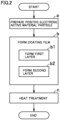
- Fig. 2 is a schematic flowchart illustrating a method of producing the composite particle according to the present embodiment.
- the method of producing the composite particle according to the present embodiment may be simply called “the present production method”.
- the present production method includes "(a) preparing a positive electrode active material particle” and “(b) forming a coating film”.
- the present production method may further include "(c) heat treatment” and the like, for example.
- the present production method includes preparing a positive electrode active material particle.
- the details of the positive electrode active material particle are as described above.
- the present production method includes forming a coating film on the surface of the positive electrode active material particle to produce a composite particle.
- the present production method includes "(b 1) forming a first layer” and "(b2) forming a second layer”.
- the present production method includes forming a first layer by drying a first coating liquid.
- the first coating liquid is prepared.
- the first coating liquid includes a first solute and a first solvent.
- the first solute includes a raw material of the first layer.
- the amount of the solute may be, for example, from 0.1 to 20 parts by mass, or from 1 to 15 parts by mass, or from 5 to 10 parts by mass, relative to 100 parts by mass of the solvent.
- the first solvent may include any component.
- the first solvent may include water, alcohol, and/or the like, for example.
- the first solvent may include ion-exchanged water, ethanol, and/or the like, for example.
- the first solute may include a lithium compound and a niobic acid compound, for example.
- lithium compound examples include lithium hydroxide, lithium carbonate, lithium nitrate, and the like.
- niobic acid compound examples include niobic acid [Nb 2 O 5 ⁇ 3H 2 O] and the like.
- the first coating liquid and the positive electrode active material particle may be mixed to form a first mixture.
- the first mixture may be suspension, or may be wet powder.
- the positive electrode active material particle (powder) may be dispersed in the first coating liquid to form suspension.
- the first coating liquid may be sprayed into powder to form wet powder.
- any mixing apparatus, any granulation apparatus, and/or the like may be used.
- the first mixture may be dried to form the first layer. That is, the first coating liquid adhered to the surface of the positive electrode active material particle may be dried to produce the first layer.
- any drying method may be used.
- the first coating liquid may be dried by spray drying. More specifically, the suspension is sprayed from a nozzle to form droplets.
- the droplets include the positive electrode active material particle and the first coating liquid.
- the droplets may be dried with hot air to form a first-step composite particle (an intermediate product).
- the solid content (volume fraction) of the suspension for spray drying may be from 1 to 50%, or may be from 10 to 30%, for example.
- the diameter of the nozzle may be from 0.1 to 10 mm, or may be from 0.1 to 1 mm, for example.
- the temperature of the hot air may be from 100 to 200°C, for example.
- a tumbling fluidized-bed coating apparatus may be used to form the first mixture and to dry the first coating liquid.
- the positive electrode active material particle may be calcined in an atmosphere containing carbon dioxide to form the first layer on the surface of the positive electrode active material particle.
- a compound such as LiOH is formed on the surface. This LiOH may be subjected to reaction with carbon dioxide to form Li 2 CO 3 on the surface of the active material.
- the present production method includes forming a second layer by drying the second coating liquid.
- the second coating liquid is prepared.
- the second coating liquid includes a second solute and a second solvent.
- the second solute includes a raw material of the second layer.
- the amount of the solute may be, for example, from 0.1 to 20 parts by mass, or from 1 to 10 parts by mass, or from 1 to 5 parts by mass, relative to 100 parts by mass of the solvent.
- the second solvent may include any component.
- the second solvent may include water, alcohol, and/or the like, for example.
- the second solvent may include ion-exchanged water, ethanol, and/or the like, for example.
- the second solute may include a phosphoric acid compound, for example.
- the second solute may include, for example, at least one selected from the group consisting of anhydrous phosphoric acid (P 2 O 5 ), orthophosphoric acid, pyrophosphoric acid, metaphosphoric acid [(HPO 3 ) n ], and polyphosphoric acid.
- the second solute may include, for example, at least one selected from the group consisting of metaphosphoric acid and polyphosphoric acid.
- Metaphosphoric acid and polyphosphoric acid may have a longer molecular chain than other phosphoric acid compounds. With the phosphoric acid compound having a long molecular chain, a continuous film (the second layer) is likely to be formed. With the second layer being continuous, the covering rate is expected to be enhanced, for example.
- the second solute may further include a lithium compound, for example.
- the second solute may include lithium hydroxide, lithium carbonate, lithium nitrate, and/or the like, for example.
- the second solute may include a boric acid compound, for example.
- the second solute may include, for example, at least one selected from the group consisting of orthoboric acid, metaboric acid, and tetraboric acid.
- the second coating liquid and the first-step composite particle may be mixed to form a second mixture.
- the second mixture may be dried to form the second layer. That is, the second coating liquid adhered to the surface of the first-step composite particle may be dried to produce the second layer.
- a composite particle (a second-step composite particle, a final product) may be produced.
- the composite particle corresponds to composite particle 100 in Fig. 1 .
- the second coating liquid may be dried by spray drying, similarly to the case of the first coating liquid.
- the present production method may include heat treatment of the first-step composite particle (intermediate product) and/or the composite particle (final product).
- the heat treatment allows the coating film (each layer) to be fixed.
- the heat treatment may also be called "calcination".
- any heat treatment apparatus may be used.
- the temperature of the heat treatment may be from 150 to 300°C, for example.
- the duration of the heat treatment may be from 1 to 10 hours, for example.
- the heat treatment may be carried out in the air, or the heat treatment may be carried out in an inert atmosphere, for example.
- the heat treatment may be carried out for one of the first-step composite particle and the composite particle, or the heat treatment may be carried out for both the first-step composite particle and the composite particle.
- a composite particle comprising a coating film having a double-layer structure consisting of a first layer (an inner layer) and a second layer (an outer layer) was produced. More specifically, coating treatment of the positive electrode active material particle was carried out twice.
- the first layer includes an alkaline oxide including Li and M (at least one of niobium and carbon).
- the second layer includes a phosphorus compound.
- n Li represents the molarity of Li in the coating liquid.
- n P represents the molarity of P in the coating liquid.
- NCM LiNi 1/3 Co 1/3 Mn 1/3 O 2
- 50 parts by mass of the positive electrode active material particles in powder form was dispersed in 40.3 parts by mass of the coating liquid to prepare a suspension.
- the resulting suspension was fed to a spray dryer (with the trade name of Mini Spray Dryer B-290, manufactured by BUCHI) to produce composite particles in powder form.
- the temperature of the air supplied by the spray dryer was 200°C, and the amount of the air supply was 0.45 m 3 /min.
- the composite particles were subjected to heat treatment in the air.
- the temperature of the heat treatment was 200°C.
- the duration of the heat treatment was 5 hours.
- the coating film of the composite particles of Comparative Example 1 includes Li x PO y (each of x and y is any numeral, where, for example, x is 0.5 and y is 3).
- the target thickness of the coating film is 15 nm.
- the coating film of the composite particles of Comparative Example 2 includes PO x (x is any numeral).
- the target thickness of the coating film is 15 nm.
- Composite particles of Comparative Example 3 were produced in the same manner as in Comparative Example 1 except that 50 parts by mass of the positive electrode active material particles in powder form was dispersed in 53.7 parts by mass of the coating liquid.
- the coating film of the composite particles of Comparative Example 3 includes Li x PO y (each of x and y is any numeral, where, for example, x is 0.5 and y is 3).
- the target thickness of the coating film is 20 nm.
- Composite particles of Comparative Example 4 were produced in the same manner as in Comparative Example 2 except that 50 parts by mass of the positive electrode active material particles in powder form was dispersed in 53.7 parts by mass of the coating liquid.
- the coating film of the composite particles of Comparative Example 4 includes PO x (x is any numeral).
- the target thickness of the coating film is 20 nm.
- NCA LiNi 0.8 Co 0.15 Al 0.05 O 2
- the coating film of the composite particles of Comparative Example 5 thus obtained includes a phosphoric acid compound (Li 0.5 PO 3 ).
- the target thickness of the coating film is 15 nm.
- a hydrogen peroxide solution (mass concentration, 30%) in an amount of 870.4 parts by mass was added to a vessel. Then, 1974.8 parts by mass of ion-exchanged water and 44.2 parts by mass of niobic acid [Nb 2 O 5 ⁇ 3H 2 O] were added to the vessel. Then, 87.9 parts by mass of an aqueous ammonia solution (mass concentration, 28%) was added to the vessel. The content of the vessel was sufficiently stirred to form a solution. It is conceivable that the resulting solution includes a peroxo complex of Nb. Further, 0.1 parts by mass of lithium hydroxide monohydrate (LiOH ⁇ H 2 O) was dissolved in the solution to prepare a first coating liquid.
- LiOH ⁇ H 2 O lithium hydroxide monohydrate
- NCM LiNi 1/3 Co 1/3 Mn 1/3 O 2
- 50 parts by mass of the positive electrode active material particles in powder form was dispersed in 53.7 parts by mass of the first coating liquid to prepare a suspension.
- the resulting suspension was fed to a spray dryer (with the trade name of Mini Spray Dryer B-290, manufactured by BUCHI) to produce first-step composite particles (an intermediate product) in powder form.
- the temperature of the air supplied by the spray dryer was 200°C, and the amount of the air supply was 0.45 m 3 /min.
- the first-step composite particles in powder form in an amount of 50 parts by mass were dispersed in 53.7 parts by mass of the second coating liquid to prepare a suspension.
- the resulting suspension was fed to a spray dryer (with the trade name of Mini Spray Dryer B-290, manufactured by BUCHI) to produce composite particles (a final product) in powder form.
- the temperature of the air supplied by the spray dryer was 200°C, and the amount of the air supply was 0.45 m 3 /min.
- the composite particles were subjected to heat treatment in the air.
- the temperature of the heat treatment was 200°C.
- the duration of the heat treatment was 5 hours.
- the coating film of the composite particles of Example 1 is composed of a first layer including LiNbO 3 (an inner layer) and a second layer including Li x PO y (an outer layer) (each of x and y is any numeral, where, for example, x is 0.5 and y is 3).
- the target thickness of the first layer is 5 nm, and the target thickness of the second layer is 10 nm.
- the coating film of the composite particles of Example 2 is composed of a first layer including LiNbO 3 and a second layer including PO x (x is any numeral).
- the target thickness of the first layer is 5 nm, and the target thickness of the second layer is 10 nm.
- a first layer 60 parts by mass of the positive electrode active material particles in powder form was dispersed in 30.5 parts by mass of the coating liquid to prepare a suspension.
- the coating film of the composite particles of Example 3 is composed of a first layer including Li 2 CO 3 and a second layer including Li x PO y (each of x and y is any numeral, where, for example, x is 0.5 and y is 3).
- the target thickness of the first layer is 5 nm, and the target thickness of the second layer is 10 nm.
- a hydrogen peroxide solution (mass concentration, 30%) in an amount of 870.4 parts by mass was added to a vessel. Then, 987.4 parts by mass of ion-exchanged water and 44.2 parts by mass of niobic acid [Nb 2 O 5 ⁇ 3H 2 O] were added to the vessel. Then, 87.9 parts by mass of an aqueous ammonia solution (mass concentration, 28%) was added to the vessel. The content of the vessel was sufficiently stirred to form a solution. It is conceivable that the resulting solution includes a peroxo complex of Nb. Further, 0.1 parts by mass of lithium hydroxide monohydrate (LiOH ⁇ H 2 O) was dissolved in the solution to prepare a first coating liquid.
- LiOH ⁇ H 2 O lithium hydroxide monohydrate
- the coating film of the composite particles of Example 4 is composed of a first layer including LiNbO 3 and a second layer including PO x (x is any numeral).
- the target thickness of the first layer is 10 nm
- the target thickness of the second layer is 10 nm.
- the coating film of the composite particles of Example 5 is composed of a first layer including Li 2 CO 3 and a second layer including Li x PO y (each of x and y is any numeral, where, for example, x is 0.5 and y is 3).
- the target thickness of the first layer is 10 nm
- the target thickness of the second layer is 10 nm.
- NCA LiNi 0.8 Co 0.15 Al 0.05 O 2
- the coating film of the composite particles of Example 6 is composed of a first layer including LiNbO 3 (an inner layer) and a second layer including Li x PO y (an outer layer) (each of x and y is any numeral, where, for example, x is 0.5 and y is 3).
- the target thickness of the first layer is 5 nm, and the target thickness of the second layer is 10 nm.
- the composite particles of Examples and Comparative Examples, the sulfide solid electrolyte, the conductive material, the binder, and the dispersion medium were mixed to prepare a positive electrode slurry.
- the amount of the conductive material to be used was 3 parts by mass relative to 100 parts by mass of the composite particles.
- the amount of the binder to be used was 3 parts by mass relative to 100 parts by mass of the composite particles.
- the positive electrode slurry was sufficiently stirred with the use of an ultrasonic homogenizer.
- the positive electrode slurry was applied to the surface of the positive electrode current collector to form a coating. The coating was dried on a hot plate at 100°C for 30 minutes. In this manner, a positive electrode raw sheet was produced. From the resulting positive electrode raw sheet, a disk-shaped positive electrode was cut out. The area
- a negative electrode and a separator were prepared. Negative electrode active material particles were graphite. Between the positive electrode, the separator, and the negative electrode, the samet type of sulfide solid electrolyte was used. Inside a tubular jig, the positive electrode, the separator, and the negative electrode were stacked in this order to form a stack. The resulting stack was pressed to form a power generation element. A terminal was connected to the power generation element to produce an all-solid-state battery.
- the positive electrode of the battery produced by using the composite particles of Example 1 was made into a thin film and a cross section of it was exposed while being cooled at -90°C, with the use of a focused ion beam (FIB) apparatus (manufactured by Hitachi High-Tech, NB5000).
- FIB focused ion beam
- the sample with an exposed cross section was transferred to a scanning transmission electron microscope (STEM) apparatus (manufactured by Hitachi High-Tech, HD-2700) with the use of an air protection holder, and elemental analysis was carried out with the use of an electron energy loss spectroscopy (EELS) apparatus (manufactured by AMETEK, GATAN Syndicium).
- STEM scanning transmission electron microscope
- EELS electron energy loss spectroscopy
- Figs. 3A-3C Results of the STEM-EELS measurement are shown in Figs. 3A-3C .
- the numeral after "Point" indicates the number of measurement point at the time of 3-nm-step measurement across the range extending from the solid electrolyte on the outside of the coating film to the positive electrode active material particles inside the coating film.
- Fig. 3A and Fig. 3B indicate that a coating film having a double-layer structure was formed as shown in Fig. 3C .
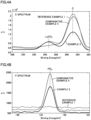
- XPS measurement was carried out for the composite particles (covered positive electrode active material) of Example 1 (coating film, Li 2 Co 3 /PO x ) and of Comparative Example 4 (coating film, PO x ).
- composite particles prepared by covering positive electrode active material particles (NCM) with a Li 2 Co 3 monolayered coating film was also subjected to XPS measurement in the same manner. Results of the measurement are shown in Fig. 4A and Fig. 4B .
- Fig. 4A and Fig. 4B show peaks of Li 2 CO 3 and PO x for the composite particles of Example 3, indicating that the coating film has a double-layer structure.
- XPS measurement was carried out for the composite particles (covered positive electrode active material) of Example 2 (coating film, LiNbO 3 /PO x ) and of Comparative Example 4 (coating film, PO x ).
- composite particles prepared by covering positive electrode active material particles (NCM) with a Nb monolayered coating film was also subjected to XPS measurement in the same manner. Results of the measurement are shown in Fig. 5A and Fig. 5B .
- Fig. 5A and Fig. 5B show peaks of LiNbO 3 and PO x for the composite particles of Example 2, indicating that the coating film has a double-layer structure.
- present embodiment and the present example are illustrative in any respect.
- present embodiment and the present example are non-restrictive.
- technical scope of the present disclosure encompasses any modifications within the meaning and the scope equivalent to the terms of the claims. For example, it is originally planned that certain configurations of the present embodiment and the present example can be optionally combined.
Landscapes
- Chemical & Material Sciences (AREA)
- Chemical Kinetics & Catalysis (AREA)
- Electrochemistry (AREA)
- General Chemical & Material Sciences (AREA)
- Composite Materials (AREA)
- Engineering & Computer Science (AREA)
- Inorganic Chemistry (AREA)
- Manufacturing & Machinery (AREA)
- General Physics & Mathematics (AREA)
- Condensed Matter Physics & Semiconductors (AREA)
- Materials Engineering (AREA)
- Physics & Mathematics (AREA)
- Crystallography & Structural Chemistry (AREA)
- Battery Electrode And Active Subsutance (AREA)
- Secondary Cells (AREA)
- Inorganic Compounds Of Heavy Metals (AREA)
Applications Claiming Priority (1)
| Application Number | Priority Date | Filing Date | Title |
|---|---|---|---|
| JP2023002380A JP7806711B2 (ja) | 2023-01-11 | 2023-01-11 | 複合粒子、正極、および全固体電池 |
Publications (2)
| Publication Number | Publication Date |
|---|---|
| EP4401166A2 true EP4401166A2 (de) | 2024-07-17 |
| EP4401166A3 EP4401166A3 (de) | 2024-08-21 |
Family
ID=89222018
Family Applications (1)
| Application Number | Title | Priority Date | Filing Date |
|---|---|---|---|
| EP23216018.4A Pending EP4401166A3 (de) | 2023-01-11 | 2023-12-12 | Verbundpartikel, positivelektrode und festkörperbatterie |
Country Status (5)
| Country | Link |
|---|---|
| US (1) | US20240243263A1 (de) |
| EP (1) | EP4401166A3 (de) |
| JP (1) | JP7806711B2 (de) |
| KR (1) | KR20240112223A (de) |
| CN (1) | CN118335984A (de) |
Citations (1)
| Publication number | Priority date | Publication date | Assignee | Title |
|---|---|---|---|---|
| JP2010135090A (ja) | 2008-12-02 | 2010-06-17 | Toyota Motor Corp | 全固体電池 |
Family Cites Families (8)
| Publication number | Priority date | Publication date | Assignee | Title |
|---|---|---|---|---|
| JP5556797B2 (ja) * | 2010-12-17 | 2014-07-23 | トヨタ自動車株式会社 | 二次電池 |
| JP5195975B2 (ja) * | 2011-07-20 | 2013-05-15 | トヨタ自動車株式会社 | 全固体電池およびその製造方法 |
| JP2017084584A (ja) * | 2015-10-27 | 2017-05-18 | トヨタ自動車株式会社 | 正極活物質の製造方法 |
| JP6323475B2 (ja) * | 2016-02-26 | 2018-05-16 | トヨタ自動車株式会社 | 複合活物質、固体電池および複合活物質の製造方法 |
| US11217785B2 (en) * | 2017-01-24 | 2022-01-04 | Samsung Electronics Co., Ltd. | Composite cathode active material and secondary battery including the same |
| JP7766283B2 (ja) * | 2020-07-22 | 2025-11-10 | パナソニックIpマネジメント株式会社 | 正極材料および電池 |
| EP4211734A1 (de) * | 2020-09-08 | 2023-07-19 | QuantumScape Battery, Inc. | Kathodenbeschichtung |
| JPWO2022244416A1 (de) * | 2021-05-20 | 2022-11-24 |
-
2023
- 2023-01-11 JP JP2023002380A patent/JP7806711B2/ja active Active
- 2023-12-12 EP EP23216018.4A patent/EP4401166A3/de active Pending
-
2024
- 2024-01-08 US US18/406,887 patent/US20240243263A1/en active Pending
- 2024-01-09 CN CN202410027573.7A patent/CN118335984A/zh active Pending
- 2024-01-10 KR KR1020240004009A patent/KR20240112223A/ko active Pending
Patent Citations (1)
| Publication number | Priority date | Publication date | Assignee | Title |
|---|---|---|---|---|
| JP2010135090A (ja) | 2008-12-02 | 2010-06-17 | Toyota Motor Corp | 全固体電池 |
Also Published As
| Publication number | Publication date |
|---|---|
| JP7806711B2 (ja) | 2026-01-27 |
| KR20240112223A (ko) | 2024-07-18 |
| CN118335984A (zh) | 2024-07-12 |
| JP2024098726A (ja) | 2024-07-24 |
| US20240243263A1 (en) | 2024-07-18 |
| EP4401166A3 (de) | 2024-08-21 |
Similar Documents
| Publication | Publication Date | Title |
|---|---|---|
| EP3242351B1 (de) | Kathodenaktivmaterial für lithium-ionen-sekundärbatterie, verfahren zur herstellung davon und lithium-ionen-sekundärbatterie damit | |
| CN114556633B (zh) | 正极活性材料、其制备方法和包含它的锂二次电池 | |
| CN108292780B (zh) | 用于固体电解质的材料 | |
| EP2950374B1 (de) | Aktivmaterial für positivelektrode/graphenkompositteilchen, positivelektrodenmaterial für lithiumionenzelle und verfahren zur herstellung von aktivmaterial für positivelektrode/graphenkompositteilchen | |
| KR101369658B1 (ko) | 비수전해질 이차 전지용 Li-Ni 복합 산화물 입자 분말 및 그의 제조 방법, 및 비수전해질 이차 전지 | |
| CN102810669B (zh) | 二次电池用正极材料和制造该材料的方法 | |
| EP4266407A1 (de) | Positives aktivmaterial für eine wiederaufladbare lithiumbatterie, verfahren zur herstellung davon und wiederaufladbare lithiumbatterie damit | |
| EP3272710A1 (de) | Nickelbasiertes aktivmaterial für lithiumsekundärbatterie, verfahren zur herstellung davon und lithiumsekundärbatterie mit positivelektrode mit dem nickelbasierten aktivmaterial | |
| EP2675002A1 (de) | Positives Aktivmaterial, Verfahren zu seiner Herstellung und Lithium-Sekundärbatterie mit dem positiven Aktivmaterial | |
| HU231626B1 (hu) | Szilárdtest elektrolittal bevont lítium-átmenetifém-oxid anyag és annak előállítási eljárásra | |
| KR20130104334A (ko) | 양극 활물질, 이의 제조방법 및 이를 이용한 이차전지 | |
| EP4230586A1 (de) | Elektrodenaktivmaterial für ein elektrochemisches element und verfahren zur herstellung davon, elektrodenmaterial für ein elektrochemisches element, elektrochemisches element und mobiler gegenstand | |
| EP3757065A1 (de) | Metallverbundhydroxidpartikel und verfahren zur herstellung davon, positivelektrodenaktivsubstanz für sekundärbatterien mit wasserfreiem elektrolyt, verfahren zur herstellung davon und sekundärbatterie mit wasserfreiem elektrolyt | |
| EP4404295A1 (de) | Beschichtetes aktivmaterial, verfahren zur herstellung eines beschichteten aktivmaterials, positivelektrodenmaterial und batterie | |
| WO2007034823A1 (ja) | 正極活物質の製造方法およびそれを用いた非水電解質電池 | |
| EP3757067A1 (de) | Metallverbundhydroxidpartikel und verfahren zur herstellung davon, positivelektrodenaktivsubstanz für sekundärbatterien mit wasserfreiem elektrolyt, verfahren zur herstellung davon und sekundärbatterie mit wasserfreiem elektrolyt | |
| EP3954657A1 (de) | Lithium-metall-komplex-oxidpulver, positivelektrodenaktivsubstanz für lithiumsekundärbatterie und verfahren zur herstellung von lithium-metall-komplex-oxidpulver | |
| EP3954661A1 (de) | Lithium-metall-verbundoxidpulver und positivelektrodenaktivmaterial für lithiumsekundärbatterie | |
| US20230216040A1 (en) | Nanopowder Coatings That Enhance Lithium Battery Component Performance | |
| CN115443555A (zh) | 正极材料和电池 | |
| EP3971141A1 (de) | Positivelektrodenaktivsubstanz für eine sekundärbatterie mit wasserfreiem elektrolyt und positivelektrode für sekundärbatterie mit wasserfreiem elektrolyt | |
| CN103137969A (zh) | 二次电池用阴极材料及其制造方法 | |
| WO2013035632A1 (ja) | リチウムイオン二次電池用正極材料、リチウムイオン二次電池用正極部材、リチウムイオン二次電池、及びリチウムイオン二次電池用正極材料の製造方法 | |
| US10230093B2 (en) | Method for manufacturing storage battery electrode | |
| EP3757066A1 (de) | Metallverbundhydroxid und verfahren zur herstellung davon, positivelektrodenaktivsubstanz für eine sekundärbatterie mit wasserfreiem elektrolyt und verfahren zur herstellung davon und sekundärbatterie mit wasserfreiem elektrolyt |
Legal Events
| Date | Code | Title | Description |
|---|---|---|---|
| PUAI | Public reference made under article 153(3) epc to a published international application that has entered the european phase |
Free format text: ORIGINAL CODE: 0009012 |
|
| STAA | Information on the status of an ep patent application or granted ep patent |
Free format text: STATUS: REQUEST FOR EXAMINATION WAS MADE |
|
| 17P | Request for examination filed |
Effective date: 20231229 |
|
| AK | Designated contracting states |
Kind code of ref document: A2 Designated state(s): AL AT BE BG CH CY CZ DE DK EE ES FI FR GB GR HR HU IE IS IT LI LT LU LV MC ME MK MT NL NO PL PT RO RS SE SI SK SM TR |
|
| PUAL | Search report despatched |
Free format text: ORIGINAL CODE: 0009013 |
|
| AK | Designated contracting states |
Kind code of ref document: A3 Designated state(s): AL AT BE BG CH CY CZ DE DK EE ES FI FR GB GR HR HU IE IS IT LI LT LU LV MC ME MK MT NL NO PL PT RO RS SE SI SK SM TR |
|
| RIC1 | Information provided on ipc code assigned before grant |
Ipc: H01M 10/0562 20100101ALI20240715BHEP Ipc: H01M 4/36 20060101AFI20240715BHEP |